文档文本内容
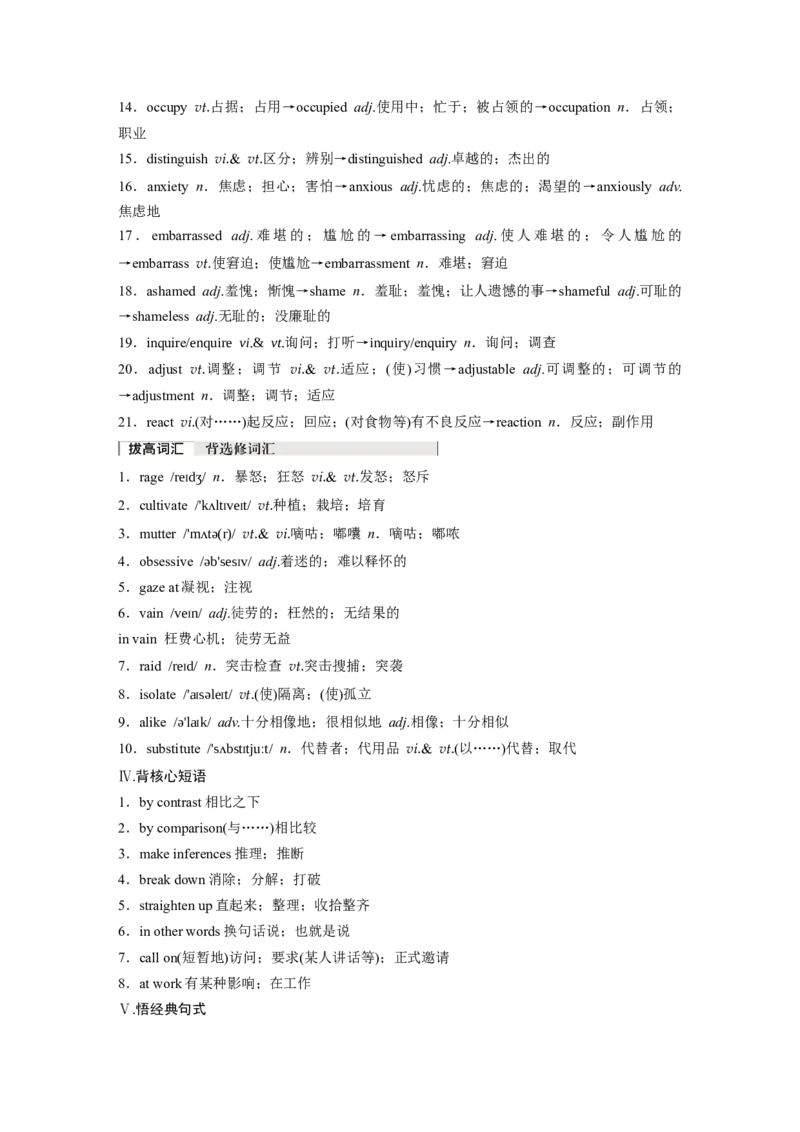
Ⅰ.阅读单词——会意
1.demonstrate vt.表现;表达;说明;证明
2.gesture n.手势;姿势;姿态
3.identical adj.相同的
4.interpret vt.把……理解(解释)为 vi.& vt.口译
5.waist n.腰;腰部
6.fake adj.假装的;假的;冒充的
7.trial n.& v.审讯;审判;试验;试用
8.nonverbal adj.不涉及言语的;非言语的
9.reveal vt.揭示;显示;露出
10.tick vt.给(试卷、问题等)打钩号 vi.(钟表)发出嘀嗒声 n.钩号
11.chin n.下巴
12.distract vt.分散(注意力);使分心
13.ultimately adv.最终;最后
14.intervene vi.干预;介入
15.component n.组成部分;零件
16.tone n.语气;腔调;口吻
Ⅱ.重点单词——记形
1.appropriate adj.合适的;恰当的
2.witness vt.当场看到;目击;见证 n.目击者;证人
3.cheek n.面颊;脸颊
4.bow vi.鞠躬;点头 vt.低(头) n.弓;蝴蝶结
5.barrier n.隔阂;障碍
6.incident n.发生的事情;严重事件;冲突
7.twin adj.双胞胎之一的;孪生之一的 n.孪生之一;双胞胎之一
8.internal adj.内部的;里面的9.slump vi.垂头弯腰地走(或坐等)
10.pose n.故作姿态;(为画像、拍照等摆的)姿势 vi.摆好姿势 vt.造成(威胁、问题等)
11.bend vt.& vi.(bent,bent)(使)弯曲;倾斜;偏向
12.clarify vt.使更清晰易懂;阐明;澄清
13.lower vt.把……放低;降低;减少 adj.下面的;下方的;较小的
14.imply vt.意味着;暗示
15.stare vi.盯着看;凝视 n.凝视
16.ceiling n.天花板;上限
17.perceive vt.察觉;看待;理解
18.chest n.胸部;胸膛
19.merely adv.只是;仅仅;只不过
20.bother vi.& vt.费心;麻烦;因……操心 n.麻烦;不便
21.weep vi.& vt.(wept,wept)哭泣;流泪
22.conflict n.矛盾;冲突 vi.冲突;抵触
Ⅲ.拓展单词——悉变
1.interaction n.交流;相互影响→interact vi.相互交流;相互影响
2.vary vi.(根据情况)变化;改变→various adj.不同的;各种各样的→variety n.多样性;
变化;种类
3.approve vi.赞成;同意 vt.批准;通过→approval n.赞成;同意;批准→approving adj.
赞许的;赞成的
4.employ vt.使用;应用;雇用→employee n.雇员;受雇者→employer n.雇主;雇用者
→employment n.雇用;聘用
5.differ vi.相异;不同于→different adj.不同的;有差异的→difference n.差别;差异
6.favour(NAmE -vor) vt.较喜欢;选择;有利于 n.帮助;恩惠;赞同→favourable adj.赞
成的;有利的→favourite adj.最喜欢的
7.anger n.愤怒;怒气 vt.使生气;激怒→angry adj.生气的;愤怒的→angrily adv.生气地;
愤怒地
8.reliable adj.可靠的;可信赖的→rely vi.依赖;信赖
9.slight adj.轻微的;略微的;细小的→slightly adv.略微;稍微
10.assess vt.评估;评价→assessment n.评价;评定
11.educator n.教师;教育工作者;教育家→educate vt.教育→educated adj.受过教育的;
有教养的→education n.教育
12.tendency n.趋势;倾向→tend vt.& vi.照料;护理 vi.倾向于;有……的趋势
13.barely adv.几乎不;勉强才能;刚刚→bare adj.赤裸的;光秃秃的;空的14.occupy vt.占据;占用→occupied adj.使用中;忙于;被占领的→occupation n.占领;
职业
15.distinguish vi.& vt.区分;辨别→distinguished adj.卓越的;杰出的
16.anxiety n.焦虑;担心;害怕→anxious adj.忧虑的;焦虑的;渴望的→anxiously adv.
焦虑地
17.embarrassed adj.难堪的;尴尬的→embarrassing adj.使人难堪的;令人尴尬的
→embarrass vt.使窘迫;使尴尬→embarrassment n.难堪;窘迫
18.ashamed adj.羞愧;惭愧→shame n.羞耻;羞愧;让人遗憾的事→shameful adj.可耻的
→shameless adj.无耻的;没廉耻的
19.inquire/enquire vi.& vt.询问;打听→inquiry/enquiry n.询问;调查
20.adjust vt.调整;调节 vi.& vt.适应;(使)习惯→adjustable adj.可调整的;可调节的
→adjustment n.调整;调节;适应
21.react vi.(对……)起反应;回应;(对食物等)有不良反应→reaction n.反应;副作用
1.rage /reIdʒ/ n.暴怒;狂怒 vi.& vt.发怒;怒斥
2.cultivate /'kʌltIveIt/ vt.种植;栽培;培育
3.mutter /'mʌtə(r)/ vt.& vi.嘀咕;嘟囔 n.嘀咕;嘟哝
4.obsessive /əb'sesIv/ adj.着迷的;难以释怀的
5.gaze at凝视;注视
6.vain /veIn/ adj.徒劳的;枉然的;无结果的
in vain 枉费心机;徒劳无益
7.raid /reId/ n.突击检查 vt.突击搜捕;突袭
8.isolate /'aIsəleIt/ vt.(使)隔离;(使)孤立
9.alike /ə'laIk/ adv.十分相像地;很相似地 adj.相像;十分相似
10.substitute /'sʌbstItjuːt/ n.代替者;代用品 vi.& vt.(以……)代替;取代
Ⅳ.背核心短语
1.by contrast相比之下
2.by comparison(与……)相比较
3.make inferences推理;推断
4.break down消除;分解;打破
5.straighten up直起来;整理;收拾整齐
6.in other words换句话说;也就是说
7.call on(短暂地)访问;要求(某人讲话等);正式邀请
8.at work有某种影响;在工作
Ⅴ.悟经典句式1.For example,making eye contact—looking into someone’s eyes—in some countries is a
way to display interest.(a way to do...)例如,在一些国家,眼神交流(即直视某人的眼睛)是表
示兴趣的一种方式。
2.However,you should avoid making this gesture in Brazil and Germany ,as it is not
considered polite.(as引导原因状语从句)
然而,在巴西和德国,你应该避免做出这一手势,因为这是一个被视为不礼貌的手势。
3.Of course,not everyone who looks up is paying attention in class.(部分否定)
当然,不是所有抬着头的学生都是在认真听课。
4.While it is easy to perceive when students are interested,bored,or distracted,it is
sometimes much harder to distinguish when students are troubled.(while引导让步状语从句)尽管
学生们何时(对讲课)感兴趣、何时感到无聊或精力不集中是容易察觉的,但要发现学生何时
有困扰有时会难得多。
5.Their body language lets me know when to adjust class activities,when to intervene,and
when to talk to students individually,so they can all get the most out of school.(疑问词+不定
式)他们的肢体语言让我知道该何时调整课堂活动、何时干预、何时与学生单独谈话,从而
让他们在校收获最大。
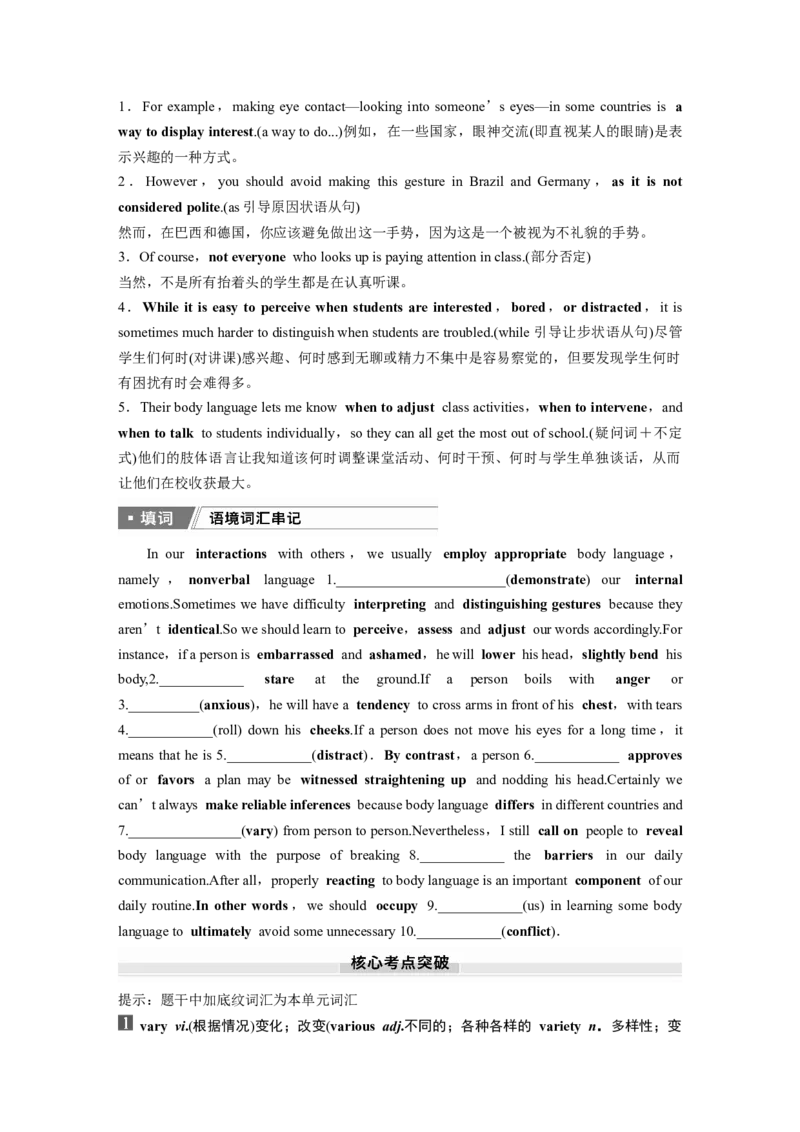
In our interactions with others ,we usually employ appropriate body language ,
namely , nonverbal language 1.________________________(demonstrate) our internal
emotions.Sometimes we have difficulty interpreting and distinguishing gestures because they
aren’t identical.So we should learn to perceive,assess and adjust our words accordingly.For
instance,if a person is embarrassed and ashamed,he will lower his head,slightly bend his
body,2.____________ stare at the ground.If a person boils with anger or
3.__________(anxious),he will have a tendency to cross arms in front of his chest,with tears
4.____________(roll) down his cheeks.If a person does not move his eyes for a long time,it
means that he is 5.____________(distract).By contrast,a person 6.____________ approves
of or favors a plan may be witnessed straightening up and nodding his head.Certainly we
can’t always make reliable inferences because body language differs in different countries and
7.________________(vary) from person to person.Nevertheless,I still call on people to reveal
body language with the purpose of breaking 8.____________ the barriers in our daily
communication.After all,properly reacting to body language is an important component of our
daily routine.In other words,we should occupy 9.____________(us) in learning some body
language to ultimately avoid some unnecessary 10.____________(conflict).
提示:题干中加底纹词汇为本单元词汇
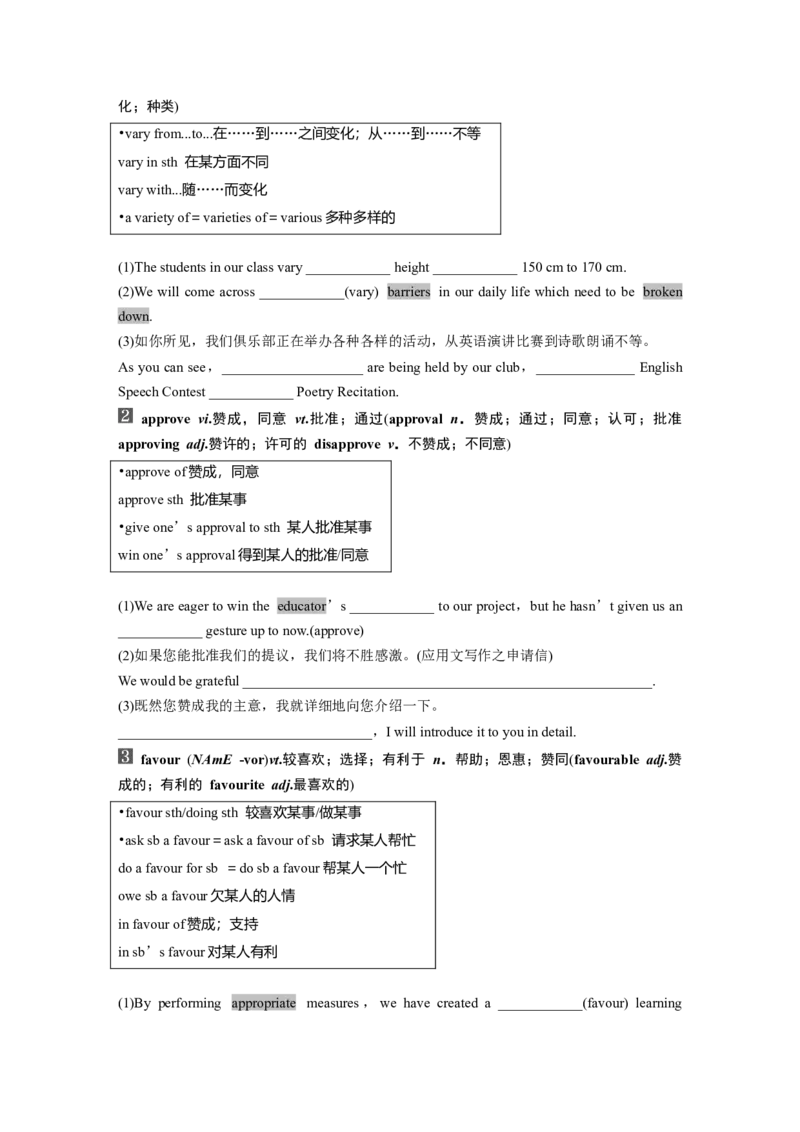
vary vi.(根据情况)变化;改变(various adj.不同的;各种各样的 variety n.多样性;变化;种类)
•vary from...to...在……到……之间变化;从……到……不等
vary in sth 在某方面不同
vary with...随……而变化
•a variety of=varieties of=various多种多样的
(1)The students in our class vary ____________ height ____________ 150 cm to 170 cm.
(2)We will come across ____________(vary) barriers in our daily life which need to be broken
down.
(3)如你所见,我们俱乐部正在举办各种各样的活动,从英语演讲比赛到诗歌朗诵不等。
As you can see,____________________ are being held by our club,______________ English
Speech Contest ____________ Poetry Recitation.
approve vi.赞成,同意 vt.批准;通过(approval n.赞成;通过;同意;认可;批准
approving adj.赞许的;许可的 disapprove v.不赞成;不同意)
•approve of赞成,同意
approve sth 批准某事
•give one’s approval to sth 某人批准某事
win one’s approval得到某人的批准/同意
(1)We are eager to win the educator’s ____________ to our project,but he hasn’t given us an
____________ gesture up to now.(approve)
(2)如果您能批准我们的提议,我们将不胜感激。(应用文写作之申请信)
We would be grateful __________________________________________________________.
(3)既然您赞成我的主意,我就详细地向您介绍一下。
____________________________________,I will introduce it to you in detail.
favour (NAmE -vor)vt.较喜欢;选择;有利于 n.帮助;恩惠;赞同(favourable adj.赞
成的;有利的 favourite adj.最喜欢的)
•favour sth/doing sth 较喜欢某事/做某事
•ask sb a favour=ask a favour of sb 请求某人帮忙
do a favour for sb =do sb a favour帮某人一个忙
owe sb a favour欠某人的人情
in favour of赞成;支持
in sb’s favour对某人有利
(1)By performing appropriate measures,we have created a ____________(favour) learningenvironment in the self-study room.(2022·浙江6月,应用文写作)
(2)当他知道大多数人都不赞成他的意见时,他勃然大怒。
He boiled with anger when knowing that most of them ____________________________.
(3)我写信是想告诉你我暑假期间去山里捡垃圾的计划,我想知道你是否能帮我一个忙。
I’m writing to tell you about my plan to pick up garbage in the mountains during the summer
vacation and I wonder if _______________________________________________________.
(4)请记住,机会和成功往往青睐那些有准备的人。(读后续写之主旨升华)
Keep in mind that _____________________________________________________.
occupy vt.占用;占领;占据(occupied adj.使用中;忙于;被占领的 occupation n.占
领;职业)
•occupy sb/oneself with sth/in doing sth 忙于做某事;专心做某事
•be occupied with sth/in doing sth 忙于做某事
(1)Ultimately , you must state your full name , age and ____________(occupy) in your
application form.
(2)Because they were ____________(occupy) in making and selling popcorn,they spared no time
to play around.(2020·新课标Ⅰ,读后续写)
→________________________________________________ , they spared no time to play
around.(用现在分词短语作状语改写)
→____________________________________,they spared no time to play around.(用过去分词
短语作状语改写)
adjust vt.调整;调节 vi.& vt.适应;(使)习惯(adjustment n.调整;适应 adjustable
adj.可调节的;可调整的)
•adjust (oneself) to (doing)...适应……;习惯……
adjust...to...调整……以适应……
•make an adjustment/adjustments作出调整
(1)To our amazement , the school chairs are ____________ , so children can make some
____________ according to their height.(adjust)
(2)我知道你在适应新的学校生活方面有些困难,所以我写信给你一些建议,希望能对你有
帮助。(应用文写作之建议信)
________________________________________________________________,I’m writing to
give you some tips,which I hope will be of help to you.
(3)由于我没有及时调整相关的信息,给您带来极大的不便,我写信向您道歉。(应用文写作
之道歉信)
I am writing to apologize to you for ________________________________________,causinggreat inconvenience to you.
break down分解;(机器等)损坏,出故障;(谈判)失败;(身体)垮掉;消除;打破
break away (from)离开;脱离
break in(不及物)插嘴;闯入
break into(及物)闯入;突然……起来
break out爆发
break up分散;拆散;驱散;分手
break through突破;克服
用break短语的正确形式填空
(1)What angered me was that my car ________________ on the way to my company.
(2)We arrived home early only to find a thief trying to ____________.
(3)It is said that two hundred houses were burned down in the fire which ____________ a few
years ago.
(4)When the father saw his lost child safe,he ____________ tears and his anxiety finally
disappeared.
(5)It was quite some time before they managed to ________________ the enemy’s barrier.
(6)Trapped in deep conflict,their partnership finally ____________ and he ________________
from the company,setting up his own company.
in other words换句话说;也就是说
in a word总之;简言之
keep one’s word遵守诺言
break one’s word失信;不守诺言
have a word with...与……谈一谈
have words with sb和某人吵架
word came that...有消息传来说……
有消息说因为你违背诺言你的搭档和你吵架了。为了消除你们之间的隔阂,为何不和你的搭
档谈一谈,并真诚表达你真诚的歉意呢?另外,从现在起遵守诺言可以避免进一步的冲突。
总之,竭尽全力去修复你们的关系,因为友谊非常重要。(应用文写作之建议信)
(1)______________________ your partner (2)______________________ you because you
(3)________________________________ . To break down your barriers , why not
(4)______________________ your partner and express your heartfelt apology sincerely?
Besides,(5)________________ from now on can avoid further conflicts.(6)____________,do
whatever you can to restore your relationship,for friendship is really important.
call on(短暂地)访问;要求(某人讲话等);正式邀请;呼吁;号召call up给……打电话;(使)想起
call off=cancel取消
call for(公开)要求;需要
call in打电话来;召来,叫来;收回
call at拜访(地点);(火车等)停留
用call短语的正确形式填空
(1)The twin brothers ____________ their grandpa on a weekly basis.
(2)Can you still ____________ the days when we were together in Brazil?
(3)The conference was ultimately ______________ because of the unexpected incident.
(4)The activity is aimed at ____________ students to be occupied with their school work.
(5)There are violent conflicts and barriers between them,which ____________ immediate
solutions.
部分否定 Of course,not everyone who looks up is paying attention in class.当然,不
是所有抬着头的学生都是在认真听课。
•部分否定:当all,both,each,every,everybody,everyone,everything,always,whole,
entirely等具有总括意义的代词、形容词和副词与否定副词not连用时,便构成了部分否定结
构,意为“不是……都;并非……都”。
•全部否定:当neither,no one,no,none,never,nothing,no more,no longer,no way,
not...any等表示否定意义的词(组)与肯定式谓语一起使用时,构成全部否定结构。
(1)我同意你说的大部分内容,但并非同意你讲的一切。
I agree with most of what you said,but ____________________________________ that you said.
(2)汤姆让杰克和彼得陪他去野餐,但是他们两个都不想去,因为他们有工作要做。
Tom asks Jack and Peter to go on a picnic with him,but ________________________,because
they have work to do.
(3)通过以上图表,可以看出并非所有学生都采用同一种方法学英语。
(2022·全国乙,书面表达)
According to the above graph,it can be seen that _____________________________________
___________________________________.
提示:题干中加底纹词汇为上一单元词汇
Ⅰ.一词多义练/熟词生义练——清除阅读障碍
1.bother(1)Sorry to bother you,but the manager is on the line.________
(2)My older brother couldn’t be bothered to play with me.(2020·浙江7月)________
(3)Don’t be afraid or embarrassed to discuss something that is bothering you.
(2020·新课标Ⅱ)________
2.employ
(1)Every day,we students are employed in doing endless schoolwork._________
(2)He criticized the extreme methods employed by the country’s government.________
(3)The boss decided to employ Tom as her secretary because of his outstanding
performance.________
3.break down
A.谈判失败 B.消除 C.机器等出故障 D.身体垮掉 E.
分解
(1)Much to my annoyance,my car broke down on the way to work.________
(2)The peace talks broke down with no agreement reached.________
(3)In other words,your health will break down if you work too hard.________
(4)You should break down your tasks in an appropriate way so that you can finish them on
time.________
(5)The “HAPPY TO CHAT” benches help break down the invisible social barrier that keeps
people from saying hello.(2020·天津)_________
4.快速阅读下列句子并猜测句中加黑词汇的汉语意思
(1)Then we realized that the spray had only angered him even more.
(2020·浙江7月,读后续写)____________
(2)His anxiety to win the vote was obvious.____________
(3)Of the two ways of sharing books,the latter wins my favour.____________
(4)He tried to force me to bend to his will,but in vain.____________
(5)Language barriers will definitely pose potential problems in further English
learning.____________
Ⅱ.核心知识强化练——巩固语言知识
1.So ____________(rely) was the journalist that we all agreed to adopt his idea and set out
immediately.
2.By ____________(compare),I prefer the column telling about splendid stories of our
national heroes.
3.With so many different themes of poetry __________(choose) from,students may want to
write poems of their own.
4.The government calls on us ____________(protect) rare animals from being extinct.5.He didn’t bother ____________(answer) my question,which didn’t appeal to him.
6.____________(occupy) in his research,he didn’t have time to take part in amusing
entertainments.
7.She was covered in spider-webs and was __________(bare) able to move her wings.
(2023·浙江1月)
8.She was ____________(employ) in doing the rewarding job every day.
9.The two sides are trying to sit down and find a way ____________(tackle) the conflict in peace.
10.The expert displays the ability to distinguish paintings of high quality ____________ poor
ones.
假定你是李华,你们学校举行了关于“Body language”的讨论,请你写一篇英语报道
向校报投稿。内容包括:
1.学生的观点;
2.肢体语言的文化差异;
3.你的建议。
完成句子
1.上周进行了一场关于肢体语言在跨文化交际中的影响的激烈讨论。(witness)
____________________________________________________________________________
____________________________________________________________________________
____________________________________________________________________________
2.大多数学生赞成肢体语言因人而异的观点。(in favor of;vary from...to...)
____________________________________________________________________________
____________________________________________________________________________
____________________________________________________________________________
3.在某些国家点头意味着不同意;相比之下,在其他一些国家,则意味着认可。(by
contrast;approval)
____________________________________________________________________________
____________________________________________________________________________
____________________________________________________________________________
4.但并不是所有的肢体语言都有相反的含义,从而在交流中造成理解问题。(部分否定;
pose)
____________________________________________________________________________
________________________________________________________________________________________________________________________________________________________
5.微笑是一种通用的肢体语言,可以打破多种语言障碍。(break down)
____________________________________________________________________________
____________________________________________________________________________
____________________________________________________________________________
6.为了促进跨文化交流,我们应该适当地使用肢体语言,并在必要时作出一些必要的调整。
(adjust;状语从句的省略)
____________________________________________________________________________
____________________________________________________________________________
____________________________________________________________________________
组句成篇
把以上句子用适当的过渡词语和过渡句组成一篇80词左右的短文。
____________________________________________________________________________
____________________________________________________________________________
____________________________________________________________________________
____________________________________________________________________________
____________________________________________________________________________
____________________________________________________________________________
教材语料整合
[情感描写] break down;anger→angry;reliable;anxiety→anxious;
embarrassed→embarrass→embarrassment;ashamed
亮词
[动作描写] approve;witness;interpret;favor;bow;straighten up;pose;
bend;lower;stare;distinguish;call on;weep;adjust
1.There are also differences in how we touch each other,how close we stand to
someone we are talking to,and how we act when we meet or part.(排比修辞)
2.It is as though they are asleep with their eyes open.(比喻修辞)
3.Students who are angry,afraid,or experiencing anxiety may have their arms
crossed in front of their chests and their legs closed or crossed,like they are
美句 guarding their bodies.(动作描写+比喻修辞)
4.Students who are sad or worried will nearly always wear a frown.(动作描写)
5.They may also hide their faces in their hands like they are embarrassed or
ashamed.(动作描写)
6.Their body language lets me know when to adjust class activities,when to
intervene,and when to talk to students individually.(排比修辞)拓展语料积累 动作细节描写:头部动作
nod v.点头;shake v.摇头;scratch v.挠(头);pat v.轻拍;turn/twist v.
单词
转;bow v.低(头);鞠躬
hang/drop/lower/bend one’s head低头;raise one’s head 抬头;throw one’s head
back头往后仰;shake one’s head摇头;put/hold/bury one’s head in one’s hands双
词块
手抱头;rest one’s head on/against把头靠在……上面;head for/towards朝……走
去
1.Feeling ashamed,the boy lowered his head awkwardly.男孩感到羞愧,尴尬地
低下了头。
2.They nodded their heads in agreement.他们点头同意。
3.Feeling embarrassed,he scratched his head,not knowing what to do next.他感
句型
到尴尬,挠了挠头,不知道下一步该怎么办。
4.He stuck his head out around the door to see what was happening outside.他把头
伸到门外看看外面发生了什么事。
5.He twisted his head slightly and looked at her.他微微转过头,抬眼看着她。
语料运用 助人
I was walking in the street when a foreigner stopped us,①______________________(分词
作状语).Not knowing what he was saying,I ②___________________________________ and
③____________________________________.Fortunately , a shop owner
④____________________________________________ , I immediately
⑤__________________________.The shop owner followed me to the foreigner and saw him
sitting on the roadside,⑥_______________________________________________.The shop
owner ⑦________________________ he must be in need of medical help now and we’d better
send him to the nearest hospital.Hearing that , the foreigner
⑧____________________________________ and sighed with relief.
我正走在街上,这时一个外国人拦住了我们,焦急地说着些什么。我不知道他在说什么,
尴尬地挠了挠头,扭过头来寻求帮助。幸运的是,一位店主正把头伸出店外,我立即走向他
求助。店主跟我走到那个外国人面前,看见他坐在路边,把头靠在他的旅行包上。店主解释
说他现在一定需要医疗救助,我们最好把他送到最近的医院。外国人听了,虚弱地点了点头,
松了一口气。