英语答案(H3)
第1页(共7 页)
炎德·英才大联考雅礼中学2027 届高三月考试卷(三)
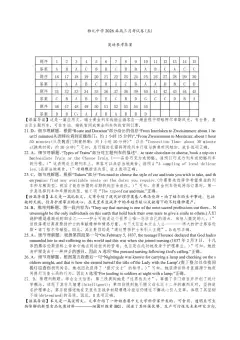
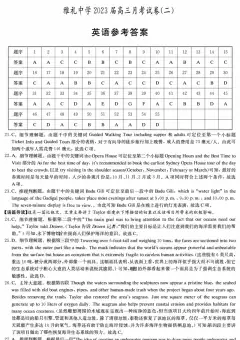
英语参考答案
题序
1
2
3
4
5
6
7
8
9
10
11
12
13
14
15
答案
C
A
C
A
B
C
A
B
B
A
C
B
A
B
C
题序
16
17
18
19
20
21
22
23
24
25
26
27
28
29
30
答案
B
C
A
B
A
A
B
C
A
C
B
B
C
A
D
题序
31
32
33
34
35
36
37
38
39
40
41
42
43
44
45
答案
B
D
B
C
A
D
C
A
G
E
D
A
C
B
B
题序
46
47
48
49
50
51
52
53
54
55
答案
D
A
C
A
D
B
C
D
A
B
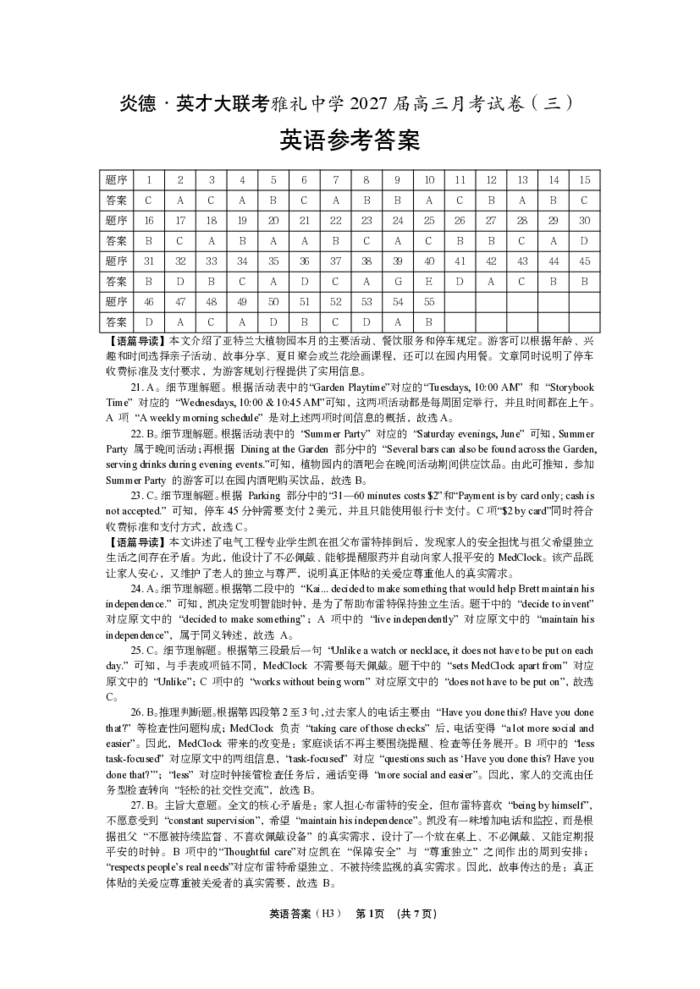
【语篇导读】本文介绍了亚特兰大植物园本月的主要活动、餐饮服务和停车规定。游客可以根据年龄、兴
趣和时间选择亲子活动、故事分享、夏日聚会或兰花绘画课程,还可以在园内用餐。文章同时说明了停车
收费标准及支付要求,为游客规划行程提供了实用信息。
21. A。细节理解题。根据活动表中的“Garden Playtime”对应的“Tuesdays, 10:00 AM” 和“Storybook
Time” 对应的“Wednesdays, 10:00 & 10:45 AM”可知,这两项活动都是每周固定举行,并且时间都在上午。
A 项“A weekly morning schedule” 是对上述两项时间信息的概括,故选A。
22. B。细节理解题。根据活动表中的“Summer Party” 对应的“Saturday evenings, June” 可知,Summer
Party 属于晚间活动;再根据Dining at the Garden 部分中的“Several bars can also be found across the Garden,
serving drinks during evening events.”可知,植物园内的酒吧会在晚间活动期间供应饮品。由此可推知,参加
Summer Party 的游客可以在园内酒吧购买饮品,故选B。
23. C。细节理解题。根据Parking 部分中的“31—60 minutes costs $2”和“Payment is by card only; cash is
not accepted.” 可知,停车45 分钟需要支付2 美元,并且只能使用银行卡支付。C 项“$2 by card”同时符合
收费标准和支付方式,故选C。
【语篇导读】本文讲述了电气工程专业学生凯在祖父布雷特摔倒后,发现家人的安全担忧与祖父希望独立
生活之间存在矛盾。为此,他设计了不必佩戴、能够提醒服药并自动向家人报平安的MedClock。该产品既
让家人安心,又维护了老人的独立与尊严,说明真正体贴的关爱应尊重他人的真实需求。
24. A。细节理解题。根据第二段中的“Kai... decided to make something that would help Brett maintain his
independence.” 可知,凯决定发明智能时钟,是为了帮助布雷特保持独立生活。题干中的“decide to invent”
对应原文中的“decided to make something”;A 项中的“live independently” 对应原文中的“maintain his
independence”,属于同义转述,故选A。
25. C。细节理解题。根据第三段最后一句“Unlike a watch or necklace, it does not have to be put on each
day.” 可知,与手表或项链不同,MedClock 不需要每天佩戴。题干中的“sets MedClock apart from” 对应
原文中的“Unlike”;C 项中的“works without being worn” 对应原文中的“does not have to be put on”,故选
C。
26. B。推理判断题。根据第四段第2 至3 句,过去家人的电话主要由“Have you done this? Have you done
that?” 等检查性问题构成;MedClock 负责“taking care of those checks” 后,电话变得“a lot more social and
easier”。因此,MedClock 带来的改变是:家庭谈话不再主要围绕提醒、检查等任务展开。B 项中的“less
task-focused” 对应原文中的两组信息,“task-focused” 对应“questions such as ‘Have you done this? Have you
done that?’”;“less” 对应时钟接管检查任务后,通话变得“more social and easier”。因此,家人的交流由任
务型检查转向“轻松的社交性交流”,故选B。
27. B。主旨大意题。全文的核心矛盾是:家人担心布雷特的安全,但布雷特喜欢“being by himself”,
不愿意受到“constant supervision”,希望“maintain his independence”。凯没有一味增加电话和监控,而是根
据祖父“不愿被持续监督、不喜欢佩戴设备” 的真实需求,设计了一个放在桌上、不必佩戴、又能定期报
平安的时钟。B 项中的“Thoughtful care”对应凯在“保障安全” 与“尊重独立” 之间作出的周到安排;
“respects people’s real needs”对应布雷特希望独立、不被持续监视的真实需求。因此,故事传达的是:真正
体贴的关爱应尊重被关爱者的真实需要,故选B。
英语答案(H3)
第2页(共7 页)
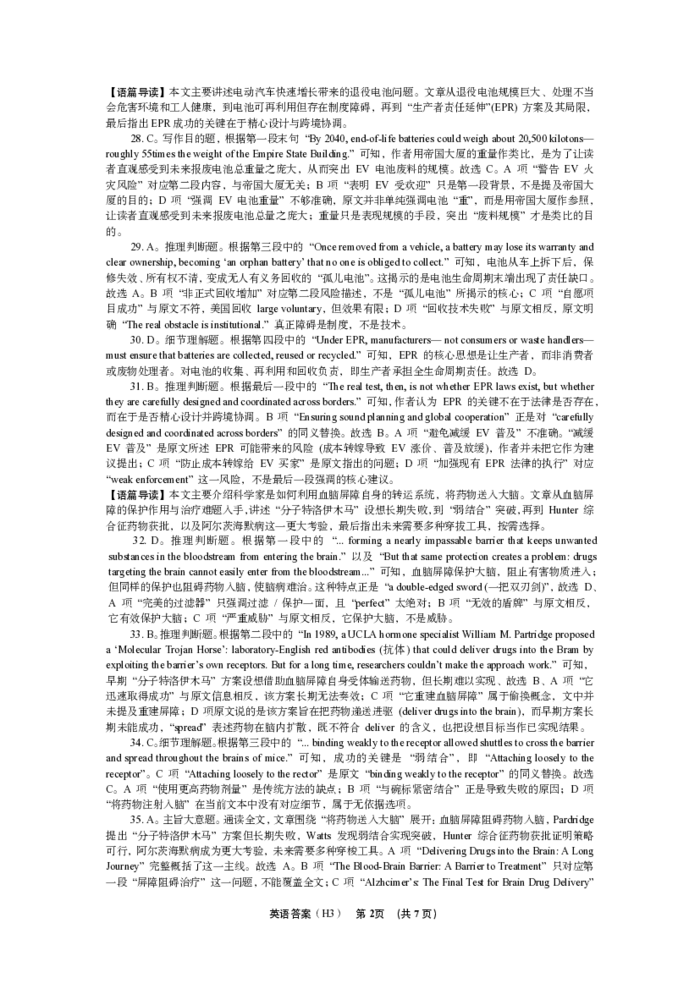
【语篇导读】本文主要讲述电动汽车快速增长带来的退役电池问题。文章从退役电池规模巨大、处理不当
会危害环境和工人健康,到电池可再利用但存在制度障碍,再到“生产者责任延伸”(EPR) 方案及其局限,
最后指出EPR 成功的关键在于精心设计与跨境协调。
30. D。细节理解题。根据第四段中的“Under EPR, manufacturers— not consumers or waste handlers—
must ensure that batteries are collected, reused or recycled.” 可知,EPR 的核心思想是让生产者,而非消费者
或废物处理者。对电池的收集、再利用和回收负责,即生产者承担全生命周期责任。故选D
28. C。写作目的题,根据第一段末句“By 2040, end-of-life batteries could weigh about 20,500 kilotons—
roughly 55times the weight of the Empire State Building.” 可知,作者用帝国大厦的重量作类比,是为了让读
者直观感受到未来报废电池总重量之庞大,从而突出EV 电池废料的规模。故选C。A 项“警告EV 火
灾风险” 对应第二段内容,与帝国大厦无关;B 项“表明EV 受欢迎” 只是第一段背景,不是提及帝国大
厦的目的;D 项“强调EV 电池重量” 不够准确,原文并非单纯强调电池“重”,而是用帝国大厦作参照,
让读者直观感受到未来报废电池总量之庞大;重量只是表现规模的手段,突出“废料规模” 才是类比的目
的。
29. A。推理判断题。根据第三段中的“Once removed from a vehicle, a battery may lose its warranty and
clear ownership, becoming ‘an orphan battery’ that no one is obliged to collect.” 可知,电池从车上拆下后,保
修失效、所有权不清,变成无人有义务回收的“孤儿电池”。这揭示的是电池生命周期末端出现了责任缺口。
故选A。B 项“非正式回收增加” 对应第二段风险描述,不是“孤儿电池” 所揭示的核心;C 项“自愿项
目成功” 与原文不符,美国回收large voluntary,但效果有限;D 项“回收技术失败” 与原文相反,原文明
确“The real obstacle is institutional.” 真正障碍是制度,不是技术。
。
31. B。推理判断题。根据最后一段中的“The real test, then, is not whether EPR laws exist, but whether
they are carefully designed and coordinated across borders.” 可知,作者认为EPR 的关键不在于法律是否存在,
而在于是否精心设计并跨境协调。B 项“Ensuring sound planning and global cooperation” 正是对“carefully
designed and coordinated across borders” 的同义替换。故选B。A 项“避免减缓EV 普及” 不准确。“减缓
EV 普及” 是原文所述EPR 可能带来的风险(成本转嫁导致EV 涨价、普及放缓),作者并未把它作为建
议提出;C 项“防止成本转嫁给EV 买家” 是原文指出的问题;D 项“加强现有EPR 法律的执行” 对应
“weak enforcement” 这一风险,不是最后一段强调的核心建议。
【语篇导读】本文主要介绍科学家是如何利用血脑屏障自身的转运系统,将药物送入大脑。文章从血脑屏
障的保护作用与治疗难题入手,讲述“分子特洛伊木马” 设想长期失败,到“弱结合” 突破,再到Hunter 综
合征药物获批,以及阿尔茨海默病这一更大考验,最后指出未来需要多种穿拔工具,按需选择。
33. B。推理判断题。根据第二段中的“In 1989, a UCLA hormone specialist William M. Partridge proposed
a ‘Molecular Trojan Horse’: laboratory-English red antibodies (抗体) that could deliver drugs into the Bram by
exploiting the barrier’s own receptors. But for a long time, researchers couldn’t make the approach work.” 可知,
早期“分子特洛伊木马” 方案设想借助血脑屏障自身受体输送药物,但长期难以实现、故选B、A 项“它
迅速取得成功” 与原文信息相反,该方案长期无法奏效;C 项“它重建血脑屏障” 属于偷换概念,文中并
未提及重建屏障;D 项原文说的是该方案旨在把药物递送进驱(deliver drugs into the brain),而早期方案长
期未能成功,“spread” 表述药物在脑内扩散,既不符合deliver 的含义,也把设想目标当作已实现结果
32. D。推理判断题。根据第一段中的“... forming a nearly impassable barrier that keeps unwanted
substances in the bloodstream from entering the brain.” 以及“But that same protection creates a problem: drugs
targeting the brain cannot easily enter from the bloodstream...” 可知,血脑屏障保护大脑,阻止有害物质进入;
但同样的保护也阻碍药物入脑,使脑病难治。这种特点正是“a double-edged sword (一把双刃剑)”,故选D、
A 项“完美的过滤器” 只强调过滤/ 保护一面,且“perfect” 太绝对;B 项“无效的盾牌” 与原文相反,
它有效保护大脑;C 项“严重威胁” 与原文相反,它保护大脑,不是威胁。
。
34. C。细节理解题。根据第三段中的“... binding weakly to the receptor allowed shuttles to cross the barrier
and spread throughout the brains of mice.” 可知,成功的关键是“弱结合”,即“Attaching loosely to the
receptor”。C 项“Attaching loosely to the rector” 是原文“binding weakly to the receptor” 的同义替换。故选
C。A 项“使用更高药物剂量” 是传统方法的缺点;B 项“与碗标紧密结合” 正是导致失败的原因;D 项
“将药物注射入脑” 在当前文本中没有对应细节,属于无依据选项。
35. A。主旨大意题。通读全文,文章围绕“将药物送入大脑” 展开:血脑屏障阻碍药物入脑,Pardridge
提出“分子特洛伊木马” 方案但长期失败,Watts 发现弱结合实现突破,Hunter 综合征药物获批证明策略
可行,阿尔茨海默病成为更大考验,未来需要多种穿梭工具。A 项“Delivering Drugs into the Brain: A Long
Journey” 完整概括了这一主线。故选A。B 项“The Blood-Brain Barrier: A Barrier to Treatment” 只对应第
一段“屏障阻碍治疗” 这一问题,不能覆盖全文;C 项“Alzhcimer’s: The Final Test for Brain Drug Delivery”
英语答案(H3)
第3页(共7 页)
只对应后半部分阿尔茨海默病的考验,以偏概全;D 项“Hunter Syndromic: A Breakthrough in Brain Medicine”
只对应第三段Hunter 综合征药物获批,以偏概全。
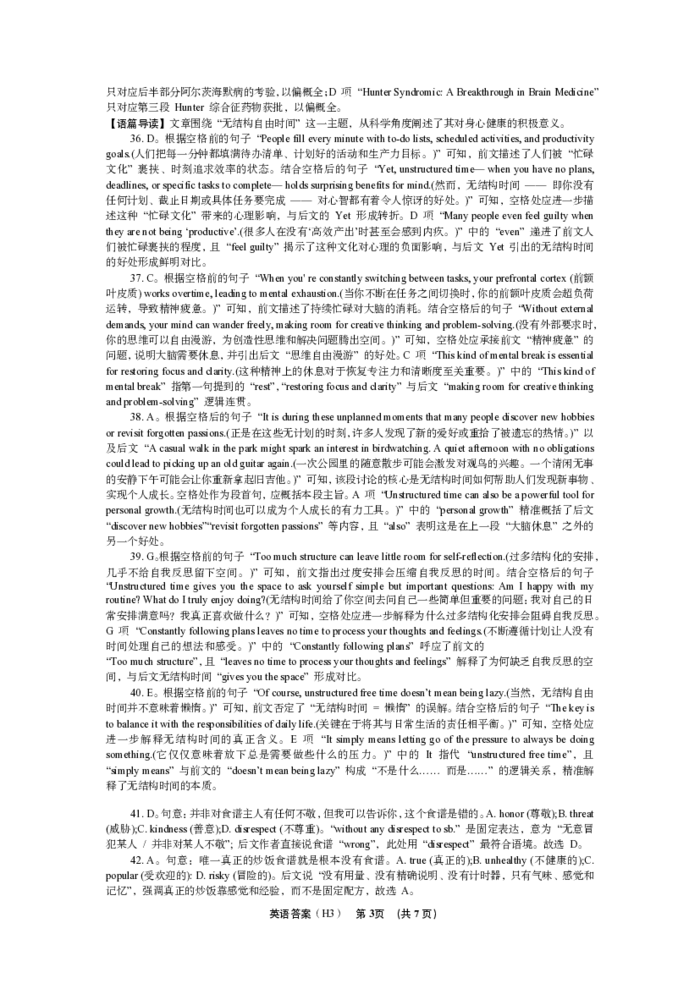
【语篇导读】文章围绕“无结构自由时间” 这一主题,从科学角度阐述了其对身心健康的积极意义。
36. D。根据空格前的句子“People fill every minute with to-do lists, scheduled activities, and productivity
goals.(人们把每一分钟都填满待办清单、计划好的活动和生产力目标。)” 可知,前文描述了人们被“忙碌
文化” 裹挟、时刻追求效率的状态。结合空格后的句子“Yet, unstructured time— when you have no plans,
deadlines, or specific tasks to complete— holds surprising benefits for mind.(然而,无结构时间—— 即你没有
任何计划、截止日期或具体任务要完成—— 对心智都有着令人惊讶的好处。)” 可知,空格处应进一步描
述这种“忙碌文化” 带来的心理影响,与后文的Yet 形成转折。D 项“Many people even feel guilty when
they are not being ‘productive’.(很多人在没有‘高效产出’时甚至会感到内疚。)” 中的“even” 递进了前文人
们被忙碌裹挟的程度,且“feel guilty” 揭示了这种文化对心理的负面影响,与后文Yet 引出的无结构时间
的好处形成鲜明对比。
37. C。根据空格前的句子“When you' re constantly switching between tasks, your prefrontal cortex (前额
叶皮质) works overtime, leading to mental exhaustion.(当你不断在任务之间切换时,你的前额叶皮质会超负荷
运转,导致精神疲惫。)” 可知,前文描述了持续忙碌对大脑的消耗。结合空格后的句子“Without external
demands, your mind can wander freely, making room for creative thinking and problem-solving.(没有外部要求时,
你的思维可以自由漫游,为创造性思维和解决问题腾出空间。)” 可知,空格处应承接前文“精神疲惫” 的
问题,说明大脑需要休息,并引出后文“思维自由漫游” 的好处。C 项“This kind of mental break is essential
for restoring focus and clarity.(这种精神上的休息对于恢复专注力和清晰度至关重要。)” 中的“This kind of
mental break” 指第一句提到的“rest”,“restoring focus and clarity” 与后文“making room for creative thinking
and problem-solving” 逻辑连贯。
38. A。根据空格后的句子“It is during these unplanned moments that many people discover new hobbies
or revisit forgotten passions.(正是在这些无计划的时刻,许多人发现了新的爱好或重拾了被遗忘的热情。)” 以
及后文“A casual walk in the park might spark an interest in birdwatching. A quiet afternoon with no obligations
could lead to picking up an old guitar again.(一次公园里的随意散步可能会激发对观鸟的兴趣。一个清闲无事
的安静下午可能会让你重新拿起旧吉他。)” 可知,该段讨论的核心是无结构时间如何帮助人们发现新事物、
实现个人成长。空格处作为段首句,应概括本段主旨。A 项“Unstructured time can also be a powerful tool for
personal growth.(无结构时间也可以成为个人成长的有力工具。)” 中的“personal growth” 精准概括了后文
“discover new hobbies”“revisit forgotten passions” 等内容,且“also” 表明这是在上一段“大脑休息” 之外的
另一个好处。
40. E。根据空格前的句子“Of course, unstructured free time doesn’t mean being lazy.(当然,无结构自由
时间并不意味着懒惰。)” 可知,前文否定了“无结构时间= 懒惰” 的误解。结合空格后的句子“The key is
to balance it with the responsibilities of daily life.(关键在于将其与日常生活的责任相平衡。)” 可知,空格处应
进一步解释无结构时间的真正含义。E 项“It simply means letting go of the pressure to always be doing
something.(它仅仅意味着放下总是需要做些什么的压力。)” 中的It 指代“unstructured free time”,且
“simply means” 与前文的“doesn’t mean being lazy” 构成“不是什么…… 而是……” 的逻辑关系,精准解
释了无结构时间的本质
39. G。根据空格前的句子“Too much structure can leave little room for self-reflection.(过多结构化的安排,
几乎不给自我反思留下空间。)” 可知,前文指出过度安排会压缩自我反思的时间。结合空格后的句子
“Unstructured time gives you the space to ask yourself simple but important questions: Am I happy with my
routine? What do I truly enjoy doing?(无结构时间给了你空间去问自己一些简单但重要的问题:我对自己的日
常安排满意吗?我真正喜欢做什么?)” 可知,空格处应进一步解释为什么过多结构化安排会阻碍自我反思。
G 项“Constantly following plans leaves no time to process your thoughts and feelings.(不断遵循计划让人没有
时间处理自己的想法和感受。)” 中的“Constantly following plans” 呼应了前文的
“Too much structure”,且“leaves no time to process your thoughts and feelings” 解释了为何缺乏自我反思的空
间,与后文无结构时间“gives you the space” 形成对比。
。
41. D。句意:并非对食谱主人有任何不敬,但我可以告诉你,这个食谱是错的。A. honor (尊敬);B. threat
(威胁);C. kindness (善意);D. disrespect (不尊重)。“without any disrespect to sb.” 是固定表达,意为“无意冒
犯某人/ 并非对某人不敬”; 后文作者直接说食谱“wrong”,此处用“disrespect” 最符合语境。故选D。
42. A。句意:唯一真正的炒饭食谱就是根本没有食谱。A. true (真正的);B. unhealthy (不健康的);C.
popular (受欢迎的): D. risky (冒险的)。后文说“没有用量、没有精确说明、没有计时器,只有气味、感觉和
记忆”,强调真正的炒饭靠感觉和经验,而不是固定配方,故选A。
英语答案(H3)
第4页(共7 页)
43. C。句意:只有气味、感觉和记忆。A. dreams (梦想);B. failures (失败);C. memories (记忆);D. regrets
(遗憾)。前文提到作者在贴满贴纸的旧凳子上、闻着奶奶围裙的香味学做炒饭,这些都是童年记忆,故选C。
44. B。句意:我们用掉所有剩饭,以及冰箱里放着的各种各样的东西的组合。A. floating (漂浮的);B.
sitting (放置着的):C. growing (生长的);D. surviving (幸存下来的)。“anything and everything sitting in the fridge”
指“冰箱里现有的/ 放着的各种各样的东西”,sitting 在此不表示“坐着”,而是“搁置、放着”,故选B。
45. B。句意:厨房总是有点乱,但那也是乐趣的一部分。A. hot (热的);B. messy (凌乱的);C. dusty (积
灰的);D. noisy (吵闹的)。前文说没有测量、没有精确说明,随意组合冰箱里的食材,这种随性的烹饪方式
自然会让厨房有点乱,且“乱” 与“乐趣” 形成呼应,故选B。
46. D。句意:然而,我一直更像一个烘焙者,而不是一个厨师。A. lecturer (讲师);B. talker (健谈者);C.
diner (食客);D. baker (烘焙者)。后文多次出现“baking recipes ”“the more I bake” 等信息,说明作者更偏向
烘焙,故选D。
47. A。句意:我喜欢菜谱,享受精准操作、钻研细节、调平、称量食材的过程。A. precise(精准的);B. creative(有
创造力的);C. patient(耐心的);D. flexible(灵活的)。根据后文“finding details, adjusting and leveling and
weighing(抠细节、调量、称量)”可知,烘焙讲究用量精准,故选A。
48. C。句意:从小时候起,我就能从西式食谱书中严谨的烘焙配方里获得心安与慰藉。A. pride(自豪);B.
evidence(证据):C.comfort(慰藉;心安);D. confidence(信心)。严谨固定的食谱有着确定的步骤,能够给作者
内心踏实安定的感觉,文中没有提及成功后的自豪或是对未来的信心,故选C。
49. A。句意:但我理解即兴和自然创造之美,而且说真的,生活不就是这样吗?A. really(真正地;说真的);B.
A. confirm(证实);B. replace(取代);C. represent(代表);D. contradict(与……矛盾)。前文作者强调自己喜欢
精确菜谱、称量细节,后文却说烘焙也许也是即兴的,前后形成转折和矛盾,故选D。
51. B。句意:我不总需要事先称面粉才能做出完美的饼干。A. buy(买);B. weigh(称重);C. estimate(估计):D
merely(仅仅);C. luckily(幸运地);D. naturally(自然地)。“and really, isn't that what life is?”中的really用于强
调反问、表示“说真的、确实”,符合口语语气,故选A。
50. D。句意:有趣的是,无配方的创作可能与我目前所写的一切相矛盾,但我越烘焙越意识到,烘焙也许
也是即兴的。
.
process(加工)。前文出现“weighing”,且烘焙中称面粉是精确操作的一部分;此处说“不总是需要事先称
面粉”.与上文形成呼应,故选B。
52. C。句意:纸杯蛋糕是我的拿手菜,但我挑战自己每次都用不同的食谱。A. main(主要的);B. side(配菜
的);C. signature(招牌的;拿手的);D. homemade(自制的)。“signature dish”是固定搭配,意为“招牌菜、拿手
菜”,符合后文作者反复挑战做纸杯蛋糕的语境,故选C。
D。句意:加一个鸡蛋会让纸杯蛋糕味道大不相同;如果你尝过我放太多小苏打的纸杯蛋糕,你会尤其
对我的烘焙技术心里没底。A. interested in(对……感兴趣);B. disappointed with(对……失望);C. worried
about(担心);D. uncertain about(对……不确定)。“way too much baking soda”说明这是一次失败尝试,后文
“trial and error”也表明是在试验和犯错;尝过失败作品的人会对作者的烘焙水平产生怀疑、没把握,故
选D。
54. A。句意:我正在学会爱上顺其自然。A. flow(流动;自然进程):B. recipe(食谱);C. theory(理论);D. tradition(传
统)。“go with the flow”是固定短语,意为“顺其自然、随遇而安”,与上文“spontaneity”及下文“embracing the
unknown”相呼应,故选A。
55. B。句意:总有一天,我会掌握自己做炒饭的本领。A. sell(卖);B. master(掌握;精通);C. design(设计);D.
understand(理解)。master表示“掌握、精通某项技能”,这里指学会并做好自己的炒饭;与开头“真正的炒饭
食谱就是没有食谱”以及作者学习即兴创造的语境相符,故选B。
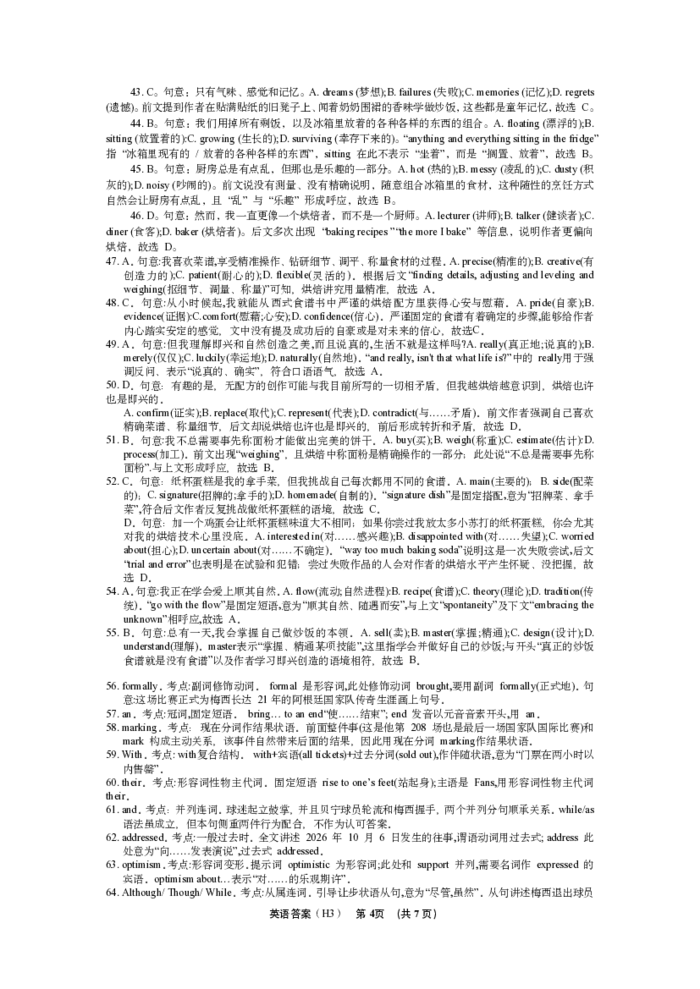
56. formally。考点:副词修饰动词。formal 是形容词,此处修饰动词brought,要用副词formally(正式地)。句
意:这场比赛正式为梅西长达21 年的阿根廷国家队传奇生涯画上句号。
57. an。考点:冠词,固定短语。bring… to an end“使……结束”; end 发音以元音音素开头,用an。
58. marking。考点:现在分词作结果状语。前面整件事(这是他第208 场也是最后一场国家队国际比赛)和
mark 构成主动关系,该事件自然带来后面的结果,因此用现在分词marking作结果状语。
59. With。考点: with复合结构。with+宾语(all tickets)+过去分词(sold out),作伴随状语,意为“门票在两小时以
内售罄”。
60. their。考点:形容词性物主代词。固定短语rise to one’s feet(站起身);主语是Fans,用形容词性物主代词
their。
61. and。考点:并列连词。球迷起立鼓掌,并且贝宁球员轮流和梅西握手,两个并列分句顺承关系。while/as
语法虽成立,但本句侧重两件行为配合,不作为认可答案。
62. addressed。考点:一般过去时。全文讲述2026 年10 月6 日发生的往事,谓语动词用过去式; address 此
处意为“向……发表演说”,过去式addressed。
63. optimism。考点:形容词变形。提示词optimistic 为形容词;此处和support 并列,需要名词作expressed 的
宾语。optimism about…表示“对……的乐观期许”。
64. Although/ Though/ While。考点:从属连词。引导让步状语从句,意为“尽管,虽然”。从句讲述梅西退出球员
英语答案(H3)
第5页(共7 页)
赛场这一事实,主句引出反差:他仍承诺坚守球队,以新身份扶持新生代球员。
65. to claim/ to have claimed。考点:不定式。他仍是唯一八次斩获金球奖的足球运动员,名词前有the only 修
饰,应用不定式作后置定语。
第四部分
第一节
【参考范文1】
Dear Mr. Smith,
I'm writing to share our school's 120th anniversary events held last week and put forward a practical proposal
for the school English newspaper.
Many former students came back for the celebration. We viewed the school history exhibition and watched
wonderful performances. I suggest creating a special column to preserve these warm memories, where we can post
old photos and students’ reflections on the event. If needed, I will be honored to gather materials and polish short
articles for the column.
I hope my idea will be of some value and we can record this unforgettable milestone together.
Yours、
Li Hua
【参考范文2】
Dear Mr. Smith,
I'm writing to share the highlights of our school's 120th anniversary celebration and my idea for our paper.
The School History Exhibition displayed old photos and awards tracing our journey, while the Dance Club,
the Calligraphy Club and the Choir staged wonderful performances at the gala, winning warm applause. The
Alumni Forum also saw graduates from different decades sharing inspiring growth stories. As a volunteer, I
suggest a special column carrying old photos and students’ reflections, so that more readers can relive those
moments.
I'd appreciate it if you could consider my proposal.
Yours、
Li Hua
第二节
【参考范文】
Standing by the truck, I suddenly asked whether he felt tired of being my problem-solver all those years.
Dad shook his head gently, a soft smile spreading across his face. He told me he had never regarded it as a burden
and was always glad to be the one I could turn to. A wave of guilt washed over me. I realized I had rarely asked
about his daily life、always rushing to share my troubles instead of listening to him. Watching his truck drive away
slowly, I made up my mind to change.
That night, I picked up the phone and dialed Dad's number without waiting for emergencies. When his
familiar voice came through, I chatted with him about his garden and his daily walks rather than asking for help. I
shared trivial things in my life as well. I sat quietly, feeling the soft warmth flowing through our conversation. For
the first time, our call was filled with pure care, not trouble-solving.
【阅卷插标说明】
一、第一段核心要点:
1.父亲回应:从不疲惫,从未将求助视为负担,始终乐意成为女儿可求助的人;
2.“我”心生愧疚,反思过往只顾倾诉自己的烦恼、很少关心父亲的日常生活;
3.父亲登车离去.“我”下定决心改变沟通方式(承上启下,衔接第二段打电话情节)。
二、第二段核心要点:
1.本次通话只闲聊日常,不寻求帮助:
2.主动分享自己生活的琐事,形成双向交流;
3.感受通话中的温暖、氛围温馨自然;
4.升华主旨:亲情在于主动陪伴与日常交流,而非有事才联系。
三、评分总原则
1.本题满分25 分,词数要求150 词左右,两段内容均衡;
2.优先评判情节逻辑契合度,再评判语言准确性、流畅度、丰富度;
3.杜绝偏离主旨、逻辑混乱、随意编造无关情节;语言错误按轻重程度分级扣分。
【各档次给分范围和要求】
第五档(21-25 分)
1.情节:完全贴合原文逻辑,紧扣两段段首句,情节连贯、完整、自然,冲突解决合理,升华精准;
2.语言:句式丰富多变,长短句结合,行文流畅无卡顿;
3.细节:动作、心理描写细腻,情感真实,无语法、拼写、标点错误;
4.词数:140—160 词,两段篇幅均衡,结构工整。
第四档(16-20 分)
1.情节:贴合原文主线,逻辑基本连贯,无偏离,情节完整但细节稍显单薄;
2.语言:句式较为丰富,行文流畅,仅有个别轻微语法、拼写错误,不影响理解:
英语答案(H3)
第6页(共7 页)
3.结构:篇幅基本均衡,词数达标,主题升华基本到位。
第三档(11-15 分)
1.情节:基本贴合原文,逻辑无重大错误,但情节单一、缺少细节铺垫;
2.语言:句式单调,多为简单句,存在少量语法错误,不影响整体语义;
3.结构:词数基本达标,两段内容基本完整,升华浅显或略有缺失。
第二档(6-10 分)
1.情节:部分偏离原文逻辑,情节衔接生硬,存在逻辑漏洞;
2.语言:语法、拼写错误较多,句式单一固化,行文卡顿;
3.结构:篇幅失衡,词数严重不足,无主题升华。
第一档(0-5 分)
1.严重偏离主题、情节完全不符,抄写原文、胡乱拼凑;
2.大量语言错误,语义混乱,无法读懂;词数极少或未作答。
听力材料
Text 1 母子对话
M: Mom, can I have some more?
W: No, Rick. You have to follow the meal plan your coach gave you. The final game is coming soon.(1) You don't
want to lose it again, right?
M: Okay. I'm finished now. Can I watch some TV?
W: Sure, I have promised you that.
Text 2 周末计划
M: Jennice, what are you going to do this Sunday?
W: I’ ll go to an art exhibition with my cousin. It's about modern paintings. Do you want to come along?
M: No, thanks. I’ ll read a novel by a famous author at home.(2)
Text 3(第3 题为推断题)等包裹送上门
W: Hi, this is Maria Cook. I just received a message saying my package has arrived. But there's nothing at the
front door.
M: The elevator in your building is broken. I'm climbing the stairs now. Please don't leave your house. I' ll arrive
in a minute.
Text 4 交报告
M: We were asked to submit the project report by next Monday, right?
W: In fact, the deadline has been rescheduled for Friday afternoon.
M: What? Why was it brought forward?(4) Can we hold a group discussion this week, then?
Text 5 变更预订
W: I reserved a table for eight for 7:00 this evening, but three of my friends can't make it. I'd like to change it to a
smaller one. (5)
M: Sure. We only have tables for four and six left.
W: Then I’ ll take a bigger one.
Text 6(第7 题为推断题)开放日准备
W: Mike, we need some posters for Open Day on Wednesday. Can your group finish them on time?(6)
M: Don't worry, Lucy. We got them done last Sunday. (6)
W: Great! Where should we put the parent information desk?
M: By the main entrance. It's near the parking lot. Parents will notice the desk easily.
W: Perfect. Also, our science teacher, Ms. Hill, wants to move her teaching aids to Room 203.
M: Got it. I' ll deal with that after school on Tuesday.
W: You' ve been a big help. Oh, Mrs. Smith is coming in with math papers. Let's hurry back to our seats!
Text 7 租车
M: Good morning, I'd like to rent a car.
W: Sure. May I see your driving licence, please?
M: Here you are. I will need the car for 10 days. How much does it cost?
W: The rent is $55 per day. And another $800 is required as a deposit.(8) You can get it back when you return the
car.
M: Is the insurance included?
W: No, we additionally charge $10 daily for it. The car is already filled with gas, and you are supposed to return it
with a full tank, too. (9)
M: Got it. (9) What else should I do? Should I wash it?
W: It's up to you. This is not a must. The car is in the parking lot. My colleague will show you the way while I fill
in your information and prepare a receipt for you.
M: Thanks. Here is my bank account.
Text 8(第10 题为推断题)游伦敦
M: Do you have a question, miss?
W: Yes. Where is our next stop?
M: Oh, we’ ll take a break here in Hyde Park. If you take a look at the center of your map, you can see the
incredible Buckingham Palace.(11) We will spend some time there in a short while.
英语答案(H3)
第7页(共7 页)
go there tomorrow after you have breakfast in the hotel.(12) Is 7:30 okay?(13)
W: Sure. Would you like to join us? We will have breakfast half an hour earlier than that.(12)(13)
M: Thanks, I'd love to
W: Is it the place where the parliament makes decisions?
M: No, it is the official London royal residence.
W: So, that is where the late Queen lived, right?
M: Yes. You must be surprised to find that it has 760 windows and 1,514 doors.(11)
W: Wow, that's amazing. I can't wait to see it.
M: Ha-ha, I am glad that you are interested. Another place I don't want you to miss is the British Museum. We can
.
Hyde Park 海德公园(英国最大的皇家公园)
Buckingham Palace 白金汉宫(在伦敦的英国王室官邸)
Text 9 司机粗鲁行为
W: Jason, do you often get angry when you' re driving?
M: I'd say, sometimes. Why?
W: I took a cab to see my doctor this morning.(14) And I think it was the most stressful ride in my life.
M: What did the driver do?
W: He was surprisingly calm. It was the other drivers who made it worse. We were stuck in a traffic jam for about
an hour, and the drivers from surrounding cars were shouting. I really don't get that. I mean, there was nothing
you could do in such a situation. You just had to wait. (15)
M: Yeah. Many people are in a rush during the morning and they can't stand being delayed, especially on their way
to work. I usually try to stay calm when I travel at rush hour. However, I can't keep my nerve when other
drivers break the road rules or act in other irresponsible ways.(16) For example, there are always people
driving too closely, making it impossible for me to change lanes. I also met some drivers who cut me off.
cut sb. off 强行超车
Text 10(第20 题为主旨大意题)奶酪
Are you a cheese lover? Do you know that cheese is one of the oldest foods on the planet? Man began to
consume it thousands of years ago—— about 7,500 years ago, to be precise.(17) Scientists came to this conclusion
after studying the remains of clay dishes in two European villages.(18) Ancient settlers who were engaged in cattle
farming and the creation of dairy products founded these two villages around 8,000 years ago. The study of the
remains of clay pots and dishes showed that they were used to store meat, fish, milk, and more importantly,
cheese.(18) Scientists believe that agriculture began to spread in Europe nearly 9,000 years ago, so these findings
also match the time. It's worth mentioning that cheese is believed to be created from goat or sheep milk by
accident. However, it became a good way of preserving milk. Although most cheese recipes from those times were
lost, it's safe to say that early cheeses were very salty, due to the means of preservation.(19) Mass cheese
production didn't occur until 1815 in Switzerland. Nowadays, over a thousand types of cheese exist and are
produced in various countries.