英语试题(Q)
第1页(共10 页)
炎德·英才大联考长沙市一中2027 届高三月考试卷(二)
英
语
命题人:颜静(A 篇、C 篇、应用文)、龙湘(D 篇、完形、读后续写)、
廖心怡(B 篇、七选五、语法填空、听力)
审题人:颜静、龙湘、廖心怡
本试卷共10 页,全卷满分150 分,考试时间120 分钟。
注意事项:
1. 答题前,考生务必将自己的姓名、考生号、考场号、座位号填写在答题卡上。
2. 回答选择题时,选出每小题答案后用铅笔把答题卡上对应题目的答案标号涂黑。如
需改动,用橡皮擦干净后,再选涂其他答案标号。回答非选择题时,将答案写在答题卡上。
写在本试卷上无效。
3. 考试结束后,将本试卷和答题卡一并交回。
第一部分听力(共两节,满分30 分)
做题时,先将答案标在试卷上。录音内容结束后,你将有两分钟的时间将试卷上的答案
转涂到答题卡上。
第一节(共5 小题;每小题1.5 分,满分7.5 分)
听下面5 段对话。每段对话后有一个小题,从题中所给的A、B、C 三个选项中选出最
佳选项。听完每段对话后,你都有10 秒钟的时间来回答有关小题和阅读下一小题。每段录
音播放两遍。
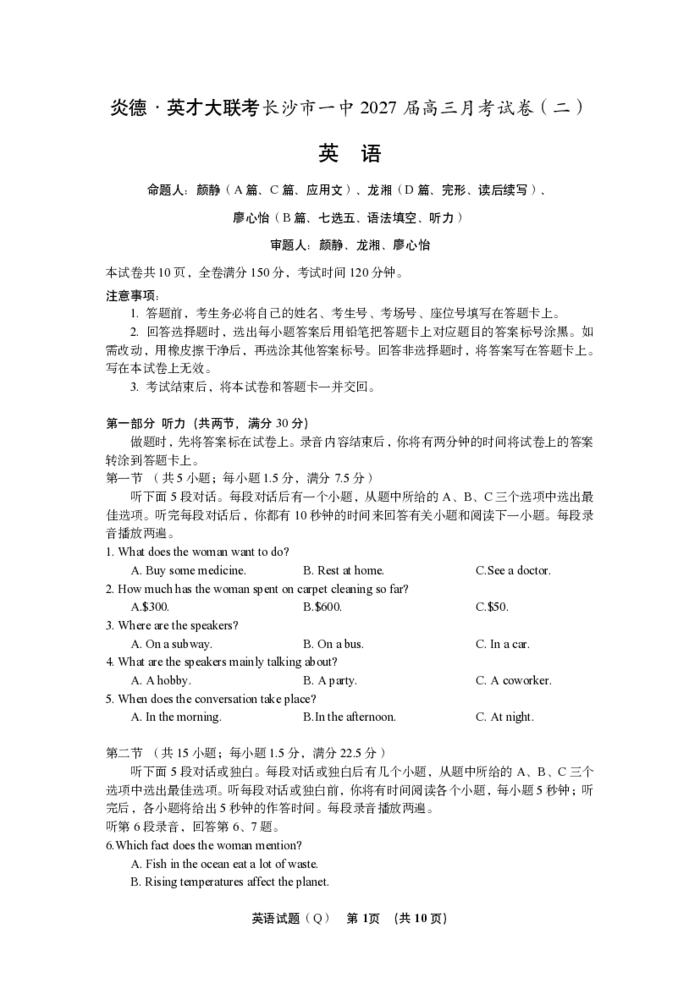
1. What does the woman want to do?
A. Buy some medicine.
B. Rest at home.
C.See a doctor.
2. How much has the woman spent on carpet cleaning so far?
A.$300.
B.$600.
C.$50.
3. Where are the speakers?
A. On a subway.
B. On a bus.
C. In a car.
4. What are the speakers mainly talking about?
A. A hobby.
B. A party.
C. A coworker.
5. When does the conversation take place?
A. In the morning.
B.In the afternoon.
C. At night.
第二节(共15 小题;每小题1.5 分,满分22.5 分)
听下面5 段对话或独白。每段对话或独白后有几个小题,从题中所给的A、B、C 三个
选项中选出最佳选项。听每段对话或独白前,你将有时间阅读各个小题,每小题5 秒钟;听
完后,各小题将给出5 秒钟的作答时间。每段录音播放两遍。
听第6 段录音,回答第6、7 题。
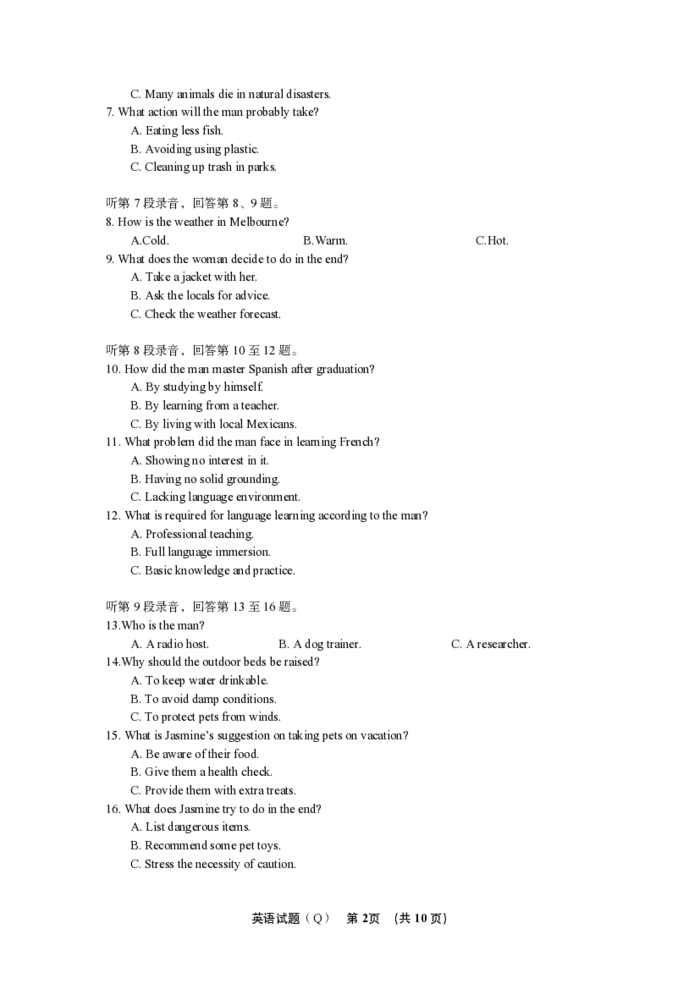
6.Which fact does the woman mention?
A. Fish in the ocean eat a lot of waste.
B. Rising temperatures affect the planet.
英语试题(Q)
第2页(共10 页)
C. Many animals die in natural disasters.
7. What action will the man probably take?
A. Eating less fish.
B. Avoiding using plastic.
C. Cleaning up trash in parks.
听第7 段录音,回答第8、9 题。
8. How is the weather in Melbourne?
A.Cold.
B.Warm.
C.Hot.
9. What does the woman decide to do in the end?
A. Take a jacket with her.
B. Ask the locals for advice.
C. Check the weather forecast.
听第8 段录音,回答第10 至12 题。
10. How did the man master Spanish after graduation?
A. By studying by himself.
B. By learning from a teacher.
C. By living with local Mexicans.
11. What problem did the man face in learning French?
A. Showing no interest in it.
B. Having no solid grounding.
C. Lacking language environment.
12. What is required for language learning according to the man?
A. Professional teaching.
B. Full language immersion.
C. Basic knowledge and practice.
听第9 段录音,回答第13 至16 题。
13.Who is the man?
A. A radio host.
B. A dog trainer.
C. A researcher.
14.Why should the outdoor beds be raised?
A. To keep water drinkable.
B. To avoid damp conditions.
C. To protect pets from winds.
15. What is Jasmine’s suggestion on taking pets on vacation?
A. Be aware of their food.
B. Give them a health check.
C. Provide them with extra treats.
16. What does Jasmine try to do in the end?
A. List dangerous items.
B. Recommend some pet toys.
C. Stress the necessity of caution.
听第10 段录音,回答第17 至20 题。
英语试题(Q)
第3页(共10 页)
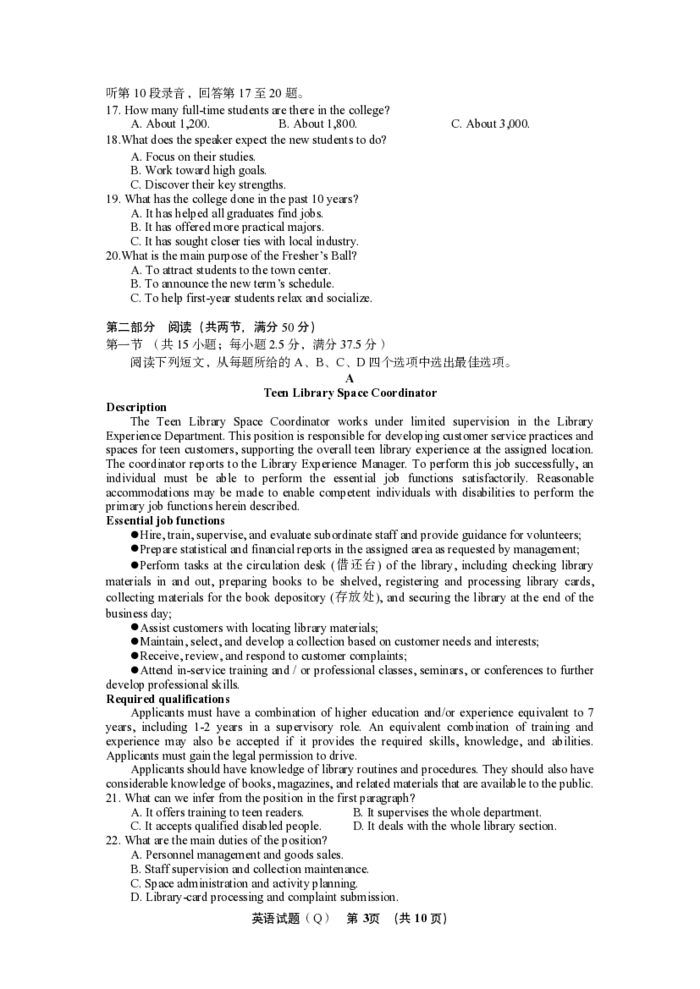
17. How many full-time students are there in the college?
A. About 1,200.
B. About 1,800.
C. About 3,000.
18.What does the speaker expect the new students to do?
A. Focus on their studies.
B. Work toward high goals.
C. Discover their key strengths.
19. What has the college done in the past 10 years?
A. It has helped all graduates find jobs.
B. It has offered more practical majors.
C. It has sought closer ties with local industry.
20.What is the main purpose of the Fresher’s Ball?
A. To attract students to the town center.
B. To announce the new term’s schedule.
C. To help first-year students relax and socialize.
第二部分
阅读(共两节,满分50 分)
第一节(共15 小题;每小题2.5 分,满分37.5 分)
阅读下列短文,从每题所给的A、B、C、D 四个选项中选出最佳选项。
A
Teen Library Space Coordinator
Description
The Teen Library Space Coordinator works under limited supervision in the Library
Experience Department. This position is responsible for developing customer service practices and
spaces for teen customers, supporting the overall teen library experience at the assigned location.
The coordinator reports to the Library Experience Manager. To perform this job successfully, an
individual must be able to perform the essential job functions satisfactorily. Reasonable
accommodations may be made to enable competent individuals with disabilities to perform the
primary job functions herein described.
Essential job functions
Hire, train, supervise, and evaluate subordinate staff and provide guidance for volunteers;
Prepare statistical and financial reports in the assigned area as requested by management;
Perform tasks at the circulation desk (借还台) of the library, including checking library
materials in and out, preparing books to be shelved, registering and processing library cards,
collecting materials for the book depository (存放处), and securing the library at the end of the
business day;
Assist customers with locating library materials;
Maintain, select, and develop a collection based on customer needs and interests;
Receive, review, and respond to customer complaints;
Attend in-service training and / or professional classes, seminars, or conferences to further
develop professional skills.
Required qualifications
Applicants must have a combination of higher education and/or experience equivalent to 7
years, including 1-2 years in a supervisory role. An equivalent combination of training and
experience may also be accepted if it provides the required skills, knowledge, and abilities.
Applicants must gain the legal permission to drive.
Applicants should have knowledge of library routines and procedures. They should also have
considerable knowledge of books, magazines, and related materials that are available to the public.
21. What can we infer from the position in the first paragraph?
A. It offers training to teen readers.
B. It supervises the whole department.
C. It accepts qualified disabled people.
D. It deals with the whole library section.
22. What are the main duties of the position?
A. Personnel management and goods sales.
B. Staff supervision and collection maintenance.
C. Space administration and activity planning.
D. Library-card processing and complaint submission.
英语试题(Q)
第4页(共10 页)
23. What is a must for applicants?
A. A valid driving licence.
B. A doctor’s degree in library science.
C. Seven years of supervisory experience.
D. Hands-on competence in book production.
B
Xu Congxiang, 69, a major grain grower in Taihe County, East China's Anhui Province,
reached a record harvest this year, with the wheat yield on his demonstration farm over 800
kilograms(kg) per mu (0. 067 hectares). “In the 1970s, most of China's wheat yield per mu was
under 300 kg. Now, as farming technology continues to improve, our grain output has increased
greatly,” recalls Xu.
A few decades ago, when Xu was under 20 and had just graduated from high school, he
returned to his hometown and became a farmer, taking up his journey of exploring new ways to
increase grain yield through science and technology. Back then, a magnifying glass (放大镜) was
Xu’s best helper for field observation. Taking a magnifying glass and a notebook, Xu used to set
off into the fields at dawn and stay there until the moon rose.
“At that time,there was no advanced equipment, such as an insect monitor. We could only
use a magnifying glass to observe very small changes in the crops. Some tiny spots on the leaves
could be the signal of the output reduction,” says Xu. During those years, Xu wrote many
notebooks, which contained detailed information including the time and degree of wind and the
growth status of crops. With his rich experience, Xu summed up the methods in the green and
efficient cultivation (栽培) of wheat and promoted them to the surrounding farmers.
Under his influence, Xu’s children followed in his footsteps to work in agriculture and
achieved further breakthroughs. His family focuses on developing high-quality varieties and
exploring high-yield cultivation techniques. Since the beginning of this year, a total of fifty new
grain varieties have been planted in the experimental field, and seven experiments have been
conducted. In Xu’s opinion, modern agricultural science and technology should be applied to help
modern farmers increase yield, and he is resolved to make continuous efforts in this field.
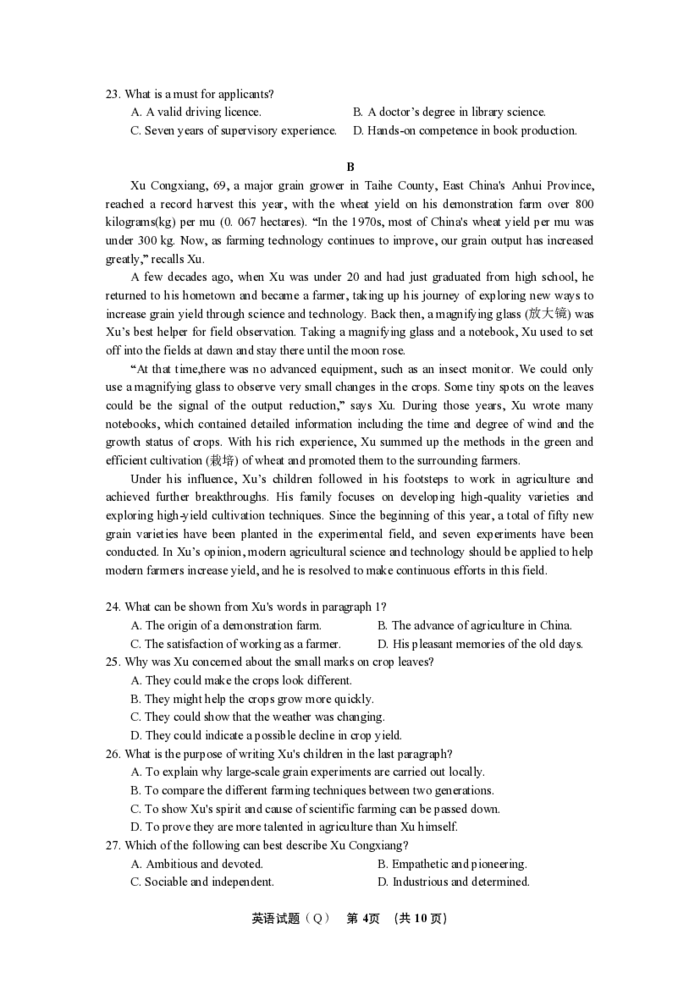
24. What can be shown from Xu's words in paragraph 1?
A. The origin of a demonstration farm.
B. The advance of agriculture in China.
C. The satisfaction of working as a farmer.
D. His pleasant memories of the old days.
25. Why was Xu concerned about the small marks on crop leaves?
A. They could make the crops look different.
B. They might help the crops grow more quickly.
C. They could show that the weather was changing.
D. They could indicate a possible decline in crop yield.
26. What is the purpose of writing Xu's children in the last paragraph?
A. To explain why large-scale grain experiments are carried out locally.
B. To compare the different farming techniques between two generations.
C. To show Xu's spirit and cause of scientific farming can be passed down.
D. To prove they are more talented in agriculture than Xu himself.
27. Which of the following can best describe Xu Congxiang?
A. Ambitious and devoted.
B. Empathetic and pioneering.
C. Sociable and independent.
D. Industrious and determined.
英语试题(Q)
第5页(共10 页)
C
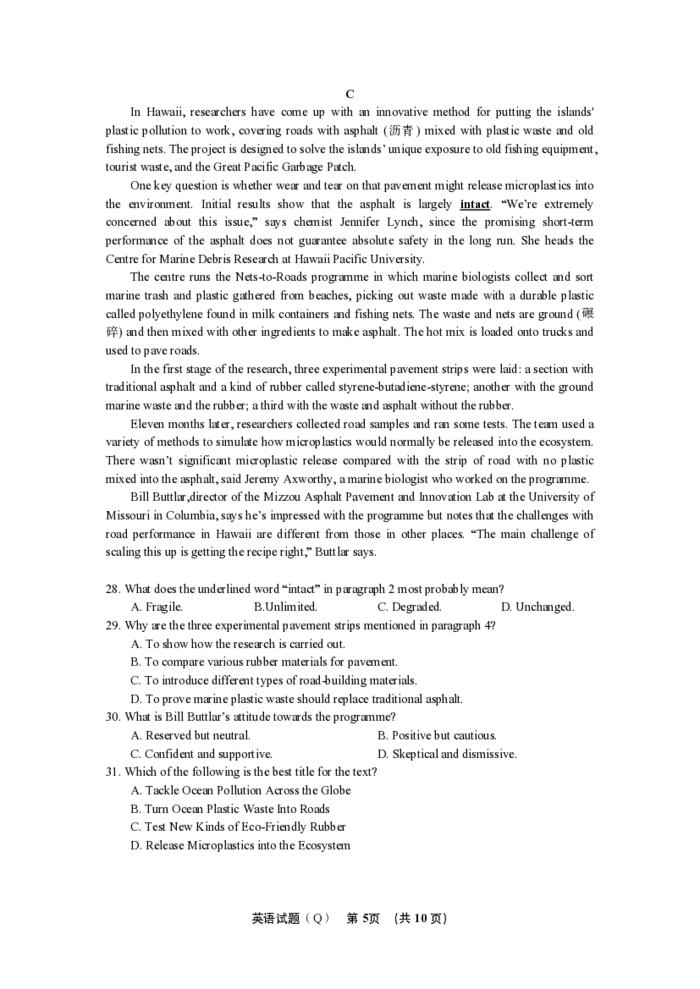
In Hawaii, researchers have come up with an innovative method for putting the islands'
plastic pollution to work, covering roads with asphalt (沥青) mixed with plastic waste and old
fishing nets. The project is designed to solve the islands’ unique exposure to old fishing equipment,
tourist waste, and the Great Pacific Garbage Patch.
One key question is whether wear and tear on that pavement might release microplastics into
the environment. Initial results show that the asphalt is largely intact. “We’re extremely
concerned about this issue,” says chemist Jennifer Lynch, since the promising short-term
performance of the asphalt does not guarantee absolute safety in the long run. She heads the
Centre for Marine Debris Research at Hawaii Pacific University.
The centre runs the Nets-to-Roads programme in which marine biologists collect and sort
marine trash and plastic gathered from beaches, picking out waste made with a durable plastic
called polyethylene found in milk containers and fishing nets. The waste and nets are ground (碾
碎) and then mixed with other ingredients to make asphalt. The hot mix is loaded onto trucks and
used to pave roads.
In the first stage of the research, three experimental pavement strips were laid: a section with
traditional asphalt and a kind of rubber called styrene-butadiene-styrene; another with the ground
marine waste and the rubber; a third with the waste and asphalt without the rubber.
Eleven months later, researchers collected road samples and ran some tests. The team used a
variety of methods to simulate how microplastics would normally be released into the ecosystem.
There wasn’t significant microplastic release compared with the strip of road with no plastic
mixed into the asphalt, said Jeremy Axworthy, a marine biologist who worked on the programme.
Bill Buttlar,director of the Mizzou Asphalt Pavement and Innovation Lab at the University of
Missouri in Columbia, says he’s impressed with the programme but notes that the challenges with
road performance in Hawaii are different from those in other places. “The main challenge of
scaling this up is getting the recipe right,” Buttlar says.
28. What does the underlined word “intact” in paragraph 2 most probably mean?
A. Fragile.
B.Unlimited.
C. Degraded.
D. Unchanged.
29. Why are the three experimental pavement strips mentioned in paragraph 4?
A. To show how the research is carried out.
B. To compare various rubber materials for pavement.
C. To introduce different types of road-building materials.
D. To prove marine plastic waste should replace traditional asphalt.
30. What is Bill Buttlar’s attitude towards the programme?
A. Reserved but neutral.
B. Positive but cautious.
C. Confident and supportive.
D. Skeptical and dismissive.
31. Which of the following is the best title for the text?
A. Tackle Ocean Pollution Across the Globe
B. Turn Ocean Plastic Waste Into Roads
C. Test New Kinds of Eco-Friendly Rubber
D. Release Microplastics into the Ecosystem
英语试题(Q)
第6页(共10 页)
D
Self-driving cars have long been backed by the widespread public hope that they will save
lives by being involved in far fewer crashes, with far fewer injuries and deaths, than ordinary
human-driven cars on public roads. Advocates often paint a future where traffic accidents almost
disappear, as automated systems eliminate human errors like distracted driving and speeding. But
so far, most direct comparisons between human drivers and automated vehicles have been deeply
unfair, creating a misleadingly positive impression of self-driving safety.
Crash statistics for human-driven cars are gathered from all sorts of real-world driving
situations and on all types of roads—in crowded city centers, on narrow country roads, in heavy
rain, sudden snow and thick fog, at any hour of the day or night. However, most of the published
data on self-driving cars’ safety have been recorded in mild weather and on well-marked highways,
where the most important tasks are staying in the car’s own lane and not getting too close to the
vehicle ahead. Automated cars are reliably good at these simple, repetitive tasks, but so are most
careful human drivers.
It is true that self-driving cars don’t get tired, angry or frustrated after long hours on the road.
But neither can they yet react to uncertain situations with the same skill or sharp anticipation as an
attentive, experienced human driver. Nor do they possess the human-like foresight to spot and
avoid hidden potential dangers far ahead. They largely drive from moment to moment, making
split-second decisions based only on what their sensors happen to detect at that exact instant.
To judge whether automated driving truly saves lives, scientists insist that we must “compare
apples with apples”—namely, measure automated cars only in the situations in which they are
actually driven. If robot cars are tested mostly on easy highways,their excellent safety records tell
us little about how they would handle busy city streets full of pedestrians, delivery bikes and
sudden unexpected incidents. Until such fair and demanding comparisons are widely made, the
promise of much safer roads remains just that—a promise, not yet a fully proven fact.
32. Why does the author say most comparisons between human drivers and automated cars are
“unfair”?
A. Human-driven cars cause more injuries and deaths.
B. Automated cars are tested under far easier conditions.
C. Human drivers make more mistakes than automated cars.
D. Automated cars are more expensive than human-driven ones.
33. What can we infer about self-driving cars from paragraph 3?
A. They have been widely used on all types of roads.
B. They can avoid all potential dangers with their sensors.
C. They are already safer than human drivers in every situation.
D. They may fail to address unpredictable situations as well as humans.
34. According to the text, the author’s attitude toward the future application of self-driving
technology can be described as ______.
A. subjective
B. objective
C. opposed
D.indifferent
35. What is the main idea of the text?
A. Autonomous cars have proven suitable for various road conditions.
B. Scientists have worked out perfect standards for self-driving car tests.
C. Human drivers will soon be completely replaced by self-driving cars.
D. The safety promise of self-driving cars lacks fair and sufficient proof.
第二节(共5 小题;每小题2.5 分,满分12.5
英语试题(Q)
第7页(共10 页)
分)
根据短文内容,从短文后的选项中选出能填入空白处的最佳选项。选项中有两项为多余
选项。
Street names help us figure out where we are.
36
Some names, like 125th Street, are
just descriptions of locations. But often, streets are named after people, which places us in a
historical or political context too.
Not far from where my brother lives in north London is a street called Kitchener Road. Just
behind the lamp post is an old sign, made of thick iron, bearing the name.
37
That sign
seems to say this person was and still is deserving of recognition. But Kitchener Road reminded
me of Britain's history of colonial (殖民地的) rule, as Kitchener (1850-1916) was a cruel British
military officer across Asia and Africa.
Saying street names are markers of history attracts two types of criticism. One is that it's
nothing more than a storm in a teacup. Street names don’t really matter.
38
But naming
streets after people responsible for killings means continuing to celebrate them and making that
view of history seem normal in everyday life. So what should we do?
39
Another option is the Amsterdam approach. There, a street honoring anti-apartheid
(反种族隔离) leader Albert Luthuli has a sign noting: “Formerly: Louis Botha street,” named
after a prime minister of colonial South Africa.
Where controversial names remain, people are also creating walking tours to provide fuller
historical context. In Glasgow, a tour was organized to make people know about the city’s role in
the enslavement of people. This practice is a creative response to damaging histories and provides
local communities with a thoughtful way forward.
Walking away from Kitchener Road, I thought of a different Kitchener: the legendary
Trinidadian calypso musician. Upon arriving in England, he sang London is the Place for Me. If
Kitchener Road must keep its name, I’d prefer to imagine they honor the “King of Calypso,” not
the colonial butcher.
40
A. This idea works in two ways.
B. In my view, such streets should be renamed.
C. The other concern is that renaming may erase history.
D. Perhaps reinterpreting street names is an approach we can adopt.
E. To name a street after a person is a way of honoring his or her achievements.
F. Old street names can sometimes encourage people to investigate local history.
G. The real question is not whether history matters, but how it should be presented.
第三部分
语言运用(共两节,满分30 分)
第一节(共15 小题;每小题1 分,满分15
英语试题(Q)
第8页(共10 页)
分)
阅读下面短文,从短文后各题所给的A、B、C 和D 四个选项中选出可以填入空白处的
最佳选项,并在答题卡上将该项涂黑。
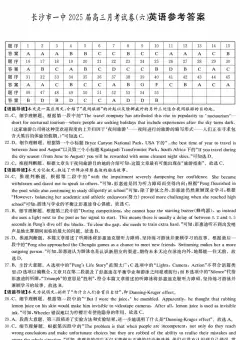
Alexander Clark , a former IT professional, found a new career after retirement. As a child,
he took a(n) ___41___ to woodwork and music, but his career took a different ___42___. After
retirement,he ___43___
his two loves and became a flute (长笛) maker.
Clark ___44___ this unique journey at the age of 70, after decades working in IT. He was 45
in a musical family, with both his parents ___46___ in music. He played the flute in his teenage
years. And his passion for the ___47___ was reawakened in his 40s.
Due to a long lack of practice, his woodworking skills have ___48___.One day, Clark found
his old school reports ___49___, which showed his best subjects were music and woodwork. That
___50___ his enthusiasm for the two again.
Around the age of 70, he signed up for an Irish flute-making workshop. ___51___, Clark
spends at least four days a week in the workshop, carefully ___52___ each flute. He has ___53___
his skills in woodturning, silverwork, leatherwork, and French polishing. He even cleared out his
garage to settle a lathe (车床), bandsaws, a milling machine and other ___54___.
Clark loves the feel of the wood and the smell of it when he is working. He feels ___55___
with his work, stating,“You could call it a job,but I never refer to it as that.”
41. A. objection
B. shortcut
C. fancy
D. attitude
42. A. prospect
B. path
C. approach
D.style
43. A. rejected
B. delayed
C.combined
D.ceased
44. A. continued
B. recognized
C. ended
D. started
45. A. cheered up
B. brought up
C. held up
D.built up
46. A. engaged
B. stuck
C. lacking
D. confident
47. A. composition
B.objective
C. recreation
D.instrument
48. A.worked
B.declined
C. improved
D.survived
49. A.with ease
B. on exhibition
C. by accident
D. in response
50. A.fuelled
B. quit
C. attained
D. anticipated
51. A. Curiously
B. Alternatively
C. Eventually
D.Presently
52. A. observing
B. painting
C. crafting
D. polishing
53. A. registered
B. sharpened
C. abandoned
D. refreshed
54. A. luggage
B.belongings
C.furniture
D. equipment
55. A. content
B.bored
C.honest
D. familiar
英语试题(Q)
第9页(共10 页)
第二节(共10 小题;每小题1.5 分,满分15 分)
阅读下面短文,在空白处填入1 个适当的单词或括号内单词的正确形式。
On April 4, the first day of the Qingming holidays, 26-year-old Sun Yiheng traveled a long
distance to a tea garden in Huzhou to experience firsthand the traditional art of tea picking. For
Sun, tea has long been an essential part of daily life in China, which made her eager to discover
the way ___56___ fresh tea leaves turn into the drink we enjoy. Although tea was familiar to her,
Sun found ___57___ fascinating to learn about the process of making it in person, and visiting
during spring, a season associated with renewal, also ___58___ (expose) her to nature up close.
Sun is not alone. On China's lifestyle-sharing platform Xiaohongshu, posts about tea garden
visits and tea culture experiences are becoming increasingly common. The enthusiasm for
tea-picking experiences reflects a growing tendency among young Chinese ___59___ (step) into
tradition in a more tangible way.
Zhang Menglu, head of Pu'er Tengyi Tea Co, oversees about 240 hectares of tea gardens in
Pu'er. During peak season, 80 to 120 participants pour ___60___ her tea garden daily. Staff
members first teach participants to identify the right buds and pick them carefully. Once ___61___
(pick), the tea leaves should be processed quickly to preserve their freshness and flavor.
___62___ staff then guide participants through each step of ___63___ process), so that they can
leave with the tea they have made themselves.
Experiential tea picking typically focuses on younger plantation trees, which are easier to
manage and better suited for educational tours. By contrast, access to ancient tea trees ___64___
(restrict) to specified zones so as to minimize human impact, which allows visitors to take part in
___65___ (immerse) experiences and also helps them gain awareness of ecological protection,
according to Zhang.
第四部分
写作(共两节,满分40 分)
第一节(满分15 分)
假定你是李华,你校的英语报要增设一个栏目。外教John 提出“CareerPlan”和“National
Security”两个选项供大家选择。请给John 写一封邮件,内容包括:
(1)你的选择;
(2)说明理由。
注意:
(1)写作词数应为80 个左右;
(2)可以适当增加细节,以使行文连贯;
(3)请按如下格式在答题卡的相应位置作答。
Dear John,
Yours,
Li Hua
第二节(满分25
英语试题(Q)
第10页(共10 页)
分)
阅读下面材料,根据其内容和所给段落开头语续写两段,使之构成一篇完整的短文。
Amanda felt as gray as the sky outside when she looked across the table at her four-year-old
sister,Li. Li sat on a booster seat,drinking from her sippy (有吸嘴的) cup. Wondering why Li was
still afraid of her, Amanda took a cookie off her plate and held it out to Li, “Want a bite?”
As soon as Li saw Amanda reaching over, her eyes widened. She jumped down from her seat
and raced to her room. What an annoyance! Amanda complained to Mom that she had thought
being a big sister would be fun. Mom took Amanda‘s hand, reminding her that Li was in a new
country with a new family and how scared she might be.
“Honey, she is still getting used to you.” Mom added. “It;s only been two weeks.”
Over a year ago, Amanda’s parents said that they were adopting a daughter from China, and
Amanda danced with excitement. She’d dreamed of taking her sister to the park, reading books to
her, and teaching her to ride a bicycle. That hadn't happened, though. In the weeks since their trip
to China,Li had only let their mom and dad near her.Amanda had drawn pictures for her, read to
her, and made funny faces, but none had worked. Whenever she got close, Li ran away.
“I just wish I knew how to help her,”Amanda said to herself,thinking of Li’s frightened eyes.
As she sat onto the couch, she turned on the TV and began to watch a cartoon about a dog and a
cat. After a few seconds, Amanda realized that the cartoon was in another language. The show
looked funny, but she didn’t understand any of it. She frowned, turning off the TV. It reminded
her of when they were in China. She had got frustrated when people talked in Mandarin, the
language spoken in Li’s province.
注意:
(1)续写词数应为150 左右;
(2)请按如下格式在答题卡的相应位置作答。
“That’s it,” cried Amanda, speeding to her room.
Mom came to the door and found them sitting side by side.