1 / 8

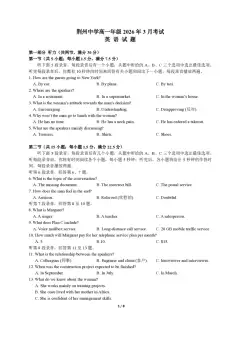
荆州中学高一年级2026 年3 月考试
英 语 试 题

第一部分 听力(共两节,满分30 分)
第一节(共5 小题;每小题1.5 分,满分7.5 分)
听下面5 段录音。每段录音后有一个小题,从题中所给的A、B、C 三个选项中选出最佳选项。
听完每段录音后,你都有10 秒钟的时间来回答有关小题和阅读下一小题。每段录音播放两遍。
1. How are the guests going to New York?
A. By car.


B. By plane.


C. By taxi.
2. Where are the speakers?
A. In a restaurant.


B. In a supermarket.


C. In the woman’s house.
3. What is the woman’s attitude towards the man’s decision?
A. Encouraging.


B. Understanding.


C. Disapproving (反对).
4. Why won’t the man go to lunch with the woman?
A. He has no time.


B. He has a neck pain.

C. He has ordered a takeout.
5. What are the speakers mainly discussing?
A. Trousers.


B. Shirts.


C. Shoes.

第二节(共15 小题;每小题1.5 分,满分22.5 分)
听下面5 段录音。每段录音后有几个小题,从题中所给的A、B、C 三个选项中选出最佳选项。
听每段录音前,你将有时间阅读各个小题,每小题5 秒钟;听完后,各小题将给出5 秒钟的作答时
间。每段录音播放两遍。
听第6 段录音,回答第6、7 题。
6. What is the topic of the conversation?
A. The missing document.

B. The incorrect bill.


C. The postal service.
7. How does the man feel in the end?
A. Anxious.


B. Relieved (欣慰的).

C. Doubtful.
听第7 段录音,回答第8 至10 题。
8. What is Margaret?
A. A singer.


B. A teacher.


C. A salesperson.
9. What does Plan C include?
A. Voice mailbox service.

B. Long-distance call service.
C. 20 GB mobile traffic service.
10. How much will Margaret pay for her telephone service plan per month?
A. 5.


B.10.


C. $15.
听第8 段录音,回答第11 至13 题。
11. What is the relationship between the speakers?
A. Colleagues (同事).


B. Engineer and client (客户).
C. Interviewer and interviewee.
12. When was the construction project expected to be finished?
A. In September.


B. In July.


C. In March.
13. What do we know about the woman?
A. She works mainly on training projects.

B. She once lived with her mother in Africa.
C. She is confident of her management skills.
{#{QQABQQQpwwCwgJYACI7bEwEYCgiYsJMTLIgOARAUKAQCCRNAFAA=}#}
 2 / 8

听第9 段录音,回答第14 至16 题。
14. What first made Richard interested in filmmaking?
A. Watching independent movies.
B. Recording life with a camera.
C. Working in a local video store.
15. What did Richard learn from the unclassifiable (不能分类的) films?
A. The techniques of filmmaking.
B. The effects of films on people.

C. The rules of the film industry.
16. What is Richard’s main reason for not making art films?
A. He is bad at making them.
B. He thinks they are all predictable.
C. He dislikes the way they are presented.
听第10 段录音,回答第17 至20 题。
17. When does the speaker make the speech?
A. At the beginning of a concert.  B. In the middle of a lecture.
C. At the end of a show.
18. Whom does the speaker say sorry to?
A. People who occupied the back seats.


B. People who have performed on the stage.
C. People who have worked behind the scenes.
19. What is the weather like tonight?
A. Sunny.


B. Rainy.


C. Windy.
20. What can we learn from the speech?
A. The roof can’t be repaired.

B. The speaker is in a theater.
C. The roof was replaced four years ago.

第二部分 阅读(共两节,满分50 分)
第一节(共15 小题;每小题2.5 分,满分37.5 分)
阅读下列短文,从每题所给的A、B、C 和D 四个选项中,选出最佳选项。
A
How High-Rises Shaped Modern Britain
Eyesores and dangerously unsafe? Or ideal housing for the working classes? Holly Smith tells the stories
behind some of the UK’s most revolutionary homes—buildings that have deeply shaped modern Britain,
mixing novelty, success and painful debate.
Kensal House (1936, west London)
Co-designed by Maxwell Fry and Elizabeth Denby, it was intended for working-class families between
the two World Wars, when modernist homes for the rich were already popular. It offered bright, spacious flats
with private balconies, labour-saving kitchens and public gardens. Managed by residents with strict rules, it
was a pioneering model that inspired thousands of estates later—completely distinct from the dark, crowded
and poor areas people had to live in before.
Ronan Point (1968, east London)
This poorly built tower collapsed just two months after opening: a small gas leak on the 18th floor
{#{QQABQQQpwwCwgJYACI7bEwEYCgiYsJMTLIgOARAUKAQCCRNAFAA=}#}
 3 / 8

destroyed a whole wing, killing 5 people and injuring 17. Its concrete panels were piled up without a strong
internal frame, and its joints were even filled with old cement (水泥) bags and wrinkled newspapers. The
public shock exposed widespread structural faults in high-rises, though hundreds of such blocks still lack
proper strengthening today.
Trellick Tower (1972, west London)
In sharp contrast, this high-rise is a masterpiece by Hungarian architect Ernő Goldfinger. It used top
materials like marble lobbies and stained glass, as the designer believed high-rises could "free the ground for
gardens" and set high standards for public housing—turning homes from just simple shelters into spaces
where people could express their lives fully.
Cascades (1988, east London)
This flashy postmodern tower dominates the Thames, mixing ocean liner elegance and old storehouse
solidity while taking inspiration from local marine history. Nicknamed "Yuppie Towers," it was the first
private luxury high-rise here, with a pool and a gym. It created a clear contradiction: social housing high-
rises are seen as signs of poverty, while new luxury ones stand for success.
21. What can we learn about Ronan Point from the text?
A. Its structural faults led to a tragic accident.    B. Its construction featured sustainable materials.
C. Its design targeted luxury housing for the rich. D. Its failure helped completely address similar faults.
22. What do Kensal House and Trellick Tower have in common?
A. They served as ideal examples.


B. They provided private gardens.
C. They were built with top materials.

D. They were under strict management.
23. How does Cascades reflect the evolution of British high-rises?
A. Postmodern designs replaced modernist ones. B. Luxury facilities became standard for high-rises.
C. They shifted from public housing to private luxury. D. Postmodernism became the mainstream design style.

B
Dr. Punam Krishan is a general practitioner—a GP—one of the doctors who stand on the front line of
medicine. GPs treat everyday illnesses, listen carefully to patients’ concerns, and decide when special medical
care is needed. Beyond her work in clinics, Dr. Krishan is also a familiar face on television and the author of
several books, including How to Be a Doctor and Other Life-Saving Jobs, You and Your Body, and her latest
release, The Superhero’s First Aid Manual.
Her journey into medicine began with caring for others. “It started off with me wanting to help people
understand themselves better,” she once explained. She often noticed when someone looked unwell and felt
driven to ask why. That quiet curiosity led her deeper into science, even when it was challenging, and
eventually toward a life dedicated to healing others.
To Dr. Krishan, being a GP is “one of the most incredible jobs in the world”. Every day, she meets
people from different backgrounds and at different stages of life. With only ten minutes per patient, she must
listen closely, read between the lines, and uncover the truth behind their symptoms. “It makes me feel a bit
like a detective,” she said. Patients may arrive with one problem or many, and finding the right answer brings
a sense of excitement that never fades. She describes her role as being “a bit of a best friend to people”.
Her newest book was shaped by a deeply personal loss. When she was a child, her grandfather died, and
for years she worried she had missed signs that he was unwell. That experience stayed with her and formed
a powerful belief: recognizing illness can be a life-saving skill, even for children. Through her book, she
teaches young readers to recognize emergencies such as allergic reactions or heart attacks, and to take simple
{#{QQABQQQpwwCwgJYACI7bEwEYCgiYsJMTLIgOARAUKAQCCRNAFAA=}#}
 4 / 8

but vital steps—staying calm, calling 999, or placing someone in the recovery position. For Dr. Krishan,
heroism begins with care, courage, and knowledge. “Children should know the basics of how to be a
superhero in that moment,” she added.
24. What can we learn about Dr. Krishan from the first paragraph?
A. She takes on multiple roles.


B. She excels in detailed work.
C. She takes pleasure in reading.


D. She aims for public recognition.
25. Why did Dr. Krishan dive into science?
A. To handle the scientific challenges.


B. To make up for her childhood regret.
C. To observe the lives of patients better.

D. To find explanations for what she observed.
26. How does Dr. Krishan find her work as a GP?
A. Fast-paced but satisfying.


B. Stressful but stable.
C. Challenging but well-paid.


D. Exhausting but promising.
27. What does Dr. Krishan’s experience indicate according to the last paragraph?
A. Better late than never.


B. Fix the roof before it rains.
C. Time and tide wait for no man.


D. Opportunity favors the prepared mind.

C
For centuries, the Rhine River has been celebrated as the lifeline of Europe, a vital waterway for
commerce, culture, and ecology. However, a study published in January 2026 reveals a troubling modern
reality: this historic river now acts as a massive conveyor belt for rubbish, carrying between 3,000 and 4,700
tons of large garbage into the North Sea every single year.
How could such a vast amount of waste have been missed? The answer lies in a revolutionary new
research method. For an entire year, researchers worked with local citizen scientists to operate a special
floating device called a litter trap. This device filtered water from the surface down to 80 centimeters deep.
Unlike older methods that relied on brief visual surveys, this long-term physical collection recorded the true,
disorganized flow of garbage. The data showed enormous changes, with the amount of rubbish collected in
a two-week period varying wildly from as few as 67 pieces to over 2,700, accounting for why short-term
observations failed to get the full picture.
The collected garbage tells a clear story about its origins. Detailed analysis showed that while plastic
items made up about 70% of all pieces, they were mostly lightweight, only 15% of the total weight. More
importantly, over 56% of all rubbish was linked directly to the choices of individual consumers, with items
like food wrappers and beverage bottles being most common. Specific activities also left their mark, with
litter from fireworks making up 10.7% of the total and tobacco-related waste like cigarette butts contributing
another 6.5%.
This year-long project, powered in part by dedicated volunteers, proves that long-term, hands-on
monitoring is essential to measure environmental challenges accurately. It provides a powerful model for
how communities and scientists can work together to gather the evidence needed for action. The Rhine’s
story is no longer just about its scenic beauty or economic importance; it is an urgent call to address the tide
of waste our modern lifestyle creates, before it all washes out to sea.
28. What is the main finding of the 2026 study on the Rhine River?
A. It has an important status in history.

B. It flows into the North Sea every year.
C. It becomes a carrier of massive rubbish.

D. It loses the role as a waterway for ecology.
29. Which of the following contributed to old methods’ failure?
{#{QQABQQQpwwCwgJYACI7bEwEYCgiYsJMTLIgOARAUKAQCCRNAFAA=}#}
 5 / 8

A. Not involving local volunteers.


B. Lacking recorded data of advanced tools.
C. Only collecting water from the surface.

D. Missing dramatic changes in short surveys.
30. What can we learn from the figures in paragraph 3?
A. Fireworks were the most polluted activity.
B. Smoking had little effect on the environment.
C. Most rubbish came from personal consumption. D. Plastics made up most of the weight.
31. What is the primary purpose of the passage?
A. To analyse origins of river garbage.


B. To emphasize pollution and urge action.
C. To explain a new method to clear rubbish.
D. To praise the project led by volunteers.

D
Brands have spent years perfecting video marketing strategies. Nearly 78% of consumers trust videos
with real people, according to research from video creation platform Animoto. That preference holds as AI
video tools flood the market and brands race to create more content faster. The finding comes from Animoto’s
State of Video 2026 report, based on a survey of 460 American consumers and marketers. As AI generates
full videos from text prompts (提示), the truth remains: People still want to see other people.
The preference for human faces isn’t just about aesthetics (美学). More than 82% of consumers report
watching videos that they believe were AI-generated, and among that group, 36% say it lowers their trust in
the brand behind it. This creates a problem for marketers. Even if AI tools can help produce videos faster, the
resulting content may raise doubt that destroys the entire purpose of making the video in the first place.
Separate research cited in the report found that 88% of consumers consider brand trust as important as
price and quality when making purchases. Three-quarters of US adults think it’s extremely or very important
to know whether images, videos, or text were created by AI or people. This trust loss appears regardless of
whether audiences correctly identify AI content. The survey showed that consumers believe they can spot
AI-generated videos based on “an entire set of signals” and contextual mismatches, according to the report
author Olga Mirkovic. Whether they’re right doesn’t matter. Awareness alone affects how they view the brand.
Surveyed marketing professionals aren’t trying to remove humans from their videos. Despite pressure
to produce more content faster, marketers still want control over which footage to use, how to present their
brand voice, and when to put themselves on camera. Roya Safarian, a survey respondent, explained the
balance: “AI can enhance storytelling as long as the brand still keeps a human touch. The key is balance;
Technology should support the message, not replace the genuine voice behind it.”
32. What is the most effective trust-building video marketing strategy?
A. Making videos featuring real people.

B. Using AI to generate videos quickly.
C. Updating video production fashion.

D. Producing true video content faster.
33. In what circumstances does the trust loss occur?
A. When video aesthetics are poor.


B. When video production speeds up.
C. When AI content is sensed.


D. When brand trust is compared to price.
34. What do marketing professionals suggest AI should be used for in video-making?
A. Generating videos automatically.


B. Aiding in content creation as a tool.
C. Controlling brand voice directly.


D. Replacing human presenters entirely.
35. What is the best title for the text?
A. Contrasting AI and Human-made Videos
B. Building Consumer Trust with AI Videos
C. Facing Trust Crisis in AI-generated Videos
D. Balancing Technology and Humanity in Videos

{#{QQABQQQpwwCwgJYACI7bEwEYCgiYsJMTLIgOARAUKAQCCRNAFAA=}#}
 6 / 8

第二节 (共5 小题:每小题2.5 分,满分12.5 分)
阅读下面短文,从短文后的选项中选出可以填入空白处的最佳选项。选项中有两项为多余选项。
A cover letter, also known as an application letter, is a document you send with your resume (简历) that
provides some additional information.    36    Frankly, a cover letter is essential.
   37    On the one hand, such a letter can explain details in your resume in more depth and is the
first impression a hiring manager has of you. On the other hand, employers use cover letters to narrow down
the applicant pool and choose the group of candidates they want to interview.
The type of letter you write should depend on the requirements of each different company or employer.
And the information that is included in a cover letter will vary depending on the goals and purposes of your
application.    38
The most common types of cover letter we see are the application cover letter and the cover letter of
interest. The former is generally written in response to a vacancy that’s posted on a company’s website. The
latter is written by a job seeker and addressed to a company where he or she would like to work.    39
Instead, it inquires about open positions in general.
When composing a cover letter, you’d better include the hiring manager’s name. This gives your letter
a proper greeting.    40    Communicate clearly and briefly. Using complex words and sentences would
fail to convey your intentions to the company. After you’ve written the letter, go over it to ensure there are
no errors.
A. Be specific when needed.
B. Besides, try to simplify your letter.
C. There are two key reasons for its importance.
D. However, it is not aimed at a specific role or vacancy.
E. That’s to say, there is no set pattern for a cover letter.
F. A standard cover letter can be used with minor changes.
G. This should be about skills and experience related to the job you’re applying for.

第三部分 语言运用(共两节,满分30 分)
第一节(共15 小题;每小题1 分,满分15 分)
阅读下面短文,从每题所给的A、B、C、D 四个选项中选出可以填入空白处的最佳选项。
Lito connects himself with a global audience through his carving artworks on fallen leaves on social
media. The artist transforms    41    leaves into delicate artworks.    42    of his work include frogs
holding umbrellas, animals jumping happily and ocean waves. He has gained international    43    for
his artworks.
For Lito, now in his forties, leaf carving is more than an art form—it is a source of calm and    44   .
He was diagnosed with attention deficit hyperactivity disorder (注意缺陷障碍) in his thirties, which made
him realize that he might do things    45   . He chose to follow his own path rather than fit in with others.
He found that the    46    and slow process of carving helped him deal with the    47   . Through his
art, he not only    48    his own struggles but also aims to bring joy to others.
In a video Lito    49    the whole process of his creation. He firstly    50    leaves with a
chemical to prevent them from drying out,    51    by sketching his designs and carving them using a
special knife. Some    52    pieces take over eight hours to complete, often in a single sitting. His
creations    53    his love for nature and his unique artistic vision.
Today, Lito is actively exhibiting his work, authoring books on his craft, and keeping an active online
{#{QQABQQQpwwCwgJYACI7bEwEYCgiYsJMTLIgOARAUKAQCCRNAFAA=}#}
 7 / 8

   54    to share his art. “If I can make people happy by doing what I am doing,” he says, “I want to do
more. That’s my    55    force for what’s next.”
41. A. decorative

B. ordinary

C. symbolic

D. broken
42. A. Reviews


B. Secrets


C. Challenges

D. Scenes
43. A. recognition

B. invitation

C. explanation

D. qualification
44. A. confusion

B. anxiety


C. focus


D. doubt
45. A. officially


B. differently

C. seriously

D. casually
46. A. similar


B. occasional

C. natural


D. detailed
47. A. tradition


B. reward


C. condition

D. promise
48. A. identifies


B. approaches

C. removes

D. records
49. A. showed


B. faced


C. reviewed

D. predicted
50. A. selects


B. delivers


C. applies


D. measures
51. A. delayed


B. misled


C. replaced

D. followed
52. A. latest


B. traditional

C. tricky


D. hidden
53. A. adapt to


B. hold back

C. result in


D. take on
54. A. presence


B. donation

C. storage


D. trade
55. A. limiting


B. driving


C. opposing

D. disturbing

第二节(共 10 小题:每小题 1.5 分,满分 15 分)
阅读下面短文,在空白处填入 1 个适当的单词或括号内单词的正确形式。
Hefei,    56    national center of science and education, was officially announced as a branch site
for the 2026 Spring Festival Gala last month. The news,    57    (share) rapidly across social media, met
with widespread    58    (approve) from residents, creating a joyful atmosphere across the city.
Over the past decade, significant technological breakthroughs    59    (make) in Hefei,    60
earns it global recognition in the tech field. It is due to its blend of innovation and cultural heritage    61
the city won the opportunity to host the gala, an honor widely acknowledged as a milestone in its development.
Local residents have poured their    62    (expect) into the event, and many are getting ready to
create a stage that combines AI projections with performances. The city is also concentrating     63
Hui-style architecture. Most people agree that Hefei truly    64    (deserve) this moment in the spotlight,
as the gala will help    65    (strength) its status as a dynamic city of tech and culture.

第四部分 写作(共两节,满分40 分)
第一节(满分15 分)
请根据所给图片,写一篇关于网络
与信息安全的英文发言稿。
注意:
(1)开头已为你写好;
(2)写作词数为80 左右;
(3)可适当增加细节,使行文连贯。

Today, I’d like to talk about network and information security.

____________________________________________________________________________________
{#{QQABQQQpwwCwgJYACI7bEwEYCgiYsJMTLIgOARAUKAQCCRNAFAA=}#}
 8 / 8

第二节(满分 25 分)
阅读下面材料,根据其内容和所给段落开头语续写两段,使之构成一篇完整的短文。
Eva started her new job at a small charity called “Caring for Carers.” While checking the shared
campaign folder, a name caught her eye: Adam Turner.
Memories suddenly flooded back. Adam had been her major opponent at school — a boy who always
carried a leather briefcase while everyone else had backpacks. He was extremely talented at maths, while
Eva excelled in English and history. They once failed a group project because they spent all their time arguing,
unable to combine his logic with her creativity.
When the office door opened, a tall, handsome man walked in. It was Adam. He smiled broadly, “You
do remember! Conker!” he teased, using her old nickname. Eva glared, but Adam quickly turned professional.
“The Simpson Foundation is offering funding. If we make a convincing speech next Friday, they’ll pay for
the whole campaign.”
As they worked together, the old disagreement remained. Adam was buried in precise budgets, while
Eva insisted on using “creative” ideas to move the funders. Eva complained that he was too obsessed with
figures, while Adam responded that her ideas were too impractical. They seemed to be back in their school
days, fighting over every detail.
However, as the deadline approached, their relationship began to shift. Eva made an effort to understand
his financial tables, and Adam started to appreciate the emotional power of Eva’s storytelling. One afternoon,
they discovered some old black-and-white photos of people the charity had helped. Eva suggested using these
to tell real stories, and Adam’s eyes lit up. He realized he could back those stories with data to prove their
impact.
The day of the presentation finally arrived, which was also the final day of Eva’s trial period. Standing
outside the boardroom, Eva felt her heart pounding. This wasn’t just about the funding; it was about whether
she and her old opponent could finally succeed as a team.
注意:
1.续写词数应为 150 左右;
2.请按如下格式在答题卡的相应位置作答。
Taking a deep breath, Eva and Adam stepped into the boardroom together. _____________________
_____________________________________________________________________________________
_____________________________________________________________________________________
_____________________________________________________________________________________

As they walked out of the room, Joanna, their manager, was waiting for them with a bright smile. ___
_____________________________________________________________________________________
_____________________________________________________________________________________
_____________________________________________________________________________________

{#{QQABQQQpwwCwgJYACI7bEwEYCgiYsJMTLIgOARAUKAQCCRNAFAA=}#}