2026-2027 学年度上学期高一年级9 月月考英语试题
第一部分
听力(共两节,满分30 分)
第一节(共5 小题;每小题1.5 分,满分7.5 分)
听下面5 段录音。每段录音后有一个小题,从题中所给的A、B、C 三个选项中选出最
佳选项。听完每段录音后,你都有10 秒钟的时间来回答有关小题和阅读下一小题。每段录
音播放两遍。
1. What are the speakers mainly talking about?
A. A restaurant.
B. The man’s dog.
C. Some bad acts.
2. Why does the woman talk to the man?
A. To give a warning.
B. To offer suggestions.
C. To ask about something.
3. Where does the conversation probably take place?
A. In the classroom.
B. On the playground.
C. In the library.
4. What is the man’s problem?
A. He missed the meeting.
B. He forgot the report at home.
C. He didn’t know the deadline.
5. Who will the woman give some flowers to?
A. The man speaker.
B. Mrs. Jones.
C. Mr. Watson.
第二节(共15 小题;每小题1. 5 分,满分22. 5 分)
听下面5 段录音。每段录音后有几个小题,从题中所给的A、B、C 三个选项中选出最
佳选项。听每段录音前,你将有时间阅读各个小题,每小题5 秒钟;听完后,每小题都有5
秒钟的作答时间。每段录音播放两遍。
听第6 段录音,回答第6、7 题。
6. When did Sally get the painting?
A. On her birthday.
B. On Christmas Day.
C. On Mother’s Day.
7. What is the relationship between the speakers?
A. Boss and assistant.
B. Father and daughter.
C. Co-workers.
听第7 段录音,回答第8、9 题。
8. How old is Mary’s mother?
A. 45 years old.
B. 50 years old.
C. 55 years old.
9. What will the man do tomorrow?
A. Cook some dishes.
B. Buy a cake.
C. Buy Chinese dishes.
听第8 段录音,回答第10 至12 题。
10. What’s the probable relationship between the speakers?
A. Doctor and patient.
B. Boss and assistant.
C. Husband and wife.
11. What can we learn about the man?
A. He has a cold.
B. He often tells lies.
C. He’s staying in bed.
12. What did the woman do with the man’s problem?
A. She put his cigarette out.
B. She gave him some medicine.
C. She prepared some hot water for him.
听第9 段录音,回答第13 至16 题。
13. What is Jennifer?
A. A teacher.
B. A student.
C. A tour guide.
14. What will Jennifer do first this summer?
A. Do some volunteer work.
B. Take a trip abroad.
C. Visit her grandparents.
15. What subject will the man probably teach?
A. English.
B. Geography.
C. Science.
16. When will the man finish his work in Nepal?
A. On July 10th.
B. On July 16th.
C. On July 23rd.
听第10 段录音,回答第17 至20 题。
17. Who is the speaker?
A. A doctor.
B. A headmaster.
C. A policeman.
18. What is happening at the school?
A. A fire.
B. An earthquake.
C. A safety exercise.
19. What should teachers do?
A. Set the alarm.
B. Keep the students calm.
C. Lock all classroom doors.
20. When should students return to their normal activities?
A. Once the bell stops.
B. At the end of the day.
C. After the second announcement.
第二部分阅读(共两节,满分50 分)
第一节(共15 小题; 每小题2.5 分,满分37.5 分)
阅读下列短文,从每题所给的A、B、C、D 四个选项中选出最佳选项。
A
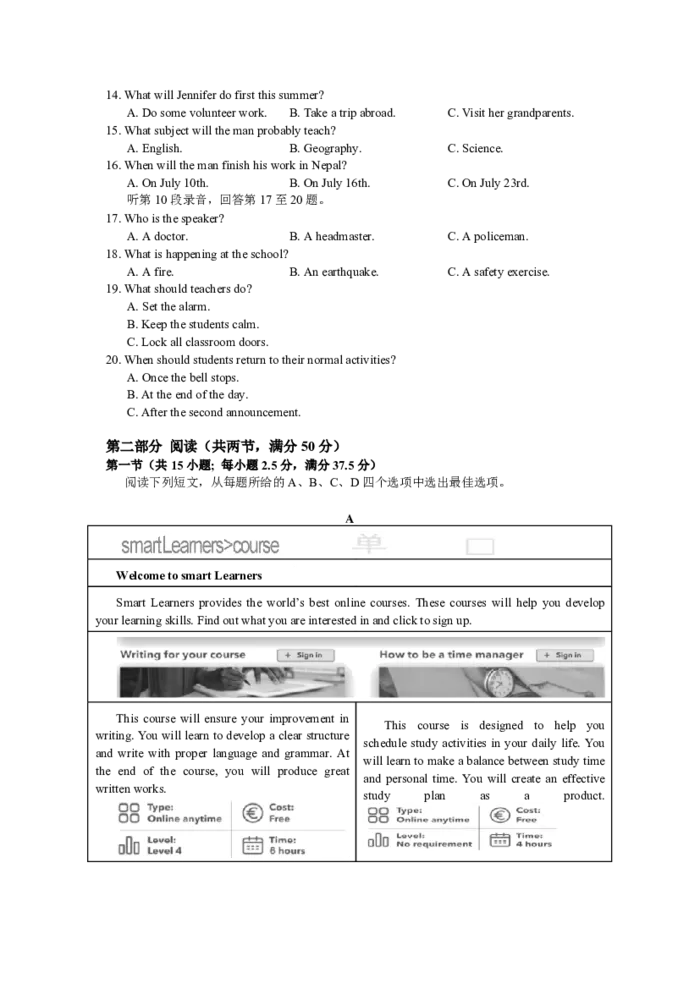
Welcome to smart Learners
Smart Learners provides the world’s best online courses. These courses will help you develop
your learning skills. Find out what you are interested in and click to sign up.
This course will ensure your improvement in
writing. You will learn to develop a clear structure
and write with proper language and grammar. At
the end of the course, you will produce great
written works.
This
course
is
designed
to
help
you
schedule study activities in your daily life. You
will learn to make a balance between study time
and personal time. You will create an effective
study
plan
as
a
product.
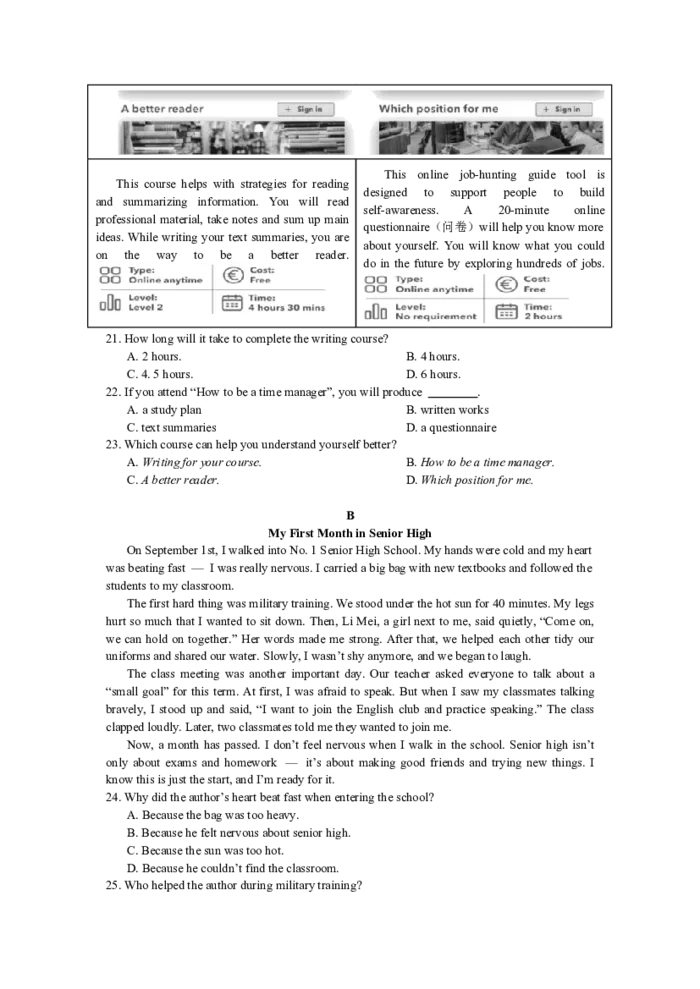
This course helps with strategies for reading
and
summarizing
information.
You
will
read
professional material, take notes and sum up main
ideas. While writing your text summaries, you are
on
the
way
to
be
a
better
reader.
This
online
job-hunting
guide
tool
is
designed
to
support
people
to
build
self-awareness.
A
20-minute
online
questionnaire(问卷)will help you know more
about yourself. You will know what you could
do in the future by exploring hundreds of jobs.
21. How long will it take to complete the writing course?
A. 2 hours.
B. 4 hours.
C. 4. 5 hours.
D. 6 hours.
22. If you attend “How to be a time manager”, you will produce
.
A. a study plan
B. written works
C. text summaries
D. a questionnaire
23. Which course can help you understand yourself better?
A. Writing for your course.
B. How to be a time manager.
C. A better reader.
D. Which position for me.
B
My First Month in Senior High
On September 1st, I walked into No. 1 Senior High School. My hands were cold and my heart
was beating fast — I was really nervous. I carried a big bag with new textbooks and followed the
students to my classroom.
The first hard thing was military training. We stood under the hot sun for 40 minutes. My legs
hurt so much that I wanted to sit down. Then, Li Mei, a girl next to me, said quietly, “Come on,
we can hold on together.” Her words made me strong. After that, we helped each other tidy our
uniforms and shared our water. Slowly, I wasn’t shy anymore, and we began to laugh.
The class meeting was another important day. Our teacher asked everyone to talk about a
“small goal” for this term. At first, I was afraid to speak. But when I saw my classmates talking
bravely, I stood up and said, “I want to join the English club and practice speaking.” The class
clapped loudly. Later, two classmates told me they wanted to join me.
Now, a month has passed. I don’t feel nervous when I walk in the school. Senior high isn’t
only about exams and homework — it’s about making good friends and trying new things. I
know this is just the start, and I’m ready for it.
24. Why did the author’s heart beat fast when entering the school?
A. Because the bag was too heavy.
B. Because he felt nervous about senior high.
C. Because the sun was too hot.
D. Because he couldn’t find the classroom.
25. Who helped the author during military training?
A. Li Mei
B. The teacher
C. His parents
D. A new friend from the club.
26. What was the author’s small goal?
A. To finish military training.
B. To get good grades in exams.
C. To make 10 new friends.
D. To join the English club.
27. What does the author think of senior high now?
A. It’s only about hard work.
B. It’s full of new chances.
C. It’s too difficult for him.
D. It’s not interesting at all.
C
The human brain remembers negative experiences more easily than positive ones. Our brains
have developed in this way because threats, like dangerous animals, have a more immediate effect
on people’s survival compared to positive things like food or shelter. As a result, you clearly know
what makes you unhappy, but do you know what makes you happy?
Research suggests that our level of happiness is partly shaped by the choices we make. If you’
ve been chasing wealth, fame, power and some material things, you may be looking for happiness
in the wrong places. Psychologists suggest that the following habits can make people happier.
People who own close relationships tend to be happier than those who do not. The number of
our friends is not important. What matters is the quality of our relationships. Relationships that
bring happiness usually consist of the sharing of feelings, acceptance, mutual(互相的)respect and
trust.
People who exercise regularly can improve both their physical and mental well-being. Some
research has shown that exercise can be as effective as some medicine in treating depression.
If we are so interested in an activity, we may lose track of time, and we can be in a state of
flow. The activity could be playing the piano, surfing the Internet or playing a game...People who
experience flow in their work or life tend to be happier.
People are more likely to be happy if they know what their strengths are and can use them
regularly. People are especially happy when they can set goals and use their strengths to achieve
them.
People, who think positively by being grateful, mindful and optimistic, are more likely to be
happy. Being grateful means being thankful. Being mindful means considering, focusing on, and
enjoying the experiences of the present moment. Being optimistic means being hopeful about the
future.
28. Why do human brains remember negative things more easily?
A. Because negative things are easy to remember.
B. Because negative things can make people live much happier.
C. Because negative things are much more important than other things.
D. Because negative things tend to affect human survival immediately.
29. According to this passage, in which of the following can people not find happiness?
A. Chasing power.
B. Doing sports.
C. Playing the violin.
D. Making friends.
30. In the last paragraph, what does the author try to tell us?
A. We should think more about our future.
B. We should be positive in our life and work.
C. We should focus on everything in our life.
D. We should only enjoy the present moment.
31. What does the passage mainly want to tell us?
A. Some habits that make people happy.
B. The habits people form in their life.
C. Why people remember positive things easily.
D. Why people remember negative things easily.
D
If you want to become a fluent English speaker, you should take some advice: there are four
skills in learning English. They are listening, speaking, reading and writing. The most important
thing you must remember is that if you want to improve your speaking and writing skills, you
should first gain the skills of reading and listening.
Read as much as you can. But your reading must be active. It means that you must think about
the meaning of the sentences, the meaning of the unfamiliar words, etc.
There is no need for you to pay much attention to grammar or try to understand all the
unfamiliar words you come across, but the fact you see them for the first time and recognize them
whenever you see them, for example in other passages or books, is enough. It would be better to
prepare yourself a notebook so you can write down the important words or sentences in it.
As for listening, there are two choices: besides reading, you can listen every day for about 30
minutes. You can only pay attention to your reading and become skillful at your reading, then you
can catch up on your listening. Since you have lots of inputs(输入)in your mind, you can easily
guess what the speaker is going to say. This never means that you should not practice listening.
For listening, you can listen to cartoons or some movies that are specially made for children.
Their languages are easy. Or if you are good at listening, you can listen to VOA or BBC programs
every day. Again the thing to remember is being active in listening and preferably taking some
notes. If you follow these pieces of advice, your speaking and writing will improve automatically,
and you can be sure that with a little effort they will become perfect.
32. According to the author, which should you improve first among the four skills?
A. Reading and listening.
B. Reading and writing.
C. Writing and speaking.
D. Speaking and listening.
33. To improve your reading, when you read, you should
.
A. look up all the new words in the dictionary.
B. think about what you are reading actively.
C. spend more time studying grammar.
D. copy as many words and sentences as possible.
34. What does the underlined words “come across” in Paragraph 3 mean?
A. Meet by accident.
B. Wind up.
C. Lose on purpose.
D. Look for.
35. Which of the following may the author agree with?
A. Everyone should listen to VOA or BBC programs every day.
B. You needn’t practice listening if you keep in reading every day.
C. Being good at reading is helpful in improving your listening.
D. You should take notes of whatever you are hearing.
第二节(共5 小题;每小题2.5 分,满分12.5 分)
阅读下面短文,从短文后的选项中选出可以填入空白处的最佳选项。选项中有两项为多
余选项。
The Power of a Personal Journal
Keeping a daily journal is one of the most powerful and beneficial habits you can develop. It
is more than just a record of your life; it is a tool for self-expression, reflection, and personal
growth.
36
For many successful writers and thinkers, it’s their first step into daily writing
discipline.
A key benefit of keeping a journal is better self-understanding. Writing down your thoughts
and feelings forces you to clarify them.
37
This process gives you new insights into your
values and life goals, creating a space for honest self-conversation.
38
The more you write, the better you express ideas clearly. You can experiment with
new vocabulary, different sentence structures, and various writing styles without the pressure of
being graded. It’s a private playground for your words.
To get started, you don’t need a fancy notebook or special pens.
39
Consistency
matters most — spend 10-15 minutes daily. You can write about your day, things you’re grateful
for, or challenges you face. You can also focus on daily observations like the weather.
The benefits of this simple practice extend far beyond the page. It can reduce stress, spark
creativity, and help you solve problems more effectively.
40
You might be surprised by
what you discover.
A. So, pick up a pen and start writing.
B. Keeping a journal also improves writing skills.
C. You can also share your journals with your friends for feedback.
D. Putting experiences into words can make them easier to understand.
E. It is important to write your journal entry at the same time every day.
F. It allows you to look within, to recall the past, and to plan for the future.
G. A simple notebook or even a document on your computer will work perfectly.
第三部分语言运用(共两节,满分30 分)
第一节(共15 小题;每小题1 分,共15 分)
阅读下面短文,从每题所给的A、B、C、D 四个选项中选出可以填入空白处的最佳选项。
As I entered the bright hall, I was surrounded by the murmur of voices and the sound of soft
music. 20 years had passed since my high school graduation, but the sight of those
41
faces brought me back to my youth at once.
Dreamlike — That’s the best way to
42
my 20-year high school reunion.
43
and excited, I recognized many
44
. No one seemed to have
45
! The women all
looked nearly unchanged and so did the men. For a moment, I felt like I could almost smell the old
posters on the classroom walls and taste the cafeteria lunches we used to share.
High school is a time full of
46
. It’s a period in life when you are trying to figure out
who you are, or simply trying to fit in with others. There are
47
and there is plenty of
stress, but here’s the thing: none of that
48
years later. It makes no difference whether
you were popular or had straight A’s.
After two decades, none of that counts. Success isn’t
49
by the car that you drive or
how much money you make. Success is what holds real
50
in your life — your
happiness, your family and your relationships. Success means living
51
and leaving a
positive mark on the world around you.
As I prepared to leave, I took one last look at this
52
. There’s a unique bond with
teenage friends. You can
53
where you left off, even if it’s been 20 years. I’m grateful for
the
54
formed in those years. I’ll see you all in 10 years, eager to hear the next chapter in
everyone’s story and see where
55
takes us next.
41. A. similar
B. familiar
C. strange
D. young
42. A. describe
B. congratulate
C. arrange
D. ignore
43. A. Calm
B. Confident
C. Nervous
D. Proud
44. A. neighbors
B. leaders
C. teachers
D.
classmates
45. A. hesitated
B. improved
C. worried
D. aged
46. A. challenges
B. chances
C. wishes
D. sadness
47. A. performances
B. emergencies
C. disagreements
D.
advantages
48. A. shows
B. succeeds
C. matters
D.
concludes
49. A. gained
B. measured
C. discovered
D.
respected
50. A. significance
B. fortune
C. command
D. strength
51. A. silently
B. comfortably
C. bravely
D. fully
52. A. team
B. section
C. circle
D. crowd
53. A. hold on
B. pick up
C. get over
D. take on
54. A. relationships
B. habits
C. promises
D. dreams
55. A. history
B. education
C. life
D.
community
第二节(共10 小题;每小题1.5 分,满分15 分)
Peter decided
56
(join) the Chinese club at his school after he saw its posters.
When he
57
(step) into the club room for the first time, he felt a little nervous. After
he got to know the club
58
(member), some of whom were exchange students from China,
his interest in Chinese grew. They taught him to speak Chinese, from the basic pronunciation
59
complicated(复杂的)expressions. Peter practiced with
60
(patient) and with the
help of the Chinese students, he made
61
(surprising) quick progress. He even learned a
little Chinese calligraphy.
Through the club, Peter also developed an interest in Chinese culture. The Chinese students
showed him traditional Chinese art and introduced him to festivals like the Chinese New Year and
the Mid-Autumn Festival,
62
he found very attractive.
By
63
end of the school year, Peter’s experience in the Chinese club had changed
him in a big way. As he looked back on his time spent in the club, he was
64
(thank) for
the experience and looked forward to
65
(continue) his exploration of the Chinese
language and culture.
第四部分写作(共两节;满分40 分)
第一节(满分15 分)
假定你是李华,你的英国笔友Peter 即将作为交换生到你所在的高中学习,他来信询问
如何更好地适应高中生活。请你给他回一封邮件,并提供建议。
注意:
1. 词数100 左右;
2. 可适当增加细节,使行文连贯;
3. 开头和结尾已给出,不计入总词数。
第
二
节
(
满
分25 分)
阅读下面材料,根据其内容和所给段落开头语续写两段,使之构成一篇完整的短文。
Helen’s father Jason had smoked for almost ten years. Smoking had become a daily habit for
him. He smoked after meals, while working, and even when he rested at home. Every time he lit a
cigarette, thin white smoke filled the room, leaving a strong, unpleasant smell on his clothes and
hair.
Helen had long disliked her father’s smoking habit. She learned from her teacher that smoking
was really harmful to people’s health. It could hurt the lungs, cause bad coughs and even lead to
serious illnesses. What worried Helen most was that her father often coughed badly at night.
Besides, second-hand smoke was also bad for the whole family’s health. She had tried to ask her
father to give up smoking many times, but Jason always shook his head and said it was too hard
for him to stop.
One Sunday afternoon, Helen saw her father smoking again in the yard. He looked tired after
a whole week’s work. Helen walked over quietly and did not blame(责怪)him at once. Instead,
she sat beside him and talked with him gently. She told her father how worried she was about his
health. She said she hoped her father could accompany(陪伴)her to grow up.
To encourage her father, Helen prepared a small notebook. She planned to record every day
when her father did not smoke. She also promised to give him a small gift if he could keep not
smoking for a month. Jason looked at his daughter’s sincere eyes and felt warm and guilty in his
heart. He knew his daughter loved him deeply. He finally made up his mind to break this bad habit
for his family.
注意:
(1)续写词数应为150 左右;
(2)请按如下格式在答题纸相应位置作答。
However, in the first few days, Jason couldn’t help smoking secretly.
Two months later, Jason managed to stay away from cigarettes.
Dear Peter,
Yours,
Li Hua