 夜雨聆风
夜雨聆风


大学生AI工具使用及体验优化分析(学术英语)
Research Background
研究背景
The rapid evolution of generative artificial intelligence has catalyzed a paradigm shift in higher education pedagogy. AI-powered tools have transitioned from experimental novelties to integral components of student learning ecosystems globally.
生成式人工智能的快速发展推动了高等教育教学模式的范式变革。在全球范围内,人工智能工具已从实验性创新产物,转变为学生学习生态系统中不可或缺的组成部分。
The study contributes both theoretically and practically to the field of educational technology by establishing an evaluation framework for AI tool assessment and providing empirical evidence to guide tool development and institutional integration strategies.
本研究构建了人工智能工具的评估框架,为工具开发与院校整合策略提供了实证依据,在理论与实践层面均对教育技术领域做出了贡献。
Demographic Details of Participants
参与者的统计细节
Purposive sampling was adopted to select 200 undergraduate students taking compulsory English courses at Guilin University of Electronic Technology in 2024. The participants shared similar academic backgrounds and had sufficient language proficiency for AI-related learning.
本研究于2024年采用目的性抽样方法,选取桂林电子科技大学200名修读大学英语必修课的本科生,确保研究对象在学术背景和语言能力方面具有一致性。
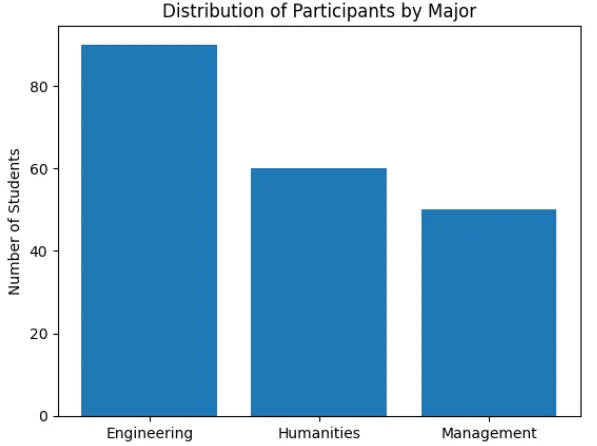
Engineering students made up the largest group, accounting for 45% (90 students), followed by humanities majors at 30% (60 students) and management majors at 25% (50 students).
从专业分布来看,工科学生占比最高(45%,90人),其次为人文学科学生(30%,60人),管理类专业学生占25%(50人)。
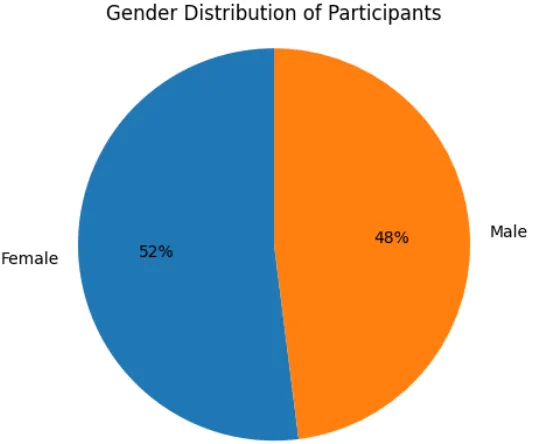
The sample showed a relatively balanced gender distribution, with 104 females and 96 males. Participants were aged between 19 and 23 years (M = 20.7).
样本性别比例较为均衡,女性104人,男性96人;年龄主要集中在19—23岁之间,平均年龄为20.7岁。
All participants reported prior experience with at least one AI tool, indicating a general level of technological familiarity within the sample.
所有受访者均有至少一种人工智能工具的使用经历,整体技术接受度较高。
Market Penetration Analysis
市场普及率分析
The AI tool market among surveyed students demonstrates a clear hierarchical pattern, with Doubao accounting for nearly half of total usage. This finding is particularly striking given ChatGPT’s global popularity, highlighting Doubao’s strong localization advantages within the Chinese educational context.
受访学生的人工智能工具使用呈现出明显的分层结构,其中豆包的使用率接近一半。鉴于ChatGPT在全球范围内的广泛影响力,这一结果凸显了豆包在中国教育情境中的本土化优势。
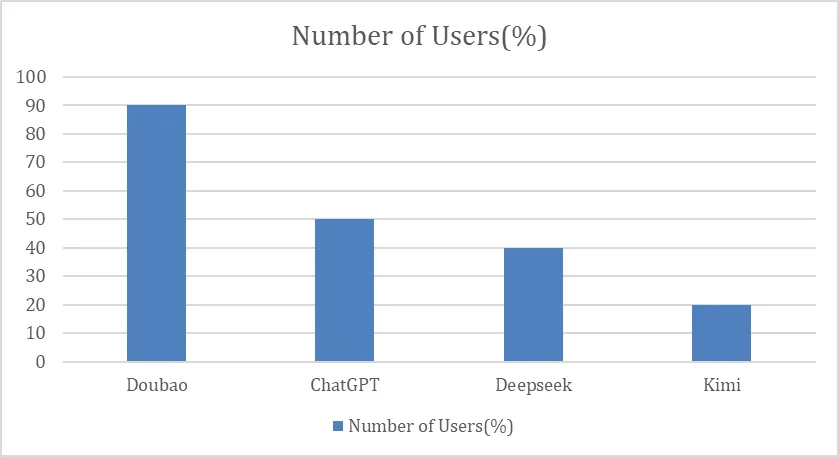
Statistical analysis revealed significant differences in AI tool adoption across academic disciplines (F(2,197) = 4.32, p < 0.05). Engineering students reported the highest usage of Doubao (58%), exceeding that of humanities (38%) and management students (42%).
统计分析结果表明,不同学科之间的AI工具使用率存在显著差异(F(2,197)=4.32,p<0.05)。其中,工科学生对豆包的使用率最高(58%),明显高于人文学科(38%)和管理类专业学生(42%)。
This disciplinary variation suggests that AI tools are adopted selectively rather than uniformly, with students more likely to engage with tools that align closely with their disciplinary demands and perceived functional value.
这一差异表明,AI工具的使用并非均匀分布,而是与学科需求密切相关,学生更倾向于选择在学习和问题解决中具有实际价值的工具。
AI Usage Frequency
AI使用频率
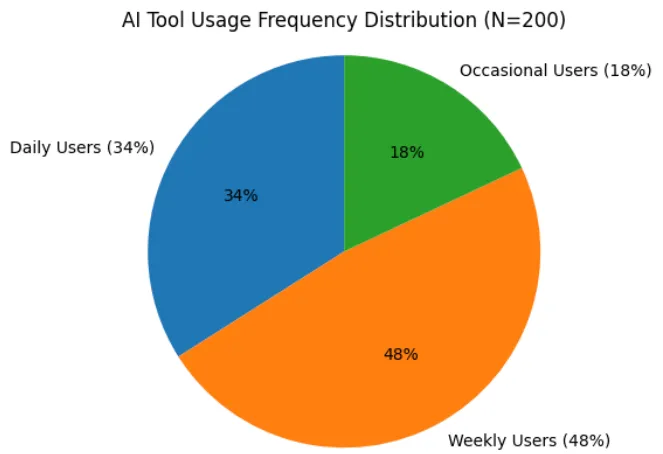
Analysis of usage frequency revealed clear behavioral patterns reflecting different levels of AI tool integration. Daily users accounted for 34% of the sample and mainly relied on AI tools for language learning and routine academic support.
使用频率分析显示,学生在AI工具使用行为上呈现出清晰的层级特征。每日使用者占34%,主要将AI工具用于语言学习和日常学业支持。
Weekly users represented the largest group (48%), primarily using AI tools for assignment completion and project-related tasks. In contrast, 18% of students were occasional users, engaging with AI tools only when facing complex or time-sensitive academic demands.
每周使用者占比最高,达到48%,主要用于作业完成和课程项目;而18%的学生为偶尔使用者,仅在遇到复杂或时间紧迫的学习任务时才使用AI工具。
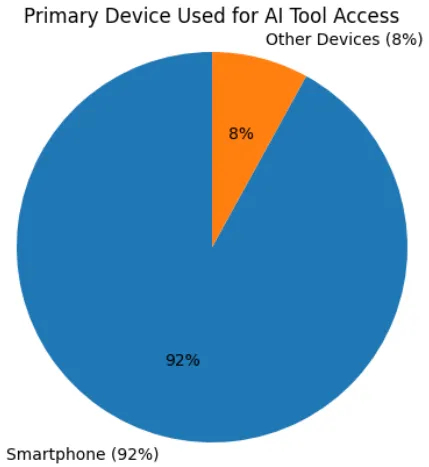
Device preference analysis showed a strong mobile-first tendency, with 92% of AI tool interactions conducted via smartphones. This usage pattern was strongly correlated with synchronization capability ratings (r = 0.76, p < 0.01), indicating that seamless cross-device experiences play a key role in sustained adoption.
在设备使用方面,AI工具呈现出明显的“移动优先”特征,92%的使用行为发生在智能手机端。同时,设备同步能力评分与使用行为之间存在显著正相关(r=0.76,p<0.01),表明跨设备无缝体验是影响持续使用的重要因素。
User Experience Comparison用户体验对比分析

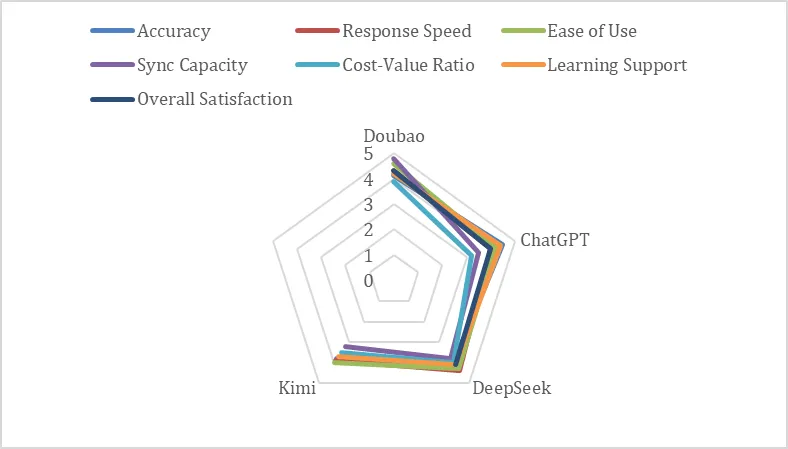
Doubao’s high synchronization score (4.8) is closely associated with its leading market share, highlighting seamless device switching as a key driver of student adoption; meanwhile, despite ChatGPT achieving the highest accuracy rating (4.5), frequent fact-checking remains common, indicating that perceived accuracy does not necessarily translate into full academic trust, while DeepSeek’s favorable cost-value evaluation has not resulted in higher usage, suggesting that price advantages alone are insufficient to sustain adoption.
豆包凭借较高的设备同步评分(4.8)与其领先的市场占有率形成显著关联,表明流畅的跨设备体验是学生采用AI工具的重要驱动因素;与此同时,尽管ChatGPT在准确性评分上最高(4.5),用户仍普遍进行事实核查,说明感知准确性并不必然转化为学术信任;此外,深度求索较高的性价比评价并未带来更高使用率,表明价格优势本身难以支撑AI工具的持续使用。
Functional Application Patterns
AI工具功能使用分布

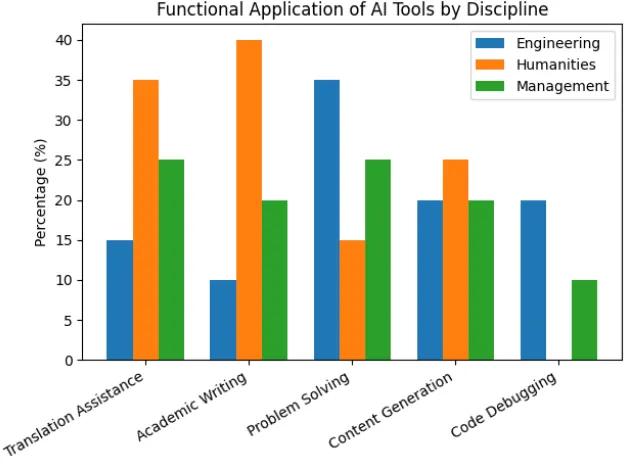
AI tool usage shows clear disciplinary differentiation, with engineering students focusing on problem solving and code debugging, humanities students prioritizing writing and translation, and management students displaying more balanced functional use.
AI工具的使用呈现出明显的学科差异:工科偏向问题求解与代码调试,人文学科侧重写作与翻译,管理类专业则表现出相对均衡的功能使用。
Accuracy and Trust Issues准确性与信任问题
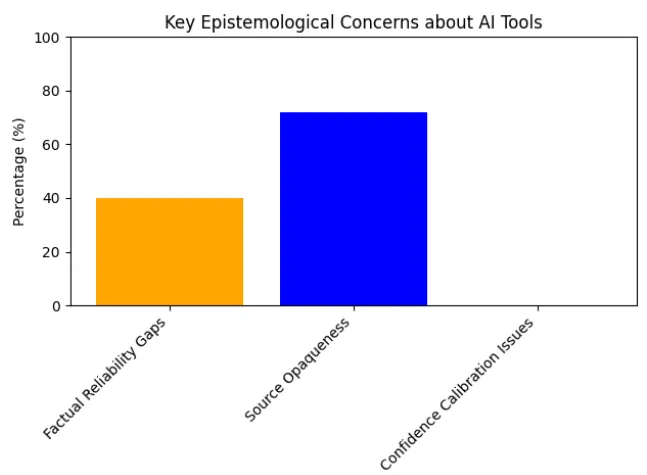
Despite high accuracy ratings, 40% of students expressed doubts about AI content in specialized fields, with engineering and humanities students highlighting domain-specific concerns. 72% of students also pointed out the lack of source attribution, undermining academic utility. Additionally, many struggled with calibrating trust in AI, suggesting the need for better AI literacy and confidence assessment training.
尽管准确性评分较高,40%的学生对AI在专业领域的内容表示怀疑,工科和人文学科学生有不同的关注点。72%的学生指出缺乏来源标注削弱了学术价值。许多学生在信任校准上遇到困难,表明需要加强AI素养教育,特别是信任评估的训练。
Academic Integrity Risks学术诚信风险
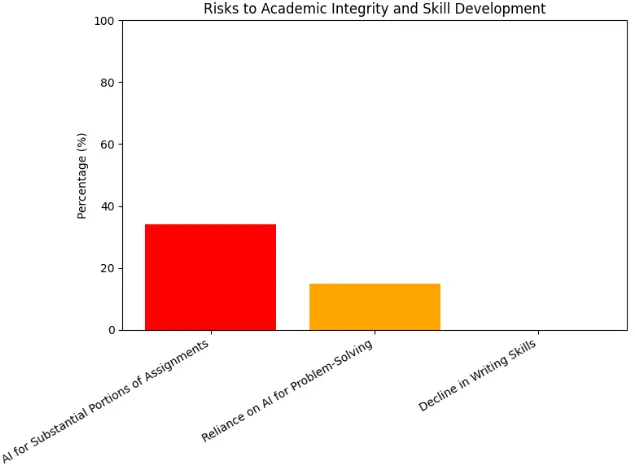
34% of students admitted using AI for substantial portions of assignments, blurring ethical lines, while 15% acknowledged plagiarism. Many also turned to AI at the first sign of difficulty, weakening critical thinking. English instructors reported declines in writing skills, linked to increased use of AI writing tools.
34%的学生承认在作业中大量使用AI工具,模糊了学术界限,15%的学生承认抄袭。许多学生在遇到困难时依赖AI,可能削弱批判性思维。英语教师表示,AI写作工具的使用增加与学生写作能力下降相关。

Survey Summary
调查总结
AI tool adoption among Chinese university students has reached a critical point, with significant differences across tools, disciplines, and use cases. While technology is important, user experience—especially mobile optimization and cross-device synchronization—is key for tool selection and retention. The tension between AI assistance and skill development presents a challenge that requires coordinated efforts from educators, developers, and policymakers. The study also reveals that trust and transparency are often overlooked in development but are crucial for future educational AI tools.
中国大学生AI工具的使用已达到关键阶段,不同工具、学科和使用场景中存在明显差异。 尽管技术能力很重要,用户体验,特别是移动优化和跨设备同步,对工具的选择和留存至关重要。AI辅助与技能发展之间的矛盾是一个挑战,需教育者、开发者和政策制定者的共同应对。研究还发现,信任和透明度在开发中常被忽视,但对未来的教育AI工具至关重要。
END
文字:
250022202030-于瑞文
250022202017-董智杰
250082202007-林玉坤
250192201002-刘鸿志
250082201024-许文杰
编辑:250082303001-袁奇
审核:王亚舟
–第1006篇