ARTICLE · 1230751
10.22 考研英语阅读题源外刊模拟试题【难度6.0】
Section II Reading Comprehension
Part A
Directions: Read the following four texts. Answer the questions below each text by choosing A, B, C or D. Mark your answers on the ANSWER SHEET.
Text 2
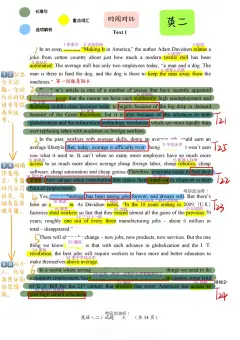
The leap second, an adjustment that many in the computing world regard as a nuisance, is to be replaced by a leap hour. Delegates from 69 countries approved the change at a meeting in France of the organisation that keeps the world’s standards of time, weight and distance, and it is due to start next year. The aim is to spare computers and other systems the risk of choking on minutes that run a second too long, or even a second too short.
The familiar leap year, devised more than 2,000 years ago, stops the calendar from drifting away from the Earth’s yearly orbit of the sun. The leap second is a far more modern invention. Since the arrival of atomic clocks, the second has been defined by the vibrations of a caesium atom rather than by the Earth’s rotation. Such clocks are remarkably steady, and modern computer networks, satellites, financial trading and power grids rely on their timekeeping. The Earth’s spin is much less dependable, since it is disturbed by the planet’s molten core, the movement of the oceans and the winds. Overall the planet is turning more slowly, and since 1972 officials have inserted 27 leap seconds to hold standard time close to astronomical time.
This worked for over half a century. Then scientists found fresh grounds for worry: during the last ten years the Earth has begun to spin faster, so the authorities could soon need their first negative leap second, which takes a second away from the clock. The estimated 30 per cent chance of that within a decade brought the vote forward.
Even positive leap seconds can do harm. When one was added in 2012, some operating systems could not handle a 61-second minute: servers locked up, networks dropped out, several popular websites crashed and airline flights were held up. A negative leap second could be more dangerous still, since no one has ever applied one and software may never have been tested against it. Testing every computer system that communicates with others worldwide would cost firms enormous sums, and it was this fear of expense that swung the vote.
Under the new rules, standard time may wander as much as an hour from astronomical time before a correction becomes necessary, something unlikely for thousands of years. A scientist on the committee that proposed the change noted that many countries already shift their clocks by an hour for daylight saving with little fuss.
Not everyone was convinced. Britain, whose national time is tied to Greenwich, had been reluctant to abandon leap seconds, and Russia raised objections over the effect on its satellite-navigation system. Even a researcher who monitors changes in the Earth’s rotation and welcomed the vote conceded that it merely leaves the real decision to people in the distant future.
26. According to Paragraph 2, leap seconds have been added since 1972 because
A. atomic clocks gradually drift away from true time
B. the calendar year is not a whole number of days
C. the Earth’s rotation is irregular and generally slowing
D. computer systems need regular corrections to stay accurate
27. What brought the vote forward, according to the text?
A. The growing number of leap seconds added since 1972.
B. The prospect of a first negative leap second.
C. The cost of testing computer systems worldwide.
D. The failures that followed the 2012 leap second.
28. It can be inferred from Paragraph 4 that a negative leap second
A. may be harder for software to handle than a positive one
B. has already caused serious problems for computer systems
C. was carefully tested before the vote took place
D. would be needed more often than a positive one
29. According to Paragraph 5, the leap hour
A. will be needed within the next ten years
B. will replace daylight saving in countries that use it
C. will be added whenever the Earth’s rotation speeds up
D. allows standard time to drift up to an hour before it is needed
30. What is the attitude of the researcher mentioned in the last paragraph towards the vote?
A. Opposed, because a leap hour will soon be needed.
B. Approving, though aware that it only postpones the decision.
C. Doubtful that it will reduce the risks to computer systems.
D. Enthusiastic, since it settles the matter for good.
附注:根据历年考研英语真题阅读题源外刊等,摘选最新文章,模拟仿真出题。
参考答案见以下。
Quick look: CBADB
26.【正确答案】C
【解析】题型:细节理解题(原因)
定位:第二段 “The Earth’s spin is much less dependable... Overall the planet is turning more slowly, and since 1972 officials have inserted 27 leap seconds to hold standard time close to astronomical time.”
分析:原子钟极为稳定,而地球自转既不可靠、总体上又在变慢,二者逐渐"对不上",所以官方自1972年起不断插入闰秒,使标准时间贴近天文时间。C项概括了这一原因。
干扰项:[A]”原子钟逐渐偏离真实时间"与原文相反,原文强调原子钟"remarkably steady";[B]"历年天数不是整数"张冠李戴,这是设置闰年(而非闰秒)的原因;[D]"计算机系统需要定期校正才能保持精确"偷换概念,原文中计算机系统是依赖原子钟计时的使用者,闰秒反而给它们带来风险,并非系统需要闰秒。
27.【正确答案】B
【解析】题型:细节理解题(因果辨析)
定位:第三段末句 “The estimated 30 per cent chance of that within a decade brought the vote forward.”
分析:近十年地球自转加快,未来十年内有约30%的可能需要首次加入负闰秒,这使投票得以提前。B项对应。注意原文区分了两个"原因":负闰秒的可能性使投票"提前",而对测试成本的担忧则是"左右了投票结果"(第四段末句)。
干扰项:[A]”自1972年以来所加闰秒越来越多"无中生有,原文只给出27个这一总数,没有说数量在增长,更没有把它当作提前投票的原因;[C]"测试全球计算机系统的成本"张冠李戴,这是左右投票结果的因素,不是使投票提前的因素;[D]"2012年闰秒之后的故障"答非所问,2012年的故障用来说明正闰秒也会带来危害,并非促使投票提前的新情况。
28.【正确答案】A
【解析】题型:推理判断题
定位:第四段 “A negative leap second could be more dangerous still, since no one has ever applied one and software may never have been tested against it.”
分析:负闰秒从未有人实施过,软件很可能从未针对它测试,因此可能比正闰秒更难应对、更危险。A项符合。
干扰项:[B]”已经造成严重问题"与原文相反,负闰秒从未实施过,谈不上已经造成问题(第四段所述故障是2012年的正闰秒引起的);[C]"投票前经过仔细测试"与原文相反,原文说软件可能从未测试过;[D]"比正闰秒更频繁需要"无中生有,原文只说有30%的可能首次需要,并未比较两者的频率。
29.【正确答案】D
【解析】题型:细节理解题
定位:第五段首句 “Under the new rules, standard time may wander as much as an hour from astronomical time before a correction becomes necessary, something unlikely for thousands of years.”
分析:新规则下,标准时间与天文时间的偏差可以达到一小时才需要校正,而这在数千年内都不太可能发生。D项对应"偏差可达一小时才需要"。
干扰项:[A]”未来十年内就需要"与原文相反,原文说数千年内都不太可能;[B]"将取代使用夏令时的国家的夏令时"无中生有,原文只是用夏令时来类比,说明一小时的调整人们已习以为常;[C]"每当地球自转加快就会加入"偷换概念,地球自转加快只是引发负闰秒担忧的原因,而闰时要等偏差累积到一小时才需要。
30.【正确答案】B
【解析】题型:态度推理题
定位:末段末句 “Even a researcher who monitors changes in the Earth’s rotation and welcomed the vote conceded that it merely leaves the real decision to people in the distant future.”
分析:这位研究者"欢迎"此次投票,但也承认它只是把真正的决定留给遥远未来的人们,也就是推迟了决策。B项概括了这种"赞成、但清楚只是推迟"的态度。
干扰项:[A]”反对,因为闰时很快就需要"与原文相反,他是欢迎的,而且闰时要很久以后才会用到;[C]"怀疑能否降低计算机系统风险"无中生有,原文未涉及他对风险问题的看法;[D]"热情,认为一劳永逸"程度夸大,他明确承认只是推迟了决策。
【参考译文】
闰秒是一种在计算机领域许多人眼中令人厌烦的校正手段,如今将被闰时取代。来自69个国家的代表,在法国举行的会议上批准了这一变更,该会议由负责维护全球时间、重量和距离标准的组织召开,新制度预计从明年开始实施。此举旨在让计算机和其他系统不必冒险应对多出一秒、甚至少了一秒的"一分钟"。
为人熟知的闰年创设于2000多年前,用来防止历法与地球绕太阳公转的周期逐渐错位。闰秒则是现代得多的发明。自原子钟问世以来,"秒"一直是以铯原子的振动,而不是以地球自转来定义的。这类钟表极为稳定,现代计算机网络、卫星、金融交易和电网都依赖其计时。地球的自转则远没那么可靠,会受到地球熔融内核、海洋运动和风的扰动。总体而言,地球转得越来越慢,因此自1972年以来,官方共插入了27个闰秒,使标准时间与天文时间保持接近。
这套办法行之有效了半个多世纪。随后科学家发现了新的忧虑:过去十年里,地球自转开始加快,因此有关部门可能很快就需要首次加入负闰秒,也就是从时钟上减去一秒。未来十年内出现这种情况的概率估计为30%,这使得此次投票提前举行。
即使是正闰秒也会造成危害。2012年加入闰秒时,一些操作系统无法处理61秒的一分钟:服务器死机,网络中断,几个热门网站崩溃,航班也被耽误。负闰秒可能更加危险,因为从来没有人实施过,软件很可能从未针对它测试过。要对全球范围内相互通信的每一个计算机系统进行测试,企业将花费巨额资金,正是对这笔开支的担忧左右了投票结果。
按照新规则,标准时间与天文时间的偏差可以达到一小时,才需要进行校正,而这在数千年内都不太可能发生。提出这项变更的委员会中的一位科学家指出,许多国家本来就会因夏令时把时钟拨快或拨慢一小时,也没有引起多大麻烦。
并非所有人都被说服。英国的国家时间与格林尼治紧密相连,一直不愿放弃闰秒;俄罗斯则对其卫星导航系统受到的影响提出异议。即便是一位监测地球自转变化、并对这次投票表示欢迎的研究者,也承认这一决定只是把真正的抉择留给了遥远未来的人们。
附注: