ARTICLE · 1314204
【优质课10】人教版高中英语选择性必修第一册 Unit 4 Body Language — Using Language教学设计
【优质课10】人教版高中英语选择性必修第一册 Unit 4 Body Language — Using Language教学设计
Zhao Jingxue
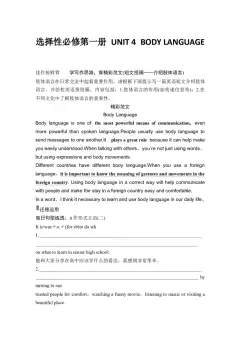
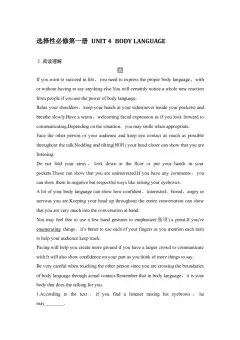
Basic Information • Textbook: Senior High English (People’s Education Press) Unit 4 Body Language, Using Language • Duration: 1 period (45 minutes) • Lesson Type: Reading‑for‑Writing (Reading‑Thinking‑Writing integration; reading to support writing) • Theme: How Do I Know My Students? • Students: Senior high students with basic expository reading competence. They can recognize simple body‑language signals but need guidance on text structure, writing devices and descriptive expressions to finish guided expository writing. • Big Idea: Body language is a vital form of non‑verbal communication. Observing and interpreting body language promotes mutual understanding between people. Teaching Objectives Linguistic Competence 1. Comprehend the expository text How Do I Know My Students? and identify its three‑part text structure. 2. Master key verbs and phrases describing body language: lean forward, make eye contact, lower one’s head, wear a frown, cross one’s arms, etc. 3. Recognize rhetorical devices: rhetorical questions, exemplification, contrast and cause‑and‑effect logic. 4. Compose the expository essay How Do I Understand My Classmate? by applying learned structure, devices and descriptive phrases. Cultural Awareness Realize the communicative value of body language as non‑verbal signals. Learn to observe others’ non‑verbal cues and build empathy for mutual understanding. Thinking Quality Develop inferential reading, summarizing skills, critical thinking (whether the last paragraph can be removed), appreciative analysis and knowledge transfer through question‑chain activities. Learning Competence Learn to write with reading scaffolds; master jigsaw cooperative writing; conduct self‑assessment and peer‑assessment with checklists; complete project‑based inquiry tasks after class. Key and Difficult Points • Key Points: Grasp the structure of exposition; identify rhetorical questions, contrast and cause‑and‑effect; accumulate body‑language expressions; finish cooperative guided writing. • Difficult Points: Transfer reading input (structure, devices, vocabulary) into independent writing; understand the two‑way communicative power of body language. Teaching Preparations Multimedia PPT, reading handouts, blackboard layout, jigsaw‑writing worksheets, assessment checklist, project‑homework report sheet. Teaching Procedures (45 mins) Step 1 Lead‑in (5 mins) 1. Greet students and review the unit theme — body language. 2. Set up an authentic context: The school newspaper runs a new column Heart‑to‑Heart with the theme His / Her Body Talks. Students act as columnists and need to write an article titled How Do I Understand My ____?. 3. Raise the real‑world writing challenge: “We want to finish this article, yet we are not sure how to organize ideas. Today we will read a sample essay How Do I Know My Students? written by an educator to get writing inspiration.” Design purpose: Create genuine reading motivation; implement reading‑to‑write. Step 2 Prediction (4 mins) 1. Students look at the title and illustrations, answer two predictive questions: ① Who might be the writer of this passage? ② What might be the answer to the title’s question? 2. Invite students to share answers and give evidence. Confirm the writer is a teacher and body language is the core answer. 3. Transition: “How does this teacher read students through body language? Let’s read for details.” Design purpose: Activate prior knowledge; lock in the core topic via inference. Step3 Read for Structure (7 mins) 1. Skimming task (3 mins): Students read the full text, divide the passage into parts and summarize the main idea for each section. 2. Co‑construct the three‑part framework on the blackboard: • Part 1 Introduction (Para.1‑2): Raise a question and introduce the topic of body language. • Part 2 Main Body (Para.3‑5): Illustrate how the teacher interprets students’ body language under different moods. • Part3 Reflection (Para.6): Reflect on the significance of reading body language for teachers. 3. Critical thinking discussion: Can the last part be removed? Why or why not? Clarify: The closing reflection elevates the theme and concludes the whole passage, so it cannot be deleted. Identify the genre: exposition. Design purpose: Train summarizing competence; build structural scaffolding for follow‑up writing. Step4 Read for Writing Techniques (8 mins) 1. Analyze Part 1: How does the writer arouse readers’ interest? 👉 Highlight rhetorical question: pose a question then offer an answer to hook readers. 2. Focus on Paragraph 3, pair discussion: What writing techniques are adopted? Guide students to spot: • Giving examples • Contrast (interested VS bored states) • Cause‑and‑effect relationships (teachers’ behaviors → students’ bodily responses) 3. Model a cause‑and‑effect case: When I make a joke (cause), they smile (effect). Design purpose: Decompose sample‑text rhetorical devices for writing output. Step5 Read for Language (7 mins) 1. Task: Underline verbs and verb phrases describing body language, and classify them according to characters’ feelings. ✅ Interested: look up, make eye contact, lean forward, look at me ✅ Bored / distracted: head lowered, stare out of window, absence of eye contact ✅ Troubled / anxious: cross one’s arms, wear a frown, hide faces in hands 2. Group activity: Left‑side students process Paragraph4; right‑side students process Paragraph5. Work in groups to pick out body‑language descriptions. 3. Draw a conclusion: Detailed verb phrases make body‑language descriptions vivid. Offer proper lexical support for abstract new words. Design purpose: Accumulate functional writing vocabulary to solve language barriers in output. Step6 Writing: Jigsaw Cooperative Writing (10 mins) 1. Review blackboard notes: three‑part structure, rhetorical question opening, contrast & cause‑and‑effect, descriptive action phrases. 2. Jigsaw‑writing task: Title How Do I Understand My Classmate? Group of 6 role assignment: • Member 1‑2: Paragraph 1 (Introduction) • Member 3‑4: Paragraph 2 (Main Body) • Member 5‑6: Paragraph3 (Reflection) 3. 5‑minute group writing on worksheets. After finishing, stick parts together to form a complete essay. 4. Assessing Session ① Students finish self‑assessment against the checklist. ② Invite one group to read their composition in front of the class. Other groups carry out peer‑assessment based on the checklist. ③ Teacher gives targeted feedback on strengths and improvement points. 📋 Writing Assessment Checklist ☐ Does the writer raise a rhetorical question at the beginning? ☐ Does the writer use contrast to show different body‑language states? ☐ Does the writer adopt cause‑and‑effect relationships? ☐ Does the writer apply detailed descriptive phrases for body language? ☐ Does the writer include reflection on the importance of body language? Design purpose: Jigsaw writing solves time limits in class and realizes full‑genre output; assessment checklist achieves teaching‑learning‑assessment integration. Step7 Further Thinking (3 mins) 1. Speculative question: Do we learn body language merely to understand other people? 2. Present Roland Barthes’ quote: What I hide by my language, my body utters. Play the short supporting video. 3. Theme conclusion: Body language helps us not only read others but also express ourselves for better mutual understanding. (Update blackboard notes) Step8 Homework: Project‑based Task (1 min) Project: Dig further into the significance of body language 1. Observe your parents and shoot short videos of them at work. 2. Note down and analyze their body language from the videos. 3. Figure out how their body language helps or disturbs their work performance. 4. Put forward practical suggestions for improvement. 5. Prepare a group report and give a presentation in the next class. Blackboard Layout Unit4 Body Language — Using Language How Do I Understand My ____? Exposition 1. Introduction → rhetorical question 2. Main Body → identify body language Techniques: contrast; examples; cause‑and‑effect Expressions: lean forward; make eye contact; cross arms… 3. Reflection → significance ⭐ mutual understanding
英语学习法精华文章推荐:
双语阅读精华文章推荐: