(cid:31)(cid:30)(cid:31)(cid:31)(cid:30)(cid:29)(cid:28)(cid:29)
(cid:28)(cid:27)(cid:26)(cid:31) (cid:25)(cid:24)(cid:23)(cid:30)(cid:27)(cid:26)(cid:25)(cid:24)(cid:22)(cid:21)(cid:20)(cid:29)(cid:19)(cid:23)(cid:26)(cid:22)(cid:21)(cid:26) (cid:18)(cid:17)(cid:16)(cid:15)(cid:31)(cid:31)(cid:30)(cid:29)(cid:28)(cid:27)G&’H’("332?IJK3’,$%L?K2?GMN-&L?O(’P%&,’#2?Q&%,,?R!$’("S)T’5’#%L)
!)GMN-&L)O(’P%&,’#2)Q&%,,)977.
U$’,)%L’#’-()!)V&’#’(H?W&-JI?-N?!"#$%&’>?GMN-&L?O(’P%&,’#2?Q&%,,?R!$’("S?T’5’#%L?"(L?X’3’(?Q&%,,?97.9
"GMN-&L# ’,?"?&%H’,#%&%L?#&"L%5"&Y?-N?GMN-&L?O(’P%&,’#2?Q&%,,
*+,-./0$12&3456¥/
!?GMN-&L?O(’P%&,’#2?Q&%,,?977.
(cid:151)/! ƒ%7§ ):¤' *+,-./0$12&3456“fg./097.9
GMN-&L?«*+,-./0‹›fifl(cid:159)(cid:176)
/–†3‡ ·(cid:181)/–†3¶¡•‚„” »…‰\Au(cid:190)¿\A(cid:192)`' \A(cid:139)´' \Amˆ
˜(cid:134)' ¯˘˙¨(cid:201)(cid:151)¡‹˚¸' mˆ˙k(cid:204)‡
!"#$%&’()
! " # !"#$%&’(%)*"+,-($) %&
%’() *+,-./0$12&3456%789):;<=
1’() >?@ A B
C ( ) DEF GHI
) : JKL M N OPQ RST UVW X Y Z2W
[\)] JKL ^_‘
abcd *+,-./0$12&3456 cde
fg./0 h i
j k lmn opq rst
. / fg./0
u v wxyzw{.|/}
~ (cid:127) 0’"-1"’!2’3’(41-5
(cid:128)(cid:129)(cid:130)(cid:131) 677(cid:132)89:(cid:132)87;8
89(cid:130)(cid:131) 79<(cid:132):=;<:=68>?:=;@9::8
(cid:133) (cid:134) (cid:135)T(cid:136)(cid:137)./(cid:138)(cid:139)(cid:140)(cid:141)3456
(cid:142) (cid:143) (cid:135)T(cid:136)(cid:137)./(cid:138)(cid:139)(cid:140)(cid:141)3456
(cid:134) (cid:144) (cid:135)T(cid:136)(cid:137)(cid:145)(cid:146)(cid:134)(cid:147)(cid:148)(cid:149)3456
(cid:150) (cid:151) @:@(cid:152)(cid:153)!.789(cid:152)(cid:153) .A.;
(cid:134) (cid:154) :B@<
/ (cid:155) 97.9(cid:156) ..(cid:157)(cid:158) 9/
(cid:134) (cid:155) 979.(cid:156) ..(cid:157)(cid:158) .7(cid:155)(cid:134)(cid:144)
(cid:159)(cid:160)¡| CDEF?8@:(cid:132)@(cid:132)<66@(cid:132)==9@(cid:132)6
¢ £ :B@=⁄
!"#$!%"&’
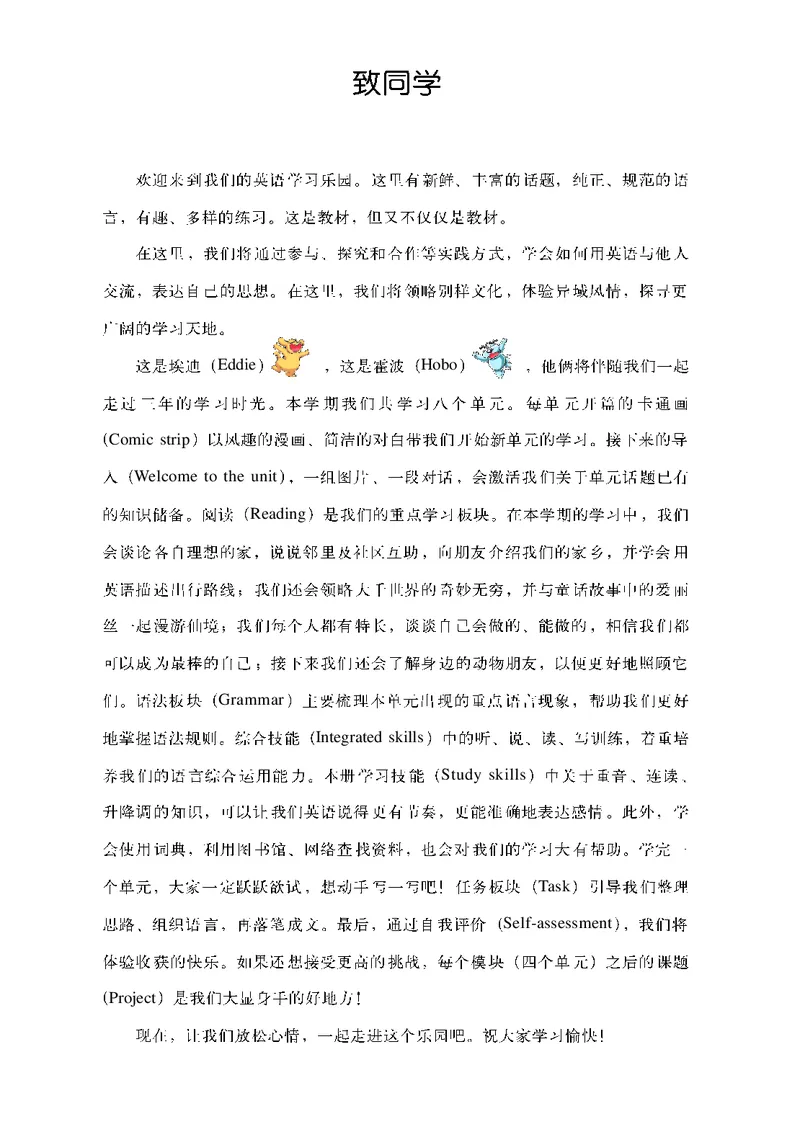
()*+, -./012 3456789:; <=> 677?:9:@..=9Eddie Hobo
Comic strip
Welcome to the unit
Reading
Grammar
Integrated skills
Study skills
Task
Self-assessment
ProjectUnit Reading Grammar
Appendices: Irregular verbs (pp. 106—107) Notes (pp. 108—116) Grammar check (pp. 117—123)
doohruobhgien
dna
emoH
1
eludoM
sgniht
lufrednoW
2
eludoM
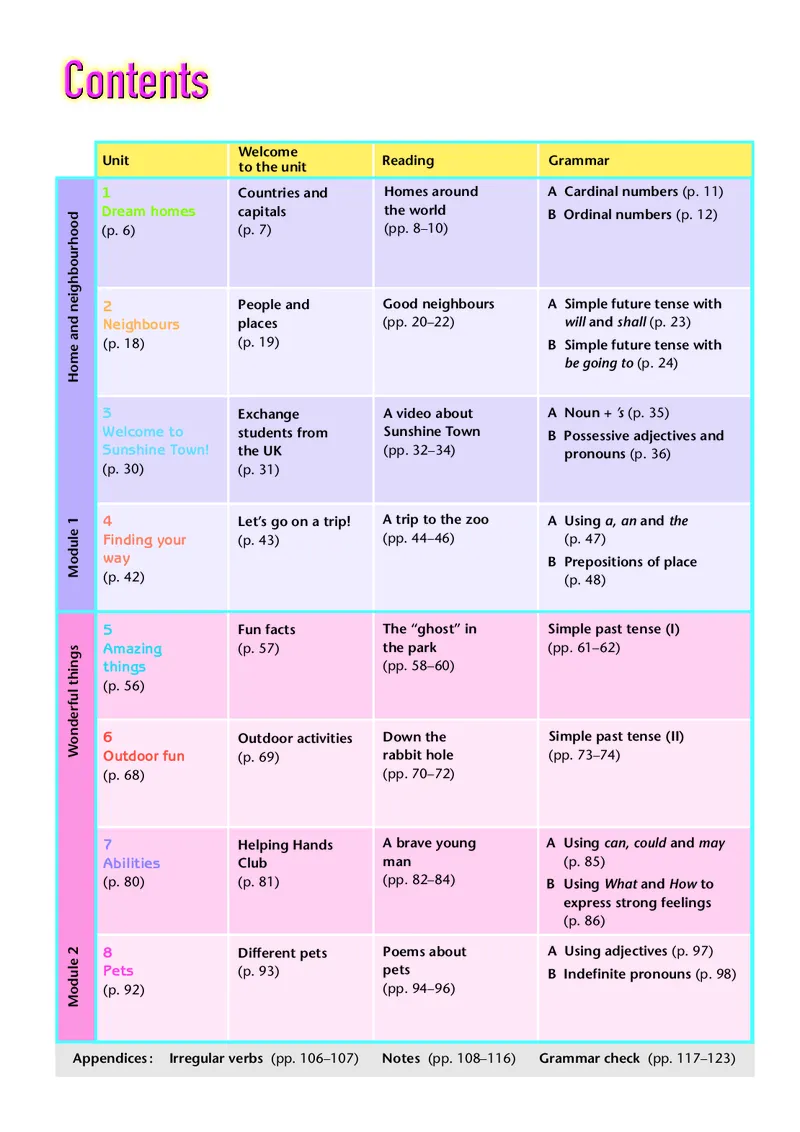
Welcome
to the unit
1 Countries and Homes around A Cardinal numbers (p. 11)
Dream homes capitals the world B Ordinal numbers (p. 12)
(p. 6) (p. 7) (pp. 8—10)
2 People and Good neighbours A Simple future tense with
Neighbours places (pp. 20—22) willand shall(p. 23)
(p. 18) (p. 19) B Simple future tense with
be going to(p. 24)
3 Exchange A video about A Noun + ’s(p. 35)
Welcome to students from Sunshine Town B Possessive adjectives and
Sunshine Town! the UK (pp. 32—34) pronouns (p. 36)
(p. 30) (p. 31)
4 Let’s go on a trip! A trip to the zoo A Using a, anand the
Finding your (p. 43) (pp. 44—46) (p. 47)
way B Prepositions of place
(p. 42) (p. 48)
5 Fun facts The “ghost” in Simple past tense (I)
Amazing (p. 57) the park (pp. 61—62)
things (pp. 58—60)
(p. 56)
6 Outdoor activities Down the Simple past tense (II)
Outdoor fun (p. 69) rabbit hole (pp. 73—74)
(p. 68) (pp. 70—72)
7 Helping Hands A brave young A Using can, couldand may
Abilities Club man (p. 85)
(p. 80) (p. 81) (pp. 82—84) B Using Whatand Howto
express strong feelings
(p. 86)
8 Different pets Poems about A Using adjectives (p. 97)
Pets (p. 93) pets B Indefinite pronouns (p. 98)
(p. 92) (pp. 94—96)tcejorP
)501—401
.pp(rettelswen
loohcs
A
2
tcejorP
Wordlists (pp. 124—136) Proper nouns (pp. 137—138)
)55—45
.pp(
ediug
tsiruot
A
1
tcejorP
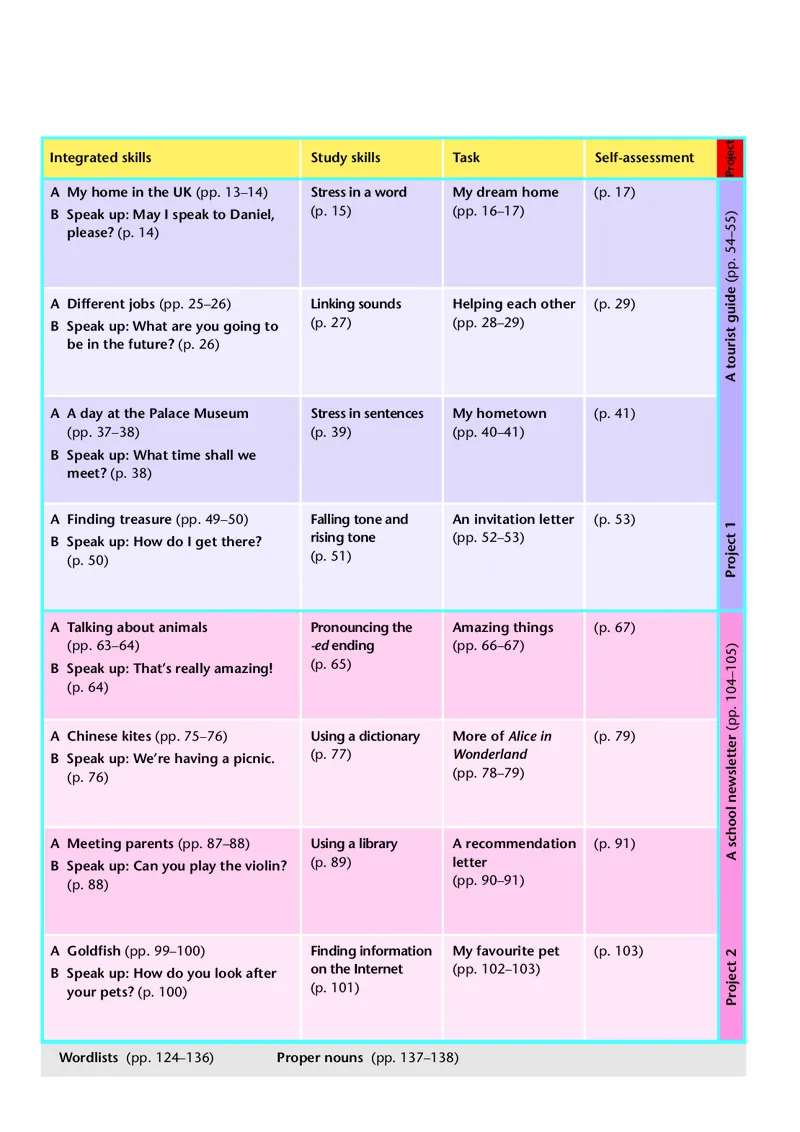
Integrated skills Study skills Task Self-assessment
A My home in the UK (pp. 13–14) Stress in a word My dream home (p. 17)
B Speak up: May I speak to Daniel, (p. 15) (pp. 16—17)
please? (p. 14)
A Different jobs (pp. 25–26) Linking sounds Helping each other (p. 29)
B Speak up: What are you going to (p. 27) (pp. 28—29)
be in the future? (p. 26)
A A day at the Palace Museum Stress in sentences My hometown (p. 41)
(pp. 37–38) (p. 39) (pp. 40—41)
B Speak up: What time shall we
meet? (p. 38)
A Finding treasure (pp. 49–50) Falling tone and An invitation letter (p. 53)
B Speak up: How do I get there? rising tone (pp. 52—53)
(p. 50) (p. 51)
A Talking about animals Pronouncing the Amazing things (p. 67)
(pp. 63–64) -edending (pp. 66—67)
B Speak up: That’s really amazing! (p. 65)
(p. 64)
A Chinese kites (pp. 75–76) Using a dictionary More of Alice in (p. 79)
B Speak up: We’re having a picnic. (p. 77) Wonderland
(p. 76) (pp. 78—79)
A Meetingparents (pp. 87–88) Using a library A recommendation (p. 91)
B Speak up: Can you play the violin? (p. 89) letter
(p. 88) (pp. 90—91)
A Goldfish (pp. 99–100) Finding information My favourite pet (p. 103)
B Speak up: How do you look after on the Internet (pp. 102—103)
your pets? (p. 100) (p. 101)Unit 1
1 2
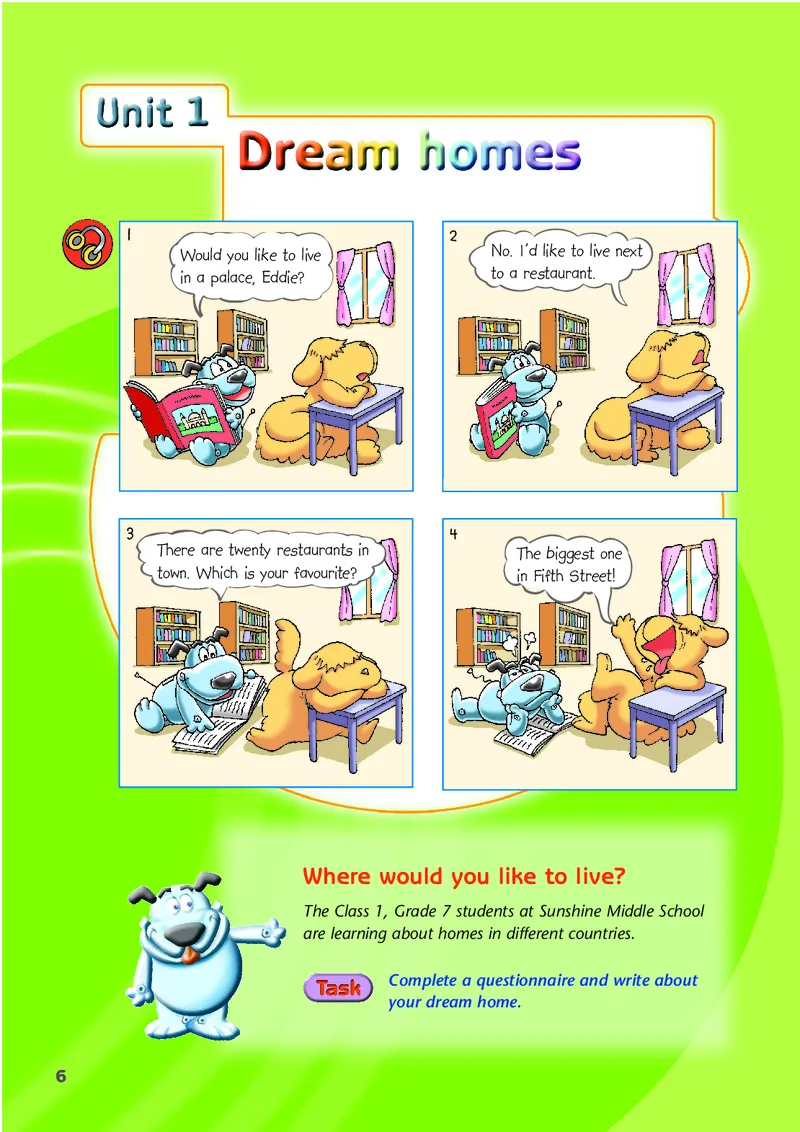
Would you like to live No. I’d like to live next
in a palace, Eddie? to a restaurant.
3 4
There are twenty restaurants in The biggest one
town. Which is your favourite? in Fifth Street!
Where would you like to live?
The Class 1, Grade 7 students at Sunshine Middle School
are learning about homes in different countries.
Complete a questionnaire and write about
your dream home.
6Unit 1
Countries and capitals
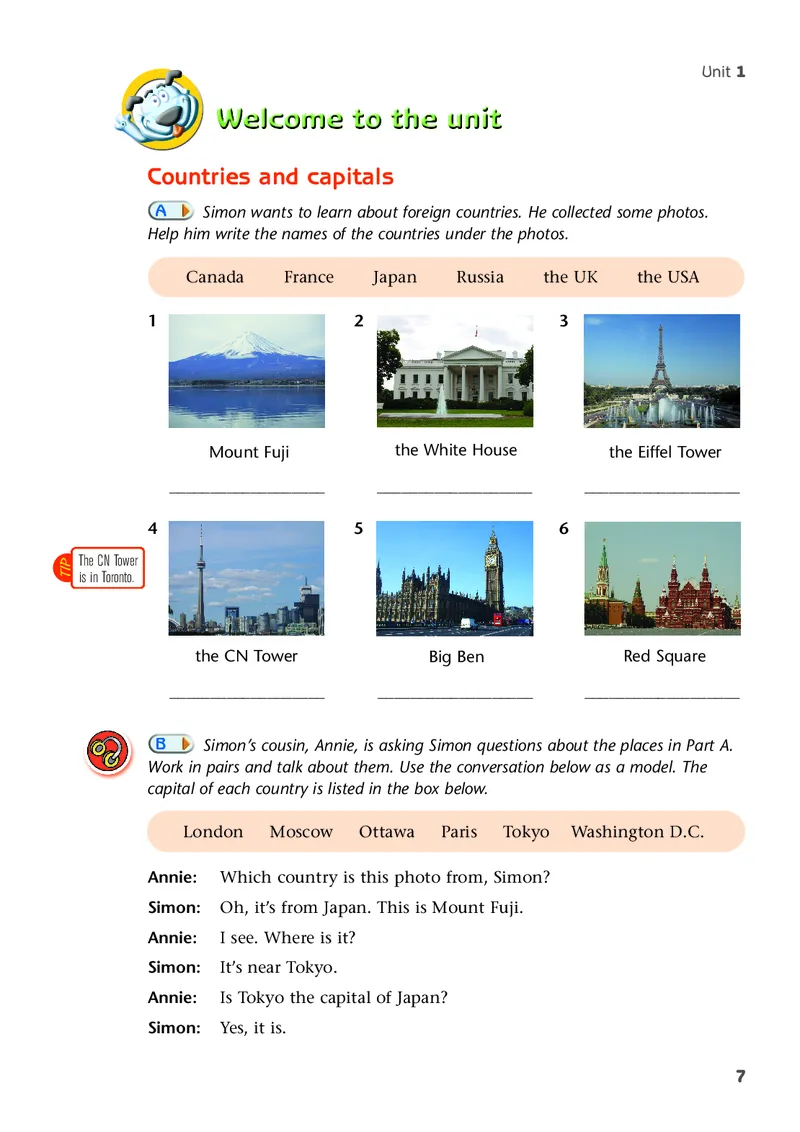
Simon wants to learn about foreign countries. He collected some photos.
Help him write the names of the countries under the photos.
Canada France Japan Russia the UK the USA
1 2 3
Mount Fuji the White House the Eiffel Tower
___________________ ___________________ ___________________
4 5 6
The CN Tower
is in Toronto.
the CN Tower Big Ben Red Square
___________________ ___________________ ___________________
Simon’s cousin, Annie, is asking Simon questions about the places in Part A.
Work in pairs and talk about them. Use the conversation below as a model. The
capital of each country is listed in the box below.
London Moscow Ottawa Paris Tokyo Washington D.C.
Annie: Which country is this photo from, Simon?
Simon: Oh, it’s from Japan. This is Mount Fuji.
Annie: I see. Where is it?
Simon: It’s near Tokyo.
Annie: Is Tokyo the capital of Japan?
Simon: Yes, it is.
7
PITUnit 1
A Homes around the world
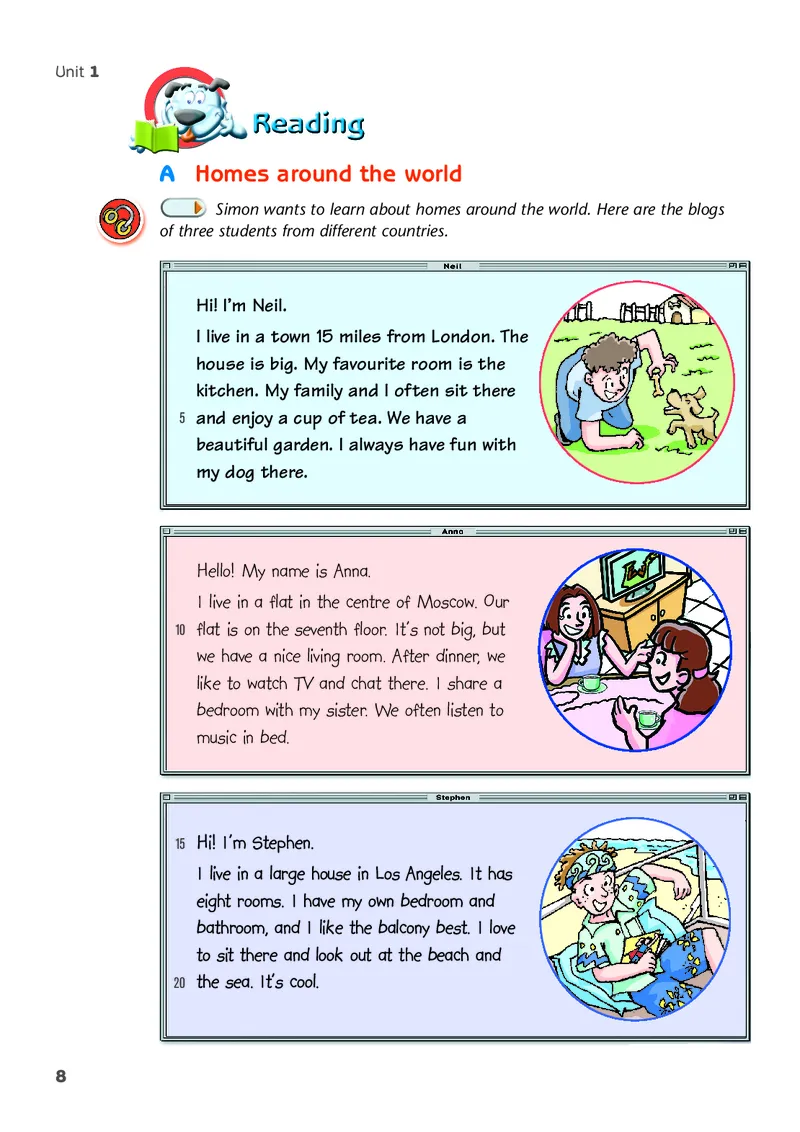
Simon wants to learn about homes around the world. Here are the blogs
of three students from different countries.
Hi! I’m Neil.
I live in a town 15 miles from London. The
house is big. My favourite room is the
kitchen. My family and I often sit there
5 and enjoy a cup of tea. We have a
beautiful garden. I always have fun with
my dog there.
Hello! My name is Anna.
I live in a flat in the centre of Moscow. Our
10 flat is on the seventh floor. It’s not big, but
we have a nice living room. After dinner, we
like to watch TV and chat there. I share a
bedroom with my sister. We often listen to
music in bed.
15 Hi! I’m Stephen.
I live in a large house in Los Angeles. It has
eight rooms. I have my own bedroom and
bathroom, and I like the balcony best. I love
to sit there and look out at the beach and
20 the sea. It’s cool.
8Unit 1
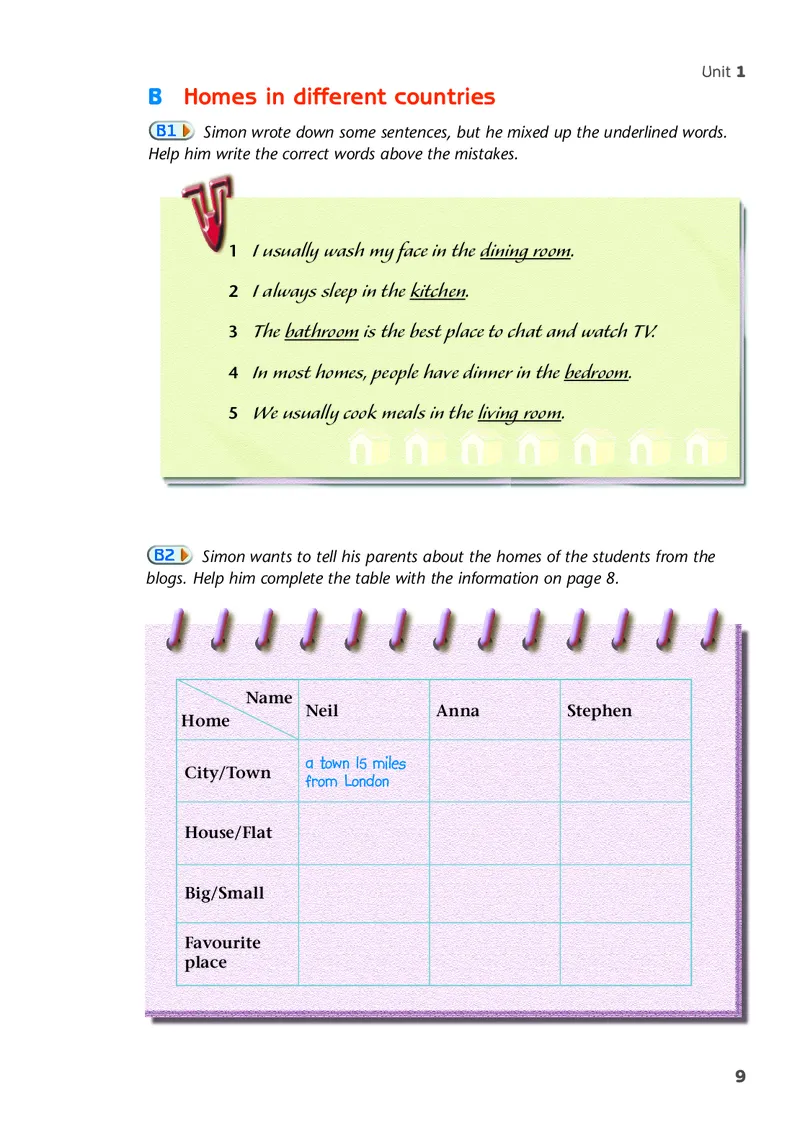
B Homes in different countries
Simon wrote down some sentences, but he mixed up the underlined words.
Help him write the correct words above the mistakes.
1 I usually wash my face in the dining room.
2 I always sleep in the kitchen.
3 The bathroom is the best place to chat and watch TV.
4 In most homes, people have dinner in the bedroom.
5 We usually cook meals in the living room.
Simon wants to tell his parents about the homes of the students from the
blogs. Help him complete the table with the information on page 8.
Name
Neil Anna Stephen
Home
a town 15 miles
City/Town
from London
House/Flat
Big/Small
Favourite
place
9Unit 1
Simon is telling his parents about the homes of the three students. Write
a T if a sentence is true or an F if it is false.
1 Neil lives in the centre of London. _________
2 Neil always has fun with his cat in the garden. _________
3 Anna and her family often watch TV and chat in their kitchen. _________
4 Anna does not have her own bedroom. _________
5 There are eight rooms in Stephen’s house. _________
6 Stephen lives near the sea. _________
There are more pictures on the students’ blogs. Look at the pictures and
help Simon complete the sentences.
Russia balcony listen to music in bed
the UK bedroom sit there and enjoy a cup of tea
the USA kitchen sit there and look out at the sea
1
This is Stephen from ______________.
He is chatting with his friends on his
______________. He loves to
___________________________________.
2
This is Anna from _______________.
She shares a _______________ with
her sister. They often
________________________________.
3
This is Neil from ________________.
He is sitting in the ______________.
He and his family often
________________________________.
10Unit 1
When we say
thirteen, we
stress the second
syllable. When we
say thirty, we
stress the first
syllable.
11
PIT
A Cardinal numbers
We use cardinal numbers almost every day. We use them to talk about the
numbers of people or things.
0 1 2 3 4 5 6 7 8 9
zero one two three four five six seven eight nine
10 11 12 13 14
ten eleven twelve thirteen fourteen
15 16 17 18 19
fifteen sixteen seventeen eighteen nineteen
20 30 40 50 60 70 80 90
twenty thirty forty fifty sixty seventy eighty ninety
100 1,000 10,000
one hundred one thousand ten thousand
100,000 1,000,000
one hundred thousand one million
How do we say the following numbers?
4,056 = four thousand and fifty-six
23,813 = twenty-three thousand eight hundred and thirteen
567,110 = five hundred and sixty-seven thousand one hundred and ten
6,425,200 = six million four hundred and twenty-five thousand two hundred
Learning about different countries
Simon is collecting some information about different countries. Help him
read the numbers correctly.
1 People from about 180 countries and areas live in New York.
2 The CN Tower is 1,815 feet tall.
3 Red Square in Moscow is about 91,000 square metres in size.
4 France has an area of over 260,000 square miles.
5 There are about 8,000,000 people living in London.
6 Tokyo, the capital of Japan, has over 13,000,000 people.Unit 1
B Ordinal numbers
We use ordinal numbers to order things and events. We use them to talk
about dates, floors, positions, etc.
Women’s Day is on the eighth of March.
Our flat is on the seventh floor.
He is always the first to come to school in our class.
How do you write it?
Millie is doing a test on numbers. Look at the numbers below and help
her write the numbers out in words.
Cardinal numbers Ordinal numbers
1 = one 11 = eleven 1st = first 11th = eleventh
2 = 12 = 2nd = second 12th = twelfth
3 = 13 = 3rd = third 19th =
4 = four 19 = nineteen 4th = fourth 20th = twentieth
5 = five 20 = 5th = fifth 21st = twenty-first
6 = 21 = twenty-one 6th = 22nd =
7 = 30 = thirty 7th = 23rd =
8 = 40 = 8th = 30th =
9 = nine 100 = 9th = ninth 40th = fortieth
10 = 101 = 10th = 100th =
Simon wants to tell his classmates where his friends live. Look at the building.
Complete the sentences with the correct floor numbers.
15 Ivan
In British English, 14
1 Elsa lives on the ________________ floor.
the floor of a 13
building at street 12 Wilson
2 Ivan lives on the ________________ floor.
level is the 11
ground floor (G). 10
3 Mary lives on the ________________ floor. 9 Ricky
8
4 Peter lives on the ________________ floor. 7 Elsa
6
5 Ricky lives on the ________________ floor.
5
4 Mary
6 Wilson lives on the ________________ floor. 3
2 Peter
1
G
12
PITUnit 1
A My home in the UK
Neil made a video of his house in the UK. He sent it to Simon. First, write the
name of the place under each picture. Then listen to Neil and put the pictures in the
correct order. Write the numbers 1—6 in the boxes.
a b
c d
e f
Listen to Neil telling more about his house. Help Simon label the things in
Part A1 with the words in the box.
flowers forks fridge knives lamp
picture shower sofa toilet TV
13Unit 1
Help Simon complete his email to Neil with the correct words in the box.
beautiful bedroom garden house living room rooms
Dear Neil,
Thanks for your video.
Your (1)_______________ is really different from the flats here in our town.
Your (2)_______________ is full of flowers. It looks (3)_______________.
I also like your (4)_______________. It looks big and comfortable. There
are many (5)_______________ in your house, and you have your own
(6)_______________. It is really nice. I also have a bedroom of my own,
but it is not big.
I hope to visit your home some day.
All the best,
Simon
B Speak up: May I speak to Daniel, please?
Simon wants to speak to Daniel, but Daniel is not at home. His father
answers the phone. Work in pairs to make a phone call. Use the conversation
below as a model.
Daniel’s father: Hello?
Simon: Hello. May I speak to Daniel, please?
Daniel’s father: Sorry, he’s not at home. Who’s speaking, please?
Simon: This is Simon. I’m calling from my new home.
Daniel’s father: New home? That’s great! Can I take a message?
Simon: Yes, please. Can you ask him to call me back? My new
telephone number is 5557 2188.
Daniel’s father: Five, five, five, seven, two, one, double eight, right?
Simon: Right. Thanks. Goodbye.
14Unit 1
Stress in a word
When we pronounce words with more than one
syllable, we stress one of the syllables. The stressed
syllable sounds stronger. The stress can be on the
first, middle or last syllable of a word.
Listen and practise saying these words.
Stressing the first syllable
1 beau•ti•ful
2 coun•try
3 pal•ace
Stressing the second syllable
1 ex•pen•sive
Today.
No. It should be today.
2 po•ta•to
3 to•mor•row
Stressing the last syllable
1 be•tween
2 en•joy
3 Hal•low•een
Listen and underline the stressed syllable of each word.
1 cen•tre 4 Oc•to•ber 7 fa•vour•ite
2 bath•room 5 mes•sage 8 won•der•ful
3 hun•dred 6 in•clude 9 de•sign
Work in pairs. Take turns to read the words in Part B aloud. The stressed
syllable of each word should sound stronger than the other syllable(s).
15Unit 1
My dream home
Complete the questionnaire below with your own information.
Last name: __________ First name: __________ Age: __________
Telephone number: _________________________________________________
What kind of home do you live in? Put a tick (✓) in the box.
House How many floors are there in your house? __________
Flat How many floors are there in your building? __________
Do you have a garden? __________
How many rooms are there in your home? __________
How many people live in your home? __________
Who are they? _____________________________________________________
Put a tick (✓) in the box next to the things you have in your home.
balcony computer fridge
living room shower sofa
study toilet washing machine
There is a/an ... in front of/behind/beside ....
It has ... floors.
There is/are ... on the ground/second floor.
There is/are always enough ... there.
I would like to invite my friends to ....
My friends like to ....
It is great fun!
16Unit 1
Read Simon’s article about his dream home.
My dream home
My dream home is at the foot of a hill. It has three floors. There is a
football field behind my house and a swimming pool beside it.
There is a kitchen and a home cinema on the ground floor. The kitchen
is very clean. There is always more than enough food there. The cinema
has a large TV. I would like to invite my friends to watch films with me
at the weekend.
On the first floor, there are six bedrooms. Each room has a new computer
and all the beds are comfortable. My friends like to come and stay here.
There are two large rooms on the second floor. My friends and I have
parties there. It is great fun!
Write an article about your dream home. Use Simon’s article as a model.
I can Examples Result
1 talk about the three homes
in different countries.
2 use the new words to talk
about my (dream) home.
3 use cardinal numbers and
ordinal numbers to talk about
people and things.
4 stress the right syllable of
each word.
Result: Wonderful! Good! Not bad!
I need to spend more time on ___________________________________.
171 2
I’m going to visit our
Hi, Hobo. Where
new neighbours.
are you going?
3 4
Wow! New neighbours!
I’ll meet them too!
I’m afraid they won’t
welcome visitors like you.
Neighbours
The Class 1, Grade 7 students are discussing life in
their neighbourhood.
Write about how people help each other
in your neighbourhood.
18Unit 2
People and places
Where can you find these people? Match them with the places. Write the
correct letters in the boxes.
1 2 3
waiter doctor teacher
4 5 6
nurse student cook
a b c
Amy is asking Simon about his neighbourhood. Work in pairs and talk about
your neighbourhood. Use the conversation below as a model.
Amy: Where do you live, Simon?
Simon: I live in a flat in City Garden in Ninth Street.
Amy: How many buildings are there in your neighbourhood?
Simon: There are about 20 buildings. Most of them have 14 floors.
Amy: What do you have around your neighbourhood?
Simon: We have supermarkets, restaurants, a school and a hospital.
Amy: Do you like living there?
Simon: Yes. It’s good to live in a neighbourhood like that.
19Unit 2
A Good neighbours
Amy wants to learn more about Simon’s neighbours. Read their conversation.
Amy: Hi, Simon. What are your neighbours like?
Simon: They’re kind and helpful. Some of them are volunteers.
They often meet at the community centre and share their
different skills. They help us with all kinds of problems.
5 Amy: When do they meet?
Simon: Usually they have a “helping hands” meeting at the
weekend.
Amy: Are they going to have a meeting this weekend?
Simon: Yes. There’s something wrong with my computer. I’m going
10 to ask a computer engineer to check it. My cousin Annie’s
bicycle is broken, so she’s going to ask someone to fix it.
Amy: Can you find anyone to help you with your homework?
Simon: Yes. Some college students are ready to help.
Amy: That’s really nice. Do the volunteers help the old people too?
15 Simon: Yes. Some of them often visit the old people and do some
shopping for them. This weekend, they’ll help the old
people clean their flats.
Amy: That’s great! You’re lucky to live in a neighbourhood like
that, Simon.
20Unit 2
B About Simon’s neighbours
Simon is showing Amy some pictures from the community centre. Help
him complete the sentences with the words in the box.
bicycle college computer engineer fixing shopping
1 2
This volunteer often does some The ____________ student is
____________ for the old man. helping the boy with his
homework.
3 4
The man is ____________ the The ____________ is checking the
girl’s ____________. ____________.
Amy is writing something about Simon’s neighbours. Read her notes. Write
a T if a sentence is true or an F if it is false.
1 Volunteers share their skills and help people in
the neighbourhood with different problems. _________
2 Usually there is a meeting at the weekend. _________
3 Simon wants to ask someone to fix his bicycle. _________
4 Annie’s computer is broken. _________
5 Parents help their children with their homework. _________
6 Volunteers also help the old people. _________
21Unit 2
Simon is writing about his neighbours for the school newsletter. Help him
complete his article with the words in the box.
all kinds of at the weekend broken check different skills
fix homework lucky problems ready to help
My neighbours
My neighbours are kind and helpful. Some of them are volunteers.
They have (1) _____________________ and often help us with
(2) _____________________ problems.
Usually there is a “helping hands” meeting
(3)
_____________________.
People go there when they need help with their
(4)
_____________________.
Computer engineers are popular. They help people (5) _____________________
their computers. You can also find someone to (6) _____________________
things like
(7)
_____________________bicycles.
Students can get help with their
(8)
_____________________. There are
some college students among the volunteers, and they are always
(9)
_____________________. Volunteers also help the old people.
We are (10) _____________________ to live in a neighbourhood like that.
People here are like a big family.
22Unit 2
I will/shall
= I’ll
I will not
= I won’t
I shall not
= I shan’t
23
PIT
We usually
use will. We
only use
shallwith I
or we, and
this usage is
becoming
old-fashioned.
PIT
A Simple future tense with will and shall
We use will or shall when we talk about
1 things that are sure to happen in the future:
It will rain this afternoon.
2 plans that we are making now:
I will take an umbrella with me.
We make positive and negative sentences using the simple future tense like this:
I/We will (not)/shall (not)
go.
You/They/He/She/It will (not)
We ask and answer questions using the simple future tense like this:
Will/Shall I/we
go?
you/they/
Will
he/she/it
will not/
I/we will/shall. I/we
shall not.
Yes, No,
you/they/ you/they/
will.
he/she/it he/she/it will not.
Asking for help
Simon’s computer is broken. He is asking someone at the community centre
for help. Complete their conversation with the simple future tense of the verbs in
brackets.
Mr Lin: Hello, Simon. Do you need any help?
Simon: Yes, Mr Lin. There’s something wrong with my computer.
Mr Lin: OK. We (1) ________________(ask) an engineer to check it for you.
Simon: When (2) ________________the engineer ________________ (be) free?
Mr Lin: Well, we (3) ________________(call) him first. (4) ________________you
________________ (wait) for us to call back?
Simon: All right. I (5) ________________(wait) for your call. Thanks.
Mr Lin: You’re welcome.PIT
Unit 2
We often use When we use
some time be going to
expressions without a time
when we talk expression, we
about the are talking
future. about the near
this afternoon future.
tonight
tomorrow
the day after
tomorrow
this Sunday
next Tuesday
next week
24
PIT
B Simple future tense with be going to
We use be going to when we talk about
1 something we decide to do:
I am going to visit our new neighbours.
She is going to watch the film next Friday.
2 things that will probably happen:
It is nine o’clock. We are going to be late.
It is so cloudy. I think it is going to rain.
We ask and answer questions with be going to like this:
Am I
Are you/we/they going to have a party tomorrow?
Is he/she/it
I am. I am not.
Yes, you/we/they are. No, you/we/they are not.
he/she/it is. he/she/it is not.
Planning a day out
Simon is telling Amy about his plan for a day out with his uncle’s family.
Help him use the correct forms of be going to to talk about his plan.
Simon: Hi, Amy. My parents and I are planning a day out
with my uncle’s family the day after tomorrow.
Amy: Great! What (1) ____________you ____________(do)?
Simon: I (2) ________________ (buy) some food, and my cousin
Annie (3) ________________ (buy) some plates and forks.
Amy: What (4) ____________your parents ____________(do)?
Simon: They (5) ________________ (bring) some water.
Amy: How about your uncle?
Simon: He (6) ________________ (make) a fire.
Amy: And your aunt? What (7) ____________she ____________(do)?
Simon: She (8) ________________ (cook) some food.
PIT
are not = aren’t
is not = isn’tUnit 2
A Different jobs
Millie wants to know more about different jobs. Look at the following
pictures. Help her write the correct names under the pictures.
manager office worker company police station
policeman postman post office restaurant
1 2 3 4
5 6 7 8
Wendy, Millie’s penfriend, is talking about her family members’ jobs. Listen
to her and complete the table below.
Person Job Place
Wendy’s dad
Wendy’s mum
Wendy’s elder brother
Wendy’s elder sister
25Unit 2
Millie is making notes about Wendy’s family. Listen to Wendy again and
help Millie complete her notes below.
Wendy’s family
There are five people in Wendy’s family.
Her dad is a (1) ________________. He works in a (2) ________________
near her school. Sometimes he works (3) ________________.
Her mum works in a (4) ________________ in the town centre. She is
a (5) ________________, so she is always busy.
Her elder brother works in a (6) ________________. He is a
(7) ________________. He often goes to work (8) ________________. He
loves his job.
Her elder sister is an (9) ________________. She works for a
(10) ________________ far away from her home, so she goes to work
by train.
B Speak up: What are you going to be in the future?
Millie is talking with her classmates about their future jobs. Work in groups
and talk about what you are going to be. Use the conversation below as a model.
Millie: Hi, Daniel. What are you going to be in the future?
Daniel: I like computers. I’m going to be a computer engineer.
Millie: That’s interesting. I’m sure you’ll be good at it. I love school. I’m
going to be a teacher.
Sandy: I’m good at drawing. I’m going to be an artist.
Millie: That sounds like a good idea. And you, Amy?
Amy: I’m going to be a doctor. I want to help sick people. How about
you, Simon? What are you going to be?
Simon: I’m going to be a football player.
26Unit 2
Linking sounds
We often link sounds together when we speak English. There are four
different ways of linking sounds together.
1 We usually link a consonant sound with a vowel sound.
an apple stand up in an hour
2 When the first word ends in -r or -re and the next word begins with a
vowel sound, we join them together with a /r/ sound between them.
there are for us here is
3 When there are two vowel sounds, we join them as if there were a /j/ or
/w/ sound between them.
we enjoy go out the other
4 When two consonant sounds of two words meet, we sometimes do not
need to pronounce the first consonant sound.
best time sit down a big cake
Listen carefully. See how you can link the following words together. Then
practise saying them.
1 cold ice 3 an egg 5 turn on
2 big orange 4 an umbrella 6 get up
Listen carefully to these words. Then practise saying them.
1 there is 3 far away 5 more or less
2 here are 4 four of us 6 over again
Listen carefully to these words. Then practise saying them.
1 high up 3 three exercises 5 no other
2 the area 4 go in 6 two oranges
Listen carefully to these words. Then practise saying them.
1 next team 3 keep busy 5 best doctor
2 cold drink 4 white cat 6 hard time
27Unit 2
Helping each other
Simon is looking at the noticeboard of the community centre. Read the
notices.
Notices
Dear all,
We are going to have a “helping hands” meeting at the
community centre on the afternoon of 5 March.
Do you have any problems? Please look at the information
below. It may help you!
City Garden Community Centre
Are you not feeling well
these days? Do not worry. Is your washing machine
There are good doctors and not working? Is there
nurses here. They will make anything wrong with your
you feel better! fridge? Our engineers
are
Health Centre here to help with your
problems!
Fix-It Club
i a h h A d n e o e r d l w a e p s c . y ! o t A o o l u o l l d u w e o r s u s o i . r g r T n r g h y r y i e o n o y u u g p w r a m i b h l o o l e u m m b t e e b w ? h e r a W h s p a e p k t h y n t a o o t v w o w e g e s a i o a v l r m e o t t e y o a o a b u a r o t p s u i o s a t t m r s s t e t y t y o o le r s
Art & Design Group
28Unit 2
Simon is writing about the meeting on his blog. Help him complete his article
with the information in Part A.
We are going to have a “helping hands” meeting at the
(1) _____________________ on the afternoon of (2) _____________________.
Some neighbours are there ready to help.
Sometimes people do not feel well. The (3) _____________________ at
the Health Centre will (4) _____________________. There are also some
(5) _____________________ at the Fix-It Club. People will get help if
there is (6) _____________________ with their washing machine or
fridge. The members at the Art and Design Group know a lot
about (7) _____________________. When people do not know
(8) _____________________ or (9) _____________________, the artists will
give them (10) _____________________.
How do your neighbours help each other? Prepare notes about it. Then write
your article. Use Simon’s article as a model.
I can Examples Result
1 talk about Simon’s neighbours.
2 use the new words to talk about
how people help each other.
3 use wwiillll/sshhaallll or bbee ggooiinngg ttoo to
talk about activities in the future.
4 link the sounds when I speak
English.
Result: Wonderful! Good! Not bad!
I need to spend more time on ___________________________________.
291 2
Let’s go to the
An old friend of mine is
supermarket.
coming to see me, Hobo.
Wait a minute ... We only
But there’s nothing
have five yuan, Eddie.
in the fridge.
3 4
Maybe we can
Is it enough for a
order a pizza ...
tin of dog food?
Of course not!
Things to do in Sunshine Town
The Class 1, Grade 7 students are planning activities
for a group of exchange students from the UK.
Write a script for a video presentation
on your hometown.
30Unit 3
Exchange students from the UK
A group of exchange students from the UK are coming to visit Sunshine
Town. Look at the pictures and complete what each person is saying.
Chinese food films football shopping
1
I like _______________.
2
I enjoy _______________.
3 4
I love playing _______________. I love watching _______________.
The Class 1, Grade 7 students are suggesting activities for the exchange
students. Work in groups and talk about what you can do in your hometown. Use
the conversation below as a model.
Millie: The exchange students are coming. Shall we take them to the
cinema?
Daniel: Sure. We can watch some wonderful films together.
Amy: Shopping is fun. We can take them to the shopping mall too.
Simon: Yes, and I’d like to take the boys to our school’s football field.
Sandy: Shall we invite them to have dinner with us? They can try some
Chinese food.
Daniel: Good idea!
31Unit 3
A A video about Sunshine Town
The Class 1, Grade 7 students are preparing a video presentation for the
exchange students from the UK. Here is their script.
Welcome to Sunshine Town!
There are lots of things to do in Sunshine Town.
Would you like to …
stay in a quiet town?
The air is fresh here. You can see many trees, lakes and green hills.
5 There is also a beautiful park in the town centre. Local people like
jogging in the park in the morning. Sunshine Town is not far from
the centre of Beijing. It takes only 40 minutes by underground.
go shopping?
There are lots of nice shops in our town. Most things are not
10 expensive. You can buy wonderful presents for your family and
friends there.
eat Chinese food?
Beijing duck is very famous. Would you like to try some? There are
many Chinese restaurants here. If you do not like Chinese food,
15 there are some Western restaurants too.
enjoy Beijing opera?
Why not visit our local theatre and enjoy Beijing opera? If you
want to learn more about Chinese art, don’t miss the opera shows
there.
20 Welcome to our town. We are looking forward to meeting you soon.
32Unit 3
B A good place to live
The students want to check their script carefully before they make the
video. Help them match the words on the left with the meanings on the right.
Write the correct letters in the blanks.
1 fresh (line 4) _________ a not hear, see or have
something
2 local (line 5) _________ b very clean or cool
3 famous (line 13) _________ c feel happy because you are
going to enjoy something
4 miss (line 18) _________ d known by many people
5 look forward to (line 20) _________ e in the area near where you live
The students want to send a picture of Sunshine Town to the exchange
students. Help them fill in the information. Write the correct letters in the boxes.
a enjoy Beijing opera e not far from the centre of Beijing
b buy wonderful presents f quiet and beautiful
c learn more about Chinese art g some Western restaurants
d most things are not expensive h try some Chinese food
1
the town
2 3
the restaurants the shops
4
the local theatre
33Unit 3
Neil, one of the exchange students, is making some notes on Sunshine Town.
Write a T if a sentence is true or an F if it is false.
1 Sunshine Town is a quiet town. _________
2 Local people like jogging in the park in the morning. _________
3 There are not many shops in Sunshine Town. _________
4 The things in the shops are nice but expensive. _________
5 You can eat Beijing duck in the town. _________
6 You can learn how to sing Beijing opera in the town. _________
Neil is calling his mum in the UK. His mum is asking him some questions
about Sunshine Town. Complete their conversation with the information on page 32.
Mum: Hello, who’s speaking?
Neil: Hi, Mum. This is Neil.
Mum: Hi, Neil! How are you? Do you like Sunshine Town?
Neil: Yes. It’s beautiful. The air is (1) _____________, and there are many
trees, lakes and (2) __________________.
Mum: Is it far from the centre of Beijing?
Neil: No. It takes only (3) __________________ by underground.
Mum: Are there many shops there, Neil?
Neil: Yes. We’ll go shopping at Sunshine Shopping Mall. Our friends say
most things there are not (4) _____________.
Mum: That’s good. What’s the food like there?
Neil: (5) _____________ food is great, and there are some (6) _____________
restaurants too.
Mum: What about Beijing opera? I know you want to watch it!
Neil: There’s a (7) __________________. We can watch Beijing opera there.
Mum: That’s nice. Have a good time!
Neil: Thanks, Mum. Bye.
Mum: Goodbye.
34Unit 3
A Noun + ’s
We usually add ’s to a singular noun to express the idea of belonging.
I would like to take the boys to our school’s football field.
We add ’ to a plural noun ending in -s.
The exchange students’ homes are in the UK.
We add ’s to plural nouns that do not end in -s.
children’s people’s men’s women’s
We often use ’s with names.
When a name ends
Neil’s mother is calling him from the UK. in -s, we also add ’s.
Charles’scar
35
PIT
•
•
•
•
Presents for the students
The students have some presents for the exchange students, but their things
got mixed up. Mr Wu is asking Amy which things belong to which people. Help Amy
complete the answers.
Daniel
Kitty
Millie
Millie’s
1 Whose postcards are these? They’re ________________.
2 Whose cap is this? It’s ________________.
3 Whose T-shirt is that? It’s ________________.
4 Whose key ring is that? It’s ________________.
5 Whose pencils are those? They’re ________________.Unit 3
B Possessive adjectives and pronouns
We use possessive adjectives and pronouns to express the idea of belonging.
There are lots of nice shops in our town.
An old friend of mine is coming to see me.
Possessive Possessive
adjective pronoun
The possessive I my mine.
adjective itsdoes You your yours.
not have an love
apostrophe (’). We our They are ours.
Note that it’s They their toys. theirs.
means “it is”.
He his his.
She loves her hers.
It its
We ___________ (need, do not need) to put a noun after a possessive
pronoun.
36
PIT
Whose books are they?
The students have some new books from the bookshop, but their books are
mixed up. Look at the picture below and complete their conversation.
Amy’s
Millie’s
Daniel’s
Sandy’s
Amy’s
Simon’s
Daniel: Look at (1) ______o_ur______ books. They’re all over the place.
Millie: Are those (2) _____________ books, Amy?
Amy: No, they aren’t (3) _____________. They’re Sandy’s. (4) _____________
book is under Sandy’s chair.
Sandy: Yes. And (5) _____________ is here too, Simon.
Simon: What about that book, Sandy? Is it (6) _____________?
Sandy: No. It’s Millie’s.
Daniel: Oh yes, it’s (7) _____________, and here is (8) _____________ book. It’s
next to Amy’s pencil case.Unit 3
A A day at the Palace Museum
The exchange students want to visit the Palace Museum. They are reading
a poster about it. Here is the poster.
TTTThhhheeee sssshhhhoooowwwwssss aaaatttt
tttthhhheeee PPPPaaaallllaaaacccceeee MMMMuuuusssseeeeuuuummmm
Come to the Palace Museum! There are many things to see here.
Don’t miss them.
Taihe Palace—the golden throne
Baohe Palace—works of art
Huangji Palace—Chinese paintings
... and many more
You can learn all about China’s history at the museum!
Neil is writing down information about the Palace Museum. Read the poster
in Part A1 and complete part of the table below.
Time Place Things to see
Taihe Palace the golden throne
Zhonghe Palace
Baohe Palace
Huangji Palace
Fengxian Palace
The exchange students are at the Palace Museum. Listen to the tour guide’s
introduction to the Palace Museum. Then complete the table in Part A2.
37Unit 3
Neil is making some notes, but there are some mistakes in them. Listen to
the guide again. Help Neil underline the mistakes and write the correct answers in
the blanks.
1 See the golden throne in Taihe Palace at 10 p.m.
2 Go to Zhonghe Palace at 10:13 a.m.
3 Go to Huangji Palace to see works of art at 11 a.m.
4 See Chinese paintings in Baohe Palace at 1 p.m.
5 See clocks and lamps in Fengxian Palace at 2:30 p.m.
B Speak up: What time shall we meet?
Simon is inviting Neil to Beihai Park. Work in pairs and make plans for a
visit. Use the conversation below as a model.
Simon: Would you like to go to Beihai Park tomorrow?
Neil: OK. What can we do there?
Simon: We can row a boat on the lake.
Neil: That’s great! What time shall we meet?
Simon: Let’s meet in front of your hotel at 8:30 tomorrow morning.
Neil: That’s fine. How far is it from the hotel?
Simon: It’s about 40 minutes by bus.
Neil: OK. We’ll have a good time there!
38Unit 3
Stress in sentences
When we speak English, we often stress important words, e.g. nouns, main
verbs, adjectives and adverbs. We do not usually stress less important words,
e.g. articles, prepositions, pronouns or conjunctions.
My aunt is a teacher in a middle school.
Mr Lin is going to visit the USA next month.
However, the words are not equally important. We can stress some of the
words to show that they are more important information.
Mr Li owns a four-bedroom flat. (It is Mr Li that owns a four-bedroom flat.)
Mr Li owns a four-bedroom flat. (He does not rent the flat from others.)
Mr Li owns a four-bedroom flat. (It is a four-bedroom flat, not another kind of flat.)
Mr Li owns a four-bedroom flat. (It is a flat, not a house.)
Listen to the following conversation. Pay attention to the stressed words.
Millie: Where are you going, Daniel?
Daniel: I’m going to the bookshop.
Millie: What are you going to buy?
Daniel: My pen is broken. I want to buy a new one.
Millie: I need some exercise books. Can I go with you?
Daniel: Sure.
Read the sentences below. Stress the different words according to the meanings
you want to express.
1 I want to buy a CD at the bookshop.
a I am talking about what I want to do, not what I do not want to do.
b I am talking about a bookshop, not another kind of shop.
c I am talking about a CD, not something else.
2 Daniel sometimes watches TV on Sunday morning.
a I am talking about watching TV, not another activity.
b I am talking about Daniel, not another student in the class.
c I am talking about Sunday morning, not another morning.
39Unit 3
My hometown
John, one of the exchange students, wants to make a video about his
hometown. He is making notes before writing the script. Read his notes below.
Things
to do
Hometown
smell the flowers
about one hundred families
hear the birds sing
raise cows
row a boat on the lake
grow wheat
know each other
go shopping
in the town centre
friendly
buses to the town centre
Useful expressions
It has ….
There is/are ….
I like ….
Some …, and others ....
My house
It is a wonderful ….
on a farm
two floors
flowers and trees around
near a lake
You also want to prepare a video presentation on your hometown. Think
about what you can see and do in your hometown. Then make some notes.
40Unit 3
Read John’s script about his hometown.
Hello, I’m John. I’m going to show you around my hometown.
Look! This is my house. It is on a farm. It has two floors. Most people
here live in houses like this. There are many flowers and trees around
my house. Every day, I can smell the flowers and hear the birds sing.
There is a lake near my house. Sometimes we row a boat there.
There are about one hundred families in our town. Some families raise
cows, and others grow wheat. People here know each other. They are all
friendly. There are buses to the town centre every day. Usually my
mother drives us there to do the shopping.
We enjoy our life here. I think it is a wonderful place to live.
I hope you can come and visit soon!
Use your notes to write a script for your video presentation. Use John’s
script as a model. Then read your script to your classmates.
I can Examples Result
1 talk about Sunshine Town.
2 use the new words to talk
about my hometown.
3 use the correct possessives
to refer to people or things.
4 stress the right words in a
sentence.
Result: Wonderful! Good! Not bad!
I need to spend more time on ___________________________________.
411 2 There’s a path between the
hills. Let’s go down here.
Follow me, Eddie.
No, I can’t.
Are you sure, Hobo?
3 4
Don’t be afraid. Come with me.
Eddie, I think we have to go up again.
Oh no!
Do you know the way?
The Class 1, Grade 7 students are learning how to
give directions.
Write an invitation letter and show your
friends how to get to your home.
42Unit 4
Let’s go on a trip!
The students are planning a class trip. Look at the map and the instructions
below. Find the places they plan to visit. Then write the correct numbers in the boxes.
Sunshine Zoo is north of Sunshine Middle School.
Sunny Garden is west of the zoo.
Lake Park is south of Sunny Garden.
Sunshine Park is east of Lake Park.
north
north-west north-east
west east
south-west south-east 1 2
south 3
5
Sunshine Zoo
4
Sunny Garden
Sunshine 8
Middle
School
Lake Park
Sunshine Park
6 7
Bus stop
Underground
Daniel and Simon are talking about the trip. Work in pairs and talk
about a class trip you want to go on. Use the conversation below as a model.
Daniel: Where are we going for our class trip?
Simon: We’re going to Sunshine Zoo.
Daniel: Where’s the zoo? Is it far away from
our school?
Simon: No. It’s north of the school, about
three kilometres away.
Daniel: How will we get there?
Simon: We’ll get there by bus.
43Unit 4
A A trip to the zoo
The students are in front of Sunshine Zoo. A tour guide is showing them a
map and telling them how to get around the zoo. Here is her introduction.
Hi, everybody. Here we’re in front of the South Gate. Go straight on,
and you’ll find the Panda House. Pandas are cute. They like to eat
bamboo and lie down all day long. Every year, lots of visitors come
here to see them.
5 Walk along the road. To the north of the Panda House, you’ll find
the lions. Lions are the kings of the animal world. Remember that
they’re dangerous. Never go near them.
Turn left, and to the west of the Lions’ Area, you’ll find the World of
Birds. Birds make beautiful sounds when they sing. To the north of
10 the World of Birds is the Monkeys’ Forest. Monkeys are clever and
funny. They jump around and make people laugh.
Then turn right, and to the east of the Monkeys’ Forest, you’ll see
the giraffes. They’re quite tall. Their long necks help them eat the
leaves from trees. North-east of the giraffes there’s a bridge. Cross
15 the bridge, and you’ll see the elephants. Their large ears are like
open fans.
Here you can see all kinds of animals. Have a nice trip!
44Unit 4
B About the zoo
Read the introduction on page 44 again. Write down the different animals in
the correct position. Then complete the instructions and tell your partner about it.
birds elephants giraffes lions monkeys pandas
• The pandas are
north
(1) ___________ of the South
Gate.
• The lions are (2) ___________
of the pandas.
• The birds are (3) ___________
of the lions.
• The birds are (4) ___________
of the monkeys.
• The giraffes are
(5) ___________ of the
monkeys.
• The elephants are
South Gate
(6) ___________ of the giraffes.
Here are some descriptions about Sunshine Zoo. Write a T if a sentence is
true or an F if it is false.
1 The students start their visit from the North Gate. __________
2 Pandas do not like to lie down all day long. __________
3 Visitors cannot go near the lions. __________
4 The birds in the zoo are very quiet. __________
5 Monkeys are clever and funny. __________
6 To the north-east of the giraffes there is a hill. __________
45Unit 4
Millie is making some notes about the animals in the zoo. Help her fill in
each blank with the correct answer.
Animal Features
(1) ___________ (cute, clever), eat (2) ___________
panda
(bamboo, grass)
lion (3) ___________ (king, friend) of the animal world
bird make beautiful (4) ___________ (pictures, sounds)
(5) ___________ (jump around, run fast) and make
monkey
people (6) ___________ (laugh, cry)
quite (7) ___________ (short, tall), long (8) ___________
giraffe
(neck, face)
(9) ___________ (large, small) ears like open
elephant
(10) ___________ (umbrellas, fans)
Millie is telling her friend Wendy online about Sunshine Zoo. Complete their
conversation with the information on page 44.
Wendy: Hi, Millie. How was your trip to the zoo?
Millie: Not bad. There are lots of (1) _____________ in the zoo.
Wendy: Are there any pandas?
Millie: Yes. Pandas are (2) _____________. Every year, lots of
(3) _____________ come to see them.
Wendy: Are there any lions?
Millie: Yes, but they’re (4) _____________. We can’t go near them.
Wendy: There are also birds, aren’t there?
Millie: Yes. I like to hear birds (5) _____________. There are monkeys too.
Wendy: I like monkeys. They’re clever and (6) _____________.
Millie: Yes, they are. And there are also tall (7) _____________. Their long
necks help them eat the (8) _____________ from trees.
46Unit 4
A Using a, an and the
We use a or an when we mention a person or thing for the first time. We
use the before a noun when the person or thing is mentioned again, or
when we are talking about a specific person or thing.
Look! Here is a panda. The panda is eating bamboo.
Fun in the zoo
Millie and Daniel are talking about the animals in the zoo. Complete their
conversation with a, an or the.
Millie: Let’s go to the Panda House first.
Daniel: Here we are. I can see (1) __________ panda there. It’s lying on the
grass.
Millie: How cute! I really love pandas. Look! There’s (2) __________ baby
panda. It’s so small.
Daniel: Yes. (3) __________ baby panda doesn’t look like its mother.
Millie: Now let’s go to see some lions.
Daniel: Are (4) __________ lions in (5) __________ open area?
Millie: No, they aren’t. They’re in (6) __________ very big cage.
Daniel: I see.
(Half an hour later)
Daniel: Millie, here’s (7) __________ bridge. What can you see across it?
Millie: Oh, (8) __________ elephant is standing over there.
Daniel: Let’s go across (9) __________ bridge and see (10) __________ elephant.
47Unit 4
B Prepositions of place
We use prepositions of place to say where things or people are.
Prepositions
of place
above The flowers are in front of the shop.
at
The trees are behind the shop.
behind
below
The shopkeeper is inside the shop.
beside
between
The boy is outside the shop.
in
in front of The food is above the drinks.
inside
next to The drinks are below the food.
on
outside The sign is over the bench.
over
under The dog is under the bench.
48
PIT
In the park
Sandy goes to the park every weekend. Look at the picture below and
complete her description with the correct prepositions of place.
There’s a beautiful lake in the park. Look! Two boys are rowing a boat
(1) _____________ the lake. (2) _____________ the lake there’s a football field.
Some boys are playing football (3) _____________ it. (4) _____________ the football
field, there are two trees. On the left, a bird is singing (5) _____________ one tree. On
the right, two boys are sitting (6) _____________ the other tree. (7) _____________
the two trees, three girls are chatting (8) _____________ the bench.Unit 4
A Finding treasure
The students are going on a treasure hunt. Mr Wu is teaching them some
simple instructions first. Listen to his instructions and tick (✓) the correct boxes.
1 a b 2 a b
3 a b 4 a b
Simon and Daniel are in the same group. Listen to the instructions. Help them
put these sentences in the correct order. Write the numbers 1–6 in the boxes.
a Walk past the house, turn left and walk along the
path next to the river.
b Walk along the path, and you’ll see a house on your
left.
c When you’re at the big tree, turn left and walk to the
bridge.
d Cross the bridge, turn right and walk straight on.
e The treasure is under the ground in front of the third
tree on the left.
f Take the second turning on the right.
49Unit 4
Listen to the instructions again and draw the route on the map. Mark on
the map where the treasure is.
You are here.
B Speak up: How do I get there?
Millie is giving Daniel directions to Sunny Garden. Work in pairs and tell
your partner how to get to a place. Use the conversation below as a model.
Millie: Hi, Daniel. There’s an English Corner at Sunny Garden this
Saturday afternoon. Would you like to come?
Daniel: Yes, I’d love to. How do I get there?
Millie: You can walk there from your building. Go out and turn left. Walk
straight on, and you’ll see the traffic lights.
Daniel: Which way should I go at the traffic lights?
Millie: Just cross the road. Walk past the supermarket and turn left at the
first crossing. Then you’ll see Sunny Garden at the corner of the
street.
Daniel: Thanks, Millie. See you there.
50Unit 4
Falling tone and rising tone
When we speak, we drop our tone at the end of a statement.
1 There is a path between the hills.
2 Pandas are cute.
When we ask a yes/no question, our tone rises at the end of the question.
1 Are there any lions?
2 Is the zoo far away from our school?
When we ask a wh- question, our tone usually falls at the end of the question.
1 What can you see across the bridge?
2 How do I get there?
We make our tone rise at the end of a sentence to show surprise.
Simon: The zoo is about three kilometres away from our school.
Daniel: Three kilometres?
Read the conversation below. Put a falling arrow ( ) or a rising arrow ( )
at the end of each sentence. Then practise it with your partner.
Millie: Hi, Sandy. Tomorrow is Saturday. Would you like to go and see
a film?
Sandy: Yes, I’d like to. Which cinema do you want to go to?
Millie: The one at Sunshine Shopping Mall.
Sandy: Sunshine Shopping Mall?
Millie: Sure. We can go shopping there too.
Sandy: Good idea. When shall we meet?
Millie: Is 2 p.m. OK?
Sandy: All right. See you then.
51Unit 4
An invitation letter
Suzy, one of the Class 1, Grade 7 students, is going to invite her friends to
her birthday party at home. Read her invitation.
Dear friends,
I am going to have a birthday party at home this weekend. I would like to
invite you to the party. It will start at 2 p.m. on Sunday, 21 April. My parents
will prepare plenty of food and drinks for us. We will also play some games.
I am looking forward to seeing you at the party.
Yours,
Suzy
Suzy wants to show her friends how to get to her home in her letter. Help her
complete the directions according to the map.
This is the way to my home. Take the (1) . Get out at Exit A.
Turn (2) and walk straight on to the traffic lights. Then cross
Autumn Street and turn (3) . Walk across Orange Street. You
will see a bank in front of you. My home is (4) the bank.
52
daoRretniW
Bank Underground
Orange Street
Exit B
Exit A
nmutuA
teertS
My
homeUnit 4
Write an invitation letter to your friends and give them directions to your
home. Use Suzy’s letter and directions as a model.
I am going to have a Christmas/birthday ... party.
I am happy to invite you to ....
It will start at noon/one o’clock/2:30 p.m. on ....
We will have a big dinner at/in ....
We will meet near/in front of/at/in ....
I am looking forward to seeing you at ....
I can Examples Result
1 talk about Sunshine Zoo.
2 use the new words to
give directions.
3 use correct articles to talk
about nouns.
use correct prepositions to
talk about places.
4 use falling tone or rising
tone for different
sentences.
Result: Wonderful! Good! Not bad!
I need to spend more time on ___________________________________.
53A tourist guide
Some of the exchange students want to visit your hometown. They will stay
for three days. Prepare a guide to your hometown for them.
A Planning schedules
Work in groups of four. First, plan some schedules. Use the table below or
design your own. There should be different schedules for students with
different interests. For example, some students might be interested in
outdoor sports or going to parks. Others might want to go shopping or visit
museums.
Day 1 Day 2 Day 3
8 a.m. — Arrive
9 p.m. — Leave
B Preparing the guide to your hometown
Next, each member of the group will work on a different section of the
guide.
1 General information: Think of some general information about your
hometown. The following questions may help you.
• When is the best time of year to visit your hometown?
• What is special about your hometown?
• What time do the shops open?
• What should visitors bring with them? Warm clothes? Umbrellas?
542 Places to stay: Find out about the different hotels in your hometown.
Get some information from the Internet.
• Where are the hotels?
• How can people get there?
• Which is the best hotel for visitors?
3 Places to visit: Think about some interesting places to visit in your
hometown. Discuss how to get there and what to see and do there.
• What are the interesting places to visit?
• Where are the places?
• How can people get there? How long does it take?
• What can visitors see or do there?
4 Pictures and maps: Find pictures, maps and postcards of your
hometown. Use them to make your guide more interesting.
Finally, put the different sections together. Start a new page for each section.
Make the front cover attractive and interesting.
551 2 It’s a UFO, Hobo.
Hey, Hobo. Look at that.
Come on, Eddie.
What is it? It’s just a plane.
I saw one yesterday.
3 No. It’s a UFO. Look at 4 It’s not a plane. Look,
its bright lights. it’s too small.
They’re only the lights
on the plane.
Imagine that!
The world is full of amazing things. The Sunshine Middle
School students are learning about some of them.
Write an article about amazing things.
56Unit 5
Fun facts
Your friend is showing you a book about some unusual things. Work in
pairs. Look at the pictures and match them with the sentences.
a
1 Fish sleep with their 2
eyes open.
b Our eyes are the same
size from birth, but
our nose and ears
never stop growing.
3 4
c The Sun is about
1,300,000 times
larger than the Earth.
d
There are no bones in
the back of elephants’
feet—only fat.
Kitty and Amy are talking about the fun facts in Part A. Work in pairs
and talk about this topic with the words in the box. Use the conversation below
as a model.
amazing cool funny great interesting wonderful
Kitty: Do you know any fun facts about the world, Amy?
Amy: Yes. The Sun is about 1,300,000 times larger than the Earth.
Kitty: That’s interesting! What about fish, Amy?
Amy: Fish sleep with their eyes open.
Kitty: Oh, really?
Amy: Yes. Isn’t that amazing?
57Unit 5
A The “ghost” in the park
Last Sunday, Millie and Amy went to Sunshine Park. Something strange
happened there. They told Daniel their story and Daniel put the story on his
blog. Here is the story.
One Sunday morning, Millie and Amy went to Sunshine
Park. As usual, they sat down under a big tree.
Suddenly, they heard a whisper from the bushes behind
the tree. They turned around but saw nothing. “Is
5 anybody there?” Millie asked. Nobody replied. “That’s
strange,” the two girls were very afraid. They left the
park quickly. On their way home, they met Andy.
“What happened?” Andy asked.
“There’s a ‘ghost’in the park!” Millie said. Then she told Andy everything. “What
10 is it?” Andy wondered. He went to the park, stood beside the tree and listened
carefully. Then he heard the whisper! He searched the bushes.
“Here it is,” Andy said to himself. He found a little cat in the bushes. It was very
weak. When it miaowed, it sounded like a whisper.
Andy picked up the little cat and went to find Millie and Amy.
15 “This is the ‘ghost’in the park,” Andy said. Millie and Amy were very surprised—it
was a little cat! Later that day, they took the little cat to the animal centre.
58Unit 5
B Talking about the “ghost”
Here are some words in the story about the “ghost” in the park. Find the
meaning of each word by circling the correct letter.
1 As usual means _______. 4 If you wonder, you _______.
a the first time a want to know something
b as they often do b feel great
c seldom c say something happily
2 To reply means _______. 5 To search means _______.
a to think a to find something
b to say something again b to shout at something
c to say or write something c to look carefully for
as an answer something
3 To leave means _______. 6 Weak means _______.
a to find out a clever
b to look for b small
c to go away c not strong
Millie wrote some sentences about what happened, but they are not in the
correct order. Help her put the sentences in the correct order. Write the numbers 1–7
in the boxes.
a We ran away quickly.
b Andy found a little cat in the bushes.
c We sat under a big tree in the park.
d Suddenly, we heard a whisper.
e We turned around but saw nothing.
f Andy went to the park.
g I told Andy about the strange sound.
59Unit 5
Millie is telling her friend Wendy on the phone about what happened in
the park, but Wendy cannot hear her clearly. Write a T if a sentence is true or
an F if it is false.
1
I was afraid when I heard the whisper.
_________
2
The whisper came from a big tree.
_________
3
We went back to the park with Andy.
_________
4
Somebody helped Andy find the “ghost”.
_________
5
Andy found a little cat in the bushes.
_________
6
Andy gave the little cat to Amy.
_________
Henry, Andy’s friend, is asking Andy about the “ghost”. Help Andy answer
his questions.
Henry: What did Millie and Amy hear?
Andy: They heard a (1) ________________. They were very
(2) ________________ and left the park quickly.
Henry: What did you find?
Andy: I found a little cat in the (3) ________________.
Henry: Why did the little cat sound like a ghost?
Andy: It was very (4) ________________, so when it (5) ________________,
it sounded like a whisper.
Henry: Where’s the little cat now?
Andy: We took it to the
(6) ________________ centre.
60Unit 5
Simple past tense (I)
We use the simple past tense to talk about things in the past.
We often use these
time expressions
when we talk about
the past.
ago
just now
yesterday
the day before
yesterday
yesterday morning/
afternoon/evening
last night/week/
month/year
61
PIT
Verbs ending in
a vowel + y
form the simple
past tense by
adding –ed.
stay stayed
PIT
present
past
A month ago, Millie and Amy went Last Sunday, they went to the park
to Sunshine Park. again.
We form the simple past tense by adding -ed to regular verbs.
Most verbs + ed walk ➜ walked
Verbs ending in –e + d live ➜ lived
Verbs ending in a consonant + y – y + ied cry ➜ cried
Short verbs ending in a double the stop ➜ stopped
vowel + a consonant consonant + ed
We form the simple past tense of irregular verbs differently. We do not add –ed.
Turn to pages No change cost ➜ cost
106 and 107 for
more changes of put ➜ put
irregular verbs.
Change the vowel write ➜ wrote
know ➜ knew
Change the consonant make ➜ made
spend ➜ spent
Change the vowel(s) and the consonant(s) leave ➜ left
teach ➜ taught
Others is ➜ was
am ➜ was
are ➜ were
have ➜ had
PITUnit 5
Talking about the past
Millie wants to practise using the simple past tense. Help her write the simple
past tense of the verbs below.
1 start _________ 5 reply _________ 9 leave _________
2 love _________ 6 say _________ 10 tell _________
3 play _________ 7 meet _________ 11 stand _________
4 plan _________ 8 hear _________ 12 bring _________
The students visited the Fun World Museum. Here is Millie’s diary entry. Help
her complete it with the simple past tense of the verbs in brackets.
This morning, we (1) ____________ (go) to the Fun World Museum. When we
(2) ____________ (get) to the museum, there (3) ____________ (be) a lot of
people there. We (4) ____________ (spend) three hours in the museum.
I (5) ____________ (take) a lot of photos. Some of us (6) ____________ (buy)
cards of the animals there. We (7) ____________ (come) back to school at
1 p.m. We (8) ____________ (have) a great time!
Daniel did not go to the Fun World Museum. Millie is telling him about the
visit. Help Millie complete the conversation.
Millie: We (1) __________ (go) to the Fun World Museum the day before
yesterday, Daniel. It (2) __________ (be) so interesting!
Daniel: Really? Tell me all about it.
Millie: OK. We (3) __________ (see) a small monkey, only 11 centimetres tall!
Daniel: That’s amazing! What else?
Millie: We also (4) __________ (learn) about some strange
birds like dodos. They (5) __________ (live) on the
earth a long time ago.
Daniel: That’s cool!
62Unit 5
A Talking about animals
Mr Wu is showing Suzy some pictures of animals. Listen to their conversation
and put the pictures in the correct order. Write the numbers 1–4 in the boxes.
a b c d
giraffe tortoise camel ant
giraffe snake camel ant
Suzy is afraid of animals. Mr Wu wants to help her. He is telling her some
interesting things about animals. Listen to their conversation and help Suzy complete
her notes.
a giraffe—has a very long neck
only (1)______________ bones in its long neck
a snake—lives on the ground, in trees or in water
eats little or nothing for (2)______________ in cold winter
camels—live in very dry places
can live without (3)______________ for a long time
ants—can (4)______________things well
63Unit 5
Suzy is not afraid of animals now. She is writing a thank-you letter to Mr Wu.
Help her finish the letter. Use the notes in Part A2 on page 63 to help you.
Dear Mr Wu,
Thank you for your help.
I know more about animals now. Some animals are really interesting.
The giraffe has a very long neck,but I was surprised to know that there are
(1) __________________________ in it. It is also amazing that a snake
(2) __________________________in cold winter. Camels live in very dry
places, and it is interesting that they (3) __________________________
for a long time. I also know that we need to keep our house clean—ants
(4) __________________________.
Now I am not afraid of animals any more. I would like to learn more
about them.
Suzy
B Speak up: That’s really amazing!
The students are talking about amazing things in the world. Work in
groups and talk about some amazing things you know. Use the conversation
below as a model.
Amy: Do you know about any amazing things, Simon?
Simon: Yes. I heard of a young man. He travelled around over 80 countries
by bicycle.
Amy: That’s cool! What amazing things do you know, Millie?
Millie: I read about a man the other day. He can write with one hand and
draw with the other at the same time.
Simon: That’s really amazing! What about you, Peter? Do you know any
amazing things?
Peter: I learnt about an artist. He can draw 3-D pictures with chalk.
Simon: That’s really great!
64Unit 5
Pronouncing the -ed ending
Many verbs in the simple past tense end in the letters -ed. There are three
different ways of pronouncing this ending: /t/, /d/ and /Id/.
How do you pronounce the following endings? Listen carefully and
repeat these words.
/t/ /d/ /Id/
1 danced 5 played 9 hated
2 helped 6 lived 10 needed
3 talked 7 answered 11 visited
4 shopped 8 carried 12 shouted
How do you pronounce the endings of these words? Listen carefully and
write /t/, /d/ or /Id/ in the blanks.
/d/
1 listened __________ 5 started __________ 9 stopped __________
2 liked __________ 6 chatted __________ 10 raised __________
3 wanted __________ 7 finished __________ 11 walked __________
4 hoped __________ 8 passed __________ 12 turned __________
Millie and Kitty met Sandy outside a museum. Listen to their conversation.
Pay attention to the different pronunciations of the -ed ending.
Millie: Sandy, you’re late. The museum closed just a minute ago.
Sandy: Sorry. My grandma visited us this afternoon, so I stayed at home
and talked to her.
Kitty: That’s OK.
Sandy: I hope you enjoyed your day. What did you do?
Millie: We watched a short film. It showed a lot of amazing things in the
world.
Kitty: Then we played some amazing games.
It was fun! We’re going to come here
again next weekend.
Sandy: Let me come with you then!
65Unit 5
Amazing things
Simon is planning to write an article about amazing things. He collected
some information. Here are his notes.
S • and g M w ot o i c n it h t s a n g a u m , t e h f e r o F m ou a rt m h a E n a r c l a o l f le S d a J n o d h w n ich
loved
playing
cards very
much
• • d p i u d t n m ot e a w t a b n e t t w to e e s n to t p w f o o r p m iec e e a s l s of bread
• • o la th te e r r s b w ec a a n m te e d p t o o p u ea la t r t a h l e l s o a ve m r e t h fo e o w d orld
•
TV
• the first TV show in the UK in 1926
• by 1935, about 2,000 TVs in use
• in China, in 1987, about 29 TVs per 100
families, but now most families have at
least one TV
• now TVs can be as large as 152 inches
66Unit 5
Simon wrote something amazing about sandwiches. Here is his article.
We live in a wonderful world with a lot of amazing things.
Many people like sandwiches, but do you know anything about this
kind of food?
Sandwich got its name from a man called John Montagu, the Fourth
Earl of Sandwich. The man loved playing cards with his friends very
much. He did not want to stop for meals, so he put meat between
two pieces of bread. Soon others wanted to eat the same food, so
they asked for a “sandwich”.
Later the food became popular all over the world. Isn’t that amazing?
You want to write about something amazing. Prepare notes on it. You can
also use the notes about TV on page 66. Then write your article.
I can Examples Result
1 talk about the “ghost” story.
2 use the new words to talk
about amazing things in the
world.
3 use the correct forms of
verbs to talk about activities
in the past.
4 pronounce the -ed ending
correctly.
Result: Wonderful! Good! Not bad!
I need to spend more time on ___________________________________.
671 2
Hobo, carry it for me.
OK.
Hurry up, Eddie.
I’m tired. This
bag is too heavy.
3 4
You complain too much.
The bag isn’t that heavy.
Alice in Wonderland
The Class 1, Grade 7 students are talking about outdoor
fun. Read a part of Alice in Wonderlandwith them.
Write your own version of Alice in
Wonderland.
68Unit 6
Outdoor activities
Daniel and Amy found some pictures of outdoor activities. Help them write the
correct letters in the boxes.
a camping b cycling c jogging
d riding e skating f swimming
1 2
3 4
5 6
Daniel and Amy are talking about outdoor activities. Work in pairs and talk
about the activities you would like to try. Use the conversation below as a model.
Daniel: What outdoor activity would you like to try?
Amy: I want to go riding.
Daniel: Why?
Amy: I love horses and I really want to ride one. What about you?
Daniel: I want to go camping.
Amy: What do you like about camping?
Daniel: I like being outside, near beautiful lakes and hills.
69Unit 6
A Down the rabbit hole
Sandy is reading Alice in Wonderland. Read a part of the story below.
Down the rabbit hole
One sunny day, Alice sat by a river with her sister.
Then she heard a sound. She looked up and saw a
white rabbit in a coat passing by.
“Oh dear! I’ll be late!” said the rabbit. It took a watch
5 out of its pocket and looked at the time.
How amazing! Alice stood up and ran across the field after the rabbit.
The rabbit jumped down a big hole. Alice did not want to let the
rabbit get away, so she jumped down the hole too.
Down, down, down. Alice fell for a long time, and then she hit the
10 ground. She found herself alone in a long, low hall. There were doors
all around, but they were all locked. Alice saw a small key on a table,
but it did not fit any of the doors.
Then Alice noticed a small door and put the
key into it. The door opened! She could see a
15 lovely garden on the other side. Alice tried to
go through the door, but she was too big.
70Unit 6
B Finding a new world
Sandy wants to find out how some of the words in the story can be used.
Match two halves of the expressions to help her. Write the correct letters in the
blanks.
1 take a watch (line 4) a down a hole
2 run (line 6) b out of its pocket
3 jump (line 7) c through a door
4 find oneself alone (line 10) d across a field
5 go (line 16) e in a long, low hall
Sandy wrote some sentences about the story, but they are not in the correct
order. Help her put the sentences in the correct order. Write the numbers 1–8 in the
boxes.
a Alice ran across the field after the rabbit.
b The strange rabbit surprised Alice.
c Alice sat by a river with her sister.
d Alice opened a small door with the key.
e Alice could see no one in the hall.
f Alice found a small key on a table.
g Alice jumped down the hole after the rabbit.
h Alice saw a white rabbit passing by.
71Unit 6
Simon made some notes about the story. Read his notes. Write a T if a
sentence is true or an F if it is false.
1 It was a cloudy day. ___
2 Alice was playing with a rabbit. ___
3 The rabbit asked Alice the time. ___
4 The rabbit jumped down the hole first. ___
5 It took Alice a long time to hit the ground. ___
6 Alice talked to the rabbit in the hole. ___
Simon is asking Sandy about the story Alice in Wonderland. Complete
their conversation with the words in the box.
door field ground hall hole
key pocket rabbit river watch
Simon: What’s the story about?
Sandy: It’s about a girl. Her name is Alice. One day, she sat by a
(1) ___________ with her sister. Then she saw a white (2) ___________.
Simon: What did the rabbit do?
Sandy: The rabbit took a (3) ___________ out of its (4) ___________ and
looked at the time.
Simon: What happened next?
Sandy: The rabbit ran across a (5) ___________. Alice ran after it. Then the
rabbit and Alice both jumped into a (6) ___________.
Simon: What happened after that?
Sandy: Alice hit the (7) ___________. Then she found herself alone in a long,
low (8) ___________. She saw a (9) ___________ on a table and used it
to open a door.
Simon: Did she go through the (10) ___________?
Sandy: No, she didn’t. It was too small.
72Unit 6
Simple past tense (II)
We use the simple past tense to make positive and negative sentences like this:
I/You/
We/They/ heard a sound.
He/She/It
did not = didn’t
was not = wasn’t
were not = weren’t
We use the simple past tense to ask and answer questions like this:
Was I/he/she/it
at home yesterday?
Were you/we/they
I/he/she/it was. I/he/she/it was not.
Yes, No,
you/we/they were. you/we/they were not.
73
PIT
I/You/
We/They/ did not hear a sound.
He/She/It
I/He/She/It was
at home yesterday.
You/We/They were
I/He/She/It was not
at home yesterday.
You/We/They were not
I/you/ Yes, I/you/ did.
Did we/they/ hear a sound? we/they/
he/she/it No, he/she/it did not.Unit 6
Weekend activities
Millie is writing about what she and her friends did last weekend. Help her
complete her article with the correct forms of the verbs in the box.
1 2 3 4
do go have play practise read stay visit
Yesterday was Sunday. I (1) ___________ the park and (2) ___________ a
good time. Simon did not (3) ___________ football. He (4) ___________
playing volleyball with his friend. Kitty likes shopping. She
(5) ___________ some shopping with her mum yesterday afternoon.
Daniel did not (6) ___________ out yesterday. He (7) ___________ at
home and (8) ___________ some books.
Sandy is asking Simon about his camping trip with his family. Complete their
conversation with the correct forms of the verbs in brackets.
Sandy: (1) ___________ you and your family ___________ (go) camping last
week?
Simon: No, we (2) ___________. We (3) ___________ (go) camping last month.
Sandy: (4) ___________ (be) it interesting?
Simon: Yes, it (5) ___________.
Sandy: What (6) ___________ you ___________ (do)
there?
Simon: We (7) ___________ (put) up our tent near a
lake. My cousin Annie and I (8) ___________ (be)
very happy. We also (9) ___________ (row) a boat on the lake.
Sandy: (10) ___________ you ___________ (stay) outside all night?
Simon: Yes, we (11) ___________. The camping trip (12) ___________ (be) really
wonderful.
74Unit 6
A Chinese kites
The students are going to fly kites this weekend. Mr Wu is asking about
their kites. Listen to their conversation. Write the students’ names under their kites.
a b c d
Mr Wu is telling the students about the history of kites. Listen to his talk.
Match each person with the correct event. Write the letters in the boxes.
1
a told people in the West all about
Mozi
kites
2
Lu Ban
b found a new way to make paper
3
Cai Lun
c used bamboo to make kites
4
Marco Polo
d made a bird out of wood
75Unit 6
Listen to Mr Wu’s talk again. Help Millie write down what he said. You can
use the information in Part A2.
Kites have a long history in China. The Chinese began to make kites
over (1) ___________ years ago. In the Warring States period, a famous
man, (2) ___________, made a bird out of (3) ___________. That was the
first kite in history. His student (4) ___________ used bamboo to make
kites. In the Eastern Han dynasty, (5) ___________ found a new way to
make paper, and then people began to use paper to make kites. In the
(6) ___________ century, an Italian man called (7) ___________ visited
China. He told people in the (8) ___________ all about kites. In the
Ming and Qing dynasties, kite flying became a very popular
(9) ___________ activity. Weifang, a city in Shandong Province, became
famous for making (10) ___________ from then on.
B Speak up: We’re having a picnic.
Amy and her cousin Shirley are going for a picnic. Work in pairs and talk
about a day out. Use the conversation below as a model.
Shirley: We’re having a picnic today. I’m so excited.
Amy: Me too. It’ll be a great day.
Shirley: What can we do there, Amy?
Amy: We can fly kites.
Shirley: Good. Can we go swimming too?
Amy: No, I’m afraid not. It’s dangerous to swim in the lake.
Shirley: I see. Remember to take your mobile phone, Amy.
Amy: OK. Now everything is ready. Shall we go?
76Unit 6
Using a dictionary
The words in a dictionary are in alphabetical order from A to Z. This helps us
find words quickly.
If two words start with the same letter, we look at the second letter of the
word we want to look up. If the first two letters of two words are the same,
we look at the third letter, and so on.
b a l l ←⎯⎯⎯⎯ l comes before n
b a n a n a ←⎯⎯ a comes before k
b a n k
Put the following words in alphabetical order. Write the numbers 1–8 in
the blanks.
a mobile _________ e remember _________
b bicycle _________ f surprised _________
c sunny _________ g forget _________
d picnic _________ h notice _________
The guide word in the top corner of each page of a dictionary can help you
find the correct page quickly.
On the left below are some page numbers and guide words from a dictionary.
Write down the page numbers for the words on the right.
Pages Guide words Words Pages
34–35 doctor drink 1 pretty 96–97
46–47 each eight 2 nothing
84–85 neck nice 3 dream
88–89 note now 4 neighbour
96–97 present price 5 earth
77Unit 6
More of Alice in Wonderland
Sandy is interested in Alice in Wonderland. She is reading the next part
of the story.
Alice did not know what to do. Then she went back
to the table and saw a little bottle on it. A note
on the bottle said “DRINK ME”.
Alice opened the bottle and drank
a little. It tasted sweet. Alice liked
it. She drank some more. Then
she felt a little ill. She looked
down and saw that her body
became smaller and smaller.
Soon Alice was small enough to go through the door, so she decided to
enter the garden. When she walked towards the door, she forgot about
the key.
Alice had to go back to the table, but she was too small to reach the
key. She tried to climb up, but failed. Then she saw a piece of cake
under the table. A note on the box said “EAT ME”.
78Unit 6
What will happen next in the story? Answer the following questions with
your own ideas.
1 Will Alice eat the cake?
2 What will happen to her after that?
3 Where will she go next?
4 What will she see?
5 Will she meet the white rabbit again?
Write about what you think will happen to Alice next.
I can Examples Result
1 talk about part of the story
Alice in Wonderland.
2 use the new words to talk
about outdoor fun.
3 use the correct forms of
verbs to talk about activities
in the past.
4 look up new words in a
dictionary.
Result: Wonderful! Good! Not bad!
I need to spend more time on ___________________________________.
791 2
I’m Superdog, Hobo! I can fly!
How cool!
You?
3 4
Believe it or not! See, you can’t fly, Eddie.
Look out, Eddie!
What can you do?
People have different abilities. Some organizations give
awards to people for the things they did for others.
You want to recommend someone for an
award. Write a recommendation letter.
80Unit 7
Helping Hands Club
Daniel and his classmates are members of the Helping Hands Club. Match
the pictures below with the descriptions. Write the correct letters in the boxes.
a planting trees d giving a seat to someone on the bus
b helping an old man e collecting things for Project Hope
c cleaning up the park f visiting an old people’s home
1 2 3
4 5 6
The members at the Helping Hands Club are talking about what they can do
to help others. Work in groups and talk about what you can do. Use the conversation
below as a model.
Daniel: What can we do for the children in poor areas?
Millie: They need clothes and shoes most. We can send some to them.
Simon: Some families are not even able to pay for pens and notebooks.
Amy: Yes. We can raise some money for them to buy these things.
Kitty: We can also collect some books for the children.
Daniel: Good idea.
81Unit 7
A A brave young man
Daniel is reading a newspaper article about a brave young man. Here is
the article.
Sunshine Daily
What a brave young man!
Lin Tao is 20 years old. He was brave enough to save his neighbour
from a fire.
On 10 May, Lin Tao was at home alone. Suddenly, he heard someone
shouting “Fire! Fire! Help!” He ran outside and saw a lot of smoke from
5 next door. He went in and found his neighbour, the 79-year-old Mrs Sun,
in the kitchen. Her left leg was badly hurt and she could not get out.
Lin Tao quickly ran to Mrs Sun’s bathroom. He poured water over his
clothes to protect himself. Then he rushed into the kitchen. There was
heavy smoke and the fire was very hot. He put a wet blanket over Mrs
10 Sun and helped her out. Later some firemen came and put out the fire.
The fire burnt Lin Tao’s arms, neck and face. He was in hospital for two
weeks. Many people visited him and gave him flowers and presents.
“How brave you are!” they said. “Were you afraid at that moment?”
“Yes, a little,” Lin Tao nodded,
15 “but I didn’t have time to think
about it. Mrs Sun needed my
help.”
“Fire is very dangerous. We
should be careful with it,” he
20 also said.
82Unit 7
B Helping people
Daniel did not understand some of the words in the article. Help him match
the words on the left with the meanings on the right. Write the correct letters in the
blanks.
1 brave (line 1) _________ a run quickly
2 alone (line 3) _________ b just then
3 rush (line 8) _________ c hurt someone with fire
4 put out (line 10) _________ d not afraid
5 burn (line 11) _________ e without any other people
6 at that moment _________ f stop something from burning
(line 13)
A radio reporter interviewed Lin Tao. Complete the conversation between
Lin Tao and the reporter.
afraid hospital neighbour protect smoke wet
Reporter: You’re a brave young man, Lin Tao. How old are you?
Lin Tao: I’m twenty.
Reporter: Can you tell us about the fire?
Lin Tao: Sure. First, I heard someone calling for help, and then I saw a lot
of (1) ________________ from next door.
Reporter: How did you save your (2) ________________ Mrs Sun?
Lin Tao: I rushed into Mrs Sun’s kitchen, put a (3) ________________
blanket over her and helped her out.
Reporter: That sounds dangerous. Did you do anything to
(4) ________________ yourself?
Lin Tao: Yes, I did. I poured water over my clothes.
Reporter: Were you (5) ________________ at that moment?
Lin Tao: Yes, a little.
Reporter: How long did you stay in (6) ________________ after the fire?
Lin Tao: For two weeks.
83Unit 7
Daniel told Simon about Lin Tao, but he made five mistakes. Help him
correct them. Underline the mistakes and write the correct word above each
mistake.
Simon: Did you hear the news about Lin Tao?
Daniel: Yes. I read about it in the newspaper.
He saved an old lady from a fire.
Simon: What did he do?
Daniel: First, he found out that his
neighbour’s bathroom was on fire. Then he
poured water over his trousers and helped her out.
Simon: How clever!
Daniel: But the fire burnt his legs, neck and face. He was
in hospital for two months.
Simon: How brave he is! Is he getting better now?
Daniel: Yes. Many visitors gave him flowers and cards.
Simon: That’s nice.
Daniel: I’m very happy that he’s well now.
Simon: Me too.
C How to be careful with fire
Daniel wants to learn more about how to be careful with fire. Help him
match the four pieces of advice with the pictures. Write the correct letters in the
boxes.
a Be careful with fireworks.
b Do not play with matches.
c Do not put anything hot into the rubbish bin.
d Keep your hair away from fire.
1 2 3 4
84Unit 7
A Using can, could and may
We 1 We use can or could to talk about ability. We use can to talk about
write
present ability and use could to talk about ability in the past.
cannot
as one Millie can speak good English.
word.
Shirley cannot ride a horse.
The old man could swim across the Yangtze River.
2 We use can, could or may to ask for permission. Could sounds more
polite than can. May is formal.
—Can I borrow your bike, Millie?
—Yes, you can. Here you are.
—Could I smoke here?
—Sorry, I’m afraid you can’t.
—May I use your mobile phone?
—Of course you may.
85
PIT
We can
also use
be able
toto talk
about
ability.
A trip to South Hill
The students are going to South Hill. Amy is talking to Mr Wu about the trip.
Complete their conversation with can, could or may.
Amy: (1) __________ I take my cousin Shirley with us, Mr Wu?
Mr Wu: Yes, you (2) __________. But we’ll get there by bike. (3) __________ she
ride a bike?
Amy: Yes, she (4) __________. South Hill is a good place to have fun.
(5) __________ we go camping there?
Mr Wu: I’m afraid you (6) __________.
Amy: I see. (7) __________ I make a call on your mobile? I left mine at
home.
Mr Wu: Of course you (8) __________. By the way,
(9) __________ you take your camera with
you, Amy?
Amy: No problem.
PITUnit 7
B Using What and How to express strong feelings
We use What ... ! or How ... ! in a short phrase to express strong feelings
about someone or something.
How dangerous!
What a brave man!
We make sentences with What ... ! and How ... ! like this:
We use a noun Noun phrase Adjective
phraseafter
Whatto form a beautiful flower (it is)! beautiful (the flower is)!
an exclamation.
We use an beautiful flowers (they are)! beautiful (the flowers are)!
adjectiveafter
Howto form an What an interesting idea (he has)! How interesting (his idea is)!
exclamation.
interesting ideas (you have)! interesting (your ideas are)!
nice music (it is)! nice (the music is)!
What can Superman do?
Millie is asking Simon what he knows about Superman. Help Millie complete
the conversation with What and How.
86
PIT
Millie: What can Superman do, Simon?
Simon: Superman can see through walls.
Millie: (1) __________amazing! His eyes are just like X-rays.
Simon: Yes. He can also burn things with his eyes.
Millie: (2) __________ special eyes he has! How about his ears?
Simon: He can hear things far away.
Millie: (3) __________ strange! What else can he do?
Simon: He can stop a train with his hands.
Millie: (4) __________ strong he is! Can he fly?
Simon: Yes. He can fly as fast as light.
Millie: (5) __________ a wonderful man!Unit 7
A Meeting parents
Mr Wu is going to meet the parents of the Class 1, Grade 7 students this
Friday afternoon. Listen to the report on Suzy and match the subjects with the
information on the report card. Write the correct letters in the boxes.
Sunshine Middle School
Suzy Class 1, Grade 7
Chinese A Good this term, but she needs to read more
and speak more.
Maths B Suzy loves it and works hard on the subject.
She knows a lot about it.
English C Good work. Suzy writes good articles.
History D She does not do her best this term.
Geography E Good, but sometimes she is careless.
Mr Wu is preparing notes about his students. Complete part of his notes
about Suzy with the information in Part A1. Then listen to the description and
complete the rest of them.
Suzy
Study: good at (1) ____________,Maths,(2) ____________ and
(3) ____________
not so good at (4) ____________
Music: (5) ____________ of the Music Club
plays the piano at school (6) ____________
Sports: practises (7) ____________ every Monday and (8) ____________
Others: nice and (9) ____________
87Unit 7
Mr Wu is writing a report about Suzy. Help him complete the report. Use
the information in Parts A1 and A2 on page 87 to help you.
Name:Suzy
Class:1 Grade:7
Class teacher:WuBing
Suzy is good at Maths.She doeswell in (1)__________________,
(2)__________________and (3)__________________too,but she needs to
do better in (4)__________________.
Suzy likes music,and she is a (5)__________________of the Music Club.
She often plays the piano at (6)__________________.She also likes sports,
and she plays (7)__________________ well.She practises hard on
(8)__________________and (9)__________________after school.I think
she will get into the school team next term.
Suzy is nice and (10)__________________.All her teachers and her
classmates like her very much.
B Speak up: Can you play the violin?
Sandy and Daniel are talking about what they can and cannot do. Work
in pairs and talk about your abilities. Use the conversation below as a model.
Sandy: Daniel, can you play the violin?
Daniel: Yes, I can. I started to play the violin at the age of six.
Sandy: Can you show me how to play it?
Daniel: Sure. Listen to this.
Sandy: What nice music!
Daniel: Thanks. I know you can play the piano well.
Sandy: Yes. I love music. I started to play the piano when I was five.
Daniel: That’s great!
88Unit 7
Using a library
A library is a useful place to find information. Remember the following
points when you look for information in a library:
• Books about different subjects are put in different sections.
• Books are organized according to topics. Books about similar topics are
put in the same area.
• Novels are arranged in alphabetical order according to the authors’
surnames.
• Librarians are there to help you. If you have any questions, ask them.
Look at the books below. Write the titles in the correct sections.
HISTORY LANGUAGES
1 _____________________________ 3 _____________________________
2 _____________________________ 4 _____________________________
LITERATURE SCIENCE
5 _____________________________ 7 _____________________________
6 _____________________________ 8 _____________________________
89Unit 7
A recommendation letter
Mr Wu wrote a letter to recommend Daniel for this year’s Young Star Award.
Dear Sir/Madam,
I would like to recommend Chen Dan for this year’s Young Star Award.
Chen Dan is a clever boy. He learns things quickly. He can use
computers well. When he is free, he often helps at the Helping Hands
Club and does most of the computer work for the club.
Chen Dan always thinks carefully when he works. He plans everything
well. He is a member of our Project Hope group and often takes part in
activities like collecting clothes and books for children in need.
Chen Dan is really kind. Last week, a five-year-old boy lost his way and
was crying in the street. Chen Dan saw him and took him to the police
station. He stayed with the boy and played with him for two hours
before the boy’s parents came.
All the members at the Helping Hands Club think that Chen Dan
should get the award. We look forward to hearing from you soon.
Yours faithfully,
Wu Bing
I would like to recommend ... for ....
He/She is a ... boy/girl.
When he/she is free, he/she always ....
He/She always/often ... when he/she ....
He/She is a member of ... and often helps ....
We all think that he/she should get ....
We look forward to hearing from you soon.
90Unit 7
You also want to recommend a classmate for an award. First, read the
notes below to learn how to write a recommendation letter.
Recommendation letter
Introduction
• The first paragraph tells what the letter is about.
Main body
• The main body of the letter includes different points in this order.
Paragraph 2: abilities of your classmate
Paragraph 3: personality of your classmate
Paragraph 4: what your classmate did
Conclusion
• The last paragraph states again who you would like to recommend.
Think of a classmate to recommend for an award. Write down some notes.
Then write a letter to recommend him or her for the award. Use Mr Wu’s letter as
a model.
I can Examples Result
1 talk about the story of
the brave young man.
2 use the new words to talk
about an escape from danger.
3 use ccaann/ccoouulldd/mmaayy to talk
about ability and permission.
use WWhhaatt and HHooww to
express strong feelings.
4 use the library to find more
information.
Result: Wonderful! Good! Not bad!
I need to spend more time on ___________________________________.
911 2
It’s 12:30, Hobo. Bring
me something to eat.
Why?
You should say “please”.
How rude you are!
3 4
Fine. Please bring me
something to eat. Oh well, I want a new pet!
That’s it.
All about pets
It is Pets Week at Sunshine Middle School. The Class 1,
Grade 7 students are learning about different pets.
Prepare a presentation on your
favourite pet.
92Unit 8
Different pets
The students drew some pictures of their pets. Look at the parts of the
pictures and write the names of the animals under them.
cat dog goldfish mouse parrot rabbit
1 2 3
_________________ _________________ _________________
4 5 6
_________________ _________________ _________________
The students are talking about why they like their pets. Match the two parts
to make correct sentences. Write the correct letters in the blanks.
1 Daniel: I love my parrot because _____ a I like watching them swim
around.
2 Kitty: I like my rabbit because _____ b she loves to sleep on my knees.
3 Peter: I like goldfish because _____ c it’s very small and soft and
I can hold it in my hand.
4 Sandy: I like my mouse best _____ d I can feed her carrots and
because I like her long ears.
5 Millie: I love my dog because _____ e I can play with him in the
park.
6 Amy: I like my cat because _____ f he can sing, and I want to
teach him to speak.
93
PIT
The plural
of goldfish
is goldfish.
The plural
of mouse
is mice.
PIT
When we
know the
gender of
a pet, we
often use
heor she
to refer to
the pet.
Otherwise,
we can
use it.Unit 8
A Poems about pets
It is Pets Week at Sunshine Middle School. Millie took a poetry book
about animals to school. Here are her favourite poems.
My dog
My dog is the cleverest animal of all.
He doesn’t just run after a ball.
With eyes open wide,
5 He hunts when I hide.
He does wonderful tricks,
Builds me camps out of sticks.
He’d never bark or bite,
And he doesn’t like to fight.
10 My dog is my best friend,
And I’ll look after him till the end.
My goldfish
My goldfish is a wonderful pet.
She doesn’t need a bed.
15 She isn’t any trouble.
She doesn’t bark.
She doesn’t miaow.
Just bubbles,
Bubbles,
20 Bubbles.
My goldfish is a wonderful pet.
She doesn’t need a bed.
She isn’t any trouble.
We don’t have to feed her much.
25 She doesn’t need a gentle touch.
Just bubbles,
Bubbles,
Bubbles.
94Unit 8
B What are the pets like?
Some of the words in the poems rhyme. Help Millie complete the sentences.
1 All rhymes with ____b_a_ll_______________.
2 Hide rhymes with _____________________.
3 Sticks rhymes with _____________________.
4 Bite rhymes with _____________________.
5 Friend rhymes with _____________________.
6 Bed rhymes with _____________________.
7 Bubble rhymes with _____________________.
8 Much rhymes with _____________________.
95
PIT
Words
rhyme if
the last
syllables
make the
same or
similar
sound.
Simon introduces the poem “My dog” to his cousin Annie. He wants to
make sure that Annie understands it. Match the lines from the poem with their
meanings. Write the correct letters in the blanks.
1 “He doesn’t just run _________ a He does amazing things.
after a ball.” (line 3)
He can run after a ball and
2 “He hunts when I hide.” _________ b
do other things.
(line 5)
3 “He does wonderful _________ c He looks around for me.
tricks,” (line 6)
And I’ll always take care
4 “He’d never bark or bite,” _________ d
of him.
(line 8)
5 “And I’ll look after him _________ e He’s friendly.
till the end.” (line 11)Unit 8
Peter’s favourite pet is a goldfish. He is telling Amy why he likes his goldfish.
Read the poem about goldfish on page 94 again and help him complete his sentences.
A goldfish isn’t any (1)____tr_o_u_b_le_____.
It doesn’t (2)_____________.
It doesn’t (3)_____________.
We don’t need to (4)_____________ it much.
It doesn’t need a gentle (5)_____________.
Just bubbles, bubbles, bubbles.
Amy and Millie are writing about their pets for the Young Pet Owners Club
website. Help them complete the sentences below with the words in the box.
barks bite hides miaows runs tricks trouble
My cat is very friendly. She is a happy cat.
She (1) ____________ when she is hungry.
She is very quiet and does not do any
(2) ____________. Sometimes she
(3) ____________ under the chair. She does
not make any (4) ____________.
My dog likes to play in the park. He often
(5) ____________ after cats and birds.
Sometimes he (6) ____________ when
someone comes to visit us. Some people
are afraid of him. They think he will
(7) ____________ them.
96Unit 8
A Using adjectives
We use adjectives to describe people or things. We can put an adjective
before a noun or after a linking verb.
We can use adjectives
after the linking verbs
below.
be become feel
get grow keep
look seem smell Rabbits have long ears. A lazy cat is sleeping on the sofa.
sound taste turn
Rabbits’ ears are long. The cat on the sofa is lazy.
About pets
Daniel is making some notes about pets. Help him make sentences with
the words below.
1 make/Birds/sounds/nice
_____________________________________________________
2 are/clever/Dogs/and/friendly
_____________________________________________________
3 and/quiet/Goldfish/look after/to/are/easy
_____________________________________________________
Daniel found two passages about pets on the website. Complete the
sentences with the words in the box.
black clever happy hungry special tired
I have a (1) ______________ cat. She likes to run
after balls. When she gets (2) ______________,
she sleeps anywhere. She miaows when she is
(3)______________.
My parrot is a (4) ______________ friend of mine.
He is very (5) ______________, and he can repeat
my words. He says “Hello!” when I come back
home. He is (6)______________ all the time.
97
PITUnit 8
B Indefinite pronouns
We use indefinite pronouns to refer to people and things when we do not
know or do not need to mention who or what we are talking about.
We use somebody, someone and something in
positive sentences.
I saw somebody/someone/something in the house.
We use anybody, anyone and anything in negative
sentences or in questions.
I did not see anybody/anyone/anything in the house.
Did you see anybody/anyone/anything in the house? I did not hear anybody.
= I heard nobody.
We use nobody, no one and nothing to refer to
“not anyone” and “not anything”.
There is nobody/no one/nothing in the house.
We use everybody, everyone and everything to refer to “all people” and
“all things”.
Is everybody/everyone here today?
Everything is ready.
98
PIT
No oneis written as two
words.
Keeping a pet at home
Mr Wu is asking the students about their pets. Complete their conversation
with the correct indefinite pronouns.
Mr Wu: Millie, I know you have a dog. What do you feed him?
Millie: We usually give him dog food.
Mr Wu: Do you feed him (1)______________ else?
Millie: Yes. Sometimes we give him some meat. He likes it.
Mr Wu: I see. Does (2)______________ have a cat?
Amy: Yes, I have a cat. She’s nice to (3)______________.
Mr Wu: Good. I know (4)______________ has goldfish, right?
Peter: Yes, I do. Goldfish are easy to look after.
Mr Wu: That’s true. Does (5)______________ have a snake?
Kitty: No. (6)______________ wants a snake, I think.
Daniel: I don’t agree. There’s (7)______________ wrong with keeping a
snake if you like it.
PIT
When we are offering something or
when we expect the answer to be
“yes”, we can use something/
somebody/someonein questions.
Would you like somethingto eat?
Is someonethere?
PITUnit 8
A Goldfish
Peter is listening to a talk on goldfish and writing down some notes. Listen
to the talk and help him check his notes below. Write a T if a sentence is true or
an F if it is false.
1 Pick up goldfish with your hands. _______
2 Put your goldfish in the sun. _______
3 A goldfish can weigh up to 40 grams. _______
4 Some goldfish are black. _______
5 Goldfish are easy to look after. _______
6 Goldfish are very expensive. _______
Peter recorded the talk. Listen again and help him prepare a fact sheet about
goldfish with the correct information.
About goldfish
• Put them in (1)______________water.
• Do not put them in (2)______________.
• Do not pick them up with (3)______________.
• They eat special fish food and (4)______________.
• Feed them once (5)______________.
• They are usually (6)______________.
• They can grow up to be (7)______________centimetres long
and weigh up to (8)______________grams.
• They can be orange, (9)______________, white or green.
99Unit 8
After the talk, Peter calls Amy to tell her about goldfish. Complete Peter’s
answers with the help of the information on page 99.
Peter: There was a talk in the Pet Club yesterday.
Amy: Really? What was the talk about?
Peter: It was a talk about (1)______________. We learnt about how to look
after them.
Amy: That’s interesting. Can you tell me more about
them?
Peter: Sure. First, they need (2)______________ water.
Amy: Do you need to feed them often?
Peter: No, not often, only once a day. They eat special
fish food and sometimes (3)______________.
Amy: How big can goldfish grow?
Peter: They can be (4)______________ centimetres long
and weigh up to (5)______________ grams.
Amy: Do they make any noise?
Peter: No. They’re very (6)______________.
B Speak up: How do you look after your pets?
The students are talking about how they look after their pets. Work in groups
and talk about pet care. Use the conversation below as a model.
Daniel: How do you look after your dog, Millie?
Millie: Dogs like exercise a lot, so we walk him in the park
every evening.
Daniel: Oh, I see. Do you walk your cat, Amy?
Amy: No, we don’t. We only brush her fur every day.
Daniel: How do you look after your fish, Peter?
Peter: We put them in clean water, and we never
feed them too much.
100Unit 8
Finding information on the Internet
What is the Internet?
The Internet is an international computer network. It connects computer
networks all over the world. People can get different kinds of information
from it. There are millions of websites on the Internet. There is a lot of
useful information on the websites. You can use search engines to find the
information you need.
How do we use search engines?
Search engines help us find information quickly and easily. Type in a
keyword or some keywords and the search engine will give you a list of
relevant websites to look at.
Millie and her friends are using search engines to find information. Look
at what they want to find. Help them choose the best keywords. Circle the
correct letters.
1 Millie wants to find information about pets.
a animals
b birds
c pets
2 Simon wants to find information about how to look after a pet.
a pet care
b pet
c pet problems
3 Kitty wants to find information about keeping an e-pet.
a different pets
b e-pet
c what to have as a pet
101Unit 8
My favourite pet
Amy gave a presentation on her cat. Here is her script.
Poppy the cat
My favourite pet is a cat. Her She is very friendly
name is Poppy and she is three and quiet. She likes
years old. sleeping in a basket.
Sometimes she plays
She has long, grey fur and white
with a ball. When she is hungry, she
paws. Her eyes are green and she
will miaow.
is quite small. She weighs about
I feed Poppy every day and give her
two kilograms.
clean water. I like to brush her fur
Usually she eats
and she enjoys it very much.
cat food, but her
Poppy is my best friend, but she
favourite food is
is very lazy sometimes! She never
fish. She likes
worries because we take good
warm milk too.
care of her.
I love/like my … very much.
My … looks like ….
He/She is always very friendly/quiet/happy/noisy.
Usually he/she eats ....
He/She lives in a cage/basket/box.
He/She usually sits/lies on the bed/floor.
He/She likes/does not like ….
He/She needs ….
We usually/sometimes ….
102Unit 8
You want to give a presentation on your favourite pet. First, prepare a fact
sheet about it to help you organize your ideas.
1 What does it look like?
Size __________ Eyes __________
Colour __________ Body __________
2 It is __________. (clever/friendly/happy/kind/lazy/noisy/quiet)
3 Think about its lifestyle.
What does it eat? _________________________
What kind of place does it live in? _________________________
What does it like/dislike? _________________________
How do you look after it? _________________________
4 What is special about your pet? _________________________
Write your script for your presentation on your favourite pet. Use the
information on the fact sheet in Part B. When you finish, present your work to
the class.
I can Examples Result
1 talk about the two poems.
2 use the new words to talk
about different pets.
3 use adjectives to describe
people or things.
use indefinite pronouns to
refer to people or things.
4 find information on the
Internet.
Result: Wonderful! Good! Not bad!
I need to spend more time on ___________________________________.
103A school newsletter
The Class 1, Grade 7 students sometimes help make the school newsletter.
You and your classmates want to prepare articles for your own school
newsletter too.
A Planning newsletter articles
1 Work in groups of four. Think about some interesting things or people in
your school. Then choose one thing or person to write about.
2 Get some information about your topic. If your article is about a person,
prepare an interview with that person.
3 Use the library and/or the Internet to get more information.
4 Find some pictures to make your article more interesting.
Volleyball team wins!
The school volleyball team won a
match at the Sports Centre last week.
Interesting facts
about animals
• Some frogs can change colour.
• Horses sleep standing up.
• Butterflies taste with their feet.
Favourite pets • The shortest snake is 10 cm long.
Our survey shows that most of the
Grade 7 students have pets. Below
are the kinds of pets they have. Visiting the
China
Science and
Technology
Museum
Cats Birds Dogs Rabbits Goldfish Others L s T i t t a n e r u s a c t t d e v h e T r e n e n h l o s , t u t s l w i o r n v s e g g d i a y s . a t i h t y W M e , e d u e t r h s t a l e e e h n u a e C d m r n C l m a . t h s I a a s i t n n b 1 w o a y , a u G S o s t c t r v i h s a e p e d e n r a r e y c c t e e 7 h a in n g d s.
104B Preparing your newsletter
Writing
• Talk to other groups. Make sure the topics of your articles are different.
• Prepare an outline first.
• Write a title for your article.
• Keep your article brief and interesting.
Using pictures and photos
• It is often a good idea to have some pictures and photos in your newsletter.
• Draw pictures and/or use photos to illustrate your points.
• Use background colours to make your newsletter more attractive.
Checking
• Make sure your article has a title.
• Check for spelling and grammatical mistakes.
• Make sure punctuation is used correctly.
Presentation
• Put all the articles, pictures and photos together.
• Add the name of the newsletter at the top.
• Put the date and the name of your school at the top.
• Include a word search, a crossword puzzle or a joke to make your
newsletter fun to read.
Sunshine Middle School
Newsletter
20 June
Zhao Mei wins first prize
Interview
……………………………………
Mr Wu talks about
……………………………………
working at SMS
……………………………………
…………………………………… Interviewer: ………………?
Mr Wu: ………………
………………
Interviewer: ………………
Helping Hands Club at SMS ………………?
Mr Wu: ………………
……………………………………………………
………………
…………………………………………………… ………………
105106
sbrev
ralugerrI
Irregular verbs
Base form Simple past Past participle Base form Simple past Past participle
be was/were been feel felt felt
bear bore born fight fought fought
beat beat beaten find found found
become became become fly flew flown
begin began begun forget forgot forgotten
blow blew blown get got got
break broke broken give gave given
bring brought brought go went gone
build built built grow grew grown
burn burnt burnt hang hung hung
burned burned have had had
buy bought bought hear heard heard
catch caught caught hide hid hidden
choose chose chosen hit hit hit
come came come hold held held
cost cost cost hurt hurt hurt
cut cut cut keep kept kept
deal dealt dealt know knew known
dig dug dug lay laid laid
do did done lead led led
draw drew drawn learn learnt learnt
dream dreamt dreamt learned learned
dreamed dreamed leave left left
drink drank drunk lend lent lent
drive drove driven let let let
eat ate eaten lie lay lain
fall fell fallen light lit lit
feed fed fed lighted lighted107
Irregular
verbs
Base form Simple past Past participle Base form Simple past Past participle
lose lost lost sleep slept slept
make made made smell smelt smelt
mean meant meant smelled smelled
meet met met speak spoke spoken
mistake mistook mistaken speed speeded speeded
pay paid paid sped sped
put put put spell spelt spelt
read /ri(cid:2)d/ read /red/ read /red/ spelled spelled
ride rode ridden spend spent spent
ring rang rung spread spread spread
rise rose risen stand stood stood
run ran run steal stole stolen
say said said stick stuck stuck
see saw seen swim swam swum
sell sold sold take took taken
send sent sent teach taught taught
set set set tell told told
shake shook shaken think thought thought
shine shone shone throw threw thrown
show showed shown understand understood understood
showed showed wake woke woken
shut shut shut wear wore worn
sing sang sung win won won
sit sat sat write wrote written108
setoN
Notes
Unit 1
1 Would you like to live in a palace, Eddie? (page 6, Picture 1)
would like to do something
Would you like to go shopping with me?
Yes, I’d love/like to. Sure, that sounds great.
I’d love/like to, but I .... Thank you, but I’m afraid I ....
2 Hobo: There are twenty restaurants in town. Which is your favourite? (page 6, Picture 3)
Eddie: The biggest one in Fifth Street! (page 6, Picture 4)
!
in town town the biggest big
one restaurant it one
it
This tie does not match my shirt well. Would you please show me another one?
This book is very interesting. Would you like to have a look at it?
3 My family and I often sit there and enjoy a cup of tea. (page 8, lines 4–5)
4 I share a bedroom with my sister. We often listen to music in bed. (page 8, lines 12–14)
share something (with somebody)
Would you mind sharing the table with him?
in bed = under the covers
on the bed = on top of the covers
5 I love to sit there and look out at the beach and the sea. (page 8, lines 18–20)
look out
The old man often looks out of the window.
6 I also have a bedroom of my own, but it is not big. (page 14, Part A3)
a bedroom of my own my own bedroom of one’s own
I need a room of my own.109
Notes
7 I hope to visit your home some day. (page 14, Part A3)
some day someday one day some
8 May I speak to Daniel, please? (page 14, Part B)
Who’s speaking, please?
This is Simon.
Can I take a message?
Can you ask him to call me back?
9 My dream home is at the foot of a hill. (page 17, Part B)
foot
the foot of the page the foot of the stairs
10 There is always more than enough food there. (page 17, Part B)
more than enough
I have had more than enough.
Unit 2
1 I’m afraid they won’t welcome visitors like you. (page 18, Picture 4)
like
Don’t look at me like that.
2 They often meet at the community centre and share their different skills.
(page 20, lines 3–4)
3 There’s something wrong with my computer. I’m going to ask a computer engineer to
check it. (page 20, lines 9–10)
there is something wrong with something something is not working well
something is broken
Her bicycle/watch is broken.
4 Some of them often visit the old people and do some shopping for them.
(page 20, lines 15–16)
do some shopping do + some/the + V-ing
do some/the cleaning do some/the reading5 I’m going to be a doctor. I want to help sick people. (page 26, Part B)
sick ill
His grandpa is very sick.
His mother has to look after his sick grandpa.
His grandpa is ill in hospital.
6 Are you not feeling well these days? (page 28, Part A)
feel well well
feel good
7 Are you worrying about what to wear to a party or how to design your home?
(page 28, Part A)
what to wear to a party how to design your home +
worry about
Unit 3
1 An old friend of mine is coming to see me, Hobo. (page 30, Picture 1)
is coming is going to come
come go leave
Where are we going for the spring outing?
2 Maybe we can order a pizza ... (page 30, Picture 4)
order
I’ll order a hamburger and a glass of juice. What about you?
3 It takes only 40 minutes by underground. (page 32, line 7)
40
it takes (somebody) some time to do something
It usually takes him an hour to do his homework.
4 Why not visit our local theatre and enjoy Beijing opera? (page 32, line 17)
why not why don’t you
Why not go shopping with me? ?
= Why don’t you go shopping with me?
5 If you want to learn more about Chinese art, don’t miss the opera shows there.
(page 32, lines 17–19)
110
setoNmiss
miss a game/party miss a bus/train/plane
6 We are looking forward to meeting you soon. (page 32, line 20)
look forward to (doing) something
Wow! I’m looking forward to the party.
7 Some families raise cows, and others grow wheat. (page 41, Part C)
some ..., and others ...
Some boys are playing football, and others are swimming.
8 I think it is a wonderful place to live. (page 41, Part C)
place in/at place to
live place to live in
Unit 4
1 Sunshine Zoo is north of Sunshine Middle School. (page 43, Part A)
be + + of ...
Our school is south of the zoo.
south-east north-east south-west
north-west
2 Go straight on, and you’ll find the Panda House. (page 44, lines 1–2)
+ and + and
Stand over there, and you can see it better.
go on on
Keep straight on for the beach.
3 They like to eat bamboo and lie down all day long. (page 44, lines 2–3)
long
They work hard all year long.
4 Remember that they’re dangerous. Never go near them. (page 44, lines 6–7)
that they’re dangerous that remember
never go near them
111
Notes5 Monkeys are clever and funny. They jump around and make people laugh.
(page 44, lines 10–11)
make people laugh + +
make let have hear see to
Please let me go with you.
6 What can you see across it? (page 47, Part A)
across cross
Cross the bridge, and you will see the elephants.
7 The flowers are in front of the shop. (page 48, Part B)
in front of behind
in the front of at the back
of
There is a big tree in front of our school gate.
Mr Wu is standing in the front of the classroom.
8 Walk past the house, turn left and walk along the path next to the river.
(page 49, Part A2)
past
We live in the building just past the bookshop.
9 How do I get there? (page 50, Part B)
Excuse me, where is ...?
Can you tell me the way to ...?
Which is the way to ...?
Can you tell me how to get to ...?
Unit 5
1 Come on, Eddie. It’s just a plane. I saw one yesterday. (page 56, Picture 2)
come on come on
Come on, Joan, or we are going to be late.
2 Fish sleep with their eyes open. (page 57, Part A )
112
setoN113
Notes
with + + /
He likes to sleep with the window open.
Our English teacher came into the classroom with a book in her hand.
3 The Sun is about 1,300,000 times larger than the Earth. (page 57, Part A)
130
the Sun the Earth
The earth revolves around the sun.
4 On their way home, they met Andy. (page 58, line 7)
home to
On her way to school, Millie met her English teacher.
5 He searched the bushes. (page 58, line 11)
search for
search (somewhere) (for something/somebody)
She searched all her bags for her ID card.
6 “Here it is,” Andy said to himself. (page 58, line 12)
say to oneself say
speak talk think to oneself
7 Now I am not afraid of animals any more. (page 64, Part A3)
be afraid of (doing) something
I am afraid of going out at night.
not ... any more
After a while, the little girl did not cry any more.
8 in China, in 1987, about 29 TVs per 100 families, but now most families have at least
one TV (page 66, Part A)
1987 100 29
per
These apples cost ten yuanper kilo.
Unit 6
1 You complain too much. The bag isn’t that heavy. (page 68, Picture 4)
that so
The baby cannot walk that far.114
setoN
2 Down the rabbit hole (page 70)
1832–1898 1865
down down
along
walk down/along the road
3 Down, down, down. Alice fell for a long time, and then she hit the ground.
(page 70, lines 9–10)
down fall down down
4 She found herself alone in a long, low hall. (page 70, line 10)
find oneself ...
He woke up and found himself in a hospital bed.
alone on one’s own by oneself
5 Alice tried to go through the door, but she was too big. (page 70, lines 15–16)
through across
walk through the forest run across the field
6 She looked down and saw that her body became smaller and smaller. (page 78, Part A)
smaller small
7 Soon Alice was small enough to go through the door, so she decided to enter the
garden. (page 78, Part A)
decide to do something
He decided to give up the job.
8 Alice had to go back to the table, but she was too small to reach the key.
(page 78, Part A)
too ... to ...
The boy is too young to go to school.
reach reach get to
9 She tried to climb up, but failed. (page 78, Part A)
fail fail (to do) something
She failed the exam.
The little girl failed to climb up to the top of the hill.Unit 7
1 Look out, Eddie! (page 80, Picture 3)
look out
Look out! A bus is coming towards us!
2 Some families are not even able to pay for pens and notebooks. (page 81, Part B)
be able to can
3 Suddenly, he heard someone shouting “Fire! Fire! Help!” (page 82, lines 3–4)
hear somebody doing -ing
see watch
I saw him walking into a hospital yesterday.
The mother watched her baby playing in the room.
4 He went in and found his neighbour, the 79-year-old Mrs Sun, in the kitchen.
(page 82, lines 5–6)
79
79-year-old
There is a ten-metre-tall tree in front of my room.
year
Mrs Sun is 79 years old. 79
5 Later some firemen came and put out the fire. (page 82, line 10)
put out put the fire out
6 He was in hospital for two weeks. (page 82, lines 11–12)
in hospital
in the/a hospital
After he finished college, he worked in the hospital.
go to school
7 Do not put anything hot into the rubbish bin. (page 84, Part C)
hot anything
Is there anything wrong with your computer?
8 I would like to recommend Chen Dan for this year’s Young Star Award. (page 90, Part A)
9 We look forward to hearing from you soon. (page 90, Part A)
hear from somebody
I heard from my grandfather yesterday.
115
NotesUnit 8
1 That’s it. (page 92, Picture 3)
2 ... I like watching them swim around. (page 93, Part B)
watch somebody do something
see hear
Did you see an old man walk into that shop?
3 My dog is the cleverest animal of all. (page 94, line 2)
cleverest clever
4 With eyes open wide,
He hunts when I hide. (page 94, lines 4–5)
open wide wide open
“Keep your mouth wide open,” said the dentist.
5 He’d never bark or bite,
And he doesn’t like to fight. (page 94, lines 8–9)
6 My dog is my best friend,
And I’ll look after him till the end. (page 94, lines 10–11)
till
He sleeps till seven o’clock every day.
7 We don’t have to feed her much.
She doesn’t need a gentle touch. (page 94, lines 24–25)
8 Put your goldfish in the sun. (page 99, Part A1)
in the sun under the sun
Do not read in the sun.
We talked about everything under the sun.
9 She never worries because we take good care of her. (page 102, Part A)
take care of look after
116
setoN117
Grammar
check
Grammar check
Unit 1
• 20
0 = zero 7 = seven 14 = fourteen
1 = one 8 = eight 15 = fifteen
2 = two 9 = nine 16 = sixteen
3 = three 10 = ten 17 = seventeen
4 = four 11 = eleven 18 = eighteen
5 = five 12 = twelve 19 = nineteen
6 = six 13 = thirteen
13–19 teen
• 20
20 = twenty 21 = twenty-one
30 = thirty 22 = twenty-two
40 = forty 23 = twenty-three
50 = fifty 24 = twenty-four
60 = sixty 25 = twenty-five
70 = seventy 26 = twenty-six
80 = eighty 27 = twenty-seven
90 = ninety 28 = twenty-eight
100 = hundred 29 = twenty-nine
1. 20 100 ty 20
2. 13 30
• = hundred
234 two hundred and thirty-four
and and
• = thousand
2,345 two thousand three hundred and forty-five
2,300 twenty-three hundred
• 1,000 = million
23,456 twenty-three thousand four hundred and fifty-six
234,567 two hundred and thirty-four thousand five hundred and sixty-seven118
kcehc
rammarG
The summer holiday starts from the first of July.
I live on the eleventh floor. the eleventh floor = the twelfth floor
Sandy always comes first in her class.
1st = first 10th = tenth 19th = nineteenth
2nd= second 11th = eleventh 20th = twentieth
3rd= third 12th = twelfth 30th = thirtieth
4th= fourth 13th = thirteenth 40th = fortieth
5th= fifth 14th = fourteenth 50th = fiftieth
6th= sixth 15th = fifteenth 60th = sixtieth
7th= seventh 16th = sixteenth 70th = seventieth
8th= eighth 17th = seventeenth 80th = eightieth
9th= ninth 18th = eighteenth 90th = ninetieth
1. th first second third
2. ve ve f th five—fifth; twelve—twelfth
3. ty y ie th twenty—twentieth; thirty—
thirtieth
4. fifty-five—
fifty-fifth; two hundred and sixty-one—two hundred and sixty-first
5. fourth—4th; twenty-third—23rd
Unit 2
will/shall
will shall
•
Her grandmother will be ninety next week.
This job will not take long.
•
—It’s cold here.
—OK. I’ll close the window.
I’ll have the salad, please.
• will shall not will shall
I will/shall not go there.
—Will they go there with me?
—Yes, they will.
I will/I shall I’ll I will not I won’t I shall not
I shan’t
• shall
Shall I go shopping with you?
Shall we go shopping?119
Grammar
check
be going to
be going to
•
I am going to phone my cousin tonight.
What are you going to do this Sunday?
•
I think I am going to faint.
The bag is not very strong. It is going to break.
tonight tomorrow the day after
tomorrow next Tuesday next week this Friday this afternoon
Unit 3
• ’s
the woman’s daughter
• ’s
Tom’s sister Charles’s pen
• s es ’
the twins’ parents the students’ hometown
• s es ’s
Children’s Day the People’s Republic of China
This is my book.
These are our books.
This book is mine.
These books are ours.
1.
2. +
•
my your his her its our your their
mine yours his hers / ours yours theirs
it120
kcehc
rammarG
Unit 4
a/an/the
a/an the
• a/an
Look, here is a cat.
There is an apple tree over there.
a an
• the
I have a pen. The pen is a present from Ben.
Can I open the window?
play football play volleyball
play the piano play the violin
There are some footballs under the desk.
There is a boy in front of the shop.
•
at
in at
on
above
below
over
under
in the front of
in front of
behind
inside
outside
beside
next to beside
between among
between121
Grammar
check
Unit 5
I
Yesterday Tom asked me a funny question.
He was a teacher three years ago.
• just now yesterday
yesterday morning/afternoon/evening last night/week/month/year two days/a
week/three years ago in 1999/2008
I made the bed just now.
He left for Shanghai last night.
•
ed ask—asked
e d arrive—arrived
y y ied study—studied
shop—shopped
ed
•
set—set cut—cut
come—came draw—drew
lend—lent build—built
catch—caught buy—bought
am/is—was are—were
Unit 6
II
• did not didn’t
He did not go there yesterday.
I did not help him with his English last week.
• be was were not
I was not here one hour ago.
They were not happy just now.
• did
Yes, + did. No, + didn’t.122
kcehc
rammarG
—Did you go to the party last night?
—Yes, I did./No, I didn’t. /
• be be Yes, +
was/were. No, + wasn’t/weren’t.
—Were you happy yesterday?
—Yes, I was.
—Were they here last night?
—No, they weren’t.
Unit 7
can/could/may
can/could
• can could
He can speak good English.
Sandy cannot dance.
The old man could swim across the river when he was young.
be able to be
can/could/may
• could can may
Can I use your pen?
Could we picnic here?
May I see the letter?
What/How
What How
• What + + + +
What a nice boy he is!
What nice boys they are!
What an exciting film it is!
What exciting films they are!
What nice weather it is!
1.
2. What a nice boy he is!
What a nice boy!
• How + +
How funny he looks!
How exciting the film is!
How exciting the film is!
How exciting!123
Grammar
check
Unit 8
•
He has long hair and short legs.
He has two big ears.
•
He is very happy today.
The cat is very lazy.
be become feel get look seem smell sound
taste turn
She felt a little ill.
Leaves turn brown in autumn.
• some- some-
somebody/someone something
There is somebody/someone at the door.
Would you like something to drink?
• any- anybody/anyone anything
Did you see anybody/anyone there?
I didn’t see anybody/anyone.
• no- no one nobody = not anyone nothing = not
anything
I saw nobody there.
= I did not see anybody/anyone there.
There is nothing in the box.
No one would like to go there.
• every- everybody/everyone
everything
Is everybody/everyone here?
Everything is ready.
everybody/everyone/everything124
tsildroW
Wordlist (by unit)
(Project)
Oxford Advanced Learner’s Dictionary (7th Edition) /I/ /W/ /IR/ /WR/
/i/ /u/ /iR/ /uR/
Unit 1 area /3eRriR/n. (11)
over /3RWvR(r)/prep. (11)
palace /3pClRs/n. (6)
fork /fO(cid:2)k/n. (13)
next toprep. (6)
fridge /frIJ/n. = refrigerator (13)
town /taWn/n. (6)
knife /naIf/n. pl.knives (13)
Canada/3kCnRdR/n. (7)
lamp /lCmp/n. (13)
France/frA(cid:2)ns/n. (7)
shower /3SaWR(r)/n. (13)
Japan/JR3pCn/n. (7)
sofa /3sRWfR/n. (13)
Russia/3rVSR/n. (7)
UK/4ju(cid:2)3keI/abbr. = United Kingdom (7) video /3vIdiRW/n. (14)
be full of (14)
London/3lVndRn/n. (7)
of one’s own (14)
country/3kVntri/n. (7)
some day (14)
capital/3kCpItl/n. (7)
mile /maIl/n. (8) may /meI/modal v. (14)
garden/3GA(cid:2)dn/ n. (8) message /3mesIJ/n. (14)
flat /flCt/n. (8) take a message (14)
centre /3sentR(r)/n. < > (8) call sb back (14)
= < > center double /3dVbl/adj. (14)
living room n. (8) study /3stVdi/n. (16)
share /SeR(r)/vt. (8) machine /mR3Si(cid:2)n/n. (16)
share sth with sb / (8) washing machine n. (16)
bedroom /3bedru(cid:2)m; 3bedrWm/n. (8) at the foot of (17)
own /RWn/adj. (8) field /fi(cid:2)ld/n. (17)
bathroom /3bA(cid:2)Pru(cid:2)m; 3bA(cid:2)PrWm/n. football field n. (17)
(8) home cineman. (17)
balcony /3bClkRni/n. (8)
invite /In3vaIt/vt. (17)
beach /bi(cid:2)T/n. (8)
stay /steI/vi. (17)
sea /si(cid:2)/n. (8)
dining room n. (9) Unit 2
zero /3zIRrRW/num. (11)
neighbour /3neIbR(r)/n. < > (18)
hundred /3hVndrRd/num. (11)
= < > neighbor
thousand /3PaWznd/num. (11)
million /3mIljRn/num. (11)
wow/waW/excl. (18)
foot /fWt/ n. pl.feet (11) will /wIl/modal v. (18)
square/skweR(r)/ adj. (11) visitor /3vIzItR(r)/n. (18)
metre /3mi(cid:2)tR(r)/n. < > (11) like/laIk/prep. (18)
= < > meter waiter /3weItR(r)/n. (19)Wordlist
notice /3nRWtIs/n. (28)
neighbourhood /3neIbRhWd/n.
information /4InfR3meISn/n. (28)
< > (19)
below /bI3lRW/adv. (28)
= < > neighborhood
better /3betR(r)/adj. good/well
helpful /3helpfl/adj. (20)
(28)
volunteer/4vBlRn3tIR(r)/n. (20)
community /kR3mju(cid:2)nRti/n. (20) anything /3eniPIN/pron. (28)
worry about (28)
skill /skIl/n. (20)
design /dI3zaIn/vt. (28)
help sb with sth (20)
group /Gru(cid:2)p/n. (28)
problem /3prBblRm/n. (20)
something /3sVmPIN/pron. (20)
Unit 3
engineer /4enJI3nIR(r)/n. (20)
check /Tek/vt. (20) mine /maIn/pron. (30)
broken /3brRWkRn/adj. (20) nothing /3nVPIN/pron. (30)
someone /3sVmwVn/pron. (20) wait a minute (30)
fix /fIks/vt. (20) yuan /ju3A(cid:2)n/n. (30)
anyone /3eniwVn/pron. (20) tin /tIn/n. (30)
college /3kBlIJ/n. (20) pizza /3pi(cid:2)tsR/n. (30)
do some shopping (20) exchange studentn. (31)
lucky /3lVki/adj. (20) quiet/3kwaIRt/adj. (32)
shall /SRl; SCl/modal v. (23) air /eR(r)/n. (32)
the day after tomorrow (24) fresh /freS/adj. (32)
fire/3faIR(r)/n. (24) local /3lRWkl/adj. (32)
make a fire (24) jogging /3JBGIN/n. (32)
manager /3mCnIJR(r)/n. (25) underground /3VndRGraWnd/n. (32)
office /3BfIs/n. (25) famous /3feImRs/adj. (32)
office worker n. (25) Western /3westRn/adj. (32)
policeman /pR3li(cid:2)smRn/n. pl.policemen (25) opera /3BprR/n. (32)
postman /3pRWstmRn/n. pl.postmen (25) theatre /3PIRtR(r)/n. < > (32)
company /3kVmpRni/n. (25) = < > theater
station /3steISn/n. (25) miss/mIs/ vt. (32)
police stationn. (25) forward /3fO(cid:2)wRd/adv. (32)
post /pRWst/n. (25) look forward to (32)
post officen. (25) soon /su(cid:2)n/adv. (32)
person/3pF(cid:2)sn/ n. (25) postcard /3pRWstkA(cid:2)d/n. (35)
job /JBb/n. (25) key/ki(cid:2)/ n. (35)
elder/3eldR(r)/ adj. (25) ring/rIN/ n. (35)
by train/bus/ship/bike key ringn. (35)
/ / / (26) yours /jO(cid:2)z/pron. (36)
future /3fju(cid:2)TR(r)/n. (26) ours /A(cid:2)z; 3aWRz/pron. (36)
artist /3A(cid:2)tIst/n. (26) theirs /QeRz/pron. (36)
sound /saWnd/linkingv. (26) hers /hF(cid:2)z/pron. (36)
sick /sIk/adj. (26) all over (36)
125tsildroW
pencil case n. (36) dangerous /3deInJRrRs/adj. (44)
golden thronen. (37) sound /saWnd/n. (44)
work/wF(cid:2)k/ n. (37) forest /3fBrIst/n. (44)
work of artn. (37) funny /3fVni/adj. (44)
painting /3peIntIN/n. (37) laugh /lA(cid:2)f/vi. (44)
row /rRW/vt. (38) giraffe /JR3rA(cid:2)f/n. (44)
hotel/hRW3tel/ n. (38) quite /kwaIt/adv. (44)
own/RWn/ vt. (39) neck /nek/n. (44)
hometown /3hRWmtaWn/n. (40) leaf/li(cid:2)f/ n. pl.leaves (44)
raise /reIz/vt. (40) north-eastn., adj. & adv. (44)
grow /GrRW/vt. & vi. bridge /brIJ/n. (44)
(40) cross /krBs/vt. (44)
wheat /wi(cid:2)t/n. (40) cage /keIJ/n. (47)
friendly /3frendli/adj. (40) across /R3krBs/prep. (47)
smell /smel/vt. (40) inside /4In3saId/prep. (48)
drive /draIv/vt. & vi. outside /4aWt3saId/prep. (48)
(41) above/R3bVv/prep. (48)
below/bI3lRW/prep. (48)
Unit 4
sign/saIn/n. (48)
over/3RWvR(r)/prep. (48)
follow /3fBlRW/vt. (42)
bench/benT/n. (48)
path /pA(cid:2)P/n. (42)
past/pA(cid:2)st/prep. (49)
have to (42)
treasure/3treZR(r)/n. (49)
north /nO(cid:2)P/n., adj. & adv. (43)
turning /3tF(cid:2)nIN/n. (49)
west /west/n., adj. & adv. (43)
traffic /3trCfIk/n. (50)
south /saWP/n., adj. & adv. (43)
traffic lightsn. (50)
east /i(cid:2)st/n., adj. & adv. (43)
should/SRd; SWd/modal v. (50)
trip/trIp/n. (43)
crossing/3krBsIN/n. (50)
kilometre/3kIlRmi(cid:2)tR(r); kI3lBmItR(r)/n. = km
corner /3kO(cid:2)nR(r)/n. (50)
< > (43)
prepare/prI3peR(r)/vt. (52)
= < > kilometer
prepare ... for ... (52)
everybody /3evribBdi/pron. (44)
plenty /3plenti/pron. (52)
straight /streIt/adv. (44)
plenty of (52)
on /Bn/adv.
exit /3eksIt; 3eGzIt/ n. (52)
(44)
bank/bCNk/ n. (52)
bamboo /4bCm3bu(cid:2)/n. (44)
all day long (44)
Unit 5
along /R3lBN/prep. (44)
road /rRWd/n. (44) amazing /R3meIzIN/adj. (56)
king /kIN/n. (44) same /seIm/adj. (57)
remember /rI3membR(r)/vt. (44) birth/bF(cid:2)P/n. (57)
that /QRt/conj. stop doing sth (57)
(44) times n. (57)
126127
Wordlist
earth /F(cid:2)P/n. (57) centimetre /3sentImi(cid:2)tR(r)/n. = cm
bone /bRWn/n. (57)
< > (62)
back/bCk/ n. (57)
= < > centimeter
fat/fCt/ n. (57)
dodo /3dRWdRW/n. (62)
fact/fCkt/ n. (57)
snake /sneIk/n. (63)
as/Rz; Cz/adv. (58)
camel /3kCml/n. (63)
usual /3ju(cid:2)ZuRl; 3ju(cid:2)ZRl/adj. (58)
ant /Cnt/n. (63)
as usual (58)
little /3lItl/pron. & det. (63)
sit down (58)
dry /draI/adj. (63)
suddenly /3sVdRnli/ adv. (58)
without /wI3QaWt/prep. (63)
whisper /3wIspR(r)/n. (58)
be afraid of (64)
bush /bWS/n. (58)
not ... any more (64)
turn around (58)
hear of (64)
anybody /3enibBdi/pron. (58)
the other day (64)
nobody /3nRWbRdi/ pron. = no one
at the same time (64)
(58)
3-Dn. = three-D (64)
reply/rI3plaI/vi. (58) chalk /TO(cid:2)k/n. (64)
strange /streInJ/adj. (58)
sandwich /3sCnwIT; 3sCnwIJ/n. (66)
leave /li(cid:2)v/vt. (58)
all over the world (66)
quickly /3kwIkli/adv. (58)
by /baI/prep. (66)
on one’s/the way (58) use /ju(cid:2)s/n. (66)
happen /3hCpRn/vi. (58) per /pR(r); pF(cid:2)(r)/prep. (66)
everything /3evriPIN/pron. at least /li(cid:2)st/ (66)
(58)
as ... as (66)
wonder/3wVndR(r)/vi.& vt.
inch /InT/n. (66)
(58)
ask for (67)
carefully /3keRfRli/adv.
(58) Unit 6
search /sF(cid:2)T/vt. & vi. (58)
outdoor /3aWtdO(cid:2)(r)/adj. (68)
himself /hIm3self/pron. (58)
hurry/3hVri/vi. (68)
say to oneself (58)
hurry up (68)
weak /wi(cid:2)k/adj. (58)
complain /kRm3pleIn/vi.& vt. (68)
miaow /mi3aW/vi. (58)
that /QCt/adv. (68)
pick /pIk/vt. (58)
camping /3kCmpIN/n. (69)
pick up (58)
cycling /3saIklIN/n. (69)
surprised /sR3praIzd/adj. (58)
riding /3raIdIN/n. = horse riding (69)
later/3leItR(r)/adv. (58)
skating /3skeItIN/n. (69)
run away (59)
ride /raId/vt. (69)
somebody /3sVmbRdi/pron. (60)
outside /4aWt3saId/adv. (69)
ago /R3GRW/adv. (61)
rabbit /3rCbIt/n. (70)
the day before yesterday (62)
hole /hRWl/n. (70)by /baI/prep. (70) Unit 7
pass/pA(cid:2)s/vi. & vt. (70)
ability /R3bIlRti/n. (80)
by/baI/adv. (70)
believe/bI3li(cid:2)v/ vt. (80)
dear/dIR(r)/excl. (70)
believe it or not (80)
watch/wBT/n. (70)
look out (80)
stand up (70)
seat /si(cid:2)t/n. (81)
get away (70)
send /send/vt. (81)
fall /fO(cid:2)l/vi. (70)
even /3i(cid:2)vn/adv. (81)
hit /hIt/vt. (70)
able /3eIbl/adj. (81)
herself /hF(cid:2)3self; hR3self/pron. (70)
pay /peI/vi.& vt. (81)
alone /R3lRWn/adj. & adv. (70)
pay for (81)
low /lRW/adj. (70)
notebook /3nRWtbWk/n. (81)
locked /lBkt/adj. (70)
raise /reIz/vt. (81)
notice /3nRWtIs/vt. (70)
brave /breIv/adj. (82)
into /3IntR; 3Intu; 3Intu(cid:2)/prep. (70)
save /seIv/vt. (82)
side /saId/n. (70)
save ... from (82)
through /Pru(cid:2)/prep. (70)
smoke /smRWk/n. (82)
go through (70)
next dooradv. (82)
surprise /sR3praIz/vt. (71)
badly /3bCdli/adv. (82)
put up (74)
hurt /hF(cid:2)t/adj. (82)
tent /tent/n. (74)
could /kRd; kWd/modal v. can
wood/wWd/n. (75)
(82)
period/3pIRriRd/n. (76)
pour /pO(cid:2)(r)/vt. (82)
dynasty/3dInRsti/n. (76)
protect /prR3tekt/vt. (82)
century/3senTRri/n. (76)
rush /rVS/vi. (82)
Italian/I3tCliRn/adj. (76)
wet /wet/adj. (82)
become/bI3kVm/ linkingv. (76)
blanket /3blCNkIt/n. (82)
province/3prBvIns/n. (76)
fireman /3faIRmRn/n. pl.firemen (82)
from then on (76)
put out (82)
excited /Ik3saItId/adj. (76)
burn /bF(cid:2)n/vt.&vi. (82)
mobile phone /4mRWbaIl 3fRWn/n. (76)
in hospital (82)
a little (78)
moment /3mRWmRnt/n. (82)
sweet/swi(cid:2)t/ adj. (78)
nod/nBd/vi. &vt. (82)
enough /I3nVf/adv. (78)
careful /3keRfl/adj.
decide /dI3saId/vt. & vi. (78)
(82)
enter/3entR(r)/vt. (78)
hurt/hF(cid:2)t/vt. & vi. (83)
towards/tR3wO(cid:2)dz/prep. = toward (78)
reporter /rI3pO(cid:2)tR(r)/n. (83)
forget /fR3Get/vi. & vt. (78)
news/nju(cid:2)z/n. (84)
too ... to ... (78)
newspaper /3nju(cid:2)zpeIpR(r)/n. (84)
reach /ri(cid:2)T/vt. (78)
match/mCT/n. (84)
climb /klaIm/vi.& vt. (78)
rubbish /3rVbIS/n. (84)
fail /feIl/vi. & vt. (78)
128
tsildroW129
Wordlist
hold /hRWld/vt. (93)
bin /bIn/n. (84)
feed /fi(cid:2)d/vt. (93)
smoke/smRWk/vi. & vt. (85)
teach /ti(cid:2)T/vt. (93)
by the way (85)
poem /3pRWIm/n. (94)
camera/3kCmRrR/n. (85)
wide /waId/adv. (94)
no problem (85)
hunt/hVnt/vi.&vt. (94)
X-ray/3eks reI/n.X X (86)
term /tF(cid:2)m/n. (87) hide /haId/vi.& vt. (94)
hard /hA(cid:2)d/adv. (87) build/bIld/vt. (94)
article /3A(cid:2)tIkl/n. (87) camp/kCmp/n. (94)
stick/stIk/n. (94)
do/try one’s best (87)
bark /bA(cid:2)k/vi. (94)
careless /3keRlRs/adj. (87)
bite /baIt/vi.& vt. (94)
piano /pi3CnRW/n. (87)
fight /faIt/vi.& vt. (94)
do well in (88)
look after (94)
better/3betR(r)/adv. well
till/tIl/prep. (94)
(88)
end /end/n. (94)
violin/4vaIR3lIn/n. (88)
trouble /3trVbl/n. (94)
at the age of (88)
bubble /3bVbl/vi. (94)
show/SRW/vt. (88)
sir /sF(cid:2)(r); sR(r)/n. (90) gentle /3Jentl/adj. (94)
touch /tVT/n. (94)
madam /3mCdRm/n. (90)
rhyme /raIm/vi. (95)
recommend /4rekR3mend/vt. (90)
award /R3wO(cid:2)d/n. (90) care /keR(r)/n. (95)
part /pA(cid:2)t/n. (90) take care of (95)
anywhere /3eniweR(r)/adv. (97)
take part in (90)
need /ni(cid:2)d/n. (90) repeat/rI3pi(cid:2)t/vt. & vi. (97)
lose /lu(cid:2)z/vt. (90) all the time (97)
agree /R3Gri(cid:2)/vi. & vt. (98)
lose one’s way (90)
before /bI3fO(cid:2)(r)/conj. (90) keep /ki(cid:2)p/vt. (98)
weigh /weI/linking v. (99)
hear from (90)
gram /GrCm/n. (99)
yours faithfully
grow up (99)
(90)
talk /tO(cid:2)k/n. (100)
Unit 8 noise /nOIz/n. (100)
brush /brVS/vt. (100)
pet /pet/n. (92)
fur /fF(cid:2)(r)/n. (100)
rude /ru(cid:2)d/adj. (92)
paw /pO(cid:2)/n. (102)
goldfish /3GRWldfIS/n. (93)
basket /3bA(cid:2)skIt/n. (102)
mouse /maWs/n. pl.mice (93)
noisy /3nOIzi/adj. (102)
parrot /3pCrRt/n. (93)
knee /ni(cid:2)/n. (93)130
tsildroW
Wordlist (in alphabetical order)
(Project)
Oxford Advanced Learner’s Dictionary (7th Edition) /I/ /W/ /IR/ /WR/
/i/ /u/ /iR/ /uR/
A B
a little (78) back/bCk/ n. (57)
ability /R3bIlRti/n. (80) badly /3bCdli/adv. (82)
able /3eIbl/adj. (81) balcony /3bClkRni/n. (8)
above/R3bVv/prep. (48) bamboo /4bCm3bu(cid:2)/n. (44)
across /R3krBs/prep. (47) bank/bCNk/ n. (52)
ago /R3GRW/adv. (61) bark /bA(cid:2)k/vi. (94)
agree /R3Gri(cid:2)/vi. & vt. (98) basket /3bA(cid:2)skIt/n. (102)
air /eR(r)/n. (32) bathroom /3bA(cid:2)Pru(cid:2)m; 3bA(cid:2)PrWm/n.
all day long (44) (8)
all over (36) be afraid of (64)
all over the world (66) be full of (14)
all the time (97) beach /bi(cid:2)T/n. (8)
alone /R3lRWn/adj. & adv. (70) become/bI3kVm/linking v. (76)
along /R3lBN/prep. (44) bedroom /3bedru(cid:2)m; 3bedrWm/n. (8)
amazing /R3meIzIN/adj. (56) before /bI3fO(cid:2)(r)/conj. (90)
ant /Cnt/n. (63) believe/bI3li(cid:2)v/ vt. (80)
anybody /3enibBdi/pron. (58) believe it or not (80)
anyone /3eniwVn/pron. (20) below /bI3lRW/adv. (28)
anything /3eniPIN/pron. (28) prep. (48)
anywhere /3eniweR(r)/adv. (97) bench /benT/n. (48)
area /3eRriR/n. (11) better /3betR(r)/adj. good/well
article /3A(cid:2)tIkl/n. (87) (28)
artist /3A(cid:2)tIst/n. (26) adv. well
as/Rz; Cz/adv. (58) (88)
as ... as (66) bin /bIn/n. (84)
ask for (67) birth/bF(cid:2)P/n. (57)
at least /li(cid:2)st/ (66) bite /baIt/vi.& vt. (94)
at the age of (88) blanket /3blCNkIt/n. (82)
at the foot of (17) bone /bRWn/n. (57)
at the same time (64) brave /breIv/adj. (82)
award /R3wO(cid:2)d/n. (90) bridge /brIJ/n. (44)
broken /3brRWkRn/adj. (20)131
Wordlist
brush /brVS/vt. (100) complain /kRm3pleIn/vi.& vt. (68)
bubble /3bVbl/vi. (94) corner /3kO(cid:2)nR(r)/n. (50)
build /bIld/vt. (94) could /kRd; kWd/modal v. can
burn /bF(cid:2)n/vt.&vi. (82) (82)
bush /bWS/n. (58) country/3kVntri/n. (7)
by /baI/prep. (66) cross /krBs/vt. (44)
prep. (70) crossing /3krBsIN/n. (50)
adv. (70) cycling /3saIklIN/n. (69)
by the way (85)
D
by train/bus/ship/bike
/ / / (26)
dangerous /3deInJRrRs/adj. (44)
dear/dIR(r)/excl. (70)
C
decide /dI3saId/vt. & vi. (78)
cage /keIJ/n. (47) design /dI3zaIn/vt. (28)
call sb back (14) dining room n. (9)
camel /3kCml/n. (63) do some shopping (20)
camera/3kCmRrR/n. (85) do well in (88)
camp/kCmp/n. (94) do/try one’s best (87)
camping /3kCmpIN/n. (69) dodo /3dRWdRW/n. (62)
Canada/3kCnRdR/n. (7) double /3dVbl/adj. (14)
capital/3kCpItl/n. (7) drive /draIv/vt. & vi.
care /keR(r)/n. (95) (41)
take care of (95) dry /draI/adj. (63)
careful /3keRfl/adj. dynasty /3dInRsti/n. (76)
(82)
E
carefully /3keRfRli/adv.
(58) earth /F(cid:2)P/n. (57)
careless /3keRlRs/adj. (87) east /i(cid:2)st/n., adj. & adv. (43)
centimetre /3sentImi(cid:2)tR(r)/n. = cm
elder/3eldR(r)/ adj. (25)
< > (62)
end /end/n. (94)
= < > centimeter
engineer /4enJI3nIR(r)/n. (20)
centre /3sentR(r)/n. < > (8)
enough /I3nVf/adv. (78)
= < > center
enter/3entR(r)/vt. (78)
century/3senTRri/n. (76) even /3i(cid:2)vn/adv. (81)
chalk /TO(cid:2)k/n. (64)
everybody /3evribBdi/pron. (44)
check /Tek/vt. (20)
everything /3evriPIN/pron.
climb /klaIm/vi.& vt. (78)
(58)
college /3kBlIJ/n. (20)
exchange studentn. (31)
community /kR3mju(cid:2)nRti/n. (20)
excited /Ik3saItId/adj. (76)
company /3kVmpRni/n. (25)
exit /3eksIt; 3eGzIt/ n. (52)132
tsildroW
F group /Gru(cid:2)p/n. (28)
grow /GrRW/vt. & vi.
fact/fCkt/ n. (57)
(40)
fail /feIl/vi. & vt. (78)
grow up (99)
fall /fO(cid:2)l/vi. (70)
famous /3feImRs/adj. (32) H
fat/fCt/ n. (57)
feed /fi(cid:2)d/vt. (93) happen /3hCpRn/vi. (58)
field /fi(cid:2)ld/n. (17) hard /hA(cid:2)d/adv. (87)
have to (42)
football field n. (17)
hear from (90)
fight /faIt/vi.& vt. (94)
hear of (64)
fire/3faIR(r)/n. (24)
help sb with sth (20)
make a fire (24)
helpful /3helpfl/adj. (20)
fireman /3faIRmRn/n. pl.firemen (82)
hers /hF(cid:2)z/pron. (36)
fix /fIks/vt. (20)
herself /hF(cid:2)3self; hR3self/pron. (70)
flat /flCt/n. (8)
hide /haId/vi.& vt. (94)
follow /3fBlRW/vt. (42)
himself /hIm3self/pron. (58)
foot /fWt/ n. pl.feet (11)
hit /hIt/vt. (70)
forest /3fBrIst/n. (44)
hold /hRWld/vt. (93)
forget /fR3Get/vi. & vt. (78)
fork /fO(cid:2)k/n. (13) hole /hRWl/n. (70)
forward /3fO(cid:2)wRd/adv. (32) home cineman. (17)
hometown /3hRWmtaWn/n. (40)
look forward to (32)
France/frA(cid:2)ns/n. (7) hotel/hRW3tel/ n. (38)
hundred /3hVndrRd/num. (11)
fresh /freS/adj. (32)
hunt/hVnt/vi.&vt. (94)
fridge /frIJ/n. = refrigerator (13)
hurry/3hVri/vi. (68)
friendly /3frendli/adj. (40)
hurry up (68)
from then on (76)
hurt /hF(cid:2)t/adj. (82)
funny /3fVni/adj. (44)
fur /fF(cid:2)(r)/n. (100) vt. & vi. (83)
future /3fju(cid:2)TR(r)/n. (26)
I
G
in hospital (82)
garden/3GA(cid:2)dn/ n. (8) inch /InT/n. (66)
information /4InfR3meISn/n. (28)
gentle /3Jentl/adj. (94)
inside /4In3saId/prep. (48)
get away (70)
giraffe /JR3rA(cid:2)f/n. (44) into /3IntR; 3Intu; 3Intu(cid:2)/prep. (70)
invite /In3vaIt/vt. (17)
golden thronen. (37)
Italian/I3tCliRn/adj. (76)
goldfish /3GRWldfIS/n. (93)
gram /GrCm/n. (99)133
Wordlist
J match/mCT/n. (84)
may /meI/modal v. (14)
Japan/JR3pCn/n. (7)
message /3mesIJ/n. (14)
job /JBb/n. (25)
take a message (14)
jogging /3JBGIN/n. (32)
metre /3mi(cid:2)tR(r)/n. < > (11)
= < > meter
K
miaow /mi3aW/vi. (58)
keep /ki(cid:2)p/vt. (98) mile /maIl/n. (8)
key/ki(cid:2)/ n. (35) million /3mIljRn/num. (11)
key ringn. (35) mine /maIn/pron. (30)
kilometre/3kIlRmi(cid:2)tR(r); kI3lBmItR(r)/n. = km miss/mIs/ vt. (32)
< > (43) mobile phone /4mRWbaIl 3fRWn/n. (76)
= < > kilometer moment /3mRWmRnt/n. (82)
king /kIN/n. (44) mouse /maWs/n. pl.mice (93)
knee /ni(cid:2)/n. (93)
N
knife /naIf/n. pl.knives (13)
neck /nek/n. (44)
L
need /ni(cid:2)d/n. (90)
lamp /lCmp/n. (13) neighbour /3neIbR(r)/n. < > (18)
later/3leItR(r)/adv. (58) = < > neighbor
laugh /lA(cid:2)f/vi. (44) neighbourhood /3neIbRhWd/n.
leaf/li(cid:2)f/ n. pl.leaves (44) < > (19)
leave /li(cid:2)v/vt. (58) = < > neighborhood
like/laIk/prep. (18) news /nju(cid:2)z/n. (84)
little /3lItl/pron. & det. (63) newspaper /3nju(cid:2)zpeIpR(r)/n. (84)
living room n. (8) next dooradv. (82)
local /3lRWkl/adj. (32) next to prep. (6)
locked /lBkt/adj. (70) no problem (85)
London/3lVndRn/n. (7) nobody /3nRWbRdi/ pron. = no one
look after (94) (58)
look out (80) nod /nBd/vi.& vt. (82)
lose /lu(cid:2)z/vt. (90) noise /nOIz/n. (100)
lose one’s way (90) noisy /3nOIzi/adj. (102)
low /lRW/adj. (70) north /nO(cid:2)P/n., adj. & adv. (43)
lucky /3lVki/adj. (20) north-eastn., adj. & adv. (44)
not ... any more (64)
M
notebook /3nRWtbWk/n. (81)
machine /mR3Si(cid:2)n/n. (16) nothing /3nVPIN/pron. (30)
notice /3nRWtIs/n. (28)
washing machine n. (16)
vt. (70)
madam /3mCdRm/n. (90)
manager /3mCnIJR(r)/n. (25)134
tsildroW
O poem /3pRWIm/n. (94)
policeman /pR3li(cid:2)smRn/n. pl.policemen (25)
office /3BfIs/n. (25)
post /pRWst/n. (25)
office worker n. (25)
post officen. (25)
on /Bn/adv.
postcard /3pRWstkA(cid:2)d/n. (35)
(44)
postman /3pRWstmRn/n. pl.postmen (25)
on one’s/the way (58)
pour /pO(cid:2)(r)/vt. (82)
opera /3BprR/n. (32)
prepare /prI3peR(r)/vt. (52)
ours /A(cid:2)z; 3aWRz/pron. (36)
prepare ... for ... (52)
outdoor /3aWtdO(cid:2)(r)/adj. (68)
problem /3prBblRm/n. (20)
outside /4aWt3saId/prep. (48)
protect /prR3tekt/vt. (82)
adv. (69)
province/3prBvIns/n. (76)
over /3RWvR(r)/prep. (11)
put out (82)
prep. (48)
put up (74)
own /RWn/adj. (8)
vt. (39) Q
of one’s own (14)
quickly /3kwIkli/adv. (58)
quiet/3kwaIRt/adj. (32)
P quite /kwaIt/adv. (44)
painting /3peIntIN/n. (37) R
palace /3pClRs/n. (6)
rabbit /3rCbIt/n. (70)
parrot /3pCrRt/n. (93)
part /pA(cid:2)t/n. (90) raise /reIz/vt. (40)
vt. (81)
take part in (90)
pass/pA(cid:2)s/vi. & vt. (70) reach /ri(cid:2)T/vt. (78)
past/pA(cid:2)st/prep. (49) recommend /4rekR3mend/vt. (90)
path /pA(cid:2)P/n. (42) remember /rI3membR(r)/vt. (44)
paw /pO(cid:2)/n. (102) repeat/rI3pi(cid:2)t/vt. & vi. (97)
reply/rI3plaI/vi. (58)
pay /peI/vi. & vt. (81)
reporter /rI3pO(cid:2)tR(r)/n. (83)
pay for (81)
rhyme /raIm/vi. (95)
pencil case n. (36)
per /pR(r); pF(cid:2)(r)/prep. (66) ride /raId/vt. (69)
riding /3raIdIN/n. = horse riding (69)
period/3pIRriRd/n. (76)
person/3pF(cid:2)sn/ n. (25) ring/rIN/ n. (35)
road /rRWd/n. (44)
pet/pet/n. (92)
row /rRW/vt. (38)
piano /pi3CnRW/n. (87)
rubbish /3rVbIS/n. (84)
pick /pIk/vt. (58)
rude /ru(cid:2)d/adj. (92)
pick up (58)
pizza /3pi(cid:2)tsR/n. (30) run away (59)
rush /rVS/vi. (82)
plenty /3plenti/pron. (52)
Russia/3rVSR/ n. (7)
plenty of (52)135
Wordlist
S stick /stIk/n. (94)
stop doing sth (57)
same /seIm/adj. (57)
straight /streIt/adv. (44)
sandwich /3sCnwIT; 3sCnwIJ/n. (66)
strange /streInJ/adj. (58)
save /seIv/vt. (82)
study /3stVdi/n. (16)
save ... from (82)
suddenly /3sVdRnli/adv. (58)
say to oneself (58)
surprise /sR3praIz/vt. (71)
sea /si(cid:2)/n. (8)
surprised /sR3praIzd/adj. (58)
search /sF(cid:2)T/vt. &vi. (58)
sweet/swi(cid:2)t/ adj. (78)
seat /si(cid:2)t/n. (81)
send /send/vt. (81) T
shall /SRl; SCl/modal v. (23)
talk /tO(cid:2)k/n. (100)
share /SeR(r)/vt. (8)
teach /ti(cid:2)T/vt. (93)
share sth with sb / (8)
tent /tent/n. (74)
should/SRd; SWd/modal v. (50)
term /tF(cid:2)m/n. (87)
show/SRW/vt. (88)
that /QRt/conj.
shower /3SaWR(r)/n. (13)
(44)
sick /sIk/adj. (26)
/QCt/adv. (68)
side /saId/n. (70)
the day after tomorrow (24)
sign/saIn/n. (48)
sir /sF(cid:2)(r); sR(r)/n. (90) the day before yesterday (62)
the other day (64)
sit down (58)
theatre /3PIRtR(r)/n. < > (32)
skating /3skeItIN/n. (69)
=< > theater
skill /skIl/n. (20)
theirs /QeRz/pron. (36)
smell /smel/vt. (40)
thousand /3PaWznd/num. (11)
smoke /smRWk/n. (82)
3-Dn. = three-D (64)
vi. & vt. (85)
through /Pru(cid:2)/prep. (70)
snake /sneIk/n. (63)
go through (70)
sofa /3sRWfR/n. (13)
till/tIl/prep. (94)
some day (14)
times n. (57)
somebody /3sVmbRdi/pron. (60)
tin /tIn/n. (30)
someone /3sVmwVn/pron. (20)
too ... to ... (78)
something /3sVmPIN/pron. (20)
soon /su(cid:2)n/adv. (32) touch /tVT/n. (94)
towards/tR3wO(cid:2)dz/prep. = toward (78)
sound /saWnd/linkingv. (26)
town /taWn/n. (6)
n. (44)
traffic /3trCfIk/n. (50)
south /saWP/n., adj. & adv. (43)
traffic lightsn. (50)
square/skweR(r)/ adj. (11)
treasure/3treZR(r)/n. (49)
stand up (70)
trip/trIp/n. (43)
station /3steISn/n. (25)
trouble /3trVbl/n. (94)
police stationn. (25)
turn around (58)
stay /steI/vi. (17)136
tsildroW
turning /3tF(cid:2)nIN/n. (49) wheat /wi(cid:2)t/n. (40)
whisper /3wIspR(r)/n. (58)
U
wide /waId/adv. (94)
UK/4ju(cid:2)3keI/abbr. = United Kingdom (7) will /wIl/modal v. (18)
without /wI3QaWt/prep. (63)
underground /3VndRGraWnd/n. (32)
use /ju(cid:2)s/n. (66) wonder/3wVndR(r)/vi.& vt.
usual /3ju(cid:2)ZuRl; 3ju(cid:2)ZRl/adj. (58) (58)
wood/wWd/n. (75)
as usual (58)
work/wF(cid:2)k/ n. (37)
V work of artn. (37)
worry about (28)
video /3vIdiRW/n. (14)
wow/waW/excl. (18)
violin/4vaIR3lIn/n. (88)
visitor /3vIzItR(r)/n. (18) X
volunteer/4vBlRn3tIR(r)/n. (20)
X-ray/3eks reI/n.X X (86)
W
Y
wait a minute (30)
yours /jO(cid:2)z/pron. (36)
waiter /3weItR(r)/n. (19)
yours faithfully
watch/wBT/n. (70)
weak /wi(cid:2)k/adj. (58) (90)
yuan /ju3A(cid:2)n/n. (30)
weigh /weI/linking v. (99)
west /west/n., adj. & adv. (43)
Z
Western /3westRn/adj. (32)
wet /wet/adj. (82) zero /3zIRrRW/num. (11)137
Proper
nouns
Proper nouns
Annie /3Cni/ (7)
Neil /ni(cid:2)l/ (8)
Anna /3CnR/ (8)
Stephen /3sti(cid:2)vn/ (8)
Elsa /3elsR/ (12)
Ivan /3aIvn/ (12)
Mary /3meRri/ (12)
Peter /3pi(cid:2)tR(r)/ (12)
Ricky /3rIki/ (12)
Wilson /3wIlsn/ (12)
John /JBn/ (41)
Suzy /3su(cid:2)zi/ (52)
Henry /3henri/ (60)
John Montagu /4JBn 3mBntRGju(cid:2)/ (66)
Earl /F(cid:2)l/of Sandwich (66)
Alice /3ClIs/ (70)
Mozi (75)
Lu Ban (75)
Cai Lun (75)
Marco Polo /4mA(cid:2)kRW 3pRWlRW/ 13 (75)
Superdog /3su(cid:2)pRdBG; 3sju(cid:2)pRdBG/ (80)
Superman /3su(cid:2)pRmCn; 3sju(cid:2)pRmCn/ (86)
Poppy /3pBpi/ (102)
Canada /3kCnRdR/ (7)
France /frA(cid:2)ns/ (7)
Japan /JR3pCn/ (7)
Russia /3rVSR/ (7)
UK /4ju(cid:2)3keI/ = United Kingdom (7)
Mount /maWnt/Fuji /3fu(cid:2)Ji(cid:2)/ (7)
the White House (7)
the Eiffel /3aIfRl/Tower /3taWR(r)/ (7)
the CN Tower (7)
Big Ben /ben/ (7)
Red Square /skweR(r)/ (7)
London /3lVndRn/ (7)
Moscow /3mBskRW/ (7)138
snuon
reporP
Ottawa /3BtRwR/ (7)
Paris /3pCrIs/ (7)
Tokyo /3tRWkjRW/ (7)
Washington /3wBSINtRn/ D.C. (7)
Los Angeles /4lBs 3CnJRli(cid:2)z; 4lBs 3CnJRlRs/ (8)
Beijing duck (32)
Beijing opera /3BprR/ (32)
the Palace Museum (37)
Taihe Palace (37)
Baohe Palace (37)
Huangji Palace (37)
Zhonghe Palace (37)
Fengxian Palace (37)
Beihai Park (38)
English Corner /3kO(cid:2)nR(r)/ (50)
UFO /4ju(cid:2)ef 3RW/
= Unidentified Flying Object (56)
the Warring /3wO(cid:2)rIN/States /steIts/ period /3pIRriRd/ (76)
the Eastern /3i(cid:2)stRn/ Han dynasty /3dInRsti/ (76)
the Ming and Qing dynasties (76)
Project /3prBJekt/Hope (81)
the Yangtze /3jCNtsi/River (85)(cid:31)(cid:30)(cid:31)(cid:31)(cid:30)(cid:29)(cid:28)(cid:29)
(cid:28)(cid:27)(cid:26)(cid:31) (cid:25)(cid:24)(cid:23)(cid:30)(cid:27)(cid:26)(cid:25)(cid:24)(cid:22)(cid:21)(cid:20)(cid:29)(cid:19)(cid:23)(cid:26)(cid:22)(cid:21)(cid:26) (cid:18)(cid:17)(cid:16)(cid:15)(cid:31)(cid:31)(cid:30)(cid:29)(cid:28)(cid:27)