2010年安徽卷普通高等学校招生全国统一考试
英 语
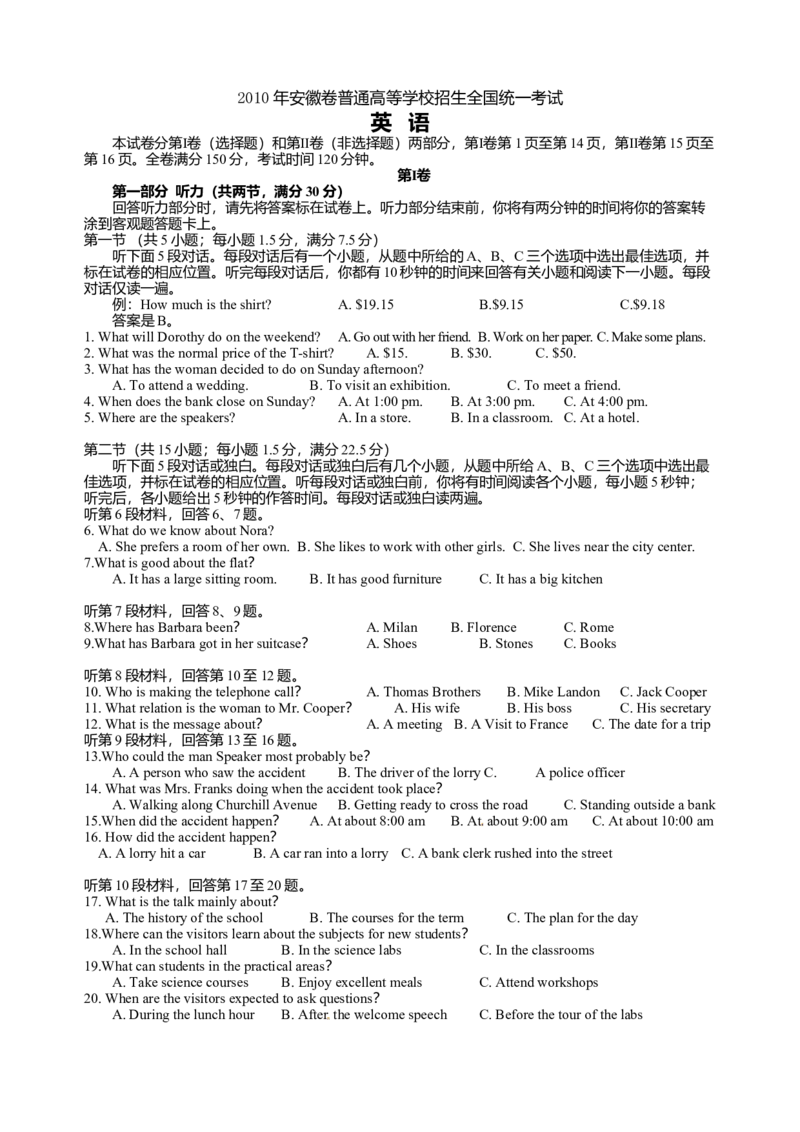
本试卷分第Ⅰ卷(选择题)和第Ⅱ卷(非选择题)两部分,第Ⅰ卷第1页至第14页,第Ⅱ卷第15页至
第16页。全卷满分150分,考试时间120分钟。
第Ⅰ卷
第一部分 听力(共两节,满分30分)
回答听力部分时,请先将答案标在试卷上。听力部分结束前,你将有两分钟的时间将你的答案转
涂到客观题答题卡上。
第一节 (共5小题;每小题1.5分,满分7.5分)
听下面5段对话。每段对话后有一个小题,从题中所给的A、B、C三个选项中选出最佳选项,并
标在试卷的相应位置。听完每段对话后,你都有10秒钟的时间来回答有关小题和阅读下一小题。每段
对话仅读一遍。
例:How much is the shirt? A. $19.15 B.$9.15 C.$9.18
答案是B。
1. What will Dorothy do on the weekend? A. Go out with her friend. B. Work on her paper. C. Make some plans.
2. What was the normal price of the T-shirt? A. $15. B. $30. C. $50.
3. What has the woman decided to do on Sunday afternoon?
A. To attend a wedding. B. To visit an exhibition. C. To meet a friend.
4. When does the bank close on Sunday? A. At 1:00 pm. B. At 3:00 pm. C. At 4:00 pm.
5. Where are the speakers? A. In a store. B. In a classroom. C. At a hotel.
第二节(共15小题;每小题1.5分,满分22.5分)
听下面5段对话或独白。每段对话或独白后有几个小题,从题中所给A、B、C三个选项中选出最
佳选项,并标在试卷的相应位置。听每段对话或独白前,你将有时间阅读各个小题,每小题5秒钟;
听完后,各小题给出5秒钟的作答时间。每段对话或独白读两遍。
听第6段材料,回答6、7题。
6. What do we know about Nora?
A. She prefers a room of her own. B. She likes to work with other girls. C. She lives near the city center.
7.What is good about the flat?
A. It has a large sitting room. B. It has good furniture C. It has a big kitchen
听第7段材料,回答8、9题。
8.Where has Barbara been? A. Milan B. Florence C. Rome
9.What has Barbara got in her suitcase? A. Shoes B. Stones C. Books
听第8段材料,回答第10至12题。
10. Who is making the telephone call? A. Thomas Brothers B. Mike Landon C. Jack Cooper
11. What relation is the woman to Mr. Cooper? A. His wife B. His boss C. His secretary
12. What is the message about? A. A meeting B. A Visit to France C. The date for a trip
听第9段材料,回答第13至16题。
13.Who could the man Speaker most probably be?
A. A person who saw the accident B. The driver of the lorry C. A police officer
14. What was Mrs. Franks doing when the accident took place?
A. Walking along Churchill Avenue B. Getting ready to cross the road C. Standing outside a bank
15.When did the accident happen? A. At about 8:00 am B. At about 9:00 am C. At about 10:00 am
16. How did the accident happen?
A. A lorry hit a car B. A car ran into a lorry C. A bank clerk rushed into the street
听第10段材料,回答第17至20题。
17. What is the talk mainly about?
A. The history of the school B. The courses for the term C. The plan for the day
18.Where can the visitors learn about the subjects for new students?
A. In the school hall B. In the science labs C. In the classrooms
19.What can students in the practical areas?
A. Take science courses B. Enjoy excellent meals C. Attend workshops
20. When are the visitors expected to ask questions?
A. During the lunch hour B. After the welcome speech C. Before the tour of the labs第二部分 英语知识运用(共两节,满分45分)
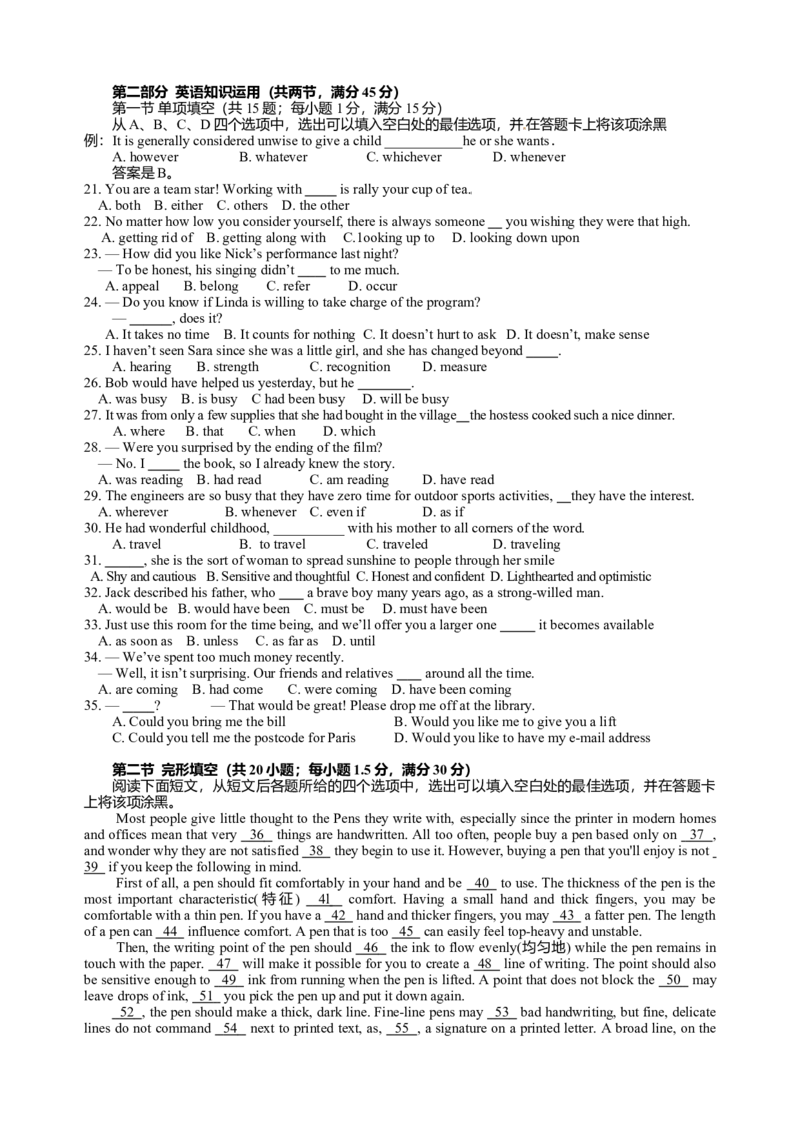
第一节 单项填空(共15题;每小题1分,满分15分)
从A、B、C、D四个选项中,选出可以填入空白处的最佳选项,并在答题卡上将该项涂黑
例:It is generally considered unwise to give a child ___________he or she wants.
A. however B. whatever C. whichever D. whenever
答案是B。
21. You are a team star! Working with is rally your cup of tea.
]
A. both B. either C. others D. the other
22. No matter how low you consider yourself, there is always someone you wishing they were that high.
A. getting rid of B. getting along with C.1ooking up to D. looking down upon
23. — How did you like Nick’s performance last night?
— To be honest, his singing didn’t to me much.
A. appeal B. belong C. refer D. occur
24. — Do you know if Linda is willing to take charge of the program?
— , does it?
A. It takes no time B. It counts for nothing C. It doesn’t hurt to ask D. It doesn’t, make sense
25. I haven’t seen Sara since she was a little girl, and she has changed beyond .
A. hearing B. strength C. recognition D. measure
26. Bob would have helped us yesterday, but he .
A. was busy B. is busy C had been busy D. will be busy
27. It was from only a few supplies that she had bought in the village the hostess cooked such a nice dinner.
A. where B. that C. when D. which
28. — Were you surprised by the ending of the film?
— No. I the book, so I already knew the story.
A. was reading B. had read C. am reading D. have read
29. The engineers are so busy that they have zero time for outdoor sports activities, they have the interest.
A. wherever B. whenever C. even if D. as if
30. He had wonderful childhood, __________ with his mother to all corners of the word.
A. travel B. to travel C. traveled D. traveling
31. , she is the sort of woman to spread sunshine to people through her smile
A. Shy and cautious B. Sensitive and thoughtful C. Honest and confident D. Lighthearted and optimistic
32. Jack described his father, who a brave boy many years ago, as a strong-willed man.
A. would be B. would have been C. must be D. must have been
33. Just use this room for the time being, and we’ll offer you a larger one it becomes available
A. as soon as B. unless C. as far as D. until
34. — We’ve spent too much money recently.
— Well, it isn’t surprising. Our friends and relatives around all the time.
A. are coming B. had come C. were coming D. have been coming
35. — ? — That would be great! Please drop me off at the library.
A. Could you bring me the bill B. Would you like me to give you a lift
C. Could you tell me the postcode for Paris D. Would you like to have my e-mail address
第二节 完形填空(共20小题;每小题1.5分,满分30分)
阅读下面短文,从短文后各题所给的四个选项中,选出可以填入空白处的最佳选项,并在答题卡
上将该项涂黑。
Most people give little thought to the Pens they write with, especially since the printer in modern homes
and offices mean that very 36 things are handwritten. All too often, people buy a pen based only on 37 ,
and wonder why they are not satisfied 38 they begin to use it. However, buying a pen that you'll enjoy is not
39 if you keep the following in mind.
First of all, a pen should fit comfortably in your hand and be 40 to use. The thickness of the pen is the
most important characteristic(特征) 4l comfort. Having a small hand and thick fingers, you may be
comfortable with a thin pen. If you have a 42 hand and thicker fingers, you may 43 a fatter pen. The length
of a pen can 44 influence comfort. A pen that is too 45 can easily feel top-heavy and unstable.
Then, the writing point of the pen should 46 the ink to flow evenly(均匀地) while the pen remains in
touch with the paper. 47 will make it possible for you to create a 48 line of writing. The point should also
be sensitive enough to 49 ink from running when the pen is lifted. A point that does not block the 50 may
leave drops of ink, 51 you pick the pen up and put it down again.
52 , the pen should make a thick, dark line. Fine-line pens may 53 bad handwriting, but fine, delicate
lines do not command 54 next to printed text, as, 55 , a signature on a printed letter. A broad line, on theother hand, gives an impression of confidence and authority (权威).
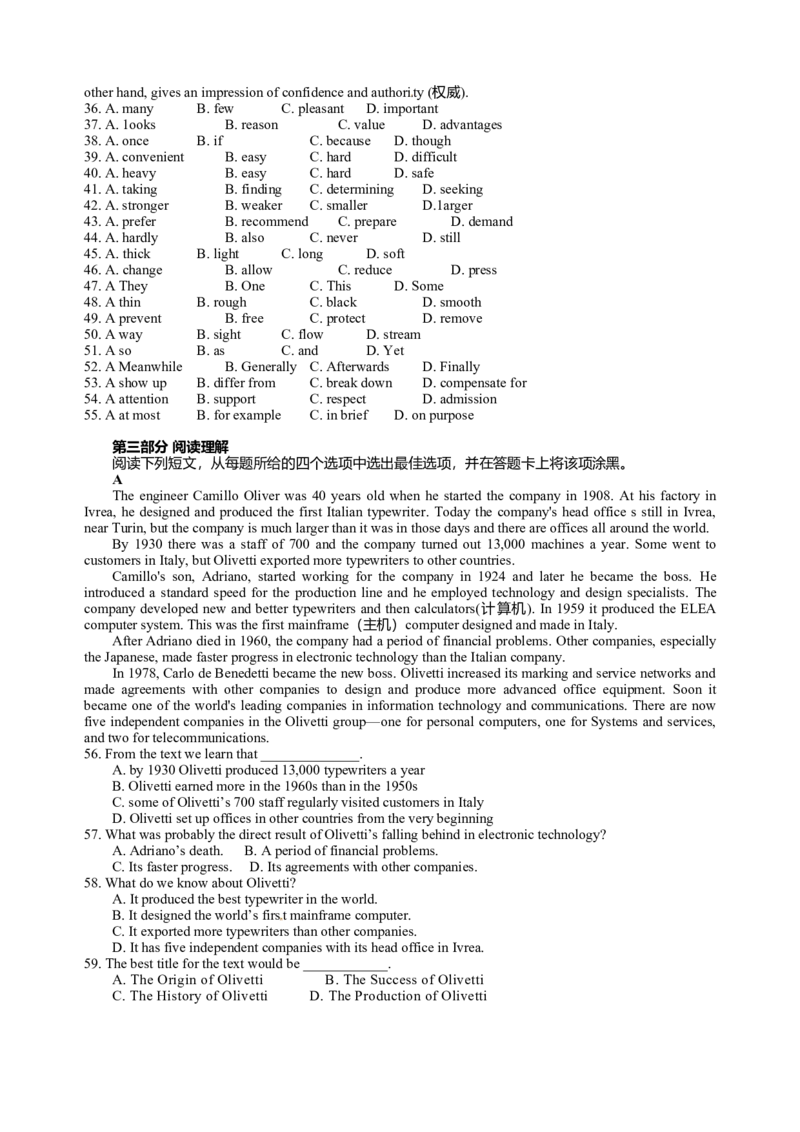
36. A. many B. few C. pleasant D. important
37. A. 1ooks B. reason C. value D. advantages
38. A. once B. if C. because D. though
39. A. convenient B. easy C. hard D. difficult
40. A. heavy B. easy C. hard D. safe
41. A. taking B. finding C. determining D. seeking
42. A. stronger B. weaker C. smaller D.1arger
43. A. prefer B. recommend C. prepare D. demand
44. A. hardly B. also C. never D. still
45. A. thick B. light C. long D. soft
46. A. change B. allow C. reduce D. press
47. A They B. One C. This D. Some
48. A thin B. rough C. black D. smooth
49. A prevent B. free C. protect D. remove
50. A way B. sight C. flow D. stream
51. A so B. as C. and D. Yet
52. A Meanwhile B. Generally C. Afterwards D. Finally
53. A show up B. differ from C. break down D. compensate for
54. A attention B. support C. respect D. admission
55. A at most B. for example C. in brief D. on purpose
第三部分 阅读理解
阅读下列短文,从每题所给的四个选项中选出最佳选项,并在答题卡上将该项涂黑。
A
The engineer Camillo Oliver was 40 years old when he started the company in 1908. At his factory in
Ivrea, he designed and produced the first Italian typewriter. Today the company's head office s still in Ivrea,
near Turin, but the company is much larger than it was in those days and there are offices all around the world.
By 1930 there was a staff of 700 and the company turned out 13,000 machines a year. Some went to
customers in Italy, but Olivetti exported more typewriters to other countries.
Camillo's son, Adriano, started working for the company in 1924 and later he became the boss. He
introduced a standard speed for the production line and he employed technology and design specialists. The
company developed new and better typewriters and then calculators(计算机). In 1959 it produced the ELEA
computer system. This was the first mainframe(主机)computer designed and made in Italy.
After Adriano died in 1960, the company had a period of financial problems. Other companies, especially
the Japanese, made faster progress in electronic technology than the Italian company.
In 1978, Carlo de Benedetti became the new boss. Olivetti increased its marking and service networks and
made agreements with other companies to design and produce more advanced office equipment. Soon it
became one of the world's leading companies in information technology and communications. There are now
five independent companies in the Olivetti group—one for personal computers, one for Systems and services,
and two for telecommunications.
56. From the text we learn that ______________.
A. by 1930 Olivetti produced 13,000 typewriters a year
B. Olivetti earned more in the 1960s than in the 1950s
C. some of Olivetti’s 700 staff regularly visited customers in Italy
D. Olivetti set up offices in other countries from the very beginning
57. What was probably the direct result of Olivetti’s falling behind in electronic technology?
A. Adriano’s death. B. A period of financial problems.
C. Its faster progress. D. Its agreements with other companies.
58. What do we know about Olivetti?
A. It produced the best typewriter in the world.
B. It designed the world’s first mainframe computer.
C. It exported more typewriters than other companies.
D. It has five independent companies with its head office in Ivrea.
59. The best title for the text would be ____________.
A. The Origin of Olivetti B. The Success of Olivetti
C. The History of Olivetti D. The Production of OlivettiB
Have you ever wondered?
1. Why do airplanes take longer to fly west than east?
It can take five hours to go west-east from New York (NY) to London but seven hours to travel east-west
from London to NY. The reason for the difference is an atmospheric phenomenon known as the jet(喷
射)stream. The jet stream is a very high altitude wind which always blows from the west to the east
across the Atlantic. The planes moving at a constant air speed thus go faster in the west-east direction
when they are moving with the wind than in the opposite direction.
2. What would happen if the gravity on Earth was suddenly turned off?
Supposing we could magically turn off gravity. Would buildings and other structures(建筑物)float
away? What happened would depend on how strongly the things were attached to the Earth. The Earth is
moving at quite a speed, moving at over a thousand miles per hour. If you turn something around your
head on a string(细绳), it goes around in a circle until you let go of the string. Then it flies off in a
straight line. ‘Switching off’ gravity would be like letting go of the string. Things not attached to the Earth
would fly off in a straight line. People in buildings would suddenly shoot upwards at a great speed until
they hit the ceiling. Most things outside would fly off into space.
60. What information can we get from the first passage?
A. It is the jet stream that affects how fast airplanes fly.
B. Planes go slower when they are moving with the wind.
C. It takes more time to fly from NY to London than from London to NY.
D. The jet stream always blows from the east to the west across the Atlantic.
61. The word “shoot” underlined in the 2nd passage probably means “__________”.
A. send for B. move quickly C. come out D. grow quickly
62. It can be inferred that without gravity _____________.
A. buildings and other structures would float away B. trees and buildings would not so easily fly off
C. something around your head would not float away
D. everything outside buildings would fly off into space
63. Where can we most probably read this text?
A. In a research paper. B. In a short story. C. In a travel magazine. D. In a student’s book
C
American cities are similar to other cities around the world: In every country, cities reflect the values of
the culture. American cities are changing, just as American society is changing.
After World War Ⅱ, the population of most large American cities decreased; however, the population in
many Sun Belt cities increased. Los Angeles and Houston are cities where population shifts(转移)to and
from the city reflect the changing values of American society. In the late 1940s and early 1950s, city residents
(居民)became wealthier. They had more children so they needed more space. They moved out of their
apartments in the city to buy their own homes. They bought houses in the suburbs(郊区).
Now things are changing. The children of the people who left the cities in the 1950s are now adults. Many,
unlike their parents, want to live in the cities. They continue to move to Sun Belt cities and older ones of the
Northeast and Midwest. Many young professionals are moving back into the city. They prefer the city to the
suburbs because their jobs are there; or they just enjoy the excitement and possibilities that the city offers.
This population shift is bringing problems as well as benefits. Countless poor people must leave their
apartments in the city because the owners want to sell the buildings or make apartments for sale instead of for
rent. In the 1950s, many poor people did not have enough money to move to the suburbs; now many of these
same people do not have enough money to stay in the cities.
Only a few years ago, people thought that the older American cities were dying. Some city residents now see a
bright, new future. Others see only problems and conflicts. One thing is sure:many dying cities are alive again.
64. What does the author think of cities all over the world?
A. They are alive. B. They are hopeless. C. They are similar. D. They are different.
65. Why did American city residents want to live in the suburbs after World War Ⅱ?
A. Because older American cities were dying. B. Because they were richer and needed more space.
C. Because cities contained the worst parts of society.
D. Because they could hardly afford to live in the city.66. According to the 4th paragraph, a great many poor people in American cities _______.
A. are faced with housing problems B. are forced to move to the suburbs
C. want to sell their buildings D. need more money for daily expenses
67. We can conclude from the text that ___________.
A. American cities are changing for the worse
B. people have different views on American cities
C. many people are now moving from American cities
D. the population is decreasing in older American cities
D
My father was 44 and knew he wasn’t going to make it to 45. He wrote me a letter and hoped that
something in it would help me for the rest of my life.
Since the day I was 12 and first read his letter, some of his words have lived in my heart. One part always
stands out. “Right now, you are pretending to be a time-killer. But I know that one day, you will do something
great that will set you among the very best.” Knowing that my dad believed in me gave me permission to
believe in myself. “You will do something great.” He didn’t know what that would be, and neither did I, but at
times in my life when I’ve felt proud of myself. I remember his words and wish he were here so I could ask. “Is
this what you were talking about, Dad? Should I keep going?”
A long way from 12 now, I realize he would have been proud when I made any progress. Lately, though,
I’ve come to believe he’d want me to move on to what comes next: to be proud of, and believe in, somebody
else. It’s time to start writing my own letters to my children. Our children look to us with the same unanswered
question we had. Our kids don’t hold back because they’re afraid to fail. They’re only afraid of failing us. They
don’t worry about being disappointed. Their fear—as mine was until my father’s letter—is of being a
disappointment.
Give your children permission to succeed. They’re writing for you to believe in them. I always knew my
parents loved me. But trust me. That belief will be more complete, that love will be more real, and their belief
in themselves will be greater if you write the words on their hearts. “Don’t worry; you’ll do something great.”
Not having that blessing from their parents may be the only thing holding them back.
68. We learn from the text that the author
A. lost his father when he was young
B.B. Worked hard before he read his father's letter
C. Asked his father's permission to believe in himself
D. Knew exactly what great thing his father wanted him to do
69. What does the author tell us in the 3rd paragraph?
A. Children need their parents’ letters.
B. Children are afraid to be disappointed.
C. His children’s fear of failure held them back.
D. His father’s letter removed his fear of failing his parents.
70. Which of the following is true of the author?
A. He got no access to success. B. He wrote back to his father at 12.
C. He was sure his parents loved him. D. He once asked his father about the letter.
71. The main purpose of the text is to _______.
A. describe children’s thinking B. answer some questions children have
C. stress the importance of communication D. advise parents to encourage their children
E
The need to feed a growing population is putting much pressure on the world’s supply of water. With 97%
of the world’s water too salty to be drunk or used in agriculture, the worldwide supply of water needs careful
management, especially in agriculture. Although the idea of a water shortage(短缺) seems strange to someone
fortunate enough to live in a high rainfall country, many of the world’s agricultural industries experience
constant water shortages .
Although dams can be built to store water for agricultural use in dry areas and dry seasons, the costs of
water redistribution(重新分配) are very high. Not only is there the cost of the engineering itself, but there is
also an environmental cost to be considered. Where valleys(山谷) are flooded to create dams, houses are lost
and wildlife homes destroyed. Besides, water may flow easily through pipes to fields, but it cannot be
transported from one side of the world to the other. Each country must therefore rely on the management of its
own water to supply its farming requirements.This is particularly troubling for countries with agricultural industries in areas dependent on irrigation(灌
溉). In Texas, farmers’ overuse of irrigation water has resulted in a 25% reduction of the water stores. In the
Central Valley area of southwestern USA, a huge water engineering project provided water for farming in dry
valleys, but much of the water use has been poorly managed.
Saudi Arabia’s attempts to grow wheat in desert areas have seen the pumping of huge quantities of
irrigation water from underground reserves. Because there is no rainfall in these areas, such reserves can only
decrease, and it is believed that fifty years of pumping will see them run dry.
72. From the first two paragraphs we learn that .
A. much of the world’s water is available for use
B. people in high rainfall countries feel lucky
C. the costs of water redistribution should be considered
D. water can be easily carried through pipes across the world
73. Which of the following is true?
A. The water stores in Texas have been reduced by 75%.
B. Most industries in the world suffer from water shortages.
C. The underground water in Saudi Arabia might run out in 20 years.
D. Good management of water use resulted from the project in the Central Valley.
74. What is most likely to be discussed in the paragraph that follows?
A. Steps to improving water use management.
B. Ways to reduce the costs of building dams.
C. Measures to deal with worldwide water shortages.
D. Approaches to handling the pressure on water supply.
75. The text is mainly about .
A. water supply and increasing population
B. water use management and agriculture
C. water redistribution and wildlife protection
D. water shortages and environmental protection
第Ⅱ卷
考生注意事项:
请用0.5毫米黑色墨水签字笔在答题卡上作答,在试题卷上答题无效。
第四部分 写作 (共两节,满分35分)
第一节 任务型读写(共10小题;每小题1分,满分10分)
阅读下面短文,根据所读内容在表格中的空白处填入恰当的单词。
注意:每个空格只填一个单词。
When difficult people express themselves orally, they generally want at least two things: they’ve been
heard and they’ve been understand. As a good communicator should be a good listener, five steps are
advocated toward good listening.
The first step is cooperating(合作). How does a difficult person know that you’re listening and
understanding? In fact, it’s through the way you look and sound while he is talking. You may help him to fully
express his thoughts and feelings. You do this by nodding your head in agreement, making certain sounds of
understanding.
When the person begins to repeat what’s been said, it’s signal of step two: turning back. It means that you
repeat back some words he is using, sending a clear signal that you’re listening carefully and that you think
what he is saying is important.
Having heard what he has to say, the next step is clarifying. At this point, you start to gather information
about what is being communicated. Ask some open-ended questions, which will allow you to figure out what
intention he is hoping to satisfy.
The fourth step is to summarize(概括)what you’ve heard. This allows you to make sure that both you
and the difficult person are on the same page. When you do this, two things happen. First, if you’ve missed
something, he can fill in the details(细节).Second, if you’ve shown that you’re making an effort to
understand completely. This increases the possibility of gaining cooperation from him.
Having listened carefully, you’ve now arrived at the point of confirming with the person that he feelssatisfied that his thoughts have been fully voiced. Ask if he feels understood.
When enough sincere listening, questioning, and remembering are brought together, understanding is
usually achieved and a difficult person becomes less difficult and more cooperative.
Topic (76) to understand
Reason Difficult people hope they have been heard and(77) when they express themselves.
◆(79) in agreement and make some sounds of understanding while a difficult person is
speaking.
(78)
◆Repeat some(80) that you have heard.
on
◆Collect information about the person’s expressions and find his(81) .
listening
◆Give a(82) of what the person has said.
◆Confirm that the person gains(83) from speaking his thoughts.
Result A difficult person will be(84) to cooperate with if understanding is achieved.
Comment You may unlock the doors to difficult people’s(85) after you listen and understand
第二节 书面表达(满分25分)
假设你将参加某英语杂志社开展的一次征文活动,征文的内容要求你在电视、手机(cell)和网络
三者中,放弃期中一个兵陈述理由。请你以“Which would you give up: TV, cell, or Web?”为题,写一篇
英语短文。
注意:1.字数100左右;
2.可以适当增加细节,以使行文连贯。参考答案
第一部分:
1—5:BBABC 6—10:ACAAB 11—15:CACCB 16—20:BCBCA
第二部分:
21—25:CCACC 26—30:ABBCD 31—35:DDADB 36—40:BAADB
41—45:CDABC 46—50:BCDAC 51—55:BDDAB
第三部分:
56—60:ABDCA 61—65:BBDCB 66—70:ABADC 71—75:DCCAB
第四部分:
第一节:
76.Listen/Listening 77.understood 78.Suggestions/Tips/Advice
79.Nod 80.words 81.intention 82.summary
83.satisfaction 84.easier 85.Hearts/minds
第二节:
One possible version
We are now living in an information age, in which TV, cells and the Web are widely used. It seems that
many people cannot enjoy themselves without them.
However, if I had to give up one of them, I would turn off the TV rather than switch off my cell or cut off
the Internet. I could do without TV because few shows take my fancy and there’re too many commercials.
Besides, most programs on TV are also available elsewhere.
As for cells and the Web, they are more necessary to me. I need a cell to keep in touch with my friends and
family, and almost all information can be gathered on the Internet.2010年安徽高考英语真题解析
第二部分
一、单项选择
21.【解析】C。考查代词的用法。本句句意是:你是一个优秀的团队合作者!与他人一起
工作正是你的喜好。A项意为“两者都”;B项意为“两者中的一个”;D项意为“(两者中)
另外一个”;C项泛指“其他的(人或物)”。本题没有限定两人,而是泛指其他人,因此答
案为C。
22.【解析】C。考查短语动词。该句运用了现在分词作someone的定语。本句句意是:无
论你认为是 多么卑微,总会有人仰望你,希望他们能有你那么高级(的地位)。A项意为
“去除”;B项意为“与…相处”;D项意为“轻视,瞧不起”;均不合题意。根据题意,选 C
项;C项意思是“尊重,仰视”。
23.【解析】A。考查短语动词辨析。该句选用了与介词 to连用放入短语动词。A项意为
“对…有吸引力”;B项意为“属于”;C项意为“指的是,提及,参照”;D项意思是“发生”。
本句句意是:--你认为Nick昨晚的表演怎么样?--老实说,他唱的歌不太吸引我。因此,
根据句意,选A。
24.【解析】C。考查情景对话。该句句意是:--你知道琳达是否愿意负责这个项目吗?--
问一下不会伤害她,对吗?。A项意为“这不费时”;B项意为“这毫无价值”;C项意为“问
一问不会伤人”;D项意为“这没有意义。”根据题意,选C项。
25.【解析】C。考查名词辨析。A项意为“听”;B项意为“力气”;D项意思是“尺寸,措
施”。均不合题意。根据题意,选C项;C项意为“辨认”,beyond recognition难以辨认。
26.【解析】A。考查时态。第一个分句用了虚拟语气,意思是:昨天Bob本会帮助我们;
第二分句说明Bob昨天忙,是实情,所以用过去时。
27. 【解析】B。考查强调句型。去掉It was和空格中的词后该句为完整的句子,即:The
hostess cooked such a nice dinner from only a few supplies that she had bought in the village.由
此判断是强调句型,故选B。该句的意思是:是用在村子里她所购买的很少的材料女主人
为我们煮了如此美味的一餐。
28. 【解析】B。考查时态。该句句意是:--这部电影的结局你感到意外吗?-不。我读过这
本书,所以了解这个故事。读过这本书是在看这部电影之前,所以是“过去的过去”,用过
去完成时。
29. 【解析】C. 考查状语从句。该句句意是:这些工程师如此繁忙以致没有时间进行户外
运动,即使他们有兴趣。A项意为“无论哪里”;B项意为“无论何时”;C项意思是“即使”;
D项意思是“好像”。根据句意,选择C。
30. 【解析】D。考查非谓语动词。句意为:跟妈妈周游世界的各个角落,他度过了精彩
的童年。该题选D,用现在分词作伴随状语。
31. 【解析】D。考查形容词辨析。根据下文“她是那种通过微笑把阳光传播给他人的妇女”
可以判断,她无忧无虑的、乐观,因此选择D。A项意为“害羞、小心翼翼”;B项意为“敏
感、周到”;C项意思是“诚实、自信”;均不合题意。
32. 【解析】D。考查情态动词。A项表示过去将来;B项常常用在虚拟语气中,过去本
会…;C项是对现在状态的推测。D项must have done是对过去的或已经发生的动作状态
的推测。该题推测Jack父亲多年以前肯定很勇敢,因此,选D。该句句意是:Jack把他的
父亲描写成一个意志坚强的人,他多年前肯定是个勇敢的男孩。
33. 【解析】A。考查状语从句。该句句意是:暂时用这个房间,一有大些的房间我们就
提供给你。A项意为“一…就”;B项意为“除非”;C项意为“远达,就…而言”;D项意为“直到…时候。”根据题意,选A项。
34. 【解析】D。考查时态。该句句意为:--最近我们钱用得太多了。--嗯,不奇怪。我们
一直有亲戚朋友来。由题中all the time可以判断,这里要说明一个一直在进行没有间断的
动作,所以用现在完成进行时,故选D。
35. 【解析】B。考查情景对话。A项意为“能把账单带给我吗?”;B项意为“要我带你一
程吗”;C项意为“能告诉我巴黎的邮编吗”;D项意为“想要我的邮箱地址吗 ”。根据下文
please drop me off at the library (请让我在图书馆下车)可以判断,说话人是问对方要不要搭
便车,因此B项。give sb. a lift 给某人搭便车;drop sb. off 让某人下车。
二、完形填空
【语篇解读】本文为说明文。作者从笔尖的粗细、墨水流动的流畅性和笔迹的粗细三个方
面给读者提出选用钢笔的建议。
36.[解析]答案B。上文说明,因为现家庭和办公室里有打印机,很少有东西是手写的,因
此,选few(很少).
37. [解析]答案A。由下文对所买的笔不满意,说明人们购买时仅凭外观(looks),没有
考虑它的内在的特性。
38. [解析]答案 A。因为购买时仅凭外观,没有考虑到是否适用等特性,所以,一旦
(once)开始用,就发现不满意。
39. [解析]答案D。作者认为只要记住下列的建议,买好用的笔不难。difficult是“困难的;
不容易决定的”;而 hard是“艰难的,艰辛的”。
40. [解析]答案B。作者在这里提出了好笔的优秀品质,因此,排除 A、C;笔的好坏与安
全无关, 排除D。因此,答案选B。
41. [解析]答案C。该句句意是:笔的粗细是决定(determining)笔用起来是否舒服的重要
特征。
42. [解析]答案D。与上一句中的small相照应。
43. [解析]答案A。A项意思是“宁愿”;B项意思是“推荐,建议”;C项意思是“准备”;D
项意思是“要求,需要”。根据上下文,手大手指粗的话,你更愿意选择肥一点的笔。
44. [解析]答案B。笔的长度也(also)影响舒服的程度。
45. [解析]答案C。解释长度影响舒服的程度的原因。
46. [解析]答案B。笔珠要允许(allow)墨水均匀地流淌。
47. [解析]答案C。this指代上文“允许(allow)墨水均匀地流淌”这一点。
48. [解析]答案D。因为墨水均匀地流淌,所以写的线条流畅(smooth)。
49. [解析]答案A。笔尖离开纸后笔珠要能敏感地阻止墨水流淌。A项prevent与from连用
表示“阻止”; B项free 与from连用表示“免于”;C项protect 与from 连用表示“保护…以免
于”;D项remove…from 表示“去除”。根据句意选A。
50. [解析]答案C。这里flow指墨水的流动;
51. [解析]答案B。as引导的时间状语从句。联系上文,这里的意思是:当你把笔拿起来
在放下时,笔尖离开纸后不能阻断墨水继续流动会形成墨水点。
52. [解析]答案D。文中作者提出了三点建议:一是在第二段中,用 First of all引出;二是
在第三段,用Then提出;这里是第三点,即最后一点,所以用finally。
53. [解析]答案D。A项意思是“出现”; B项意思是“与…不同”; C项意思是“分解,破裂”;
D项意思是“弥补”;该句意思是“细线条的笔虽然可以弥补书写不好的弊端….因此,答案
应该是D。
54. [解析]答案A。这里作者提出细线条的笔的弊端;下文讲粗线条给人印象深刻,由此判
断,在印刷体的文字旁细线条的字不会引人注意。command赢得,博得。
55. [解析]答案B。举例说明。第三部分 阅读理解
A
【语篇解读】本篇文章为记叙文。主要讲述意大利的计算机和电信集团 Olivetti(好利
获得)公司的建立、发展。
56. A 【解析】细节理解题。根据第二段第一句“By 1930 there was 1 staff of 700 and the
company turned out 13,000 machines a year.”可知选A项。
57. B 【解析】细节理解题。根据第四段判断。
58. D 【解析】细节理解题。根据第一段第二句中“Today the company 's head office is
still in Ivrea”和文章最后中“There are now five independent companies in the Olivetti group“可
以判断答案为D。
59.C【解析】主旨大意题。文章按照时间顺序叙述了该公司的建成和兴衰以及现状。
由此判断选C项。
B
【语篇解读】本人属于说明文。文章解释了两个特殊的地理现象:一个是在大西洋上
空的气流影响了飞机的飞行速度;二是如果没有了地球引力将会出现什么现象。
60.A【解析】细节理解题。由第一篇的第二句 The reason for the difference is an
atmospheric phenomenon known as the jet(喷射)stream.可以推知。
61 . B【解析】词汇理解题。根据第二篇的最后一句中的upwards at a great speed判断。
62 . B【解析】推理判断题。根据第二篇的倒数第一句中 Things not attached to the
Earth would fly off in a straight line.推断,没有粘在地球的事物将会飞掉,言下之意是粘在
地球的事物不容易飞掉。
63 . D【解析】推理判断题。根据文章内容,B、C显然不符合;A项的研究论文应该
有数据和理论支撑,而文章仅仅是泛泛而谈。因此,只有D项符合题意。
C
【语篇解读】本文介绍了美国城市发展过程中的两次不同的进程:第一次是二次大战
后城市居民变得富有,而且孩子多,需要更大的空间,所以城市居民向郊区发展;第二次
是现在大量城郊居民又回到了城市。
64 . C【解析】细节理解题。由文章的第一句 American cities are similar to other cities
around the world判断。
65 . B【解析】细节理解题。由文章第二段的二、三句中“city residents(居民)became
wealthier. They had more children so they needed more space ”可以判断。
66 . A【解析】细节理解题。由第四段的第二句 Countless poor people must leave their
apartments in the city because the owners want to sell the buildings or make apartments for sale
instead of for rent.可知。
67 . B【解析】推理判断题。文章最后一段讲述了两种不同的态度,由此推知答案是
B。
D
【语篇解读】父亲在信中给“我”鼓励和信任,促使我不断取得进步;通过这件事,作
者目的在于说明父母应该给予孩子鼓励。
68. A【解析】细节理解题。根据文章中的第一句“……he wasn’t going to make it to 45
(他活不到45岁).”可知。
69. D【解析】细节理解题。由第三段中的倒数第三句“They’re only afraid of failing us.”
和倒数第一句中的“Their fear-as mine was until my father’s letter”可以推知答案为D。
70. C【解析】细节理解题。由最后一段中的“I always knew my parents loved me.”可知。
71. D【解析】主旨大意题。整篇文章都在说明父亲的鼓励使我不断进步,特别是文章的最后一句进一步点明主题。
E
【语篇解读】本文说明了世界上水资源缺乏严重,水资源的管理,特别是在农业方面
的管理存在问题,需要细心的管理。
72. C【解析】细节理解题。由第二段第一句中的“the costs of water redistribution(重新
分配) are very high”可知。
73. C【解析】细节理解题。由最后一句中的“and it is believed that fifty years of
pumping will see them run dry”可知。
74. A【解析】推理判断题。文章的第一段是主题段—提出农业方面水资源的管理的
问题;二、三、四段具体分析水资源管理中存在的问题;由此可以推测,下面意部分应该
是解决问题。因此,下文应该讨论解决问题的具体措施。
75. B【解析】主旨大意题。由74题的分析可以看出,整篇文章讲的是农业中水资源
的管理问题。
第四部分
任务阅读
76. 【解析】Listen/Listening。归纳型。这篇文章的就是如何理解口头表达有困难的人,
提出了建议。因此,文章中心词是Listen/Listening,其目的是为了understand。
77.【解析】understood。原文中的词汇。由文章第一句中的“they generally want at
least two things: they’ve been heard and they’ve been understood.”可知。
78.【解析】Suggestions/Tips/Advice。归纳型。本文的重点是建议读者如何听以理解
表达有困难的人;表格相应的右侧就是作者的建议。
79.【解析】Nod。词型转换。由第二段最后一句中的“You do this by nodding your
head in agreement”可知。
80.【解析】words。释义型。把第三段第一句中的what’s been said换用words。
81.【解析】intention。原文中的词汇。由第四段中的“gather information”和“figure
out what intention he is hoping to satisfy”可知。
82.【解析】summary。词型转换。根据第五段的第一句“The fourth step is to
summarize(概括)what you’ve heard.”可知。summary 是动词summarize 相应的名词。
83.【解析】satisfaction。演绎型。由“he feels that his thoughts have been fully voiced”
推断,目的达到了,感到满意。
84.【解析】easier。反义词。原文中的“ less difficult”转换成“easier”。
85.【解析】hearts/minds。演绎型。由最后一段“understanding is usually achieved”推
断,因为相互理解了,所以“心”门打开了。
书面表达
One possible version
We are now living in an information age, in which TV, cells and the Web are widely used.
It seems that many people cannot enjoy themselves without them.
However, if I had to give up one of them I would turn off the TV rather than switch off my
cell or cut off the Internet. I could do without TV because few shows my fancy, and there’re too
many commercials. Besides, most programs on TV are also available elsewhere.
As for cells and the Web, they are more necessary to me. I need a cell to keep in touch
with my friends and family, and almost all information can be gathered on the Internet.