文档文本内容
阅读理解+完形填空+书面表达分类综合训练
阅读理解
阅读下列短文,从每题所给的 A、B、C 和 D 四个选项中,选出最佳选项。
A
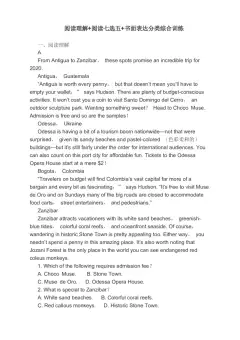
Do you want to get ahead in your career, but need to bring your skills
up to date? Thanks to the power of online learning, the following courses
can give your skills an improvement in just a few weeks.
· PMT Course—Rating (等级): 4.8 stars out of 5
In this course, you’ll understand exactly how your brain picks up,
stores and makes sense of new information. Also you’ll learn how to
overcome procrastination (拖延) and make full use of your memory.
· EPSDM Course—Rating: 4.1 stars out of 5
Whatever your job is, you’ll need to undertake some degree of problem-
solving and decision-making tasks regularly. Master these skills and you’ll be
seen as a reliable individual with leadership potential. The course contains
real-life case studies that will help you appreciate the importance of critical
thinking in day-to-day situations.
· SP Course—Rating: 5 stars out of 5
There are few forms of communication more persuasive (有说服力的)
than a high-quality presentation, but many people find public speaking to
be a discouraging thing. In this course, you’ll learn how to overcome your
fears, and make use of verbal and non-verbal tips in getting your message
across.
· IP Course—Rating: 4.7 stars out of 5
If you want to make an important difference within your organization and
ensure your ideas are heard, you need to learn how to influence others.
This course will equip you with the skills you need to share your ideas with
others in such a way that they take notice.
21. What can you learn from EPSDM Course?
A. How to make friends. B. How to make decisions.
C. How to make use of your time. D. How to make you heard clearly.
22. What courses are helpful in communication skills?
A. PMT Course and EPSDM Course.
B. EPSDM Course and SP Course.
C. PMT Course and IP Course.D. SP Course and IP Course.
23. What does the underlined word “they” in the last paragraph refer to?
A. Courses. B. Others. C. Skills. D. Ideas.
B
Zheng He was one of Chinas most famous explorers. Towards the end of
the fourteenth century, his fleet (舰队) sailed to countries far away.
Zheng He had over 300 ships, some of which were over 150 meters
long, and could carry up to 1,000 people. Besides, the ships carried
gold, silver, silk, china and other treasures to give as gifts to the rulers
of other countries. Some ships even had earth on board so that the sailors
could grow their crops for food.
On Zheng He’s first voyage, he set sail across the Indian Ocean. His
fleet traveled many days far away from land. One day, they were hit by a
storm. All the sailors thought the fleet was going to sink. Then a strange light
appeared and after that, the storm passed. The strange light was probably
electricity from a thunderstorm, but the sailors in Zheng He’s fleet believed
it was a sign of protection from the gods. With the belief, they were happy
to follow Zheng He wherever he led them.
Zheng He completed seven famous voyages between 1405 and 1433. He
visited many countries in Asia and Africa. He brought back many gifts from
the countries he visited, such as medicines, pearls and strange animals.
The most famous of them were a giraffe and a zebra.
In 28 years of traveling, Zheng He had managed to share the glory
(辉煌) of China with many different countries. When he died in 1435,
the stories of his travels made him one of Chinas most famous sailors.
24. Why did some of the ships carry earth on board?
A. To use it for exchange.
B. To plant trees for shade.
C. To give it to others as a gift.
D. To grow their own crops for food.
25. Why were the sailors willing to follow Zheng He?
A. They believed in gods protecting them.
B. They wanted to make a fortune.
C. They thought they were lucky.
D. They respected him.26. What were the most famous gifts Zheng He brought back?
A. Gold and silver.
B. A giraffe and a zebra.
C. Medicines and pearls.
D. A monkey and a tiger.
27. What can be the best title for the text?
A. Zheng Hes Life
B. The Glory of China
C. Zheng He and His Voyages
D. Chinas Famous Explorer
C
The Carnival of Brazil is an yearly festival held 46 days before Easter,
especially famous for the Carnival in Rio de Janeiro. Carnival celebrations
are believed to have roots in the festival of Saturnalia, which, adapted to
Christianity, became a farewell to bad things in a season of religious
discipline to regret Christ’s death and prepare for his coming back to life.
Modern Brazilian Carnival dates back to Rio de Janeiro in 1641. It
originally copied the European form of the festival, later taking in elements
of native American and African cultures.
In the late 19th century, the strings were introduced in Rio de Janeiro.
These were pageant (盛裝游行) groups that paraded (游行) through
city avenues performing on instruments and dancing. Today they are known
as blocks, consisting of a group of people who dress in costumes or
special T-shirts with themes or logos. Blocks are generally connected with
particular neighborhoods; they include both a music group and a lot of
revelers (狂欢者).
Block parades have become an expressive feature of Rios Carnival.
Today, the groups are more than 100 in total and increase each year.
Blocks can be formed by small or large groups of revelers with a clear title.
Before the show, they gather in a square, and then parade in sections of
the city, often near the beach.
Carnival time in Rio is very interesting, but is also the most expensive
time to visit Rio. Hotel rooms and other lodgings can be up to four times more
expensive than the regular rates. There are big crowds at some locations and
life is far from ordinary in many parts of town.28. What can we infer from Paragraph 1 about the Carnival of Brazil?
A. It is often held after Easter.
B. It is from Easter and Saturnalia.
C. It is mainly to celebrate the birth of Christ.
D. It is a festival to say goodbye to bad things and begin a new life.
29. When did modern Brazilian Carnival begin?
A. About 100 years ago.
B. More than 370 years ago.
C. Over five centuries ago.
D. Less than two centuries ago.
30. What can we learn about the blocks in Rio de Janeiro?
A. They don’t parade before the show.
B. There are no more than 100 blocks today.
C. They always parade through countryside villages singing and dancing.
D. They are always wearing costumes or special T-shirts with themes or
logos.
31. What does the text mainly talk about?
A. The carnival in Rio de Janeiro.
B. The famous carnivals in the world.
C. The way the carnival was introduced in Brazil.
D. The happy life of the people in Rio de Janeiro.
D
Does stress cause gray hair? Many people believe that tension (紧
张) and stress can cause your hair to lose its color. In fact, it is an old
wives tale that being upset all the time can result in premature graying (过
早老龄化). Here is a closer look at this situation and why some believe that
this old wives tale could be true.
As one ages, the hairs on the head also age. In fact, just about
everything on the human body begins to show signs of wear and tear after a
while. The joints wear and hurt when moved and skin wears and becomes
wrinkled (有皱纹的). Hairs on the head grow and eventually die. They are
replaced, but in the process something else happens.
When new hairs are replaced, the color or pigment (色素) is also
added to them. However, as one ages, this pigment becomes less and
less available. At first, hairs will have a limited amount of pigment and theywill appear to be grayish in color. In time, they will lose all of their pigment
and will be white. Many things are known to cause graying, and genetics is
a very powerful factor. If one of your parents turns gray at an early age,
there is a good chance that you will too. Some people begin the graying
process in high school, while others may be over the age of forty.
Constant worry and tension can have many harmful effects on the human
body. It is a known fact that stressful times can cause one to suffer hair loss.
It would make sense that if it can cause these problems, perhaps it also
may contribute to graying. However, there is no sound evidence to support
this.
On the other hand, many medical professionals believe that there may
be a link between graying and a constant state of anxiety or tension. Does
stress cause gray hair? There is no scientific evidence to support the
theory, but it is best to avoid stressful situations.
32. What does the underlined phrase in Paragraph 1 most probably
mean?
A. Silly remarks.
B. Clever remarks.
C. Exciting remarks.
D. Disappointing remarks.
33. What does Paragraph 2 mainly tell us?
A. Skin becomes wrinkled with age.
B. Every part of the body ages with age.
C. Hairs will grow weak but not die.
D. Most parts of the body is replaced with age.
34. What can play the most important role in the graying process?
A. The amount of food people eat and living environment.
B. Genetics and the amount of water people drink.
C. Genetics and the amount of sleeping time.
D. The amount of pigment and genetics.
35. What can we infer from the text?
A. Stress causing gray hair is still in question. B. Gray hair has nothing to
do with tension.
C. Stressful situations could be of benefit. D. Sound evidence has been
found.第三部分 英语知识运用(共两节,满分 45 分)
第一节 完形填空(共 20 小题;每小题 1.5 分,满分 30 分)
阅读下面短文,从短文后各题所给的 A、B、C 和 D 四个选项中,选出可以
填入空白处的最佳选项。
One evening I was resting in a cafe. I 1 a pair of newly bought white
leather shoes, which were rather expensive. Then a boy came to me.
He was in a(n) 2 shirt, looking pale and about eleven. No
sooner had I begun to speak than he opened the 3 in his hand and took
out the tools of shoe-polishing. He 4 down, took off my leather
shoes, and began to shine them. He was busy doing his work 5
heavy rain began to pour down. People rushed to the cafe for 6 from
the rain. More and more people crowded 7 and gradually separated the
boy from me.
Hours passed, and it turned 8 . I had no shoes on my feet and
9 where the boy had been. I thought he would not 1 0 my shoes,
and I would have to go home on my bare feet.
When it was near midnight the 1 1 ended, and there were fewer and
fewer people in the cafe. The cafe was to be 1 2 . I had to move to the
door, head lowered. Just as I went to the gate, I 1 3 found that a
boy of about eleven, looking very 1 4 , was sleeping at the 1 5
with his head leaning against a box and his upper body being 1 6 . He
held a package made of his shirt tightly in his arms.
I shook him slightly and woke him up. He 57 up and rubbed (搓)
his eyes for a while before he recognized me. Then he opened the package
1 8 , gave me my leather shoes, and apologized to me shyly. I 1 9
him and wrapped (用……包裹) him with his unfit shirt, which had
wrapped my leather shoes. On my way home, the 2 0 of the boy stayed
in my mind.
1. A. took B. wore C. mended D. owned
2. A. old B. unfit C. small D. dirty
3. A. bag B. package C. box D. suitcase
4. A. fell B. bent C. bowed D. looked
5. A. when B. after C. because D. since
6. A. protection B. rest C. hide D. preparation
7. A. out B. away C. in D. off
8. A. dark B. fine C. foggy D. bright9. A. thought B. wondered C. guessed D. imagined
10. A. shine B. keep C. return D. carry
11. A. rain B. drinks C. time D. work
12. A. cleaned B. locked C. visited D. closed
13. A. shortly B. surprised C. sadly D. immediately
14. A. familiar B. happy C. strong D. polite
15. A. table B. door C. bed D. cafe
16. A. wet B. bare C. pale D. cold
17. A. stayed B. turned C. jumped D. rose
18. A. finally B. suddenly C. unfriendly D. hurriedly
19. A. recognized B. forgave C. paid D. inspired
20. A. feature B. shirt C. image D. form
三、书面表达
假如你是李华,你班新来了一批美国留学生,老师将组织一次关于中美文
化与风俗方面的交流会。请你用英语写一篇发言稿,介绍一下中国的传统节日
——春节。内容包括:
1.春节的时间;
2.主要活动(年夜饭、拜年等)。
注意:
1.词数 100 左右,短文的开头和结尾已给出,不计入总词数;
2.可以适当增加细节,以使行文连贯。
Hello, dear friends.
I do hope you can have an opportunity to celebrate the Spring Festival in
China.
That’s all. Thank you!
答案
一、阅读理解
A: 1-3 CBC
B: 4-7 CDBB
C: 8-11 BCAA
D: 12-15 CBBC
二、完形填空
1—5 BADAC6—10 CDABD
11—15 BCBAD
16—20 CACDB
三、书面表达
One possible version:
Dear Lucy,
I’d like to invite you to join us for a visit to the nearby nursing home next
Saturday for the Double Ninth Festival. It is the day for the elderly in our
culture. Well go and make dumplings and cakes with the elderly people
there. Well also spend some fun time together singing, dancing and playing
games, which we hope will make them happy. We will leave for the nursing
home at 9 am and return at around 4 pm by bus. If you are able to come with
us, please let us know and well wait for you at the school gate.
Looking forward to your reply.
Yours,
Li Hua