文档文本内容
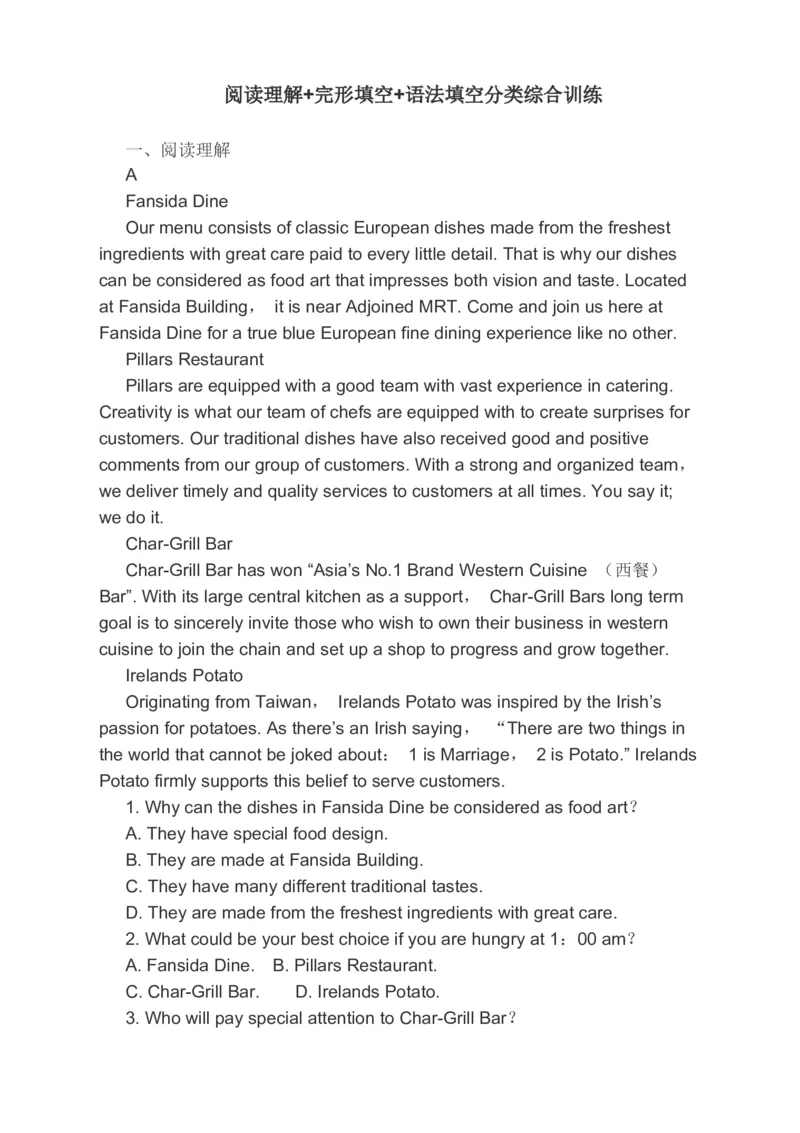
阅读理解+完形填空+语法填空分类综合训练
一、阅读理解
A
Fansida Dine
Our menu consists of classic European dishes made from the freshest
ingredients with great care paid to every little detail. That is why our dishes
can be considered as food art that impresses both vision and taste. Located
at Fansida Building, it is near Adjoined MRT. Come and join us here at
Fansida Dine for a true blue European fine dining experience like no other.
Pillars Restaurant
Pillars are equipped with a good team with vast experience in catering.
Creativity is what our team of chefs are equipped with to create surprises for
customers. Our traditional dishes have also received good and positive
comments from our group of customers. With a strong and organized team,
we deliver timely and quality services to customers at all times. You say it;
we do it.
Char-Grill Bar
Char-Grill Bar has won “Asia’s No.1 Brand Western Cuisine (西餐)
Bar”. With its large central kitchen as a support, Char-Grill Bars long term
goal is to sincerely invite those who wish to own their business in western
cuisine to join the chain and set up a shop to progress and grow together.
Irelands Potato
Originating from Taiwan, Irelands Potato was inspired by the Irish’s
passion for potatoes. As there’s an Irish saying, “There are two things in
the world that cannot be joked about: 1 is Marriage, 2 is Potato.” Irelands
Potato firmly supports this belief to serve customers.
1. Why can the dishes in Fansida Dine be considered as food art?
A. They have special food design.
B. They are made at Fansida Building.
C. They have many different traditional tastes.
D. They are made from the freshest ingredients with great care.
2. What could be your best choice if you are hungry at 1:00 am?
A. Fansida Dine. B. Pillars Restaurant.
C. Char-Grill Bar. D. Irelands Potato.
3. Who will pay special attention to Char-Grill Bar?A. One who lives near Adjoined MRT.
B. One who wants to become a teacher.
C. One who likes eating potatoes very much.
D. One who wants to have a western cuisine bar.
4. What do we know about Irelands Potato?
A. It is run by an Irish.
B. It is famous in Ireland.
C. It originated from Ireland.
D. It has a strict working principle.
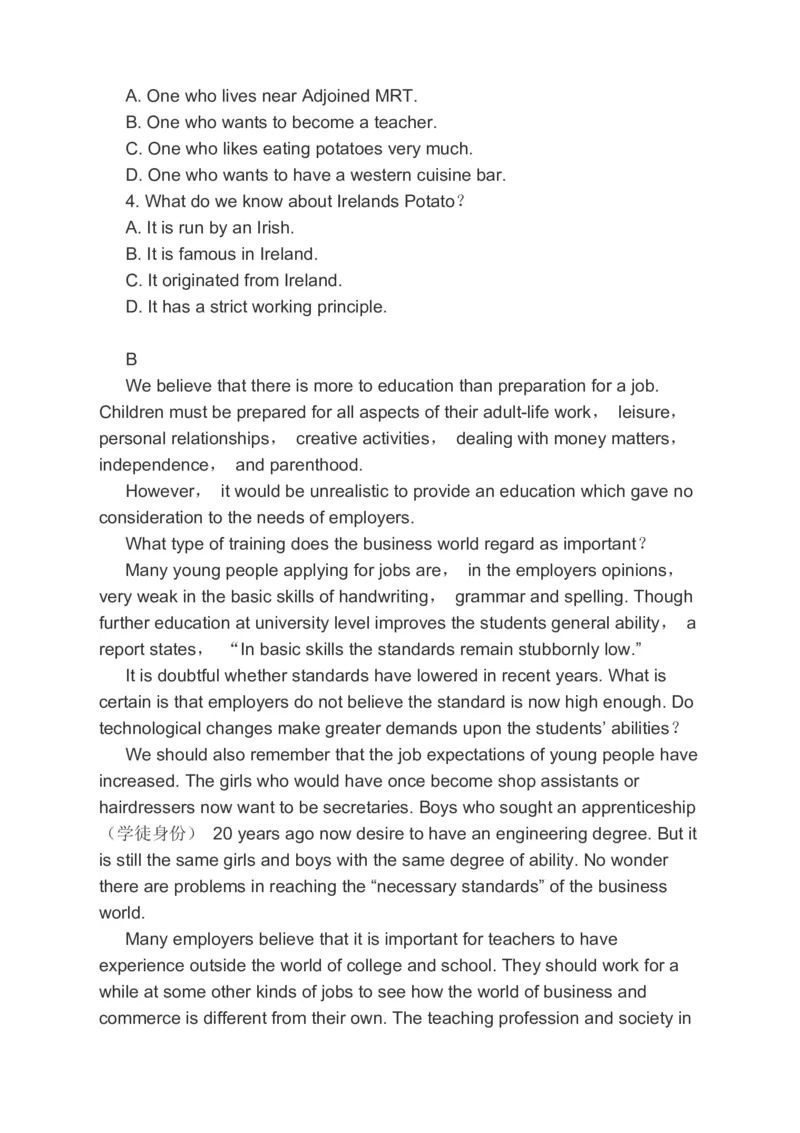
B
We believe that there is more to education than preparation for a job.
Children must be prepared for all aspects of their adult-life work, leisure,
personal relationships, creative activities, dealing with money matters,
independence, and parenthood.
However, it would be unrealistic to provide an education which gave no
consideration to the needs of employers.
What type of training does the business world regard as important?
Many young people applying for jobs are, in the employers opinions,
very weak in the basic skills of handwriting, grammar and spelling. Though
further education at university level improves the students general ability, a
report states, “In basic skills the standards remain stubbornly low.”
It is doubtful whether standards have lowered in recent years. What is
certain is that employers do not believe the standard is now high enough. Do
technological changes make greater demands upon the students’ abilities?
We should also remember that the job expectations of young people have
increased. The girls who would have once become shop assistants or
hairdressers now want to be secretaries. Boys who sought an apprenticeship
(学徒身份) 20 years ago now desire to have an engineering degree. But it
is still the same girls and boys with the same degree of ability. No wonder
there are problems in reaching the “necessary standards” of the business
world.
Many employers believe that it is important for teachers to have
experience outside the world of college and school. They should work for a
while at some other kinds of jobs to see how the world of business and
commerce is different from their own. The teaching profession and society ingeneral need a greater understanding of manpower needs and therefore of
“the desired” direction of the education system.
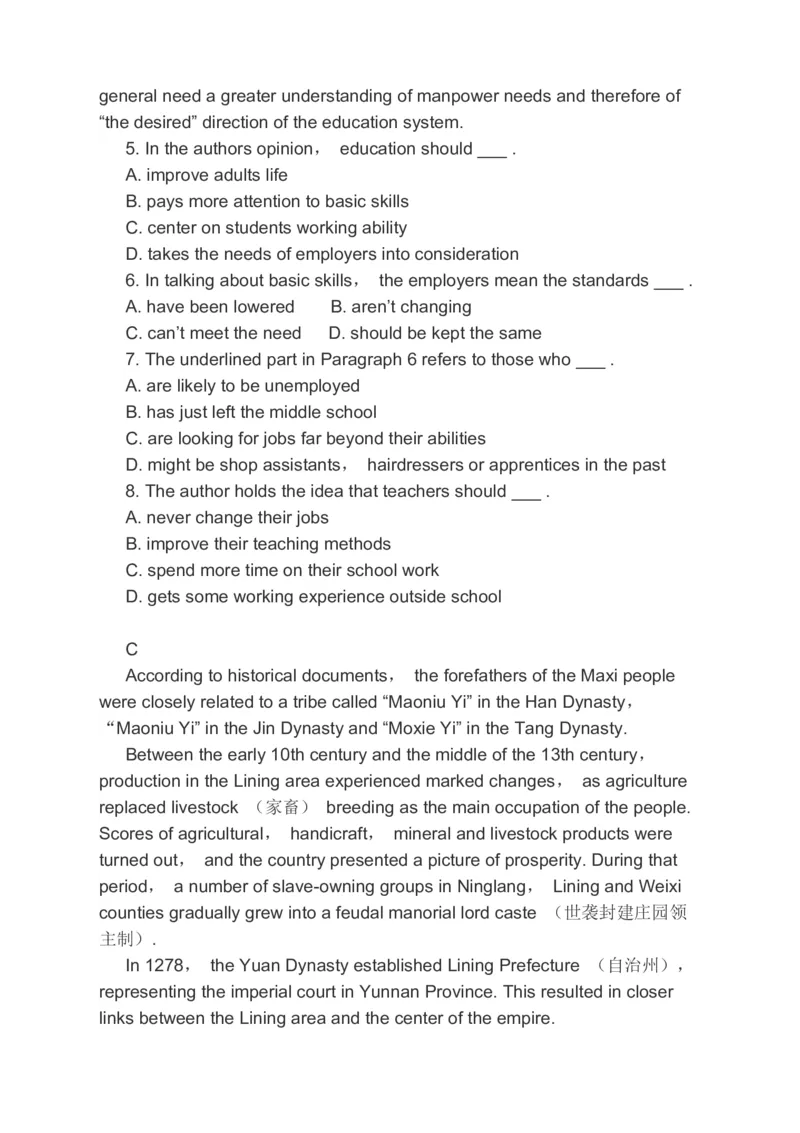
5. In the authors opinion, education should ___ .
A. improve adults life
B. pays more attention to basic skills
C. center on students working ability
D. takes the needs of employers into consideration
6. In talking about basic skills, the employers mean the standards ___ .
A. have been lowered B. aren’t changing
C. can’t meet the need D. should be kept the same
7. The underlined part in Paragraph 6 refers to those who ___ .
A. are likely to be unemployed
B. has just left the middle school
C. are looking for jobs far beyond their abilities
D. might be shop assistants, hairdressers or apprentices in the past
8. The author holds the idea that teachers should ___ .
A. never change their jobs
B. improve their teaching methods
C. spend more time on their school work
D. gets some working experience outside school
C
According to historical documents, the forefathers of the Maxi people
were closely related to a tribe called “Maoniu Yi” in the Han Dynasty,
“Maoniu Yi” in the Jin Dynasty and “Moxie Yi” in the Tang Dynasty.
Between the early 10th century and the middle of the 13th century,
production in the Lining area experienced marked changes, as agriculture
replaced livestock (家畜) breeding as the main occupation of the people.
Scores of agricultural, handicraft, mineral and livestock products were
turned out, and the country presented a picture of prosperity. During that
period, a number of slave-owning groups in Ninglang, Lining and Weixi
counties gradually grew into a feudal manorial lord caste (世袭封建庄园领
主制).
In 1278, the Yuan Dynasty established Lining Prefecture (自治州),
representing the imperial court in Yunnan Province. This resulted in closer
links between the Lining area and the center of the empire.In the early Ming Dynasty, the leader of the Maxi people, named
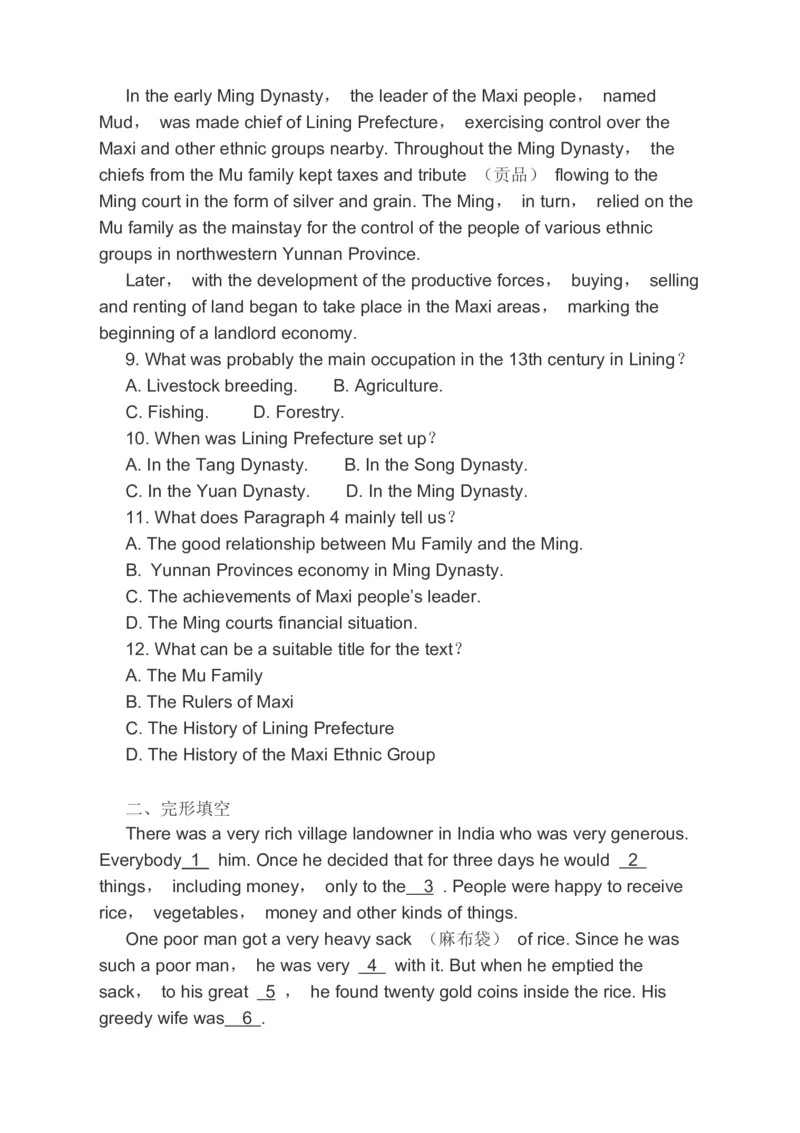
Mud, was made chief of Lining Prefecture, exercising control over the
Maxi and other ethnic groups nearby. Throughout the Ming Dynasty, the
chiefs from the Mu family kept taxes and tribute (贡品) flowing to the
Ming court in the form of silver and grain. The Ming, in turn, relied on the
Mu family as the mainstay for the control of the people of various ethnic
groups in northwestern Yunnan Province.
Later, with the development of the productive forces, buying, selling
and renting of land began to take place in the Maxi areas, marking the
beginning of a landlord economy.
9. What was probably the main occupation in the 13th century in Lining?
A. Livestock breeding. B. Agriculture.
C. Fishing. D. Forestry.
10. When was Lining Prefecture set up?
A. In the Tang Dynasty. B. In the Song Dynasty.
C. In the Yuan Dynasty. D. In the Ming Dynasty.
11. What does Paragraph 4 mainly tell us?
A. The good relationship between Mu Family and the Ming.
B. Yunnan Provinces economy in Ming Dynasty.
C. The achievements of Maxi people’s leader.
D. The Ming courts financial situation.
12. What can be a suitable title for the text?
A. The Mu Family
B. The Rulers of Maxi
C. The History of Lining Prefecture
D. The History of the Maxi Ethnic Group
二、完形填空
There was a very rich village landowner in India who was very generous.
Everybody 1 him. Once he decided that for three days he would 2
things, including money, only to the 3 . People were happy to receive
rice, vegetables, money and other kinds of things.
One poor man got a very heavy sack (麻布袋) of rice. Since he was
such a poor man, he was very 4 with it. But when he emptied the
sack, to his great 5 , he found twenty gold coins inside the rice. His
greedy wife was 6 .The husband said, “The landowner didn’t intend to give me these gold
coins. This must be a 7 . I should return these coins.” The wife said 8 ,
“You are a fool! We are so poor. This is the time to take the gold to the
market and 9 it for lots of money.” The husband 10 to do what his wife
suggested. Then they 11 about the gold for hours. Of course, the husband
12 because it was he who had brought the rice home.
The following day, he went 13 to the rich man’s house and said,
“You were so 14 to give all of us so many things. I have found these
twenty gold coins put in the rice sack by mistake. Now I have come to 15
them to you. Though I am only a beggar, I can 16 accept this kind of gift if
it was a mistake.” The rich man was so 17 by his sincerity and decided to
give the poor man twice the amount. He said, “You brought me twenty
gold coins and now you are getting forty. You are such an honest man. I am
going to 18 an honest man as my housekeeper. Will you come and have a
19 ?”
As expected, the rich man finally found his 20 house-keeper—the poor
but honest man.
1. A. pleased B. admired C. envied D. appreciated
2. A. give away B. get back C. throw away D. put away
3. A. sick B. young C. poor D. old
4. A. strict B. confident C. qualified D. satisfied
5. A. excitement B. surprise C. disappointment D. joy
6. A. frightened B. delighted C. crazy D. cautious
7. A. test B. mistake C. joke D. trick
8. A. eagerly B. patiently C. foolishly D. angrily
9. A. use B. charge C. take D. exchange
10. A. managed B. tried C. refused D. agreed
11. A. discussed B. thought C. talked D. quarreled
12. A. finished B. won C. changed D. defeated
13. A. back B. away C. round D. down
14. A. wealthy B. friendly C. kind D. careless
15. A. return B. send C. give D. offer
16. A. hardly B. never C. seldom D. nearly
17. A. happy B. shocked C. ashamed D. moved
18. A. meet B. train C. employ D. help
19. A. job B. break C. drink D. try20. A. clever B. wise C. special D. faithful
三、语法填空
In China, the history of people planting and using bamboo can date
back as far as 7,000 years. As early as the Shang Dynasty, bamboo was
being used in ancient peoples daily lives. It was used for food, clothing,
housing, transportation,1(music) instruments and even weapons.
The 2 (apply) of bamboo in science and technology is thrilling. In 251
BC, Li Bing, in Sichuan, 3 (lead) the local people in building the
Dujiang Weirs, the first irrigation network in the world, in which bamboo
played an important role. The world’s oldest water pipe 4 (make) of
bamboo, too. During the Han Dynasty, the people in Sichuan 5
(success) sank a 100-metre-deep well with thick bamboo ropes. This
technology did not spread to Europe 6 the 19th century, and it was by
using the technology 7 the Americans drilled the first oil well in
Pennsylvania in 1859.
In Chinese culture, bamboo is well-known 8 one of the “four
gentlemen” in plants. To many distinguished men, bamboo is a symbol of
goodness and 9 (honest). It is always closely related to people of positive
spirits. Bamboo culture contributes to encouraging people to hold on when
10(face) tough situations.
1. 2. 3. 4. 5.
6. 7. 8. 9. 10.
答案
阅读理解
A:1—4 DBDD
B:5—8 DCDD
C:9-12 BCAD
完形填空
1—5 BACDB 6—10 BBDDC
11—15 DBACA 16—20 BDCDD
语法填空
1. musical 2. application 3. led 4. was made 5. successfully6. until/till 7. that 8. as 9. honesty 10. facing