专题 13 阅读理解:推理判断题
备考 2023 年高考英语二轮复习讲练测--测
(原卷版)
时间:60分钟
全国名校最新模拟题 (共八篇)
Passage 1 (2022届东北三省四市教研联合体高考模拟)
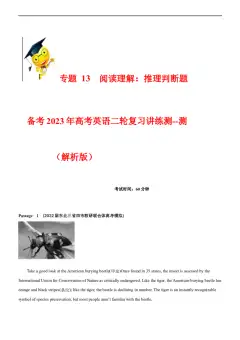
Take a good look at the American burying beetle(甲虫)Once found in 35 states, the insect is assessed by the
International Union for Conservation of Nature as critically endangered. Like the tiger, the American burying beetle has
orange and black stripes(条纹); like the tiger, the beetle is declining in number. The tiger is an instantly recognizable
symbol of species preservation, but most people aren’t familiar with the beetle.This difference is an example of the domination of the so-called celebrity species—the fascinating creatures that
nonprofits and government agencies use to raise public interest in conservation. Most nonprofit funds for animal
protection go to species such as apes, elephants, big cats, rhinoceroses, and giant pandas. Tigers are often rated the most
popular animal—and India, home to the majority of these big cats, spent more than 49 million on tiger conservation
alone in 2019. Meanwhile, many lesser known species of fish, reptiles, amphibians, and birds weaken in namelessness.
Worldwide, more than 35, 500 plant and animal species are on the edge of disappearing forever.
This leaves us with a tough situation. Conservation is underfunded, so how do we decide which species to save?
One potential solution, the debatable idea of conservation triage(检伤分类), holds that experts need to quickly
decide which species can be saved while realizing that others can’t be saved. Conservationists have developed
analytical tools to approach the question in a less emotional, more practical way. Fish and Wildlife Service now uses
this knapsack (背包)method—inspired by a hiker’s need to fit the most valuable items into a small space—to get the
“most bang for their buck” in saving species. The method calculates the most efficient conservation strategies using
factors such as costs to recover a species and its likelihood of going extinct.
8.What does the first paragraph serve to the whole passage?
A.To propose a definition B.To introduce the topic
C.To reach a conclusion D.To present an argument
9.What is the author’s attitude to the lesser known species?
A.Concerned. B.Unclear.
C.OptimisticD.Indifferent.
10.What does the underlined part in the last paragraph probably mean?
A.Damage to the environment. B.Hard work for a goal.
C.Best value for money. D.Most fun from the hike.
11.What will the author probably talk about in the following paragraph?
A.Causes of some animals’ endangerment.
B.Other methods of deciding which species to save.
C.The authorities’ role in reasonable use of funds.
D.An appeal to save the American burying beetle.
Passage 2 ( 2023届江西省南昌市高三零模英语试题 )
Tina Leverton was 62 when she bought her first pair of ballet shoes. She said putting her feet into the soft
leather was very emotional. She said: “I’ve waited a long time for it.”A few days later, Leverton took her first ballet class after seeing an advertisement in a newspaper. It showed
older women dancing in a class near Leverton’s house. “As I came in the door, I found a big smile on my face. From
the minute I started, I felt like coming home.”
Leverton had longed to dance as a child. Sadly, her parents couldn’t afford ballet classes, for they were first-generation
Indian immigrants, struggling to make a living in the UK. Her father was a train driver on the underground in London
and her mother held two cleaning jobs. Nonetheless, she harboured her dream of being a ballerina (芭蕾舞女演员).
At her present age, a grand plie-lowering to the floor with bent knees-seemed to be out of the question. It took
her three months to master the move: leaping and landing on one foot. ”I love the struggle and the challenge of learning
something new. People in their 60s have a lot of self-limiting beliefs: ‘I can’t do it,’ ‘I’m not good enough.’ And maybe
they’re not good enough. But it doesn’t matter,” she said.
Ballet has been transformative. At a medical appointment a few months after Leverton’s first class, a nurse
measured her at 163cm, half an inch taller than she had thought. She attributes (归因) the difference to improved
posture. Her muscle tone has improved and her lower back pain has stopped. Dancing has also brought new friends.
She met a group of older, more independent women and worked together towards a team award with the Royal
Academy of Dance. And then, of course, there is the joyful feeling. “Ballet is all the therapy (治疗) I’ll ever need,” said
Leverton.
4.How did Leverton feel after taking her dance lesson?
A.Tired. B.Confused.C.Shocked. D.Thrilled.
5.Why didn’t Leverton learn to dance she was young?
A.Her family was badly off. B.She wasn’t able to leap high.
C.Her family laughed at her dream. D.She had to focus on classes.
6.What did dancing bring to Leverton?
A.A team award. B.Money and fame.
C.Friendship and joy. D.A medical treatment.
7.What can we learn from Leverton’s story?
A.Hard work pays off.B.Never too old to pursue dreams.
C.Interest is the key to success. D.Money isn’t everything.
Passage 3 (2023届粤湘鄂名校联盟高三上学期第一次联考英语试题)
It is lunchtime. At a long table inside a restaurant, some young people sit together over lunch. There is less
conversation than you might expect from a typical group of friends: a boy seems to talk only to himself, and a girl looks
anxious.These young people met through a program organized by the nonprofit Actionplay, where young people with autism
work together to write and stage a musical. Each Sunday, they work and have lunch together. “You meet other people
just like you,” says Lexi Spindel. “That was the first time my daughter had a friend,” says Lexi’s father. “That never
happened before Actionplay.”
For decades, scientists have supposed people with autism don’t have or need friends. A new research is forcing a
rethink of those long-held beliefs. Autistic people report they want friends. One significant barrier to friendships is
common people’s opinion that autistic people are not interested in connecting with them. Appearing uninterested,
however, is not always the same as being uninterested. An autistic child looking uninterested in games may in fact be
overcome by the noise. And behaviors like clapping hands repeatedly are a way to manage their anxiety and
uncertainty, not a sign of their low social interest.
For some autistic people, friendships develop through experimental programs. In a program Lerner developed,
participants play a game called Gibberish. where teenagers must interpret each other’s intentions without using real
language. The point is not to get it right. but to attend to what the other person is doing in a way that creates
opportunities to connect.
Lerner’s ideas were inspired by a moment 16 years ago after he established a small camp for children with
autism called Spotlight. On the second day an l1-year-old boy ran up and pulled his clothes. “Lerner, Lerner, where did
you find these kids?”
“All over the place,” Lerner answered. “Everyone wants to come to camp, just like you.”
“This is the first normal group of kids I have never met.” the boy said.
12.The scene in paragraph 1 is described to ________.
A.reveal the lack of an interpersonal conversation
B.prove the difficulty in reducing teenage anxiety
C.stress the great necessity of forming friendships
D.show the different behavior of a particular group
13.What is Actionplay aimed at?
A.Curing young people of autism. B.Developing autistic people’s taste in art.
C.Offering autistic people a social platform. D.Improving young people’s family relationship.
14.What can we infer from paragraph 3?
A.Autistic people have no intention to make friends.
B.Noise sets barriers to autistic people’s views on games.
C.Repetitive movements make autistic people feel secure.D.Common beliefs cause autistic people’s low social interest.
15.What does the underlined sentence imply?
A.He feels at ease with his autistic fellows.
B.He no longer regards himself as an autistic kid.
C.Lerner’s guidance helps him get out of autism.
D.Autistic kids don’t long to socialize with normal ones.
Passage 4 (2023届浙江省杭州第二中学新高三上学期适应性测试英语试题)
Although it is a business not many are aware of, sidewalk robots are set to become an industry with annual sales
of $Ibn within a decade, reckons IDTechEx, a British firm of analysts. These four-or six-wheeled autonomous
machines, usually the size of a suitcase, are already delivering groceries and other goods in America, China and Europe.
That puts them ahead of many driverless cars, vans and lorries being developed. Those bigger vehicles are held
back not by technology but regulation, says Zehao Li of IDTechEx. So having a "safety driver" on board ready to take
over if there is a problem, which is hardly labor-saving.
For these larger contraptions regulators want to see safety systems thoroughly proved. But there are legal
hurdles, too. In January Britain's Law Commission, which reviews legislation, recommended that it should not be the
person in the driver's seat who faces prosecution if a vehicle in autonomous mode crashes, but the manufacturer or body
that sought approval for its use.
Meanwhile, sidewalk robots are getting on with the job. Among them, Starship Technologies, based in San
Francisco, reckons it has already clocked up more than 2.5m deliveries with bots in a number of cities, university
campuses and business parks in Europe and America. Amazon is carrying out trials with a similar sort of machine it
calls Scout. Kiwibot, a Colombian startup, is making sidewalk deliveries in Califomia.
Typically, these robots carry a few bags of groceries using a variety of sensors, including cameras, radar and
GPS to navigate and avoid obstacles and people. Their progress can be monitored on a phone app, which also unlocks
them for goods to be retrieved. As they are small. move slowly(Starship's bots might reach a heady 6kph) and are
"telemonitored" by people in a control room who can take over, authorities seem more willing to give them a green
light.
Such robots are also becoming more autonomous. In January Serve Robotics, another San Franciscan firm
whose backers include Uber, a ride-hailing giant, said it had deployed a new sidewalk bot with "level 4"autonomy,
which means it can operate without telemonitoring in some predesignated areas.Robotic versions which operate on roads but have no driver's cab are also appearing. Nuro, a Silicon Valley
firm, makes one about the size of a small car that can carry 24 bags of groceries. It has chilled and heated compartments
for food and drinks. Further along the road in earning their keep, these delivery bots are helping to pave the way for the
time when bigger autonomous vehicles can join them.
8.What can we learn from paragraph one?
A.Sidewalk robots are portable like a suitcase.
B.In the past decade, Ibn dollars have been invested into industry.
C.The delivery industries of the US, China and Europe are dependent on sidewalk robots.
D.The industry of sidewalk robot is expanding unknowingly.
9.According to the passage, who should be responsible for automatic driving car accidents?
A.Safety drivers seated in the driver's seat.
B.Every passenger except the driver.
C.Organizations supportive of autonomous mode.
D.Manufacturers and bodies seeking approval for using safety drivers.
10.What does the underlined phrase in paragraph four mean?
A.reached B.designed
C.bought D.invented
11.Which of the following statements is NOT true according to the passage?
A.Amazon is using Scout to deliver groceries for people.
B.If groceries are wrongly delivered, robots can take them back.
C.Some robots may deliver groceries with no one telemonitoring them.
D.Both cold and hot food can be preserved inside a sidewalk robot developed by Nuro.
Passage 5 (北京市第八十中学2022-2023学年高三上学期10月月考英语试题)
When Kirk Alexander went missing for 11 days, an unlikely savior came to his rescue: his neighborhood pizza
store.
Almost every night for more than ten years, Kirk Alexander, 48, of Salem, Oregon ordered a late dinner from his local
Domino’s pizza store. He had no signature order. Sometimes he would call for a salad, sometimes a pie, sometimes
chicken wings. The only sure thing for the staff of the Silverton Road Domino’s was that they would see Alexander’s
name show up on their online ordering site sometime between 11 p. m. and midnight several times a week.
Until suddenly, for nearly two weeks at the end of April 2016, they didn’t.It was a slow Saturday night on May 7th when Domino’s general manager Sarah Fuller felt she could no longer ignore
Alexander’s recent absence.
“I went and looked up to see how long it had been since he last ordered,” Fuller told KATU. com. “It was 11
days, which was not like him at all.”
Fuller knew Alexander worked from home, and neighbors said he rarely left. She also knew that he had suffered
some health issues in the past. Something, Fuller worried, was wrong.
Around 1 a. m. on Sunday, May 8, Fuller sent longtime delivery driver Tracey Hamblen to stop in at
Alexander’s home. Hamblen approached Alexander’s door as he had countless times before and knocked. He could
plainly see that Alexander’s TV set was on, as were his lights; but after several minutes, Alexander still didn’t answer
the door.
Hamblen rushed back to the store to relay the upsetting developments to Fuller. She encouraged Hamblen to
dial 911. Soon, officers were on their way.
When deputies from the Marion County Sheriff’s office arrived at Alexander’s house, they heard a man calling
for help from inside the residence, deputies said. They broke the door down, and found Alexander on the floor in need
of immediate medical attention. One day later, and they might have been too late.
Alexander was rushed to Salem Hospital, where he was listed in stable condition shortly after the dramatic rescue. In
the following weeks, Fuller, Hamblen, and other store employees went to visit him with flowers and cards, noting that
Alexander greeted them with knowing smiles.
24.How did Fuller sense that something was wrong?
A.She knew Alexander had serious health problems.
B.Alexander hadn’t ordered chicken wings for nearly 2 weeks.
C.Alexander had never before broken his routine in the store for 10 years.
D.Alexander had disappeared from the store’s ordering system for about 2 weeks.
25.What can you infer from the underlined sentence?
A.Hamblen was fond of knocking at Alexander’s door.
B.Hamblen was more than an acquaintance to Alexander.
C.Every time Hamblen arrived at Alexander’s house, he would knock first.
D.When Hamblen had enough time in the past, he would go to Alexander’s house.
26.The saying we can learn from the story is________.
A.Better late than never
B.Born in distress, die in peaceC.Details determine success or failure
D.Even the wise are not always free from error
Passage 6 (甘肃省武威市凉州区部分校联考2022-2023学年高三上学期第二次诊断)
The first time that I met a blind scientist. I worked in a program for disabled students interested in pursuing
STEM (Science, Technology, Engineering, Maths) research. Until that point, it had never occurred to me how blind
students were prevented from receiving science education. My daily experience in classrooms consisted of professors
drawing and writing on the board with the assumption that students in the class could see. But what about those
students who cannot see or suffer from vision problems?
A recent paper from Baylor University, led by Katelyn Baumer and Bryan Shaw, was inspired by exactly this
problem.They designed a study to assess whether people could learn to recognize 3D models, like those often used to
teach science, with their mouths instead of with their eyes.
A 202l paper in Nature found that primates(灵长类动物)showed the same brain circuit activation(激活)when
grasping objects with their hands and when moving an object with their tongues.This indicates that there may be
underlying similarities of physical manipulations(操纵)of the hand and the mouth.
Baumer and Shaw found that there was comparable touch recognition with hands to mouth manipulation
recognition when using these models. 365 college students and 31 primary school students participated in the study.
The participants were blindfolded and then divided into two groups, one assigned to manipulate objects by hand, and
one to manipulate the objects with only their mouths. Each participant was given a single model protein to study. They
then were asked to identify whether each of a set of eight other protein models matched the original they were given.
The research team saw that both age groups of students were able to successfully distinguish between models.
Moreover, the accuracy of recalling the structures was higher in people who only assessed the models through mouth
manipulation.
Although this study did not involve blind or low-vision students, it sets the basis for expanding into them next.
It may offer a way to have science become more accessible, which is the ultimate goal.
8.Who will most probably benefit from Baumer and Shaw’s study?
A.Professors. B.College students.
C.Primary school students. D.Blind and low-vision students.
9.What does the author intend to do in paragraph 3?
A.Explain a concept to readers. B.Provide supporting information.
C.Summarize the previous paragraphs. D.Introduce a new topic for discussion.
10.What method is used in the study?A.Making comparisons. B.Doing surveys.
C.Conducting interviews. D.Reviewing papers.
11.What is the text mainly about?
A.A recent paper about STEM education.
B.A protein model used in science teaching.
C.A potential way for disabled students to learn science.
D.An academic program for blind scientists to do research.
Passage 7 (河北省衡水市部分学校2022-2023学年高三上学期9月月考)
When she was just 9 years old, Hilde Lysiak became famous across the United States for reporting on difficult
news stories. Now Hilde has written a book telling her own story, and sharing some of the challenges she faced.
Hilde Kate Lysiak’s father was a reporter for the New York Daily News. When she was young, he often took her
to work with him, and she developed a strong interest in news stories and reporting. When she was 8, Hilde started her
own newspaper, called the Orange Street News (OSN). Her family lived on Orange Street. Hilde did the writing, her
sister Izzy took pictures, and her father helped her organize and print the newspaper. Following the rules her father had
taught her, she researched and reported stories in her monthly newspaper.
OSN suddenly became famous when a murder happened in town, and 9-year-old Hilde was the first person to
report it. Soon, news organizations around the country were doing stories on Hilde. Some people criticized her parents
for allowing her to report on something as unpleasant as a murder. Others criticized Hilde for “pretending to be a
reporter”. Some people even suggested she should be playing with dolls.
Hilde was upset by the complaints. She responded with a You Tube video. “I never began my newspaper so that
people would think I was cute,” she said. “I want to be taken seriously. I’m sure other kids do, too.” That wasn’t the last
time Hilde had trouble getting people to take her seriously. Sometimes, it was because of her age. Other times, it was
because she was a girl. But she never let that stop her. Hilde continued reporting.
Hilde’s activities as a reporter have made her famous, and she has earned several awards. With her father, Hilde
has written a series of books for young people, called Hilde Cracks the Case. The books are based loosely on stories
that Hilde wrote. The books have now been turned into a TV show called Home Before Dark.
4.What caused Hilde to be interested in news reporting?
A.Her unusual writing skills. B.Her experience with her father at work.
C.Her mother’s encouragement. D.Her passion for reading newspapers.
5.What can we infer from the third paragraph?
A.Hilde took pride in the Orange Street News.B.All the media misunderstood Hilde’s behaviour.
C.Not everyone was happy about Hilde’s efforts.
D.Unpleasant stories were prohibited from being reported.
6.Which of the following can be used to describe Hilde?
A.Determined. B.Adaptable.
C.Awkward.D.Reliable.
7.What is probably the best title for the text?
A.Challenges Hilde Faced When She Was Young
B.A Biographical Novel Written by Hilde Lysiak
C.The Orange Street News: a Popular Newspaper
D.Hilde Lysiak: Young Reporter Tells Her Own Story
Passage 8 (河南省南阳市第一中学校2022-2023学年高三上学期第一次月考)
Just like happiness and sadness, anxiety is part of everyone's lived experience-but it’s not always tolerated as
such. “People often spend too much time and effort trying to rid anxiety,” says Dr Joel Minden, a clinical psychologist.
“I encourage them to remember that anxiety is a normal emotional response.”
If you try to banish anxiety, all you're doing is putting it more at the forefront of your mind. But if you accept
anxiety as part of life, you can learn to relate to it with self-pity or even with humour. This is a cornerstone of
acceptance and commitment therapy (ACT), which has been gaining clinical validation, including by the American
Psychological Association. ACT guides people to see their unpleasant emotions as just feelings and to accept that
hardship is an indispensable part of life. Sufferers are encouraged to begin a dialogue with anxious thoughts, examining
their causes while also keeping in mind their personal goals and values.
This way of relating to anxiety has been a powerful strategy for John Bateman, the 52-year-old host of the
podcast Our Anxiety Stories. When negative thoughts arise, he acknowledges them but doesn’t let them drive his
decisions. Over the years, Bateman has noticed that if he submits to his thoughts, they don’t go away but dramatically
increase. But if he recognizes them for what they are, just a passing thought and not a fact that needs to be acted on,
they gradually go away.
Learning to live with anxiety is an individual process and one that requires trial and error to get just right. While
acceptance is the first and most important step to take, some lifestyle changes have been proven to take the edge off as
well. Since tiredness, increased tension and stress leave us much easier to fall into anxiety, a well-balanced diet,
sufficient rest and, especially, regular exercise can help us manage it better.
12.What may Dr Joel Minden agree about anxiety?A.It goes hand in hand with joy. B.It should be seriously taken.
C.It is easily-earned experience. D.It is often improperly treated.
13.What can explain the underlined word “banish” in Paragraph 2?
A.Recognize. B.Focus. C.Hide.D.Eliminate.
14.Why does the author mention John Bateman in Paragraph 3?
A.To define.B.To inform.C.To illustrate. D.To educate.
15.What is advised to deal with anxiety in the last part?
A.Concentrating on the process. B.Making lifestyle adjustments.
C.Avoiding exposure to pressure. D.Learning to get things in place.
答案:
1._______________________; 2._______________________
3._______________________; 5._______________________
5._______________________; 6._______________________
7._______________________; 8._______________________