绝密★启用前
1998年全国硕士研究生招生考试
英语
(科目代码:201)
☆考生注意事项☆
1. 答题前,考生须在试题册指定位置上填写考生编号和考生姓名;在答题卡
指定位置上填写报考单位、考生姓名和考生编号,并涂写考生编号信息点。
2. 考生须把试题册上的“试卷条形码”粘贴条取下,粘贴在答题卡的“试卷
条形码粘贴位置”框中。不按规定粘贴条形码而影响评卷结果的,责任由
考生自负。
3. 选择题的答案必须涂写在答题卡相应题号的选项上,非选择题的答案必须
书写在答题卡指定位置的边框区域内。超出答题区域书写的答案无效;在
草稿纸、试题册上答题无效。
4. 填(书)写部分必须使用黑色字迹签字笔书写,字迹工整、笔迹清楚;涂
写部分必须使用2B铅笔填涂。
5. 考试结束,将答题卡和试题册按规定交回。
(以下信息考生必须认真填写)
考生编号
考生姓名一
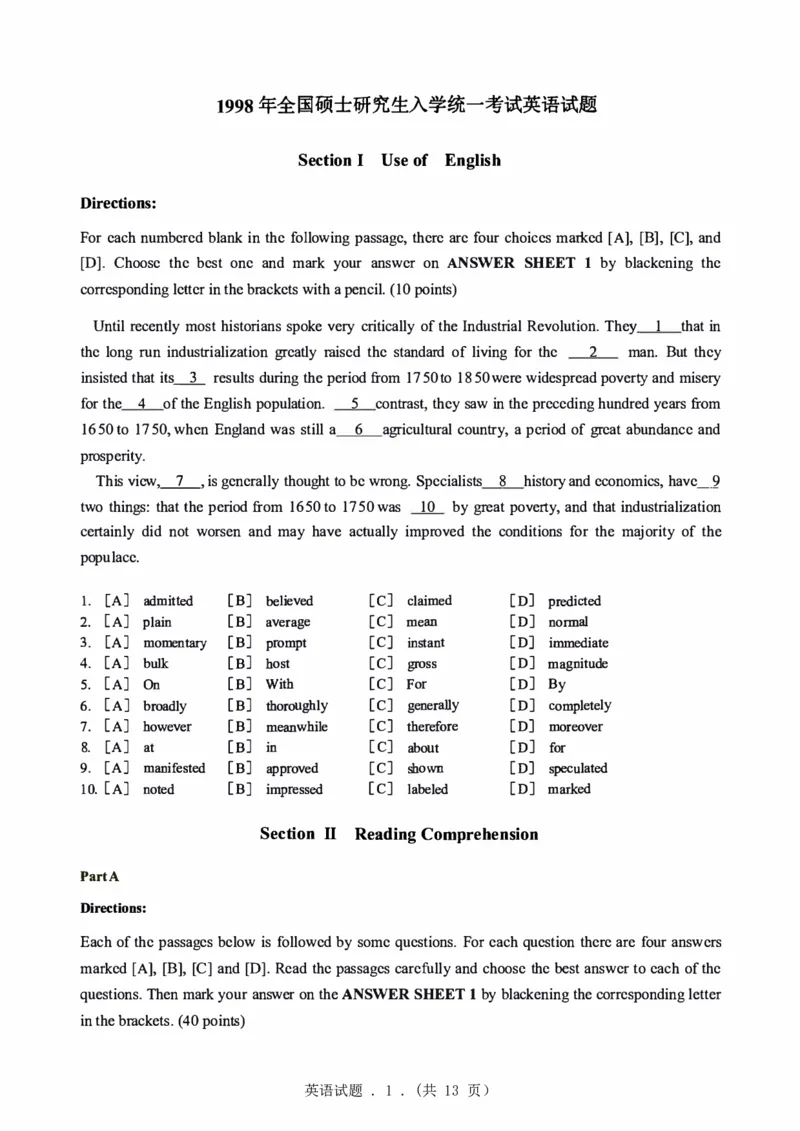
1998年全国硕士研究生入学统 考试英语试题
Section I Use of English
Directions:
For each numbered blank in the following passage, there are four choices m昢ed [A], [B], [C], and
[D]. Choose the best one and mark your answer on ANSWER SHEET 1 by blackening the
corresponding letter in the brackets with a pencil. (10 points)
Until recently most historians spoke very critically of the Industrial Revolution. They 1 that in
the long run industrialization greatly raised the standard of living for the 2 man. But they
insisted that its土results during the period from 17 50 to 18 50were widespread poverty and misery
for the 4 of the English population. 5 contrast, they saw in the preceding hundred years from
16 50 to 17 50, when England was still a 6 agricultural country, a period of great abundance and
prosperity.
二
This view, isgenerally thought to be wrong. Specialists 8 history and economics, have_.2
two things: that the period from 16 50 to 17 50 was 10 by great poverty, and that industrialization
certainly did not worsen and may have actually improved the conditions for the majority of the
populace.
1. [A] admitted [ B] believed [CJ claimed [ D] predicted
2. [A] plain [BJ average [CJ mean [DJ normal
3. [A] momentary [BJ prompt [CJ instant [DJ immediate
4. [A] bulk [BJ host [CJ gross [DJ magnitude
5. [A] On [BJ With [CJ For [DJ By
6. [A] broadly [BJ thoroughly [CJ generally [DJ completely
7. [A] however [BJ meanwhile [C ] therefore [ D] moreover
8. [A] at [BJ in [CJ about [DJ for
9. [A] manifested [BJ approved [CJ shown [ D] speculated
10. [A] noted [ B] i mp ressed [CJ labeled [DJ marked
Section II Reading Comprehension
PartA
Directions:
Each of the passages below is followed by some questions. For each question there are four answers
marked [A], [B], [C] and [D]. Read the passages carefully and choose the best answer to each of the
questions. Then mark your answer on the ANSWER SHEET 1 by blackening the corresponding letter
in the brackets. (40 points)
英语试题 . 1 . (共 13 页)Text 1
Few creations of big technology capture the imagination like giant dams. Perhaps it is
humankind's long suffering at the mercy of flood and drought that makes the idea of forcing the waters
to do our bidding so fascinating. But to be fascinated is also, sometimes, to be blind. Several giant dam
projects threaten to do more harm than good.
The lesson from dams is that big is not always beautiful. It doesn't help that building a big,
powerful dam has become a symbol of achievement for nations and people striving to assert
themselves. Egypt's leadership in the Arab world was cemented by the Aswan High Dam. Turkey's bid
for First World status includes the giant Ataturk Dam.
But big dams tend not to work as intended. The Aswan Dam, for example, stopped the Nile
flooding but deprived Egypt of the fertile silt that floods left -- all in return for a giant reservoir of
disease which is now so full of silt that it barely generates electricity.
And yet, the myth of controlling the waters persists. This week, in the heart of civilized Europe,
Slovaks and Hungarians stopped just short of sending in the troops in their contention over a dam on
the Danube. The huge complex will probably have all the usual problems of big dams. But Slovakia is
bidding for independence from the Czechs, and now needs a dam to prove itself.
Meanwhile, in India, the World Bank has given the go-ahead to the even more wrong-headed
N armada Dam. And the bank has done this even though its advisors say the dam will cause hardship
for the powerless and environmental destruction. The benefits are for the powerful, but they are far
from guaranteed.
Proper, scientific study of the impacts of dams and of the cost and benefits of controlling water
can help to resolve these conflicts. Hydroelectric power and flood control and irrigation are possible
without building monster dams. But when you are dealing with myths, it is hard to be either proper, or
scientific. It is time that the world learned the lessons of Aswan. You don't need a dam to be saved.
英语试题 . 2 . (共 13 页)11. The third sentence of Paragraph 1 implies that
[A] people would be happy if they shut their eyes to reality
[B] the blind could be happier than the sighted
[C] over-excited people tend to neglect vital things
[D] fascination makes people lose their eyesight
12. In Paragraph 5, "the powerless" probably refers to
[A] areas short of electricity
[B] dams without power stations
[C] poor countries around India
[D] common people in the Narmada Dam area
13. What is the myth concerning giant dams?
[A] They bring in more fertile soil.
[B] They help defend the country.
[C] They strengthen international ties.
[D] They have universal control of the waters.
14. What the author tries to suggest may best be interpreted as
[A] "It's no use crying over spilt milk"
[B] "More haste, less speed"
[C] "Look before you leap"
[D] "He who laughs last laughs best"
英语试题 . 3 . (共 13 页)Text2
Well, no gain without pain, they say. But what about pain without gain? Everywhere you go in
America, you hear tales of corporate revival. What is harder to establish is whether the productivity
revolution that businessmen assume they are presiding over is for real.
The official statistics are mildly discouraging. They show that, if you lump manufacturing and
services together, productivity has grown on average by 1.2% since 1987. That is somewhat faster than
the average during the previous decade. And since 1991, productivity has increased by about 2% a year,
which is more than twice the 1978-87 average. The trouble is that part of the recent acceleration is due
to the usual rebound that occurs at this point in a business cycle, and so is not conclusive evidence of a
revival in the underlying trend. There is, as Robert Rubin, the treasury secretary, says, a "disjunction"
between the mass of business anecdote that points to a leap in productivity and the picture reflected by
the statistics.
Some of this can be easily explained. New ways of organizing the workplace -- all that
re-engineering and downsizing -- are only one contribution to the overall productivity of an economy,
which is driven by many other factors such as joint investment in equipment and machinery, new
technology, and investment in education and training. Moreover, most of the changes that companies
make are intended to keep them profitable, and this need not always mean increasing productivity:
switching to new markets or improving quality can matter just as much.
Two other explanations are more speculative. First, some of the business restructuring of recent
years may have been ineptly done. Second, even if it was well done, it may have spread much less
widely than people suppose.
Leonard Schlesinger, a Harvard academic and former chief executive of Au Bong Pain, a rapidly
growing chain of bakery cafes, says that much "re-engineering" has been crude. In many cases, he
believes, the loss of revenue has been greater than the reductions in cost. His colleague, Michael Beer,
says that far too many companies have applied re-engineering in a mechanistic fashion, chopping out
costs without giving sufficient thought to long-term profitability. BBDO's Al Rosenshine is blunter. He
dismisses a lot of the work of re-engineering consultants as mere rubbish -- "the worst sort of
ambulance chasing."
英语试题 . 4 . (共 13 页)15. According to the author, the American economic situation is
[A] not as good as it seems
[B] at its turning point
[C] much better than it seems
[D] near to complete recovery
16. The official statistics on productivity growth
[A] exclude the usual rebound in a business cycle
[B] fall short of businessmen's anticipation
[C] meet the expectation of business people
[D] fail to reflect the true state of economy
17. The author raises the question "what about pain without gain?" because
[A] he questions the truth of "no gain without pain"
[B] he does not think the productivity revolution works
[C] he wonders if the official statistics are misleading
[D] he has conclusive evidence for the revival of businesses
18. Which of the following statements is NOT mentioned in the passage?
[A] Radical reforms are essential for the increase of productivity.
[B] New ways of organizing workplaces may help to increase productivity.
[C] The reduction of costs is not a sure way to gain long-term profitability.
[D] The consultants are a bunch of good-for-nothings.
英语试题 . 5 . (共 13 页)Text3
s
Science has long had an uneasy relationship with other aspects of culture. Think of Gallileo
17th-century trial for his rebelling belief before the Catholic Church or poet William Blake's harsh
remarks against the mechanistic worldview of Isaac Newton. The schism between science and the
humanities has, if anything, deepened in this century.
Until recently, the scientific community was so powerful that it could afford to ignore its critics -
but no longer. As funding for science has declined, scientists have attacked "anti-science" in several
books, notably Higher Superstition, by Paul R. Gross, a biologist at the University of Virginia, and
Norman Levitt, a mathematician at Rutgers University; and The Demon-Haunted World, by Carl Sagan
of Cornell University.
Defenders of science have also voiced their concerns at meetings such as "The Flight from
Science and Reason," held in New York City in 1995, and "Science in the Age of (Mis) information,"
which assembled last June near Buffalo.
Anti-science clearly means different things to different people. Gross and Levitt find fault
primarily with sociologists, philosophers and other academics who have questioned science's
objectivity. Sagan is more concerned with those who believe in ghosts, creationism and other
phenomena that contradict the scientific worldview.
A survey of news stories in 1996 reveals that the anti-science tag has been attached to many other
groups as well, from authorities who advocated the elimination of the last remaining stocks of
smallpox virus to Republicans who advocated decreased funding for basic research.
Few would dispute that the term applies to the Unabomber, whose manifesto, published in 1995,
scorns science and longs for return to a pre-technological utopia. But surely that does not mean
environmentalists concerned about uncontrolled industrial growth are anti-science, as an essay in US
News & World Report last May seemed to suggest.
The environmentalists, inevitably, respond to such critics. The true enemies of science, argues
Paul Ehrlich of Stanford University, a pioneer of environmental studies, are those who question the
evidence supporting global warming, the depletion of the ozone layer and other consequences of
industrial growth.
Indeed, some observers fear that the anti-science epithet is in danger of becoming meaningless.
"The term 'anti-science' can lump together too many, quite different things," notes Harvard University
philosopher Gerald Holton in his 1993 work Science and Anti-Science. "They have in common only
one thing that they tend to annoy or threaten those who regard themselves as more enlightened."
英语试题 . 6 . (共 13 页)19. The word "schism" (Line 3, Paragraph 1) in the context probably means
[A] confrontation
[B] dissatisfaction
[C] separation
[D] contempt
20. Paragraphs 2 and 3 are written to
[A] discuss the cause of the decline of science's power
[B] show the author's sympathy with scientists
[C] explain the way in which science develops
[D] exemplify the division of science and the humanities
21. Which of the following is true according to the passage?
[A] Environmentalists were blamed for anti-science in an essay.
[B] Politicians are not subject to the labeling of anti-science.
[C] The "more enlightened" tend to tag others as anti-science.
[D] Tagging environmentalists as "anti-science" is justifiable.
22. The author's attitude toward the issue of "science vs. anti-science" is
----
[A] impartial
[B] subjective
[C] biased
[D] puzzling
英语试题 . 7 . (共 13 页)Text 4
Emerging from the 1980 census is the picture of a nation developing more and more regional
competition, as population growth in the Northeast and Midwest reaches a near standstill.
This development -- and its strong implications for US politics and economy in years ahead -- has
enthroned the South as America's most densely populated region for the first time in the history of the
nation's head counting.
Altogether, the US population rose in the 1970s by 23.2 million people -- numerically the
third-largest growth ever recorded in a single decade. Even so, that gain adds up to only 11.4 percent,
lowest in American annual records except for the Depression years.
Americans have been migrating south and west in larger numbers since World War II, and the
pattern still prevails.
Three sun-belt states -- Florida, Texas and California -- together had nearly 10 million more
people in 1980 than a decade earlier. Among large cities, San Diego moved from 14th to 8th and San
Antonio from 15th to 10th -- with Cleveland and Washington. D. C., dropping out of the top 10.
Not all that shift can be attributed to the movement out of the snow belt, census officials say.
Nonstop waves of immigrants played a role, too -- and so did bigger crops of babies as yesterday's
"baby boom" generation reached its child bearing years.
Moreover, demographers see the continuing shift south and west as joined by a related but newer
phenomenon: More and more, Americans apparently are looking not just for places with more jobs but
with fewer people, too. Some instances
•Regionally, the Rocky Mountain states reported the most rapid growth rate -- 37.1 percent since
1970 in a vast area with only 5 percent of the US population.
•Among states, Nevada and Arizona grew fastest of all: 63.5 and 53.1 percent respectively.
Except for Florida and Texas, the top 10 in rate of growth is composed of Western states with 7. 5
million people --about 9 per square mile.
The flight from overcrowdedness affects the migration from snow belt to more bearable climates.
Nowhere do 1980 census statistics dramatize more the American search for spacious living than
in the Far West. There, California added 3.7 million to its population in the 1970s, more than any other
state.
In that decade, however, large numbers also migrated from California, mostly to other parts of the
West. Often they chose -- and still are choosing -- somewhat colder climates such as Oregon, Idaho
and Alaska in order to escape smog, crime and other plagues of urbanization in the Golden State.
As a result, California's growth rate dropped during the 1970s, to 18.5 percent -- little more than
two thirds the 1960s' growth figure and considerably below that of other Western states.
英语试题 . 8 . (共 13 页)23. Discerned from the perplexing picture of population growth the 1980 census provided, America
in 1970s
----
[A] enjoyed the lowest net growth of population in history
[B] witnessed a southwestern shift of population
[C] underwent an unparalleled period of population growth
[D] brought to a standstill its pattern of migration since World War II
24. The census distinguished itself from previous studies on population movement in that
[A] it stresses the climatic influence on population distribution
[B] it highlights the contribution of continuous waves of immigrants
[C] it reveals the Americans' new pursuit of spacious living
[D] it elaborates the delayed effects of yesterday's "baby boom"
25. We can see from the available statistics that
----
[A] California was once the most thinly populated area in the whole US
[B] the top 10 states in growth rate of population were all located in the West
[C] cities with better climates benefited unanimously from migration
[D] Arizona ranked second of all states in its growth rate of population
26. The word "demographers" (Line 1, Paragraph 7) most probably means
[A] people in favor of the trend of democracy
[B] advocates of migration between states
[C] scientists engaged in the study of population
[D] conservatives clinging to old patterns of life
英语试题 . 9 . (共 13 页)Texts
Scattered around the globe are more than 100 small regions of isolated volcanic activity known to
geologists as hot spots. Unlike most of the world's volcanoes, they are not always found at the
boundaries of the great drifting plates that make up the earth's surface; on the contrary, many of them
lie deep in the interior of a plate. Most of the hot spots move only slowly, and in some cases the
movement of the plates past them has left trails of dead volcanoes. The hot spots and their volcanic
trails are milestones that mark the passage of the plates.
That the plates are moving is now beyond dispute. Africa and South America, for example, are
moving away from each other as new material is injected into the sea floor between them. The
complementary coastlines and certain geological features that seem to span the ocean are reminders of
where the two continents were once joined. The relative motion of the plates carrying these continents
has been constructed in detail, but the motion of one plate with respect to another cannot readily be
translated into motion with respect to the earth's interior. It is not possible to determine whether both
continents are moving in opposite directions or whether one continent is stationary and the other is
drifting away from it. Hot spots, anchored in the deeper layers of the earth, provide the measuring
instruments needed to resolve the question. From an analysis of the hot-spot population it appears that
the African plate is stationary and that it has not moved during the past 30 million years.
The significance of hot spots is not confined to their role as a frame of reference. It now appears
that they also have an important influence on the geophysical processes that propel the plates across
the globe. When a continental plate come to rest over a hot spot, the material rising from deeper layers
creates a broad dome. As the dome grows, it develops deep fissures (cracks); in at least a few cases the
continent may break entirely along some of these fissures, so that the hot spot initiates the formation of
a new ocean. Thus just as earlier theories have explained the mobility of the continents, so hot spots
may explain their mutability (inconstancy).
英语试题 . 10 . (共 13 页)27. The author believes that
[A] the motion of the plates corresponds to that of the earth's interior
[B] the geological theory about drifting plates has been proved to be true
[C] the hot spots and the plates move slowly in opposite directions
[D] the movement of hot spots proves the continents are moving apart
28. That Africa and South America were once joined can be deduced from the fact that
[A] the two continents are still moving in opposite directions
[B] they have been found to share certain geological features
[C] the African plate has been stable for 30 million years
[D] over 100 hot spots are scattered all around the globe
29. The hot spot theory may prove useful in explaining
[A] the structure of the African plates
[B] the revival of dead volcanoes
[C] the mobility of the continents
[D] the formation of new oceans
30. The passage is mainly about
[A] the features of volcanic activities
[B] the importance of the theory about drifting plates
[C] the significance of hot spots in geophysical studies
[D] the process of the formation of volcanoes
英语试题 . 11 . (共 13 页)PartB
Directions:
Read the following passage carefully and then translate the underlined sentences into Chinese. Your
translation must be written clearly on the ANSWER SHEET 2. (15 points)
They were, by far, the largest and most distant objects that scientists had ever detected: a strip of
enormous cosmic clouds some 15 billion light-years from earh. 31) But even more important, it was
the farthest that scientists had been able to look into the past, for what they were seeing were the
patterns and structures that existed 15 billion years ago. That was just about the moment that the
universe was born. What the researchers found was at once both amazing and expected: the US
National Aeronautics and Space Administration's Cosmic Back ound Explorer satellite -- Cobe --had
gr
discovered landmark evidence that the universe did in fact begin with the primeval explosion that has
become known as the Big Bang (the theory that the universe originated in an explosion from a single
mass of energ).
32) The existence of the giant clouds was virtually required for the Big Bang, first put forward in
the 1920s, to maintain its reign as the dominant explanation of the cosmos. According to the theory,
the universe burst into being as a submicroscopic, unimaginably dense knot of pure energy that flew
outward in all directions, emitting radiation as it went, condensing into particles and then into atoms of
gas. Over billions of years, the gas was compressed by avity into galaxies, stars, plants and
gr
eventually, even humans.
Cobe is desi ed to see just the biggest structures, but astronomers would like to see much
gn
smaller hot spots as well, the seeds of local objects like clusters and superclusters of galaxies. They
shouldn't have long to wait. 33) Astrophysicists working with ground-based detectors at the South
Pole and balloon-borne instruments are closing in on such structures, and may report their findings
soon.
34) If the small hot spots look as expected, that will be a triumph for yet another scientific idea, a
refinement of the Big Bang called the inflationary universe theory. Inflation says that very early on, the
universe expanded in size by more than a trillion trillion trillion trillion fold in much less than a second,
propelled by a sort of anti avity. 35) Odd though it sounds, cosmic inflation is a scientifically
gr
plausible consequence of some respected ideas in elementary paricle physics, and many
astrophysicists have been convinced for the better part of a decade that it is true.
英语试题 . 12 . (共 13 页)m
Section Writing
36. Directions:
A Study the following cartoon carefully and write an essay in no less than 150 words.
B. Your essay must be written clearly on the ANSWER SHEET 2. (15 points)
C. Your essay should meet the requirements below:
1. Write out the messages conveyed by the cartoon.
2. Give your comments.
如此承诺
各行各业兴永订
欢笠扦个推托
1个许为分内帛
句须t:,q\ 畸"t-'ll"
英语试题 . 13 . (共 13 页)