绝密★启用前
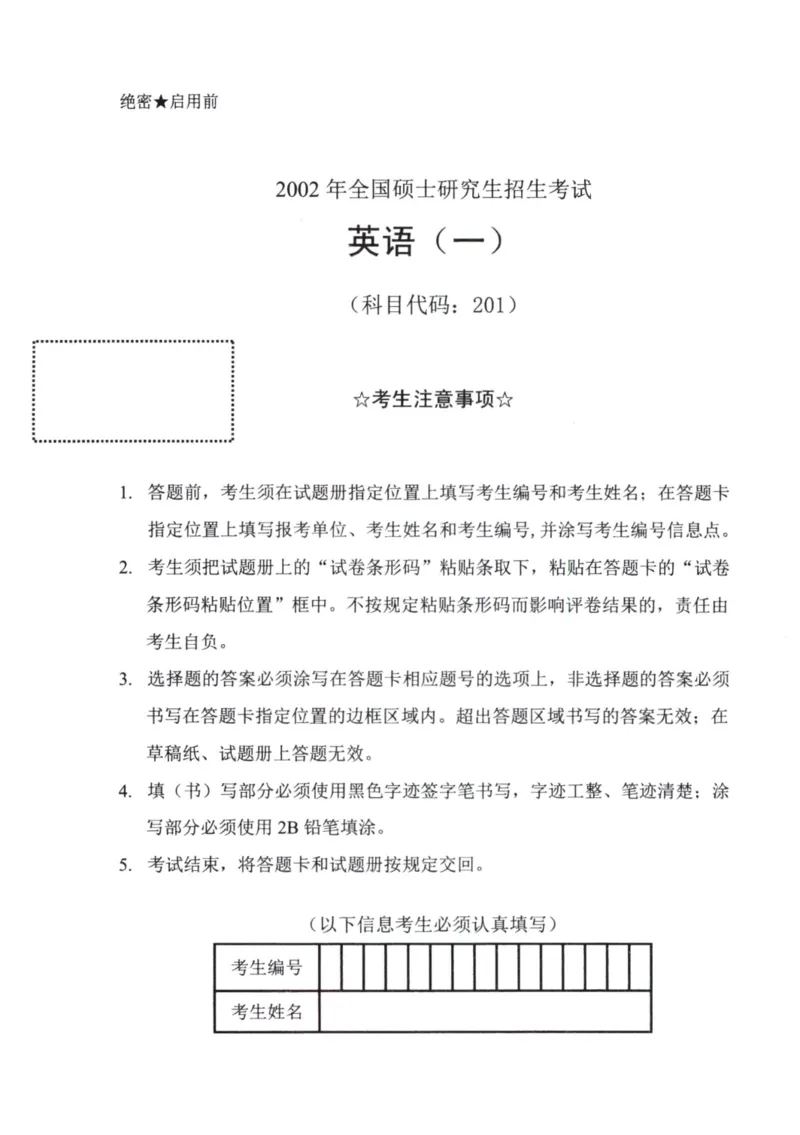
2002年全国硕士研究生招生考试
英语
(科目代码:201)
☆考生注意事项☆
1. 答题前,考生须在试题册指定位置上填写考生编号和考生姓名;在答题卡
指定位置上填写报考单位、考生姓名和考生编号,并涂写考生编号信息点。
2. 考生须把试题册上的“试卷条形码”粘贴条取下,粘贴在答题卡的“试卷
条形码粘贴位置”框中。不按规定粘贴条形码而影响评卷结果的,责任由
考生自负。
3. 选择题的答案必须涂写在答题卡相应题号的选项上,非选择题的答案必须
书写在答题卡指定位置的边框区域内。超出答题区域书写的答案无效;在
草稿纸、试题册上答题无效。
4. 填(书)写部分必须使用黑色字迹签字笔书写,字迹工整、笔迹清楚;涂
写部分必须使用2B铅笔填涂。
5. 考试结束,将答题卡和试题册按规定交回。
(以下信息考生必须认真填写)
考生编号
考生姓名2002 年全国硕士研究生入学统一考试英语试题
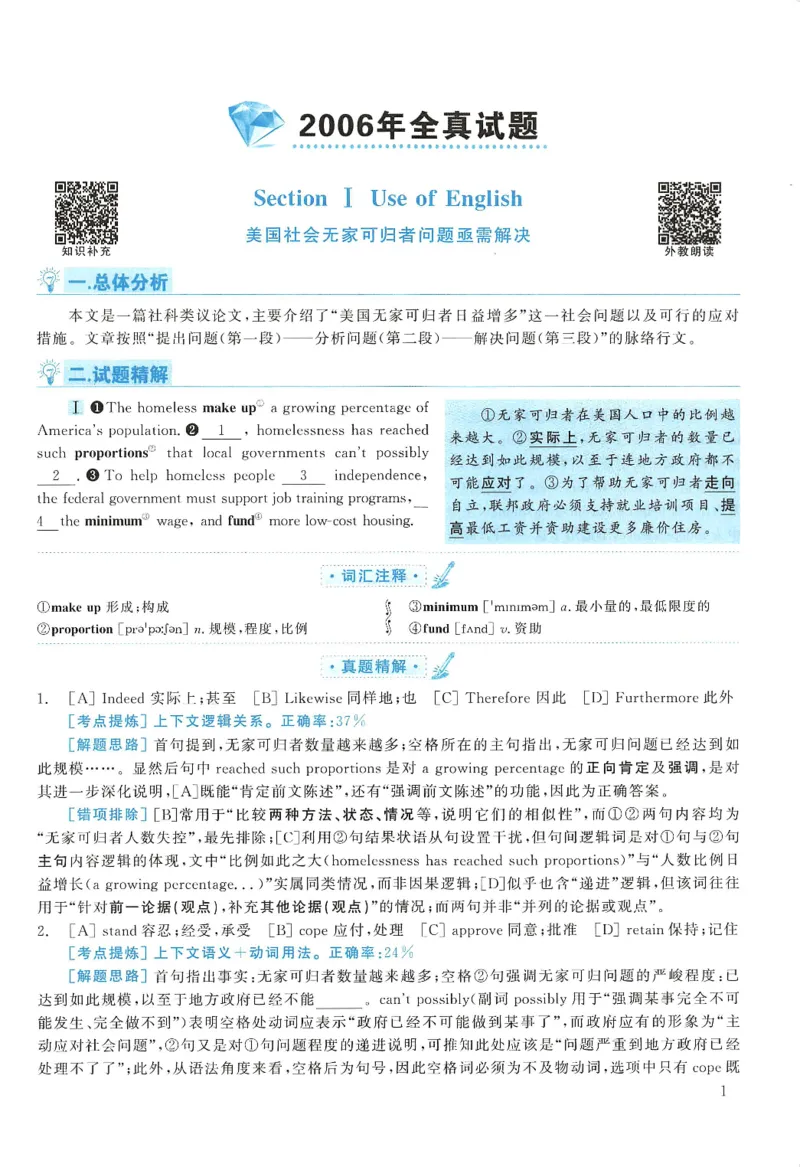
Section I Use of English
Directions:
Read the following text. Choose the best word(s) for each numbered blank and markA, B, C or D on
ANSWERSHEET1.(10points).
Comparisons were drawn between the development of television in the 20th century and the
diffusion of printing in the 15th and 16th centuries. Yet much had happened 1 . As was discussed
before, it was not 2 the 19th century that the newspaper became the dominant pre-electronic
3 ,following in the wake of the pamphlet and the book and in the 4 of the periodical. It was
during the same time that the communications revolution 5 up, beginning with transport, the
railway, and leading 6 through the telegraph, the telephone, radio, and motion pictures 7 the
20th century world of the motor car and the air plane. Not everyone sees that Process in 8 . It is
importanttodoso.
It is generally recognized, 9 , that the introduction of the computer in the early 20th century,
10 by the invention of the integrated circuit during the 1960s, radically changed the process, 11
its impact on the media was not immediately 12 . As time went by, computers became smaller
and more powerful, and they became “personal” too, as well as 13 , with display becoming
sharper and storage 14 increasing. They were thought of, like people, 15 generations,
withthedistancebetweengenerationsmuch 16 .
It was within the computer age that the term “information society” began to be widely used to
describe the 17 within which we now live. The communications revolution has 18 both
work and leisure and how we think and feel both about place and time, but there have been 19
view about its economic, political, social and cultural implications. “Benefits” have been weighed
20 “harmful”outcomes.And generalizationshaveproveddifficult.
英语试题 . 1 . (共 12 页)1. [A]between [B]before [C]since [D]later
2. [A]after [B]by [C]during [D]until
3. [A]means [B]method [C]medium [D]measure
4. [A]process [B]company [C]light [D]form
5. [A]gathered [B]speeded [C]worked [D]picked
6. [A]on [B]out [C]over [D]off
7. [A]of [B]for [C]beyond [D]into
8. [A]concept [B]dimension [C]effect [D]perspective
9. [A]indeed [B]hence [C]however [D]therefore
10.[A]brought [B]followed [C]stimulated [D]characterized
11.[A]unless [B]since [C]lest [D]although
12.[A]apparent [B]desirable [C]negative [D]plausible
13.[A]institutional [B]universal [C]fundamental [D]instrumental
14.[A]ability [B]capability [C]capacity [D]faculty
15.[A]bymeansof [B]intermsof [C]withregardto [D]inlinewith
16.[A]deeper [B]fewer [C]nearer [D]smaller
17.[A]context [B]range [C]scope [D]territory
18.[A]regarded [B]impressed [C]influenced [D]effected
19.[A]competitive [B]controversial [C]distracting [D]irrational
20.[A]above [B]upon [C]against [D]with
Section II Reading Comprehension
PartA
Directions:
Read the following four texts.Answer the questions below each text by choosing [A], [B], [C] or [D].
Markyour answersonANSWERSHEET1.(40points)
英语试题 . 2 . (共 12 页)Text 1
If you intend using humor in your talk to make people smile, you must know how to identify
shared experiences and problems. Your humor must be relevant to the audience and should help to
show them that you are one of them or that you understand their situation and are in sympathy with
their point of view. Depending on whom you are addressing, the problems will be different. If you
are talking to a group of managers, you may refer to the disorganized methods of their secretaries;
alternativelyifyou areaddressingsecretaries,youmaywanttocommentontheirdisorganizedbosses.
Here is an example, which I heard at a nurses’convention, of a story which works well because
the audience all shared the same view of doctors.Aman arrives in heaven and is being shown around
by St. Peter. He sees wonderful accommodations, beautiful gardens, sunny weather, and so on.
Everyone is very peaceful, polite and friendly until, waiting in a line for lunch, the new arrival is
suddenly pushed aside by a man in a white coat, who rushes to the head of the line, grabs his food and
stomps over to a table by himself. “Who is that?” the new arrival asked St. Peter. “Oh, that’s God,”
camethereply,“butsometimeshethinkshe’sadoctor.”
If you are part of the group which you are addressing, you will be in a position to know the
experiences and problems which are common to all of you and it’ll be appropriate for you to make a
passingremark aboutthe inedible canteenfood or thechairman’s notoriousbadtasteinties.With other
audiences you mustn’t attempt to cut in with humor as they will resent an outsider making disparaging
remarks about their canteen or their chairman. You will be on safer ground if you stick to scapegoats
likethePostOfficeorthetelephonesystem.
If you feel awkward being humorous, you must practice so that it becomes more natural. Include
a few casual and apparently off-the-cuff remarks which you can deliver in a relaxed and unforced
manner. Often it’s the delivery which causes the audience to smile, so speak slowly and remember that
araisedeyebroworanunbelievinglookmayhelptoshowthatyou aremakingalight-heartedremark.
Look for the humor. It often comes from the unexpected. A twist on a familiar quote “If at first
you don’t succeed, give up” or a play on words or on a situation. Search for exaggeration and
understatement. Look atyour talk and pick out a few words or sentenceswhich you can turn about and
injectwithhumor.
英语试题 . 3 . (共 12 页)21.Tomakeyourhumorwork,youshould .
[A]takeadvantageofdifferentkindsofaudience
[B]makefun ofthedisorganizedpeople
[C]addressdifferentproblemstodifferentpeople
[D]showsympathyfor yourlisteners
22.Thejokeaboutdoctorsimpliesthat,intheeyesofnurses,theyare .
[A]impolitetonewarrivals
[B]veryconsciousoftheirgodlikerole
[C]entitledtosomeprivileges
[D]verybusyevenduringlunch hours
23.Itcanbeinferredfrom thetextthatpublicservices .
[A]havebenefitedmanypeople
[B]arethefocusofpublicattention
[C]areaninappropriatesubjectforhumor
[D]haveoftenbeenthelaughingstock
24.Toachievethedesiredresult,humorousstoriesshouldbedelivered .
[A]inwell-wordedlanguage
[B]asawkwardlyaspossible
[C]inexaggeratedstatements
[D]ascasuallyaspossible
25.Thebesttitleforthetextmaybe .
[A]UseHumorEffectively
[B]VariousKindsofHumor
[C]AddHumortoSpeech
[D]DifferentHumorStrategies
英语试题 . 4 . (共 12 页)Text 2
Since the dawn of human ingenuity, people have devised ever more cunning tools to cope with
work that is dangerous, boring, burdensome, or just plain nasty. That compulsion has resulted in
robotics—the science of conferring various human capabilities on machines.And if scientists have yet
tocreatethemechanicalversionofsciencefiction,theyhavebeguntocomeclose.
As a result, the modern world is increasingly populated by intelligent gizmos whose presence we
barely notice but whose universal existence has removed much human labor. Our factories hum to the
rhythm of robot assembly arms. Our banking is done at automated teller terminals that thank us with
mechanical politeness for the transaction. Our subway trains are controlled by tireless robot-drivers.
And thanks to the continual miniaturization of electronics and micro-mechanics, there are already
robot systems that can perform some kinds of brain and bone surgery with submillimeter accuracy—
fargreaterprecisionthanhighlyskilledphysicianscanachievewiththeirhandsalone.
But if robots are to reach the next stage of laborsaving utility, they will have to operate with less
human supervision and be able to make at least a few decisions for themselves—goals that pose a real
challenge. “While we know how to tell a robot to handle a specific error," says Dave Lavery, manager
of a robotics program at NASA, “we can't yet give a robot enough ‘common sense’to reliably interact
withadynamicworld.”
Indeed the quest for true artificial intelligence has produced very mixed results. Despite a spell of
initial optimism in the 1960s and 1970s when it appeared that transistor circuits and microprocessors
might be able to copy the action of the human brain by the year 2010, researchers lately have begun to
extendthatforecastbydecadesifnotcenturies.
What they found, in attempting to model thought, is that the human brain's roughly one hundred
billion nerve cells are much more talented—and human perception far more complicated—than
previously imagined. They have built robots that can recognize the error of a machine panel by a
fraction of a millimeter in a controlled factory environment. But thehuman mind canglimpse a rapidly
changing scene and immediately disregard the 98 percent that is irrelevant, instantaneously focusing
on the monkey at the side of a winding forest road or the single suspicious face in a big crowd. The
most advanced computer systems on Earth can't approach that kind of ability, and neuroscientists still
don’tknowquitehowwedoit.
英语试题 . 5 . (共 12 页)26.Humaningenuitywasinitiallydemonstratedin .
[A]theuseofmachinestoproducesciencefiction.
[B]thewideuseofmachinesinmanufacturingindustry.
[C]theinventionoftoolsfor difficultanddangerouswork.
[D]theelite’scunningtacklingofdangerousandboringwork.
27.Theword “gizmos”(line1,paragraph2)mostprobablymeans .
[A]programs
[B]experts
[C]devices
[D]creatures
28.Accordingtothetext,whatisbeyondman'sabilitynowistodesign arobotthatcan .
[A]fulfilldelicatetaskslikeperformingbrainsurgery.
[B]interactwithhumanbeingsverbally.
[C]havealittlecommonsense.
[D]respondindependentlytoachanging world.
29.Besidesreducinghumanlabor,robotscanalso .
[A]makeafewdecisionsfor themselves.
[B]dealwithsomeerrorswithhumanintervention.
[C]improvefactoryenvironments.
[D]cultivatehumancreativity.
30.Theauthor usestheexampleofamonkeytoarguethatrobotsare .
[A]expectedtocopyhumanbrainininternalstructure.
[B]abletoperceiveabnormalitiesimmediately.
[C]farlessablethanhumanbraininfocusingonrelevantinformation.
[D]bestusedinacontrolledenvironment.
英语试题 . 6 . (共 12 页)Text 3
Could the bad old days of economic decline be about to return? Since OPEC agreed to
supply-cuts in March, the price of crude oil has jumped to almost $26 a barrel, up from less than $10
last December. This near-tripling of oil prices calls up scary memories of the 1973 oil shock, when
prices quadrupled, and 1979-1980, when they also almost tripled. Both previous shocks resulted in
double-digit inflation and global economic decline. So where are the headlines warning of gloom and
doomthistime?
The oil price was given another push up this week when Iraq suspended oil exports.
Strengthening economic growth, at the same time as winter grips the northern hemisphere, could push
thepricehigherstillintheshortterm.
Yet there are good reasons to expect the economic consequences now to be less severe than in the
1970s. In most countries the cost of crude oil now accounts for a smaller share of the price of petrol
than it did in the 1970s. In Europe, taxes account for up to four-fifths of the retail price, so even quite
bigchangesinthepriceofcrudehaveamoremutedeffectonpumppricesthaninthepast.
Rich economies are also less dependent on oil than they were, and so less sensitive to swings in
the oil price. Energy conservation, a shift to other fuels and a decline in the importance of heavy,
energy-intensive industries have reduced oil consumption. Software, consultancy and mobile
telephones use far less oil than steel or car production. For each dollar of GDP(in constant prices) rich
economies now use nearly 50% less oil than in 1973. The OECD estimates in its latest Economic
Outlook that, if oil prices averaged $22 a barrel for a full year, compared with $13 in 1998, this would
increase the oil import bill in rich economies by only 0.25-0.5% of GDP. That is less than one-quarter
of the income loss in 1974 or 1980. On the other hand, oil-importing emerging economies—to which
heavy industry has shifted—have become more energy-intensive, and so could be more seriously
squeezed.
One more reason not to lose sleep over the rise in oil pricesis that, unlikethe risesin the 1970s, it
has not occurred against the background of general commodity-price inflation and global excess
demand.Asizable portion of the world is only just emerging from economic decline. The Economist’s
commodity price index is broadly unchanging from a year ago. In 1973 commodity prices jumped by
70%,andin1979byalmost30%.
英语试题 . 7 . (共 12 页)31.Themainreasonfor thelatestriseofoilpriceis_______
[A]globalinflation.
[B]reductioninsupply.
[C]fastgrowth ineconomy.
[D]Iraq’ssuspensionof exports.
32.Itcanbeinferredfrom thetextthattheretailpriceofpetrolwillgoupdramaticallyif______.
[A]priceof cruderises.
[B]commoditypricesrise.
[C]consumptionrises.
[D]oiltaxesrise.
33.TheestimatesinEconomicOutlookshowthatinrichcountries_______.
[A]heavy industrybecomesmoreenergy-intensive.
[B]incomelossmainlyresultsfrom fluctuatingcrudeoilprices.
[C]manufacturingindustryhasbeenseriouslysqueezed.
[D]oilpricechangeshavenosignificantimpactonGDP.
34.Wecandrawaconclusionfromthetextthat_______.
[A]oil-priceshocksarelessshockingnow.
[B]inflationseemsirrelevanttooil-priceshocks.
[C]energyconservationcankeepdowntheoilprices.
[D]thepriceriseofcrudeleadstotheshrinkingofheavyindustry.
35.Fromthetextwecanseethatthewriterseems .
[A]optimistic.
[B]sensitive.
[C]gloomy.
[D]scared
英语试题 . 8 . (共 12 页)Text 4
The Supreme Court’s decisions on physician-assisted suicide carry important implications for
howmedicineseekstorelievedyingpatientsofpainandsuffering.
Although it ruled that there is no constitutional right to physician-assisted suicide, the Court in
effect supported the medical principle of “double effect”, a centuries-old moral principle holding that
an action having two effects—a good one that is intended and a harmful one that is foreseen—is
permissibleiftheactorintendsonlythegoodeffect.
Doctors have used that principle in recent years to justify using high doses of morphine to control
terminallyillpatients’pain,eventhoughincreasingdosageswilleventuallykillthepatient.
Nancy Dubler, director of Montefiore Medical Center, contends that the principle will shield
doctors who “until now have very, very strongly insisted that they could not give patients sufficient
medicationtocontroltheirpainifthatmighthastendeath”.
GeorgeAnnas, chair of the health law department at Boston University, maintains that, as long as
a doctor prescribes a drug for a legitimate medical purpose, the doctor has done nothing illegal even if
the patient uses the drug to hasten death. “It’s like surgery,” he says. “We don’t call those deaths
homicides because the doctors didn’t intend to kill their patients, although they risked their death. If
you’reaphysician,you canriskyourpatient’ssuicideaslongasyou don’tintendtheirsuicide.”
On another level, many in the medical community acknowledge that the assisted-suicide debate
has been fueled in part by the despair of patients for whom modern medicine has prolonged the
physicalagonyofdying.
Just three weeks before the Court’s ruling on physician-assisted suicide, the NationalAcademy of
Science (NAS) released a two-volume report, Approaching Death: Improving Care at the End of Life.
It identifies the undertreatment of pain and the aggressive use of “ineffectual and forced medical
procedures that may prolong and even dishonor the period of dying” as the twin problems of
end-of-lifecare.
The profession is taking steps to require young doctors to train in hospices, to test knowledge of
aggressive pain management therapies, to develop a Medicare billing code for hospital-based care, and
todevelopnewstandardsfor assessingandtreatingpainattheendoflife.
Annas says lawyers can play a key role in insisting that these well-meaning medical initiatives
translate into better care. “Large numbers of physicians seem unconcerned with the pain their patients
are needlessly and predictably suffering”, to the extent that it constitutes “systematic patient abuse”.
He says medical licensing boards “must make it clear...that painful deaths are presumptively ones that
areincompetentlymanagedandshouldresultinlicensesuspension”.
英语试题 . 9 . (共 12 页)36.Fromthefirstthreeparagraphs,welearnthat .
[A]doctorsusedtoincreasedrugdosagestocontroltheirpatients’pain
[B]itisstillillegalfor doctorstohelpthedying endtheirlives
[C]theSupremeCourtstronglyopposesphysician-assistedsuicide
[D]patientshavenoconstitutionalrighttocommitsuicide
37.Whichofthefollowingstatementsitstrueaccordingtothetext?
[A]Doctorswillbeheldguiltyiftheyrisktheirpatients’death.
[B]Modernmedicinehasassistedterminallyillpatientsinpainlessrecovery.
[C]TheCourtruledthathigh-dosagepain-relievingmedicationcanbeprescribed.
[D]Adoctor’smedicationisnolongerjustifiedbyhisintentions.
38.AccordingtotheNAS’sreport,oneoftheproblemsinend-of-lifecareis .
[A]prolongedmedicalprocedures
[B]inadequatetreatmentofpain
[C]systematicdrugabuse
[D]insufficienthospitalcare
39.Whichofthefollowingbestdefinestheword“aggressive”(line3,paragraph7)?
[A]Bold.
[B]Harmful.
[C]Careless.
[D]Desperate
40.GeorgeAnnaswouldprobablyagreethatdoctorsshouldbepunishedifthey .
[A]managetheirpatientsincompetently
[B]givepatientsmoremedicinethanneeded
[C]reducedrugdosagesfor theirpatients
[D]prolongtheneedlesssufferingofthepatients
英语试题 . 10 . (共 12 页)PartB
Directions:
Read the following text carefully and then translate the underlined segments into Chinese. Your
translationshouldbewrittenclearlyonANSWER SHEET2.(10points)
Almost all our major problems involve human behavior, and they cannot be solved by physical
and biologicaltechnology alone.Whatis neededis a technology of behavior,but we have been slow to
develop thescience from which such a technology might be drawn.(41)One difficulty isthatalmost
all of what is called behavioral science continues to trace behavior to states of mind, feelings, traits of
character, human nature, and so on. Physics and biology once followed similar practices and advanced
only when they discarded them. (42)The behavioral sciences have been slow to change partly
because the explanatory items often seem to be directly observed and partly because other kinds of
explanations have been hard to find.The environment isobviously important, but its rolehas remained
obscure.It doesnotpush or pull,it selects, andthisfunctionisdifficulttodiscoverandanalyze.(43)
The role of natural selection in evolution was formulated only a little more than a hundred years ago,
and the selective role of the environment in shaping and maintaining the behavior of the individual is
only beginning to be recognized and studied. As the interaction between organism and environment
has come to be understood, however, effects once assigned to states of mind, feelings, and traits are
beginning to be traced to accessible conditions, and a technology of behavior may therefore become
available. It will not solve our problems, however, until it replaces traditional prescientific views, and
these are strongly entrenched. Freedom and dignity illustrate the difficulty. (44)They are the
possessions of the autonomous(self-governing)man of traditional theory, and they are essential to
practicesin which a person isheld responsible for hisconduct and given credit for his achievements.A
scientific analysis shifts both the responsibility and the achievement to the environment. It also raises
questionsconcerning “values”.Whowilluse atechnology andto whatends? (45)Untiltheseissues
areresolved, a technology of behavior willcontinuetobe rejected,and withitpossibly theonlyway to
solveourproblems.
英语试题 . 11 . (共 12 页)Section III Writing
46.Directions:
Study the following picture carefully and write an essay entitled “Cultures National and
International”.
In theessayyoushould
1)describethepictureandinterpretitsmeaning, and
2)giveyour commentonthephenomenon.
Youshouldwriteabout200wordsneatlyonANSWER SHEET2.(20points)
AnAmericangirlintraditionalChinesecostume(服装)
英语试题 . 12 . (共 12 页)