仁爱九年级下册 unit5Topic2 综合过关检测
考试范围:unit5Topic2;考试时间:100 分钟
一、单项选择(15 分)
1.We all know India is ________ Asian country and Russia is ________ European country.
A.an; a B.an; an C.a; an D.a; a
2.—Confucius (孔子) was a great Chinese educator and philosopher (哲学家).
—His thoughts and ideas have had a deep ________ in China and western countries.
A.attention B.influence C.chance D.victory
3.The general has drawn up a plan to ______the enemy(敌人).
A.win B.lose C.get D.defeat
4.A student can learn ________.
A.wise; wise B.wise; wisely
C.wisely; wise D.wisely; wisely
5.Mrs. White is ________ enough to spend her spare time on our maths problems.
A.confident B.curious C.wise D.generous
6.If you are free when you _____, I hope you can come to see me.
A.pass by B.pass away
C.pass on D.pass out
7.Thanks for your___________ .You're so _____________ to me.
A.kind; kindly B.kindly; kind C.kindness; kind D.kindful; kindness
8.—Could you please tell me how to get to the nearest flower store?
—Sure. Go along this street until you ________ a bookstore. The flower store is next to it.
A.look for B.pass by C.set up D.walk into
9.My English teacher ________ me a lot since she began to teach us.
A.influences B.influenced C.is influencing D.has influenced
10.The boys who ________on the playground are my classmates.
A.is playing soccer B.are playing soccer C.was playing soccer.11.On the dark street, there were no people around ________ she could turn for help.
A.to whom B.with whom C.by whom D.for whom
12.When facing a new challenge, we should be ________ at first. It takes time.
A.patient B.busy C.polite D.wise
13.My study in junior high school is coming to an end. It’s time ________ us ________.
A.for; graduate B.to; to graduate C.for; to graduate D.to; graduating.
14.—People, especially the young, ________ by their friends.
—That’s true. Friends play an important part in everyone’s life.
A.easily influences B.easily influenced
C.are easily influenced D.will be easily influenced
15.—What impressed you most in your middle school?
— _______________. They were strict but always encouraged me when necessary.
A.The teachers who helped me a lot B.The activities which I took part in
C.The subjects which I was interested in D.The books that I shared with my friends
二、完形填空(10 分)
根据短文内容,从A、B、C、D四个选项中选出一个能填入相应空格的最佳答案。
During the Spring and Autumn period, there was a great singer in the State (诸侯国) of Han. People called her
Han E.
One year, Han E went to the State of Qi but soon 16 money. In order to earn (赚得) some money,
Han E went to the city gate of Qi’s capital and sang there. Everyone who heard her song was deeply 17 by hgeern tle
voice. Even after Han E left the city gate, the audience (听众) there was still lost in her 18 . Her beautiful
song seemed to linger (萦绕) there for three days afterwards.
Later, Han E stayed in a small inn (客栈). Since she was poor, the innkeeper treated her 19 . The singer
left that place in tears. Her cries were like a sad song. The people who lived nearby could not forget her crying. They
were so 20 that they could not eat for days.
Then, the people decided to go in search of Han E. They found the 21 and invited her back to sing a
pleasant song for them. Han E 22 . Her song drove away the “dark clouds” that were hanging over the
people. Smiles appeared on 23 faces once again. Some of them could not help dancing happily 24the song. In the end, they gave many gifts to Han E 25 they sent her on her way.
16.A.took away B.ran out of C.turned down D.ended up
17.A.tired B.excited C.scared D.touched
18.A.singing B.crying C.saying D.watching
19.A.truly B.carefully C.badly D.wisely
20.A.patient B.upset C.shocked D.relaxed
21.A.singer B.dancer C.artist D.farmer
22.A.doubted B.replied C.agreed D.refused
23.A.her B.his C.our D.their
24.A.at B.for C.to D.with
25.A.after B.before C.until D.unless
三、阅读单选 (共 30 分)
根据短文内容,在A、B、C、D四个选项中选择一个正确答案。
A
Who is the greatest teacher in Chinese history? Many people would think of Confucius. Although he lived over
2, 000 years ago, people still remember and respect him for his contribution to the education today.
Confucius lived in the Kingdom of Lu, which lies in Shandong Province. He lived during the Spring and Autumn
Period. He had a hard childhood. His father died when he was only 3. His mother brought him up. As a child, he had
to work to help his mother, but young Confucius didn’t give up studying. He visited many famous teachers and
learned music, history, poetry and sports.
Later, he became a teacher and started the first public school in Chinese history. At that time only children
fromnoblefamilies could go to school, but Confucius believed everyone should go to school if they wanted to learn.
He had about 3, 000 students in his lifetime.
Today, people still follow Confucius’ lessons. He told us that we all have something valuable to be learned.
“When I am with three people, one of them must be better than me in some areas. I choose their good qualities and
follow them”
He also taught us that thinking is very important in study. “All study but no thinking makes people puzzled
(困惑的). All thinking but no study makes people lazy.”Confucius is not only a great teacher, but also a famous thinker with wise thoughts about the world and society.
His most important teachings are about kindness and good manners. “A person should be strict with himself, but be
kind to others.”
26.Today we still remember Confucius mainly because __________.
A.he lived a poor life in his childhood
B.he lived during the Spring and Autumn Period
C.he traveled with his students from state to state
D.he had wise thoughts and great views about education
27.Confucius learned music, history, poetry and sports __________.
A.by teaching himself at home B.by visiting many famous teachers
C.by going to school D.with the help of his mother
28.The underlined word “noble” in Paragraph 3 has the closest meaning to “__________”.
A.poor B.bright C.cute D.rich
29.The correct order of the following statements is ___________.
①Confucius worked to help his mother as a child.
②Confucius taught about 3, 000 students in his lifetime.
③Confucius’ father died.
④Confucius started he first public school in Chinese history.
A.①③②④ B.②③④① C.③①④② D.④③①②
30.Which of the following is the best title for the passage?
A.Confucius’ teaching ways. B.Person who travels around China.
C.Confucius—great teacher and thinker. D.Great man with happy childhood.
B
Zhuge Liang, also known as Kongming, was a famous and smart person in ancient China. He was good at
strategy and was very clever.
Born in the late 2nd century, Zhuge Lang became well-known when he joined Liu Bei, the leader of the Shu
Kingdom, as his main strategist. Zhuge Liang was really good at planning military actions and helped Liu Bei win
many battles. This made the Shu Kingdom one of the three major powers at that time.
Zhuge Liang was not only good at military strategy, but also skilled in governance (统治) , engineering, anddiplomacy (外交). He was known for being humble and virtuous (品德高尚的), which made people trust and respect
him.
One of Zhuge Liang’s most famous achievements was the Longzhong Plan, a strategy he made to protect the
Shu Kingdom from attacks by the rival Wei Kingdom. He successfully defended against several invasions by carefully
planning and building fortifications (防御工事).
Zhuge Liang’s reputation lasted through history, and he became a legendary figure in China, seen as the symbol
of wisdom and intelligence. His contributions and accomplishments continue to inspire people, both in China and
worldwide.
31.Who was Zhuge Liang?
A.A famous military strategist in ancient China.
B.A leader of the Wei Kingdom.
C.A famous scholar (学者) of diplomacy.
D.A skilled engineer in the Shu Kingdom.
32.Which kingdom did Zhuge Liang join as a strategist?
A.Wei Kingdom.
B.Shu Kingdom.
C.Wu Kingdom.
D.Qin Kingdom.
33.How did Zhuge Liang help Liu Bei’s kingdom?
A.He helped his kingdom gain independence.
B.He helped his kingdom become the most powerful at that time.
C.He helped his kingdom win many battles.
D.He helped his kingdom establish trade routes.
34.What was one of Zhuge Liang’s most famous achievements?
A.The construction of the Great Wall.
B.The invention of papermaking.
C.The idea of the Longzhong Plan.
D.The establishment of the Silk Road.
35.How is Zhuge Liang remembered in Chinese history?
A.As a master of literature and poetry.
B.As a skilled diplomat and politician.C.As a victor of many kingdoms.
D.As a symbol of wisdom and intelligence.
C
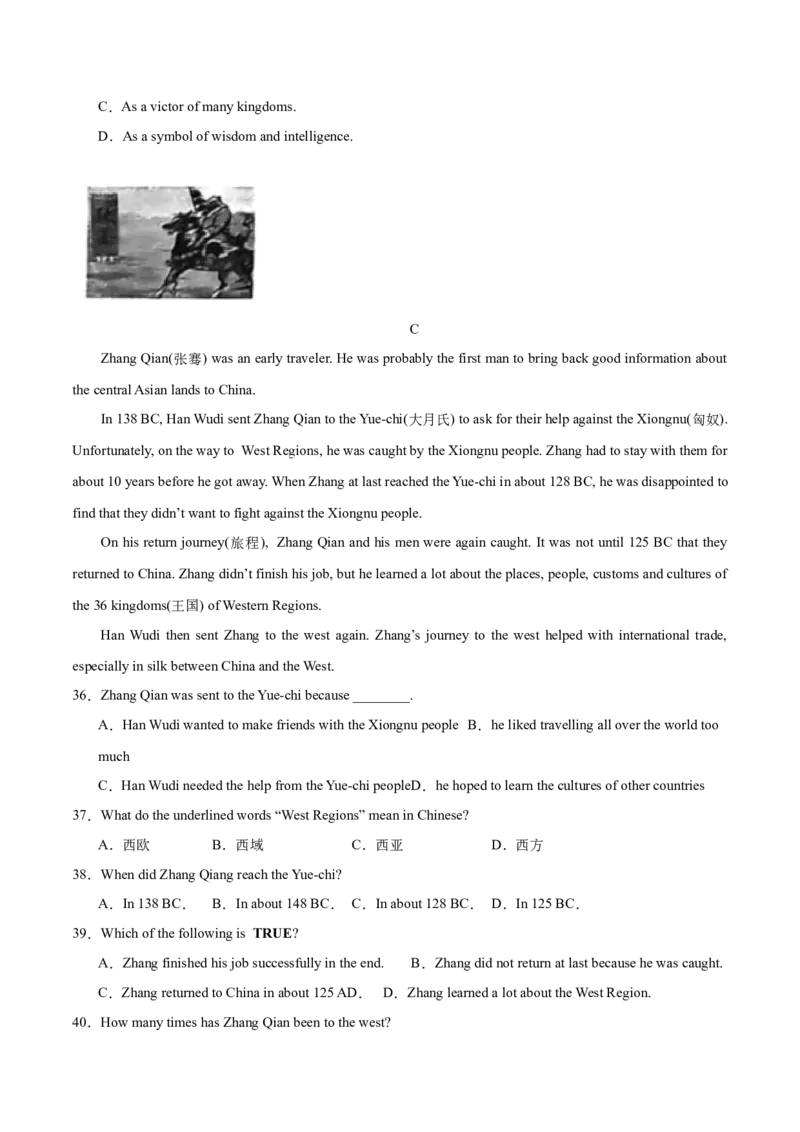
Zhang Qian(张骞) was an early traveler. He was probably the first man to bring back good information about
the central Asian lands to China.
In 138 BC, Han Wudi sent Zhang Qian to the Yue-chi(大月氏) to ask for their help against the Xiongnu(匈奴).
Unfortunately, on the way to West Regions, he was caught by the Xiongnu people. Zhang had to stay with them for
about 10 years before he got away. When Zhang at last reached the Yue-chi in about 128 BC, he was disappointed to
find that they didn’t want to fight against the Xiongnu people.
On his return journey(旅程), Zhang Qian and his men were again caught. It was not until 125 BC that they
returned to China. Zhang didn’t finish his job, but he learned a lot about the places, people, customs and cultures of
the 36 kingdoms(王国) of Western Regions.
Han Wudi then sent Zhang to the west again. Zhang’s journey to the west helped with international trade,
especially in silk between China and the West.
36.Zhang Qian was sent to the Yue-chi because ________.
A.Han Wudi wanted to make friends with the Xiongnu people B.he liked travelling all over the world too
much
C.Han Wudi needed the help from the Yue-chi peopleD.he hoped to learn the cultures of other countries
37.What do the underlined words “West Regions” mean in Chinese?
A.西欧 B.西域 C.西亚 D.西方
38.When did Zhang Qiang reach the Yue-chi?
A.In 138 BC. B.In about 148 BC. C.In about 128 BC. D.In 125 BC.
39.Which of the following is TRUE?
A.Zhang finished his job successfully in the end. B.Zhang did not return at last because he was caught.
C.Zhang returned to China in about 125 AD. D.Zhang learned a lot about the West Region.
40.How many times has Zhang Qian been to the west?A.Only once. B.Twice. C.Three times. D.Four times.
D
During the Qin Dynasty in China, there was a boy named Han Xin. He was born in a very poor family and often
had nothing to eat. He often went fishing but almost caught nothing. He was always hungry.
One day, Han Xin was fishing at the river. An old lady saw that the boy was very thin and looked hungry. She
gave him a bowl of rice.
“Thank you so much,” said Han Xin as he bowed down to the old lady. Since then, every time Han Xin met the
old lady at the river, he never went hungry. Han Xin was very thankful to the old lady. “I will find a way to pay you
back someday,” he said.
“Why do you promise so much when you have nothing?” she said. “I give you rice because I feel sorry that you
don’t have anything to eat. I don’t expect you to repay me. If you are a real man, you will find a way to support
yourself.”
When Han Xin grew up, he became brave and kind. He joined the army and then became a general. And later
he became the “King of Qi” and the “King of Chu” in the Han Dynasty. He did many good things and helped many
people.
Han Xin never forgot the old lady. He went back to the village and took her to his palace. Han Xin bowed down
to her and gave her a bowl filled with gold.
“I promised I would pay you back someday,” he said.
The old lady refused. “Thank you for the gold,” she said. “You have already paid me back by becoming a strong
and kind man.”
The Chinese idiom “one rice, thousand gold” (一饭恩,千金酬) comes from this story. It tells us that we
should always give a hand to others without expecting anything in return, and we should also forever remember the
help from someone else.
根据语篇内容,选择最佳选项。
41.How was Han Xin’s life when he was young?
A.It was easy. B.It was hard. C.It was happy. D.It was unfair.
42.Where did Han Xin meet the old lady one day?
A.In a village. B.In a palace. C.On the street. D.At the river.
43.What did Han Xin give the old lady?
A.A gold bowl. B.Some bowls. C.A bowl full of gold. D.Some gold.44.What does the underlined (划线的) word in the last paragraph mean in Chinese?
A.习语 B.准则 C.礼节 D.风俗
45.What’s the main idea of the story?
A.If you help others, you will get gold in return.
B.We should always remember those who help us.
C.Don’t help those who are living in a poor family.
D.Please be ready to help others because they will help you in return.
During the Tang Dynasty, Emperor Taizong asked the prime minister Feng Deyi to look for talented people.
However, several months passed, Feng didn’t find anyone.
“I tried my best, but there are not unusual and well-rounded people at all,” Feng said.
“People are like utensils (器物). What we need to do is to make good use of their strengths. You should blame
(责怪) yourself for not noticing talented people. How could you say that there are no talented people in our country?”
said the emperor.
It is really true that each utensil or tool has a specific use. A knife is made to cut things while chopsticks are
made to pick up food. We can’t use a knife as chopsticks. Like a utensil, each person has a special strength. Nobody
is perfect. We can’t expect a person to be good at everything.
With this idea in mind, Emperor Taizong discovered many talented people of different backgrounds. He offered
them important positions, which helped them make the most of their talents. A good example is Ma Zhou, who grew
up in a poor family. Ma gave a lot of useful advice, so Emperor Taizong offered him a position and promoted (晋升) him
many times. Ma helped the emperor deal with difficult problems and became a famous person in history. During that
period, the important officials around Emperor Taizong, such as Fang Xuanling, Wei Zheng, LiJing, all were the
brightest and the best of the time with their own strong points.
Emperor Taizong’s talented people helped the society develop and created a “golden age”.
46.Why couldn’t Feng Deyi find any talented people in Taizong’s opinion?
A.His standards were wrong.
B.There were no talented people then.
C.He was afraid of being replaced.
D.He wasn’t satisfied with the emperor.
47.Knives and chopsticks are compared to ________.
A.positions B.backgrounds C.tools D.people48.Which of the following best explains “make the most of” in Paragraph 5?
A.Come up with something.
B.Have something in common.
C.Put something to good use.
D.Bring good luck to something.
49.Ma Zhou is a good example of people who ________.
A.have no talent but are still useful
B.are unusual and well-rounded
C.know when to take a chance
D.show talent in the right field
50.What is the main message of the story?
A.Opportunity only comes to those who are prepared.
B.Talented people should be valued and led to the right place.
C.Nothing in the world is difficult if you put your heart into it.
D.Appearance can be changed, but talent always stays the same.
四、阅读还原 5 选 5(5 分)
阅读下面的短文,根据短文内容,从短文后的选项中选出能填入文中
空白处的最佳选项。
E
Yan Hui was born in the Lu Kingdom during the Spring and Autumn Period. His father, Yan Lu, was one of the
earliest followers of Confucius. At the age of 13, Yan Hui became a student of Confucius and followed his teachings
for the rest of his life.
Yan Hui was the youngest student of Confucius. 51 Because he did not wish to speak with them, the
other students concluded(断定) he was stupid. Confucius watched his student carefully. After a short time, he realized
that Yan Hui was very clever. Gradually, the other students realized this, too. On one occasion, Confucius asked
another student, Zigong, how he compared himself with Yan Hui. Zigong answered without a moment’s thought, “I
can’t compare with him.” Confucius laughed in agreement and said, “It seems that neither of us is as good as him!”Although he was very clever, Yan Hui was always keen to learn. 52 He admired him, as people admire a holy(
神圣的) person. Yan Hui once said, “The Master has taught me many things. 53 ”
Confucius liked Yan Hui for his good nature. Yan Hui lived in an old house, ate simple food and drank cold
water. 54 Every evening, Yan Hui sat quietly by himself and went over his actions during the day. He asked himself
if he was polite and kind. Perhaps the reflection on his actions made him a better person.
Yan Hui followed Confucius on his travels to various kingdoms, and took every chance to try to teach his
Master’s principles(道德准则) of ren (kindness) and li (social norms).
People did not always accept his teachings and none of the kingdoms agreed to his ideas. 55 However, Yan
Hui was not one of them. He said, “The thoughts of my Master are too deep for most people. They cannot understand.
But the more our ideas are rejected(拒绝), the stronger we become.”
When Confucius heard these words, he said, “Only Yan Hui can follow my ideas for a long period of time.”
A.Most people could not live that way, but it seemed that he enjoyed it.
B.Even some of Confucius’ students began to doubt their teacher.
C.As time went by, he began to really understand the deep thoughts of his teacher.
D.The more I think about his teachings, the more I feel they are too hard to achieve.
E.He was quiet and not interested in talking with the other students.
第 II 卷(非选择题)
四、完成句子
56.difficult, set up, it’s, a, to, website
.
57.do, want, what, to, you, express
?
58.very much, I, who, is, like, he, the man
.
59.young, is, up, to, own, set, man, company, the, planning, his
.
60.with, you, whom, last weekend, play, did
?五、根据图画及所给单词写出句子
根据每小题所提供的图画情景和提示词,写出一个与图画情景相符的
句子。(10 分)
61. make a great contribution to education
62. explore, lead, in his life
63. The president passed away, illness
64. spend, watch TV, one’s spare time
65. outdoor activities, instead of, watch TV六、综合填空(10 分)
Lord Pingyuan was from the State of Zhao. At that time, Zhao was 66 (weak) than Qin, so Qin
wanted to control Zhao. Lord Pingyuan decided to ask the State of Chu 67 help. He wanted to pick twenty
talented people to go with him. But he could only find nineteen people. Soon, a man 68 (call) Mao Sui
recommended (推荐) himself. “Please believe me,” Mao Sui said with a confident smile 69 his face.
Finally Lord Pingyuan let Mao Sui join them.
Lord Pingyuan 70 (lead) these twenty men to the State of Chu. However, the king didn’t want to help
Zhao. Mao Sui was so brave 71 he walked to the king with a sword (剑) in his hand. The sword was 72
(shine) bright and the king was shocked and had to listen to Mao Sui. Mao Sui explained the 73
(important) of the friendship between Chu 74 Zhao. Finally, the king agreed to help Zhao. The good news
excited all the people of Zhao and Mao Sui became a hero of the state. This story reminds us that we should always
believe in 75 (our) like Mao Sui. Don’t hide your talents and show yourself to others.
七、书面表达(10 分)
76.假如你是李华,请根据信息提示,给在英国的笔友 Peter 写一封信,和他分享你是如何防控新型冠状
病毒(COVID -19)的。词数:80 左右。
健康生活习惯:
常开窗,保持室内干净; 勤洗手,注意个人卫生; 适量运动,增强体质;……
防控新型冠状病毒
外出注意事项:
少外出;戴口罩 (mask);少乘公共交通工具;……
注意事项:
1.必须包含所提示的信息,可适当发挥,开头已给出,不计入总词数;
2.意思清楚,表达通顺,行文连贯,书写规范;3.请勿在文中使用真实的姓名、校名及提示信息以外的地名。
Dear Peter,
How are you? As we know, COVID -19 is spreading all over the world and has influenced human’s health
greatly. I’d like to share how to keep safe from it with you.
Yours,
Li Hua