文档文本内容
状语从句的用法
责编:王晓丽
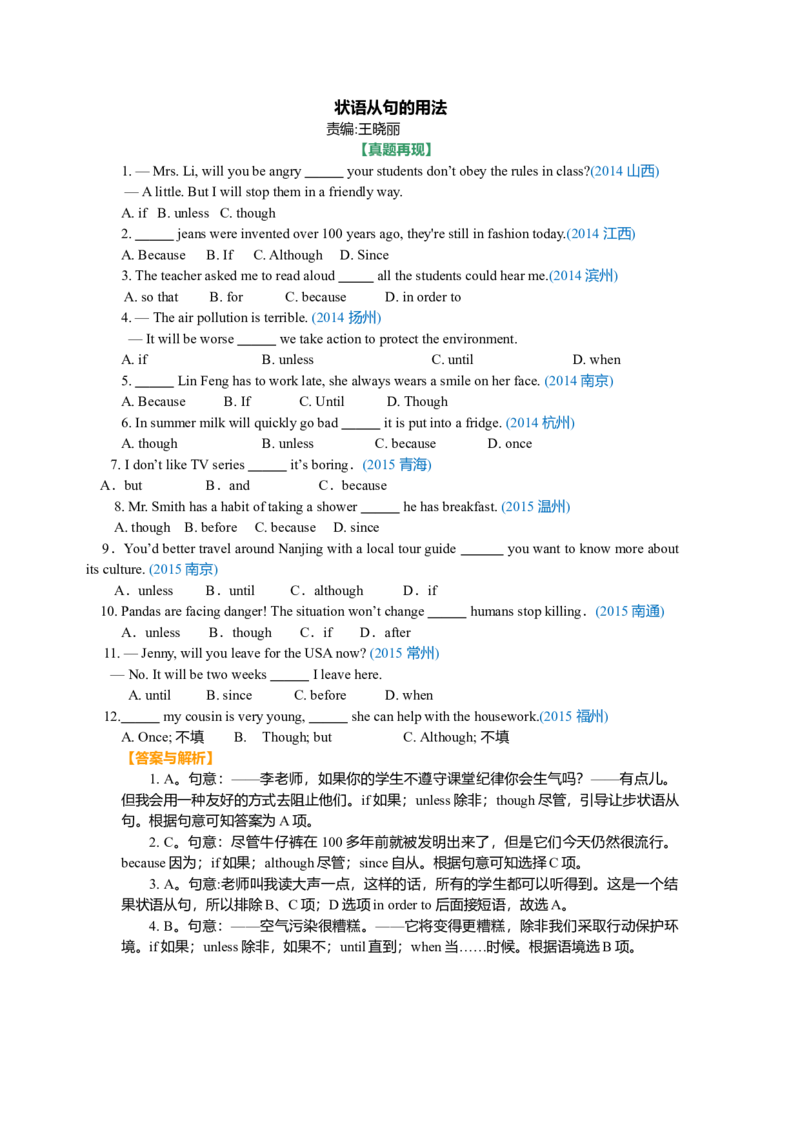
【真题再现】
1. — Mrs. Li, will you be angry your students don’t obey the rules in class?(2014 山西)
— A little. But I will stop them in a friendly way.
A. if B. unless C. though
2. jeans were invented over 100 years ago, they're still in fashion today.(2014 江西)
A. Because B. If C. Although D. Since
3. The teacher asked me to read aloud all the students could hear me.(2014 滨州)
A. so that B. for C. because D. in order to
4. — The air pollution is terrible. (2014 扬州)
— It will be worse we take action to protect the environment.
A. if B. unless C. until D. when
5. Lin Feng has to work late, she always wears a smile on her face. (2014 南京)
A. Because B. If C. Until D. Though
6. In summer milk will quickly go bad it is put into a fridge. (2014 杭州)
A. though B. unless C. because D. once
7. I don’t like TV series it’s boring.(2015 青海)
A.but B.and C.because
8. Mr. Smith has a habit of taking a shower he has breakfast. (2015 温州)
A. though B. before C. because D. since
9.You’d better travel around Nanjing with a local tour guide you want to know more about
its culture. (2015 南京)
A.unless B.until C.although D.if
10. Pandas are facing danger! The situation won’t change humans stop killing.(2015 南通)
A.unless B.though C.if D.after
11. — Jenny, will you leave for the USA now? (2015 常州)
— No. It will be two weeks I leave here.
A. until B. since C. before D. when
12. my cousin is very young, she can help with the housework.(2015 福州)
A. Once; 不填 B. Though; but C. Although; 不填
【答案与解析】
1. A。句意:——李老师,如果你的学生不遵守课堂纪律你会生气吗?——有点儿。
但我会用一种友好的方式去阻止他们。if如果;unless除非;though尽管,引导让步状语从
句。根据句意可知答案为A项。
2. C。句意:尽管牛仔裤在100多年前就被发明出来了,但是它们今天仍然很流行。
because因为;if如果;although尽管;since自从。根据句意可知选择C项。
3. A。句意:老师叫我读大声一点,这样的话,所有的学生都可以听得到。这是一个结
果状语从句,所以排除B、C项;D选项in order to 后面接短语,故选A。
4. B。句意:——空气污染很糟糕。——它将变得更糟糕,除非我们采取行动保护环
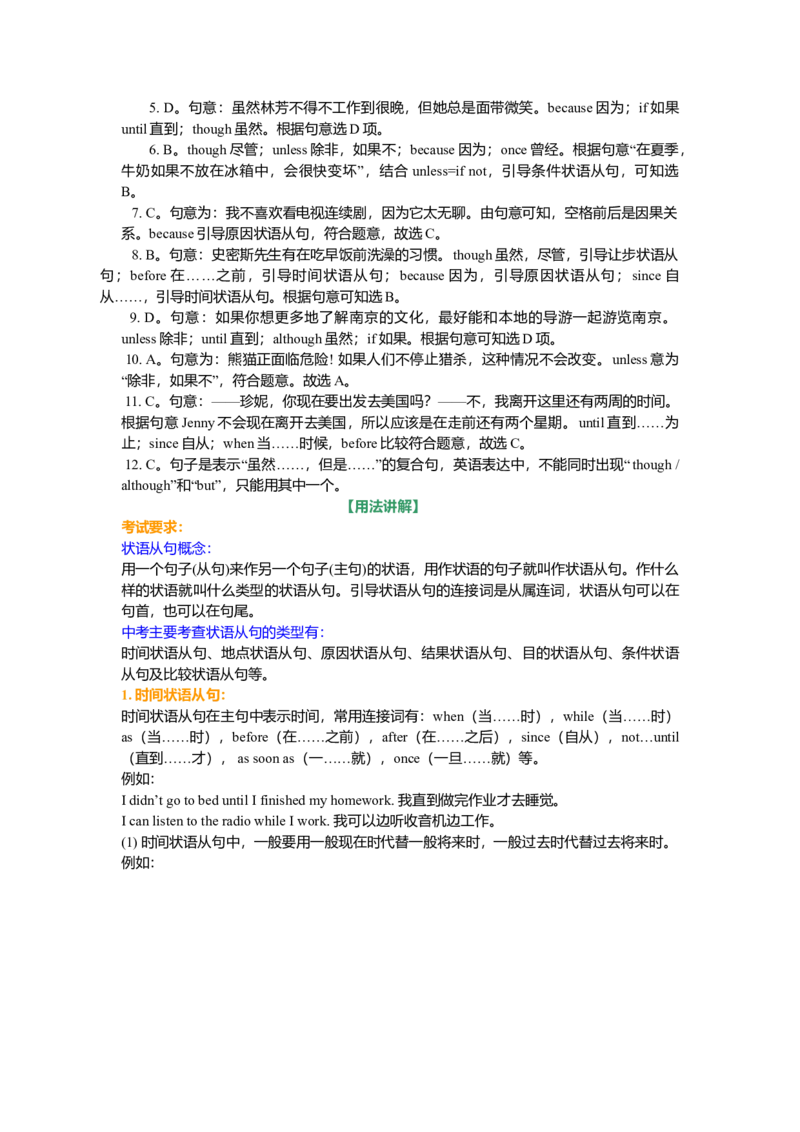
境。if如果;unless除非,如果不;until直到;when当……时候。根据语境选B项。5. D。句意:虽然林芳不得不工作到很晚,但她总是面带微笑。because因为;if如果
until直到;though虽然。根据句意选D项。
6. B。though尽管;unless除非,如果不;because因为;once曾经。根据句意“在夏季,
牛奶如果不放在冰箱中,会很快变坏”,结合 unless=if not,引导条件状语从句,可知选
B。
7. C。句意为:我不喜欢看电视连续剧,因为它太无聊。由句意可知,空格前后是因果关
系。because引导原因状语从句,符合题意,故选C。
8. B。句意:史密斯先生有在吃早饭前洗澡的习惯。though虽然,尽管,引导让步状语从
句;before在……之前,引导时间状语从句;because因为,引导原因状语从句;since自
从……,引导时间状语从句。根据句意可知选B。
9. D。句意:如果你想更多地了解南京的文化,最好能和本地的导游一起游览南京。
unless除非;until直到;although虽然;if如果。根据句意可知选D项。
10. A。句意为:熊猫正面临危险! 如果人们不停止猎杀,这种情况不会改变。unless意为
“除非,如果不”,符合题意。故选A。
11. C。句意:——珍妮,你现在要出发去美国吗?——不,我离开这里还有两周的时间。
根据句意Jenny不会现在离开去美国,所以应该是在走前还有两个星期。until直到……为
止;since自从;when当……时候,before比较符合题意,故选C。
12. C。句子是表示“虽然……,但是……”的复合句,英语表达中,不能同时出现“though /
although”和“but”,只能用其中一个。
【用法讲解】
考试要求:
状语从句概念:
用一个句子(从句)来作另一个句子(主句)的状语,用作状语的句子就叫作状语从句。作什么
样的状语就叫什么类型的状语从句。引导状语从句的连接词是从属连词,状语从句可以在
句首,也可以在句尾。
中考主要考查状语从句的类型有:
时间状语从句、地点状语从句、原因状语从句、结果状语从句、目的状语从句、条件状语
从句及比较状语从句等。
1. 时间状语从句:
时间状语从句在主句中表示时间,常用连接词有:when(当……时),while(当……时)
as(当……时),before(在……之前),after(在……之后),since(自从),not…until
(直到……才), as soon as(一……就),once(一旦……就)等。
例如:
I didn’t go to bed until I finished my homework. 我直到做完作业才去睡觉。
I can listen to the radio while I work. 我可以边听收音机边工作。
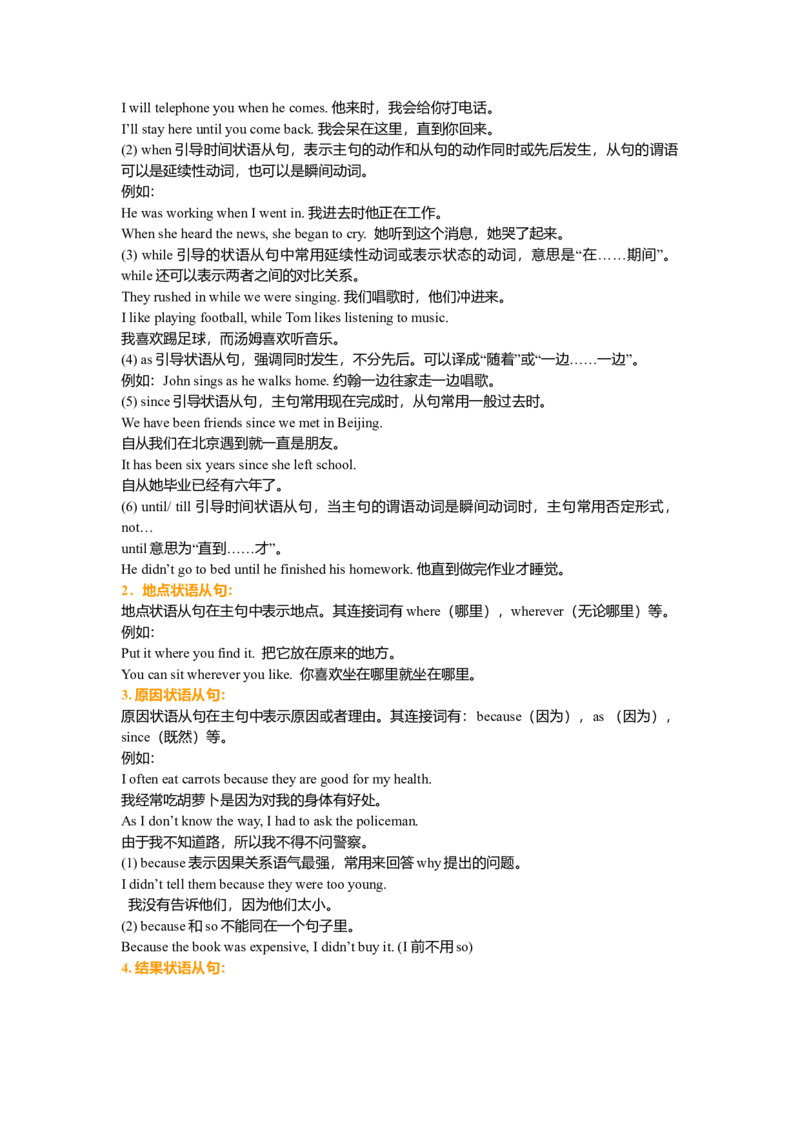
(1) 时间状语从句中,一般要用一般现在时代替一般将来时,一般过去时代替过去将来时。
例如:I will telephone you when he comes. 他来时,我会给你打电话。
I’ll stay here until you come back. 我会呆在这里,直到你回来。
(2) when引导时间状语从句,表示主句的动作和从句的动作同时或先后发生,从句的谓语
可以是延续性动词,也可以是瞬间动词。
例如:
He was working when I went in. 我进去时他正在工作。
When she heard the news, she began to cry. 她听到这个消息,她哭了起来。
(3) while引导的状语从句中常用延续性动词或表示状态的动词,意思是“在……期间”。
while还可以表示两者之间的对比关系。
They rushed in while we were singing. 我们唱歌时,他们冲进来。
I like playing football, while Tom likes listening to music.
我喜欢踢足球,而汤姆喜欢听音乐。
(4) as引导状语从句,强调同时发生,不分先后。可以译成“随着”或“一边……一边”。
例如:John sings as he walks home. 约翰一边往家走一边唱歌。
(5) since引导状语从句,主句常用现在完成时,从句常用一般过去时。
We have been friends since we met in Beijing.
自从我们在北京遇到就一直是朋友。
It has been six years since she left school.
自从她毕业已经有六年了。
(6) until/ till 引导时间状语从句,当主句的谓语动词是瞬间动词时,主句常用否定形式,
not…
until意思为“直到……才”。
He didn’t go to bed until he finished his homework. 他直到做完作业才睡觉。
2.地点状语从句:
地点状语从句在主句中表示地点。其连接词有where(哪里),wherever(无论哪里)等。
例如:
Put it where you find it. 把它放在原来的地方。
You can sit wherever you like. 你喜欢坐在哪里就坐在哪里。
3. 原因状语从句:
原因状语从句在主句中表示原因或者理由。其连接词有:because(因为),as (因为),
since(既然)等。
例如:
I often eat carrots because they are good for my health.
我经常吃胡萝卜是因为对我的身体有好处。
As I don’t know the way, I had to ask the policeman.
由于我不知道路,所以我不得不问警察。
(1) because表示因果关系语气最强,常用来回答why提出的问题。
I didn’t tell them because they were too young.
我没有告诉他们,因为他们太小。
(2) because和so不能同在一个句子里。
Because the book was expensive, I didn’t buy it. (I 前不用so)
4. 结果状语从句:结果状语从句在主句中表示结果。其连接词有:so…that…(如此……以至于……),
such… that…(如此……以至于……)等。
例如:
It’s such a good chance that you can’t miss it. 这次机会如此好,你不能失去它。
注意:
so…that 和 such …that 都可以引导结果状语从句,注意so和such后面所接的词不同。
(1) such... that
such+a(an)+形容词+单数可数名词+that从句
such+形容词+复数名词/不可数名词+that从句
例如:
He was such an honest man that he was praised by the teacher.
他非常诚实,因而受到了老师的表扬。
They are such interesting novels that I want to read them once again.
这些小说非常有趣,我想再读一遍。
(2)但是如果名词前由many、much、few、little(少)等词修饰,则用so。
例如:
He had so many falls that he was black and blue all over.
他摔了很多跤,以至于全身上下青一块,紫一块的。
(3) so ... that
so+形容词/副词.+that从句
so+形容词+a(an)+单数可数名词+that从句
例如:
He runs so fast that nobody can catch up with him.
他跑得非常快,没人能追上他。
Dr. Wang is so good that everybody loves and respects him.
=He is so good a doctor that everybody loves and respects him.
=He is such a good doctor that everybody loves and respects him.
他是一位好医生,大家都尊敬并爱戴他。
5. 目的状语从句:
目的状语从句在主句中表示目的。其连接词有:so(以便),so that(为了),in order that
(为了)等,从句中多用情态动词can, will, may, should 等。
例如:
He got up very early so that he could catch the first train.
他起床很早以便于赶第一班火车。
I will run slowly so that you can catch up with me.
我慢慢跑以便你能赶上我。
6. 条件状语从句:
条件状语从句在主句中表示条件。其连接词有:if(如果),unless (如果不,除非),as
long as(只要)等。
例如:If it is fine tomorrow, we will go swimming.
如果明天天气好的话我们去游泳。
注意:
在条件状语从句中,一般要用一般现在时代替一般将来时,一般过去时代替过去将来时。
例如:Unless it rains, the game will be played.(= If it doesn’t rain, the game will be played.)如果不下雨,比赛就将进行。
As long as you tell truth , I’ll try to help you.
只要你说出真相,我就尽力帮助你。
7. 让步状语从句:
常由though/although (虽然),even if/ though (即使)等引导,但though/although不能和but同
时出现在一个句子里。
例如:
Though it’s hard work, I enjoy it.(= It’s hard work, but I enjoy it.)
尽管这是一件艰苦的工作,但我乐意做。
Though/Although it was raining,we went there.
虽然下着雨,但我们还是去了那儿。
She won’t leave the TV set even though /even if supper’s on the table.
即使晚饭已摆在桌上,她也不愿意离开电视机。