【暑假辅导班】
新高二英语暑假精品课程(人教版)
第4讲 省略句
一、“省略”的定义
在用英语表达时, 将句子中的某些成分省去, 这种语言现象叫做省略。
*Amy took out a book and (Amy) handed it to me.
艾米拿出一本书给了我。
该句中and后的主语Amy与句首的主语是重复的, 故将后面的主语省略。
二、“省略”的原因
1. 避免重复
当句子有重复的词或结构复杂时, 可省略某些重复的词或不必要的部分。如:
*(Does) Anyone want a drink? 有人想要喝一杯吗?
*I’m studying at high school and my sister (is studying) in primary school. 我在上高中, 我妹妹在上小学。
2. 简洁实用
*(I’m) Coming. (我)来啦。
*(It) Doesn’t matter. (它)不要紧。
3. 句法允许
*He got up at six (o’clock). 他六点(钟)起床。
*This dictionary costs seven (dollars) thirty (cents).
这本词典的费用是7美元30美分。
*What a hot day (it is)! 多热的天呀!
三、“省略”的用法
Ⅰ. 简单句中的省略
省略部分 用法说明
主语 在祈使句中和不易引起歧义时省略
在口语对话中双方都知道宾语是谁时, 省略该宾语; 并列谓语后有多个相同宾语时,
宾语
只保留最后一个宾语
表语 后文有与前文完全相同的表语时省略
(部分)谓语 后文有与前文完全相同的谓语时省略; 不影响句意的部分谓语也可以省略
主谓结构或
不影响句意的主谓结构或者对话中与前文重复的谓语及其他部分可以省略
谓语及其他
动词不定式 某些特定动词后有带to的动词不定式时省略其中的动词或整个动词不定式其他部分 冠词、介词、连词或名词所有格后的名词等不影响句意的部分可省略
1. 省略主语
*(You) Open the door, please. 请开一下门。
*(I)Thank you for your help. 谢谢你的帮助
2. 省略宾语
*—Do you know Mr Li? 你认识李先生吗?
—I don’t know (him). 我不认识他。
*She washed(the shirt), ironed(the shirt), and folded the shirt.
她洗了衬衫, 并且把它熨好、折叠好。
3. 省略表语
*—Are you thirsty? 你渴吗?
—Yes, I am(thirsty). 是的, 我渴了。
4. 省略(部分)谓语
*(Is) Anything wrong? 有什么问题吗?
5. 省略主谓结构或谓语及其他
*—What did he say? 他说了什么?
—(He said) Nothing. (他)没(说)什么。
*(Are you)Swimming in the sea?
(你)在海里游泳吗?
*—I won’t join them. 我不和他们一起。
—Why (will you not join them)?
为什么(你不和他们一起)?
6. 动词不定式
*—Are you going there? 你打算去那里吗?
—Yes, I’d like to (go there). 是的, 我想(去那里)。
*I saw her enter the classroom. 我看见她进了教室。
注:在感官动词后作宾语补足语的动词常省略to, 但是在被动语态中, to要带上。
7. 其他部分
*The noun is the name of a person or (a) thing.
名词是人和物的名称。
*I’ll arrive (on) Friday. 我将星期五到。
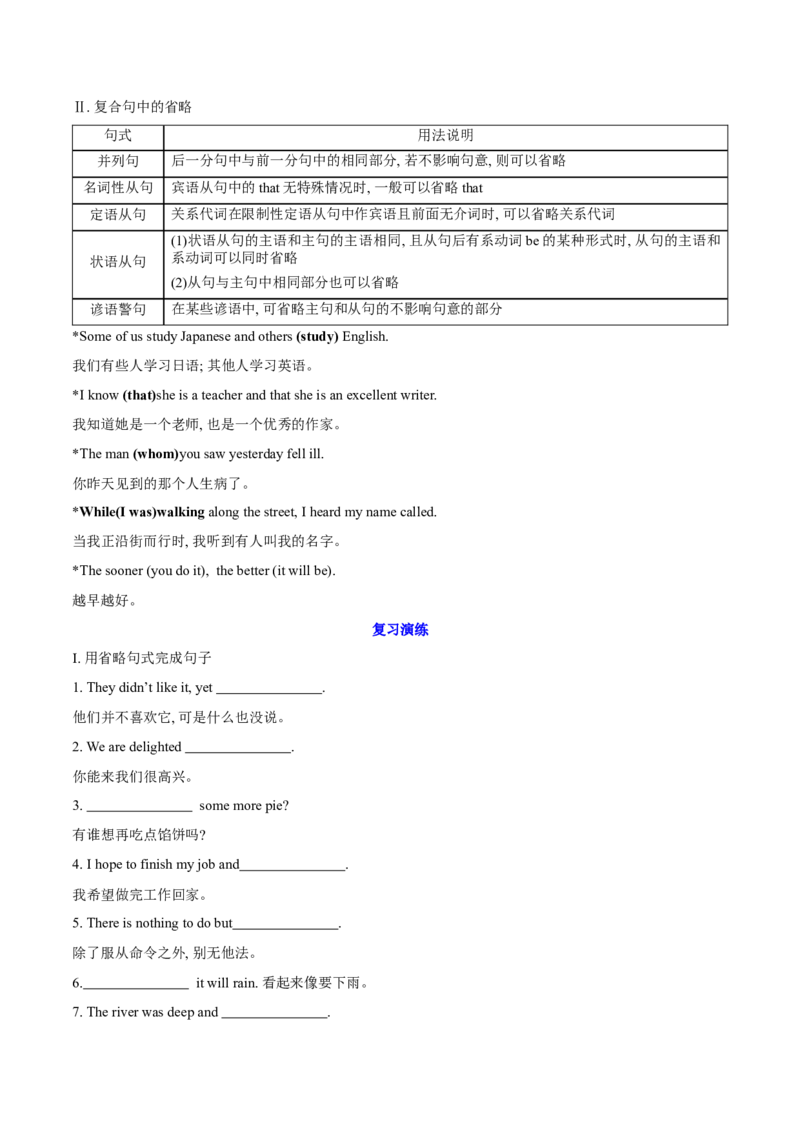
*The book is Tom’s (book). 这本书是汤姆的(书)。Ⅱ. 复合句中的省略
句式 用法说明
并列句 后一分句中与前一分句中的相同部分, 若不影响句意, 则可以省略
名词性从句 宾语从句中的that无特殊情况时, 一般可以省略that
定语从句 关系代词在限制性定语从句中作宾语且前面无介词时, 可以省略关系代词
(1)状语从句的主语和主句的主语相同, 且从句后有系动词be的某种形式时, 从句的主语和
状语从句 系动词可以同时省略
(2)从句与主句中相同部分也可以省略
谚语警句 在某些谚语中, 可省略主句和从句的不影响句意的部分
*Some of us study Japanese and others (study) English.
我们有些人学习日语; 其他人学习英语。
*I know (that)she is a teacher and that she is an excellent writer.
我知道她是一个老师, 也是一个优秀的作家。
*The man (whom)you saw yesterday fell ill.
你昨天见到的那个人生病了。
*While(I was)walking along the street, I heard my name called.
当我正沿街而行时, 我听到有人叫我的名字。
*The sooner (you do it), the better (it will be).
越早越好。
复习演练
I. 用省略句式完成句子
1. They didn’t like it, yet .
他们并不喜欢它, 可是什么也没说。
2. We are delighted .
你能来我们很高兴。
3. some more pie?
有谁想再吃点馅饼吗?
4. I hope to finish my job and .
我希望做完工作回家。
5. There is nothing to do but .
除了服从命令之外, 别无他法。
6. it will rain. 看起来像要下雨。
7. The river was deep and .河很深, 冰很薄。
8. I asked him to see the film, but he didn’t . 我请他去看电影, 但他不想去。
9. , you should speak English as much as you can. 在任何可能的时间, 你都应多讲英语。
10. James enjoys the theatre more than .
詹姆斯比苏珊更喜欢戏剧。
IⅠ. 阅读理解
Van Gogh painted sunflowers for the first time in the summer of 1886. Two years later, his interest appeared
again after he settled in Arles. After he had invited the French artist Paul Gauguin, whom he admired, to join his
Studio of the South, he began painting sunflowers to brighten up the whitewashed walls of the yellow house he
was living in, not far from the town’s railway station.
Gauguin accepted Van Gogh’s invitation. When he began dragging his heels(脚后跟), Van Gogh painted the
last two of the four original Sunflowers for the modest bedroom where his guest would sleep following his arrival
that autumn, “Van Gogh saw the Sunflowers for Gauguin’s bedroom as a way of attracting his friend to come from
Brittany, ” says Bailey.
According to Martin Gayford, “Gauguin was very surprised by the Sunflowers, which he repeatedly praised
and asked for as a gift. Years later, Gauguin himself painted some sunflower pictures. ”
Van Gogh’s Sunflowers paintings stand for (代表)his relationship with Gauguin. “I think he painted them for
the joy of it, ” says Jansen. “Van Gogh was at the height of his powers in the summer of 1888, ”explains Bailey.
“He painted the Sunflowers quickly and with great energy and confidence. ” Van Gogh wrote to his brother Theo in
late August, “I’m painting quickly now, which won’t surprise you when it’s a question of painting large
Sunflowers. ”
Van Gogh recognized at once that he had created something important and that his sunflowers were so
different. As he told Theo in January 1889, while other artists were known for painting other flowers, “The
sunflower is mine. ” This, in fact, explains the reason for the popularity of Van Gogh’s Sunflowers today.
1. Van Gogh painted sunflowers in 1888 in order to .
A. give them to Gauguin
B. make his living
C. decorate his house
D. show his artistic talent to others
2. Where were the last two Sunflowers placed by Van Gogh?
A. In the British museum.B. In Gauguin’s bedroom.
C. In the town’s railway station.
D. In a rich businessman’s house.
3. How did Gauguin feel about Van Gogh’s painting—the Sunflowers?
A. Very bad. B. Just so-so.
C. Rather worried. D. Quite surprised.
4. From the last two paragraphs we can learn that .
A. Van Gogh was not good at painting large Sunflowers
B. Van Gogh had much trouble in painting the Sunflowers
C. Van Gogh didn’t like his Sunflowers at all at that time
D. Van Gogh realized the Sunflowers would make him known
IⅡ. 语法填空
阅读下面材料, 在空白处填入适当的内容(1个单词)或括号内单词的正确形式。
It’s almost a common belief that the best food you can find in a place is not in the fancy restaurants, 1.
in the backstreets. These spots are usually away from popular tourist 2. (attract), which means that to
find them you’ll need the spirit of an explorer.
That’s 3. I came across roujiamo when I was exploring Beijing. I found 4.
restaurant that sold dishes from Xi’an when I explored the area around my office one day. I decided to try it out.
My roujiamo 5. (make) fresh, so the bread was still warm. It was soft when I 6.
(bite) into it, and the meat inside was delicious and tender. In fact, I enjoyed it so much that I ordered more to take
home with me. Though it’s just a snack, it’s still quite filling and can 7. (easy) satisfy your appetite.
There are a variety of things you can put inside the “mo”, as the bread is called. For example, in certain areas
in Xi’an, the meat 8. (use) is usually beef, but in Gansu Province, lamb is more common. And the first
roujiamo that I tried was made 9. pork. However it’s made, it’s still a tasty snack. And for an
American like me who grew up 10. (eat) hamburgers, it’s a perfect combination of East and West.
IV. 完形填空
I remember when I was young, people often asked me, “What are you going to be when you grow up? ”
It 1 being a cowboy or some super hero. Later it was a fireman, a policeman, a lawyer. As I grew
older, my dreams for the future 2 . When I was in college, I set my heart on becoming 3 like my father.
4 I studied and prepared for that. I reached the 5 in the end and I was teaching
6 full-time for much of my adult life.However, there is a “thief” that goes around stealing our 7 . Sometimes, the thief will come as a parent,
or a friend, but the 8 thief is usually
9 .
We find ourselves just about reaching the top, and a “small” 1 0 inside says, “You’ll never make 1 1 .
” “You 12 possibly do this. ” On and on the “small” voice predicts our failure. Failure, 13 is one of the
most important tools we have may teach us valuable 14 . When we learn these lessons well, we are ready
15 success.
I always tell my children that you are 16 to do anything that your heart desires. Remember the saying,
“Nothing is 17 for a willing heart. ” There are 18 “overnight” successes, but with determination, they
will come. Imagine 19 a life you dream of. Then in your heart, believe it will happen to you. Then work,
work, work. You’ll get the picture.
So, be true to your dream, and don’t let anyone 2 0 it from you—especially yourself.
1. A. insisted on B. kept on
C. felt like D. started out
2. A. changed B. planned C. failed D. left
3.A.a doctor B. an engineer
C. a musician D. a teacher
4. A. But B. Or C. So D. As
5. A. aim B. agreement
C. decision D. position
6. A. hardly B. nearly
C. slightly D. extremely
7. A. money B. plan C. dreams D. friends
8. A. greatest B. poorest C. tallest D. oldest
9. A. themselves B. ourselves
C. yourselves D. itself
10. A. sound B. noise C. speech D. voice
11. A. it B. her C. him D. me
12. A. can B. can’t C. must D. mustn’t
13. A. where B. who C. when D. which
14. A. stages B. lessonsC. suggestions D. choices
15. A. to B. for C. atD. with
A. able B. ready
C. likely D. necessary
17. A. interesting B. important
C. impossible D. necessary
18. A. many B. some C. different D. no
19. A. spending B. planning
C. living D. changing
20. A. buy B. fool C. steal D. borrow