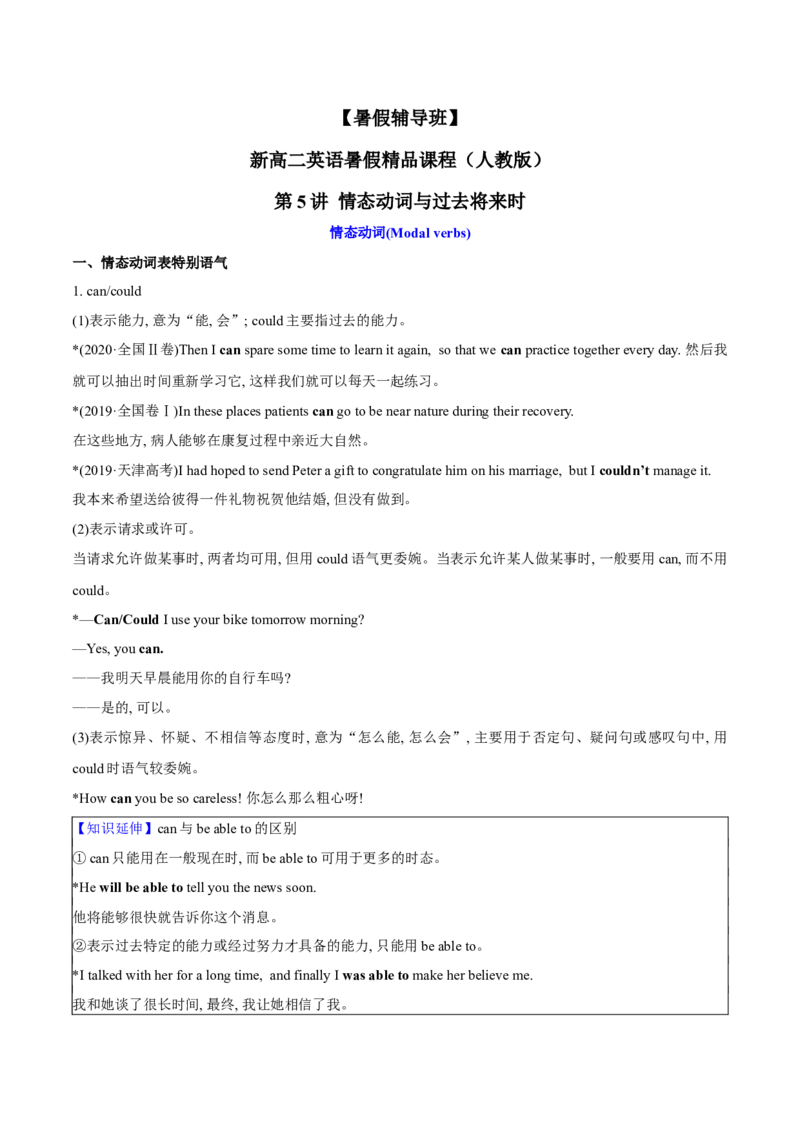
【暑假辅导班】
新高二英语暑假精品课程(人教版)
第5讲 情态动词与过去将来时
情态动词(Modal verbs)
一、情态动词表特别语气
1. can/could
(1)表示能力, 意为“能, 会”; could主要指过去的能力。
*(2020·全国Ⅱ卷)Then I can spare some time to learn it again, so that we can practice together every day. 然后我
就可以抽出时间重新学习它, 这样我们就可以每天一起练习。
*(2019·全国卷Ⅰ)In these places patients can go to be near nature during their recovery.
在这些地方, 病人能够在康复过程中亲近大自然。
*(2019·天津高考)I had hoped to send Peter a gift to congratulate him on his marriage, but I couldn’t manage it.
我本来希望送给彼得一件礼物祝贺他结婚, 但没有做到。
(2)表示请求或许可。
当请求允许做某事时, 两者均可用, 但用could语气更委婉。当表示允许某人做某事时, 一般要用can, 而不用
could。
*—Can/Could I use your bike tomorrow morning?
—Yes, you can.
——我明天早晨能用你的自行车吗?
——是的, 可以。
(3)表示惊异、怀疑、不相信等态度时, 意为“怎么能, 怎么会”, 主要用于否定句、疑问句或感叹句中, 用
could时语气较委婉。
*How can you be so careless! 你怎么那么粗心呀!
【知识延伸】can与be able to的区别
①can只能用在一般现在时, 而be able to可用于更多的时态。
*He will be able to tell you the news soon.
他将能够很快就告诉你这个消息。
②表示过去特定的能力或经过努力才具备的能力, 只能用be able to。
*I talked with her for a long time, and finally I was able to make her believe me.
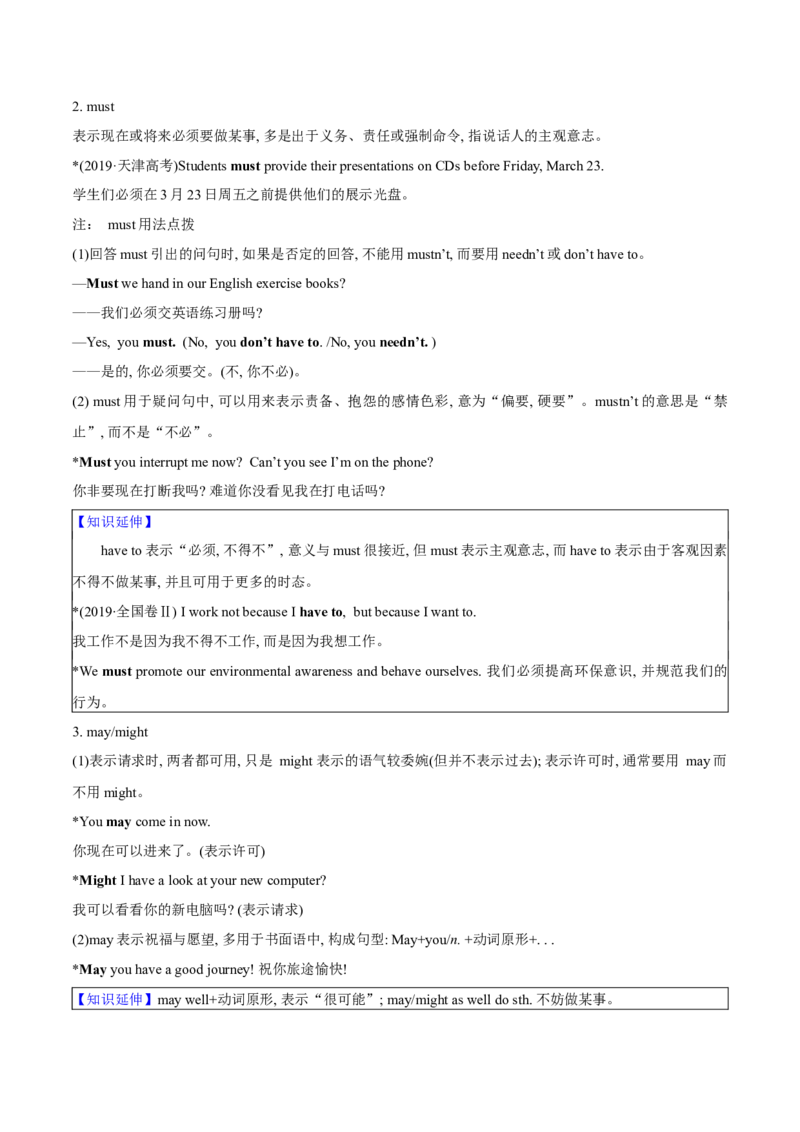
我和她谈了很长时间, 最终, 我让她相信了我。2. must
表示现在或将来必须要做某事, 多是出于义务、责任或强制命令, 指说话人的主观意志。
*(2019·天津高考)Students must provide their presentations on CDs before Friday, March 23.
学生们必须在3月23日周五之前提供他们的展示光盘。
注: must用法点拨
(1)回答must引出的问句时, 如果是否定的回答, 不能用mustn’t, 而要用needn’t或don’t have to。
—Must we hand in our English exercise books?
——我们必须交英语练习册吗?
—Yes, you must. (No, you don’t have to. /No, you needn’t. )
——是的, 你必须要交。(不, 你不必)。
(2) must用于疑问句中, 可以用来表示责备、抱怨的感情色彩, 意为“偏要, 硬要”。mustn’t的意思是“禁
止”, 而不是“不必”。
*Must you interrupt me now? Can’t you see I’m on the phone?
你非要现在打断我吗? 难道你没看见我在打电话吗?
【知识延伸】
have to表示“必须, 不得不”, 意义与must很接近, 但must表示主观意志, 而have to表示由于客观因素
不得不做某事, 并且可用于更多的时态。
*(2019·全国卷Ⅱ) I work not because I have to, but because I want to.
我工作不是因为我不得不工作, 而是因为我想工作。
*We must promote our environmental awareness and behave ourselves. 我们必须提高环保意识, 并规范我们的
行为。
3. may/might
(1)表示请求时, 两者都可用, 只是 might 表示的语气较委婉(但并不表示过去); 表示许可时, 通常要用 may而
不用might。
*You may come in now.
你现在可以进来了。(表示许可)
*Might I have a look at your new computer?
我可以看看你的新电脑吗? (表示请求)
(2)may表示祝福与愿望, 多用于书面语中, 构成句型: May+you/n. +动词原形+. . .
*May you have a good journey! 祝你旅途愉快!
【知识延伸】may well+动词原形, 表示“很可能”; may/might as well do sth. 不妨做某事。*He may well be surprised at the result.
他很可能会对这个结果感到意外。
*To start with, you might as well learn to speak Mandarin.
首先, 你最好学会说普通话。
4. shall
(1)shall用于第一、三人称的疑问句中时表示征求意见。
*Shall I get you some tea? 我给你倒点茶好吗?
(2)用于第二、三人称的陈述句时, 往往表示给对方(you)或第三者(he, she, they)以允诺、命令、决心、警告
或威胁等, 在法律、条约、协定等文件中可以表示义务、规定等。
*You shall fail if you don’t work harder.
如果你不再努力点儿, 你就会失败。(警告)
*Each citizen shall carry his identification card when travelling. 旅游时每个市民务必带上身份证。(规定)
5. should/ought to
(1)表示责任、义务, 意为“应该, 应当”。
*(2020·全国Ⅰ卷)I wonder if parents should always tell the truth no matter the consequences.
我想知道父母是否总是说出真相, 无论结果如何。
*(2019·全国卷Ⅱ)You should reassess your goals, and motivate yourself to set a fresh goal.
你应该重新评估你的目标, 并激励自己设立新的目标。
(2)should表示惊讶、赞叹或不满, 意为“竟然”。
*It’s strange that he should be late. 真奇怪, 他竟然会迟到。
6. will/would
(1)will表示“意愿, 意志”, would表示过去时间的“意愿、意志”。
*I promise I will do my best to provide best service for the Asian Games.
我许诺我会尽最大努力为亚洲运动会提供最好的服务。
*I told her to stop crying, but she just wouldn’t listen.
我告诉她别哭, 但是她不愿意听。
(2)表示征求意见或提出请求。主要用于第二人称疑问句中, will和would均可用, would此时不表示过去, 而
是表示委婉语气。
*Will/Would you pass me the book?
请你把书递给我好吗?
(3)will表示某种倾向或习惯性动作, 意为“总会, 老是”; would表示过去反复发生的动作或过去的一种倾向。
*Fish will die without water. 没有水, 鱼会死去。*When my parents were away, my grandmother would take care of me. 我父母外出的时候, 祖母总是照看我。
【知识延伸】would与used to的区别
(1)would表示过去经常性且反复发生的动作, 没有与现在对比的含义。
*When we were boys, we would go swimming every summer.
当我们是孩子的时候, 我们每年夏天常常去游泳。
(2)used to表示过去经常发生的动作或存在的状态, 且现在已终止, 强调今昔对比。
*People used to believe that the earth was flat.
过去, 人们总以为地球是扁平的。(现在已不再这样认为)
7. need, dare
(1)need表示必要性, 意为“需要”, dare表示“敢于”; need和dare作情态动词时常用于否定句、疑问句或
条件句中, 无人称和数的变化, 疑问句和否定句中不加助动词。
*You needn’t come here this afternoon.
你今天下午不必来这里。
*How dare you say I’m unfair? 你怎么敢说我不公平?
(2)need和dare用作实义动词时, 有词形变化。在否定句、疑问句中要加助动词。
*You don’t need to hurry. You have enough time.
你不需要着急。你有足够的时间。
*He doesn’t dare (to) answer. 他不敢回答。
二、情态动词表推测
1. must表示有把握的推测, 只用于肯定句中, 意为“一定, 肯定”。
*(2020·全国Ⅰ卷)I like eating fried tomatoes with eggs, and I thought it must be easy to cook.
我喜欢吃西红柿炒鸡蛋, 并且我认为它炒起来一定很简单。
*I’m sure that you must be concerned about Robert the moment you left for London.
我确信你一去伦敦就会很担心Robert。
2. can/could表示推测, 意为“可能”, 用于否定句和疑问句。can比could语气强。
*Tom has gone to Beijing, so you can’t see him in our school now. 汤姆已经去北京了, 所以你现在在我们学校
看不到他。
注:can表示客观可能性(理论上或是逻辑判断上), 意为“可能会”。
*It can be rather hot in our hometown in March.
在我们家乡三月份可能会很热。
3. may/might意为“可能, 也许”, 指可能性小的猜测。might比may语气更不确定, 表示的可能性更小。
*He may be at home, but I am not sure.他或许在家, 但是我不确定。
*(2020·全国Ⅲ卷)I tell my mom that if we’re forced to eat things, we may become ill.
我告诉我妈妈, 如果我们被迫吃东西, 我们可能会生病。
4. should表推测, 暗含很大的可能, 意为“应该, 理应”。
*It’s 4: 30. They should be in New York by now.
现在是四点半, 他们现在应该到达纽约了。
注:情态动词表示推测时, 可能性的大小
肯定句: must>can/could>should>may>might
否定句: can’t/couldn’t>shouldn’t >may not>might not
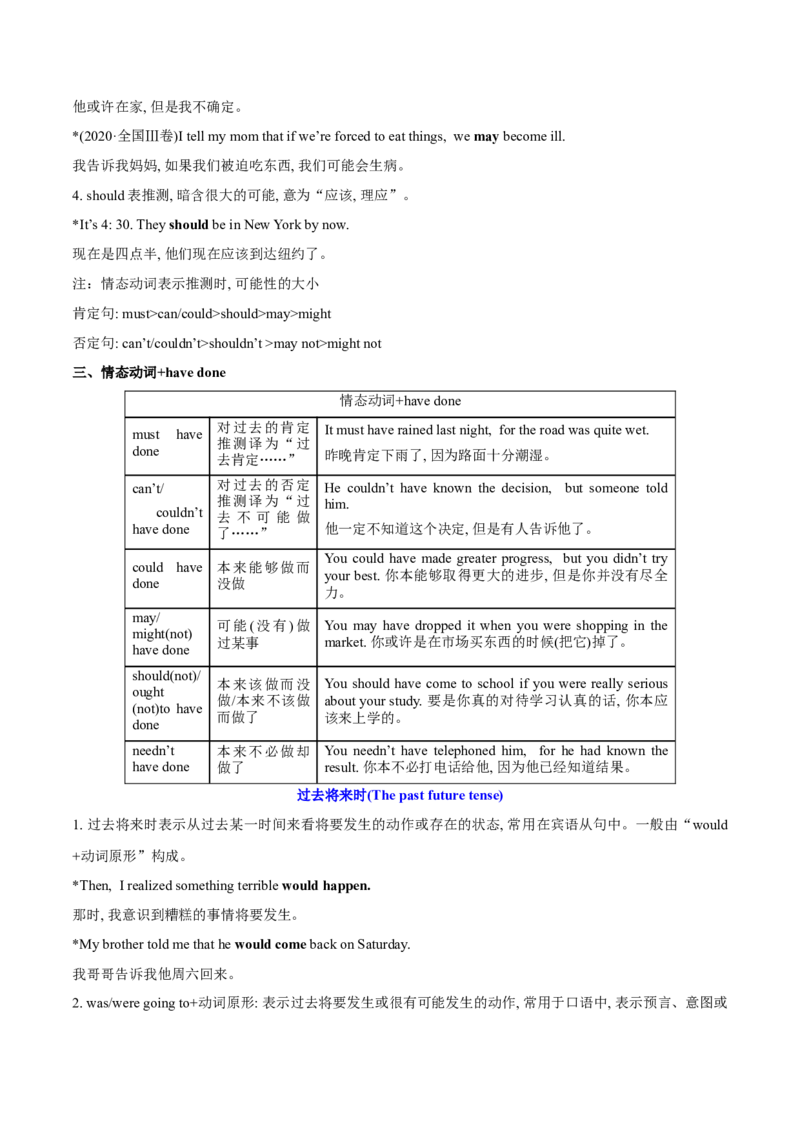
三、情态动词+have done
情态动词+have done
对过去的肯定 It must have rained last night, for the road was quite wet.
must have
推测译为“过
done
去肯定……”
昨晚肯定下雨了, 因为路面十分潮湿。
can’t/ 对过去的否定 He couldn’t have known the decision, but someone told
推测译为“过 him.
couldn’t
去 不 可 能 做
have done 了……” 他一定不知道这个决定, 但是有人告诉他了。
You could have made greater progress, but you didn’t try
could have 本来能够做而
your best. 你本能够取得更大的进步, 但是你并没有尽全
done 没做
力。
may/
可能(没有)做 You may have dropped it when you were shopping in the
might(not)
过某事 market. 你或许是在市场买东西的时候(把它)掉了。
have done
should(not)/
本来该做而没 You should have come to school if you were really serious
ought
做/本来不该做 about your study. 要是你真的对待学习认真的话, 你本应
(not)to have
而做了 该来上学的。
done
needn’t 本来不必做却 You needn’t have telephoned him, for he had known the
have done 做了 result. 你本不必打电话给他, 因为他已经知道结果。
过去将来时(The past future tense)
1. 过去将来时表示从过去某一时间来看将要发生的动作或存在的状态, 常用在宾语从句中。一般由“would
+动词原形”构成。
*Then, I realized something terrible would happen.
那时, 我意识到糟糕的事情将要发生。
*My brother told me that he would come back on Saturday.
我哥哥告诉我他周六回来。
2. was/were going to+动词原形: 表示过去将要发生或很有可能发生的动作, 常用于口语中, 表示预言、意图或者打算等。
*I was going to play basketball, but in the end I went to the cinema. 我打算去打篮球, 但是最后我去看电影了。
*He was going to start work the following week.
他打算下星期开始工作。
3. was/were about to do: 常用来表示即将发生的动作, “刚要/正要做……”。注意该结构不与任何时间状语连
用。
*I was about to leave for home when a new task was assigned to me. 我正要离开回家, 这时我又被指派了一项
新任务。
4. start, go, come, leave, see, meet等动词的过去进行时, 表示就过去某一时刻而言即将发生的动作。
*She was coming later. 她随后就来。
*I had just put on my overcoat and was leaving to visit a friend of mine. 我刚穿上外套要去看我的一个朋友。
5. was/were to do: 表示“曾计划做某事”; 如果表示“本来计划做某事, 动作没实现”, 则需用 “was/were to
have done”。
*She said that they were to visit their English teacher the next week. 她说他们下周将去看望他们的英语老师。
*She said she was to have told me about the accident.
她说她本来想告诉我关于事故的事。
复习演练
Ⅰ. 用情态动词或所给词的适当形式填空
1. Helen go on the trip with us, but she isn’t quite sure yet.
2. More reserves should be set up so that they live safely.
3. we go on with this activity on Saturday morning?
4. He to clean the classroom after school.
5. The manager said that he (leave) at seven the next Friday.
6. You be tired after the long trip, aren’t you?
7. He said he (be) ninety years old in two years.
8. you pass the College Entrance Examination!
9. It is strange that he think so.
10. you make so much noise while I was working?
Ⅱ. 完成句子
1. She someone knocked at the door of her office.
她正要离开这时有人敲她办公室的门。
2. You me up; I don’t have to go to work today. 你本没必要叫醒我; 我今天不必去工作。
3. The sky went very dark and we thought it but it was a false alarm.
天空变得黑沉沉的, 我们以为要下雨了, 不过只是虚惊一场。
4. You on the phone at that time, for I couldn’t get through.
你当时一定在打电话聊天, 因为我打不通。
5. You ! It’s an emergency exit.
你不许在这里停车! 这是应急出口。
6. When it comes to teachers’ praise or criticism, we it seriously.
当谈到老师的表扬或批评时, 我们最好认真对待。
7. He had known the matter before you told him, so you it to him.
在你告诉他之前他就知道这件事了, 因此你没必要告诉他。
8. They wanted to know next.
他们想知道接下来要发生什么。
9. When he was there, he that coffee shop at the street corner after work every day. 当
他在那里的时候, 他每天下班后都会去街角的那家咖啡店。
10. I did not call to make any airline reservation but I .
我没打电话订机票, 但是我本应该这么做的。
IIⅠ. 阅读理解
It was a cold and windy night. My friend and I had met after a long time, and were chatting for hours. We did
not notice the time passing by, and soon it was close to ten in the night. We decided to take an auto rickshaw(黄包
车) to go to our house.
It started raining, and we hurried to get into an auto rickshaw and reach our place. None of the auto rickshaws
stopped for us, except one.
The driver asked us where we wanted to go and we told the place. Without saying anything about the fee, he
said, “please get in. ”
We thanked him and got in.
Since it was very cold, I asked the driver to stop at any small restaurant or a tea shop. We wanted to have a
cup of hot tea. The driver stopped near a small restaurant. We ordered tea and asked the driver to join us and have a
cup of tea. The driver refused. I insisted, but he refused again politely.
I was really surprised.
In 15 minutes we reached our house. We paid the fee and the driver thanked us. On an impulse, I stopped him,as I really wanted to ask him why he refused to drink tea with us at the restaurant.
He thought for a moment and replied, “Sir, My son passed away this morning in an accident. I don’t have
enough money for his funeral(葬礼), so I made a promise not to drink anything until I earn enough money. That’s
why I didn’t drink tea when you offered. Please don’t misunderstand. ”
We both were touched and offered him more money for his son’s funeral. He politely refused.
“Thank you for your generosity, sir. In one or two hours, if I get one or two more customers, I will earn the
money I need. ” Then he left the place.
1. Which of the following is not true?
A. The driver stopped near a small restaurant because of the author’s requirement.
B. The author got into the driver’s auto rickshaw without knowing the fee.
C. The driver accepted the money the author offered him for his son’s funeral.
D. It was a long time before the author and his friend met.
2. Why did the driver refuse to join them and have a cup of tea?
A. Because he didn’t like tea.
B. Because he didn’t like the author.
C. Because he had made a promise to his son that he would never drink tea again.
D. Because he had made a promise not to drink until he earned enough money for his son’s funeral.
3. Which words can be used to best describe the driver?
A. Strange and serious.
B. Unfriendly and greedy.
C. Determined and self-respected.
D. Honest and hard-working.
IV. 语法填空
阅读下面材料, 在空白处填入适当的内容(1个单词)或括号内单词的正确形式。
I chatted with my friend in a well-known coffee shop in a town of Italy.
As we enjoyed our coffee, a man entered and 1. (sit) beside us. He called the waiter over and
said, “Two 2. (cup) of coffee, one of them there on the wall. ”We heard his order with interest and
noticed that he was served one cup of coffee but he paid for two.
When he left, the waiter put a piece of paper on the wall, 3. (say) “A Cup of Coffee”. While we
were still there, two other men entered and ordered the coffee, two on the table and one on the wall. They had two
but paid for three. This time the waiter also did 4. same thing. It was something 5. (usual)for us. After a few days, we had a chance 6. (enter) this coffee shop again. While we were enjoying
our coffee, a man 7. appeared homeless entered. He looked at the wall and said, “One cup of coffee
from the wall. ”
The waiter served a cup of coffee to this man 8. (polite). The man had his coffee and left without
paying. We were 9. (amaze) to watch all of this as the waiter took a piece of paper off the wall 10.
threw it into the bin.