暑假题型专项:阅读理解(60)
一、阅读理解
Have you ever heard of upcycling? It is a creative way to turn waste materials
into new products of higher value. Different from recycling, which often breaks things
down, upcycling gives old items a new life without using extra energy.
Every day, people throw away lots of things, such as old clothes, bottles and
furniture. These may end up in landfills and pollute the environment. Upcycling helps
reduce waste. For example, an old tyre can become a beautiful swing; unwanted jeans
can be turned into fashionable bags. Some artists even create wonderful sculptures
from used metal parts. More and more communities now offer upcycling workshops
to teach people useful skills.
Upcycling is not only good for the planet, but also fun and rewarding. It
encourages creativity and makes us think about how we use things. Next time before
you throw something away, ask yourself: Can I turn it into something new?
1.What does upcycling mean?
A.Throwing away old things.
B.Breaking waste into small pieces.
C.Turning waste into new products of higher value.
D.Collecting waste for money.
2.How is upcycling different from recycling?
A.It uses more energy.
B.It makes things less useful.
C.It adds value to old items without breaking them down.
D.It only deals with bottles.
3.What is the example of upcycling old clothes in the text?
A.Making them into paper.
B.Turning jeans into bags.
C.Using them to clean the floor.
D.Selling them to factories.
4.Why do communities offer upcycling workshops?
A.To make money from the waste.
B.To teach people useful skills.
C.To collect more waste.
D.To ask people to buy new things.
5.What is the best title for the passage?
A.Ways to Collect Waste
B.The Importance of Recycling
C.Upcycling: Give Waste a New Life
D.How to Make a Bag from Old Jeans
Amy was a quiet girl. She moved to a new school and had no friends there.
During breaks, she often sat alone in the corner reading books. One day, she found a
book called The Brave Little Star in the library. The story was about a small star that
1was afraid to shine because it thought it was too tiny. But after a great storm, the little
star helped guide a lost bird back home. It realized that even the smallest light could
make a big difference.
Amy was deeply moved by the story. She decided to join the school reading
club and share her thoughts on the book. To her surprise, many students enjoyed her
ideas. They started talking to her, and Amy gradually opened up. Books became the
bridge connecting her to the world. Now Amy is the leader of the reading club and
always encourages new students to read more.
6.Why did Amy often read alone at first?
A.Because she didn’t like talking. B.Because she was new and had no
friends.
C.Because she was too busy studying.D.Because the library was her favourite
place.
7.What was the book The Brave Little Star about?
A.A star that wanted to become the biggest one. B.A small star that helped a
lost bird.
C.A bird that taught a star to fly. D.A storm that destroyed the stars.
8.What did Amy do after reading the book?
A.She wrote a letter to the writer. B.She bought more books.
C.She joined the school reading club. D.She gave the book to a friend.
9.How did the other students react to Amy’s ideas?
A.They made fun of her. B.They didn’t listen to her.
C.They enjoyed her ideas. D.They asked her to leave.
10.What can we learn from Amy’s story?
A.Reading is boring. B.Books can change a person’s life.
C.It’s hard to make friends at a new school. D.Only brave people enjoy
reading.
Summer Camps for Teenagers
Camp Date Place Activities Cost Ages Contact
hiking, bird
A.
July watching,
Nature Green Hills $200 12–15 555-1234
10–16 learning about
Explorer
plants
City programming,
B.Code July 5–
Technology robot making, $250 13–16 555-5678
Camp 11
Center game design
painting,
C. Art July Sunshine
paper cutting, $180 11–14 555-9012
Magic 20–26 Art School
pottery
D. basketball,
July Central
Sports swimming, $220 12–15 555-3456
15–21 Sports Park
Power rock climbing
211.If Mike is interested in programming, which camp should he choose?
A.Nature Explorer B.Code Camp C.Art Magic
D.Sports Power
12.How much does Nature Explorer cost?
A.$180 B.$200 C.$220 D.$250
13.Which camp is the cheapest?
A.Nature Explorer B.Code Camp C.Art Magic
D.Sports Power
14.Which activity is NOT included in Sports Power?
A.Basketball B.Swimming C.Rock climbing D.Painting
15.Tom is 14 and likes paper cutting. Which camp can he join?
A.Nature Explorer B.Code Camp C.Art Magic
D.Sports Power
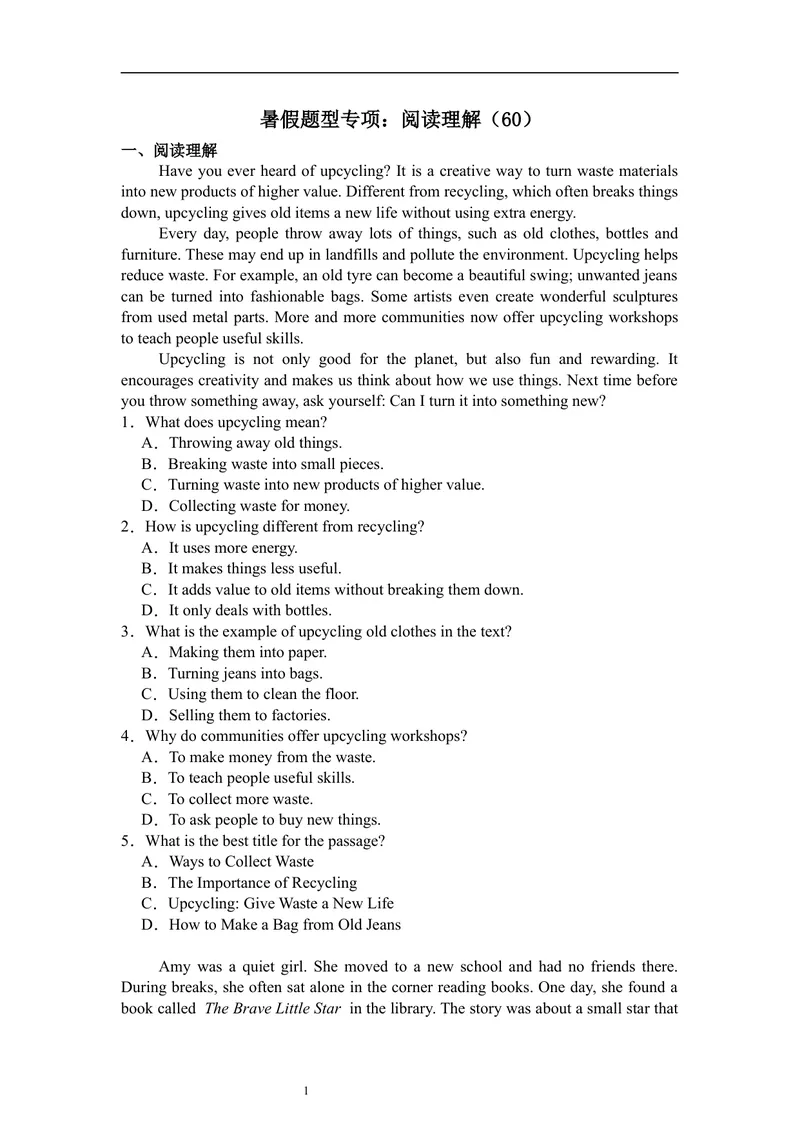
Have you ever thought of forests as the Earth’s lungs (肺)? They take in carbon
dioxide (二氧化碳) and give us the fresh oxygen (氧气) we need to live. But our
green friends are at risk because the climate is changing and people are cutting down
trees excessively (过度). Luckily, technology is stepping in to help! Welcome to the
amazing world of “Smart Forests”, where modern technology works with nature to
keep our planet safe.
So, how do forests become “smart”? Imagine placing small listening tools and
sensors (传感器) at the tops of the trees. These smart tools listen to the sounds of the
woods day and night. If they hear the loud noise of a dangerous tool cutting down
trees or the sound of a forest fire breaking out, they will send a quick alert to forest
workers. They even listen to bird songs and animal calls to make sure wildlife is safe
and healthy.
Technology also brings some amazing flying helpers: drones (无人机)! These
small flying machines fly high above the trees, taking pictures to check if forests are
healthy. If drones see an empty area where trees have been cut down, the smart
system will study the soil and weather to find out exactly which seeds (种子) should
be planted there. Then, special drones can fly over and carefully drop seeds into the
ground to grow a whole new forest.
By acting as the eyes and ears of the woods, “Smart Forests” is changing the
way we protect the environment. It provides a practical way to protect forests and
help them recover better with the power of modern technology.
16.What is Paragraph 3 mainly about?
A.The growth of seeds into healthy trees. B.The role of drones in restoring
forests.
3C.The advantages of drones over sensors. D.The problems drones face in bad
weather
17.What problems put forests in trouble?
A.No listening tools or good sensors.B.Lack of technology and seed shortage.
C.Forest fires and wildlife disappearance. D.Climate change and too much
tree cutting.
18.What does the underlined word “alert” refer to in the text?
A.A message to show love and care. B.A warning of danger or problems.
C.A piece of information about the forest.D.A friendly reminder to check the
weather.
19.What is the writer’s attitude towards “Smart Forests”?
A.Unclear. B.Supportive. C.Negative. D.Doubtful.
20.What is the best title for the text?
A.Why Forests Are Disappearing Fast? B.Drones: The Future of Flying
Machines
C.How Scientists Study Animals and Plants? D.Smart Forests: Technology Is
Protecting Nature
Some Information about Chinese Medicine
Name: HuoxiangNote: If people vomit(呕吐)and don’t want to eat anything, they
can use it.
Way to take it: First cook it in water for some minutes and then get the medicine
soup. When taking it, you can add some brown sugar to it to make it taste better.
Name: BaishaoNote: It’s useful for the stomachache and the headache.
Way to take it: First put it in water for 30—60 minutes. Then cook it for some
minutes. Finally, get the medicine soup and drink it.
Name: SanqiNote: People can use it to stop the bleeding or use it when they have a
sore back, a toothache or a sore in other parts of the body. The taste is not terrible.
Way to take it: It’s OK to take it after making it into powder(粉末). People can also
put it on the sore part of the body.
Name: NiuhuangNote: It’s useful for the sore throat and clearing heat-toxin(清热
解毒).
Way to take it: Take it with water or make it into powder and put it on the sore body
part.
21.Which of the people can take Huoxiang according to the table?
A.Jack has a headache now.
B.Lisa has a sore back.
C.Bob doesn’t want to eat anything these days.
D.Rose always feels hot these days.
22.Before we cook Baishao, we need to________.
A.add some brown sugar to it B.put it in water for some minutes
C.make it into powder D.make it as dry as possible
23.People can use ________ to stop losing blood from the body.
A.Sanqi B.Niuhuang C.Huoxiang D.Baishao
424.What do Sanqi and Niuhuang have in common?
A.Both of them taste terrible.
B.It’s OK to turn both of them into powder.
C.People can use them to stop the stomachache.
D.They are not useful for clearing heat-toxin.
25.In which part of a newspaper can we read the passage?
A.Sports. B.People. C.Travel. D.Health.
Reading is a wonderful hobby. It can open up a whole new world for you. Here
are some reasons why you should read more books:
First, reading can improve your vocabulary. When you read, you will meet
many new words. You can learn their meanings and use them in your own writing and
speaking. This will help you become better at English and other subjects.
Second, reading can make you smarter. Books are full of knowledge. They can
teach you about history, science, nature and many other things. By reading, you can
learn a lot without going to different places.
Third, reading can help you relax. After a long day of studying or working,
reading a good book can make you forget your stress. You can get lost in the story and
feel peaceful.
Finally, reading can help you develop your imagination. When you read a story,
you can imagine the characters and the scenes in your mind. This will make your
mind more creative.
So, pick up a book and start reading today! You will find it very rewarding.
26.There are ________ reasons for reading more books.
A.three B.four C.five D.six
27.Reading can improve your ________ according to the passage.
A.vocabulary B.cooking skills C.running speed D.drawing skills
28.What can reading teach you about?
A.Only history. B.Only science.
C.History, science and nature. D.Only nature.
29.Reading can help you ________ after a long day of studying.
A.feel tired B.relax C.feel hungry D.get angry
30.Why can reading make people smarter?
A.Because it helps people sleep well.
B.Because books contain (包含) lots of different kinds of knowledge.
C.Because people can make many friends from books.
D.Because it helps people speak loudly.
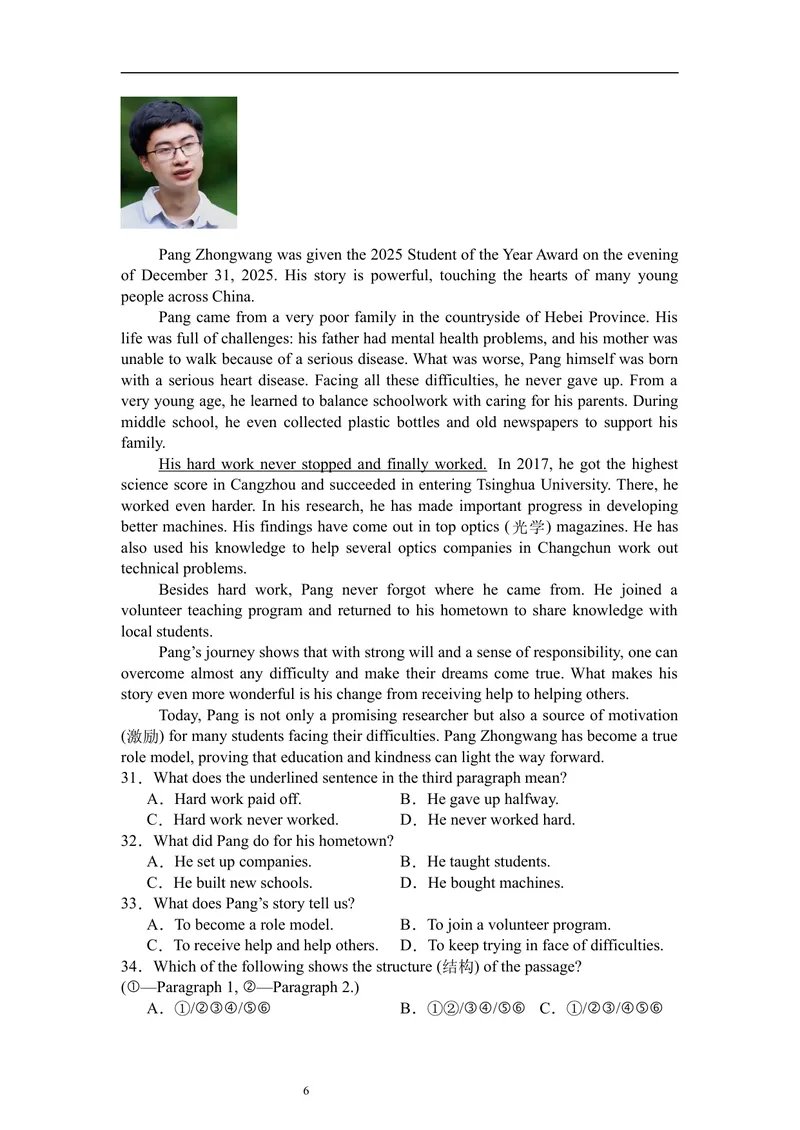
5Pang Zhongwang was given the 2025 Student of the Year Award on the evening
of December 31, 2025. His story is powerful, touching the hearts of many young
people across China.
Pang came from a very poor family in the countryside of Hebei Province. His
life was full of challenges: his father had mental health problems, and his mother was
unable to walk because of a serious disease. What was worse, Pang himself was born
with a serious heart disease. Facing all these difficulties, he never gave up. From a
very young age, he learned to balance schoolwork with caring for his parents. During
middle school, he even collected plastic bottles and old newspapers to support his
family.
His hard work never stopped and finally worked. In 2017, he got the highest
science score in Cangzhou and succeeded in entering Tsinghua University. There, he
worked even harder. In his research, he has made important progress in developing
better machines. His findings have come out in top optics (光学) magazines. He has
also used his knowledge to help several optics companies in Changchun work out
technical problems.
Besides hard work, Pang never forgot where he came from. He joined a
volunteer teaching program and returned to his hometown to share knowledge with
local students.
Pang’s journey shows that with strong will and a sense of responsibility, one can
overcome almost any difficulty and make their dreams come true. What makes his
story even more wonderful is his change from receiving help to helping others.
Today, Pang is not only a promising researcher but also a source of motivation
(激励) for many students facing their difficulties. Pang Zhongwang has become a true
role model, proving that education and kindness can light the way forward.
31.What does the underlined sentence in the third paragraph mean?
A.Hard work paid off. B.He gave up halfway.
C.Hard work never worked. D.He never worked hard.
32.What did Pang do for his hometown?
A.He set up companies. B.He taught students.
C.He built new schools. D.He bought machines.
33.What does Pang’s story tell us?
A.To become a role model. B.To join a volunteer program.
C.To receive help and help others. D.To keep trying in face of difficulties.
34.Which of the following shows the structure (结构) of the passage?
(①—Paragraph 1, ②—Paragraph 2.)
A.①/②③④/⑤⑥ B.①②/③④/⑤⑥ C.①/②③/④⑤⑥
6D.①②/③④⑤/⑥
It was a normal Monday afternoon. On a street in Berlin, Germany, a young
man ran to catch a bus when the bus was leaving the stop.
Suddenly, the man fell down and got caught by the tire (轮胎) of the bus.
Luckily, the bus driver stopped the bus right away. And people from all around went
to help.
About 40 people tried to lift the right side of the heavy bus high enough to get
the young man out. Doctors and nurses from a medical centre heard about the
accident and went to provide medical help. Everyone tried their best to help the man.
Thanks to the quick and collective actions of these people, the man only had a few
scrapes (擦伤) and an arm injury.
Frank Kurze, one of the 40 people, said, “I saw many people trying to lift the
bus, and it was clear to me that I should help lift the bus and try to help the young
man out.”
The police in Berlin said it was nice to see that everyone worked together to
save the man. Lending a helping hand can make a big difference in someone’s life.
35.What happened to the young man?
A.He stopped the bus. B.He had an accident.
C.He fell ill on the bus. D.He missed the bus.
36.What’s Paragraph (段落) 2 mainly about?
A.People’s help to the young man.
B.The young man’s words of thanks.
C.The young man’s health problems.
D.People’s ideas about the young man.
37.The underlined word “collective” in Paragraph 2 means________.
A.大胆的 B.共同的 C.合适的 D.严格的
38.How does the writer develop Paragraph 4?
A.By answering a question.
B.By describing the accident scene (场景)
C.By showing the police’s ideas.
D.By using a man’s words.
39.What does the writer want to tell us through the passage?
A.Think twice before you act. B.Great hope makes great men.
C.Many hands make light work. D.A friend in need is a friend indeed.
The Strait of Hormuz (霍尔木兹海峡) is a narrow and important sea channel. It
lies between Iran (伊朗) and Oman (阿曼). The narrowest part is about 33 kilometers
wide. It is the only sea way from the Persian Gulf (波斯湾) to the Indian Ocean, so it
is very important for world trade.
People call it the world’s “energy throat”. More than 20% of the world’s oil
carried by ships and plenty of natural gas pass through it. Most of this energy goes to
Asia and Europe. It helps people work and live well. Lots of ships sail here every day,
so we must keep this place safe and open for the world’s energy use.
7Now there are some troubles in this area. When tensions rise, fewer ships will
come here. There will be less oil and gas in the world, so energy prices will rise.
People need to pay more for electricity and fuel. If something goes wrong here, many
countries will not have enough energy.
In a word, the Strait of Hormuz is very important for energy around the world.
Changes here will greatly affect the world’s economy.
40.Where is the Strait of Hormuz?
A.Between China and Japan. B.Between Iran and Oman.
C.Between India and Pakistan. D.Between Europe and Africa.
41.What does “energy throat” mean in the passage?
A.A place that looks like a neck. B.A narrow and important passage for
energy transport.
C.A place for people to talk about energy. D.A place with lots of underground
energy.
42.Why do fewer ships pass through the strait recently?
A.The water is too shallow for big ships. B.The weather becomes terrible.
C.Tensions in the area have risen. D.People use new shipping routes.
43.What will happen if fewer ships sail through the strait?
A.Energy prices will become higher. B.More gas will be produced.
C.People will use less electricity. D.New energy will be found soon.
44.What is the main idea of the passage?
A.The trade history of the Middle East. B.Countries around the Persian
Gulf.
C.Ways to make ships safer on the sea. D.The great importance of the Strait
of Hormuz.
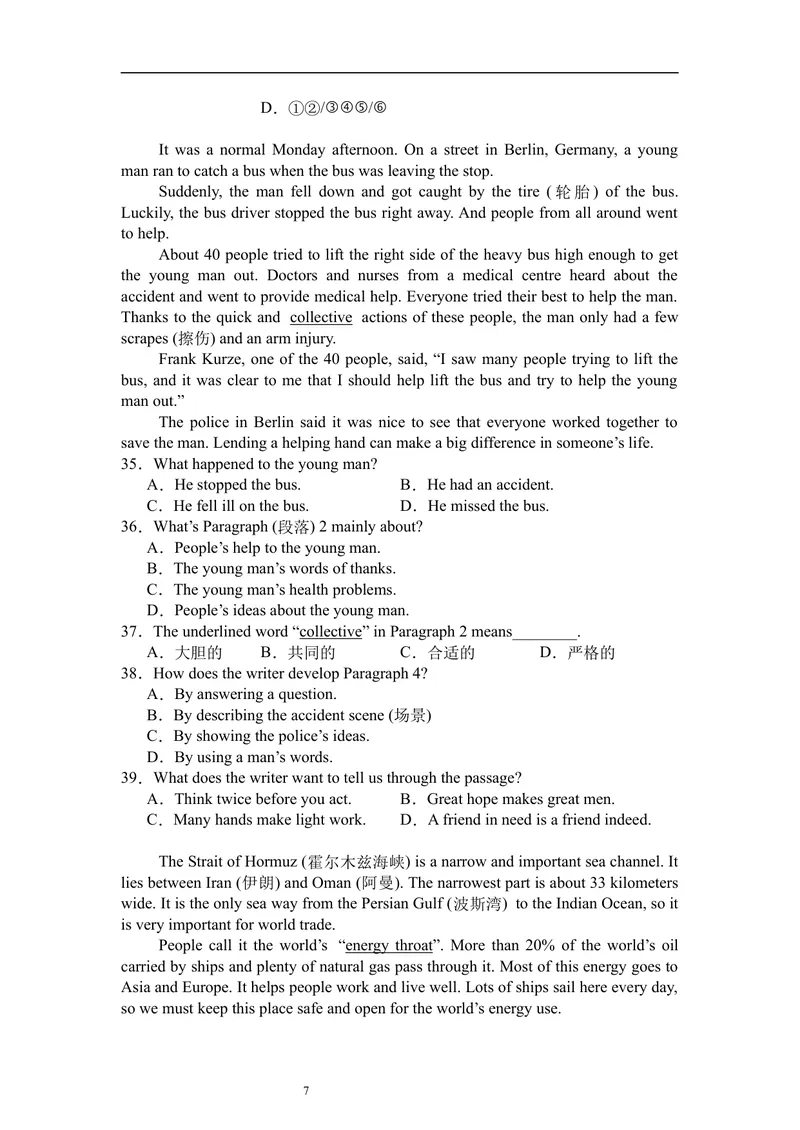
45.These pictures are most likely from a ________.
8A.daily newspaper B.growth diary C.news report
D.story book
46.Which of the following pictures means “seedling”?
A. B. C. D.
47.How much time passed between planting and seeing the pink strawberries?
A.Over 2 months. B.Over 1 month. C.About 2 weeks.
D.About 1 week.
48.What role does the net play in Week 4?
A.To help keep the soil wet. B.To stop the wind from blowing it
away.
C.To help the plant grow faster. D.To stop birds from eating the plant.
49.What can you learn from the pictures?
A.Strawberries grow inside red flowers.
B.Pink strawberries taste better than the red ones.
C.Growing strawberries takes a long time and requires care.
D.Each strawberry plant can only grow one strawberry at a time.
We’ve all heard about the man who discovered gravity (重力) and the apple that
fell from a tree and hit him on the head. However, the 17th-century “aha moment” is
actually a bit of a lie! Newton did witness an apple falling from a tree one day and this
got him thinking about what actually caused the apple to fall to the ground.
Newton later developed his theory of Gravity, believing that Earth has a force
that pulls objects down, which prevents objects from aimlessly floating around.
While we know that Isaac Newton discovered Gravity, he also made many other
scientific discoveries. Newton is also credited with discovering the three laws of
motion. These three laws, or principles, explain how things move.
Law 1: An object at rest Law 2: It takes more force
stays at rest. A moving (力量) to move a heavy
Law 3: For every force,
object keeps moving. object than a lighter one.
there is an equal reaction
Objects continue doing Newton came up with a
(相等大小的作用力) in
what they’re doing unless scientific formula (公式)
the opposite direction.
a stronger force acts on to explain this:
them. Force=Mass×Acceleration
Air from
(质量) (加速度)
Here, the an untied balloon rushes
Large
out in one direction. As
the air escapes, it pushes
stronger force is the wall. weights with a lot of mass
the balloon in the
It stops the truck but not require more force to lift
opposite direction.
the boxes, so they keep than smaller, lighter
moving forward. weights do.
50.The picture in Law 1 shows that ________ .
A.the boxes are a stronger force than the truck
9B.the truck stays at rest, but the boxes do not.
C.the wall acts on the truck but not on the boxes.
D.the truck moves forward, but the boxes move backward
51.The underlined word “this” in Law 2 refers to “________”.
A.the law B.the force C.the object D.the formula
52.From the example in Law 2, we can know that ________ .
A.adults are stronger than children
B.more force is required to lift a heavier object
C.the larger an object is, the faster it is to lift it
D.an object moves more quickly when a heavy man lifts it
53.Which law of motion can explain the following picture?
A.Law 1. B.Law 2. C.Law 3. D.Law of Force.
54.The purpose of the passage is to ________.
A.introduce how Newton discovered the three laws.
B.provide the formulas for Newton’s laws of motion.
C.explain how Newton’s laws of motion work in our life.
D.encourage students to learn Newton’s laws of motion well.
Mama pulled the car into a small alley (小巷). When she shut the engine off,
everything got in quiet.
I hung a beach towel over the clothesline that Mama had strung along the
middle of the car to make me a bedroom. I could picture my classmate Luanne, lying
in her pink-and-white quilt with her toy animals lined up along the wall beside her,
and I surely felt sorry for myself.
Then I curled up on the seat, turning every which way trying to get myself
comfortable. Finally, I settled on my back with my feet right against the car door and
looked out at the starry sky.
And then I saw it. A sign, up there on a telephone pole right outside the car
window. An old sign that said: REWARD (酬谢) $500. And under that was a picture
of a bug-eyed little dog with its tongue hanging out.
And then under that it said: HAVE YOU SEEN ME? MY NAME IS MITSY.
Five hundred dollars! Who in the world would pay five hundred dollars for that
little dog?
“Mama?” I whispered through my beach towel wall.
10Mama rustled (沙沙作响) some in the front seat.
“Would five hundred dollars be enough money to get us a place to live?” I
asked.
Mama sighed. “I suppose so, Georgina. Now go to sleep. You got school
tomorrow.”
I looked up at Mitsy and my mind started racing.
What if I could find that dog? I could get that money, and we could have a real
place to live instead of this dirty old car.
But that dog could be anywhere. I wouldn't even know where to look for it.
Besides, that sign was old. somebody had probably already found Mitsy and got that
five hundred dollars.
I stared out the window at the sign, thinking about Mitsy and wondering if there
were other people out there who would pay money for their lost dogs.
And that’s when I got a thought that made me sit up so fast that Toby mumbled
in his sleep and Mama hissed, “Shhhh—.”
I folded my legs up and lay back down in my beach towel bedroom. The car
seat smelled like oily French fries and bug spray. I closed my eyes and smiled to
myself. I had a plan…
55.Where did the writer and her family live?
A.In an alley B.In a house C.In their car D.In the school
56.Why did the writer mention Luanne in Paragraph 2?
A.To introduce a new character. B.To compare with her own hard life.
C.To show Luanne was her close friend. D.To explain her fear of sleeping
there.
57.How did the writer feel when she said “my mind started racing”?
A.Hopeful and excited. B.Curious and surprised. C.
Nervous and worried. D.Doubtful and uncertain.
58.Which of the following sentences is right?
A.The sign about Mitsy was new and the dog was just lost.
B.The reward sign for Mitsy was found on a wall outside the car.
C.The writer's plan was to find Mitsy to get the reward money.
D.The writer thought it easy to find Mitsy because she knew where to find it.
59.What is the best title for this story?
A.The Night in the Car B.The Lost Dog C.The Search for
Mitsy D.The Birth of a Plan
Growing up means dealing with different emotions. When we are upset or
facing troubles, we need to find positive ways to feel better and grow stronger. The
following stories show how different people handled their difficult feelings in smart
ways.
Peter and Harry had a fight because Harry broke Peter’s guitar. Peter was angry
and said hurtful things. Later, Peter felt really sorry for his words. With Ella’s advice,
he called Harry and apologized. Harry said it was his fault too. They forgave each
other and became friends again.
11Judy felt stressed because her parents had high standards. They often compared
her with her cousin Kate. Lily advised Judy to write a letter to her parents. Judy did so
and her parents understood her feelings better.
Tom helped Matt stay positive after they lost the basketball game. He told Matt
to look on the bright side. “You can’t win them all,” Tom said. Matt felt better and
decided to work harder next time.
60.How many emotion examples are there in the passage?
A.Two. B.Three. C.Four. D.Five.
61.Why did Peter and Harry have a fight?
A.Harry lost Peter’s guitar. B.Peter said hurtful things to Harry.
C.Peter didn’t lend his guitar to Harry. D.Harry broke Peter’s guitar.
62.How did Judy’s parents change after receiving her letter?
A.They stopped comparing her with her cousin. B.They understood her
feelings better.
C.They set even higher standards for her. D.They asked Lily to talk to her.
63.What can we learn from Tom’s words “You can’t win them all”?
A.Losing is a common part of life. B.Matt should give up playing
basketball.
C.Matt will never win a basketball game. D.Tom thinks Matt is not good at
basketball.
64.What is the main idea of the passage?
A.It is easy to solve conflicts between friends.
B.We should always listen to others’ advice.
C.Growing up means dealing with different emotions properly.
D.Parents should not compare their children with others.
Volunteers NeededWorld Cleanup Day falls on the third Saturday in September. It
asks people to clean up and care for their communities (社区). Our community
needs some volunteers.
People aged 6 to
The Town River9:00
70Children under 12
a.m.-11:00 a.m.
must
The Forest Park
come here with an
9:00 a.m.-12:00 a.m.
adult (成年人).
Register (报名)
Go to the square in our community on the 8th. Fill in the
form (表格)
with your name, telephone number and room number.
12Donation (捐赠) from the Star Supermarket
Rubbish bags, bread and water. Thanks so much!
NoticeEvery volunteer will get a T-shirt. Please put it on
and bring your
own gloves
We will put off the activities if the weather is not good.
根据表格及图示内容,选择最佳答案。
65.When will they have the cleanup activities?
A.On Sep 14th B.On Sep 15th C.On Sep 21st D.On Sep 22nd
66.Who can join the cleanup activities?
①11-year-old Paul ②45-year-old Simon
③40-year-old Jack and his 72-year-old father
④7-year-old Susan and her 40-year-old mother
A.②④ B.②③④ C.①③ D.①②③④
67.How long will the volunteers work in the Forest Park?
A.For 2 hours. B.For 3 hours. C.For 5 hours. D.For 4 hours.
68.What do the volunteers need to bring with them?
A.Bread. B.Water. C.Gloves. D.Rubbish bags.
69.Why did they put up the poster?
A.To call for volunteers. B.To stop pollution.
C.To show us how to be a volunteer. D.To ask people to donate (捐赠).
Glaciers (冰川) hold about 70% of the earth’s fresh water. They are large pieces
of closely packed (压缩的) ice and snow. Glaciers only form in places where it is very
cold. Every year, new snow falls on top of the old snow. The layers (层) of snow press
down on each other, and then the snow crystals (雪晶) start to change. They get
smaller, and the air is pushed out of the snow. This allows the crystals to grow longer.
Over time, the snow layer at the bottom becomes ice. The whole process of making a
glacier takes about 100 years.
The snow on top of a glacier looks white because it reflects (反射) all of the
13light. However, the ice layers are packed so closely that they look like they are blue.
The reason is that the ice doesn’t have much air, so it absorbs different parts of light
and reflects blue light.
Some of the glaciers on the earth may be very old. Scientists think that a few
glaciers have ice that is about 8 million years old. Not all of the glaciers are that old,
though. A number of glaciers in Alaska (阿拉斯加) are only about 100 years old.
There are different kinds of glaciers. An ice stream is a kind of glacier that
forms on another glacier, and it looks like a frozen river. Rock glaciers are made when
ice, rock, and other objects get mixed together.
70.Which is the correct process (过程) of forming a glacier?
①New snow falls on top of the old snow.
②The snow crystals grow longer.
③Air is pushed out of the snow.
④The layers of snow press down on each other.
⑤The snow layer at the bottom becomes ice.
A.⑤①②④③ B.①④③②⑤ C.①④②③⑤ D.⑤④②①③
71.The underlined word “absorbs” in Paragraph 2 probably means “________”.
A.takes in B.carries out C.gives up D.cuts down
72.Why does the writer talk about Alaska’s glaciers?
A.Because the writer thinks there are a number of glaciers in Alaska.
B.Because the writer thinks they are the oldest glaciers on the earth.
C.Because the writer explains the rocks in them are valuable.
D.Because the writer explains not all of the glaciers are very old.
73.How does the writer support his idea in the last paragraph?
A.By giving examples. B.By showing numbers.
C.By giving opinions. D.By telling stories.
When I was in primary school, my grades weren’t very good. I often hid my
exam papers whenever I failed (失败) them. I put them into a waste paper box. I
thought I could keep doing it this way forever.
But on my 12th birthday, my dad gave me a big white box. I opened it and
found that in it were all of those exam papers. I thought he would be angry with me,
but he wasn’t. He said, “I know you can make a change, so I would like to give you a
chance.” Then he gave me a smile, “This is the real gift for you today!” I was deeply
moved and closed the box. “Thank you, Dad. These exam papers are the real gifts for
me.” I said. I came over to my father and hugged him with tears full in my eyes.
This is the story of Li Yuan, a 12-year-old girl from Hubei. Do you have any
stories with your dad? Father’s Day falls on June 15 this year. We’re looking forward
to your best stories with your fathers. And you can send your stories to us by email;
our address is fakzxh@126.com.
74.Where did Li Yuan hide her exam papers in the past?
A.In her room. B.In a waste paper box.
C.In a big white box. D.In her schoolbag.
75.Why did Li Yuan’s father keep those exam papers?
14A.Because Li Yuan got good grades. B.Because he was angry with Li Yuan.
C.Because he wanted Li Yuan to change. D.Because they were gifts from his
daughter.
76.How did Li Yuan feel after she got the gift?
A.She was moved. B.She was sad.
C.She was excited. D.She was angry.
77.What’s the writer’s purpose of writing the passage?
A.To tell us the story of Li Yuan.
B.To show us Li Yuan’s father is great.
C.To introduce how people celebrate Father’s Day.
D.To ask people to tell the stories with their fathers.
Before going out, Marilla reminded her adopted daughter (养女) Anne, “The
raspberry cordial (树莓果汁) is on the kitchen table. Be careful and don’t take the
wrong bottle.”
“I won’t,” Anne answered.
On the kitchen table stood a bottle filled with a bright red drink. It looked just
like raspberry cordial, so Anne poured it into Diana’s glass without thinking twice.
Diana drank one glass, then another. In no time, her face turned red. She began
to laugh loudly and could hardly stand. Anne grew worried, but she still didn’t know
what had gone wrong.
Not long after, Mrs. Barry, Diana’s mother, learned what her daughter had
drunk. She hurried to Green Gables, her face full of anger.
“What drink did you give my daughter? That was not raspberry cordial!” she
cried.
Marilla checked the bottle. “It is currant wine (葡萄酒),” she said, totally
amazed!
Mrs. Barry turned to Anne. “Diana is not allowed to come here again!” Anne
stood there silently, feeling sorry and heartbroken.
Several days later, Diana ran into Green Gables.
“Oh, Anne, do come quickly! Minnie May is awfully sick. Father and Mother
are away. I don’t know what to do!” Diana’s voice shook and tears rolled down her
face.
Anne didn’t waste a moment and went with her at once. Remembering what she
had learned while caring for sick children in the hospital before, Anne stayed calm
and worked patiently all night until a doctor finally arrived. Minnie May felt much
better.
The next day, Mrs. Barry went to Green Gables with some fresh flowers for
Anne.
“Anne,” she smiled and said gently, “I’m truly sorry. I shouldn’t have kept you
and Diana apart. I supposed you might hurt her, but now I realize you never would. If
it’s all right with you, Diana may visit you again.”
Anne said nothing, but her eyes shone softly. She had made a careless mistake,
but from it she learned the true meaning of friendship.
15—Adapted from Anne of Green Gables
78.Why did Anne give Diana the wrong drink during tea time?
A.Anne didn’t remember Marilla’s words.
B.Anne took the bottle from the wrong table.
C.Diana asked for another drink at the table.
D.The wrong drink looked like raspberry cordial.
79.According to the story, which event made things start to get better?
A. B. C.
D.
80.How does Mrs. Barry’s view of Anne change?
A.From trust to fear. B.From fear to excitement.
C.From anger to thankfulness. D.From regret to anger.
81.What does the story mainly show about friendship?
A.True friends are always there for your brightest moments.
B.Good friendship grows from common interests and hobbies.
C.Trouble doesn’t break true friendship but makes it stronger.
D.True friendship can make growing older much less lonely.
Henry was a little blue hummingbird. He was migrating (迁徙) with his family
to a warmer place for the winter.
“Stay close to us,” his parents told him before they set off. But Henry became
very excited about all the new things on the trip. That day, while flying, he saw a flash
of light below. “What is that?” Henry wondered and flew down to check it out.
“Wow!” Henry shouted as he found a big, pretty lake. The flash of light was the
sunlight shining on the lake. He had fun flying over the water and playing with his
reflection (倒影). When he flew back up and called out to his family, no one
answered. They had already flown off.
Henry flew around to look for his family but had no luck. He felt sad and tired.
Suddenly, he remembered what his parents had told him. “If you get lost, stay where
we were last together. Stand in a high place so that we can see you when we come
back.” Henry returned to the lake and stood in the tallest tree nearby. While waiting,
he met some other birds. He told them he was lost. The birds decided to help him by
singing loudly together. Soon, their songs could be heard far and wide. This helped
Henry’s family to find him at last!
82.Why did Henry fly down from the sky?
A.To rest because he felt tired. B.To find food near the water.
C.To check out the flash of light. D.To play with his reflection.
83.Thanks to ________, Henry could be together with his family in the end.
16A.The shining sun B.The birds’ loud singing
C.His fast flying skill D.His reflection on the lake
84.What is the main idea of the story?
A.Hummingbirds must fly carefully while migrating.
B.Nature is full of beautiful surprises for young birds.
C.Birds always depend on friends to get out of trouble.
D.Staying calm helps think clearly and solve problems.
85.What do you think of Henry?
A.He is curious and smart. B.He is careless but lucky.
C.He is curious and helpful. D.He is shy and quiet.
Have you ever seen a bee fly busily? Do you think the bee is just flying around?
In fact, the bee is hard at work.
Bees spend lots of time looking for food. However, not all the bees in the hive
(蜂巢) have work. Bees can be divided into three kinds—a queen bee, drones (雄蜂),
and worker bees. The queen bee is very important. She is the mother of all the bees
that live in the hive. Worker bees do all the other work in the hive. Besides looking for
food, they make and clean the hive. They also look after the queen and protect her.
Bees make dance-like movements to send messages about food. They use
different movements to give different information. They tell where food can be found
and how far it is from the hive. Bees can even share how much food there is and how
good it is. And surprisingly, a new study found that a group of bees could generate an
amazing amount of electricity by beating their wings more than 200 times per second
and the amount of electricity could reach 100 to 1,000 V.
Scientists found that the thicker a swarm of bees is, the more electricity it
generates. Based on these findings, the team recorded that bees — which group
together to form a huge, thick swarm of bees—could have an influence similar to that
of a storm. Further research is needed to find out how electricity influences the bees
and their environment.
86.How do bees communicate with one another?
A.By making noise B.By spreading smells
C.By producing electricity D.By using different movements.
87.What do worker bees need to do?
①Make the hive. ②Look for food. ③Take care of the queen. ④Protect drones.
A.①②④ B.①②③ C.②③④ D.①③④
88.What does the underlined word “generate” in Paragraph 3 mean?
A.Cost. B.Spread. C.Change. D.Produce.
1789.Which one shows the relationship between the thickness of a swarm of bees (x)
and the amount of electricity (y)?
A. B. C.
D.
90.Which can be the best title for the text?
A.The Ways of Flying B.The History of Bees
C.The Secrets of Bees D.The Beauty of Nature
Do you know how well Chinese people sleep? Here is a report from Chinese
Sleep Research Society. Let’ s take a look at it!
91.Which generation goes to bed later than the average according to the report?
A.People born in the 1980s. B.People born after the 2000s.
C.People born before the 1990s. D.People born in the 1970s.
92.How many people are not sure whether they have sleep problems or not?
A.59%. B.41%. C.22%. D.19%.
93.In which part of a magazine can we read the text?
A.Chemistry book. B.Travel diary.
C.Literature Newspaper. D.Health magazine.
I was born in Madrid, Spain, but I wanted to see other cultures, so I moved to
New York in the late 1990s. I liked its hectic life—people working long hours and
always moving. Living there changed how I saw time, work, and friendships.
After several years in New York, I moved to Los Angeles to explore its unique
lifestyle. Drawn to its creative energy and film industry, I found LA’s slower pace
centred on art, community, and tradition—unlike New York’s intensity. Being flexible
helped me adapt and fit in better, allowing me to appreciate these differences. The
contrast deepened my understanding of American culture, especially LA’s influence
on trends. I also grew fascinated by old traditions tied to nature and their modern
18connections.
My studies made me think about how societies were organized and the roles
people played. I focused on how different cultures show leadership and beliefs.
Through my travels, I learnt that culture deeply affects our thoughts. In Madrid,
people were relaxed about time, but in New York, being on time was very important.
In LA, people valued new ideas and personal expression, while in Europe, history and
customs were more respected.
These experiences taught me that no single culture has all the aspects. By living
in different places, I gained a wider view of the world. Culture is like a pair of glasses
—▲
Would you like to explore new cultures too? Understanding differences can help
us grow and connect with others.
94.Why did the writer move to New York in the late 1990s?
A.To work in the film industry.
B.To experience other cultures.
C.To enjoy a slower lifestyle.
D.To study American history.
95.What is one difference between New York and Los Angeles according to the
passage?
A.New York has a slower pace than Los Angeles.
B.Los Angeles focuses more on art and community than New York.
C.New York is less intense than Los Angeles.
D.Los Angeles has a more hectic life than New York.
96.What did the writer’s studies mainly focus on?
A.The history of the film industry in Los Angeles.
B.How societies were organized and people’s roles.
C.Traditional art forms in Madrid.
D.The influence of New York on global trends.
97.How did people in Madrid view time according to the passage?
A.They thought being on time was very important.
B.They were relaxed about time.
C.They often rushed to save time.
D.They tied time to work efficiency.
98.Which sentence is best for the “▲” in Paragraph 5?
A.It makes us see the world in a certain way.
B.It is easy to break if we don’t care for it.
C.It can only be used by people from the same culture.
D.It becomes useless when we travel to new places.
Welcome to Health First Aid Courses
WHO: For any community member (must be over 18 years old), volunteer,
teacher or parent who communicates with young people.
WHAT: Youth Mental Health First Aid is an 11-hour course that teaches those
who take part in the course about young people’s common mental health.
19SUBJECTS: How to help young people solve mental health problems.
WHEN: May 7th 5 p.m.—9 p.m.
June 5th 9 a.m.—11:30 a.m. or 2:30 p.m.—5:00 p.m. (the same in the morning
and in the afternoon)
June 17th 8 a.m.—12:30 p.m.
Address: Green Ave Public Library—300N. Green Ave.
If you would like to book the courses, you can visit our website:
http://mentalhealth.com
OR send an email to JessicaBrown@highschools.org
OR visit Ms. Brown’s office—3500 Mountain Li Dr. Green Ave.
WHY: 1 in 10 persons in the community feels sad or hopeless every day for two
weeks.
Young people who have an adult to ask for help are less likely to hurt
themselves.
Thanks to the Project Mental Health, we offer the course for free.
99.Who can take the courses?
A.Primary school students. B.School teachers.
C.Volunteers under 18. D.All community members.
100.How long will it take if you have the course on June 5th?
A.For 2.5 hours. B.For 4 hours. C.For 4.5 hours.
D.For 3.5 hours.
101.How many ways can people book the courses?
A.One. B.Two. C.Three. D.Four.
102.What can we learn from the text?
A.There are 3 days in June for the courses. B.90% of people feel sad very
often.
C.Adults can help children with schoolwork. D.You don’t need to pay for the
courses.
103.Where is this text most probably from?
A.A science magazine. B.A community notice. C.A school
newspaper. D.A travel guide.
In the South China Sea, there is a group of Jiaoren, or Chinese mermaids, whose
tears can turn into pearls (珍珠) after they fall. To the north of the Kunlun Mountains,
there is a monster called Xiangliu, which has nine heads with the body of a snake.
These magic creatures are from the ancient mythical (神话的) book Shan Hai Jing.
Shan Hai Jing, also known as The Classic of Mountains and Seas, is said to be
at least 2, 200 years old. It is about culture and geography of China before the Qin
Dynasty. It has 31, 000 words, more or less. The whole collection includes eighteen
parts, talking about more than 550 mountains and 300 seas. It also tells many
interesting stories and creatures.
A famous story in the book is about Zhu Rong, the god of fire. He was seen as
having a beast-like body and a human face, riding around the sky on two loongs.
When he had a big fight with Gong Gong, the god of water, Zhu Rong won. But after
20the fight, the human world became dark. Then he brought fire from heaven to the
world and taught humans how to use it.
It is an important ancient book in the pre-Qin period of China and thought as
one of the treasures of Chinese culture.
104.How does the writer start the passage?
A.By telling a story.
B.By giving two examples.
C.By raising a question.
D.By comparing two facts.
105.What is Paragraph 2 mainly about?
A.The introduction to Shan Hai Jing.
B.The importance of Shan Hai Jing.
C.Why Shan Hai Jing is popular.
D.How Shan Hai Jing was written.
106.What does the word “it” in Paragraph 3 refer to?
A.The book. B.The body. C.The fire. D.The water.
107.What does the writer think of the book?
A.Famous. B.Popular. C.Different. D.Valuable.
108.According to the passage, what is the main value of Shan Hai Jing in Chinese
culture?
A.Recording ancient wars. B.Describing modern geography.
C.Telling funny jokes. D.Passing down knowledge and
imagination.
Since the Zhou Dynasty(1046 BC—256 BC), a complete etiquette system has
been set. Today, many of these rules are not as strict as before. However, some are
still followed on important occasions(场合) and are thought of as good examples of
good manners.
Walking Etiquette
① In ancient China, while walking with someone with a higher status(地位) or
an old person, one should lower one’s head, bend down, and walk a little bit behind
them. If three people walk together, the elder or a teacher should be in the middle.
One should bow down and walk fast using smaller steps when passing by an elder or a
teacher.
Sitting Etiquette and Seating Rules
② Everyone should be sitting in a proper position at dining tables. It is based on
their titles, ranks, or age. If someone doesn’t know the exact position, they should
wait and follow the host’s lead. The best seat is the one that faces the east or the door.
Hosts usually sit facing the west.
Bow, and Fist-and-Palm Salute(抱拳)
③ Bow, in Chinese Yi Li or Zuo Yi, means having their hands folded in front in
different ways. Today, however, the simplest Zuo Yi gesture is good enough, as well
as nodding, smiling, and handshaking.
④ The Fist-and-Palm Salute, is another type of Yi Li, with the fist’s right hand
21covered by the left hand. It first appeared in the army when people held weapons(武
器) while showing respect to others. So people always use the left hand to cover the
right hand that holds weapons.
109.In ancient China, which place should your teacher be when walking with you
and your classmate?
A.In the middle. B.On the left. C.On the right.
D.At the back.
110.Where can we put the sentence “The seating order is still widely used in family
and business dinners.” in the passage?
A.① B.② C.③ D.④
111.Which of the following pictures correctly describes “the Fist-and-Palm Salute”?
A. B. C.
D.
112.Why is the underlined sentence included in the last paragraph?
A.To give an example. B.To set the order. C.To add more
information. D.To show a result.
113.What may the writer talk about in the following paragraph?
A.Another kind of Chinese etiquette.
B.Another kind of Western etiquette.
C.Differences among the three kinds of etiquette.
D.Differences between Chinese and Western etiquette.
A blue hole is a flooded sea cave (洞穴)with a hole that opens up at the land’s
surface. These cave systems form in carbonate rock, often on islands. Far below sea
level there are some of the hardest environments on Earth, with no oxygen (氧) and
no light. Yet these areas are filled with life forms that have got used to such
conditions.
Blue holes get their name from the color that some have when seen from the air.
It is usually a reflection of the sky on the water. ★Some have dark or muddy water.
Blue holes have several layers of water, chemicals and bacteria (细菌). The top
layer of fresh water comes from rainfall, which acts like a cap on top of the layered
mixture and keeps out oxygen from the air. The fresh water covers a denser layer of
salt water. Underneath this is a layer of poisonous hydrogen sulfide (有毒的硫化氢),
produced by bacteria living in the water. At the bottom is anoxic seawater—water that
does not have any oxygen.
“Underwater caves are probably one of the least understood ecosystems on the
22planet, ”Kenny Broad, a scientist at the University of Miami in Florida, says. “One
reason is that you still physically have to go there—you can’t send in a submarine (潜
水艇) or any other machine. ”
There are many safety rules that divers must follow to help ensure their survival.
First, divers must have training to swim in such caves. Those who explore an
underwater cave for the first time must use a thin rope called a guideline, which helps
them to safely enter and exit without getting lost. Besides, divers must bring several
light sources and more than one set of breathing equipment (设备) just in case. And
they must pay careful attention to their air supply (供应).
114.According to the passage, blue holes ________.
①are sea caves far below sea level
②give off bright blue light
③have life forms but no oxygen and light
④are found mostly on islands
⑤include three layers in all
A.①②⑤ B.②③④ C.③④⑤ D.①③④
115.Which of the following can be put in ★?
A.Why are blue holes in the color of the sky?
B.But not all of these cave systems have blue surfaces.
C.What life forms can be found there?
D.How can water in blue holes change color?
116.The underlined word “this” in Para. 3 refers to “________”.
A.the top layer of fresh water
B.anoxic seawater
C.the layer of salt water
D.bacteria living in the water
117.Blue holes are little understood perhaps because ________.
A.few instruments can be used to explore these caves
B.divers cannot ensure their survival there
C.the caves are full of poisonous matter
D.they have ever-changing conditions
118.When exploring blue holes, divers must ________.
A.bring one set of breathing equipment and a light source
B.be careful with their air supply
C.have a thin rope as a guideline anytime
D.swim as quickly as possible to save time
Welcome to the Hong Kong Palace Museum
About Us
The Hong Kong Palace Museum presents more than 900 treasures from the
23Palace Museum. Many of them are on display in Hong Kong for the first time. Others
have never been shown to the public before.
Special Exhibitions The Ticket Information General
Making of Masterpieces (杰作): Admission Ticket (标准门票)
Chinese Painting and Calligraphy (书 [Gallery 1 to Gallery 7] HK$50
法) from the Palace Museum Special Exhibition Ticket
[Gallery 1 to Gallery 9] HK$120
[Gallery (展厅) 8]
This special exhibition displays 35
treasures of early Chinese painting
and calligraphy. It tells the stories of
Opening Hours: Monday,
how these works were made. The
Wednesday, Thursday and Sunday (10 a.m.
works allow visitors to explore many
to 6 p.m.)
different artistic styles (艺术风格)
Friday, Saturday and public
throughout Chinese history.
holidays (10 a.m. to 8 p.m.)
Grand Gallop (驰骋): Art and
Culture of the Horse [Gallery 9]
The horse is the star at this
special exhibition. Visitors can find
Location:
more than 100 paintings, sculptures
West Kowloon Culture District, 8
and other works of art about this
Museum Drive, Kowloon
animal. It gives visitors a great
chance to learn about the importance
Contact UsPlease visit our Plan
of horses to ancient Chinese society.
Your Visit page or call (852)2200-0217 for
more information
119.How many treasures from the Palace Museum does the Hong Kong Palace
Museum present?
A.More than 100. B.About 50. C.More than 900.
D.35.
120.Why are the treasures at the Hong Kong Palace Museum special?
A.They are all very large in size.
B.They are the newest artworks from China.
C.Many are being shown in Hong Kong or to the public for the first time.
D.They were all made in Hong Kong.
121.What kind of art is shown in “The Making of Masterpieces”?
A.Sculptures and paintings of horses.
B.Early Chinese painting and calligraphy.
C.Modern art from Hong Kong.
D.European masterpieces.
122.What is the main subject of the “Grand Gallop” exhibition?
A.Dragons in Chinese culture. B.The history of calligraphy.
C.The horse in art and culture. D.Ancient Chinese emperors.
123.If you want to visit Gallery 8, what ticket do you need?
A.General Admission Ticket. B.Special Exhibition Ticket.
C.A free ticket. D.A Saturday ticket.
24124.What can we learn about the museum from the whole passage?
A.It only shows paintings about horses. B.Visitors can get information in
two ways.
C.All tickets cost the same price. D.The museum closes at 6 p.m. every
day.
125.What is the writer’s main purpose of writing this passage?
A.To tell people how to draw Chinese paintings.
B.To introduce the Hong Kong Palace Museum to visitors.
C.To teach people how to protect old art works.
D.To persuade readers to visit the Hong Kong Palace Museum.
Shaine Kilyun is an American high school student. In her free time, Shaine
builds wheelchairs for animals in need. So far, she has made wheelchairs for dogs,
cats, and a duck.
Shaine has always loved animals. She had a dog and two cats. She also
volunteered at an animal help center and hospitals. But the animal lover was sad when
she learned old and disabled animals were often euthanized (安乐死) because they
couldn’t walk and needed special care.
One night in December of 2020, a video on the Internet gave her hope. In the
video, disabled dogs ran around happily in wheelchairs. From then on, she spent her
free time watching videos to learn to make wheelchairs for animals. She also learned
from animal doctors. After she made the first one, she tested on her own dog and cats.
She tried to cooperate with some factories in order to make more wheelchairs with
lower prices. The factories offered the machines, while Shaine shared her design of
the special wheelchairs.
In February of 2021, she was so excited to get her first Thank-you note from an
owner of a blind dog—Tobby. The 7-month-old dog had shorter front legs than his
back legs. Seeing him run and play in his wheelchair, she felt good and decided to go
on. Now she can make wheelchairs for animals of all shapes and sizes.
“I just do them in my free time,” she said. “But I’ve saved a few lives, and I
really hope to save more.”
126.Why did Shaine want to make wheelchairs?
A.To make some money. B.To save the old and disabled animals.
C.To help her dogs move around. D.To make her dream come true.
127.What can we know about Shaine Kilyun?
A.She built the first wheelchair for animals.
B.She felt sad after learning old and disabled animals were euthanized.
C.She learned to build wheelchairs only from online videos.
D.She only made wheelchairs for dogs.
128.What is the meaning of the underlined word “cooperate”?
A.Work hard. B.Work together as partners. C.Work as
volunteers. D.Work alone.
129.Which of the following statements is TRUE?
A.Shaine volunteers most of her time to make wheelchairs for animals.
25B.Shaine keeps on making wheelchairs to make herself feel happy.
C.Shaine finds it possible to make wheelchairs for all kinds of animals.
D.Shaine was so excited that she wrote a Thank-you letter to Tobby.
130.What is the passage mainly about?
A.What Shaine does to help the old and disabled animals.
B.How Shaine made the wheelchairs for animals.
C.Why Shaine helped so many old and disabled animals.
D.When Shaine started to help make the wheelchairs for animals.
Last Sunday, my parents and I had a special dinner at a new restaurant. When
we walked in, the restaurant looked very clean and beautiful. Soft music was playing,
and the waiters were very friendly.
The menu had many kinds of food. We decided to try some traditional Chinese
dishes. First, we ordered Mapo Tofu. It looked red and smelled spicy. My mom loves
spicy food, so she was very excited. Then we had Gongbao Chicken. The chicken
pieces were mixed with peanuts (坚果) and vegetables. It tasted sweet and a little bit
spicy.
The most amazing dish was Beijing Duck. The waiter brought a whole duck to
our table first. Then he skillfully cut the duck into thin pieces in front of us. He told
us to eat the duck with thin pancakes, green onions, and a special kind of sauce (调味
汁). When I put a piece of duck with some onions and sauce in a pancake and ate it, I
couldn’t help saying, “What a delicious meal!”
After the main dishes, we had some dumplings. They were filled with meat and
vegetables. My dad said they were as good as the ones my grandmother made.
We all enjoyed the dinner very much. I think I will ask my parents to take me
there again next time.
131.Which dish did the writer’s mother like best?
A.Mapo Tofu. B.Gongbao Chicken.
C.Beijing Duck. D.Dumplings.
132.What does the underlined word “skillfully” mean in Paragraph 3?
A.quickly B.carefully C.with great abilityD.loudly
133.Which of the following dishes is NOT mentioned (提及) in the passage?
A.Mapo Tofu. B.Sweet and sour pork.
C.Gongbao Chicken. D.Beijing Duck.
134.What is the main purpose of this passage?
A.To introduce different kinds of Chinese food.
B.To explain how to cook Beijing Duck
C.To describe a wonderful dining experience at a restaurant.
D.To compare homemade food with restaurant food.
Body language is important in communication. However, the same body
language can have very different meanings in different cultures. Here are some
examples.
In the West, people like to look at each other when they talk. Strong eye contact
26(交流) is very common in Spain, Greece and Arab countries. People from Finland and
Japan are embarrassed (尴尬的) when others keep staring (盯着) at them during a
talk. They only make eye contact at the start of a discussion.
Tipping (轻敲) your nose means “secret” in England. In Italy, the same gesture
means “be careful”.
Nodding your head usually means “yes”. But in Bulgaria ( 保加利亚) and
Greece, nodding up and down means “no”.
In many cultures, like Italy and the US, people use their arms freely when
talking. They often wave their arms around. Northern Europeans don’t like gesturing
with their arms. They think it shows insincerity (不真诚) and is too dramatic (戏剧
的). In Japan, gesturing with broad arm movements is thought to be impolite.
Sitting cross-legged is common in North America and some European countries.
In many countries in Asia and the Middle East, sitting like this is not respectful.
135.In which of the following countries is strong eye contact very common during a
talk?
A.Japan. B.Spain. C.Finland. D.Bulgaria.
136.When an Italian man tips his nose during a conversation, what may he want to
say?
A.I agree. B.Be more careful. C.This is dramatic. D.Keep this a
secret.
137.Linda was travelling in Greece. She met a local man who could speak English.
Linda asked him, “Do you know where Acropolis (卫城) Museum is?” The man
nodded. What did he mean?
A.He had heard the question.
B.He thought the question was rude.
C.He didn’t know where the museum was.
D.He knew where the museum was and wanted to tell her.
I began to move more freely around the island again and built myself a third
house. It was a very secret place in a cave. “No wild man will ever find that,” I said to
myself.
Then one year, something happened which I can never forget. I was again on the
west side of the island and was walking along the shore. Suddenly, I saw something
which made me feel ill. There were heads, arms, feet and other pieces of men’s bodies
everywhere. For a minute, I couldn’t think, and then I understood. Sometimes there
were fights between the wild men on the other islands. Then they came here to my
island with their prisoner, to kill them, cook them and eat them. Slowly, I went home,
27but I couldn’t help wondering how men could do this.
For many months, I watched carefully for the smoke from fires, but I didn’t see
anything. Somehow, the wild men came and went, and I never saw them. I was angry
and afraid. I wanted to shoot them all, but there were many of them and only one of
me.
One morning in my 23rd year on the island, I was out in my fields and I saw the
smoke from a fire. Quickly, I went up the hill to watch.
There were nine men around the fire, and they were cooking their terrible food.
Then these wild men danced round the fire, singing and shouting. This went on for
about two hours, and then they got into their boats and sailed away.
138.What made Robinson feel ill?
A.The bad weather. B.Men’s body parts.
C.The thick smoke. D.The wild men’s shout.
139.How did Robinson feel when he knew the truth, according to the third
paragraph?
A.Excited. B.Angry. C.Relaxed. D.Worried.
140.Which is the correct order according to the story?
①He saw the smoke and watched wild men. ②He built himself a third house.
③He found terrible body pieces on the shore. ④He waited for the fire smoke for
months.
A.③②①④ B.②④③① C.②③④① D.③④②①
Peter on 02/01 19:30
Home is a warm place full of love. Doing chores is one of the ways to show our
love. Let’s share our family stories and ideas! Do you do chores at home? What
chores does your family do? What do you think about doing chores?
Ya Ming on 02/01 20:08
In my family, my brother and I don’t do too many chores. I only make my bed and
my brother folds his clothes. In fact, my mum does most of the chores although she
is busy. She thinks children should spend a lot of time studying instead of doing
chores. When we grow up, we will have time to do them.
Wang Xiaogang on 02/01 20:20
My sister Wang Xiaoyue is eight years older than me. When our parents were away,
she always did the chores, like cleaning the living room. In my eyes, she is
independent. But she went to another country to study last year. So I took over the
job.
141.What chores does Ya Ming do?
A.Fold clothes. B.Water flowers.
C.Make the bed. D.Clean the living room.
142.Why did Wang Xiaogang start to do chores?
28A.Because his sister left. B.Because his parents asked.
C.Because he had free time. D.Because he loved cleaning.
143.What’s the main topic of the text?
A.Family daily stories. B.Ways to help our parents.
C.Tips on studying abroad. D.Different ideas about chores.
“Made in China” is a label (标签) that can be found on many products in our
life. Products produced in China have become a necessary part of the market. These
products below will give people an idea of how much our market is shaped by
Chinese production.
In America, many experts believe that it is almost impossible to have a meal
without food produced in China. Products such as chips and garlic ( 大蒜) are
produced in China. Many canned (罐装的) foods on the market are also made in
China.
Chinese factories produce winter coats, gloves and hats for people around the
world. T-shirts and suits are among the things sold to people around the world from
China. Sports caps are also produced in China.
Educational toys such as the“Rubik’s Cube (魔方) are created in China. Piggy
banks are also produced in China. Remote (远程) control cars are produced there as
well. And pet toys are often made in China, too.
Your briefcase (公文包) is probably made in China. Chinese factories also
produce schoolbags. Suitcases (手提箱) are made in China, as well as shopping bags.
Wallet and mobile phone cases are also produced in China.
Click (点击) here to know more.
144.How many kinds of products are mentioned in the passage?
A.Two. B.Four. C.Six.
145.What is TRUE according to the passage?
A.China has the largest food factory.
B.Chinese factories produce books.
C.Bags made in China are popular.
146.Who may be most interested in this passage?
A.A worker who works in a factory.
B.A worker who wants to find a job.
C.A student who likes reading international news.
147.Where can we read this passage?
A.In a teacher’s diary.B.On the Internet. C.On a TV program.
Did you hear the news? When Shenzhou-20 was ready to come home, a tiny
piece of space junk (太空垃圾) hit it! Luckily, the astronauts came back safely, but it
made people think about a big problem — space junk.
Space junk is all the rubbish that humans have left in space. This includes old
satellites (卫星), used rocket (火箭) parts, and tiny pieces from crashes (碰撞). In
2009, two satellites hit each other and created thousands of space junk pieces!
Astronauts also lose small things in space sometimes. In 1965, astronaut Ed White
29lost a glove during a spacewalk. When we started exploring space, we started making
space junk.
Space junk is a growing problem. It flies around Earth at about 20,000 km per
hour! So even a small piece can damage a spacecraft (航天器). There are over
36,000 big pieces and millions of smaller ones moving around our planet. More junk
means more crashes and even more junk.
Scientists are thinking of ways to clean it up. All countries need to work
together to keep space safe. After all, space is valuable for everyone. By working
together, we can solve this problem and continue our exciting space journey.
148.What can we know from Paragraph 2?
A.What space junk is. B.How space junk moves.
C.How to clean up space junk. D.Why space junk is dangerous.
149.The underlined word “damage” in Paragraph 3 means ________.
A.protect B.follow C.harm D.find
150.What is the writer’s purpose of writing this text?
A.To tell readers a piece of sad news.
B.To show a new way to clean space junk.
C.To describe the history of space exploration.
D.To warn people about the danger of space junk.
The earliest use of lanterns was to provide light for reading and working. Now,
lanterns have become a symbol of national pride in China and are used to decorate (装
饰) homes and public places.
First Chinese lanterns were invented in the Eastern Han Dynasty (朝代). And
then lanterns became widely known by common people, especially during the time of
festivals. In the Tang Dynasty, lanterns were made in order to celebrate people’s
peaceful life.
There are three main types (各类) of lanterns that are used in China.
The most common type of lantern is the hanging variety (悬挂种类). These
decorative lanterns are hung in both homes and public space. You can see lanterns
decorating streets, public buildings, and shops. Lanterns hung during Chinese New
Year are thought to bring good luck. During the Mid-Autumn Festival, you can see a
special type of floating (浮着的) lantern being released (放) into the night skies. They
are beautiful to watch and are often released in large groups.
Lantern celebrations, such as the Dragon Boat Festival, took place near rivers and
lakes. This variety comes in many different shapes. They are floating (漂浮) on the
water in large groups to create a beautiful scene.
Although there is no longer a practical need for Chinese lanterns, they are still
made, used, and enjoyed by Chinese people during festivals. The streets in both big
cities and small towns are decorated with red lanterns during different festivals.
151.When were the first lanterns invented?
A.In the Han Dynasty. B.In the Tang Dynasty.
C.In the Ming Dynasty.
152.What do Paragraphs 4~6 mainly talk about?
30A.What lanterns are used for.
B.What the three main types of lanterns are.
C.Why people like lanterns.
153.What does the underlined word “practical” mean in Chinese?
A.实际的 B.花哨的 C.多余的
154.Lanterns are still made, used and enjoyed by Chinese people today. Which
reason isn’t mentioned in this passage?
A.To celebrate a better life. B.To decorate our home.
C.To provide light for studying.
Paper Cup Stool (凳子)What do you think would happen if you tried to
stand on some paper cups? You would crush (压坏) them, right? What if you used
the power of STEM (Science Technology Engineering and Math) to stand on the
cups without crushing them?
In this activity, you will build your own paper cup stool!
What you need 5-10 Paper Cups·1 Piece of Cardboard (Big enough for your feet
to stand on)
Try standing on 1 or 2 paper cups. Do they crush
under your weight? If not, see what you have to do to get
them to crush. We will use this same way later on.
Put at least 5 paper cups on the floor.Make sure you
spread them out evenly (平均地) to help the stool hold
weight better.
Put your cardboard on top of the paper cups.
Now try standing on top of the cardboard. Do the
cups support your weight? Try the same way you used
before to crush the cups. Does it work this time?
If you have more cups and another piece of
cardboard, try adding another layer (层) of cups and
cardboard to make a two-tier (双层的) stool!
155.How many paper cups are needed at least to build a stool?
A.One. B.Two. C.Five. D.Ten.
156.What should you do after placing the paper cups on the floor?
A.Stand on each cup one by one. B.Try to break them with your hands.
31C.Move the cups closer together. D.Put a piece of cardboard on top of
them.
157.Why do people spread cups evenly on the ground?
A.To make the stool look nicer. B.To let the stool bear weight well
C.To save more paper cups. D.To make more layers easily.
158.What is the main purpose of this activity?
A.To learn how to recycle paper cups. B.To build a strong stool using
paper cups.
C.To show how to break paper cups easily. D.To test how much weight
cardboard can hold.
159.What can we infer from the text if we have more cups and cardboard?
A.Make a two-tier stool. B.Make a big paper table.
C.Make a big paper box. D.Make a thick cardboard mat.
On April 19, 2026, at the Beijing E-Town half marathon (马拉松), a humanoid
robot named “Flash” crossed the finish line in 50′26″, beating the human world record
of 57′20″ in 2025. For the first time, a machine had outrun the best human runners in
a long-distance race.
This was no accident. The victory showed that robots had reached a new level
of skill in working independently. More than 40 percent of the competing robots ran
completely on their own. Using only sensors (传感器), cameras and other tools, these
robots could see the road in real time and independently complete difficult tasks such
as avoiding obstacles (障碍物) and planning their own ways. Even the course itself
was made more challenging by including hills and turns. Yet, the leading self-driving
robots still did well with added difficulties.
Besides, engineers used to need several minutes to change the battery and restart
the robot. This year, however, the process only took a few seconds with the
development of hot-swap battery technology (热插拔电池技术). With it, the robot
no longer needed to shut down, saving much time.
The marathon is more than a sports event. It’s a real-world test for robots. This
helps engineers find their weaknesses and improve their designs, which opens the
door for robots to be used more widely—in factories, in hospitals, and even at home
helping people.
We are now seeing the rise of smarter machines that are learning to live in our
world. Clearly, the robot race has only just begun.
160.What did the robot “Flash” do?
A.Beat a human record. B.Broke a machine.
C.Recorded running time. D.Lost a running race.
32161.What do we know about the competing robots this year?
A.They could run without sensors or cameras.
B.All of them completed the race independently.
C.They depended on humans to plan their ways.
D.Some succeeded in dealing with the challenges.
162.What does “it” refer to in Paragraph 3?
A.The battery. B.The robot. C.The technology. D.The event.
163.According to Paragraph 4, what’s the value of the robot marathon?
A.It serves as a show for people to enjoy and relax.
B.It allows workers and doctors to free their hands.
C.It helps the public to understand running events.
D.It provides more information for future improvement.
164.Which is the best title for the passage?
A.The Fastest Human Runner in History
B.From Racing to Reality: Humanoid Robots
C.How to Train a Robot for a Marathon
D.The History of the Beijing Robot Marathon
Table for one? Yes, please! In 2026, eating out alone is no longer a lonely habit
but a bold lifestyle choice. From busy restaurants in Kansas City to trendy bistros (小
餐馆) in New York, solo diners have discovered that flying solo can lead to best
experiences in the city. It is a good chance to stay away from noise and focus on
yourself.
One big advantage for solo eaters is getting a seat easily. While large groups
wait in long lines for twenty minutes or more, a single person can often skip the
crowd and get the best seat. You may sit in a quiet corner or by the window with a
nice street view.
Besides good seats, solo dining also brings special VIP treatment. Some
restaurants may offer a free glass of champagne or a small treat to make your night
unforgettable. Being alone also gives you total control over your clock. Without a
partner to talk to, you can finally eat at your own speed. You can slurp (吸食) your
soup, linger over dessert, and admire the cool decor (装潢) without ever feeling
rushed.
Dining alone also brings a sense of adventure. You are free to choose any
restaurant you like and try new dishes without asking others for advice. It is better to
put down your phone, talk to the waiter or just watch people around you.
Solo dining helps build independence. It makes you enjoy staying alone. So
walk into that new bistro with your head held high. Order the most adventurous thing
on the menu and enjoy every single moment of your solo food tour.
165.What do we know about solo dining from Paragraph 1?
A.It is still considered a lonely habit.B.It has become a popular lifestyle.
C.It is only popular in big cities. D.It makes people feel very noisy.
166.Solo diners can often easily get the best areas in a restaurant because ________.
A.they are able to book a table ahead of time B.they are willing to pay more
33for seats with a better view
C.taking up less room allows them to fit into more flexible (灵活的) spaces
D.restaurants keep window seats only
for them
167.The author mentions “slurp your soup” and “linger over dessert” in paragraph 3
to ________.
A.point out the bad table manners of solo diners B.show the freedom of
eating at one’s own pace
C.give suggestions on how to enjoy dishes alone D.explain why solo diners
spend more time eating
168.According to the article, who is enjoying a perfect solo dining experience?
A.Ruby, who shares her food on social media while dining. B.Dean, who
calls his brother to decide which restaurant to go to.
C.Sam, who is busy doing research on his laptop while eating. D.Mary, who
picks a creative dish she has never tried before.
169.Why does the author suggest walking into a bistro with your head held high?
A.To show that you are looking for a better seat. B.To show confidence in
your choice to dine alone.
C.To check the decor of the restaurant more clearly. D.To make sure you
look important enough to receive VIP treatment.
Dear Liz,
Life is busy and exciting in Thailand. Bangkok is just like any other big city
with a population of 10 million and heavy traffic. I’m very lucky because my host
family is in a nice quiet area outside the city. There are Mr. and Mrs. Phairat, their son
Sanan, who is 18, the daughter Chinda, who is 16, and grandpa and grandma.
I go to an international school with Sanan and Chinda. About 70 percent of
teachers communicate in English, and 30 percent in Thai, in the school. I’ve learned
some spoken language, but Thai writing is very difficult. The cooking lesson is my
favorite. I’m learning all about Thai food and culture. People don’t use chopsticks (筷
子) here, but spoons and forks. When I come back, I’m going to cook you a real Thai
meal.
Last weekend, we visited some temples (庙). We also drove to Pattaya beach
near Bangkok. I thought it was great, but Sanan and Chinda say that next month
they’re taking me to Phuket Island, where the beaches are even more beautiful. The
month after next, we’re going to travel to Mr. Phairat’s hometown in the north of
Thailand. The Phairats own land there, and they have two elephants. I’m going to ride
those elephants and even wash them. Sanan and Chinda say it’s really fun.
I’m amazed by everything in this country, especially by the elephants. Elephants
are an important part of Thai culture and way of life. They have been a traditional
symbol of Thailand for many years in times of war and peace. In the seventh century,
a Thai king trained 20, 000 elephants for battle (战争).
Love,
Mandy
34170.How many family members are there in Mandy's host family?
A.4. B.5. C.6. D.7.
171.Mandy writes in her e-mail that the lesson is her favorite.
A.boxing B.Thai writing C.cooking D.English
172.Next month, Mandy is going to visit .
A.Pattaya beach B.Phuket Island C.Bangkok D.
Phairat's town
173.From the passage, we know that Mandy is when she stays in Thailand.
A.bored B.lonely C.sad D.excited
174.What is the possible title of the passage?
A.Study Trip in Thailand B.Food Culture in Thailand
C.Elephant Riding in Thailand D.Living Conditions in Thailand
After a 10-year project to count tuna (金枪鱼) and other large fish in the world’s
oceans, scientists have made a very surprising discovery: These fish are almost gone.
Because of too much fishing, almost 90 percent of the worldwide population of large
fish—the ones we usually eat—has disappeared. If we don’t act, these animals will
totally disappear. That will influence every animal in the ocean.
The demand for fish is growing. Almost a billion people around the world get
their protein (蛋白质) mostly from fish. Doctors praise seafood for being low in fat.
But what seems like a healthy choice for humans is causing a disaster to our oceans.
“People are consuming (消费) too much,” says Lance Morgan, a scientist at the
Marine Conservation Biology Institute.
A dish of tuna in restaurants costs more than just one animal’s life. When fish
like tuna disappear from the ecosystem (生态系统), the ocean’s food chain breaks
down. Animals such as sharks, which normally eat tuna, may die because they find no
food.
The news may be scary, but taking action from now on can prevent harm that
hasn’t happened yet. World organizations are ordering countries to stop fishing too
much. The Monterey Bay Aquarium gives seafood choices to anyone hoping to keep
healthy without destroying the environment.
“If you care about wildlife, first spend time and think about your own values
and beliefs,” says Morgan. “Then decide what you’re going to eat.”
175.How does the writer start the text?
A.By giving a fact. B.By asking a question. C.By telling a
story. D.By using a saying.
176.What does the underlined word “demand” mean?
A.Wish. B.Support. C.Need. D.Price.
177.What do we know from Paragraph 3?
A.If sharks die out, tuna will die out soon. B.Tuna will be more popular in
35restaurants.
C.Tuna plays an important role in the ecosystem. D.Tuna disappeared
because they found no food.
178.What is the writer’s purpose in writing the text?
A.To tell people to stop polluting our oceans.
B.To tell people to protect wildlife in oceans.
C.To tell people to avoid eating too much seafood.
D.To tell people to live a balanced and healthy life.
179.What does the last paragraph want to tell us?
A.We need to care about wildlife. B.We need to eat wild animals.
C.We need to reflect on our own values and beliefs. D.We don’t want to
protect wild animals.
“Look in my eyes! Tell me why?” Have you found yourself listening to “ancient
people” online recently? Creative vloggers are using AI technology to bring famous
people from history, like Tang Dynasty poets Li Bai and Du Fu, “back to life”. This
kind of video has become very popular, showing these historical people speaking in
modern language.
In one video, Du Fu talks about his experiences while Ming Dynasty medical
expert Li Shizhen jokes about modern life. “The videos let me learn more about
important ancient people, such as Wen Zhengming and Tang Bohu. I didn’t know
much about their stories before,” said Wang Jiayi, 15, from Shandong. These kinds of
videos also make people more excited to learn about history and culture. A Douyin
user from Guangdong shared her changing feelings in a message under one of the
videos: “I used to be totally uninterested in history, but now I sometimes even go to
the library to search for more information when some topics really attract me.”
However, not everyone enjoys the popular style. Some people feel annoyed by
the way these characters speak in loud voices and always ask questions. “They’re
different from how they really were,” explained 14-year-old Wang Shuotong from
Jiangsu. “For example, Wen Zhengming was a polite and modest (谦逊的) artist in
history. So I think the video harms his image in a way.” Xia Boen, 14, from Hubei,
felt the same way. However, Xia admitted that the strong speaking style in the videos
helped him remember almost everything they said about their experiences and
achievements.
These videos use a more modern way to let ancient people speak for themselves.
36However, we should be careful with these videos, making sure they tell the truth and
aren’t just for fun.
180.What do the underlined words “This kind of video” in Paragraph 1 refer to?
A.The videos made by vloggers. B.The videos made with AI technology.
C.The videos made by famous people. D.The videos made with 3D
printing technology.
181.What did the Douyin user from Guangdong do after watching the new kind of
history videos?
A.She visited the library to look for more information sometimes.
B.She started to share her own historical experiences online.
C.She began to teach history to other people through the new way.
D.She always used the new technology to make her own history videos.
182.What can we know from the third paragraph?
A.It shows the popularity of the new kind of history videos.
B.There are different opinions about the new kind of history videos.
C.People can remember everything about ancient figures in the new kind of
history videos.
D.People are excited to learn how to make creative vlogs.
183.What is the writer’s attitude (态度) towards the new kind of history videos in
this text?
A.Positive. B.Negative. C.Balanced. D.Uninterested.
184.What is the structure of the text?
A. B. C.
D.
To better protect trees, China has made a new rule to care for old and famous
ones. This rule came into effect on March 15, 2025.
37Trees, whether old or young, play an important role on our planet. They make
oxygen for us to breathe and help clean the air. They provide homes and food for
animals. We use trees to make paper, furniture and musical instruments. Trees also
give us places to relax. It feels great to have a picnic under trees or take a walk in the
woods.
Trees can also make us feel better. The US ecologist ( 生态学家) Nalini
Nadkarni says trees help us become more mindful and kind to our surroundings. This
might be why many cultures have sacred ( 神 圣 的 ) forests. Artists often find
inspiration in trees. The US poet Joyce Kilmer wrote, “I think that I shall never see a
poem lovely as a tree.” Dutch artist Piet Mondrian painted many trees because he
loved their shapes.
Ancient trees are also part of our culture. They have lived for hundreds or even
thousands of years and have seen much of history. Ma Yunxin, who works at a
research center in Beijing, said, “▲. In Beijing, there are many ancient cypress trees
(柏树), each with its own story.”
Since trees are so wonderful, British author Matt Haig gives this advice in his
book Reasons to Stay Alive: “Look at trees. Be near trees. Plant trees.”
185.When did the rule about trees come into effect?
A.In the autumn of 2024. B.In the winter of 2024.
C.In the spring of 2025. D.In the summer of 2025.
186.What does Paragraph 2 mainly talk about?
A.How trees help clean the air. B.The importance of trees on our planet.
C.How trees provide homes for animals. D.The uses of trees in making paper
and furniture.
187.According to the ecologist, why do trees make people feel better?
A.Because they help people focus and care more.
B.Because they can make people earn more money.
C.Because people find inspiration in trees.
D.Because people love their shapes.
188.Which of the following sentences can be put in ▲ in Paragraph 4?
A.Old trees are important for the environment.
B.Old trees can tell us something about the past.
C.It’s a bit difficult to take good care of old trees.
D.Ancient trees are often found in sacred forests.
189.What can be the best title for the text?
A.Reasons to Stay Alive B.The Importance of Trees
C.Ancient Trees Need Protection D.The Relationship of Trees and the
Environment
New York is a very big city in the USA.It has more than 8 million (百万)
people. How do so many people get to work or school? How do people travel? Here’s
something about it.
Most people in New York take the subway. A single ride (单程票) is
Subway
$2.75. Traveling by subway is the fastest way to get around the city.
38The second way to travel around the city is by bus. Taking the bus in
New York is convenient (方便的), but it needs a long time. If (如果)
Bus
you don’t want to walk, then taking the bus is a great way to see New
York. You only have to pay $2.90 for a bus ride.
This is the most expensive (昂贵的) way, but the taxi will take you to
Taxi the place you wish to go to. If the traffic (交通) is bad, the taxi will
be slow (缓慢的).
190.What is the fastest way to get around New York?
A.Walking. B.Taking the bus. C.Taking the subway.
191.If you and your parents want to travel by bus in New York, how much do you
need?
A.$8.70. B.$8.25. C.$2.90.
192.What’s the passage mainly about?
A.The transportation in New York. B.The people in New
York. C.The rules of New York.
Many people dream of travelling to Europe. Whether you are taking your first
trip by yourself, going there with a little money, or just searching for new cities,
cultures and food, Europe has something for everyone.
Europe is one of the most interesting continents (大陆) you can visit. It has a
deep-rooted (根深蒂固的) history and welcomes cultures from all over the world.
And it’s one of the easiest places to travel around with the convenient transportation
(交通).
There are several parts of Europe: Eastern Europe, Northern Europe, Southern
Europe and Western Europe. Among these, the eastern one is a good choice for
travelers who want to save money. Northern Europe is known for its natural
phenomenon (现象)—the Northern Lights. If you want to see them, you need to visit
in the winter only when conditions are at their best. Southern Europe is made up of all
the countries close to Mediterranean (地中海) and it’s known for its natural wonders
and ancient history. Western Europe is the most popular part of Europe, and it has lots
of famous sights, like the Eiffel Tower and the Van Gogh Museum.
If you are backpacking (背包旅行) through Europe, the best time to travel is
from November to March, when you’ll find cheap tickets for planes and hotels.
However, if you are planning a ski (滑雪) vacation, you’ll find large crowds of
travelers. The busiest time of year for Europe is summer. From June to August,
travelers from all over the world go to this place to enjoy the good weather.
193.Why do many people travel to Europe according to the passage?
A.Because they can spend less money on hotels.
B.Because they can enjoy different cultures and food.
C.Because they can buy lots of cheap clothes.
194.What does the underlined part “this place” refer to(指代)?
A.Europe. B.Western Europe. C.Southern Europe.
195.What can we learn from this passage?
A.We can visit the Eiffel Tower in Northern Europe in summer.
39B.You can spend the least in December if you backpack in Europe.
C.Only a few people would like to ski in winter in Europe.
196.What’s the best title?
A.Good Experiences in Europe B.History of Europe
C.Travelling in Europe
A myth (谬论) is something that is not correct, but many people believe. There
are a lot of myths about the human brain.
One of the biggest myths is that we only use 10 percent of our brains. The next
part of the myth is that if we can learn to use the rest of our brains, then we’ll be much
smarter. People say this all the time, but it’s absolutely not true! The truth is that
although we don’t know everything about the human brain, we know that each part of
it has an important function. Modern scientists think the “10 percent myth” ridiculous
(荒谬的).
The other most popular myth is about being “right brained” or “left brained”.
According to this myth, people who use the right side of their brains are more artistic
and creative. People who use the left side of their brains are better at math and
science. This is as popular as the 10 percent myth, and it’s also wrong. In 2013, a
study at an American university examined the right brain and left brain myth.
According to the study, we use both sides of our brains equally.
It’s true that we use different parts of our brains for different things. We use our
left side for language more, and our right side when we need to pay attention. But
there is no evidence (证据) that creative people use the right side more, or that
scientific people use the left side more.
We’ve talked about myths, so let’s look at a few interesting facts about the
brain. First of all, the brain feels no pain. Second, about 75 percent of the brain is
made of water. It’s also the fattest organ in your body. Here’s another interesting fact
about the brain. Around the time you turn 18 years old, it stops growing.
197.What is the most famous myth about the human brain?
A.The brain stops growing at 18.
B.We use both sides of the brain equally.
C.We only use 10 percent of our brains.
D.Each part of the brain is not useful at all.
198.What is the left side of the brain more used for?
A.Language. B.Attention. C.Art and creativity.D.Math and
science.
199.What does the underlined word “This” in Paragraph 3 refer to?
A.the left brain myth B.the right brain and left brain myth
C.the use of human brains D.the study of an American university
40200.Which of the following is TRUE about the human brain?
A.It is growing all life long. B.The right side is used more by artists.
C.Some parts of it are not used at all.D.Three quarters of it is made of water.
201.What is the main idea of this passage?
A.The growing of the brain. B.Right brain and left brain.
C.Myths and facts about the brain. D.Different functions of the brain.
Many of us don’t pay much attention to the importance of eye care. If we take
care of our bodies, then we can surely be healthy. That is why we should give our eyes
a lot of care. Eye care is of foremost importance.
There are reasons for poor sight, like not eating enough food and aging (变老).
TVs, computers and reading are also causes of having poor sight. If you happen
to work in front of a computer, you’d better take a break once in a while.
Something dirty can cause redness and it will make you feel uncomfortable. It is
bad for your eyes, too. If this happens, the best way is to clean your eyes by using
cold water. You must also try your best to protect your eyes from harmful things. For
example, sunglasses are not just for fashion but they can also serve as a great way to
protect your eyes from UV rays.
Eating healthy food will do good for your sight. Remember that vitamins (维生
素) A, C, and E are good for the eyes. Try to eat food groups that have these vitamins.
And you should do eye exercises because they protect your sight too. If a person
exercises regularly and eats the right kind of food, his or her eyes will stay healthy for
a long time.
These ways of eye care can help us keep our eyes healthy. Being happy all the
time can be helpful to a person’s sight, too. In a word, eye care is very important, no
matter how old a person is.
202.What is the most important way to protect our eyes, according to the text?
A.Taking medicine. B.Eye care. C.Seeing a doctor.
203.Which of the following CAN NOT cause poor sight?
A.Computers. B.Aging. C.Height.
204.What should you do if you have to work in front of a computer?
A.Have a rest after working for a while.
B.Eat healthy food.
C.Clean eyes by using cold water.
205.What is the best title for the text?
A.Ways of Eye Care B.Ways of Being Happy C.Ways of Being Healthy
Tai Hang Fire Dragon Dance
The history of the show
It's said that in 1880,a serious plague(瘟疫)broke out in a village, and it caused
many deaths. The villagers performed the fire dragon dance and set off fireworks to
drive it away.
The appearance of the fire dragon
The dragon is about 70 meters long and its head weighs about 50 kilograms. It usually
41takes more than 300 people to carry the dragon. Its whole body is full of burning
incense(香).
Information about this year's show
Place Tai Hang Victoria Park
September 16th &18th:
8:15 p.m.—10:30 p.m. September 17th:
Time
September 17th: 8:45 p.m.—10:00 p.m.
8:15 p.m.—10:00 p.m.
Directions:
Best viewing point: Wun Sha Turn left at Tin Hau Subway Station Exit
Note
Street A2.Then, get into the park from Hing Fat
Street.
Ticket: Free!
206.Why did people perform the fire dragon dance in the very beginning?
A.Because they loved dancing while holding fireworks.
B.Because they wanted to celebrate the festival.
C.Because they wanted to show off their culture.
D.Because they hoped to drive away the plague.
207.How long is the fire dragon?
A.About 10 meters. B.About 30 meters.
C.About 50 meters. D.About 70 meters.
208.What is the fire dragon's body covered with during the show?
A.Paper and cloth. B.Water and lights.
C.Burning incense. D.Flowers and leaves.
209.We can't enjoy the dragon dance
A.in Tai Hang B.in Victoria Park
C.on Wun Sha Street D.at Tin Hau Subway Station
210.In which part of a newspaper can we read this text?
A.Culture. B.Science. C.Nature. D.History.
It’s wintertime. In China, November, December, January and February are
winter months. They include the following solar terms (节气): lidong (Beginning of
Winter),xiaoxue (Minor Snow), daxue (Major Snow), dongzhi (Winter Solstice),
xiaohan (Minor Cold) and dahan (Major Cold).
42Winter begins at lidong (Nov. 7-8), after which most parts of the country can
start to expect cold weather. On this day, after a year of hard work, people are happy
to take a break and spend some time with family. The northern part of China
celebrates lidong as the “Small Spring Festival”. People have dumplings and eat
mutton soup (汤). But in the southern part, people enjoy eating yuanxiao and rice
cakes.
Xiaoxue (Nov. 22-23) and daxue (Dec. 6-8) come after lidong. During xiaoxue,
northern China can expect snow and temperatures to slowly fall below 0℃. Daxue
means even more snow and greater temperature drops.
When dongzhi (Dec. 21-23) comes, it brings the shortest day of the year and the
longest night. Many places around the country can expect the coldest weather yet.
Ancient Chinese people would often start counting “nine cold periods (数九寒天)”
from dongzhi. Every cold period has nine days. They believed that after 81 cold days,
spring would arrive.
Xiaohan (Jan. 4-6) usually brings the lowest temperatures of the year. There
may be high winds and light snow.
Finally, during dahan (Jan. 19-21), the sleety weather fills the fields with rain
and snow. All Chinese are ready to welcome the Chinese New Year after dahan. The
Spring Festival, China's most important festival, falls at this time. After that, a new
round of solar terms will start.
211.What can we know from Paragraph (段落) 1?
A.Who created solar terms.
B.The number of winter solar terms.
C.What people did for solar terms.
D.How solar terms came into being.
212.How do people from the northern part of China usually celebrate lidong?
A.By having dumplings and eating mutton soup.
B.By welcoming the Chinese New Year.
C.By having yuanxiao and rice cakes.
D.By counting “nine cold periods” like ancient Chinese people.
213.Which solar term usually has the lowest temperatures of the whole year?
A.Xiaoxue. B.Xiaohan. C.Dahan. D.Dongzhi.
214.What does the underlined word “sleety” mean?
A.Dry and cold. B.Sunny and warm.
C.Rainy and snowy. D.Windy and cloudy.
215.What is the purpose of this text?
A.To show us how people celebrate festivals.
B.To introduce the solar terms in wintertime.
C.To tell us the stories of different solar terms.
D.To explain how to predict the coming of spring.
43Bamboo is an amazing plant. It is strong and is the fastest growing plant in the
world. Because of its amazing qualities, it has been used in many different ways.
Everyone knows that pandas love eating bamboo. But it has also been loved by
Chinese people for thousands of years. Bamboo shoots (竹笋)came out on people’s
dining tables during the Western Zhou Dynasty. They are still widely enjoyed today.
In southern China, people usually use bamboo leaves to make zongzi, a traditional
food for the Dragon Boat Festival. In some areas, people put different kinds of food
inside grown bamboo and roast(烘烤)it. It gives a lovely taste to the food.
Since ancient times, many Chinese people have lived near bamboo. People also
plant bamboo in Chinese gardens. They love how it looks as well as the sound it
makes in the wind and rain. If you walk around many modern homes in China, you
will find desks and chairs made of bamboo.
Bamboo is important in a lot of Chinese cultural activities. In Chinese music,
for example, the sounds of bamboo are very common. Bamboo instruments like the
sheng, the dizi, and the xiao are often heard in Chinese music, old and new.
Bamboo has shaped the history of China in many ways. It has deeply
affected(影响)the Chinese language, too. We can still see the character for bamboo in
many Chinese characters used every day.
Today bamboo forests are getting bigger. New technology is going to allow us
to make more and more amazing things with this amazing plant. Chinese people hope
that bamboo will help the world move towards a greener future.
216.What is special about bamboo?
A.It’s the longest plant. B.It’s the most useful plant.
C.It’s the fastest growing plant. D.It’s the strongest plant.
217.Why do Chinese people plant bamboo in their gardens?
A.To enjoy the sound it makes in the wind. B.To use the leaves for
cooking.
C.To eat the bamboo shoots. D.To make it into instruments.
218.Which instrument is mentioned in the text?
A.The guitar. B.The piano. C.The dizi. D.The violin.
219.Which is the best reason why bamboo affects the Chinese language?
A.People write poems about bamboo in Chinese.
B.People name their kids with words about bamboo.
C.Bamboo is a common word in Chinese conversations.
D.The bamboo character is in many daily Chinese characters.
220.What is the best title of the text?
A.Bamboo and Food B.The Way to Use Bamboo in the Future
44C.Life with Bamboo D.Bamboo and Chinese Music
Foxes with nine tails, animals with human faces and fish bodies, turtles with
bird heads and snake tails, these magical animals are from Shan Hai Jing (The Classic
of Mountains and Seas). This old book played an important role in the world and
inspired (给予灵感) today’s works. Let’s learn more about it!
Shan Hai Jing took shape before the Qin Dynasty (221-206 BC). Like an
encyclopedia (百科全书), it writes about the world in the eyes of people at that time.
The 30,000-word book records about 40 states, 550 mountains, 300 rivers, more than
100 people in history and 400 interesting animals.
Shan Hai Jing had a deep influence (影响) on the culture of mythology (神话
学) in the world. It was taken to Japan during the Sui (581-618) and Tang (618-907)
dynasties, or much earlier. In Japan, it was popular. People there once saw it as a
guidebook for traveling in China. The book’s monsters (怪兽) were also popular.
Shan Hai Jing has inspired many works. Liu Siliang is a teacher at Shanghai
Jiao Tong University. He said the book inspired the writing of Journey to the West and
Strange Tales from a Chinese Studio《聊斋志异》. Pop culture works also borrow
ideas from the book. Some of the animals in the book even go into movies, such as
Zouwu, the star monster in Shan Hai Jing. It has a tiger-body with stripes of five
colors. Its tail is longer than its body. It can travel 1,600 kilometers in a day. We can
see it in the popular movie Fantastic Beasts II in 2021.
221.Why did the writer talk about the strange animals in Paragraph 1?
A.To answer some questions.
B.To give some examples.
C.To interest the readers.
D.To make a conclusion.
222.What does the underlined word “it” refer to in Paragraph 2?
A.The encyclopedia. B.The mythology.
C.Shan Hai Jing. D.The monsters.
223.Which of the following can you find in Shan Hai Jing?
1. states 2. mountains 3. rivers 4. plants 5. art
A.1234 B.123 C.234 D.345
224.What happened when Shan Hai Jing arrived in Japan?
A.People liked the book except for the monsters.
B.People were afraid of the monsters in the book.
C.It was too difficult for people to understand.
D.People liked both the book and the monsters.
225.What is the main idea of the passage?
A.Shan Hai Jing has inspired works across the world.
B.Shan Hai Jing includes many special monsters.
C.Shan Hai Jing sells very well across the world.
D.All people like the monsters from Shan Hai Jing.
I grew up in the countryside. I didn’t understand what it brought to me until I
45became an adult. It helped me learn more useful skills than the people who grew up in
cities.
I learned to cook at about 10 years old. The first skill Ilearned was making dough
(面团) . I thought it would be easy because I often saw my mom do it—just mix water
and flour (面粉) , right ? Not quite! It was either too soft or too hard at first, but as I
kept trying, I learned how to do it.
Later, I cooked fried dishes and things like dumplings. Thanks to my cooking
skill, I can eat anything I want. Now I cook every meal instead of buying food from
the Internet. It saves money and I don’t have to wait for others to feed me.
Besides cooking, I did a lot of farm work in my childhood. I got to know how to
plant vegetables. Though it was hard work, I learned a lot. For example, the part of a
potato that has sprouts (芽) can be planted as a seed (种子) .
I discussed it with others. Some might say we can learn these things from
textbooks. But it can’t compare to the joy of doing it yourself. It brings a new way to
look at the world.
This may be why I was so happy when I heard the news that China would have
labor education (劳动教育) . Students in primary and middle schools should have at
least one class every week from September, 2022 to learn skills like cooking and
cleaning. Trust me. These useful skills will help you for the rest of your life.
226.Which cooking skill did the writer learn first ?
A.Making dough. B.Making dumplings.
C.Cooking eggs. D.Cutting vegetables.
227.How did the writer learn to plant vegetables ?
A.By discussing it with others. B.By learning it at school.
C.By doing it in life. D.By reading a book about it.
228.Which is TRUE according to the passage ?
A.The writer can make dough easily for the first time.
B.The writer can cook fried dishes and dumplings.
C.The writer likes buying food from the Internet.
D.The writer knows nothing about potatoes.
229.What does the writer think of labor education ?
A.It’s mainly about cooking and cleaning.
B.It is necessary and helpful.
C.It should be adults’ job.
D.It is useless but interesting.
230.What is the passage mainly about ?
A.What we can learn in the countryside.
B.How to plant vegetables.
C.Life in Chinese villages.
D.The importance of labor education.
Adventures of Huckleberry Finn is written by Mark Twain and is seen as one
of the great works of American fiction. The 13-year-old Huck tells us about how he
46gets out of the control of his father who always drinks a lot, his friendship with Jim
and their adventures (冒险) on the Mississippi as they journey south.
The Nobel Prize-winning writer Hemingway even said that “all modern
American literature comes from one book by Mark Twain called Huck Finn... There
was nothing before. There has been nothing as good since.”
Maikafer, flieg! is a novel written in German. The storyteller in this book is a
9-year old girl Christine who lives in Vienna (维也纳) at the end of World War Ⅱ.
The world in a kid’s eyes is sometimes kind of different from that in adults’ eyes.
You may know more details about people’s daily life at that time by going on a
journey with Christine and listening to the voice deep in her heart.
“Sometimes it makes you laugh, but sometimes it makes you become silent,”
said one reader.
Alice in Wonderland is an English novel by Lewis Carroll, a math teacher at
Oxford University. It details the story of a young girl who falls through a rabbit
hole into a fantasy world. The characters, structure, the crazy imagination, and the
way the writer tells the story all make big differences to popular culture and
literature.
Unlike other literature works for children at that time, the book doesn’t want
to teach or educate kids. It shows that kids can read literature just for fun.
Oliver Twist is the second novel of the English writer Charles Dickens and
one of his most popular works. The story is mainly about a boy with no parents who
runs away from the workhouse (济贫院) to London and his life in the capital city.
Although the main character in this book is a boy, it’s not a children’s book. The
book calls people’s attention to different problems in London at that time, including
the poor conditions in the workhouses, asking children to work and recruiting (招
募) children as criminals.
231.The four books are written in ________ languages.
A.two B.three C.four D.five
232.What can you NOT know about Adventures of Huckleberry Finn from this
passage?
A.What the story is mainly about.
B.When the story in this book happens.
C.Why the book is important in America.
D.How old Huckleberry Finn is.
233.If you want to read a book full of imagination, you can choose ________.
A.Maikafer, flieg! B.Alice in Wonderland
C.Oliver Twist D.Adventures of Huckleberry Finn
234.Maikafer, flieg! shows us ________.
A.people have a hard time during World War Ⅱ
B.Christine travels around Europe at the end of World War II
C.How brave Christine is during World War Ⅱ
D.Christine’s opinion on her experiences during World War II
47235.Which of the following statements is NOT true according to the passage?
A.The main characters in the four books are children and they are fit for kids to
read.
B.Children can read Alice in Wonderland for fun.
C.A good book might make people happy and also make them think.
D.All the four books have deep meaning.
Most of you may think of clams (河蚌) as part of a big meal. But these little things
can do a more important job: testing how clean people’s drinking water is.
The main water station in Poland provides water for millions of people there.
They make eight clams to test the drinking water, because clams are good at finding
dirty water. If the water is not clean enough, they close their shells (壳). So, the water
station gets the clams and connects their shells to a computer. When four or more
clams close their shells at the same time, people know the water is dirty now.
Clams get used to dirty water in a few months, so they only work for three
months. People get new clams to take over the job. The water station says this could
work well to test how clean the water is.
There’s a film on this story called Fat Kathy. The film shows how wildlife helps
people around the world.
236.What do we know about the water station in Paragraph 2?
A.It is the biggest one in the world. B.It sells clams to millions of people.
C.It will build a home for clams. D.It uses clams to test water.
237.What do clams do in dirty water?
A.Clean water. B.Close their shells.
C.Open their shells. D.Clean each other’s shells.
238.Why does the station connect the clams shells to a computer?
A.To make the clams stay together. B.To find the clams.
C.To check on their health. D.To know the cleanliness of water.
239.How does the water station stop the clams from getting used to dirty water?
A.By cleaning the water at the station. B.By keeping them at different
stations.
C.By making them work for a short time.D.By making them do different
kinds of jobs.
240.What do we know from the last paragraph?
A.Wildlife can help people live better. B.People make the world
wonderful.
C.Good stories make good films. D.Water stations are important.
Have you ever seen a bee fly busily? Do you think the bee is just flying around?
In fact, the bee is hard at work.
Bees spend much time looking for food. But not all the bees in the honeycomb
have this work. There’re three kinds of bees—a queen bee, drones (雄蜂), and worker
bees. The queen bee is the mother of all the bees that live in the honeycomb. Worker
bees do all the other work in the honeycomb. Besides looking for food, they make and
48clean the honeycomb. They also look after the queen bee and protect her.
Bees make dance-like movements inside the honeycomb to send different
information about food. They tell where the food is and how far away it is from the
honeycomb. Bees can even share how much food there is and how good it is. And
surprisingly, a new study has found that a group of bees could create an amazing total
of electricity (电) by beating their wings more than 200 times per second. And the
amount (量) of electricity could reach 100 to 1,000 V. That’s eight times greater than
the electricity a storm cloud can create.
Scientists found that the thicker (更厚的) a cloud of bees is, the more electricity
it generates. Based on these findings, the team recorded that bees—which group
together to form a huge, thick cloud of bees—could have an influence similar to that
of a storm. Further research is needed to find out how electricity influences the bees
and their environment.
241.What do worker bees need to do?
①Make the honeycomb.
②Look for food.
③Take care of the queen.
④Protect drones.
A.①②④ B.①②③ C.②③④ D.①③④
242.How do bees communicate with one another?
A.By making noise. B.By creating electricity.
C.By spreading (散播) smells. D.By using different movements.
243.What does the underlined word “generates”in Paragraph 4 mean?
A.Takes. B.Spreads. C.Changes. D.Creates.
244.Which one shows the relationship between the thickness of a cloud of bees (x)
and the amount of electricity (y)?
A. B.
C. D.
245.Which can be the best title for the passage?
A.The Ways of Flying B.The History of Bees
C.The Secrets of Bees D.The Beauty of Nature
Do you go on school trips? Do you think you can learn a lot from the school
trips? It’s true that the classroom is very important in students’ learning, but they can
learn outside, too. School trips give students different learning experiences.
First of all, school trips are special lessons for students. There are many
49interesting things that are easy to learn on the trips. It’s like watching videos in class,
but even better.
What’s more, being outside can be the best way of understanding the things you
learned in the classroom. On school trips, students get excited to see the things that
teachers often talk about in the classroom. It can help them explore their interests and
make them think differently. Taking the students to a historical place, for example,
makes them picture what they learned inside the classroom and read from history
books.
Also, students can meet new people on school trips. They meet people who may
be working to look after the plants, animals or parks. These people have better ideas
of how things work in the real world. Talking with them can help open students’ eyes.
Also students need to work in groups on a school trip. They may meet new students
from other schools. They can make friends and then help each other.
With all these benefits of school trips, why don’t you go out of the classroom
and start the journey of learning?
246.How does the writer start the article?
A.By asking questions. B.By giving examples. C.By listing
numbers. D.By using a saying.
247.Which is the best way to understand the things learned in the classroom?
A.Watching videos. B.Reading books. C.Being outside.
D.Talking to teachers.
248.Why is it good for students to meet new people?
①Some new people are from the real world.
②Some new people help open students’ eyes.
③Students need to work in groups with old friends.
④Students can make friends with students from other schools.
A.①② B.②④ C.①④ D.②③
Have you visited any traditional Chinese gardens (花园)? If you compare them
with some Western gardens, you may find that traditional Chinese gardens look more
like natural landscapes (风景).
Chinese gardens have a long history. There were two main types of gardens:
imperial (皇家的) and private (私人的) gardens. Imperial gardens were for the
emperor and his family. Private gardens were built by general nobles. Both types of
gardens were built for hunting and resting.
The Summer Palace in Beijing is China’s famous imperial garden. It covers
about 3 million square meters. Kunming Lake takes up almost 3/4 of the garden’s
total area. There are over 3,000 ancient buildings and more than 1,600 ancient and
famous trees in the garden. You can also see a large number of priceless historical
treasures. With such a rich collection, the Summer Palace is known as the “Imperial
Garden Museum”.
As for private gardens, the most famous one is the Humble Administrator’s
Garden (拙政园) in Suzhou. It has an area of about 52,000 square meters. The garden
is very delicate. It looks like a beautiful picture when people stand in the garden,
50viewing it from any angle (角度). And the whole garden looks different in different
seasons.
In fact, like traditional Chinese landscape paintings, Chinese gardens are
influenced (影响) and developed by nature in some ways. It shows the importance of
nature in Chinese culture.
249.What do imperial gardens and private gardens have in common?
A.They are similar in size and style.B.They both have historical treasures.
C.They look the same in different seasons. D.They were for the use of
hunting and resting.
250.How does the writer describe the Summer Palace?
A.By giving numbers. B.By providing research results.
C.By sharing personal ideas. D.By showing examples.
251.What does the underlined word “delicate” in Paragraph 4 probably mean in
Chinese?
A.基本的 B.现代的 C.精致的 D.复杂的
252.What can we learn from the last paragraph?
A.Chinese gardens are like natural landscapes.
B.Chinese culture can be influenced by nature.
C.Chinese landscape paintings are from Chinese gardens.
D.Chinese gardens are more beautiful than Western gardens.
The summer vacation is coming. Where will you go for your holiday? Nature
reserves are great places to spend holidays. Here is a family-friendly one.
Radipole Lake
Radipole Lake is home to a lot of wildlife. Everyone in your family will have a
good time here.
Opening times
The Visitor Center is open 7 days a week.
Weekdays: From 9:00 a.m. to 5:00 p.m.
Weekends: From 10:00 a.m. to 4:00 p.m.
The reserve is open at all times.
How to get here
The closest subway station is about 3 kilometers away. Buses run every thirty
minutes. You can also drive a car here.
What people say
What a lovely place! This was my third visit to this wonderful reserve with my
friends. We took the train there. I had a great time. I was able to take photos of
different species (物种) in one day.
—Gareth Cox
My family and I paid our first visit to this beautiful reserve. The air was so
clean. It was great to find this wonderful place in the middle of the town. The workers
were all friendly and helped us a lot. We will come again.
—Terry Wearn
253.If you want to visit the Visitor Center on Saturday, when can you go there?
51A.At 8:00 a.m.B.At 11:00 a.m. C.At 5:00 p.m. D.At 6:00 p.m.
254.What can we know from Terry Wearn’s words?
A.The reserve was clean and quiet. B.The workers in the reserve were
helpful.
C.There were many species in the reserve. D.His family have been to the
reserve twice.
255.What does the passage want to show us?
A.Some beautiful places in a big city. B.The best way to get to a nature
reserve.
C.A great nature reserve to spend holidays. D.How to spend a meaningful
summer vacation.
Can you imagine that a fish talks to you? As we know, fish often swim silently
in the water. However, recent research by Aaron Rice, a scientist at the Cornell Lab of
Ornithology, has shown that fish can talk! Rice and his team found that many fish use
sounds to communicate (交流), just like we use our voices to talk with each other.
Rice’s research has shown that fish have their language and can communicate
with each other in many different ways. This communication is important to fish
because it helps them share important information. Fish use different sounds for
different reasons. For example, some fish use sounds to warn of danger—if a fish
senses danger, it can warn other fish by making a special sound. And they can use a
different sound to find other fish of their kind.
Rice’s team found that one kind of fish can make a loud sound by contracting
muscles (收缩肌肉) around their swim bladders (鱼鳔). Another kind of fish that
Rice studied can use their swim bladders to make a sound that is comparable to a
human voice. Some scientists think that they can make that sound by rubbing (摩擦)
their swim bladders together.
Now, thanks to Rice’s research, we understand more about fish and their
amazing abilities. And here also comes the question: Is there something else—
something more secret about fish communication that we don’t know about?
256.What did Aaron Rice find in his research?
A.Fish can talk with humans.
B.Fish swim silently in the water.
C.Fish sounds are different from human voices.
D.Fish can use sounds to communicate with each other.
257.Why is communication important to fish?
A.Because they can make more friends.
B.Because they want to show their language.
C.Because they can share important information.
D.Because communication makes them stronger.
258.What does Paragraph 3 mainly talk about?
A.How some fish make sounds. B.Why the fish make sounds.
C.The importance of swim bladders.D.Fish make sounds for different
reasons.
52259.What will the writer probably talk about next?
A.Why we need to learn about fish. B.Aaron Rice’s research on other
animals.
C.New fish species found by researchers.D.Fish can use body language to
communicate.
In China, paper cutting is more than just a hobby; it is a symbol of luck and
happiness. During the Spring Festival, people paste red paper cuttings on windows
and doors to wish for a better year.
Li Xia, a 35-year-old teacher from Xi’an, has loved paper cutting since she was
a child. “When I hold the scissors and red paper, I forget all my worries,” she says. “It
helps me find inner peace. Creating a complex pattern takes patience, but seeing the
final work gives me great joy.”
Unlike modern digital art, paper cutting is done entirely by hand. “It’s not about
speed or making money,” says Wang Lei, a master of this art. “It’s about the
connection between your heart and your hands. Every cut carries emotion.” He
believes that even in the age of computers, this traditional skill is valuable because it
teaches us to slow down and focus.
For some young people, paper cutting is also a form of exercise for the brain. “It
requires great concentration,” says a college student. “After cutting for an hour, I feel
relaxed, just like after doing yoga.”
Today, paper cutting is not only popular in China but also known around the
world. It shows the beauty of Chinese culture and brings peace to modern lives.
260.What do people usually do with paper cuttings during the Spring Festival?
A.Give them as gifts to friends.
B.Paste them on windows and doors.
C.Sell them to make money.
261.Why does Li Xia love paper cutting?
A.Because it makes her famous.
B.Because it helps her earn extra money.
C.Because it helps her forget worries and find peace.
262.How does the college student feel after doing paper cutting?
A.Tired and bored. B.Relaxed and focused. C.Nervous and stressed.
263.What is the main purpose of the passage?
A.To teach readers how to cut paper.
B.To show the history of the Spring Festival.
C.To introduce the value and charm of paper cutting.
Today, people are looking for different ways to relax in their free time. Let’s
learn about three wonderful relaxing activities.
Forest bathing is a way to relax by spending time in nature.
You can go to a park or a forest to try forest bathing. Walk slowly
and look around at the beautiful landscape. Listen to the sounds
of the birds. Take deep breaths of the fresh air. This helps your
53body and mind feel relaxed.
Tea Bai Xi (茶百戏) is a traditional Chinese hobby. People
draw beautiful pictures on the surface (表层) of tea with a small
tool. Watching this art makes people feel peaceful and happy. It is
a nice way to relax and learn about Chinese culture at the same
time.
In Guangxi, there is a fun village activity called the
Farmers’ Tool Walk Show in Guiping. It happens at a county
super league football game (县级超级足球赛). Farmers from
villages come to the field. They walk on the field in traditional
clothes. They show farming tools like bamboo hats and baskets.
This helps them take a break from hard work and share happiness
with others.
These activities show us that relaxing can be simple and fun. The most
important thing is to enjoy the moment and feel happy.
264.How many free-time activities are mentioned in the passage?
A.Three. B.Four. C.Five.
265.Where can people try forest bathing?
A.In a tea house.
B.At a county super league football game.
C.In a park or a forest.
266.How can Tea Bai Xi make people feel?
A.Peaceful and happy. B.Tired and worried.
C.Excited and noisy.
267.Who comes to the field for the Farmers’ Tool Walk Show in the passage?
A.Teachers from schools. B.Farmers from villages.
C.Workers from factories.
268.Where can we read this passage?
A.In a storybook. B.In a magazine. C.In a science report.
What do young people like to do in their free time? If you think they are all
playing video games or watching short videos on their phones, you might be wrong.
In 2026, many young people are turning to something quite different — “grandma
hobbies.”
“Grandma hobbies” is a fun name for traditional activities like needlepoint (刺
绣) and gardening. These are things that people’s grandmothers used to enjoy. But
now, Gen Z (people born after 1997) are falling in love with them.
54Emma MacTaggart, 26, from the US, is a good example. She used to work long
hours in banking. After work, she would just look through her phone for hours — a
habit called “getting lost in her phone.” To change this, she and her roommates
decided to try needlepoint. Soon, they became “fully obsessed.” Emma said it was so
relaxing that they spent almost all their free time making needlepoint works instead of
looking at a screen.
These old hobbies help young people reduce stress and feel relaxed. When they
finish a gift or a dish, they feel proud and successful. Social media helps them become
more popular. Young people share their works online and make friends. Some even
turn their hobbies into businesses. Take Anna Weare as an example, a 31-year-old
blacksmith (铁匠) — people now wait a year for her handmade products.
So next time you see a young person blacksmithing, don’t be surprised. It’s the
newest cool thing to do!
269.What are “grandma hobbies” according to the passage?
A.Modern mobile phone apps. B.Old-fashioned video
games. C.Traditional enjoyable activities.
270.Why did Emma MacTaggart start needlepoint?
A.To make more money. B.To change her lifestyle.
C.To pass the time with friends.
271.What does the underlined word “obsessed” in Paragraph 3 probably mean?
A.紧张的 B.着迷的 C.困惑的
272.What does the writer mainly want to tell us?
A.“Grandma hobbies” help young people relax and find pleasure.
B.All young people turn their hobbies into successful businesses.
C.Video games are the most popular free-time activity for Gen Z.
55《暑假题型专项:阅读理解(60)》参考答案
题号 1 2 3 4 5 6 7 8 9 10
答案 C C B B C B B C C B
题号 11 12 13 14 15 16 17 18 19 20
答案 B B C D C B D B B D
题号 21 22 23 24 25 26 27 28 29 30
答案 C B A B D B A C B B
题号 31 32 33 34 35 36 37 38 39 40
答案 A B D A B A B D C B
题号 41 42 43 44 45 46 47 48 49 50
答案 B C A D B A B D C C
题号 51 52 53 54 55 56 57 58 59 60
答案 A B C C C B A C D B
题号 61 62 63 64 65 66 67 68 69 70
答案 D B A C C A B C A B
题号 71 72 73 74 75 76 77 78 79 80
答案 A D A B C A D D B C
题号 81 82 83 84 85 86 87 88 89 90
答案 C C B D A D B D A C
题号 91 92 93 94 95 96 97 98 99 100
答案 B C D B B B B A B A
题号 101 102 103 104 105 106 107 108 109 110
答案 C D B B A C D D A B
题号 111 112 113 114 115 116 117 118 119 120
答案 B C A D B C A B C C
题号 121 122 123 124 125 126 127 128 129 130
答案 B C B B B B B B C A
题号 131 132 133 134 135 136 137 138 139 140
答案 A C B C B B C B B C
题号 141 142 143 144 145 146 147 148 149 150
答案 C A D B C C B A C D
题号 151 152 153 154 155 156 157 158 159 160
答案 A B A C C D B B A A
题号 161 162 163 164 165 166 167 168 169 170
答案 D C D B B C B D B C
题号 171 172 173 174 175 176 177 178 179 180
答案 C B D A A C C B C B
题号 181 182 183 184 185 186 187 188 189 190
答案 A B C B C B A B B C
题号 191 192 193 194 195 196 197 198 199 200
答案 A A B A B C C A B D
题号 201 202 203 204 205 206 207 208 209 210
答案 C B C A A D D C D A
题号 211 212 213 214 215 216 217 218 219 220
答案 B A B C B C A C D C
题号 221 222 223 224 225 226 227 228 229 230
答案 C C B D A A C B B D
题号 231 232 233 234 235 236 237 238 239 240
答案 A B B D A D B D C A
题号 241 242 243 244 245 246 247 248 249 250
答案 B D D A C A C B D A
题号 251 252 253 254 255 256 257 258 259 260
答案 C B B B C D C A D B
题号 261 262 263 264 265 266 267 268 269 270
答案 C B C A C A B B C B
1题号 271 272
答案 B A
1.C 2.C 3.B 4.B 5.C
【导语】本文主要介绍了“升级改造”的概念、与回收的区别、具体例子以及
其优势,旨在鼓励人们尝试升级改造以减少浪费并发挥创意。
【详解】1.第一段第二句“It is a creative way to turn waste materials into new
products of higher value”,说明升级改造的意思是将废物转化为价值更高的新产
品。
2.第一段结尾句“Different from recycling, which often breaks things down,
upcycling gives old items a new life…,说明升级改造不同于回收,它不需要分解
物品且能赋予旧物品新生命(增加价值)。
3.第二段中“unwanted jeans can be turned into fashionable bags”,提到的旧衣服
升级利用的例子是将牛仔裤改造成包。
4.第二段结尾句说明原因“More and…upcycling workshops to teach people
useful skills”,社区提供工作坊是为了教人们有用的技能。
5.通读全文,文章主要介绍了升级改造的定义、与回收的区别、具体例子及其
好处,核心主题是升级改造赋予废物新的生命。
6.B 7.B 8.C 9.C 10.B
【导语】本文是一篇记叙文,讲述内向女孩艾米转学后孤身一人,因一本书受
到鼓舞加入阅读社,最终收获朋友、改变自我的成长故事。
【详解】6.根据第一段第二句“She moved to a new school and had no friends
there.”可知,艾米起初独自阅读是因为她刚转到新学校且没有朋友。
7.根据第一段倒数第二句“But after a great storm, the little star helped guide a
lost bird back home.”可知,这本书讲的是一颗小星星帮助迷路的小鸟回家的故事。
8.根据第二段第二句“She decided to join the school reading club and share her
thoughts on the book.”可知,读完书后艾米决定加入学校的阅读俱乐部。
9.根据第二段第三句“To her surprise, many students enjoyed her ideas.”可知,
其他学生很喜欢她的想法。
10.通读全文可知,书籍帮助艾米从孤独变得开朗,甚至成为俱乐部领导者,
第二段提到“Books became the bridge connecting her to the world.”,说明书籍可
以改变一个人的生活。
11.B 12.B 13.C 14.D 15.C
【导语】本文是一则夏令营广告,介绍了四个不同主题夏令营的时间、地点、
活动、费用、年龄要求及联系方式。
【详解】11.表格中Code Camp一行“Activities: programming, robot making,
game design”可知,编程是Code Camp的活动。
12.表格中Nature Explorer一行“Cost: $200”可知,自然探索营的费用是200美
元。
13.表格中Cost一列:Nature Explorer $200,Code Camp $250,Art Magic
$180,Sports Power $220,其中最便宜的是Art Magic(180美元)。
14.表格中Sports Power一行“Activities: basketball, swimming, rock climbing”可
知,Sports Power的活动包括篮球、游泳和攀岩,不包括绘画。
15.表格中Art Magic一行“Activities: painting, paper cutting, pottery”和“Ages:
11–14”可知,Tom 14岁且喜欢剪纸,可以参加Art Magic。
216.B 17.D 18.B 19.B 20.D
【导语】本文是一篇说明文。文章介绍了“智慧森林”的概念——现代科技如
何与自然协作来保护森林。文章从传感器监测和无人机播种两个方面说明了技
术在森林保护中的应用。
【详解】16.第三段开头提到“Technology also brings some amazing flying
helpers: drones!”,随后详细描述了无人机如何拍摄照片检测森林健康、分析土
壤和天气、选择种子并播种。整段核心是无人机在森林恢复中发挥的作用。
17.第一段第三句“But our green friends are at risk because the climate is
changing and people are cutting down trees excessively.”明确指出,气候变化和过
度砍伐是森林面临的两大威胁。
18.第二段中提到传感器听到“危险工具砍树的声音或森林火灾爆发的声音”
后会发送alert给护林工人。结合语境,这是在危险发生时发出的通知,即“警
报/警告”。
19.文章最后一段称“Smart Forests is changing the way we protect the
environment”,并用“amazing”、“practical”等词描述技术的作用,说明作者对
智慧森林持支持和肯定态度。
20.全文围绕“智慧森林”展开,强调科技保护自然这一核心主题。D选项
“Smart Forests: Technology Is Protecting Nature”精准概括文章主旨。
21.C 22.B 23.A 24.B 25.D
【导语】本文是一篇说明文,以表格形式介绍四种中药材(藿香、白芍、三七、
牛黄)的适用病症与服用方式,科普中医药相关健康知识。
【详解】21.根据表格中Huoxiang部分的Note内容“If people vomit and don’t
want to eat anything, they can use it.”可知,呕吐或不想吃东西的人可以使用藿香。
选项C中“Bob doesn’t want to eat anything”符合这一条件。
22.根据表格中Baishao部分的Way to take it内容“First put it in water for 30—
60 minutes. Then cook it...”可知,在烹煮白芍之前,需要先将其放入水中浸泡。
选项B“put it in water for some minutes”符合文意。
23.根据表格中Sanqi部分的Note内容“People can use it to stop the bleeding...”
可知,三七可以用来止血。
24.对比Sanqi和Niuhuang的Way to take it部分,Sanqi提到“making it into
powder”,Niuhuang提到“make it into powder”,说明两者都可以制成粉末使用。
选项B符合这一共同点。
25.通读全文可知,文章主要介绍了四种中药的功效及服用方法,属于医疗健
康类内容。因此,最有可能出现在报纸的“健康(Health)”版块。
26.B 27.A 28.C 29.B 30.B
【导语】本文介绍阅读是很棒的爱好,分四点说明了多读书带来的各类好处,
呼吁大家多读书。
【详解】26.原文依次出现First、Second、Third、Finally共四个分点阐述读书
的理由,一共有四条理由。
27.原文第二段提到“First, reading can improve your vocabulary.”,直接说明阅
读可以提升词汇量。
28.原文第三段提到“They can teach you about history, science, nature and many
other things.”,说明阅读能让我们了解历史、科学和自然。
29.原文第四段提到“After a long day of studying or working, reading a good
3book can make you forget your stress.”,说明学习一整天后阅读能帮你放松。
30.原文第三段提到“Second, reading can make you smarter. Books are full of
knowledge.”,说明书本包含大量不同知识,所以阅读能让人更聪慧。
31.A 32.B 33.D 34.A
【导语】本文讲述了庞众望从贫困家庭考入清华大学,并在科研上取得成就,
同时回馈社会的励志故事。
【详解】31.第三段划线句子“His hard work never stopped and finally worked.”
意为“他的努力从未停止,最终有了回报”,结合前文他考入清华大学、在科
研上取得进展,说明努力得到了回报。
32.第四段指出:“He joined a volunteer teaching program and returned to his
hometown to share knowledge with local students.”,说明他回故乡教学生。
33.庞众望面对家庭贫困(“came from a very poor family”)、父母疾病(“his
father had mental health problems, and his mother was unable to walk”)、自身心脏
病(“Pang himself was born with a serious heart disease”),从未放弃(“he
never gave up”),最终考入清华并取得科研成就,说明他的故事告诉我们要在
困难面前坚持不懈。
34.文章结构为:第一段总起介绍获奖,第二至四段分述身世、求学科研经历、
回馈家乡事迹,第五至六段总结全文主旨,符合“①/②③④/⑤⑥”的结构。
35.B 36.A 37.B 38.D 39.C
【导语】本文是一篇记叙文,讲述德国柏林一名男子赶公交时摔倒被车轮卡住,
数十个路人合力抬车救人,众人齐心协力的救助让男子仅受轻伤,传递了众人
团结互助、齐心协力力量大的道理。
【详解】35.根据文章第二段第一句“Suddenly, the man fell down and got caught
by the tire of the bus.”可知,这名男子发生了意外事故。
36.第三段主要描述了大约40人试图抬起公交车,医生和护士提供医疗帮助,
“everyone tried their best to help the man”(每个人都尽力帮助这名男子)。整段
内容围绕众人对受伤男子的救助展开。A选项符合。
37.根据划线词所在的句子“Thanks to the quick and collective actions of these
people”以及上文提到的“About 40 people tried to lift...Everyone tried their best”,
可知这是许多人共同行动的结果。因此“collective”表示“共同的、集体的”。
38.文章第四段直接引用了参与者Frank Kurze说的话:“I saw many people
trying to lift the bus...”,通过引用当事人的原话来展开段落内容。D选项符合。
39.文章讲述了柏林街头40多人合力抬起公交车救助被困男子的故事,强调了
团结合作的力量。谚语“Many hands make light work”表示“众人拾柴火焰高”
或“人多力量大”,最契合文章主题。
40.B 41.B 42.C 43.A 44.D
【导语】文章主要介绍了霍尔木兹海峡作为全球能源咽喉的重要战略地位、其
在世界能源运输中的关键作用以及该地区局势动荡可能引发的全球性经济连锁
反应。
【详解】40.文章第一段“It lies between Iran and Oman.”指出,霍尔木兹海峡
位于伊朗和阿曼之间。
41.文章第二段前两句话“People call it the...pass through it.”表明,世界上超过
20%的石油和大量的天然气通过它。因此“energy throat”指的是能源运输狭窄且
重要的通道。
442.文章第三段“When tensions rise, fewer ships will come here.”指出,近期经过
海峡的船只减少是因为该地区的紧张局势加剧,即“Tensions in the area have
risen.”。
43.文章第三段“There will be less oil and gas in the world, so energy prices will
rise.”表明,如果通过的船只减少,会导致石油和天然气供应减少,从而使能源
价格上升,即“Energy prices will become higher.”。
44.通读全文可知,文章介绍了霍尔木兹海峡的地理位置、作为“能源咽喉”
的重要性以及局势变化对全球能源和经济的影响。最后一段总结“In a word, the
Strait of Hormuz is very important for energy around the world.”,因此主旨是强调
霍尔木兹海峡的重要性。
45.B 46.A 47.B 48.D 49.C
【导语】本文是一组草莓生长过程的记录图片,主要展示了从种植到收获的各
个阶段,包括播种、发芽、幼苗生长、开花、结果和成熟等环节。
【详解】45.文章以“Week 1”“Week 4”“Week 6”为时间线索,按周记录草莓的
生长变化,内容为第一人称的观察记录,因此最可能来自“生长日记”。
46.第一周(Week 1)原文明确指出:“We take the seedling out from the pot,
and put it into the hole, give it water and compost!”,说明第一周的内容涉及从花
盆中取出“幼苗”进行移栽,对应图A。
47.根据内容,种植在第1周,粉色草莓出现在第6周,间隔为5周,即超过1
个月,不到2个月,B选项符合描述。
48.根据Week 4的原文“Many birds also like to eat strawberries. Then the net
plays an important role, which can keep them away"可知,网的作用是阻止鸟类吃
草莓。
49.全文记录了从栽种幼苗到收获草莓的完整过程,历时数周,期间需要浇水、
施肥、防鸟等,说明种植草莓需要较长时间和细心的照料。
50.C 51.A 52.B 53.C 54.C
【导语】本文纠正了牛顿被苹果砸头的不实传闻,介绍了万有引力,再结合实
例通俗讲解牛顿三大运动定律及其原理与现实应用。
【详解】50.原文Law 1配图注释原文“Here, the stronger force is the wall. It
stops the truck but not the boxes, so they keep moving forward.”墙施加外力作用在
卡车上使其停下,但没有作用在箱子上,对应C选项。
51.原文Law 2中“It takes more force to move a heavy object than a lighter one.
Newton came up with a scientific formula to explain this” ,this指代前一句话表述
的第二条运动定律内容。
52.原文Law 2末尾“Large weights with a lot of mass require more force to lift
than smaller, lighter weights do.”质量大的重物相比轻便物体,需要更大的力才能
抬起,和B选项表述完全对应。
53.原文Law 3中“For every force, there is an equal reaction in the opposite
direction.”两人互相推对方,受到反向等大的力而分开,符合牛顿第三定律作用
力与反作用力规律。
54.文章先纠正苹果砸头的小故事,介绍万有引力,随后逐条讲解牛顿三大运
动定律,并搭配生活实例解释每条定律的实际应用,写作目的是阐释三大定律
在生活中如何发挥作用。
55.C 56.B 57.A 58.C 59.D
5【导语】本文是一篇记叙文,讲述了小女孩Georgina和妈妈、弟弟住在汽车里。
她看到一张悬赏500美元寻找小狗Mitsy的启事后,萌生出找到小狗换钱来改
善家庭住宿条件的计划。
【详解】55.原文第一句“Mama pulled the car into a small alley”和第三段“I
settled on my back with my feet right against the car door and looked out at the starry
sky.”,以及后文“instead of this dirty old car”,都说明她们住在车里。
56.第二段提到Luanne“lying in her pink-and-white quilt with her toy animals lined
up”后说“I surely felt sorry for myself”,将自己与Luanne的舒适条件对比,突出
自己的艰难。
57.“my mind started racing”后接着她想到“ What if I could find that dog? I
could get that money, and we could have a real place to live instead of this dirty old
car.”,畅想着能够拥有一个真正的住处,能够说明她充满希望和兴奋。
58.倒数第五段“I could get that money”和结尾“I had a plan…”表明她计划找到
Mitsy获得赏金。“that sign was old”说明启事是旧的;“on a telephone pole”说
明启事不在墙上;“That dog could be anywhere. I wouldn’t even know where to
look”说明狗不太容易找到。
59.全文围绕作者看到启事后产生计划展开,结尾点明“I had a plan…”,准确
概括故事核心。
60.B 61.D 62.B 63.A 64.C
【导语】本文讲述了成长意味着处理不同情绪,通过彼得和哈利打架后和解、
朱迪因父母压力写信沟通、汤姆帮助马特在比赛失利后保持积极这三个事例,
表明成长过程中要以明智的方式处理困难情绪。
【详解】60.第一段总述成长意味着处理不同情绪,第二段讲述Peter因Harry
弄坏吉他而生气,第三段讲述Judy因父母高要求感到有压力,第四段讲述Matt
输球后的情绪,共三个情绪例子。
61.第二段第一句“Peter and Harry had a fight because Harry broke Peter’s guitar.”
明确指出Peter和Harry打架是因为Harry弄坏了Peter的吉他。
62.第三段最后一句“Judy did so and her parents understood her feelings
better.”,Judy按照Lily的建议给父母写信后,她的父母更好地理解了她的感受。
63.第四段“He told Matt to look on the bright side. ‘You can’t win them all,’ Tom
said.”,Tom劝慰Matt凡事往好处想,不可能事事成功,意在告诉他不必因一次
失败沮丧,失败是生活中很正常的一部分,以此帮Matt重拾积极心态。
64.第一段第一句“Growing up means dealing with different emotions.”和最后一
句“The following stories show how different people handled their difficult feelings
in smart ways.”,文章开篇点明成长意味着处理不同情绪,后面通过例子说明人
们如何处理困难情绪,所以文章主旨是“成长意味着恰当地处理不同情绪”。
65.C 66.A 67.B 68.C 69.A
【导语】本文主要介绍了社区为“世界清洁日”招募志愿者的活动信息,包括
活动的时间和地点、志愿者的年龄要求、报名方式、捐赠物品以及注意事项。
【详解】65.根据第一段“World Cleanup Day falls on the third Saturday in
September.”,世界清洁日是在9月的第三个星期六,对应图片中的21号,即选
项C。
66.根据“People aged 6 to 70”和“Children under 12 must come here with
an adult (成年人) .”,6-70岁都可以参加此项活动,12岁以下的孩子必须有一个
6成年人陪伴。因此“45岁的西蒙(在6-70岁之间)”以及“7岁(<12岁)的苏珊和
她40岁的妈妈(一个成年人陪伴)”可以参加此活动。
67.根据“ The Forest Park 9:00 a.m.-12:00 p.m.”,志愿者将在森林公园工作
“3(12-9=3)小时”。
68.根据Notice“Please...bring your own gloves”,志愿者需要自带“手套”。
69.根据标题“Volunteers Needed”和第一段最后一句“Our community needs
some volunteers.”以及下文提到的年龄要求、时间地点、报名方式等,张贴这张
海报是“为了招募志愿者”。
70.B 71.A 72.D 73.A
【导语】本文是一篇说明文,介绍了冰川的形成过程、颜色成因、年龄差异及
不同类型。
【详解】70.根据第一段内容“Every year, new snow falls on top of the old snow.
(①) The layers of snow press down on each other, (④)...and the air is pushed out of
the snow. (③) This allows the crystals to grow longer. (②) Over time, the snow layer
at the bottom becomes ice. (⑤)”可知,冰川形成的正确顺序是:新雪落在旧雪上
→雪层相互挤压→空气被挤出→雪晶体变长→底部雪层变成冰。即①④③②⑤。
对应选项B。
71.第二段提到“The reason is that the ice doesn’t have much air, so it absorbs
different parts of light and reflects blue light.”可知,冰层没有太多空气,因此它会
“吸收”不同部分的光线并反射蓝光。absorbs意为“吸收”,与选项A”Takes
in (吸收/接纳)”意思相近。
72.第三段提到“Not all of the glaciers are that old, though. A number of glaciers in
Alaska are only about 100 years old.”,作者提到阿拉斯加的冰川只有约100年历
史,是为了支撑前一句的观点,即解释并非所有的冰川都非常古老。
73.最后一段首句提出“There are different kinds of glaciers.”,随后分别介绍了
“An ice stream”和“Rock glaciers”两种具体类型,这是通过举例子的方式来支
持观点。
74.B 75.C 76.A 77.D
【导语】本文讲述了李媛过去考试失败后藏起试卷,12岁生日时父亲将她藏的
所有试卷装在白盒子里送给她,并鼓励她改变,李媛深受感动的故事。文章最
后呼吁读者分享自己与父亲的故事。
【详解】74.根据第一段第三句“I put them into a waste paper box.”可知,李媛
过去把试卷藏在废纸盒里。
75.根据第二段父亲说的话“I know you can make a change, so I would like to
give you a chance.”可知,父亲保留试卷是希望李媛能认识到不足并做出改变。
76.根据第二段“I was deeply moved and closed the box.”可知,李媛收到礼物后
的感受是感动的。
77.根据最后一段“We’re looking forward to your best stories with your fathers.
And you can send your stories to us by email”可知,作者讲述李媛的故事是为了引
出话题,号召大家分享自己与父亲的故事。
78.D 79.B 80.C 81.C
【导语】本文节选自《绿山墙的安妮》,讲述了安妮因粗心误将葡萄酒当作树
莓果汁给好友戴安娜饮用,导致两人被禁止来往;后来戴安娜的妹妹米妮梅突
发重病,安妮连夜悉心照顾,成功挽救了孩子,戴安娜的母亲深受感动,消除
7了对安妮的偏见,两人重归于好的故事,体现了真正的友谊能经受住考验并变
得更加牢固。
【详解】78.根据原文第三段“It looked just like raspberry cordial, so Anne
poured it into Diana’s glass without thinking twice.”可知,安妮误倒酒的原因是,
葡萄酒的外观和树莓果汁非常相似,安妮没有仔细辨认就给戴安娜倒了。
79.安妮和戴安娜因醉酒事件被禁止来往,直到戴安娜的妹妹米妮梅突发疾病,
戴安娜来找安妮求助(对应图片B)。根据原文第9~10段“‘Oh, Anne, do
come quick! Minnie May is awfully sick...’ Anne didn’t waste a moment and went
with her at once... Anne stayed calm and worked patiently all night until a doctor
finally arrived. Minnie May felt much better.”可知,安妮连夜照顾孩子并挽救了她
的生命,这一事件让戴安娜的母亲改变了对安妮的看法,事情才开始好转。
80.根据原文第8段“Mrs. Barry turned to Anne. ‘Diana is not allowed to come
here again!’”可知,一开始巴里夫人对安妮非常生气;而根据原文第12~13 段
“The next day, Mrs. Barry went to Green Gables with some fresh flowers for
Anne...‘I’m truly sorry. I shouldn’t have kept you and Diana apart.’”可知,安妮救了
她的小女儿后,巴里夫人对安妮的态度转为感激和歉意,态度从愤怒转变为感
激。
81.安妮和戴安娜的友谊因一场误会遭遇了挫折,但安妮在朋友遇到困难时挺
身而出,用行动证明了自己的真诚。根据原文最后一句“She had made a
careless mistake, but from it she learned the true meaning of friendship.”以及全文情
节可知,困境不会摧毁真正的友谊,反而会让它更加牢固。
82.C 83.B 84.D 85.A
【导语】本文是一篇记叙文,讲述了蜂鸟Henry在迁徙途中因好奇离群迷路,
又通过冷静回忆父母的叮嘱、寻求其他鸟儿的帮助,最终和家人团聚的故事。
【详解】82.第二段提到“he saw a flash of light below. ‘What is that?’ Henry
wondered and flew down to check it out.”,说明Henry飞下来是为了查看那道闪
光。
83.第四段提到“The birds decided to help him by singing loudly together. Soon,
their songs could be heard far and wide. This helped Henry’s family to find him at
last!”,说明是鸟儿们的大声歌唱帮助Henry和家人团聚。
84.Henry迷路后没有慌乱,而是想起父母的叮嘱回到湖边、站在高处,还主
动向其他鸟儿求助,最终解决了问题。故事体现了“保持冷静能帮人清晰思考、
解决问题”的主旨。
85.Henry看到闪光就好奇地飞下去查看,体现了他的好奇心;迷路后他冷静
回忆父母的话并采取行动解决问题,体现了他的聪明机智,因此他“curious
and smart”。
86.D 87.B 88.D 89.A 90.C
【导语】本文科普蜜蜂的种类分工、交流方式、振翅产生电量等相关知识,揭
开蜜蜂的小秘密。
【详解】86.根据原文第三段“Bees make dance-like movements to send
messages about food. They use different movements to give different information.”,
蜜蜂依靠不同动作互相交流。
87.根据原文第二段“Worker bees do all the other work in the hive. Besides
looking for food, they make and clean the hive. They also look after the queen and
8protect her.”,工蜂要筑蜂巢、觅食、照料蜂王,文中未提及保护雄蜂。
88.根据后文“an amazing amount of electricity by beating their wings”,蜜蜂扇
动翅膀产生电量,generate含义为produce(产生)。
89.根据原文第四段“Scientists found that the thicker a swarm of bees is, the more
electricity it generates.”,蜂群越厚,电量越多,二者呈正相关递增关系,对应图
像A。
90.全文介绍蜜蜂分工、交流、发电等内在知识奥秘,最佳标题为The Secrets
of Bees。
91.B 92.C 93.D
【导语】本文展示了中国睡眠研究会的一份关于国人睡眠状况的报告,包括平
均睡眠时长、不同代际的就寝时间差异,以及失眠等睡眠问题的统计数据。
【详解】91.报告中平均bedtime为12:01 am,而Born after the 2000s的就寝时
间为12:33 am,晚于平均值。
92.根据饼图“May have insomnia”的比例为22%,这部分人群是不确定自己是
否有睡眠问题的人。
93.文章主题是关于睡眠健康的调查报告,这类内容通常出现在健康杂志中,
与化学、旅行或文学类内容无关。
94.B 95.B 96.B 97.B 98.A
【导语】本文是一篇记叙文,讲述作者从马德里移居纽约,再到洛杉矶的经历,
通过对比不同城市的文化差异,阐述了文化如何深刻影响人们对时间、工作、
友谊的看法,最终得出“没有单一文化能涵盖一切”的感悟。
【详解】94.第一段明确指出:“I wanted to see other cultures, so I moved to
New York in the late 1990s”,搬去纽约的原因是想体验其他文化。
95.第二段对比纽约和洛杉矶时写道:“I found LA’s slower pace centred on art,
community, and tradition—unlike New York’s intensity”,说明洛杉矶更注重艺术
和社区,而纽约更紧张激烈。
96.第三段直接说明:“My studies made me think about how societies were
organized and the roles people played. I focused on how different cultures show
leadership and beliefs”,研究重点是社会组织方式和人的角色。
97.第四段明确对比:“In Madrid, people were relaxed about time, but in New
York, being on time was very important”,马德里人对时间很随意。
98.第五段前文说“Culture is like a pair of glasses”,后文接“By living in
different places, I gained a wider view of the world”,眼镜的比喻应强调“让我们
以某种方式看世界”,A选项“It makes us see the world in a certain way”与上下
文逻辑一致。
99.B 100.A 101.C 102.D 103.B
【导语】本文是一则社区心理健康急救课程的通知,介绍了课程的适用对象、
时长、主题、时间地点、报名方式及开设原因。
【详解】99.通知中“WHO: For any community member (must be over 18 years
old), volunteer, teacher or parent who communicates with young people.”,直接说明
学校教师可以参加该课程。
100.通知中“June 5th 9 a.m.—11:30 a.m. or 2:30 p.m.—5:00 p.m.”,上午9:00到
11:30为2.5小时,下午2:30到5:00也为2.5小时。直接说明6月5日的课程时
长为2.5小时。
9101.通知中提供了三种报名方式:访问网站、发送电子邮件、前往Brown女
士办公室。直接说明有三种报名方式。
102.通知最后一行指出“we offer the course for free.”,直接说明课程是免费的,
不需要付费。
103.通知面向社区成员、志愿者、教师和家长,内容涉及社区心理健康课程,
语言正式且信息清晰。由此推断,本文最可能来自社区公告。
104.B 105.A 106.C 107.D 108.D
【导语】本文是一篇说明文。介绍中国古代神话典籍《山海经》,包括书中记
载的奇幻生物、书籍的基本信息以及其中的著名神话故事,并点明它在中国文
化中的重要地位。
【详解】104.根据第一段内容“In the South China Sea, there is a group of
Jiaoren...To the north of the Kunlun Mountains, there is a monster called Xiangliu”可
知,文章开头列举了“鲛人”和“相柳”这两个神话生物作为例子来引出主题。
105.第二段介绍了《山海经》的别名、年代、内容、字数、结构基本信息。这
些都是对这本书的介绍。
106.根据第三段划线词所在句子“Then he brought fire from heaven to the world
and taught humans how to use it”可知,祝融从天上带来火,教人类如何使用
“它”。根据上下文逻辑,“它”指代的是前文提到的“fire”。
107.根据最后一段“It is an important ancient book...and thought as one of the
treasures of Chinese culture”可知,作者认为这本书是中国文化的瑰宝之一。
treasure意为“珍宝”,对应选项中的Valuable有价值的。
108.通读全文可知,该书记录了先秦时期的地理、文化、神话故事和神奇生物,
是文化的瑰宝。A 项“记录古代战争”文中未提及主要为此;B 项“描述现代
地理”错误,文中说是before the Qin Dynasty;C项“讲笑话”错误,文中是
interesting stories;D项“传承知识与想象”最能概括其记录地理文化和神话生
物的价值。
109.A 110.B 111.B 112.C 113.A
【导语】本文是一篇说明文,主要介绍了中国礼仪体系。文章从周朝建立完整
礼仪系统讲起,指出如今许多规则虽不如以前严格,但部分仍在重要场合沿用
并被视为良好礼仪的典范。内容涵盖三个方面:行走礼仪(与长辈同行时的位
置与礼节)、座次礼仪(餐桌座位安排依据身份/年龄)以及作揖礼(抱拳、拱
手、左掌掩右拳的含义与演变)。
【详解】109.第一段Walking Etiquette中指出:“If three people walk together,
the elder or a teacher should be in the middle.” 说明三人同行时老师应走在中间位
置。
110.该句“The seating order is still widely used in family and business dinners.”意
为“座次顺序在家庭和商务宴席中仍被广泛使用”,是对Sitting Etiquette部分
的总结性陈述;第②段末尾详细介绍了座位安排规则(best seat faces east or the
door),此句放在②处承上启下最为恰当。
111.第四段明确描述了Fist-and-Palm Salute(拱手礼)的动作:“with the fist's
right hand covered by the left hand”,即左手覆盖右手握拳,对应图片B所示的手
势。
112.最后一段提到军队中使用左掌掩右拳的方式持武器表示尊敬,这是对前文
Fist-and-Palm Salute(另一种Yi Li)的补充说明,用于提供更多相关信息。
10113.全文围绕中国礼仪展开,已介绍了行走礼仪、座次礼仪、作揖礼(含抱拳、
拱手、Fist-and-Palm Salute三种),下一段自然应继续介绍其他种类的中国传
统礼仪。
114.D 115.B 116.C 117.A 118.B
【导语】本文是一篇说明文。这篇文章主要介绍了蓝洞的定义、名称由来、水
体分层结构、研究难点以及潜水探索的安全规则,让读者了解这种特殊的水下
洞穴生态系统。
【详解】114.根据第一段“A blue hole is a flooded sea cave...Far below sea
level...with no oxygen and no light. Yet these areas are filled with life forms...often on
islands.”可知,蓝洞是海平面以下的海洞。①正确,无氧无光但有生命形式。③
正确,常形成于岛屿上。④正确。第二段指出颜色是天空的反射而非自身发光。
②错误,第三段描述了多层结构,不止三层。⑤错误。因此①③④正确。
115.空前句提到蓝洞颜色通常是天空在水中的倒影,空后句提到“Some have
dark or muddy water”有些是深色或浑浊的水。前后语意存在转折,说明并非所
有蓝洞表面都是蓝色的。B 项“But not all of these cave systems have blue
surfaces.”符合逻辑衔接。
116.根据第三段“The fresh water covers a denser layer of salt water. Underneath
this is a layer of poisonous hydrogen sulfide...”可知,淡水覆盖在咸水层之上,而
“this”指代的是被覆盖的那一层,即“a denser layer of salt water”咸水层。
117.根据第四段科学家Kenny Broad的话“One reason is that you still physically
have to go there—you can't send in a submarine or any other machine.”可知,蓝洞
难以被理解的原因之一是无法使用潜水艇或其他机器仪器进行探索,必须亲自
前往。
118.根据最后一段“And they must pay careful attention to their air supply.”可知,
潜水员必须仔细注意他们的空气供应。A项中设备数量应为“more than one
set”;C项中指南绳主要针对“for the first time”的探索者;D项文中未提及速度
要求。
119.C 120.C 121.B 122.C 123.B 124.B 125.B
【导语】本文是一则关于香港故宫博物院的宣传介绍,涵盖了馆藏珍宝概况、
特别展览内容、门票价格、开放时间、地点及联系方式等信息。
【详解】119.“About Us”部分明确指出:“The Hong Kong Palace Museum
presents more than 900 treasures from the Palace Museum.”,说明展示了超过900
件来自故宫博物院的珍宝。
120.“About Us”部分指出:“Many of them are on display in Hong Kong for the
first time. Others have never been shown to the public before.”,说明这些珍宝的特
殊之处在于许多是首次在香港展出或首次向公众展示。
121.“Special Exhibitions”部分中关于“The Making of Masterpieces”的介绍提
到:“This special exhibition displays 35 treasures of early Chinese painting and
calligraphy.”,说明该展览展示的是早期的中国书画作品。
122.“Special Exhibitions”部分中关于“Grand Gallop”的介绍提到:“Art and
Culture of the Horse... The horse is the star at this special exhibition.”,说明该展览
的主要主题是艺术和文化中的马。
123.根据“Ticket Information”,Gallery 8属于特别展览(Special Exhibition
Ticket涵盖Gallery 1到Gallery 9),而标准门票(General Admission Ticket)只
11涵盖Gallery 1到Gallery 7。因此,参观Gallery 8需要购买特别展览门票。
124.A项错误,博物馆还展示书画等其他艺术品;C项错误,门票价格不同
(HK$50和HK$120);D项错误,周五、周六及公众假期开放至晚上8点;B
项正确,文章末尾“Contact Us”部分提到:“Please visit our Plan Your Visit page
or call... for more information”,说明游客可以通过访问网页或打电话两种方式获
取信息。
125.这是一篇典型的博物馆介绍指南,包含开放时间、票价、展览内容等实用
信息,其主要目的是向游客介绍香港故宫博物院,方便他们计划参观。
126.B 127.B 128.B 129.C 130.A
【导语】本文是一篇记叙文。讲述美国高中生Shaine Kilyun为行动不便的动物
制作轮椅,以此救助年老、残疾动物的暖心事迹。
【详解】126.文章第2段“But the animal lover was sad when she learned old and
disabled animals were often euthanized (安乐死) because they couldn’t walk and
needed special care.”表明,她制作轮椅是为了拯救这些年老残疾的动物。
127.文章第2段“But the animal lover was sad when she learned old and disabled
animals were often euthanized (安乐死) because they couldn’t walk and needed
special care.”表明,得知年老且残疾的动物被安乐死后,她感到非常难过。
128.文章第3段“The factories offered the machines, while Shaine shared her
design of the special wheelchairs.”表明,双方分工协作,cooperate含义为“搭档
合作”;与选项B意思相近。
129.文章第4段“Now she can make wheelchairs for animals of all shapes and
sizes.”表明,她可以为各类动物制作轮椅。
130.通读全文,全文介绍Shaine因心疼残疾动物被安乐死,自学制作动物轮
椅、和工厂合作、持续救助小动物的完整事迹,核心讲述她为救助年老残疾动
物所做的一系列行动。
131.A 132.C 133.B 134.C
【导语】本文是一篇记叙文,主要讲述了作者上周日与家人在一家新餐厅用餐
的经历,描述了餐厅环境、所点的菜品以及用餐感受。
【详解】131.第二段的到“First, we ordered Mapo Tofu. It looked red and
smelled spicy. My mom loves spicy food, so she was very excited.”,妈妈喜欢辛辣
食物,而麻婆豆腐是辣的,因此她对此感到兴奋,推断她最喜欢这道菜。
132.第三段提到“Then he skillfully cut the duck into thin pieces in front of us.”,
服务员在顾客面前将整只鸭子切成薄片,这需要高超的技巧和能力。选项
C“with great ability” (很有能力/熟练地) 与skillfully意思最接近。
133.通读全文可知,文中提到的菜品有“Mapo Tofu”、“Gongbao
Chicken”、“Beijing Duck”和 “dumplings”。选项B在文中并未提及。
134.第一段“had a special dinner at a new restaurant”及最后一段“We all
enjoyed the dinner very much.”,整篇文章围绕这次愉快的用餐经历展开,描述
了食物和服务。选项C“To describe a wonderful dining experience at a restaurant.”
最符合文章主旨。
135.B 136.B 137.C
【导语】本文是一篇说明文,介绍了不同文化中肢体语言的不同含义。
【详解】135.由第二段“Strong eye contact is very common in Spain, Greece and
Arab countries.”可知,西班牙是常见的。
12136.由第三段“Tipping your nose means ‘secret’ in England. In Italy, the same
gesture means ‘be careful’.”可知,在意大利轻敲鼻子表示“小心”,因此他想说
“Be more careful.”。
137.由第四段“But in Bulgaria and Greece, nodding up and down means ‘no’.”可
知,在希腊,点头表示“不”。因此对方点头意思是他不知道博物馆在哪里。
138.B 139.B 140.C
【导语】本文节选自《鲁滨逊漂流记》,讲述了鲁滨逊在荒岛上先修建了第三
处秘密住所,之后在岸边发现野人食人留下的人体残块,得知野人会登岛后,
他连续数月警惕观察野人踪迹,最终在登岛的第23年亲眼看到了野人的活动。
【详解】138.根据第二段“Suddenly, I saw something which made me feel ill.
There were heads, arms, feet and other pieces of men’s bodies everywhere.”可知,让
鲁滨逊感到不适的是散落的人体残块。
139.根据第三段“I was angry and afraid.”可知,鲁滨逊得知野人会登岛吃人的
真相后,他很生气。
140.第一段提到鲁滨逊修建了第三所房子(对应②),第二段讲述他在岸边发
现人体残块、得知野人登岛吃人的真相(对应③),第三段描述他连续数月警
惕观察生火产生的烟(对应④),第四、五段讲述他发现烟后前去观察野人活
动(对应①),正确顺序为②③④①。
141.C 142.A 143.D
【导语】本文是论坛留言类材料,由Peter发起关于家务的讨论话题,邀请大家
分享自家做家务的经历与观点,亚明、王小刚分别讲述了各自家庭做家务的实
际情况与相关想法。
【详解】141.定位Ya Ming的发言原文“I only make my bed and my brother
folds his clothes”,可知Ya Ming亲自做的家务是整理床铺。
142.定位Wang Xiaogang的发言原文“But she went to another country to study
last year. So I took over the job”,能得出他开始做家务的原因是姐姐出国求学、
离开了家。
143.文章围绕做家务展开讨论,两位发言者分别分享了自家对于做家务的不同
情况与想法,全文核心主题是人们关于做家务的不同看法。
144.B 145.C 146.C 147.B
【导语】本文是一篇说明文,主要介绍生活中随处可见 “中国制造” 标签,
分别从食品、服饰、益智玩具、箱包四大品类列举大量商品,说明中国制造深
刻影响全球市场。
【详解】144.根据文章第二段(Food)、第三段(Clothes)、第四段(Toys)
和第五段(Bags/Cases)可知,文中主要提到了食品、服装、玩具和生活用品
(包袋)这四类产品。
145.文中第五段详细列举了公文包、书包、手提箱等多种包袋均产自中国,可
知中国制造的包很受欢迎,选项C正确。
146.文章主要讲述了“中国制造”的产品在国际市场上的广泛分布及其对全球
市场的影响,属于国际经贸新闻范畴。因此,喜欢看国际新闻的学生会对这篇
文章最感兴趣。
147.根据文章最后一句“Click (点击) here to know more.”可知,这是一个可点
击的链接,通常出现在网页上。因此,我们可以在互联网上读到这篇文章。
148.A 149.C 150.D
13【导语】本文是一篇说明文,文章详细介绍了太空垃圾的定义、来源及其对航
天事业造成的巨大威胁,并呼吁全球合作共同应对这一挑战。
【详解】148.第二段第一、二句“Space junk is all the rubbish that humans have
left in space. This includes old satellites...”明确给出了太空垃圾的定义及具体包含
的物品,由此可知,从第二段中我们可以了解到什么是太空垃圾。
149.第三段“It flies around Earth at about 20,000 km per hour! So even a small
piece can damage a spacecraft.”,提到太空垃圾绕地球运行的速度极快(每小时2
万公里),因此即便是很小的一块碎片也能“damage”航天器,结合上下文语境,
“损坏”航天器即是对其造成伤害,故“damage”与“harm”意思接近。
150.文章从突发新闻入手,分析了太空垃圾的构成和极高的运行速度,最后一
段强调“All countries need to work together to keep space safe”,纵观全文,作者
的主要目的是为了警示人们关注太空垃圾所带来的危险。
151.A 152.B 153.A 154.C
【导语】本文是一篇说明文,介绍了中国灯笼的起源、历史发展以及三种主要
类型(悬挂灯笼、漂浮灯笼、水上灯笼)。文章指出灯笼最早用于照明,后来
成为节日装饰和民族自豪感的象征。
【详解】151.第二段第一句“First Chinese lanterns were invented in the Eastern
Han Dynasty (朝代)”,明确说明中国最早的灯笼发明于东汉时期。
152.第三段提到“There are three main types (各类) of lanterns that are used in
China”,随后第四至第六段分别介绍了悬挂灯笼、漂浮灯笼和水上灯笼这三种
主要类型。
153.根据画线词所在句“Although there is no longer a practical need for Chinese
lanterns...”并结合第一段提到的最早用途是照明(实际用途),而现在主要用于
装饰和象征意义,可推断此处指不再有“实际的”需求。practical意为“实际
的、实用的”。
154.根据第一段可知,为学习提供照明(provide light for reading and working)
是灯笼最早的用途;而最后一段提到现在不再有实际需求,主要用于节日装饰
和庆祝。“为学习提供照明”不是现在使用灯笼的原因。
155.C 156.D 157.B 158.B 159.A
【导语】本文是一篇STEM实践活动指南,介绍了如何利用纸杯和硬纸板制作
简易凳子,展示了科学原理在日常生活中的有趣应用。
【详解】155.根据原文步骤2“Put at least 5 paper cups on the floor.”可知,制作
一个凳子至少需要5个纸杯。
156.根据原文步骤3“Put your cardboard on top of the paper cups.”可知,在地板
上放好纸杯后,下一步应该把硬纸板放在纸杯的上面。
157.根据原文步骤2“Make sure you spread them out evenly to help the stool hold
weight better.”可知,人们把纸杯均匀摆开是为了让凳子更好地承重。
158.根据全文内容,文章开头提出可以利用STEM的力量站在纸杯上而不压坏
它们,接着详细介绍了制作纸杯凳子的具体步骤,因此这个活动的主要目的是
用纸杯制作一个结实的凳子。
159.根据原文步骤5“If you have more cups and another piece of cardboard, try
adding another layer of cups and cardboard to make a two-tier stool!”可知,如果有
更多的纸杯和硬纸板,可以制作一个双层的凳子。
160.A 161.D 162.C 163.D 164.B
14【导语】本文以人形机器人Flash在北京亦庄半程马拉松打破人类世界纪录为引
入,介绍了当前人形机器人在自主运动、电池方面的技术突破,说明了机器人
马拉松赛事对测试改进机器人技术、推动人形机器人走入实际生产生活应用的
重要价值。
【详解】160.根据第一段“a humanoid robot named ‘Flash’ crossed the finish line
in 50′26″, beating the human world record of 57′20″ in 2025”可知,Flash打破了人
类的赛事纪录。
161.根据第二段“Even the course itself was made more challenging by including
hills and turns. Yet, the leading self-driving robots still did well with added
difficulties.”可知,赛道增设坡道、弯道等挑战,但头部机器人依旧表现良好,
说明部分机器人成功应对了难题。
162.根据第三段“This year, however, the process only took a few seconds with the
development of hot-swap battery technology.”可知,it指代前文的hot-swap battery
technology,依靠这项技术,机器人换电无需关机,节省时间。
163.根据第四段“It’s a real-world test for robots. This helps engineers find their
weaknesses and improve their designs”可知,赛事能帮工程师发现短板、优化设
计,为后续改良提供数据参考,对应D选项。
164.全文从机器人马拉松竞速切入,介绍机器人技术进步、赛事的实用研发价
值以及机器人落地现实各行各业的前景,因此From Racing to Reality: Humanoid
Robots最贴合全文主旨。
165.B 166.C 167.B 168.D 169.B
【导语】本文主要介绍了独自用餐这一生活方式的流行趋势及其带来的诸多好
处,如更容易获得座位、享受个性化服务、获得自由感、培养独立性等。
【详解】165.根据第一段“In 2026, eating out alone is no longer a lonely habit
but a bold lifestyle choice.”可知,独自就餐已成为一种勇敢的生活方式。
166.根据第二段内容“While large groups wait in long lines...a single person can
often skip the crowd and get the best seat.”可知,单人就餐因为人数少、占用空间
小,安排座位更灵活,所以更容易获得好位置。
167.根据第三段中“Being alone also gives you total control over your clock.
Without a partner to talk to, you can finally eat at your own speed.”可知,作者列举
“slurp your soup”和“linger over dessert”是为了说明独自就餐可以按照自己的节
奏进食,不受他人催促,享受自由。
168.根据第四段“try new dishes without asking others for advice.”以及第五段
“Order the most adventurous thing on the menu”可知,Mary尝试从未吃过的新菜
符合文中描述的完美独自就餐体验。
169.根据最后一段“Solo dining helps build independence. It makes you enjoy
staying alone. So walk into that new bistro with your head held high.”可知,“head
held high”象征着自信,作者建议这样做是为了展示对独自就餐这一选择的自信
和独立精神。
170.C 171.C 172.B 173.D 174.A
【导语】本文是一篇书信体应用文。主要讲述了作者Mandy在泰国曼谷的寄宿
家庭生活经历、学校学习情况以及未来的旅行计划。
【详解】170.根据原文第一段,最后一句“There are Mr. and Mrs. Phairat…and
grandpa and grandma.”明确列出Mr.、Mrs.、儿子Sanan、女儿Chinda、爷爷和奶
15奶,共计6人。
171.第二段直接陈述“The cooking lesson is my favorite.”,明确指出烹饪课是
作者最喜欢的课。
172.根据第三段第三句中“but Sanan and Chinda say that next month they're
taking me to Phuket Island”,可知下个月的行程是“Phuket Island”。
173.文章开头段点明“Life is busy and exciting in Thailand.”,结尾段再次强调
“I'm amazed by everything in this country”。关键词“exciting”和“amazing”表明
作者的心情是激动、兴奋的。
174.全文不仅描述了泰国的食物文化和骑大象活动,还涵盖了寄宿家庭生活和
学习情况,整体是介绍作者在泰国的游学体验。
175.A 176.C 177.C 178.B 179.C
【导语】本文借一项十年海洋鱼类普查结果点明:过度捕捞让大型海鱼大幅减
少,破坏海洋生态;文章呼吁控制滥捕、理性吃海鲜,保护海洋生物。
【详解】175.第一段“After a 10-year project to count tuna (金枪鱼) and other
large fish in the world’s oceans, scientists have made a very surprising discovery:
These fish are almost gone.”文章开篇抛出科研事实:十年调研发现大型海鱼近乎
绝迹,即用客观研究数据开篇。
176.第二段“The demand for fish is growing. Almost a billion people around the
world get their protein (蛋白质) mostly from fish. Doctors praise seafood for being
low in fat.”后文解释说全球近十亿人主要从鱼肉中摄取蛋白质,医生也推崇海鲜
低脂的优点,对应鱼的需求在增长,“demand”意为“需求”,与“Need”同义。
177.第三段“A dish of tuna in restaurants costs more than just one animal’s life.
When fish like tuna disappear from the ecosystem (生态系统), the ocean’s food chain
breaks down. Animals such as sharks, which normally eat tuna, may die because they
find no food.”指出金枪鱼消失→食物链断裂→鲨鱼缺少食物濒临死亡,可推断
金枪鱼在生态系统里地位关键。
178.全文围绕滥捕造成海洋鱼类濒危、生态受损,呼吁管控捕捞、理性饮食,
核心目的是保护海洋野生动物。
179.最后一段“‘If you care about wildlife, first spend time and think about your
own values and beliefs,’ says Morgan. ‘Then decide what you’re going to eat.’”落脚
点是反思自身价值观与信念、理性选食材。
180.B 181.A 182.B 183.C 184.B
【导语】本文介绍博主运用AI技术复刻李白、杜甫等古代名人出镜、用现代语
言对话的新式历史短视频:一方面这类视频广受喜爱,激发大众尤其是年轻人
学习历史的兴趣;另一方面也有部分人提出质疑,认为视频人物言行和真实历
史形象不符。
【详解】180.第一段“Creative vloggers are using AI technology to bring famous
people from history, like Tang Dynasty poets Li Bai and Du Fu, ‘back to life’. This
kind of video has become very popular, showing these historical people speaking in
modern language.”中“This kind of video”指代前文出现的AI制作的历史人物短
视频。
181.第二段“A Douyin user from Guangdong shared her changing feelings in a
message under one of the videos: ‘I used to be totally uninterested in history, but now
I sometimes even go to the library to search for more information when some topics
16really attract me.’”说明她会去图书馆搜索更多资料。
182.第三段“However, not everyone enjoys the popular style. Some people feel
annoyed by the way these characters speak in loud voices and always ask questions…
However, Xia admitted that the strong speaking style in the videos helped him
remember almost everything they said about their experiences and achievements.”说
明一部分人反感视频改编历史形象;另一人虽不认同人设但承认视频便于记忆
历史,体现褒贬不一、观点不同。
183.最后一段“These videos use a more modern way to let ancient people speak
for themselves. However, we should be careful with these videos, making sure they
tell the truth and aren’t just for fun.”说明既肯定新式视频的创新优势,又提醒要尊
重史实,态度中立客观。
184.P1总起:引出AI历史短视频;P2阐述正方观点;P3阐述反方观点;
P4:作者客观评述,总结,对应B项结构。
185.C 186.B 187.A 188.B 189.B
【导语】本文介绍了我国出台新规保护古树名木,文章从生态、生活、身心、
历史文化多方面介绍树木的重要价值,倡导人们亲近、爱护树木。
【详解】185.第一段“To better protect trees, China has made a new rule to care
for old and famous ones. This rule came into effect on March 15, 2025.”指明政策于
2025年三月生效,即春季。
186.第二段“Trees, whether old or young, play an important role on our planet…
Trees also give us places to relax. It feels great to have a picnic under trees or take a
walk in the woods.”通过介绍树木产氧气、净化空气、动物居所、用材、休闲,
整体讲树木重要性。
187.第三段第二句“The US ecologist (生态学家) Nalini Nadkarni says trees help
us become more mindful and kind to our surroundings.”说明树木能让人变得心思沉
静,善待周遭环境。
188.第四段“They have lived for hundreds or even thousands of years and have
seen much of history…In Beijing, there are many ancient cypress trees (柏树), each
with its own story.”前文介绍古树存活几百上千年、见证历史,后文介绍北京古
柏树,每棵都有自己的故事,B项“Old trees can tell us something about the
past.”承接上文“见证历史”,衔接下文“自带故事”,逻辑通顺。
189.文章先引出护树新规,主体全段讲述树木各类价值,因此标题应为“The
Importance of Trees”。
190.C 191.A 192.A
【导语】本文主要介绍了美国纽约不同的出行交通方式,分别说明了地铁、公
交车、出租车三种出行方式的票价与特点,回答了纽约众多人口如何出行的问
题。
【详解】190.根据Subway板块的内容“Traveling by subway is the fastest way
to get around the city.(乘坐地铁出行是在纽约出行最快的方式)”可推知,纽
约最快的出行方式是乘坐地铁。
191.根据Bus板块的内容“You only have to pay $2.90 for a bus ride.”可知,乘
坐一次公交车仅需支付2.9美元,一共三人出行,总费用是2.9×3=8.7美元。
192. 根据文章首段“How do so many people get to work or school? How do
people travel? Here’s something about it.(这么多纽约人如何上班或上学?人们日
17常怎么出行?下文为你介绍相关内容)”,结合全文分别介绍三种纽约的出行
方式可推知,本文主要讲述纽约的交通情况。
193.B 194.A 195.B 196.C
【导语】本文主要介绍了欧洲的相关信息以及去欧洲的旅游攻略。
【详解】193.根据第一段“searching for new cities, cultures and food, Europe has
something for everyone”可知,人们去欧洲旅行是为了探索新的城市、文化和食
物。选项B“因为他们可以享受不同的文化和食物”与文意相符。
194.根据最后一段“The busiest time of year for Europe is summer. From June to
August, travelers from all over the world go to this place…”可知,此处主要讨论欧
洲的旅游旺季,结合上下文语境,“this place”指代的是前文中的“Europe(欧
洲)”。
195.根据第四段“If you are backpacking through Europe, the best time to travel is
from November to March, when you’ll find cheap tickets for planes and hotels.”可知,
背包旅行在11月至次年3月期间花费最少,12月包含在此时间段内,故B项正
确。A项埃菲尔铁塔位于西欧而非北欧;C项与文中“large crowds of travelers
(大量游客)”不符。
196.通读全文可知,文章介绍了人们去欧洲旅行的原因、欧洲各区域的特色以
及最佳旅行时间,主要内容是围绕“在欧洲旅行”展开的攻略介绍。选项
C“Travelling in Europe”最能概括文章主旨。
197.C 198.A 199.B 200.D 201.C
【导语】本文主要介绍了关于人脑的两大常见谬论,纠正了“只用10%大脑”,
“左右脑分工决定天赋”的错误说法,同时介绍了大脑几个真实有趣的生理常
识。
【详解】197.第二段点明:“One of the biggest myths is that we only use 10
percent of our brains”,由此可知最知名的人脑谬论是人类只使用了大脑的
10%。
198.第四段写明:“We use our left side for language more”,说明左脑更多用于
语言。
199.第三段前文介绍:“The other most popular myth is about being ‘right
brained’ or ‘left brained’”,代词This指代上文的左右脑谬论。
200.最后一段说明:“Second, about 75 percent of the brain is made of water”,
75%即四分之三,对应D选项表述正确。
201.全文先介绍两类关于大脑的错误谬论,末尾罗列大脑真实冷知识,因此主
旨是C选项关于大脑的谬论与客观事实。
202.B 203.C 204.A 205.A
【导语】本文介绍了护眼的重要性、视力变差的诱因以及多种科学护眼方法。
【详解】202.文章首段末尾提到“Eye care is of foremost importance.”,由此可
知护眼是保护眼睛最重要的方式。
203.原文第二段写“There are reasons for poor sight like not eating enough food
and aging. TVs, computers and reading are also the causes of having poor sight.”,文
中列出的伤眼因素不含身高,所以Height不能造成视力变差。
204.根据原文第二段“If you happen to work in front of a computer, you’d better
take a break once in a while.”,可知长时间用电脑时需要中途休息。
205.文章依次介绍伤眼原因、清洁眼睛、佩戴墨镜、健康饮食、做眼保健操等
18护眼办法,全篇围绕护眼方法行文,因此最佳标题是Ways of Eye Care。
206.D 207.D 208.C 209.D 210.A
【导语】本文是关于香港大坑舞火龙的活动介绍摘要。这项活动是香港最具代
表性的中秋节传统习俗之一,也是国家级非物质文化遗产。
【详解】206.根据文章第一段“The villagers performed the fire dragon dance and
set off fireworks to drive it away.”可知,村民表演火龙舞和燃放烟花是为了驱赶
瘟疫。故选D。
207.根据文章第二段“The dragon is about 70 meters long…”可知,火龙大约70
米长。对应选项D。故选D。
208.根据文章第二段“Its whole body is full of burning incense.”可知,火龙全身
插满了燃烧的香。故选C。
209.根据表格信息可知,表演地点为Tai Hang 和Victoria Park,最佳观赏点为
Wun Sha Street。Tin Hau Subway Station仅是前往Victoria Park的指引地点,并
非表演或观赏地点。故选D。
210.文章主要介绍了大坑火龙舞的历史渊源、外形特征及演出信息,属于传统
文化范畴,因此最可能出现在报纸的“文化”版块。故选A。
211.B 212.A 213.B 214.C 215.B
【导语】本文依次介绍冬季六大节气的时间、气候特征与南北各地传统民俗。
【详解】211.根据第一段“They include the following solar terms: lidong…
xiaoxue…daxue…dongzhi… xiaohan…and dahan…”可知,一共6个冬季节气。
212.根据第二段“The northern part of China celebrates lidong…People have
dumplings and eat mutton soup.”可知,中国北方人吃饺子、喝羊肉汤来庆祝立冬。
213.根据第五段“Xiaohan usually brings the lowest temperatures of the year.”可
知,全年气温最低通常在小寒。
214.根据尾段“the sleety weather fills the fields with rain and snow”其中的“rain
and snow”可知sleety是指“雨雪交加的”。
215.全文分段逐个介绍六个冬季节气的时间、气候、习俗,可知核心是B项
“介绍冬季的节气”。
216.C 217.A 218.C 219.D 220.C
【导语】本文介绍竹子的特性、饮食用途、生活装饰、文化乐器、汉字影响及
未来价值,全方位讲述竹子与中国人、中国生活和文化的紧密联系。
【详解】216.第一段指出:“It is strong and is the fastest growing plant in the
world.”,这直接点明竹子的特殊之处是世界上生长最快的植物。
217.第三段指出:“They love how it looks as well as the sound it makes in the
wind and rain.”,这说明人们在园林中种植竹子是为了欣赏它的样貌和风雨中的
声响。
218.第四段指出:“Bamboo instruments like the sheng, the dizi, and the xiao are
often heard in Chinese music, old and new.”,这直接说明文中提到的竹子乐器包
含笛子。
219.第五段指出:“We can still see the character for bamboo in many Chinese
characters used every day.”,这直接说明竹子影响汉语的原因是许多日常汉字中
都含有竹字旁。
220.全文分别介绍竹子的特性、饮食用途、生活装饰、文化乐器、汉字影响及
未来价值,全方位讲述竹子与中国人、中国生活和文化的紧密联系,因此最佳
19标题为“Life with Bamboo”。
221.C 222.C 223.B 224.D 225.A
【导语】本文是一篇说明文,主要介绍了《山海经》这部古老书籍,讲述了其
成书时间、内容,对世界神话文化的影响,对众多作品的启发以及在日本的情
况等。
【详解】221.第一段提到“Foxes with nine tails, animals with human faces and
fish bodies, turtles with bird heads and snake tails, these magical animals are from
Shan Hai Jing (The Classic of Mountains and Seas).”作者列举了《山海经》中各种
奇特的动物,目的是引起读者的兴趣。
222.第二段“Shan Hai Jing took shape before the Qin Dynasty (221-206BC). Like
an encyclopedia (百科全书), it writes about the world in the eyes of people at that
time”中,前文提到了《山海经》,后面说像百科全书一样记录当时人们眼中的
世界,所以“it”指代的是“Shan Hai Jing”。
223.第二段提到“The 30,000-word book records about 40 states, 550 mountains,
300 rivers, more than 100 people in history and 400 interesting animals.”可知在《山
海经》中能找到州、山、河,没有提到植物和艺术。所以能找到1、2、3。
224.第三段提到“In Japan, it was popular. People there once saw it as a guidebook
for traveling in China. The book’s monsters (怪兽) were also popular.”说明《山海
经》到了日本后,书和书中的怪兽都很受欢迎。
225.文章最后一段提到“Shan Hai Jing has inspired many works.”以及前文对
《山海经》对世界文化、作品等方面影响的阐述,可知文章主要讲的是《山海
经》启发了世界各地的作品。
226.A 227.C 228.B 229.B 230.D
【导语】本文是一篇记叙文,主要讲述作者自己在农村学会做饭、农活的亲身
经历,以此说明劳动教育的重要性与益处。
【详解】226.第二段第二句“The first skill I learned was making dough.”,原文
直接点明最先学会的烹饪技能是揉面团。
227.第四段、第五段“Besides cooking, I did a lot of farm work in my childhood. I
got to know how to plant vegetables… it can’t compare to the joy of doing it
yourself.”,作者童年做农活,亲身实践学会种菜,
228.第三段一句“Later, I cooked fried dishes and things like dumplings.”,原文
说明作者会炒菜、包饺子。
229.第六段最后一句“These useful skills will help you for the rest of your life.”,
作者认为劳动技能终身受益,说明劳动教育是必要且有用的。
230.全文,尤其第六段“This may be why I was so happy when I heard the news
that China would have labor education… These useful skills will help you for the rest
of your life.”, 作者通过自身农村劳动经历,论证劳动教育的重要性。
231.A 232.B 233.B 234.D 235.A
【导语】本文是一篇介绍四部文学作品的说明文,分别介绍了《哈克贝利·费恩
历险记》《Maikafer, flieg!》《爱丽丝梦游仙境》《雾都孤儿》的作者、主要内
容、写作语言及文学价值等。
【详解】231.第一段和第三段指出《哈克贝利·费恩历险记》和《爱丽丝梦游
仙境》为英文作品,第二段指出《Maikafer, flieg!》为德文作品,第四段指出
《雾都孤儿》为英文作品,因此四本书共使用两种语言。
20232.第一段提到故事主要内容(how he gets out of the control...)、Huck的年龄
(The 13-year-old Huck)以及该书对美国文学的重要性(Hemingway的评价),
但没有提及故事发生的时间。
233.第三段提到《爱丽丝梦游仙境》包含“crazy imagination”,因此充满想象
力的书应选择此书。
234.第二段指出《Maikafer, flieg!》通过9岁女孩Christine的视角展现世界,
并提到“listening to the voice deep in her heart”,说明该书展现了Christine对二
战期间亲身经历的看法。
235.第四段指出《雾都孤儿》“it’s not a children’s book”,且《哈克贝利·费恩
历险记》《Maikafer, flieg!》虽主角是孩子,但并非全部适合儿童阅读,因此A
项“四本书主角都是孩子且适合儿童阅读”错误。
236.D 237.B 238.D 239.C 240.A
【导语】本文是一篇说明文。介绍了波兰水站利用河蚌检测饮用水水质的方法、
原理与相关情况。
【详解】236.文章第二段第二句“They make eight clams to test the drinking
water, because clams are good at finding dirty water.”指出,波兰水站用河蚌检测水
质。
237.文章第二段第三句“If the water is not clean enough, they close their shells.”
指出,水质不干净时河蚌会合上壳。
238.文章第二段最后一句“When four or more clams close their shells at the same
time, people know the water is dirty now.”指出,连接电脑是为了监测水质是否干
净。
239.文章第三段第一句、第二句“Clams get used to dirty water in a few months,
so they only work for three months. People get new clams to take over the job.”指出,
通过缩短工作时间防止河蚌适应污水。
240.文章最后一段第二句“The film shows how wildlife helps people around the
world.”指出,野生动物可以帮助人类更好地生活。
241.B 242.D 243.D 244.A 245.C
【导语】本文是一篇说明文,主要介绍了蜜蜂的分工、交流方式,以及新研究
发现的蜂群振翅发电的现象,揭示了蜜蜂的多种有趣特性。
【详解】241.第二段明确指出“Worker bees do all the other work in the
honeycomb. Besides looking for food, they make and clean the honeycomb. They also
look after the queen bee and protect her”,直接说明工蜂的工作包括寻找食物、筑
造清理蜂巢、照顾蜂王,不包含保护雄蜂,因此答案是原文直接信息。
242.第三段开头提到“Bees make dance-like movements inside the honeycomb to
send different information about food”,说明蜜蜂通过类似舞蹈的不同动作传递信
息,因此答案是原文直接信息。
243.第三段提到“a group of bees could create an amazing total of electricity”,第
四段指出“Scientists found that the thicker a cloud of bees is, the more electricity it
generates”,表明“generates”与“create”意思一致,意为“产生、创造”。
244.第四段明确说明“the thicker a cloud of bees is, the more electricity it
generates”,即蜂群的厚度(x)与产生的电量(y)呈正比关系,因此答案是基
于原文直接信息的逻辑推断。
245.全文介绍了蜜蜂的分工、交流方式、蜂群发电等多种特性,这些都是蜜蜂
21的“秘密”,因此 “The Secrets of Bees”最能概括全文主旨,是基于全文内容
的主旨概括信息。
246.A 247.C 248.B
【导语】本文是一篇议论文,围绕校园旅行的价值展开论述,介绍了校园旅行
能为学生提供不同的学习体验、帮助学生理解课堂知识、丰富学生社交等多种
好处,呼吁学生走出教室开展课外学习。
【详解】246.文章开篇前两句为“Do you go on school trips? Do you think you
can learn a lot from the school trips?”,作者开篇通过两个问题引出本文关于校园
旅行的主题,属于以提问的方式开篇。
247.第三段第一句“What’s more, being outside can be the best way of
understanding the things you learned in the classroom.”,原文直接点明身处户外是
理解课堂所学内容的最佳方式。
248.第四段“Talking with them can help open students’ eyes.”,②符合原文“和
遇到的新人交流能开阔学生眼界”的描述;第四段“They may meet new
students from other schools. They can make friends and then help each other.”,④符
合原文“学生可以结识其他学校的新学生并成为朋友”的描述。①错误,原文
仅说明旅行中遇到的从业者更了解现实世界的运行,该表述不符合原文;③错
误,原文提到学生在旅行中需要分组,结识的是其他学校的新学生,并非和老
朋友分组。
249.D 250.A 251.C 252.B
【导语】本文介绍了中国传统园林的分类、特点及代表,包括皇家园林(颐和
园)和私家园林(拙政园)。
【详解】249.第二段指出:“Both types of gardens were built for hunting and
resting.”,说明两者都是为狩猎和休憩而建。
250.第三段通过“3 million square meters”“3/4”“3,000 ancient buildings”“1,600
ancient and famous trees”等数字描述颐和园。
251.第四段中“delicate”所在句为:“The garden is very delicate. It looks like a
beautiful picture when people stand in the garden, viewing it from any angle.”,说明
站在园中任何角度都像一幅美丽的画,因此“delicate”意为“精致的”。
252.最后一段指出:“Chinese gardens are influenced and developed by nature in
some ways. It shows the importance of nature in Chinese culture.”,说明中国文化可
以受到自然的影响。
253.B 254.B 255.C
【导语】本文介绍了Radipole Lake自然保护区的基本信息,包括开放时间、交
通方式以及游客评价。
【详解】253.“Opening times”部分指出周末开放时间为“Weekends: From
10:00 a.m. to 4:00 p.m.”,周六上午11:00在此时间段内。
254.Terry Wearn的评价中提到:“The workers were all friendly and helped us a
lot.”,说明工作人员乐于助人。
255.本文旨在推荐Radipole Lake自然保护区作为家庭度假的好去处。
256.D 257.C 258.A 259.D
【导语】本文介绍了科学家Aaron Rice关于鱼类通过声音进行交流的研究发现,
探讨了交流对鱼的重要性、鱼发出声音的方式,并对鱼类交流的其他秘密提出
了展望。
22【详解】256.根据第一段中“Rice and his team found that many fish use sounds
to communicate…, just like we use our voices to talk with each other.”可知,Aaron
Rice发现鱼可以使用声音互相交流。
257.根据第二段中“This communication is important to fish because it helps them
share important information.”可知,交流对鱼很重要是因为这帮助它们分享重要
的信息。
258.根据原文“…by contracting muscles around their swim bladders.”和“…by
rubbing their swim bladders together.”可知,第三段主要描述了鱼是如何发出声音
的。
259.根据文章最后一段提出的问题“Is there something else—something more
secret about fish communication that we don’t know about?”可知,文章接下来可能
会探讨声音交流之外的其他交流方式,选项D“鱼可以使用肢体语言交流”符合
“其他交流方式”的推测。
260.B 261.C 262.B 263.C
【导语】本文是一篇说明文,讲述了中国传统剪纸艺术的文化象征意义、不同
人群对它的喜爱原因以及它在现代社会的价值与魅力。
【详解】260.根据第一段“During the Spring Festival, people paste red paper
cuttings on windows and doors to wish for a better year.”可知,春节期间人们会把
剪纸贴在门窗上,祈求新的一年更美好。
261.第二段“When I hold the scissors and red paper, I forget all my worries...It
helps me find inner peace.”可知,李夏喜欢剪纸是因为它能帮她忘记烦恼、找到
内心的平静。
262.第四段“It requires great concentration...After cutting for an hour, I feel
relaxed, just like after doing yoga.”可知,做完剪纸后会感到放松,且剪纸过程需
要专注。
263.全文从剪纸的文化寓意、对人们身心的益处、手工艺术的独特价值等方面
展开介绍,第一段“paper cutting is more than just a hobby; it is a symbol of luck
and happiness”,第三段“it teaches us to slow down and focus”,第五段“It shows
the beauty of Chinese culture and brings peace to modern lives”可知,文章的主要目
的是介绍剪纸的价值与魅力。
264.A 265.C 266.A 267.B 268.B
【导语】本文主要介绍了森林浴、茶百戏、广西桂平农具走秀三种简单有趣的
休闲放松活动,告诉我们放松可以很简单,重在享受当下。
【详解】264.根据“Let’s learn about three wonderful relaxing activities.”,我们
一起来了解三种很棒的休闲放松活动。并且下文分别介绍了森林浴、茶百戏、
广西桂平农具走秀三种活动。
265.根据森林浴部分指出“You can go to a park or a forest to try forest
bathing.”,你可以去公园或森林尝试森林浴。
266.根据茶百戏部分指出“Watching this art makes people feel peaceful and
happy.”,观赏这项艺术能让人感到平静又愉悦。
267.根据广西桂平农具走秀部分指出“Farmers from villages come to the
field.”,来自乡村的农民们来到赛场。
268.这篇文章介绍休闲活动,属于生活方式类内容,最可能出现在生活或休闲
类杂志中。
23269.C 270.B 271.B 272.A
【导语】本文介绍了当下Z世代年轻人中流行的“奶奶爱好”——刺绣、园艺
等传统活动。
【详解】269.第二段指出“‘Grandma hobbies’ is a fun name for traditional
activities like needlepoint and gardening.”,“奶奶爱好”指的是刺绣、园艺这类
传统的、令人愉悦的活动。
270.第三段指出“She used to work long hours in banking. After work, she would
just look through her phone for hours—a habit called ‘getting lost in her phone.’ To
change this, she and her roommates decided to try needlepoint.”,Emma开始刺绣是
为了改变自己沉迷手机的生活方式。
271.后文指出“Emma said it was so relaxing that they spent almost all their free
time making needlepoint works instead of looking at a screen.”,她们把几乎所有空
闲时间都用来做刺绣,不再看屏幕,说明对这项爱好极度投入,因此
“obsessed”的意思是着迷的。
272.第四段指出“These old hobbies help young people reduce stress and feel
relaxed. When they finish a gift or a dish, they feel proud and successful.”以及全文
内容可知,作者主要想告诉我们:“奶奶爱好” 能帮助年轻人放松、找到乐趣。
24