暑假题型专项:任务型阅读(30)
一、任务型阅读
阅读短文,根据短文内容回答问题,每个题目的答案不超过10个单词。
In January, some special artworks were shown at the Lillian M. Jacobs School
in Hull, Massachusetts. The sculptures are made entirely of rubbish collected by sixth-
graders!
The school lies on the coast of the Atlantic Ocean. In February 2024, the
students spent a cold day cleaning up a nearly 1-mile area of Nantasket Beach. They
collected more than 40 bags of rubbish.
“I often go to the beach and don’t notice the rubbish,” says Derek DeGallo, who
is now a seventh-grader. “But when I looked for it, I realized how much there was.”
Every year, billions of pounds of rubbish end up in oceans all over the world.
The students found many things on the beach, from fishing lines to old shopping carts.
Most of it is plastic. This waste makes beaches dirty and can hurt sea animals—many
get stuck in the plastic or eat it by mistake, falling ill.
After their beach cleanup, the students sorted the rubbish into groups like glass,
plastic and foam and counted each piece of rubbish. They sent the data to the Center
for Coastal Studies, an organization that helps protect the ocean near Massachusetts.
Then, a local artist named Jackie Ranney and the school’s teachers helped the
students turn the rubbish into sculptures of fish and other sea creatures, like whales
and seahorses. The artworks show people how important it is to take care of the earth.
“I hope kids see these artworks and think about how they use plastic,” says
Ranney, the local artist. “They might ask themselves, ‘Do I throw away and recycle
my rubbish in the right way?’”
Derek, now a seventh-grader, feels proud that he and his classmates helped stop
rubbish from getting into the ocean.
“Our own town’s beaches are wonderful,” he says. “We want to make sure they
stay clean.”
1.Why are some artworks shown at the Lillian M. Jacobs School special?
2.What did Derek realize when he collected rubbish?
3.How does rubbish hurt sea animals?
4.What did students do after cleaning the beach?
5.What do you think about the students’ activities? Why?
Sunny Middle School’s Newspaper
Team Talk: Group Work Advice Corner
Li Hua’s Group Trouble
To Ms. Chen,
1My name is Li Hua, a 7th-grade student. Last month, my class started a group
project about environmental protection. My four-person team was excited at first—
but things quickly fell apart.
When we divided tasks, some teammates called me “bossy” because I kept
checking their work. I only wanted us to finish on time! Meanwhile, two quiet
members never spoke up in meetings. They nodded and said “OK,” but I later
found they hadn’t even started their parts. When I asked, they said they were too
shy to share their thoughts.
Last week, we had a big fight. No one listened to each other, and our project
is way behind schedule. I’m really worried—how can we fix this?
Li Hua
Ms. Chen’s reply
Dear Li Hua,
I’m sorry to hear about your group trouble. Group work teaches us so much,
but it can be tricky when communication breaks down. The good news is, small
changes can turn things around!
Here are my 3 key tips for your team:
- The “Speak & Listen” Rule Before your next meeting, write down your
ideas, but let everyone else speak first. This way, you won’t sound like you’re
giving orders, and your quiet teammates will feel safe to share.
- Use “I” Statements, Not Blame Instead of saying, “You never do your
work,” try, “I feel worried when we don’t know how the project is going.” This tells
others how you feel without making them defensive (抵制的).
- Play to Everyone’s Strengths Your quiet teammates might be shy about
speaking up, but they could be amazing at researching facts or designing posters!
Assign roles based on what each person enjoys, not just what “needs to get done.”
Remember: Good team communication isn’t about winning arguments. It’s
about making sure everyone feels heard. Try these tips, and I’m sure your group
will get back on track soon!
Ms. Chen
School Counselor
Task 1: Answer the questions.
6.Does Li Hua’s group have four members?
7.Why did Li Hua’s teammates call her “bossy”?
8.What should Li Hua use instead of blaming others according to Ms. Chen?
9.What may the quiet teammates be good at?
10.What is the purpose of the Team Talk column in the school newspaper?
Task 2: 主观表达
11.Explain the sentences “Good team communication isn’t about winning
arguments. It’s about making sure everyone feels heard.” by using your own example.
(Write about 30 words.)
2Everybody has his or her dream job. And me too. My dream is to work for
foreign tourists (游客) as a tour guide.
Now let me share my reasons. First, I’m an outgoing (外向的) girl, and I like
doing something exciting. Maybe being a tour guide is the best choice. If I become a
tour guide, I can travel all around China and know more about our country. Then I
will tell the foreign tourists about our colorful Chinese history. Second, I like making
friends. And I am able to make lots of friends. If I work as a tour guide, I can make
more friends all over the world. That may be great. Perhaps someday my foreign
friends will ask me to visit their countries. I really like to go to their countries to know
something about their cultures. The trip will be excellent. Third, I like singing.
Singing English songs is my hobby. I believe I will be popular with foreign tourists.
Now, I am still a middle school student. My job now is to work hard in school.
Then I’ll go to university to learn something about being a tour guide. I’m sure I can
be a good tour guide when I grow up.
根据语篇内容,回答问题。
12.Who does the writer want to work for in the future?
13.What’s the writer’s personality?
14.Where does the writer come from?
15.What’s the writer’s hobby?
16.Do you want to be a tour guide? Why or why not? (不超过15个词)
阅读下面短文,并用英语回答问题 (请注意每小题的词数要求)。
If you want to know real Beijing, walk along the streets of Beijing and visit a
siheyuan. As traditional buildings, the siheyuan is mostly seen in northern China. A
typical siheyuan has a big square courtyard (院子) with four buildings on all four
sides. Usually, one big family lives here. The design of a siheyuan follows Confucian
(儒家的) ideas of respecting authority (尊重权威) and the old. The northern main
house gets the most sunshine, so the eldest family lives there. The east and west wing
houses are for children and grandchildren. The southern building is closest to the
doorway. It is usually for servants (仆人) or guests. Living under the same roof helps
to form a strong family bond (纽带). Every family member stays close by sharing
laughs and cries together.
But nowadays, you can’t see many of these traditional, beautiful buildings.
There are many modern, tall buildings in this big city. The number of the siheyuan in
Beijing has dropped from about 40,000 in the Qing Dynasty to about 3,000 today. To
protect the siheyuan, the government (政府) will do something.
17.Where is the siheyuan mostly seen? (不超过10个单词)
318.Why does the eldest family live in the northern main house? (不超过10个单词)
19.What is good about living under the same roof? (不超过15个单词)
阅读下面的短文,然后根据短文内容回答问题。
We usually go to see a doctor when we are ill. Doctors may give us some
medicine, and the medicine often makes us feel better.
But sometimes the medicine doesn’t work. This happened to one man, Thomas
Smith. He was ill in hospital, but he wasn’t getting well. Then he found a new
“doctor” inside himself. He saw funny films. He read funny books. And something
wonderful happened.
Laughing took away his pain after half a year. He could have a good night’s rest.
His own happy feeling helped him get well again. He wrote his story in his book. He
said laughing was very useful. It was the best “medicine”.
Another man, Simon Beck, was also ill, and he had a serious pain in his back. The
doctor couldn't stop it, so the man began to “picture” his pain. In his head he “drew” a
picture of a dog.
He imagined it to be a real dog. And it was hurting him. Then the man talked
softly to the dog. He put his hand on the dog's head and made friends with it. One
year later, his pain went away!
These stories may surprise you, but more and more people are getting well in this
way. So call on the “doctor” inside your mind, and keep happy and well!
20.What may doctors give us when we are ill?
21.How long did it take for the man’s pain to go away because of laughing?
22.According to Thomas Smith, what was the best “medicine”?
23.What did Simon Beck begin to do when the doctor couldn’t stop his pain?
24.If your friends feel a little sad and tired, what would you suggest to help them
feel better? And why?
阅读下面短文,按照题目要求用英语回答问题,并将答案写到答题卡的相应位
置。
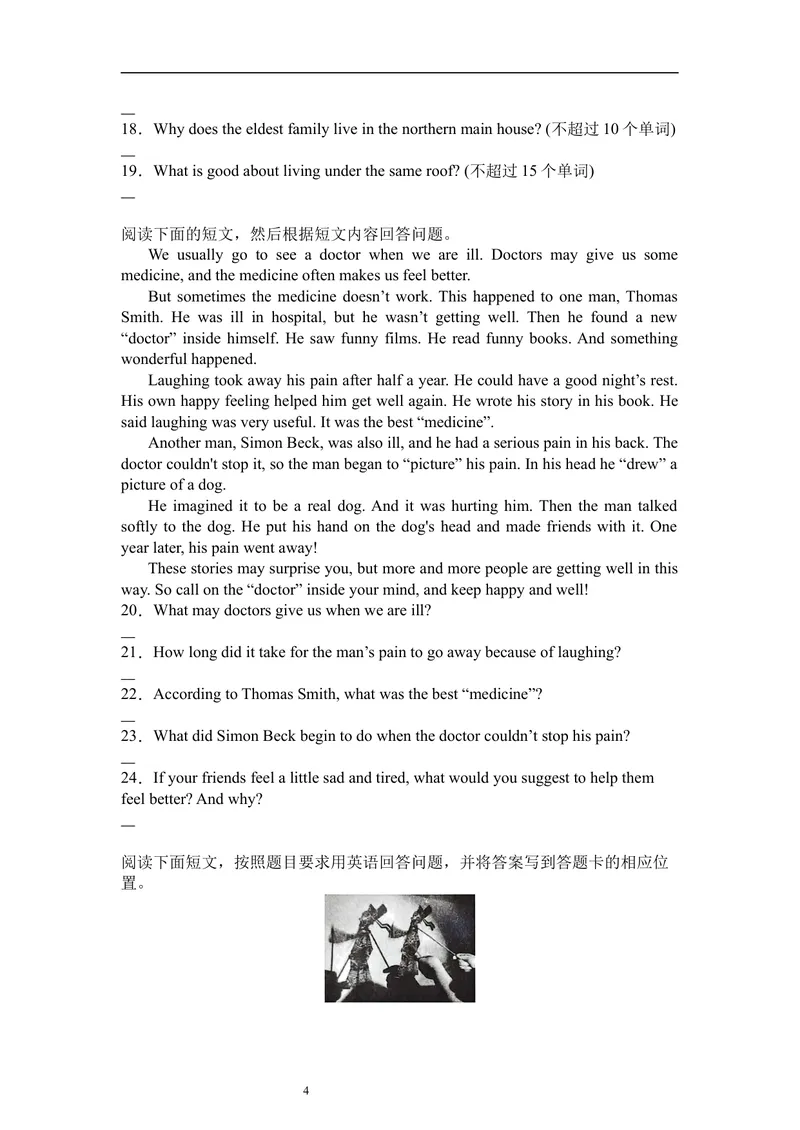
4The Chinese shadow puppet play is an old art. Do you know how it is
performed? Usually, one moves the puppets, one sings, and the other three people
play music.
It’s said that it appeared in China over 2,000 years ago. After the wife of
Emperor Han Wudi died, the emperor was very sad. One day, a man called Li
Shaoweng saw children playing with dolls, and the shadows of the dolls were dancing
on the wall. So he thought of an idea to help the emperor. He went back home and
made a puppet of the emperor’s wife.
He put sticks on the puppet’s hands and feet to make it easy to move. When
night came, he put up a cloth, lit a candle and invited the emperor to sit before the
cloth. Li Shaoweng moved the puppet behind the cloth. The emperor felt like he was
seeing his wife again, and he was very happy. After that, the shadow puppet play
became the emperor’s favourite hobby. Today, the shadow puppet play is still popular.
And it is loved by more and more people all over the world.
25.How many people are usually needed to perform a traditional Chinese shadow
puppet play according to the passage?
26.What was Li Shaoweng’s purpose of making the puppet?
27.What did Li Shaoweng do to make the puppet easy to move?
28.How do you know that the emperor enjoyed the shadow puppet play for a long
time?
29.Do you think traditional art forms like shadow puppet play are still important
today? Why or why not?
阅读下面短文, 完成短文后的问题。
At 97, Ye Lianping has spent most of his life helping children learn. He is a kind
teacher and a true hero in Bu Chen, Anhui.
Ye stopped working in 1991, but he didn’t stop teaching. He started the Home
for Left-Behind Children in 2000 to help children whose parents have to work far
away in big cities. Ye gives free English lessons to these children and has helped over
2,000 of them.
For 25 years, Ye has never asked his students to pay for their education, because
he believes that learning should be free for everyone. To help his students, he buys
books and pens for them. He even lets the children in need eat and live at his home.
However, Ye lives a very simple life. His house is simple, built 30 years ago. He has
even used the same cup for ten years. He doesn’t mind this because he cares more
about the children than himself.
In 2012, Ye took another step. He started the“Ye Lianping Scholarship Fund (叶
连平奖学金)”with the government and Buchen School, which helps students pay for
school. It has provided over 400,000 yuan for more than 400 students. Many of them
5have become teachers themselves. They remember Ye’s kindness and are now passing
it on to their own students.
Ye is racing against time. He wants to spend as much time as he possibly can on
education. He teaches us that the best things in life come from giving, not taking. He
has set an example to us all.
30.Why did Ye Lianping start the “Home for Left-Behind Children” in 2000?
31.What did Ye Lianping do to help his students besides giving free English
lessons?
32.What can the “Ye Lianping Scholarship Fund” do for students?
33.Why do a lot of Ye Lianping’s students decide to be teachers when they grow up?
34.What truth can we learn from Ye Lianping’s experience?
Do you often help people who are in need?
One day, two boys were walking along the road to school when they saw an old
woman carrying a large basket of pears. The old woman looked very tired. They went
up to her and said, “Are you going to town? If you are, we’ll help you carry your
basket. ” “Thank you,” said the woman. “That’s very kind of you. ” Then she told
them that she was going to the market to sell the pears. So the boys decided to lift the
basket together. They walked slowly with the heavy basket, but they were very happy.
The other day, I saw a little girl pick up a piece of banana peel. She threw it into
the dustbin (垃圾箱). “I hope nobody would throw that on the street,” she said.
“Someone may slip (滑倒)and fall. ”
Perhaps some people may say that these are not great things. That’s right. But
almost all great things are made up of such small things. We shouldn’t wait for the
time to do great things. We should begin with these small things that are full of love.
35.Why did the old woman look very tired?
36.What did the little girl hope about the street?
37.Why was the old woman going to the market?
38.What did the little girl do with the banana peel?
39.Do you agree that we should help others by doing the small things? Why or why
not?
阅读下面的短文,根据短文内容回答问题。
Now you’re in a store with 100 yuan in your hand. There are all kinds of foods
6and drinks around you. How can you use maths to make smart choices and not spend
too much?
First, let’s look at discounts (折扣). Stores often have discounts like “30% off”
or “Buy one, get one free”. Maths can help you find the better deal (交易). For
example, a bottle of juice is 10 yuan. With 30% off, you only need to pay 7 yuan for
one bottle. But if it’s “Buy one, get one free”, you get two bottles for 10 yuan, so each
bottle is 5 yuan. In this way, “Buy one, get one free” is better!
Next, think about sizes. Stores may sell the same thing in different sizes.
Sometimes, bigger packs are cheaper (更便宜) for each unit. For example, a 250-
gram (克) bag of chocolates costs 20 yuan, and a 1000-gram bag costs 70 yuan. If you
do the maths, you’ll find that one gram costs 0.08 yuan in the small bag and 0.07 yuan
in the big bag! So, the big bag is a better deal.
Maths isn’t just for school. It’s also useful when you shop. With simple maths,
you can save money and make better choices. By comparing prices and calculating
unit costs, you can stretch your budget further. This practical skill helps you become a
wise shopper and manage your money well in everyday life.
40.Is maths only useful at school?
41.In how many aspects (方面) can you use maths when shopping?
42.Which discount is a better deal for juice: “30% off” or “Buy one, get one free”?
43.How much does one gram of chocolate cost in the 1000-gram bag?
44.What is the main purpose of using maths when shopping?
Family Day is a day for families to have fun together. It’s a time for us to show
love to our family. Here are some kinds of activities for Family Day.
◆We can just stay at home and play games together, like board games or
puzzles.
◆We can have a picnic or play sports in the park. It is relaxing and comfortable
for us to enjoy fresh air.
◆Some families may like to go to another city because they want to try
something new there, such as visiting a museum or tasting local food.
◆Helping others is a very good family activity. So we can help our parents to do
some cleaning or cooking, which makes the home warmer.
These activities make us know each other better and bring us closer. Families
help us a lot and give us support. In Canada, Family Day becomes a holiday on the
third Monday in February. Different families have different activities, but they are all
very happy on Family Day. It’s a special time to cherish and create sweet memories
together. What about your Family Day? Could you tell us something about it?
根据短文内容,回答下列问题。(每题不超过8个词)
45.What do we show to our family on Family Day?
746.Where can we have a picnic?
47.Why do some families like to go to another city?
48.How many kinds of activities for Family Day does the passage mention?
49.When is Family Day in Canada?
It’s the tallest peak (山峰) on Earth. Here, you can see snowy mountains shine
under the blue sky. You can take a breath of the freshest (最新鲜的) air. Welcome to
Qomolangma (珠穆朗玛峰)!
The name “Qomolangma” means “Mother of the Earth”. It’s also called Mount
Everest. It stands on the border (边境) between Nepal and China.
Qomolangma is part of the Himalayan Mountains. It is 8,848.86 meters tall,
reaching into the sky as high as airplanes fly.
Every year, hundreds of climbers from all over the world come here. They wear
warm clothes, sunglasses and get together in teams. Tents are their homes.
The first two people to climb Qomolangma were Edmund Hillary from New
Zealand and Sherpa Tenzing Norgay from Nepal. They made history by climbing the
mountain in 1953.
The weather there is always very cold and windy. There is snow everywhere.
The wind blows all year long. In winter, the lowest temperature (温度) can reach
-60℃.
There is very little oxygen (氧气) on the mountain. Not many animals can live
there, although you can see some yaks (牦牛). Yaks have long hair to keep them
warm. They are very strong and able to walk on narrow paths. People call yaks “the
ships of the highland”.
回答下面5个问题
50.Where is Qomolangma?
51.What’s the height of Qomolangma?
52.When did the first two people climb the mountain?
53.What do people call yaks?
54.How can yaks keep themselves warm?
请阅读下面非连续性文本,按要求完成所给任务,并将答案写在答题卡相应的
位置上
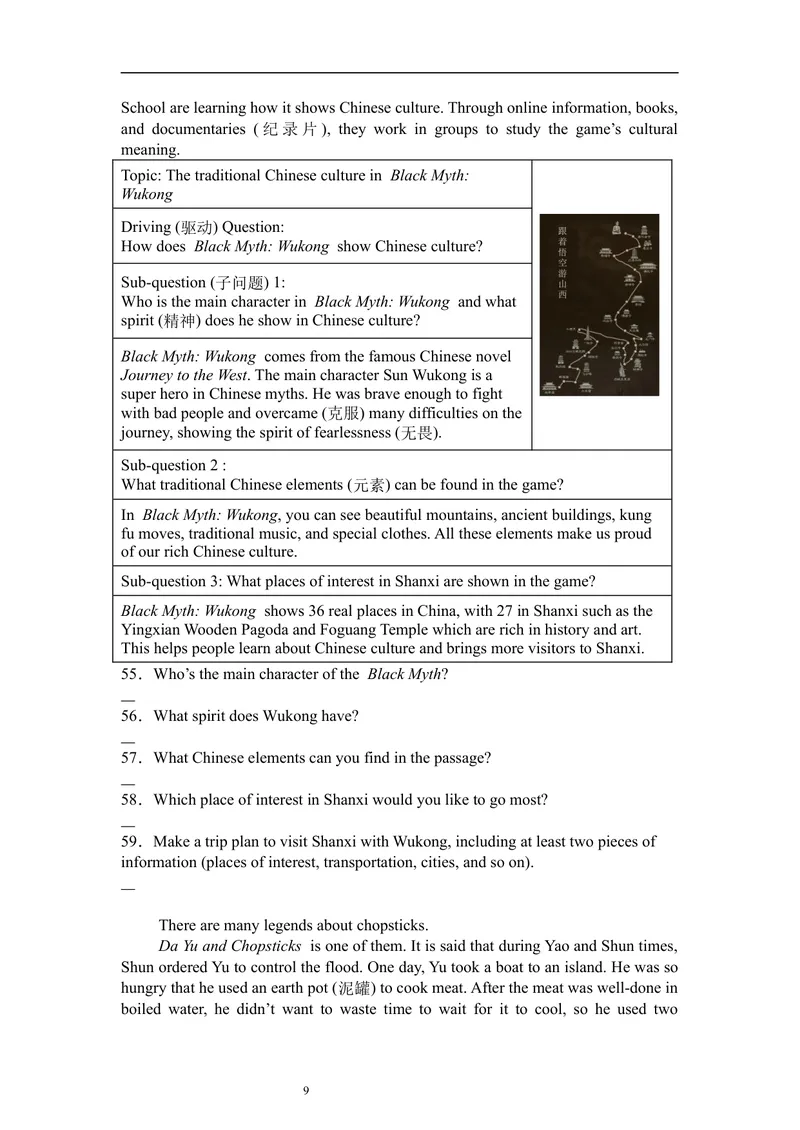
The game Black Myth: Wukong is very popular. Students in Guangming Middle
8School are learning how it shows Chinese culture. Through online information, books,
and documentaries (纪录片), they work in groups to study the game’s cultural
meaning.
Topic: The traditional Chinese culture in Black Myth:
Wukong
Driving (驱动) Question:
How does Black Myth: Wukong show Chinese culture?
Sub-question (子问题) 1:
Who is the main character in Black Myth: Wukong and what
spirit (精神) does he show in Chinese culture?
Black Myth: Wukong comes from the famous Chinese novel
Journey to the West. The main character Sun Wukong is a
super hero in Chinese myths. He was brave enough to fight
with bad people and overcame (克服) many difficulties on the
journey, showing the spirit of fearlessness (无畏).
Sub-question 2 :
What traditional Chinese elements (元素) can be found in the game?
In Black Myth: Wukong, you can see beautiful mountains, ancient buildings, kung
fu moves, traditional music, and special clothes. All these elements make us proud
of our rich Chinese culture.
Sub-question 3: What places of interest in Shanxi are shown in the game?
Black Myth: Wukong shows 36 real places in China, with 27 in Shanxi such as the
Yingxian Wooden Pagoda and Foguang Temple which are rich in history and art.
This helps people learn about Chinese culture and brings more visitors to Shanxi.
55.Who’s the main character of the Black Myth?
56.What spirit does Wukong have?
57.What Chinese elements can you find in the passage?
58.Which place of interest in Shanxi would you like to go most?
59.Make a trip plan to visit Shanxi with Wukong, including at least two pieces of
information (places of interest, transportation, cities, and so on).
There are many legends about chopsticks.
Da Yu and Chopsticks is one of them. It is said that during Yao and Shun times,
Shun ordered Yu to control the flood. One day, Yu took a boat to an island. He was so
hungry that he used an earth pot (泥罐) to cook meat. After the meat was well-done in
boiled water, he didn’t want to waste time to wait for it to cool, so he used two
9branches (树枝) to pick up the meat from the soup for the first time. Later, to save
time, he always took small branches to take out food from the hot pot. For a long
time, he was skilled at picking up food with small sticks. In this way, the first types of
chopsticks were born.
The chopsticks are made of different kinds of materials including bamboo,
wood, animal bone, beautiful stone, and some other materials. There are more than
200 types of chopsticks now. Among them, the bamboo chopsticks are most widely
used.
“A chopstick can be broken easily, ten pairs of chopsticks hold each other
tightly (紧紧地) ...” The song is popular with many people, and it also shows the deep
meaning of chopsticks—the importance of working together.
根据短文内容,回答下列问题。
60.What times did the story Da Yu and Chopsticks happen?
61.What did Yu use to pick up the meat from the soup for the first time?
62.How many types of chopsticks are there now?
63.What kind of chopsticks are most widely used of all?
64.What do you think of chopsticks?
阅读下面短文,根据短文内容回答问题,每题答案不超过8个单词。
Xie Zhaoyutong is a 14-year-old middle school student from Zhengzhou, Henan
province.
He turned his bedroom into a “private(私人的)museum” and caught a lot of
attention online, CCTV News said.
He calls it the Yu Tang Museum. His bedroom is just about 10 square meters. It
is filled with his collections like old books, copper coins(铜币)and pottery(陶器). Xie
bought these things with almost all of his pocket money.
Xie started reading when he was 3 or 4 years old. At 6, he visited a museum
with his mother and became very interested in old objects and history. At first, he
liked the artifacts(文物)because they looked interesting. Later, he learned more about
their history and saw that each has its own story. He wanted to let more people know
about these interesting stories and Chinese history, so he began to make short videos
about his collections. His videos were full of fun facts, so they quickly won the hearts
of many netizens.
His small bedroom museum is where he grows this love for culture—every item
there is a symbol of his dream. The only free space in the room is his bed. “This bed
is for my body, and everything else is for my spirit,” he said. “It helps me spend less
time on my phone.”
65.How old is Xie Zhaoyutong?
1066.Did Xie use his pocket money to buy the collections?
67.Why did he like the artifacts at first?
68.How did he let more people know about the stories and history?
69.What does the boy mean by the underlined sentence?
阅读下面短文,简略回答问题。
Some people think that friends should be alike, but some other people think that
friends should be different. What do you think? Should friends be similar or different?
Matt:
I think a good friend is like a mirror. You can understand people by knowing
their friends. My friend, Stephen, is a great example. We often hang out together
because we have similar hobbies and interests. For example, we both love sports. He
plays badminton better than I do, so he always wins our matches. Because of that, I
try harder when I practise, and now I’m getting better at badminton.
Stephen and I are similar in other ways. He is as serious as me. When we aren’t
playing sports, we enjoy reading together. I read more history books than he does, and
he reads a lot of novels. We often share interesting books with each other.
Diana:
For me, friends who are different make me better. I think we should respect each
other’s differences and learn from each other. For example, I am kind of shy, but my
best friend, Yuan Lei, is outgoing. She has a great sense of humour too. Thanks to her,
I am becoming more outgoing.
I have another friend, Zhang Yong. He is not afraid to give his opinion (意见),
especially when he thinks I am making a mistake. I am less straightforward (坦率
的) than he is, but I am glad to have an honest friend.
70.What’s Matt’s opinion on this topic?
71.Why do Stephen and Matt hang out together?
72.In what ways is Stephen similar to Matt?
73.What’s the difference between Diana and Yuan Lei?
74.What do you think are the important things in a friendship? (说出一点即可)
请阅读下面语篇,根据其内容回答问题,并将答案写在答题卡相应的位置上。
As middle school students, we often face a lot of problems, especially in our
relationships with classmates and friends. These problems can make us feel unhappy.
Understanding the problems
11Many students feel nervous when they have to speak in front of the class. They
worry about what others might think of them. Some students also have trouble making
friends. They feel shy and don’t know how to start a conversation.
Another common problem is disagreement (分歧) with friends. Friends may
have different opinions or interests, and they can cause arguments between friends.
Sometimes, a small disagreement can turn into a big fight, and students may not know
how to solve it.
Finding help to solve problems
Who will you talk to when you meet problems?
When we face these problems, it’s important to find someone to talk to. Talking
to a friend, a family member or a teacher can be very helpful. They can listen to our
feelings and give us useful advice. For example, if you feel nervous about speaking in
class, your teacher might tell you to practice in front of a mirror or join a speaking
club.
My best friend and I had a big fight over a misunderstanding. I felt so sad. I talked
to my teacher. With her help, we made up and became close again.
——Jack
In a word, it’s normal to have these problems. But we don’t have to deal with
these problems alone. By talking to others and getting help, we can find ways to solve
our problems and feel happier.
75.Why do many students feel nervous when speaking in front of the class?
76.What can cause arguments between friends?
77.What per cent of the students will talk to their friends according to the chart?
78.Who did Jack talk to when he fought with his best friend?
79.What do you think of talking to others when you have problems with your
classmates or friends? Why do you think so?
阅读下面短文,完成短文后的问题。
12The 2026 Winter Olympics are coming! It will begin on February 6th and take
place in Italy. Eileen Gu, the former Olympic skiing winner, hopes to show us her
amazing jumps in the air again. However, winning isn’t her only dream this time. She
also wants to send an important message to young people, especially girls, all over the
world.
What’s her advice for young people? “Don’t be afraid to try,” she says. “Most of
the time, your own worry stops you. You might think: What if I’m not good enough?
What if someone laughs at me? But believe me: If you try your best, you will never be
sorry later.”
Gu started skiing when she was three years old and joined her first team at the
age of seven. For many years, she was the only girl on her team. She says that some
people don’t believe in the ability of women athletes in sports. This stops many girls
from playing sports. But Gu doesn’t agree. She believes girls can do well in every
sport. She hopes her story helps girls be brave enough to try.
Gu tells us that we will become stronger if we face our fear bravely. So
remember: Don’t let fear become bigger and bigger like a snowball. Even if
something seems scary at first, have a try!
80.Where will the 2026 Winter Olympics take place?
81.What is Eileen Gu’s advice for young people?
82.When did she start skiing?
83.What stops many girls from playing sports according to Eileen Gu?
84.What can we learn from Gu’s story?
阅读短文,简略回答以下各小题。
For many years scientists have said that the earth is getting warmer. Now they
have found something new-hot cities! In the southern US, they have found that cities
become very hot in summer.
China also has the same kind of problems. Every year more farming land is used
for factories or offices. More housing is needed too. As people become richer, they
buy more cars. New roads are needed and new car parks are built in the city centres.
This all makes the cities hotter.
It is not easy to change the situation. City planners say that we should plant
13more trees in the middle of cities. ‘Every new street should have trees on both sides,’
they say. Trees make the temperature lower, so we should have more trees in our
parks and squares. Also we should paint our roofs (屋顶) white. If we do this, they do
not become so hot. Every roof in a hot and sunny country should have solar roof
panels (太阳能屋顶板). The electricity from these can be used to run the air
conditioners in the building.
People continue to cut down forests around the cities. This makes the problem
worse. Cities are growing faster and faster. By the year 2050, 80% of the world’s
population will be living in cities. If we go on like this, there will not be enough
farmland to feed everyone in the world.
85.What have scientists newly found about hot cities?
86.Why do cities in China become hotter?
87.How can trees help cities become cooler?
88.What should people paint white to reduce heat?
89.What will happen if forests keep being cut down?
阅读下面短文,完成短文后的问题。
Deep down in the sea, Ivan sat on the floor covered with sand. He was bored
and unhappy. He watched other pretty fish swimming in and out of rocks. They were
laughing and dancing in the sea. “Why am I so different?” he said to himself.
“You are an octopus (章鱼), Ivan. That’s special.” The sweet voice of Peter, a
beautiful white dolphin, always made Ivan feel better. Ivan looked up at the white
dolphin and smiled. Peter said, “Let’s play games together.” They were having a lot of
fun and they didn’t know they swam far from home.
Suddenly, Peter saw a large shark swimming above them. “It is Big White. The
biggest, most terrible shark in the sea,” he shouted to Ivan. Peter looked at Big White
hopelessly. Peter was so afraid that he couldn’t swim. Just at this moment, Big White
rushed down towards them. An idea came to Ivan. He sprayed (喷) black ink over the
shark’s eyes. Then Ivan and Peter swam away and got home safely.
“Are you OK?” asked Ivan. “Yes. I am lucky to have you as my friend!” replied
Peter. Ivan’s face turned red. “I guess being different from others can be so cool
sometimes,” Ivan said. “That is what I want to tell you,” Peter said.
90.Where did Ivan sit at the beginning of the story?
91.Why was Ivan unhappy?
92.What is the Big White in the sea?
93.How did Ivan save Peter and himself from Big White?
1494.What did Peter think of Ivan?
阅读下面短文,回答短文后面的各个小题。
In Portland, 16-year-old Carlos Mendez found that many kids in his
neighborhood had broken bicycles lying in their garages (车库). Carlos, who had
learned to repair (修理) bikes from his older brother, saw a chance to help.
He had a free bicycle repair class in his family’s yard every Saturday afternoon.
With tools given by a local bike shop and spare parts from old bicycles, Carlos taught
kids how to repair bikes. Soon, his yard became a popular place to hang out on
weekends.
To help more people, Carlos saved money from his part-time job and bought a
second-hand tricycle (三轮车). He turned it into a mobile repair station named
“Rolling Wrenches”. Now, he rides his tricycle to different parks and community
centers in the city, offering free simple repairs and safety checks (检查).
Carlos’s project got bigger with the support of the community. A man called
Jack heard about his work and helped him get some money to buy more tools to give
away. His mobile workshop has repaired over 200 bicycles so far. Carlos believes that
every kid should have a safe bike to ride, and he’s making that come true.
95.What problem did Carlos notice in his neighborhood?
96.Where did Carlos have his free bicycle repair class?
97.What is the name of his mobile repair station?
98.How did Jack support Carlos’s work?
99.Why does Carlos think his work is meaningful?
Once upon a time, an old man kept a lovely bird and loved it very much. One
day, the bird flew away and the old man was sad. Luckily, the old man found the bird
in the forest after two weeks. He asked the bird to go home with him, but the bird said
no. “I live very well here,” it said. The old man was happy to hear that and decided to
go home. The bird gave him a basket as a gift. When he got home, the old man found
there was gold (金子) in the basket. His wife also wanted it, although she wasn’t kind
to the bird before. The old woman came to the forest, found the bird and asked for a
gift. “Well,” said the bird, “I have two baskets here. One is light and the other is
heavy. Just choose one and open the basket when you get home.”
Of course, the old woman took the heavy one because she thought there must be
more gold in it. She carried it home and opened it, but there were only stones in it.
From then on, the old woman regretted her greed (贪婪) deeply. So she decided
to change herself. She learned that kindness brings good luck and greed causes
15nothing, and she treated every living thing kindly.
根据语篇内容,按要求回答问题。
100.Where did the old man find the bird?
101.What did the bird give the old man as a gift?
102.How did the old woman treat the bird before?
103.Why did the old woman take the heavy basket?
104.What can we learn from the story?
Today, I want to take you to a magical place in China. It is called Jiuzhaigou. It
is in the heart of Sichuan Province. Jiuzhaigou means Nine Village Valley (溪谷). It is
like a real-life fairyland (仙境). Visitors from all over the world are interested in its
natural beauty, and I am one of them.
Last summer vacation, I went there with my parents. We took a long walk along
the lakeside small roads, breathed the fresh mountain air, and even tried to take photos
of the lovely wild birds that flew over the water.
Jiuzhaigou is beautiful and special. Why is it so special? Because of the water.
The lakes there are not just blue, they are colorful. You can see green, yellow and blue
colors mixing together. The water is so clear that it looks like a big mirror.
There is a beautiful Chinese story about this place. People say a fairy dropped
her magic mirror from the sky. The mirror turned into 108 pieces. These pieces were
the 108 beautiful lakes we see today. This story tells us that nature is a precious gift. I
think we should love and protect our beautiful land.
After visiting Jiuzhaigou, I felt that we couldn’t describe China’s natural
landscape in words. Every corner is full of surprises, and it makes me proud (自豪的)
of my country’s beautiful land.
根据语篇内容,回答问题。
105.Where is Jiuzhaigou?
106.Who did the writer go to Jiuzhaigou with?
107.Why is Jiuzhaigou so special according to the passage?
108.How many lakes are there in Jiuzhaigou?
16109.What is your short continuation (续写) of the passage? (No more than 15
words)
In the future, students’ lives will be quite different from their lives now. When
you wake up in the morning, your service robot will prepare a meal for your family.
You won’t need to carry heavy schoolbags anymore because all your things will be in
a small tablet (平板电脑). As you sit down at the table, your tablet will show you a
to-do list. It’s convenient (方便的).
On the way to school, students won’t take the bus or the car. Instead, they will
use a small flying board. Just step on it, and it will fly in the air. It can find the best
route to school and avoid traffic jams (堵塞).
Teachers will use VR to teach. For example, in a history class, students can feel
as if they are in ancient times. And when students have questions, they can talk to a
smart robot teacher at any time. A better future is within reach. Scientists and
engineers are working hard to realize it.
根据语篇内容,按要求回答问题,并把答案写在相应的横线上。
110.What will prepare breakfast for a family in the future?
111.How will students go to school in the future?
112.What can students do when they have questions in the future?
113.Who is working hard to realize the better future?
114.Do you like such a school life in the future? Why or why not? (15字以内)
Nowadays, we have so many ways of communication. It’s amazing how
technology changes the way we communicate. For me, the youngest boy in my
family, this helps a lot, especially with my brothers who are away at college.
To keep in touch, we use technology. We can chat (聊天) online whenever we
want. I often text them and they always reply when they can. Sometimes, I call them
just to hear their voices and we even have video calls to see each other.
But my brothers also encouraged me to try something old-fashioned (老式的):
writing letters. They said it was really a great way to practise my writing skills and
take the time to share my thoughts. I started writing to them and it has become
something I really enjoy. I tell them about my day, my problems and everything on
my mind. They always give me good advice in their replies. The more I write, the
better I become at expressing myself.
In a word, technology brings us closer, and so does the simple act of writing
letters. Now we communicate every day through messages, calls, videos and letters.
It’s like we’re never really apart (分开), even though they’re at college and I’m at
17home. We can share everything that’s happening in our lives, and it feels just like
we’re still together.
根据语篇内容,按要求回答问题。
115.Who does the writer keep in touch with through technology?
116.What do the writer and his brothers sometimes do in order to see each other?
117.What does the writer benefit from writing letters according to Paragraph 3?
118.Why does the writer say he and his brothers are never really apart?
119.How do you communicate with your family and why? (不超过15个词)
Once there was a boy who loved drawing pictures. When people asked him
what he was going to do in the future, he said he wanted to be a sculptor (雕刻家),
just like his father. The boy started to learn to make statues (雕像) from his father
when he was only five years old.
Later, the boy grew into a young man. Every time he finished a statue, his father
would give him some advice. At first, he listened to his father’s words. Later, his
statues could sell at higher prices than his father’s. “I’m doing great now. I don’t need
your advice,” the young man said to his father.
A few months later, he found that fewer people bought his statues. He asked his
father why. “Well, you didn’t listen anymore,” the father said. “It is important to take
advice from others.”
The young man listened to those words and started to take his father’s advice
again. At last, he became a famous sculptor all over the world.
120.When did the boy start to learn to make statues?(不超过10个词)
121.What would the father do after his son finished a statue at first?(不超过10个
词)
122.What can we learn from the story?(不超过10个词)
请阅读下面语篇,根据其内容回答问题,并将答案写在答题卡相应的位置上。
Parents are the closest people to you in the world. They love you just because
you are you. And they would do anything for you.
Like a lot of middle school students, Zhang Shuxia has a problem. She and her
parents don’t get on well. “I really want to be my daddy’s little girl, but it feels like he
doesn’t understand. He talks to me but doesn’t listen to me,” said Zhang, a junior 3
student in Shijiazhuang, Hebei.
Do you and your parents also have problems?
Well, why don’t you all take a walk or have a talk? It’s the International Day of
18Families on 15th May. People around the world give thanks for good things about
their families and work on family problems.
A study last year showed that 1,500 Beijing families had the same problem as
Zhang’s family. The children,12 to 15 years old, didn’t like talking with their parents
much. They weren’t happy at home.
But you and your parents will be much happier if you can be friends. Here are
some ways to have a good talk with them:
Find a good time to talk, like when you’re eating dinner, going out for a walk
or watching TV.
Tell them something you’re interested in, or ask them about their lives when
they were young. They love to talk about it.
Listen to them carefully, and look them in the eye.
Be honest, and your parents will trust you more. And a trusting family is a
happy family.
123.Who are the closest people to us?
124.What is Zhang Shuxia’s problem?
125.What does the writer suggest the students do if they and their parents have
problems?
126.How can we have a good talk with our parents according to the passage? (One
example is ok.)
127.Is being honest a good way to get on well with parents according to the
passage?
Besides the ways in the passage, what else can you do to improve your relationship
with your parents? (Two ways are ok.)
阅读下面短文,并根据短文内容回答问题。
Last spring break, instead of flying somewhere sunny, my parents, encouraged
by an old book, planned a journey in Cornwall, England. They wanted to show us that
the real vacation doesn’t need a plane ticket.
We arrived in St. Ives on a cloudy afternoon. The wind was strong, and the air
tasted of salt. Our booked hotel was small, with old beds, a table and a fireplace. It
felt like getting into a time as 100 years ago. How terrible it was! My brother, Tom,
was not glad about the slow Wi-Fi as soon as we got there.
The next morning, the weather turned worse. It was raining hard. “Perfect day
for a tour,” Dad said with sweetness, opening an old map. He told us about a nearly
forgotten way along the rocky seaside, once used by fishermen a hundred years ago.
We put on our jackets and set out.
The way was just like mashed potatoes. The “short walk” turned into a three-
hour hike against the wind. We couldn’t see the famous blue sea—everything was
19grey and wild. My feet felt bad, and I was cold and felt awful. Tom kept asking, “Are
we there yet?”
Just as we were about to give up, the rain stopped. The clouds disappeared, and
we found ourselves on a cliff (悬崖). Below us, was the prettiest sight: ruins (遗迹) of
a tiny stone house, with rocks around it in the sea. It was so silent except for the sea
and birds. Fantastic! How glad and excited we were! We sat there, eating our
sandwiches, feeling like the only people in the world.
That difficult hike became the highlight of our trip. It taught me that the best
memories sometimes come from unexpected challenges, not just perfect weather.
128.Why did the writer’s family choose to go to Cornwall for their holiday?
129.Did they feel happy when they got there?
130.What did the father plan for the family on the rainy day?
131.How did the writer’s sense change during the hike?
132.What did the writer learn from this holiday?
Have you ever visited Hukou Waterfall? Hukou Waterfall is always compared to
a shining pearl (明珠) in the middle reaches of the Yellow River.
When the Yellow River runs through mountains to Hukou, the river narrows (变
窄) from 300 meters to just over 50 meters. The water suddenly falls into a deep pool.
As a result, a wonderful waterfall appears. It seems that the water pours into a big pot,
which is how it got the name “Hukou”.
The power of the waterfall is tremendous (巨大的) when it falls, so it is hard for
you to get close to the main waterfall. Looking from far away, you can enjoy the
amazing fog-covered water. The beauty cannot be described in words. You cannot
know unless you visit it in person.
There are four wonders of Hukou, “smoking in water”, “colourful bridge to the
sky”, “dragons playing with waves” and “thunder generated from valley stream”. The
waterfall flies straight down with water splashing (溅), clouds and mist rising. Under
the sunlight, you will see a rainbow hanging over the waterfall. The poem “Chant to
Hukou” written by Zhang Yingchun in the Ming Dynasty describes the beauty of
“colourful bridge to the sky”.
The view of Hukou Waterfall changes according to the seasons. So you can
enjoy its special beauty from spring to winter.
133.Why is this waterfall called Hukou Waterfall?
134.When can you enjoy the beauty of Hukou Waterfall?
135.What does the underlined word “it” in Paragraph 3 refer to (指的是)?
20136.Which of the four wonders of Hukou Waterfall was written in the poem?
137.If you have a holiday, will you go to Hukou Waterfall? Why?
Huang Xuhua, a great Chinese scientist, passed away on February 6th, 2025.
But his amazing actions and strong spirit will always stay in our hearts and keep
guiding China’s future.
Huang was born in Guangdong Province in 1926. When he was young, he saw
that our country was in a very hard situation. He wanted to use his knowledge (知识)
to make our country stronger, so he studied really hard.
In the 1950s, China started the difficult job of building nuclear submarines (核
潜艇). Huang Xuhua joined without thinking twice. During that difficult time, the job
seemed impossible to finish. But he and his team never gave up. While they were
working, they met many problems. For example, building a nuclear reactor (反应堆)
was very hard. Without help from other countries, they had to do research by
themselves. Using simple tools like calculators (计算器) and rulers, they worked hard
to calculate and test. To keep the job secret (秘密), they cut off communication with
the outside world, even their families.
Finally, in the 1970s, China’s first nuclear submarine was built and tested
successfully. China became one of the countries that could make nuclear submarines.
Huang Xuhua didn’t stop there and he kept helping to improve the submarine. His
hard work brought him many prizes, including the “Medal of the Republic” in 2019.
Now, as we remember him, we find his life story is encouraging. We, especially
the younger people, should follow his example, face difficulties bravely, and work
hard to make China stronger.
138.How old was Huang Xuhua when he passed away?
139.Why did Huang Xuhua study really hard when he was young?
140.What does the phrase “without thinking twice” probably mean in Chinese?
141.Why did Huang Xuhua and his team cut off communication with their families?
142.What can we learn from Huang Xuhua?
Floods are becoming more common, and it’s a big problem for the whole world.
As cities get larger and more land is covered with concrete (混凝土), less water can
be taken into the ground. If the rain is too heavy and the sewage systems (排水系统)
can not hold all the water, floods may happen easily.
In 2013, Chinese designer Yu Kongjian came up with the idea of “sponge
cities”. These cities are designed to work like a sponge. They can take in water like a
sponge and help reduce the sudden floods.
21In 2015, China started a national plan. The government chose some cities as
“Sponge City” pilots (试点). Wuhan is one of them. In the city, water can pass
through the road. There are also gardens, ponds and wetlands all over the city. When
it rains, they can take in water quickly. This has helped reduce floods there.
Other cities around the world are also trying similar ideas. Auckland in New
Zealand has built green parks along rivers. These parks can take in extra (额外的)
water during heavy rain. Amsterdam in the Netherlands collects rainwater by using
“green roofs” on buildings. These roofs, with grass and small plants, can not only take
in rainwater, but also store and clean the water for daily use with the help of smart
systems.
Yu Kongjian said building sponge cities is like doing Tai Chi. It means working
with nature, not against it. China and other countries are putting this idea into practice
by connecting nature with modern technology (技术).
根据语篇内容,按要求回答问题。
143.What’s the big problem for the whole world according to the text?
144.What can “sponge cities” do like a sponge?
145.When did China start its “Sponge City” pilot plan?
146.How does Amsterdam in the Netherlands collect rainwater?
147.Write an ending sentence for the passage. (不超过15个词)
22《暑假题型专项:任务型阅读(30)》参考答案
1.Because they are made of rubbish (collected by sixth-graders). 2.There was
much rubbish. 3.They get stuck in plastic, eat it and fall ill. 4.
They sorted and counted the rubbish and sent the data. 5.Meaningful. Because
they stop rubbish from getting into the ocean.
【导语】本文介绍了美国马萨诸塞州一所学校的学生清理海滩垃圾,并将其制
作成艺术品的故事。
【详解】1.第一段提到这些艺术品完全由六年级学生收集的垃圾制成“made
entirely of rubbish collected by sixth-graders”,因此答案是原文信息提取。
2.第三段Derek说“when I looked for it, I realized how much there was”,因此他
意识到垃圾很多。
3.根据文章第4段“many get stuck in the plastic or eat it by mistake, falling ill.”
可知垃圾伤害海洋动物的方式,答案为原文直接信息。
4.根据文章第5段“the students sorted the rubbish... counted each piece... sent the
data to the organization”可知清理海滩后学生的行动,答案为原文直接信息。
5.开放题,答案不唯一。需表达对学生们活动的看法并说明理由,合理即可。
6.
Yes, they do. 7.
Because she kept checking their work. 8.
“I” Statements. 9.
Researching facts or designing posters. 10.
To give advice on group work problems. 11.
When my team disagreed on a plan, I chose to listen to their ideas first instead of
arguing for mine. This made them feel respected and we solved the problem together
peacefully and efficiently.
【导语】本文是一篇校报专栏文章,主要讲述了学生李华在小组合作中遇到困
难向陈老师求助,以及陈老师给出沟通建议的故事。
【详解】6.文章李华的信第一段“My four-person team was excited at first—but
things quickly fell apart.”表明,李华的小组有四名成员。
7.文章李华的信第二段“some teammates called me ‘bossy’ because I kept
checking their work.”表明,队友称她专断的原因是她一直检查工作。
8.文章陈老师的回复第二条建议“Use ‘I’ Statements, Not Blame”表明,陈老师
建议用“我”陈述来代替指责。
9.文章陈老师的回复第三条建议“Your quiet teammates might be shy about
speaking up, but they could be amazing at researching facts or designing posters!”表
明,安静的队友可能擅长研究事实或设计海报。
10.文章标题“Team Talk: Group Work Advice Corner”及全文内容说明,该专栏
旨在为学生提供小组合作问题的建议。
11.本题为开放性试题,需结合个人实例解释句意。核心在于表达“倾听而非
争辩”的重要性。示例通过描述自己在团队分歧时选择倾听,体现了让他人感
到被重视从而解决问题的过程,符合文意且词数适中。
12.
Foreign tourists. 13.
She is outgoing. 14.
1She comes from China. 15.
Singing English songs. 16.
Yes. Because I like travelling and making friends.
【导语】本文是一篇记叙文。文章主要讲述了作者梦想成为一名导游,阐述了
想要从事这份工作的原因以及目前的努力计划。
【详解】12.第一段“ My dream is to work for foreign tourists (游客) as a tour
guide.”说明作者想要为外国游客工作,答案几乎是原文引述。
13.第二段“First, I’m an outgoing (外向的) girl, and I like doing something
exciting.”说明了作者的性格特点,直接提取信息。
14.第二段“I can travel all around China and know more about our country. Then I
will tell the foreign tourists about our colorful Chinese history.”说明作者来自中国,
直接提取信息。
15.第二段“Singing English songs is my hobby.”说明了作者的爱好是唱英文歌,
答案几乎是原文引述。
16.本题为开放性问题,答案不唯一,围绕自身喜好和意愿,合理作答即可。
17.In northern China. 18.Because the northern main house gets the most
sunshine. 19.Living under the same roof helps to form a strong family bond.
【导语】本文是一篇说明文,主要介绍了北京传统民居四合院的分布、建筑布
局、居住文化、意义以及现状和保护措施。
【详解】17.第一段“As traditional buildings, the siheyuan is mostly seen in
northern China.”,原文直接给出对应地点信息,直接提取。
18.第一段“The northern main house gets the most sunshine, so the eldest family
lives there.”,原文直接给出原因,直接提取。
19.第一段“Living under the same roof helps to form a strong family bond (纽
带).”,原文直接给出对应好处,直接提取。
20.Doctors may give us some medicine. 21.Half a year. 22.Laughing.
23.He began to “picture” his pain. 24.I would suggest that they should watch
funny films or take a walk in the park. Laughing can drive away bad mood, and
proper exercise can make people feel energetic and relaxed.
【导语】文章介绍了两位病人不靠药物,依靠心理调节、积极情绪恢复健康的
案例,点明积极乐观的心态也是治愈身心的良方。
【详解】20.根据原文第一段“Doctors may give us some medicine”,可知生病
时医生会给我们一些药物。
21.根据原文第三段“Laughing took away his pain after half a year”,可知半年之
后疼痛感消失。
22.根据原文第三段“He said laughing was very useful. It was the best
‘medicine’.”,Thomas Smith认为欢笑是最好的良药。
23.根据原文第四段“the man began to ‘picture’ his pain. In his head he ‘drew’ a
picture of a dog”,医生无法止痛后,他开始在脑海想象、勾勒自己疼痛的具象
画面。
24.结合文章主旨,推荐看喜剧、散步倾诉,因为愉悦的情绪可以舒缓疲惫、
排解低落。
25.Five. 26.To help the emperor./To cheer the emperor up./To make the
emperor happier. 27.He put sticks on the puppet’s hands and feet./By putting
2sticks on the puppet’s hands and feet. 28.After that, the shadow puppet play
became the emperor’s favourite hobby. 29.Yes, I think they are important
because they carry history and culture. They also show the creativity of ancient people
and can bring joy to people today. They are a symbol of Chinese traditional culture.
【导语】本文主要讲述了皮影戏的起源及发展变化。
【详解】25.第一段明确提到“Usually, one moves the puppets, one sings, and the
other three people play music”,这是原文直接给出的信息,通常表演中国传统皮
影戏需要五个人。
26.第二段提到“So he thought of an idea to help the emperor”,结合前文可知,
李少翁制作皮影的目的是帮助皇帝,让皇帝开心起来。
27.第三段提到“He put sticks on the puppet’s hands and feet to make it easy to
move”,这是原文中的具体做法信息,他在皮影的手和脚上放上棍子以便于移
动。
28.第三段提到“After that, the shadow puppet play became the emperor’s
favourite hobby”,这是皇帝长时间都很喜欢皮影戏的依据,从那以后,皮影戏
成了皇帝最喜欢的爱好。
29.开放性试题,回答合理即可。
30.He started it to help children whose parents have to work far away in big cities.
31.He buys books and pens for them and even lets the children in need eat and live
at his home. 32.It can help students pay for school. 33.Because they never
forget Ye’s kindness and hope to pass it on to their own students. 34.We can
learn that the best things in life come from giving, not taking.
【导语】本文主要讲述了安徽卜陈的叶连平老师大半生致力于教育事业,他创
办留守儿童之家,免费为留守儿童授课、资助困难学生,还设立了叶连平奖学
金,用行动诠释了“人生最美好的事物来自给予,而非索取”的道理,是一位
受人敬仰的良师与英雄。
30.第二段第2句直接给出了创办留守儿童之家的原因:“He started the Home
for Left-Behind Children in 2000 to help children whose parents have to work far
away in big cities.”,原文直接信息直接提取。
31.第三段第2、3句明确提到了除免费英语课外的帮助行为:“To help his
students, he buys books and pens for them. He even lets the children in need eat and
live at his home.”,原文直接信息直接提取。
32.第四段第2句明确说明了奖学金的作用:“He started the ‘Ye Lianping
Scholarship Fund (叶连平奖学金)’with the government and Bu Chen School, which
helps students pay for school.”,原文直接信息直接提取。
33.第四段第4、5句直接给出了学生成为老师的原因:“Many of them have
become teachers themselves. They remember Ye’s kindness and are now passing it on
to their own students.”,答案几乎是原文引述。
34.第五段第3句直接点明了从叶老师经历中学到的人生道理:“He teaches us
that the best things in life come from giving, not taking.”,原文直接信息直接提取。
35.Because she was carrying a large basket of pears. 36.She hoped nobody
would throw a piece of banana peel on the street. 37.Because she was going to
sell the pears. 38.She picked it up and threw it into the dustbin. 39.Yes, I
do. Because it’s easy to achieve./No, I don’t. Because I want to help others a lot.
3【导语】本文是一篇记叙文,通过两个生活中的小事例,传递了“伟大的善举
源于小事,我们应从身边的小事做起帮助他人”的主题。
【详解】35.对应第一段内容,原文提到“an old woman carrying a large basket
of pears. The old woman looked very tired.”,说明老妇人提着一大篮子梨,因此
她看起来很累。
36.对应第二段内容,原文引述小女孩的话“‘I hope nobody would throw that
on the street,’ she said. ‘Someone may slip and fall.’”,说明她希望没人把香蕉皮扔
在街上,避免别人滑倒。
37.对应第一段内容,原文提到“Then she told them that she was going to the
market to sell the pears.”,说明老妇人去市场是为了卖梨。
38.对应第二段内容,原文提到“The other day, I saw a little girl pick up a piece
of banana peel. She threw it into the dustbin.”,说明小女孩捡起香蕉皮并扔进了垃
圾桶。
39.本题是开放性试题,答案不唯一,但观点需基于文中事实。
40.No. 41.Two. 42.“Buy one, get one free.” 43.0.07 yuan.
44.To save money, make better choices, become a wise shopper and manage money
well in everyday life.
【导语】本文以“手持100元在超市购物”为场景,介绍了数学在购物中的两
大实用应用。
40.第四段第一句“Maths isn’t just for school. It’s also useful when you shop.”原
文直接否定“数学只用于学校”,明确说明其在购物中也有用,应作否定回答。
41.第二段首句“First, let’s look at discounts.”及第三段首句“Next, think about
sizes.”文章用First和Next明确分两个方面讲解数学的应用:看折扣、对比商品
规格,因此答案是原文信息。
42.第二段最后一句“In this way, ‘Buy one, get one free’ is better!”明确指出,买
一送一更好,答案机会是原文引述。
43.第三段倒数第二句“If you do the maths, you’ll find that one gram costs 0.08
yuan in the small bag and 0.07 yuan in the big bag!”直接给出数值0.07元,因此答
案是原文直接数值信息。
44.第四段第三至四句“With simple maths, you can save money and make better
choices…This practical skill helps you become a wise shopper and manage your
money well in everyday life.”原文有四个核心作用:省钱、做出更好的选择、成
为更理智的购物者、在日常生活中妥善管理资金。答案将四点整合为“To save
money, make better choices, become a wise shopper and manage money well in
everyday life.”。
45.Love. 46.In the park. 47.Because they want to try something new.
48.Four. 49.On the third Monday in February.
【导语】本文主要介绍了家庭日的意义以及四种可以进行的家庭活动。
【详解】45.第一段“It’s a time for us to show love to our family”介绍了我们在
家庭日向家人表达爱。
46.第三段“We can have a picnic or play sports in the park”介绍了可以在公园野
餐。
47.第四段“because they want to try something new there”介绍了一些家庭喜欢
4去另一个城市的原因是想尝试新事物。
48.文章第二至五段分别提到了四种活动:在家玩游戏、去公园野餐或运动、
去另一个城市、帮助家人做家务。
49.第六段“In Canada, Family Day becomes a holiday on the third Monday in
February”介绍了加拿大的家庭日在二月的第三个星期一。
50.It stands on the border between Nepal and China. 51.It is 8,848.86 meters
tall. 52.In 1953. 53.The ships of the highland. 54.Yaks have long
hair to keep themselves warm.
【导语】本文主要介绍了珠穆朗玛峰的地理位置、高度、气候特点以及登山历
史,同时描述了牦牛适应高海拔环境的特性。
50.第二段第三句明确说明了珠穆朗玛峰的位置:“It stands on the border
between Nepal and China.” 因此答案是原文直接信息。
51.第三段第二句明确给出了珠穆朗玛峰的高度:“It is 8,848.86 meters tall...”
答案是原文直接信息。
52.第五段最后一句明确说明了首次登顶的时间:“They made history by
climbing the mountain in 1953.” 答案是原文直接信息。
53.第七段最后一句直接给出了人们对牦牛的称呼:“People call yaks ‘the ships
of the highland’.” 答案是原文直接信息。
54.第七段第三句明确说明了牦牛保暖的方式:“Yaks have long hair to keep
them warm.” 答案是原文直接信息。
55.Wukong./Sun Wukong./Monkey King./The Monkey King. 56.
Fearlessness. 57.Beautiful mountains, ancient buildings, kungfu moves,
traditional music, and special clothes. 58.The Yingxian Wooden
Pagoda./Foguang Temple. 59.I will take a train to Datong to visit the Yingxian
Wooden Pagoda and Xuankong Temple.
【导语】本文介绍了游戏《黑神话:悟空》如何展现中国文化,包括主角精神、
传统元素及山西景点。
55.Sub-question (子问题) 1下的第二段第二句“The main character Sun Wukong
is a super hero in Chinese myths.”,《黑神话:悟空》的主要角色是“孙悟空”。
可以直接提取答案,也可以使用相关同义表达。
56.Sub-question (子问题) 1下的第二段最后一句“...showing the spirit of
fearlessness (无畏).”,悟空身上体现了“无畏”的精神。直接提取答案。
57.Sub-question 2下的第二段“In Black Myth: Wukong, you can see beautiful
mountains, ancient buildings, kung fu moves, traditional music, and special
clothes.”,你能找到美丽山川、古建筑、功夫招式、传统音乐和特色服饰这些中
国元素。直接提取答案。
58.开放性回答,合理即可,可参考最后一段“...such as the Yingxian Wooden
Pagoda and Foguang Temple...”回答。
59.开放性回答,合理即可,从“名胜古迹、交通、城市等等”中至少选两个
回答,答案从交通、城市和名胜古迹三方面进行了回答。
60.Yao and Shun times. 61.Two branches. 62.More than 200. 63.
The bamboo chopsticks. 64.Chopsticks are a useful kind of invention whose
deep meaning of them is the importance of working together.
【导语】本文是一篇说明文,主要介绍了筷子的相关知识,包括其定义、历史、
5种类、制作材料以及在文化中的重要意义等内容,展现了筷子作为一种传统餐
具所蕴含的文化内涵和价值。
【详解】60.根据“It is said that during Yao and Shun times, Shun ordered Yu to
control the flood.”可知,大禹与筷子的故事发生在尧舜时期。故填During Yao
and Shun times.
61.根据“...he used two branches to pick up the meat from the soup for the first
time.”可知,大禹第一次用树枝夹起汤里的肉。故填Two branches.
62.根据“There are more than 200 types of chopsticks now.”可知,现在有200多
种筷子。故填More than 200.
63.根据“Among them, the bamboo chopsticks are most widely used.”可知,竹筷
子是使用最广泛的。故填The bamboo chopsticks.
64.根据“... it also shows the deep meaning of chopsticks—the importance of
working together.”可知,筷子象征着团结协作的重要性。故填Chopsticks are a
useful kind of invention whose deep meaning of them is the importance of working
together.
65.14./14 years old./He is 14./He is 14 years old. 66.Yes./Yes, he did.
67.Because they looked interesting. 68.By making short videos./By making
short videos about his collections./He made short videos./He made short videos about
his collections. 69.He loves his collections./He enjoys the artifacts./He is
interested in Chinese culture.
【分析】本文介绍了14岁的郑州中学生谢昭宇,用零花钱收藏文物并将卧室改
造成私人博物馆。他通过短视频分享藏品故事,并在网络走红。
65.文章第一句直接点明“Xie Zhaoyutong is a 14-year-old middle school
student…”,提取年龄信息即可。故填14./ 14 years old./ He is 14./ He is 14 years
old.
66.文中提到“Xie bought these things with almost all of his pocket money.”,明
确说明他用零花钱购买了藏品,因此给出肯定回答。故填Yes./ Yes, he did.
67.根据“At first, he liked the artifacts because they looked interesting.”可知,因
为他们看起来是有趣的,直接引用原因即可。故填Because they looked
interesting.
68.文中提到“He wanted to let more people know about these interesting stories
and Chinese history, so he began to make short videos about his collections.”,提取
“制作短视频”这一方式即可。故填By making short videos./ By making short
videos about his collections./ He made short videos./ He made short videos about his
collections.
69.划线句“This bed is for my body, and everything else is for my spirit.”中,
“bed”代表满足身体休息的需求,而“everything else”(指藏品与文化)则是滋
养精神、丰富内心的寄托,体现了他对传统文化的热爱与精神追求。故填He
loves his collections./ He enjoys the artifacts./ He is interested in Chinese culture.(本
题答案不唯一,言之有理即可。)
70.He thinks friends should be similar, like a mirror, and shares common hobbies
and interests. 71.Because they have similar hobbies and interests. 72.
They have similar hobbies and interests, and they are both serious. 73.Diana is
kind of shy, but Yuan Lei is outgoing. 74.Learning from each other.
6【导语】本文主要讲述了Matt和Diana对“朋友应当相似还是不同”的观点及
相关事例。
70.根据“I think a good friend is like a mirror.”以及“We often hang out together
because we have similar hobbies and interests.”可知,他认为朋友应该彼此相似,
就像镜子一样,他们应该有共同的爱好和兴趣。故填He thinks friends should be
similar, like a mirror, and shares common hobbies and interests.
71.根据“We often hang out together because we have similar hobbies and
interests.”可知,因为他们有着相似的爱好和兴趣。故填Because they have
similar hobbies and interests.
72.根据“He is as serious as me. When we aren’t playing sports, we enjoy reading
together.”可知,他们有着相似的爱好和兴趣,并且都非常认真。故填They have
similar hobbies and interests, and they are both serious.
73.根据“I am kind of shy, but my best friend, Yuan Lei, is outgoing.”可知,Diana
有点害羞,但袁雷外向。故填Diana is kind of shy, but Yuan Lei is outgoing.
74.开放性问题,言之有理即可。参考答案为Learning from each other.
75.Because they worry about what others might think of them. 76.Different
opinions or interests. 77.39% 78.His teacher. 79.I think it’s a good
idea. Because talking to others(like friends, family members or teachers)can help us
feel better. They can listen to us and give useful advice. Also, it can help us solve the
problem easily, just like Jack and his friend made up with the teacher’s help. We don’t
have to deal with the problem alone.
【导语】本文主要讨论了中学生在与同学和朋友相处时可能遇到的问题,以及
如何通过寻求帮助来解决这些问题。
75.根据文章第二段“Many students feel nervous when they have to speak in front
of the class. They worry about what others might think of them.”可知,许多学生在
全班面前讲话时感到紧张是因为他们担心别人对他们的看法。
76.根据文章第三段“Another common problem is disagreement(分歧) with
friends. Friends may have different opinions or interests, and they can cause
arguments between friends.”可知,朋友之间的分歧,如不同的意见或兴趣,会导
致争吵。
77.题目询问根据图表有多少比例的学生会和朋友交谈,图表中显示有39%的
学生在遇到问题时选择和朋友交谈。
78.根据文章倒数第二段“My best friend and I had a big fight over a
misunderstanding. I felt so sad. I talked to my teacher. With her help, we made up and
became close again.”可知,Jack在和他的好朋友打架后,选择和他的老师交谈。
79.是一个开放性问题,询问个人对于在遇到与同学或朋友的问题时与他人交
谈的看法。根据文章内容和个人理解,可以认为这是一个好主意,因为与他人
交谈可以帮助我们感觉更好,他们可以倾听我们并给出有用的建议,还可以帮
助我们轻松解决问题,就像Jack在老师的帮助下和他的朋友和解一样。我们不
必独自面对问题。
80.In Italy. 81.Don’t be afraid to try. If you try your best, you will never be
sorry later. 82.When she was three years old. 83.Some people don’t
believe in the ability of women athletes in sports. 84.We will become stronger if
we face our fears bravely. Don’t let fear stop us, and we should be brave enough to
7have a try even when something seems scary at first.
【导语】本文介绍了将参加2026年冬奥会的谷爱凌,分享了她对年轻人尤其是
女孩的建议,鼓励大家勇敢尝试,不要被恐惧和偏见阻挡。
【详解】80.根据原文第一段“It will begin on February 6th and take place in
Italy.”,可直接得出2026年冬奥会在意大利举办,是原文信息,直接提取。
81.根据原文第二段谷爱凌的发言“Don’t be afraid to try”和“...But believe me:
If you try your best, you will never be sorry later.”,可直接得出她给年轻人的建议
为:不要害怕尝试,只要尽力而为,日后就不会后悔。
82.根据原文第三段“Gu started skiing when she was three years old and joined
her first team at the age of seven.”,可知谷爱凌三岁时就开始滑雪,是原文信息,
直接提取。
83.根据原文第三段内容“She says that some people don’t believe in the ability of
women athletes in sports. This stops many girls from playing sports.”,可得出结论:
一些人不相信女运动员在体育中的能力,这阻碍了很多女孩参与体育运动,是
原文信息提取。
84.开放性问题,答案不唯一,结合最后一段,总结给出答案即可。
85.In the southern US, cities become very hot in summer. 86.Because more
farming land is used for factories or offices, more housing is needed, more cars are
bought, new roads are needed and new car parks are built in the city centres. 87.
Trees make the temperature lower. 88.People should paint their roofs white.
89.There will not be enough farmland to feed everyone in the world.
【导语】本文主要介绍了城市变热的现象、原因以及应对措施,同时指出持续
砍伐森林会带来的严重后果。
【详解】85.第一段明确提到“In the southern US, they have found that cities
become very hot in summer.”,所以科学家关于“热城市”的新发现是在美国南
部,城市在夏天变得非常热,答案直接从原文提取。
86.第二段指出“Every year more farming land is used for factories or offices.
More housing is needed too. As people become richer, they buy more cars. New roads
are needed and new car parks are built in the city centres. This all makes the cities
hotter.”,即因为更多的农田被用于建工厂或办公室,需要更多住房,人们买更
多汽车,需要新道路且在城市中心建新停车场,这些使得中国城市变得更热,
答案是对原文内容的整合。
87.第三段提到“Trees make the temperature lower, so we should have more trees
in our parks and squares.”,说明树木能降低温度,从而使城市变得更凉爽,答案
直接从原文提取。
88.第三段明确说“Also we should paint our roofs (屋顶) white.”,即人们应该把
屋顶涂成白色来减少热量,答案直接从原文提取。
89.最后一段提到“If we go on like this, there will not be enough farmland to feed
everyone in the world.”,表明如果森林持续被砍伐,将没有足够的农田来养活世
界上的每个人,答案直接从原文提取。
90.He sat on the floor covered with sand./On the floor covered with sand. 91.
Because he felt different from other fish. 92.Big White is the biggest and most
terrible shark in the sea. 93.He sprayed black ink over the shark’s eyes./By
spraying black ink over the shark’s eyes. 94.Peter thought Ivan was a special
8friend./Ivan was his lucky friend.
【导语】本文主要讲述了章鱼Ivan一开始因自己与众不同而不开心,后来在与
海豚Peter一起玩耍遇到鲨鱼时,凭借自己的特殊能力救了Peter,最终意识到
与众不同有时很酷的故事。
90.根据文中“Deep down in the sea, Ivan sat on the floor covered with sand.”可知,
故事一开始Ivan坐在铺满沙子的地板上,答案可从原文直接提取。
91.根据文中“‘Why am I so different?’ he said to himself.”以及前文描述他看到
其他鱼开心地游来游去,可推断出Ivan不开心是因为他觉得自己和其他鱼不一
样,答案需根据文中内容进行合理推断。
92.根据文中“It is Big White. The biggest, most terrible shark in the sea”可知,
Big White是海里最大最可怕的鲨鱼,答案可从原文直接提取。
93.根据文中“An idea came to Ivan. He sprayed (喷) black ink over the shark’s
eyes. Then Ivan and Peter swam away and got home safely.”可知,Ivan是通过向鲨
鱼的眼睛喷黑墨水来救了Peter和他自己,答案可从原文直接提取关键信息并总
结。
94.根据文中“‘Yes. I am lucky to have you as my friend!’ replied Peter.”以及
“Peter said. ‘That is what I want to tell you,’”可推断出Peter认为Ivan是一个特别
的朋友,是他的幸运朋友,答案需根据文中内容进行合理推断。
95.Many kids in his neighborhood had broken bicycles lying in their garages.
96.In his family’s yard. 97.Rolling Wrenches. 98.He helped Carlos get
some money to buy more tools to give away. 99.Because he believes that every
kid should have a safe bike to ride, and he’s making that come true.
【导语】本文主要讲述了16岁的Carlos Mendez注意到邻居家有很多坏掉的自
行车,于是他开设免费的自行车修理课,并创建移动修理站,为孩子们提供免
费修理和安全检查服务,他相信每个孩子都应该有一辆安全的自行车来骑。
【详解】95.第一段提到“In Portland, 16-year-old Carlos Mendez found that
many kids in his neighborhood had broken bicycles lying in their garages (车库).”,
说明Carlos注意到他的邻居家有很多坏掉的自行车被扔在车库里。
96.第二段提到“He had a free bicycle repair class in his family’s yard every
Saturday afternoon.”,说明Carlos在他家的院子里开设免费的自行车修理课。
97.第三段提到“He turned it into a mobile repair station named ‘Rolling
Wrenches’.”,说明他的移动修理站的名字是“Rolling Wrenches”。
98.第四段提到“A man called Jack heard about his work and helped him get some
money to buy more tools to give away.”,说明Jack通过帮助Carlos筹集资金购买
更多工具来支持他的工作。
99.最后一段提到“Carlos believes that every kid should have a safe bike to ride,
and he’s making that come true.”,说明Carlos认为他的工作有意义是因为他相信
每个孩子都应该有一辆安全的自行车来骑,并且他正在努力实现这一目标。
100.In the forest./He found it/the bird in the forest. 101.A basket./The bird (It)
gave him/the old man a basket as a gift. 102.She wasn’t kind to the bird before.
103.Because she thought there must be more gold in it. 104.We learn that
kindness brings good luck and greed causes nothing./We should treat every living
thing kindly./We should be kind to others...
【导语】本文讲述了一位老人善待飞走的鸟儿,鸟儿赠予他装有金子的篮子;
9而老人的妻子此前对鸟儿不善,因贪婪选择了重篮子,结果只得到石头,最终
她悔悟并学会友善对待万物的故事,传递了善良会带来好运,贪婪终将一无所
获的道理。
100.根据第一段第三句“Luckily, the old man found the bird in the forest after two
weeks.”可知,老人在森林里找到了那只鸟。
101.根据第一段中的“The bird gave him a basket as a gift.”可知,鸟儿送给老人
一个篮子作为礼物。
102.根据第一段中的“His wife also wanted it, although she wasn’t kind to the bird
before.”可知,老妇人之前对这只鸟并不友善。
103.根据第二段第一句“Of course, the old woman took the heavy one because
she thought there must be more gold in it.”可知,她认为重篮子里一定有更多金子,
所以选择了重篮子。
104.根据文中最后一段“She learned that kindness brings good luck and greed
causes nothing, and she treated every living thing kindly.” 可知,我们能学到:善
良会带来好运,贪婪终将一无所获或我们应该友善对待每一个生命。
105.It is in the heart of Sichuan Province. 106.The writer’s parents.
107.Because of the water. 108.108. 109.I think I will visit Jiuzhaigou
again next year.
【导语】本文主要讲述了作者暑假期间与父母一同游览四川九寨沟的经历,描
述了其独特的水景、相关的传说故事以及作者对祖国壮丽山河的自豪感。
105.首段直接描述了九寨沟的位置是“in the heart of Sichuan Province”,因此
答案是原文直接信息。
106.第二段明确提到“I went there with my parents”,表明作者是和父母一起去
的九寨沟,答案直接提取原文信息。
107.第三段明确指出“Jiuzhaigou is beautiful and special. Why is it so special?
Because of the water”,答案直接提取原文信息。
108.第四段提到“The mirror turned into 108 pieces. These pieces were the 108
beautiful lakes we see today”,答案直接提取原文信息。
109.本题是开放性试题,答案不唯一,此答案结合文章内容,表达出想再次游
览九寨沟的想法,符合续写要求且字数在15词以内。
110.A service robot will prepare breakfast for a family in the future./A service robot.
111.They will use a small flying board to go to school./By using a small flying
board. 112.They can talk to a smart robot teacher at any time. 113.
Scientists and engineers. 114.Yes. That’s because the school life in the future is
more interesting and convenient.
【导语】本文主要从日常起居、上学方式、课堂教学等方面,介绍了未来的学
生生活和当下生活的不同,描绘了未来的学生生活的发展前景。
110.第一段的第二句“When you wake up in the morning, your service robot will
prepare a meal for your family.”指出,服务机器人会准备早餐。
111.第二段的前两句“On the way to school, students won’t take the bus or the car.
Instead, they will use a small flying board.”指出,将来学生们的上学交通工具是小
飞行板。
112.最后一段的第三句“And when students have questions, they can talk to a
smart robot teacher at any time.”指出,学生有问题时,可以随时与智能机器人
10“老师”交谈。
113.最后一段的最后一句“Scientists and engineers are working hard to realize it.”
指出,科学家和工程师正在努力实现更好的未来。
114.结合文章描述的未来的学校生活,给出自己的回答,答案不唯一,言之有
理即可。
115.His brothers. 116.They have video calls. 117.He practises his
writing skills and becomes better at expressing himself. 118.Because they can
share everything that’s happening in their lives. 119.①I communicate with my
family/them face to face. (By communicating with them face to face.) Because I can
know their feelings well. ②I send text messages/make a video call/make a phone call.
(By sending text messages./By making a video call./By making a phone call.)
Because I can communicate with them whenever I want.
【导语】本文是一篇记叙文,讲述了作者通过科技与在远方上大学的哥哥们保
持联系的方式,包括线上聊天、发短信、打电话、视频通话,还提到哥哥们鼓
励作者写信以及写信带来的好处,最后作者感慨科技和写信让自己和哥哥们虽
处不同地方却感觉从未分开。
【详解】115.根据“For me, the youngest boy in my family, this helps a lot,
especially with my brothers who are away at college.”可知,作者通过科技和在远
方上大学的哥哥们保持联系。故填His brothers.
116.根据“Sometimes, I call them just to hear their voices and we even have video
calls to see each other.”可知,作者和哥哥们有时为了见到彼此会进行视频通话。
故填They have video calls.
117.根据“They said it was really a great way to practise my writing skills and take
the time to share my thoughts.”以及“The more I write, the better I become at
expressing myself.”可知,作者从写信中锻炼了写作技巧,也更善于表达自己的
想法。故填He practises his writing skills and becomes better at expressing himself.
118.根据“We can share everything that’s happening in our lives, and it feels just
like we’re still together.”可知,作者说和哥哥们从未真正分开是因为他们能分享
生活中发生的一切。故填Because they can share everything that’s happening in
their lives.
119.本题为开放性问题,答案不唯一,结合自身喜好和理由合理作答即可。故
填①I communicate with my family/them face to face. (By communicating with them
face to face.) Because I can know their feelings well. ②I send text messages/make a
video call/make a phone call. (By sending text messages./By making a video call./By
making a phone call.) Because I can communicate with them whenever I want.
120.When he was only five years old. / At the age of five. 121.He would give
his son some advice. 122.It is important to take advice from others.
【导语】本文是一篇记叙文,讲述了一个男孩从父亲那里学习雕刻,起初听从
父亲的建议,后来自满不再听取建议,导致雕像销量下滑,最终在父亲的提醒
下重新接受建议并成为著名雕刻家的故事。
【详解】120.根据“The boy started to learn to make statues from his father when
he was only five years old.”可知,男孩在五岁时开始学习雕刻雕像。故填When
he was only five years old. / At the age of five.
121.根据“Every time he finished a statue, his father would give him some advice.”
11可知,起初男孩完成雕像后,父亲会给他一些建议。故填He would give his son
some advice.
122.根据“It is important to take advice from others.”可知,这个故事告诉我们听
取他人建议很重要。故填It is important to take advice from others.
123.Our father and mother./Our parents. 124.She and her parents don’t get on
well. 125.They should take a walk or have a talk with their parents. 126.
By finding a good time to talk./By telling them something they’re interested in, or
asking them about their lives when they were young./By listening to them carefully,
and looking them in the eye. 127.Yes, it is. I can not only help my parents do
some housework to show my love for them, but also give my parents a hug and say “I
love you” every day./Yes, it is. I can talk with my parents about my school life and
listen to their stories.
【导语】本文是一篇说明文,探讨了中学生与父母相处不融洽的普遍问题,介
绍了国际家庭日的背景,并给出了与父母友好沟通的具体建议。
【详解】123.根据“Parents are the closest people to you in the world.”可知,父
母是我们在世界上最亲近的人。故填Our father and mother./Our parents.
124.根据“She and her parents don’t get on well.”可知,张淑霞的问题是她和父
母相处得不好。故填She and her parents don’t get on well.
125.根据“Well, why don’t you all take a walk or have a talk?”可知,作者建议如
果和父母有矛盾,可以去散步或者和父母谈一谈。故填They should take a walk
or have a talk with their parents.
126.根据“Find a good time to talk”“Tell them something you’re interested in, or
ask them about their lives when they were young. They love to talk about it.”“Listen
to them carefully, and look them in the eye.”以及“Be honest”可知,文中给出了多
种与父母好好交谈的方法,任选其一即可。故填By finding a good time to
talk./By telling them something they’re interested in, or asking them about their lives
when they were young./By listening to them carefully, and looking them in the eye.
127.根据“Be honest, and your parents will trust you more. And a trusting family is
a happy family.”可知,诚实是和父母友好相处的好方法,所以答案是肯定的,
所以第一个问题回答Yes, it is.;第二个问题答案不唯一,结合自身实际,如帮
父母做些家务来表达对他们的爱,还可以每天给父母一个拥抱并说“我爱你
们”等合理作答即可。故填Yes, it is. I can not only help my parents do some
housework to show my love for them, but also give my parents a hug and say “I love
you” every day./Yes, it is. I can talk with my parents about my school life and listen to
their stories.
128.Because the parents were encouraged by an old book. 129.No, they
didn’t. 130.To hike an old way along the sea/To hike an old way along the
rocky seaside. 131.She (He) was cold and felt awful at first, but ended up
feeling fantastic (glad) and excited. 132.The best holiday memories can come
from difficult but real experiences. (意思相近即可)
【导语】本文主要讲述了作者一家在去年春假时,受一本旧书启发前往英国康
沃尔旅行,在旅途中经历恶劣天气徒步,最终收获美好回忆的故事,体现了最
好的回忆有时来自意外挑战而非完美天气。
128.根据第一段“my parents, encouraged by an old book, planned a journey in
12Cornwall, England. They wanted to show us that the real vacation doesn’t need a
plane ticket.”可知,作者的父母受一本旧书启发,计划去康沃尔旅行,想让大家
知道真正的假期不需要机票。故填Because the parents were encouraged by an old
book.
129.根据第二段“How terrible it was! My brother, Tom, was not glad about the
slow Wi-Fi as soon as we got there.”可知,他们到达那里时并不开心。故填No,
they didn’t.
130.根据第三段“He told us about a nearly forgotten way along the rocky seaside,
once used by fishermen a hundred years ago. We put on our jackets and set out.”可知,
下雨天父亲计划带家人沿着海边的一条古老小路徒步旅行。故填To hike an old
way along the sea/To hike an old way along the rocky seaside.
131.根据第四段“My feet felt bad, and I was cold and felt awful.”以及第五段
“Fantastic! How glad and excited we were!”可知,作者一开始感觉很糟糕,后来
感觉很棒、兴奋。故填She (He) was cold and felt awful at first, but ended up
feeling fantastic (glad) and excited.
132.根据最后一段“It taught me that the best memories sometimes come from
unexpected challenges, not just perfect weather.”可知,作者从这个假期中学到最好
的假期回忆可能来自困难但真实的经历。故填The best holiday memories can
come from difficult but real experiences. (意思相近即可)
133.It seems that the water pours into a big pot, which is how it got the name
“Hukou”. 134.We can enjoy the beauty from spring to winter/We can enjoy the
beauty all year round. 135.Hukou Waterfall. 136.Colourful bridge to the
sky. 137.Yes, I will. Because it is very beautiful and amazing.(开放性回答,
合理即可)
【导语】本文主要介绍了黄河壶口瀑布名字的由来、壮观景色、四大奇观以及
四季不同的美景。
133.根据“It seems that the water pours into a big pot, which is how it got the name
‘Hukou’.”可知,因为水流看起来像倒进一个大壶里,所以得名壶口瀑布。故填
It seems that the water pours into a big pot, which is how it got the name “Hukou”.
134.根据“So you can enjoy its special beauty from spring to winter.”可知,从春
天到冬天都可以欣赏壶口瀑布的美景。故填We can enjoy the beauty from spring
to winter/We can enjoy the beauty all year round.
135.根据“The beauty cannot be described in words. You cannot know unless you
visit it in person.”可知,“it”指代的是壶口瀑布。故填Hukou Waterfall.
136.根据“The poem ‘Chant to Hukou’ written by Zhang Yingchun in the Ming
Dynasty describes the beauty of ‘colourful bridge to the sky’.” 可知,诗中描写的是
“彩虹通天”这一奇观。故填Colourful bridge to the sky.
137.根据全文对壶口瀑布壮观景色和四季之美的描述可知,壶口瀑布景色迷人,
值得一游。故填Yes, I will. Because it is very beautiful and amazing. (开放性回
答,合理即可)
138.He was 99 years old. 139.Because he saw that his country was in a very
hard situation, and he wanted to use his knowledge to make China stronger.
140.毫不犹豫/不假思索 141.To keep the job secret. 142.We should
follow his example, face difficulties bravely, and work hard to make China stronger.
13(答案不唯一,合情合理即可)。
【导语】本文主要讲述了中国伟大科学家黄旭华的生平事迹、为中国核潜艇事
业作出的巨大贡献以及他的爱国与奉献精神,激励我们向他学习。
138.根据“Huang Xuhua…passed away on February 6th, 2025.”和“Huang was
born in Guangdong Province in 1926.”可知,用2025减去1926得出他去世时99
岁。故填He was 99 years old.
139.根据“When he was young, he saw that our country was in a very hard
situation. He wanted to use his knowledge to make our country stronger, so he studied
really hard.”可知,他努力学习是为了用知识让国家更强大。故填Because he saw
that his country was in a very hard situation, and he wanted to use his knowledge to
make China stronger.
140.根据“In the 1950s, China started the difficult job of building nuclear
submarines. Huang Xuhua joined without thinking twice.”可知,他立刻加入没有犹
豫,这个短语意为“毫不犹豫/不假思索”。故填:毫不犹豫/不假思索。
141.根据“To keep the job secret, they cut off communication with the outside
world, even their families.”可知,他们切断和家人的联系是为了对工作保密。故
填To keep the job secret.
142.根据“We, especially the younger people, should follow his example, face
difficulties bravely, and work hard to make China stronger.”可知,我们要学习他勇
敢面对困难、努力奋斗、热爱祖国的精神。故填We should follow his example,
face difficulties bravely, and work hard to make China stronger. (答案不唯一,合
情合理即可)
143.Floods are becoming more common./Floods are becoming more common, and
it’s a big problem for the whole world./Floods. 144.They (Sponge
cities/“Sponge cities”) can take in water and help reduce the sudden floods.
145.China started its “Sponge City” pilot plan in 2015./In 2015. 146.
Amsterdam in the Netherlands collects rainwater by using “green roofs” on
buildings./By using “green roofs” on buildings. 147.Working with nature is the
key to fighting against floods and building a better future./Working with nature and
technology makes cities better and safer.
【导语】本文主要讨论了洪水成为全球大问题,介绍了“海绵城市”的概念、
中国的试点计划以及其他国家类似举措,强调与自然合作应对洪水。
【详解】143.根据第一段首句“Floods are becoming more common, and it’s a big
problem for the whole world.”可知,洪水变得愈发常见,这是整个世界面临的大
问题。故填Floods are becoming more common./Floods are becoming more
common, and it’s a big problem for the whole world./Floods.
144.根据第二段“These cities are designed to work like a sponge. They can take in
water like a sponge and help reduce the sudden floods.”可知,“海绵城市”能像海
绵一样吸收水分,并有助于减少突发的洪水。故填They (Sponge cities/“Sponge
cities”) can take in water and help reduce the sudden floods.
145.根据第三段“In 2015, China started a national plan. The government chose
some cities as ‘Sponge City’ pilots (试点).”可知,中国在2015年启动了“海绵城
市”试点计划。故填China started its “Sponge City” pilot plan in 2015./In 2015.
146.根据第四段“Amsterdam in the Netherlands collects rainwater by using ‘green
14roofs’ on buildings.”可知,荷兰阿姆斯特丹通过在建筑物上使用“绿色屋顶”来
收集雨水。故填Amsterdam in the Netherlands collects rainwater by using “green
roofs” on buildings./By using “green roofs” on buildings.
147.开放性问题,言之有理即可。参考示例:结合前文提到各国通过与自然合
作的方式应对洪水问题,强调了这种做法的重要性和积极意义,所以结尾句可
以总结这种做法是应对洪水、建设美好未来的关键,或者强调与自然和技术合
作能让城市更好更安全。参考答案为Working with nature is the key to fighting
against floods and building a better future./Working with nature and technology
makes cities better and safer.
15