mffif;Hi# fralf+tfi. Brsfi4ifr
*ffii3iiffiffiffi%
HffiIft)HW
ffiffi
J".)1
+tffi{=HE E#ffi txE7, mi*s.ia
5
+FA %,2 F.titkl 2*z lE Hfr\ Xi0tn, R*T +\HrE#
6r +z h r.fr\t^+ +ffia4+t#. 5 E+ffi{Ft + Ht'+ z Htifr GT, frVH-&Rffilv+ 5 ffrfc /K+
l
Qv z ft -EE EhtE +HiEtEiJ,, +fifri*Hi=
+ffitffi H7, E4Eiptri)|r+.lftl*?
t#l^f
fr\6h, xt T , H p fEE 5 tr+ffi frUEtrd,xE6 E|[fu " tE +ffi txJ Effi 'l*,,tt * T ffi +.f
*Xz
fr\ 4 frffi9+, €tF. ffi *th#:trstt f, f, FI + ffi , Bli4 X T ffiX1E 4frffiruTi|-t, frLfr,5 K4
r
i{Tf,J5 , F7.IFIEffiNB"
zJ' # h Ft H! iE Y* + r E XE, .F. E I E H' r& 4 H(,, l, # HIVXE H E -*.A tf,H.2# ffn Hrn+,frt + "
+
BF{E ,*a frhfrtTT x+,E r#, fr,fr4py.Ewh1trEit +Lfi!. zJ.Yh w6frMi^trtr "4ft8))rl2*
rl
/
t
r
7
!\ t
E
E
t
l
:trntr+ E!trfr*i1'lz" Eii,iEY*Z<84, mEqrdq+Z)E}*Hlril, 2#Ai9ffi,* i
id,lz. ,K2#. +iE+ffi+ fr\iEl*%.ZEliEAA1. ffiElititfr\"
f\
ttl+ **a$r:iu#frw&rfi E ft#z, fliit+ a E
IRH{THAfifr?
ry A {L+A8trilft+r*Hq l{trX ffi4++Z Fi,R , dEila Dl, +D! F , L. , f*#HT"rt@t1+.n
ixffia, M6 4 +f+ffi iN +AHlEfi#f E E ffi fr\ *tr+ W+ri* . fi [N,+n 6 lyxfrrr iN H! r 4n,
=
fHr HtE6.
ll+
-.
i;Wi
JvI_
J
-
-
-l=F r:E t..t
*I,H
RJ
i tR:E 6
#4r#>l ffiiH, iHHlHtilH - rEfig
EfH#fffiiliEI fEIHfi#iEI ffi
ffiE
#*i+ffi g8EffiDI is*#rffi w.*ww
ilmffiffirffi
EHffiffi HffiffiS ffiffi9[u i8xfiffiUU Htrg[S
g}+EfrF, -#fr\"
+E.t\,#-frfr., fuEH Ib]EEiHE}Hff'E " 42lDFiol "
G
f,,l1,l"f-;llHJ*
' ,> '
tgl ,Y,I
trffi
+48F^
I
EffifrU Id' E
+tfrtEtr
+^+E+
*fiatqnfr I $t
ffi[
*ft I
ts,{.rtxln Id' E
A*At 6f-nfr I E tr
( SAT.A-level.IB.PIS A)
I E 6
Arlfr,X-(AMC.uKMT.IMC.Eucliil6fnfr
I Ff;E= tE ll(XX E tfi
B#lfil$ l,J Xtl ={+ln ry
ffi# IESIE *h EEE= H#
'KiFfti lA
EHXF
Xl] tfrFf,nn ir 1, :l
ilinffU{f EFI I tKflHflH XUI+[+ '& 't* Id'BtE I|JHZiF ,i',,i
I ;fi ='f€iE
?.tE+iaE,B.ffi ',& ffirr=
I EI n +ffiE tEH
tr++tlEEr'l +E XU E,H;ffi fibh'+
I tsrt+ffifi&+
i*#EE#
Fffi{69fi8
I tE t rrfr 9=la ftffilF .
.*,)fr XllHf|J +B@tat xll
+E
{4 H rtttr*tr + EI EEEiE F,il(E +{*ryf Hdtlr
t=HH *+EE fi tF
ta1; ,fr.
n P I ;IHfr ifiIffi^ idi+iE +{:tfr EIEiff . E rgE+
*+!f #rq- *EiE Etl+rE +Hfr+ thHE
t+#.r?
iI=+
IKF,L. fE4HlE
?EIEi#
,E,,t I gEI)t EI+tr EEEHfl 9KIEIff iEIfrfr Xffiffi Ff;IdId
ThHtr, E;T'E
'I(x;E
I lf
,r'=E
W
I
i[HolJH xl] ffi
={+fi
+
IK
IZffifE
66ffiU{f I H?.t= Ett#fi Uf&EE *EE EiEEF 't*D++
Ef;;Eil+ E'EIH
I +
In^HI+ERr-fr
+i$Contentso
o c
+.
o c
+,
o',ffiffiffi*#,,' #
ut
...
8J4JffJEfrtrffi-ffiffi1',JE
there be P83
^8, Ar,lTErt* H H'i ...... Pee
.) -ffirl,aEsf!-ffifi *Hf ^ B 6 ! E H 5l [ J A ..,.L..'.+.. . pe run out f,fi run out of #ff ... Ploo
o Aiflit*tt """ .'.
ful*.[t*Lt[U P10
o """
-fftit*BfH!*flt$tl"l6 P26 +E+*+ER|Hi*
o -flttr*Et'B\WffiffiHA ......P27 #tL "i.+5frt",BElryJAZlE ...
PG
o *+HWffiHHttffiA4 """ HffiffifrEWWlfiflF.* .........
P43 P2s
o -ffi,|s*E{-be going to #t8 """ P.1,1 ,L.E -k€# ,*ffi1++.MH/6i# ......... p4()
o #P8 ... XTEfIEI{F,HHO{HffiiEA ......P62
want to do /need to do P65
o f if,#m ( 5 +4x., ;iti fr *a X. ) ...... ...... t']66 l.Erf.,{mEE'+Ht+BZ!;ffi ......... P7!)
o iEAAi-,] can H!H]* "' PBZ hfut*-+A*E *X "' I'eti
i
,,ffiffiffi,irA&:ltH5*i*trH "'
K+E+f++a,L'#.# P63
*if,tx
t{tt#i )
)
...
+wf}-[tE# iEHi-,lxEffi ......... Plo6
.........P11rr
) EfiIEffi
) i,EEEH
wtrBi5wffiiE.H .........
r,60
+Bl+rfr.f\Hfr1*rLffi "'
P122
4Ef+X
I)24.l']ll1.Pse,Ptio
>
) SiEiEE
. F*H ...
dlVJffillH{H,H.i5H5itH ......Pss ) r'>22,P72
&ffirEiEzffirtrffi
'.."".'P118
+8tr*fiflEri*,fa*k
) #ttrEFt
fEstH{+
#lrFtHXBt+ >
P20
ffienft:lI P23
frfrh#&xn P60
EgTTW' 4ffi Ir32
4,1*iHfr [,6 1
taei6
frFrfrfrA P116 I)BB
fih*fi ) rfii+Et
>
BEIH&ffi'EA P94
@RTAE Ps9
) j*lEH
{*+Ftr$ P79 E
*
ft+s#
frnfra{R P94 E P80
fiErf/F..i1dr P96 > E ETfiF
ffiHHifiZ'lfit ...... PI12 tft{ritill Ir5 6
fr,EME
>
)|Effiffi"trfi+)i[XLfq Plogging ffiAi&ffi Pl23
) ililFts > iEtSt'it#
fii,Atit "' ,ti,fxHffi ...
=F H PZo P95
#fi'ffidrhH ... Pss ) irirfrrEE
4lL*,{tfr.H1+fr!l
.........P5e *fi,*,[fr.ffi P63
'.' "."".'
HH]fHE'fffifA P116
"' """ +RR*y.+i+-ffk,
X9ffitufr4ffi
P13o
frfi+ffi "'
MAp6+2-
>,8'E++E P12
*{lH.ffij41 ...... r)56 fia{'4+1- #,ff:Ed1+ffiVffilill ...... PZe
zoso adf*Zffi ...... Peo fiE{.4+A= sarah trJllibie+- ......... P46
zj<ffiiffiffifi{8,H,ffi}E "' rnEl{1+2tr Wt6tfrWiL ""'.".
P1o6 P68
&fHHffi """"' rne!6+rJfr. ffixfffiEEffi .'..'.".'..
P11e P8s
) +flile INEft+EA fr+trI* E ...... Ploz
4lLffiW.+i+H54iEiaH "' tr+;t1]h "'
Pse ITEE,IEH+U PrztI
l+ffi}
Unir
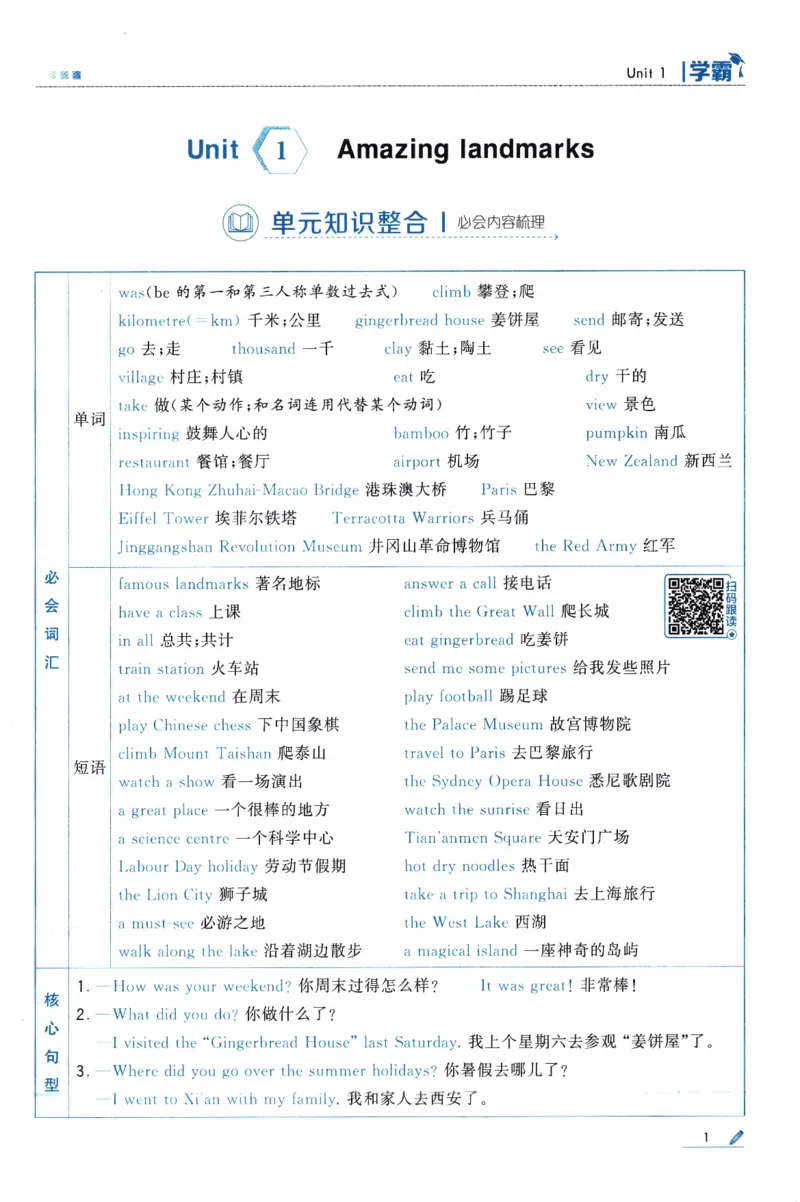
Unit ffi) Amazing landmarks
@ +zE-XIiRHA rularteffiE-,
!
was(be #'Jffi-pffi = )'-/ll+*tit*d) climb 4H;IIE
kilonretre( .-knr) +X;/a\E gingcrbrczrd house *fftr s"nd fi[ff tfr.*
8o 2 I r;rE + thousand -f clav 4fi4.;Wt see 84,
village ff E;fffE cat d.v TEt
Fts2,
trrke 'ffi( *+A+f ;tu Litli€Ifl4\+* +AA) view F@,
4i"f
inspiring fiffiu\,L.Pi brrnlroo tt *tT pumpkin H/R
rcstzrrrrirnt Effi;Etrl- airltort t)l,Et New Zealand #E -*
Ilong Kong ZhLrhai-lV1acao I]riclge B4#/tffi Paris E&
Flitfel 'l-ower tRlErf#.E 'l'erracotta Wrirriors trqffi
j t _J i, _ rss,,ns. hnn R t'vo I r.rtion M use unr # n L\Hft!fi]frJ fH the Red Army 2IT
d,[-
| [nnlou. landnrarks #&fuF',r answer a calt l*Eifr
A A i have a clars tiR climb the Great Wall I[EKfil
ifl ,H,*;*it tz*tfr
in all ea1 gingerbreacl
ir
train statirn )<#ifr send me some pictures h#,H,WWH
at llrc wcekcncl &HX play football WEI*
pkLy ('hinese chess T+E*.H llrer Palace Museum fr\.trffi-+rJW
clinib Mount 'I'aishan IEAilI triLvel to Paris *\ryffift
ffiiE
wirtch a slrow A-%Wfr thc Sydney Opera House #trffiE{H
a srcat place -f flE&ffJfut watch the sunrise E H fr
a science centrc' -ffll++,L' 'lian'anmen Srluare XXn-. Ih
LiLlr<xrr Dny holiclay frdJfrIWW hot dry noodles ffiTH
rhc l.ion (:ity trJI[Tfil tzrkc a trip to Sharrghai *t-Wffi?1
a nrrrst-see 'l'ffiZfu the Wesl l.akc Eirfi
wiLlk i,long thr lakc #Elffibffi.D a nragical islzrnd -EiF6'H'i,ftd6
Ilt.,w wirs your w.r,kend'l {.fiHf,-itf+ffi tat#? It was great! IFH'ffi!
t
Whrrt clirl you clo'/ ttflfr.ftAT?
r['
I visirccl the "()ingcrbreacl House" last Szrturdzry. fitfEffix**Lfr,"*tfiET
"
frJ
fl Whcrc dicl you so over thc summer holidays'/ [EZ[F..*WF)LTt
I I I w.nt to Xr an wrth rny fzrnrily. fr,ffixL*EXT .
t35---
I -. trL=^-Erntr
=ffi1
. -&iJ*FL,ffiTffiiEtr*EH ffJdrtE.:[t#448
1
"
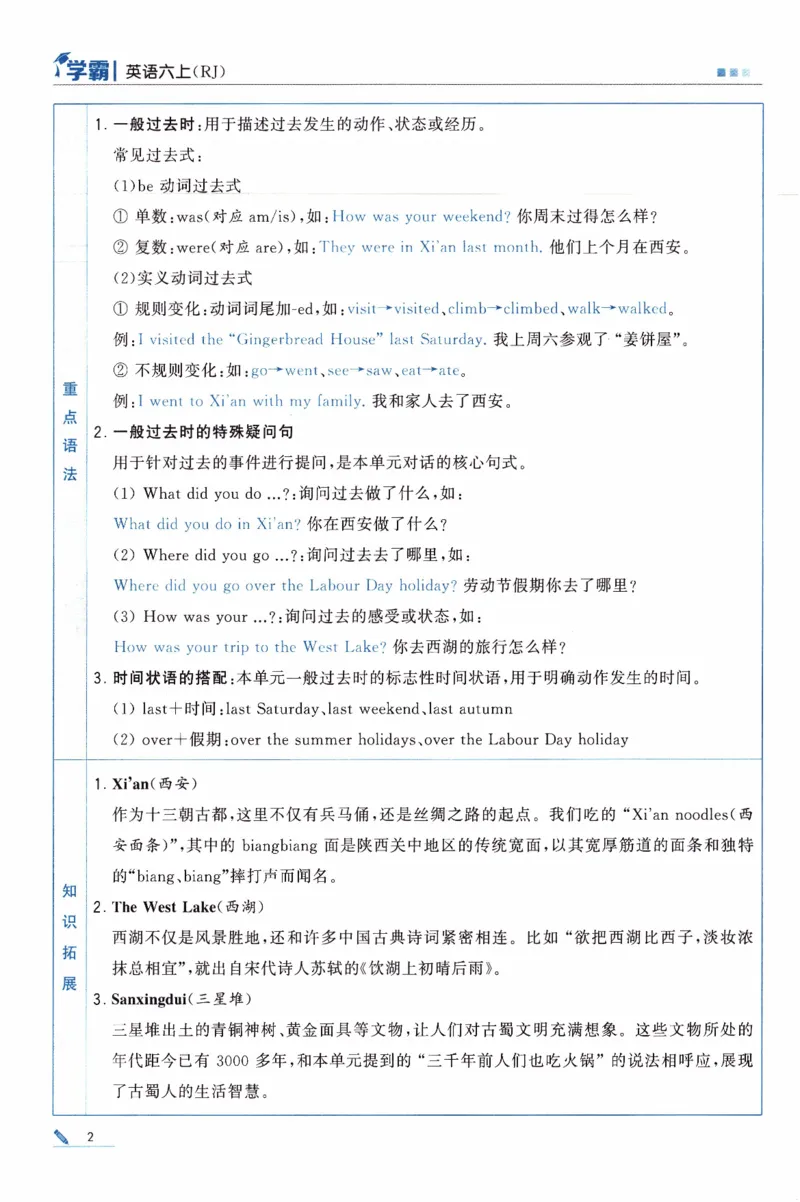
HrLit*fr,
(1)be &li-,li$*rt
O +ry:was(rtlrr amlis) ,ip, How was your we,eken,l'l ltiBf-jJf$ffi Atr?
@ E-W.:were(ftirr are)ol[,']'ht'r,wcrc in Xi'an lzrst nronl]r. lfi,ll1l.+E&E*"
(2)qXAiAfi*rt
@ inUE.4t rdJi1irdBfi[-ed, itl , visit "-visitecl. climb*climbecl. walk-walkc,d"
f{;l visirccl the '"(iingerbrczrcl [{ouse" lzLst Salurday. fitIflx*\nT "*ffril.
@ 6 *4I|J A lN, r{n : go.+wcr) t \ sco > szrw . cat+at c.
EE
fU:l wt'nt to Xi'an with my lirnrily. fr,ffiXL*TE.X"
5
2
-fieil*r.Ifrl#*ffirEtl
;t
}H
)t ffi T ft xf fi * H! S {+it Tt ft14, E 4 B zuxtifi H! lZ,L' A fr .
(1) What did you do...?,iElhlrj*'ffiTit/a,!fr,
What clicl you clo in Xi'an? ttffrWElfrT 4lAl
(2) Where did you so ...?'if,Jlrlil**f ry[E,ff
'
Wlrrrc rlitl i,ou go ove.r the l-alrour l)ay holiday? fr&Ifr[HWttfXTElljf?
(3) How was your ...?,fr|{iS*Ptl*EEIfi#,ltl'
[{ow was y<rur rril-r ro the- Wesr l-;rkc' ttl,*W1frfr\fft.11R,AtYl
3 . r.J r4 {t iE Ht H EB, 4 S /6 - ffi fi * Et' H! t,n H'H Ef lHt )tti#, ffi + HA ffi dJ tF H.4 H! H{ I El "
(1) last*B{14,last Saturday.last weekend.last autumn
(2) overf'fHH'over the summer holidays.over the Labour Day holiday
l. Xi'an(6+)
tE-lt+-ffifi#[ 'ts86{XHtrqffi ,frftrLmz$frB!E,F, " ft{ll f7,ffi "xi'an noodles( 6
,* tu *) " , H + fii biangbians EEHtrX + ffi Eitulltqfr,fr,ffi , UEffi,f+ffiG.ffJfrRfiElil++
kl " bians. bians"fFtJF m I4 €
"
*n
2. The West Lake( 6 #X )
,'B
E Xfi T'fX E EI F ffi e, fi frE 1+ * + tr fi 4 i+ i-,1 K ffi fH,S " Lf,rt "'&+EW lfr LV,N +, lfr.V,W
+E ffi ,H.fEH", f;li fr H fi {ti+^fi #,ffJKt {tttil r6,trm ).
E
3. Sanxingdui(aEff)
I
= E,& fi A H,l H ffi ?+ ftf . H A W R + X,WJ, it ,,\ {[ xf fi 6 HA fi,ffi M^ " )* e X. WJ ffi nb. #)
+,ftSE+ E 4' sooo *+ ,frAB)L EEtJill " =+ +BfrAfi e, W, r<hfr" H! iI,fXfE n{'M., ffi.Tn
r Sffi
H,iHffiHH"
\2I
l+ffi}
Unir
/=\
(r? iRruEffiffi.llt.(-)l'"no
,84*8fr,i*A Part A A+f + 4 8,7,i\iu,r*4 fr-tt"
- ' +RIEH+Effi;rr'i1'+ A+ ' #itF -\A+tH )3 Ulrii4Ll -what you do at
E EE,Hi E,H, \BF-ffi+ 5#ruffi +f; E 6J the school's Chinese Culture Week?
"
A. -I learned to make paper-cuts.
A. do B. did C. does
asked my cousin to
me some photos of Daming
Lake in Jinan.
A. send B. draw C. make
) 1. [l&}4"4*o Mount Taishan, a famous
)5. is the weather today?
-How
mountaln in China, in Tai'an,
1S . It's sunny but a little windy.
Shandong. Do you want toc it? A. It's bad. B. Great. C. Not too bad.
)2. It w a great trip to the Great = . .H Ff HtE,ffi M*,tHE.
"
w 'AEia
1. She ( be) happy yesterdav (aF k)
) 3. Mike got to the Hong Kong-Zhuhai- because she got a nice gift.
Macao Bridge. It's 55 k long. 2.My classmates and I ( clean ) our
)4. Peter explored the "G
classroom after school last Friday.
H "-a beautiful train station 3. You ( be ) Iate for the morning
in New Zealand.
reading class last time.
)5 [rt4#-6-]1;1, t
4. China has many amazing (landmark).
and visited the Eiffel Jbwer E . tRrEH'+EEll.TtiEHtErrr jH+
"
last holiday. Last holiday' my family and I v
+rnit#.
Qingdao. It is a beautiful city by the sea. How
)1.@vt, best friend and I
was our trip? It great
!
a traditional shadow puppet We were there for three days all.
(B-#jr\)
show last weekend. Wew along the beautiful coastal road
A. watched B. watch C. watches and the beach for hours. I took many nice
)2. The National Stadium (Bird's Nest) photos at the famous seafood market.
like a big bird nest, and it's The weather was fine every day, and the
a famous landmark in Beijing. food was delicious. We all had a good t .I
A. look B. looks C. looked love Qingdao, and I want to go there again
!
3@f+gl
FL=^..<nl> :ffi
(:
p
@ ixr^rxntle_t/r ) ll:rt
,
)e44E-*,i*E Part B A+f + 4 h,rt,h"iu,t#4 &41.
- .,fR+EGr Hffi H+qlEzrrtH+ . A. My family and I visited there last summe
to the park last
holiday.
Sunday. I w old people do Chinese
B. We bought some presents and tried som
kung fu there.
nice snacks.
Is
2. a lovely bird in the tree yesterday
. Mountains and lakes make it beautiful.
morning.
D. How did you go there?
3. The clothes are after a long time
in the sun. E. We visited the Cnnfucius Temple(*-f ,6) too.
4. His words were very l and we tried
=. @thl i* ltfi ,H Ht ffr ,# i+ it, E rE E
our best at that time.
gs+i'l
6J Ff HtiE trr=tlE+ .
5. We had dinner ln a nlce r near the =
park and it took us an hour. Chen Jie-Guilin, China
*****
6. We got to the a and took a plane to Wonderful views and delicious food!
Xi'an last National Day.
Guilin was a great place for our spring
Eq jtHAiEHt A+ ft,fi
=. fR*E{HH, trip because the weather was nice and the
rf if;. scenery was beautiful. We I.
(Li Ying is reading a postcard of Nanjing ( climb ) the green hills and 2.
with Sherry now. ) (take) many photos of the mountains and
Sherry: Nanjing is really a great city. Look! clear rivers. I'11 always remember how
l. peaceful it felt there.
Li Ying: Wowo you got a postcard. Did you go We also 3.
there before? (eat) tasty Guilin rice noodles
Sherry : Yes, I did. 2. and some local snacks at a
Li Ying: That's cool. 3. small restaurant near the
Sherry: We went there by high-speed train. river. Everything 4.
Li Ying: Did you climb Zijin Mountain! (be) fresh and delicious!
Sherry: Yes. 4. The city is only about two hours from
Li Ying: What did you do there? the train station by buso so it's easy
Sherry: 5. 5. (visit). I really hope to go back
_
Li Ying: Sounds great. I also want to travel one dav!
there next time
!
\riij..'irl rlli'i
r-l
i#fl.miErE{t
- - Qozs ny,h*t f )*HHtrH!H*{tlE*+trirlff,#rt ,ElfrtAlfr.liliE#-T+trB!FHnE,! rfl
i*t
Ft ,fr,11.1f#.
"
O l€i{m Eil : ? ,* 4f @ ffiE : *****
There are many beautiful cities in China. Here is some information('f?,S) about five famous cities.
A. Chongqing is a city in the west of China. It is beautiful at night. It is famous for
yummy food like its spicy(7i) hot pot.
s4
{#l B. Harbin is in the north of China. It is very cold in winter and famous for ice and
&ubd,b
snow. There are amazing ice lanterns and snow sculptures(FrE&) every year.
Giel
C. Sanya is in the south of China. It has beautiful beaches and clear sea water. It is
warm all year round. Lots of people go there to spend their winter holidays.
D. Guilin is in the south of China. It is famous for its green mountains and clear
rivers. The natural scenery(# 6) here looks like a beautiful painting.
E. Xi'an has a long history. It is one of the oldest(&t* 6'i) cities in China. There
are many famous places in this city.
e) ffi fltr tuT rU fi {n + +.ffi# e.f+ A ffi,fi1BiI B0 fit fi . r 4 ft t )
(
) I . Lucy is a quiet girl. She loves nature and likes beautiful scenery such as mountains and rivers.
(
)2. Mike likes old cities because he can learn a lot from them. He doesn't want to go to new cities.
(
)3. Peter loves hot weather. Swimming is his favourite sport.
(
)4. Tom likes snow best. He wants to see the ice and snow world.
(
)5. Cathy is good at cooking. She likes eating different delicious foods.
(-)tfli*ffiLEl6l{M.
I. Why do lots of people go to Sanya for winter holidays?
2. What does Guilin's natural scenery look like?
-. @mm KErauz rHi*iEt ,t Ffitiktrfrrn+ jtu6EI.H,ra HrlH!ffi,f+jtrn.Erf, +H-rfrit*
+itrR
*****
OI=I{HES: T,l4f g ffiH: I
Last year's spring was a perfect time to hike(4Lt ) on Mount Huangshan. l. They
turned out to be pretty heavy for the hike. We didn't book a hotel room and started the trip. In
order to watch the sunrise, we tried to find a place to live on top of the mountain.
5@_.
,e---
t-=ffi1
HLE^I(RJ)
3'#l
2. So many steps made me want to go back to a safe and comfortable place. "Look!
The top is getting closer and closer. 3. " With the help of my friend's encouragement(Bi.
frh) , I cheered up and kept going.
Aftera three-hour tiring hike, we finally reached the top and also found a hotel that looked
good. But the hotel worker said we could get a big room for 1,500 yuan! 4. I was only
looking forward to a relaxins bed! Finally, we asked for the possibility of a tent(tK€). Bingo!
The hotel's owner sold us a tent for 80 yuan.5. So, that night, we ended up sleeping
in a tent in front of the hotel on Mount Huangshan
!
A. We are almost there. B. I am not an experienced hiker(fr%.b#l0h)r*).
money!
C. That's so much D. That stopped so many visitors.
E. My {riend and I prepared our backpacks.
F. He was so friendly that he even helped to put it up.
iAtffHE: book 1fri.7 order tcr \JT Qe#-+>
".
t=l
Hrl'miEE{t
-. ".r AAffiEtr€E *41T fr+l'lfft,f iHtRrEfUHifft,ffW&.#UffiTflA+#tE
-"Hllt'4, Sam
(T)iE(I').
O f*flffiFf : S h\if g ffitr: ***** I
Sam's Labour Day Holiday
Kaili
o')\
fi.Kt*tffi-4- The first stop (3 days)
_#
% Anshun Qianlinsshan Park(,P|( & za\ E )
eat Siwawa and Huaxi Beef Noodles
The second stop (2 days)
;;,.;
visit Huangguoshu Waterfall
EW@
(*.E)
eat Rice Wrapper Rolls
\6r l#ffi}
i.i iffi il unir
( ) I . Sam stayed in Guizhou for g days.
(
)2. Sam went to Anshun from Guiyang by bus.
(
)3. Sam visited Qianlingshan Park in Kaili.
(
)4. At the third stop, Sam visited China's Sky Eye in Pingtang.
(
)5. Sam ate Siwawa and Huaxi Beef Noodles in Guiyang.
: . @ffipx pEr 6E, tE i* tE t, tR rE *s t 6J 6, it F E 6fr fr! tr * .
h\+f *****
oeixffir$: 7 gxfiE: I
Parts of a Plant OPlants have roots, leaves, and {lowers. They have seeds too. Some
seeds fall on the field. New plants grow from these seeds next to the old
plants. When plants grow in this way, there are too many of them in one
place. Some of them can't live. So some seeds get the ability to travel.
And there are many ways to do that.
@Some plants grow near the water. Their seeds go into the water
and travel away with it like boats. They may travel many miles be{ore
they stop. When they stop, they begin to grow.
@ A Some seeds have their own special little parts. They look like small wings({Xf).
When the wind comes, the seeds fly away. Soon they fall to the ground and new plants may grow
there.
@Some seeds have special parts called "stickers". The stickers help the seeds travel far. How?
These seeds wait for an animal to walk by. Then they stick(,F&) on the animal to get a free ride.
Sometimes they can travel a long way. Birds carry some plant seeds to new places too.
@Seeds don't have arms or legs, so they can't walk, run or climb. But they can travel with the
help of water, wind and animals.
(
) 1 . According to Paragraph 1, which part of a plant can travel?
A. Roots. B. Seeds. C. Leaves.
)2. According to the passage, which o{ the following is TRUE?
A. Seeds grow the best near the water.
B. Plants only have roots: leaves and flowers.
C. Some seeds can stick on the animals to travel.
( )3. Which is the best sentence(4Jt) to put in the A
?
A. The wind helps the plants grow tall.
B. The wind is not important for seeds to grow.
C. Water is not the only way for seeds to travel.
(r:;rH=: ahiliry n. fiv)l get a free ride #84 lr
*"1
""....9
7aTfi)J€IEIE{,[
-. ffi*E.E*I+ r-s gATr[EH]lFF" (,rr&6)
l;
liffirl
[:=1^rt-'-* |
()
ffi *E' tRfEI,}iE fi A+|J WA+E ('l) iF ( I") . ('fr $t @)
( ) 1. Linda went to Beijing in April.
( )2. Linda went there by plane.
( ) 3 . Linda went to visit her parents.
( )4. Linda went to the Great Wall, Tian'anmen Square and the Palace Museum.
( )5. Linda enjoyed her holiday very much.
=. ffi *8, fnlEfEt fi #jt#iEffi H!6* " ( otr&d )
( ) 1 . When did they have a nice trip!
A. Last week. B. Last month. C. Last year.
)2. Where did they go?
A. To Beijing. B. To Shanghai. C. To Hebei.
)3. How did they go there?
A. By car. B. By train. C. By plane.
)4. How did Jim feel?
A. Sad. B. Tired. C. Happy.
)5. What did they do on the way?
ate. read.
A. They B. They C. They played cards.
.
E. [q1q1{l ffi*E.tRrEFf ffifi6,l.haFE.t=H,E+-ia (,n r&& )
Dear Mary'
Iam havingagood time in 1. . I came here by 2. .I will
stay here for a 3
I visited some interesting places and took many beautiful 4. . To ,
I - I o: l r v rarY r Lee
I
buy some 5. , I am going to Wangfujing Street tomorrow.
20, xxx 193d,
How is your holiday?
Guangzhou
Love,
Alice
\8,iltrrn1iiri.lri,,, ,,. ;r,., i,11,rr1,i,lf ii,,1 11.i." i ,;iili,1rt.ltr*"1.1t,'.
iE;*€IEIE{T
-
( ) -fifirflEEitrr-ffiiJ*EiH!trElJ
EXEffii#
*Mwa.Ef fr-&ff * *4
1 . B'I B9 trElJiuT,
-ffirEGr.I -f,Etrtr.J
42,L.H_[ glH'l*, Z'ffi'l*.il tF ; E xfl S * &EE . is * + + H{ lel fr. 4.fr+J, f, fr fr,ffJ d1 +E &
)trffi.
often, usually, always, every day, on yesterday, last week, ago; in
i4ffiffi
H'f
Sundays 2025, just now
1. -ffi tr * r.t ;F jl *.8, 4 &H A iFl
drrs1yfr 2. tiEE he/ she/ it/ HW.A i,4 dJia1ffi ,JJI-}*r\.
= l.ttr+Wrfi" 2. $ldJia1 did tr ,*'Hffidrlf,lRV.
EIh1 I play football every Sunday. I played football yesterday.
2. -&fi*EfBtffiB,
( 1 ) fi * +,+ E r,f E E H ffJ dr tF H EAffi H! it * E{ lEJ,fi * FI 14 & "
fiJ , They visited the museum last weekend. 'lt tl t.rA *'81fr"-{ ffi M tE
"
( 2 ) ff * H! ft # il Z,lft, fff s$*x+r'f H B!,lHlil
"
frJ'When I was a child, I loved cartoons. +Lz].fttifr{REYX+iEH"
fiHil|4+
+rnit#.
) 1. I often football with my good friends after school.
A. play B. plays C. played
)2. My mother usually TV plays at home after dinner every evening.
A. watch B. watches C. watched
)3. They the science museum with their teachers last weekend.
A. visit B. visits C. visited
)4. When I was a little child' I colourful cartoons very much.
loves
A. love B. C. loved
)5. Where you go for your summer holidays last year?
A. do B. does c. did
e@f+wl
q*^-t<nr>
fB
: gft
( ) Etri-;JiE*fi H! tfl nU
N.hL, AJIFIXHHI*ifi fr.* fr,-i* / a/ *, / t /
"a, "
Ft) rplay - played walk - walked look * looked
2. D) e #RffJdl;d, H&/:n-d
N.IN,,XE-Efi. e, THfrHfrn,H1*in d,EBi*/a/*./t/
"
* liked(Eli.) * $E*) *
@J,like dance danced( close closed(*.}.)
3. ,JffiB+E*v #RffJdlfl,{ y } i,Fi[-ed
zJ'EHE, EffiB?& *v(*e dry, r* y), in*EiB?& * v(a / e/ i/ o/ u*y, *, play, a* y), H
&ln"arFhffi1*).
N.lL,y*i* ed, H.Et* / a/
"
fr{: study * studied cry + cried trY -+ 1ti"6
4 HiimBfr#H, HXRRA-f ffiB+&, x[5ffi#+e,EiB-"d
t
ffi s*il ffi E, drfrffi.E = ++effi ,g r ffi + 7r + ffi r ( fii + fi. + + +fr + ), -H. E E A Etr -+B
=F'FJtX5. (,J'+frLiL+++' a/e/i/o/rt#6*4#, fh-l a/e/i/o/u #t ++)
*.lN,,XXtr XRffiB * ed, fr.* t* / t / .
* --* +
@J,stop stopped skip skipped chat chatted
5. HH WTil,X\N.+L.
gO --+ Went do * did see + saw get + got
* * said * made +
have had say make eat ate
take + took read * read(r**t)
fi,s.il|1+
H +frB fiFf gA+iFlHiEfifrtr rtrHH.
1.I (walk) to school with my best friend yesterday morning.
2. They (stop) and (chat) with each other under the tree just now.
3. My sister (dance) and (sing) beautifully at the party last week.
4. He (study) Maths hard and (get) a good grade yesterday.
5. We (go) to the zoo and (see) many lovely animals last Sunday.
6. The little baby (cry) loudly because he couldn't find his mum just now.
7. She (close) the door and (read) a storybook be{ore sleeping.
8.I (have) a big dinner and (make) a card for my mum last night.
\roAE/tr,+tflll.u\i.F,Ti+*5fF{rfHJ€ktirllE,6+ZTfi'lElfffS-tLffi/-tff.,l4fiffrffiE" it+t
/t
fi - E ia ffi #f H H! irl lt ffi EJ N, frl X x 4 - tLttr W ffi Y ffi 1- ng I
Eft#+
It is a beautiful city.
f lri:
ffifi-ix4i+ attFfi
fl_,Ffri*k"
eb4: L&f*4iat$*" I like this trip very much.
I really enjoyed this trip.
6A 4+)+Ie,X
t *,
Hello, I'm Tom. I went to Jinan last holiday. It is called the il a Lfu
^.*ru,+4
"City of Springs" and it's very charming. {*4i$t ?1fr
"
In Jinan' I visited many beautiful places. First, I went to
Baotu Spring. The water was so clear! Then I walked around f J,il , 4 .f+ + 9a Etli h #t Frt n,
Daming Lake. The willow trees by the lake were very beautiful. I Ffrl*-.
also ate some delicious food.
I really enjoyed this trip. Travelling is fun! t* E: ,*eb f,*4i#t a &
"
4riil9#
ffi tE ffi in -n,8, ffi + K l{ ffi E rrr, tr " tr lt| fu1 * lF.ffi'4l, 6 EI iE Y Fffi , 6'). T 5 0 iFl "
^
Where did you go?
What did you see or hear there? What did you do there?
My summer holiday
How was your summer holiday? Who played with you?
My summer holiday
ll ?f+w
nm^-r<nlr IH,
rFtr lL#z-,,Rttrx+ff;
frr&rE *-, ffi-* Ntr ia, di.,mn-t *,i+ + 4 -e, * fu1 ffi # #" i&- * ;* *., tfi 4L * *,fl lfi.,J. S
-&", lfl *E + A L #.t r+,fJ 4+ €, tr* -& 14 Ft, frt t * 4> 4 it.E " w fr & fr, 2 A frt, - t*",J+ 4 +,ii.
^
ill" fr {x-4t,2*""
#J
(-)1ffilftt1+fifrj{l#*.8 ,l,rfia E +{ll r}+}HE 5^ LU A*B! X*k1241fr.,t/. a-r' + it#6iE
H!Af ,ihex'Iif;,H **)frtfr
"
A: Hi, Li Ming! I.
B: It was great! I went to Jinan with my iamily.
A. Good morning!
A' Wow! 2.
B. Where did you go in Jinan?
B, We went to Baotu Spring first.
Bye ! See you tomorrow.
A: What did you do there?
D. Did you eat any special food?
B'
3.
E. How was your weekend?
A: What did you think of Baotu Spring?
F. We saw the famous springs an
B t It was beautiful and amazing.
took manv photos.
A'
4.
B: Yes! We ate Jinan fried noodles for lunch.
( - ) t,fr fT ie * I'fft tr rft ?r E its, + ie * 7 - x ffi 'fi tE, H +f; + FJ + iA H! E ffi fir tt ;irF A fE t .
Last Labour Day holiday ' I 1 . (go) to Jinan with my family. We 2. (get) up
early and 3. (take) the train to Jinan. In the morning, we 4. ( visit ) Baotu
Spring. The water 5. (be) very clear and the springs 6. (be) beautiful. At Dooor
we7. (eat) Jinan fried noodles at a restaurant near Furong Street. They were delicious! In
the afternooo, w€ walked along Daming Lake and 8. (see) many beautiful lotus flowers.
The trip was great and we had a wonderful time.
t
( = ) [ffr ?i ffi Mllr,F m IEJ # lmy fr.tl +7 iU Hi )] H' zffr. " tR fE IE h 6, YlJ ffi 6r + E ( r) iF ( F) .
Last Saturday, I went to Jinan with my elder sister. Our first stop was Black Tiger Spring. We
saw three stone tiger heads, and the spring water came out from their mouths. It was very
wonderful. At noon, we ate braised pork ribs with lotus root( €.# ft,J+6) , a kind of special food in
Jinan. In the afternoon, we visited the Shandong Museum. We saw many old clay pots and ancient
paintings there. We also watched a short show about Jinan's history. In the evening, we walked on
Quancheng Road and bought some souvenirs(9e*8"). The trip was great' and I learned a lot about
Jinan's culture.
(
) 1 . Their first stop was Baotu Spring.
(
)2. They ate braised pork ribs with lotus root for lunch.
(
)3. They visited the Shandong Museum in the afternoon.
(
)4. They didn't buy any souvenirs in Jinan.
\12I
l+ffi}
Wil Unir
Unit
1 LE'f7tE
.l/*
( r'i l'{l 'AO 'ffi'zt ' 100 '\ )
tfi )1frl|il ( 30 )
^
ffi *8,&tEFfffi 6 #it#Effi HIELH " ("t fr@.) ( s A)
( )1.A. B. c. a,frh,E)
I .r-r-&
I
t@l
)2. A.
"M '@
)3. A.
'm
)4. A.
'm
B.[-T_l
)s. A.
L.'--e-lWd::.:-:l
lffiffiP-]
[=-""1
Ef*E,itiliEtfi#JEA" (ot&@)(5
-. a\)
( ) I . A. He went to the Bund. B. They went to Jinan. C. I went to Jinan.
( )2. A. I have a good time. B. It was great fun. C. I went to the park.
( )3. A. I visited the Nanjing Museum. B. I go to the Palace Museum.
C. I often climb Mount Taishan.
( )4. A. At school. B. Yes, he did. C. He did housework.
( )5. A. It's in Hong Kong. B. It's in Sydney. C. It's in Paris.
=
( ) 1 . Where did Tony go over his winter holidays?
A. Hainan. B. Harbin. C. Hebei.
(
)2. When did Tony go there?
A. On January 3rd. B. On February 2nd. C. On February 3rd.
133f+ml
EL=^-Ernl>
)3. How did Tony go theref
A. By plane. B. By train. C. By subway.
)4. What did Tony do there?
A. Ice-skated. B. Took pictures. C. Ice-skated and took pictures.
)5. Did Tony like ice-skating before?
A. No, I didn't. B. No, he didn't. C. Yes, he did.
E. rE * E . tE tE i.f iE 6r B{+ +E E'l=,H H! ffi + lH 5 frffi#, L . ('t & {a ) ( 5 h\)
A. Turpan B. Beijing C. by train D. by plane E. stayed at the hotel F. took pictur
A )
-1.
!. +=\ ---\
@
@ J. 4. M
- '{_-/t
F;A
IT"',,I
6.
a. @ ffi*E,tR+EFfFf rtJE,if.eErE+El . (,fr&@)(10 r\)
Kitty
London, the UK
bv 2. hv 7.
[.a^st Summer her 8.
Withwhom
Holiday
visited 4. , the Palace Museum visited Big Ben, Tower Bridge
and the Summer Palace and the British Museum
on Wangfujing Street on the [nndon Eye
ate Beijing Roast Duck ate 10. and chips
and 6.
€iEt*[r] (70 ';)
HIEEfi FfifAHtaHtE{frY,.*.tH*.. (10 ,\)
^.
1 [J&,}J.t4t6l Last National Day, we (go) to Jinan's Daming Lake and (see) the
beautiful lotus flowers by the water.
2.1 (take) a photo of the giant "Gingerbread House" and (send) it to my cousin
in Shanghai.
3. It (be) very dry in Jinan last springo so the bamboo in Baotu Spring Park grew slowly.
4. They (see) about two (thousand) people at the show last weekend.
5 @ We usually _(go) to the Temple Fair( fr*) during the Spring Festival, but
last year we (stay) at home and (make) sweet potato pancakes together.
\141 l#ffi)
I Unit
.i4
t. (6-'frft_rt*'fr)(10
ftEaiEH!6r+:irh+fiif; " a\)
(Liu Tao is talking with Eric now.)
Eric: London is really a great city.
Liu Tao: Yes. Did you go there before?
Eric: l. My family went there last summer. A. No, you can't.
Liu Tao: That's cool! 2. B. Sure.
Eric: We went there by plane. How did you go there?
Liu Tao: 3. D. We took lots o{ pictures.
Eric: Yes. I visited the London Bridge too. E. Did you visit Big Ben?
Liu Tao: What did you do there? F. Yes, I did.
Eric: 4.
Liu Tao: Sounds great! Can I see your pictures sometime?
Bric: 5.
/\.@tfli*uire*trfrfr,,,t1Eie.*UffiT,{fr+E-(T)i*(F).(10,\)
Sunday, June 1st
In the morning, I went to Kaifeng from Zhengzhou with my parents by car. We ate lunch
there and had a rest at the hotel. We were a little tired but very excited.
Monday, June Znd
At 8:30 in the morningr we went to the Millennium City Park(ita[LFIEI) by bus. It was
really beautiful and it made us feel that we were in the Song Dynasty(XnA). We took many
pictures there. After dinner, we visited Tianbo Yangfu. It's the former residence(*-E) of Yang
Ye.
Tuesday, June 3rd
It was the last day in Kaifeng. It was hot today. We got up at 8:00 in the morning. After
breakfast, w€ wert to the Song Dynasty of Kungfu City(tR*.,Rl}i.). We watched many shows
there. Before we came back to Zhengzhou, we at€ much delicious food and bought some gifts.
(
) 1. Mike went to Kaifeng from Zhengzhou by bike.
(
)2. Mike visited the Millennium City Park on June 1st.
(
)3. Tianbo Yangfu is the former residence of Yang Ye.
( )4. It was cool on June 3rd.
(
)5. Mike watched shows in the Song Dynasty of Kungfu City.
n. rEi**Et,it#E'f+itrE. ( i5 ,\)
Last weekend our geography teacher, Mr Read, took us to the Green Town for a school trip.
He wrote to some hotels there. In the end he chose the Ally Hotel.
153f+m!
E;=^trnl>
fi
ar,r,
We left home at 7:00 a.m. on Saturday morning. Mr Read drove the school bus. The bus ride
took many hours ! Some of us were asleep on the way because we got up very early in the morning.
We finally arrived at the Green Town at 11:30 p.m. Then it started to rain heavily.
We got up early on Sunday morning and looked outside. We could see the river. The water
level(7Y4t) was very high. We went down for breakfast. Oh, there was water everywhere in the
kitchen! Then at lunch, orre of the boys fell into the river. I-uckily, Mr Read was very good at
swimming. He heard his shouts and ran out for him.
Sunday afternoon was terrible too. Two girls didn't tell Mr Read and went to the centre of the
town. They got lost. A policeman sent them back to our hotel. Mr Read was very angry.
We returned to our city on Sunday evening. We were cold, wet and tired. Never again
!
) l. How did they go for the school tripf
A. By train. B. By car. C. By bus. D. By subway.
)2. What was the weather like on Saturday?
A. Sunny. B. Rainy. C. Windy. D. Snowy.
)3@Whatdoestheunderlinedword..returned,,inParagraph5meanJ
A. Gave back. B. Came back. C. Sat up. D. Went with.
)4@Whatwouldbethebesttitleforthispassage?
A. A bad school trip B. A happy experlence
C. A helpful and kind teacher D. A sweet day to remember
)5. What would be the best structure of the passagef
A. c B.oo V D.o
o@ C. e@@@ ,-t\
@c@
\L"-
/?\
@ lJ,
@
+.@
ff*4.rxtif " (1s r\)
Dear Li Ming'
Thank you for inviting me to your hometown. I really had a good time in Harbin.
Harbin is called the "Ice City". It is famous for its cold and snowy winters. This city became a
hot tourist destination(ia*'&A #Jrb,) at the beginning of 2024. And the 9th Asian Winter Games
were held in Harbin in February,2025. As for me, I visited Harbin for Chinese New Year holiday
with your warm welcome.
On the {irst day, I took the high-speed train to Harbin. You picked me up at the station. In the
evening, we walked through Central Street. I saw lots of interesting things and tried the frozen
pears. On the second day, we visited the Harbin Ice and Snow World. It was great fun. I also went
skating and watched the ice dance. On the third day, you invited me to your home. Your mother
\roI
!+ffi}
,11ffiI Unir
cooked yummy dishes. Thanks a lot ! I really liked Fried Pork in Scoop.
Though I missed the Asian Winter Gamesr mf stay in Harbin was wonderful. I hope to visit
Harbin again and try more activities, like skiing. I can't wait!
Yours,
Jack
(-)
&ffi{Ht+frF,tr6i.,1ffi" (s r>)
1. When is the best time to visit Harbin?
2. How did Jack go to Harbin?
3. You can find two kinds of special foods of Harbin in this letter. What are they?
(:) d,fr#ffi.t+frtfr. (6
+Effi{H,f+p!
'\)
( )1.@Theunderlinedword..hot,,means(€,g.,&-)"
A. high temperature( E.A) B. spicy in taste
C. very popular D. di{ficult and worrying
(
)2. Which of the following is RIGHT?
A. Jack went to Harbin for the 9th Asian Winter Game in early 2025.
B. Jack doesn't want to go to Harbin next time.
C. Jack went skiing and watched ice dance in Harbin.
D. Jack walked through Central Street with Li Ming in the evening.
+-. #Eitit(
10 a\)
ffi }.l " A visit to a city" t m, mffi P-l T,E, 4E+ K,q -tr lF*#+fi fr'fft Wffi % )!.
"
Where did you go? How long did it take you to get there?
Who did you go with? A visit to a city What did you do there?
How did you get the-re? How did vou feel?
J
4* , t. 50 rslE6 t2. ?ttIH*Lr*Er *.,.I.5 Enil ,frdfrM)#ffi, ,EAWfih
"
17/f+ml q*ttrn:r
Unit O Getting together
HTEfrUiRHA I u'artemm
paste f,frflfi drcss 4tfE gala iHH;EE c()un1 down 'lFlJitH{
EEfi#
nrarzLthon B&fla\#,lE u, lFh race #fE; run flE ;#fiE
cheer ,tff ;if iH book fair #fi writer tEXttF# read lfli*
+ia make ffi;&fi![ sing [fl(4t);iHE wear f ;ff yc'sterday Bfif,
ffiE;E*
notice iEf,fl wakc HE; HE* later jLrdee #*U
begin #ih win ff,ffi wi n ner tf, trt ki u\ ( d" r/. ) ; filt)t#
ever G*.4i !b+t trt n+ne#,i*n)U'EitlE1tlF exciting + LW.AJffJ
hzrve trreakiast E,-F€ Mid-Autumn I'estival holiday +ft^fr lE.ffi
tzrke a trip *ffil1 eat mooncakes VazE tfr
enjoy some mooncakes and fruit Hffi-rt-t'Etf.frffilKff tell .stories i+fiIS
il,
*frfaWT
A eat jiuozi together make cards ftU'ff -F,H
4
clean the house +TfrE+ paste.f'z on the door Ell_Lflfi "M" +
irl
ir clress in red ff?IEt.Eft wait for the Spring Festival Gala €i#FfrffiXRW,*
colrnt down to the new year lSJi+Bt'jt[&M+ Children's Dov .JLEfi
I)ragon lJoat F'estivnl ffi+fi' I-anlern Festival )LHfr
fdiE
Mid-Autumn Festival +tlfi National Dov ElEiS
'l'eachers' D"v ffilfrfi go to a marathon *^)nq&fla\
work as ;r volunteelffi#tr# watch the race XnAt|.,#
cheer for the nrnners IJEE*#lJltfr hike in the mountains 4tI lf'lrtDnkft
rlrn a marathon rlEq&fla\ put up a camp WTr1KE
go tamping logethcr -E*ffiH dragon boat race )f,frffi
on a rirce team fI*f *ffiWE wake up early-flffi
win tl.re race ffi1r*LV,# make zrrrg zi @ffil
l. Did you tzrke a trip? lFlll*ift'llT Wl
tt, No, we didn't. 6 , +tfi&A .
rl' 2. - Did you eat mooncakes'! 0tflllP6,EtXTP4?
frr Yes, we did. EH!,WT .
*u 3. - What clid you like about it? {tfBfiit+iEdffiW$t7ffil
I liked watching the runnert. fikEXRES##(iUl)
"
\re2 I#ffi1
Unit
I . Did 5l +ri_ffiffi lbl6r ( rE it +.fe,t.fe.)
,m ft' H* l{ EU-,\ " i$*A lA H lfrH#"' @E'y"rfrft" ft / E"
"
*" t6,Did + + iE + a ia IRM + H lfu,t
HE 86, Yes, +i#+did. 6E EI6,No' tiE*didn
fitJ, I)id you take a trip? lf.lll*ffi|-T wJ?
we didn't. T,+kll1lL6 .
I)id you eat mooncak.t'i $$lll[i,zBtXTpan
Yes. we did. Effi,fr-T
"
nffiftW' l"lAEftlA 1fl'il,rnffil*M ,6frV,Hfr.*rt
"
u*r.IH!ffi*ffi i']fi
-f,f
EE
Cr # tq ffi hl iA ( w ha t / H o w ) * d i d * + iE + A i-,1 IRM + H fifi, t
, } ' E t FtJ, - What did you clo last we,ckcnd'/ ttf t-lAXW.l+AT?
it I joined zrn online book fair. tk*)UT-+*,1:fl8.
ttt*#ildift
and
,H i*, ffi and +EN + d1 tFfrN + +rJ F, #E- fr #rri " f,[, .X. . ffi E' .
'
ffiJ,l run and cheere.d for my dad. fiEE#t€€inifi.
We enjoyed some mooncakes zrnd fruit. *,fiFlzT-WEtfrfillL#-"
n ffi ftW, H a nd jg +* E + r$ * dr tF Ht, W + dr ts1#FE H fi * rt
"
l*4+*-x-l
/)iEl on ffJHIE(Efr a
tfi
ffiFx, "fr......Et'{E",Em1*t El .4 E .ESlrL,E,fA E Sl
"
ffiJ:on National I-)uy EEEiS on Earth Day E&,I* E on Children's I)ay fr) t L t + le + lJ
on Sunday ftEffiH on October lst & 10 E 1 E
l
DffiRW.T E .E,f+H-xHfrH o",L+
trfrIfi (Mid-Autumn Festival) , +t^fiHWW*l}-lLFJi6, ,,\fll*rz,E lfr -
\- ^ffExLE!ft"
D1. E " tr+fiffi.€,s+fu, f.Xfr + ffi X frrzFf W +fr-, H, &lL .
*r # t(Spring Festival):6=FE + Eft Eq Htis E,i#^fi+ IB irl+f " {ll A[f 2rfi=+. +nr.,E
#
,.tr ffi..@w+"
tfi v u ffi f f (Drrgon Boat Festival), ffi +fi 4# )ifr .8 ffi+, fth T 4,ftE.tr i+,,lE IR,&.H98
E ffiif?EH,tHH.
EI ftfif National Day), El fti5tretr,,\R+IFjftifi,,iE tr4 E H! E +,&!fr.*#Trl[if;{Xrt.
]
IE+Wtffi+'tfra)r I
"
19?f+ml
EL=^..<nlr I&,
,,-\
(tl+\ iftltJEttlfllft(-)l'ono
\\ir- /
,/
;eF#lfti^,iF.f Part A Af[ + 1 E, i,l\tUe#A &4t
"
fR fE E H EE E- + E +E?r^ft, ttfi 7 )5. I make cards my teachers on
"
2. 3. Teachers' Day.
A. at B. to C. for
= . tRtE'EH, it# AiE kiitrE *FIi'IiE .
WTLT4EMy family _ fu on the Mike: How was your Lantern Festival, Lilyt
door last week. Lily: It was wonderful ! I .
2 WEZAChildren like to 1n Mike: What did you do? Did you go to the
lantern show in the city square!
clothes on Chinese New Year's Day.
3. We w {or the Festival Gala Lily: 2. We stayed at home and made
our own paper lanterns together.
last night.
Mike:3.
4. We usually c the h before
Lily: Yes, we did. We also watched the lion
the Spring Festival.
5. People always c_ dance on TV.
Mike: That sounds amazing! 4.
welcome the new year happily.
- . srnit++" Lily: Sure! You can also join us for the
)l Qingming Festival. 5.
[]&l,\1roMyfamily Sichuan
Mike: Perfect! I'm really looking forward to it!
hot pot to celebrate the Spring Festival
A. Did you eat tangyuan'!
last year.
A. enjoy B. enjoyed C. enjoys B. No, we didn't.
)2. you zongzi with your . Can I join you next year'!
-Did
family on the Dragon Boat Festival? D. We can go to the park and fly kites together.
-Yes, we did. It was very delicious. E. Mv familv and I had a trme.
E.@frn*niRrEff.
A. make B. made C. makes
)3. -How was your trip? 1. Did you watch dragon boat races on the
great Dragon Boat Festival?
-It !
A. is B. was C. were
)4 @ which of the following is a 2. Why do we celebrate Teachers' Day?
kind of traditional food for the Mid-
Autumn Festival? 3. What do children usually do on Children's
A. Mooncakes. B. Dumplings. DaYt
C. Zongzi.
\202 l+ i - l 1 lr
Unit
iRltErul#ltu
(_) ! nort B
--------)
ifl41ft-i, 'iFA Part B ++ls+4 8,rt,iln!',2*,4 &-4L"
- . H +FE Fr Ff ,H+ia trtEffiM=liH * of , the, pictures, painted, park) We also
"
t @ Many people (run) in the talked about our favourite colours and
2025 Chengdu World Heritage Marathon (.di" ideas.
*f*i6.4J.ii).) to keep hcalthy. Jack: Wow, that's really {un!
2. Our sports meet (begin) at 8: 30 = . 16 T rl6J rtlFrIJ Et -EiEIIA Hi $IiE
"
yesterday. ( ) Sure.
3. We ( feel ) very huppy when ( ) I danced with my friends.
we (win) the race yesterday. ( ) What do you think of the New Year's
4. [rt,rt?F6.l161. was such an party?
(excite) football match! We ( cheer) ( )Excuse rn€r ffia! I ask you some questionsJ
( )It was great.
for the Jiangsu Football City League
( )What did you do at the party, then?
(win)
!
5. She became a good ( write ) when tr . U@@B EfE+ fiFfitidiia HiiE *ftri\
she was only fifteen years old. lH+
_ "
- +RTE,HiH, iS iF] FT A . HFTI'TiE . Yesterday was my ilth birthday. I didn't
Lily: How was your weekend, Tom? tell my classmates about it, but they
Tom: It was great !
1 . 1. (give) me a nice surprise.
(went; Ir on' trip; ar school) I worked When | 2. ( get ) to the
as a volunteer guide.
classroom r my classmates 3. ( come)
Lily: That sounds cool! 2.
? to me. They said, " Happy Birthday !" I was
(did, what, like, aboutr you, it)
so surprised. I couldn't say a word.
Tom: I liked walking through the woods and
My best friend Lrcy 4. ( bring)
seeing all the different trees and flowers.
a big cake. lVe 5. (sing) the birthday
The fresh air was amazing too
! song together and then 6. (eat) the
Jack: Nice ! And you, Lily? 3.
cake. The cake was very delicious. Some
? ( what,
classmates gave me small gifts. I 7 . _
you, do, last, did ' weekend)
(open) the gifts and thanked them.
Lily: I went to a community art class with my
I will never forget this birthday party. It
best friend, Emma. 4.
.(I, enjoyed, really, it) 8. (make) me feel warm. Because I
have such good classmates and I am always
Jack: What did you like about it?
Lily: 5. .(we, h"ppy at school.
21 3-, Q025 h,1 #f ) rfl i*Ist, it#E'f+itiE.
OEIIIEBT:7'l1f g Htr: t***t)
Last Spring Festival was my most memorable(xEE 6i) one, because I spent
it with my grandparents in their village.
As soon as we arrived at my grandparents' house, the warm smell of
traditional iood filled the air. I ran to help Grandma wrap(0) dumplings. Grandpa
put a clean coin into one dumpling for good luck in the new year.
When dinner was ready, the whole family sat around the table to enjoy it. We talked and
laughed-Mum told funny work stories, Grandma shared interesting things about the village, and
my cousin showed me her photos. After dinner, we watched the Spring Festival Gala on TV and
played card games until midnight. When the clock struck twelve, we S€t off fireworks outside. I
held Grandpa's hand tightly, feeling warm and happy.
On the day we left, Grandma packed a big bag of homemade snacks for us. She held my hand
and said, "Come back soon, my dear." I noddedo with tears in my eyes.
Those huppy moments will stay in my heart forever.
(
) 1 . Who put a coin into one dumpling?
A. Grandpa. B. Grandma. C. Mum. D. Cousin.
(
)2. What did they do after dinner?
A. They wrapped dumplings together.
B. They set off fireworks at once.
C. They watched TV, played games, and later set off {ireworks.
D. They packed snacks {or the trip home.
(
)3. We can learn from the passage that
A. the writer ate the dumpling with a coin in it
B. the writer's family set off fireworks in the morning
C. the writer felt bored during the Spring Festival
D. the writer didn't want to leave his grandparents
)4 [j.E,Ji€l What is the main idea of the passage!
A. To tell why Spring Festival is the most important holiday in China.
B. To tell how to make dumplings and set off fireworks correctly.
C. To share a story about a memorable Spring Festival spent with family.
D. To list different traditional activities people do during Spring Festival.
-
. Qo25 r\. x ) + frrlF#. .
'a4
*****
OEil,HSJz 6h\ff ffitr:
@
A long time ago, there was a monster(+*htt) named Nian. It came down to the village every
\zz2 IHtr}
I Unit
,lW
year. It had 1 claws and teeth. People were very scared of it. One winter day, a wise man
visited the village and had a good 2 . He told people to stick 3 paper on windows. When
Nian came at night, people lighted torches. The bright red light made Nian's 4 hurt. Then they
5 outside and played the drums. The loud sound scared Nian away. It ran back to the
mountains and never came back. From then on r people 6 this special day every year.
) 1. A. small B. big C. cute
)2. A. time B. treat C. idea
)3. A. red B. white C. green
)4. A. eyes B. ears C. feet
)5. A. talked B. run C. ran
)6. A. greet B. celebrate C. understand
iAiffRH r sciircd adj. g,lfi H! HfrH ffJ
t=l
i*rl-miEE{/t
6 fiEixHflil: T h\4 g ffiE; **,t**
Dear Amy'
How are you doing? I can't wait to tell you something about my great class trip.
Last Saturday, our class took a trip to a castle(ri.6). 1. We had to find the answers
when we were there. It made the trip more interesting.
Mrs Dean asked us to go to the garden of the castle first and draw a picture of it.2.
I thought so too. But Tina said she had a lot of fun in the garden. A{ter drawing a picture, she took
many photos with her new phone. We had lunch in the castle garden.
3. That was my favourite part of the trip. The castle was old but beautiful. We
walked around some of the rooms in the castle. 4. But to my surprise, there was still a
family living in this castle.
5. I will ask my parents to take me there again.
Where did you go last week? Please share with me!
Yours sincerely,
Ella
A. We went to the castle by bus. B. I thought no one lived in castles.
C. Carole said that was really boring. D. After that, we walked into the castle.
E. We didn't really have much time to visit the castle this time.
F. Before our visit, Mrs Dean asked us some questions about the castle.
23?{*
IZLffil *;=x.r(RJ)
Ifif
-. @n-ln pFf62,J ,ffi*EiEttfFH!=E =fffrng? it+t{n-frB*E-ErE! {a*fl)fli*.
*****
O ftEiXHfj: t0 h\1f el ffiE:
Oth" Zhuang People's Folk Song Festival is also known as Sanyuesan Festival. Last month, I
had the chance(t/LA) to celebrate it in a small town in Guangxi.
@Early in the morning, people in traditional clothes got together in the town square. The
festival began with a lively dance show. People held hands, forming circles and moving with the
rhythm(fi*) of drums. Some even danced between bamboo sticks-it looked difficult but fun!
After that, groups of people sang folk songs. Their voices mixed beautifully, showing love and
nature.
@Of course, food was everywhere! Families shared plates of colourful "{ive-coloured sticky
rice(ffi*tE-)" made with natural dyes( **+) from plants. The five colours of sticky rice mean good
luck and health. I tried a sweet rice cake wrapped in leaves-it tasted like a mix of sugar and
flowers.
@By evening, lanterns made the streets bright. Kids laughed while playing games, and elders
chatted happily. I learned this festival was not only about singing and eating, but also about keeping
traditions alive('it * #D.
OI left with a full stomach and a heart full oi memories. The Zhuang People's Folk Song
Festival taught me how Guangxi's culture is as colourful as its rainbow-coloured rice!
( - ) &ffi i.Effi FJ 6, &4>F E 6 l,l ffi "
l. When did the writer celebrate the Sanyuesan Festival?
2. Where did people in traditional clothes get together?
3. What did groups of people do a{ter the dance show?
4. What do the five colours of sticky rice mean?
What was the festival about in the writer's opinion(rL,F-)?
-
( ) )ft?+#iE Ptitrfr E 6 14 ffi
"
)[.E:E;ff:1] What does the underlined word "lively" in Paragraph 2 mean?
A. Quiet and slow. B. Happy and active.
C. Boring and short. D. Cold and sad.
Effifi!
iAiEHEr be known clifficult adj. mix v.
"rVfr.ffTh;Afr.i)'hft;D)"""#tr5
\24-. ffi*E'Hffi+ r-s rd"Tt|JElHfiFtr. ('t ffti&)
rfi *8, it#tHtr Ht tEft fr €6r . ('fr ffi &.)
) 1 . A. It was wonderful. B. I went to the Palace Museum.
C. It will be fun.
>2. A.It's OK! B. I liked watching the runners.
C. I like it.
)3. A. Did you play with Peter last night?
B. Will you stay at home this weekend?
C. What did you do last night?
)4. A. What did you have for lunch?
B. What did you do yesterday?
C. Where did you go last weekend?
( )5. A. No, I don't. B. Yes, I did. C. Yes, I will.
ffi*E,frttfr+ 8"J "" (,t
fii&_)
ffi fi
th
/CIfi
ffi
ohd
@
Zhang Peng
John
Ken
Tim
The plan for the National Day finally 1. out last Friday. I was excited because my
family would go to the 2.
In the morning ' my dad 3. me up early. We went to the zoo later and 4. for
'We
the opening. Then the zoo opened r and we went in. saw many animals, like pandas, tigers and
monkeys. The pandas were so cute! They 5. bamboo all the time. We took many photos.
In the evening, our family had a big dinner for the festival. We were all happy. It was the best
National Day 6.
!
25?( - )
-ffi8*EiH!-fiAFEE6J
EiE+Ei#
l. 4 ts 7E + 4 + A T * & t * H{ + e * X A irl B0 - ffi ffi lol A, H E + # t6 t'
Did + t.iE + a i,I IF.M + H til,t
E H, tiEE I, you, we. they. he. she. it, Bfi * ial,F-W&iE Bf , AH -'H H Did. f[ A E ffi T
Did,Emaia'/arfrM.wlflM.
BEE6 :Yes, tiB+aia. 6EtrS,No, tiE*didn't.
in , -Oid you clean your room yesterday? 4t VF x+f E H l l 7 ,4 ?
-Yes, I did./No, I didn't. ft.W,tt ff+, t " /4,ltiAtIA.
2. frR ,fr b" &Jif, (was/were) ffi-&ffiIEA
#t6 .Was/Were+ ti$ + H{& t
tiBE he. she,it,Bfi€ i"] E{, ffi Was"
HEEI6 :Yes, tiB*l"a.. AEE6,No' fri#*wasn't.
Itl,-Wu" she late this mornins? lt,+x-+-LiEfli 7 v\?
-Yes, she was./No, she wasn't. fr.W,t&,iBrl] 1 . /4,tr&iErl]
"
+iBE you . we. th ey ,HW6in]H-f , ffi 'Were .
HEEl6 :Yes, iiB*were. 68tr6,No, *iE*weren't.
iE,-W"r" they at home yesterday? {t'fll BF X&*-'11
they were./No, they weren't. frfu!,1&,11fr" /4,{'b,4114#"
-Yes,
fiHil|ffi
- . H Did/Was/Were &H?5EtrttiEf , ?,l.tl{if;
"
l. - you watch TV last night? -Yes, I
2.- he go to the park yesterday? -No, he
3. - she at home this morningJ -Yes, she
4.- they in the library yesterday? they
-No,
5. - your father clean his car last Sunday? -Yes, he
-.
ErnftE"
( )r. you to school yesterday? A. Did; went B. Did; go C. Were; go
( )2. your mother at home last night? A. Was B. Were C. Did
( )3. they play football last weekend? they
-No,
A. Did; didn't B. Did; did C. Were; weren't
\262 l#ffi}
Unit
)
(
= -f,qU*EiH!++r'*EEt"l6J
EXEffii#
- ffi ff * Hf Ht ++ffi Bt l,j 61 tlE,ffi 'l# tfi,, * be d; ifl was/ were kl A +. A * X A if, #J 6J +
"
*ffi,u*Hf Blt+ffiffiEa( xy-aa)E+#t[fr,
1.
++ffi ffi l{ iFl + did + tiE + dr in1 RM+ H {& z
A)+"
Hfr,W*htl4i"J,what(+l D.where(4F-9).when(,f{ft}).who(rE),how(,6i#).why(;b,ft
tr E H! * X dl1f, Mrfr ffi dlfr IF.M
"
i[ , -What did you do yesterd av? ltf,W Xltkl+ A 1 ?
-I played football. #"W R-tt{l .
-How did they go to the park? {U,fll k i***ar WW?
lil*'^*)\+-*W
-They went there by bus. +t
"
HtBffiftEA(+ dtt4)E##Mft
2. -ffiit*Bf be
++ffiffi 14ifl * was/were* tiE *H{&t
tiEE
he.she,it *,HW.EiolEf ,fH was"
itl'-How was your weekend? ltf.WH*'RLtr? -It was great. 4fr&"
+iFE you.we.th.v fi,HWEiFlBf ,ffi were.
itl,-Ho* were they yesterday? l&,111W x-k- A#? -They were happy. 4Utl {Rff,,\'.
xt,firtl4+
- . tRfE tr,H fn t,l ArErrr, 5 H,[H& #JEE)
"
1. -What did you do last weekend? ffi'ffi
2. did your brother go yesterday afternoonJ
-Where
- , /'1;t-tE+it}+AjEfftrfrJ++l'*x.fif;. (4 , #ib'1^)
Tom: Hi, Amy ! I
.
A. How was the weather there?
Amy: I visited my grandparents on the farm.
B. What did you do last SundayJ
Tom: That sounds fun ! 2.
C. Did you go there by bus?
Amy: It was sunny and warm.
D. How did you go to the farm?
Tom: 3.
E. Where did you go last Sunday?
Amy, I went there by car.
27/+$rt, +t{llil.i.Af i+*5fr E frffiafE*Hli-,lYt,6+ Z T lllTtfiid-AffiH H!t' E 4ffi4.
iI +t'fll - E iA H +f + ffi iA it ffi A 4, ro1 f.^lt fr -T tB eF ffr fi E EI ffi A rE !
^W^tJ
-5
tr;k: ,{ aAfi a lftaa4hfu*
The ... Festival /... was great!
{+a&"
It is a very important festival. / ...
A festival / f fal:jsd-fr a l#A+fiFfi1,
A big event Ftitk"
I ate ... / I watched ... / I played ...
I like this ... very much.
,bE-,: *-tLrtT n l#Ahlt&ft" I really enjoyed this ...
It was a wafln and happy ...
6+fr*
The Spring Festival was great fun ft*,41^itru-6-f rp fratut
!
First, we cleaned our house and put up red couplets and
paper-cuts. Then, my parents and I went to the supermarket
to buy all kinds of delicious food and new clothes. In the f r'dl , *4++% &*-fr #t - fi. rt
afternoon r we visited my grandparents and gave them our :l.at- .=rJ*
o
best wishes. At night, the whole family got together to have
'We
a big dinner and watch the Spring Festival Gala. also set
off beautiful fireworks.
It was a warm and happy festival 2* 14,, ,(.rlxI*-t frt A ft
!
"
4tirtBT
ffi EZT rtJEl.H, P-t --. ]ix$ H ffJ,ffi d: tr +m, q -ffi M.y. 88, *ItrH ffi , iEA iEliln ;6 D T 50 iE
"
\ze2 l#ffi}
u Unir
ir,{
-
|L#Z
IR tr +tB!trAD *ffi*rEfilEl
,
X- rh &fi n *rt,,y + it h k i*- I & * FJ 6i +f @ E A * g, & - )k # n0,. .4 - F "fr ,8"*F A 4+ *
iLfr. it- rt ,iL*"tt14t,fl ii El,l. i?,* , n *i**ii Fl4+. i*.s..fr-t r ttF, g 4rflFi-b)flsLr-/lr*6
A,ti 6t Oflwl i^l
"
(-)I#th*ifrllF*ttiEdriE,#,$frEE-x,tfrlEl# A-['+it#AiEk:6rr
Lucy *tgil*4V|fr,1,[.
;ilhefiifi fi*frtfr
,H
"
A: Hi, Lucy!
1.
B: It was exciting ! I had a great time there. A. Did you win the race?
A' Wow! 2. B. What did you do in the sports meet?
B: I ran a 100-metre race and cheered for my classmates. C. What did you do yesterday?
A: What did you like about it? D. How was your sports meet?
B: 3. It was so wonderful to see everyone work E. I liked the games and the spirit of
hard. our class.
A:4, F. Good morning!
B: No, I didn't. But I tried my best, and that's enough.
l
( =)l#thtfi ffilltFEW.E l- ffi ffi + 5 T T e e ffr :gtrt*.[, lEl, t' E + ft #'fr iE frl + fil, # H H E
t
ifrYt;t.+l'*tE ( +iiJfk ltl - ;k)
"
run cheer dress go make
begin
Yesterday was our school sports meet. I woke up early and 1. in my sports clothes.
After breakfast, I 2. to school with my friend. The sports meet 3. at 8:30. I
4. a 200-metre race. My classmates 5. for me loudly. At noon, we had some
bread and milk together. In the afternoon, I cheered for the runners. I also 6. a card for
the winner. The sports meet was great, and I had a wonderful time.
(=)l#tbtfi.+I'lftHilE# n,m trIllfrfrH,*-tr)+TlfrffJtrdi*4Lffi,ffitEE-+&fE7F,il'+iEt"
Yesterday, our school held a great sports meet. I went there with my brother. I didn't run any
race-I 1 . w as a volunteer. I 2. h the judges count the scores and 3. g
water to the runners. At noon , I 4. a rice and vegetables with my brother. In the
afternoon, I 5. w the dragon boat race. It was very exciting. I cheered for the race teams
loudly. My best friend was on a race teamr and his team 6. w the race. I was so happy for
him. In the evening' I told my parents about the sports meet. They were prclud o[ me.
2e3f+wl
n'=x-trru> Ig
unit 2tfrlti#,
( E+ l,ii ,60 h-/* ;ffi A 100 ,\ )
'
tfr rtfr$tl r so ,> )
. ffi*E'E*l+ t-s SATrtJEHtlE,i. ('tfft@)(s r\)
() ()
:.
ffi*H,EH.E nfrtT#frJ" ('n&@.)(s h-)
(
) 1. A. It was great. B. I'm huppy. C. It is interesting.
(
)2. A. I go to Beijing. B. I went to Beijing. C. I will go to Beijing.
(
)3. A. Yes, I do. B. Yes, I am. C. Yes, I did.
(
)4. A. I played games. B. I play games. C. I'm playing games.
(
)5. A. By plane. B. Last Sunday. C. With my parents.
=. ffi*8,+UE[Trlj6:TE'<rli*(F) " (,fr ffi@.)(5 a\)
(
)'l . I went to the countryside during the holiday. ( )2. I went there with my friends.
( )3. We picked apples on the farm. ( ) 4 . The weather was rainy and cold.
(
)5. We had a good time.
(-) Fti ffi -H xf ifr , H" J " -ftWE + ffi fi Kate ft* Afr fi?1 *l'{fr dJ " Q +)
ffi@@@ffi@
( -)EFf -ffixfifi ,*tlwTrtJEJrtr(T)iE(F) (3 r\)
"
( (
) 1 . Kate stayed in the park for 2 hours. )2. Kate had lunch at home.
(
)3. Kate read a storybook a{ter dinner.
E. ffi +8, tRfEFf ffi fi 6,ihetm, E + -ia . (,frffi6)(10 r\)
When Iast I Where to the 2. _
3.
Who my and I Weather sunnY--+4.
5. _ many animals: cute 6. _, clever monkeys
.
What
had a 7. : some 8. and juice
How to go back 9. by 10
\so2 l+ffi}
Wil Unit
€iEt*[r] Qo +)
;li. @ tErHis;tr*t" i*-i*,E#E{fifrif Hi$,H,IHFE " ez
^)
A. Children's Day B. Dragon Boat Festival C. Lantern Festival
D. Mid-Autumn Festival E. National Day F. Teachers'Day
(
) 1 . We eat zongzi and watch dragon boat races on this day.
(
)2. We often eat mooncakes and enjoy the bright full moon with family.
(
)3. We can watch beautiful lanterns and eat sweet tangyuan at this festival.
(
)4. It's on October 1st. We celebrate the founding(r€-a) of our country.
(
)5. We say "Thanks!" to our teachers and give them cards or flowers.
(
)6.It's a huppy day for kids. We have parties and get gifts.
t
. +IFit#E " ( 10 a\ )
( ) 1 . -Did you up early and the house yesterday?
I
-Yes ' did.
A. wake; clean B. woke; cleaned C. wake; cleaned
(
)2. They went to watch the race and for the
A. cheer; runner B. cheered; runners C. cheered; run
( )3. People usually count down and the new year New Year's Eve.
A. welcome; on B. welcomed; in C. welcome; at
( )4. She worked a volunteer and watched the dragon boat races.
for
A. as B. C. in
(
)5.r some cards and my friends last Children's Day.
A. make; visited B. made; visited C. made; visit
( )6. The said he was the of the race.
A. judge; winner B. judge; win C. judged; winner
( )7. It was the most exciting race we had.
A. even B. every C. ever
(
)8. He dressed red and for the Spring Festival Gala.
A. in; wait B. in; waited C. at; waited
( )9. We went to the book fair and with the famous writer.
A. read B. reads C. readed
( )10. Last year, we to Harbin for the winter holiday. I -_: to ski there.
A. went; learnt B. went; learn C. go; learn
31 3f+gl
*r=n-rrnl>
/\. @B tRlEfEr fi *. jtFE{E * Ht#R. ( 10 r\)
EX
x"*
ffiffi message
From r Liam
To, Mum & Dad
Subject; My New Year's Eve in Spain
Hi, Mum and Dad!
Huppy New Year! I had a wonderful New Year's Eve in Spain with my friend Dego and his family.
There's a tradition in Spain. People eat twelve grapes at midnight: one for each chime
Gt F ) of the clock, for good luck. I really wanted to try it ! When the clock started
ringing, I tried to eat the grapes as fast as I could. But it was too difficult! I had grape
juice all over my face, and I couldn't chew(,x.B) fast enough. Everyone in Diego's family made
it, but I could only finish six. At midnight, I laughed to tears(ERiE) with six huge hard grapes in
my mouth.
A{ter midnight, I asked Diego, "How does anyone do that? I thought I knew the tradition."
Diego smiled. He showed me a bowl of small so{t grapes in the water. "This is our secret,"
he said. "LJnderstanding the tradition isn't just about knowing you eat twelve grapes. It's about
knowing how to do it and getting everything ready before midnight !"
Last night taught me a lot. Now I know the best way to try any tradition.
Miss you both' and I'm learning so much here.
Love,
Liam
) l. Liam really wanted to in Spain on New Year's Eve.
A. try the tradition B. hear the chime
C. share secrets D. learn about {ood
)2.Liam laughed to tears at midnight probably because
A. he was sad that he didn't finish grapes
B. he thought the experience was funny
C. the huge grapes made him feel sick
D. everybody else laughed at him
)3. The secret of Diego's family is that they
A. eat six grapes B. practlse eatrng
C. make juice D. choose grapes
\322 l+ iltr
6J Unit -]
)4. Liam thinks the best way to try any tradition is
A. to enjoy the fun moments B. to share the experiences
C. to get ready for the celebration D. to ask friends for help
)t. @it++AiEkiElE?he*st ( 6 -'n ? h q> " ( 10 r\ )
A story about the Mid-Autumn Festival
A great {estival for the Chinese takes place on the 15th day of the 8th Chinese lunar month.
t. In 2026, the Mid-Autumn Festival falls on September 25th. As a time for families to
be together, the Mid-Autumn Festival has its typical food-the mooncake which is round and
delicious.
2. Long ago there was a king in China who was very cruel(t\,&#J) to the people and
the country didn't go well. 3. So they wrote notes telling about the meeting place and
time and put them into cakes. On the 15th of August every person was told to buy the cakes. When
they ate them, they discovered(.t4,) the notes. So they got together to make a sudden attack(k
*) on the king. From then on, the Chinese people celebrated on August 15th.
When the Mid-Autumn Festival is near, shop owners decorate their shop windows beautifully
with pictures of ancient Chinese ladies. People go to buy many kinds of mooncakes.
4. On the evening of the day, people and their family have a big meal. After it, they
eat mooncakes and watch the fullest and brightest moon.
A. There is a popular folk story about it.
B. Almost every kid in China can have some lucky money.
l. It is called the Mid-Autumn Festival or the Chinese Moon Festival.
D. The people were so angry that some brave ones suggested killing the king.
E. And they send presents such as wine, fruits and mooncakes to their friends and relatives.
+. 1T#flrHJi*,, (18 a\)
In our school ' an exciting basketball game happened last week. Our team played against the
strong team from another school. At first, we faced a big problem. Their players were very
powerful( lg,k#J ) and fast. We tried hard to control(JE#,I) the ball, but they always got it back. In
one momert, our best player fell down and hurt his knee. Everyone worried about him, but he
stood up and continued to play. This made us braver.
The score was not good for us. They led by many points. But we did not give
up(;it f ). We worked together as a team. I held the ball and passed it to my
teammate. He caught it and shot. The ball went into the basket. We all cheered. We
tied(*T*) the game. It was a wonderful moment. The crowd in the court shouted
and clapped [or rrs.
In the end, we won the game. A newspaper reported about our victory(Mfrt). We felt very
33?f+gl
EL=^rrnl>
huppy and proud. This game taught us that
(-) Ei*ffiI *UBtrrE(T)E(F) . (8 ,>)
(
) 1 . Our team played against a team from another school.
(
)2. Their players were weak and slow at first.
(
)3. Our best player hurt his arm and left the game.
(
)4. We didn't give up when we were behind(EE).
( -)tfli*ffiL Elsl4ffi. (10 a)
1. An exciting basketball game happens this week, doesn't it?
2. What problem did we face at first?
3. How did we feel when our best player hurt?
4. Who shot the ball to tie the game? The writer or his teammate?
5. How can we fill the last sentence?
+-. +Etit"
(10 r\)
-L f lfl X, fr, HH ff , + + - XH.il f fi * m'RE H't - X " iH lBffiffi tn R Wffi zi, ffi En + + ietr-
B-x" ^
E>F,1. 6/)'T 50 i"l;
2. ffiX.fr dffi E A A R frJ E+ Ffi H H,e., EI D.l iE E E fr M.* ;
3. iEaiElrm, H,E,i6E Et#ArE, fl5*4ffi
,
"
morrung afternoon
t,dl
Fna;ETarl
.- --'h -r- l*l ILJL--jl-
;td'ffi',:' El M:--
(-++
f4f ti1'(eEdrF --Rh*Tilllf,-f-iJ-t
=llLvaltr
}P#M
l8f4 )d bt -bB yg-ut-"*
A Happy Day
\343 l+ffi1
Unit
Unit O Healthy Iife
HTEXUiR#6 I u,aruannm
cold B H ili 6ffEE;Hffi head *;**F
rul1ny nose i;fiFl# soor-r 7E'R;4t' fcvcr H'HtH.ffi
cough &lfi discuss itiA;ffiEt diet El HffiA
stay r-rp ffi{{ ..y 9{;Xii email H,TH['fS
tsia
(,td. (45"."')fTEi6
another fr - tTlE Ht F *n> call
r.rnhappy 6'R.6 Ht ; Xft tr Ht glass -ffi (#J A); fiffi
muy &,if ; PI6E add ?l'fii4;8Ir
video ilffi t*18 better ffi W e iltr t (fa *) *TW ffJ
have a runny .,ore iffiFW have a bad cold El* E'
head hurts */H see a doctor €tr4^
il, take sb. to hospital ffi+u\*Effi take care {flE
A
E get well soon F EffiF- not feeling well 66f[R
ia feel cold /*ffi1+ drink some water r6,fi2ft
ir
have a rest {fi,H,-T have a lever fr.'R
have a cough [}ffi in hospital ,ff H
prepare {or lE& good body *THW
ffi.E
feel happy BE|jTF,L' healthy life &8H4if;
cat healthy food fa&f ffi frilEVJ do exercise lfrj6dl
take care of your eyes atrd teeth *+P[tfffJ1flHfrffitfr drink enough water WEWffrtK
healthy diet &*Htf,A jump rope BblE
play ball s?imes it{Tl.*#iaA fcerl down 'HghlK,l&
ffiFUfi-tfitfi
move to another citv make video calls +Ifl,fifrH,ffi
join after-school clubs *l\fil*tr+lW nrake new friends f,ffiAEX-
/*Htf,fif
fecl better take a deep lrrezrth ffiryry
l. How do you fccl? ltfffiffiRAtr?
fh
2. I feel ill. My head hurts ancl I l'rave a runny,.,or.. ftl$fr,T**T" +t*ffitrffi,H'}fr.
rf,.
3. My mum is going to take me to hospital this afternoon.
frl
4l trrtrnB+XT+Effi+t* E H .
fi-i4$flfil\A€E+-.
4. Maybe you shouid sce a docr<-rr.
3s3f+ml
x*^-trnr>
f .i6Jtilrfi'lHFiHHtl4l:"what's wrong with sb.?" HEE"H E/AT?". EXAE
I
"What's the matter with sb.?"" ilH,E+* f6,fti-,1illE+&Ml\. iE#hl+u\/*ffiE Aff,
l nt tli[", How doldoes* *iB* feel (now)
?
2 HtrAEHIHETI,
(1) have EU5*..ml#-ffifr\hif,i$ffi,trrl ",H+ffitrffi",l!t|ln,I have a cokl. +tEH T
"
Shc hzts a fever. nfr,fr.'HT
"
-dJflffiEnFlMW
ha"e HtH'f&mfX 5-Eb Eif,iSH, *rT X+dy(F,ln, have a look/
'
walk/ talk ; tr 4 D-l 5 # zi lfi dl frtl Eid f# m, l[, hur" a party f picnicl lesson.
(n
FID)m"tiE*be ihidl{eel(s)* frtdf,1(J,tA)." ffJEJN" ffrJln I'm tired. ftHT.
He feels cold. 'f&,HfU6"
EE f eel EB -B R A1A, H'fdts -E' 6 dJi:il6d look( fr L * ), sound ('fr fu k) +, tr EFM d tf, .
a (3) H{&#b,fflfin:My leg hr.rrrs. fiH!fi8)8.
.ll_pE 3 . - ffi {+ * Y.f going to : *z\ +TH . itiU . {+4,ffi + S
-5. "
it #ffi , t iE f amlis/ are * going to * &1 f4 IRM+ E {t,.
FtJEl rMy mum is going to takc mc 1o hospitzrl this aftcrnoon.
+AT+fi'qE1THffi+T,*E.W.
D ffi ,F,, be goi ng to E ffi ,l' lfr.frR dl ifl 'tRM, 6 frVltl -sl-edl-ing .
4. 'H#Aif, should HtEr*:should *.^ "fr.14" ,lLd ,EWdyfdlRM.
(1) HXEHrgi,(ffi,ts E,EEf*dirlRM" B)ln,S ^ h ff e if fi s W ho . r t - r r J lc E l w .4 e t z rr more clothet. *fr,fiLi*.
**,F,rfrv"
Q) dfr.Mrt should not:shouldn't. Frlln,You shoulcln't eat too much meat. tBTfr-i^
tzX*fr"
(3) "what should ... do?" *7s "......tfr.1hifr.|tA?". 1aEJ4ffiTiful{H/\Dialfi.lt/a
S,IH.
fr*LEX.4N,+ , i4iA&fH fil,ffi%Bl ,H -*gffi9-itH ffiiEH frfr ,
*r I E,You look a bit down. Is everything okay'/ tEEfr*.H,{iH* "
-b)J#F*TW?
;tr How arc yor-r feeling? You cio.'t secm likc yourself. ttiffiffi,EAt*l tF6fu*Tl^+fltW
ffi+.
TE
E EDJ€,L'Bt',[hTH+*i],BEl{m, &ilUii#.zrBiff,BiI,ryE'H/X:'l'hanks for asking. I'm just
a bit sacl because my lriend rnovctl awrry. ihtifltt/n*lX,1." +t,F,EA,F,x&iJ,Elh+\V1frEh.W.
EJ
"
\.
363 l# -1
,$1 ffi Unii UEI
/:\ lt:rl
(ll:+) iiRr^JErslE_flr(- )
Y_/
,
)F-F#bft;<,iF.& Part A A+lr + 1 E, nl*"tUgfr 4 fr41.
f
, tR+EH+Effi,rr,it +iA. go to school.
l. My sister has a f . She feels very hot. 2. She ( not feel ) well. She needs to
2. I have a cough. I can't s coughing. have a rest.
3. Tom has a bad coid and he has a r 3. Qi 71fi-ftt)Youshould (drink) more
water and (eat) healthy food.
4 My head h so much. I need to have a 4. Let's (take) care of the sick boy
rest. together.
5. If you feel ill, you should see a d 5. His head ( hurt ). He can't play
-.
+rnfti+.
football today.
(
) 1. -What's wrong with 6. Maybe she (need) to see a doctor.
-He has a cold.
A. he B. him C. his A. I have a headache and a fever.
)2 @Ifeel . I think I B. You should stay in bed and rest too.
need to drink some warm water. . What should I do?
A. cold B. happily C. good D. Do you eat any cold food?
)3. -How you feel now? E. I feel good.
-I feel better. F. You look very pale.
A. do B. does C. are G. I ieel better.
)4. Maybe you stay in bed and Doctor: Good morning. 1.
have a good rest. Patient: Good morning. I don't feel well at all.
A. should B. are C. will Doctor: What's wrong with you?
)5. My father going to take me Patient: 2. I couldn't sleep last night.
to see the doctor this afternoon. Doctor: Let me check. You have a bad cold.
A. am B. is C. are Patient: 3.
)b. the matter with I-ily? Doctor: You should drink a lot of warm water,
-What's
eyes hurt. and take the medicine three times a day.
A. Her B. She C. His 4.
= . E FfiLhiA[HtiE{frfirrt}HE. Patient: Thank you very much, Doctor.
1. My brother (have) a fever. He can't Doctor: You're welcome.
373f+*t
n,=^-t<ru> ;F.
(:)trrl?
iftttEIURlt
,
,8#ffi.fr:lF8 Part B A+tr +4 8,rt.tu"il.r#A #-4t"
- . fR+E E H EIH+E}ErrriE+ . iEtEiF * 6 6+|J Sf 617E ( r) iE ( F) .
1. To stay healthy' we should ( ) 1. Liu Jia felt sad because her good friend
e
often. moved to another city.
2. When you feel sad, you can )2. Miss White told Liu Jia to think about
t to your friends or family. huppy things.
3. It's not good to s up late. We need )3. Liu Jia tried to call her {riend but it
to sleep well. didn't help.
4. A healthy d means eatlng more )4. Liu Jia joined a basketball club and
vegetables and less junk food. made new friends.
5. You should take c of your eyes and )5. Liu Jia still feels unhappy now.
teeth. w. @lr i-E + it# 6 iE kt + ia, #
+rFit#
" HEEffitr,tt+FeiEt €++iol RH -)t.
,
-How can we live a healthy
hrppy exercise call email bette
lub friend sad move think
-We should healthy food.
As the old saying go€s "You are what Chen Xi felt 1. because her
r
good friend 2. to a new city. They
you eat."
once made zongzi together for the Dragon
AA.. e e a a t t BIJ.. ate (C. eattng
)2.@ It's important Boat Festival and had many sweet memories.
Her teacher saw her unhappiness and
good rest every day.
gave her advice. She told Chen Xi to
A. have B. to have C. having
3. about those 4. festival
) 3. -What should I do when I feel down?
moments. She also said Chen Xi could
-You can happy things.
A. think about B. think 5. her friend or send 6.
with zongzi-making photos. The teacher
C. thinking about
suggested she do some 7. to relax,
)4.WiE61You shouldn't stay up late.
or join the school's culture 8.
It's bad your health.
make new 9
A. for B. to C. at
Now Chen Xi keeps in touch with her
)5. I often join after-school clubs to make
friend often and has new friends in the club.
new
She feels much 10. now.
A. friend B. friends C. friendly
\38(-)
i#rl.lfli*rE{r[
-, Qozs A fu rytf ) tHli*r*6,ft,dLtr4
"
Oft3iXHAil: 5 h\1f g l*tr: *****
Jack has many bad habits. One day, he has a dream. In the dream, he is
Tom, a health guardian(.I-t) of Jack's body.
Jack likes eating sweet food. But he never brushes his teeth, so he has a
toothache.
Tom has to brush the teeth every day. With his hard work, those teeth are
clean again.
Jack doesn't like to eat healthily. He needs more vegetables and less oily
(+refii)
food. Tom helps him eat the right food.
e) mi**+, +\w rt( r) iF ( F) .
(
) 1. Jack is a health guardian of Tom's body.
( )2. The word toothache means "TR" in Chinese.
(
)3. Jack brushes his teeth every day.
(
)4.Jack needs more oily food and fewer vegetables.
(
)5. Tom helps Jack eat the right food.
C ) ffi ttrh Jack E-f &8ffi i- E H0 uJ.€iL .
You can
- . Qo25,hn Hf ) tEi*iEt, ;ihetfi&
"
**r**
6 ftgiIHES: 7 'a.1f g ffitr: I
Peter is a lovely boy in Grade Six. He has a healthy lifestyle. Every morning, his alarm clock
rings at 6:30, and he gets up immediately(ihl). Right after that, he goes outside to do exercise,
breathing in the fresh morning air. Whether it's sunny or a bit chilly, he goes to school and comes
back home on foot every day.
He always eats a big breakfast with eggs, milk' and fruit. He loves colourful vegetables like
carrots and broccoli, and he rarely eats junk food. He never eats sweet snacks. Because he thinks
sweet snacks have too much sugar in them and they are not good for his health. " Healthy food
makes me strong !" he says.
3e@f+ml
F;=^r<nlr
tr
$l'
At school, Peter works hard in PE class. He plays basketball with his friends and always wins
races. But sometimes, he isn't very careful in Maths class. When the teacher writes on the
blackboard, he chats with his deskmate or draws little robots in his notebook. His teacher often
reminds trim,-IPeter, listen carefully!"
r,
ffi friend Peter
Living habits Eat 1. In class
. Peter doesn't get up . He always eats a big breakfast. . He does 5._
2._ and does . He likes vegetables. in PE class.
exercise every morning. . He doesn't like junk food or sweet snacks. . He doesn't listen
. He 3._ to He says that healthy food makes him carefully in Maths
4._!
school every day. class.
iAiEH=t alarm ". l'mlffi immediately adv. ihtJ exercise n./v. ffi'!ff.
breath v. frYW fresh adj. ffiW-ff) chilly adj. +i$H!
rarely adv. trE./)- junk food erR€'ffi remind ". EHE
i.tr,'il
(=)
iltrl.rfliElE{ri
:
*****
o EtxHEs: 7 h\4f @ ffiH: I
f
China Urges Citizens to Lose Weight( tr "f 'f E A)d,fg)
Our country China has made a three-year plan called "Weight Management(€ trL) Year".
Now, many children and adults are getting fat. According to a report(*E+E€), over half of adults
and about 20% of school-age children in China are overweight(*€.€#t). Being too fat can make
people ill. So we should have a healthy weight.
School will make more time for students to do sports every day. Students can have a fifteen-
minute rest between lessons now. They can do some outdoor activities, such as running r and
playing football. If it rains, they can also do some indoor activities, such as playing basketball or
badminton. The eating habit is also important. People should cook food with less( 9-'y #J ) sugar or
oil. Keeping healthy isn't just about weight. Let's work together to lose weight and have better
health.
\403 IHffi}
WI Unit
EI
( - ) &ffi 6t 6, +lW 6J+rt.( r) iE ( F)
"
) I . China's "Weight Management Year" is a plan for three years.
(
)2. Over 20% o{ adults and about half of school-age children in China are overweight.
(
)3. To have a healthy eating habit, we should cook food with more sugar and oil.
(
)4. When students have a rest between lessons, they can watch TV on rainy days.
c)E*+
EI6t4ffi"
What can you do to keep healthy?
:. .li+tfriiltl6
"u)rf,"E.+4ExEEERr.I{<frEEt;E illaf+Ltf+Hlz rf;Ji*x.IH4r#t( 1)ffi 45
E*.HFTTEHiEEEI"
*fr *****
:
O ft*IIHE$ 7 @ XfiE: I
Sleeping time(hours) ( - ),fEffi lE 6.t, fr FXffiEW.E " fr?+ E^ffi ff)
Sleeping Time How many students
7-8 hours t2
:i
At weekends, there are 1 . %of
students sleeping for nine to ten hours. It's
9-10 hours otr.
good for their health. About activities, the
)10
hours 8
number of going on outings is 2.
Activities at weekends
than the number of playing computer games.
Weekend Activities How many students Only 3 students have classes at weekends. As
do housework 10 a result( E *b), we think these students have
play sports t2
3. weekends.
go on outings l4
1. A. 26.7 B. 17.8 c. 55.6
play computer games 6
2. A. shorter B. bigger C. smaller
have classes J
3. A. worried B. terrible C. nice
(
) tRffir/fl A#-*l&.ffi ,)fr#frfiA+ffi*Ffiffi{B,H. .
Sleeping Time Weekend Activities
(
) (l) 161 )(2)
t2l
A. 7-8 hours 8l A. play computer games
B. 9-10 hours 4l B. do housework
C. >10 hours 0l C. play sports
idiETRH: weight n. BE managemernt n. €IE n. A\R aclult fi+/\
fi
rep(l rt n. *EiE o1111i1rrry 6ij. F il-frr) adj. AFl lralrit >l,lH
.,,. ,,ft
4ta.W
ffi *E' it H -5Ff ffi h 6fE f+ Ht B H . ('fr ffi &.)
( )1. A. B.
c'li*- -_l
)2. A. t-ffi1
I
| ,s,h( E@I
Iwsl| l,ml
4*---)
)3. A. B. c.
@
linfrml
.ImWI
)4. A. B.
r@t
tMt
l*W\l
ffi * H, +tJ ffi T rU A 7 -i Ffi sfi fiJ 6 E ?5 ffi f+, tE t+ ffi E * r", T tH {S Ht -E * F' " (,t ffi &-)
, ) I . Anna is a schoolgirl. ( )2. Anna is at school with her friends today.
( )3. Anna sees the doctor because she is ill. ( )4. Anna has a bad cold.
( )5. Anna should go running every day.
ffifrE , tR+Ex'liE 6J Eitf+iEffi Fltr* " (ot ffr&-)
a ) 1 . What is Lily preparing forJ
A. A health report for the class meeting. B. A maths test. C. A speech about sports.
)2. What does Lily think we should do first?
A. Go to bed early. B. Eat more vegetables and fruit, and do sports.
C. Stay up late to study.
)3. What does the boy think is also important for a healthy life?
A. Eating more meat. B. Keeping good habits like sleeping early.
C. Watching TV for a long time.
E.
A report
j{) Re)
Name Symptom(E. Reason(
Sue I goes swimming
Bob has a toothache 2.
Ben 3. plays outside in the cold wind
John 4. 5.
\42iE;*€rErE{r[
(-
) *THtf$fiEHH!3.EmE4
E*Effii#
I
4 +78 E,fi + Z T itu l,l H WWn. ffi id {f 6 iE B! H" H A 4, ffi + iE, 6J U.# /rA. f6 #f m ffi E
,EXIA.
t. frtEtHl*)trIil,
gtfi
fiJfl Ef;&EH
What's wrong with sb.? sb. 4' lfr ffi Lf6'ft i',l E ffi ( me/ wrong with her?
-What's
+^ft.L7? .-She
him/her/them/you) has a cold.
o
What's the matter with the matter with
5-L- E)fr,+lElX, E[E&, -What's
sb.
sb. ? them?
IEI#ffi^Bfi&.
*^ft.L7
have a fever.
? -They
tiB t ffi = /r.ffi B W. $e/ she/ it/ -How do you feel?
* H ow do/does sb. feel? 4*f-Z #J ) H does; HA f l/yot/ -I feel i11.
A fr,KAH? -How does Tom feel?
we/they/E*-Aa)ffi do.
-He feels tired.
2. ffifrH/66i8,
Hfa E,H'Aft +riffiffiffifit#8frJft
TB ",ffiHffiffi. have a cold. have a fever, have a
have*E)ffi / HWZK)fi*ir1
a'Hffi6iE" cough.have a runny nose
I feel i11./He is cold./She feels
.EiE*feel /be+Mdfr #.iLHt*#{&tr#/l*E
tired.
tit
+iF + 9{ffr{{i *hurt(s) "H+HW#liw" My head hurts./His leg hurts.
I'J,firtl1+
t. My sister has a bad cold.(r.l'q *.+f +lX-14) with your sister?
2. Tom feels ill.(*I'4 *"+Fi&-14) Tom
A: Hi, Mike. You look sad. 'l
. A. How does he feel?
B: I feel ill. 2.
B. What's wrong with you?
A: I'm sorry to hear that. 3.
C. My stomach hurts.
B: Yes, my mother will take me to hospital.
A: Hope you get well soon!
43@f+wl
HL=^-rrnl>
ffi#x
( ) -fie{+*Ei-ne going to F-'ffi
=
ElE)fHi#
---- t + rE F ir[# f6 't E"ffi* #'B$il,t &$ ffi 14 ruS0it*U("*B 6E*4.-if,"9-*- 8. ffr,) & ,b A,***-
"
b e &1 irl H'l l\ f6 # m . 6 E / ffi I,l # tA, ffi &dJ 1FS m M, E zJ' # JS * Ht W #.n#,Mrt, fi ffi ffi af ffi A #,
NJH#+qHffi.
1 . &,1. ft X, #zi i},ifr if tU . fTH . {+ 4'ffi H +, dl tF H Hll..* X, H EAffiB! i+ trj H K .
2.61fi#M
glEt
6'Jrt HM
+i# + am/is/are* going to* I am. going to see a doctor.
HEA
AtAmru(+*{e). 4\,fi H*AW E.
tiB + am/ rsf are* not * going I am not going to play football today.
6E6J
to*di-olHffi<+ *4t). {X,+x 4fi
H-trh R-rt<"
-Are you going to see a doctor?
Am/Is/Are *EiE* going to tttfiH-*frtr +.,4?
-fltBil{61
+dylf,RV( +.F4e) I am./No, I'm not.
? -Yes,
fr.W,1r,fiH-. /4'&4+dH"
++ ffi ffi. I4 if, ( what/where/
are you going to do? lFttHl#.ltLl
*+r*ffiHA When) * am/is/are * *iE * -What
going to* fi iol H fr, G * 4e,) ? -I'm going to have a rest. *,fi Hli,g. -- T.
+t ,bhffi,R
3. 3
(1)be AiflH0,\f6HEB,t ffi am,you ffi are,ffi= LffiHW./flW$ix1ffi is,HW/we/they H are;
( 2) be going to ffi M'ffi&dJliJl*frr,ZKfrEiln s / ed/ ins ;
( 3 ) E 6-ffi ffi l"l A E{, be d ifl ffi 5 14 A'fXf+ --*., FfrV,ffi do/do.' El 6 .
ffi be going to HttiEE ,ft,FiAfE[$IiE"
(not eat) junk food any more.
2. your sister (see) a doctor tomorrow morning?
3. We (do) more exercise to keep healthy.
4. -What Tom (do) ? -He (have) a good rest.
-.
614+tffr.
l. She is going to stay in bed for a day.Gk-lJ4-R-AJ)
She stay in bed for a day.
2. We are going to drink more warm water. (fkh'fih-*ft-n A *+f i E E 8)
you drink more warm water?
-Yes,
\44ZIE€IEIE{'E
4+7tr +E ffi#,ffiR+if; i* - tZ,L. rt ffi Rfr , E I H A + 7E iA if . E &, H ffi fff iE H Wffn, h
*jl .
fr &tH eiX fr MffiH0 4 ffi tr rt iI fi fll rE H Ffi + ffl i1,h % -T H B H! ffi ffi 4 if; trrt pE !
5,{f,EE
It's important to ...
I have good healthy habits.
We need to ... to keep healthy.
Healthy life f Fl: ,,),*./f A€+4+hltl{Rq 'ffi
"
Having a healthy diet is good for us.
Living a healthy life makes us strong
,liifi.l€
th E : ,€,9b1*..&-tr rL I 4,L#."
and happy.
6tfr.*
It's very important to live a healthy life. I have good t * ,,*. EX & R 4 )t #,t €-*,W , 4l *,
healthy habits. a a$&.Ra,m
"
First, I have a healthy diet. I eat lots of vegetables and
fruit every day. I don't eat much junk food. Second, I
f , afr
exercise often. I jump rope in the morning and play f'dl , ,>r'l,tLAtA. E-A .4+
basketball after school. Third, I don't stay up late. I sleep fr */6+9a4AR rJ {fr "
nine hours every night.
These habits make me strong and happy. * fa, E2|&-R-E ffi#t &&.4",1(#
"
4riil9f
&ffi,8'9&+El , Lll"My healthy li{e"}ffi ,q-ffi 50 i'18fiH!*iEffiI.
do things you enjoy
have a good habit
L?f+wl
n*ntrnr>
Aie*
IR tr M#Z = Sarah B! l"l
:
&.R.ftfi"Xat &iJgq ft.X*,"f ffnl--61ffitr; +*ttfiff*tx,tt *,fr &ee&&-
,{E d(,fi 'b&#l *:itt*-h?" rt- ik,-tLl\4n4N,q"&R,l'flh *" ,++zikiL Sarah #t frl'ad.-lie,*
++ +P A Lfu4&,)-#rt*.Ro
( - )li, *rtiElSarah T frI EE, lg !g H lU * E E & ",t\ a-r' + it 61 r,i'l' t $i6, H g *frrn
"
Mum: Good morning, Doctor! My daughter Sarah didn't sleep well last night.
Doctor r Good morning ! Please sit down. I
.
Sarah: 2. And I have a cough too. I couldn't stop coughing last night.
Doctor: Let me take your temperature. Oh, you have a slight fever.3.
Sarah: 4. I don't want to miss my lessons at school.
Doctor: You should drink plenty of warm water' stay in bed and have a good rest. You shouldn't
stay up late or eat cold food.
Sarah, Thank you so much, Doctor.
Doctor: 5.
A. What should I do to get better soorl, Doctor?
B. I feel ill. My head hurts badly and I have a runny nose.
C. You're welcome. Remember to follow the advice and you'll get well soon.
D. What's wrong with you, Sarah? You look very tired.
E. My mum is going to take me home and take care of me.
F. Don't worry. You iust have a bad cold and a little fever.
( - )(1fi'lEie*IiH{ftiRfE Sarah fE E+ H!I'f i6 , }HE E *.ffi'!fr (+T-- #l )
"
Medical Record
Name, Sarah
Doctor's Advice:
Age:
12
O Sh" should drink plenty of warm
Date: October 28th
and rest well.
1 . She feels (ill/happy) and very tired.
@ Sh" should stay in and not go to
2. She has a cold and a slight fever. Her
school for one day.
head hurts and she has a runny nose.
@ Sh" shouldn't stay up late or eat
3. She also has a . She couldn't sleep
food.
well last night because of it.
\46l. il Unit
3 Il i|Iptril -E]lr
Unit B IE'f/rE
,s4+
( fl.i f,il ,60 i& h\ ,100 ,\ )
Ffi )tfiftfi ( 30 )
Ef *E' +RtEFf ffi fi #it#Effi H! BIH . ('ft ffi@ ) ( 5 ^ a \ )
)1. A. B.
a------)
)2. A. B. a----l---] c. l^l
I
1
"uuo/b'/A"i\'
I i
I
rl*-.=:^
I dr,e I 'mI \LiL _/ I
I
I
)3. A.
H1-yr
UH
)4. A. c. 1-,p";-]
tw
'l@l
)5. A.
Id4
I
- . ffitE .it H iEffi #tEA
"
(
) l. A. He is ill. B. She is ill. C. He should see the doctor.
(
)2. A. He is sleeping. B. He is fat. C. He feels cold.
(
)3. A. It is interesting. B. It's a cat.
C. It is about an old man and a little girl.
)4. A. You're tired. B. I am fine. C. I'm sorry to hear that.
)5. A. He should wear more clothes. B. He should count to ten.
C. He should do less exercise.
ffi * H, tR tE Ff Ef i,l if; fE ht ru, ft # lE ffi H! 6 * . (,t & @. ) ( s 2\ )
( ) 1. A. He would like a cup of tea. B. He would like a glass of water.
C. He would like a cup of coffee.
)2. A. She can't eat sweets. B. She can't brush her teeth.
C. She can't go to bed early.
47?f+wl
n*^-r<nlr
)3. A. Yes, he's at school. B. No, he's not at school.
C. Yes, he's in the hospital.
( )4. A. He has a bad cough. B. He has a runny nose. C. He has a cold.
( )5. A. He's at the zoo. B. He's in the hospital. C. He's in the library.
E. ffifrE, H4t+ l-s gfTrilEHliFJi. (,t r&@ ) (i, 2\)
()()()
(
r. ffirtE.fFtTErftfEtr.€t-irt . ('frr&io.) (l0a\)
*:l
,ro*ing,l I n" takes a 3. The doctor 6. over Jackl
J'"!f""1'?:---) and says he 7.
i 1 with his 5.
outdoor exercise.
They come back home Jack meets two of his friends They walk to the 8.
in the late 10. and has great 9. near the hospital.
eiit*llr) (70 ';)
x,
,H,6EI*JFf LA.H.irlHtEffifirrt}.H4. ( 10 ,z.)
(he)?
1. -What's wrong with -He has a bad cough.
2. My leg (hurt). I can't play football with you.
3. They are going to (see) a doctor this evening.
4. She shouldn't (stay) up late. It's bad for her health.
5. -How (do) your father feel todayJ -He {eels better.
t,
tr F fr iE Ht 6r + ;irl'+ i,iif; ,, ( fr -'r ft , A rfr I ( 1 0,2\ )
David: Good morning, Doctor.
A. Anything else?
Doctor: Sit down, please. l.
B. I don't think so.
David: I have a headache.
What's wrong with you?
Doctor: 2.
D. First, take some medicine.
David: I have a sore throat too.
E. You shouldn't eat too much at night.
Doctor: 3 . Put it under your tongue(*i().
F. Let me take your temperature.
David: OK.
Doctor, Now, let me see. Oh, 38.2C. You have a {ever. Open your mouth and say "Ah"
David: Ahhh.
Doctor: You have a cold. 4,
\48-*]
3 I#utr
iMil Unit
David: Do I need an injection( )i-,+)?
Doctor: 5. Drink more water and stay in bed. If you still have a fever, come to see me
tomorrow.
David: OK. Thank you, Doctor.
/\.@ (ir
ft,frrra*. r\)
A boy and a doctor
In the doctor's waiting roorr; sick men and women are sitting on their chairs. Bob, a
schoolboy, is 1 among them. They all look sad' but Bob doesn't. During the 2 time, he is
reading an interesting storybook. Just 3 , the doctor comes in to say he is ready for the next
4 . Bob jumps up and runs into the doctor's room.
"W'hat's wrong with you?" says the doctor. 5 Bob can say a word, the doctor makes htm
lie(4ih) down on the bed. "Now let me listen to your heart." Bob tries to 6 . The doctor 7
him not to say anything. "Let me check," he says. Bob tries to sit up, 8 the doctor stops him.
After a moment; the doctor says, "Well, boy, you don't have a fever. There's 9 wrong with
you." "I know there isn't," says Bob. "I just come here to get 10 medicine for my father."
)1. A. sits B. sitting C. sit D. wait
)2. A. waiting B. playing C. checking D. studying
)3. A. than B. then C. when D. while
)4. A. person B. man C. woman D. girl
)5. A. When B. Before C. After D. As
)6. A. speak B. play C. sleep D. go
)7. A. speaks B. says C. tells D. talks
)8. A. but B. and C. so D. because
)9. A. everything B. anything C. nothing D. something
)]0. A. a B. some C. a few D. few
/'.@E4HLittlePeterHtlBl-B'|+T-HtH.ffi}EEt,jtFEdfrH!s*.(10a\)
Want to stay away from colds? Put on a happy face.
Compared to unhappy people, those who are cheerful and relaxed are less likely to suf{er from
(i€.&) colds, according to a new study. It's possible that being huppy helps the body fight illness,
say the researchers from New York University.
"It seems that positive(#,t\-#l) feelings may reduce the danger of illness," said the study's
chief researcher Sheldon Cohen.
In an earlier study, Cohen found that people who were cheerful and lively caught coughs and
colds less often. People who showed positive feelings were also less likely to tell their doctors that
4e3{*
IZLffil x;=xt(RJ)
W *r,
they felt ill.
In this study, Cohen interviewed 193 adults every day for two weeks. During the interviews,
the people told researchers that they were given colds by doctors and had to stay alone in a room for
six days.
The results showed that everyone in the study was equally likely to get ill. But for people who
said they felt happy during the research period, their illness was less serious and lasted for a
shorter time.
Cohen believes that when people experience positive feelings, their body may produce a
chemical that helps fight illness and disease. So if you are worried about your health, look on the
bright side more often.
(
) 1 . Which of the {ollowing was NOT a part of the study?
A. People talked about their feelings. B. People were kept alone for six days.
C. People were given colds by doctors. D. People were made to feel unhappy.
(
)2. What did the study find?
A. People who felt hrppy never got ill.
B. People's {eelings didn't influence their health.
C. People with good feelings became ill more easily.
D. People with positive feelings had less serious illness.
(
)3. According to Cohen, which of the following may help fight illness?
A. Eating. B. Crying. C. Laughing. D. Sleeping.
(
)4. This passage is a(n)
A. advertisement B. newspaper report C. story D. diary
(
)5 EEFfl What is the best title for this passageJ
Colds
A. Smiles Can Fight B. Cause of Colds Found
C. The Danger of Colds D. How People Get Sick
+. {I+4rfli*. (1s a\)
Tom was a little boy who loved his phone. He watched films and played games on it all day.
His friends, Ben and Max, often invited him to play outside with them. But Tom always
answeredo "No, thanks. I'm busy with my phone." He stayed indoors day after day.
After some timeo Tom started to feel terrible. His eyes turned red from looking at the screen
for so long. His body {elt stiff('[Er{.6t) because he spent too much time sitting. He was not hungry
at meals and felt sleepy all the time.
One sunny afternoon, Ben and Max came again. "Come on; Tom! It's a beautiful day. Let's
play football!" Tom was sad. "I can't run. I feel too tired," he said. Ben looked at him with worry.
\so'ut 3 IHffi}
Unit
"Tom, lou use your phone too much. Come with us. You will feel better!"
So, Tom went outside with them. They played football in the park. After a while, Tom
started to smile. "This is fun!"
From that day on; Tom used his phone less. He played outside with his friends every day.
Soon, he became healthier-his eyes were better and he didn't feel stiff any more. What's more, he
felt much happier.
Tom learned an important lesson. Phones can be fun, but playing with friends outside is much
better
!
(-) t^#,Hw+hTilw
&ffiffi h#Ftr" (5 r\)
(-)@
. a)
tRffii#ffi'FJ6, &F>F El#lorffi ( 10
1. What did Tom do on his phone all day?
2. Why did Tom's body {eel stiff?
3. Where did Tom and his friends play football?
4. What changes did Tom have after he started playing outside? (r€it 15 A)
(r*€it
5. What can we learn {rom Tom's story? 15 #l)
+-. #trtit.
( 10 'z\)
Tom * E W.Effi . #A WH Ezr, * E t#AtLffi,^,ld if, l,l ffi 'H 9J E fi eil, mH E 4 fil Tom
,T,rT
Z'IEI Etxtifi 6 Affi
"
Doctor:
Tom:
Doctor:
Tom:
Doctor:
Tom:
_sl
_@E---
r-=f-f i1- EiEfi.rtn:r I+
F.E+ffiA,nllitt6
( E+ i'r-l : t)t.t ,t 4'Y i,6 rt , 100 a\ I
rfi hfrltll t so z) )
. ffi * E' tR *EFf ffi 6 6 it f+ E {fr H! tr,H,, ('fr th,tg ) ( r, a\ )
B. ffi C. M
[#m
)2. A. B. C.
ffi-t
t&t
E
-/Hi
l,' L-wt
E==V--J
)3. A. B. C. ffi
@t
l'-l
)4. A. B. ffi C. ffi
ffi
)5. A. B. C.
@
t2_t#
:.
ffifr8,ft HE{fr fftEfrJ " ('t&re.) (s
'z\ )
(
) l. A. I go to school by bus. B. I went to a village nearby.
C. We rode bikes together.
( )2. A. Yes, I do. B. Yes, I did. C. Yes, I can.
(
)3. A. That's good. B. He looks worried.
C. I feel ill and I have a runny nose.
( )4. A. I feel tired. B. I read a book. C. I saw a big tree.
( )5. A. I usually exercise after school. B. I usually have a cold in winter.
C. Health is having a good body.
= . ffi * E . iR +Erfifr fi 6 it f+ rE{ft Hi tr *,, ( ofr & {4. ) ( s r\ )
( ) 1. A. She pasted fu on the door. B. She cleaned the house.
C. She watched TV.
( )2. A. He ate mooncakes. B. He ate dumplings. C. He ate noodles.
(
)3. A. She should see a doctor. B. She should sleep. C. She should exercise.
\s2l#ffi}
ffi+H6ilUEr6 ilEr
;sffi
( )4. A. The Great Wall. B. The Eif{el Tower. C. The Sydney Opera House.
( )5. A. He cheered for the runners. B. He ran in the marathon.
C. He worked as a volunteer.
E. EftE'tE*EFfEf fi6*ilEITrUA+E (r)iF(F). {'frff] r@.)(5 r')
(
) 1. Lily went to Hangzhou with her family last summer holiday.
(
)2. Lily and her family drank Longjing tea and ate some noodles by the West Lake.
(
)3. They visited the former home of Lu Xun in Shaoxing.
(
)4. Lily took many photos of the forests and waterfalls.
(
)5. Lily thought her trip to Hangzhou was special and great.
E. *E' 6,iFetffi . ('t
Ff tRtEFf ffi FJ trr,&) ( 10 a\)
Healthy Lifestyle What to do whv
l. _ diet eat fruit and 2. keep the body 3.
run; jump rope and play
ball
4. often make the body 6.
5._
Sleep well go to bed 7, not feel 8.
Be happy talk with 9. and friends keep the 10. healthy
x. HtFEfi Ffi4h+1a1*tr8-6frM=\.jH+. (tz h\)
'@Myfamily(go)toGuilinlastNationalDay.We-(see)beautiful
mountains and rivers there. Just as the saying go€S, "East or west, Guilin's landscape is best(il
rlcFiT)."
+^,lr
2,@Mygrandmausually-(pastdfuonthedoorbeforetheSpringFestival.It's
a traditional custom.
3. If you feel sad, lou should _(think) about huppy things and talk with your friends.
4. The students (cheer) for the runners at the school marathon last Friday.
5 @ did you eat in Wuhan?
-What
(eat) hot dry noodles. They were very tasty.
-I
t. @ jt#AiEfrifir,ih+r'jiE. tz +)
Tony: Hi, Li Ming! I heard you climbed Mount Huangshan during the Double Ninth Festival.
't.
Li Ming: It was great! It's a special mountain in Anhui.
Tony: Sounds cool! 2.
Li Ming: No, I went there with my parents.
533{*
t1+ffi I x;=xt(RJ) A{4
Tony: 3.
Li Ming: First, I climbed Mount Huangshan and watched the sunrise with my parents. It was so
beautiful! Then we went to the old people's home. 4. It' s a traditional drink for
the Double Ninth Festival.
Tony: Wow, you had a busy holiday! Are you OK now? You look a little tired.
Li Ming: Not very good. 5.
Tony: I'm sorry to hear that. 6.
Li Ming: Thank you! I will take your advice.
A. We drank chrysanthemum tea with the old people. B. How was your trip?
C. You should drink more water and not run too fast. D. Did you go there with your friends!
E. What did vou do there with your familv? F. I have a small coush now.
Healthy Eating
We need to eat healthy food. It's good for our 1 We should eat 2 like apples and
bananas every day. They have many kinds of vitamins(9E L*). g , such as carrots and
tomatoes, help us see well. We need to drink 4 every day. It keeps us clean inside(?iA). Milk
makes our bones(tr#) 5 . Eating eggs and {ish gives us protein to 6
Try not to eat too much 7 food like hamburgers and chips. They are bad for our health.
not
Candy and chocolates are 8
Always eat breakfast in the morning. It 9 us energy( hVA) to start the day.
Remember to run and play outside too. Healthy food and exercise make us 10
( ) 1. A. school B. body C. friend D. {arm
( )2, A. fruits B. rice C. noodles D. meat
( )3. A. Watermelon B. Chicken C. Vegetables D. Plants
( )4. A. juice B. yogurt C. coffee D. water
( )5. A. strong B. soft C. tall D. nice
( )6. A. plant B. grow C. buy D. order
( )7. A. fresh B. healthy C. delicious D. fast
( )8. A. healthy B. bad C. unhealthy D. well
( )9. A. gave B. give C. gives D. giving
( )10. A. angry B. happy C. sad D. tired
)t , <zozs )q )V F.A t) ff*U.rhl i* " ( 1 4 ,\ )
Spring Festival is coming. Alex is going to Guangzhou for five days with his {amily. They are
very happy about this trip. His father is a businessman. His mother is a teacher. She likes taking
photos, so she is going to take many photos in Guangzhou. Alex likes reading books and playing
\s4l+-3
ffi+ffi6illJu46 gEr
,lil ffi
football. They are going to Guangzhou by plane. AIex feels a little worried because this is his first
time on a plane. But his father says he can listen to music and read books on the plane. He is going
to eat a lot of delicious food, climb Baiyun Mountain, visit the Canton Tower r see the animals in
Guangzhou Zoo and take photos in Yuexiu Park.
It X -, ffi ffi H ffi {H,H. fl D-t i fr! d *\W EJ+ E ( r) iF ( F ) . G + )
BOARDINC PASS
Name Flightf;i9r Time To
G,ug,ngelroffi,'
AIexXu i'i i, ,f;A5936 10:30
, Flight CASffi6
Classfrt4iff9& Date H #l Seat
Econorny ,;ii,.[$f' Seat t F
I Jun,,.3S.. ;
To Gatet**I-s No.
CIe5
Guangphou' , 856,,
30 JAN
ililililililililil1tilt
(
) 1 . Alex is going to Guangzhou on Jan. 30.
(
)2. Now, it's 1 p.m. onJan.30. Alex is at home.
l+ X -, ffiffi i) W fr H! tr zr {,,+',H. fr FJ 6 ;ftt+ 86fr frl )fr$. ( 4 } )
) l . [E iq4 / Alex is 1.5 metres tall. His brother is 1 metre tall. How much should they pay
for the tickets( I-l *)?
A. Y40. B. Y30. c. Y 20.
(
)2. Now, they are at the gate. They are going to see the elephants. How can they get thereJ
A. Go straight and turn left at the Dolphin Centre.
B. Walk straight, and then turn right at the Monkey Mountain.
C. Go straight, then turn left at the Parrot Theatre and go straight again.
l+X=,tEffifrf+A d@ETrrJIEEE" (6 ,\)
1. What is Alex's father's job?
2. Why does Alex feel worried?
3@rWhatdidyoudoduringthe1astSpringFestiva1?
s5@f+wl
EL=^-Ernl> ffi lii
+. F +E JrFl rHli* u Ming frUtFktrffi.'Gt+tilt.HFtTrtJ&ffi ( r0 ,\)
A travel plan in China
lst Stop (3 davs)
I
, \' I I -ffi- visit Shanehai
+_1/ t ii llvvrluusseeuumm
I I Shanghai rhe TV Tower
I fl_visit
.
Last Storr (3 days)
e?
/a?
\e/4
Chengdu
{@
l-@_fi,'-]
@ Xi'an
(-
) ffi ffi -LitittUt ;frfr rtffiW$#- " Q h\)
( stop?
)'l . Which city is the first A. Beijing B. Chengdu C. Shanghai
(
)2. How will Li Ming go to Chengdu? A. By train. B. By plane. C. On foot.
( - )tEffi-Liditnllt, E6TEl4ffi . Q +)
How many days will(:lf,*) he travel in China?
e
) lWW|lt'E Li tvii"g, ltf i+ i,\E)t H, tfr.4f A t iH}E tr H&4T " (4 +)
o ^
@
E + {ll, * + * [W.{,Bfl] * Btr g H [W.T W,t EtEffi ,E' 1E + K Em, D)" My last summer holiday" ]
ffi,5-ffiffi.y^frttrtrl*4w$E,. 4tiEaiE/lm, aL'@A 4 f4,fi ,6,)'+ 6 Effi
"
Where did you go? Where did you stay?
What did you
Mv last summer holidav
do there? JJ
What was the weather like there? Did you have a good time there?
My last summer holiday
\so4 l+ffi}
,*r
Unir
Unit @ Managing money well
HrE*[iRHe I ru,artanne
*crrr"y & lrocket money *ft,e, schoolbag Sts
soods ffi'ffi dnnk fi#l .c'rvice fE#
haircut &E;frH microscope fl'ffiffi, lucky +trH!
+if,
.ou" .,p #t& .nl" t#fIfHtr; HH ticket H
fitr;B*
-onog" €IE difficult EXEH! st,ll
jar ffi7 half -* for exampl" MJin
piggy ltank E#,W coln)r v<rrrr pocke1 rroney w.tll'trJ4ft,*,
h*.* ftt*ffiffi
eat too muc'h buy goods
pay for services Y.ltnftf-ffiH havc er haircrrr 4E
,1, home deliveries Xfft ll go swinrnrins *mfi(
A go to a dance c1as. *t'#ffii.* go 1o the cinema *EHffi
ijil see a docto: Etr*- Spending plon iHfiitt{
ir things for now ETffiEH!frtr a book zrbout r1,o." -fXTtAB!fl
-_E[t[8ffi
zr pair oI strnglass". things for lzrlr,r Utrffi9-H0frE
ffiiE wait for a serle +iftffi/tIffi szrvc up for a comPtrter Ffi*-6Eflfr
be careful witl'r monev EfHH& a robot show ticker ttt#,,\EllH
usc our moncy wisely EEHru&H*,ll1ffJ#,.ronry l..urzrgement K+94
manasr) money well {EiIflXHIE#ffi sell wastc anrl olcl things *EffiflIEfitr
*JXI+WffiEe,
save up for big things ;t long timc ago 4H.LUffi
exchange goocls or services teffiffi4fEf .h"ll moncy tLfitrfi
mctal .oi". #Effiffi 1)a[)er ,',,,,,,,'y frffi
pay for your hnircut. I'fttlH0frE-frH pay i, .,,.h HI[#i'f{
usc my mobile pltone {EffifiB!+di so tluick ;tncl t'iLs1, X'RXtrE
M 1. How are you gr>ing ro spend fl llf'tlHK/aftGt&1D?
[. 2. I'm going to buy a schoolbac. +t+lH*-f+@.
6) 3. I also want to buy a microscope. +ttrH*-+fl:ffiffi,"
rui 4. I still rrcccl 1o s.\.'c nrorc. fifif*ffiF*#R*,.
s7@f+wl
nmxtrn,
I M,i
1. fiJt''li+tUf,frHtHEt]4, How are you going to*&Ji"lRV"""l
t*
H,B E" f6 fl H- Effi [fr."' "' ?". IEI X E" How will you * &1'AIRM " " " 7" o
E.H,to Faffi'il'lfr,Wd:jnllF.M*'fflUUdtil-insW-*,&,Ef,tHHTijf,hllL{;k.lt#..'ffiSH!
f i
E {+}-fr " in *ffi iE lE'f& ,,\ Ht i.t ntl tt, .R ffi +E iB you 6 & FI xf D ffJ LtrJ\ ( *" he/she/
they),be Ai-rlXtD&lJ is/are,fiJ,How is she going to save money? tMtTHffiffi#t*l
2. i6lili.+JtilfiJEHtHEdlU,What are you going to do...?
H,E, 8",f6 fI Hlfr.4t /a... ... ?". E _X. t*8* What will you do ... ?,, .
ii H, do tr E nI f*tr{+ H'i B{ lnl . }1U,fr {tiB ( *s this weekend/next month), +l' fi ifu l{ it i{ Pl
Bf 14EI}&,H,; liE#&Hf ,be SljnlEJf-N.ll,, fU' What is he going to do with his lucky
money? fifi,+I H- H ED i*,ltr lt At
3. want to dolneed to do frffi,BE,+Ht|tr#F&dliF1l*M ,*fiHEffi 'I,'F-'W"
(1)want to do sth. tr1s "H${fi#S",tfitfi;fX[trp." FrJ:She wants to go to the cinema.
iufrB*E HW.
(2)need to do sth. tB "ffip'ffi#S",l[1fl*\n,1,4flt" f[,] need to save more money.
*,ffi**E *ffi"
E
I +. should,can f,E maybe
,fi | (1)should #-7s "\fi-1a",HThiliAlEeiI . M),We should use our money wisely. +t{[D
i
iE i*,lfrHtr&ffi
+t{t1ffr#",
"
;r* | (2)cantrs "F[D),fr?W",ffiTffi'f*iE#dtrJFE'l+.. Ft]:You can buy some animal books.
tlrr{U*-wAVJfrffi"
(3)maybe EUi"f , #.7s "fr,i+.4i.+"'ffiTE frFffifr.Hleil.,iEfr&*W," EJ,Maybe you
can buy some animal books. fr,1,+[t.I'trlU*-WdJWfiffi.
5. Goods fE Services
(1)Goods(ffif"),EIDJ16*Y!*W. @J'food and drink, clothes, school things, books
(2)Services(,{R#),ffigttfrffJ11IJ-d',ffidJ"
fiJ,haircuts, home deliveriesr seeing
a
doctor
w.+5fr.ffi#t
6.
25 yuan + twenty-five yuan 357 yuan - three hundred and fifty-seven yuan
+
146 yuan one hundred and forty-six yuan
H'ffit*,
total: Y200 ,H.i+,200 )L
save: Y50 t*#,so tr
spendr Ytso iHfr,150
7E
\58*1
rWI Unit 4 I# JEI
iRItJEtt|ffilft(-)lnortn
ieF&-,f Part A ,t.si6+A E,i,t*"n|,ti4 &41"
'rFA
- . @ r"TrtJ#iaft FeiE HiH* tr+y ){. [Fil,q*e Na11. has 39 yuan. The
(fr?+,Ltf
t" schoolbag costs 23 luan, and the
A. goods B. want C. service storybook costs 13 yuan. After buying
D. piggy bank E. spend F. need them, he has yuan left for
G. haircuts H. pocket m ice cream.
) 1 . The act of using money to pay for 4.2 B. 3 C.4
something you buy.
)2. Small amounts of money given to I. Matt is (count) his pocket money in
the room.
children regularly(E-#:l&) Uy parents.
2. I also want to buy some ( animal)
)3. Things that are made to be sold(e.g.,
books.
food, books, schoolbags).
)4. Jobs that people do for others in 3. We use money to pay for different
exchange ( {- & ) for money (e.g., ( service).
4 @-should I buy a lot of ice cream?
haircuts).
)5. Something you must have because it is -No. You ( not eat ) too much
necessary( ')b*#l). sweet food.
)6. Something you would like to have, but E . tRlEi+6 h 6#U Bf tr. rr> iE < r'> .
it is not essential( ,YrZ^T 'Y #t), ( ) l. Matt has 375 yuan of pocket money.
(
+rnit#. )2. Matt is going to buy a new schoolbag
)1. - are you going to spend first.
(
your pocket money? ) 3. Mike advises Matt to buy some picture
-I'm going to buy some storybooks. books.
A. How B. What C. Where ( )4. Matt wants to buy some ice cream.
)2. I also want some lce cream ( )5. Mike tells Matt to eat too much ice
with my pocket money. cream.
:l.@nE*E#r"tE"
A. buy B. to buy C. buying
) 3 @ which of the following is l. What do you need to buy with your pocket
NOT a kind of "goods"! money this month?
A. A carton of milk.
B. A new schoolbag. 2. What do you want to buy in the future? Whyt
C. A haircut.
se@f+ml
HL=^trru> Iffi
iffiruEffiRfift(-)l'on,
)F-#&-i::iF.f, Part B A+r + 4 E, rt,funbrf,, E #-4t
"
- . +R,Etl HfE E'+EtrE;niH + . A. Write a spending plan.
1. Sarah is going to s up for a B. Spend all your money at once.
microscope because it's expensive. C. Save money for big things.
2. We should w foras to buy . l@ia,* rH H, m ffi t r *.in,Ffi h
=
expensive things at a lower price. t
iE zr iEJ iH 5 + iEl, il' + lE
3. Chen Jie k her money in three "
At the start of every month, the Jones
money Jars to manage rt w family sit down at the kitchen table
4. It's important to make a spending plan l. (make) a budget (+frtr). They
you spend money.
understand the importance of managing their
HUi-tE.
money 2. ( good ) ' no matter how
) I. He is going to buy a nice gift difficult it can be sometimes. Mr and Mrs
Grandpa. Jones teach their kids that it's important to
to for
A. B. C. at save 3. a rainy day(6 Fi4€).
)2. Mike ' together with his friends, Their son, Timmy, is 4. player
to save up for a computer to in the school football tearn r and he dreams o{
learn AI. becoming the biggest star in the sport one
plan plans
A. B. C. planning day. This month, Timmy needs a new pair of
)3. Chen Jie gets extra money by football shoes, but there is a problem: the
waste and old things. money. Shoes come in many different
A. sell B. selling C. to sell 5. ( kind ) and prices. Timmy's
)4 @ The old saying "A penny dream shoes are beyond the family budget.
saved is a penny earned(m)." means Timmy knows that he needs 6.
saving money is as good as earning it. ( find ) a cheaper pair. After 7 .
Which of Chen Jie's actions matches (look) through many stores, Timmy and his
this sayingJ dad find a suitable pair. It's not expensive,
A. She uses Jar 1 to buy books. but just right for Timmy's needs.
B. She uses Jar 2 to buy gifts. Timmy learns an important lesson about
tt).
C. She uses Jar 3 to save money. money 8. responsibility( fr He
)5 @ which of the following is has the support of his family and a pair of
shoes to play the game he loves.
NOT a good tip for managing money?
\.
oot-l
iltfl.iiili*lE{/i
- . (2025 h,1 fr^ ) thl i* *s t, Ffr ta ifrrfr + it H HE iH /\ s H tL H! ffi .f* it rR, E + H - rfr E t +.
^
itrn.
bfr **r**
O eUH[$ : 6 s ffiE: I
Saving money is very important. It helps you manage your money well and prepare for the
future. To save money, you should think about how to spend it wisely. l.
list(64)
First make a shopping and write down all the things you really need to
'
buy.2. If something is not in your budget or on the list, choose to save the
money for later.
3. Do some homework before shopping. It's always a good idea to compare(xItb) the
price and quality(fi'E) of things in different shops. It may take a lot of time. 4.
Third, do the shopping before or during holidays. There are usually discounts on many things
at that time, so you can save more.
5. It's a good habit in your lifetime.
A. Second, don't try to buy anything in a hurry.
B. Here are some useful(6'lfl 6t) shopping tips for you.
C. It's important not to buy things you don't need.
D. You can also follow what your friends buy to save time.
E. Becoming a smart shopper can help you save more money.
F. However, it really helps you get the best one at the lowest( &0t"trr ) price.
- . Qo25,flerlSi)rhli*lg*.I\f +E+Et+iE*fi+iAEtEiE,iHz\EEffiYtit." trt+iijEt+E
iE{r H -)k .
*4f ***r*
: g Btr:
O EiyHES 6 I
want to take show pocket money look fo
Little Susan has three dollars-the 1. she saves up. She wants to buy a
birthday gift for her father. She comes to a big shop.
"Can I help you, little girl?" says the shopkeeper, Mr King. "Yes, please. I'm
2. a gift for my dad," says Susan, "but I don't know what to buy." Mr King
her a nice shirt and says, "What about this one?"
"Thank you. But my father doesn't like blue. And I have only three dollarse" says Susan. Then
she sees a beautiful white tie. She 4. get it, but the price may be very high. She is
worried.
6l /f+gl
HL=^r<ru> I8,r
"How much is it?" she asks. Mr King takes off the price tag and says, "That's just three
dollars." "Oh, fine!" Susan says happily. "I'll 5. it."
i"];ttRE: dollar n. *.x shoplreeper n. / + E ! _t tie n. ffffi
- . lH i*fE *, it#fr 'ltltrfi .
*****
SfiEt[ffiffi: 6,11f o ffiH: I
It's helpful to know how much money we usually spend on different things. Then' if we also
know how much money we will have, we can decide which things we should buy now and which
things we can go without.
Here is a student's weekly budget during the school year.
Bus fares to class $ 5 Movies $ 6
Candy/Gum $ 5 Soft drinks $ 3
School lunches $ 10 CDs $ 10
Restaurants $ 15 computer games $ 10
Total, $ 04
This student has only $ 50 a week to spend; so he must spend less on some things or not have
them at all. If he wants to save on bus fares, he can walk to class. If he doesn't buy any candy, he
can save $ 5 a week. Or, he can save $ S ii he has no soft drinks. He can save on lunches if he
brings his own.
He may be able to save on CDs by borrowing ( 4+ ) them from his friends or buying them
second-hand. He doesn't have to go to the movies or restaurants.
Different people need or want different things, so their budgets are different. Girls may not
like computer games. They may want to spend more money on clothes or jewellery.
For most of us, a weekly budget is only a little helpful. We really need to have a monthly
budget r or ever a yearly budget. This is because we have to pay for some things only once a month
or once a year. For example, clothes, textbooksr vacations and so on are not weekly expenses(ff
/lJ ). They are monthly or yearly expenses.
\oz-#I 4 !+ffi}
Unir
)l.Wecansee if we use a monthly budget.
A. more money B. things we don't buy all the time
C. how prices go up quickly D. the best place to buy sweets
)2@Ifthestudentdoesn,tgotothemoviesanddoesn,tbuysoftdrinks{orthree
weeks, he can save
A. $ ie2 B. $64 C. $27 D. $21
)3. [,-[,EEE] The writer mainly tries to tell the readers that
A. buying second-hand things can help to save lots of money
B. students can only buy textbooks once a month
C. a weekly budget is not helpful at all
D. making plans for money is very important
-.
Oxil+A KEre?i; rnli**T Mary fn wu Hui H!*i,.8trt.]tr"
olEEixHrf | 6,s4f o ffitr: *****
The school English CIub has had an interview about pocket money. Let's have a look.
Mary
I have f,15 as pocket money a month. Look at the chart on the right. I use
the pocket money in this way. I think pocket money gives a kid a sense of
independence(tri,-a). If kids have their own money, they can buy what they need.
Wu Hui
I get Y100 a month from my parents. My parents buy me clothes, so I don't
spend any money on them. As the chart on the right shows, I save a half. So
sometimes I can go to the cinema or buy birthday gifts for my parents and friends.
I think it's important for kids to learn how to manage money. Of course, it
doesn't mean "The more pocket money, the better." I think YIOO a month is enough for someone
of my age. Kids may buy something they don't need if they have too much pocket money.
L What does Mary spend 30% of her pocket money on!
2. What can Wu Hui do with his savingsJ
3. How do you spend your pockct money? Why?
iA ;f [F E I go wi t ho ut ft]pfi ... ... H,i,H /n T W+ / T ffi / TW fare n. *tJl #fr
inlerview ". *1fr chart n. EI* a scnse o{ ... -ffi......tulffifr,/xfrfi
633:ril:ffi
r+\ili:i+
_.
ffi*E,iTEEffiHiEIH (,t ffi@)
( " l
)r. A. C.
]
[ffi"l
)2. A. B. M C.
t1{'I
| - '' ' ip 'J
| I
I
)3. A. B. GA C.
ls-l t-ffi,-]
t_:" _J
)4. A. B. C.
@ @
r..\
)5. A. B. tkH C.
tMl
I @
tdi$_l
-.
Ef *E,tE+EfEtfiJ#Ef+iEffiHt#* " ('tffl&-)
(
) 1 . Why do Mrs Smith and her son go shopping?
A. To buy some books. B. To buy some gifts. C. To buy some food.
(
)2. How do Mrs Smith and her son go to the shopping mall?
A. On foot. B. By bike. C. By car.
(
)3. Which floor does Mrs Smith go to in the shopping mall?
A. The first floor. B. The second floor. C. The third floor.
(
)4. How much is the cheapest( &4f.-i.6t) jacket in the shopping mall?
A. 100 yuan. B. 200 yuan. C. 300 yuan.
(
)5.Why do Mrs Smith and her son go to the smaller shops around the corner(Elfifrtr.'t)?
A. To buy something cheaper. B. To look for something special.
C. To buy a more expensive camera.
= . Ef +E, fR+EFf Ef fi 6,iit &tffi , Et-iA . ('t fft &-)
Peter's lucky money
when He gets some lucky money on special days, like his birthday or the 1. 2.
. He spends most of his lucky money on 3. things, such as pens, books and rulers.
what . He also 4. _ some money to 5 people in need.
. He 6. the rest in his bank account.
\64iE;T€IEIE{'[
( - ) want to do ,/ need to do t*-"f4
EEffii#
1 . W +#tr[ fr tr *dJ1f, IF.M, ffif t it 4 M th R + Ht t X[, tr E ( want tO ffi &ffi,ffi * ( need to ),
E++7Effi$iHfrffi*WHffi#fA.
#ffi t4,L',ffi* ffiJ6J
t (D Matt wants to buy a new schoolbag and some animal books.
"m*ffix
4ffiffiX-+trtfe,tu-UdtM+#.
want to
*
EF", 5E }H X[,
do sth. @ Sh. wants to wait for a sale to buy a microscope.
HIE
,s-o
,Ut +'f,t# X -+&M.ffi.
t O Sarah needs to save more money because the microscope is
"ffig{fix
need to expensive. F& ffi 4 & ##,,W h fl'Mffififrfr .
ffi*ffi
*F",ifi
do sth. @ We need to be careful with our pocket money.
d'E{t"
*fr&.
+Jt,flt ffi Eig,lE&.]fl
2. 2 +&lbh#,fi, (j)ffi#trfr'y',rfr&dJAlF,M ,TffAfrn-s/-ea/-ing(*r X wants to buys,J wants
'
to buy; X need to saving,J need to save)
"
( 2 ) need fF * i(AiFl Bf , + LE t ffi = 4fi ( helshe / it / 4 *. A fl ) rf , ffi i[-s ( r, X She need
^fB
to saverJShe needs to save)
"
HHil[4+
+rEitffi"
(
)1. Tom to buy a robot show ticket, but he to save money first.
A. want; need B. wants; needs C. wants; need
)2. -What do you need with your pocket money?
-I need to buy a new pencil box.
A. do B. to do C. doing
)3. My sister want to spend money on snacks. She wants to save for a storybook.
isn't
A. don't B. C. doesn't
)4. -Mum, can I play football with my friends?
-Of courser but you finish your homework first.
A. need to B. need C. want to
65?f+ml
x*x-tcnlr
IE;
( = ) ( Er b4\. iff ffi la *.>
^iAIHEB
ETEffii#
t.4$zuE,€+65ffi
,ffiTiet+le-
#rH.c"
/lia M.,tlHl* MJA
(*^/* O Binbin is going to buy a gift for Grandpa.
#. "trrT
ififitr h++*-hiLryt
#
for #)",tr&iH ffixtx*, "
@ W. use money to pay for goods and services.
Hkt
AfiH #,tMXfrF,tpfrftf-.
t"iEff(*frr O Chen Jie gets extra money by selling waste and old
d)",,tr&#BA&*
by
@ We can save money by waiting for a sale.
4[tfr!]-fr
+x,,fi]E rxiEt+ ffi.ffi#&..
t"H(+1\)",8& O I'- going to buy a new schoolbag with my pocket money.
with 4\il#taE-fi,e,x-+ffi+a"
trffifr{,f{n'fr
@ Sh" pays for the book with cash. !&,1fl1L+*-'1.iit++.
+til,bnffiR
2. 2
( 1 ) /} i,f by tr Wdtfr1frt, ffi ffi dl trirl D rt ( doing) ( *r X by sell, J by sellins) ;
Q)tr/}puy for fu buy with:pay for El* "m!.X#l*t*",buy with E& " L4'l#1fr
(*p Xpay{orthemoney, Jpay forthebook; Xbuythebookwiththeshop, Jbryth ^/ e b b 1 o k o " k "
with money)
"
x.IHillrf;
+IRJTF
"
( ) I . My mother buys a new dress me her salary( Lfr).
A. for; with B. to; with C. for; to
( money
)2. We can get extra pocket selling old storybooks.
with B.by
A. C. for
( pay
)3. -How do you the robot show ticket?
-With my pocket money.
A. for B. with C. by
( money
)4. He saves not buying useless snacks.
A. for B. with c. bv
\. 66fr & ffi i.+ i!, 1t fr H e Ht E M t *, u D_ h l&, Lffi fi iH fr, e iL " iL ft f[ E ffi n + ril iF,, lt fr -T fr J
H0rHfri+*ffie6fr*rB
!
E.If+EE
f;k:,(-,EtgM#J€
It's imnortant to manase monev well.
*,lL, rl *aL6i,Pi
ft rt r,J Sirs M >l ,ffi, I have a good spending plan.
"
First,I'm going to buy ... because I need it.
f
My Spending Fl: A,F*/t9A*4+.#r
And I also want to buy..., so I will save up for it.
frrtr'ld.ewi*"
Plan ,'ii
I keep my money in... to manage it well.
This plan helps me use money wisely.
9bE:,&*19.M#tk
)L/{tfi"
Managing money well makes me a
responsible person.
6*fr*.
It's important to manage money well. I have a good t *,,i*En tgP. #t €*,W, 41 * A L
spending plan for my pocket money. #t Xfi,e",'Ei fr i+ i'l
"
First' I'm going to buy a new schoolbag. My old one is
f , *,8#-**6t+ A,*E&
broken. And I also want to buy a microscope. It's expensive, fdl
f
so I will save up for it and wait for a sale. I keep the rest of 4X 6t flffi4kLrYq Ji" , &E 4l
fr,*thft+#r
*AF
my money in a piggy bank. "
This plan helps me use money wisely and form good ?* fa : fi,. * t+ \l #r +F frl i4 n
-rs
habits. 4\,trr-lt"frE W
"
dtirt9#
&ffi,Bffi+ @ ,D)"My Spending Plan"tff ,E-m 50 lf,EfrffJfriBffiI.
67,f+*l
HL=x-rcnl> Iffitr'
rRtr lL#zE ,wfiltfrffi?t
Fa rt,,i."#"X ( 5) r/iFI. n i " tgP. 4frff-il" ;iF+ X-*rr€1ii?fl;{+ta fi.; fr i;l.tt+&.ffii*-h , +
tJ ,9M fuix " )E&*t 1 "q?
r - l(x,liEffi*I+Z!,FlgiiH 7 *fi68'fittrIEnilFR r,l ( financial advisor) 9ft,fX,lIE|J Wr&.fiRBEM*[ iR
e i# . tR fE It iE, +lJ ffi T rll ifi, t* E ( r ) 6 < r > ff, 6 il(,H,H Hi r lF .
Miss Li: Children, let's welcome our special guest, MrZhang from the City Bank.
Lily: Mr Zhang, what does a financial advisor do?
Mr Zhang: I help people find out where their money goes. I look at their spending habits and find
"money leaks"( )kfr #1fu,i).
Tom: Can you give an example?
Mr Zhang: Sure! If someone buys too many snacks every week, I will help them make a plan to
save. I also teach kids to tell "needs" from "wants".
Children: That sounds cool
!
Mr Zhang: I also go to different schools and give students tips on spending. My goal( H *6) is to
help everyone be a smart money manager.
( ) l. Mr Zhang helps people find out where their money goes.
(
)2.Mr Zhang looks {or "money leaks" in spending habits.
(
)3. Mr Zhang teaches kids to buy more snacks.
(
)4. Mr Zhang gives students money tips at different schools.
(
)5 . Mr Zhang's goal is to help people be smart money managers.
( - ) ( H {+ r} +F I tH i* rE [' it * * Hi e T[ ft ", it E fr .ft jt u .
-,.,H
Xiao Ming has 20 yuan of pocket money every week. On Monday, he bought a new toy for 15
luar, because his classmates had it. On Wednesday, he saw nice stickers(flI2fi,) at the school gate
and spent 3 yuan on them. On Friday, he had only 2 yuan left. He couldn't buy the exercise book he
needed. He is confused(4fr.*), "Where did my money goJ"
( )'l . What did Xiao Ming buy on Monday? A. A toy. B. Stickers. C. An exercise book.
(
)2. Why did Xiao Ming buy the toy?
A. Because he needed it. B. Because his classmates had it. C. Because it was cheap.
( )3. How much money was left on Friday! A. 2 yuan. B. 3 yuan. C. 15 yuan.
( )4, What was Xiao Ming's problem?
A. He saved too much money. B. He spent money without a plan.
C. He bought only school things.
\osr1
trl 4 l+
Unit
unit 4+Rlli# r fo*t f #r f olo i ffExfmrEii
,l1f
( FI i6l ,Ao iffi,z\,100 ,z\)
)t*lttl
Efi ( 30 )
^
-. ffi*E,Hffi+
-. Ef*E'E#18ffi. ('tffi@)(s
a\)
lfrffi-Wxtffi, tr6TEffifuJ.ffi.
(
) I . Who usually gives the boy some pocket money?
A. His parents. B. His grandparents. C. His friends.
(
)2. How does the boy spend his pocket money?
A. He uses it to buy some unhealthy food.
B. He gives the money to his parents.
C. He spends the money on useful things.
f
Efi ffi =wxti6, EI alT ffi a zJrffi
"
( )3. What did Max buy? A. Pens. B. Drinks. C. Snacks.
( )4. Where are the two speakers! A. On a bus. B. In a shop. C. At a restaurant.
(
)5. What is the conversation mainly about?
A. Choosing school things. B. Making shopping lists.
C. Being smart shoppers.
=. Ef *E'tEtE*Eth*itf+EffiHi$* " (otffir&.) (5 a\)
(
) 1. Where does Sarah work?
A. In a factory. B. In a school. C. At a restaurant.
(
)2. How much does Sarah save a year?
A. 30,000 yuan. B. 25,000 yuan. C. 5,000 yuan.
(
)3. Who does Sarah live with in Shanghai!
A. Her parents. B. Her friends. C. Her teachers.
(
)4. What does Sarah love to do in her free time?
A. She loves to read books. B. She loves to play fun games.
C. She loves to go to museums and parks.
69,f+ml
HL=^..cnl> n
#.,1
(
)5. What does Sarah think of saving money?
A. A difficult thing. B. A kind of game. C. A good habit.
tr. @ ffi*E,r€f iHif;#jt#titt/'ir,,fiHtitrn " (,rTffi@)(s a\)
(
) l. Speaker 1 A. Money is not so easy to make.
(
)2. Speaker 2 B. Money is important, but it isn't everything.
(
)3. Speaker 3 C. We shouldn't use all our money to buy what we like.
(
)4. Speaker 4 D. We should learn how to use money from our parents.
(
)5. Speaker 5 E. We should make a clear plan to save money.
A Smart Shopper
. It's 1. today.
. She plans to take 2. to go shopping.
' To save time and 3. , she makes a shopping list.
.
Then we walk to the supermarket at 4
. The supermarket is on 5. today.
€iEt*tlr) Qo ';)
. H rEB h Ff ,A+i-.I ffi86frIi,,*jH+ " ( 10 /,l\ )
^
I. We want (visit) the Palace Museum during the Spring Festival.
2 @ -What does your sister save money for?
-She (save) money for visiting the Terracotta Warriors.
3. Many students enjoy (learn) about money management from stories.
4 @+6lEveryone should (be) careful with money in daily life.
5 [Jt4,i,iDl My grandma needs (buy) some red paper to teach me how to do paper
cuttlng.
t.
tr*+AiEHi6r+;il'+i{ifr " (frtrt'fift_?#'n )(10 r\)
Millie: Mum, I have some pocket money and I want to use it well. l.
Mum: Sure. What do you want to do with your
A. Thanks, Mum!
money?
B. I'll just wait there.
Millie: First' I want to buy some new things.
C. Can you help me?
Mum: OK. 2.
D. What do you want to buy?
Millie: I don't have any notebooks. I need some
E. I have no idea.
new ones. 3,
F. Where can I buy the notebooks?
Mum: Do you have any ideas for the rest of your
I also want to buy some gifts for my friends.
money?
\.
704 I+ffi}
ffi!t Unir
Millie:
4.
Mum: Maybe you can put it in the bank. I can help you.
Millie: Great! 5.
/\ . rH if fE I, i.l r' tE + it++ iE E Ht + ia # E H E [fr fir tt ]H + . ( 1 0 a\ )
ut pocket but spend for save popular interest important he
I'm Simon. I have a good friend, and l. name is Jack. Jack always manages his
money well. Jack also enjoys 2. money. He gets some 3. money from his parents
every week. He has a piggy bank. He 4. some of his pocket money into it every week. He
does not 5. it all. And 6. example, he plans to buy a video game. It is very
7. in his school. He is really 8. in it. 9. he needs to buy some school
things as well. School things are 10. , so he buys them first. The video game has to wait.
/r. #.:WffiKEreg, fr,yrrili.. (10 a\)
Lucy had $ 50 from her birthday. She wanted to buy a new dress, but she remembered her
parents taught her to spend money 1
First, Lucy went to a 2 shop. She saw a beautiful dress and it 3 $ +0. She really liked
it. But then she thought, "Do | 4 need this dres5J" $6 she decided not to buy it.
Next r she walked into a shoe store. There was a pair of shoes on sale for $ 15. They looked
nice, and they were very 5 . Her friend Lily said, "Buy them ! You can wear them every dayl"
But Lucy 6 , "No, I don't need new shoes right now. If I buy them, I won't have enough
money left for school things."
After 7 the shoe store, Lucy went to a bookstore. She found a book about saving money.
It said, "Always ask yourself- 8 do you really want?" Lucy read the book carefully, 9 she
didn't pay for it. She didn't buy anything that day.
When she got home, Lucy put all the $ 50 into her savings jar. She felt 10 because she
spent her money wisely. Her parents praised her and said, "You learn to be a smart shopper."
(
) 1. A. wisely B. slowly quickly D. happily
(
)2. A. food B. vegetable shoe D. clothes
(
)3. A. paid B. spent was D. took
(
)4. A. always B. usually really D. carefully
(
)5. A. expensive B. old bad D. cheap
(
)6. A. asked B. answered told D. ordered
(
)7. A. Ieaving B. finding seeing D. passing
(
)8. A. when B. how why D. what
(
)9. A. but B. and or D. so
(
) 10. A. sorry B. happy angry D. sad
71 3f+ml
x*tr<ru>
lWi
+ . @ rnti*fEt, jtf+ffi'f+itIn. ( i0 r\ )
Are you good with money? Do you get pocket money from your parents or do you work to
make money? Read on to find out about British teenagers ( * E A 'y + ) and how they save and
spend their money.
Pocket money; Most teenagers in Britain get pocket money from their parents. They might
have to do housework to get their pocket money' such as cleaning, cooking, doing the dishes' and
washing cars.
Part-time jobs: Teenagers who don't have pocket money or who want to make a little more
money usually choose to do a part-time job. About t5% of teenagers have a job. Only children over
the age of 13 can work. Babysitting, delivering(jelits) newspapersr shop work and restaurant work
are some popular part-time jobs for them.
Teenagers in Britain can work at most two hours a day on a school day, but not during school
hours. During weekends and school holidays, they can work longer hours.
Bank accounts([K,P ), Some teenagers have bank accounts. Parents can put pocket money into
their children's bank accounts. Most banks have a prepaid(ff,,f+6t) bank card for young people.
So many teenagers are getting experience by working part-time, dealing with banks and
deciding whether to save or spend their money. These are all important for teenagers to make better
decisions(*t) when it comes to managing their own money.
()'@ABritishboymightgethispocketmoneyby
according to the passage.
A. C. 'ls,*ml
i*
ryry1
)2. What does the underlined word "them" in Paragraph 3 refer to?
jobs.
A. People without B. Some places to find work.
C. All the children. D. Kids who want to make money and are over 13.
)3. How long are teenagers in Britain allowed( iLi+) to work on Sunday?
A. One hour. B. At most two hours.
C. More than( , A) two hours. D. Less than( 'y t) {ive hours.
)4. What can we learn from the passage!
A. British children can't work on school days.
B. ),5% oi British teenagers can't work.
C. Having a prepaid bank card is bad for young people to save money.
D. Making good decisions on money is important to teenagers.
)5 [j.Hd€.l Which is the best title for the passagef
A. Getting pocket money B. Making more money
C. Saving and spending money D. Opening a bank account
\724 lHBl
iII Unir
Boyan Slat is a young man from the Netherlands. He wants to clean the ocean. When he was
just 18 years old, he saw too much plastic( fr*+) in the sea while diving(#rK) in Greece. Instead of
doing nothing, he decided to help.
ln 2012, he gave a talk about his idea to clean the ocean. Many people liked his idea and gave
him money to start his project called The Ocean Cleanup.[n2025, his team did amazing work.
They put 100 clean-up machines ()il\* ) in the Pacific Ocean where there was a lot of floating
plastic. They used smart boats with computers to stop plastic in 30 big rivers before it went into the
ocean. By 2025, they collected over 30 million kilos of rubbish-that was as heavy as 3 Eiffel
Towers.
Boyan doesn't just throw the plastic away. His team makes new things from it, like
sunglasses. The money from selling these things helps pay for more clean-up work. Many people
said his idea wouldn't work, but Boyan didn't give up. He shows us that young people can change
the world. His story teaches us that everyone can help protect('f*lP) the Earth. If we work hard,
small ideas can become big things.
1. How old was Boyan when he first had the idea to help the ocean?
2. Where did he see too much plastic?
3. When did he give a talk about his idea?
4. What does Boyan's team make from the collected plastic?
5. @ What do you think of Boyan!
+-. SEtit"
(10/z\)
t,
E - ffi 5 0 in1 Efr W *1*n ffi. y 85 i+ ffi , i^Wt\ tr E E ffi #, ffJ lfr. ffi 'lH tril lR. rE H .
Pocket Money Management
73?f+n
xsntrnr>
I lffi
o
Unit Exploring space
@ I uartanne
-IP7E-frriRHa -----------)
planct fTE crarth (also Earrh) 1&I* sky tr;Xf daytime EX
cloud i moon (also the Moon) ES; EH;A^E star'[EE;E
(r[r*)rBf
space ltE;Al4 ocean ti6;i6if marble
glE*-W
satellite llELE soil i.H alien sunrise E H
Ei-,1
rover ffiIflll# into HE;ffA telescope l4jfffi, astronaut +ffiE;filXE
,l' slrzrceship +Bnf,ft month E;frlll taikonaut +EfiilXE
(-,*)fr;4,W -TH
A cloth toothpzLste question lRlffi
6
iil sunset El# time fi;El Mars:kE
ir
explore space ffiHfte in the universe A+B+ talk about ih.it
outer space ,ltrE.lrJ;tl'td space station AIHlffi travel around #"""Bfl
put a rover on Mars #!<EJ'WE-f#UU*$ look into Ifr,R;#fi.
ffiE
Eft
get up wash one's face iftXft brush one's teeth ffiUT
grow vegetables and rice ffiffi#ffitKtr| give classes to childre" rh%+llll.i.+
stay healthv {*f*&trffi do exercise lfr.trdJ feel the warmth of the Sun BEtpHBiiHffi
l. can you see in the sky? lf'frAtrXE.fEfll4tAl
-What
-
We can see the Sun and the clouds. +kmfrAAflUtPEffiZ.
2. At night, w€ czrn see the Moon and the stars. #Wj-,*lntrAEgJAHfrlEE"
3. It looks like a big blue marble. E6fr*-@'--+tr)EffiW.AWHt+ffi"
4.
Is tlrere any water on Mars? :)<EJ-HIKWZ
Yes. there is. Therc is soil too. E,Hk\" flFEtrA.t'4"
&
5. Are there any nliens'/ fll\)LdrlEAISt
rf,r
-l don't think so. They say there aren't any living things.
frJ
fi76iI#i,r \r " ffiiilflFL&6 +.ryJ
"
ru
6. China alre;rdy put a rover on Mars. +EEr4.fr:)<E..LtrIETffiUU*$"
7. -How can we explore spacc'J fr'fllffiffiffiHJtdt
Wc can look into space with telcscop"r. fi{ll4ItllHgEiEffiX[F7tA.
+Ef,fiXEtrtE^+.
8. The taikonzruts get up early in the morning.
9. Every afternoon they clo exercise to keep healthy and strong.
@ x r +,f& ltl lfi.E i) *{* ++ &s H ffi eE tt .
\745 I# ffi)
Unit
1, _ W N-eFJffi iI B T4H * fE H #
r *,
,H E, H T ffi 6 E n{ 14 El qt H! F} + S XW:gT:. *Lle-4, fl H Z{fi
"
-
#+q,+ig + AiA ffi /.trr 4W. / IRM+ H{&.
"
filj,Earth travels around the Sun. fu*ffi,Ej(.pE#.
nffiRW, E +iEEH = *s Earth, the Sun) Et ,ilir'J,Y,ni[-' 4-"',6FEi6ffi
"
^trsF&(
2. there ue ft4HtEE6]
t h e r e b e hJ 4 ffi T UX,HA X rf-F, E H +rJ, b e 4l irl ffJ + A- W. 5 H B & i]f ffi h iA - *., # W E f,1
ilZKEIW.Eif,ffi is ,FW.trif,H are. E*#t6, HE: There is/are* Eif,+ ru,fi.. 68,
There is not/are not*Eirf +ffi,H. . HHffiH:is not:isn't; are not:aren't
*
f|Jtl'here is a book on lhe desk. There isn't a lrook on the desk.
Etl 'lherc arL. some birds in the trcr. -'l-herc aren't any birds in tl-re tree.
E5 ilH,6-fr.EJf ,some EAr5t uny.
rz \IREJFH no,EIH+*ffi There is no*€inJ:There isn't a/any+Eta1"
}la
)t 3. tr#AriFl can tfrBETilEIHE{t
ffi i*, #tsH ,,\EI XWJ frU,W l&H #, fr H ffi 'tH ilil, El frA fr. +. .
#M,IiE * *
can dnf, IRM+ H{&. .
frd'We can see mountainsr oc€noS and clouds. fiflEl^U€1\tr+fi.i61+ffi=+.
n ffi WW, c an 8,il, /Ii EP.AI 1f, IRM, T frEfin to, &, 6 6E ffi + iE H! ,,\ f6 trI Wffi M. lL .
4. -WffiliJft Is there ...?/Are there ...?
ffilt,ffiTiful4rfti,f.X&LftEAHVJ, EI6H Yes 4 No"
#M .I s there * n[ W.fr ia 4W. / 6 nI W Ai"l * ffi,,H, r / Are there + El W. fr rd F-W * W,,R t
ff\r-- Ar" thcre zrny living thingsJ flFHA+-VlE&Wt - No, there aren't. 6,YLH.
D ffi ftW' a,y rB H,ffi T Bt hl A frEA tr 6J, Sorne iE H' ffi T H E A ; E H be &l iE 5 H E fr ill
W&n1ffJHF-W.-W."
1. Blue Planet( frF- Ert )
flU I* Ht + tr *f,\, E t,1. t e E, ffifi#E t *[ A & E f+ tr ffi , EflH ffi e W tl ffi" ]& ]* E
t
E Hfr /r.+ E f[ H! ptr - H +.fr tre ff)'tl 8,ffi A iE H H! iH H . zF fr ft,,'fft +F B ffi " ffi.& E
fn
$" EA/\+Ht*Eff,ff
.
itr
2. Taikonaut( f trfi,X-fi )
TE 1^tn1fr+I "AE" il,JtfrE taikong f[rEI astronaut #Afri*-,E€tr+EffiXEHt4I
E
t)t, wilT + E ffi t s iL 6! rH ffi ,lt fl E ffi iI. EI H . + E ffi x fr T ly&4.tEt nfi tr E AI + *
&, tr iE it " B i.* H " f,l A$ H')' +* X-XA *il i.A, Taikonaut e, II T + E fiil x Ht - $K E
^
w&h;
7s3f+wl
nxxrrn:r
DW
ift Eft lftlft ( - ) | ,"n o
ItJ
)tflift-f,:,iFA Part A A+f + 4.E,i,tl"nu,4i,4 &-4t"
-. tRIEE +E+Errr,i'1.4, 6)+ . #it,+ Efr+tr1 Miss Zhang: Great. Let me ask you some
E Ed, kl tr H . \4 .4 H+ 5 trEEEfr +fr E 6,, questions. 3.
A. Cindy: I can see the Sun and the clouds. At
night ' I can see the Moon and the stars
too.
ffi'ffi
Miss Zhang: 4.
Cindy: Because half of the Earth faces the Sun.
And the Earth takes one year to go
) I . From space, Earth looks like a around the Sun.
beautiful blue m Miss Zhang: Wonderful. 5.
)2 [f*JtE:;r/Jl Magpie Bridge(*4dF) is the Cindy: Springr surrrrn€rr autumn and winter.
name of a Chinese s between A. What are they?
the Earth and the Moon. It makes the B. I watched a film about Earth.
C. What can you see in the sky?
Chinese dream come true.
)3 @when we climb Mount D. Why do we have four seasons?
E. How was your weekend' Cindy!
Taishan, we can see white c
. @ tnfe.t rtiEHfEE +qfezrrH+.
in the blue s on sunny days. =
is a
)4.@xDlDuring the Mid-Autumn Our Mother E beautif ul
p .It t around t
Festival' families can enjoy the full
S And the M is its
at night.
neighbour. It is very important to us. It keeps
)5 @Inthed , visitors
us alive.
on the Great Wall can enjoy
a
What can we see from o
magnificent ( *I F[ 6't ) view of the .
The green parts are f . They can
mountains.
keep the air clean. They can cool the air too.
@
= . ft FeiE Hicr T,irFexf ifr . . The brown parts are lands. People build
Miss Zhang: l.
their houses there. There are many wonderful
Cindy: It was great!
Miss Zhang: What did you . The blue parts are o People g
do? fish from them.
Cindy: 2. Let's protect our home together!
\765 l+ - l, 3 lr
ffiI Unit
(r
iRfiE{ttEflr
@ ) !r:l
,_
ifl#&-fii,;F^ Part B A+f + tJ E,ft,t"ru,t*,E &4i.
. +R+E E,H E[E-+E]Ezr frFl"A+ A. Is there any waterf
"
2. 3. B. Yes, there is.
C. And what can they do there?
D. Do you know who the teachers are?
t. @ " Zhurong" is China's first Mars E. Where do they work?
. This name means the god of fire in
Chinese mythology( rf ,6 ). = . @E *EE Ft Ffi h+ i,i Ht tr * flz =t
iH+.
Z.[.4*J{€lfl-l n, the Beijing Planetarium,
Mars is l (Earth) red neighbour,
visitors can look into space with huge
3 [Jt,}i.4f6] Many painters love to paint the about 225 million kilometres away on average
(+,rJ).
beautiful
over West I-ake in Hangzhou
in the late afternoon, with the sky turning 2. ( prepare ) for the trip to
Mars, taikonauts train for years. They learn
orange and red.
4. Before going i_ space r the a how to live in a spaceship and use special
waved to the camera. machines like a lander( #fh#*) to touch down
(i+ts) (safe).
5. There is no s on the Sun, so no 3. China has already
plants can live there. put a rover on Mars. We can see many
: . @r&,8-l jt# A iE H! 6r ++hei,iiE 4. (photo) of its rocky surface and
"
Mike: We will have a special Science class. dry riverbeds ( .B E #t &fr fu + iA fi 'Ff R> .
t. On Mars, we might find signs of past
John, Yes. They're taikonauts. life. 5. ( scientist ) use computer
Mike: Wow ! 2. programmes to study the 6.
John: They work on a space station. (planet). A day on Mars is only 40 minutes
Mike: Really? 3. 7. (long) than that on Earth, but
John: Yes, but they can't use water to wash 8. (it) thin air makes breathing very
their {aces. They have to use a wet cloth. difficult without a spacesuit(d,iX-XE ).
Mike: Is there any food? I imagine standing on a Martian(RE.6t)
John: 4. They can even have a island of red sand, watching the Earth shine
barbecue('H.W) in space. like a bright 9. (star). As an old
Mike: 5. saying goesr "The stars belong to everyone."
John: They can do exercise and grow vegetables With hard work, my 10. ( space )
and rice. journey could begin
!
Mike: Wonderful!
773r-r
Hrl.rlili*lE{/t
(2025 ?E'{l *X-fi-) thli*IE*, HFITT\JE#.
"
,l4f *****
I
O ftgiyHFJ: el XEH: I
Chang'e 6 is a Chir,"i" lunar probe. It explored the far side of the Moon and colleeted soil
samples in 2024, No one had ever collected soil samples from that area before.
As we all know, the Moon travels around Earth. It always faces the same side toward Earth,
so we cannot see its far side from our planet. It's also super quiet there because it's hard for any
messages to get through. Landing there is more difficult than landing on the near side. Because of
these challenges, Chang'e 6's whole mission was more complex and lasted about 53 days.
To solve the communication problem, China first launched a satellite called Queqiao 2. It was
placed in a special orbit where it could "see" both the far side of the Moon and Earth. This special
position helped Queqiao 2 pass messages between Chang'e 6 and Earth.
What does the far side look like?
The far side looks a lot like the near side. But it has more craters. It also has a super large
basin called the South Pole-Aitken basin. It's the largest of its kind in the solar system. This is
where Chang'e 6 lands.
Is the far side always in the dark?
No. Both sides o{ the Moon have night and day just like Earth does.
Fun Moon facts:
#
,qfu
*The Moon has much less gravitv(€h ) than Earth. If you weigh
kg
30 kg on Earth, you would weigh only about 5 kg on the Moon. ,3@o \f6fUi
*th" Moon is about 384,400 km away from Earth. W.e would have
@;--ffi
to put about 18 Great Walls end to end to reach the Moon.
*It's very hot during the day and very cold at night on the Moon.
@a@a
Dayt 130 degrees
130 degrees -l80degrees
Night: -180 degrees Day Nisht
l+ * -, tH i*f,d L fi FIT E*Tfffi ffi x € Ht {H,H, t
"
Task
Landing spot
Trip time Its satellite friend
It * =, +tlWT Frl H+E ( T) iE ( F)
"
(
) 1 . Landing on the far side of the Moon is difficult.
\. 785 l+ffi1
'&r Unir
( )2. The far side of the Moon looks much different from the near side.
( )3. The Moon has much less gravity than Earth.
( )4. It's very cold during the day on the Moon.
( )5. The far side is always dark during the day.
i.f;EtREl lunar probe fiI*ffiU||#$ soil samplcs :t&ffiA whole mission W+11f. orbit
frMil
crater n. South I'ole Aitken basin ffi+e-Jt++Hfije solar system
itrl'tlili*lE{t t=l
fr,frrtF*
"
**t**
O ftEIIHEtr: r ,tr.4f. o Htr: I
Our planet Earth is a beautiful place. There are forests, rivers, mountains and fields. Some
places are very hot, and some are very cold. We live 1 our Earth. It's 2 home. But how
much do you know about it? Let me tell you 3 about our Earth.
Earth looks like 4 big marble. Like the other seven planets, Earth is travelling around the
Sun. It's the third nearest planet to the Sun. It takes Earth about 365 days 5 around the Sun.
At the same time, Earth is going around itself. 6 you are in space, /ou can see 7 white
clouds over the surface of Earth. Through the clouds, lou can see the blue colour of the seas and
the brown colour of the land. About ?0% of Earth is covered 8 water.
Earth used to be very clean and beautiful. But today there 9 too much pollution. People cut
down trees and kill animals. They put rubbish into rivers and seas. So, more and more water is
becoming polluted. We must stop 10 these things. I think it is important for us to protect Earth
for our future.
(
)1. A. in B. at C. on
(
)2. A. us B. our C. ours
(
)3. A. something B. anything C. nothing
(
)4.A.a B. an C. the
(
)5, A. travelling B. travel C. to travel
(
)6. A. But B. If C. Because
(
)7. A. lot of B. lots of C. a lot
(
)8. A. with B. at C. for
(
)9. A. is B. are C. be
(
)10. A. doing B. to do C. do
79?f+ml
HL=^..cnlr
-.
rAiE#68*.HFITTtJ#ru.
@ *****
OEil[Hftf : 7 h\+f O HH: I
Contents
Unit 1 Our Earth, Sun and Moon
Unit 3 Animals
Lesson 1 What is the Earth? 2
Animals
Lesson 1 Kinds of 50
Lesson 2 Day and Night 10
Lesson 2 Where Do Animals Live?
Lesson 3 The Moon 19
61
Unit 2 Seasons
Lesson 3 How Do Animals Get Food?
Lesson 1 What is Spring! 27
75
Lesson 2 What is Summer? 32
Lesson 3 What is Autumn? 38
Lesson 4 What is Winter? 45
(-)ffiffiEtr hitN ,fr#&.i+frtn
"
( ) l. What is this book about?
A. Music. B. Science. C. Art.
(
)2. On which page can you find this picture?
A. Page 38. B. Page 45. C. Page 50.
)3. How many lessons can you see!
(fr
A. 5. B. 6. c. 10. 2 4,ru>
c
H44fl
)&ffiFfih*ttf+, Ht,E,4+ El .
The Earth, Day and Night, (l)
Our Earth, Sun and Moon
All About the Earth
Kind, Habitat, Food Spring, Summer, Autumn, W.inter
( = ) fi+4fl6€^ Unit 4 ,+W&El!ryfrEt tRffi-Li8M N ,Lfrtr Unit 4 fil El *
"
Unit 4
Lesson 1 86
Lesson 2 97
Lesson 3 10
E+
idiETRH: ftEr 4X- lnl r,rsecl to l,cE%.fr
fr.w nru habitat rr. ffi,H,tr
\80-. ffitE ,tflffi{r,FFfitfiElJHi6J#,itHffieHfE,h . (fr 7 h,L"n )('f ffi@.)
A. C. D.
l.
3. 4. 5.
. Ef RE, itHEffi Ht til a ir6,Et. (oft&&)
( ) 1. A. 'Where can you see stars? B. What do you know about Earth?
C. What can you see in the sky?
( )2. A. Yes, there is. B. No' there isn't. C. We don't know.
( )3. A. The space station. B. I like the space station.
C. We can look into space with telescopes.
)4. A. Where do astronauts live? B. What do astronauts do in space?
C. How do astronauts go to space?
)5. A. Why do taikonauts exercise? B. What do taikonauts do to keep healthy?
C. How often do taikonauts do exercise?
(
) 1 . Tiangong is China's space station.
(
)2. Taikonauts stay on the space station for weeks.
(
)3. Taikonauts give classes to students on Earth.
(
)4. Wang Yaping was the second woman taikonaut to give a lesson from space.
(
)5. Taikonauts can see the sunrise 16 times a day.
E. ffi*E,+l.+TEtfi&" (+E-#t)('tr&&)
Planets I 5. Venus Jupiter Saturn
looks like a big blue
the
biggest
2.
8._
Features has 3._ and has water and the 7. has over ten
and has
a
6._
G* 4r-> mountains planet 10,
{amous bis
9._
has many 4. _
81
@)
( - 'lE#6tri4 can H!ffii*
EXE$Hi#
mi.EiF ,"an $HIFH Lt.r'ffiW.ffJN.tL, BIl g tiBtH =,,\f8+&E{ ,can S1iflfrfJ,ffr#fiq. H
1. AH H!H.E6J#M\J"tiB*"^n+dltn1lRV+H{&.". l[,From the top of the mountain,
"un
visitors can see the entire valley. A ilr TF L ,W EfrV,A A) &+ ilr A
"
2. frH H!6861,ff can Ellil not,5t cannotrtEIUffiqfJ can'to 6ft.6JF,H any,f{fr
"un
someo l[,Oliu"r can't run very fast. Nfii)frfu|l+4W""
3. aH H!-l& ffi.lE.hJ,w can wflJhJH *t5E ?e,E.+W.ht'ol+ " E -.W.ffi.tEA +, in+
"un
R ft + rfifrl,l {H,H,, H' H any'ft B so me ; iE R E E fl ffi * 4 eil', * ft W1+#lJ xf tr Ht H' E E F-,
NinH someo l[,Cun I have some water? {t fiEo&,k zl<r*t Xf f can H!-ffiffilE6],H8tr6
i"Yes,ii#*can.";68 El6t"No, tiB*can't." ,!8, -.Cun you help me? lt frU,# t\'41
-Yes, I can. ft-#l ,A 64.
4. AH can H!ffiffi ffif4il#+At"ffil,liA*can*iiB +dJiFllRM*Hlb?". H,ffiftloliE], what,
where, when, who, how S" in:What can you see in the sky? l^hl,&x.*.+A4t)1+L? /
kdt
How can we explore space? A'fn fu1T# R
E,H, fi iA t iE E ffi JL *, H E-N., can ffi ft ffi++ Z-. A, HH tr,1' rfr E&. dl fq IHM .
^fB
-. trialH+.
1. My friend (can/like) draw pictures. 2.My sister can swim, but I (can/can't).
3. (Can/Do) your father drive a car? 4. The cat (can/cans) climb trees.
5. We can't see (some/any) stars in the daytime.
6. - (What/Where) can we put these books? -On the shelf.
7 . -l can't make a puppet. -Don't be sad. I (can/cannot) help you.
- . &E* fr,fitfit+
"
1. Danny's sister can dance.(FI,E, 9\4Ih\lLt1)
2. Robin can do some kung fu.Gklt-fikbft-neJ,++F6ft-@E)
3. What can he do? ( frNE SFIXE) MM
4. Can she play the pipa? (fr E E 8lE f6)
(ffi3n
(ffi 4n
\s25 l+ffi}
ifl{ifln Unir
( : ) there be EEH!6EEf[-flAXEiEE
E}ETEi#
there be E! H,B. E " t. ", 5 have fr1J XfriJE T : there be ffi Flfr,f+EffJ" A ", *.fr XfuHfrH L
*H+rJ, ft-ffi #fr*.6 ;have ffi + X[ l' " ffi H ", *.fi # X+rJ, E - ffi ld R *A" there be
^ffiH
HHt there EEI+iA ,+Hfi9ffiHX, be EE&H! trta1ftdtf H0tiF" 4$7rfrfllE,fii#ffi
there be AU B!686]fl -ffiffi I'EA
"
-. there be ftflki75Efi
alfr*h
1. there be 6l&HHEAAfiAEA ,ffiW& be d:.ifltrfil not( isn't/aren't). IEHftA
ffi'some,Em any'ft#" lH,There isn't a bird in the tree. irt jrAd *. There aren't any
people in the park. /a\ EikA L.
@
2. there be 64H!EEaJtrEIDJfH"Therebe no*&i-,1+H{&."ffJ#tA,no EEikER€iA,6Bin
ffilf,d',# any +. in# be dii-,lE is,no EffiEflnlff.&ifl-H^ffifr#T.trI&hifri;in# be d:if,E
are , ro tr E,IRE& fr1f,FW.. l[ , There is no juice on the table. * R LikA Xit . There are
lkH+X.
no apples on the tree. #i }.
I. f,4Ht-ffiffitilfi
there be
1 . E+r|ffi : Is/Are* there* a/an / any ... + ffiF1+ H,f& t ( A a h t *. A14 +*t Fi, fr fr hs af an;
nlE-ed.^T&.&abLfr frl any.),€'Etr6,Yes,there is/are. ft.W,fr " 6EEl6,No,
there isn't f aren't. 4 ,WH
"
2, ,B there be 6J4fl!DF6A&r-ffi48t.{6H{ , *E be Aif,E$UAE +tEE ?&;6 F Ht .o-.
e*.trJ uny;)vfr$tFffilfrN.tL(*o my 4.;i your);be ?]i,JWFH-W.Rffi4'S,lllfrtrffiffJ€rp1F.
E, ln , There are some keys in my schoolbag. +I, Ht S €, EA - * ffifu" *Are there any keys
in your schoolbas? '|fi et S H,EA - Uffifu'Xl
fiHillrf;
+IRJTF.
( ) l. There any milk in the fridge. Let's go and buy some.
A. is B. are C. isn't D. aren't
( )2. There water in the bottle. It's empty.
A. is no B. are no C. is not D. are not
(
)3. there any students in the classroom?
-
, . They are all in the playground.
-No
A. Is; there isn't B. Are; there aren't C. Is; there are D. Are; there are
( )4. Look! a big tree in the park. It many leaves.
A. There is; has B. There is; there is C. It has; has D. It has; there is
83@:, :li
AIEQIEIE{T
*t;tE
ft+H;mffJ+Z + , +t{lli,tiXTtemHfHXH0{U,1.iEYf , &,HE T if;A H0E,H EJN
"
it +t {t] - E r5 H ff + H! if, it ffi A 4, r,] 7t A fff it a Jt e e iffi H! iE a 5 /* E rE !
5,ff+E+
t*: *EiiAA
rl The life in soace is
it-^.6tr6fE
" Let me tell you about a day on the space station.
Brush the teeth with a special toothpaste.
t
rat: +eaERE-E Grow vegetables and rice on the space station.
fi#a
"
*E: ,4*&*.,E8
€-^6-ia&. I enjoy my day in space very much.
@
A Day in Space
t*, 1lx4J(tr/Et-
I am a taikonaut. Life in space is special. Let me tell you about a
day in space. kfr|i#ru"
I get up early in the morning. I use a wet cloth to wash my face
and brush my teeth with a special toothpaste. I'm very busy and do a
f , frti&J(a-nf
lot of work. I grow vegetables and rice. I also give classes to children r6't
on Earth and answer their questions about space. In the afternoon, I 6tta,u'itA .
do exercise to stay healthy and strong. I can see the sunrise and
sunset 16 times a day.
,*8,
I enjoy my day in space very much. My job is interesting and I &ehrt&JlaAit
++j,ru.
am proud to work in space. -f.-#tAfr"
[w.lnttr'&#tE rjittlj ffi H -ffi u" + E ffi t " i ]ffi H! +R X216*:OsOa a .m. frtt
)tob
E. lEh&.flie# Z-, $$fr!ff &5-ffi'*+ + E ffi xE &A a.m. +
* 8:0t0_ tE 7 , :3 t+ 0 t a & .m.
l4ifi E!- XW ffi.t. 1H{6ffi ffifr tufrtJ fr dfr FXWtr lt+ "
i
>F,i"f fi 60 Efr;@ffiFfiHWm FJ#, EIi6 *fr#; #*frffi,iE 1 " 2: L 30 * p t . e m . 2:0 # 0 . ' p |* .m.
+t'
t*ifr-&j'ft
aiElm.
t
li9t 1O:00 p.m. . 8:0O-10:0O p.m 6:00 p.m.
_LFF@fr, EIN$I6I T4L
\s45 l#ffi}
,* dl Unir
IRtr IL+ZE, fiNXSAREEflN
+P rA &tr, B # ? ts ffi" * fi, & & til, " t- i- E h )t f i,4. +t & &. A'rtiL f.-W * #r fu h, fr T 7 E,
tALfi-frri.^.f&.!
( - ) [# H r E I74( ItJ 7 - ffi X + /' iE r E Ht t E, rHJ iE I E H! r'{f +H i6 .t E u! EBtH & H! K H
^if "
We are starting our work. Now, I'm looking at the sky. It's time to
1
help people make the weather report.
We can help farmers grow plants. Scientists are listening to our
signals(4?f ) now. We tell them when to water the plants.
After school, how do you get home? We are using our superpower
2.
'17:20 to show people the right way.
What do you usually do after dinner? When you are watching TV,
3.
l9:30
we are sending(4t€) signals in time from space.
Some of us help people know more about other planets. We are
'21:30
4.
measuring space in a special way.
( - )tfffixg#It^{E?*TffiEl)Letr;Arr++FIrfih.gt 74r&.r,E, *W-r *#S. tU6Etr
#.n#*h+r,*r4,flilxs ! l ftE+it#AiEHltr+,it t*E*. (6 I +)
-'r.
Nine junior high school students from Nepal made their space dream come true. l. A
(#u&)
Chinese rocket named Lijian-1 Y11 carried their satellite into the right orbit high above
Earth. 2.
The students spent months working on Slippers2Sat. With guidance from Chinese experts and
local teachers, they learned basic space and science skills first. 3. Their hard work paid off.
4. It will watch lakes and rivers on Earth, and also check for early signs of
earthquakes. When the students watched the rocket take off, they felt so excited and proud.
Slippers2Sat is small but very useful. 5.
A. The satellite has two important jobs. B. The students are from a high school in Nepal.
C. Then they designed and built the small satellite.
D. Their satellite, Slippers2Sot, succesSfully went into space on December 10, 2025.
E. This task was part of a China-Nepal education programme.
F. Their story shows that young people can also do great things for space science if t work hard.
854f+wl
HL=^-trnlr I
6fi\
Unit
5 LE'f7t6
( Bt lrl , t;r.i 2t t'F i,6 r\ : 100 a\ )
rfi fi*lS/; r:lr ,,)
)
W
)1. A. B. tt C.
tl
t@ffi
rE
[a-D
)2. A. B. M C.
&:6l
,-Z*8,'l
I
)3. A. B. C.
@ W
)4. A. B. ffi C.
@
)s. A. B. ft-(--)r--{ C. M
| \_-/l
ldt
ffi*E,itHEtfi#IEGJ" ('t &@ )(5 ;)r
( ) 1. A. I can see clouds and rain. B. I can see birds and planes.
C. I can see Earth and the Sun.
>2. A, Yes, there are. B. No, there aren't. C. Yes, there is.
)3. A. They use water. B. They use a special toothpaste.
C. They don't brush.
( )4. A. 16 times. B. 24 times. C. 8 times.
( )5. A. It is man-made. B. A telescope. C. A wet cloth.
ffitH.iRrEi'jiEfiAftFEffiH!#* ,, (,t &@)(s ,\)
( ) I . What can Mike see?
A. The Moon and stars. B. Some buildings and a river. C. Birds and planes.
)2^ What is on Mars?
A. Water only. B. Aliens. C- Water and soil.
\865 l+- u 3 tl
I unit
)3. What do taikonauts use to wash their faces?
A. Water. B. A wet cloth. C. A toothbrush.
)4. Does the boy want to travel to Mars?
A. Yes, he does. B. No, he doesn't. C. He is not sure.
)5. What does the girl think of space travel?
A. Boring. B. Amazing. C. Difficult.
E.
2. 3.
: heln us see distant and nlanets
Rovers: help us leam more about different 4.
8.
Grow and rice
Astronauts' work
ona6. Give online classes to
children on 9.
10.
Do to keerr
healthy and strong
/s)
€i,tfrt]r)(70
,.-. HrEitlE" (10 /z\)
(
) 1. There living things on Mars according to scientists.
A. is no B. are no C. isn't any
)2'@TheMoonisEarth,son1ynaturalsate1litelandittravels the Earth
every 27 days.
A. around B. into C. through
)s. There isn't any life on the . But it gives us light and keeps us warm.
A. Sun B. Moon C. Earth
)4. Which of the following is NOT a way to explore spaceJ
A. Using telescopes. B. Sending astronauts. C. Swimming in the ocean.
) 5. @ rfr" theme of the 2026 China is " Seventy Years of Space
Exploration: Join Hands to Explore the Heavens(-tdAHnn&,&*ff-tt,F)"
Day Day
A. Labour B. Space C. National Day
873f+ml
xxx-trnlr
me,
t, (2025 {ry.nf )itFAiEH!fiJ7,il'+I'Irfr" ( 6 -"n g #>r 10 a\)
(Yesterday uas Daming's birthday. He got a book from his mum. Now he is talking about it
with Simon.)
Simon: What a great book ! I
.
Daming: My mum gave it to me. 2. A. It's about space travel.
Simon: What's it about? B. Whose book is this?
Daming:3. There are many pictures o{ C. It's my birthday present.
spaceships from China, Russia and the US. D. Then we can make a paper
Simon: 4. spaceship.
Damingr Yang I-iwer. E. Who gave it to you?
Simon r How great he is ! I want to read about that. F. Who is the first Chinese man to
Daming: Let's read it together! 5. o into space?
Simon: That's great!
/ \ . iR +EE T 6 6, {+ T tr H! A + tr JH E{l T + + E'[,,{E *E * I*J 6HH.Elrln " (fr -,, ? #) ( 10
^)
We can see the Sun in the day and the Moon at night. Do you want to know more about them?
1.
Earth moves around the Sun. 2. When our part of the Earth turns away from the
Sun, it is night.
3. But sometimes the Moon looks bigger than the Sun, because it's much nearer to
Earth.
4. It gives very strong light. The Moon looks quite brisht too. But it doesn't give any
light at all.
5. But in fact, the stars are much bigger and brighter than the Moon. They look
smaller than the Moon because they are much farther away from us.
A. And the Moon moves around Earth. B. The Sun is much bigger than the Moon.
C. The Moon looks much bigger and brighter than the stars.
D. I-et me tell you more about them. E. The Sun is very bright.
F. Let's explore the space!
t t& * *
EU 7 H flnx E Ht {H . tR+EH + E+E z' ?h + Is " ( 1 0 a\ )
Dear Mumu,
Hello ! I'm an a and I'm writing to you from a very special place-in a s
Up here in space, life is very d from what you have on E . We {loat around
instead of walking, and we must do everything c because we don't have gravity(€ h) to
help us. We have special food to eat, and we even do e to keep h and strong.
\885 I#ffi1
ffit Unir
One of the most exciting parts of my job is looking out of the window and seeing Earth. It's
amazing to see our p . I hope my story makes you have a big dream and work h
Maybe one day, you'll be an astronaut too.
Take care and keep e space.
Yours sincerely,
Your friend in
s
+. PEreVfi ft,fiw*.. (12 h\)
@,Nj,'ffi
Have you ever dreamed of becoming an astronaut? How did these astronauts get there?
OHealth is important
To be an astronautr you need to be very healthy. Good eyesight and a strong heart are
important. You'd better not have other small problems. For example' bad teeth problems could get
1 in space and bring trouble to astronauts.
with
OBecome stronger 2
You must be a great pilot before you can be an astronaut. You must fly more than 600 hours
without 3 and then you may be chosen as a backup astronaut and start training. It's very
difficult. You need to make yourself very strong by running, swimming and doing pull-ups. You
will also wear a 200-kilogram suit and do tasks under water for six or seven hours. This is like
doing tasks during a spacewalk.
OLearn science
Knowledge is important. Astronauts need to take 60 courses to spacewalks ' including
maths, spacecraft design and many more. So they will know what ttoo do 5 something terrible
happens. They can also do scienti{ic experiments( *4f) in space.
Even if you are great enough to become an astronaut, it's 6 that you will never go to
space. There are many unsung( fuA#J) heroes of the space programme.
(
)1. A. cleaner B. brighter C. worse D. harder
(
)2. A. hard training B. long journey C. different activities D. heavy suit
(
)3. A. food B. rest C. glasses D. accidents
(
)4. A. talk about B. get to C. hear from D. prepare for
(
)5. A. when B. since C. until D. because
(
)6. A. useful B. possible C. relaxing D. convenient
+_ . tHi*IE* , jt#Effi His* " ( l0 a\ )
Tom is reading an interesting book. Let's go and have a look.
Hello' everyone. I am Yutu-Z. I am on the far side of the Moon. I am 1.5
metres long, 1 metre wide(fi,), t.t metres tall, and 140 kilograms. Although I look
heavy. I am not a fat rabbit.
89?{*,
tlL ffil n*xr(Rr)
6
Do you want to travel to space? Come on ! Blue Origin, an American company'
t=,
"g \ r u will take people to space. People will go there by rocket( r(ft) Do you want to try?
!
Welcome to our new home in space. It's the Tiangong space station. People can
live and work there. They can eat delicious food, do exercise and talk with their
families on Earth.
)1. Yutu-2 is on the far side of the
A. Sun B. Moon C. Earth
)2. People can go to space by
A. train B. ship C. rocket
)3. People can't in the Tiangong space station.
A. buy delicious food B. talk with their families C. do exercise
)4. Yutu-2 is 1.1 metres and 1.5 metres
A. tall; wide B. wide; Iong C. tall; long
'ffi
)5. What kind of book is Tom reading?
A. B.ar- --rl
| | lreof z0o,ll
I
llffiwll
I \ _t-_#-a_;ff,i;t I
I
t=. flc
t,s. {FitnflEg 2030 +.1tl1n+&.fr9,7-i[*.Sll-fiztfr " ffiltriRfEr)tT*F,rfi+trH!
87,', L)l"R trip to the Space Station"truS-ffiHiEfEt,its,*[k)lfrfifi" (8 ,\)
ak*.trib<.it*
t*4ila*.|e,{ )€qJ ,li#.{"Aft
1. Fl 16l . 4-€rJ( t. +vn ktr iE 1. 4(*.: 7 fr+9-9 Xt
2.9 Lat)L kE Htal*a'lF,
Bft: """
2.
E H' ( 1 ) rIAE,&+ K 6E,rs Ht Erilt i6 I fEE{H,H. ;
( D E 6J #fr., 6 D T 6 6 ^ J rt " fg I B! &n ffi ffl # * e 4h fr , n i+ ,H. iA & .
A Trip to the Space Station
There was a trip to the space station in our school.
\po-*1
Unit 6 !l ilLiJl JEI
Unit O Energy, hoture and us
power A E V E , ; A H V E E E elcctricity S, solar 1t[HH! energy 6EYE
so,rrce ftffi r l r i h - ,r h r t / B rr\r E u E
heat i[ft; (,ft) Affi;flEt cool (,ft) 4H'6*p run {EE4J
re,source ffiffi tew (bV#-*B- fewer) 6*;flED change ('f{.) 6lEJ ;ek*.
HiFl
quick fliEHt;'RE0 shower ffiffr r-rnplug W+8"" " H0 E lHrffi*
rliffcre'nce #.frtJ;68(<-ft.) reduce ffi,/)- drive 44t fr4
rer.rsc Bft&,ffi; AE-ffi.ffi own H E B! market Rfi ;frtVt bottle ffiT
*E;-th
rop (4:i-8,r8-fi1d"+EE) eHfr! useful Hffiill;Hffi.ffi dirty [EH! side
rrrn out fBft air conditioner SiEttl find out 84,
il,
make elecrricity frft, come from f; fi
A
E
work on it together *lEi{fiB{+EF wind power XEE
iil
it solar power aPHFE green energy &@,fr?W
cool a room %RIEIF+ffi light a bulb ,fiH*li@
qg{H+ Tffi
run a car dry up save energy frnAV,{R
ffiiE give an example #+Ml+ take showcrs/a shower Iffin
unplug lhe computers and TVs ffifEHnfiflEifl,H!tsiF
niakc a differcnce F+-ffilfil turn off J€fH
walk nrore ancl clrive less *ftW,')'#+ recycle bottles Eltltffi+
rcduce cncrgy usc [fi4'6EiFiHffi irt a lr' rr]e -/ vL
r,rseful tips E.ffiBlEm both sides of paper ffi,fr1JWW
sc.t llre air conditioner to 26"L WEtBt*.H-h ZA"C
itl *TEtFfrfiWilAl
Whar clo you know about
Ilunrring war('r can make clectricity. ffizJ<flD)H.fr,.
M Whar else clo you wanl to know about wzrter'/ *.TIK[B[.M.TffiWll/al
,L\ Whcre cloes water come fronr'/ /(rr\EFJL*?
frJ Wincl powt:r, solar power antl watcr powcr are typcs of grecn energy.
,-TU Et frE . 7t trE 6E ffi zJ< 6E E 6 E 4 UffiA*AfrE{F. .
l3r-rt nrany resour(:es arc running ofi. lHft4W*W{F,'W4ffiEf .
\\'ir;,t .'lrt,ttl.-l w. .1"? fi{llfiE,A)l'l
?
91f+wl
HL=^t<nl> f $fi
8. IIow can we save enersv? ft'fllF,Httr€fr?\frEjffi.l
9. We can lakc rquick show"... ft'[ll4Dl'REffiffi"
tr*
10. Wc can also usc LE[) lighting. fi{ll6trIUlfr.H I-ED n€EE.
,Lr
11. We sl-roulcl always unplug our com[)utcrs antl J'Vs.
frl
+ilt1fr.ih&tR#pw+EH,flfrffi trt]E H! E ffitffi)k.
,trJ
12. Small changes can make a big diffcrence. zJrzJrffi&qefiVffi*-try'..fr\Flpfr:"
13. We should use air conditioners lcss. *,ll1Mi7.D'ffiAi,E.
1 iliiJTErtt E Ht
"to|_i)frlRfrr" #+6ltEJ+IF H H!)triE ,iX,HfrdJtFH! H H!
"
frU,W.'lrlant tret,s to care for nzrturc. +t'fl]ffitrfEhT*+FE*.
2. run out tE run out of #fif
run out *.fi"*V1W,ffift.ffitr",Wff+i#, fi&.dy. run out of tzi"HlffiftTHW",
AfF +iE, E T* " W.HftffJfr,W"
"
ffU,The salt in tl.re kitchen ran out. EEEH'l*hHfrT
"
I ran <rut of the water in the bucket. fi+g+mEH!7KHft,T.
3. It's*too*Yt,Ffrf to do sth. 614
H i^#+aH! H,E tr",ffi # s t ... ... r ( v\ a t le atJ / * L 1 ) " " It tFM a\+ 18, E E H't +
^ ^
E iEEEmHlTEtt to do sth. i^f"MffiiB"lfrZK9tJ",ilHfl It'sifldif,*to do sth.(X€
;E rt.d+4+++fr)8h.
}H
rX ff{'lt's too late to change. il,trElk{.E 4Kfrfr,T
"
4. can ffl should tzrfEiI,
can f,n should 4 t'H A A i"l, m T t * e iI flt, tr t*dJ tn1 lRM, fim = LfiT FWM. 4L' 6 E
trtilHt*#i,f Er[ not. should #eiLEtiEftEE,E,l'rfrlffiful iL. ca" #€i.X\\H*W"
{I{,w" should save enersy. frll1frlafrqfrAW" we can rccycle bottles. ft'flltr^t}Eq(ffi+.
5 . - W\-ftB{ f[ -ffi I+* E{ H! YEA,fEffi
t B jE 48, ffi A H{ iL EA " rnfrE U [fi.ffi #",,H {+ * E{ ifr,W " fi /a tfi.Z E * P +-ffJ H R" .
f[,Yo,, can r ' e [, u se bottles. This will help protect natLrrc. ttSEUfrA-flJHffi+. tsAErT
liltFfrtrr-"
*E *ry EI X<*"6Afi"rt*)9-fifh*+ffi"+ry4 tr 4tffilJ , Xt #IE{Afrrl"f{r'E+ry #.,Wfrfi+gHffi
itr
& fi ffi TF' € ffi E {t f/1, tJL ++ * fi Ep fr,it, FI E W.+P e & r[ A 4 +ft WA +rJ #." ii ffi dl fitJ ffi 4iX W.
+a ffiJ ffi 8n E &, ir ffi 7 & H -,f.18 fr H- fiiJ H, Wyfr ,)- fr " W'E W, y t* # + R rli'f* Z'tfi .
m
\?26 l+l - l 1 r
L'-1'H Unir
@rftISErttrf/t(-)!ryl
o
)fr*&-i< ,ix& Part A ++l\+ tJ E , nt\"*U,2*,A &4L.
. HFfi tA Hjrl*tr8-nfrfrrttr.H E . )4. -What are those? They're like huge fans.
t. We can get ( electric ) from the -They're wind-driven generators (.EL
energy of running water. h LE ilu). They change wind power
2. There are many different (type) of into electricity.
plants in the garden. )5. -How did people in ancient China use
3. The sun rises and ( light ) the dark solar energy?
street. -They used it to dry food and crops
in the sun.
4, EIE-+,-a Eggs are a good ( source)
of protein( & A fr) for our bodies. )6 |f}J{lt+;.;i};.l -Why is the licence plate
- , +rnit#. (+1,+) of this car greenf
( ) L My classmates and I will work -Because it's an electric vehicle( { 4
ii+). It uses electricity to run.
this project together in the
B. C.
science class.
A. in B. on C. at
)2.- can we use wind power
m'M
for?
can use it to make electricity
-We
and run big machines. tr . it#AE Hlia #{eH HE ffi firrt:irl.t*Et
.,
A. What B. How C. Where
wind type change
warm
) 3 [.Ai*€c -It's so hot. I want to cookins run eift sunlisht
drink ice water.
There are many 1. of energy in
let your body down
-Don't our lives, including light' heat, electricity, and
so quickly. It's unhealthy.
water. One kind of energy can also 2.
A. cool B. light C. cold
into another. For example, we use solar panels
=, if 6r r Elrf ifr . it# -5 fi H tH t+ Ht tr H . (*A) to make 3. into electricity. We
( ) I . Running water is a good source of use energy from the wind to 4. huge
energy. machines. Also, we can burn fuels ( P* *t ) to
)2. The street lamps collect solar power make heat for 5. and to keep
during the daytime and light the 6. . Energy is very useful. Some of it is
streets at night. renewable (al * L #1 ), like water and
)3. Electricity is useful. We use it to heat 7. Somc is non-renewable. like coal
the water. (HX-). They are 8. of nature for us.
e33f+wl
*'=n-rrnlr
/-. (:)lterl
ffi fit*\ iftfiJErUlftllt ?
--,/ ,
iflr#&-f,< ,i*i- Part B ++f + 1 E , nk"t|,9+.>J &4f
"
I
. tR +E 6r.a* fu 6 ElE rrrlH + . Tim does a project about 1. e .He
1. Many natural r are runnrng OUt r SO is reporting the result(At*-),
we need to save them.
Most of our energy comes from
2. Let's u the computer when we don't
2.o and coal. But they're limited(6F&
use it. It can save electricity.
3. We can r plastic bottles and paper to fr'l) and they will 3. r out one day. So
protect the environment. we should save energy. For 4. e rW€
4. Our actions are small but can make a big
should not drive so much because cars use a lot
d_ in the world.
of energy and make pollution. We can
5 [jf4s6] After I wash the rice, I o{ten
5.w or take a bus to work or school.
the water to water flowers.
- . tRfE E H +Errr+l'+tr +. @it f
w . E 6 iE Ht tr rf, ;i.t r.Iifr
"
1. We can reuse the paper
Kate: Hello, Ben. What are you doing?
to hold old toys.
Ben:
1.
2. Please turn off the @q Kate: When is Earth Day?
when you leave the room. Ben:2.
3. My mum always Kate: What do people do on Earth Day!
cloth bags to the market. She +ffi( Ben: 3.
seldom uses plastic bags.
Kate: That's good. 4.
4. Look ! I use an old glass
Ben: We can save water and electricity.
to grow
small
Kitty: Yes ! We can stop using plastic bags
plants.
too.
5. Shared are popular
Ben: You're right! 5.
in big cities. They're convenient
and good for the environment. Kate: OK.
=. EilItr e 'r im E trtu-X+ eE iH {E E Ht rR A. It's on 22nd April every year.
El, TEE fU H! iJB 6f" *, iE +R fE E F h 6 fE E B. I'm learning about Earth Day.
+EfErr',iF+IgI
" C. Let's work together to save Earth.
7KF,3oto ANAV, D. They do a lot of things to help the Earth
'
R,4e fr)h like planting trees and cleaning the park.
23o/o **x.
t9m 2(m 20t0 2020 2030 2040 2050 E. What should we do?
\e4- . tH i* T Eii*'fr|rlfJ E tE #, #|J ffi T rlj ifi,,t E ( r ) 6 ( F) tr ffi .
,l1f *****
O $giXHFJ: 6 g ffitr:
Name: Amy Age: 11 Date: May Sth, 2026
l. How far is it from your home to school?
Iz-s t-.
M L".. than 2 km. l-l ou", 5 km.
2. How do you go to school?
.u.. ur..
l-l By l-l sv I ny uit M o, foo,.
".
3. What do you do with used batteries( {}&) in your house?
l--l thro* them in the rubbish bin directly.
fr,
I them in groups and throw them in the rubbish bin.
fut"
fl them to a place that recycles old batteries.
4. What kind of shopping bags do you use when you go to the mall?
l_l R"rr"d plastic bags. M R".y.led cloth bags. I Si"gle-use plastic bags.
5. Does your family sort waste into different bins at home?
f v"r, we do. [-l Sometimes. E *o, we don't.
6. What environmental problems does your community have?
The noise is so loud that I can't sleep well at night.
(
) 1 . Amy's home may be 3.5 km away from her school.
(
)2. Amy always walks to school.
(
)3.Amy puts used batteries in groups and throws them in the rubbish bin.
( )4. A-y often uses plastic bags when shopping.
(
)5. There is noise pollution in Amy's community.
( )6. A-y is a person with a green life.
-
. (2025 l#'tt1 B,fi.) tHi**Et,fr,fitTttJtr*.
"
*****
0 leUHEi: 6 h\if g HH: I
One week ago, I was full of yummy juice. A boy bought me at the supermarket and took me
home. The next morning, he drank all my juice, and threw me into a rubbish bin. A street cleaner
found me and picked me up. Then, he put me in a truck. There were many other friends like me.
The truck brought us to a factory. There, workers put us into a big machine. We became small
pieces(Etfi ). These pieces were washed carefully to get rid of any leftover(r\W 6t) drink or dirt.
Finally, we were used to make new products. Some of us (including me) became pieces of cloth.
Some of us became warm blankets( e&). Some even changed into new drink bottles.
e5@f+n
I E,*^-trnl> sffi;
Now I'm part of a jacket! My change shows how to recycle and protect our Earth. What other
"rubbish" can people recycle!
li*-
,frt+ffi.1t)ftrfr,.
) l. What am "I" in the story?
jacket.
A. A paper bag. B. An old C. A plastic bottle. D. A banana skin.
)2. What is the RIGHT order of "my" change?
OPurt of a jacket. @Small pieces. @A piece of cloth. @A bottle.
@@OO @@@O
A. B. c. @@@O D. @o@o
)3@Whichrubbishbindidtheboythrow..me,,into?
'[-m
C.
I
tlMl
ff*.'@Whatother..rubbish,,canpeoplerecycle|Pleaselisttwoexamples.
t=l
ir*rFtfli*IE{/i
:i'l'eEi
- . itFE'lH' * H! Hi-Fl, .
,l4f
o eixHrf : 7 g ffitr: ***** I
A green world is important for all living things. To make our planet healthier, we should live a
green life and protect the 1 . Here's how our community helps our planet.
Reduce' Reuse, Recycle
We use reusable bags when shopping. We 2 rubbish into paper, plastic, and food waste.
Every week, we collect old bottles and boxes for recycling.
Plant More Green Friends
Last springr our cornrrrunity planted 50 trees and many flowers in the park. Now birds and
small insects make 3 here, and bees buzzhappily! This year' we are going to plant more!
Save Energy
turn 4
Families lights and other electrical appliances({:g) when they don't use them. On
5
days r we dry clothes outdoors instead of using dryers. We reuse water to clean the floor after
washing vegetables.
Eco-Friendly( *I4 *r &.i*t6i ) Transport
We walk or ride bikes for short trips and take public transport as much as possible(&tI6b).
For example, kids ride bikes or walk to school. Adults share cars or take buses to reduce 6
pollution.
\poiIW! I Unir 6 I ! |'Pf/l E ffi E } T
Help Witdlife
We build bird feeders( 4A@) and leave water for squirrels in summer. Never litter( $L4n li
jA) get
because animals could 7 !
Join us! Small actions will make a 8 . Let's keep our neighbourhood cleanr green' and full
of life
!
) 1. A. Earth B. Sun C. Moon D. sea
)2. A. throw B. put C. pick D. sort
)3. A. houses B. homes C. food D. rooms
)4. A. up B. on C. off D. down
)5. A. windy B. cloudy C. sunny D. rainy
)6. A. land B. water C. air D. light
)7. A. ill B. angry C. hot D. warm
)8. A. decision B. difference C. difficulty D. discovery
jt#ffi,f*itu.
=. ffirt+r KEr ffih {ftffiE- wwF ft.Hjr+fr4^,il1ffiE-n9,r trti*iEt,
****it
6 ft=iltHEi: 6 'l1f e ffitr: I
The World Wide Fund for Nature (WWF) is a famous organization(Afl4X) in the world. Now
many animals and plants become endangered because people kill them and destroy ( 9t if,. ) their
homes. WWF works to protect these wild animals and plants.
WWF began in Switzerland on April 29' 1961. It uses a panda as its logo. Now, it has offices
in more than 100 countries and about 5 million members all over the world. The members are from
different groups, including governments, businesses ' scientists and farmers. They have played an
active role in saving our Earth. One o{ WWF's projects is protecting the Amazon rain{orest. It also
helps giant pandas in the wild by increasing(Wto) the size of panda reserves( A?*4*+ttr).
There are many organizations like WWF. They try to protect the living places of many
endangered animals. They do studies and they educate(&6) people. Not only the big organizations
but also you can help. You can give away money or you can volunt€€rr or you can just follow the
"3R" rules.
(
) 1 . What does the underlined word "endangered" mean in Chinese?
HEtutr
A. B. tfrfr,iltr c. *#ktr
(
)2. What can we do to help protect our Earth according to the text?
A. Be a volunteer. B. Follow the "3R" rules. C. Both A and B.
)3 [EE,*'E.] What is the main purpose of the text?
A. To tell us how to protect wild animals. B. To show us the members and size of WWF.
C. To introduce \4/WF and encourage us to help protect our Earth.
I idiE[HE: hezLlthier adj. E&tHPi inscc't n. E-H. t,lectrical adj. E P!,5H+E*fr!
f
I
I
e73-. ffi*E,Hffi+ r-s#,TttJEHflF,+" etffi&)
:. Hf*E,fRffiltiEh6+ilEftl7E (r)iF(F). ('t
ffifii.)
(
) I . Mike's project is about green energy.
(
)2, Tim has no LED lights at home.
(
)3. Jerry is taking a shower now.
(
)4. The boy wants to make a bag with the old toys.
(
)5. Wind power and solar power are good for the environment.
= . ffi *H, tR*Ex'IiE 6 #itt+iEffi k!6* " ('t trr e.)
(
) I . What club does Kate want to join?
A. The running club. B. The walking club. C. The cycling club.
(
)2. Who started the walking club?
A. Kate and Andy. B. Andy and Laura. C. Laura and Kate.
(
)3. What do the members in the walking club do?
. A. Walking to school and other places. B. Running to school every day.
C. Taking the bus to work and school.
(
)4. Kate thinks the walking club can _.
A. help people keep healthy B. save a lot of energy
C. help people in need
( )5. Does the man want to join the club with Kate?
A. Yes, he does. B. No, he doesn't. C. We don't know
E . ffi fHB'r BE ffi 4 fri H,#t5 fE E t Ki fiT fi , U E E t H # " ET iJfl EH ffi" ffi E HT $T ffi " ffi * E .
'R
,it +tfi&'l=,8 " ('fr fft&-)
One of the "greenest" cities in Europe-Stockholm
Ways of transportation Many people go to work by
1
Collect rainwater for 2.
Greenhouses
Their electricity comes from 3.
The special energy It's made from waste 4.
Aim Use only 5. _ energy.
\ps(-
EtrialTEit*EH!
)
EIEffii#
,ttr€,fiqffiax,&EE&fF H" driflFErtt E B0B{ ,M,btrffiftin1E"{fix#*! ElHi.H
w" " v,#taiE H' {n T 6J +*R, &,q E T a H " fr6JE Hf ffi H iE € 5 t a ffi ff , L'ft WEJf-* H
ffiEgEfl{,^fr"HffJ'" M!98,
I get up early to catch the first bus. #"+fufr.h T ft-L ffi -*^X+.
We should close the window so as not to let the cold air in. +I.tlEV,*.LW P ,h X 4i.t7+45,
tr*"
To protect the environment, everyone should reduce waste. h 1 1*#4fr,,&+ x4 M'frJfi"') iH&
"
E,€, t. E-tl"TEmt H B!"5"6ErttFRL=" ,tH HtE{,TErtE)ttiE ,inBdlfFP0Hffi ttER
iEE{,TEfrEAiAfilEE,ftAffWxt*-. FIJ:I want to eat an apple. ljttts% =t#+. iItJffi
+68fr to eat an apple fF want BiEiB,6E EIB!"
H" " ffiJ,She goes to the library to read books; i&,* K fi 4Hfr fi " "E#"ffi"*Eflffi"Hf tiE#F
E she,"ES"E"*El #H"ffJ ElH0.
x'lHill4+
-. EIE+h+iaHtEffirrfiH+"
1. (learn) English well, you must read more.
2. We plant trees (make) our city beautiful.
3, We should (save) water and energy (protect) Earth.
4 My mother often gets up early (cook) breakfast for the family.
5. We should eat less junk food (keep) healthy.
6. I like (read). I often go to the bookstore (buy) books.
7. Let's (sit) down to (have) a rest. I'm tired.
8. Lily (study) very hard (get) good grades.
- . 6r fl ft f4, {+ffi 6rifr A *"-Aifr , {EH TErtt E Hi
"
evervi,:;],;r-",
1 He sets up earrv
-:,:::":;Ty
;:
day.
2. They will go to the supermarket. They want to buy some food.
:
They will go to the supermarket some food.
ee@f+ml
HL=^t<nl> IH
) f[
( = run out run out of ir+tE
ExEi€i#
run out f,ll run out of fr##'ffifr;ffi8 2'84 iA'H .+iB -ffi *Et.€zEE-efr!,Ml\E&fr-
T" ftE h+tJ" fr " iiEE Lfr ft,w"
"
ot
1. run ft6&.WJd1f4ffi.ffi,fiW.Ai##,EEnHEHf*f*EiB( run out sth.). +iEjEH'
^fiB,nfr.
frW(*6" XMi n n-{ ") ,l&1H"HWHh#ffiffrE"H! H f&tr# ,firfrWh" )\"#JdltF " FrJ,in,
frl (].i*
Our time is running out. fl{,'lll Ht F} l4'RlA " time fthh)
The petrol ran out on the way to the airport. fr*ilLfr frtB}.'fr.i&/fl Hl . (il* petrol ftirh)
2. run out of ftX.VJdJfdmlE,AW.Altr#,trW,Jl'fiHRiE(Bp run out of sth.,.&fr"nfr#-
#t") " +iBiEHE *,t/fl n-{ *+h"),r&iE"/\lal#ffiRWJ,+*x+tJffi8", ryEmffi
^(hfr"
LI.$JAIF"
ffilfin
I ran out of money. tr\.H ftl#.. (i1* I E-,\,R:.ft money)
She ran out of patience after waiting for an hour.
(ii+
+ 1 - + A. F't,E,lhf.'* 1 mi,\ " She .€A, E^i*ftpatience)
3. ?]'fi EX*B : run out: be used up( ii*E- Mt) ; run out o{: use up( ii*E-A) . fiJln .
The ink ran out.:The ink was used up. E/('ffi ft,'{
"
:
He ran out of ink. He used up the ink. 'f& fr1 ft,l B .dt
"
x.JHill1+
_.
EHE,IEEU.
( ) 1. Time quickly when you are busy.
A. runs out B. runs out of C. is run out
( )2. The battery of my phone yesterday, so I couldn't call you.
A. ran out B. ran out of C. run out
( )3. She all her energy after finishing the marathon( htra*X>.
A. ran out B. run out of C. ran out of
( )4. If we don't save water' we it in the future.
A. will run out B. will run out of C. run out of
( )5. We petrol, So w€ walked to the nearest gas station()te)hi*).
A. run out B. ran out of C. were used up
-
. ,t fHiE#Bltr tr61,F.€'-4f ffii*
H .
"
1. The time is running out of , so we must hurry up.
2.I ran out all my paper. Could you give me some?
\
_Lqo_AIEEIEIE{T
f
+ #tL, +t'fll HffiE L 5 H H! * 6, 1,\ i.A T fr f* n- hT +t {ll frt ffi flH frEW, H i.A FlJ T fr %)
-
6E ffi B! E E'14, tr it v[ T 4W * lrstF ffi I* e * ktr f, W ft a)t. it +t {ll - E ia H +f + H0 iF] [ fl A N, # A
H H ffJ +ffi %W, H E E E fi ,f*F ffi I$&* B! ry [F[E !
5.ff+E+
f a[rbt*frrl##t
;k: ,F* fu*n :
,ftrfr.w{, i6&,ii*+.
f ,5*448€ix, ei+
f,-l:
Third, we need to ...
It is not too late to change.
*H: /.-4bt+,f"
... can make a big difference.
6*fr*
t * a.r6*8-,j
The resources on our Earth are running out. We should ,6f aA fu,rj*fr 16
take actions to save our Mother Earth. Here are some useful #t @&,, haA&*k-rbrii++ 6t ,i,s .
tips.
First, we can save water. When we brush our teeth, we
f *,*fratftt*#J*x,*
turn off the tap. Second, we need to use less electricity. I,iJ, ,$
When we don't watch TVs, we should turn them off and ,s.itw,4+ €;ra b * -r *+l#t
unplug them. Third, we c&fl recycle old things in our lives, $rt+ ,ru4&r6 * Efr
"
such as clothes and toys.
It is not too late to change. Take actions now !* E-, E-* iry *-qe-4iAfi*t.
!
d.irtBT
E+{[i
iuatE+t{t1*ftuL#wxa, H HfiEiHE E &ffift,#, {*+Fxu}tZlZK*ffi" nYWX.x
'f* +F e S ftU +F T -*Wffi , ffi ltr hi& ffi Fff tu I + fr d, E frfE iL . E 8' * IE H ffi , iE A iE Im ; 6,)' T
60 inl.
Protect Earth
effi\/
_d'p\
u*Yr'
rol 3f+wl
n*^-rrnr>
3e
rRtr lb+z^, t[ffiiurxE
& + #J 4 A 22 B'€"#)F,&, r& E"'-, *nfrtffiffi *ffftAr*e-*J&,rit*+** . Joh* Ffi ,{tfi -
,E W- t & -r " fi av 4i a " #t 4- +, -iI ri" .f[ - fu * fr fr ,e, !
^
(-)ti
iRiu}fiI+i{t'tk'ftG.-t+EEkl9*6E}*t,i*fEr*$a#{t]t.*flg.lr+ilmtlfiEfr,+tL.
John fE IA +{ll A-r -+^21turrtt#t*EH , tEtE+H fi 6 .H *t+ t-s lAT rl@h }1E/? .
This is Earth. The green part is land. The blue part is the sea. The white part is clouds. Our
Earth is very beautiful and interesting. There are rivers; SesS and lakes. There are hills and
mountains. It gives living places to plants and animals. But now it faces problems. People are
cutting down the trees. Many wild animals, birds and insects lose their homes. People are polluting
the air, land and water. Their factories emit(JlFit) dirty gas. There is a lot of rubbish on the road.
Some resources are starting to run out. It's time for us to save our Earth!
()()()()()
(-
)lfr62;(i&)IJotrn frE+{lli'}iA#E,E E E,ttrEHlltr,i.-r.TttJtrTEEfiJUffiE h#*lffi{t{rl
trrtilrE6r{rfrH E!+.8!1ffr8 O ,6fr.t1ktrtr O
.
) 1 . Amy: I always order too much food but I can't eat it all. O
)2. John: I walk to school with my classmates every arr.O
)3, Linda: I turn off the lights when I leave the classroo-.O
)4. Tom, I often collect the bottles and make them into other things. O
o
)5. Mike: I pick up rubbish when I see it on the road.
tE;=A
^[@--] B. C. D. E. ffi
:rl
f________l_]]_u
(= )(.W,ti+T+It TE*1tfr8*fifre?Gdi,{X+FiUffiE+, Et E +triliT 7 H E, Ht+T+t, Hg H e
} t
E E H + ?E + d 6E E ++ {* +F fi ra.#t'fi . iH'fft iR +E T lEl ki + ifr 1H H iq it {fi H! +T +
"
At
school
I
D collect the bottles and boxes turn offthe lights after school
tr
tr
T
\
ro26 l+ffi}
H}I Unir
Unit
6 IE'f7tB
,t4f
( B.l l,il ,eo j&2\,100 r\)
Ffr)t*Sl| (30 +)
ffi *8, ffi +EFf ffi 6 #it#E6fr H! E H " ('fr $t@. ) ( i.,'z\ )
)1. A. B. C.
@
,m
)2. A. C. ffi
)3. A. e. a--;-_=) C. r--^_]
t@l
Nry]
)4. A. B. a t --- g ---_-) C.
@
a----l
)5. A. B. C. ffi
t,Hl
ffi *8, it il 86fr kl#frlEI iE 6r . ('t fii @-)( s ?' )
( ) 1 . A. It's good for the environment. B. It comes from the sea and rivers.
C. We can reuse the bags.
)2, A. Driving a car. B. Taking a plane. C. Walking.
)3. A. We can reduce waste. B. Electricity is very useful.
C. We can watch TV all day.
)4. A. What are the 3R rules? B. How can we save energy?
C. Why do we have to save energy?
)5. A. Can we ride a bike to school? B. Can we reuse old bottles?
C. Do we need to use more plastic bags?
= ffi fr E, fR fE fE t 6 6 +rJ 6[ T rU ifi, i* E ('t ) 6 ( F ) ]E fift . ('fr fl] ,0. ) ( 1 0 a\ )
( ) 1 . New energy is dirty and bad for the environment.
( )2. Wind energy is a kind of new energy.
( )3. Solar energy uses the sunshine to make power.
ro3 3f+ml
n'*^-trn:>
* $!'
( )4. New energy cars use gas to run.
( )5. China will use more new energy in the future.
E. ffi*H, tR*EFf ffi 61 6?1.+ttfi'{=,8-. ('fr $b @. ) ( 1t) ,\ )
j&,r[-
Earth Hour( ,J. ft] )
Date On the 28th of
1
When 2. thirty in the evening
What does he/she usually do? What is he/she doing?
She usually reads 3. before
Kate She is chatting with her 4.
bedtime.
She usually watches 5. with
Wendy She is looking at the 6.
her parents.
[-i Hua He usually does his 7. at night. He is telling 8. with his friends.
Jack He usually plays 9. games. He is 10. outside.
€iitE[A (70 ';)
E, 1,r.tr+E fi itlEAiEH!tEiE+1.€ fr)+ . ( tz + )
green travel both sides o{ turn off
reduce food waste heat water save wate
1. Don't throw this piece of paper. We can use 1t.
2. t7r"€i{l The Chinese poem "iEfi#+€,&*ilEo+#" tells us that getting food is not easy, so
we should
3 [+|-T{EA If we forget to the lights and we aren't at homer w€ csrr do so with
our phones.
4. Walking and riding bikes to school are good ways of
5. To r we can use the water again after washing fruit and vegetables.
6. In summerr w€ uS€ solar energy to for taking a shower.
: (8r\)
. HIRE++,
( ) 1 . In ancient times, people used candles to the room at night.
A. cool B. heat C. light
( )2. -Why do we need to save energy?
many natural resources are
-Because
out
A. running B. going out C. running out of
)3.
wind power is a good way electricity.
A. Using; making B. To use; make C. Using; to make
v1046 I+t - r 1 fl
WI Unit
()4.@-ourCountryisworkinghardforthedoublecarbongoals(..xLd',,Hi6),and
everyone should do their best.
-Yes.
A. It's too late to make changes.
B. Small changes can make a difference.
C. V[e can waste some energy in daily life.
t, xf;ftf.{,Mike Eg+Tff+iJa. TtrE Mike fE!\r4zfitJHtx'f ifr,iftEeiEkiGlT;i1.4$}iE.
(fr-'^R-,
Aral110,z\)
Mike: Mum, it's so hot today. 1.
Mum: Sure, but you should set the temperature to 26C or more.
Mike: Why? It will not be cool. I want to set it to 20C.
Mum: 2.
Mike: Use electricity less? Why should we do that?
Mum: Because the environmental problem is serious( FE#l) now. 3.
Mike: Oh, I see. 4.
Mum: A lot of things. We can reduce the amount of rubbish we produce.5. For example,
we can turn off the tap( rY)LX) when we don't use it.
Mike: That's easy to do. I will remember all these small things.
Mum: Good boy!
A. We should save energy and protect Earth. B. We can also save water.
C. It helps us use electricity less. D. Can I turn on the air conditioner!
E. What else can we do for Earth? F. Solar power can make electricit
/\ .'fft *E jEAEtu{EI F +.trtrg? E€,{+ .aBt!,pEr rHi*tEt . f FITrlltf-. ( 10 a\ )
Where does wind come from? Let's find out.
When the Sun warms Earth, the air near the ground gets warm too. Warm air is lighter than
cool air and rises up into the sky. Cool air then moves in to take its place( E#4trH). This moving
air is wind.
There are two types of wind.
When the wind blows strongly, we call it a strong wind. It can move windmills(IL+) quickly.
It can make electricity and dry wet clothes fast. Children can fly kites happily on a windy day. But
very strong wind, like a typhoon( e N), can destroy many houses and plants. That's dangerous(6
b6t ).
When the wind blows gently, we call it a gentle wind or breeze(ffi.fi\,). It can trans{er pollen
(++4&trt*n) to help plants grow. It also makes people feel comfortable on hot days.
los
@f+ml
HL=^r<ru> aw
ff* -,*\WT rtJiXi*E (r) 6 (F) rtffi " Q
^)
(
) 1. Wind is moving air when cool'air rises and warm air takes its place.
(
)2. There are two types of wind in the passage.
(
)3. A typhoon is a kind of gentle wind and it is safe.
(
)4. Gentle wind can help plants by transferring pollen.
ff*-,)fr#&.filfttfr" (6 r\)
( )t @AELlThe underlined word "lighter" in the sentence "'Warm air is lighter than cool
a , f r f ra a means " here in Chinese.
A. EryEHH! B. E+Affi(#,&.,J.) C. EEfla\fri
rrv,
(
)2. What would be the best structure of the passage? (O:Paragraph 1, ...)
A.o V D.c
c.co@@
n
A
/i\\
@@n
o@@@ @ @ @o
,,-@Sarahtr'EjIUffif+*FJfr5,hbTffiT\.tfr,*tffiL3H'|zt'+HlEtR?E7kE#,ffi^*
*lJtrllfi Ed('fi iHfEft*H! tr ffi . thli* m fr.,fr,FI*F.rE+ E, € E-irl . ( 10 /z\ )
Earth has a lot of water, so it might look like we have enough water 1or everyone.
However, only 3% o{ the water is fit for human us€r and the rest is frozen(,*,t #l) or
salty. Now, our Earth is facing the problem-water shortage(*E**). tt,r*(
-*(, There are many reasons. First, the heat makes water dry out because of climate( {"
g
'fft) change. The next is water pollution. Chemicals (4N,+*h fr> from factories and farms
Whv'?
get into groundwater. It pollutes the clean water people can use. Third r rrore people are
born, making the water shortage worse(E-,f**i).
It's time to take action. Here are three ways for us to save water in daily life.
(
Take a quick shower. Save a minute or two of your shower time.
( Check your taps. If you forget to turn off a tap, all those wasted drops add
up-sometimes 5,300 litres( 1l) of water a yearl
(
Reuse water. Collect water after washin etables and pour it on r plants.
+. @$jffiKErau,h thti*iE{.E}+fr,f+jtrE" (10 r\)
All around the world, buildings are going green ! People are making green buildings. What is a
\
1066 I#ffi]
ltt unir
green building? It uses energlr water' and other materials in a green way. It is good for Earth.
When planning green buildings, designers must think about how to use energyr waterr and
materials in an environment-friendly way. To save energy, they use natural light. They also use
solar power or wind power. To save water, gre€n buildings collect rainwater on the roofs. The
toilets in the bathroom use less water. As for materials, it is important to use materials that are
good for the air or water. Recycled materials are welcome to build green buildings.
Here are some green buildings: The Academy of Sciences building in California, lJS, uses
recycled materials and solar energy. It also has a huge "living roof" of plants. A temple(*rtli) i"
Thailand is made from 1.5 million recycled glass bottles! This is a great use of recycled materials.
And it also lets natural light into the templer making it beautiful.
More and more green buildings are being built ' and they are making the world a better place !
(
) 1. What is a green building?
A. A building painted green. B. A building using green ways to build.
C. A building with many plants.
(
)2. What does the underlined word "environment-friendly" in Paragraph 2 mean in Chinese?
frtH.E*TffJ B.r6B,F-*W
A. c. frH,*ffiffJ
(
)3. How do green buildings save energy!
@By using natural light. @By using solar power or wind power.
@By planting trees around. @ Bv using old materials
o@
A. B. o@ c. @@
(
)4. The temple in Thailand uses
A. a "living roof" of plants B. smart toilets C. glass bottles
(
)5. Which book is this passage from?
A. A storybook. B. A science book. C. A cookbook.
+-.
+Eitit( ,\)
10
,UltE+tfll*fruLtrW*ffi ,WE , +tfi E E f*Filtr RW,+$IqiH H ffi
^XHtffi*TffiiBrh I
MlN, . lBtR ffi T E trl,B 9ft + El, LI " Protect Earth" h ffi ,5 - ffi' HiE ffi .
F>F,f . iBtsiEnm,titBfiffi,4tr,Rfiffi,+5Ig t2.6')'T 60 iA"
How was it
save water
in the past
We should ...
107 /,_.
E---
I +ffi1 EL=^-ErnJr
o (-)rfifi
,H*{+ l-.1 lATrUtrH*1FJi,, ("f 14@)
()()()(
t . (,t
Ef E, y|J E[ T rIJ E H 5 Ffr rfr fi 6 E ( r) 6 ( rr ) tH f+ fft @.)
2. 3, 4.
=. ffi*H.tRrEFf ffil.fiE,jtFEffiHis# " (,t fi@.)
( ) 1. What's wrong with Tim?
A. He has a bad cough. B. His head hurts. C. He has a cold.
)2. What did Su Hai do during her holiday?
A. She visited her father. B. She went to Beijing and visited the Great Wall.
C. She went to Shanghai.
)3. How was Mike's holiday?
A. It was great fun. B. It was sad. C. Yes, it was.
(
)4. What did Taotao do during his holiday?
A. He picked apples. B. He went to the Great Wall. C. He visited his uncle.
(
)5. What can't Yang Ling do today?
A. She can't eat an apple. B. She can't go swimming. C. She can't stay at home.
E , ffi*E . iRlETEffifgi{iE , it#Erft H!€* " ('fr rrt !a )
(-
) rfi ffi -& x,f i6, fr F\ t - 2 ffi
"
(
) 1 . How many power stations are there in the cityf
A. Two. B. Three. C. Four.
(
)2. What do power stations use to produce electricity( 6ifr,)?
power.
A. Solar power. B. Wind C. Water power.
c
)Efim-&xf ifi ,ftdi" 3-5 ffi.
(
)3. What does the man think of electricity?
A. It's important. B. It's dangerous. C. It's interesting.
)4. How many ways of saving electricity does the woman mention(t€41)?
A. Two. B. Three. C. Four.
( )5. Where may the dialogue take place? A. In a shop. B. In a hotel. C. In a school.
\ r08l+ffi}
sl ffix€mE{/r
][. ffi *E, tRrETtrffi ffi IEr . it#trEfr H!tr*,, (,fr & jra )
e)wffi-ffi'ffiI
,ft,F\7-2 ffi.
(
) I . What is not mentioned in the text about Earth?
A. Mountains and forests. B. Fields and rivers. C. New energy.
(
)2. How can we start to protect Earth?
A. By saving energy. B. By stopping using lights.
C. By stopping producing rubbish.
(-)Ffim=ffi'ffiI
,fffiX 3-b ffi.
(
)3. What makes our planet look blue from space?
A. The sky. B. The land. C. The water.
(
)4. What is the special day for Earth?
A. April 12th. B. April 22nd. C. May 22nd.
(
)5. What is the speaker doing on Earth Day?
A. Cleaning up parks. B. Planting trees. C. Making a poster.
7\ . Ef *8. tRfEtEt 6 6,tr}+E{fr H!6* . (,t&@ )
(
) 1 . Where does Shirley go on Saturday morning?
A. To the park. B. To the supermarket. C. To the shopping mall.
(
>2 Why does Shirley go there?
A. Because she wants to buy a gift for her sister.
B. Because she wants to buy a new dress for her mother.
C. Because she wants to buy something to eat.
(
)3. Which dress does Shirley buy?
A. A white one. B. A blue one. C. A pink one.
(
)4. How much does Shirley pay for the dress?
A. 150 yuan. B. 500 yuan. C. 550 yuan.
(
)5. How does Shirley's sister feel after seeing the dress?
A. Happy. ts. Sad. C. Surprised.
t. @ ffi*H .tt1tBFfirfi fi6;ihe,E rE+E.trE-iat " ("t &@ )
1. from went to the 2.
my home at 8:30 bv 3.
-
6. some insects and
went home at
7.
to 8.
10._
| i and- 9. with them
r-l I
roe 3f+wl
**^t<ni>
lffi
(-)iElif
-. IEEE)Ll ffiitr,ffrt. if -i*, jt#rEffiHti*,E,IEFE"
A. money B. village C. restaurant D. schoolbag E. ticket
F. microscope G. Moon H. energy I. planets J. bottle
) I . It is a bag for students. We often put books, pencils and notebooks in it.
)2.\t is a place. Many people live there. It is usually small and quietr flot a big city.
)3. It is a special place. People go there to eat nice food when they don't cook at home.
)4.It is very useful. We can use it to see very small things clearly.
)5. We use it to buy many things like food, drinks and school things. We can save it too.
)6.It is in the sky at night. It goes around our Earth and sometimes looks bright and round.
)7. Earth is one of them. They go around the Sun in space.
)8.It can give us power. We need it to make machines work and keep our liie going.
)9. It is a small piece of paper. We need it to get on the bus, take a train or go into a place.
)10. It is usually made of glass or plastic. We can put water' milk or juice in it.
:'@+fifrEEa65:kE#*tr*,tfl,Ht*H+frffiTEE"iH,ffifR}EEHfnts.?E
+ErrrlHS+iA.
= . ltgxS+ia.
1 . good( 'ElrA ) 2. interest( fiE-A)
win(d*d)
3 . diif icult ( X- )L ,4 ) 4.
5. happy(E-jLE) 6. wear(d,+d)
7. hobby('B-*L) 8. bv( Fl+r{ )
Afr)
9. should( 4- re-fr 10. write(
^)
E . ffi fEiEffi fE E +E+ErrlHE HiA, +t +6r +
"
1.Iw in Beijing last summer holiday. I visited the Great Wall.
\iloffi*€ruE{/i l+ffi}
ilI
2. We can c mountains and enjoy the beautiful v in the countryside.
3. She s a nice song at the school gala yesterday.
4.@If you have a cold and a f : you should stay in bed and have a rest.
5. We can use m to buy school things, food and drinks.
6. He r in the marathon and his classmates c for him loudly.
7 @We should try to s e and keep our Earth clean.
8 [3-;6€/fl] Don't throw away bottles. We can r them and make new things.
9. I want to be an astronautr and go into o_ s_ one day.
10. I s an email to my friend and told him about my trip.
i[ . E Ffi?F"+iF1HliE E Y,.*,8*., +1.+6-J7
"
1. I (go) to the village with my family last weekend.
2. She (see) the Terracotta Warriors and (take) many photos yesterday.
3. My head (hurt) and I have a runny nose. I don't feel well today.
4 . Wind pow€r, solar power and water power ( be ) types of green energ!, but many
are (run)
resources out.
5.My mother and I took part in a marathon last Sunday. I liked _(watch) the runners.
6. Binbin ate mooncakes with his family last Mid-Autumn Festival. He (think) they were
delicious.
7. The (different) between summer and winter is very clear.
8. I think there are going to be (few) books in the future because people will read on
computers.
9. It's (use) to learn how to reuse the waste water at home.
10. If you feel _(ill), you should _(stay) at home and rest.
t l t
. f, tE + it # A iE Ht + iiJ Et lE iE # E E iE E rr rtiE H, +h e iE
"
health eat get together heat love important
Why don't many Chinese people like ready-made(1frfr!#t ) food? Because hot food is very
l. for Chinese people. Traditional Chinese doctors say hot food can warm the body and
keep us 2._. Ready-made food is cold, So w€ must 3 it again. After heating, it
still doesn't taste fresh out of the pot. Also, food is not just for 4 It helps us
5. with family and friends. When we cook, we put love in the food. Ready-made food is
only a product (P 8"). It looks the same every time and has no 6._. So many Chinese
people still like cooking at home. They enjoy hot and fresh meals together.
111 3f+*l
n*^-trn,
ffi
(=
)frJ+
) l. -What did you do last weekend?
-I the Jinggang Mountains with my parents.
A. vtstt B. visited C. am visiting
do we get together at the Spring Festival?
we love our family.
-Because
A. Why B. Where C. How
)3. You look tired and have a cold. You see a doctor right now.
A. may B. should C. will
)4. -How are you going to manage your pocket money?
-I save some to buy a science book about space.
A. am going to B. want C. need
)5. -What can we see from the plane?
-We can see blue , white clouds, and green forests on Earth.
A. oceans B. cars C. houses
)6 @ To save energy' we take quick showers.
A. can B. would C. mustn't
,M
f
i* -i*, tfi +E E H Ft1.Iifr .
2.
I A: I went to Xi'an last summer holiday. Where did you go?
B:
2. A, My family are going to watch the Mid-Autumn Festival Gala this weekend. What about you!
B:
3. A: G.P"*E X 6J *8. Fl )
B: I can see many white clouds.
'What
4. A: I feel ill. I have a cough and a runny nose. should I do?
(4ftE8)
B:
5. A: How are you going to spend your pocket money?
B:
\ tt2ffix€ffiE,n l+ffi1
il
,is
if -iH .it H E'fifr H! itrR ,ffi
"
s a story about Oliver's interesting week.)
B. C.
( )1. On Monday, Oliver learned about festivals. He watched a dragon boat race on TV.
( )2. On Wednesday, Oliver visited a space museum. He learned what astronauts do every day.
( )3. On Friday, Oliver thought about his pocket money. He made a spending plan for next
month.
)4. On Saturday, Oliver went on a trip. He wrote a short travel review about the Jinggang
Mountains.
( )5. On Sunday, Oliver studied "Healthy LiIe". He made a healthy lifestyle pamphlet for his
friends.
E. &EXft,ffiA+
"
1.I visited the "Gingerbread House" last Saturday.(rt,4 ,\'$f
^l,ft-14)
you last Saturday?
2. We are going to see a film about space travel next week.Gkh -frtit*fr.f )
3.@DHe needs to buy some red packets for the Spring Festival.(*i,qr\+fs';lpl4)
4. Astronauts took many photos of Earth from the space station.(fkh6'LA)
5@WevisitedtheTerracottaWarriorsMuseum.WeusedanARappto..walk,,withthe
(++ j€l+)
warriors. h - eJ, /fl and
t
E . +nfEt T rFHi+ iFl FI fi], ?h a1'Ii6.
Ben: Are you counting your pocket rrron€!; A-y?
Amy: Yes. I have one hundred yuan.
Ben: Wow! l. ? (your spend, it, going, howr ar€r to)
Amy: I'm going to buy a new schoolbag.
Ben: Nice ! 2. . ( new, lou r need : olle r a)
Amy: 3. .(wantr Ir sofire, buy, storybookso also, to)
Ben: Maybe you can buy some candy too.
Amy: Great idea! I like candy.
Ben: 4. . ( don't , too, butr cstr much)
Amy: You're right. I won't.
il33f+*l
F;=^t<ru> II
( E),lEFtffi
^M'm'M
-.
EEE_irE'[f,.88-6ilm-HH
) l. -How was your weekend?
was great! I visited the Hong Kong-Zhuhai-Macao Bridge.
-It
( )2. -What are you going to do? -I'm going to write a notice about the dragon boat race.
( )3. -How do you feel? -I feel ill. I have a runny nose.
( )4. -How are you going to spend your money? -I'm going to buy a science book.
( )5. -What can we see in the sky? -We can see the Sun.
( )6. -How do we save energy? -We can ride bikes.
iTEiEffi ffJM.Efi
"
( ) 1. Did you eat mooncakes in the festival? A. You should eat more vegetables.
( )2. What did you do last holiday? B. It comes from the sea and the rain.
( )3. I need to buy a new schoolbag. C. No, there aren't.
( )4. Are there any living things on the Moon? D. So you need to save your pocket money.
( )5. Where does water come from? E. Yes, we did. They were delicious.
( )6. What should I do to keep healthy? F. I wrote a travel review about Xi'an.
;il'tl,f
if;
"
(---.)
El.atrn ffrfl+il+xtifr . (fr , A^'fr)
^nffi+frFxfD
A: What's the matterr ]oung man?
B: 1. And I hardly ever sleep well.
A: That sounds bad. Let me have a look.
B: Do I have a cold, doctor?
A: No, your temperature is all right. 2.
B: Oh' I usually play computer games until very late every night.
\ 114l+ffi)
trx€ffiE.t/E
il
if,$
A,
3.
B, No, I don't. I want to sleep more in the morning. Can you give me some medicine?
A: Sorry, medicine can't help you.4. First, stop playing too late at night. Second, take
much exercise every day. Third, eat healthily. Then you will feel better soon.
B'
5.
A. I don't feel well. B. Thanks a lot, doctor. C. You should live a healthy life.
D. You play computer games for a long time. E. What do you usually do every night?
F. It's important for you to take medicine. G. Do you get up early and take exercise?
(-)
|F;e.-^e +Rffi iBlH iH E aiE Ht 6 6 ?t'axtifr
"
A: Hi, Jane. I read an interesting book last night.
B: Reallyf What's it about?
A, It's about an interesting journey(tr*l?-) to 1.
B, Do you think we can travel to Mars?
A,r 2. . Spaceships can take us there. Do you think we can live there?
B: I don't think so.
A'
3.
B: Because the gravity(€h ) on Mars isn't as strong as it's on Earth. We can hardly stand still on
Mars.
A, You are right. The temperature on Mars changes a lot. Sometimes it can be 27'C, but
sometimes it's too 4. . The lowest temperature can be -138C.
B: Yeah. It's really hard for us to live there. But maybe we can 5. our holidays
there in the future.
A: I wish to fly to Mars some day. That must be great fun.
tr . tRIEH?Efn iEffi lE,l', iheiE*
"
If you have 100 luan, how much do you spend? And how much do you save?
Spending and saving are the two things we often do with our 1. m
Our families usually spend money 2.o_ food, clothes and fun activities like travelling
or going to the movies. Spending helps us get the things we 3. n to enjoy life.
4. S helps us prepare( )E&) for the future. My mum usually puts money in the bank.
By putting money aside, we can 5 b_ some bigger things later, like a car or even a house.
It also helps in emergencies( tfr6,lt)i-), like going to the doctor. Try to find a balance (+4ft)
between spending and saving. You can live a better life
!
ils3f+ml
x*xt<ru>
Itri
rar lHi*rEft'B-5#E#A
- . @ rHli*'fEiY # .F-fr.tr*
"
Save Electricity, Save Earth
Electricity is useful. We use it every day. People use electricity to run the air a ^- > I 2
-\--,l
conditioner. People use electricity to run the machines. People use electricity to cook
food. So we must save electricity. When we leave the classroorr, we should turn off the lights.
When we use the air conditioner, we should keep it at26'C,
) 1 . Which is NOT the use of electricity in the passage!
A. Running the machines. B. Cooking food. C. Washing.
)2. What does the passage tell us to do to save electricity with the air conditioner?
A. Never use it on hot days. B. Keep it at 26C when using it.
C. Turn it on all the time.
(
)3. People don't use electricity to run the . A. bike B. fridge C. computer
(
)4. We can learn from the passage that
A. electricity has only three uses in life B. small daily actions can help save electricity
C. we don't need to save electricity at home
5 [F&l;lBl When we don't watch TV, we should
-.
r)tTE Jiamin H!{FiSB4;Eie*" tHti**Ei .fr,dttr#.
"
Last week, Ben and I travelled to Harbin. We went there by plane and stayed with my cousin.
It was my first time to visit the city and I felt so excited.
On the first day, we visited the Children's Park. We took some lovely photos and played lots of
games with my cousin. In the evening: we watched TV for a long time and stayed up very late. We
didn't go to bed until it was one o'clock at night.
On the second day, we walked to the supermarket and tasted delicious food {or lunch. I felt ill.
I had a stomachache( H;4) because I ate too much ice cream. Then I became better after I took
some medicine.
On the third day of the trip, Ben and my cousin went skiing in the Harbin Ice and Snow
World. It was cold and snowy there. Ben said skiing was so much fun. But I thought it was boring
because I didn't like any sports. So I just sat there and waited for them. After that, we flew back
home.
It was a really unforgettable(4rE 6t ) trip!
\il6ffi*€ruEflr l#ffi1
L
( - ) rEi*ffi iE# l{ ffi ffr EffiEX .
) l. W'here did Jiamin and Ben go on a tripJ
A. Beijins. B. Hainan. C. Harbin.
)2. What did they do in the Children's Park?
photos. cream.
A. They took B. They ate ice C. They went skiing.
)3. How did Jiamin feel after he ate too much ice cream?
A. He felt ill. B. He felt tired. C. He felt excited.
)4. Whv didn't Jiamin go skiing with Ben?
A. He was tired. B. The weather was cold. C. He didn't like taking exercise.
( : ) @ tE ffi ffi r frJ 6,,f,'' f tE + fr?+ frffiH! iE in,H H 4 + El ( 4 f{ x i& - + I * ) .
watched TV for
A. read books under the sun a long time
the first day
B. stayed up very late
Jiamin's bad habits
didn't like any sports
(Jiaminft T.FL*-rt
D. ate too much ice cream
,,|fr)
E. played computer games all da
the third day
= . E jE, + & Etj jE Ei +, E ffi ,E rE U 7 - #' E * HH € " . E E e'h t6 7E, tft t H+ER,rtrO[4 .,
T1l+E+{lllE'[tii5#.#&AAEfr.frT-+-t&Bfr.4+t&,*,'lEAt"iEA" iHtR]El.)lT]ErrrE-H
My Tips for Saving Money
At the beginning of every month . Plan how to spend 2. Make a list
1
At the store l. Look for 2. Check 3.
My hope
ilHs4
1.'y,rfr@,aFfiHwfifH,H.,EIi6EffiE;2. H,EiH€,tAiBltm,'.r1yfiF,+5flffi;3. iol
(t
w 60 Efr * Lb *, d. itr.,(. i4 *t)
"
These days, many students spend a lot of money on "Blind Box Pens". It's fun to try new
things but it is also important to spend money wisely. I have some tips to share with you.
117 /,{*
ta+ffil nxxt(RJ)
lffii
- . @ r+T ril fiIih it#rt& Ht E,F.
"
) I . Beijing A. the Oriental Pearl TV Tower
)2. Shanghai B. the Stone Forest
)3. Kunming C. the Potala Palace
)4. Hong Kong D. the Palace Museum
)5. Hangzhou E. West Lake
) 6 . Lhasa F. Victoria Harbour
@ i*-iE, jtuE&tEi*HttrEfrffii:E"
=.
)1. Turn left, then follow your nose and you'11 find the shop.
A. ![,!,\F.+HTEflF B. -H]TrHfrT C. EEH+ft D. )ttfr/.ttrfrl,L'H
)2.It made me look like a duck to water.
c. zJ<EH!flBT D. BKSfYi(ffiFg+
) 3. She is under the weather.
ax5.TE 6ffi88,+.ffi TBrtitt*r
A. B. frrEx5, c. D.
)4. When Tom meets with a difficult problem, he always buries his head in the sand.
#**<
A. +E)L4ittb+E B. C. XFXiIEffiH,!#E D. E+&*,UbfiN
)5. Don't make faces in class. You should listen to the teacher care{ully.
*4tr
A. ffim B. IffiHffi c. D. ,f&ffi
)6. Please go to bed early, Dad. Don't be a night owl.
&tfr+ B. ffiI.H!/H*tr C. M.LE'H*E D. ,H*tr
^.
)7. My {riend told me something about the film. It was so short and sweet.
n.ffixfrH x.ffixtH
A. B. c. fifrlb,ih,tr, D. ffiN.EAT
)8. It's once in a blue moon that you get a chance like that.
A. #frin+ B. *EE }* c. T#xfitr D. a-fffi€,HtE r*E
)9. She dolls up like a girl of eighteen.
q*
@t+l*r*
B. +I#1tr+wH:'F":'ftffJc. D. &Entritr?+ffitr
^.
)10. Don't let the cat out of the bag.
A. ,H,I.€,EH* B. \HE.AE c. &.lxfrtult$ D. luffifrIB
( ".
)1. In the UK, people call the metro " A. underground B. subway C. metro
(
)2. You can find in the USA.
A. Yellowstone National Park B. the Great Wall C. Stonehenge
\u8a{RE{/r
l+fffii}tr
,ffiil
(
)3. The is in London. A. Uluru B. Tower Bridge C. Niagara Falls
(
)4. In the USA, we call a policeman aa ,, A. doctor B. fireman C. cop
(
)5. The Olympic Games are held
A. every {ive years B. every six years C. every four years
( )6. The Buckingham Palace lies in A. London B. Edinburgh C. Sheffield
( )7. Earth Day is on A. May Sth B. June 5th C. Aprll?Znd
)8@Whichwordcanweputintheblankinthepoem?
(
At sunset hillside village still seems far;
Cold and lonely the poor houses are.
At wooden gate a dog is heard to bark;
With wind and snow I come when night is
By Liu Changqing
A. dark B. cool C. long
@
tr . i*ibl+,frt+rtmn! +rHE
"
( ) 1 . Where there is a will, there is a way. A. ftfa+dx,.
(
)2. Better to do well than to say well. B. iil4+*Tz..lnl<*fr
"
( )3. Even the walls have ears. c. ffiHfl|l^x.
( )4. Great winds blow upon high hills. D. Lgwrd.
(
)5. Haste makes waste. E. H#,#+HtrT"
( )6. When in Rome, do as the Romans do. F.:-.ERTE'i"
( )7. Look before you leap. G. ffiffia4.
E.
iltsqf;,EIE
"
A policeman' a waiter, a businesswoman and a nurse go to a party. They dress up in costumes
and wear di{ferent animal masks (fr *). Read the clues( *"k) and try to guess who is under the
mask.
1. Tiger mask,
A. The waiter likes small animals.
2. Duck mask
t
B. The person under the duck mask works in a hospital.
3. Chicken mask,
C. The person under the tiger mask is a man.
4. Horse maskt
* fli,,*,\?t E*,i,1' fi H # .
How to keep healthy
Everybody wants to be . But how can we keep healthy? First, we should try to eat
1 .
lle lff+wl
HL=^rrru> il
ffi:
Eat healthy food. healthy food. We should eat a lot of fruit
We should eat fruit Enough sleep. and 2. . 'We should drink more
We must sleep early.
and vegetables.
Drink more milk. Sleep well, study well. milk. Secondr we must have enough
.Ifwe
steep. We must-sl€€p 3.
don't sleep well, we can't study well.
Third r we rnUSt exercise more than three times a week. Walking, 4. , jumping and
playing ball games are good exercise. So, healthy 5. r enough sleep and exercise keep us
healthy.
t
. @ rHi*+Mfl fr!ffi H, #FIT TIJE*
"
Long long ago, there was a miser(+M*x-). He had lots of money. He buried
(19) a large bag of coins under a tree. Every week, he came to dig(iE) it up and
have a look.
One nightr soln€oo€ took all the money away. When the miser came again, he found nothing.
All his coins were lost.
"Where is my money?" He was angrl, and then cried. People all heard him and came around.
He told them the story. "Did you ever take any of it out?" asked a man. "No," he said. "I only
came to have a look at it. I never use it to buy anything."
"Then come again and have a look at the hole(ilEl)," said the man. "It will be the same as
looking at the money."
From the story, we know that money is nothing if people
(-)@
IH
tEffi Fr d,EED-I TtEffi
"
1. Where did the miser bury his money?
Where
2. What did he do every week?
6;;N
What
\r/
land)
3. How did he feel when he couldn't find his money?
How
4. Why couldn't the miser find his money?
whv
:) I
( 4Rffi ffi FJ 6, ?].AIHE E - 6J
"
( )From the storl, we know that money is nothing if people
A. use it B. don't use it C. buy things with it
\
r2o'xa xEru,EH+z l+ffi}
* $t
ffi + tfi '1*, h T ru&ffi W + ffJ flJX, J i m ffi X & ft x 11 Jt fi lh, fi fi a +. * H IE lfJ
,fr{ll-E* ^tE
H^WJtrn ,ifi,fillfrfl,T 4R*HffiffJ+rJF, EE1V
"
- . lg g E G ffi E tE f[, t E E- *s !\ E Ht fft ?T ie * fE rfi ?i r.t fH ffi Ht .ffi H, iJ * - + {u {tl - x L * T
ffi. * rfifi . iH +E HH H fE t + E EE,, # tR fE H + E fE irr fE t + ie * ;il' + . E 4 - ia .
In February, w€ went to Milan in Italy. Look at this building. It's 1. t-, and
huge. It looks so wonderful. We watched some exciting games of the Winter Olympic
Games, like skating and skiing. The players tried their best and they were so cool.
In April; we visited Nanjing. We 2. w_ along Xuanwu Lake( *fi\';fl), visited
Jiming Temple(tg'$+) and enjoyed the nice view. The weather was warm and fine.
There were many beautiful pink cherry blossoms(#&). W" 3. u some tasty
local food too.
Over the summer holiday' we went to Xiamen. We visited Gulangyu Island. It is a
beautiful and quiet island. There are many old houses and green 4. t_ on the
island. We went to the beach, played with the sand and enjoyed the blue sea. It was
really relaxing.
In October, we w€rrt to Shanghai. We visited the Oriental Pearl Tower(
,S). tt looked so bright and beautiful, especially at 5.._. The ^ n i ig a h A t * v ' i f e r w ,i f o l, [
Shanghai was amazing. We walked along the Bund and enjoyed the modern city.
A. B. C. D.
_.
Jim ErE#Er.J,Hr[.&i4,7drE{,lEl$tffi*Ht}Uffi{I,TEEft.rtErgrgtril.IiE,it#eiEffiitrE
+htxtiE,H-u**"
Jim: It's my old globe!
1 .
Mum: Wow, that's been missing(*l.T.6t)#l) for years! You loved it so much when you were little.
Jim: Yes! It was the first thing I bought with my own saved money!
Mum: Really? 2.
Jim, I saved my pocket money every week. I also did housework to get money from you. I didn't
buy ice cream or toys for three months.
Mum: That's amazing! 3.
Jim r I was interested in space at that time. It was a tool to help me learn space knowledge.
121 ?{*
taLffi
I
x;=xt(Ri)
MM
Mum: Haha, I remember. 4. A. I took it to my school and shared it with my
Jim, But now I want to be a writer. friends.
Mum: How do you deal with(ALl9) it? B. How did you save up for it?
Jim, The old globe is dirty but good. C. Mum, look what I found under the bookease
!
5. She will use it in her science D. I will clean it and give it to my cousin, Lucy.
class. E. You even wanted to be an astronaut.
Mum: 0K. She will like this gift. F. Why did you like it so much?
= . 6 6 * T *fi #J E E', lE fft E E e #Tm E 7, Jim ft lE E Ifi Lfr.I4, U Efr )q * H ?tl ffJ ei-Fl =
ttx". if t, it#Erft #* -"
rhl lE .
The dog days of SUrrrln€rr also called sanfutictn in
2026
Ch"f"
Chinese, refer to(&fr) the hottest days of the year. It
15 July-24 July
starts in July and lasts for about 30 to 40 days. These
Zhongfu
days can be different from year to year. Sanfutian have 25 July-I3 August
three stagesz chufu, zhongfu and mofu. Mofu
14 August-23 August
In Chinese, "Fu" has the meaning of "hiding". So
Chinese people believe that staying quiet can make them feel cool even on hot days. Activities like
deep breathing(**) r reading, fishing and gardening can help people relax and cool down.
Because of high temperatures, people may have a poor appetite(EN> during sanfutian. To
stay healthy, it is important to choose the proper('W5#J ) food during the sanfutian period. People
like to eat something sour to improve(f*-+) their appetite. Food that is easy to digest()'H4N,) and
full o{ protein(&h fr) is a good choice. To stay cool during sanfutian o doctors say that icy drinks
and too much ice cream may not be good for health. Chinese have dif{erent kinds of foods during
sanfutian r such as cucumbers and wax gourd duck soup.
As a saying goes, "Eating a chicken at the beginning of the sanlzrlan period will keep you
healthy for a whole year." When the sanfutian period, arrives' it will be better to choose proper
food to keep healthy.
(
) 1 . Which day is NOT one of sanfutian in 2026?
A. July Zoth. B. August 2nd. C. August 25th.
(
)2. What can people choose to eat during the sanfutian period?
A. Cold {ood. B. Hot food. C. Food {ull oi protein.
(
)3.@l*EnWhat's the meaning of the underlined sentence in Chinese?
A.4nlfr.vzR7E,-+ITHW.
B. +,f A{dlH,WZ#iHfr"
c. *{teia-X.,ffiRL'TT
"
(
)4, What is the passage mainly about?
A. Weather during the sctnfutian period. B. Feelings o{ the sanfutian period.
C. Knowledge about the sanfutian penod,
\
rzzI+ffi}
AEffi,,HHHZ
"ffiil
E.@.IimfiHIeHeH!#.fr.IE7-lrB,ft+.t'Ei^2ETHEg4ElniJffi'iril]-
"plogging(id t@)" " lili*Et EtITr[ l**
" "
Do you like running? Do you care for our Earth? Now there is an activity that combines(4tl*
A) the two things-plogging.
What is plogging? Plogging means picking up rubbish while jogging. People take rubbish bags
with them during their jogging time. When they see rubbish on the road, they will pick it up and
put it in their rubbish bags. This sport started in Sweden(Iff4), and it became popular around the
world quickly. Ploggers from different countries like to share their routes(Y**<) and rubbish bags
on the Internet.
Why do people like plogging? Firstly, it can help people keep fit and strong. Secondly, during
the plogging time, people can have a good time in nature( H *). They can relax(;iti}) their eyes
and minds(/iffi). Thirdly' plogging also helps keep the environment clean.
In short(,(.Z.), plogging is a cool way to exercise. Luckily, we will have a plogging in our
Central City Park. Come and have fun with us ! Here is a poster about it.
Topic: If garbage does not fall to the ground, our city will be more beautifirl.
Date: July lst (Saturday)
Starting time: 8 a.m.
Ending time: 5 p.m.
Meeting place: East Gate of City Central Park
Tips: Don't run too fast. And please bring your own garhage bags.
lr* -, lrgJf{lrBl mi*ffi r, fi fi ,8 ffi + El .
l.-
picking up while jogging
origin (fu,fr.)rZ.
help people keep fit and 3.
advantages
heln oeonle 4. their eyes and minds
(*rrL)
help protect the 5.
ff* -, mi*K I,+\wT r\iill*E rr> 6 (F) Em .
(
)'1. We don't have to bring our own garbage bags.
( )2. We can join the activity at 1:00 p.m.
123 3f+wl
nx^-rcnl>
IS
(
)3. The meeting place is at the west gate of City Central Park.
(
)4. This activity is a great way to make our city cleaner and to get some exercise.
r.
,riJ-xfri#/:.JimfE66L\L\r1+tE7tEqf ,A+}+-r,f&,{n&}auTlEal*tEH!l,tFafiEE
ffi , + rA ix t-b f; tr E fiF 7 * rI " tE tE Is t h 6 . # FI t fi&{=,8. .
Some of them are still in good condition( *4*)-clesrrr Dot broken( tt#J) and not
too old. We don't need to throw them away. We can donate ( JE nB ) these good old
clothes to poor families. It is kind to help people in need. Some clothes are broken. We
can make them into cleaning cloths to clean tables and floors. If they are too old, we can throw
them into the special bins for old clothes.
First, we can send them to the recycling station. We can fold paper boxes to
save space. For bottl€s r we need to pour out the water in them. Workers can recycle
them to make new products. Second, we can reuse them to make handicra{ts. We can
use paper boxes to make storage boxes r pencil cases or small toy houses. We can turn empty
bottles into pretty vases, or small flower pots. It is very interesting. 'We can make useful and lovely
things with our family.
We can give old toys and books to our friends. We need to clean the toys and
make the books tidy first. They will be very happy to receive(4tr{) others' gifts.
Secondr w€ cdo sell them on second-hand platforms(=++6) ut a low price. We
can put nice photos of them with simple information. These old things can have a new use and we
will get pocket money too.
Things How to deal with them
ln good condition 2. _ them to poor families
old I make them into cleaning cloths
broken and too old
throw them into the special 3.
Paper boxes send them to the 4. station
and bottles reuse them to make 5. like pencil cases and pretty vases
Old toys and give them to others tip: make them clean and 6.
7._
sell them online tips: take 8. , write simple in{ormation
n=. Jim H!JaErE,iSEEffifrElEW*HH!$t#3itAT Jim H Ht[IE,'lEE Jim ffigE-+rl4ttHi.+til.
,ffi ru {fi E J im, {fi * fi {EI tL rE i* +ffi,nB? iH tR tE tE zr H H & }E . E - ffi H iE iE t, 60 iA Efr
"
ffi I want to buyt
m for my parents
-gi{ts
I rl -school things
W
\ r24trxffiailljfiB l+ffi}
'?I
ffiXffie)flUifi6
..a.af
( r$ lul ,00 iffi ,z\ , I oo A\ )
lt*fsfi (:lo /,)
Ffr )
*.
ffi*E ,ftfrtitFfitfi slJ Ht fi ('fr $t @ ) ( s a\ )
( ) 1. A. climb B. cried C. cool
( )2. A, thousand B. marathon C. astronaut
( )3. A. healthy diet B. pocket money C. green energy
( )4. A. run out B. stay up C. save up
( )5. A. take a shower B. count down C. have a fever
uffi
h\)
1. 2.
K e#-ffi
l:r_-- ->--l
f----:"-:
Y::__'___::::JI
(
,l)
=. Ef *E,EEE{frHtitrfl " (,fr &@.)(.,
BIiffi - wttffi , fr fi\ 1 - 2 zJrffi
"
(
) l. What thing did John lose?
A. His schoolbag. B. His pencil case. C. His cap.
(
)2. What will John do?
money.
A. Save B. Ask the teacher for help. C. Go to the market.
BJiffi-wxtffi,ftd,. 3-5 /rffi.
(
)3. What will they do in the park?
A. Clean the park. B. Plant trees. C. A and B.
(
)4. What can Jack do for the activity!
A. Give a speech. B. Buy some little trees.
C. Make a poster.
(
)5. When will they meet?
A. At 9:00 a.m. on Sunday. B. At 8:00 a.m. on Saturday.
C. At 8:00 a.m. on Sunday.
E. ffi*8,*|JffiTr|JiH'tE(1')6(l')Etfi " (,t &@.)(5 ,})
(
) 1 . Chen Jie spent the Lantern Festival with her grandparents.
(
)2. They made sweet rice balls together in the morning.
125 ?f+wl
x*^-rrn:r
m fif,
(
)3. Chen Jie's mum taught her to draw cats on the lanterns.
(
)4. They watched the Lantern Festival Gala at home in the evening.
(
)5. Chen Jie had a happy time in the Lantern Festival.
E. Bolr+lHtr*{Fi*rfrfif ., ffi*E,fR+EfiiEfiJ6*trli sob H!rft,ffi+til, l-3 +}HCiA,Ef -
ial;{-5 t}H$f&EHkiJ"B(E ,&)" ('fr$t@)(l0
a\)
Bob's travel plan
Ll._
Time
Place 2.
Transport Bv 3.
Activities
Saving money for 5.
Preparation Qlf &) A.
€iitEtlr) (70 +)
--!- . it s Trlj€rEHiir EtlEiE + T Ia *ffi -u " ( 5 a\ )
( ) l. A. Eiffel Tower B. Terracotta Warriors C. spaceship D. Great Wall
( )2. A. difficult B. ill C. healthy D. sell
( ) 3. A. headache B. cough C. exercise D. fever
( )4. A. writer B. astronaut C. month D. doctor
( )5. A. reduce B. restaurant C. recycle D. reuse
.
+, tR rE H + & +E rrr, +l' + 6r T E[ I'f if; , # E Ed,fi iU H! E H, ]H F € ( s r\ )
B. C. D.
(
)r. Ir a marathon last Sunday. This sport is good for my body.
(
)2. -I have a runny n . I think I may have a cold.
a rest and drink more warm water.
-Take
) 3. We can see the beautiful v from the top of the Eiffel Tower.
)4 [j.}FJ&El China made great progress in space food. T could roast('W) meat in
the space station.
\ 126ffixffi6ilt1il6 I+ Effi}tr
l$tr1
()5.@TheoldmanSetofffirecrackerstodriveawaythemonsterNian.Fromthen
on, people b to celebrate()Xtx,) the Spring Festival every year.
/\. +IRit#. (s r\)
( ) l. -How was your summer holiday?
was great! I the Yellow Crane Tower(*fS#) in Wuhan.
-It
A. visit B. visited C. will visit D. am visiting
( )2. -How do you feel now? -I feel ill. Maybe I see a doctor this afternoon.
A. should B. need C. want D. am
(
)3 WEEeWe go to the old people's home in the Double Ninth Festival every year. I
to buy some gifts for those old people.
A. save energy B. save up money C. study hard D. get together
(
)4. -Did you eat mooncakes with your family in the Mid-Autumn Festival?
. We also listened to Grandpa's stories.
A. Yes, I did B. No, I didn't C. Yes, I was D. No, I wasn't
(
)5. - any living things on Mars?
-No, there aren't. But there soil and water on Mars.
A. Are there; are B. There are; is C. Are there; is D. There are; are
n . @ ffi +E t T t, it E 6 iE Ht tr T ?1. f I'l iE, E' - rR * * . ( 1 0 r\ )
Betty: Hello, Mary. Long time no see. I
.
Mary: Wonderful! I went to Yunnan. It's a great place. Look at this photo of me.
Betty: Mary, you look so happy in the photo. 2.
Mary: I was in the Water-Sprinkling Festival in Yunnan. Lots of people poured water on me.
Betty: Why do people throw water in this festival?
Maryt Well, the Water-Sprinkling Festival in Yunnan is Dai's New Year.3.
Betty: Sounds interesting. What else did you do there?
Mary: 4. I also enjoyed delicious food.
Mary: You'll be happy there! Visitors are welcome to join in these activities. I even saw some
foreigners there.
A. They think the water makes people huppy and healthy. B. But why were you all wet?
C. I saw the peacock(4L)E) dance and some other shows. D. How was your holidayf
E. I'd like to travel to Yunnan in the future. F. T think it's an important festival.
+ . E +F q + Ffi h if, ( rn. ) ffiiE + fir rt EI tE fE H + E+E ,J' ;ih e fE I . ( I 0 + )
It l. (be) Sunday yesterday. Lucy and Amy 2. (not go) to school. They
127
@f+gl
n*n-trn,
f
F;ii
went to the Space Museum. It was their first time to visit the museum r and they were very
3. e
They saw many 4. (photo) of planets-Mars, Venus, Jupiter and so on. The guide
told them some fun facts about each of them. They liked the photo of Earth best. It looked like a
blue 5. m from space. They also watched a video. It introduced ( ,lf ,4) some Chinese
taikonauts. They knew taikonauts lived and worked in the space station for months. They did a lot
of science work and 6. (do) exercise every day to keep healthy. They saw a photo of an
astronaut. He was the first Chinese man in space. His name was Yang Liwei. They liked
7. (he) very much.
Lucy and Amy also learnt about the 8. in space food in the museum. At first,
taikonauts only ate dry food in space. It didn't taste good and there were few choices. But now, they
can even eat 9. h and tasty food.
All the things in the museum were amazing. Lucy and Amy felt very proud of our country's
great space achievements(it"ii,). They decided to 10. s hard in all the subjects. They hope
they can do something for our country's space dream in the future
!
+-. ,ft,Fll**
thli* Jact< Hi E ie " ( 10 a\)
Monday, November 15th #
Today is a happy day! I got my pocket money from my mum-20 luanr and I also found m
old lucky money in the drawer, that was an extra 60 yuan! I'm rich now.
I need a new notebook for my English class, so I bought one in the bookstore. It was 5 yuan.
I also want a pencil case. It cost me 15 yuan. I put the rest(*lh#t) of the money in my empty(E
6't ) piggy bank.
Wednesday, November lTth Q
On my way home, I bought an ice cream for 3 yuan, it was my favourite strawberry flavour!
In the evening, I helped my mum with sweeping the floor. And I earned(ffi) 2 yuan because of it.
urday, November 20th +
Today is my friend's birthday. I went to the market and bought a toy car for her. It was small
but expensive. I spent 55 yuan. Seeing the money in the piggy bank, I find myself poor again.
lan to save money in my daily life. So I can buy a science book next month. It's 40 yuan.
lt*-,@iHfi$Ja.kid*{&tr-EH!'ltI,4t^H"*,,,9Hm"-",+&&.E-,fr&tr.E
xfiJAHlfi" (s a\)
Monday Wednesday Saturday
-55 yuan
\
rze,T ffixHailllH6 !+ffi}
*,Y\WT
lI+ rlliilittr<rl 6 (F) Em. (5 r>)
(
)1. At Jack's home, the child can earn money by doing housework.
(
)2. Jack bought a pencil case for 5 yuan on Monday.
(
)3. The notebook is a "need" for Jack, and the ice cream is a "want".
(
)4. Jack wants to buy a 40-yuan storybook next month.
(
)5. Jack needs an extra 36 yuan to buy the book next month.
+-. (2025 )Errl #ll f )lllfrtrl+LE city wark rg'i tEi**E*, jt#ffi.f+ftin" ( 10 ,\)
People like to take a city walk now. What is a city walk? It means people travel around a city
on foot.
Some people don't have a plan for a city walk. They just walk along the street with some
friends. When they see a drink shop, they go and buy some drinks. When they see a museum, they
go and have a look. After they come out ' they turn to another street and keep on walking. People
may({6b) find a very nice noodle shop, or they may buy a cute bag. These surprises often make
people huppy.
Some people make a plan for a city walk. They want to learn about the history ( fr {) of the
city, so they go to some old streets and visit some old buildings. Some want to eat something
delicious, so they walk to the restaurants and enjoy the food.
A city walk can help people learn about their city, and it's good exercise too. Please put on
your sports shoes and take a city walk with your parents or friends at the weekend
!
( ) l. When people take a city walk, they
A. walk fast B. visit nice places C. don't talk
( )2. The word "surprises" in the passage means " " in Chinese.
ffidy 'HS c.l*
A. B.
(
)3. The writer thinks a city walk can help people
A. stay healthy B. make friends C. clean the city
( )4. Which is the RIGHT structure(rb*D of the passageJ (O:Paragraph 1, ...)
A. O B.C@O c.
A,
\
t/ ,,O^\
/t\ v @
eOe @ \." @
@
(
)5. From the passag€r w€ know that
A. a city walk can be seen as a kind of sport
B. we should take a city walk every day
C. young people don't like to take a city walk with their parents
12e
@f*ml
HL=^tcnl>
n*$,,
+ = . @{a /. {tl H itr, " iJ T EH / \ idi E + " . fiH / \ t H lt a >l i6 trr'? +t {tl - fte * E - 8 " thl i* iE
I'Elfft,lru" (8 a\)
In China, the 12th month o{ the lunar calendar (.& fr ) is called La Yue. Chinese people
celebrate( E.iI.) the Laba Festival on the eighth day of the month. It marks(ifr,t) the start of the
Spring Festival season. After the festival, people begin to get ready for the Spring Festival.
On this day, people usually have I-aba porridge(ffi). People often use rice, red datesGt{1 ,
beans, and dried fruits to make the porridge nice. TraditionallvGtll,-,|'b,) o there are eight dif{erent
things. So the porridge is also called eight-treasure porridge(z\f *5). But you can put other things
you like in the porridge too. The sweet and hearty porridge is believed to bring good luck and
health.
(*)
Another tradition( 4 is making Laba garlic(*5). Families put fresh garlic into vinegar(E*)
'
and over time, the garlic turns green. It has a sour and crisp taste and people later eat it with
dumplings during the coming Chinese New Year.
Different places have their own ways of celebration. For example, in parts o{ Anhui Province,
people eat a special dish called Laba tofu a few days before the festival. In Qinghai Province, beef or
mutton is added to the porridge in some places.
1. When is the Laba Festival?
2. What does Laba porridge mean in our culture?
3. What do people use to make Laba garlic?
4@HowdoyoucelebratetheLabaFestivalinyourhometown?
+E. {WtufrFfrE#tgrrfr.aU4#11U"'fi+H+if;,'Hfi*{Fi"tEEEklUI*,iHtRtEtltTlE-H0EH,
fi ,ALfr+I HtE'lEI tr iJ i8 t + {Fi . g *, iF fil rE iln . t j8 *4 fi ; 60 iFJ Efr . Q'; )
My Colourful Winter Holiday
Celebrate the
Spring Festival
\
r3ow#frffi.ffiH(crP)&ffi
+HflEif , 2026.5. -- ISBN 978 -7 -s7zz -0461 -6
I.
c624.313
+ E EI Xffi#tE ctP W.ffit4,?ffi zozexsg toz €
ffiE
E E + eh E i$.tz +, *"4n & frl ? €+^ + h E-#t tF €" " .A,tL, 4(,fi ,t,s * +F t" #1 4F * hfr WW#t €kF. tu
Aifr" .fcfif *r,\+F*#twLt"tu rrL^l.+,*"4t1ft,j*w-44#4,&i**tifr*+F*Lfr+F+&,t*5*\.frwa,v\
{q.t.l.}i64il ,**:ltrWt
w&p,i€:025-846s1016
#AL,E-B-
+ E sE*iE.
r.zu
WUXING YINGYU.UU SHANG RI
+ +
rsBN 978-7-5777-0461-6
frEffiH ffi
*fEiiEi+ ' n & u [ffif;l
frffia:fr iEjEll+Hffiii
ru fi
ffiHft'trHw | +(tsF&ffits, 2100e8)
H i,f;
(o2s)837378s2(,H.ffiE)
fr *
33s Ea)Kxl23o"Z* t/r6
ETJ ffi
8.5
+
W. t7o ++
HE if.
2026 + s EH | ffi.
EIr ik
2026 + s EH I rtEtrffi{
E fft
39.80 7E
*"fr8 +ep *frAnxl,t Er *nL#-A'tHl*." (K&fr,i*:025-84651016),|lllnJlJ|Jtryt{Ltr[il
fil[ill[fiffiilil[
EffI: 3e.8oi