绝密★启用并使用完毕前
2024 年 3 月济南市高三模拟考试
英语试题
本试卷共10页。满分120分。考试用时100分钟。
注意事项:
1. 答题前,考生先将自己的姓名、准考证号码填写清楚,将条形码准确粘贴在考生信息
条形码粘贴区。
2. 选择题必须使用2B铅笔填涂;非选择题必须使用0. 5毫米黑色字迹的签字笔书写,
字体工整、笔迹清楚。
3. 请按照题号顺序在答题卡各题目的答题区域内作答,超出答题区城书写的答案无效;
在草稿纸、试卷上答题无效。
4. 保持卡面清洁,不要折叠,不要弄破、弄皱,不准使用涂改液、修正带、刮纸刀,
第一部分阅读(共两节,满分50分)
第一节(共15小题;每小题2. 5分,满分37. 5分)
阅读下列短文,从每题所给的A、B、C和D四个选项中选出最佳选项。
A
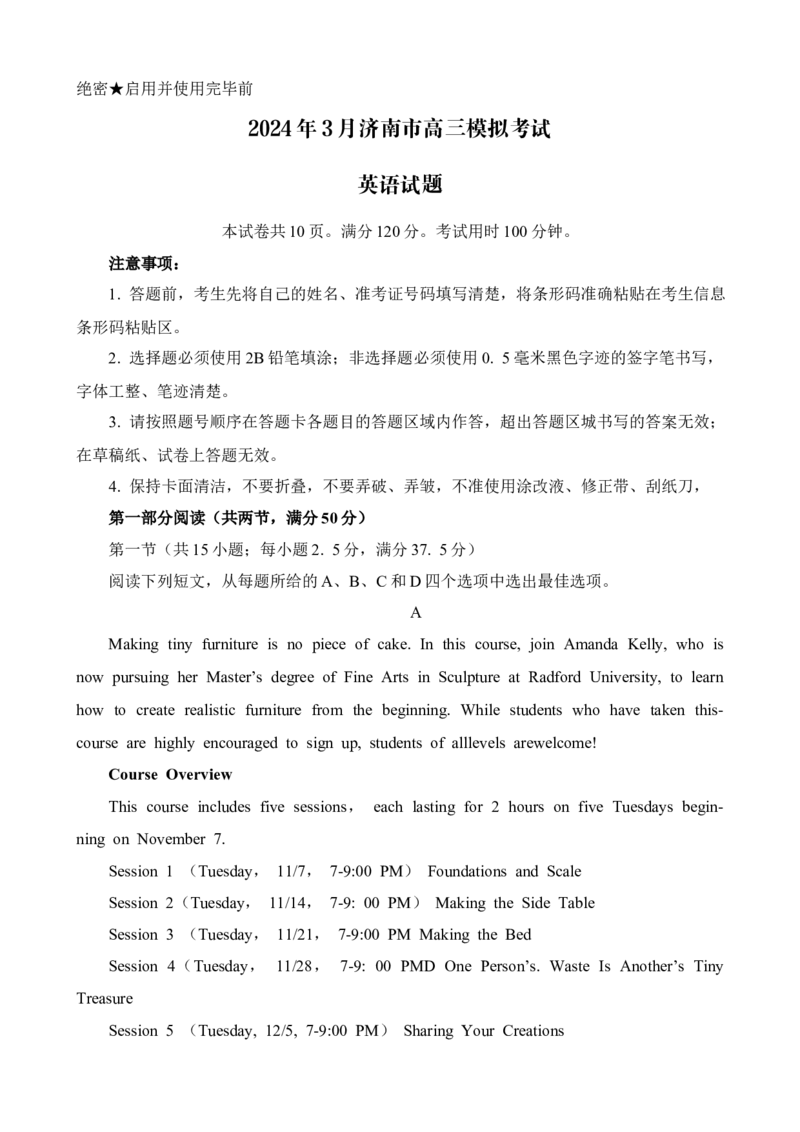
Making tiny furniture is no piece of cake. In this course, join Amanda Kelly, who is
now pursuing her Master’s degree of Fine Arts in Sculpture at Radford University, to learn
how to create realistic furniture from the beginning. While students who have taken this-
course are highly encouraged to sign up, students of alllevels arewelcome!
Course Overview
This course includes five sessions, each lasting for 2 hours on five Tuesdays begin-
ning on November 7.
Session 1 (Tuesday, 11/7, 7-9:00 PM) Foundations and Scale
Session 2(Tuesday, 11/14, 7-9: 00 PM) Making the Side Table
Session 3 (Tuesday, 11/21, 7-9:00 PM Making the Bed
Session 4(Tuesday, 11/28, 7-9: 00 PMD One Person’s. Waste Is Another’s Tiny
Treasure
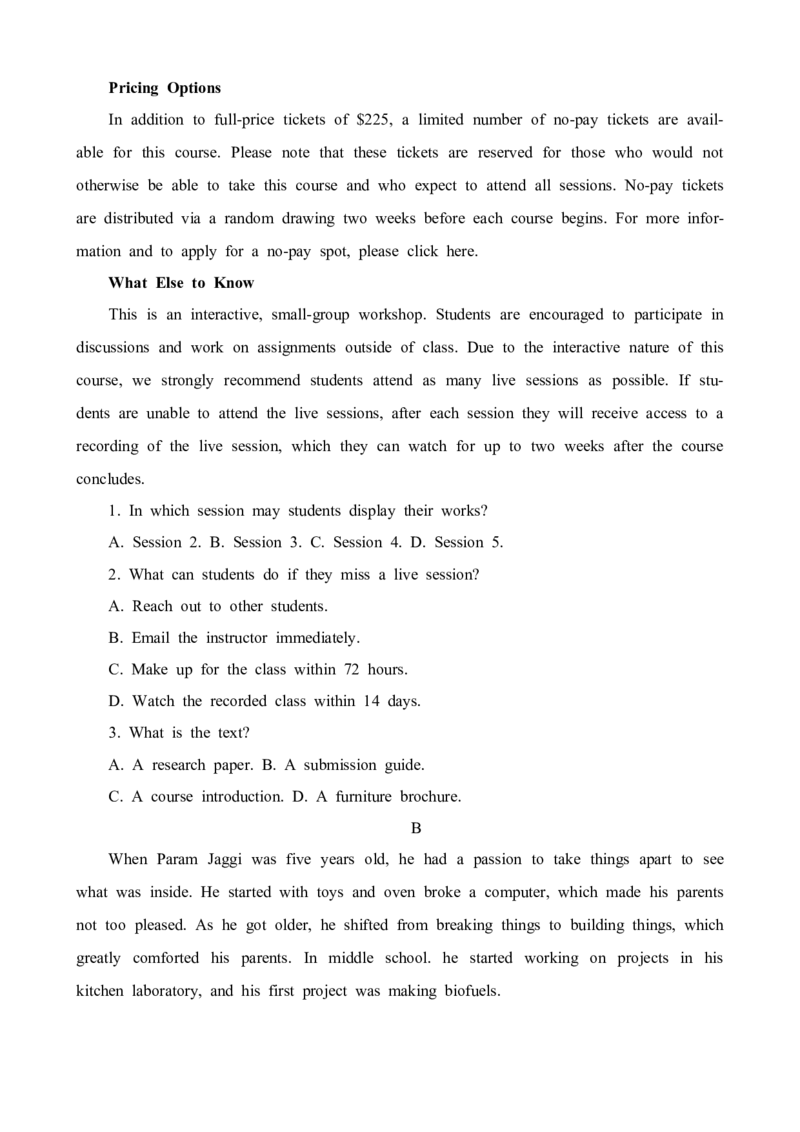
Session 5 (Tuesday, 12/5, 7-9:00 PM) Sharing Your CreationsPricing Options
In addition to full-price tickets of $225, a limited number of no-pay tickets are avail-
able for this course. Please note that these tickets are reserved for those who would not
otherwise be able to take this course and who expect to attend all sessions. No-pay tickets
are distributed via a random drawing two weeks before each course begins. For more infor-
mation and to apply for a no-pay spot, please click here.
What Else to Know
This is an interactive, small-group workshop. Students are encouraged to participate in
discussions and work on assignments outside of class. Due to the interactive nature of this
course, we strongly recommend students attend as many live sessions as possible. If stu-
dents are unable to attend the live sessions, after each session they will receive access to a
recording of the live session, which they can watch for up to two weeks after the course
concludes.
1. In which session may students display their works?
A. Session 2. B. Session 3. C. Session 4. D. Session 5.
2. What can students do if they miss a live session?
A. Reach out to other students.
B. Email the instructor immediately.
C. Make up for the class within 72 hours.
D. Watch the recorded class within 14 days.
3. What is the text?
A. A research paper. B. A submission guide.
C. A course introduction. D. A furniture brochure.
B
When Param Jaggi was five years old, he had a passion to take things apart to see
what was inside. He started with toys and oven broke a computer, which made his parents
not too pleased. As he got older, he shifted from breaking things to building things, which
greatly comforted his parents. In middle school. he started working on projects in his
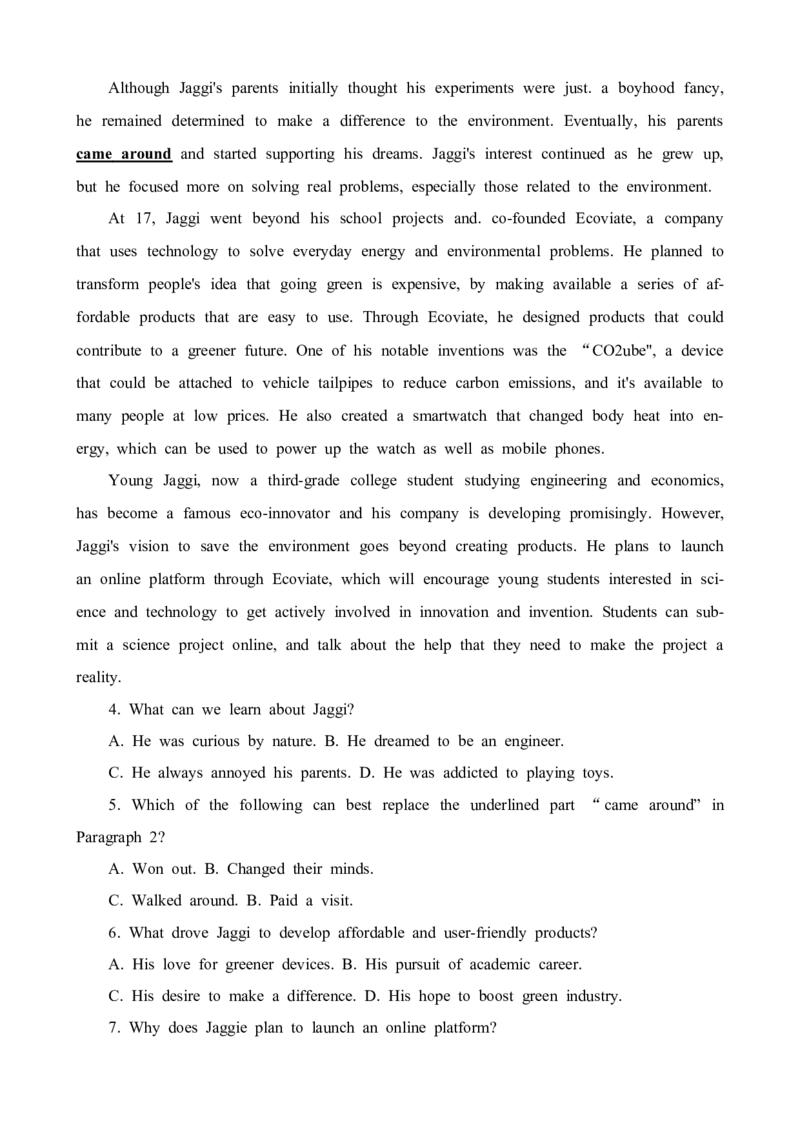
kitchen laboratory, and his first project was making biofuels.Although Jaggi's parents initially thought his experiments were just. a boyhood fancy,
he remained determined to make a difference to the environment. Eventually, his parents
came around and started supporting his dreams. Jaggi's interest continued as he grew up,
but he focused more on solving real problems, especially those related to the environment.
At 17, Jaggi went beyond his school projects and. co-founded Ecoviate, a company
that uses technology to solve everyday energy and environmental problems. He planned to
transform people's idea that going green is expensive, by making available a series of af-
fordable products that are easy to use. Through Ecoviate, he designed products that could
contribute to a greener future. One of his notable inventions was the “CO2ube", a device
that could be attached to vehicle tailpipes to reduce carbon emissions, and it's available to
many people at low prices. He also created a smartwatch that changed body heat into en-
ergy, which can be used to power up the watch as well as mobile phones.
Young Jaggi, now a third-grade college student studying engineering and economics,
has become a famous eco-innovator and his company is developing promisingly. However,
Jaggi's vision to save the environment goes beyond creating products. He plans to launch
an online platform through Ecoviate, which will encourage young students interested in sci-
ence and technology to get actively involved in innovation and invention. Students can sub-
mit a science project online, and talk about the help that they need to make the project a
reality.
4. What can we learn about Jaggi?
A. He was curious by nature. B. He dreamed to be an engineer.
C. He always annoyed his parents. D. He was addicted to playing toys.
5. Which of the following can best replace the underlined part “came around” in
Paragraph 2?
A. Won out. B. Changed their minds.
C. Walked around. B. Paid a visit.
6. What drove Jaggi to develop affordable and user-friendly products?
A. His love for greener devices. B. His pursuit of academic career.
C. His desire to make a difference. D. His hope to boost green industry.
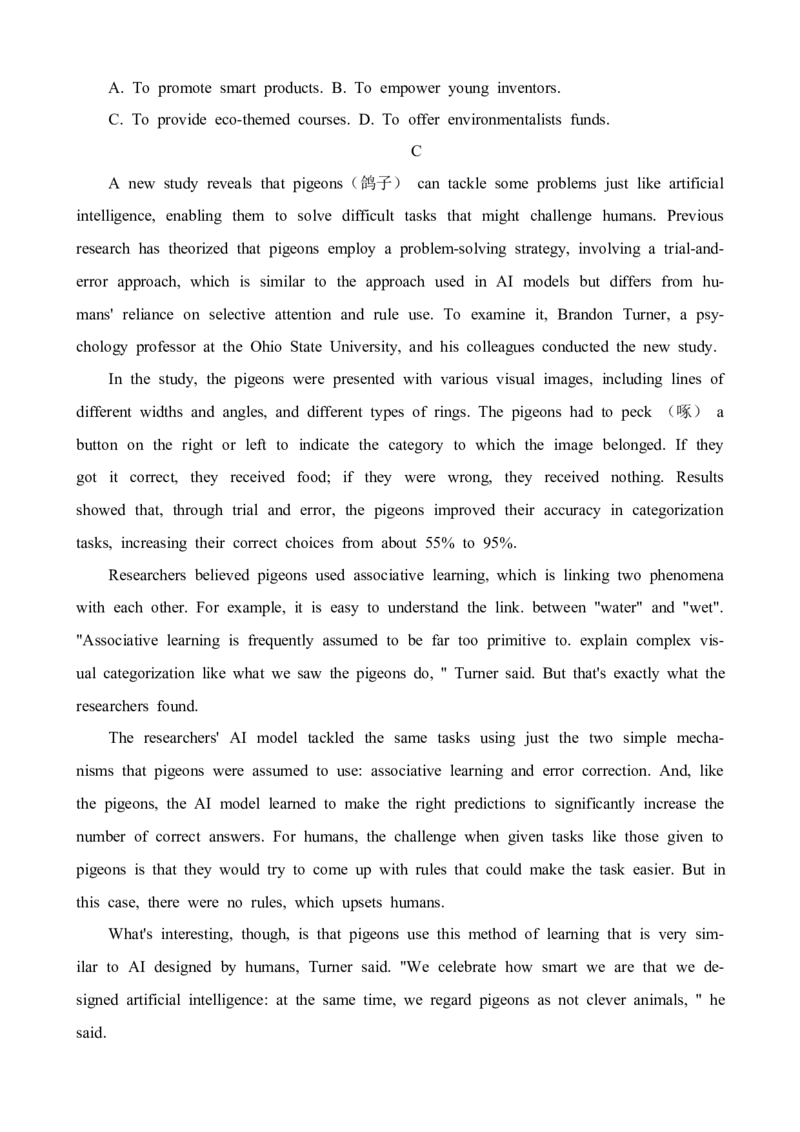
7. Why does Jaggie plan to launch an online platform?A. To promote smart products. B. To empower young inventors.
C. To provide eco-themed courses. D. To offer environmentalists funds.
C
A new study reveals that pigeons(鸽子) can tackle some problems just like artificial
intelligence, enabling them to solve difficult tasks that might challenge humans. Previous
research has theorized that pigeons employ a problem-solving strategy, involving a trial-and-
error approach, which is similar to the approach used in AI models but differs from hu-
mans' reliance on selective attention and rule use. To examine it, Brandon Turner, a psy-
chology professor at the Ohio State University, and his colleagues conducted the new study.
In the study, the pigeons were presented with various visual images, including lines of
different widths and angles, and different types of rings. The pigeons had to peck (啄) a
button on the right or left to indicate the category to which the image belonged. If they
got it correct, they received food; if they were wrong, they received nothing. Results
showed that, through trial and error, the pigeons improved their accuracy in categorization
tasks, increasing their correct choices from about 55% to 95%.
Researchers believed pigeons used associative learning, which is linking two phenomena
with each other. For example, it is easy to understand the link. between "water" and "wet".
"Associative learning is frequently assumed to be far too primitive to. explain complex vis-
ual categorization like what we saw the pigeons do, " Turner said. But that's exactly what the
researchers found.
The researchers' AI model tackled the same tasks using just the two simple mecha-
nisms that pigeons were assumed to use: associative learning and error correction. And, like
the pigeons, the AI model learned to make the right predictions to significantly increase the
number of correct answers. For humans, the challenge when given tasks like those given to
pigeons is that they would try to come up with rules that could make the task easier. But in
this case, there were no rules, which upsets humans.
What's interesting, though, is that pigeons use this method of learning that is very sim-
ilar to AI designed by humans, Turner said. "We celebrate how smart we are that we de-
signed artificial intelligence: at the same time, we regard pigeons as not clever animals, " he
said.8. What is the purpose of the new study?
A. To test a theory. B. To evaluate a model.
C. To employ a strategy. D. To involve an approach.
9. What were the pigeons expected to do in the experiment?
A. Draw circles. B. Correct errors. C. Copy gestures. D. Identify images.
10. What do pigeons and AI have in common according to the study?
A. They are of equal intelligence.
B. They are good at making rules.
C. They respond rapidly to orders from humans.
D. They employ simple ways to get things done.
11. What can be a suitable title for the text?
A. Pigeons' trial-and-error method is revealed
B. Pigeons outperform humans in tough tasks
C. "Not smart" pigeons may be as smart as AI
D. AI models after pigeons' learning approach
D
Like many people over the past few years, I have found myself turning to audiobooks
as my main means of reading literature. I find it far more comfortable to "read with my
ears" while my eyes are resting. My consumption of new books has doubled as a result--
but a recent paper makes me wonder if this will come at the price of my comprehension.
The study comes from Boaz Keysar and Janet Geipel, both at the University of
Chicago, and it draws from the "dual process model" of mental processing. According to
this-view, we have two ways of assessing information. System 1 is intuitive (直觉的),
relying on natural ability and feeling. It is quick, but likely exposed to misinformation. Sys-
tem 2 is analytical. involving the use of logic reasoning. It is mentally demanding. When it
is engaged, we think our way through the material step by step. For decades, psychologists
have designed various tests to determine which of these two systems a person is using. As
one example, consider the/ following question: How many animals of each kind did Moses
take on the Ark(方舟)? If you answered two, you were probably only considering the core
of the question, which is System 1 thinking. To get to the right answer-zero, you need tothink more carefully about the wording, which would allow you to remember it was Noah
who built the Ark, not Moses. That is the kind of analytical process.
Keysar and Geipel's brilliant idea was to investigate whether the sensory form-seeing
vs. hearing-of the information would make a difference. They found that it did: when an-
swering these kinds of simple questions, participants were more likely to make errors when
the sentences were spoken out loud, rather than written.
A greater reliance on our feelings could be a problem if we are consuming informa-
tion that needs logical study. For this reason. I will return to reading non-fiction with my
eyes rather than my ears. But I won't stop listening to novels. I am quite happy to go with
the flow of my emotions while my critical mind takes a break.
12. What does the author think of listening to audiobooks?
A. It is economical. B. It is demanding.
C. It is time-consuming. D. It is relaxing.
13. Which of the following best describes System 2 model?
A. Fairly reliable. B. Fully automatic.
C. Question-centered. D. Emotion-involved.
14. Why is the Ark mentioned in Paragraph 3?
A. To present a fact. B. To illustrate a view.
C. To introduce a topic. D. To draw a conclusion.
15. What does the author intend to tell us?
A. Listening to books comes at a price.
B. Reading non-fiction books benefits.
C. Critical thinking is a must in reading.
D. Ways of processing information differ.
第二节(共5小题;每小题2. 5分,满分12. 5分)
根据短文内容,从短文后的选项中选出能填入空白处的最佳选项,选项中有两项为多余
选项。
Risks of OvertrainingGetting in shape and training for an event such as a marathon requires long-lasting
and intense physical commitment. 16 But the truth is, sometimes the very acts we
do to get healthy can actually push us past our physical limits.
Specifically, overtraining is a set of signs that occur when your body is not able to
recover sufficiently before going into your next workout. 17 People tend to ignore
them. Over time, the cycle of starting the next training session before allowing recovery
causes breakdown of the very parts of the body that you work so hard to build up.
The structures and systems of your body adapt to the demands you have placed on
them before the rest time. If your workout slightly goes beyond your current ability, it will
adapt toward what you did in a positive way. 1 8
Two main factors are necessary in recovery: nutrition. and rest. Good nutrition, includ-
ing water and protein intake, is extremely important, especially within 40 minutes of your
workout. 19 Your body uses the nutrients you have given it during the rest time.
especially sleep, to strengthen.
One of the best ways to prevent overtraining is to focus on your morning resting heart
rate. 20 Generally, you will detect an increase in your heart rate before the other
signs show up. Tracking it in a log can be a great way to monitor your recovery.
A. It's easy to measure and track.
B. Allowing time for recovery is also essential.
C. The problem is that they show up very gradually.
D. Below are the signs and symptoms of overtraining.
E. Listening to your body will assure you of your fitness goals.
F. If far beyond, it'll take longer to adapt and may cause injury.
G. We generally assume regular intense exercise good for our health.
第二部分语言运用(共两节,满分30分)
第一节(共15小题;每小题1分,满分15分)
阅读下面短文,从每题所给的A、B、C、D四个选项选出可以填入空白处的最佳选项。
The 13-year-old girl Anna Grace is a volleyball manager, a basketball manager, and a
theatervolunteer, but perhaps her greatest 21 is the fact that she has beaten cancer
twice.Anna was first diagnosed (诊断) with a rare type of 22 in December of 2019.
A softball player at the time, she told her parents she was experiencing muscle 23 in
her left arm, only lifting it about eye-level. She had to 2 4 surgery on her left arm.
For the following weekends after the surgery, doctors scanned her 25 to make
sure she was cancer-free and then in August of 2023, doctors 26 a spot on her lungs.
She had another 27 on September to remove it. Anna said later the first time with
cancer, it felt like a learning stage. The second time around, it was a little 28 to ac-
cept the news.
And throughout all of this, Anna has had to 29 school work and hospital life.
Hersufferings with cancer forced her to really 30 herself because she was out of
school forquite a while. Now she has 31 and has straight As. Anna's father, Eric Bar-
tel, said herjourney has inspired him to 32 every moment, enjoying time with his lov-
ing daughter.
Anna is doing well these days though. She's 33 in theater and is a coach's as-
sistant. "When you're on 3 4 you have to keep fighting, Anna said. "Always live life to
thefullest each day. You're loved. Your life 3 5 .”
21. A. excitement B. achievement C. devotion D. ambition
22. A. pain B. cold C. cancer D. fever
23. A. weakness B. growth C. recovery D. relief
24. A. perform B. have C. attend D. refuse
25. A. briefly B. occasionally C. partly D. regularly
26. A. noticed B. crased C. ignored D. marked
27. A. assessment B. appointment C. examination D. operation
28. A. harder B. easier C. stranger D. better
29. A. solve B. connect C. abandon D. balance
30. A. apply B. control C. convince D. forgive
31. A. caught up B. held back C. dropped out D. blown up
32. A. spare B. appreciate C. imagine D. create
33. A. active B. graceful C. dominant D. cautious
34. A. vacation B. trust C. treatment D. duty35. A. declines B. suffers C. matters D. waits
第二节(共10小题;每小题1. 5分,满分15分)
阅读下面短文,在空白处填入1个适当的单词或括号内单词的正确形式。
Driven by a great passion for guqin, 36 is an ancient Chinese instrument, Li
Xiangting, a professor at the Central Conservatory of Music in Beijing 37 (devote)
nearly 70 years to mastering and promoting it since his first encounter with it.
In 1958, Li became the only gugin major in the Traditional Chinese Instruments De-
partment. Given that guqin was 38 (relative) unknown, Li was often ignored. Ev-
eryone considered it out of date, 39 he thought it deserved an important position
and was determined to make it 4 0 (appreciate) by everyone.
In order to introduce it 41 a global audience, Li innovated while honoring the
instrument's rich traditions. Later, he also produced teaching videos, 42 (publish)
books, and released albums, significantly boosting the instrument's 4 3 (popular).
In the following years, more enthusiasts and musicians like Li worked on the art, With
44 (they) efforts, the UNESCO recognized the art as an intangible (非物质的) her-
itage of humanity in 2003. Moreover, his daughter, Li Pengpeng, has followed in her fa-
ther's footsteps, 45 (serve) as an ambassador in promoting traditional Chinese cul-
ture.
第三部分写作(共两节,满分40分)
第一节(满分15分)
假定你是李华,你的英国朋友 Frank发来邮件,询问你校“阳光大课间”活动的开展情
况。请写封回信,内容包括:
1. 活动内容;
2. 你的看法。
注意:
1. 写作词数应为80个左右;
2. 请按如下格式在答题卡的相应位置作答。
Dear Frank,
Yours sincerely,
Li Hua第二节(满分25分)
阅读下面材料,根据其内容和所给段落开头语续写两段,使之构成一篇完整的短文。
6-year-old Quinn Hill became her family's hero when she took immediate action during
an emergency that saved her mother's life with the help of her neighbor, Mrs. Smith.
Jennifer, a 39-yearold single mother, began the day by sending her child, Hill, to
school. Having no idea what would happen, Jennifer was filled with anxiety. After all, it
was the first day of a new school year for Hill, a fresh start! On the way school. she re-
peatedly reminded Hill to solve problems positively and fit in. Though worried, Jennifer
had to wave goodbye to her daughter, watching her towards the school gate.
The whole day was packed with housework. Jennifer tidied the house, washed clothes,
and prepared for the evening meal. As the school bell rang, signaling the end of the day,
Jennifer picked Hill up from school. On seeing Jennifer, Hill couldn't wait to hug her,
sharing the school experiences. Chatting and laughing accompanied them all the way. Hill's
innocent laughter was like Jennifer's ray of sunshine.
Approaching home, they encountered Mrs. Smith, a most kind and thoughtful house-
wife living in their neighborhood for many years. Mrs. Smith often invited Jennifer and Hill
to her home and shared her homemade desserts and cookies. The two families developed a
close relationship and Hill liked to stay with Mrs. Smith, who always brightened her days
with willingness and timely help. After exchanging greetings, they went back to their own
homes.
On arriving home, Jennifer set out to prepare dinner. As the sun began to set, the
house was full of a pleasant smell of cooking food. Jennifer and Hill sat at the kitchen
table when Jennifer suddenly began to seize. She was sitting in a chair, looking up at the
ceiling. and experiencing abnormal breathing. She then fell out of the chair onto her left
side, her hands balled into fists, and her body was shaking violently. Her eyes were open,
and Hill kept calling "Mommy, Mommy, but she could not respond.
注意:1. 续写词数应为150个左右;
2. 请按如下格式在答题卡的相应位置作答。
Realizing the severe situation, Hill ran out for help.
Jennifer finally came to herself in the hospital.济南市高三学习质量检测
英语试题参考答案
第一部分阅读(共两节,满分50分)
第一节(共15小题:每小题2.5分,满分37.5分)
A 篇1—3 DDC
B 篇4—7 ABCB
C 篇8—11 ADDC
D 篇12—15 DABA
第二节(共5小题:每小题2.5分,满分12.5分)
16—20 GCFBA
注意:每小题2.5分,凡是与答案不符者,不绐分。
第二部分语言知识运用(共两节,满分30分)
第一节(共15小题:每小题1分,满分15分)
21-25 BCABD 26-30 ADBDA 31-35 ABACC
注意:每小题1分,凡是与答案不符者,不给分。
第二节(共10小题:每小题1.5分,满分15分)
36.which 37.has devoted 38. relatively 39.but/yet 40. appreciated
41. to 42. published 43. popularity 44. their 45. serving