09.减少塑料污染
一、阅读理解
1
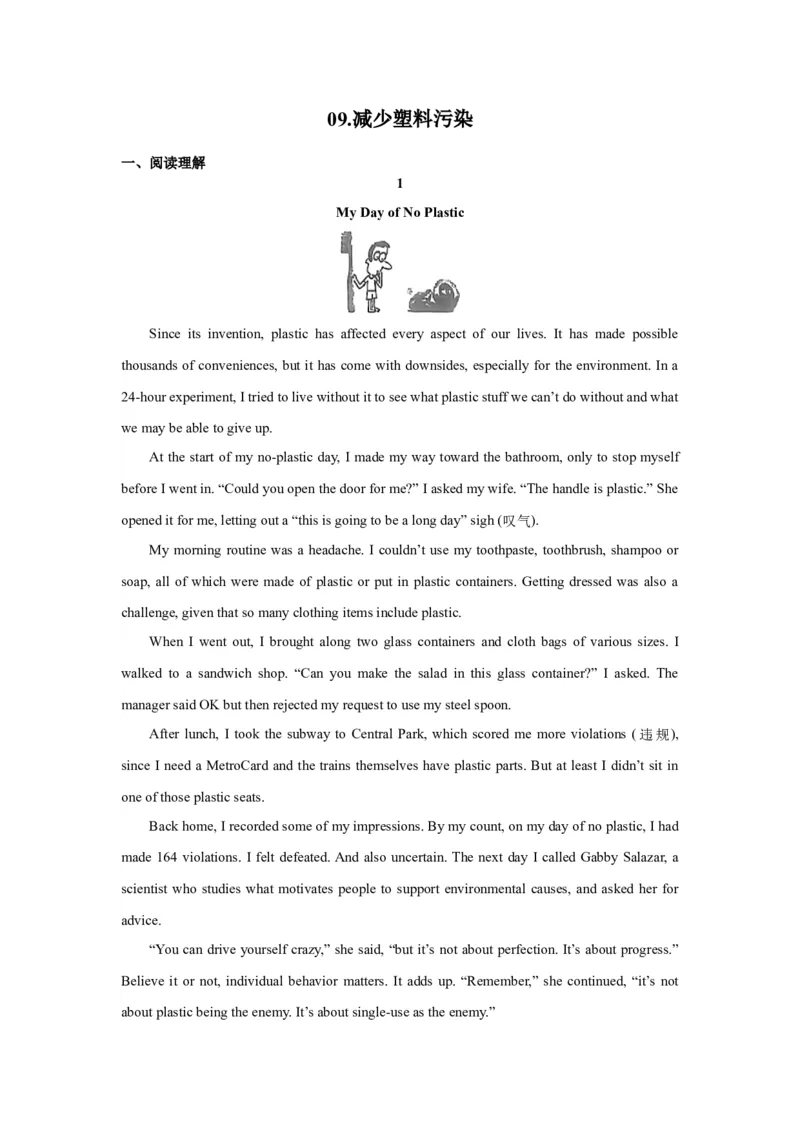
My Day of No Plastic
Since its invention, plastic has affected every aspect of our lives. It has made possible
thousands of conveniences, but it has come with downsides, especially for the environment. In a
24-hour experiment, I tried to live without it to see what plastic stuff we can’t do without and what
we may be able to give up.
At the start of my no-plastic day, I made my way toward the bathroom, only to stop myself
before I went in. “Could you open the door for me?” I asked my wife. “The handle is plastic.” She
opened it for me, letting out a “this is going to be a long day” sigh (叹气).
My morning routine was a headache. I couldn’t use my toothpaste, toothbrush, shampoo or
soap, all of which were made of plastic or put in plastic containers. Getting dressed was also a
challenge, given that so many clothing items include plastic.
When I went out, I brought along two glass containers and cloth bags of various sizes. I
walked to a sandwich shop. “Can you make the salad in this glass container?” I asked. The
manager said OK but then rejected my request to use my steel spoon.
After lunch, I took the subway to Central Park, which scored me more violations (违规),
since I need a MetroCard and the trains themselves have plastic parts. But at least I didn’t sit in
one of those plastic seats.
Back home, I recorded some of my impressions. By my count, on my day of no plastic, I had
made 164 violations. I felt defeated. And also uncertain. The next day I called Gabby Salazar, a
scientist who studies what motivates people to support environmental causes, and asked her for
advice.
“You can drive yourself crazy,” she said, “but it’s not about perfection. It’s about progress.”
Believe it or not, individual behavior matters. It adds up. “Remember,” she continued, “it’s not
about plastic being the enemy. It’s about single-use as the enemy.”I promised to try, even after my not successful attempt. I’ll start with small things, building
up habits. I can take cloth bags to the grocery. I might start packing my glass water bottle and steel
spoon. And from there, who knows?
1. The author conducted the 24-hour experiment because ________.
A. he was tired of using plastic stuff in his daily life
B. he tried to call upon people to ban plastic products
C. he wondered how much plastic he consumed each day
D. he wanted to figure out how to use plastic stuff wisely
2. Why did the author’s wife sigh?
A. Because she didn’t know his intention.
B. Because she worried about her husband.
C. Because she thought it hard to avoid using plastic.
D. Because she didn’t realize the downsides of plastic.
2
Just when you thought you were taking care of your health by eating enough fruit and
vegetables every day, new research has come out revealing that you might be swallowing
microplastic particles (颗粒) along with all those vitamins, minerals, and fiber. A groundbreaking
study published in the journal Environmental Research has found that fruits and vegetables absorb
microplastic particles from the soil and move them through vegetal tissues, where they remain
until eaten by hungry diners, thus getting transferred to human bodies.
The researchers, who are from the University of Catania in Italy, as well as Sousse and
Monastir universities in Tunisia, analyzed a variety of common fruits and vegetables —carrots,
lettuce, broccoli, potatoes, apples, and pears. These were chosen for the fact that they are
frequently consumed, usually one per day, which allowed the researchers to better assess the
dietary intakes of MPs (microplastic particles) and NPs (nano-plastics). The samples were
purchased from different sources in the city of Catania, including a small fruit vendor and a
supermarket.
The researchers found that apples, followed by pears, were the most polluted fruit samples,
and carrots were the most polluted vegetable. In the study’s discussion section, the authors wrote,
“We can assume that the fruits contain more MPs not only because of the very high
vascularization (血管化) of the fruit pulp (果肉) but also due to the greater size and complexity ofthe root system and age of the tree (several years) compared to the vegetables (60-75 days for the
carrot).”
This study is important because it's the first to detect microplastics in fruits and vegetables.
They have been found in other sources before, such as sea salt, beer, water (bottled, in particular),
shellfish, sugar, soil, and even air, but never inside fresh produce. It’s an alarming discovery that
raises yet another red flag about microplastic pollution in the natural environment.
It’s an area that will likely see a lot more attention in coming years, with the study authors
calling for further research into the question of microplastic and whether it harms the health of
both plants and humans.
3. What is the study mainly about?
A. The main cause and influence of soil pollution.
B. The microplastic pollution in fruits and vegetables.
C. The benefits of daily fruits and vegetables consumption
D. The great changes in people's dietary habits.
4. What may cause fruits to contain more MPs according to the authors?
A. The age of root system. B. The huge size of fruit tree roots.
C. The complex preservation method. D. The large amounts of the fruit pulp.
5. What do the study authors think of the research on microplastic?
A. It needs to be further studied. B. It wasted them quite a lot of time.
C. It has caused harm to health. D. It has attracted attention to diets.
3
Whether due to genuine concern for the environment or the widespread criticism of plastic
among consumers, many companies have invested heavily in reducing their use of plastic
packaging, which may indeed have a positive environmental impact. But another trend that’s
grown out of the anti-plastic movement is a lot less positive: overpackaging. More and more
brands have begun adding unnecessary paper packaging on top of plastic packaging in order to
make their products look more environmentally friendly, without actually reducing plastic waste.
Unfortunately, there’s a very good reason companies are adopting this clearly problematic
approach. Through a series of eight studies with more than 4,000 participants, we found that
consumers will accept a product’s packaging as more environmentally friendly if it’s plastic withan additional layer of paper than if the product is visibly packaged in identical plastic packaging
but without the paper. These perceptions (认知) in turn make consumers both more likely to buy a
product, and willing to pay more for it.
Part of what makes this overpackaging trend particularly harmful is that it is much valued by
consumers who reported engaging in more eco-friendly behaviors. They were more likely to view
overpackaged products as environmentally friendly. As a result, the very consumers who are most
interested in pushing companies to make sustainable choices are likely unintentionally
encouraging the environmentally harmful practice of overpackaging.
The good news is, overpackaging isn’t the only way to signal sustainability and attract such
consumers. In our studies, we found that instead of additional paper packaging, simply adding a
minimal packaging sticker to plastic packaging could clarify the misperception that overpackaged
products are more sustainable, Especially for products for which plastic is necessary to ensure safe
transportation and lengthen shelf life, this kind of clear messaging can help reduce consumers,
discrimination against the responsible use of plastic packaging.
Of course, minimal packaging stickers certainly should only be used if a brand has actually
ensured that it is using the minimal possible packaging, ideally under the supervision of a trade
organization or regulatory body that maintains clear, consistent standards.
6. What can we learn about overpackaging according to paragraph 1?
A. It calls for less investment.
B. It involves the proper use of paper.
C. It has a positive environmental impact.
D. It causes over-consumption of materials.
7. What do the eight studies find about consumers according to the text?
A. They care about the environment.
B. They are always following the trend.
C. They like comparing products’ qualities.
D. They prefer beautifully-decorated products.
8. What function is expected of minimal packaging stickers?
A. To help products stay fresh longer.
B. To improve the brand’s popularity.
C. To correct consumers’ misunderstanding.D. To present more information about products.
9. What can we infer from the last paragraph?
A. Minimal packaging stickers have been widely used.
B. Advantages of minimal packaging stickers are overestimated.
C. The use of minimal packaging stickers should be strictly regulated.
D. The use of minimal packaging stickers is a solution to over-packaging.
4
Every order of takeout comes with aside of single-use plastics and each plastic fork, knife,
spoon and straw—whether or not you wanted it or used it—ends up in the trash.
New research found that 139 million metric tons of single-use plastic waste was generated in
2021—six million metric tons more single-use plastics compared to2019. A hunger for takeout
meals during the pandemic contributed to the surge.
An estimated 60%of Americans order takeout or delivery at least once a week and online
ordering is growing 300%faster than in-house dining; that means millions of single-use plastic
utensils (餐具) are going out with every order.
New laws aim to address the problem. Some of the recent bills are thanks to The National
Reuse Network, part of the environmental nonprofit Upstream, which launched a national Skip the
Stuff campaign to work out policies that require restaurants to include single-use plastic utensils,
straws, and napkins only when customers request them.
The bills also require meal delivery and online apps like Uber Eats, GrubHub and Door Dash
to add single-use extras to their menus; customers can choose the items and quantities to have
them included in the order. Customers that don’t order the single-use plastics won’t receive them.
The goal of the bills is to reduce the 40 billion plastic utensils sent to the landfill (填埋场)
every year.
“Most of the time, people are taking food home or to their offices where there are reusable
utensils so these utensils wind up in a drawer or get thrown out,” says Goldsmith. “Some people
do need utensils, but for the most part, they’re not needed.”
To date, Skip the Stuff bills have been passed in several cities, including Denver, Washington,
D. C. and Chicago. California and Washington state passed statewide bills that make single-use
plastic “accessories” available with takeout orders only upon request.Organizations like upstream, Beyond plastics and NRDC have created toolkits to help
additional communities launch their own Skip the Stuff campaigns.
10. What does the underlined word “surge” in paragraph 2 probably mean?
A. Strong panic. B. Good solution.
C. Sharp increase. D. Great pressure
11. What can be done according to Skip the Stuff?
A. Selecting green products.
B. Providing utensils only on request.
C. Recycling and reusing some utensils.
D. Using identical products nationwide.
12. What is the aim of the newly passed bills?
A. To better serve customers. B. To reduce plastic waste.
C. To correct bad eating habits. D. To prevent illegal activities.
13. What is Goldsmith’s attitude towards the Skip the Stuff campaign?
A. Concerned. B. Doubtful. C. Favorable. D. Unclear.
5
Washing machines are one of the greatest inventions of the last few centuries.They have
made life easier. Unfortunately, washing machines also contribute to the environmental issues of
energy use and micro-plastics flowing into the oceans. That is why the washing machine
manufacturer (制造商), Samsung, and the outdoor-wear company, Patagonia, are working
together to make a change.
For Patagonia, the issue of micro-plastics has been on its mind for years — its woolen jackets
release many microfibers. As for Samsung, new requirements throughout the world have forced
many producers to start thinking about ways to help reduce the number of micro-plastics. There
are currently more than 14 million tons of micro-plastics floating in the oceans. Though people
previously think of things such as plastic bottles and fishing lines when it comes to plastics in the
ocean, thousands of micro-plastics are released into seas with every wash.
The issue is a sort of catch-22. In order to reduce energy costs, manufacturers try to make
their machines more efficient. These machines use hotter water and are designed to create more
friction (摩擦) between the clothing in the machine. However, both of these things lead to therelease of more micro-plastics. So, using Patagonia clothes as test cases, Samsung came up with a
two-fold solution: One is a technology called Eco-bubbles, which creates more bubbles to make
the detergent (洗涤剂) more powerful, and the other is a water purifier that can filter (过滤) out
more micro-plastics.
The cooperation between the two companies is proof of how complicated protecting the
environment can be. On the one hand, clothing that is well-constructed and durable is a weapon in
the fight against fast fashion. On the other hand, the material used to make those clothes and the
way they are washed can also add pollutants to the environment.The same goes for washing
machines. There is no one-size-fits-all solution. The fight against climate change requires creative
thinking and learning how to attack a problem from many angles. This will certainly lead to even
more strange and fruitful cooperation between the environmentally conscious companies.
14. What is Samsung’s purpose in partnering the outdoor clothing company?
A. To limit the use of micro-plastics.
B. To solve the issue of energy waste.
C. To find a solution to micro-plastic pollution.
D. To produce high-efficiency washing machines.
15. What does the underlined word “catch-22” in paragraph 3 refer to?
A. A tricky situation. B. A questionable fact.
C. A possible dream. D. A practical method.
16. Which of the following will reduce the release of micro-plastics during washing?
A. Using hotter water.
B. Creating more friction.
C. Using powerful detergents.
D. Adding a water purifier to washing machines.
17. What does the cooperation between the two companies show?
A. The difficulty in fighting against fast fashion.
B. The complexity of environment conservation.
C. The influence of humans’ active action.
D. The importance of creative thinking.
6
An impressive invention made by a 17-year-old teenager, called Anna Du, is helping to cleanup small pieces of plastic from the ocean.
While walking along her local beaches in Massachusetts, the young student began collecting
waste plastic bags and bottles. But what she noticed was a large number of tiny pieces of plastic or
microplastics that were impossible to pick up. At just 12 years old, Du set out to solve the
problem. After testing a few prototypes(原型)in her backyard, she invented a remotely operated
vehicle that uses the infrared camera(红外摄像机)to detect microplastics on the ocean floor. More
recently, Du has also created a simulation(模拟)model that uses artificial intelligence to predict
where microplastics are located.
Du’s robot invention has earned her awards at top science fairs in the US, and she’s now a
nationally recognized advocate for microplastic awareness and pollution prevention. “When I first
started doing science fairs, I had no idea that a young girl without lots of money and just a little
advanced engineering knowledge could make a difference in the world. I’ve learned that I truly
love working on a problem that’s so much larger than me,” Du said.
Du has also released a new book to help spread the word not only about the dangers of
microplastics but also about the ways to relieve the problem. Titled Microplastics &Me, the
book follows Du’s own story of how she went from worrying about the environment to designing
award-winning solutions. Writing for kids her own age, the young girl alerts her readers to the
threat of microplastic pollution and urges them to care about the environment. The book hopes to
encourage young students to get into science, technology, engineering and math(STEM)subjects
and to inspire a new generation of inventors and engineers. What’s more, Du has even raised more
than $7,000 to distribute the book free to kids and libraries in high-need communities.
18. What inspired Du to make the invention?
A. There was too much rubbish along the beaches. B. The plastics were too small to
collect by hand.
C. The sea was polluted seriously. D. She was interested in AI.
19. What can we learn about Du from paragraph 3?
A. She has a spirit of challenge. B. She is too poor to make a difference.
C. She doesn’t study hard in engineering. D. She wins international recognition.
20. In which section of a newspaper may this text appear?
A. Innovation. B. Voice. C. Culture. D. Art.21. Why does Du write the book Microplastics & Me?
A. To inspire readers to share their stories.
B. To raise the awareness of microplastics pollution.
C. To encourage high schools to offer STEM subjects.
D. To collect money for kids in high-need communities.
7
The scientists who re-engineered the plastic-eating enzyme (酶) PETase have now created a
new enzyme called “cocktail”, which can digest plastic up to six times faster.
PETase breaks down PET back into its building blocks, creating an opportunity to recycle
plastic and reduce plastic pollution. PET is the most common thermoplastic (热塑性塑料) used to
make single use drinks bottles, which takes hundreds of years to break down in the environment,
but PETase can shorten this time to days. The initial discovery set up the prospect of a revolution
in plastic recycling, creating a potential low-energy solution to tackle plastic waste.
Now, the same trans Atlantic team have combined PETase and its “partner”, a second enzyme
called MHETase, to generate much bigger improvements: simply mixing PETase with MHETase
doubled the speed of PET breakdown, and engineering a connection between the two enzymes to
create a “super-enzyme” increased this activity by a further three times.
The team was co-led by the scientists who engineered PETase, Professor John McGeehan and
Dr Gregg Beckham. Professor McGeehan said: “Gregg and I were chatting about how PETase
attacks the surface of the plastics and MHETase chops things up further, so it seemed natural to
see if we could use them together. Our first experiments showed that they did work better together,
so we decided to physically link them. It took a great deal of work, but it was worth the effort—
we were delighted to see that our new enzyme is up to three times faster than the separate
enzymes.”
The original PETase enzyme discovery indicated the first hope that a solution to the global
plastic pollution problem might be within grasp, though PETase alone is not yet fast enough to
handle the tons of PET bottles. Combining it with a second enzyme and finding they work even
faster together means another leap forward has been taken towards finding a solution to plastic
waste. PETase and the new combined MHETase-PETase both work by digesting PET plastic. Thisallows for plastics to be made and reused endlessly, reducing our reliance on fossil ( 化石)
resources.
22. What can we learn about “cocktail” from the text?
A. It doubles the breakdown of plastics. B. It takes hundreds of years to break down.
C. It deals with the plastic waste three times faster. D. It contributes to breaking down
plastic quickly.
23. What is the second paragraph mainly about?
A. A new study of PET. B. The breakdown of PET.
C. The functions of PETase. D. The discovery of PETase.
24. What does the underlined word “It” in paragraph 4 refer to?
A. Combining PETase and MHETase. B. Co-leading the trans Atlantic team.
C. Attacking the surface of the plastics. D. Conducting experiments.
25. What can we infer from the text?
A. Plastic eating enzyme “cocktail” promises new hope for plastic waste.
B. MHETase-PETase makes the world free from plastic pollution.
C. New enzyme is speeding up our reliance on fossil resources.
D. PET pollution is no longer a difficult problem to deal with.
8
Companies have been switching from, plastic straws to paper ones on the grounds of being
more environmentally friendly. However, new research suggests the good - intentioned trend
might not be the best alternative after all.
The study found the vast majority of paper straws tested contained PFAS. Commonly
referred to as “forever chemicals,” PFAS don’t break down in the body or in the environment.
“Straws made from plant-based materials, such as paper and bamboo, are often advertised as
being more sustainable and eco-friendly than those made from plastic,” said Thimo Groffen,
author of the study. “However, the presence of PFAS in these straws means that’s not necessarily
true.”
Researchers on the study examined 39 brands of straws in Belgium from supermarkets, toy
stores, fast-food chains, drug stores and e-commerce stores. The straws were either made of paper,
bamboo; glass, stainless steel or plastic, and the researchers tested each brand for concentrationsof PFAS. 69% of the brands contained PFAS, with paper straws more likely to contain the
chemicals. The researchers found 90% of paper straws had PFAS, compared to 80% of bamboo
straws, 75% of plastic straws, and 40% of glass straws. Further, a paper straw brand was the brand
with the highest PFAS concentration.
Small amounts of PFAS do not pose a risk. However, a build-up of the chemicals in the body
may cause dangerous health problems like liver damage, increased blood
“The presence of PFAS in paper and bamboo straws shows they are not necessarily
biodegradable (可生物降解的),” said Groffen. “We did not detect any PFAS in stainless steel
straws, so I would advise consumers to use this type of straw — or just avoid using straws at all.”
26. Why do companies show a preference for paper straws?
A. They are considered more economical.
B. They are considered less harmful to the environment.
C. They are considered more beneficial to health.
D. They are considered easier to produce.
27. What can we know about PFAS from the text?
A. They exist the least in plastic straws. B. They protect our health effectively.
C. They are basic materials for straws. D. They are a potential threat to human health.
28. What does Groffen probably agree with?
A. Paper straws will become more popular. B. We should use glass straws more often.
C. We’d better drink without using straws. D. Stainless steel straws should be avoided.
29. Which of the following serves as the best title?
A. Paper straws are more likely to contain forever chemicals
B. Paper straws have entirely taken the place of plastic straws
C. Paper straws have caused dangerous, health problems to humans
D. Paper straws will become the best alternative for us in the future
二、完形填空
Holland is famous for being bike friendly. Recently, the world’s first plastic bike path has
been 30 in the Dutch city of Zwolle, a 100- foot bike path made of recycled plastic.
The company that created the path, PlasticRoad, says their 31 of making roads isbetter in many ways than asphalt(沥青) roads. PlasticRoad creates its roads 32 in a
factory. All the pieces are the same. Since the plastic pieces are light, they are easy to 33 .
To make the road, a special truck 34 drives along and lays down the pieces, almost like
35 bricks in a sidewalk. This makes it much 36 to make than an asphalt road.
PlasticRoad thinks their road will 37 three times as long as an asphalt road. If part of it
breaks, it is easy to take out the broken section, and 38 it. The broken section can then be
recycled 39 and turned into a road again.
The plastic roads are hollow(中空的) below, allowing rainwater to flow away, instead of 40
the street. The hollow area also makes it easy to 41 pipes under the road.
Many people think this is a 42 way to recycle plastic, but some are worried. One of the
biggest 43 is what will happen to the bits of plastic that break off as the path is used. The
company is planning another test, hoping to find 44 .
30. A. destroyed B. decorated C. widened D. created
31. A. secret B. way C. goal D. refusal
32. A. halves B. pairs C. groups D. pieces
33. A. break B. keep C. move D. shape
34. A. clumsily B. simply C. naturally D. difficultly
35. A. putting B. finding C. picking D. making
36. A. earlier B. harder C. faster D. cheaper
37. A. save B. take C. last D. count
38. A. replace B. sell C. recycle D. examine
39. A. in private B. at times C. on time D. once more
40. A. crossing B. blocking C. flooding D. deserting
41. A. control B. run C. below D. prepare
42. A. ridiculous B. conventional C. common D. creative
43. A. concerns B. challenges C. burdens D. disasters
44. A. users B. solutions C. similarities D. volunteers
三、语法填空
阅读下面短文, 在空白处填入1个适当的单词或括号内单词的正确形式。Plastic production is energy intensive (能源密集型) and consumes fossil fuels. When burnt,
waste plastic gives off heat-trapping gases and other pollutants. Once such emissions (排放) reach
a certain level, it results 45 environmental problems that will, in turn, harm human
beings. All of this makes recycling plastic waste important.
China’s efforts 46 (recycle) plastic waste have contributed 47
(significant) to slowing global climate change, reducing oil consumption and carbon emissions by
millions of tons. China has also prevented 900 million tons of waste from 48
(generate).
Over the past decade, China 49 (establish) a market-based plastic recycling system
with wide-ranging coverage, which accounts for over 45 percent of the world’s total recycled
plastic waste. China now has the 50 (large) plastic recycling capacity (能力) in the
world. Its huge plastic recycling industry, which employs about 900,000 workers, recycled 31
percent of the plastic waste produced nationally in 2021, about 1.7 times 51 global
average rate.
China has also made great 52 (contribution) to the recycling of plastic waste from
other parts of the world. Between 1992 and 2018, China recycled 106 million tons of imported
plastic waste, a lot of 53 was from the European Union and the United States. This
54 (help) save 318 million tons of oil.
四、书信写作
55. 假如你是学校环保社(Environment Protection Club)社长李华,近期,你想在学校开展一
次“减塑(Less Plastic)”社团活动,倡议大家保护环境,请写一篇发言稿。内容包括:
1. 大量使用塑料的危害;
2. 倡议减塑环保。
注意:
1. 词数100左右;
2. 可以适当增加细节,以使行文连贯;
3. 开头语已写好,不计入总词数。
Dear fellow students,
______________________________________________________________________________________________________________________________________________________________
_______________________________________________________________________________
_______________________________________________________________________________
_______________________________________________________________________________
_______________________________________________________________________________
_