2025~2026 学年度武汉市部分学校高三
年级九月调研考试(题型二次开发)
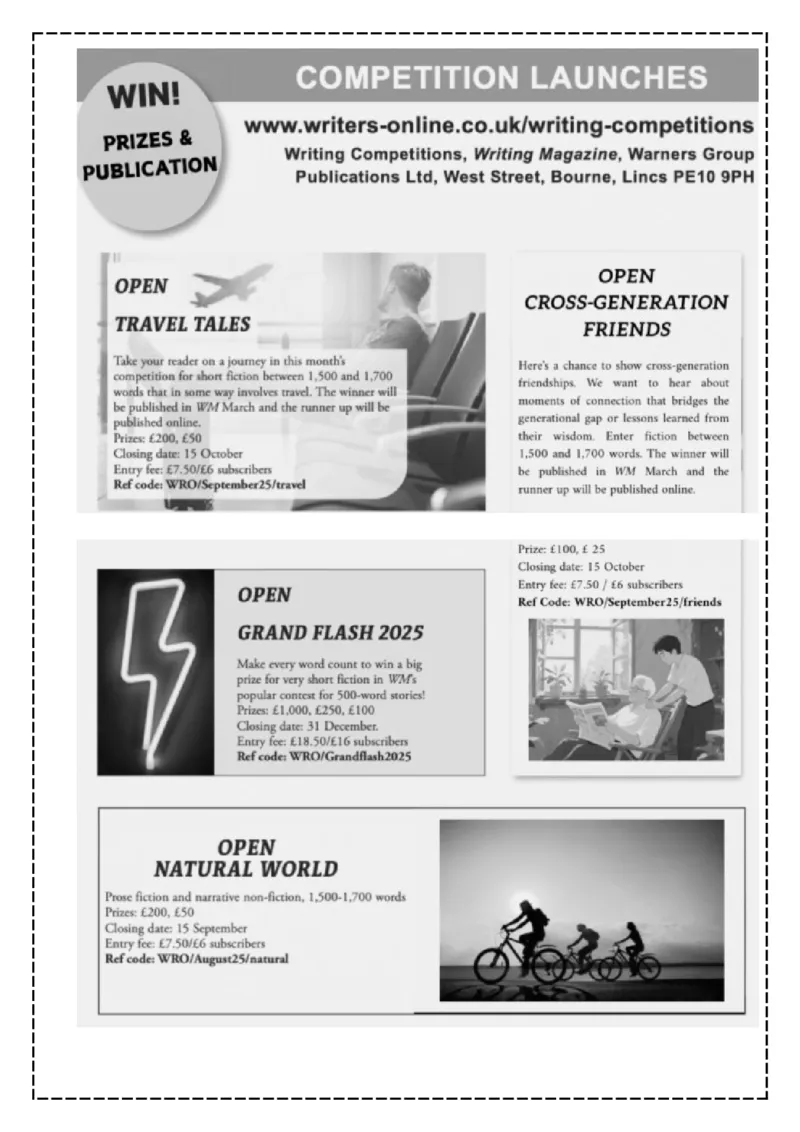
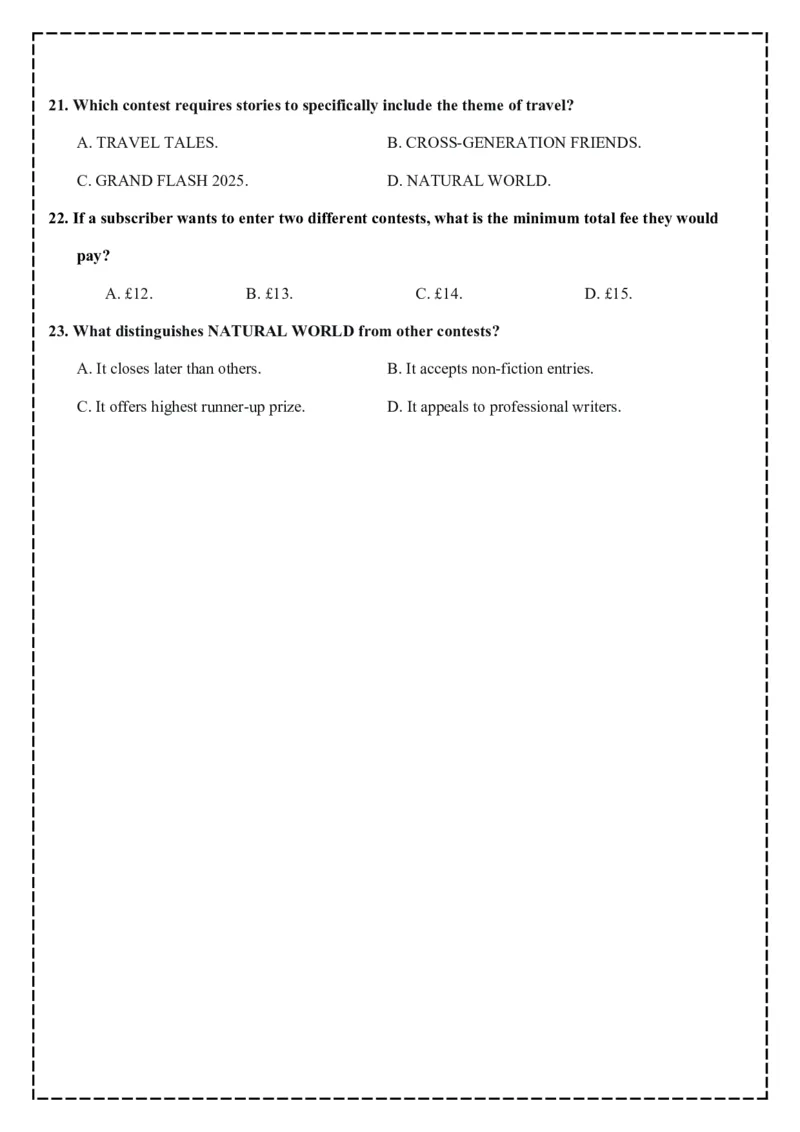
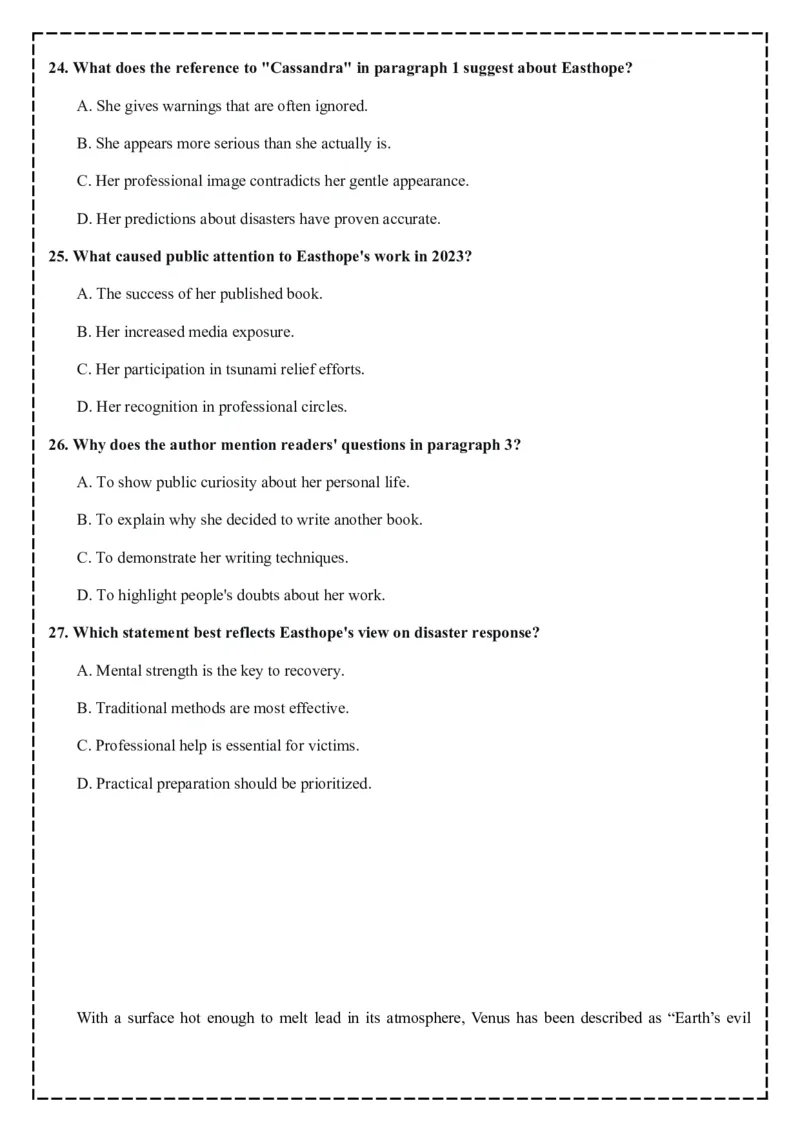
21. Which contest requires stories to specifically include the theme of travel?
A. TRAVEL TALES.
B. CROSS-GENERATION FRIENDS.
C. GRAND FLASH 2025.
D. NATURAL WORLD.
22. If a subscriber wants to enter two different contests, what is the minimum total fee they would
pay?
A. £12.
B. £13.
C. £14.
D. £15.
23. What distinguishes NATURAL WORLD from other contests?
A. It closes later than others.
B. It accepts non-fiction entries.
C. It offers highest runner-up prize.
D. It appeals to professional writers.
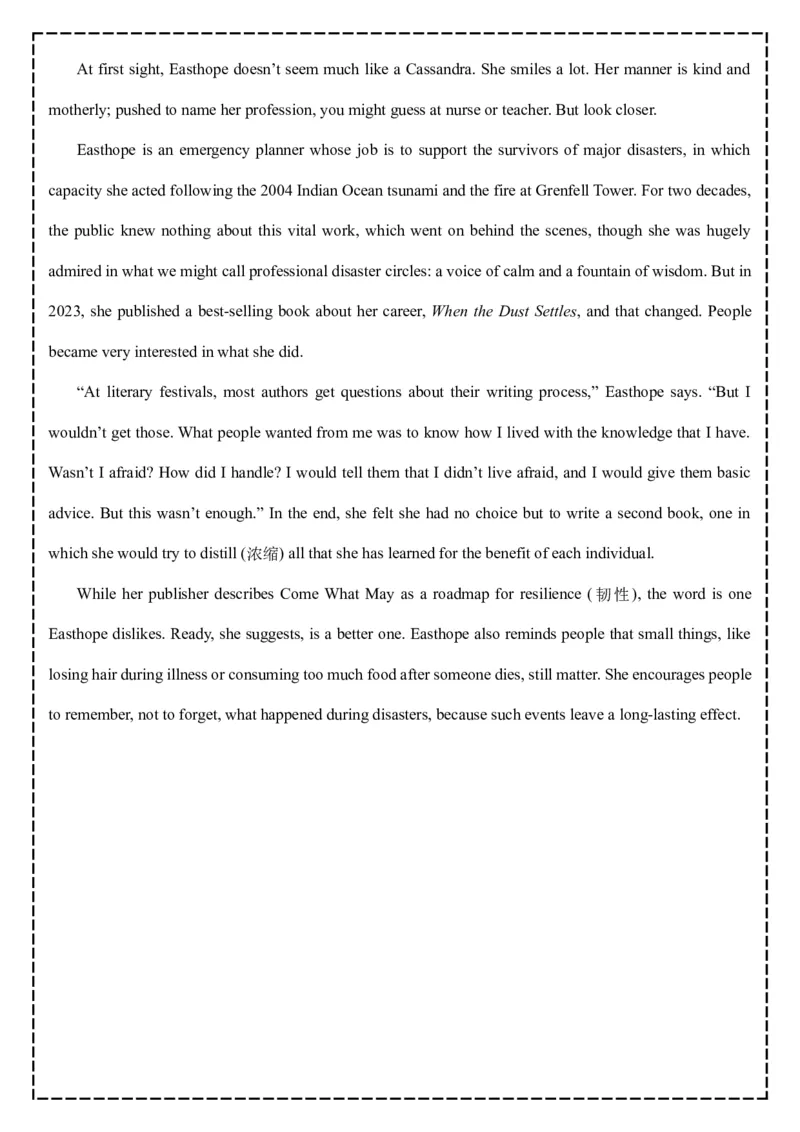
At first sight, Easthope doesn’t seem much like a Cassandra. She smiles a lot. Her manner is kind and
motherly; pushed to name her profession, you might guess at nurse or teacher. But look closer.
Easthope is an emergency planner whose job is to support the survivors of major disasters, in which
capacity she acted following the 2004 Indian Ocean tsunami and the fire at Grenfell Tower. For two decades,
the public knew nothing about this vital work, which went on behind the scenes, though she was hugely
admired in what we might call professional disaster circles: a voice of calm and a fountain of wisdom. But in
2023, she published a best-selling book about her career, When the Dust Settles, and that changed. People
became very interested in what she did.
“At literary festivals, most authors get questions about their writing process,” Easthope says. “But I
wouldn’t get those. What people wanted from me was to know how I lived with the knowledge that I have.
Wasn’t I afraid? How did I handle? I would tell them that I didn’t live afraid, and I would give them basic
advice. But this wasn’t enough.” In the end, she felt she had no choice but to write a second book, one in
which she would try to distill (浓缩) all that she has learned for the benefit of each individual.
While her publisher describes Come What May as a roadmap for resilience ( 韧性), the word is one
Easthope dislikes. Ready, she suggests, is a better one. Easthope also reminds people that small things, like
losing hair during illness or consuming too much food after someone dies, still matter. She encourages people
to remember, not to forget, what happened during disasters, because such events leave a long-lasting effect.
24. What does the reference to "Cassandra" in paragraph 1 suggest about Easthope?
A. She gives warnings that are often ignored.
B. She appears more serious than she actually is.
C. Her professional image contradicts her gentle appearance.
D. Her predictions about disasters have proven accurate.
25. What caused public attention to Easthope's work in 2023?
A. The success of her published book.
B. Her increased media exposure.
C. Her participation in tsunami relief efforts.
D. Her recognition in professional circles.
26. Why does the author mention readers' questions in paragraph 3?
A. To show public curiosity about her personal life.
B. To explain why she decided to write another book.
C. To demonstrate her writing techniques.
D. To highlight people's doubts about her work.
27. Which statement best reflects Easthope's view on disaster response?
A. Mental strength is the key to recovery.
B. Traditional methods are most effective.
C. Professional help is essential for victims.
D. Practical preparation should be prioritized.
With a surface hot enough to melt lead in its atmosphere, Venus has been described as “Earth’s evil
twin” — similar in size, yet worlds apart. The question of whether Venus was ever habitable has long been a
hot topic among scientists. Some astronomers believe the planet was once much more hospitable, but a recent
research by Tereza Constantinou, a PhD student from the University of Cambridge, has now dealt a blow to
the idea that it ever hosted life as we know it.
Constantinou noted that early in the formation of Venus, the planet was covered in a vast sea of magma
(岩浆). If this cooled quickly, water would form oceans or be trapped as it crystallised (结晶), meaning the
planet’s interior (内部) would be water-rich. As a result, water would be released when volcanoes erupt. “If
you look at any photos of volcanism on Earth, you can see these large clouds coming out. Most of that is
water,” said Constantinou. But if the magma cooled slowly, water would have ended up as steam in the
atmosphere. In this situation, water would not be trapped inside the interior of the planet.
Constantinou and his colleagues studied changes in the Venusian atmosphere to cast light on the water
content of its interior. When they analysed the amount of substances being refilled, they found very little water
was being added. In other words, volcanic eruptions are “dry”. “The shortage of water in volcanic release
reflects an equally dry Venusian interior,” said Constantinou. The team announced that their findings did not
support the theory that Venus had surface oceans of water in its past, or a habitable climate.
Their conclusion could soon be tested. Later this decade, NASA is set to launch a mission to carry out
fly-bys of Venus. Constantinou said resolving the question could help astronomers rule out Venus as a
habitable planet now that the dry interior of Venus suggests it never has the oceans of liquid water traditionally
thought necessary for life to begin.
28. What is the main conclusion of Constantinou's research?
A. Venus is geologically similar to Earth.
B. The study offers new insights into planetary formation.
C. Venus probably never supported life.
D. Venus once had abundant surface water.
29. What is the primary focus of paragraph 2?
A. The geological history of Venus.
B. The volcanic activity on Venus.
C. How water might have formed on Venus.
D. How Venus's atmosphere has changed over time.
30. How did the research team investigate Venus's water content?
A. By studying water composition.
B. By comparing Venus with other planets.
C. By analyzing volcanic rock samples.
D. By measuring atmospheric changes.
31. According to the text, what practical value might this research have?
A. Helping design future space missions.
B. Aiding the search for habitable planets.
C. Improving climate change models.
D. Predicting volcanic activity on Earth.
Quick: what’s your best friend’s phone number? Don’t feel bad if you couldn’t answer off the top of your
head. You have no reason to commit phone numbers to memory: it’s just there in your phone. Or perhaps you
once had a phone book to store them. In either case, an object does the remembering for you.
“Prosthetic memory” (人工记忆) is nothing new. Writing itself has been a means of storing information.
Yet the information revolution has generated more data than ever before. We are flooded with information.
We’re creating more of it, and keeping more of it, The storage capacity of the human brain has since been
eclipsed. No wonder, then, that we’re increasingly dependent on memory prostheses, from libraries to
smartphones.
Not everyone thinks this trend in external memory is good. Historically, memory prostheses were
expensive. As technologies such as printing and photography become more affordable, sharing experiences
with others is easier than ever. So every breakfast, every sunset, every encounter with a cat finds its way on to
social media. And here comes the worry. When we devote ourselves to capturing and sharing the world in this
way, something immensely valuable is lost; when recording so much of our lives, we’re forgetting to actually
live them. We put something between ourselves and the world-a camera-instead of just being in the moment,
and so disconnect ourselves from experience.
But is our social media-driven transformation wholly bad? If we’re still creating and sharing memories
like this, perhaps this is because we’ve not had sufficient time to learn how to do these things without thinking
about what we’re doing. It is easy to ignore that the mass social media era is less than a decade old. That’s just
a short blink (眨眼)in human history, yet it has totally changed how we live. I suspect we’re not far off from
being directly faced with experience yet with the ability to share experience in ways less bounded by
geography and time. After all, technology can do what our fragile meat-computers can’t: protect all the
moments of a life that would otherwise be lost.
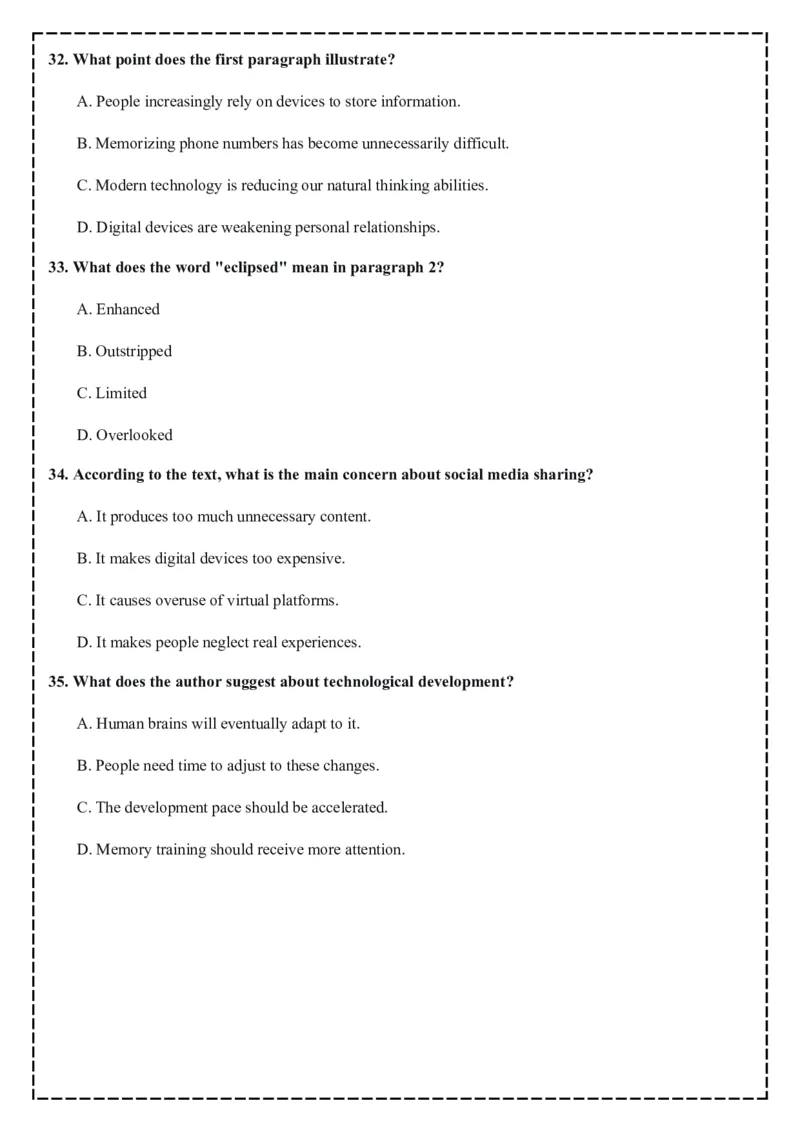
32. What point does the first paragraph illustrate?
A. People increasingly rely on devices to store information.
B. Memorizing phone numbers has become unnecessarily difficult.
C. Modern technology is reducing our natural thinking abilities.
D. Digital devices are weakening personal relationships.
33. What does the word "eclipsed" mean in paragraph 2?
A. Enhanced
B. Outstripped
C. Limited
D. Overlooked
34. According to the text, what is the main concern about social media sharing?
A. It produces too much unnecessary content.
B. It makes digital devices too expensive.
C. It causes overuse of virtual platforms.
D. It makes people neglect real experiences.
35. What does the author suggest about technological development?
A. Human brains will eventually adapt to it.
B. People need time to adjust to these changes.
C. The development pace should be accelerated.
D. Memory training should receive more attention.
I vividly remember the process of moving in for the first time: stuffing clothes, comfort items, and pieces
of my childhood into various bags and boxes. It was a whirlwind of excitement. __36__ What would it be like
living at college? Would I get along with my roommate? How would I make friends with complete
strangers?
__37__ I had always felt like I struggled more than others to find “my people.” In high school, I had a
few close friends, but it always seemed like everyone else had these big, inseparable friend groups. I wanted
that sense of belonging, too.
Like many, I was drawn to the first people I met in college. _38___ We lived next to each other, ate
together, and stayed up late talking. They brought laughter, growth, and memories — both good and bad.
Those highs and lows taught me something important: not every friendship is meant to last forever, and that’s
okay.
Your friendships don’t just shape your social life — they influence your motivation, your studies, and
even how you see yourself. I’ve learned how valuable it is to be around people who share my values and keep
me grounded. ___39_ Still, college is one of the few times you’re surrounded by people from wildly different
backgrounds. Keeping an open mind is just as essential as finding common interests.
College can be, and probably will be, a little chaotic. People come and go. You might even cry over
friendships that fade away. __40__ That’s all part of the journey. In time, you will find your people.
A. They remain a part of your story.
B. But there was also a lot of uncertainty.
C. I wouldn’t trade those early connections for anything.
D. As it turned out, they were mostly living on the same floor as me.
E. Even so, it’s important not to only stick with people similar to you.
F. You might find yourself smiling at memories with people you’ve grown apart from
G. Among all these worries, the last one weighed on my mind the most.
Hillary Krieger was sitting in her parents’ house with her friend, David. The man accidentally squirted
orange juice all over himself. "I shouted, ‘Oh, the orange just orbiculated,’" she later recalls. David was thrown
into confusion, "It did what?"
Curious herself, Hillary quickly grabbed a dictionary and turned to the "O" section — only to freeze. The
word was nowhere to be found. In disbelief, she marched into her father’s study. Wearing an awkward smile,
he admitted he’d invented the word back in college, never imagining it would stick— yet he’d used it naturally
around the family for years and everyone had assumed it was real.
At first, Hillary felt frustrated, wondering how many other make-up words had slipped into her vocabulary
without her noticing. But that frustration faded fast. Soon, she began to see "orbiculate" not as a mistake, but
as a gift— a small window into her father’s inventive soul. "It speaks to his creativity," she believes. "Even
when something is annoying-like orange juice in your eye — he found a way to laugh at it, turning a messy
moment into something fun."
Two decades later, Hillary’s father passed away. Sorrow settled over her, but so did determination:
"Orbiculate" deserved a place in the dictionary. Her goal wasn’t just to get a word defined; it was to keep her
father’s joy alive. This, she thought, was the best way to honor him.
41. What is the main purpose of the passage?
A. To discuss the history of dictionary making
B. To tell a story about a made-up word and its emotional significance
C. To explain how to create new words in English
D. To describe a funny incident between friends
42. How did Hillary's father expect the word "orbiculate" to be received when he first created it?
A. He thought it would become widely popular
B. He hoped it would be added to the dictionary
C. He never expected people to continue using it
D. He wanted to teach it to his linguistics class
43. Which of the following best describes the change in Hillary's attitude toward the word?
A. From confusion to understanding
B. From anger to forgiveness
C. From embarrassment to pride
D. From frustration to appreciation
44. What does the word "orbiculate" represent to Hillary after her father's death?
A. A scientific term needing proper definition
B. A connection to her father's creative spirit
C. A mistake that needs correction
D. A funny memory with her friend David
As temperatures rise across China, a new trend is taking hold. Outdoor sports are drawing citizens out of
gyms           45           test their physical limits and reconnect with nature.
One standout in this trend, the Spartan Race, has become increasingly           46           (popular) in many
Chinese cities. So far, the race, with           47           (it) challenging routes and various obstacles,           48
(gain)significant attention online. Last month, the Spartan China series           49           (hold) in Changchun
while on October 16-17, the Spartan Kids World Championship will be organized          50        the second
time at Yunding Snow Park.
Each event requires participants           51          (complete) distances from 5 to 50 kilometers, facing
some           52          (extreme) difficult obstacles. In practice, the race involves climbing, hanging, and carrying
sandbags, representing          53          complete return to nature from indoor gyms.
Liu Mingyi, chief expert at the China Youth Sports Center, stated that the popularity of outdoor running
competitions is hardly accidental. "In the past, people preferred indoor activities,          54          (focus) on
gym workouts. Now, there's an increasing desire to escape urban environments," Liu commented. "These
events provide not only physical challenges but also a profound connection with the natural world."
答案与解析
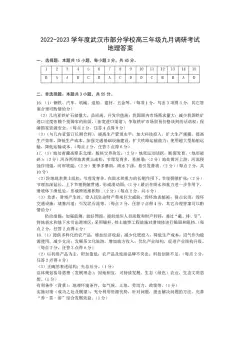
【答案】21. A   22. A    23. B
21 题详解:细节理解题。根据TRAVEL TALES 部分中“short fiction between 1,500 and 1,700 words
that in some way involves travel(短篇小说需在1500-1700 字之间,并以某种方式涉及旅行)”可
知,该比赛明确要求作品必须包含旅行主题。其他比赛均无此特定要求。故选A。
22 题详解: 细节理解题。订阅者参加两个比赛的最低费用组合:选择参赛费最低的两个比赛。除
GRAND FLASH 2025 外,其他三个比赛的订阅者费用均为£6。因此最低费用为£6 + £6 =
£12。故选A。
23 题详解:细节理解题。根据NATURAL WORLD 部分中“Prose fiction and narrative non-fiction(散
文体小说与叙事性非虚构作品)”可知,该比赛接受非虚构作品投稿。而其他三个比赛
(TRAVEL TALES、CROSS-GENERATION FRIENDS、GRAND FLASH 2025)均只接受虚构类
作品。由此可知,NATURAL WORLD 与其他比赛的区别在于它接受非虚构作品。故选B。
【答案】24. C   25. A   26. B   27.D
24 题详解:推理判断题。通过第一段中Easthope" smiles a lot"和"kind and motherly"的外表描述,与
Cassandra 形象的对比,以及"but look closer"的转折,表明她温柔的外表与严肃的职业形象形成对
比。选项C 准确抓住了这种表面与实质的反差关系。
25 题详解:细节理解题。根据第二段最后两句"But in 2023...that changed. People became very interested
in what she did"明确说明,2023 年出版的畅销书直接引发了公众对她工作的关注。选项A 与此完
全吻合。
26 题详解:推理判断题。第三段通过读者问题表明,人们更关心她如何应对专业知识,而她的基本
建议不够充分,这直接导致她决定写第二本书来提炼所有知识。选项B 准确反映了这个因果关
系。
27 题详解:细节理解题。最后段明确说明Easthope 不喜欢"韧性"这个词,认为"准备"是更好的选择,
同时强调关注小事的重要性。这显示她最强调的是实际准备工作,因此选项D 最符合文意。
【答案】 28. C    29. A     30. D      31. B
【解析】
28 题详解:细节理解题。根据第一段最后一句"a recent research...has now dealt a blow to the idea
that it ever hosted life"和第三段最后一句"their findings did not support the theory that Venus had...a
habitable climate"可知,研究的主要结论是金星不太可能曾经存在生命。故选C。
29 题详解:段落主旨题。第二段主要讨论了金星早期形成时的地质状况,包括岩浆海洋的冷却方式
如何影响水的分布,属于金星地质历史的范畴。故选A。
30 题详解:细节理解题。根据第三段首句"studied changes in the Venusian atmosphere to cast light on
the water content of its interior"可知,研究团队通过分析金星大气的变化来推断其内部含水量。故
选D。
31 题详解:推理判断题。根据最后一段"resolving the question could help astronomers rule out Venus as
a habitable planet"可知,这项研究有助于天文学家在寻找宜居行星时排除金星,从而缩小搜索范
围。故选B。
【答案】 32. A    33. B    34. D    35. B
【解析】
32 题详解:推理判断题。第一段通过"an object does the remembering for you"等表述,说明人们越来
越依赖外部设备来存储信息。故选A。
33 题详解:词义猜测题。根据第二段"The storage capacity of the human brain has since been
eclipsed"的上下文,提到信息革命产生大量数据,人脑存储能力已被"超越"。故选B。
34 题详解:细节理解题。第三段明确指出"when recording so much of our lives, we're forgetting to
actually live them",表明过度分享导致人们忽视真实体验。故选D。
35 题详解:观点态度题。最后段提到"we've not had sufficient time to learn how to do these things",说
明作者认为人们需要时间来适应这些变化。故选B。
【答案】36. B   37. G    38. D   39. E   40. F
【解析】
36. B 解析:第一段描述了搬入大学时的兴奋感,但空格后提出了几个关于大学生活、室友和交朋友
的问题,体现了不确定性的情绪。选项B“But there was also a lot of uncertainty.”(但也有很多不
确定性)恰好承接了兴奋感并引入下文的问题,因此为正确答案。
37. G 解析:第二段开头空格后提到作者总是觉得比别人更难找到“自己的人”,并回忆了高中时期
的交友经历。空格前是第一段结尾的几个问题,其中最后一个问题是关于如何与陌生人交朋友。
选项G“ Among all these worries, the last one weighed on my mind the most.”(在所有这些问题中,
最后一个最让我困扰)承上启下,强调了交朋友问题的担忧,因此为正确答案。
38. D 解析:第三段开头提到作者被最初遇到的人吸引,空格后描述了与他们一起生活、吃饭、熬夜
的经历。选项D“As it turned out, they were mostly living on the same floor as me.”(结果,他们大
多和我住在同一层楼)解释了这些人的身份,与上下文逻辑一致,因此为正确答案。
39. E 解析:第四段空格前提到与有共同价值观的人在一起很重要,但空格后指出大学里有很多不同
背景的人,保持开放心态很重要。选项E“ Even so, it’s important not to only stick with people
similar to you.”(即使如此,不要只坚持和相似的人在一起很重要)起到了转折作用,连接了前
后文,因此为正确答案。
40. F 解析:第五段空格前提到大学混乱、人来人往,可能为逝去的友谊哭泣,空格后说这都是旅程
的一部分。选项F“ You might find yourself smiling at memories with people you’ve grown apart
from”(你可能会发现自己对已经疏远的人的记忆微笑)体现了对过去友谊的接受和回忆,与下
文“That’s all part of the journey”呼应,因此为正确答案。
【答案】41. B   42. C   43. D  44. B
41. B (主旨大意题)  解析:文章通过"orbiculate"这个自创词,讲述了一段关于父亲创造力、家庭情感
传承和缅怀亲人的故事。选项A 和C 过于片面,只涉及字典或造词本身;选项D 只提到朋友间
的趣事,未能涵盖文章后半段的情感深度。全文真正主旨是通过这个特殊的词展现父女之间的
情感联系和永恒纪念。
42. C (细节理解题)解析:第二段明确提到"never imagining it would stick",说明父亲从未预料这个词
会流传下来。选项A、B 与文中"never imagining"相矛盾;选项D 文中未提及。此题关键在准确
理解"stick"在此处的含义(持续使用、流传)。
43. D (观点态度题)解析:第三段清晰展现了Hillary 的情感变化轨迹:开始时"felt frustrated"(沮丧)
但很快"frustration faded",最后将这个词视为"a gift"(礼物),说明其态度转变为欣赏和珍惜。
选项A 中的"confusion"是David 的反应;选项B 的"anger"和"forgiveness"程度过重;选项C
的"pride"不准确,文中更多体现的是理解和珍惜。
44. B (推理判断题)解析:文章最后两段表明,对Hillary 而言,"orbiculate"已成为连接父亲精神世界
的纽带("a small window into her father's inventive soul"),她希望这个词被字典收录是为了"keep
her father's joy alive"(让父亲的快乐永存)。选项A 过于字面理解;选项C 与文章情感相悖;选
项D 只涉及表面记忆,未能体现深层情感价值。
【答案与解析】
45. to 考查不定式作目的状语。表示户外运动吸引人们走出健身房的目的。
46. popular 考查词性转换。become 后接形容词作表语,表示"变得越来越受欢迎"。
47. its 考查物主代词。修饰名词routes 需要用所有格形式,指代"这项比赛的"。
48.has gained 考查现在完成时。根据时间状语so far 确定用现在完成时,表示从过去持续到现在
的关注度。
49. was held 考查动词时态和语态。根据时间状语last month 确定用过去时,且赛事与举办之间是
被动关系。
50. for 考查固定搭配。for the second time 表示"第二次"。
51.to complete 考查固定搭配。require somebody to do something。
52.extremely 考查副词。修饰形容词difficult 需要用副词形式。
53. a 考查冠词。return 在这里是可数名词,表示"一种回归"。
54. focusing 考查非谓语动词。现在分词短语作伴随状语,说明人们偏爱室内活动时的具体行为。