文档文本内容
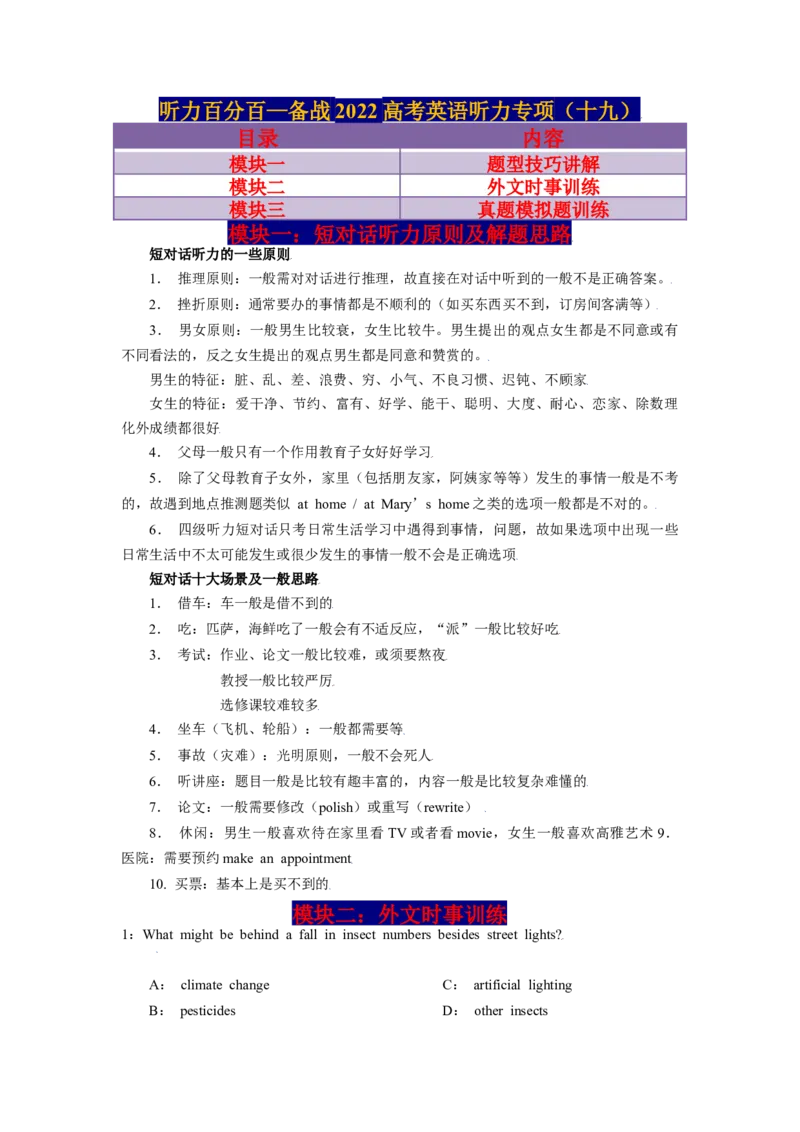
听力百分百—备战 2022 高考英语听力专项(十九)
目录 内容
模块一 题型技巧讲解
模块二 外文时事训练
模块三 真题模拟题训练
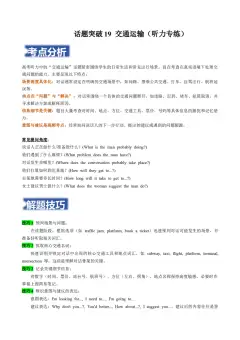
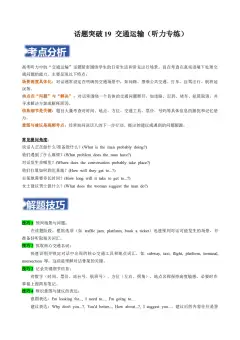
模块一:短对话听力原则及解题思路
短对话听力的一些原则
1. 推理原则:一般需对对话进行推理,故直接在对话中听到的一般不是正确答案。
2. 挫折原则:通常要办的事情都是不顺利的(如买东西买不到,订房间客满等)
3. 男女原则:一般男生比较衰,女生比较牛。男生提出的观点女生都是不同意或有
不同看法的,反之女生提出的观点男生都是同意和赞赏的。
男生的特征:脏、乱、差、浪费、穷、小气、不良习惯、迟钝、不顾家
女生的特征:爱干净、节约、富有、好学、能干、聪明、大度、耐心、恋家、除数理
化外成绩都很好
4. 父母一般只有一个作用教育子女好好学习
5. 除了父母教育子女外,家里(包括朋友家,阿姨家等等)发生的事情一般是不考
的,故遇到地点推测题类似 at home / at Mary’s home之类的选项一般都是不对的。
6. 四级听力短对话只考日常生活学习中遇得到事情,问题,故如果选项中出现一些
日常生活中不太可能发生或很少发生的事情一般不会是正确选项
短对话十大场景及一般思路
1. 借车:车一般是借不到的
2. 吃:匹萨,海鲜吃了一般会有不适反应,“派”一般比较好吃
3. 考试:作业、论文一般比较难,或须要熬夜
教授一般比较严厉
选修课较难较多
4. 坐车(飞机、轮船):一般都需要等
5. 事故(灾难):光明原则,一般不会死人
6. 听讲座:题目一般是比较有趣丰富的,内容一般是比较复杂难懂的
7. 论文:一般需要修改(polish)或重写(rewrite)
8. 休闲:男生一般喜欢待在家里看 TV或者看movie,女生一般喜欢高雅艺术 9.
医院:需要预约make an appointment
10. 买票:基本上是买不到的
模块二:外文时事训练
1:What might be behind a fall in insect numbers besides street lights?
A: climate change C: artificial lighting
B: pesticides D: other insects2:What colour light is causing a decline in insect numbers?
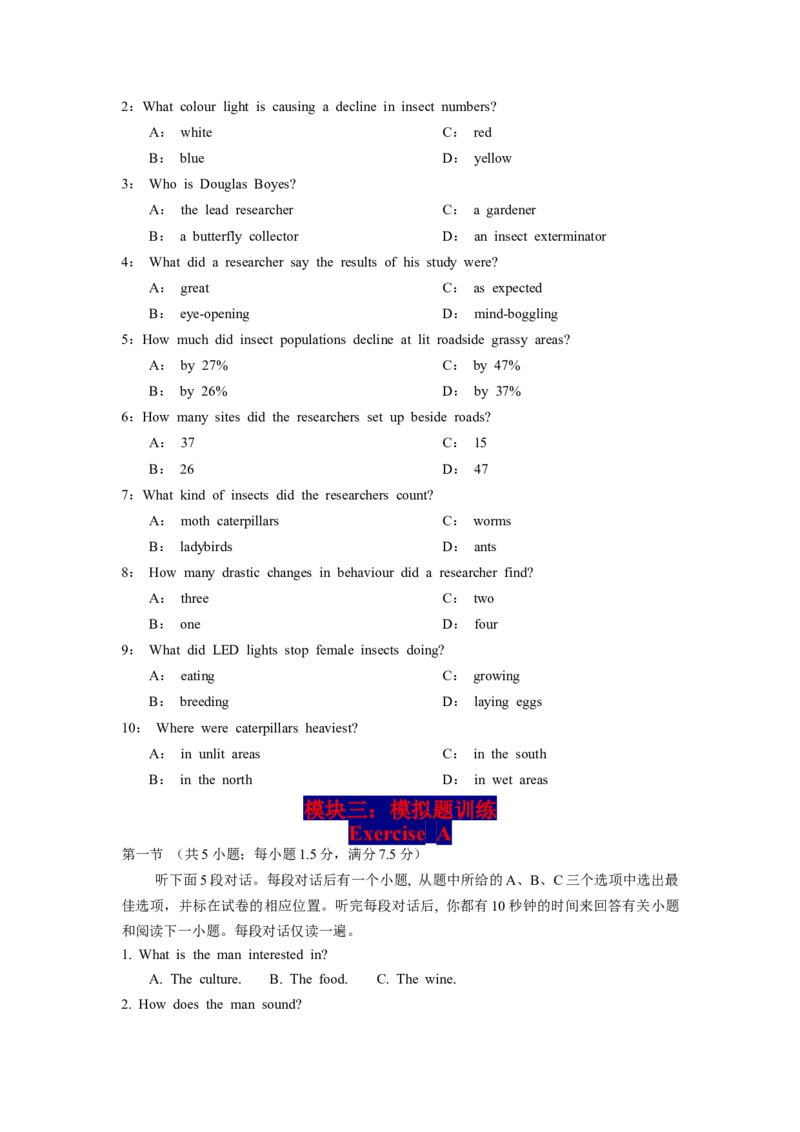
A: white C: red
B: blue D: yellow
3: Who is Douglas Boyes?
A: the lead researcher C: a gardener
B: a butterfly collector D: an insect exterminator
4: What did a researcher say the results of his study were?
A: great C: as expected
B: eye-opening D: mind-boggling
5:How much did insect populations decline at lit roadside grassy areas?
A: by 27% C: by 47%
B: by 26% D: by 37%
6:How many sites did the researchers set up beside roads?
A: 37 C: 15
B: 26 D: 47
7:What kind of insects did the researchers count?
A: moth caterpillars C: worms
B: ladybirds D: ants
8: How many drastic changes in behaviour did a researcher find?
A: three C: two
B: one D: four
9: What did LED lights stop female insects doing?
A: eating C: growing
B: breeding D: laying eggs
10: Where were caterpillars heaviest?
A: in unlit areas C: in the south
B: in the north D: in wet areas
模块三:模拟题训练
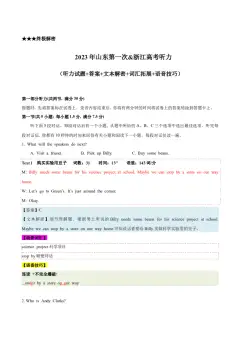
Exercise A
第一节 (共5小题;每小题1.5分,满分7.5分)
听下面5段对话。每段对话后有一个小题, 从题中所给的A、B、C三个选项中选出最
佳选项,并标在试卷的相应位置。听完每段对话后, 你都有10秒钟的时间来回答有关小题
和阅读下一小题。每段对话仅读一遍。
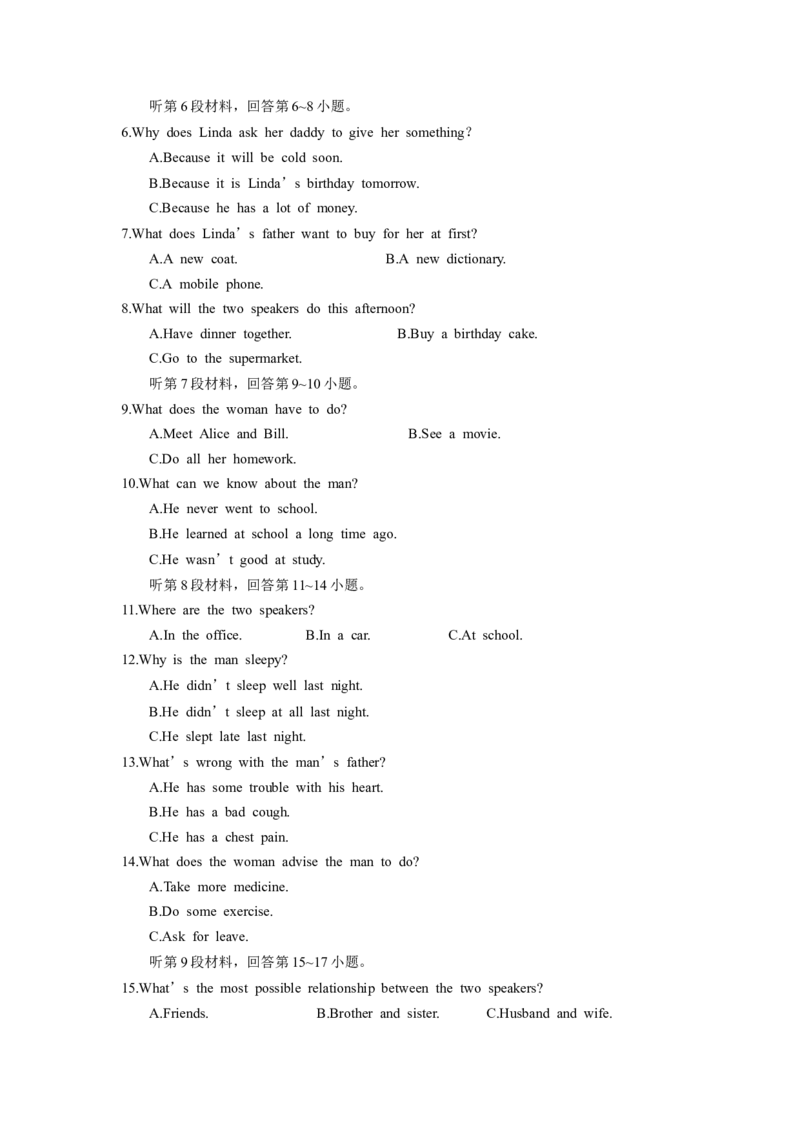
1. What is the man interested in?
A. The culture. B. The food. C. The wine.
2. How does the man sound?A. Sad. B. Excited. C. Disappointed.
3. What does the woman mainly want to do?
A. Go shopping. B. Save money. C. Buy a new house.
4. When will the man watch the movie?
A. This Friday. B. This Saturday. C. Next Tuesday.
5. Where are the speakers probably?
A. In a cinema. B. In a library. C. In a classroom.
第二节(共15小题;每小题1.5分,满分22.5分)
听下面5段对话或独白。每段对话或独白后有几个小题,从题中所给的A、B、C三个
选项中选出最佳选项,并标在试卷的相应位置。听每段对话或独白前,你将有时间阅读各
个小题,每小题5秒钟;听完后,各小题将给出5秒钟的作答时间。每段对话或独白读两
遍。
听第6段材料,回答第6、7题。
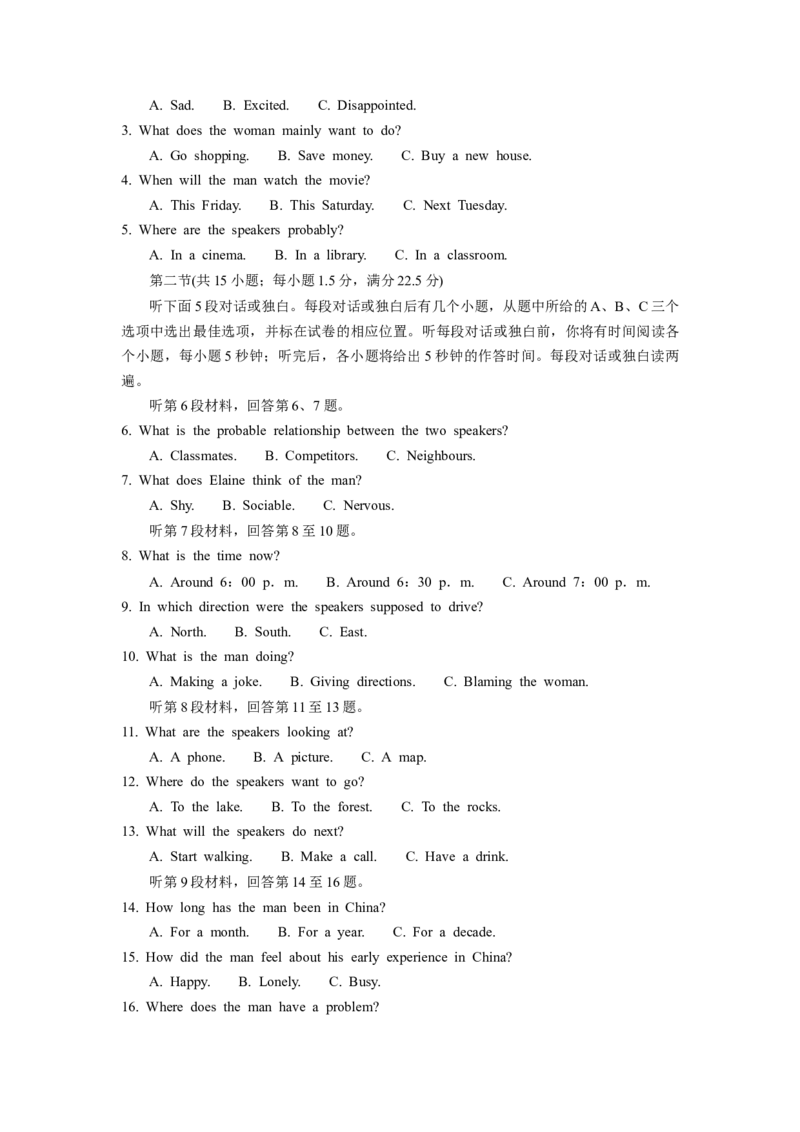
6. What is the probable relationship between the two speakers?
A. Classmates. B. Competitors. C. Neighbours.
7. What does Elaine think of the man?
A. Shy. B. Sociable. C. Nervous.
听第7段材料,回答第8至10题。
8. What is the time now?
A. Around 6:00 p.m. B. Around 6:30 p.m. C. Around 7:00 p.m.
9. In which direction were the speakers supposed to drive?
A. North. B. South. C. East.
10. What is the man doing?
A. Making a joke. B. Giving directions. C. Blaming the woman.
听第8段材料,回答第11至13题。
11. What are the speakers looking at?
A. A phone. B. A picture. C. A map.
12. Where do the speakers want to go?
A. To the lake. B. To the forest. C. To the rocks.
13. What will the speakers do next?
A. Start walking. B. Make a call. C. Have a drink.
听第9段材料,回答第14至16题。
14. How long has the man been in China?
A. For a month. B. For a year. C. For a decade.
15. How did the man feel about his early experience in China?
A. Happy. B. Lonely. C. Busy.
16. Where does the man have a problem?A. At the hairdresser's. B. At the shop. C. At the bank.
17. What does the woman suggest the man do for his main problem?
A. Take a note. B. Carry more money. C. Consult a Chinese.
听第10段材料,回答第18至20题。
18. What is the age difference between the couple?
A. One year. B. Two years. C. Three years.
19. How did the couple's daughter feel after seeing the film?
A. Amused. B. Moved. C. Uninterested.
20. What is the story about?
A. The film industry in the 1960s.
B. Wedding traditions in the 1960s.
C. The discovery of a wedding film in the 1960s.
Exercise B
第一节 (共5小题;每小题1.5分,满分7.5分)
第一节(共5小题;每小题1.5分,满分7.5分)
听下面5段对话。每段对话后有一个小题,从题中所给的A、B、C三个选项 中选出
最佳选项。听完每段对话后,你都有10秒钟的时间来回答有关小题和阅读下 一小题。每
段对话仅读一遍。
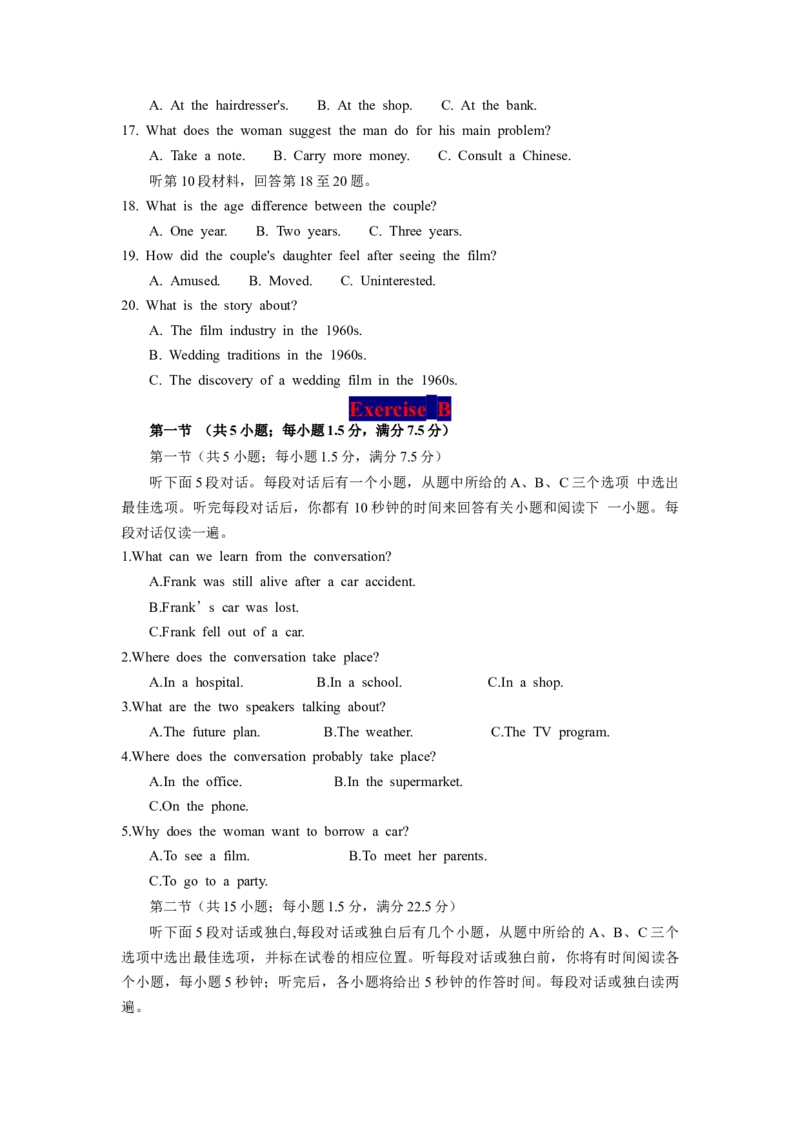
1.What can we learn from the conversation?
A.Frank was still alive after a car accident.
B.Frank’s car was lost.
C.Frank fell out of a car.
2.Where does the conversation take place?
A.In a hospital. B.In a school. C.In a shop.
3.What are the two speakers talking about?
A.The future plan. B.The weather. C.The TV program.
4.Where does the conversation probably take place?
A.In the office. B.In the supermarket.
C.On the phone.
5.Why does the woman want to borrow a car?
A.To see a film. B.To meet her parents.
C.To go to a party.
第二节(共15小题;每小题1.5分,满分22.5分)
听下面5段对话或独白,每段对话或独白后有几个小题,从题中所给的A、B、C三个
选项中选出最佳选项,并标在试卷的相应位置。听每段对话或独白前,你将有时间阅读各
个小题,每小题5秒钟;听完后,各小题将给出5秒钟的作答时间。每段对话或独白读两
遍。听第6段材料,回答第6~8小题。
6.Why does Linda ask her daddy to give her something?
A.Because it will be cold soon.
B.Because it is Linda’s birthday tomorrow.
C.Because he has a lot of money.
7.What does Linda’s father want to buy for her at first?
A.A new coat. B.A new dictionary.
C.A mobile phone.
8.What will the two speakers do this afternoon?
A.Have dinner together. B.Buy a birthday cake.
C.Go to the supermarket.
听第7段材料,回答第9~10小题。
9.What does the woman have to do?
A.Meet Alice and Bill. B.See a movie.
C.Do all her homework.
10.What can we know about the man?
A.He never went to school.
B.He learned at school a long time ago.
C.He wasn’t good at study.
听第8段材料,回答第11~14小题。
11.Where are the two speakers?
A.In the office. B.In a car. C.At school.
12.Why is the man sleepy?
A.He didn’t sleep well last night.
B.He didn’t sleep at all last night.
C.He slept late last night.
13.What’s wrong with the man’s father?
A.He has some trouble with his heart.
B.He has a bad cough.
C.He has a chest pain.
14.What does the woman advise the man to do?
A.Take more medicine.
B.Do some exercise.
C.Ask for leave.
听第9段材料,回答第15~17小题。
15.What’s the most possible relationship between the two speakers?
A.Friends. B.Brother and sister. C.Husband and wife.16.How long did the man stay in Hong Kong?
A.10 days. B.15 days. C.20 days.
17.Why couldn’t the woman get in touch with the man when he was in Hong Kong?
A.Because he didn’t have a telephone.
B.Because his telephone number was changed.
C.Because he didn’t want to answer her call.
听第10段材料,回答第18~20小题。
18.What did Rosemary’s father do that day?
A.He went out to look for his wife.
B.He prepared meals for his parents.
C.He took his wife to the hospital.
19.What happened to Rosemary?
A.She lost her parents.
B.She lost her hands.
C.She lost her legs.
20.Which of the following words can be used to describe Rosemary?
A.Dependent. B.Beautiful. C.Independent.
Exercise C
第一节(共5小题;每题1.5分,满分7.5分)
听下面5段对话。每段对话后有一个小题,从题中所给的A、B、C三个选项中选出最
佳选项,并标在试卷的相应位置。听完每段对话后,你都有10秒钟的时间来回答有关小题和
阅读下一小题。每段对话仅读一遍。
1. Who is having a holiday abroad?
A. Jack. B. Mike. C. John.
2. What does the man think of the lecture?
A. Boring. B. Unimportant. C. Popular.
3. What will the woman do?
A. Clean the sitting room. B. Do some gardening. C. Make a snowman.
4. Where does the conversation probably take place?
A. At a bus station. B. At a train station. C. At an airport,
5. What does the woman like doing on sunny days?
A. Being with friends. B. Exploring the city. C. Watching movies.
第二节(共15小题;每小题1分,满分15分)
听下面5段对话或独白。每段对话或独白后有几个小题,从题中所给的 A、B、C三个
选项中选出最佳选项。听每段对话或独白前,你将有时间阅读各个小题,每小题 5秒钟;
听完后,各小题将给出5秒钟的作答时间。每段对话或独白读两遍。
听下面一段较长对话,回答以下小题。6. What does Jessica want to learn from Annie?
A. Biology. B. Sign language. C. Volleyball.
7. Who is Annie?
A. A teacher. B. A coach. C. A student.
听下面一段较长对话,回答以下小题。
8. Why does the woman refuse to go to Spain?
A. It is very far.
B. There are too many tourists.
C. The hotels there are too expensive.
9. Where are the speakers probably from?
A. America. B. Australia. C. France.
听下面一段较长对话,回答以下小题。
10. What does the woman offer to do for the man?
A. Make a cup of tea for him.
B. Lend him some salt.
C. Take him for treatment.
11. Where are the speakers?
A. In a taxi. B. On a road. C. At a hospital.
12. What did the woman plan to do?
A. Go shopping. B. Go to work. C. Go home.
听下面一段较长对话,回答以下小题。
13. When was Mei’s party held?
A. On Friday. B. On Saturday. C. On Sunday.
14. How was the weather on Saturday?
A. Sunny. B. Rainy. C. Windy.
15. What did the woman do on Saturday?
A. She washed her car.
B. She went for a picnic.
C. She watched a football game.
16. Where did the woman spend her Sunday afternoon?
A. At home. B. In her studio. C. In the gym.
听下面一段独白,回答以下小题。
17. What does Dr. Ro. do?
A. She is a nutritionist. B. She is a saleswoman. C. She is a researcher.
18. Which of the following food is important to a good diet?
A. Fruit. B. Burger with cheese. C. Much red meat.
19. Why preplanning is necessary to successful shopping?
A. It does not add much work.B. It saves time and money.
C. It means more choices.
20. What does the speaker mainly talk about?
A. How to choose fast food.
B. How to shop in the supermarket.
C. How to eat healthy on a budget.
Exercise D
第一节(共5小题;每小题1.5,分,满分7.5分)
听下面 5 段对话。每段对话后有一个小题,从题中所给的 A、B、C 三个选项中选出
最佳选项,并标在试卷的相应位置。听完每段对话后,你都有 10 秒钟的时间来回答有关
小题和阅读下一小题。每段对话仅读一遍。
1.Where will the woman probably go first?
A.To a shop. B.To a restaurant. C.To a post office.
2.Why was the woman so late?
A.Something went wrong with the bus.
B.She took somebody to hospital.
C.She didn’t catch the bus.
3.What are the two speakers doing?
A.Playing a ball game. B.Cheering for Oxford.
C.Watching a football match.
4.What did the man do last night?
A.He went to a school. B.He talked with his friend.
C.He saw a film on TV.
5.What does the man think of the woman?
A.She can make money. B.She doesn’t like money.
C.She’s careless with money.
第二节(共15小题;每小题1.5分,满分22.5分)
听下面5段对话或独白,每段对话或独白后有几个小题,从题中所给的A、B、C三个
选项中选出最佳选项,并标在试卷的相应位置。听每段对话或独白前,你将有时间阅读各
个小题,每小题5秒钟;听完后,各小题将给出5秒钟的作答时间。每段对话或独白读两
遍。
听第6段材料,回答第6~7小题。
6.Why did the man call for help?
A.Because the man lost his way home.
B.Because the man was too old to walk home.
C.Because the man was tired and unwilling to walk home.
7.Who is the woman?
A.The man’s wife. B.A policewoman.C.The man’s granddaughter.
听第7段材料,回答第8~10小题。
8.What are the two speakers?
A.They are foreigners.
B.They are teachers.
C.They are students.
9.What do the kids do with the boy from Brazil?
A.They excuse him. B.They hate him.
C.They welcome him.
10.What is rewarding according to the woman?
A.Her students’ praises for their teacher.
B.Her students’ progress in the end.
C.Her students’ efforts to catch up.
听第8段材料,回答第11~13小题。
11.What are the speakers talking about?
A.Mount Tai. B.Mount Hua. C.Mount Huang.
12.What can we learn about the man?
A.He reached the top of the mountain.
B.He stopped halfway.
C.He met many famous people.
13.What can we learn about the woman?
A.She doesn’t like climbing mountains.
B.She wants to climb the famous mountain,too.
C.She has been to the famous mountain before.
听第9段材料,回答第14~17小题。
14.What can we learn about the man?
A.He’s lost his way. B.He’s lost something. C.He’s going to the hospital.
15.Where does the man work?
A.In a town. B.In London. C.In a hospital.
16.Why does the man come to the town?
A.To do business. B.To have a holiday. C.To find a job.
17.Where are the speakers now?
A.On the way to the hospital.B.On the way to London. C.On the way to a town.
听第10段材料,回答第18~20小题。
18.When did the speaker buy his ticket?
A.Fourteen days ago. B.Thirteen days ago. C.On Monday morning.
19.How did the speaker go to the airport?
A.On a bus. B.In a car. C.On a train.20.What can we learn from the passage?
A.He had never been in a plane before.
B.He is often in a plane.
C.He had been in a plane only twice.