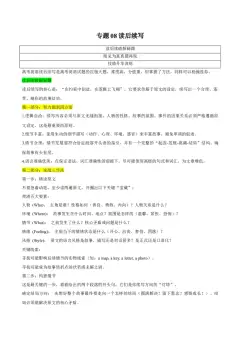
考点分析
话题突破08 语言学习(听力专练)

“语言学习”话题主要围绕以下几个方面展开:
学习方法与困难:讨论如何学习单词、语法、听说读写,以及遇到的困难(如发音、听力、口语表达等)。
课程与教师:谈论语言课程、课堂体验、对老师的评价。
学习资源与工具:涉及使用App、网站、书籍、电视、广播等工具辅助学习。
学习经历与动机:分享个人学习经历、学习某种语言的原因、学习时长等。
语言应用与体验:谈论在旅行、工作、面试等真实场景中使用外语的经历和挑战。
多语言能力:讨论会说几种语言,以及哪种语言更擅长。
“语言学习”话题可以覆盖所有高考听力题型,但最常见的是以下三种:
1. 主旨大意题
常见问法:
What are the speakers talking about?
What is the conversation mainly about?
What is the topic of the conversation?
解题技巧:
抓住反复出现的关键词,如 English, learn, study, language, grammar, vocabulary, pronunciation, teacher,
class 等。
关注对话的开头,通常第一句话就会点明话题。例如,当听到 “How did you improve your English so
quickly?” 时,基本可以确定主题是英语学习方法。
2. 细节信息题
常见问法:
What language is the woman studying now?
What does John find difficult in learning German?
How many languages can the woman speak?
What helped the woman most in learning foreign languages?
解题技巧:
提前阅读题干和选项,预测听力内容。如果看到选项是A. Math B. English C. Geography,就要集中注意
力听“正在讨论哪个科目”或“哪个科目有困难”。
边听边做笔记,特别是数字、名称、原因、方式等具体信息。
注意听清转折词(but, however)和强调词(the most, especially, the best),它们后面往往是答案所在。
例如:“I studied both in high school, but I think travel has probably been the most helpful.”
3. 推理判断题
常见问法:
解题技巧
语料总结
What can we infer from the conversation?
What is the probable relationship between the speakers?
How does the woman feel about the man’s suggestions?
Where does the conversation most probably take place?
解题技巧:
关系推断:注意称呼和语气。如果是 “Professor...”,很可能是师生;如果是 “Mom, I need help
with...”,则是母子。讨论课程、作业、老师,通常是同学或师生。
地点推断:如果对话中出现 “ class”, “homework”, “teacher”,场景可能是学校;如果提到
“interview”, “multinational company”,则可能与职场相关。
态度推断:注意说话人的语气是兴奋、赞同(“That’s helpful!”)、犹豫还是沮丧(“It’s too hard for
me”)。
技巧1  读:预判话题
在听力开始前,快速浏览问题和选项。例如,如果看到 “What does the man find difficult in
learning German?” 和选项 A. Pronunciation B. Vocabulary C. Grammar,你就要在听的时候特别留意关
于“困难”和这三个具体方面的描述。
技巧2  听:抓关键信息
首句原则:对话的第一句常常开宗明义。
信号词原则:重点关注:
转折词:but, however, yet, actually → 后面是真实意图或关键信息。
因果词:because, so, the reason is → 后面是原因或结果。
建议词:you should, why not, how about, I suggest → 后面是方法或解决方案。
强调词:the most important, especially, remember → 后面是核心内容。
技巧3  记:速记要点
用缩写或符号快速记下时间、地点、人物、原因等细节。比如记 “G gram hard” 表示 “德语语法
难”。
技巧4  答:排除干扰
听力材料中可能会出现多个相关信息,但只有一个能直接回答所问的问题。要排除片面信息或未提及
信息的干扰,选择那个最直接、最准确的答案。
高频词汇
核心概念
language learning / acquisition 语言学习 / 习得
target language 目标语言
native language / mother tongue 母语
foreign / second language 外语 / 第二语言
proficiency / fluency 熟练度 / 流利度
(language) skills / competence(语言)技能 / 能力
study abroad / overseas 出国留学
immersion environment 沉浸式环境
语言技能和知
识模块
四项核心
技能
listening comprehension 听力理解
speaking / oral english 口语
reading comprehension 阅读理解
writing 写作
translation 笔译
interpretation 口译
知识构成
grammar 语法
vocabulary / lexicon 词汇
pronunciation 发音
intonation 语调
sentence structure 句子结构
phrases & collocations 短语与搭配
idioms & slang 习语与俚语
学习过程与体
验
方法与活
动
practice / drill 练习 / 操练
memorize 记忆
review 复习
preview 预习
take notes 记笔记
rote learning 死记硬背
contextual learning 情境学习
watch movies with subtitles 看带字幕的电影
listen to podcasts / music 听播客 / 音乐
have a conversation 进行对话
language exchange 语言交换
shadowing 影子跟读法
think in English 用英语思考
use a dictionary / app 使用词典 / app
困难与挑
战
I’m struggling with... 我在...方面很吃力
I find it difficult to... 我觉得很难...
I have trouble/difficulty (in) V-ing... 我在...方面有困难
I can’t get my tongue around it. 我发不准这个音。
It’s a bit of a struggle. 有点费劲。
I’m stuck. 我被卡住了。
It’s beyond me. 这超出了我的能力。
It’s easier said than done. 说起来容易做起来难。
I don’t have a gift for languages. 我没有语言天赋。
It’s all Greek to me. 我完全不懂。(像天书一样)
进步与成
就
Make (great) progress 取得(很大)进步
Improve by leaps and bounds 进步神速
Have a good command of... 精通...
Come a long way 取得巨大进展
Break through a plateau 突破瓶颈
I’m getting the hang of it. 我渐渐掌握窍门了。
It’s starting to click. 开始开窍了。
I’ve finally cracked it! 我终于搞懂了!
I’m on a roll. 我进展得很顺利。
It’s paying off. 努力有回报了。
评价与感受
积极
helpful / useful 有帮助的 / 有用的
effective / efficient 有效的 / 高效的
practical 实用的
inspiring / motivating 鼓舞人心的 / 激励的
user-friendly 用户友好的
It’s a piece of cake. 小菜一碟。
It’s very rewarding. 很有成就感。
It’s a breeze. 很容易。
It’s my cup of tea. 这很合我的胃口/我喜欢。
消极
confusing / complicated 令人困惑的 / 复杂的
boring / dull 无聊的
frustrating / discouraging 令人沮丧的
time-consuming 耗时的
overwhelming 令人难以承受的
It’s a pain in the neck. 真让人头疼。
It’s driving me crazy/nuts. 快把我逼疯了。
It’s not my thing. 这不是我的菜/我不擅长。
课程与评估
course / class 课程
major / minor 主修 / 辅修
强化训练
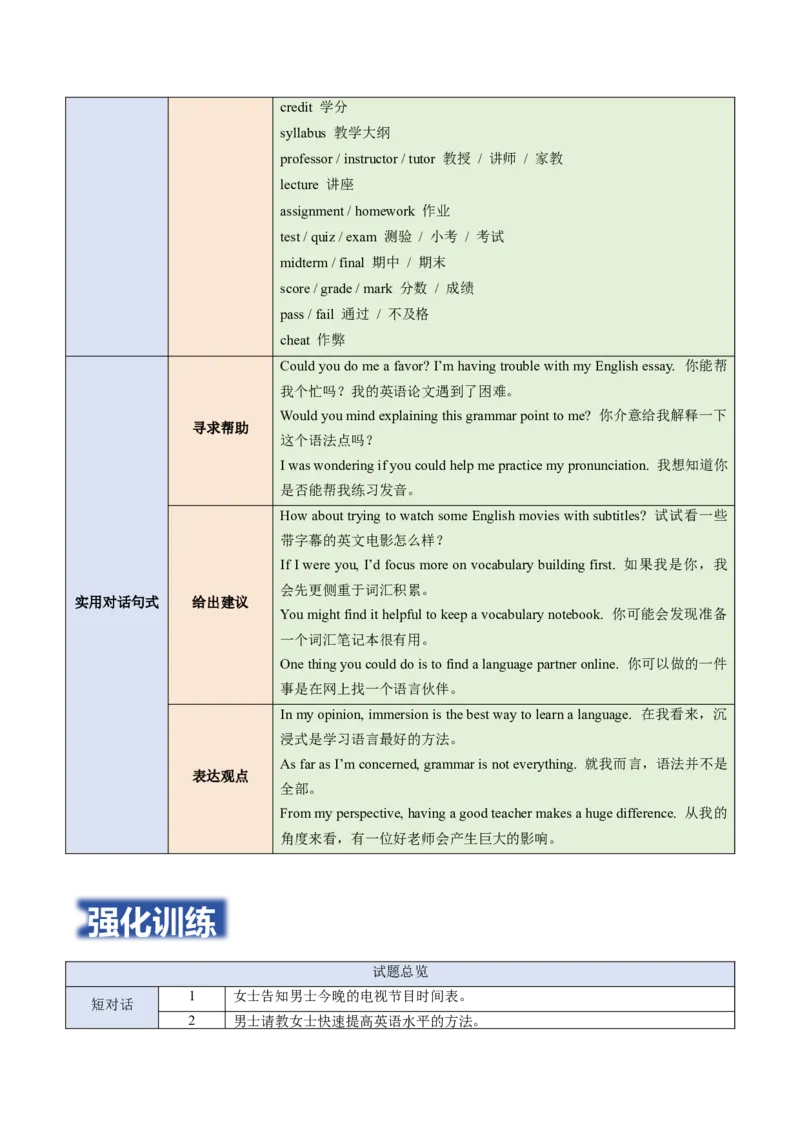
credit 学分
syllabus 教学大纲
professor / instructor / tutor 教授 / 讲师 / 家教
lecture 讲座
assignment / homework 作业
test / quiz / exam 测验 / 小考 / 考试
midterm / final 期中 / 期末
score / grade / mark 分数 / 成绩
pass / fail 通过 / 不及格
cheat 作弊
实用对话句式
寻求帮助
Could you do me a favor? I’m having trouble with my English essay. 你能帮
我个忙吗?我的英语论文遇到了困难。
Would you mind explaining this grammar point to me? 你介意给我解释一下
这个语法点吗?
I was wondering if you could help me practice my pronunciation. 我想知道你
是否能帮我练习发音。
给出建议
How about trying to watch some English movies with subtitles? 试试看一些
带字幕的英文电影怎么样?
If I were you, I’d focus more on vocabulary building first. 如果我是你,我
会先更侧重于词汇积累。
You might find it helpful to keep a vocabulary notebook. 你可能会发现准备
一个词汇笔记本很有用。
One thing you could do is to find a language partner online. 你可以做的一件
事是在网上找一个语言伙伴。
表达观点
In my opinion, immersion is the best way to learn a language. 在我看来,沉
浸式是学习语言最好的方法。
As far as I’m concerned, grammar is not everything. 就我而言,语法并不是
全部。
From my perspective, having a good teacher makes a huge difference. 从我的
角度来看,有一位好老师会产生巨大的影响。


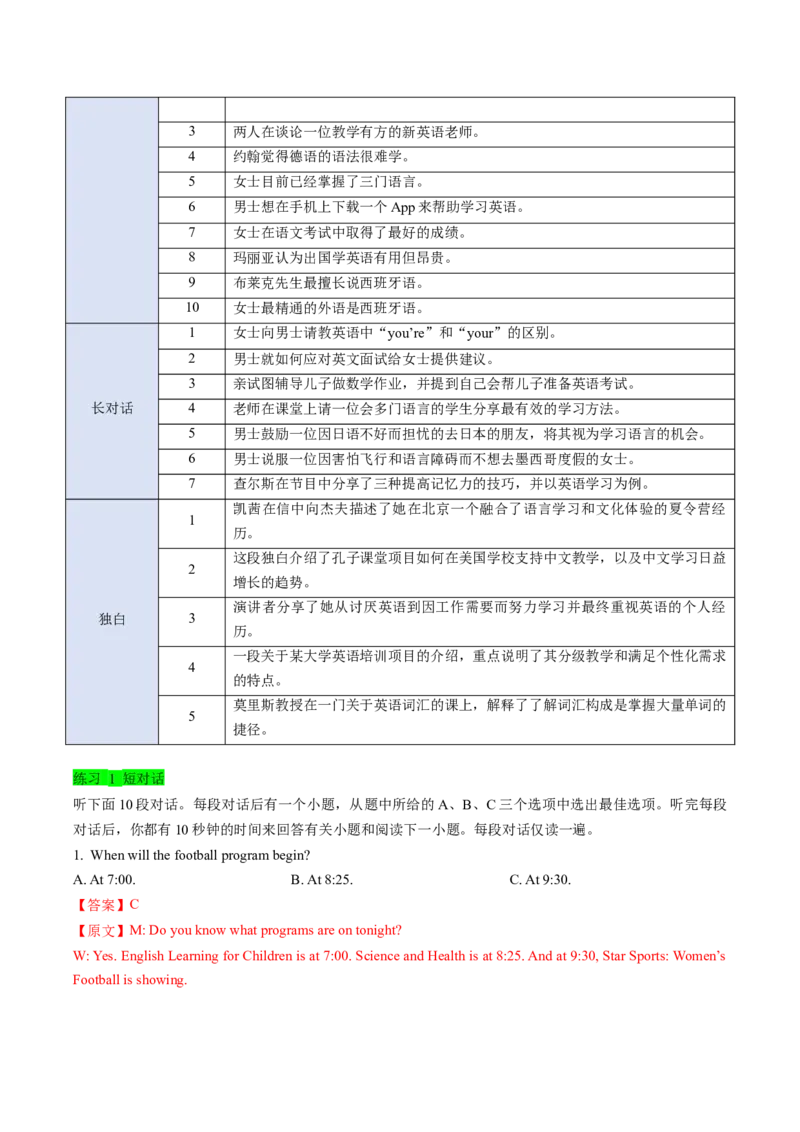
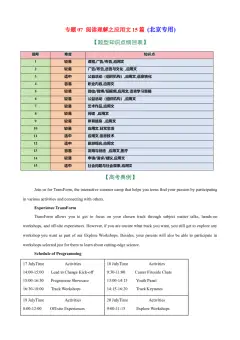
试题总览
短对话
1
女士告知男士今晚的电视节目时间表。
2
男士请教女士快速提高英语水平的方法。
3
两人在谈论一位教学有方的新英语老师。
4
约翰觉得德语的语法很难学。
5
女士目前已经掌握了三门语言。
6
男士想在手机上下载一个App 来帮助学习英语。
7
女士在语文考试中取得了最好的成绩。
8
玛丽亚认为出国学英语有用但昂贵。
9
布莱克先生最擅长说西班牙语。
10
女士最精通的外语是西班牙语。
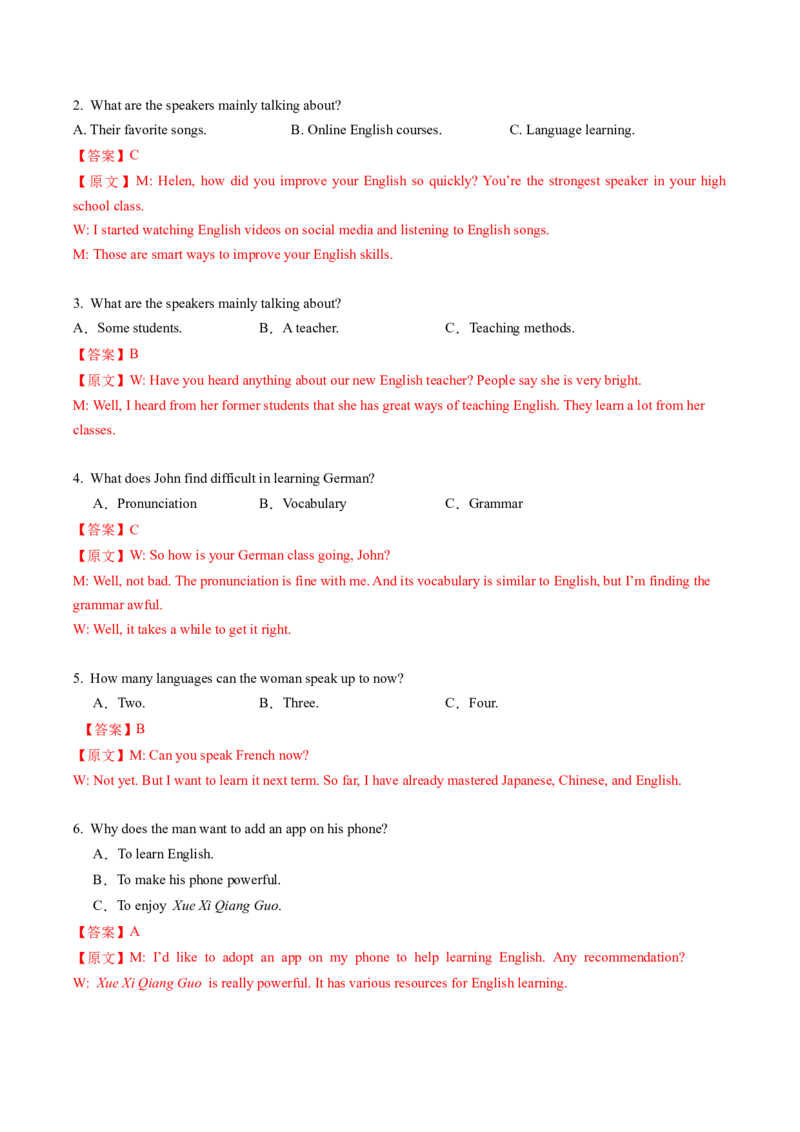
长对话
1
女士向男士请教英语中“you’re”和“your”的区别。
2
男士就如何应对英文面试给女士提供建议。
3
亲试图辅导儿子做数学作业,并提到自己会帮儿子准备英语考试。
4
老师在课堂上请一位会多门语言的学生分享最有效的学习方法。
5
男士鼓励一位因日语不好而担忧的去日本的朋友,将其视为学习语言的机会。
6
男士说服一位因害怕飞行和语言障碍而不想去墨西哥度假的女士。
7
查尔斯在节目中分享了三种提高记忆力的技巧,并以英语学习为例。
独白
1
凯茜在信中向杰夫描述了她在北京一个融合了语言学习和文化体验的夏令营经
历。
2
这段独白介绍了孔子课堂项目如何在美国学校支持中文教学,以及中文学习日益
增长的趋势。
3
演讲者分享了她从讨厌英语到因工作需要而努力学习并最终重视英语的个人经
历。
4
一段关于某大学英语培训项目的介绍,重点说明了其分级教学和满足个性化需求
的特点。
5
莫里斯教授在一门关于英语词汇的课上,解释了了解词汇构成是掌握大量单词的
捷径。
练习 1 短对话
听下面10 段对话。每段对话后有一个小题,从题中所给的A、B、C 三个选项中选出最佳选项。听完每段
对话后,你都有10 秒钟的时间来回答有关小题和阅读下一小题。每段对话仅读一遍。
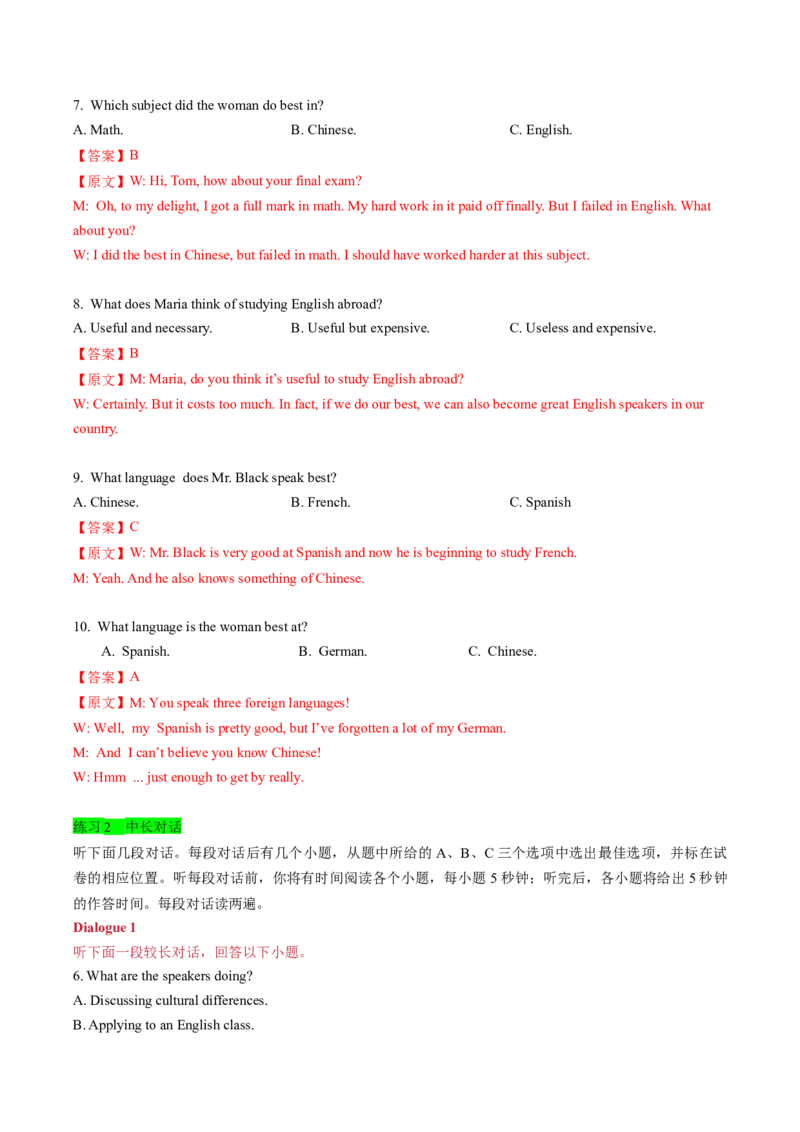
1. When will the football program begin?
A. At 7:00.
B. At 8:25.
C. At 9:30.
【答案】C
【原文】M: Do you know what programs are on tonight?
W: Yes. English Learning for Children is at 7:00. Science and Health is at 8:25. And at 9:30, Star Sports: Women’s
Football is showing.
2. What are the speakers mainly talking about?
A. Their favorite songs.
B. Online English courses.
C. Language learning.
【答案】C
【原文】M: Helen, how did you improve your English so quickly? You’re the strongest speaker in your high
school class.
W: I started watching English videos on social media and listening to English songs.
M: Those are smart ways to improve your English skills.
3. What are the speakers mainly talking about?
A.Some students.
B.A teacher.
C.Teaching methods.
【答案】B
【原文】W: Have you heard anything about our new English teacher? People say she is very bright.
M: Well, I heard from her former students that she has great ways of teaching English. They learn a lot from her
classes.
4. What does John find difficult in learning German?
A.Pronunciation
B.Vocabulary
C.Grammar
【答案】C
【原文】W: So how is your German class going, John?
M: Well, not bad. The pronunciation is fine with me. And its vocabulary is similar to English, but I’m finding the
grammar awful.
W: Well, it takes a while to get it right.
5. How many languages can the woman speak up to now?
A.Two.
B.Three.
C.Four.
【答案】B
【原文】M: Can you speak French now?
W: Not yet. But I want to learn it next term. So far, I have already mastered Japanese, Chinese, and English.
6. Why does the man want to add an app on his phone?
A.To learn English.
B.To make his phone powerful.
C.To enjoy Xue Xi Qiang Guo.
【答案】A
【原文】M: I’d like to adopt an app on my phone to help learning English. Any recommendation?
W: Xue Xi Qiang Guo is really powerful. It has various resources for English learning.
7. Which subject did the woman do best in?
A. Math.
B. Chinese.
C. English.
【答案】B
【原文】W: Hi, Tom, how about your final exam?
M: Oh, to my delight, I got a full mark in math. My hard work in it paid off finally. But I failed in English. What
about you?
W: I did the best in Chinese, but failed in math. I should have worked harder at this subject.
8. What does Maria think of studying English abroad?
A. Useful and necessary.
B. Useful but expensive.
C. Useless and expensive.
【答案】B
【原文】M: Maria, do you think it’s useful to study English abroad?
W: Certainly. But it costs too much. In fact, if we do our best, we can also become great English speakers in our
country.
9. What language does Mr. Black speak best?
A. Chinese.
B. French.
C. Spanish
【答案】C
【原文】W: Mr. Black is very good at Spanish and now he is beginning to study French.
M: Yeah. And he also knows something of Chinese.
10. What language is the woman best at?
A. Spanish.
B. German.
C. Chinese.
【答案】A
【原文】M: You speak three foreign languages!
W: Well, my Spanish is pretty good, but I’ve forgotten a lot of my German.
M: And I can’t believe you know Chinese!
W: Hmm ... just enough to get by really.
练习2  中长对话
听下面几段对话。每段对话后有几个小题,从题中所给的A、B、C 三个选项中选出最佳选项,并标在试
卷的相应位置。听每段对话前,你将有时间阅读各个小题,每小题5 秒钟;听完后,各小题将给出5 秒钟
的作答时间。每段对话读两遍。
Dialogue 1
听下面一段较长对话,回答以下小题。
6. What are the speakers doing?
A. Discussing cultural differences.
B. Applying to an English class.
C. Talking about the language.
7. What does the man most likely do?
A. He is a student.
B. He is a teacher.
C. He is a writer.
【答案】6. C    7. B
【原文】W: Can you explain the difference between “you’re” and “your” in English?
M: Certainly. “You’re” is a combination of two words, “you” and “are”.
W: So I could say “You’re tall”.
M: Exactly. It’s a way to describe someone or something. But “your” means something belongs to you.
W: Like “This is your pen.”
M: Perfect. See, you know it already. A lot of people use them incorrectly when writing, especially native English
speakers.
W: I just needed it explained. You always put things so simply in a way I can understand.
M: Well, if I didn’t, I wouldn’t be doing my job.
Dialogue 2
听下面一段较长对话,回答以下小题。
10. What are the two speakers talking about?
A. Advice on having an interview.
B. Tips on choosing a job.
C. Ways of learning English.
11. What does the man advise the woman to do?
A. Remember her answers in advance.
B. Be natural when she speaks.
C. Use as many English words as possible.
12. How does the woman feel about the man's suggestions?
A. Not practical.
B. A bit confusing.
C. Quite valuable.
【答案】10. A    11. B    12. C
【原文】W: Hi, Sam. I’m thinking of applying for a job with a multinational company, but I’m worried about
having an interview in English. Can you give me any good tips?
M: Hum. That’s a tough question. I guess the first thing is to try to make a good impression.
W: All the people say that! But I just don’t know what to do!
M: Well, let me see. You should learn a little bit about the company before the interview. Find out what they do,
what their business concept is, that kind of thing. You should also anticipate possible questions, and think about
how you will answer.
W: Should I memorize my answer beforehand?
M: No, definitely not! You should be natural when you speak.
W: I never thought about that before. But what should I do if I can’t remember an English word when answering a
question?
M: In that case, you can use other words to explain what you want to say.
W: That’s very helpful, Sam.
Dialogue 3
听下面一段较长对话,回答以下小题。
10. What is the relationship between the speakers?
A. Classmates.
B. Tutor and student.
C. Mother and son.
11. What subject is the boy struggling with?
A. Math.
B. English.
C. Geography.
12. What activity is related to the woman’s job?
A. Testing.
B. Writing.
C. Teaching.
【答案】10. C    11. A    12. B
【原文】W: Malcolm, have you finished your homework yet?
M: Not yet, I need dad’s help with one of the questions.
W: Well, maybe I can help?
M: Thanks, but dad knows more about algebra than you.
W: I am just as capable as your father. We both went to university.
M: But dad uses it all the time in his job. You write a lot in your job, so I come to you when I need help with my
English tests.
W: That’s very smart, but sometimes your father won’t be able to help you. So if you need it, I’m here. I’m also
good at geography.
M: OK then. Can you tell me the answer to this one?
W: No, but I can show you how to find the answer yourself.
Dialogue 4
听下面一段较长对话,回答以下小题。
8. What’s the probable relationship between the speakers?
A. TV host and guest.
B. Teacher and student.
C. Classmates.
9. What language is the woman studying now?
A. Spanish.
B. French.
C. English.
10. What helped the woman most in learning foreign languages?
A. Listening to the radio.
B. Studying in the university.
C. Traveling in these countries.
【答案】8. B    9. A    10. C
【原文】M: Good morning. Since so many of you have asked me how to learn a language, I thought it might be
useful to take some class time today to discuss it. Betty, you speak several foreign languages, don’t you?
W: Yes, I speak Spanish and French.
M: And can you tell me what helped you most in learning these languages?
W: Well, I studied both languages in high school, and I’m still studying Spanish here at the university. But I think
travel has probably been the most helpful to me.
M: Yes. When you live in a country where the language you are learning is spoken, it’s perfect.
W: That’s true. But whether or not I’m living in a country where the language is spoken, I always watch TV or
listen to the radio in the language I’m trying to learn.
M: That’s good.
Dialogue 5
听下面一段较长对话,回答以下小题。
13. What's the big problem of the woman?
A. She doesn't know how to go to Japan.
B. She isn't good at Japanese.
C. She doesn't want to go to Japan.
14. Why does the man think it is a chance for the woman?
A. Because she can make new friends.
B. Because she can learn a new language.
C. Because she can be a tour guide.
15. How can the woman learn Japanese?
A. By learning from the Japanese who can speak English.
B. By asking a tour guide in Japan for help.
C. By attending a language school in Japan.
16. What will the speakers do next?
A. Go for a walk.
B. Have a drink.
C. Travel together.
【答案】13. B    14. B    15. A    16. B
【原文】M: I am so happy for you that you will go to Japan.
W: Thank you. But I don’t know how to live there because of my poor Japanese.
M: Yeah, it’s really a big problem. But, you see, it is also a chance for you to learn a new language when going
there.
W: I know. But how can I communicate with the Japanese? How can I express myself?
M: Everything will be okay. You know, many Japanese know English. You will find a translator.
W: It is a good idea I can learn Japanese from native speakers who understand English.
M: Absolutely. And you will make many friends and learn much about Japan. It’s a good place. I will go there to
visit you next vacation. Maybe you can be my tour guide.
W: OK. I promise I will take you to visit all wonderful places in Japan if you go there.
M: Sure. I believe you can do it.
W: Yeah, let’s go for a drink. It is my treat.
Dialogue 6
听下面一段较长对话,回答以下小题。
13. What are the speakers talking about?
A. Their trip abroad.
B. Vacation plans.
C. Cultural differences
14. Why doesn’t the woman want to go to Mexico?
A. She’s afraid of flying.
B. She hates the food there.
C. She went there with her cousin last summer.
15. What does the man say about Spanish?
A. It’s not easy to learn.
B. He’s been learning it for a year.
C. He can only say a few words.
16. What probably makes the woman change her mind?
A. The beauty of the beaches in Mexico.
B. The possibility of learning some Spanish.
C. Many people speaking English in Mexico.
【答案】13. B    14. A    15. B    16. A
【原文】M: Do you know what you’re going to do for spring break?
W: My parents want to take my brother and me to Mexico, but I don’t really want to go outside the country.
M: Why not? Mexico is supposed to be amazing.
W: To tell you the truth, I’m a little scared of flying.
M: Have you been on a plane before?
W: Yeah, a few times, and I hated it every time.
M: Well, maybe you can just listen to some relaxing music during the flight.
W: I guess so, but I also don’t speak Spanish. How am I supposed to enjoy my vacation when I can’t even
communicate with anyone?
M: I’m sure you could pick up a few words. Spanish is a pretty easy language to learn. I’ve only been taking it for a
year and I can already have some simple conversations with people, but tons of people in Mexico speak English.
W: They do?
M: Of course. Have you seen pictures of the beaches in Mexico?
W: Ah no.
M: Take a look at this. My cousin went to cancun last summer vacation and he had a great time.
W: Wow, those are some beautiful beaches. Maybe I would like Mexico after all.
Dialogue 7
听下面一段较长对话,回答以下小题。
13. Where are the speakers?
A. In a radio studio.
B. In a lab.
C. In a gym.
14. What did Charles do in the history exams?
A. He thought of some images in the book.
B. He associated the knowledge with classic songs.
C. He recalled the contents by singing in his mind.
15. How many tips does Charles mention?
A. 2.
B. 3.
C. 4.
16. What is the function of teaching others according to Charles?
A. To get some tips from others.
B. To build up your confidence before the exam.
C. To strengthen your understanding of the content.
【答案】13. A    14. C    15. B    16. C
【原文】W: Charles, can you give us some advice about improving our ability to memorize?
M: Yes! Try to visualize an image that is connected to the thing you need to remember, For example, you can use
several images to remember a list of ingredients for a recipe.
W: Yes, that makes sense.
M: Singing can help with memorization too. It is one of the earliest memory tricks that are used for learning new
concepts. I used to “sing” lists of historical facts and dates. It works.
W: And did you have to sing aloud in your history exams?
M: Not aloud! But I did use to sing in my head. And I always got good marks for history.
W: Any more tips, Charles?
M: Yes! I’ve saved the best one till last. It’s particularly relevant for any students who have tuned in. Teach
whatever it is that you want to remember. So, if you’re studying for an English exam, teach the concepts to
someone else. It really works because in order to teach something you need to digest it first.
W: Thank you, Charles. Now, I think we’ve got time for a couple of questions from our listeners.
练习 3 独白
Passage 1
听下面一段较长独白,回答以下小题。
18. Why did the speaker go to Beijing?
A. To learn Chinese.
B. To take a holiday.
C. To experience life.
19. Which activity attracted the speaker most?
A. Fan painting.
B. Paper cutting.
C. Opera mask painting.
20. What does the speaker mainly talk about?
A. Her interest in Chinese culture.
B. Advice on touring Beijing for Jeff.
C. Her experience at the summer camp.
【答案】18. A    19. A    20. C
【原文】W: Dear Jeff,
I am writing to tell you something about my two-week summer camp in Beijing. The summer camp that
offered a variety of fun activities was for language learning. The other campers and I learned Chinese through
games, role-playing and storytelling. We also took part in activities like buying vegetables at the market and
booking entrance tickets to the museum. The real-world practice gave us the chance to use the vocabulary we had
learnt.
We were involved in many cultural activities, such as fan painting, paper cutting and opera mask painting. My
favorite one was fan painting. We learnt traditional fan painting skills and designed our own fans in the workshop.
It was so cool to drive away the summer heat with a fan painted by myself.
A visit to Beijing would not be complete without seeing the Great Wall and Tian’anmen Square. And I was
amazed by their splendor. We also visited some famous hutongs and other places of interest. What’s more, an
exhibition showing China’s development over the past 70 years also impressed me.
What’s your plan for this summer holiday? Can you share it with me?
Yours sincerely,
Cathy
Passage 2
听下面一段独白,回答以下小题。
17. How many languages does Saint Mary’s school teach now?
A. 3.
B. 4
C. 5.
18. Which of the following isn’t mentioned about the program?
A. China offers books.
B. China sends some teachers.
C. China partly pays teachers in the school.
19. How many American schools and universities join the program?
A. More than 15.
B. About 40.
C. Over 50.
20. What can we infer in the talk in the United States?
A. Fewer people study Chinese.
B. It is short of various teachers.
C. More and more people learn Chinese.
【答案】17. B    18. B    19. C    20. C
【原文】W: Some schools in the United States and other countries offer Chinese language classes with the
government support from China. Saint Mary’s School is a private college preparatory school in Medford, Oregon,
in the Pacific Northwest. Saint Mary teaches Spanish, German and Latin. It added Mandarin in two thousand five.
Two years ago, it became the first school in the country to join the Confucius classroom program.
The program pays about half the costs of a teacher sent to a school in the United States. China’s Education Ministry
also provides books and other materials.
Saint Mary’s principal, Frank Phillips, says knowing Chinese will help students in a world where China is quickly
gaining economic power. The Confucius classroom program is in about forty countries, including more than fifty
American schools and universities.
A recent report said more schools in the United States are teaching Chinese, although the numbers are still low. But
it said foreign language teaching in public elementary and middle schools dropped sharply in recent years. Fewer
schools teach French, German, Russian or Japanese. There are language teacher shortages, but some schools say a
law that only measures progress in math and reading has hurt language teaching.
Passage 3
听下面一段独白,回答以下小题。
18. Why did the speaker learn English again when she started work?
A. She wanted to take a degree.
B. She was persuaded by a friend.
C. She had to speak to customers in English.
19. How did the speaker make progress in English?
A. Her colleagues helped her a lot.
B. She took English classes in her spare time.
C. Her English-speaking friend taught her privately.
20. What does the speaker think of English now?
A. It’s difficult.
B. It’s important.
C. It’s interesting.
【答案】18. C    19. C    20. B
【原文】W: Good afternoon, boys and girls. I’m glad to share my experience in English learning with you. I
hated languages at school. I just wasn’t interested in learning, so I never did my homework and I was always
bottom of the class when it came to exams! Maybe it wasn’t her fault, but I really didn’t get on with my teacher.
She seemed to think I was a stupid young girl. Things started to change when I got my first job, though. I spent my
first two years in the Sales Department, and I had to speak English on the phone almost every day, which wasn’t
easy. I didn’t really have enough time to go to class, so at first I tried to study on my own. I also persuaded an
English-speaking friend to give me some private lessons and I started to make progress. I don’t know when it was
exactly that I realised my English was good enough to do First Certificate, but I did…and I passed! So, I don’t hate
English any more. In fact it’s made quite a big difference in my life!
Passage 4
听下面一段独白,回答以下小题。
17. How many levels of courses does the program offer?
A. Seven.
B. Eight.
C.  Twelve.
18. What is the strength of the program?
A. It can meet personal needs.
B. It provides courses on US culture.
C. It is available throughout the year.
19. What can students get if they perform well in an end-of-session test?
A. A course for free.
B. A promotion to a higher level.
C. A chance to work part-time.
20. What does the Language Center Bonus Project provide?
A. Field trips.
B. Social activities.
C. Extra practice hours.
【答案】17. B    18. A    19. B    20. C
【原文】
W: Good morning! Welcome to the language center of our university. We aim at helping people improve their
language ability in several languages. Now, I’ll focus on one of our programs, the English Training Program, which
I think you might be interested in. The program offers year-round English courses in eight levels. It offers courses
for students, scholars, and professionals. Participants can prepare for study at an American university and improve
their language skills and knowledge of American culture. The strength to the program is its ability to offer courses
to meet any students’ specific needs and goals. Most students in this program study full time, which consists of
twenty hours a week. On the first day of the program, you take a test to determine your level. At the end of each
seven-week session, your language skills are evaluated. And if you’ve made enough progress, you are promoted to
the next level. In addition, you can enter the Language Center Bonus Project, which will allow you to have extra
English hours with a native speaker. For more practice chances, there are also several social activities and field trips
organized by the student center.
Passage 5
听下面一段较长独白,回答以下小题。
17. Where can you most probably hear this talk?
A. In a class of the Greek language.
B. In a class of the French language.
C. In a class of the English language.
18. How long does the class last?
A. 30 weeks.
B. 15 weeks.
C. 13 weeks.
19. What is “the shortcut” to learning words according to the speaker?
A. Taking more courses.
B. Learning how words are formed.
C. Reading basic words aloud.
20. Why is the class popular?
A. It helps to master useful rules.
B. It’s taught by Professor Morris.
C. It is offered at a given time.
【答案】17. C    18. C    19. B    20. A
【原文】M: Good morning everybody and welcome to this class on English words. I hope that all of you can
hear me. If not, please let me know. I am Professor John Morris. I'll be your teacher for the next 13 weeks. As you
can probably tell, this is one of the most popular and crowded classes. Indeed, every time this course is offered, this
room is full. Why is that? Well, in order to use the English language, it's very important to have at least a basic
understanding of how words are formed. Just to mention one figure and there are many; there are about one million
words in English. If you are an English learner, you may wonder how you can possibly remember all of these
words. Well, for one thing, you don't have to. No native speaker exists who knows all of the words in the English
language. Besides, there are short cuts. Shortcuts? Yes, for example, if you know how words are formed by using
parts of words from other languages, such as Greek and French, you'll understand a good number of English words
when you first come across them. Let me put it this way. Knowing the rules will help you to master a large number
of words. This is probably the No. 1 reason why this class is so popular.