听力百分百—备战 2022 高考英语听力专项(三)
目录 内容
模块一 题型技巧讲解
模块二 外文时事训练
模块三 真题模拟题训练
模块一:题型及技巧讲解
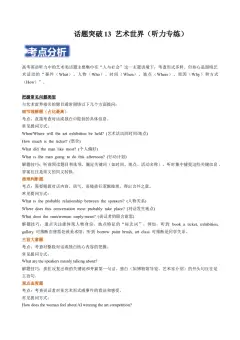
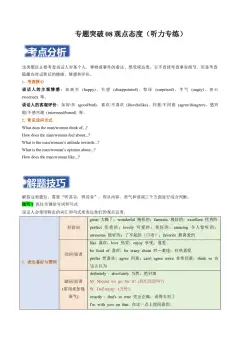
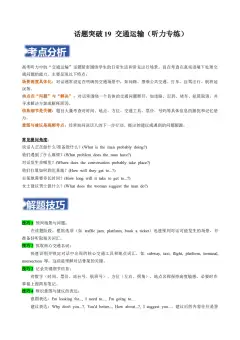
谈论话题型(主旨要义)解题要点
题型特点:此类题型的选项基本都属于名词结构,主要考查对于对话内容的整体把握,
要求考生能够领会谈活人所谈论的话题或谈论对象。
问题类型: What are the two speakers talking about? / What are they talking
about? / What are they arguing about?
解题技巧:在这种对话中,the second speaker在回答the first speaker的问题会加以
发挥,引出与主题相关但又联系松散的信息,听者有可能被误导,无意中忽视了主题内容
因此一般情况下,对话讨论的主题是the first speaker谈到的内容。做此类题时,一定要
有清晰的思路,不能只抓住只言片语,而要学会从整体出发,进行归纳总结。
例题讲解
例1:Q: What are the speakers mainly talking about?
A. A snack place. B. Food from Taiwan. C. Bad economy
M: I drove by the Taiwanese snack place, and I noticed that it's closed. I think it
went out of business.
W: You can't be serious! I just ate there yesterday, and the owner didn't say
anything about closing down.
解析:在该对话中,第-一个说话人提到it's closed. Out of business等,以及can't be
serious ,didn't say anything进行干扰。不要忽视主题内容: A snack place.
例2: Q: What are the speakers mainly talking about?
A. A novel. B. A film. C. A writer.
M: God, I'm glad that's over.
W: So you don't like it? It's based on a novel written by a famous writer.
M: No, I think the story, the dialogue and the whole thing about the war are hard to
understand.
W: But the leading actor is my favorite.
例3: Q: What are the speakers arguing about?
A. Who to blame. B. Which way to go. C. What transport to
take.
M: This is all your fault! This wouldn't have happened if you hadn't tried to give
money to that policeman!
W: Well, if you'd listened to me when I suggested asking someone for directions, we
shouldn't have got lost inthe first place, would we?
M: Oh, go on! Blame it all on me! You were the one who was driving when we
got stopped by the police. If you hadn't been speeding, we wouldn't have been stopped at
all!
W: That's not fair. We were doing fine until you suddenly decided you knew a
quicker way!
M: Oh, come on! I only suggest it because we were running so late. We would've
been fine if you hadn't suggested driving instead of taking the train.
W: No! We would've been fine if you had remembered to book tickets!
例4: Q: What are the speakers mainly talking about?
A. A song. B. A concert. C. A band.
W: Oh, I love that song. He is my favourite.
M: I know it. It is John Lennon. And I remember the day he was shot. That was in
1970. Right?
W: No, Tom! It was 1980.
M: What was the name of that band he was in?
W: The Beatles!
M: Oh, yes. Were they from London?
W: No. They were from Liverpool.
M: How many of them were there in the band?
W: Four一John, Paul, George and Ringo. They were great. Their songs are still on
the radio.
M: Oh, yeah. There was a really good song called Miss You on the radio last week.
W: No, Tom. Miss You was the Rolling Stones, not the Beatles.
例5: Q:What is the talk mainly about?
A. Secrets of playing chess. B. History of the game of chess.
C. Different playing forms of chess.
W: We're glad to have Mr Silver to talk to us about chess today. Welcome, Mr
Silver.
M: Hello, everyone. I'm sure you are all familiar with the wonderful game of chess
But have you ever stopped to
think about where it came from and when? Well, we believe the game dates back to
before AD 600 and was first played in what is now northern India. We think the form
played by Europeans and Americans today travelled through Iran to the main business
centers of Europe by the year 1000. The game was then taken to Northern Europe, so by
the 1400s chess was played throughout Europe. There are quite a few forms of the game
found in other parts of the world. For example, one form is played in Japan. Another
form is played in China. One person whose name stands out in the history of chess isthe chess master Howard Staunton. Staunton lived in England in the mid 1800s and gave
his name to the chess pieces that are still used in competitions all over the world today.
The idea of chess competitions is relatively recent. The first official competition was
played in 1866 in London and was won by a man called Steinitz. He was, in effect, the
world's first official winner and he held the title until 1894 when he was beaten by a
German called Emanuel Lasker, who in tum lost the title in 1921 to a Cuban called
Capablanca.
例6 Q : What does the woman think of the meeting?
A. She is unsatisfied with it. B. It went very well.
C. The man should talk more about his opinion.
W: John, I have to say I was bothered by the way you handled the meeting today.
M: How so? I thought it went fine.
W: I think you should have given us more of a chance to give our opinions.
M: I am sorry. I thought we were all pretty much in agreement.
Keys: 2-6BACBA
模块二:外文时事训练
1:What will soon be on the faces of Japanese children?
A.masks C.smiles
B.sun screen D.face visors
2:How many children will get the cash?
A.around 20 million C.over 20 million
B.exactly 20 million D.under 20 million
3: Who promised that there would be a cash handout?
A.Japan's children's minister C.Japan's finance minister
B.Japan's education minister D.Japan's prime minister
4:Who will benefit besides children, people in need and part-time workers?
A.shopkeepers C.amusement parks
B.families with small children D.grandparents
5: How much will the plan cost in Japanese yen?
A.around ¥17.6 billion C.around ¥2 trillion
B.around $17.8 billion D.around $2 trillion
6: What does the article say Japan is burdened with?
A.expectations C.cargo
B.debt D.guilt
7:When was the last time Japan had a surplus of funds?
A.2008 C.2019
B.2010 D.fiscal 20208:What kinds of restaurants will children not go to?
A.fast food restaurants C.sushi restaurants
B.upmarket restaurants D.hotel restaurants
9: Where did critics say the money would end up?
A.in savings accounts C.in candy stores
B.down the back of sofas D.being wasted
10:What will the children of a mother of three buy?
A.cakes and candies C.books and music
B.toys D.new computers
模块三:模拟题训练
Exercise A
第一节 (共5小题;每小题1.5分,满分7.5分)
听下面5段对话。每段对话后有一个小题, 从题中所给的A、B、C三个选项中选出最
佳选项,并标在试卷的相应位置。听完每段对话后, 你都有10秒钟的时间来回答有关小题
和阅读下一小题。每段对话仅读一遍。
1. What did the man do last weekend?
A. He went shopping. B. He watched a movie. C. He read books at home.
2. Where is the man’s watch?
A. In the kitchen. B. In the bathroom. C. In the bedroom.
3. What does the man’s brother look like?
A. He wears dark hair. B. He has blonde eyes. C. He wears glasses.
4. What does the woman ask the man to do?
A. Help paint her bedroom. B. Look after her brother. C. Examine her brother’s arm.
5. Why did the man fail to answer the phone?
A. The TV was too noisy. B. His phone was broken. C. He went to sleep early.
第二节(共15小题;每小题1.5分,满分22.5分)
听下面5段对话或独白。每段对话或独白后有几个小题, 从题中所给的A、B、C三个
选项中选出最佳选项,并标在试卷的相应位置。听每段对话或独白前,你将有时间阅读各
个小题, 每小题5秒钟;听完后,各小题将给出5 秒钟的作答时间。每段对话或独白读两
遍。
听第6段材料,回答第6、7题。
6. What are the speakers mainly talking about?
A. A class meeting. B. Their appointment. C. A new lesson.
7. When will the woman and Sarah review their lessons?
A. At about 2: 10. B. At about 3: 10. C. At about 4: 10.
听第7段材料,回答第8、9题。
8. What’s wrong with the man?A. He had his leg hurt. B. He lost the game. C. He missed the training.
9. What can we learn from the conversation?
A. The woman fell down.
B. The man’s cut is deep.
C. The woman will dress the wound.
听第8段材料,回答第10至12题。
10. How is the woman’s present job?
A. Quite okay. B. Not too bad. C. Unpleasant.
11. What is probably the man’s plan now?
A. Finding a new job in Spain.
B. Learning to speak Spanish.
C. Setting up a business travel.
12. What is the probable relationship between the speakers?
A. Fellow workers. B. Good friends. C. Travel partners.
听第9段材料,回答第13至16题。
13. What does the woman care about the flat?
A. The size. B. The surroundings. C. The decoration.
14. How much will the man pay for the flat per week?
A. Two hundred pounds. B. Five pounds. C. Forty pounds.
15. What does the man have to borrow from his mother?
A. The cooker. B. The washing machine. C. The fridge.
16. When will the man move house?
A. On Sunday. B. On Saturday. C. On Monday.
听第10段材料,回答第17至20题。
17. Where will Carole Berg give a talk?
A. In the Oak Room. B. In the Green Room. C. In the Union Theatre.
18. What can people do in the Campus Comer Cabaret?
A. Attend a dance party. B. Watch a great film. C. Enjoy a live show.
19. How much does a film ticket cost?
A. $7. B. $5. C. $3.
20. What should people do to hear the recording again?
A. Press the pound key. B. Call the Hotline. C. Dial the Theater.
Exercise B
第一节 (共5小题;每小题1.5分,满分7.5分)
第一节(共5小题;每小题1.5分,满分7.5分)
听下面5段对话。每段对话后有一个小题,从题中所给的A、B、C三个选项 中选出
最佳选项。听完每段对话后,你都有10秒钟的时间来回答有关小题和阅读下 一小题。每
段对话仅读一遍。1. Why did the man go to see a doctor?
A. He can only see things up close.
B. His glasses no longer work.
C. He is going blind.
2. What are the speakers mainly talking about?
A. Basketball practice. B. The man's new ball. C. Training games.
3. How many people are probably eating with the man?
A. Two. B. Three. C. Four.
4. Where are the speakers?
A. At a gym. B. At a health store. C. In a doctor's office.
5. How does the woman describe her dog?
A. He's good at protecting her.
B. He's not very nice sometimes.
C. He's too small to do any harm.
第二节(共15小题;每小题1.5分,满分22.5分)
听下面5段对话或独白。每段对话或独白后有几个小题,从题中所给的A、B、 C三
个选项中选出最佳选项。听完每段对话或独白前,你将有时间阅读各个小题,每 小题 5秒
钟;听完后,各小题将给岀5秒钟的作答时间。每段对话或独白读两遍。 听第6段材料,
回答第6、7题。
6. What are the speakers mainly discussing?
A. A computer museum.
B. Advances in computer technology.
C. A library with examples of old technology.
7. What is the PowerBook 100?
A. A $700,000 computer.
B. A machine from 1976.
C. The original portable computer.
听第7段材料,回答第8至10题。
8. Who will be on the face of the $20 bill?
A. Susan B. Anthony. B. Harriet Tubman. C. Alice Paul.
9. What did Susan B. Anthony do?
A. She saved many slaves.
B. She helped pass a new law.
C. She started an important conversation.
10.Why are the speakers excited?
A. The 19th Amendment just passed.
B. Women will be featured on U.S. money.
C. Alexander Hamilton won't be on the $10 bill.听第8段材料,回答第11至13题。
11.How did the speakers find out the restaurant?
A. From a friend. B. From a website. C. From the newspaper.
12.What does the woman want to do after the meal?
A. Talk to the owner of the restaurant.
B. Get another drink.
C. Eat some pizza.
13. What will the woman probably do this week?
A. Get some money from Brian.
B. Go back to the restaurant.
C. Talk to Susan.
听第9段材料,回答第14至16题。
14. When does the man need to turn in his application?
A. By January 2nd. B. By May 1st. C. By September 3rd.
15. How many people applied last year?
A. Fifty. B. Twenty. C. Seventeen.
16. Who might the woman be?
A. A professor.
B. A current student.
C. An administration assistant.
听第10段材料,回答第17至20题。
17. What did Milton do?
A. He caught a thief B. He went to a theme park.
C. He traveled across the country.
18. What happened on Monday?
A. Some cars were stolen. B. A roller coaster stopped working.
C. The Johnson family moved to New York.
19. Where is Six Flags located?
A. In Orange County. B. In Union City. C. In New York.
20. What will viewers see next?
A. An advertisement. B. An interview. C. A weather report.
Exercise C
第一节(共5小题;每题1.5分,满分7.5分)
听下面5段对话。每段对话后有一个小题,从题中所给的A、B、C三个选项中选出最
佳选项,并标在试卷的相应位置。听完每段对话后,你都有10秒钟的时间来回答有关小题和
阅读下一小题。每段对话仅读一遍。
1. What is the man offering to do for the woman?
A. Help her check in. B. Carry her suitcases. C. Take her to her room.2. What does the woman think of the man’s office?
A. It is messy. B. It is large. C. It is neat.
3. Where are the speakers?
A. At the office. B. At their house. C. At a restaurant.
4. When will the next train for London leave?
A. At 8:30. B. At 10:30. C. At 11:30.
5. What is the woman doing?
A. Taking a photo. B. Painting a picture. C. Waiting in line.
第二节(共15小题;每小题1分,满分15分)
听下面5段对话或独白。每段对话或独白后有几个小题,从题中所给的 A、B、C三个
选项中选出最佳选项,并标在试卷的相应位置。听每段对话或独白前,你将有时间阅读各
个小题,每小题5秒钟;听完后,各小题将给出5秒钟的作答时间。每段对话或独白读两
遍。
听第6段材料,回答第6、7题。
6. What does the man ask the woman to do?
A. Wash the windows. B. Wash the wheels. C. Clean the inside of the car.
7. What is the relationship between the speakers?
A. Brother and sister. B. Mother and son. C. Friends.
听第7段材料,回答第8至10题。
8. How did the woman feel about her exam?
A. She did as well as expected.
B. She did worse than expected.
C. She did better than expected.
9. Which section did the speakers both find difficult?
A. The section about the novel.
B. The grammar section.
C. The poetry section.
10. When is the man’s next exam?
A. This afternoon. B. The following morning. C. Next week.
听第8段材料,回答第11至13题。
11. What animal is in the video that the woman saw?
A. A duck. B. A turtle. C. A fish.
12. What do scientists think could happen by 2050?
A. There will be fewer fish in the sea than plastics.
B. 50% of the fish in the ocean will die.
C. All businesses will stop using straws.
13. Where will the speakers go next?
A. To a restaurant. B. To a gift shop. C. To a coffee shop.听第9段材料,回答第14至17题。
14. What are the speakers mainly talking about?
A. Childhood pets. B. Farm work. C. Family history.
15. Who taught the man about horses?
A. His grandfather. B. His father. C. His uncle.
16. What does the woman think of the man’s abilities?
A. She is not impressed.
B. She thinks he knows a lot about horses.
C. She feels he needs a lot of practice first.
17. How does the woman want to communicate with the man’s father?
A. In person. B. By phone. C. By email.
听第10段材料,回答第18至20题。
18. How many script types are discussed in the talk?
A. Three. B. Four. C. Five.
19. What do we know about the earliest writing?
A. It looked like particular pictures.
B. It was used for personal purposes.
C. It showed the ideas of the government.
20. Which writing style has the Chinese name Kaishu?
A. The “standard script”. B. The “seal script”. C. The “running script”.
Exercise D
第一节(共5小题;每小题1.5,分,满分7.5分)
听下面 5 段对话。每段对话后有一个小题,从题中所给的 A、B、C 三个选项中选出
最佳选项,并标在试卷的相应位置。听完每段对话后,你都有 10 秒钟的时间来回答有关
小题和阅读下一小题。每段对话仅读一遍。
1. What will the man do next?
A. Rewrite the report. B. See a doctor. C. Correct the text.
2. What does the man advise the woman to write about?
A. Her grades in class.
B. Her musical talent.
C. Her experiences outside class.
3. What is the woman’s name?
A. Mary. B. Julia. C. Florence.
4. How old was the man when he had two children?
A. 21. B. 22. C. 23.
5. Why does the woman want James to stop playing his video games?
A. Dinner is ready.
B. She’s worried about his eyes.C. He hasn’t finished his homework.
第二节(共15小题;每小题1.5分,满分22.5分)
听下面5段对话或独白。每段对话或独白后有几个小题,从题中所给的A、B、C 三
个选项中选出最佳选项,并标在试卷的相应位置。听每段对话或独白前,你将有时间阅读
各个小题,每小题 5 秒钟;听完后,各小题将给出5秒钟的作答时间。每段对话或独白读
两遍。
听下面一段较长对话,回答以下小题。
6. Which did the woman take?
A. Vitamin C. B. Vitamin D. C. Vitamin E.
7. What will the woman probably do next?
A. Listen to the doctor.
B. Eat a balanced meal.
C. Tell different vitamins apart.
听下面一段较长对话,回答以下小题。
8. Where does the conversation probably take place?
A. At the police station.
B. Inside the woman’s car.
C. On the side of the highway.
9. What is the man getting a ticket for now?
A. Driving too fast.
B. Driving without a license.
C. Driving too close behind another car.
10. How many times has the man been fined?
A. Twice. B. Six times. C. Seven times.
听下面一段较长对话,回答以下小题。
11. Why are there tears in the woman’s eyes?
A. She is cutting onions.
B. She heard some bad news.
C. She wants the man to leave.
12. What is the probable relationship between the speakers?
A. Mother and son.
B. Brother and sister.
C. Uncle and niece.
13. How does the man feel?
A. Worried. B. Optimistic. C. Relieved.
听下面一段较长对话,回答以下小题。
14. What does the man think about the effect of social media?
A. It’s strange. B. It’s sad. C. It’s worrying.15. How did the man’s parents mainly keep in touch with others in their time?
A. Through the Internet. B. By mail. C. Over the phone.
16. Why does the woman check social media on her computer?
A Due to her habit.
B. To contact friends.
C. For her work.
17. What does the woman’s brother want to do?
A. Make more friends.
B. Delete some social media apps.
C. Communicate with his parents through Facebook.
听下面一段独白,回答以下小题。
18. What was wrong with the speaker’s friend?
A. She was seriously ill.
B. She lost much money.
C. She had a family emergency.
19. How did the speaker feel before the trip?
A. Happy. B. Worried. C. Angry.
20. What happened after the speaker was helped?
A. She made new friends.
B. She got her friend to join her.
C. She introduced some delicious dishes to the locals.