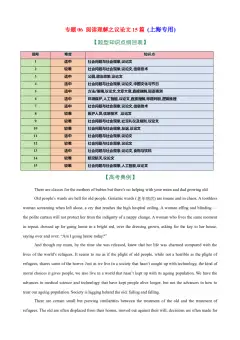
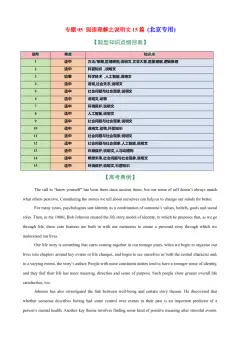
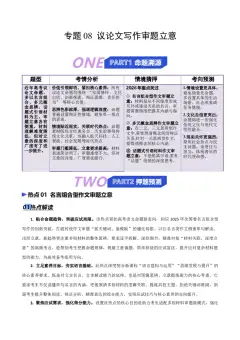
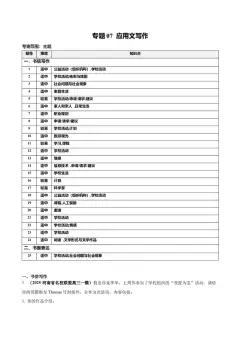
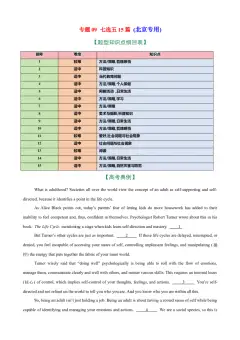
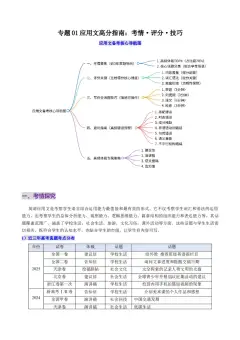
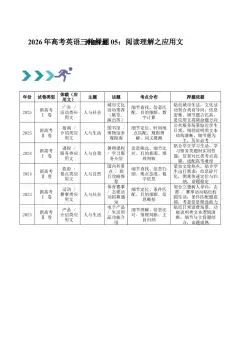
考点分析
解题技巧
话题突破16 社会现象(听力专练)

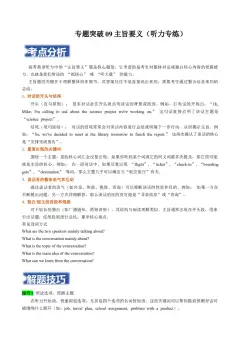
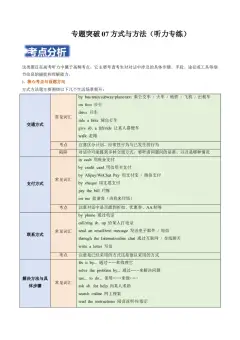
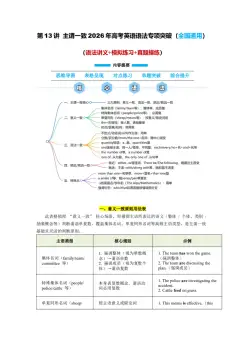
社会现象类听力题目通常是通过考查对对话或独白内容的理解,间接考查考生对背后社会现象的洞察。主
要题型包括:
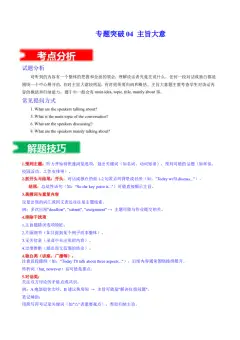
主旨大意题
常见问法:
What are the speakers mainly talking about?
What is the main purpose of the passage?
What is the talk mainly about?
考查重点:能否抓住整篇内容的核心,即所讨论的社会现象或趋势本身。例如,是在讨论“二手购物”、
“健康保险”还是“汉语热”。
细节理解题
常见问法:
What is the advantage of...?
Why is... peaceful/expensive/popular?
How does...?
Who...?
考查重点:针对现象的具体表现、原因、方式、人物角色等进行提问。这类题目的答案通常直接来自原文,
需要精准捕捉关键词。
推理判断题
常见问法:
What does the speaker mean in the end?
What can we infer from the talk?
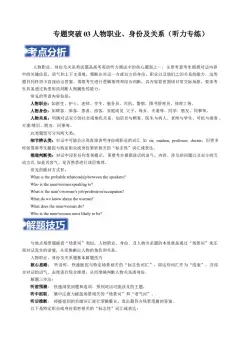
What is the probable relationship between the speakers?
How does the man feel about...?
考查重点:考查对言外之意的理解,以及对说话人观点、态度、身份和关系的推断。这是社会现象题目的
难点和高级考查形式。
技巧1 读题预测,锁定主题:
在听力开始前,快速浏览问题和选项。通过关键词(如 health insurance, second-hand clothes, Confucius
classroom, karaoke)预判听力材料将围绕何种社会现象展开。
技巧2 抓听开头,把握主旨:
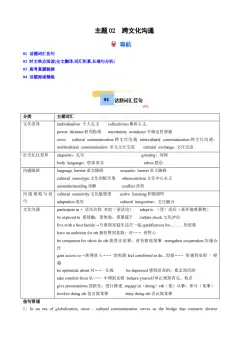
语料总结
独白或对话的开头部分通常会点明主题。例如,“Here’s some information about health insurance...”
或 “We all know karaoke is a big part of Asian culture...”。听清开头是解答主旨题的关键。
技巧3 识别信号词,捕捉细节:
关注那些引出现象原因、好处、方式的信号词。
原因: because, since, the reason is that, due to...
好处/优点: advantage, benefit, good thing, the best part is...
方式/方法: by, through, the way is to...
对比/差异: but, however, on the other hand, while, unlike...
技巧4 理解弦外之音,进行推断:
对于推理题,要结合语境和常识。当说话人说“More and more people do it these days.” 时,暗示这是
一种日益流行的趋势。当提到“It's better for the environment.”时,表明该现象与环保理念相关。
技巧5 归纳语料库,熟悉场景:
熟练掌握与常见社会现象相关的核心词汇和表达(见下文语料库),能极大提升反应速度和理解深度。
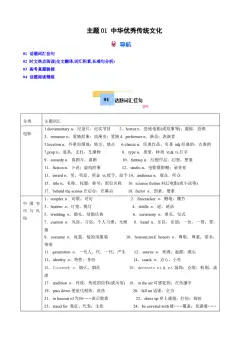
高频词汇
教育与发展
vocational education / training 职业教育 / 培训
college major selection 大学专业选择
lifelong learning 终身学习
gap year 间隔年
study abroad / overseas study 海外留学
quality-oriented education 素质教育
core literacy 核心素养
职场与就业
job market / employment market 就业市场
career path / prospect 职业道路 / 前景
work-life balance 工作与生活平衡
remote work / telecommuting 远程办公
start-up / entrepreneurship 创业
freelancing 自由职业
健康与生活
healthy diet / balanced diet 健康饮食
fitness trend 健身潮流
mental health / well-being 心理健康
sugar intake control 糖分控制
health insurance coverage 健康保险覆盖
medical system 医疗体系
消费与环保
second-hand shopping / thrifting 二手购物
强化训练
sustainable living / green lifestyle 可持续生活 / 绿色生活方式
fast fashion 快时尚
overconsumption 过度消费
garbage sorting / waste separation 垃圾分类
environmental awareness 环保意识
科技与文化
smartphone addiction 智能手机成瘾
social media influence 社交媒体影响
online education / e-learning 在线教育
cultural integration / shock 文化融合 / 冲击
digital divide 数字鸿沟
information explosion 信息爆炸
社会与治理
aging population 人口老龄化
volunteer service 志愿服务
community building 社区建设
public security / order 公共安全 / 秩序
cultural heritage protection 文化遗产保护
实用对话句式
Why not train to become a computer programmer? 什么不培训成为一名计算机程序员呢?
Have you tried taking small breaks to recharge? 试过短暂休息来恢复精力吗?
Why don't you try out (for the team)? 为什么不试试(加入队伍)呢?
More and more people do it these days. 如今越来越多的人这么做。
The world is becoming increasingly computer-based. 世界正变得越来越依赖计算机。
There is a great demand for computer programmers. 市场对计算机程序员的需求很大。
It's better for the environment. 这对环境更好。
The best way to meet this responsibility is to get health insurance. 履行这一责任的最佳方式是
购买健康保险。
You can buy lots of nice things cheaply. 你可以便宜地买到很多好东西。


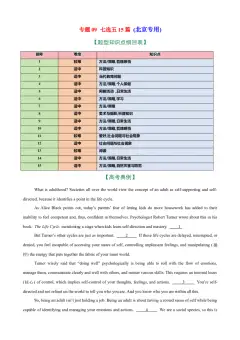
试题总览
短对话
1
女士建议因工作疲惫的男士适当休息,以提高效率。
2
男士正在平板上玩冒险游戏,不愿停下。
3
女士向Robinson 先生投诉他女儿Mary 的狗破坏自家花园。
4
女士分享了自己找到理想工作的好消息,男士对此感到意外。
5
两人在谈论他们父亲退休后的生活(锻炼、访友、下棋)。
6
两人讨论新年计划,女士想学吉他和摄影。
7
男士认为那本书很无聊,而且没什么用。
8
女士选择用信用卡支付一张200 英镑的桌子。
9
教练正在带领学员进行健身训练,并鼓励他们。
10
两人讨论婚礼地点,女士希望在户外举行。
长对话
1
两人讨论穿衣和购物。女士每月购买一次二手衣物,并认为这既环保又实惠。
2
Charlie 因转学不适应,Monica 阿姨建议他通过参加俱乐部(如棒球队、读书俱
乐部)来结交新朋友。
3
夫妻/家人计划为从国外回来的邻居Daisy 举办一个欢迎派对,并分工准备物品。
4
两位同学考试后讨论暑假计划,女士将去英国旅行,男士则打算做兼职攒钱买电
脑。
5
女士分享了她休学一年的经历,通过在残疾儿童教育领域的实践,她找到了学习
动力和职业方向(教育)。
6
两人讨论温布尔登网球锦标赛的传统着装规定(必须全白)及其历史渊源。
7
Williams 分享了他的职业探索之路,从放弃足球和表演到最终因热爱高迪的建筑
而选择在巴塞罗那成为一名建筑师。
独白
1
一则计算机编程培训学校的广告,宣传该行业前景好、薪资高,并突出其夜校课
程的便利性。
2
面向哈佛大学国际学生和学者,介绍健康保险的重要性、法律规定以及购买要
求。
3
向大学新生介绍不同宿舍楼(Brown Hall, Blake Residence, Queen‘s Building,
Parkway Flats)的设施和特点。
4
一个名为“Interesting Culture”的广播节目,介绍了中西方卡拉OK 在环境(私
密房间 vs. 公开舞台)和点歌方式(屏幕点歌 vs. DJ 控制)上的文化差异。
5
介绍中国通过“孔子课堂”项目在美国学校推广中文教学的情况,并指出学习中
文的人越来越多。
练习 1 短对话
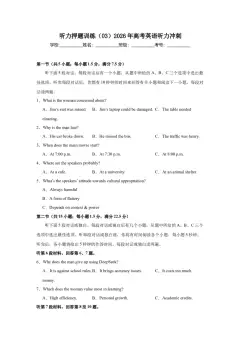
听下面10 段对话。每段对话后有一个小题,从题中所给的A、B、C 三个选项中选出最佳选项。听完每段
对话后,你都有10 秒钟的时间来回答有关小题和阅读下一小题。每段对话仅读一遍。
1. What does the woman advise the man to do?
A. Continue his task.
B. Charge his phone.
C. Have a rest.
【答案】C
【原文】M: Work has been crazy lately that lines are approaching.
W: I feel that. Have you tried taking small bricks to recharge?
M: I should have. I just feel like I can’t afford to stop.
W: Trust me, a quick break can actually make you more productive.
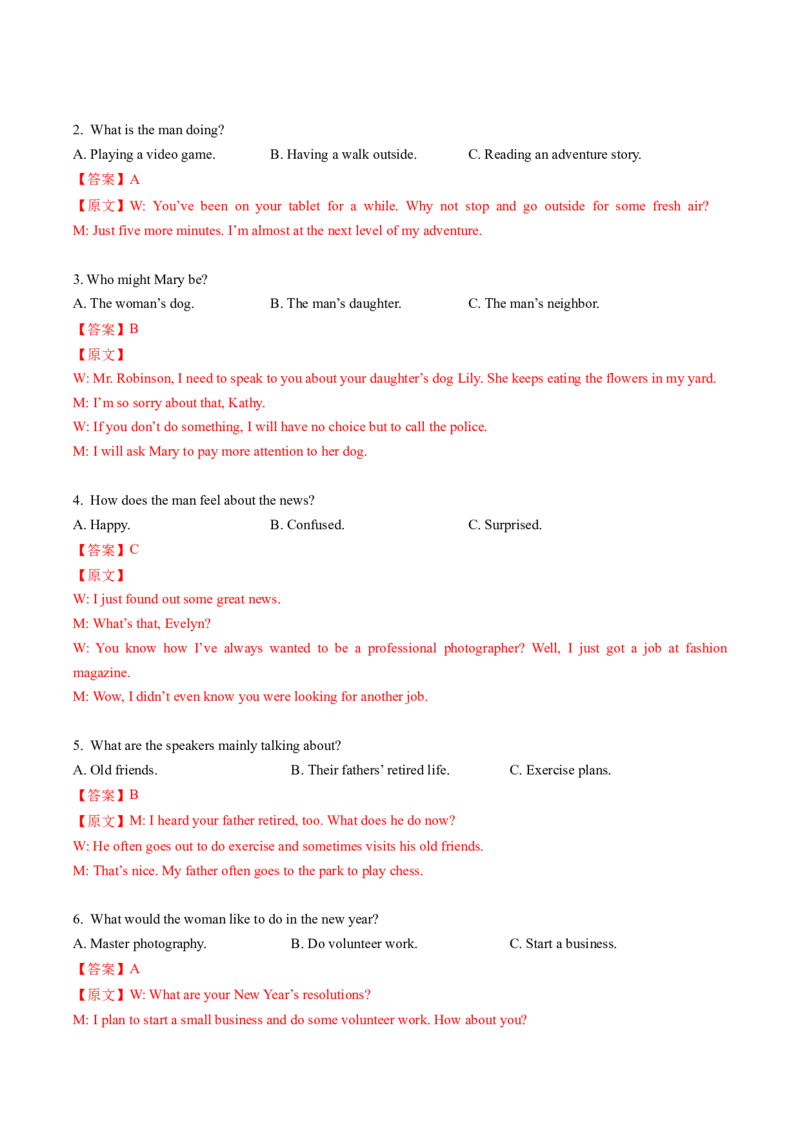
2. What is the man doing?
A. Playing a video game.
B. Having a walk outside.
C. Reading an adventure story.
【答案】A
【原文】W: You’ve been on your tablet for a while. Why not stop and go outside for some fresh air?
M: Just five more minutes. I’m almost at the next level of my adventure.
3. Who might Mary be?
A. The woman’s dog.
        B. The man’s daughter.
C. The man’s neighbor.
【答案】B
【原文】
W: Mr. Robinson, I need to speak to you about your daughter’s dog Lily. She keeps eating the flowers in my yard.
M: I’m so sorry about that, Kathy.
W: If you don’t do something, I will have no choice but to call the police.
M: I will ask Mary to pay more attention to her dog.
4. How does the man feel about the news?
A. Happy.
B. Confused.
C. Surprised.
【答案】C
【原文】
W: I just found out some great news.
M: What’s that, Evelyn?
W: You know how I’ve always wanted to be a professional photographer? Well, I just got a job at fashion
magazine.
M: Wow, I didn’t even know you were looking for another job.
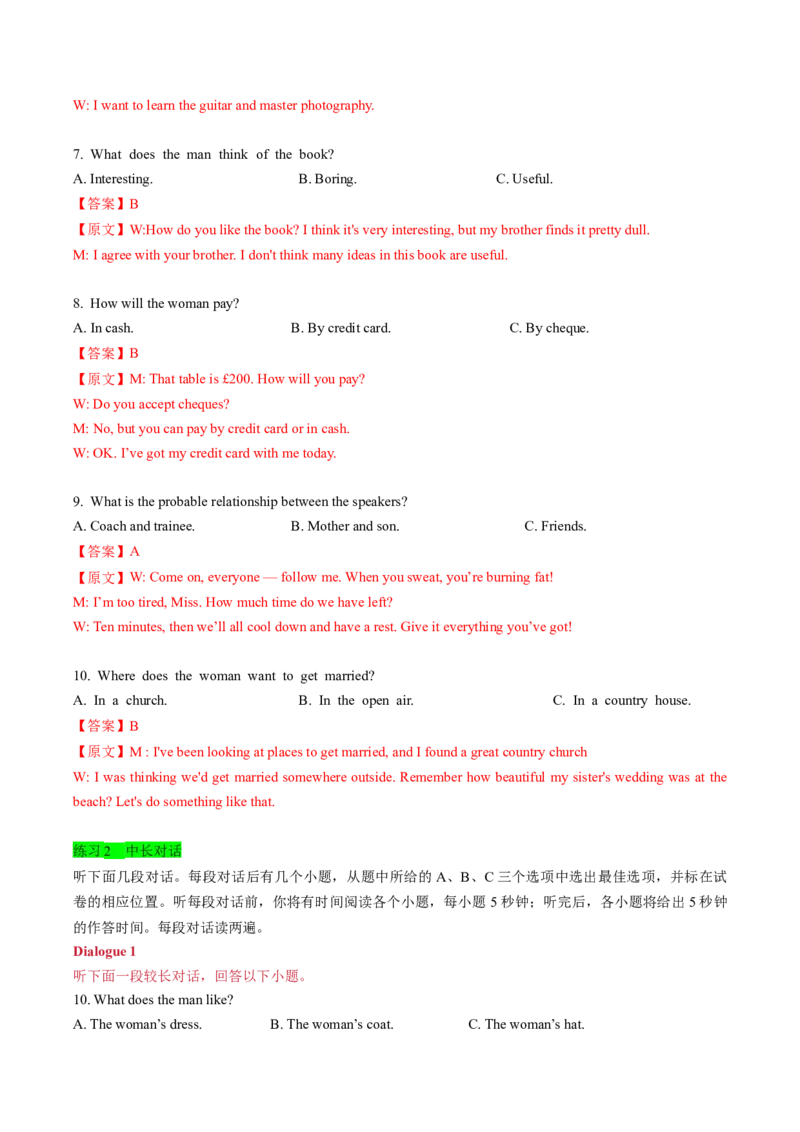
5. What are the speakers mainly talking about?
A. Old friends.
B. Their fathers’ retired life.
C. Exercise plans.
【答案】B
【原文】M: I heard your father retired, too. What does he do now?
W: He often goes out to do exercise and sometimes visits his old friends.
M: That’s nice. My father often goes to the park to play chess.
6. What would the woman like to do in the new year?
A. Master photography.
B. Do volunteer work.
C. Start a business.
【答案】A
【原文】W: What are your New Year’s resolutions?
M: I plan to start a small business and do some volunteer work. How about you?
W: I want to learn the guitar and master photography.
7. What does the man think of the book?
A. Interesting.
B. Boring.
C. Useful.
【答案】B
【原文】W:How do you like the book? I think it's very interesting, but my brother finds it pretty dull.
M: I agree with your brother. I don't think many ideas in this book are useful.
8. How will the woman pay?
A. In cash.
B. By credit card.
C. By cheque.
【答案】B
【原文】M: That table is £200. How will you pay?
W: Do you accept cheques?
M: No, but you can pay by credit card or in cash.
W: OK. I’ve got my credit card with me today.
9. What is the probable relationship between the speakers?
A. Coach and trainee.
B. Mother and son.
C. Friends.
【答案】A
【原文】W: Come on, everyone — follow me. When you sweat, you’re burning fat!
M: I’m too tired, Miss. How much time do we have left?
W: Ten minutes, then we’ll all cool down and have a rest. Give it everything you’ve got!
10. Where does the woman want to get married?
A. In a church.
B. In the open air.
C. In a country house.
【答案】B
【原文】M : I've been looking at places to get married, and I found a great country church
W: I was thinking we'd get married somewhere outside. Remember how beautiful my sister's wedding was at the
beach? Let's do something like that.
练习2  中长对话
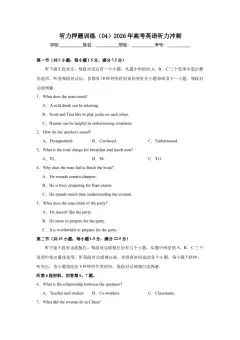
听下面几段对话。每段对话后有几个小题,从题中所给的A、B、C 三个选项中选出最佳选项,并标在试
卷的相应位置。听每段对话前,你将有时间阅读各个小题,每小题5 秒钟;听完后,各小题将给出5 秒钟
的作答时间。每段对话读两遍。
Dialogue 1
听下面一段较长对话,回答以下小题。
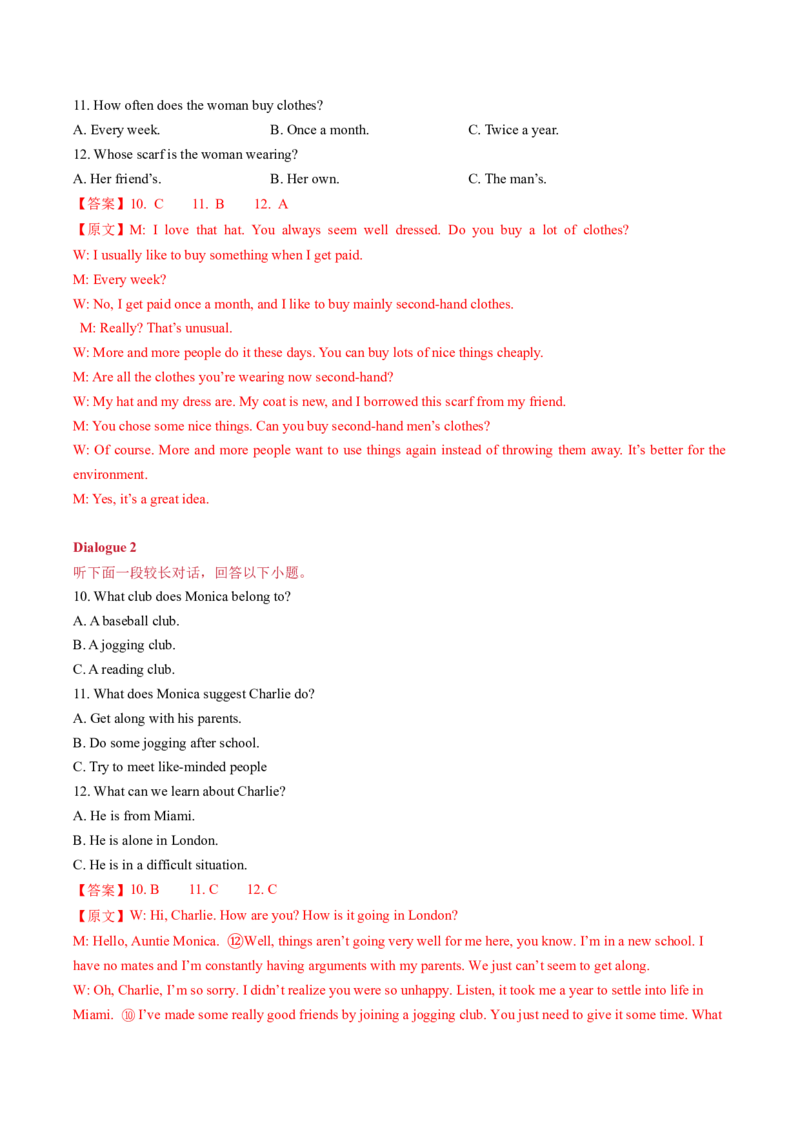
10. What does the man like?
A. The woman’s dress.
B. The woman’s coat.
C. The woman’s hat.
11. How often does the woman buy clothes?
A. Every week.
B. Once a month.
C. Twice a year.
12. Whose scarf is the woman wearing?
A. Her friend’s.
B. Her own.
C. The man’s.
【答案】10. C    11. B    12. A
【原文】M: I love that hat. You always seem well dressed. Do you buy a lot of clothes?
W: I usually like to buy something when I get paid.
M: Every week?
W: No, I get paid once a month, and I like to buy mainly second-hand clothes.
 M: Really? That’s unusual.
W: More and more people do it these days. You can buy lots of nice things cheaply.
M: Are all the clothes you’re wearing now second-hand?
W: My hat and my dress are. My coat is new, and I borrowed this scarf from my friend.
M: You chose some nice things. Can you buy second-hand men’s clothes?
W: Of course. More and more people want to use things again instead of throwing them away. It’s better for the
environment.
M: Yes, it’s a great idea.
Dialogue 2
听下面一段较长对话,回答以下小题。
10. What club does Monica belong to?
A. A baseball club.
B. A jogging club.
C. A reading club.
11. What does Monica suggest Charlie do?
A. Get along with his parents.
B. Do some jogging after school.
C. Try to meet like-minded people
12. What can we learn about Charlie?
A. He is from Miami.
B. He is alone in London.
C. He is in a difficult situation.
【答案】10. B    11. C    12. C
【原文】W: Hi, Charlie. How are you? How is it going in London?
M: Hello, Auntie Monica. ⑫Well, things aren’t going very well for me here, you know. I’m in a new school. I
have no mates and I’m constantly having arguments with my parents. We just can’t seem to get along.
W: Oh, Charlie, I’m so sorry. I didn’t realize you were so unhappy. Listen, it took me a year to settle into life in
Miami. ⑩I’ve made some really good friends by joining a jogging club. You just need to give it some time. What
efforts are you making to meet new people?
M: Well, none actually.
W: ⑪You were on the baseball team at your old school. There must be a team in your school. Why don’t you try
out? M: I guess I could.
W: ⑪And you are into books; why not join a book club? Go to your local library and ask.
M: That sounds interesting. I’ll do that.
Dialogue 3
听下面一段较长对话,回答以下小题。
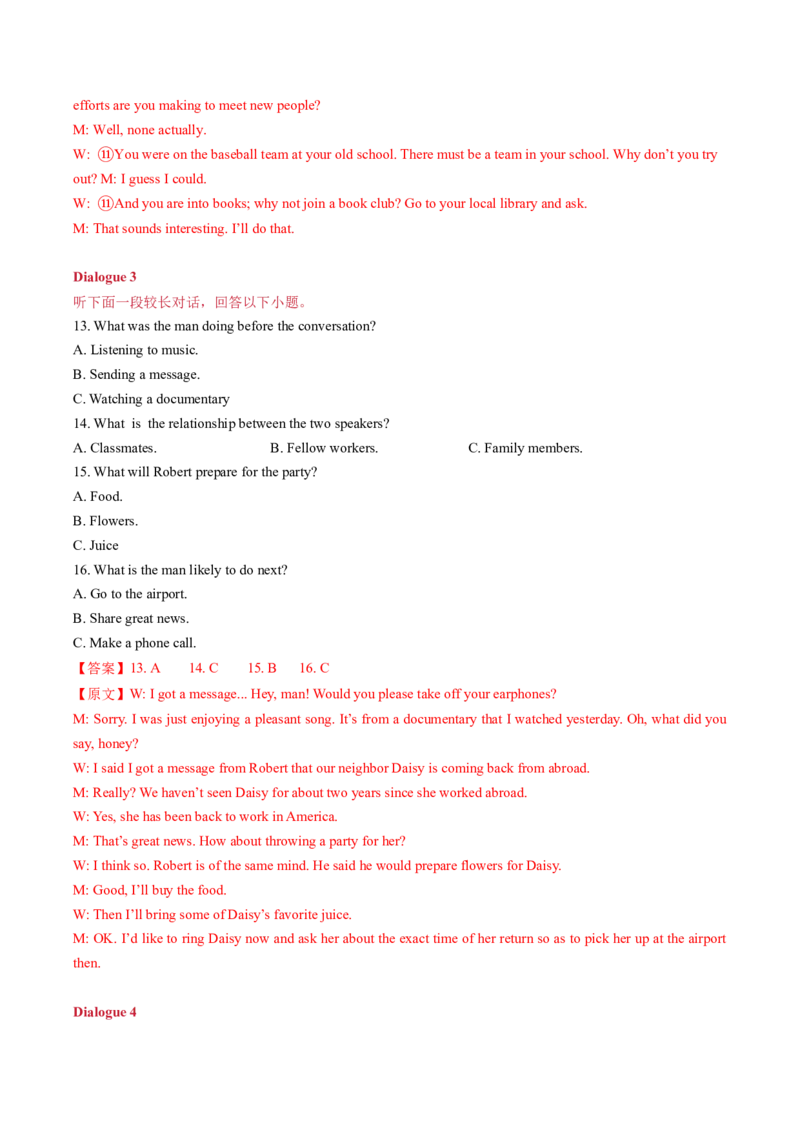
13. What was the man doing before the conversation?
A. Listening to music.
B. Sending a message.
C. Watching a documentary
14. What is the relationship between the two speakers?
A. Classmates.
B. Fellow workers.
C. Family members.
15. What will Robert prepare for the party?
A. Food.
B. Flowers.
C. Juice
16. What is the man likely to do next?
A. Go to the airport.
B. Share great news.
C. Make a phone call.
【答案】13. A    14. C    15. B
16. C
【原文】W: I got a message... Hey, man! Would you please take off your earphones?
M: Sorry. I was just enjoying a pleasant song. It’s from a documentary that I watched yesterday. Oh, what did you
say, honey?
W: I said I got a message from Robert that our neighbor Daisy is coming back from abroad.
M: Really? We haven’t seen Daisy for about two years since she worked abroad.
W: Yes, she has been back to work in America.
M: That’s great news. How about throwing a party for her?
W: I think so. Robert is of the same mind. He said he would prepare flowers for Daisy.
M: Good, I’ll buy the food.
W: Then I’ll bring some of Daisy’s favorite juice.
M: OK. I’d like to ring Daisy now and ask her about the exact time of her return so as to pick her up at the airport
then.
Dialogue 4
听下面一段较长对话,回答以下小题。
11. What makes the woman excited?
A A new computer.
B. A trip to England.
C. Good exam results.
12. What will the man probably do this summer?
A. Work.
B. Study.
C. Travel.
13. What is the probable relationship between the speakers?
A. Co-workers.
B. Family members.
C. Classmates.
【答案】11. B    12. A    13. C
【原文】W: The exams are finally over! I’m so excited about summer vacation. I have made all the arrangements
for my summer vacation.
M: What are you planning to do?
W: Well, my family and I are planning to go to England. We’ve been talking about going there for years, and we
finally planned the whole thing out.
M: Wow!
W: How about you? What’s your plan?
M: I haven’t really got any plans to travel anywhere. In fact, I intend to get a part-time job to save a little money for
next year.
W: That sounds all right.
M: You know, I really want to buy a new computer next term, so I have to save as much money as possible.
W: Why don’t you ask your parents for some money?
M: I’d rather my parents didn’t pay for it. I’d feel better about it if I bought it with my own money.
W: It’s good to be independent. Sounds like you have a great goal this summer.
Dialogue 5
听下面一段较长对话,回答以下小题。
14. What did the woman learn during her time off?
A. How to work with kids.
B. How to teach science classes.
C. How to work with disabled adults.
15. How long was the woman away from school?
A. One semester.
B. One year.
C. Four years.
16. Why was the woman having a difficult time in school before?
A. Her classes were boring.
B. She didn’t know what she wanted to study.
C. Her parents wouldn’t allow her to study education.
17. Who would the woman advise to take a break from school?
A. All students.
B. Students who dislike studying.
C. Students who want to find some motivation.
【答案】14. A    15. B    16. B    17. C
【原文】M: I’m so glad you’re back in school this semester.
W: Thanks. I missed it here, but I’m really glad I took time off.
M: Why? Most people want to graduate in four years.
W: I know. But I wasn’t doing very well in my classes. I had no direction. I needed some real world experience.
M: So, what did you do?
W: I assisted a teacher who taught students with disabilities. It was very meaningful and inspiring… I had never
worked with kids before, so I had to learn a lot.
M: Like what?
W: Well, I had to learn to give directions very clearly because I didn’t want to confuse them. I also had to learn how
to respond to kids who were behaving badly. Overall, I became very patient.
M: Are you glad you took the year off?
W: Yeah. Before, I was taking classes in biology because my parents wanted me to become a doctor. But now, I’ll
take classes in Education and Child Development because I know what I want.
M: That’s great. It sounds like your time away from school was very valuable.
W: It was. You know, I wouldn’t recommend taking time off to every student. But it helped me to find some
motivation to come back to school and take it more seriously.
Dialogue 6
听下面一段较长对话,回答以下小题。
11. What is a must for Wimbledon tennis players?
A. Wearing cream shoes.
B. Dressing in white.
C. Wearing bright-coloured shirts.
12. When were the first Wimbledon Tennis Championships held?
A. In the late 19th century.
B. In the early 18th century.
C. In the mid⁃17th century.
13. What might Andre Agassi like?
A. Plain clothes.
B. Eye-catching clothes.
C. High-quality clothes.
14. What is the talk mainly about?
A. Wimbledon’s dress rule.
B. Athletes’ clothing preferences.
C. Victorian England.
【答案】11. B    12. A    13. B    14. A
【原文】W: Jack, are you excited about the Wimbledon Tennis Championships this year? I love all the
traditions they have there.
M: Yeah. It isn’t a true Wimbledon experience without the strawberries and cream.
W: Exactly! But did you know that those tennis players have to wear all-white clothes? Even their shoes can’t be
off-white or cream.
M: Ha, I know! I read it’s because back then, in Victorian England, sweat marks were a big no-no. White was the
best way to hide them. So, the rule for athletes to wear white has been in place since the first tournament in 1877.
W: So what happens if they wear something with color?
M: They have to change their clothes.
W: Interesting. I remember that Andre Agassi, who was known for his colorful clothes, was against this tradition
from 1988 to 1990. But he eventually won Wimbledon in 1992 in white.
M: I guess even the greats have to follow the rule.
Dialogue 7
听下面一段较长对话,回答以下小题。
14. Why did Williams quit football?
A. He preferred acting.
B. He hated being pushed.
C. He was poor at running.
15. What motivated Williams to start his career in Barcelona?
A. Gaudi’s works.
B. Local dishes.
C. Exciting matches.
16. What challenged Williams the most in Barcelona?
A. Spanish idioms.
B. Extreme heat.
C. Huge crowds.
17. Which best describes Williams?
A. Ambitious.
B. Considerate.
C. Generous.
【答案】14. C    15. A    16. B    17. A
【原文】W: Hello Williams, can you share how you chose your career path?
M: Trial and error. Honestly, my dad was a professional footballer so I tried that first. But let’s just say running
wasn’t my strength so I quit after six months. My mom pushed me toward acting since she was on stage herself, but
I kept struggling on lines. Then I realized I’d always get really excited about studying cool buildings. That aha
moment let me straight to architecture school.
W: Why did you choose Barcelona specifically?
M: When I visited it at nineteen for a football match and got attached to Gaudi’s famous designs? I read tongues
about his urban design afterward and promised myself I’ll add my own style to this city someday. Plus, I truly
enjoy the amazing local dishes and exciting match days.
W: So what’s your biggest adjustment when living here?
M: Surviving extremely hot summers, learning Spanish everyday expressions and handling crowds took time too.
But hey, great local food fixed most problems.
W: Thanks for sharing. Your journey was super inspiring. I’m sure many of our young listeners learned a lot from
your experience.
M: Hopefully so.
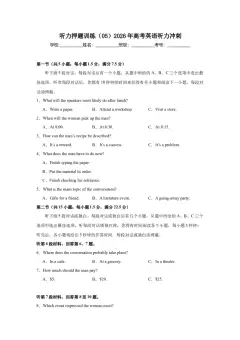
练习 3 独白
Passage 1
听下面一段较长独白,回答以下小题。
17. What is the main purpose of the passage?
A. To recommend a job.
B. To advertise a school.
C. To recruit(招募)computer programmers.
18. What is an advantage of being a computer programmer?
A. Good job prospects.
B. Flexible working conditions.
C. Plenty of training opportunities.
19. What is most attractive about the school?
A. It partners with large firms.
B. It provides evening classes.
C. It has well-trained teachers.
20. What does the speaker mean in the end?
A. The present job market is competitive.
B. Doctors and lawyers are tired of their jobs.
C. Being a computer programmer is a smart career move.
【答案】17. B
18. A    19. B    20. C
【原文】Are you tired of your job and want to do something different? Do you long to find work that both
interests you and pays well? If you answered yes to the questions, we have a suggestion to make: why not train to
become a computer programmer?
The world is becoming increasingly computer-based, so there is a great demand for computer programmers. Every
day, employers call our school and ask us to send them more students. They want well-trained people to work in
their large firms. You could soon be working in the high-tech field of computers and running the office. This is your
big chance. Just think about the pay. You’ll be earning a lot of money every year. There’s the respect you’ll get
from your friends and family when they discover that you work with computers. So what are you waiting for?
Best of all, our school offers night classes, so you can continue your present job while training at night. You have
nothing to lose. Don’t forget that doctors and lawyers wanting to change their jobs also come here to learn. Perhaps
they know something that you don’t.
Passage 2
听下面一段独白,回答以下小题。
18. Who is the probable audience?
A. Health care and health insurance staff.
B. International students and scholars in Harvard University.
C. All the full-time and part-time students in Harvard University.
19. What is the benefit of buying health insurance?
A. To meet the responsibility.
B. To get all medical cost covered.
C. To get protected against the high medical cost,
20. Who needn't buy Harvard health plan?
A. International scholars.
B. Visiting professors.
C. International students.
【答案】18. B    19. C    20. A
【原文】M: Good morning! Here’s some information about health insurance. Health care and health insurance are
important during your stay at Harvard. It is crucial that you learn about the differences between the medical care
system in your own country and that in the United States. Arranging paying for medical care is your responsibility.
The best way to meet this responsibility is to get health insurance coverage to protect you against high cost. Access
to health insurance depends on your connection with the University. Requirements for health insurance also vary.
American law requires that any full-time and part-time student registered in an institution of high learning in
America must participate in a student health insurance program or in a health plan of comparable coverage.
Therefore, all Harvard University students are automatically registered in the Harvard University Health Plan
unless they can show that they have similar health insurance coverage on their own. International scholars are not
required to purchase the Harvard health insurance plan.
Passage 3
听下面一段独白,回答以下小题。
17. Which building has a gym?
A. Blake Residence.
B. Brown Hall.
C. Queen’s Building.
18. Why is Blake Residence peaceful?
A. Only girls live there.
B. No visitors can come in.
C. Everyone has a private room.
19. What is the advantage of Queen’s Building?
A. It has shower rooms.
B. It has a computer room.
C. It has its own private garden.
20. Why is the Parkway Flats expensive?
A. Parking there is charged.
B. There are the largest rooms.
C. The fees include the cost of meals.
【答案】17. B    18. A    19. A    20. C
【原文】
W: Good afternoon and welcome to Stanton University. I’m here to tell you about the various dorms we have. We
aim to offer accommodation to all first-year students. First of all, there’s Brown Hall, which is not the most modern
of buildings, but it is very popular. Unlike the other halls, it has recently had a gym built in its basement. Another
option is Blake Residence, built like a large house. Everybody cooks and eats together. It has a private garden and
is even more peaceful because this is an all-girl’s residence but boys can visit it. The largest one we have is
Queen’s Building and this has been upgraded recently. The original parking area has been built on and each
bedroom now has its own shower room. A further option is the Parkway Flats with a preservation order. This has
meant that only a limited amount could be done to upgrade it, and the surrounding area is important. So parking is
not permitted around the flats. However, the flats do have many extra facilities such as a special computer room, a
small library and a self-service restaurant. The cost of meals is covered in the fees so it does look a bit more
expensive.
Passage 4
听下面一段独白,回答以下小题。
17. What's "Interesting Culture"?
A. A radio program.
B. A school lecture.
C. A social organization.
18. Where does a person sing songs in western karaoke?
A. At a table.
B. On a stage.
C. In a room.
19. Who usually controls the songs in western karaoke?
A. The singer.
B. The audience.
C. The DJ.
20. How does a singer choose songs in China's karaoke?
A. By writing on a paper.
B. By selecting on a screen.
C. By turning to the DJ.
【答案】17. A    18. B    19. C    20. B
【原文】W: Good morning, everyone. This is Lucy Green with "Interesting Culture” on the air. We all know
karaoke is a big part of Asian culture, but it's also a well-known activity to westerners. Today, we're going to talk
about the main differences between them. In China, you can book a private room for just you and your friends.
Western karaoke, on the other hand, is for people to sing in front of strangers. People at the bar go on a stage and
sing in front of everybody at the bar, not just their friends. Because of that, not everyone will enjoy. If the key is too
high, then it's hard for anyone to sing. Karaoke in North America is an open event, so there is always a DJ who is
managing the mics and songs. The bar usually hires the DJ for these events, which are usually once a week.
Because the DJ controls the song, you can't skip a song, and it's also difficult to cancel a song. In China, there's
always a song book or a screen with a menu for choosing the song you want to sing. But in North America, there
often isn't even a book. People often just write their name and song request on a list, then the DJ finds it. It's not
like KTV, where the singer selects a song on the machine first. In Western karaoke, when it's that person's turn, the
DJ calls die person's name, and they go up on stage...
Passage 5
听下面一段较长独白,回答以下小题。
17. How many languages does Saint Mary’s school teach now?
A. 3.
B. 4
C. 5.
18. Which of the following isn’t mentioned about the program?
A. China offers books.
B. China sends some teachers.
C. China partly pays teachers in the school.
19. How many American schools and universities join the program?
A. More than 15.
B. About 40.
C. Over 50.
20. What can we infer in the talk in the United States?
A. Fewer people study Chinese.
B. It is short of various teachers.
C. More and more people learn Chinese.
【答案】17. B    18. B    19. C    20. C
【原文】W: Some schools in the United States and other countries offer Chinese language classes with the
government support from China. Saint Mary’s School is a private college preparatory school in Medford, Oregon,
in the Pacific Northwest. Saint Mary teaches Spanish, German and Latin. It added Mandarin in two thousand five.
Two years ago, it became the first school in the country to join the Confucius classroom program.
The program pays about half the costs of a teacher sent to a school in the United States. China’s Education Ministry
also provides books and other materials.
Saint Mary’s principal, Frank Phillips, says knowing Chinese will help students in a world where China is quickly
gaining economic power. The Confucius classroom program is in about forty countries, including more than fifty
American schools and universities.
A recent report said more schools in the United States are teaching Chinese, although the numbers are still low. But
it said foreign language teaching in public elementary and middle schools dropped sharply in recent years. Fewer
schools teach French, German, Russian or Japanese. There are language teacher shortages, but some schools say a
law that only measures progress in math and reading has hurt language teaching.