文档文本内容
考点分析
解题技巧
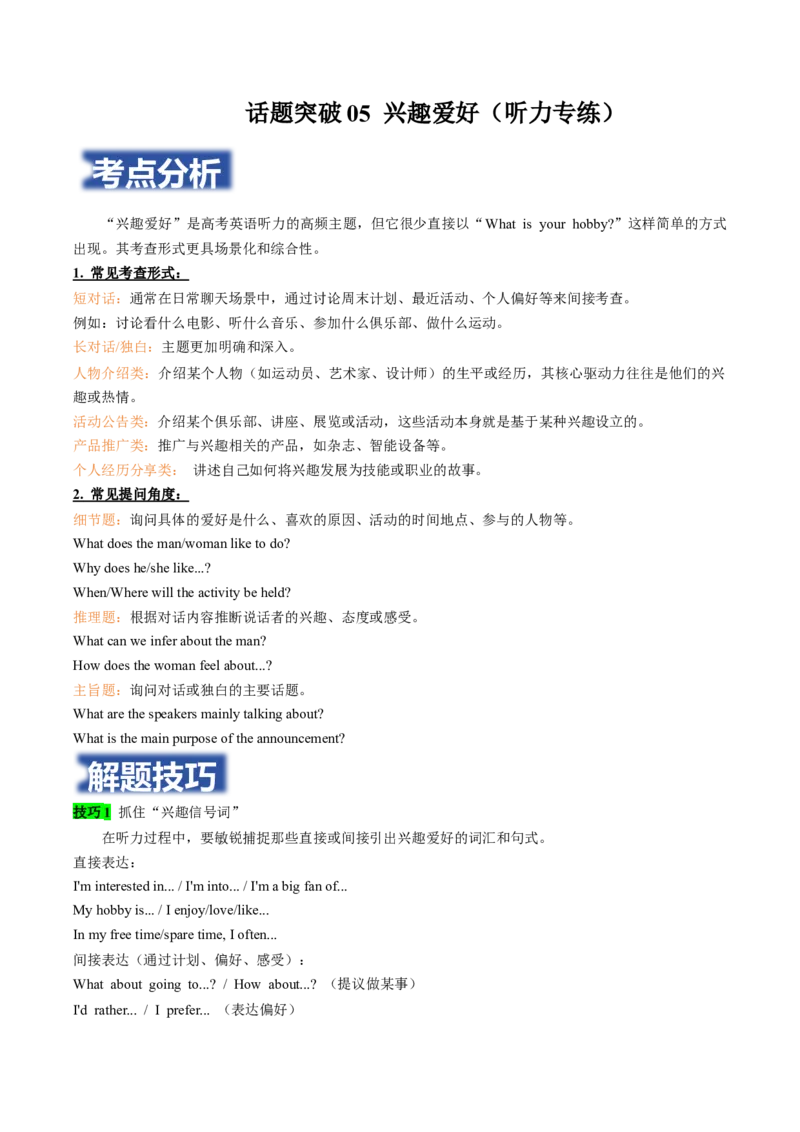
话题突破05 兴趣爱好(听力专练)

    “兴趣爱好”是高考英语听力的高频主题,但它很少直接以“What is your hobby?”这样简单的方式
出现。其考查形式更具场景化和综合性。
1.   常见考查形式:


短对话:通常在日常聊天场景中,通过讨论周末计划、最近活动、个人偏好等来间接考查。
例如:讨论看什么电影、听什么音乐、参加什么俱乐部、做什么运动。
长对话/独白:主题更加明确和深入。
人物介绍类:介绍某个人物(如运动员、艺术家、设计师)的生平或经历,其核心驱动力往往是他们的兴
趣或热情。
活动公告类:介绍某个俱乐部、讲座、展览或活动,这些活动本身就是基于某种兴趣设立的。
产品推广类:推广与兴趣相关的产品,如杂志、智能设备等。
个人经历分享类: 讲述自己如何将兴趣发展为技能或职业的故事。
2.   常见提问角度:


细节题:询问具体的爱好是什么、喜欢的原因、活动的时间地点、参与的人物等。
What does the man/woman like to do?
Why does he/she like...?
When/Where will the activity be held?
推理题:根据对话内容推断说话者的兴趣、态度或感受。
What can we infer about the man?
How does the woman feel about...?
主旨题:询问对话或独白的主要话题。
What are the speakers mainly talking about?
What is the main purpose of the announcement?
技巧1 抓住“兴趣信号词”
在听力过程中,要敏锐捕捉那些直接或间接引出兴趣爱好的词汇和句式。
直接表达:
I'm interested in... / I'm into... / I'm a big fan of...
My hobby is... / I enjoy/love/like...
In my free time/spare time, I often...
间接表达(通过计划、偏好、感受):
What about going to...? / How about...? (提议做某事)
I'd rather... / I prefer... (表达偏好)
强化训练
It's so much fun / amazing / relaxing. (表达积极感受)
I can't wait to... / I'm looking forward to... (表达期待)
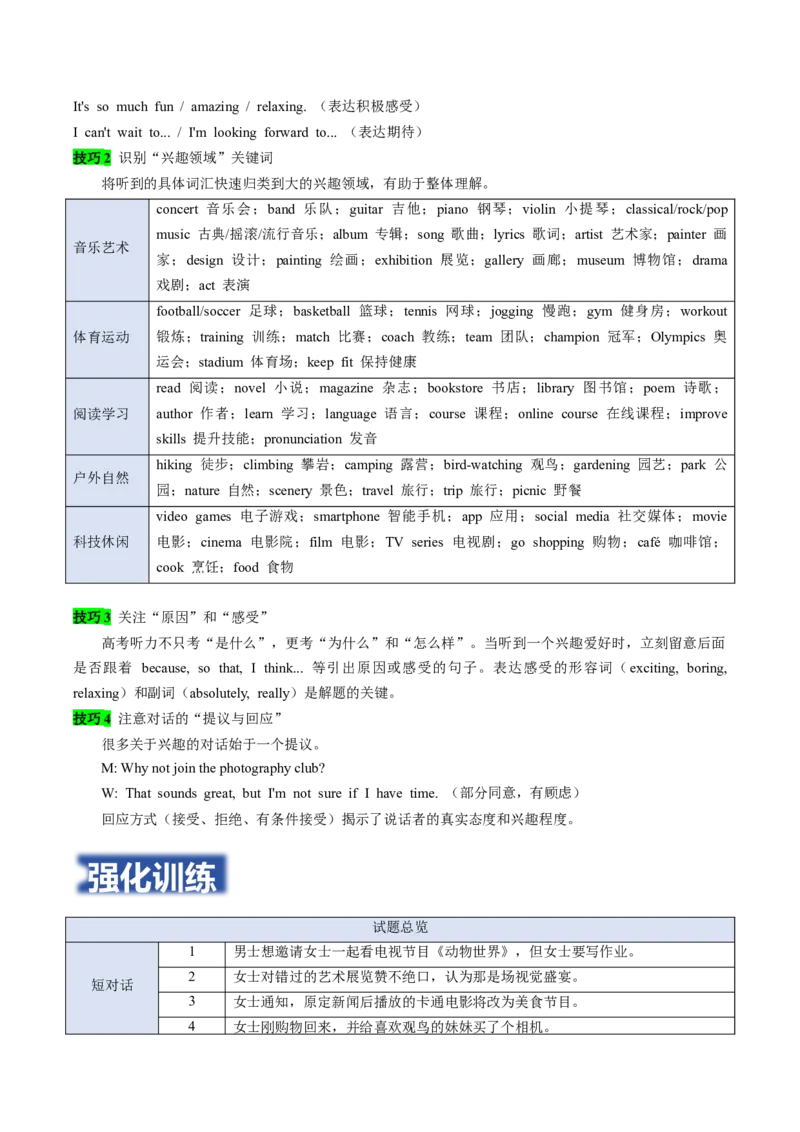
技巧2 识别“兴趣领域”关键词
将听到的具体词汇快速归类到大的兴趣领域,有助于整体理解。
音乐艺术
concert 音乐会;band 乐队;guitar 吉他;piano 钢琴;violin 小提琴;classical/rock/pop
music 古典/摇滚/流行音乐;album 专辑;song 歌曲;lyrics 歌词;artist 艺术家;painter 画
家;design 设计;painting 绘画;exhibition 展览;gallery 画廊;museum 博物馆;drama
戏剧;act 表演
体育运动
football/soccer 足球;basketball 篮球;tennis 网球;jogging 慢跑;gym 健身房;workout
锻炼;training 训练;match 比赛;coach 教练;team 团队;champion 冠军;Olympics 奥
运会;stadium 体育场;keep fit 保持健康
阅读学习
read 阅读;novel 小说;magazine 杂志;bookstore 书店;library 图书馆;poem 诗歌;
author 作者;learn 学习;language 语言;course 课程;online course 在线课程;improve
skills 提升技能;pronunciation 发音
户外自然
hiking 徒步;climbing 攀岩;camping 露营;bird-watching 观鸟;gardening 园艺;park 公
园;nature 自然;scenery 景色;travel 旅行;trip 旅行;picnic 野餐
科技休闲
video games 电子游戏;smartphone 智能手机;app 应用;social media 社交媒体;movie
电影;cinema 电影院;film 电影;TV series 电视剧;go shopping 购物;café 咖啡馆;
cook 烹饪;food 食物
技巧3 关注“原因”和“感受”
高考听力不只考“是什么”,更考“为什么”和“怎么样”。当听到一个兴趣爱好时,立刻留意后面
是否跟着 because, so that, I think... 等引出原因或感受的句子。表达感受的形容词(exciting, boring,
relaxing)和副词(absolutely, really)是解题的关键。
技巧4 注意对话的“提议与回应”
很多关于兴趣的对话始于一个提议。
M: Why not join the photography club?
W: That sounds great, but I'm not sure if I have time. (部分同意,有顾虑)
回应方式(接受、拒绝、有条件接受)揭示了说话者的真实态度和兴趣程度。


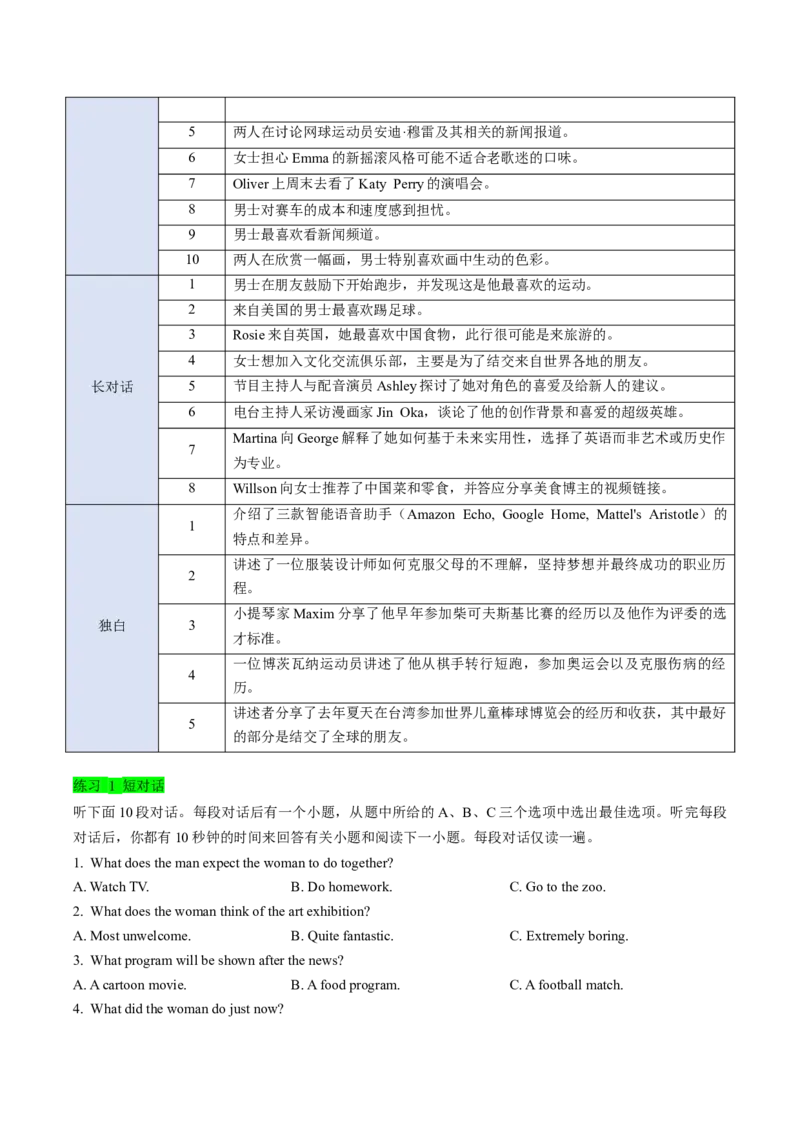
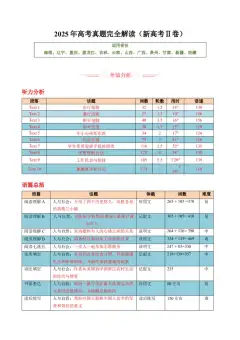
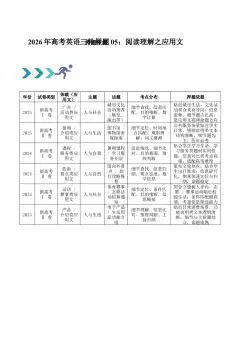
试题总览
短对话
1
男士想邀请女士一起看电视节目《动物世界》,但女士要写作业。
2
女士对错过的艺术展览赞不绝口,认为那是场视觉盛宴。
3
女士通知,原定新闻后播放的卡通电影将改为美食节目。
4
女士刚购物回来,并给喜欢观鸟的妹妹买了个相机。
5
两人在讨论网球运动员安迪·穆雷及其相关的新闻报道。
6
女士担心Emma 的新摇滚风格可能不适合老歌迷的口味。
7
Oliver 上周末去看了Katy Perry 的演唱会。
8
男士对赛车的成本和速度感到担忧。
9
男士最喜欢看新闻频道。
10
两人在欣赏一幅画,男士特别喜欢画中生动的色彩。
长对话
1
男士在朋友鼓励下开始跑步,并发现这是他最喜欢的运动。
2
来自美国的男士最喜欢踢足球。
3
Rosie 来自英国,她最喜欢中国食物,此行很可能是来旅游的。
4
女士想加入文化交流俱乐部,主要是为了结交来自世界各地的朋友。
5
节目主持人与配音演员Ashley 探讨了她对角色的喜爱及给新人的建议。
6
电台主持人采访漫画家Jin Oka,谈论了他的创作背景和喜爱的超级英雄。
7
Martina 向George 解释了她如何基于未来实用性,选择了英语而非艺术或历史作
为专业。
8
Willson 向女士推荐了中国菜和零食,并答应分享美食博主的视频链接。
独白
1
介绍了三款智能语音助手(Amazon Echo, Google Home, Mattel's Aristotle)的
特点和差异。
2
讲述了一位服装设计师如何克服父母的不理解,坚持梦想并最终成功的职业历
程。
3
小提琴家Maxim 分享了他早年参加柴可夫斯基比赛的经历以及他作为评委的选
才标准。
4
一位博茨瓦纳运动员讲述了他从棋手转行短跑,参加奥运会以及克服伤病的经
历。
5
讲述者分享了去年夏天在台湾参加世界儿童棒球博览会的经历和收获,其中最好
的部分是结交了全球的朋友。
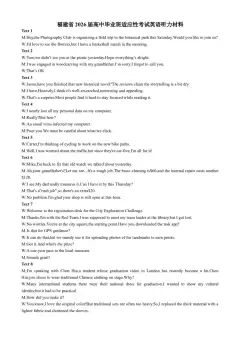
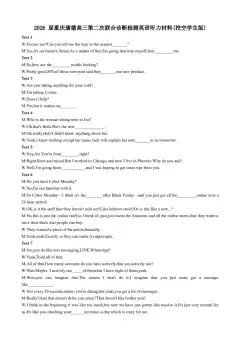
练习 1 短对话
听下面10 段对话。每段对话后有一个小题,从题中所给的A、B、C 三个选项中选出最佳选项。听完每段
对话后,你都有10 秒钟的时间来回答有关小题和阅读下一小题。每段对话仅读一遍。
1. What does the man expect the woman to do together?
A. Watch TV.
B. Do homework.
C. Go to the zoo.
2. What does the woman think of the art exhibition?
A. Most unwelcome.
B. Quite fantastic.
C. Extremely boring.
3. What program will be shown after the news?
A. A cartoon movie.
B. A food program.
C. A football match.
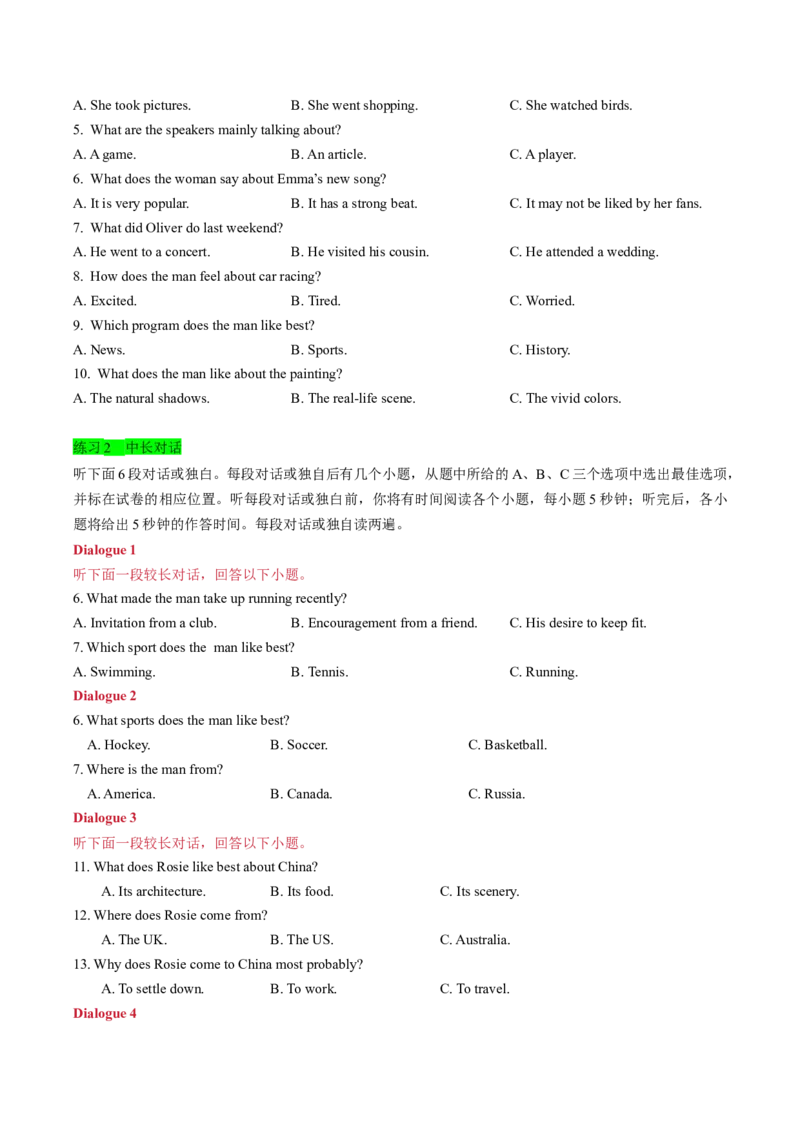
4. What did the woman do just now?
A. She took pictures.
B. She went shopping.
C. She watched birds.
5. What are the speakers mainly talking about?
A. A game.
B. An article.
C. A player.
6. What does the woman say about Emma’s new song?
A. It is very popular.
B. It has a strong beat.
C. It may not be liked by her fans.
7. What did Oliver do last weekend?
A. He went to a concert.
B. He visited his cousin.
C. He attended a wedding.
8. How does the man feel about car racing?
A. Excited.
B. Tired.
C. Worried.
9. Which program does the man like best?
A. News.
B. Sports.
C. History.
10. What does the man like about the painting?
A. The natural shadows.
B. The real-life scene.
C. The vivid colors.
练习2  中长对话
听下面6 段对话或独白。每段对话或独自后有几个小题,从题中所给的A、B、C 三个选项中选出最佳选项,
并标在试卷的相应位置。听每段对话或独白前,你将有时间阅读各个小题,每小题5 秒钟;听完后,各小
题将给出5 秒钟的作答时间。每段对话或独自读两遍。
Dialogue 1
听下面一段较长对话,回答以下小题。
6. What made the man take up running recently?
A. Invitation from a club.
B. Encouragement from a friend.
C. His desire to keep fit.
7. Which sport does the man like best?
A. Swimming.
B. Tennis.
C. Running.
Dialogue 2
6. What sports does the man like best?
A. Hockey.
B. Soccer.
C. Basketball.
7. Where is the man from?
A. America.
B. Canada.
C. Russia.
Dialogue 3
听下面一段较长对话,回答以下小题。
11. What does Rosie like best about China?
A. Its architecture.
B. Its food.
C. Its scenery.
12. Where does Rosie come from?
A. The UK.
B. The US.
C. Australia.
13. Why does Rosie come to China most probably?
A. To settle down.
B. To work.
C. To travel.
Dialogue 4
听下面一段较长对话,回答以下小题。
8. What is the main goal of the cultural exchange club?
A. To show beautiful views.
B. To invite guest speakers to give speeches.
C. To help students understand the world better.
9. Which club activity does the woman probably like best?
A. International food fair.
B. Sports and games.
C. Cultural nights.
10. Why does the woman hope to join the club?
A. To enjoy cultural events.
B. To improve her language skills.
C. To make friends from different countries.
Dialogue 5
听下面一段较长对话,回答以下小题。
14. Who is probably the man?
A. A voice actor.
B. A program host.
C. A game producer.
15. Why does Ashley like the role of Kate?
A. Kate has a sense of humor.
B. Kate has a special voice.
C. Kate runs an amazing shop.
16. What does Ashley think of becoming stars?
A. It’s easy.
B. It’s hard to say.
C. It’s unnecessary.
17. What advice does Ashley give to new voice actors?
A. Using social media well.
B. Improving acting skills.
C. Acquiring a reputation first.
Dialogue 6
听下面一段较长对话, 回答以下小题。
14. Who is the woman?
A. A writer.
B. A publisher.
C. A radio host.
15. What style of comic does Jin Oka probably write?
A. Japanese.
B. American.
C. Chinese.
16. Which character does Jin Oka like best?
A. Spider-Man.
B. Iron Man.
C. Batman.
17. What will the speakers do first?
A. Read a comic book.
B. Rest for a while.
C. Watch a video.
Dialogue 7
听下面一段较长对话,回答以下小题。
13. What are the speakers mainly talking about?
A. How Martina chose her course.
B. What Martina’s teacher looks like.
C. Whether Martina enjoys her campus life.
14. What do we know about the art teacher?
A. He is from France.
B. He has a bad accent.
C. He gives Martina advice.
15. What subject does Martina like best?
A. Art.
B. Science.
C. History.
16. Why did Martina decide to major in English?
A. She liked the English teacher.
B. It was more practical for her future.
C. It is easier to learn than other subjects.
Dialogue 8
听下面一段较长对话,回答以下小题。
11. Which dish does the woman probably prefer?
A. Peking duck.
B. Mapo tofu.
C. White cut chicken.
12. What kind of snacks does the man like best?
A. Sweet.
B. Salty.
C. Spicy.
13. What will the man do tonight?
A. Learn to make red bean cake.
B. Meet a Chinese food blogger.
C. Send a message to the woman.
练习 3 独白
Passage 1
听下面一段较长独白,回答以下小题。
17. When did Google come out with Google Home?
A. In 2016.
B. In 2015.
C. In 2017.
18. How many songs does Google’s product have?
A. 35 million.
B. 2 million.
C. 2.5 million.
19. Which product is aimed at young children?
A. Amazon Echo.
B. Google Home.
C. Mattel’s Aristotle.
20. What is typical of the Mattel’s Aristotle?
A. The lowest price.        B. The earliest product.
C. The best interaction.
Passage 2
听下面一段独白,回答以下小题。
17. What is the speaker’s mother?
A. A designer.       B. A doctor.       C. A teacher.
18. What did the speaker do first after he left high school?
A. He got a full-time job.
B. He did a business course.
C. He went to an art college.
19. How long did the speaker stay in Milan?
A. One year.       B. Two years.       C. Three years.
20. What difficulty did the speaker have in New York?
A. He was homesick.
B. His parents didn’t support him.
C. He could not start a company there.
Passage 3
听下面一段独白,回答以下小题。
17. Where was Open Tchaikovsky Competition held in 1986?
A. In Moscow.
B. In Chelyabinsk.
C. In Berlin.
18. What does Maxim say about the competition he attended at 10?
A. It inspired many young musicians.
B. It was the music event of his dreams.
C. It was a life-changing experience.
19. Which kind of music are the young players required to play?
A. Rock music.
B. Pop music.
C. Classical music.
20. What does Maxim value most in young players’ performance?
A. Expressiveness.
B. Smoothness.
C. Completeness.
Passage 4
听下面一段独白,回答以下小题。
17. What did the speaker do before the year 2012?
A. A fitness coach.
B. A chess player.
C. A marathon runner.
18. Why was the 2016 Olympics important for the speaker?
A. He was motivated by Bolt.       B. He broke a world record.
C. He won fifth place.
19. Which is the hardest for the speaker?
A. Getting over an injury.
B. Doing strength training.
C. Representing Botswana.
20. What is the speaker mainly talking about?
A. His plan to go for the gold.
B. His experience on the track.
C. His love for his home country.
Passage 5
听下面一段较长独白,回答以下小题。
17. Where was the Baseball Fair held last summer?
A. In France.
B. In Taiwan, China.
C. In Japan.
18. What did the speaker do in the mornings?
A. He learned baseball skills.
B. He visited local museums.
C. He watched baseball games.
19. Where did the speaker learn to make rice dumplings?
A. On a farm.
B. In a restaurant.
C. In a cooking class.
20. What did the speaker like best about his trip?
A. Traveling around the world.
B. Learning several languages.
C. Making new friends.