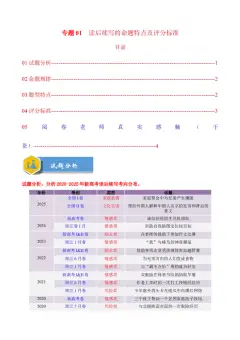
考点分析
话题突破13 艺术世界(听力专练)

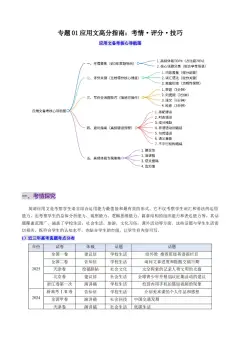
高考英语听力中的艺术类话题主要集中在“人与社会”这一主题语境下,考查形式多样,但核心是围绕艺
术活动的“事件(What)、人物(Who)、时间(When)、地点(Where)、原因(Why)和方式
(How)”。
把握常见问题类型
与艺术世界相关的题目通常围绕以下几个方面提问:
细节理解题(占比最高)
考点:直接考查对话或独白中提到的具体信息。
常见提问方式:
When/Where will the art exhibition be held? (艺术活动的时间/地点)
How much is the ticket? (票价)
What did the man like most? (个人偏好)
What is the man going to do this afternoon? (行动计划)
解题技巧:听前预读题目和选项,圈定关键词(如时间、地点、活动名称),听时集中捕捉这些关键信息。
答案往往是原文的同义转换。
推理判断题
考点:需要根据对话内容、语气、语境进行逻辑推理,得出言外之意。
常见提问方式:
What is the probable relationship between the speakers? (人物关系)
Where does this conversation most probably take place? (对话发生地点)
What does the man/woman imply/mean? (说话者的隐含意思)
解题技巧:重点关注能体现人物身份、地点特征的“标志词”。例如,听到 book a ticket, exhibition,
gallery 可推断在售票处或美术馆;听到 borrow paint brush, art class 可推断是同学关系。
主旨大意题
考点:考查对整段对话或独白核心内容的把握。
常见提问方式:
What are the speakers mainly talking about?
解题技巧:抓住反复出现的关键词和开篇第一句话。独白(如博物馆导览、艺术家介绍)的开头句往往是
主旨句。
观点态度题
考点:考查说话者对某艺术形式或事件的看法和感受。
常见提问方式:
How does the woman feel about AI winning the art competition?
解题技巧
语料总结
What does the man think of the modern art pieces?
解题技巧:留意表达观点和情感的形容词 (angry, amazing, fantastic, disappointed)、副词和语气。例如,
Ugh, it makes me really angry! 明确表达了愤怒的情绪。
技巧1 听前预测:充分利用读题时间,分析选项,预测对话主题和可能的问题。
技巧2 抓关键词:集中注意力捕捉与“艺术”相关的核心词汇(见下方语料库)和题目涉及的具体信息点
(数字、时间、地点等)。
技巧3 听中笔记:对于数字、日期、名称等易混淆信息,可做简单笔记。
技巧4 同义转换:意识到正确答案很少是原文的简单重复,通常是换一种说法。例如,"It closes at 6
pm" 可能对应选项 "It's open until 6 pm"。
技巧5 整体理解:结合上下文和常识进行合理推断,不要纠结于个别听不懂的单词。
艺术形式
与场所
art gallery / museum
美术馆 / 博物馆
exhibition / show
展览
modern / contemporary art
现代艺术
traditional art 传统艺术
painting / drawing 绘画 / 素描
sculpture 雕塑
portrait
肖像画
photography
摄影
digital art数字艺术
calligraphy
书法
concert / performance
音乐会 / 表演
theatre / play 剧院 / 话剧
art center / art club 艺术中心 / 艺术社团
workshop工作坊
艺术活动
与职业
visit an exhibition 参观展览
book a ticket
订票
be open/closed 开放/关闭
make a reservation 预约
强化训练
artist / painter 艺术家 / 画家
photographer 摄影师
writer / author 作家 / 作者
(art) major / student(艺术)专业学生
create / make artwork
创作艺术作品
take a photograph
拍照
join a class / club
参加课程/社团
win a prize / competition 赢得奖项/比赛
观点与评
价
amazing / fantastic / wonderful
令人惊叹的 / 极好的
interesting
有趣的
beautiful / pretty
美丽的
disappointed
失望的
angry / upset
生气的 / 心烦的
I love/like...
我喜欢……
I'm not into...我对……不感兴趣
It's my dream.
这是我的梦想。
It's not for everyone.
这不适合所有人。
It's worth it. 这是值得的。
常用句式
表达
活动与计划
There's an exhibition at... 在...有个展览。
I'd like to book a ticket for... 我想预订一张...的票。
Why don't we go to the art museum? 我们为什么不去美术馆呢?
I'm planning to visit... 我计划去参观...
观点与感受
I love modern art. 我喜欢现代艺术。
It's my dream to be an artist. 成为一名艺术家是我的梦想。
It makes me really angry! 这让我很生气!
I was disappointed about... 我对...感到失望。
信息咨询
How much does it charge? 票价是多少?
Do I need to make a reservation? 我需要预约吗?
What time does it open/close? 它几点开门/关门?
How did you make it? 你是怎么做到的?
问题与困难
What a pity! 真可惜!
I'd like to, but I have an appointment. 我想去,但我有个约会。
I've left my paint brush at home. 我把画笔忘在家里了。
I'm on a tight budget. 我的预算很紧。


试题总览
短对话
1
女士预订了一场艺术展下午2:30 的门票。
2
男士在游览过的景点中,最喜欢的是教堂,而非美术馆或植物园。
3
Jason 向对方坦言,尽管父亲希望他从商,但成为艺术家才是他自己的梦想。
4
男士因已和朋友约好去露营,无法和女士同去现代艺术博物馆看展。
5
女士白跑一趟,因为博物馆从周二到周四闭馆维修,共三天。
6
他们最早只能在周三去看展,因为国家美术馆要求提前三天预约。
7
他们讨论Jake 用来赢得数字艺术比赛一等奖的AI 绘画工具ArtGen。
8
两人在博物馆里边欣赏现代艺术边讨论其意义与感受。
9
两人正在前往大剧院的路上,并以艺术中心为地标。
10
男士同意将画笔借给女士,但他下午有艺术课要用。
长对话
1
男士咨询美术馆信息,得知周末开放至下午6 点且有免费导览。
2
作家Jennifer 分享了她通过学习文学、为教好书而广泛阅读,最终成为作家的经
历。
3
女士在参观中国的工作坊后想学剪纸,并计划在家清理出空间作工作室。
4
男士建议对艺术感兴趣的女孩Megan 在大学里应先广泛学习再做决定。
5
一位画家对AI 绘画赢得艺术比赛一等奖感到愤怒,认为应收回奖项。
6
两人盛赞纽约艺术节,并分享了自己(及亲友)从事绘画的经历。
7
水下摄影师Alex 分享了他的创作挑战、给新手的建议以及下一步计划。
独白
1
演讲者分享他在巴厘岛乌布通过游戏和歌曲教授英语的志愿者经历。
2
介绍了意大利艺术家Jacopo 在北京创作、生活并因其作品激发公众艺术兴趣的
经历。
3
博物馆导览员为大家规划参观路线,并特别推荐了法国现代艺术展。
4
一则学生艺术品售卖会的广告,收益将用于邀请艺术家讲座。
5
一则关于艺术家在美术馆吃掉“天价香蕉”艺术品的奇闻报道。
练习 1 短对话
听下面10 段对话。每段对话后有一个小题,从题中所给的A、B、C 三个选项中选出最佳选项。听完每段
对话后,你都有10 秒钟的时间来回答有关小题和阅读下一小题。每段对话仅读一遍。
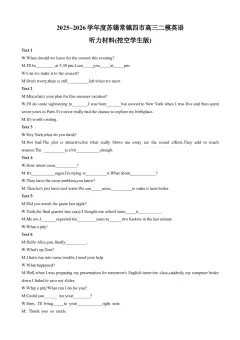
1. When will the woman go to watch the art show?
A. At 9:00 a.m.
B. At 11:30 a.m.
C. At 2:30 p.m.
【答案】C
【原文】W: I’d like to book a ticket for the art show on November 30th.
M: OK. We have tickets available for 9:00 a.m. and 2:30 p.m.
W: One ticket for the second, please.
2. Which place attracted the man most?
A. The church.
B. The art gallery.
C. The botanical garden.
【答案】A
【原文】W: Which of the attractions did you visit, and which one did you like the most?
M: First, I went to the art gallery, which had some amazing exhibits. But it couldn’t compare to the church, which
is such a historic part of the city’s culture. That was definitely my favourite. I also visited the botanical garden, but
it didn’t really catch my interest.
3. What does Jason want to be in the future?
A. An artist.
B. A teacher.
C. A businessman.
【答案】A
【原文】W: Jason, you love art so much. Do you plan to become an artist in the future?
M: Yes, it’s my dream. But my father doesn’t like this idea. He’d like me to do business with him.
4. What will Jason do this weekend?
A. Go camping.         B. Entertain friends.      C. Attend an exhibition.
【答案】B
【原文】W: Jason, there is an exhibition at the Modern Art Museum this weekend. Do you want to go and watch
it?
M: I’d like to, but I’ve made an appointment with my friends to go camping then.
5. How long is the museum closed?
  A. One day.
B. Three days.
C. Five days.
【答案】B
【原文】W: What a pity! I drove 3 hours here for the digital exhibition.
M: I’m sorry about that. Our museum is closed from Tuesday to Thursday because of the repairs.
6. When will the speakers go to the exhibition earliest?
A. On Wednesday.
B. On Saturday.
C. On Sunday.
【答案】A
【原文】W: What a nice Sunday! I've heard there's a great exhibition in the National Gallery, Why not go and
have a look?
M: That sounds great. But I just checked my phone and it said visitors must make reservations at least 3 days in
advance.
7. What are the speakers mainly talking about?
A. An AI painting tool. B. A unique art style.
C. A digital art competition.
【答案】A
【原文】W: Jake, congratulations on your winning the first prize in the competition! Your digital art
looks amazing! How did you make it?
M: Thanks! I used an Al tool called ArtGen. It turns sketches into colorful designs.
W: Wow! Can beginners use it too?
M: Definitely. You just upload a drawing, pick a style, and boom — it’s done!
8. What are the speakers probably doing?
A. Creating paintings.
B. Exploring a museum.
C. Taking an art history course.
【答案】B
【原文】
W: I love modern art but don’t understand the artworks’ meanings. M: Me too. Unlike traditional paintings you see
in other art history museums, these modern art pieces aren’t meant to be clear. The question is: how do they make
you feel? W: Interesting.
9. Where will the speakers meet?
A. At the library.
B. At the dentist’s
C. At the museum.
【答案】C
【原文】W:Now we've crossed the Stone Bridge. Turn right again. Look, here is the Art Centre. The Grand
Theatre is two blocks away.
M: Nearly there. We won't be late then.
10. What is the man going to do this afternoon?
A. Lend a paintbrush.
B. Have a class.
C. Return an artwork.
【答案】B
【原文】W:Can I borrow your paint brush? I've left mine at home.
M: Sure, but I have an art class in the afternoon.
W: I'll return it during lunch break.
M: No problem, just be careful with it.
练习2  中长对话
听下面几段对话。每段对话后有几个小题,从题中所给的A、B、C 三个选项中选出最佳选项,并标在试
卷的相应位置。听每段对话前,你将有时间阅读各个小题,每小题5 秒钟;听完后,各小题将给出5 秒钟
的作答时间。每段对话读两遍。
Dialogue 1
听下面一段较长对话,回答以下小题。
6. When is the art gallery available to visitors?
A. At 1 p.m. on Tuesday.
B. At 9 a.m. on Saturday.
C. At 5 p.m. on Sunday.
7. Which aspect of the gallery does the man ask about at last?
A. The time.
B. The guide.
C. The price.
【答案】6. C    7. B
【原文】
W: Good morning, sir. What can I do for you?
M: I'd like some information about the art gallery, please.
W: It's definitely worth a visit. What would you like to know?
M: First it is about the time. Is it open every day? And what time does it open?
W: Umm... let me check. It's open every day except Tuesday. On weekdays the opening hours are 10 am to 4:30
pm. And on Saturdays and Sundays it closes a bit later, at 6 pm.
M: Then how much does it charge?
W: It's £5 per person.
M: Just one more question. Does the gallery have guides?
W: Yes, it does. There are free guided tours, but only at the weekend.
Dialogue 2
听下面一段较长对话,回答以下小题。
10. What did Jennifer study in university?
A. Teaching.
B. Literature.
C. Fine arts.
11. Why did Jennifer read widely about creative writing?
A. To do her work better.
B. To be a writer one day.
C. To successfully get her PhD.
12. What relation is most probably Henry to Jennifer?
A. Her son.
B. Her brother.
C. Her husband.
【答案】10. B   11. A
12. C
【原文】M:Jennifer, had you studied writing before you became a writer?
W:Yes. I did a unit called “The Art of Writing” as part of my undergraduate degree at Moi University. But it was
not really enough to prepare one to be a writer.
M:So what else helped you become a writer?
W:(10)I think studying literature in university was helpful. As a literature student, I learned about writing
by experiencing writing first hand. Reading helped too. (11)After getting my PhD, I became a university
lecturer. I read widely about creative writing.
M:(11)Did you read in order to become a writer?
W:(11)Not really. I just wanted to become a better literature teacher. Later I ended up teaching a course on
creative writing at Daystar University. All of these experiences helped me become a creative writer.
M:So do you have a lot of time to write now?
W:Not really. (12)Now I've got a family to take care of. But Henry is very supportive. He sometimes takes
our kids out so that I can write.
Dialogue 3
听下面一段较长对话,回答以下小题。
10. How long has the woman wanted to do paper cutting work?
A. Since she visited a workshop in China.
B. Since she saw it in her teacher’s house.
C. Since she took a class.
11. What can the woman use in the teachers’ workshop?
A. The glue. B. The paper.
C. The scissors.
12. How will the speakers make space to do paper cutting work?
A. By building a workshop.
B. By using the living room.
C. By clearing out old chairs.
【答案】10. A   11. C
12. C
【原文】W: Ever since we visited that paper cutting workshop in China, I’ve wanted to learn how to make my
own window paper cuts. (10) It looks like an interesting thing to try.
M: It might be a good idea to join a class and learn some skills.
W: Yes, I’m a complete beginner. Also, I could learn from the teachers and use the scissors in their workshop. (11) I
only need to buy some paper and glue.
M: As paper became cheaper, paper cutting became one of the most popular art forms in China. Later, it spread to
other parts of the world. If you enjoy it, then we could make use of the spare bedroom. There would be enough
room if we clear out those old chairs we don’t use anymore. (12)
W: Good idea! (12)
Dialogue 4
听下面一段较长对话,回答以下小题。
10. What did the man study in college?
A. Art history.
B. Medicine.
C. Business.
11. How do the speakers know each other?
A. They’re neighbors.
B. They’re salesman and customer.
C. They’re teacher and student.
12. What is the man’s advice for the woman?
A. Doing what her father suggests.
B. Learning about a bunch of different things
C. Giving up as early as possible.
【答案】10. C   11. A
12. B
【原文】M: So, what do you want to study when you go to college, Megan?
W: I’m not sure, Mr. Sanders. My dad would be excited if I studied medicine, but that sounds too difficult. I’ve
always been interested in art, but I’m not sure if I want to be a professional artist.
M: Well, you could study art history. That was my wife’s major, you know.
W: Really? What did you major in?
M: Oh, I always wanted to be a businessman, so that’s what I did in college. (10) It’s not for everyone, but I
liked it. I wish I had taken some other classes, though. If you have a chance to learn about a bunch of
different things and then make a decision, I think that would be your best bet

 (
  你
  最好选择). (12)
W: That’s good advice, Mr. Sanders. Thanks!
M: My pleasure. If you want to talk more, come next door anytime you want. (11)
W: I sure will. Thank you!
Dialogue 5
听下面一段较长对话,回答以下小题。
11. How does the art competition make the woman feel?
A. Angry.                   B. Surprised.                   C. Excited.
12. What does the woman probably do?
A. She’s a short story writer.    B. She’s a digital artist.
C. She’s a painter.
13. What does the man think should happen now?
A. The judges should apologize.
B. The prize should be taken back.
C. A competition for AI art should be held.
【答案】11. A   12. C
13. B
【原文】M: What do you think about this art competition? (11)
W: Oh, you mean an AI painting winning first prize? Ugh, it makes me really angry! (11)
M: Yeah, honestly, I’m not surprised!
W: I’ve been painting for years, and I spend hours creating each of my paintings. (12) All those creative
works will disappear if we take AI artworks seriously.
M: Right, exactly.
W: I mean, I’m not against digital art. Some of it can be really exciting. But AI art requires very little effort or skill.
We shouldn’t compare them with the works of real artists.
M: I agree.
W: Did the judges realize it was an AI picture when they gave the prize?
M: Well, that’s unknown. But now they know, I think they should take the prize back. (13)
Dialogue 6
听下面一段较长对话,回答以下小题。
14. Which art festival was the biggest according to the woman?
A. The one in New York.
B. The one in Los Angeles.
C. The one in Chicago.
15. What did the speakers miss from the art exhibition?
A. Oil paintings.
B. Watercolor paintings.
C. Sculptures.
16. Who enjoys making chalk art?
A. The woman’s uncle.
B. The man’s niece.
C. The man’s friend.
17. Why is the woman going to pay for the taxi?
A. She has extra money this month.
B. The man will pay for the next one.
C. It is her turn to pay.
【答案】14. C    15. B    16. A    17. A
【原文】W:I can’t believe how cool that art festival was last night. And it was even bigger than the
ones we went to in Los Angeles and Chicago.
M: New York is the birthplace of the modern art movement in the U.S.
W: The only thing I was missing was sculpture. The watercolor paintings were my favorite.
M: I was also disappointed about the lack of sculpture, but in general, I liked it a lot. Hey, how long do
you think it takes to become an accomplished artist?
W: It’s tough to say. My uncle is a painter, and it took him 20 years to get to the point where he could
do his art full-time.
M: I have always enjoyed oil painting, but the materials are so expensive. I had to give it up.
W: That’s too bad! I guess we all have to make sacrifices.
M: Maybe I just need a cheaper alternative. My niece has been doing a lot of chalk art on her
blackboard and she even likes to show it to her best friend.
W: We should stop by the art supply store on the way home.
M: OK...as long as the cost of a cab is not too high. I am on a tight budget this month.
W: This one’s on me. You got the taxi last weekend.
M: Awesome! Let’s go to the reception counter. They can help us find the taxi stand.
Dialogue 7
听下面一段较长对话,回答以下小题。
14. What is Nick Hanna?
A. A host.
B. A photographer.
C. A writer.
15. What does Alex find most challenging about filming wildlife underwater?
A. Predicting animals’ behaviors.
B. Grabbing the perfect moment quickly.
C. Communicating underwater with divers.
16. What does Alex suggest new underwater photographers do?
A. Choose suitable subjects.
B. Take shots of small things at first.
C. Avoid getting too close to the subjects.
17. What is the main attraction for Alex to go to Sardinia?
A. The convenient location.
B. The wide range of underwater life.
C. The temperature and clarity of the water
【答案】14. C    15. B    16. A    17. B
【原文】
W: My guest today is the photographer Alex Mustard, who specializes in underwater shots. His cooperation with
Nick Hanna, a master storyteller, resulted in the book entitled The Art of Diving. Alex, how much is luck and how
much is judgment to get great shots?
M: With wildlife shots, it’s not always the case that you can get the animals to behave in the way you want. When
you spend much time in the ocean though, you get to predict behaviors and you get used to knowing when and
where you’re going to get particular shots. But often there’s only a second to grab the shot you have in mind, which
is the hardest part. With diver shots, communication is tough underwater, so everything needs planning ahead.
W: What advice would you give to new underwater photographers?
M: Well, the most important thing is to choose your subject very carefully; find something that you can get close to,
that’s not going to swim away, and that’s a not too big or too small size.
W: So what’s next for you?
M: I’m planning a trip to Sardinia-within easy reach of the airport at Olbia. And the water’s lovely and warm. But
these aren’t really the draws for me. It’s more the underwater landscapes — like the soft corals and the fish life.
练习 3 独白
Passage 1
听下面一段较长独白,回答以下小题。
17. What subject did the speaker teach?
A. Art.
B. Math.
C. English.
18., Where did the speaker volunteer?
A. In a village.
B. In a town.
C. In a city.
19. What do we know about the speaker?
A. He shared a room with others.
B. He used a swimming pool for free.
C. He received three traditional meals every day.
20. What is the speaker doing?
A. Making a trip plan.
B. Introducing a scenic spot.
C. Sharing a volunteer experience.
【答案】17. C    18. B    19. A    20. C
【原文】
M: ⑳Good morning, everyone. Now I’d like to tell you about a volunteer experience of mine. In the summer of
2022, I went to volunteer in a local kindergarten in beautiful Ubud in Bali. ⑰I taught basic English through
games, dance and songs there. The children really loved my teaching. Now I’d like to tell you something about
Ubud. It is the cultural and artistic center of Bali. It is famous for its arts and crafts. ⑱ The town is surrounded by
beautiful rice fields, small villages, art and craft communities, ancient temples, palaces and rivers. The best part is
that it’s far from the tourist crowds of Kuta. So it’s a very quiet place. ⑲ During my stay there, I shared a room
with seven other volunteers. It allowed me to make some new friends there. We could use a swimming pool there.
It cost us about three dollars each time. There are also several gyms nearby. We received three traditional meals
each day on weekdays and two meals on weekends. ⑳That’s all about my time volunteering in Ubud. If you want
to volunteer abroad one day, I strongly suggest you try the teaching volunteer program in Ubud.
Passage 2
听下面一段独白,回答以下小题。
17. Which university did Jacopo graduate from?
A. Peking University.                   B. The University of Milan.         C. The University of
Florence.
18. At what age did Jacopo move to China?
A.12.
B.20.
C.25.
19. What was the biggest pleasure for Jacopo?
A. His artworks were bought by visitors.
B. He expressed himself through his artworks.
C. His artworks inspired visitors' interest in art.
20. What do Chinese and Italians both value according to Jacopo?
A. Family.
B. Work.                        C. Life
【答案】17. B    18. C    19. C    20. A
【原文】Italian artist Jacopo Della Ragione's works on display in Beijing have attracted many visitors. Jacopo
was born in Florence in 1976, the art capital of Italy. Jacopo showed a strong interest in art in his childhood. While
studying at the University of Milan, Jacopo took a master's course in graphic design and printing technology.
Before coming to China, Jacopo knew almost nothing about it. With a strong curiosity about this country, Jacopo
moved to Beijing in 2001. “I planned to spend two weeks knowing about China, but later I found the time was far
from enough, and I've been here for more than 20 years until now,” Jacopo said. He created some paintings with
traditional colors to show his love for traditional Chinese culture. The happiest time for Jacopo was after enjoying
his artworks, some visitors who didn't understand art began to show interest in it and realized art is part of their life.
Having lived in China for more than two decades, Jacopo said he was amazed by the country's rapid development.
Now, he has put down roots in Beijing. “China and Italy have something in common—we both value family. I was
born in Italy and live in China. China is now my home and I will continue to live and work here," he said.
Passage 3
听下面一段独白,回答以下小题。
17. What is the speaker probably?
A. An artist.
B. A tour leader.
C. A history teacher.
18. Which part does the speaker suggest exploring first?
A. The Gallery of Sculpture.
B. The Gallery of Classic Art.
C. The Gallery of Modern Art.
19. What does the speaker particularly recommend the listeners to see?
A. French modern art.
B. Classic paintings.
C. Ancient coins.
20. When will the listeners meet in the hall?
A. At 11:00 a.m.

B. At 3:00 p.m.

C. At 4:00 p.m.
【答案】17.B
18. A    19. A    20. B
【原文】Welcome, ladies and gentlemen, to the Museum of Fine Arts. This museum houses some of the greatest
works of art to be found in the entire world. There are priceless collections of paintings, coins and other items
spanning a period of history from 3000 BC to the present day. There are four separate parts to the museum— the
Gallery of Ancient Treasures, the Gallery of Classic Art, the Gallery of Modern Art and the Gallery of Sculpture. I
highly recommend you should start your tour in the Gallery of Sculpture. (18) I particularly advise you to
visit the Gallery of Modern Art, because at the moment, there is a visiting collection of French modern art.
(19) It is truly incredible. The paintings on display there are nothing short of wonderful. I promise you won’t be
disappointed. To get the most out of your museum tour, you can buy an audio(录音的) guide from the gift shop. It
really is worth it because you’ll be able to hear expert opinions and descriptions of all the works. So, ladies and
gentlemen, the time now is 11:00 a.m. I suggest we all meet in the hall in four hours. (20) That should give
you plenty of time to see everything. Does anyone have any questions? No? OK, enjoy your visit and I will see
you later.
Passage 4
听下面一段独白,回答以下小题。
18. Why are several local artists mentioned?
A. They teach in the art program.
B. They will be present at the sale.
C. They provide some art for free.
19. What will the profits from this year's art sale be used for?
A. Funding a student trip.
B. Supporting next year's event.
C. Inviting an artist to give lectures.
20. How can the listeners see some art before the event?
A. By checking the school website.
B. By reading the school newspaper.
C. By contacting the program organizer.
【答案】18. C   19. C    20. A
【原文】Are you looking for beautiful art that won’t cost much? Then come down to Indigo High
School’s twentieth Student Art Sale .Hundreds of works of art will be available ,all of which were
produced in the student art program. Donations in the form of artworks from several local artists will
also be up for sale. The sale will be held in the school hall from 9 am to 5 pm this weekend.Because
of last year’s sale,the school was able to fund a trip to visit the Art Museum. The profits from this
year’s sale will go toward bringing a famous artist to give talks at the high school. Any additional
funding will be used to buy art supplies. Brighten up your house or apartment with some new art, and
you’ll also be supporting a good cause. For further information, and to view some of the art ahead of
time please visit the school website. The school newspaper will also be present to cover the sale.
Passage 5
听下面一段独白,回答以下小题。
18. What is the speaker’s job?
A. An artist.
                B. A news announcer.
      C. An art gallery director.
19. What does the speaker most likely think about the whole story?
A. It was strange.
            B. It was meaningful.
      C. It was understandable.
20. What will directly follow the commercial?
A. Politics.
                B. Weather.
              C. Traffic.
【答案】18. B   19. A
20. C
【原文】
W: Welcome to the Nightly News at Nine on Channel 29.I'm Dana Spry, filling in for Robert Smith. The top
story of the day is an unusual one for Miami. Do you remember the modern art piece that everyone has been
talking about? Yes, it's the banana taped to the wall at the Art Basel Gallery. Well, David, an artist from New York
walked into the gallery yesterday, took the banana from the wall, and ate it. He said his performance was called
“Hungry Artist". The artwork was originally sold for 120 thousand dollars. The strangest thing about this story
is that no legal action will be taken against David. Another banana will simply be taped to the wall. The art
gallery director said that the price of the artwork was for the idea, and the banana was meant to be replaced. It
makes sense, because pretty soon that banana is going to go bad, right, folks? Stay tuned for traffic, weather and
politics coming at you in that order right after this commercial break.