衔接点20 特殊句式
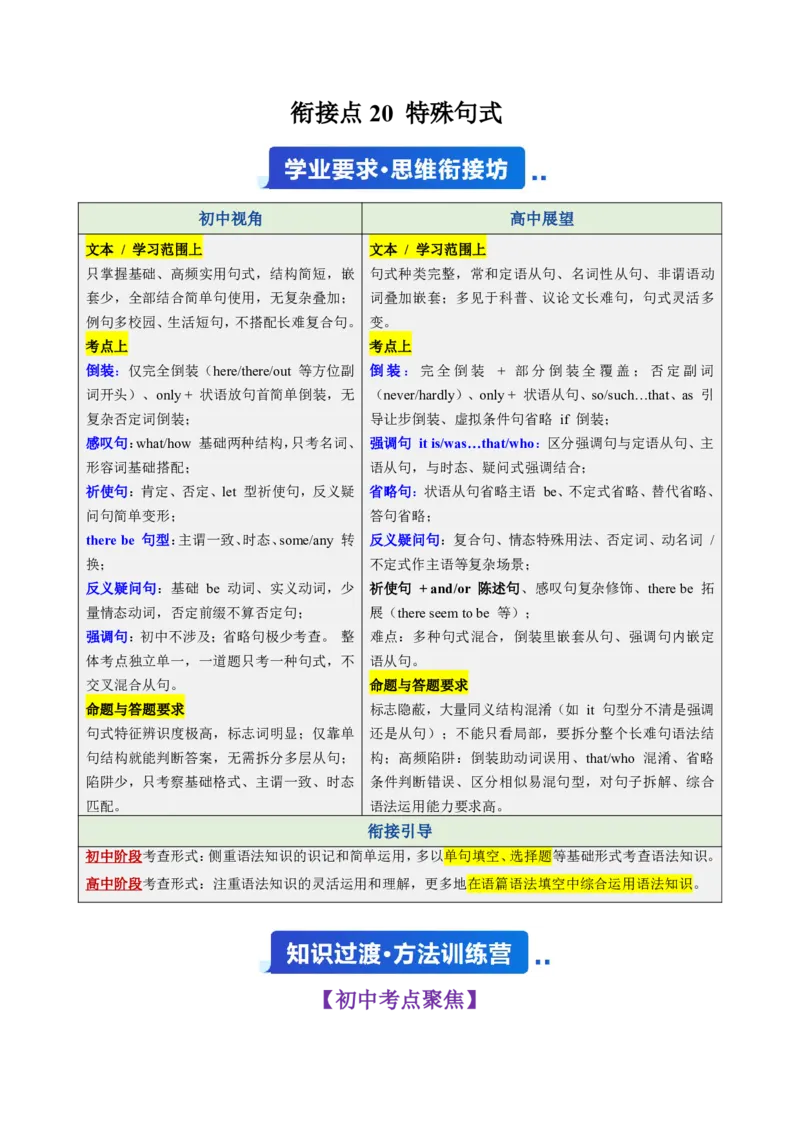
初中视角
高中展望
文本/ 学习范围上
只掌握基础、高频实用句式,结构简短,嵌
套少,全部结合简单句使用,无复杂叠加;
例句多校园、生活短句,不搭配长难复合句。
考点上
倒装:仅完全倒装(here/there/out 等方位副
词开头)、only + 状语放句首简单倒装,无
复杂否定词倒装;
感叹句:what/how 基础两种结构,只考名词、
形容词基础搭配;
祈使句:肯定、否定、let 型祈使句,反义疑
问句简单变形;
there be 句型:主谓一致、时态、some/any 转
换;
反义疑问句:基础be 动词、实义动词,少
量情态动词,否定前缀不算否定句;
强调句:初中不涉及;省略句极少考查。整
体考点独立单一,一道题只考一种句式,不
交叉混合从句。
命题与答题要求
句式特征辨识度极高,标志词明显;仅靠单
句结构就能判断答案,无需拆分多层从句;
陷阱少,只考察基础格式、主谓一致、时态
匹配。
文本/ 学习范围上
句式种类完整,常和定语从句、名词性从句、非谓语动
词叠加嵌套;多见于科普、议论文长难句,句式灵活多
变。
考点上
倒装:完全倒装
+ 部分倒装全覆盖;否定副词
(never/hardly)、only + 状语从句、so/such…that、as 引
导让步倒装、虚拟条件句省略if 倒装;
强调句it is/was…that/who:区分强调句与定语从句、主
语从句,与时态、疑问式强调结合;
省略句:状语从句省略主语be、不定式省略、替代省略、
答句省略;
反义疑问句:复合句、情态特殊用法、否定词、动名词/
不定式作主语等复杂场景;
祈使句+ and/or 陈述句、感叹句复杂修饰、there be 拓
展(there seem to be 等);
难点:多种句式混合,倒装里嵌套从句、强调句内嵌定
语从句。
命题与答题要求
标志隐蔽,大量同义结构混淆(如it 句型分不清是强调
还是从句);不能只看局部,要拆分整个长难句语法结
构;高频陷阱:倒装助动词误用、that/who 混淆、省略
条件判断错误、区分相似易混句型,对句子拆解、综合
语法运用能力要求高。
衔接引导
初中阶段考查形式:侧重语法知识的识记和简单运用,多以单句填空、选择题等基础形式考查语法知识。
高中阶段考查形式:注重语法知识的灵活运用和理解,更多地在语篇语法填空中综合运用语法知识。
【初中考点聚焦】
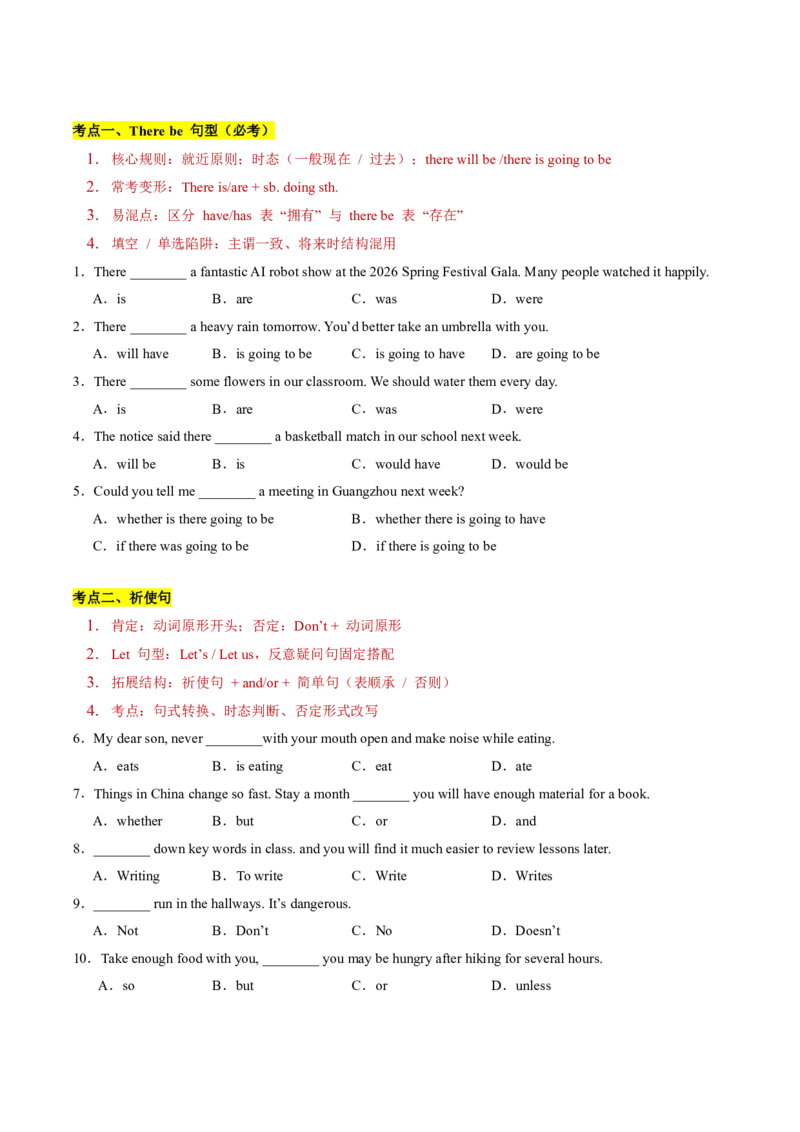
考点一、There be 句型(必考)
1.
核心规则:就近原则;时态(一般现在/ 过去);there will be /there is going to be
2.
常考变形:There is/are + sb. doing sth.
3.
易混点:区分have/has 表“拥有” 与there be 表“存在”
4.
填空/ 单选陷阱:主谓一致、将来时结构混用
1.There ________ a fantastic AI robot show at the 2026 Spring Festival Gala. Many people watched it happily.
A.is
B.are
C.was
D.were
2.There ________ a heavy rain tomorrow. You’d better take an umbrella with you.
A.will have
B.is going to be
C.is going to have
D.are going to be
3.There ________ some flowers in our classroom. We should water them every day.
A.is
B.are
C.was
D.were
4.The notice said there ________ a basketball match in our school next week.
A.will be
B.is
C.would have
D.would be
5.Could you tell me ________ a meeting in Guangzhou next week?
A.whether is there going to be
B.whether there is going to have
C.if there was going to be
D.if there is going to be
考点二、祈使句
1.
肯定:动词原形开头;否定:Don’t + 动词原形
2.
Let 句型:Let’s / Let us,反意疑问句固定搭配
3.
拓展结构:祈使句+ and/or + 简单句(表顺承/ 否则)
4.
考点:句式转换、时态判断、否定形式改写
6.My dear son, never ________with your mouth open and make noise while eating.
A.eats
B.is eating
C.eat
D.ate
7.Things in China change so fast. Stay a month ________ you will have enough material for a book.
A.whether
B.but
C.or
D.and
8.________ down key words in class. and you will find it much easier to review lessons later.
A.Writing
B.To write
C.Write
D.Writes
9.________ run in the hallways. It’s dangerous.
A.Not
B.Don’t
C.No
D.Doesn’t
10.Take enough food with you, ________ you may be hungry after hiking for several hours.
A.so
B.but
C.or
D.unless
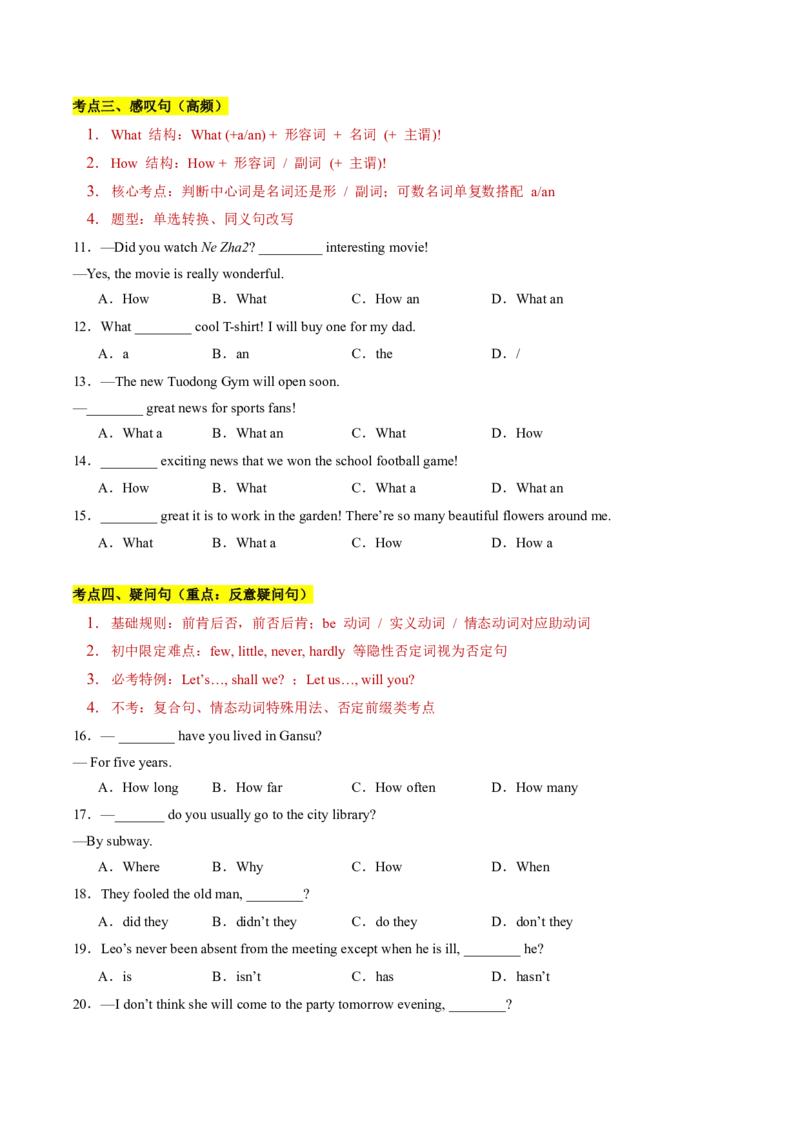
考点三、感叹句(高频)
1.
What 结构:What (+a/an) + 形容词+ 名词(+ 主谓)!
2.
How 结构:How + 形容词/ 副词(+ 主谓)!
3.
核心考点:判断中心词是名词还是形/ 副词;可数名词单复数搭配a/an
4.
题型:单选转换、同义句改写
11.—Did you watch Ne Zha2? _________ interesting movie!
—Yes, the movie is really wonderful.
A.How
B.What
C.How an
D.What an
12.What ________ cool T-shirt! I will buy one for my dad.
A.a
B.an
C.the
D./
13.—The new Tuodong Gym will open soon.
—________ great news for sports fans!
A.What a
B.What an
C.What
D.How
14.________ exciting news that we won the school football game!
A.How
B.What
C.What a
D.What an
15.________ great it is to work in the garden! There’re so many beautiful flowers around me.
A.What
B.What a
C.How
D.How a
考点四、疑问句(重点:反意疑问句)
1.
基础规则:前肯后否,前否后肯;be 动词/ 实义动词/ 情态动词对应助动词
2.
初中限定难点:few, little, never, hardly 等隐性否定词视为否定句
3.
必考特例:Let’s…, shall we? ;Let us…, will you?
4.
不考:复合句、情态动词特殊用法、否定前缀类考点
16.— ________ have you lived in Gansu?
— For five years.
A.How long
B.How far
C.How often
D.How many
17.—_______ do you usually go to the city library?
—By subway.
A.Where
B.Why
C.How
D.When
18.They fooled the old man, ________?
A.did they
B.didn’t they
C.do they
D.don’t they
19.Leo’s never been absent from the meeting except when he is ill, ________ he?
A.is
B.isn’t
C.has
D.hasn’t
20.—I don’t think she will come to the party tomorrow evening, ________?
—________. She said she would have finished her project by tomorrow afternoon.
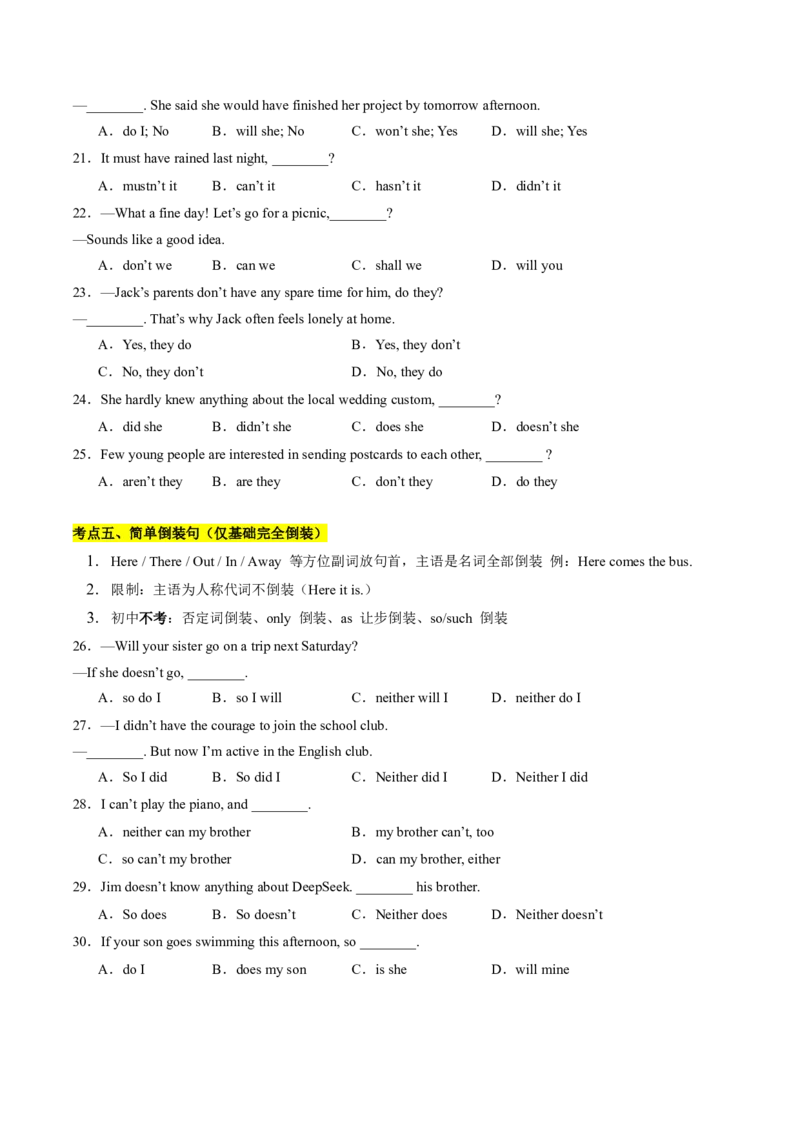
A.do I; No
B.will she; No
C.won’t she; Yes
D.will she; Yes
21.It must have rained last night, ________?
A.mustn’t it
B.can’t it
C.hasn’t it
D.didn’t it
22.—What a fine day! Let’s go for a picnic,________?
—Sounds like a good idea.
A.don’t we
B.can we
C.shall we
D.will you
23.—Jack’s parents don’t have any spare time for him, do they?
—________. That’s why Jack often feels lonely at home.
A.Yes, they do
B.Yes, they don’t
C.No, they don’t
D.No, they do
24.She hardly knew anything about the local wedding custom, ________?
A.did she
B.didn’t she
C.does she
D.doesn’t she
25.Few young people are interested in sending postcards to each other, ________ ?
A.aren’t they
B.are they
C.don’t they
D.do they
考点五、简单倒装句(仅基础完全倒装)
1.
Here / There / Out / In / Away 等方位副词放句首,主语是名词全部倒装例:Here comes the bus.
2.
限制:主语为人称代词不倒装(Here it is.)
3.
初中不考:否定词倒装、only 倒装、as 让步倒装、so/such 倒装
26.—Will your sister go on a trip next Saturday?
—If she doesn’t go, ________.
A.so do I
B.so I will
C.neither will I
D.neither do I
27.—I didn’t have the courage to join the school club.
—________. But now I’m active in the English club.
A.So I did
B.So did I
C.Neither did I
D.Neither I did
28.I can’t play the piano, and ________.
A.neither can my brother
B.my brother can’t, too
C.so can’t my brother
D.can my brother, either
29.Jim doesn’t know anything about DeepSeek. ________ his brother.
A.So does
B.So doesn’t
C.Neither does
D.Neither doesn’t
30.If your son goes swimming this afternoon, so ________.
A.do I
B.does my son
C.is she
D.will mine
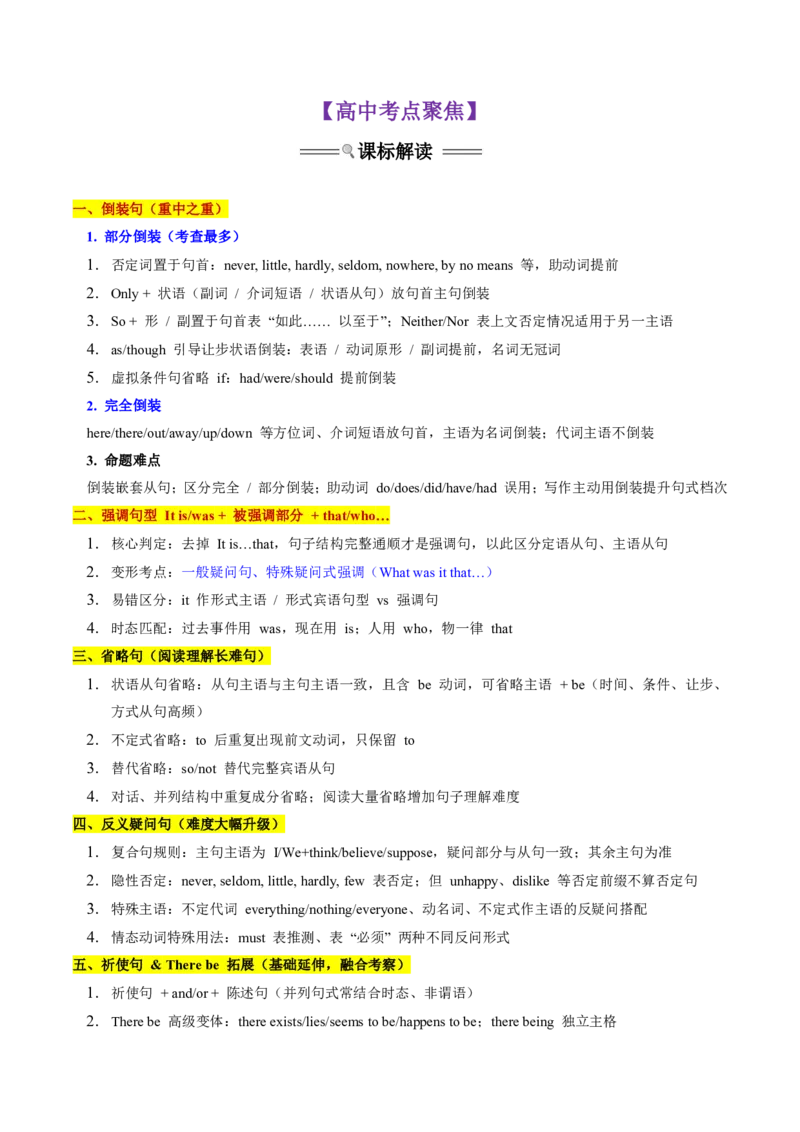
【高中考点聚焦】
课标解读
一、倒装句(重中之重)
1. 部分倒装(考查最多)
1.
否定词置于句首:never, little, hardly, seldom, nowhere, by no means 等,助动词提前
2.
Only + 状语(副词/ 介词短语/ 状语从句)放句首主句倒装
3.
So + 形/ 副置于句首表“如此…… 以至于”;Neither/Nor 表上文否定情况适用于另一主语
4.
as/though 引导让步状语倒装:表语/ 动词原形/ 副词提前,名词无冠词
5.
虚拟条件句省略if:had/were/should 提前倒装
2. 完全倒装
here/there/out/away/up/down 等方位词、介词短语放句首,主语为名词倒装;代词主语不倒装
3. 命题难点
倒装嵌套从句;区分完全/ 部分倒装;助动词do/does/did/have/had 误用;写作主动用倒装提升句式档次
二、强调句型It is/was + 被强调部分+ that/who…
1.
核心判定:去掉It is…that,句子结构完整通顺才是强调句,以此区分定语从句、主语从句
2.
变形考点:一般疑问句、特殊疑问式强调(What was it that…)
3.
易错区分:it 作形式主语/ 形式宾语句型vs 强调句
4.
时态匹配:过去事件用was,现在用is;人用who,物一律that
三、省略句(阅读理解长难句)
1.
状语从句省略:从句主语与主句主语一致,且含be 动词,可省略主语+ be(时间、条件、让步、
方式从句高频)
2.
不定式省略:to 后重复出现前文动词,只保留to
3.
替代省略:so/not 替代完整宾语从句
4.
对话、并列结构中重复成分省略;阅读大量省略增加句子理解难度
四、反义疑问句(难度大幅升级)
1.
复合句规则:主句主语为I/We+think/believe/suppose,疑问部分与从句一致;其余主句为准
2.
隐性否定:never, seldom, little, hardly, few 表否定;但unhappy、dislike 等否定前缀不算否定句
3.
特殊主语:不定代词everything/nothing/everyone、动名词、不定式作主语的反疑问搭配
4.
情态动词特殊用法:must 表推测、表“必须” 两种不同反问形式
五、祈使句& There be 拓展(基础延伸,融合考察)
1.
祈使句+ and/or + 陈述句(并列句式常结合时态、非谓语)
2.
There be 高级变体:there exists/lies/seems to be/happens to be;there being 独立主格
3.
否定祈使、带主语祈使句写作运用
六、感叹句(基础拓展,侧重写作优化)
除基础What/How 结构,拓展复杂修饰、名词前多层形容词搭配,主要用于书面表达加分
七、命题综合特点
1.
句式常互相嵌套:倒装里包含强调、省略、定语从句,单一句子多层语法叠加
2.
题型分布:语法填空挖空考结构;单选题辨析易混句型;写作要求主动使用倒装、强调、省略提升语
言档次
3.
核心难点:相似句型辨析(it 强调句vs it 形式主语句、倒装语序判断、省略句缺失成分还原)
4.
阅读中大量特殊句式压缩句子,增加长难句解读障碍,是阅读理解的核心卡点之一
考点清单
考点一、倒装句用法梳理
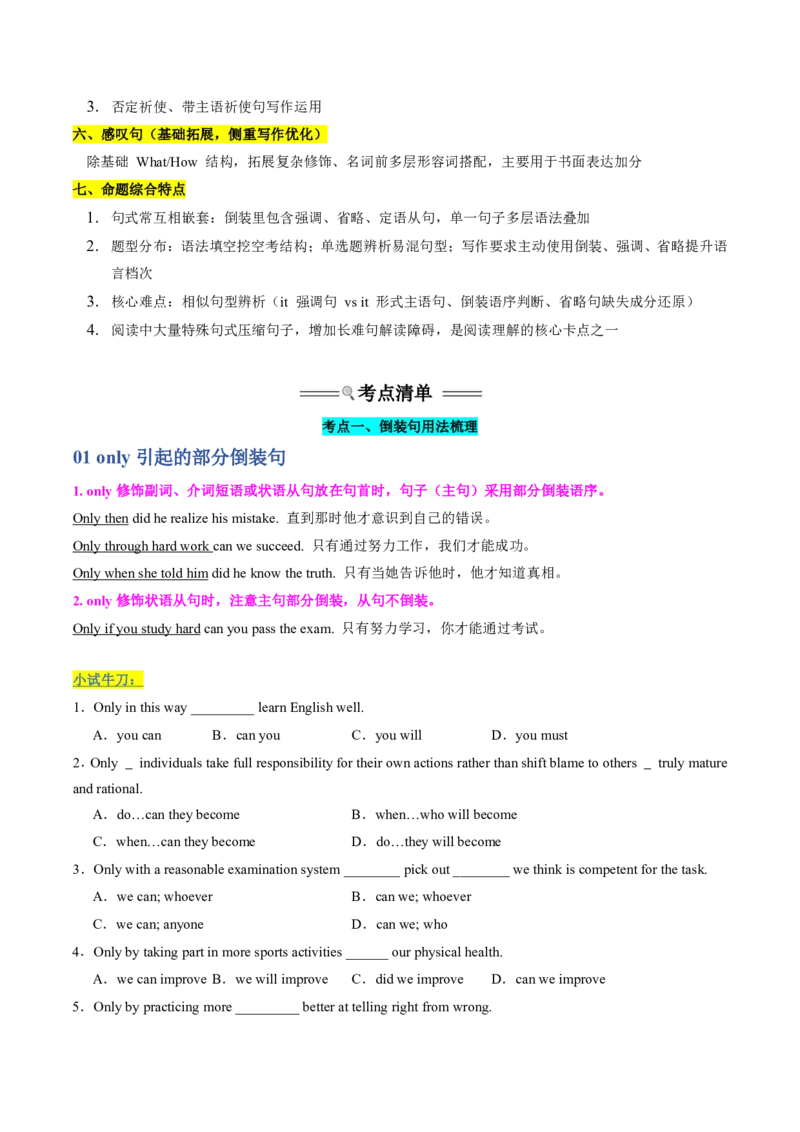
01 only 引起的部分倒装句
1. only 修饰副词、介词短语或状语从句放在句首时,句子(主句)采用部分倒装语序。
Only then did he realize his mistake. 直到那时他才意识到自己的错误。
Only through hard work can we succeed. 只有通过努力工作,我们才能成功。
Only when she told him did he know the truth. 只有当她告诉他时,他才知道真相。
2. only 修饰状语从句时,注意主句部分倒装,从句不倒装。
Only if you study hard can you pass the exam. 只有努力学习,你才能通过考试。
小试牛刀:
1.Only in this way _________ learn English well.
A.you can
B.can you
C.you will
D.you must
2.Only
individuals take full responsibility for their own actions rather than shift blame to others
truly mature
and rational.
A.do…can they become
B.when…who will become
C.when…can they become
D.do…they will become
3.Only with a reasonable examination system ________ pick out ________ we think is competent for the task.
A.we can; whoever
B.can we; whoever
C.we can; anyone
D.can we; who
4.Only by taking part in more sports activities ______ our physical health.
A.we can improve B.we will improve
C.did we improve
D.can we improve
5.Only by practicing more _________ better at telling right from wrong.
A.we can be
B.can we be
C.we are
D.are we
6. Only when he is seriously ill
he ever stay in bed.
7.
when we learn to exist in harmony with nature can we stop being a threat to wildlife and our planet.
8. Only in this way
the team begin its journey to the next Olympics.
9. Only when he apologizes for his rudeness
I speak to him again.
10. Only when I reached the top of the mountain
I feel a great sense of achievement.(用适当的词填空)
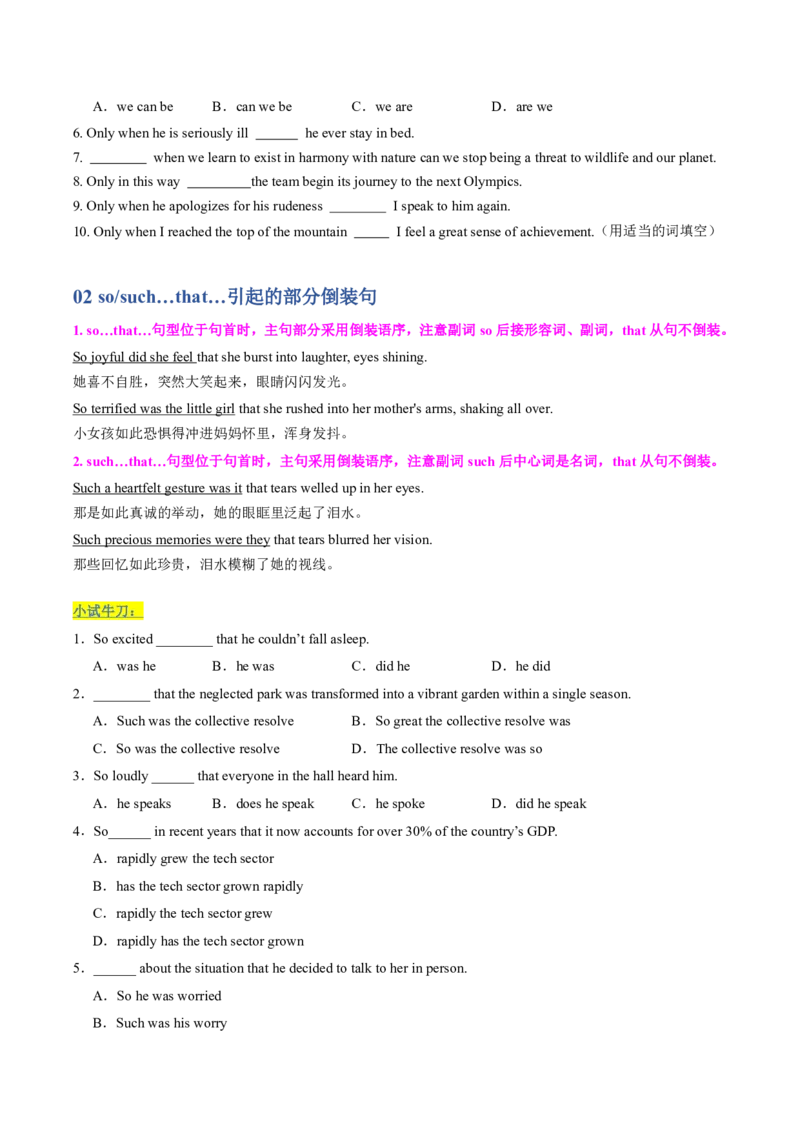
02 so/such…that…引起的部分倒装句
1. so…that…句型位于句首时,主句部分采用倒装语序,注意副词so 后接形容词、副词,that 从句不倒装。
So joyful did she feel that she burst into laughter, eyes shining.
她喜不自胜,突然大笑起来,眼睛闪闪发光。
So terrified was the little girl that she rushed into her mother's arms, shaking all over.
小女孩如此恐惧得冲进妈妈怀里,浑身发抖。
2. such…that…句型位于句首时,主句采用倒装语序,注意副词such 后中心词是名词,that 从句不倒装。
Such a heartfelt gesture was it that tears welled up in her eyes.
那是如此真诚的举动,她的眼眶里泛起了泪水。
Such precious memories were they that tears blurred her vision.
那些回忆如此珍贵,泪水模糊了她的视线。
小试牛刀:
1.So excited ________ that he couldn’t fall asleep.
A.was he
B.he was
C.did he
D.he did
2.________ that the neglected park was transformed into a vibrant garden within a single season.
A.Such was the collective resolve
B.So great the collective resolve was
C.So was the collective resolve
D.The collective resolve was so
3.So loudly ______ that everyone in the hall heard him.
A.he speaks
B.does he speak
C.he spoke
D.did he speak
4.So______ in recent years that it now accounts for over 30% of the country’s GDP.
A.rapidly grew the tech sector
B.has the tech sector grown rapidly
C.rapidly the tech sector grew
D.rapidly has the tech sector grown
5.______ about the situation that he decided to talk to her in person.
A.So he was worried
B.Such was his worry
C.So worried he was
D.Such his worry was
6. So nervous was he ________ he forgot his speech during the presentation.
7. So angry was I ________
I avoided her during school all day.
8. ________ is the power of TV that it can make a person suddenly famous.
9. So fast ________ she drive at the turn that the car almost went off the road.
410. Such an honest person is he ________ you can turn to him when you are in trouble.
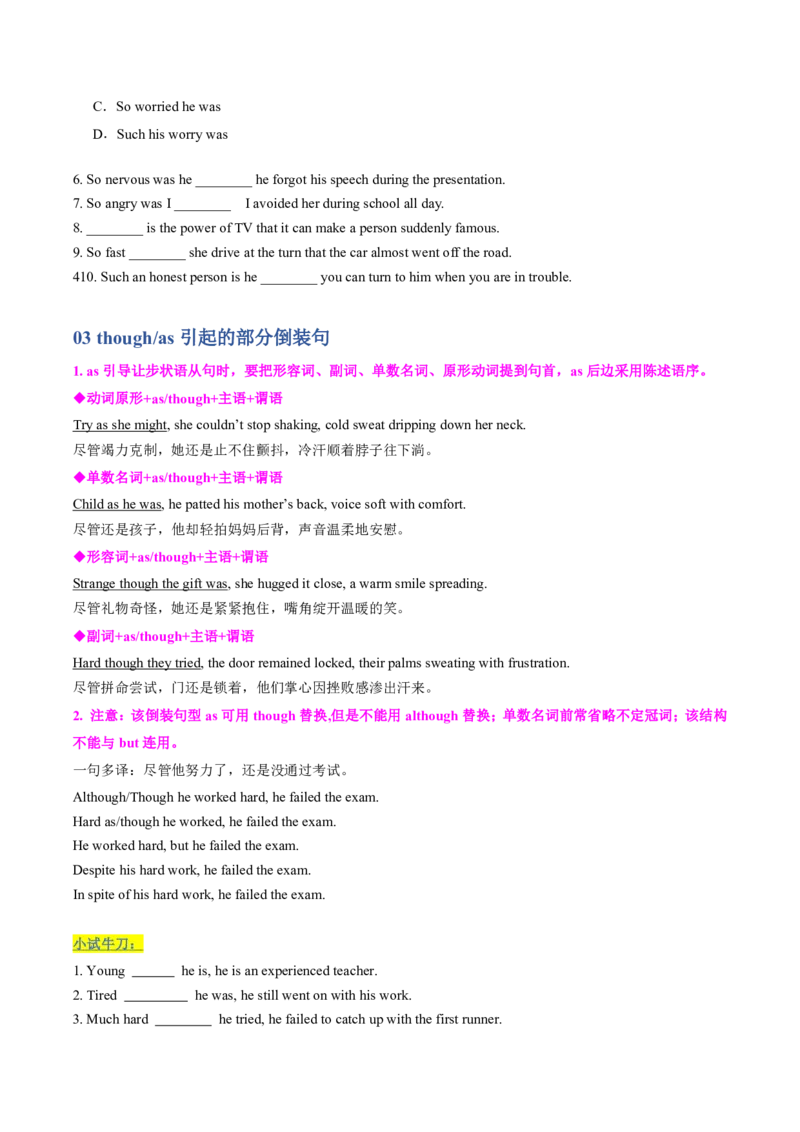
03 though/as 引起的部分倒装句
1. as 引导让步状语从句时,要把形容词、副词、单数名词、原形动词提到句首,as 后边采用陈述语序。
◆动词原形+as/though+主语+谓语
Try as she might, she couldn’t stop shaking, cold sweat dripping down her neck.
尽管竭力克制,她还是止不住颤抖,冷汗顺着脖子往下淌。
◆单数名词+as/though+主语+谓语
Child as he was, he patted his mother’s back, voice soft with comfort.
尽管还是孩子,他却轻拍妈妈后背,声音温柔地安慰。
◆形容词+as/though+主语+谓语
Strange though the gift was, she hugged it close, a warm smile spreading.
尽管礼物奇怪,她还是紧紧抱住,嘴角绽开温暖的笑。
◆副词+as/though+主语+谓语
Hard though they tried, the door remained locked, their palms sweating with frustration.
尽管拼命尝试,门还是锁着,他们掌心因挫败感渗出汗来。
2. 注意:该倒装句型as 可用though 替换,但是不能用although 替换;单数名词前常省略不定冠词;该结构
不能与but 连用。
一句多译:尽管他努力了,还是没通过考试。
Although/Though he worked hard, he failed the exam.
Hard as/though he worked, he failed the exam.
He worked hard, but he failed the exam.
Despite his hard work, he failed the exam.
In spite of his hard work, he failed the exam.
小试牛刀:
1. Young
he is, he is an experienced teacher.
2. Tired
he was, he still went on with his work.
3. Much hard
he tried, he failed to catch up with the first runner.
4. Try
she might, Sue couldn’t get the door open.
5. Hard
it was raining, they went on working in the field.
04 Not until…引起的部分倒装句
1. Not until…句型位于句首,句子采用倒装语序。注意until 从句不倒装;后接名词短语时,until 用作
介词;后接从句时,until 用作连词。
Not until years later was the truth known.
直到多年后,真相才为人所知。
Not until all the players arrived did the game begin.
直到所有球员都到齐,比赛才开始。
2. 注意Not until…倒装句不能与It was not until…that…强调句混为一谈。
It was not until then that he realized the truth. 直到那时,他才意识到真相。
小试牛刀:
1. Not until I finished reading the book
I truly understand the author’s intention.
2. Not until he climbed into bed
he free to think about it.
3. Not until then
I realise words could be powerful in positive and negative ways. (用适当的词填空)
4. Not until Lucy went to see it for herself
she believe what we said.
5. Not until then
Megan pour out what had been disturbing her the whole day.
05 Not only…but also 引起的部分倒装句
1. Not only…but also…表示“不但……而且……“,位于句首且连接两个分句时,前一分句部分倒装后
一句不倒装(前倒后不倒)。
Not only was she hurt by his words, but she also doubted their friendship.
她不仅被他的话刺伤,还开始怀疑他们的友谊。
Not only did the crowd cheer, but they also lifted him onto their shoulders.
人群不仅欢呼,还把他举到了肩上。
2. 易错提醒:Not only…but also…句型中also 可以省略。
小试牛刀:
1. Not only
he turn up late, but he also forgot his books.
2. Not only
we forget to turn off the light in the kitchen, but we also failed to lock the front door.
3. Not only
she speak Spanish, but she also knows how to type it.
4. Not only
the sun give us light, but also it gives us heat.
5. Not only
the mountain climbing get us loser to nature, it also promoted the friendship among us.
考点二、强调句型用法梳理
01 强调句型陈述句式
1. 强调句型基本句式:It is/was+被强调部分+that/who+其他。这也是强调句型陈述句式。
It was the computer that crashed yesterday. (强调主语;指物)
正是电脑昨天死机了。
It was she who/that met Tom in the park yesterday. (强调宾语;指人)
是她昨天在公园遇见了汤姆。
It was in the park that she met Tom yesterday. (强调地点状语;指物)
她昨天是在公园遇见汤姆的。
2. 该句型可用来强调主语、宾语和状语等,但不能用来强调谓语。所强调的成分可以是单词、短语,也可
以是从句,但结构必须完整。
It is this new policy that will affect our daily life.
正是这项新政策会影响我们的日常生活。
It was by working with her team that she solved the problem.
她是通过和团队合作解决问题的。
It was before the storm came that they left the house. (确定时间状语从句;指物)
正是在暴风雨来临前,他们才离开了房子。
3. 强调人时可用that 或who 来连接,强调事或物时只能用that 连接。
It was my mother who/that taught me to cook. (强调主语指人,who/that 均可)
是我妈妈教我做饭的。
It was a diamond ring that she bought for her anniversary. (强调主语指物,只能用that)
她为周年纪念日买的是一枚钻戒。
It was in the park that they first met. (强调时间、地点状语,只能用that)
他们是在公园第一次遇见的。
小试牛刀:
1.It is during the holiday season
the city becomes most lively.
2.It is this
distinguishes humans from machines.
3.It was on Monday night
all this happened.
4.It was yesterday afternoon
I saw Jacob in the street.
5.It was Tom
helped me out of trouble.
02 强调句型一般疑问句式
1. 强调句型的一般疑问句需要把is/was 提前,其形式为“Is/ Was it-+被强调部分+that/who+其他?” 。
Was it Tom who/that broke the window? 是汤姆打破窗户的吗?
Was it her mother who/that she called yesterday? 她昨天打电话的是她妈妈吗?
2. Is it...? 用于现在时或将来时的原句;Was it...? 用于过去时的原句。
Is it in the library that he studies? 他是在图书馆学习吗?
Was it because he didn’t study hard that he failed the exam? 他考试不及格是因为没努力学习吗?
小试牛刀:
1. __________is he who goes to school by bike every day.
2.__________was only after the war broke out that people realized the importance of peace.
3. Was it because Jack came late for school __________Mr. Smith got angry?
4. Was it because of the bad weather __________the football match had to be put off?
5. Could it have been the other day __________ Tom saw Mary seated and dressing herself on the bed?
03 强调句型特殊疑问句式
1. 强调句型的特殊疑问句形式为:特殊疑问词+is/was it+that/who+其他? 注意特殊疑问词必须放在句首,
后面是疑问语序。
What was it that she bought yesterday? (强调内容)昨天她买的是什么?
How was it that he solved the problem? (强调方式)他是如何解决问题的?
2. 特殊疑问词的选择要依据特定语境来取舍。
When was it that they arrived? (强调时间)他们是什么时候到的?
Which book was it that you like? (强调内容)你喜欢的是哪本书?
小试牛刀:
1.Where was it
he picked up the small bag yesterday?
2.Who was
that bought a new car?
3.What was it
brought you two together? Was it your love of music?
4.Why is it
some people are so much more intelligent or creative than the rest of us?
5.Where was it
the road accident happened yesterday?
04 强调句型含not…until…句式
1. 针对not…until…句型进行强调,要把not 一并提前,构成“It is/was not until+被强调部分+that
+其他成分。”
It was not until midnight that I went to bed. 直到午夜我才睡觉。
It was not until his mother came back that the child stopped crying. 直到妈妈回来,孩子才停止哭泣。
2. 注意用于强调句型不能把Not until….倒装句式混用;until 引导的从句保持不变。
Not until he apologized did she forgive him. 直到他道歉,她才原谅他。
It was not until he apologized that she forgave him. 她是直到他道歉才原谅他。
小试牛刀:
1.It was not until the latter half of the 20 century
calligraphy truly began to experience a revival.
2.It was not until his friends came to congratulate him backstage
the great man realised his symphony
was a success.
3.It was not until an hour later
he noticed that Carolyn had left her emergency device home.
4.It was not until 1920
regular radio broadcasts began.
5.It is not until he realized the significance of studying hard
he concentrated his attention on study.
一、单句语法填空(倒装句)
1.There
(go) the final bell — our discussion about the youth dilemma begins right now. (所给词的适
当形式填空)
2.With the development of society
(come) many new problems. (所给词的适当形式填空)
3.In the east of the province
(lie) the small town, whose scenery is beautiful beyond description. (所给
词的适当形式填空)
4.Not only
they prepare delicious food, but they also decorated the entire house. (用适当的词填空)
5.Only
we learn to live in harmony with nature can we stop being a threat to wildlife and to our
planet. (用适当的词填空)
6.Catherine is a very brave girl. She always asks questions in class, and
does Mary. (用适当的词填空)
7.So loudly
he speak that even people in the next room could hear him. (用适当的词填空)
8.Not until he retired from teaching
he consider having a holiday. (用适当的词填空)
9.Such is the spirit of the Minnan people
they have maintained their traditions for centuries. (用适当的
词填空)
10.Plain
the sketch seemed at first, it gradually revealed the artist’s unique understanding of light and
shadow. (用适当的词填空)
二、单句语法填空(强调句型)
11.It was
she forgot the appointment that caused the trouble. (用适当的词填空)
12.It was in the park
I met my old friend yesterday. (用适当的词填空)
13.It is that we spare no effort to constantly explore the vast ocean
enables us to discover its
countless unknown wonders. (用适当的词填空)
14.It is that local charity foundation
donates money to the local schools every year. (用适当的词填
空)
15.In the face of difficulties, what we do
(need) is to stay calm and find solutions step by step. (所给词
的适当形式填空)
16.She did
(tell) me about her address but I forgot all about it. (所给词的适当形式填空)
17.He
come yesterday but soon went back because of an important meeting. (用适当的词填空)
18.Could it be in the restaurant where you had dinner with me yesterday
you lost your handbag? (用
适当的词填空)
19.
was it that made his parents so happy? (用适当的词填空)
20.We wonder
it was that made him change his mind suddenly. (用适当的词填空)
三、完成句子(倒装句、强调句专练)
用倒装句完成下列各句。
1.An old temple stands on the top of the hill. (改为倒装句)
→_____________________________
2.下午放学铃声一响,孩子们便立刻冲出了校门。
________________ as soon as the school bell rang in the afternoon.
3.用not only 倒装句升级句子
This not only lets them “live forever” digitally but also conveys the brilliance of Chinese civilization.
4.我们没有看到你的城堡,也没有看到大教堂。
We didn’t get to see the castle, _______________ the cathedral.
5.We not only learned a lot about different plants but also developed a deeper appreciation for nature.(用not
only... but also... 倒装句升级)
_______________________________________________________________
6.直到他为迟到而道歉了,我才原谅了他。
Not until he ________ ________ me ________ being late ________ I forgive him.
7.典型句式only+状语(从句)
教材原句
Only when darkness had again descended upon me ____________________ (我才意识到) how much I had left
unseen. (根据汉语提示完成句子)
8.直到夕阳西下,我们才踏上了回家的路。(not…until…)
________ did we ________ on our way home.
9.我爷爷虽然年纪大了,但身体很健壮。
①(普通表达) ________________, he is quite strong.
②(高级表达) ________________, he is quite strong.(倒装)
10.She was so moved that tears welled up in her eyes. (用倒装句改写)
____________________________________________________________________________________________
用强调句型完成下列各句。
1.
who is knocking at the door.
一定是邮递员在敲门。(强调句)
2.
made all the people present laugh.
正是他说的内容让在场的人都大笑起来。(强调句)
3.
he realized the task was extremely difficult to complete.
正是在他读了这些文件之后,他才意识到这个任务极难完成。(强调句)
4.
most people realized how valuable the normal life was.
直到那时,大多数人才意识到正常的生活是多么宝贵。(强调句型)
5.When
applied for your visa?
你是什么时候申请的签证? (强调句型)
一、语法填空
阅读下面短文,在空白处填入1 个适当的单词或括号内单词的正确形式。
I’ve always loved the ocean. In the
1
(seven) grade, I started volunteering at the Monterey Bay
Aquarium in California. I was upset to learn that many sea animals eat plastic garbage,
2
(think) it is
food.
I decided to do something
3
(educate) people about this problem. I held presentations at schools
to teach kids about plastic waste. I wanted to reach businesses too. I decided that if I learned of a company
4
used a lot of plastic, I’d send it an email urging it to cut back.
One day, I saw a commercial for a health-care company. People in the ad were using plastic straws (吸管). I
found the contact information of the company,
5
emailed its president. I told him how
6
(harm) plastic could be to the environment and asked him to consider using more eco-friendly options. I was so
excited when he wrote back to me. He said he would make sure that the company cut
7
(it) use of plastic
straws in half.
I kept going. Whenever I heard of businesses using plastic, I’d send an email. One of the biggest companies I
wrote to
8
(be) Alaska Airlines Paris. A company representative wrote back and told me the airline was
switching over
9
plastic to paper cups on all of its 1,200 daily
10
(fly).
二、阅读理解
二、阅读理解
When I was a young boy, every summer, Mom, Dad, my brothers and I would climb into our old car and
drive for 7 hours over long mountain roads to visit Mom’s relatives in Tennessee. We always stayed in Grandma’s
house there with her, Uncle Rich and Aunt Charlotte. It was a fun time with days full of excitement and joy. Often
Aunt Charlotte would even make us a Thanksgiving dinner in the summertime. Some of my happiest childhood
memories came from those visits.
One especially holds a special place in my heart. During that visit, I had great fun every day. One evening, I
climbed into bed in the guest bedroom on the second floor of the house. Although I had played and explored the
whole day and was really tired, I was still wide awake, my mind racing with the day’s sweet events. As I lay there,
I heard the most pleasant sound coming from the front window below me. It was laughter. Mom, Dad, Uncle Rich,
and Aunt Charlotte were down there sharing stories and telling jokes. The laughter was so happy, so joyous, that I
found myself smiling. And even then in my young mind and childish heart, I realized that this is how life should be.
The laughter became a sweet song to me and I fell asleep feeling all was right with the world.
Whenever my life seems too hard or crazy, I look back on that memory. And I took the lessons that Uncle
Rich and Aunt Charlotte taught me. They always lived their lives with love and joy and laughter and smiles. Uncle
Rich passed away many years ago but Aunt Charlotte is still alive. I write to her each week and I am so thankful to
still have her in my life.
We fill lives with laughter, smiles, love and joy. We not only give ourselves happiness but also make this
world a better and more beautiful place.
11.Why did the author and his family drive a long way every summer?
A.To go on a mountain trip.
B.To spend the summer vacation.
C.To get away from trouble in life.
D.To get together with his relatives.
12.What does the underlined word “One” in paragraph 2 mean?
A.A road trip.
B.A relative.
C.A visit.
D.A Thanksgiving dinner.
13.Why couldn’t the author fall asleep at first that night?
A.He was too energetic.
B.He was too excited.
C.He found it noisy downstairs.
D.He found it pleasant downstairs.
14.What did the author learn from his aunt and uncle?
A.Their ability to tell jokes.
B.Their lasting kindness.
C.Their joyful and loving spirit.
D.Their strong family bond.