高考英语时态 — 过去将来时态(主动+被动)(原卷版)
英语时态高考考情解读
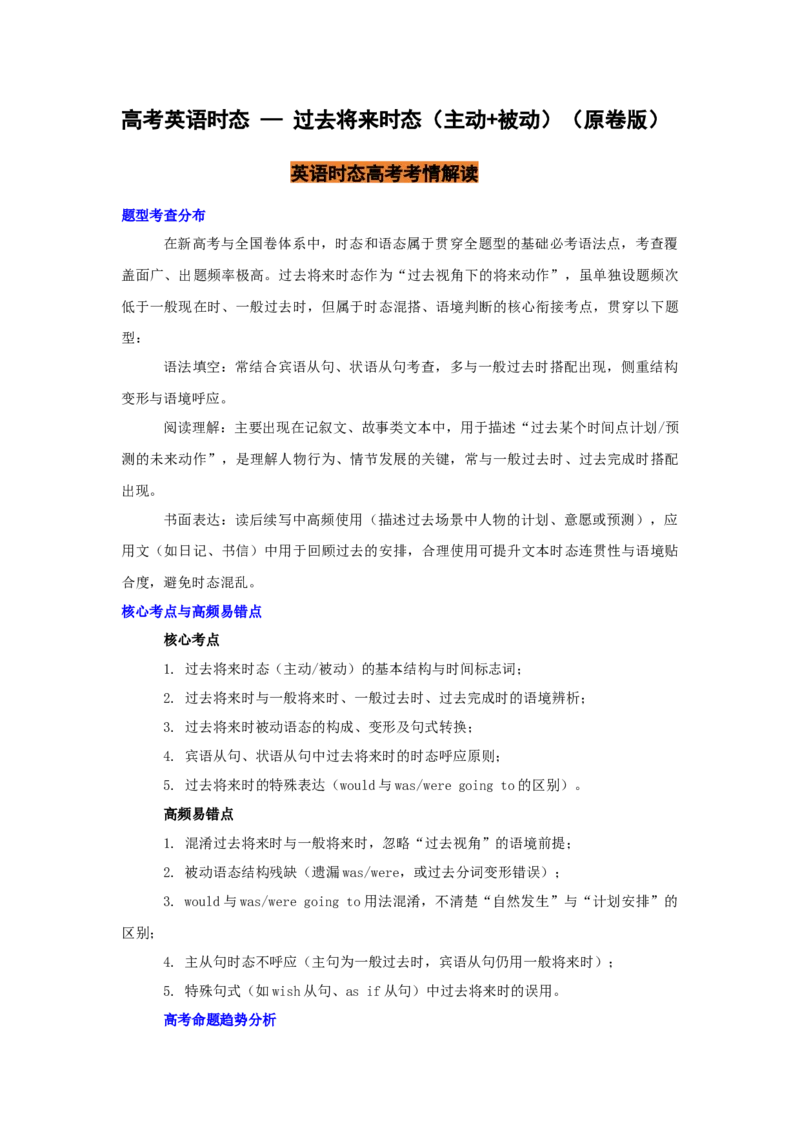
题型考查分布
在新高考与全国卷体系中,时态和语态属于贯穿全题型的基础必考语法点,考查覆
盖面广、出题频率极高。过去将来时态作为“过去视角下的将来动作”,虽单独设题频次
低于一般现在时、一般过去时,但属于时态混搭、语境判断的核心衔接考点,贯穿以下题
型:
语法填空:常结合宾语从句、状语从句考查,多与一般过去时搭配出现,侧重结构
变形与语境呼应。
阅读理解:主要出现在记叙文、故事类文本中,用于描述“过去某个时间点计划/预
测的未来动作”,是理解人物行为、情节发展的关键,常与一般过去时、过去完成时搭配
出现。
书面表达:读后续写中高频使用(描述过去场景中人物的计划、意愿或预测),应
用文(如日记、书信)中用于回顾过去的安排,合理使用可提升文本时态连贯性与语境贴
合度,避免时态混乱。
核心考点与高频易错点
核心考点
1. 过去将来时态(主动/被动)的基本结构与时间标志词;
2. 过去将来时与一般将来时、一般过去时、过去完成时的语境辨析;
3. 过去将来时被动语态的构成、变形及句式转换;
4. 宾语从句、状语从句中过去将来时的时态呼应原则;
5. 过去将来时的特殊表达(would 与was/were going to 的区别)。
高频易错点
1. 混淆过去将来时与一般将来时,忽略“过去视角”的语境前提;
2. 被动语态结构残缺(遗漏was/were,或过去分词变形错误);
3. would 与was/were going to 用法混淆,不清楚“自然发生”与“计划安排”的
区别;
4. 主从句时态不呼应(主句为一般过去时,宾语从句仍用一般将来时);
5. 特殊句式(如wish 从句、as if 从句)中过去将来时的误用。
高考命题趋势分析
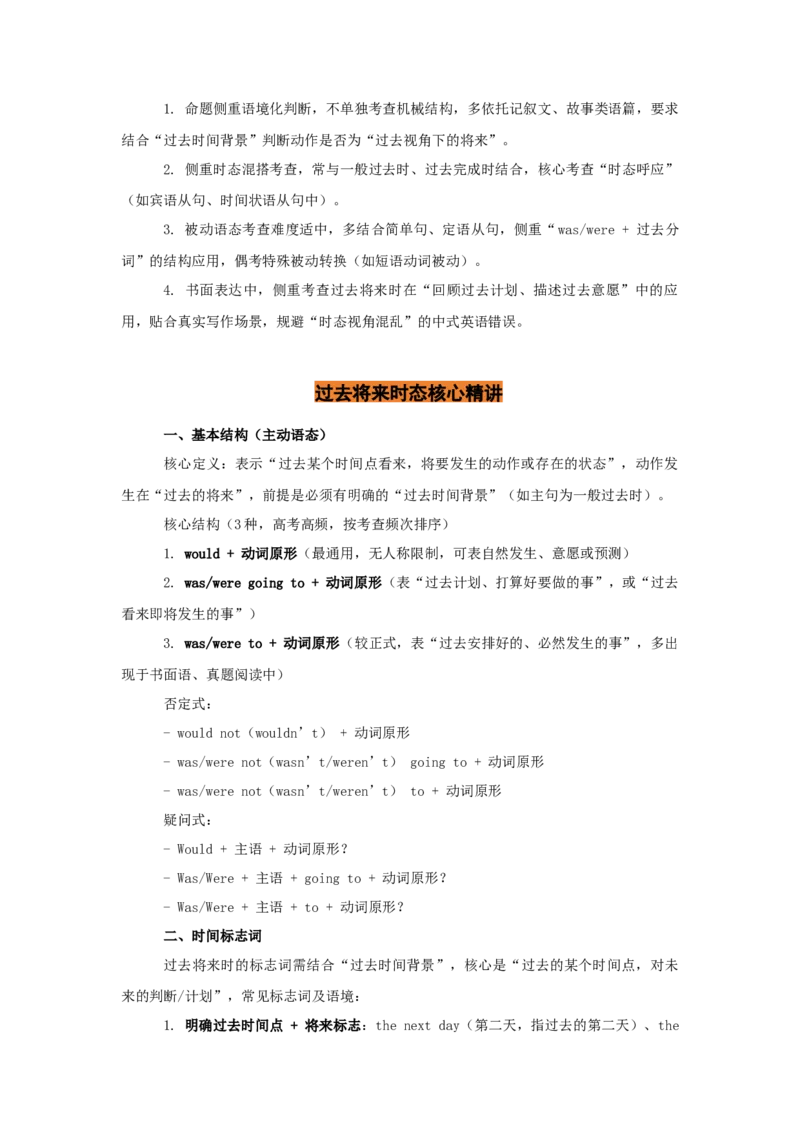
1. 命题侧重语境化判断,不单独考查机械结构,多依托记叙文、故事类语篇,要求
结合“过去时间背景”判断动作是否为“过去视角下的将来”。
2. 侧重时态混搭考查,常与一般过去时、过去完成时结合,核心考查“时态呼应”
(如宾语从句、时间状语从句中)。
3. 被动语态考查难度适中,多结合简单句、定语从句,侧重“was/were + 过去分
词”的结构应用,偶考特殊被动转换(如短语动词被动)。
4. 书面表达中,侧重考查过去将来时在“回顾过去计划、描述过去意愿”中的应
用,贴合真实写作场景,规避“时态视角混乱”的中式英语错误。
过去将来时态核心精讲
一、基本结构(主动语态)
核心定义:表示“过去某个时间点看来,将要发生的动作或存在的状态”,动作发
生在“过去的将来”,前提是必须有明确的“过去时间背景”(如主句为一般过去时)。
核心结构(3 种,高考高频,按考查频次排序)
1. would + 动词原形(最通用,无人称限制,可表自然发生、意愿或预测)
2. was/were going to + 动词原形(表“过去计划、打算好要做的事”,或“过去
看来即将发生的事”)
3. was/were to + 动词原形(较正式,表“过去安排好的、必然发生的事”,多出
现于书面语、真题阅读中)
否定式:
- would not(wouldn’t) + 动词原形
- was/were not(wasn’t/weren’t) going to + 动词原形
- was/were not(wasn’t/weren’t) to + 动词原形
疑问式:
- Would + 主语 + 动词原形?
- Was/Were + 主语 + going to + 动词原形?
- Was/Were + 主语 + to + 动词原形?
二、时间标志词
过去将来时的标志词需结合“过去时间背景”,核心是“过去的某个时间点,对未
来的判断/计划”,常见标志词及语境:
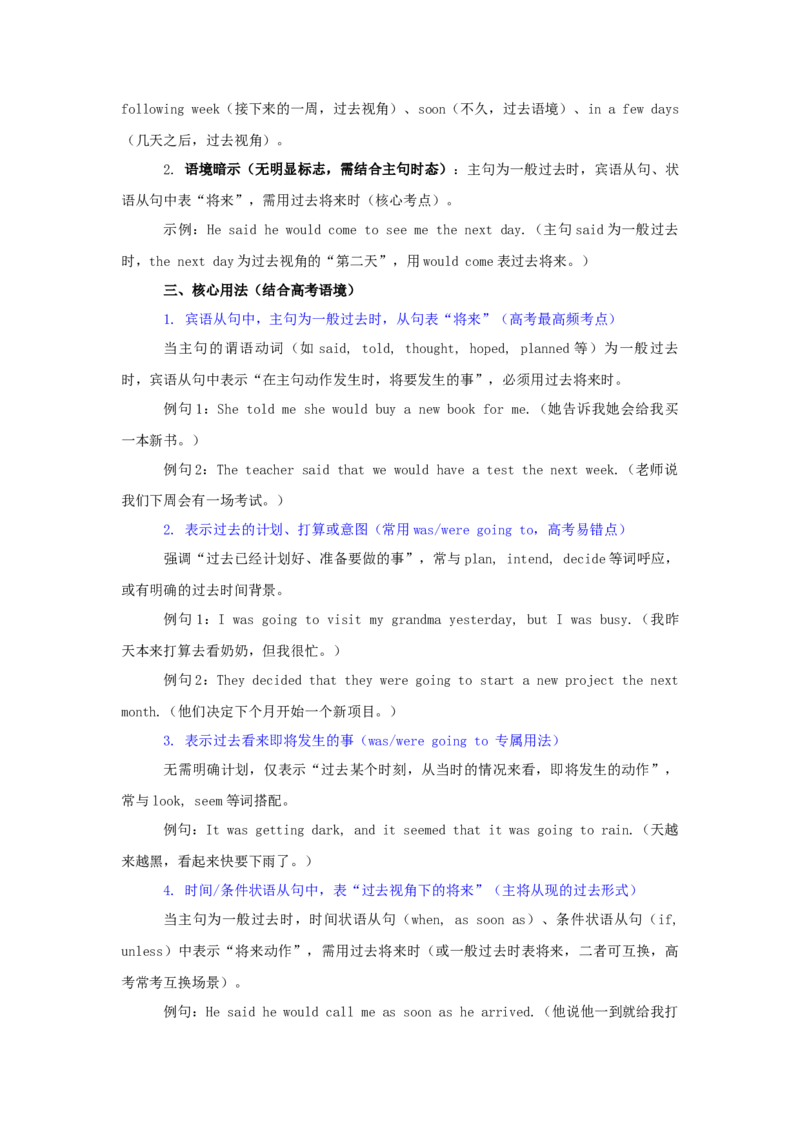
1. 明确过去时间点 + 将来标志:the next day(第二天,指过去的第二天)、the
following week(接下来的一周,过去视角)、soon(不久,过去语境)、in a few days
(几天之后,过去视角)。
2. 语境暗示(无明显标志,需结合主句时态):主句为一般过去时,宾语从句、状
语从句中表“将来”,需用过去将来时(核心考点)。
示例:He said he would come to see me the next day.(主句said 为一般过去
时,the next day 为过去视角的“第二天”,用would come 表过去将来。)
三、核心用法(结合高考语境)
1. 宾语从句中,主句为一般过去时,从句表“将来”(高考最高频考点)
当主句的谓语动词(如said, told, thought, hoped, planned 等)为一般过去
时,宾语从句中表示“在主句动作发生时,将要发生的事”,必须用过去将来时。
例句1:She told me she would buy a new book for me.(她告诉我她会给我买
一本新书。)
例句2:The teacher said that we would have a test the next week.(老师说
我们下周会有一场考试。)
2. 表示过去的计划、打算或意图(常用was/were going to,高考易错点)
强调“过去已经计划好、准备要做的事”,常与plan, intend, decide 等词呼应,
或有明确的过去时间背景。
例句1:I was going to visit my grandma yesterday, but I was busy.(我昨
天本来打算去看奶奶,但我很忙。)
例句2:They decided that they were going to start a new project the next
month.(他们决定下个月开始一个新项目。)
3. 表示过去看来即将发生的事(was/were going to 专属用法)
无需明确计划,仅表示“过去某个时刻,从当时的情况来看,即将发生的动作”,
常与look, seem 等词搭配。
例句:It was getting dark, and it seemed that it was going to rain.(天越
来越黑,看起来快要下雨了。)
4. 时间/条件状语从句中,表“过去视角下的将来”(主将从现的过去形式)
当主句为一般过去时,时间状语从句(when, as soon as)、条件状语从句(if,
unless)中表示“将来动作”,需用过去将来时(或一般过去时表将来,二者可互换,高
考常考互换场景)。
例句:He said he would call me as soon as he arrived.(他说他一到就给我打
电话。)(从句arrived 用一般过去时表过去将来,主句would call 为过去将来时)
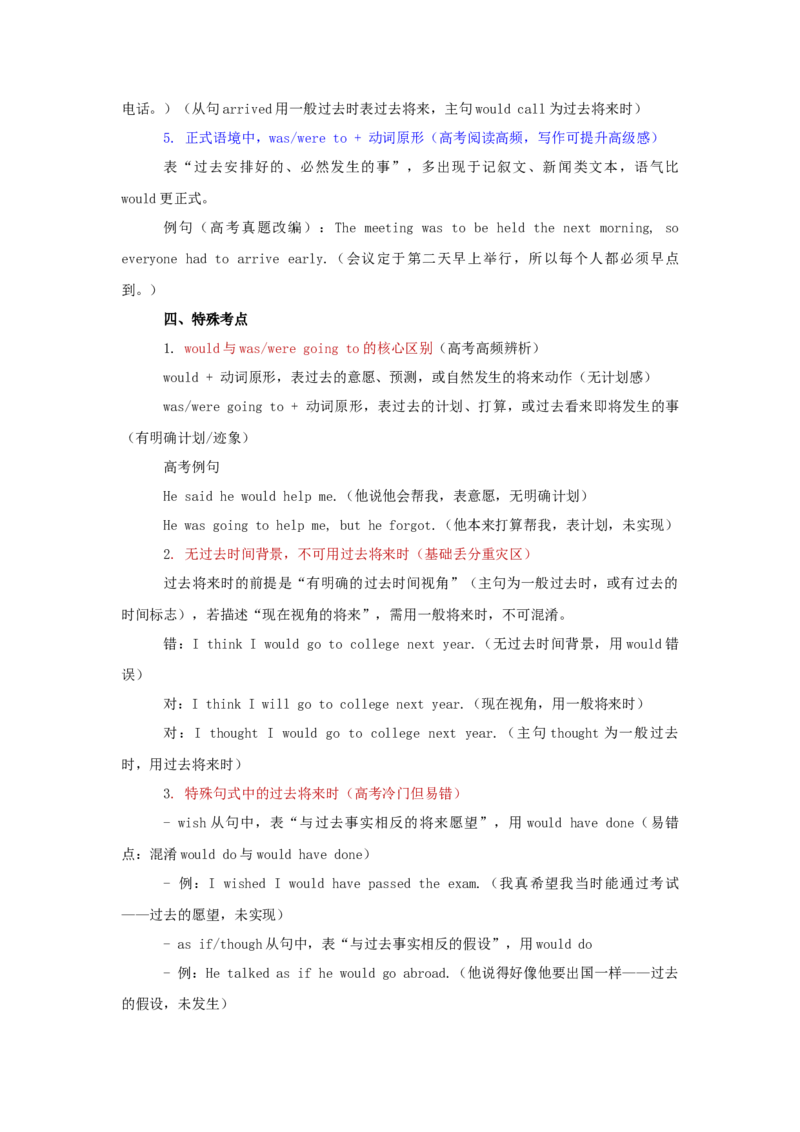
5. 正式语境中,was/were to + 动词原形(高考阅读高频,写作可提升高级感)
表“过去安排好的、必然发生的事”,多出现于记叙文、新闻类文本,语气比
would 更正式。
例句(高考真题改编):The meeting was to be held the next morning, so
everyone had to arrive early.(会议定于第二天早上举行,所以每个人都必须早点
到。)
四、特殊考点
1. would 与was/were going to 的核心区别(高考高频辨析)
would + 动词原形,表过去的意愿、预测,或自然发生的将来动作(无计划感)
was/were going to + 动词原形,表过去的计划、打算,或过去看来即将发生的事
(有明确计划/迹象)
高考例句
He said he would help me.(他说他会帮我,表意愿,无明确计划)
He was going to help me, but he forgot.(他本来打算帮我,表计划,未实现)
2. 无过去时间背景,不可用过去将来时(基础丢分重灾区)
过去将来时的前提是“有明确的过去时间视角”(主句为一般过去时,或有过去的
时间标志),若描述“现在视角的将来”,需用一般将来时,不可混淆。
错:I think I would go to college next year.(无过去时间背景,用would 错
误)
对:I think I will go to college next year.(现在视角,用一般将来时)
对:I thought I would go to college next year.(主句thought 为一般过去
时,用过去将来时)
3. 特殊句式中的过去将来时(高考冷门但易错)
- wish 从句中,表“与过去事实相反的将来愿望”,用would have done(易错
点:混淆would do 与would have done)
- 例:I wished I would have passed the exam.(我真希望我当时能通过考试
——过去的愿望,未实现)
- as if/though 从句中,表“与过去事实相反的假设”,用would do
- 例:He talked as if he would go abroad.(他说得好像他要出国一样——过去
的假设,未发生)
五、必考易错点 + 高频丢分点总结
1. 核心概念易错(基础丢分重灾区)
混淆“现在视角的将来”与“过去视角的将来”
错:She said she will come.(主句said 为过去时,从句用will 错误)
对:She said she would come.(从句用过去将来时,呼应主句时态)
规避:只要主句为一般过去时,宾语从句、状语从句中表“将来”,必用过去将来
时(would/was/were going to)。
2. was/were going to 单复数易错(最高频丢分点)
- 主语为单数(he/she/it/单个人名/单数名词)→ 用was going to
- 错:He were going to play football.(were 错误,主语he 为单数)
- 对:He was going to play football.
- 主语为复数(we/you/they/复数名词)→ 用were going to
- 错:They was going to have a party.(was 错误,主语they 为复数)
- 对:They were going to have a party.
3. 否定/疑问句结构易错(考试高频挖坑)
- would 的否定/疑问:直接在would 后加not,或把would 提前,动词用原形(无
变形)
-

✅He wouldn’t go to school.(否定:wouldn’t + 动原)
-

✅Would you go with him?(疑问:Would 提前,动原go 不变)
- was/were going to 的否定/疑问:否定加not,疑问把was/were 提前,to 后动词
用原形
-

✅She wasn’t going to watch TV.(否定:wasn’t + going to + 动原)
-

✅Were they going to the park?(疑问:Were 提前,going to + 动原)
- 易错坑:疑问/否定句中,to 后动词变三单(错误)
- 错:Was he going to goes to school?(goes 错误,to 后用动原go)
4. 特殊场景易错(高考语境挖坑)
- ① 时间/条件状语从句中,用一般过去时表过去将来(与过去将来时互换)
-

✅He said he would leave when he finished his work.(finished 用一般
过去时表过去将来,等同于would finish)
- ② 计划未实现的场景,只能用was/were going to(不能用would)
-

✅I was going to visit him, but I was ill.(计划未实现,用was going
to)
-

❌I would visit him, but I was ill.(错误,would 不表“未实现的计
划”)
- ③ 客观预测用would,有迹象的预测用was/were going to
-

✅He thought it would rain.(客观预测,无明显迹象)
-

✅The clouds were dark; it was going to rain.(有迹象,乌云密布)
六、过去将来时万能做题步骤
1. 判时态:先找“过去时间背景”(主句为一般过去时,或有the next day,
soon 等过去视角标志)→ 确定动作是“过去看来的将来”→ 锁定过去将来时。
2. 定结构:根据语境选结构——表计划/迹象用was/were going to;表意愿/客观
预测用would;正式语境用was/were to。
3. 看人称:若用was/were going to/was/were to,根据主语单复数确定was/were
(单数was,复数were)。
4. 查句式:否定句加not (wouldn’ t/wasn’ t/weren’ t );疑问句
把would/was/were 提前,动词用原形。
七、四大高频考点答题模板
模板1:宾语从句(高考最高频)
结构:主句(一般过去时,如said/told/thought )+ that + 从句
(would/was/were going to + 动词原形)
例:She told me that she would finish her homework before 9 o’clock.(她
告诉我她会在9 点前完成作业。)
模板2:过去的计划/打算(易错点)
结构:主语 + was/were going to + 动词原形 + (but + 计划未实现的原因)
例:We were going to have a picnic, but it rained.(我们本来打算去野餐,
但下雨了。)
模板3:时间/条件状语从句(主将从现的过去形式)
结构:主句(would + 动词原形)+ 从句(when/if/as soon as + 一般过去时)
例:He said he would call me if he got there on time.(他说如果他准时到,
就给我打电话。)
模板4:否定 & 疑问万能公式
- ① would 句式:
- 否定:主语 + wouldn’t + 动词原形
- 疑问:Would + 主语 + 动词原形?
- ② was/were going to 句式:
- 否定:主语 + wasn’t/weren’t + going to + 动词原形
- 疑问:Was/Were + 主语 + going to + 动词原形?
八、核心避坑复盘
1. 无过去时间背景(主句不是一般过去时),绝对不能用过去将来时,用一般将来
时。
2. was/were going to 看主语单复数:单数was,复数were,不可混用。
3. 计划未实现,必用was/were going to,不用would。
4. 宾语从句中,主句为一般过去时,从句表将来,必用过去将来时(时态呼应)。
5. would 无人称变化,所有人称都用would + 动原。
6. 否定/疑问句中,to 后动词、would 后动词均用原形,不变形。
7. 时间/条件状语从句中,可用一般过去时表过去将来(与would 互换)。
8. 正式语境(阅读/书面表达)可用was/were to + 动原,提升高级感。
九、过去将来时态的被动语态
核心构成
结构:would be + 过去分词(done) / was/were going to be + 过去分词
(done)(高考高频前两种,was/were to be done 较少考)
人称搭配(仅was/were going to be done 需区分人称):
- I / he / she / it / 单数名词 / 不可数名词 → was going to be + done
- We / you / they / 复数名词 → were going to be + done
- would be + done 无人称限制,所有人称通用
基本句式
 肯定句
 结构1:主语 + would be + 过去分词
 例:The work would be finished the next day.(这项工作第二天会被完成。)
 结构2:主语 + was/were going to be + 过去分词
 例:The meeting was going to be held in the hall.(会议打算在大厅举
行。)
2. 否定句
结构1:主语 + would not(wouldn’t) be + 过去分词
例:The letter wouldn’t be sent until tomorrow.(这封信要到明天才会被寄
出。)
 结构2:主语 + was/were not + going to be + 过去分词
例:The project wasn’t going to be completed on time.(这个项目不会按时完
成。)
 3. 一般疑问句
 结构1:Would + 主语 + be + 过去分词?
 回答:Yes, 主语 + would. / No, 主语 + wouldn’t.
 例:Would the book be translated into Chinese? — Yes, it would.
 结构2:Was/Were + 主语 + going to be + 过去分词?
 回答:Yes, 主语 + was/were. / No, 主语 + wasn’t/weren’t.
 例:Was the bridge going to be built next year? — No, it wasn’t.
4. 特殊疑问句
结构1:特殊疑问词 + would + 主语 + be + 过去分词?
 例:When would the report be submitted?(这份报告什么时候会被提交?)
结构2:特殊疑问词 + was/were + 主语 + going to be + 过去分词?
例:Where were the books going to be put?(这些书打算放在哪里?)
核心用法
- 表示过去计划、安排中“将要被做的动作”,常与过去时间标志(the next day,
soon 等)搭配,多出现于宾语从句、定语从句中。
- 例:He told me that the task would be finished by his team.(他告诉我这
项任务会被他的团队完成。)
- 表示过去看来“即将被发生的动作”,侧重被动关系,结合语境判断。
- 例:The house was going to be pulled down, so people moved out.(这栋房
子即将被拆除,所以人们搬走了。)
- 强调过去视角下“动作的承受者”,不知道动作执行者或无需说出执行者。
- 例:A new school would be built in our town, according to the news.(据
新闻报道,我们镇上将要建一所新学校。)
主动变被动 转换规则
- 主动句(过去将来时):主语 + would/was/were going to + 动词原形 + 宾语
- 被动句(过去将来时):主动宾语 → 被动主语;主动谓语 → would
be/was/were going to be + 过去分词;主动主语 → 置于by 后(可省略)
- 示例1(主动):They would hold a party the next day.(他们第二天会举办
一场派对。)
- (被动):A party would be held (by them) the next day.
- 示例2(主动):She was going to buy a gift for me.(她打算给我买一份礼
物。)
- (被动):A gift was going to be bought (by her) for me.
重点补充
1. by 短语引出动作执行者,过去将来时被动中可省略,若强调执行者则保留(高
考语法填空偶考by 后的人称代词宾格)。
2. 例:The letter would be sent by her.(强调动作执行者her,不可省略)
3. 2. 短语动词的被动转换(高考易错点):短语动词整体变被动,不可遗漏介
词/副词。
4. 主动:They would look after the children.(他们会照顾孩子们。)
5. 被动:The children would be looked after (by them).(look after 为短语
动词,整体变被动)
高频易错
① 遗漏be 动词:错:The work would finished.(缺be);对:The work would
be finished.
② 过去分词变形错误:错:The book would be write.(write 用原形,错误);
对:The book would be written.
 ③ was/were going to be done 单复数混淆:错:They was going to be
invited.(was 错误);对:They were going to be invited.
单句语法填空
1. He said that the problem ________ (solve) the next week.
2. The meeting ________ (hold) the following day, so we prepared well.
3. She told me that a new park ________ (build) in our neighborhood.
4. ________ the letter ________ (send) by him the next morning?
5. The tasks ________ (not, finish) on time, according to the plan.
6. They said that the old building ________ (pull) down soon.
7. The gifts ________ (not, give) to the children until Christmas.
过去将来时态核心精练
基础版
用所给动词的正确形式填空,直击:过去将来时结构、单复数、被动语态、时态呼
应高频考点。
1. He said he ________ (go) to Beijing the next day.
2. She told me she ________ (not, watch) TV that evening.
3. They ________ (be) going to have a party, but it rained.
4. The teacher said we ________ (have) a test the following week.
5. If he ________ (come) back, I ________ (tell) him the news.
6. She thought the work ________ (finish) soon.
7. ________ you ________ (go) with him the next morning?
8. He said the book ________ (sell) well and would be reprinted.
9. They were going to ________ (visit) their grandparents, but they were
busy.
10. The letter ________ (not, send) until the next day, according to him.
进阶版
一、单句语法填空
1. She said she ________ (buy) a new dress for her daughter the next
week.
2. He ________ (be) going to start a new job, but he changed his mind.
3. If you ________ (call) me, I ________ (pick) you up at the station.
4. The teacher told us that the exam ________ (not, be) too difficult.
5. They thought the old bridge ________ (pull) down soon.
6. When he ________ (arrive), we ________ (have) dinner together.
7. ________ the meeting ________ (hold) the next day?
8. She said the flowers ________ (water) by her mother every day and
would grow well.
9. He was going to ________ (learn) English, but he was too busy.
10. We thought the problem ________ (solve) by the experts soon.
二、语法填空
阅读短文,用括号内动词的适当形式填空
Last week, my friend Tom told me that he 1________ (go) to his hometown
the next month. He said his grandparents 2________ (wait) for him and he
3________ (spend) a week with them. He 4________ (be) going to take some gifts
for them, including a pair of shoes for his grandma and a book for his grandpa.
Tom also said that his hometown 5________ (change) a lot in recent years
and a new park 6________ (build) there soon. He told me that he 7________
(show) me photos of the park when he came back. I asked him if he 8________
(visit) his old school, and he said he would.
He said the school 9________ (be) very different now and a new teaching
building 10________ (build) the next year. I hoped he would have a good time
there.
过去将来时态过关达标练习
一、 单句语法填空 用所给动词的适当形式填空。
1. He said he ________ (not, come) to the party that evening.
2. She ________ (be) going to see a movie, but she had to study for the
exam.
3. If it ________ (rain) tomorrow, we ________ (cancel) the picnic.
4. The teacher told us that we ________ (have) a holiday the next week.
5. The work ________ (finish) the next day, so we worked hard.
6. They said that a new hospital ________ (build) in their city soon.
7. ________ you ________ (help) me with my homework the next afternoon?
8. She thought the song ________ (sound) beautiful and would listen to it
again.
9. He was going to ________ (play) basketball, but he got hurt.
10. The books ________ (not, send) to the school until the next month.
二、语法填空
阅读短文,用所给动词的适当形式填空。
Yesterday, my mom told me that she 1________ (go) to the supermarket the
next morning. She said she 2________ (buy) some vegetables and fruit for our
family. She 3________ (be) going to buy my favorite apples and oranges.
My mom also said that the supermarket 4________ (have) a big sale the
next day and many things 5________ (sell) at a low price. She told me that she
6________ (save) some money by buying things on sale. I asked her if she
7________ (take) me with her, and she said she would.
I was very happy because I 8________ (want) to buy a new toy. My mom said
that if I behaved well, she 9________ (buy) the toy for me. I told her I
10________ (be) a good boy and would not make trouble.
你都答对了吗?恭喜你成功晋级!下一关,解
锁现在进行时态吧。