文档文本内容
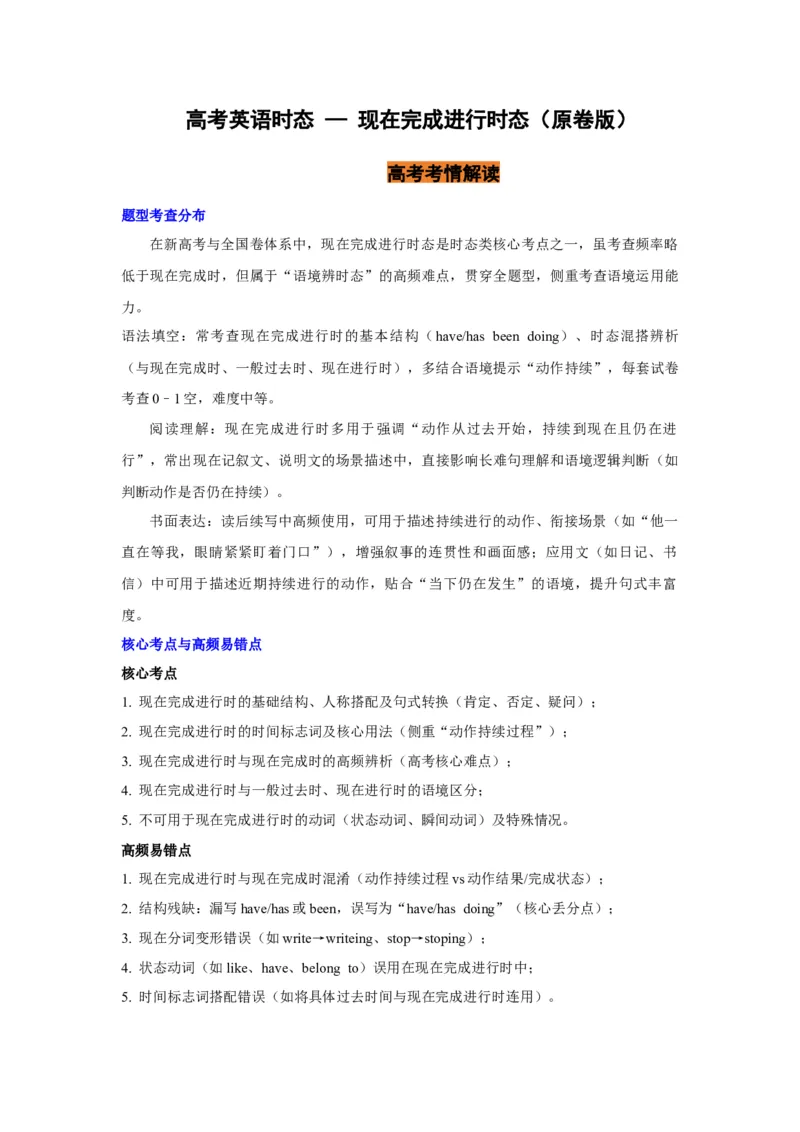
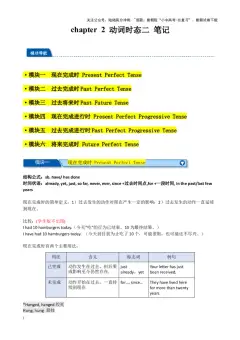
高考英语时态 — 现在完成进行时态(原卷版)
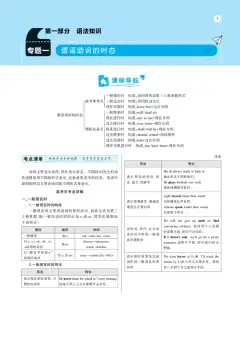
高考考情解读
题型考查分布
在新高考与全国卷体系中,现在完成进行时态是时态类核心考点之一,虽考查频率略
低于现在完成时,但属于“语境辨时态”的高频难点,贯穿全题型,侧重考查语境运用能
力。
语法填空:常考查现在完成进行时的基本结构(have/has been doing)、时态混搭辨析
(与现在完成时、一般过去时、现在进行时),多结合语境提示“动作持续”,每套试卷
考查0–1 空,难度中等。
阅读理解:现在完成进行时多用于强调“动作从过去开始,持续到现在且仍在进
行”,常出现在记叙文、说明文的场景描述中,直接影响长难句理解和语境逻辑判断(如
判断动作是否仍在持续)。
书面表达:读后续写中高频使用,可用于描述持续进行的动作、衔接场景(如“他一
直在等我,眼睛紧紧盯着门口”),增强叙事的连贯性和画面感;应用文(如日记、书
信)中可用于描述近期持续进行的动作,贴合“当下仍在发生”的语境,提升句式丰富
度。
核心考点与高频易错点
核心考点
1. 现在完成进行时的基础结构、人称搭配及句式转换(肯定、否定、疑问);
2. 现在完成进行时的时间标志词及核心用法(侧重“动作持续过程”);
3. 现在完成进行时与现在完成时的高频辨析(高考核心难点);
4. 现在完成进行时与一般过去时、现在进行时的语境区分;
5. 不可用于现在完成进行时的动词(状态动词、瞬间动词)及特殊情况。
高频易错点
1. 现在完成进行时与现在完成时混淆(动作持续过程vs 动作结果/完成状态);
2. 结构残缺:漏写have/has 或been,误写为“have/has doing”(核心丢分点);
3. 现在分词变形错误(如write→writeing、stop→stoping);
4. 状态动词(如like、have、belong to)误用在现在完成进行时中;
5. 时间标志词搭配错误(如将具体过去时间与现在完成进行时连用)。
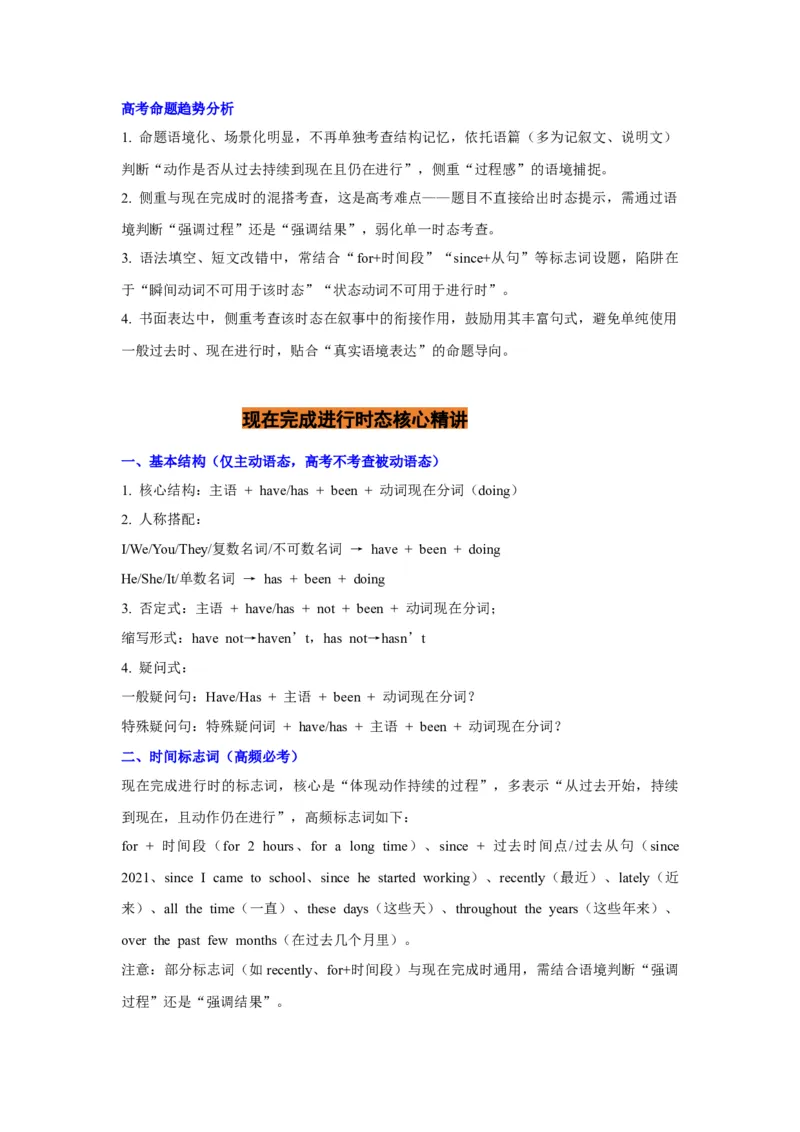
高考命题趋势分析
1. 命题语境化、场景化明显,不再单独考查结构记忆,依托语篇(多为记叙文、说明文)
判断“动作是否从过去持续到现在且仍在进行”,侧重“过程感”的语境捕捉。
2. 侧重与现在完成时的混搭考查,这是高考难点——题目不直接给出时态提示,需通过语
境判断“强调过程”还是“强调结果”,弱化单一时态考查。
3. 语法填空、短文改错中,常结合“for+时间段”“since+从句”等标志词设题,陷阱在
于“瞬间动词不可用于该时态”“状态动词不可用于进行时”。
4. 书面表达中,侧重考查该时态在叙事中的衔接作用,鼓励用其丰富句式,避免单纯使用
一般过去时、现在进行时,贴合“真实语境表达”的命题导向。
现在完成进行时态核心精讲
一、基本结构(仅主动语态,高考不考查被动语态)
1. 核心结构:主语 + have/has + been + 动词现在分词(doing)
2. 人称搭配:
I/We/You/They/复数名词/不可数名词 → have + been + doing
He/She/It/单数名词 → has + been + doing
3. 否定式:主语 + have/has + not + been + 动词现在分词;
缩写形式:have not→haven’t,has not→hasn’t
4. 疑问式:
一般疑问句:Have/Has + 主语 + been + 动词现在分词?
特殊疑问句:特殊疑问词 + have/has + 主语 + been + 动词现在分词?
二、时间标志词(高频必考)
现在完成进行时的标志词,核心是“体现动作持续的过程”,多表示“从过去开始,持续
到现在,且动作仍在进行”,高频标志词如下:
for + 时间段(for 2 hours、for a long time)、since + 过去时间点/过去从句(since
2021、since I came to school、since he started working)、recently(最近)、lately(近
来)、all the time(一直)、these days(这些天)、throughout the years(这些年来)、
over the past few months(在过去几个月里)。
注意:部分标志词(如recently、for+时间段)与现在完成时通用,需结合语境判断“强调
过程”还是“强调结果”。
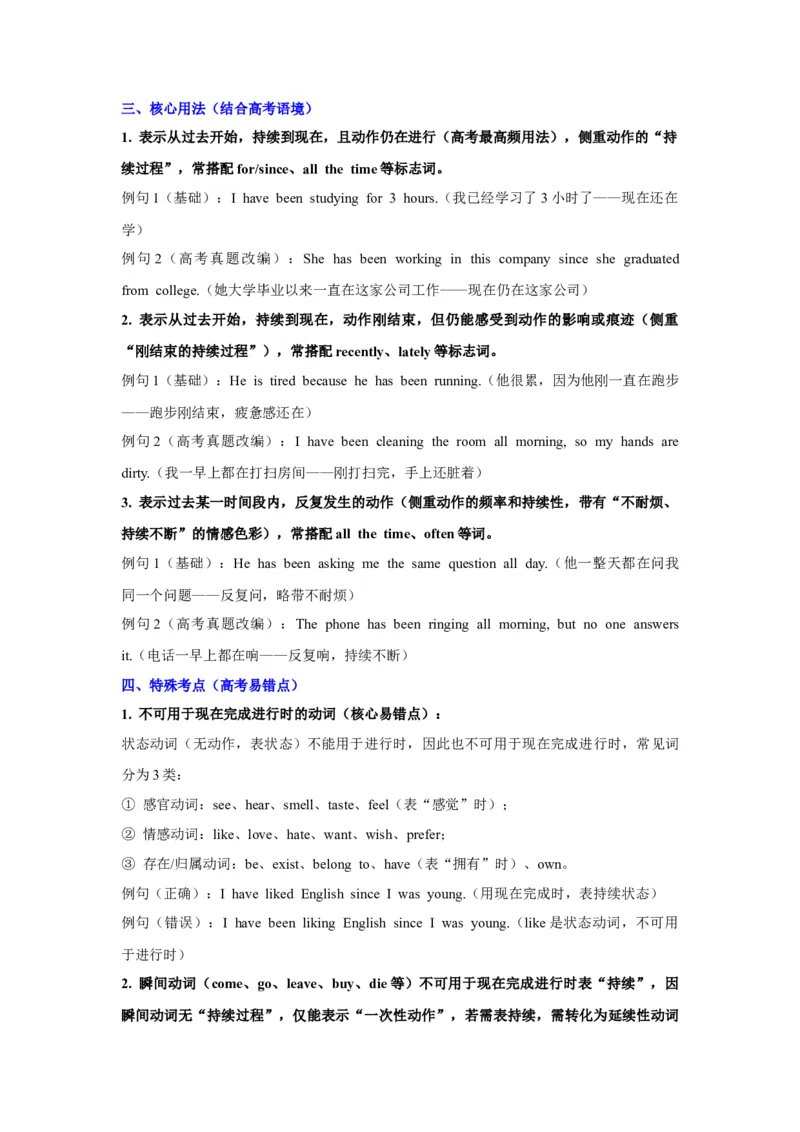
三、核心用法(结合高考语境)
1. 表示从过去开始,持续到现在,且动作仍在进行(高考最高频用法),侧重动作的“持
续过程”,常搭配for/since、all the time 等标志词。
例句1(基础):I have been studying for 3 hours.(我已经学习了3 小时了——现在还在
学)
例句2(高考真题改编):She has been working in this company since she graduated
from college.(她大学毕业以来一直在这家公司工作——现在仍在这家公司)
2. 表示从过去开始,持续到现在,动作刚结束,但仍能感受到动作的影响或痕迹(侧重
“刚结束的持续过程”),常搭配recently、lately 等标志词。
例句1(基础):He is tired because he has been running.(他很累,因为他刚一直在跑步
——跑步刚结束,疲惫感还在)
例句2(高考真题改编):I have been cleaning the room all morning, so my hands are
dirty.(我一早上都在打扫房间——刚打扫完,手上还脏着)
3. 表示过去某一时间段内,反复发生的动作(侧重动作的频率和持续性,带有“不耐烦、
持续不断”的情感色彩),常搭配all the time、often 等词。
例句1(基础):He has been asking me the same question all day.(他一整天都在问我
同一个问题——反复问,略带不耐烦)
例句2(高考真题改编):The phone has been ringing all morning, but no one answers
it.(电话一早上都在响——反复响,持续不断)
四、特殊考点(高考易错点)
1. 不可用于现在完成进行时的动词(核心易错点):
状态动词(无动作,表状态)不能用于进行时,因此也不可用于现在完成进行时,常见词
分为3 类:
① 感官动词:see、hear、smell、taste、feel(表“感觉”时);
② 情感动词:like、love、hate、want、wish、prefer;
③ 存在/归属动词:be、exist、belong to、have(表“拥有”时)、own。
例句(正确):I have liked English since I was young.(用现在完成时,表持续状态)
例句(错误):I have been liking English since I was young.(like 是状态动词,不可用
于进行时)
2. 瞬间动词(come、go、leave、buy、die 等)不可用于现在完成进行时表“持续”,因
瞬间动词无“持续过程”,仅能表示“一次性动作”,若需表持续,需转化为延续性动词
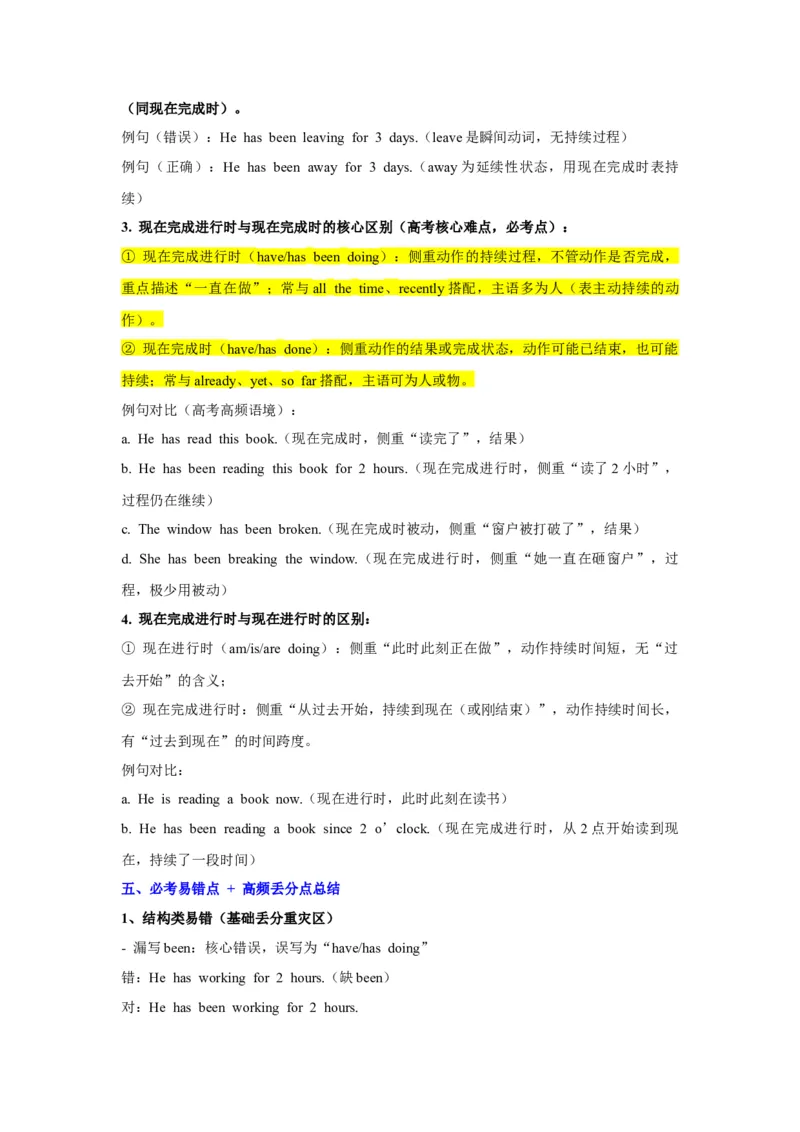
(同现在完成时)。
例句(错误):He has been leaving for 3 days.(leave 是瞬间动词,无持续过程)
例句(正确):He has been away for 3 days.(away 为延续性状态,用现在完成时表持
续)
3. 现在完成进行时与现在完成时的核心区别(高考核心难点,必考点):
① 现在完成进行时(have/has been doing):侧重动作的持续过程,不管动作是否完成,
重点描述“一直在做”;常与all the time、recently 搭配,主语多为人(表主动持续的动
作)。
② 现在完成时(have/has done):侧重动作的结果或完成状态,动作可能已结束,也可能
持续;常与already、yet、so far 搭配,主语可为人或物。
例句对比(高考高频语境):
a. He has read this book.(现在完成时,侧重“读完了”,结果)
b. He has been reading this book for 2 hours.(现在完成进行时,侧重“读了2 小时”,
过程仍在继续)
c. The window has been broken.(现在完成时被动,侧重“窗户被打破了”,结果)
d. She has been breaking the window.(现在完成进行时,侧重“她一直在砸窗户”,过
程,极少用被动)
4. 现在完成进行时与现在进行时的区别:
① 现在进行时(am/is/are doing):侧重“此时此刻正在做”,动作持续时间短,无“过
去开始”的含义;
② 现在完成进行时:侧重“从过去开始,持续到现在(或刚结束)”,动作持续时间长,
有“过去到现在”的时间跨度。
例句对比:
a. He is reading a book now.(现在进行时,此时此刻在读书)
b. He has been reading a book since 2 o’clock.(现在完成进行时,从2 点开始读到现
在,持续了一段时间)
五、必考易错点 + 高频丢分点总结
1、结构类易错(基础丢分重灾区)
- 漏写been:核心错误,误写为“have/has doing”
错:He has working for 2 hours.(缺been)
对:He has been working for 2 hours.
- 现在分词变形错误:
规则变形易错:以e 结尾去e 加-ing(write→writing,不写writeing);重读闭音节双写尾
辅音加-ing (stop→stopping ,不写stoping );以“ 辅音+y” 结尾,直接加-ing
(study→studying,不变y 为i)。
易错对比:do→doing(正确) vs done(过去分词,错误);run→running(正确) vs
run(原形/过去分词,错误)。
- 否定句、疑问句结构错误:
错:He not has been working. / Has been he working?
对:He hasn’t been working. / Has he been working?
2、语境搭配类易错(高考难点)
- 具体过去时间(yesterday、last week、in 2023)不可与现在完成进行时连用,因该时态
强调“过去到现在的持续”,与具体过去时间矛盾。
错:He has been working yesterday.
对:He was working yesterday.(一般过去进行时) / He has been working recently.(现
在完成进行时)
- 状态动词误用在现在完成进行时中(高频陷阱)
错:They have been belonging to this group for 5 years.
对:They have belonged to this group for 5 years.(现在完成时)
- 混淆“现在完成进行时”与“现在完成时”的语境
错:The work has been finishing.(想表达“工作已完成”,却用了进行时,侧重过程)
对:The work has been finished.(现在完成时被动,侧重结果)
3、特殊场景易错
- since 从句的时态:同现在完成时,since 从句用一般过去时,主句用现在完成进行时。
错:He has been living here since he has come to this city.
对:He has been living here since he came to this city.
- for+时间段的搭配:即使动作刚结束,只要是“从过去持续到现在”,仍可用现在完成
进行时。
例:She has been cooking for an hour, and now she is resting.(做饭刚结束,仍用现在
完成进行时表持续过程)
六、现在完成进行时万能做题步骤
1. 判时态:看到这些标志/语境 → 锁定现在完成进行时
标志词:for+时间段、since+过去时间点/从句、recently、lately、all the time、these days;
语境提示:“动作从过去开始,持续到现在仍在进行”“刚结束的持续动作”“反复发生
的动作”。
2. 定have/has:根据主语单复数,确定用have 还是has
单数主语(he/she/it/单数名词)→ has;
复数主语(we/you/they/复数名词/不可数名词)→ have。
3. 变现在分词:根据动词变形规则,正确写出现在分词(重点规避e 结尾、重读闭音节的
变形错误)。
4. 看句式:
否定句:have/has + not + been + 现在分词;
一般疑问句:Have/Has + 主语 + been + 现在分词?
特殊疑问句:特殊疑问词 + have/has + 主语 + been + 现在分词?
七、高频考点答题模板
模板1:动作持续到现在(仍在进行)
结构:主语 + have/has + been + 现在分词 + for + 时间段 / since + 过去时间点/从句
例:We have been studying English since we entered high school. / She has been
working for 8 hours.
模板2:动作刚结束(有痕迹/影响)
结构:主语 + have/has + been + 现在分词 + recently/lately + (结果状语)
例:He has been running lately, so he is in good shape. / I have been cleaning the room,
so it’s tidy now.
 模板3:动作反复发生(带情感色彩)
结构:主语 + have/has + been + 现在分词 + all the time/often + (语境补充)
例:She has been complaining about the weather all day. / The kid has been asking
questions often recently.
模板4:否定 & 疑问万能公式
否定:主语 + have/has + not + been + 现在分词
例:They haven’t been working recently. / He hasn’t been studying hard lately.
疑问:Have/Has + 主语 + been + 现在分词?
例:Have you been waiting for me? / Has she been practicing the piano?
八、核心避坑复盘
1. 结构必记:have/has + been + doing,缺一不可,尤其不可漏写been(核心坑)。
2. 动词限制:状态动词(like、have、belong to)、瞬间动词(leave、buy)不可用于现
在完成进行时,状态动词用现在完成时,瞬间动词需转化为延续性动词。
3. 时态辨析:强调“过程”用现在完成进行时,强调“结果/完成”用现在完成时;强调
“此时此刻”用现在进行时,强调“过去到现在的持续”用现在完成进行时。
4. 时间搭配:不与具体过去时间(yesterday、last week)连用,搭配for/since、recently
等标志词。
5. 现在分词变形:重点记忆e 结尾、重读闭音节的变形规则,避免写错(如
write→writing,stop→stopping)。
现在完成进行时态核心精练
基础版
用所给动词的正确形式填空
1. I ________ (work) on this project for 5 days; I need a break.
2. My sister ________ (practice) the piano since this morning; she hasn’t stopped
yet.
3. He ________ (not, sleep) well lately; he looks tired.
4. ________ you ________ (wait) for me for a long time? — Yes, I have been
waiting for 20 minutes.
5. They ________ (talk) about the problem all afternoon; they still haven’t agreed.
6. The baby ________ (cry) all night; his mother is very tired.
7. She ________ (learn) Chinese since she came to China; she can speak it well now.
8. We ________ (not, watch) TV these days; we are busy with our exams.
9. The wind ________ (blow) strongly all day; the trees are shaking.
10. He ________ (always, ask) me for help; I’m a little tired of it.
进阶版
一、单句语法填空
1. The students ________ (prepare) for the exam for 2 weeks; they will take it
tomorrow.
2. My father ________ (not, smoke) lately; he wants to keep healthy.
3. When I saw her, she ________ (cry) because she ________ (argue) with her friend
all morning.
4. He ________ (work) in this factory since 2018; he knows every part of the
machine.
5. ________ your brother ________ (play) computer games all day? — No, he
stopped an hour ago.
6. The weather ________ (get) worse recently; it has been raining every day.
7. She ________ (not, eat) well these days; she has lost some weight.
8. We ________ (look) for the missing dog since yesterday; we haven’t found it yet.
9. He ________ (always, forget) his keys; his mother is angry with him.
10. The workers ________ (build) the bridge for 6 months; it will be finished next
month.
二、语法填空
阅读短文,用括号内动词的适当形式填空
It is 4 o’clock in the afternoon. The students in our class 1________ (be) very busy
recently. They 2________ (prepare) for the school sports meeting for a month. Some
students 3________ (practice) running on the playground since last week. They
4________ (run) every afternoon, and they 5________ (get) faster and faster. Our
monitor 6________ (organize) the activities all these days; he 7________ (not, have) a
good rest. Look! He 8________ (talk) with the teacher about the meeting plan. Some
girls 9________ (decorate) the poster for the meeting since this morning. They
10________ (finish) half of the work so far. A few boys 11________ (help) them with
the poster; they 12________ (work) together for 2 hours. Everyone 13________ (be)
tired, but no one 14________ (stop) working. They 15________ (work) hard recently,
and they believe they will win the first prize in the sports meeting.
现在完成进行时态过关达标练习
一、 单句语法填空  用所给动词的适当形式填空。
1. She ________ (teach) in this school for 10 years; she is a popular teacher.
2. We ________ (not, see) each other lately; I miss her very much.
3. The rain ________ (fall) for 3 hours; the ground is all wet.
4. He ________ (study) hard since he failed the exam; he wants to pass next time.
5. ________ you ________ (look) for your pen all morning? — Yes, but I still can’t
find it.
6. They ________ (argue) about the plan all day; they haven’ t reached an
agreement.
7. My mother ________ (cook) in the kitchen since 11 o’clock; lunch will be ready
soon.
8. The dog ________ (bark) all night; the neighbors are very angry.
9. He ________ (not, drink) coffee lately; he thinks it’s bad for his health.
10. We ________ (travel) around the country for a month; we have visited many
cities.
二、语法填空
阅读短文,用所给动词的适当形式填空。
Every day this year, our teacher 1________ (encourage) us to read more books. So
far, we 2________ (read) a lot of books. Some students 3________ (read) storybooks
since last month; others 4________ (read) science books for 2 weeks. Our teacher
5________ (check) our reading notes recently; she 6________ (spend) a lot of time on
it. Look! She 7________ (talk) with a student about his reading note. The student
8________ (not, finish) his note yet, because he 9________ (play) basketball all
afternoon. He 10________ (promise) to finish it tomorrow. At the moment, most
students 11________ (read) in the classroom. They 12________ (read) quietly for an
hour. No one 13________ (disturb) others. We 14________ (make) great progress in
reading recently, because our teacher 15________ (help) us all the time.
你都答对了吗?恭喜你成功晋级!熟练掌握
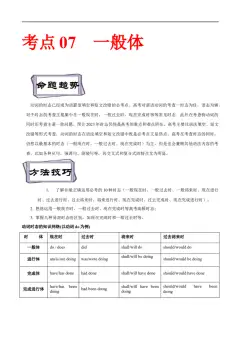
英语中的9 种主要时态。下表中标红的是不常
用的7 种时态。
十六种时态结构总表
时态名称
基本结构(以动词do
为例)
典型例句(高考适配)
高考考点提示
一般现在时
do/does(三单)
He plays football every
Sunday.
高频,主将从现、客观
真理
一般过去时
did
She went to the park
yesterday.
高频,明确过去时间、
易错
一般将来时
will do / be going to do
I will visit my
grandparents tomorrow.
高频,四种表达辨析
过去将来时
would do / was/were
going to do
He said he would come.
中频,主从复合句
现在进行时
am/is/are doing
They are playing
basketball now.
高频,特殊表意(抱
怨、渐变)
过去进行时
was/were doing
I was reading at 8 last
night.
高频,while/when 从句
搭配
现在完成时
have/has done
I have lived here for 5
years.
高频重点,for/since、
固定句型
过去完成时
had done
By last year, we had
finished it.
高频难点,过去的过去
现在完成进行
时
have/has been doing
I have been studying for
3 hours.
高频,与现在完成时辨
析
过去将来完成
时
would have done
He said he would have
finished it.
低频,了解基础用法
过去完成进行
时
had been doing
They had been waiting
for an hour.
中频,强调持续过程
将来完成进行
时
will have been doing
I will have been studying
for 4 years.
低频,了解基础用法
过去将来完成
进行时
would have been
doing
He said he would have
been working.
低频,了解基础用法
将来进行时
will be doing
I will be studying at 8
tomorrow.
低频,了解基础用法
过去将来进行
时
would be doing
He said he would be
working then.
低频,了解基础用法
将来完成时
will have done
By 2027, I will have
graduated.
低频,了解基础用法