压轴题 03 阅读理解 C、D 篇
分析近几年高考阅读理解C、D篇可知,高考命题中科普说明文一直都是以压轴题的形
式存在,着重考查考生对于语篇的理解能力以及信息处理能力。 题材多样,语篇主要来源于
英美主流报刊、杂志和网站。内容涉及科技创新发明、人工智能类、医疗保健卫生类、社会
与文化研究报告、观念事理类、环境与保护类、动植物研究等多种领域,具有较强的思想
性、趣味性、实际功用性和较强的时代感。
命题预测
从近年全国卷和各地高考试卷中科普类阅读命题的统计来看,高考阅读理解科普类文章
的理论性和逻辑性强、生词多、句式结构复杂。六种命题类型都有所体现。命题尊重语篇的
文体特征和行文特点,考查了考生理解说明文语篇的能力,以及灵活运用各种阅读策略提
取、归纳所读信息的能力,尤其加大了对概括能力和推断能力等高阶思维能力的考查。预测
2024年高考对于科普说明文的考查仍然是重点。
1. 推理判断题
2. 标题归纳题
高频考法
3. 细节理解题
4. 词义猜测题
一、说明文基本规律及解题要领
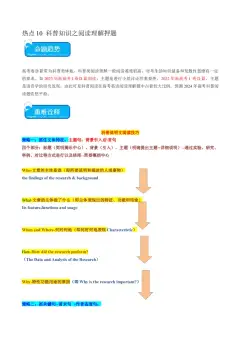
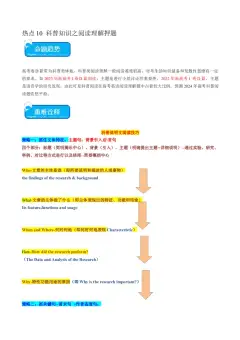
高考中科普类阅读理解一般不给标题,反而经常要求考生选择最佳标题。说明文一般采用如下四部分:
首段:一般即是文章的主题段,开门见山点明新发明或研究对象。
背景 : 交代问题的现状或研究的起因。
主干 : 部分介绍研究所取得的突破,作者往往会详细介绍研究对象、研究方法、研究理论或具体的实
验、统计等过程。
结尾 : 通常会再次对中心进行概括、重述研究成果、预计的市场未来等与主题呼应。
二、说明文的解题技巧1 . 运用语篇结构( text structure ),了解文章大意
科普说明文主题鲜明、脉络清晰,行文结构模式较为固定。弄清文本结构有助于把握文章主旨和阅读
重点。社会文化研究类文章多用描述法、问题与历史文化背景等方法,通过列数据、做对比等来说明新的
文化研究的内容及影响,内容涉及语言、传统习俗、建筑、艺术等行为模式、价值观念、知识体系等多方
面的知识。 结构上一般采用上述四个部分,说明手法上常使用以下说明方法:描述法(包括举例子、下
定义、列数据等)、因果法、问题与对策法。
实验研究型文章一般会以实验的过程进展为线索,多用描述法、问题与对策法等方法,通过列数据、
做对比等来说明新的科学研究发现及其产生的影响。
阅读时,首先用略读法快速浏览每段的首尾句,根据英语说明文思维模式特征,作者一般都会开门见
山,直奔主题。结尾通常也是中心思想的概括,并与导语相呼应。因此在做主旨大意、写作意图和最佳标
题等题目时,需要重点关注首尾段落里面高频复现的词汇和内容。
2 . 定位标志词,分析长难句,进行逻辑推理判断
每一个问题,在原文中,都要有一个定位。然后精读,找出那个标志词或者中心句。根据题干要求,
用查读法快速定位到相关段落。再利用标志词所提供的逻辑关系找到细节信息,如列数据、举例子、原因
和结果等。如果句子成分复杂,有生词,也不要烦躁退缩,分析主句和从句或非谓语动词之间的关系,一
些出现在术语、抽象概念、长难句前后的同义词、近义词等,都是用以理解文章的语境线索。通过这些对
长句进行层层剖析,露出主干部分,就能明晰句意,弄懂作者的真实意图。
3. 关注某人说到或推断观点态度题
某人说过的话,有时并不是题眼,但可以从侧面或某个角度来反映作者的观点,也就是作者想表达的,正
确答案都是和这样的观点相一致的。要把握关键词,有感情色彩的词。
4 . 关注转折关系的逻辑词
说明文中常会出现表示转折意义的词,如however, but, yet,while等。这些词后面才是作者真正想表达的
意思,常常会在此处命题。
5 . 熟悉选项设置规律,关注细节
正确选项:文中内容的“同义替换”或者“归纳概括”。
干扰项:“张冠李戴”、“偷梁换柱”、“无中生有”和“以偏概全”四种类型。03 社会文化研究类
1.(2223高三·江西鹰潭·开学考试)
Letting kids learn more about science at an early age is easier than you think. It is happening all around us, and
you can use daily things to arouse (激发) your children’s interest. Most parents believe it is difficult to help their
children with science. But you don’t need a high scientific degree to teach your children science. All you need is
that you’re willing to try, to see the world, and to take the time to encourage their natural curiosity. When they
strongly want to know about something, they get the ticket to the unknown world.
You can help by having an active attitude (态度) towards science yourself. Then start simply by asking your
children questions about the things you see every day. Next listen to their answers without judging (评判) them,
which will improve their confidence (自信), and help you decide just what your children know or do not know.
Different kids have different interest, so they need different kinds of science projects. Collecting rocks may
interest your young daughter, but your older son may need something more to deal with it. Knowing your children
is the best way to find enjoyable learning activities. Here are some more pieces of advice: Choose activities that are
the right level of difficulty. If you are not sure, pick something easier. Read the suggested ages on any projects,
books, and then make sure that the activity is proper for your children. Let your children choose the project or
activity themselves. It’s easy enough to ask rather than force them. Suggest choosing 2 or 3 things your children
can do. When a child picks something he or she is interested in, he or she will enjoy it and learn more from it.
1.What do most parents believe?
A.Science should be learnt early.
B.Science teaching needs time.
C.Helping children with science is hard.
D.Many children have no interest in science.
2.What does the underlined word “curiosity” mean in English?
A.The spirit of changing. B.The ability of understanding.
C.The method of thinking. D.The feeling of wondering.
3.How can we start to help children?
A.By judging them. B.By asking them questions.
C.By collecting their answers. D.By deciding what interests them.
4.Which is the best way to find enjoyable learning activities for children?A.To know the children. B.To improve their confidence.
C.To have an active attitude. D.To offer different kinds of projects.
5.What can we mainly learn from the passage?
A.How to choose activities for children.
B.Why to let children learn science earlier.
C.Why not force children to learn science.
D.How to arouse children’s interest in science.
2.(2024·全国·模拟预测)
Between 1945 and 2000, educators employed a fairly uniform approach. The teacher was the sun in the
classroom, and all lessons and activities centered around him or her. Educators stressed the importance of discipline
and obedience(服从) within the classroom, and students were expected to follow very rigid standards for behavior
and academic performance. The stated goal of this model was to ensure fairness by applying the same expectations;
however, the result was that only a few students succeeded while many others were left behind.
When computers and Internet technology entered the classroom a few decades ago, another pattern appeared
and progressive educators immediately saw the opportunity to change the way school worked. Instead of needing to
focus on the teachers for the vast majority of the day, students could use computers, websites, and even games to
learn new materials and improve their skills and knowledge. Not all educators welcomed this shift, however, as
some believed it took power and responsibility away from the teachers and cheapened the educational experience
for learners.
Over the last decade, two distinct camps of educators have emerged. Tech advocates stress that computers and
Internet technology allow students to learn at their own pace in an environment that makes them feel comfortable,
while the traditional classroom sets a pace that many learners can’t keep up with and often makes students feel
uncomfortable. Traditionalists, on the other hand, believe that over-reliance on tech limits students’ ability to
develop their own knowledge and skills and does little to prepare them for the realities of being adults in the real
world.
Regrettably, the inability of these two parties to find an agreement has prevented the growth of our education
system. We must learn from what worked in the past while adopting the best of our new technologies to create an
education system that reflects our modern world. If we can’t get all our teachers on the same page, then we will be
at risk of failing future generations.
6.Who can probably learn better under the 1945 -2000 model of education?A.Lisa who tends to read by herself. B.Michael who disciplines himself.
C.Kate who can focus on listening for long.D.Tom who prefers hands-on learning.
7.Why do some educators prefer the second education pattern?
A.It allows for different learning styles. B.It has the same hope for students.
C.It fires students’ enthusiasm for learning. D.It reduces teachers’ level of stress.
8.What message is conveyed in paragraph 3?
A.Two of a trade never agree. B.Everyone thinks in his way.
C.Every potter praises his pot. D.One’s words reflect one’s thinking.
9.What is the author’s understanding of a good education system?
A.It’s full of well-trained subject teachers. B.It’s an accurate mirror of the real world.
C.It’s inclusive and accessible to all students. D.It’s an integration of tradition and modernity.
3.(23-24高三下·辽宁大连·阶段练习)
Falcons are powerful birds that may be trained to hunt in cooperation with humans. The art of training falcons
as “hunting dogs of the skies” is called falconry (训鹰术). It was developed in the ancient Arabian Desert around
4000 B.C. In the past, falconry mainly involved hunting with falcons to supplement one’s diet. But now, it has
become the favorite sport and pastime in the Arabian Peninsula.
Falconry includes three major processes: acquiring the falcons, training them, and hunting with them. Every
year, falconers begin capturing wild falcons in June and July, the migration season. The best birds to catch are the
ones with naturally nurtured hunting skills, aged one or two years. Once the falcons are captured, their heads are
immediately covered with a leather hood. This is essential because they imprint as their master whomever they see
first after the hood is removed. Right after a bird is caught, the training process starts. It begins by depriving (剥夺)
the bird of food to make it easier to tame. The birds are taught to know their own name and respond to their master
when called. Arab falconers live with their birds day and night in order to build a strong relationship with them.
By the end of October or mid-November, the trained falcons are ready to hunt in the desert. They have
excellent vision, 2. 6 times greater than that of a human. They are also the fastest divers on the planet. One hunting
technique that sets them apart from other animals is that they can be trained to deliver their prey, without killing it
first. This is vital in Islamic culture because animals used for food must still be alive to ensure that the meat is
halal, that is, properly prepared according to Islamic law.
Falcons have played such a crucial role in traditional Islamic cultures that a number of countries in the Middle
East have made them their national bird. Falconry has grown so popular that specialist hospitals have beenestablished to take care of these magnificent birds. Falcons are even issued their own passports. They are the only
animals in the United Arab Emirates that are legally allowed to travel inside planes, enjoying a level of luxury that
some humans can only dream of.
10.What is the main reason for Arabic people to hunt with falcons today?
A.To serve as entertainment and exercise.
B.To supplement their diet.
C.To replace the practice of hunting with dogs.
D.To honor their national bird.
11.What can we learn from the passage?
A.Falconers don’t give food to falcons in order to capture them.
B.Falcons are not allowed to see their masters during the training process.
C.Wild falcons with natural hunting skills are ideal for falconers to catch.
D.The trainers’ names are written on the hoods covering the birds’ heads.
12.What especially makes falcons a unique species for hunting in Islamic culture?
A.Falcons keep their prey alive before delivering it to falconers.
B.Falcons can form a strong bond with their owners quickly.
C.Falcons’ vision is particularly suitable for hunting in deserts.
D.Falcons are relatively easy to train for specific hunting.
13.According to the article, what privilege do falcons enjoy in the Arab world?
A.Free air ticket. B.Passports issued by the King.
C.Expensive meals. D.Access to specialized medical care.
4.(2023·全国·模拟预测)
Norwegians would perhaps highlight their custom of “gå på tur”— going on a journey on foot or on skis. In
Denmark, everyone knows what “hygge” is — to freely enjoy the good life with the people you love. They’re the
issues of “intangible cultural heritage”, things that cannot be physically touched such as traditions, stories, music,
dance and craft skills.
In 2003, UNESCO, the education, science and culture organization of the United Nations, adopted an
agreement to “preserve the intangible” and many developing-world countries were quick to get their traditions
included on the official list. But it would take almost 10 years for “Agreement for the Safeguarding of the
Intangible Cultural Heritage” to be approved by the Scandinavian countries.Annika Sjöberg is responsible for managing the work of the agency in Sweden. She has been, and continues to
be, flooded with suggestions of intangible cultural heritage worthy of protection, submitted by committed citizens
and organizations wanting to see their particular traditions included on the list that should be ready sometime in the
next couple of years.
Suggestions have also been received concerning various maritime traditions: old shipwright skills such as the
building of wooden hulled vessels, are in decline and at risk of being lost forever.
“Our work has attracted considerable attention as it is regarded as being a little out in left field,” says Sjöberg.
“In addition, it’s also opened people’s eyes to the fact that the things we can’t physically touch indeed have a major
bearing on the way in which we live. Even in an urbanized society, there is knowledge we carry with us that we’ve
inherited from previous generations-knowledge that’s important to preserve and take care of.”
Sjöberg explains that the point is not to preserve this cultural heritage in a stony rigid form, as traditions must
be allowed to change and evolve. She also emphasizes that her work should not be interpreted as a nationalistic
project, rather as a means of multicultural spreading.
It’s actually a matter of documenting the knowledge that exists in the various traditions. What is most exciting
is the diversity that now exists and the ways in which different cultures interact with each other.
14.Why are “gå på tur” and “hygge” mentioned at the beginning of the text?
A.To remind people to enjoy a healthy lifestyle.
B.To introduce the main topic of the text.
C.To appeal to the world to mind physical cultures.
D.To highlight how special the northern European countries are.
15.How should a tradition be included on the official list?
A.Date back to 2003. B.Last for ten years old.
C.Meet the agreements of UNESCO. D.Be in the developing country.
16.What do we know about Annika Sjöberg?
A.She is working for the UNESCO agency in Switzerland.
B.She monitors the protection of physical cultural heritage.
C.She tries her best to restore the world-wide particular traditions.
D.She has been managing the cases of the intangible cultural heritage.
17.What does the text mainly talk about?
A.Creation of the UNESCO.
B.Annika Sjöberg’s daily routine.C.Intangible cultural heritage of UNESCO.
D.Safeguarding the cultures of the Scandinavian countries.
5.(2024·湖南岳阳·一模)
Classical Chinese furniture — a desk, a cabinet or any other fine piece of furniture and often out of precious
wood —impresses us with its delicate shape. The secret of its graceful form is less visible and lies in its
complicated sunmao (榫卯) system, which allows the various components to be assembled neatly without glue or
nails.
Suzhou, a scenic and peaceful city in Jiangsu, a province long known for its wealth, developed its own
tradition of classical furniture design over the centuries. Examples of the Suzhou-style furniture are currently on
display as part of Oriental Wisdom in Sun Mao, a group exhibition at the Prince Kung’s Palace Museum in Beijing.
Running until Sunday, the show demonstrates the way that the complex sunmao technique has been used in
making furniture, as well as the variations that developed in different parts of the country. Also on display are
models of different kinds, as well as the components of two chairs, which are disassembled and laid out to give
museum goers a clear view of the inner structure of classical furniture.
The Suzhou style flowered during the Ming Dynasty(1368-1644), and once dominated the market in Jiangnan,
the southern region along the lower reaches of the Yangtze River. It integrated input from the intellectual class, who
put their ideals regarding living spaces and spiritual harbors into its design. According to Xu Jianping, one of the
inheritors of classical furniture design in the city, the Suzhou style presents beauty in the same delicate way the city
does, and represents the life philosophy of its people to achieve “refinement through careful calculations”.
Guangzhou style furniture is normally made out of tropical hardwood, and its forms and decorative patterns
show the influence of European furniture styles resulting from Guangzhou’s history as an international trade port.
The Beijing style, which is more splendid, incorporates aesthetic (美学) and stylistic elements from both Suzhou
and Guangzhou.
“While the Suzhou style is light in weight and elegant in outline, furniture in the Beijing style is more
magnificent, as it used to be made for royalty and aristocracy.” Xu says. “Ultimately, people live with their
furniture, so the principle of quality furniture is that it should be appropriate to the space.”
18.What is on display in the exhibition?
A.The lifestyle in Sunzhou. B.The modern furniture in Suzhou.
C.The secret of sunmao system. D.The classical furniture in China.
19.What does the underlined word ”disassembled“ in paragraph 3 mean?A.taken apart B.broken up C.torn down D.given away
20.What is paragraph 4 of the text mainly about?
A.The beauty of the delicate city. B.The development of the Suzhou Style.
C.The influence of historical design ideas. D.The formation of the Suzhou life philosophy.
21.Why did the author mention Guangzhou and Beijing style furniture?
A.To compare their differences. B.To evaluate the usage of furniture.
C.To express the way to display furniture. D.To illustrate the theory of furniture design.
6.(2024·浙江杭州·二模)
Education in 2080 is distinctive from education in the 2020s. Until about 2035, the main function of education
systems was to supply the economy with the next generation of workers. In 2080, the purpose of education is the
well-being of society and all its members. To make this a bit more tangible for you, I would like to give an example
of what a child’s education looks like in 2080. Her name is Shemsy. Shemsy is 13, and she is confident and loves
learning.
Shemsy does not go to school in the morning because schools as you know them no longer exist. The
institution was abolished as it was widely thought of as more like a prison or a factory than a creative learning
environment. Schools have been replaced with “Learning Hubs” that are not restricted to certain ages. They are
where intergenerational learning happens, in line with the belief that learning is a lifelong pursuit.
Every year, Shemsy designs her learning journey for the year with a highly attentive “teacher-citizen”. Shemsy
is actively engaged in designing her education and has to propose projects she would like to be involved in to
contribute to and serve her community. She also spends lots of time playing as the role of play in learning has
finally been recognized as essential and core to our humanity. Shemsy works a lot collaboratively. Access to
education is universal, and higher education institutions no longer differentiate themselves by how many people
they reject yearly. Variability between students is expected and leveraged (利用) as young people teach one another
and use their differences as a source of strength. Shemsy naturally explores what she is curious about at a pace she
sets. She still has some classes to take that are mandatory for children globally: Being Human and the History of
Humanity.
We invite you to think about your vision for education in the year 2080, what does it look like, who does it
serve,and how does it transform our societies?
22.What does paragraph 1 mainly tell us?
A.There are different types of education.B.The present education needs improvements.
C.Education and economy are closely associated.
D.The goal of future education is fundamentally different.
23.What do we know about the Learning Hub that Shemsy goes to?
A.It accepts students of all ages. B.It promotes competition.
C.It discourages individualized learning. D.It is all about play-based learning.
24.What does the underlined word “mandatory” in paragraph 3 mean?
A.Tough. B.Satisfactory. C.Optional. D.Required.
25.What is the suitable title for the text?
A.An Example to All B.A Vision for Education
C.A Challenge for Education D.A Journey into the Future