题型08 阅读理解说明文
题型简介
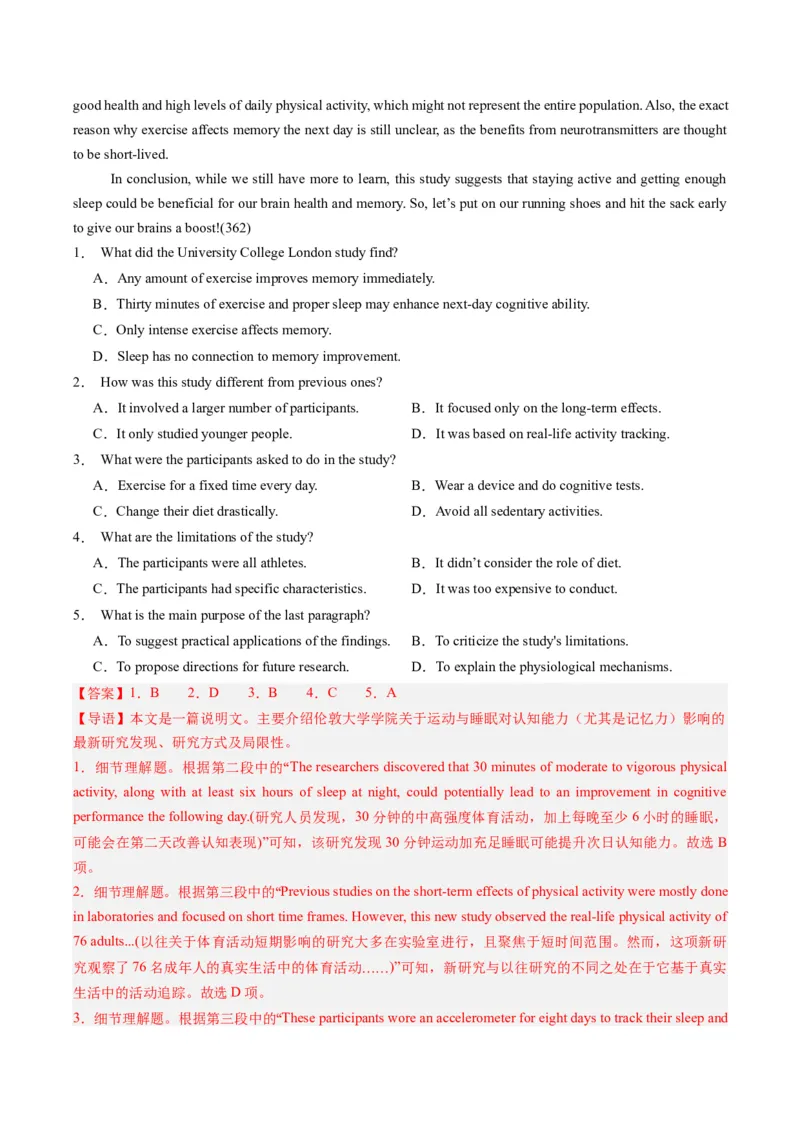
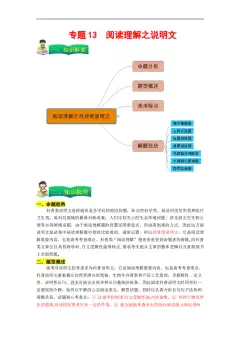
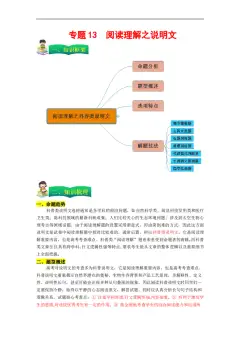
在高考英语的语境下,说明文是一种以解释、阐述为主要目的的文体。它的核心功能是告知,而非
“
”
讲述故事(记叙文)或论证观点(议论文)。简单来说,
“
”
“
”
说明文就是用来传递知识、解释现象、阐述
事物工作原理或介绍某种事物的文章。
主要特点:客观性与准确性:文章通常基于事实和信息,语言客观,力求准确,较少掺杂作者的个人
情感或主观意见。逻辑性与条理性:文章结构清晰,层次分明。常使用时间顺序、空间顺序、逻辑顺序
(如从因到果、从现象到本质、从整体到部分等)来组织内容。
主题明确:一篇文章通常围绕一个核心主题或几个密切相关的方面展开。
方法多样:为了把复杂的事物说清楚,作者会运用多种说明方法,例如:下定义:明确解释一个概念
是什么。举例子:用具体实例来使说明更生动、易懂。列数据:使用数字、统计数据来增强说服力和精确
性。作比较:将陌生事物与熟悉事物进行比较,突出其特点。分类别:将事物分成不同类别,分别说明。
常见话题:高考英语阅读理解中的说明文题材非常广泛,常涉及:科普知识:如黑洞、人工智能、基
因编辑、气候变化等。社会文化:如不同国家的节日习俗、社交礼仪、社会现象分析等。新技术/新发明:
介绍某项新技术的原理、应用或影响。健康与生活:如睡眠的重要性、健康饮食的建议、某种疾病的成因
等。动植物研究:介绍某种动植物的独特习性、生存环境等。
目录
第一部分 题型解码 高屋建瓴,掌握全局
第二部分 考向破译
解
微观
剖,精细教学
典例引领
方法透视
变式演练
考向01 研究类说明文【常考】
考向02 事实类说明文【重难】
考向03 新事物说明文【常考】
第三部分 综合巩固
合
整
应用,模拟实战
专题01 高考真题练
专题02 优秀模拟题
设题类型&命题方式
考向1 研究类说明文
研究类说明文通常遵循一个清晰的叙事结构:为何研究 如何研究 有何发现 意义何在
→
→
→
。高考
命题也紧密围绕这个结构展开。
1. 研究背景与目的:考查推理判断
“
”:这类题目不直接询问文章中的事实,而是考查你对研究起因和
动机的深层理解。
典型问法:What is the author's purpose in writing this passage? (作者写这篇文章的目的是什么?)/What
prompted the research? (是什么促成了这项研究?)
解题关键:答案通常不会明说。你需要根据文章开头描述的某种现象、一个未解决的问题或一个现有
理论的困境,来推断出研究者开展此项工作的背景和初衷。
2. 研究过程与方法:考查细节理解与词义猜测
“
”
“
”:这部分聚焦于研究的具体操作和执行层面,是细
节题的高发区。
典型问法:How did the researchers carry out their study? (研究人员是如何开展研究的?)/What is the
function of the underlined word "methodology"? (划线词“methodology”的功能是什么?)
解题关键:你需要准确定位并理解关于研究对象、实验设计、使用工具、操作步骤等具体信息。同时,
一些表示研究方法和步骤的专业术语可能会通过词义猜测题来考查,需要根据上下文(如下定义、举例
“
”
子)来推断其含义。
3. 研究数据与发现:考查细节理解与推理判断
“
”
“
”:这是文章的核心,命题会直接考查研究的直接结
果和初步发现。
典型问法:What did the study find? (研究发现了什么?)
解题关键:精准定位描述研究结果和数据的关键句。注意区分哪些是本研究发现的事实,哪些是基
“
”
于事实的进一步推断。
“
”
4. 研究结论与主旨:考查主旨大意
“
”:这是研究的最终产出,即研究者对整个工作的总结性论断。
典型问法:What is the main idea of the passage? (文章的主旨是什么?)/What is the best title for the
passage? (文章的最佳标题是什么?)
解题关键:研究的结论往往就是文章的主旨。你需要超越具体细节,抓住研究者最终得出的
“
”
“
”
核心
观点、理论突破或对现象的根本性解释。结论通常出现在文章的结尾部分。
5. 研究意义与展望:考查推理判断
“
”:这类题目考查你对研究价值和应用前景的理解,是最高层次的
思考。
典型问法:What is the significance of the research? (这项研究的意义是什么?)/What can we learn from the
passage? (我们可以从文章中学到什么?)
解题关键:答案通常隐含在文中。你需要根据研究的结论,推断其在现实生活中的应用、对未来研究
的启发或对社会/科学领域的潜在影响。
考向2 事实类说明文
1. 特征与细节辨析:这是最基础的题型,直接考查对文章中事物特征、属性、构成部分等具体信息的
捕捉与理解。解题的关键在于精准定位,并注意选项与原文在表达上的同义转换。
常见问法:What can be learned about cats’ meowing from the first paragraph? / What do we know about the
solar still equipment from the first paragraph?
考查本质:确认考生是否准确获取了文本直接陈述的、支撑事物说明的关键事实。
2. 功能与用途推断:此类题目要求考生基于事物的描述,推断其实际作用、应用场景或带来的影响。
这需要将事物的特征与其在现实世界中的价值联系起来。
常见问法:What is the main use of...? / What would be the positive effect of...?/ How does a pet cat assess
different situations?
考查本质:考查从是什么到有什么用的思维跨越,需要结合文本信息进行合理的逻辑延伸。
“
”
“
”
3. 理清步骤与顺序:对于介绍过程、方法或构造的事物,题目会聚焦于对操作流程或事件发展环节的
理解。
常见问法:What’s the last step of constructing a working solar still? / When a solar still works, drops of water
come into the cup from ?
考查本质:考查对时间顺序、空间顺序或程序逻辑的把握,要求能厘清各个环节的先后与关联。
4. 理解词义与指代:要求考生根据上下文线索,推断出生词、短语或代词的具体含义。
常见问法:Which best explains the phrase “xxx” in paragraph 3? (词义猜测)
What does the underlined phrase “xxx” in paragraph 2 refer to? (指代关系)
考查本质:考查利用语境理解特定语言单位真实含义的能力,而非依赖词汇量。
5. 概括主旨与标题 此类题目为最高层次的概括,要求基于对全文的深入理解,提炼核心内容,为文
章选择最贴切的标题。
常见问法:What is a suitable title for the text?
考查本质:考查对文章整体说明对象及其核心特征的综合概括能力,需排除片面、笼统或偏离主题的
观点。
考向3 新事物说明文
1. 识别新事物的定义与核心特征:这类题目要求准确理解文章中介绍的新事物究竟是什么,包括其基
本定义、形态或最主要的功能。
常见问法:What is the new robot in the first paragraph designed to do? /What is the main function of the device
mentioned in the text?
考查本质:考查对文章核心说明对象的把握,答案通常出现在文章开头部分。
2. 分析新事物的优势与存在理由:这类题目聚焦新事物相较于旧有方式的优越性,即其产生的必要性、
解决的问题或带来的积极变化。
常见问法:What problem does the robot aim to solve? /What is the advantage of the new method compared to
the traditional one?
考查本质:考查对新旧对比和因果逻辑的理解,需要明确新事物针对的痛点及其带来的效率提升、
“
”
成本降低等具体优势。
3. 理解新事物的应用与运作机制:此类题目深入考查新事物如何运作,可能涉及工作原理、关键技术、
应用场景或具体步骤。
常见问法:How does the robot monitor the health of cattle? /According to the passage, how does the new
system work?
考查本质:考查对过程、机制等细节信息的捕捉与理解,需要梳理文章中对技术原理或操作流程的描
述。
4. 评估新事物的局限与发展前景:题目会关注新事物当前存在的不足、面临的争议或未来的发展潜力。
这对应你提到的新事物目前有什么局限性需要日后不断改进。
“
”
常见问法:What is the limitation of the robot mentioned in the passage?/What is some people's concern about
the new invention?
考查本质:考查批判性思维和辩证看待事物的能力,需要识别文中关于缺陷、挑战或不同看法的信息。
5. 辨析不同观点与作者态度
这类题目要求辨别文中不同人物(如支持者、怀疑者)对新事物的态度,并推断作者的隐含立场。
常见问法:What is Peter Bonds' attitude towards the robot? /What does Michael Kelsey think about the
robot?
考查本质:考查推理判断和综合理解能力。作者态度虽未必明说,但常通过材料编排(如先抑后扬)
或支持者论据的强度来体现。
解题思路
1. 研究类说明文核心解题方法
1. 结构预判法:快速把握文章脉络:在开始阅读前,先在心理上预设文章会遵循 背景过程发现
“
→
→
→
结论意义
→
” 的基本结构。带着这个地图去阅读,能帮你:
“
”
快速将具体内容归位,理解其在不同部分的作用。
当题目考查特定环节时(如研究目的、研究方法),能迅速定位到原文的相应部分。
2. 首尾定位法:锁定研究目的与核心结论
研究目的:通常出现在文章开头部分。关注作者为了引出研究而描述的现象、提出的问题或指出的现
有知识的空白。这些内容直接揭示了为何研究。
“
”
核心结论:通常位于文章结尾部分。研究的最终结论往往是全文主旨的体现,也是解答主旨大意题的
关键。
3. 细节锚定法:精准捕捉研究过程与发现:研究过程与发现是细节题的高发区。解题时务必:
精准定位:根据题目关键词(如研究方法名称、特定数据等)回到原文找到对应句子。
仔细比对:将选项与原文进行细致对比,注意选项是否在范围、程度、因果关系上对原文进行了偷换
或曲解。
4. 语境释义法:攻克术语与词义猜测:研究中不可避免会出现专业术语或生词。遇到时:
寻找上下文线索:密切关注该词前后的定义、解释、举例或对比关系。
利用逻辑关系:通过分析句子内部的因果、转折、并列等逻辑关系来推断词义。
5. 逻辑推理法:推断研究意义与作者意图:对于研究意义、影响或作者写作目的等推断题:
基于结论,合理推演:答案不会明说,需要你基于研究的最终结论,向前推演一步,思考其所以然
“
”
——即这项发现可能如何应用、对现有认知或实践会产生什么影响。
辨别观点与事实:严格区分文中客观陈述的研究发现(事实)和作者或他人基于事实发表的评论与
“
”
“
看法(观点),这对推理至关重要。
”
6. 主旨提炼法:概括研究核心:为文章选择最佳标题或概括主旨时:
覆盖全局:正确选项必须能涵盖研究的整体内容,而不仅仅是某个细节。
突出核心:标题应精准指向研究的核心对象与最重要发现。
警惕陷阱:注意排除那些以偏概全、过于笼统或偏离重点的选项。
2. 事实类说明文核心解题方法
1. 精准定位法:攻克细节与特征题:此类题型要求直接回到原文寻找答案。
题干定位:抓住题干中的关键名词(如 cats' meowing, solar still equipment)和位置信息(如 from the
first paragraph),迅速锁定原文相关句。
比对筛选:将选项与原文信息进行逐字逐句的仔细比对。注意识别选项的同义转述,并排除无中生有、
偷换概念或扩大/缩小范围的干扰项。
2. 逻辑延伸法:推断功能与用途:解答此类题目需要在事实基础上进行一步合理的逻辑推演。
寻找功能词:定位并勾画描述事物能力或特性的词句(如 can monitor..., is used to...)。
推导现实价值:基于其特性,思考拥有这种能力,在现实中能解决什么问题或带来什么好处?。例
“
”
如,一个能监控牛群健康的机器人,其用途自然是保障牛群健康而非直接治疗病牛。
“
”
“
”
3. 步骤重建法:理清顺序与过程:对于涉及流程或构造的说明文,可视化方法非常有效。
勾画标志词:在阅读时,注意 first, then, next, finally 等序列信号词。
流程图解:在草稿纸上快速画出简单的步骤流程图或事物构造图。这能直观地帮你理清顺序,应对如
the last step 或 drops come from... 这类问题。
4. 语境分析法:破解词义与指代:这是阅读理解的核心微技能,绝不依赖词汇量猜测。
指代题:向前寻找该短语或代词所指代的那个具体名词或概念。答案通常就在前一句或前几句中。
词义题:紧密分析生词或短语所在的上下文,寻找定义、解释、举例、比较或对比等线索来推断其含
义。
5. 核心聚焦法:概括主旨与标题:这是对全文内容的顶层概括。
主题句筛查:重点审查文章开头、结尾以及各段首句,这些地方通常包含中心思想。
综合概括:确保正确选项能够全面覆盖文章的说明对象及其最核心的特征或价值。
排除陷阱:果断排除以下选项:
以偏概全(只涉及某个细节)。
过于笼统(缺乏文章具体内容)。
偏离主旨(与文章核心说明对象无关)。
3. 新事物说明文核心解题方法
1. 定义定位法:精准把握新事物本质
首段聚焦:新事物的基本定义、核心功能或设计目标通常在文章开头(尤其是第一段)明确给出。
信号词捕捉:关注如 is designed to..., aims to..., the main function/purpose is... 等明确表达功能目的的信
号词。
解题关键:准确识别并定位这些核心句,就能直接解答关于新事物是什么的问题。
“
”
2. 对比分析法:厘清优势与存在理由
寻找参照物:在文中明确找出被对比的旧事物或传统方法。
“
”
“
”
识别问题与优势:定位旧模式面临的 痛点
“
” (如 labor shortage, low efficiency)和新事物带来的 亮
“
点” (如 higher accuracy, cost-saving)。
解题关键:新事物的优势总是相对于旧事物的不足而存在。找到这个对比关系,就找到了答题的钥匙。
3. 过程可视法:理解应用与运作机制
勾画步骤与组件:对于涉及流程或构造的说明,在阅读时随手圈出 by using..., through..., the first step 等
表示方法或顺序的词。
构建逻辑链:在脑中或草稿上简单梳理出“通过什么技术/方法
实现了什么功能
达到了何种效
→
→
果的逻辑链条。
”
解题关键:区分监控与治疗等不同性质的功能,确保对运作机制的理解精准到位。
“
”
“
”
4. 辩证思考法:评估局限与发展前景
主动预判:阅读时主动思考这项新技术可能有什么缺点?
“
”
定位批评意见:直接寻找表达疑虑、批评或指出不足的词句,通常位于介绍完新事物基本功能后的段
落中,并伴有 however, some people concern..., the limitation is... 等信号词。
解题关键:认识到局限性是新事物说明文的常见组成部分,不必因其存在而否定新事物的整体价值
“
”
。
5. 立场推断法:辨析观点与作者态度
划分阵营:在文中标记出不同人物及其观点,如支持者(
“
”
Michael Kelsey)和怀疑者(
“
”
Peter
Bonds)。
分析论证强度:对比双方论据的说服力,并关注文章结构的安排(如先写反对意见再写支持意见,往
往暗示作者倾向于后者)。
解题关键:作者的态度虽未必明说,但可通过其给予不同观点的篇幅、论证逻辑的强弱以及材料的组
织方式推断出来。总体而言,介绍新事物的文章基调通常是谨慎乐观的。
考向01 研究类说明文
【例1-1】(25-26 高三·山东德州·期中)
Candles on a birthday cake mark calendar age, but they miss the hidden clock inside our bodies. Harvard
Medical School now reports that each of us also has a “biological age” for every major organ, and these ages vary
sharply even among people born in the same year.
Using blood samples from 44,498 UK Biobank volunteers aged 40-70, the team measured nearly 3,000 proteins.
About fifteen percent of those proteins originate in a single organ, allowing an algorithm (算法) to assign an “organ
age” to the brain, heart, kidneys and eight other systems. Participants were then followed for up to seventeen years.
The results translate numbers into risks. One-third of the volunteers had at least one organ whose protein signature
lay more than 1.5 standard deviations (标准差) from the age-adjusted average, a gap linked to sharply higher disease
risks. Most striking was the brain. “The brain is the gatekeeper of longevity,” said senior author Tony Wyss-Coray,
“If you’ve got an old brain, you have an increased likelihood of death.” An “extremely aged” brain raised the
fifteen-year risk of death by 182% and multiplied the chance of an Alzheimer’s diagnosis compared with an “extremely
youthful” brain.
Because organ age is readable years before symptoms appear, the same blood test could guide prevention.
Wyss-Coray envisions pairing the test with detailed lifestyle and medication records to see whether already-approved
drugs can rewind the biological clock of a high-risk organ. “Today you go to the doctor because something aches,”
he noted, “We’re trying to shift from sick care to health care.”
Unfortunately, the technology is currently available only for research, but Wyss-Coray has started two
companies, Teal Omics and Vero Bioscience, approved by Harvard to turn the findings into commercial drug searches
and a consumer test. “A streamlined panel focusing on the brain, heart and immune system could reach clinics within
two to three years,” he predicts, “and the cost will come down as we focus on fewer key organs.”
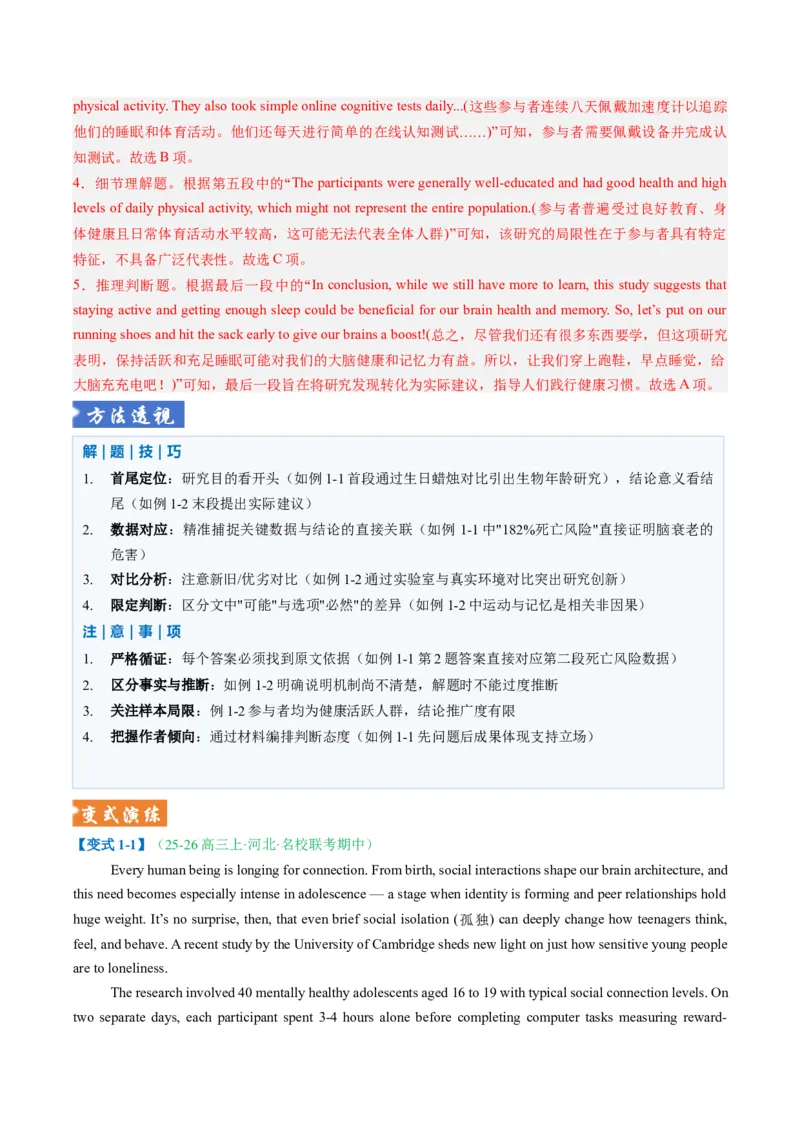
1. Why are birthday cake candles mentioned in paragraph 1?
A.To issue a warning.
B.To draw a contrast.
C.To highlight a custom.
D.To make a prediction.
2. What can we learn from the research?
A.Severe brain aging increases death risk.
B.Organs age at the same rate individually.
C.Volunteers’ diets affect protein signatures.
D.Young brains ensure Alzheimer’s prevention.
3. Which practice matches the study in paragraph 3?
A.Treating a heart attack when it happens.
B.Repairing functions of organs at high risk.
C.Tracking daily exercise before health checks.
D.Using brain age tests to prevent early diseases.
4. What is Wyss-Coray’s prediction mainly about?
A.Potential clinical application.
B.Consumers’ possible reaction.
C.More researchers’ engagement.
D.Research technology innovation.
【答案】1.B 2.A 3.D 4.A
【导语】本文是一篇说明文。文章主要讲述了哈佛医学院研究发现人体器官有生物年龄,且与疾病风险
“
”
相关,未来或可应用于临床预防。
1.推理判断题。根据第一段“Candles on a birthday cake mark calendar age, but they miss the hidden clock inside
our bodies. Harvard Medical School now reports that each of us also has a “biological age” for every major organ,
and these ages vary sharply even among people born in the same year.(生日蛋糕上的蜡烛标志着日历年龄,但它
们却无法体现我们体内隐藏的时钟。哈佛医学院如今报告称,我们每个人的每个主要器官也都有一个生
“
”
“
物年龄,即便同年出生的人,这些年龄也存在显著差异
”
)”可知,生日蛋糕上的蜡烛代表日历年龄,而人体
内部还有隐藏的生物年龄,两者形成对比。故选B。
2.细节理解题。根据第二段中“An “extremely aged” brain raised the fifteen-year risk of death by 182% and
multiplied the chance of an Alzheimer’s diagnosis compared with an “extremely youthful” brain.(与极其年轻的
“
”
大脑相比,极其衰老的大脑会使
“
”
15 年内的死亡风险增加182%,并使阿尔茨海默病的诊断几率成倍增
加)”可知,严重的脑部衰老会增加死亡风险。故选A。
3.推理判断题。根据第三段中“Because organ age is readable years before symptoms appear, the same blood test
could guide prevention.(由于器官年龄在症状出现前几年就可以被检测出来,同样的血液检测可以指导预防)”
以及第二段中“An “extremely aged” brain raised the fifteen-year risk of death by 182% and multiplied the chance
of an Alzheimer’s diagnosis compared with an “extremely youthful” brain.(与极其年轻的大脑相比,极其衰老
“
”
“
”
的大脑会使15 年内的死亡风险增加182%,并使阿尔茨海默病的诊断几率成倍增加)”可知,使用大脑年龄
测试来预防早期疾病与第三段中的研究相匹配。故选D。
4.细节理解题。根据最后一段中““A streamlined panel focusing on the brain, heart and immune system could
reach clinics within two to three years,” he predicts, “and the cost will come down as we focus on fewer key
organs.”(“一个专注于大脑、心脏和免疫系统的流线型面板可以在两到三年内到达诊所,他预测,随着我
”
“
们专注于更少的关键器官,成本将会下降。”)”可知,Wyss-Coray 的预测主要是关于潜在的临床应用。故选
A。
【例1-2】(25-26 高三上·天津咸水沽一中&天津一百中·期中)
In our daily lives, we often hear about the benefits of exercise for our physical health. But have you ever
wondered about its effect on our memory? Well, a recent study from University College London has some interesting
findings.
The researchers discovered that 30 minutes of moderate to vigorous physical activity, along with at least six
hours of sleep at night, could potentially lead to an improvement in cognitive performance the following day. This
means that activities like cycling to work or going for a brisk walk in the morning might not only make you feel good
for the day but also have a positive impact on your memory the next day.
Previous studies on the short-term effects of physical activity were mostly done in laboratories and focused on
short time frames. However, this new study observed the real-life physical activity of 76 adults aged 50 — 83, who
did not have cognitive impairment or dementia. These participants wore an accelerometer for eight days to track their
sleep and physical activity. They also took simple online cognitive tests daily to measure their attention, memory, and
processing speed.
The results showed that each 30-minute increase in physical activity corresponded to a 2% — 5% increase in
episodic and working memory scores the next day. But when sleep data was considered, only the working memory
score improvement remained significant. The study also found that more sedentary behavior was associated with a
drop in working memory scores, while getting enough sleep led to better scores in episodic memory and other
aspects.
Despite these findings, the study had its limitations. The participants were generally well-educated and had
good health and high levels of daily physical activity, which might not represent the entire population. Also, the exact
reason why exercise affects memory the next day is still unclear, as the benefits from neurotransmitters are thought
to be short-lived.
In conclusion, while we still have more to learn, this study suggests that staying active and getting enough
sleep could be beneficial for our brain health and memory. So, let’s put on our running shoes and hit the sack early
to give our brains a boost!(362)
1. What did the University College London study find?
A.Any amount of exercise improves memory immediately.
B.Thirty minutes of exercise and proper sleep may enhance next-day cognitive ability.
C.Only intense exercise affects memory.
D.Sleep has no connection to memory improvement.
2. How was this study different from previous ones?
A.It involved a larger number of participants.
B.It focused only on the long-term effects.
C.It only studied younger people.
D.It was based on real-life activity tracking.
3. What were the participants asked to do in the study?
A.Exercise for a fixed time every day.
B.Wear a device and do cognitive tests.
C.Change their diet drastically.
D.Avoid all sedentary activities.
4. What are the limitations of the study?
A.The participants were all athletes.
B.It didn’t consider the role of diet.
C.The participants had specific characteristics.
D.It was too expensive to conduct.
5. What is the main purpose of the last paragraph?
A.To suggest practical applications of the findings.
B.To criticize the study's limitations.
C.To propose directions for future research.
D.To explain the physiological mechanisms.
【答案】1.B 2.D 3.B 4.C 5.A
【导语】本文是一篇说明文。主要介绍伦敦大学学院关于运动与睡眠对认知能力(尤其是记忆力)影响的
最新研究发现、研究方式及局限性。
1.细节理解题。根据第二段中的“The researchers discovered that 30 minutes of moderate to vigorous physical
activity, along with at least six hours of sleep at night, could potentially lead to an improvement in cognitive
performance the following day.(研究人员发现,30 分钟的中高强度体育活动,加上每晚至少6 小时的睡眠,
可能会在第二天改善认知表现)”可知,该研究发现30 分钟运动加充足睡眠可能提升次日认知能力。故选B
项。
2.细节理解题。根据第三段中的“Previous studies on the short-term effects of physical activity were mostly done
in laboratories and focused on short time frames. However, this new study observed the real-life physical activity of
76 adults...(以往关于体育活动短期影响的研究大多在实验室进行,且聚焦于短时间范围。然而,这项新研
究观察了76 名成年人的真实生活中的体育活动……)”可知,新研究与以往研究的不同之处在于它基于真实
生活中的活动追踪。故选D 项。
3.细节理解题。根据第三段中的“These participants wore an accelerometer for eight days to track their sleep and
physical activity. They also took simple online cognitive tests daily...(这些参与者连续八天佩戴加速度计以追踪
他们的睡眠和体育活动。他们还每天进行简单的在线认知测试……)”可知,参与者需要佩戴设备并完成认
知测试。故选B 项。
4.细节理解题。根据第五段中的“The participants were generally well-educated and had good health and high
levels of daily physical activity, which might not represent the entire population.(参与者普遍受过良好教育、身
体健康且日常体育活动水平较高,这可能无法代表全体人群)”可知,该研究的局限性在于参与者具有特定
特征,不具备广泛代表性。故选C 项。
5.推理判断题。根据最后一段中的“In conclusion, while we still have more to learn, this study suggests that
staying active and getting enough sleep could be beneficial for our brain health and memory. So, let’s put on our
running shoes and hit the sack early to give our brains a boost!(总之,尽管我们还有很多东西要学,但这项研究
表明,保持活跃和充足睡眠可能对我们的大脑健康和记忆力有益。所以,让我们穿上跑鞋,早点睡觉,给
大脑充充电吧!)”可知,最后一段旨在将研究发现转化为实际建议,指导人们践行健康习惯。故选A 项。
【变式1-1】(25-26 高三上·河北·名校联考期中)
Every human being is longing for connection. From birth, social interactions shape our brain architecture, and
this need becomes especially intense in adolescence — a stage when identity is forming and peer relationships hold
huge weight. It’s no surprise, then, that even brief social isolation (孤独) can deeply change how teenagers think,
feel, and behave. A recent study by the University of Cambridge sheds new light on just how sensitive young people
are to loneliness.
The research involved 40 mentally healthy adolescents aged 16 to 19 with typical social connection levels. On
two separate days, each participant spent 3-4 hours alone before completing computer tasks measuring reward-
解|题|技|巧
1.
首尾定位:研究目的看开头(如例1-1 首段通过生日蜡烛对比引出生物年龄研究),结论意义看结
尾(如例1-2 末段提出实际建议)
2.
数据对应:精准捕捉关键数据与结论的直接关联(如例1-1 中"182%死亡风险"直接证明脑衰老的
危害)
3.
对比分析:注意新旧/优劣对比(如例1-2 通过实验室与真实环境对比突出研究创新)
4.
限定判断:区分文中"可能"与选项"必然"的差异(如例1-2 中运动与记忆是相关非因果)
注|意|事|项
1.
严格循证:每个答案必须找到原文依据(如例1-1 第2 题答案直接对应第二段死亡风险数据)
2.
区分事实与推断:如例1-2 明确说明机制尚不清楚,解题时不能过度推断
3.
关注样本局限:例1-2 参与者均为健康活跃人群,结论推广度有限
4.
把握作者倾向:通过材料编排判断态度(如例1-1 先问题后成果体现支持立场)
seeking motivation (e.g., reacting to social interaction images or money-earning games). The critical difference: one
day, they had no social contact at all (no phones, no Internet); the other, they could use devices for virtual interaction.
The results were striking: after total isolation, teens showed far stronger drive to seek rewards—staring longer at
happy social scenes and excelling (胜出) more in money-earning games. Virtual socializing softened this shift, though
it still caused a drop in positive mood.
This study adds nuance (细微差别) to the social media debate. While digital platforms are often blamed for
rising teen loneliness, they acted as a buffer here, easing loneliness and reducing intense reward-seeking. Yet they’re
no cure-all — Professor Sarah-Jayne Blakemore notes virtual connection brings risks like harmful content or addiction.
Its value depends on context: it helps when in-person bonds are scarce but can never replace their richness.
Global teen loneliness has doubled in a decade, driven by academic pressure, changing family structures,
economic instability, and more — not just social media. Loneliness ties to depression, anxiety, and even long-term
cardiovascular risks.
The study’s core lesson: social interaction is a basic human need, not a luxury. For caregivers, educators, and
society, creating environments where teens build genuine in-person connections is essential for healthy development.
Loneliness, ultimately, is a signal — seek community. Answering that call doesn’t just ease teens’ present pain; it lays
the groundwork for their lifelong well-being.
1. What difference was found between the two test days in the study?
A.Teens used more devices on the day with total isolation.
B.Positive mood dropped only on the day of no social contact.
C.Total isolation led to stronger reward-seeking motivation in teens.
D.Virtual interaction made teens perform worse in money-earning games.
2. What can we infer about virtual socializing from the text?
A.It has both positive effects and potential risks for teens.
B.It is the main cause of increasing teen loneliness globally.
C.It can completely replace in-person connections for teens.
D.It eliminates the need for teens to seek real-world rewards.
3. What does the author think of teens’ healthy development??
A.Virtual socializing is sufficient.
B.Loneliness is self-overcomable.
C.Academic pressure is the biggest barrier.
D.In-person social connections are essential.
4. Which of the following is the best title for the text?
A.The Dangers of Social Media for adolescents
B.A Study on Teenagers’ Love for Virtual Interaction
C.The Profound Impact of Loneliness on adolescents
D.How to Reduce Teenagers’ Loneliness in Digital Times
【变式1-2】(25-26 高三上·安徽·期中)
Autism (自闭症) should not be viewed as a single condition with a unified underlying cause, according to
scientists who found that those diagnosed early in childhood typically have a distinct genetic profile to those diagnosed
later.
“The term ‘autism’ likely describes multiple conditions,” said Dr. Varun Warrier, from Cambridge’s department
of psychiatry, senior author of the research. “For the first time, we have found that earlier and later diagnosed autism
have different underlying biological and developmental profiles.” While autism is defined as having challenges with
social communication, sensory processing and restrictive behaviours, there is huge variability in how these difficulties
present themselves between individuals. Scientists have been investigating whether subgrouping the population based
on shared features or pathways could make the study of autism more manageable.
The international study, published in Nature, based on genetic data from more than 45,000 autistic people in
Europe and the US, found that the underlying genetic profiles differed greatly between those diagnosed with autism
earlier and later in life, with only limited overlap. It showed that the average genetic profile of later-diagnosed autism
is closer to that of ADHD (a mental disease), as well as to mental health conditions such as depression and PTSD,
than it is to autism diagnosed in early childhood.
Those diagnosed in early childhood, typically before six years old, were more likely to show behavioural
difficulties from early childhood, including difficulty in walking fast and interpreting hand gestures, as well as
problems with social interaction, but remain stable. Those diagnosed with autism later, typically after the age of 10,
were more likely to experience increasing social and behavioural difficulties during adolescence and also had an
increased likelihood of mental health conditions such as depression.
The scientists are not advocating a move towards two diagnostic categories, saying that this could be unhelpful
for the many who fall somewhere in the middle.
Prof Uta Frith, a professor at University College London, who was not involved in the research, said,“It makes
me hopeful that even more subgroups will come to light, and each will find an appropriate diagnostic label. It is time
to realize that’ autism’ has become a ragbag (大杂烩) of different conditions.”
1. What is typical of autism?
A.Inability to behave controllably.
B.Tendency to talk too much.
C.Eagerness for public attention.
D.Difficulty in relieving loneliness.
2. What does the underlined word “overlap” in paragraph 3 probably mean?
A.Contrast.
B.Commonality.
C.Variation.
D.Stability.
3. What is paragraph 4 mainly about?
A.The relationship between age and autism.
B.Mental health risks in adolescents with autism.
C.Social interaction difficulties in autism patients.
D.Differences in autism features based on diagnosis age.
4. What can be inferred from Prof Uta Frith’s words?
A.Autism is a consequence of mixed factors.
B.Different categories of autism have been properly labeled.
C.More diagnostic categories of autism are to be discovered.
D.The research should be improved with more detailed data.
考向02 事实类说明文
【例2-1】(25-26 高三·山东省实验中学·期中)
What if your friends are going through life-or-death situations in the family? Social exchange theory would
suggest that you’d better drop them because they’re not providing as many benefits to you as they could. Different
from the exchange-based relationship, real-life experiences with these situations might be the opposite: These are the
times when many people are most likely to support their friends.
A recent research backs this up. “When surveyed about what they want in a friend, people didn’t place a high
value on paying back any debts — something highly valued from a social exchange perspective”. “Instead, they
considered other traits — such as loyalty, reliability and being there in times of need — to be much more important”,
Charlie Kirk, leader of the investigation added. The essence of friendship may be what is called risk-pooling where
our ancient ancestors support each other to survive life challenges.
According to the survey by The Human Generosity Project, a cross-disciplinary research collaboration, this
kind of friendship can still be found across societies, from “kere kere” in Fiji to “tomor marang” among the Ik in
Uganda. Similarly, the Maasai, a native group in Kenya and Tanzania who rely on cattle herds to make their living,
cultivate friends who help them when they are in need, with no expectation about paying each other back. Just like
the “neighboring” network rooted in southern Arizona and New Mexico, farmers help their neighbors with
unpredictable challenges such as an accident, injury or illness.
“What all these findings suggest is that friendship is less about the exchange of favors and more about being
there for each other when unforeseeable disaster strikes. Friendship seems more like an insurance plan designed to
kick in when you need it most rather than a system of balanced exchange”, says Charlie.
In a world of growing uncertainty, cultivating risk-pooling friendships and striving to be a good partner yourself
may help you build resilience. Our ancestors survived with the help of this kind of relationship; our future may depend
on them too.
1. How does the author present the issue in the first paragraph?
A.By defining a concept.
B.By making a comparison.
C.By analyzing reasons.
D.By giving examples.
2. Which may be valued according to social exchange theory?
A.A good grasp of maths.
B.A timely period of company.
C.Balanced cost and benefit.
D.Distinguished survival skills.
3. What does Paragraph 3 mainly talk about?
A.The cases of risk-pooling friendship.
B.The reasons for risk-pooling friendship.
C.The mechanism of exchange-based friendship.
D.The possible logic of exchange-based relationship.
4. What is the author’s attitude toward Charlie Kirk’s research findings?
A.Dismissive.
B.Approving.
C.Neutral. D.Doubtful.
【答案】1.B 2.C 3.A 4.B
【导语】这是一篇说明文。文章指出社会交换理论与现实友谊相悖,研究表明友谊核心是风险共担而非利
益交换,且这种友谊普遍存在,对当下和未来都很重要。
1.推理判断题。根据第一段“What if your friends are going through life-or-death situations in the family? Social
exchange theory would suggest that you’d better drop them because they’re not providing as many benefits to you as
they could. Different from the exchange-based relationship, real-life experiences with these situations might be the
opposite: These are the times when many people are most likely to support their friends.(倘若你的朋友正身处家
庭中的生死攸关的困境之中,那么社会交换理论会指出,你最好放弃与他们保持联系,因为他们给你的益
处远远没有达到应有的水平。与基于交换的关系不同,与这类情况的实际接触可能会呈现出相反的情况:
在这些关键时刻,许多人最有可能支持自己的朋友)”可知,作者在第一段通过比较提出这个问题。故选
B。
2.推理判断题。根据第一段“What if your friends are going through life-or-death situations in the family? Social
exchange theory would suggest that you’d better drop them because they’re not providing as many benefits to you as
they could.(如果你的朋友正遭遇家庭中的生死危机,社会交换理论会建议你疏远他们,因为他们无法再为
你提供以往那样多的益处)”可知,根据社会交换理论,成本与收益的平衡可以被评估。故选C。
3.主旨大意题。根据第三段“According to the survey by The Human Generosity Project, a cross-disciplinary
research collaboration, this kind of friendship can still be found across societies, from “kere kere” in Fiji to “tomor
marang” among the Ik in Uganda. Similarly, the Maasai, a native group in Kenya and Tanzania who rely on cattle
herds to make their living, cultivate friends who help them when they are in need, with no expectation about paying
each other back. Just like the “neighboring” network rooted in southern Arizona and New Mexico, farmers help their
neighbors with unpredictable challenges such as an accident, injury or illness.(根据人类慷慨度项目(一项跨学
“
”
科研究合作项目)的调查,这种友谊在不同社会中依然存在,从斐济的克雷克雷到乌干达伊克人的托莫
“
”
“
尔马朗都属于此类。同样,肯尼亚和坦桑尼亚的马赛族人依靠牛群为生,他们也会结交能在自己需要时提
”
供帮助的朋友,而且彼此之间并不期望回报。就像扎根于亚利桑那州南部和新墨西哥州的邻里网络一样
“
”
,
农民们会在面对诸如意外、受伤或疾病等不可预测的挑战时帮助他们的邻居)”可知,第三段主要讲了风险
共担型友谊案例。故选A。
4.推理判断题。根据最后一段“In a world of growing uncertainty, cultivating risk-pooling friendships and striving
to be a good partner yourself may help you build resilience. Our ancestors survived with the help of this kind of
relationship; our future may depend on them too.(在这样一个充满不确定性的世界里,培养能够共担风险的友
谊,并努力成为一位优秀的伴侣,或许能帮助你增强适应能力。我们的先辈正是依靠这种关系才得以生存
下来;而我们的未来或许也取决于这种关系)”可知,作者对查理·柯克的研究成果持赞成态度。故选B。
【例2-2】(25-26 高三上·河北秦皇岛山海关一中·月考)
My grandmother was an extraordinary woman who single-handedly raised three children while working
multiple jobs and volunteering in her community. I loved her for her warm heart and belief in nature. But there’s one
particular thing that I didn’t see eye-to-eye with her: her firm belief that everything used to be much better. My
grandmother criticized everything from modern food options to modern equipment like computers. Once, she threw
out a calculator because she thought it unnecessary.
This worldview is a classic example of “declinism”, a pessimistic thinking bias leading people to believe that
things are constantly getting worse over time. It reflects an overly negative view of the current situation, and usually
goes hand in hand with tendencies to romanticize the past. Individuals with declinist views often recall positive
memories of the past while overlooking negative ones.
Negative news reporting often triggers (引起) declinism. Alarmist news stories of war, disaster, and suffering
frequently occupy TV and newspaper headlines because they’re effective in grabbing attention. With hopelessness
occupying each title page, it’s hardly surprising if people assume that things are going downhill. Once the seed of
declinism is planted, the notion is difficult to shake off. Confirmation bias can perpetuate the negative worldview
because people seek out information to confirm their ideas.
Declinism plays into humans’ rooted fear of change. Sticking with what’s known is easy. Doing things “the
way we’ve always done them” provides comfort in an uncertain world. Declinism may even have evolutionary
advantages. Pessimistic worrying about the world’s decline may motivate us to get prepared and minimize personal
risks.
To deal with declinism, factual, statistical information might go a long way. Providing objective facts about
current levels of crime, poverty, and suffering compared to past data can challenge negative worldviews. One
possibility could be to use the power of AI to provide relevant information and tailor it to address particular concerns,
supported by recent research that found chatbot (聊天机器人) dialogues to be effective for tackling misperceptions.
1. What does the author’s grandmother think of modern conveniences?
A.They are odd.
B.They are nonsense.
C.They are vital.
D.They are convenient.
2. What does the underlined word “perpetuate” in paragraph 3 mean?
A.Carry on.
B.Work out.
C.Make up.
D.Turn up.
3. What is paragraph 4 about?
A.What is the result of declinism?
B.How does declinism shape thinking?
C.Who does declinism affect most?
D.Why is declinism so persuasive?
4. What’s the best title for the text?
A.Overcoming Declinism: Turning to AI
B.Embrace Change: Dealing with Declinism
C.The Past and Present: A Comparative Angle
D.The Power of Memory: Remembering Old Days
【答案】1.B 2.A 3.D 4.B
【导语】本文是一篇说明文。文章主要介绍衰落主义的含义、成因及应对方法。
1.细节理解题。根据第一段中“My grandmother criticized everything from modern food options to modern
equipment like computers. Once, she threw out a calculator because she thought it unnecessary.(我的祖母批评从
现代食物选择到电脑等现代设备的一切。有一次,她扔掉了一个计算器,因为她觉得没必要。)”可知,祖
母认为现代便利设施是没必要的,毫无意义。故选B。
2.词句猜测题。根据第三段中“Once the seed of declinism is planted, the notion is difficult to shake off.
Confirmation bias can perpetuate the negative worldview because people seek out information to confirm their
ideas.(一旦衰落主义的种子被种下,这种观念就很难摆脱。证实偏差会perpetuate 这种消极的世界观,因为
人们会寻求信息来证实他们的想法。)”可知,因为人们会寻求信息来证实他们的想法,所以证实偏差会让
这种消极的世界观一直持续下去,所以perpetuate 意为持续,延续。故选
“
”
A。
3.主旨大意题。根据第四段“Declinism plays into humans’ rooted fear of change. Sticking with what’s known is
easy. Doing things “the way we’ve always done them” provides comfort in an uncertain world. Declinism may
even have evolutionary advantages. Pessimistic worrying about the world’s decline may motivate us to get prepared
and minimize personal risks.(衰落主义迎合了人类对变化的根深蒂固的恐惧。坚持已知的很容易。在不确定
的世界里,按照我们一直以来的方式做事会带来安慰。衰落主义甚至可能具有进化优势。对世界衰落的
“
”
悲观担忧可能会激励我们做好准备,将个人风险降到最低。)”可知,本段主要讲的是衰落主义为什么如此
有说服力。故选D。
4.主旨大意题。通读全文,尤其是根据最后一段“To deal with declinism, factual, statistical information might
go a long way. Providing objective facts about current levels of crime, poverty, and suffering compared to past data
can challenge negative worldviews. One possibility could be to use the power of AI to provide relevant information
and tailor it to address particular concerns, supported by recent research that found chatbot (聊天机器人) dialogues
to be effective for tackling misperceptions.(为了应对衰落主义,事实和统计数据可能会大有帮助。提供关于
当前犯罪、贫困和苦难水平的客观事实,并与过去的数据进行比较,可以挑战消极的世界观。一种可能性
是利用人工智能的力量提供相关信息,并根据特定需求进行调整,最近的研究发现聊天机器人对话对于解
决误解是有效的。)”可知,本文主要讲述了衰落主义这一悲观思维偏差,并提出了应对方法,即接受变化,
应对衰落主义。所以B 选项“Embrace Change: Dealing with Declinism(接受变化:应对衰落主义)”作为文章
标题最为合适。故选B。
【变式2-1】(25-26 高三·云南昆明一中·第三次联考)
If you are a perfectionist, you are probably familiar with the feeling of wanting to get everything right. You
may struggle with handing in impressive papers, stress over joint projects, and even worry about insignificant errors
from the past.
High standards are one thing, but perfectionism is quite another. Perfectionists hold themselves to unrealistically
high standards and become self-critical if they believe they fail to meet these standards. Perfectionists are also likely to
feel shame if they experience failures, which often leads them to avoid situations where they are anxious they might
fail.
Although people see the pursuit of excellence as a good thing, on the extreme end, it might do harm. Researchers
have found that perfectionism is associated with depression, anxiety, and eating disorders. Besides, people who are
more strongly identified with perfectionist qualities have reported higher levels of overall psychological unease.
Giving up on perfection doesn’t mean being less successful. In fact, because mistakes are an essential part of
解|题|技|巧
1. 识别文章开篇的钩子
“
”——技巧点拨:作者如何引出话题,决定了第一段的写作手法。不要死记术
语,要看作者在做什么。
经典例题分析(例2-1,第1 题):第一段将社会交换理论的建议(抛弃困境中的朋友)与现实
“
”
“
生活的普遍做法(支持朋友)并置,形成了鲜明的
”
对比。这就是作者提出议题的方式。
2. 概括段落主旨,看森林而非树木
“
”
“
”——技巧点拨:段落主旨是所有细节共同指向的中心思想。要忽
略具体的例子(树木),看到它们共同构成的森林。
“
”
“
”
经典例题分析(例2-1,第3 题):第三段列举了斐济、乌干达、马赛族、美国农民等多个来自不
同文化的具体案例,所有这些案例都为了证明同一件事:风险共担型友谊普遍存在。因此,段落主旨
就是展示这些案例本身。
3. 选择文章标题,覆盖始与终
“
”
“
”——技巧点拨:最佳标题必须准确涵盖文章的核心问题与最终落点。
经典例题分析(例2-2,第4 题):文章不仅定义了衰落主义(问题),更花了大量篇幅解释其
“
”
成因,并最终落脚在如何
“
应对(Dealing with) 衰落主义上。选项
”
B“接受变化:应对衰落主义完整
”
地覆盖了从问题到解决方案的全过程。
注|意|事|项
1.
答案必须落地生根
“
”:每一个正确选项,都必须在原文中找到明确的对应语句或强烈暗示。找不到
根的选项,再合理也可能是干扰项。
“
”
2.
分清作者和他人
“
”
“
”:文章中提到某个理论或某人的观点(如社会交换理论、祖母的想法),
“
”
“
”
不代表作者赞同。作者的态度要通过他自己的总结和评论来判断。
3.
主旨题要兜住全部内容
“
”
:概括段落或文章主旨时,你选的答案必须能覆盖段落或文章中的大部分
主要内容。如果某个选项只对应其中一个例子或一个点,那它很可能是片面的。
learning and growing, accepting imperfection can actually help people in the long run.
One possible alternative to perfectionism involves developing a growth mindset. Unlike those with fixed
mindsets, who see their skill levels as unchangeable, those with growth mindsets believe they can improve their
abilities by learning from their mistakes. Parents can help their children develop healthier attitudes toward failure:
praise their children for making an effort even if their results are imperfect, and help the children learn to persevere
(坚持) when mistakes happen.
Another potential alternative is to develop self-sympathy. Think about how you would respond to a friend if
he has made a major mistake. Odds are, you’d probably respond with kindness and understanding, knowing that your
friend meant well. The idea behind self-sympathy is that we should treat ourselves kindly and avoid being consumed
by negative emotions.
After all, it’s possible to make peace with perfectionism and develop a healthier way of setting goals for
yourself.
1. What does paragraph 2 mainly talk about?
A.The features of perfectionists.
B.The standards of perfectionism.
C.The situations of perfectionism.
D.The experiences of perfectionists.
2. What can we infer from paragraph 3?
A.The pursuit of excellence does harm to people.
B.Perfectionism may worsen mental health states.
C.The perfectionist qualities are easy to identify. D.A high level of unease signals a stable mindset.
3. What sets growth and fixed mindsets apart?
A.How to change attitudes.
B.How to evaluate children.
C.How to improve abilities.
D.How to perceive mistakes.
4. How can one develop self-sympathy?
A.By accepting oneself after failures.
B.By avoiding making major mistakes.
C.By responding to friends with care.
D.By understanding negative emotions.
【变式2-2】(24-25 高三·广东肇庆·一模)
Nowadays, many Chinese tourists are so troubled by holiday crowds that seeking out unheralded (冷门的)
destinations has become a trend known as “reverse travel”. Aside from providing people with better travel experiences
with fewer crowds, reverse travel also meets their need for novelty and uniqueness.
A key driver of travelers heading to lesser-known cities is cost. While the Labor Day holiday saw record
numbers of domestic travelers, average spending per person remained below pre-pandemic levels according to a
report. Hotels in lesser-known cities can be five times cheaper than in Beijing or Shanghai.
The reverse travel trend has seen surging bookings in smaller cities, driven mostly by young people escaping
the crowds on Shanghai’s Nanjing Road or in Beijing’s Forbidden City. Wang Xinyu is one of them. During the Labor
Day holiday, she left for Weihai, a less famous city for traveling. “Not only can I experience the local way of life by
wandering through a park or exploring a market, but the hotel here also costs only a third of the price of Nanjing’s
downtown hotels — it’s much more cost-effective,” says Wang.
However, escaping large popular cities doesn’t guarantee better experiences. The recent virality of niche (小
众的) travel spots has revealed formerly hidden gems (宝石) to more travelers, but many small towns and rural areas
aren’t well equipped to handle the new tourist influx. Handan, a city of 9 million in Hebei Province, suffered
overcrowding during the Labor Day holiday when it was listed as the seventh most popular “niche” travel spot by
social media. Those who come with high hopes of idyllic (田园风的) breaks often instead find limited public transport,
entertainment facilities, and charm. Some even report boredom.
No destination or time is perfect. Either visitors see famous sites and face the crowds, or head off the beaten
track and endure worse accommodation and transport options. “With the crazy amount of people traveling now, you
have to let go of something if you want some peace and quiet,” says Mr. Zhai, a tourism researcher from Beijing.
1. Why does the author mention Wang Xinyu’s traveling experience?
A.To explain how to choose hotels.
B.To introduce Weihai’s scenic spots.
C.To present reverse travel’s advantages.
D.To prove young people love traveling.
2. What might have caused unpleasant reverse traveling experiences?
A.Low budget way of traveling.
B.Higher hotel costs during holidays.
C.Overcrowding in famous destinations.
D.Inadequate facilities in small destinations.
3. What might be Mr. Zhai’s attitude to traveling?
A.Travelers prefer unheralded spots.
B.Travelers need to think carefully.
C.Traditional tours are in decline.
D.Reverse travel is a new trend.
4. What would be a suitable title for the text?
A.Reverse Travel: Trends and Troubles
B.Cost-effective Holidays Gain Popularity
C.Holiday Crowds Trouble Chinese Tourists
D.Famous Attractions VS Small Destinations
考向03 新事物说明文
【例3-1】(25-26 高三·江西上进联考·阶段检测)
Exercising has many health benefits. Soon, it could help lower your electricity bill! Instead of spending hours
charging your wearable devices, scientists from the United Kingdom have developed a nano device that generates
electricity from running energy.
The flexible nanogenerator (纳米发电机), which turns some mechanical energy into electricity, could become
as useful in creating clean energy as solar cells. A study published in Nano Energy showed it produces 1,000
milliwatts of power — a 140-fold increase over traditional 10-milliwatt nanogenerators.
“What’s really exciting is that our little device with high energy harvesting efficiency could one day rival the
power of solar panels and could be used to run anything from self-powered sensors to smart home systems that run
without ever needing a battery change,” explains Md Delowar Hussain, a researcher at the University of Surrey and
lead author of the study.
Researchers have created a new nanogenerator that collects and turns the energy from everyday movements
into electricity. It uses materials that become electrically charged when in contact. Think of how rubbing a balloon
on someone’s hair makes it stick to each other because of static electricity (静电). Instead of one electrode (电极)
passing energy by itself, the new device has a relay of workers who shift mechanical energy, like running, into
electricity. Each electrode collects a charge and then passes it on to the next electrode. The accumulating charge
creates more energy in a process known as the charge regeneration effect.
Hussain says the ultimate goal is to use these nanogenerators to capture and use energy from everyday
movements, like your morning run, mechanical vibrations, ocean waves, or opening a door. “The key innovation with
our nanogenerator is that we’ve enhanced the technology with 34 tiny energy collectors using a laser technique that
can be scaled up for manufacture to increase energy efficiency further.” Hussain says.
For now, the researchers are working on launching a company that uses nanogenerators like the one in the
study to create self-powered, harmless healthcare sensors. These devices could then expand to other sections of health
technology.
1. What does the underlined word “rival” in paragraph 3 probably mean?
A.Absorb.
B.Balance.
C.Reflect.
D.Match.
2. What does paragraph 4 mainly talk about?
A.How the nanogenerator works.
B.Why the device needs electrodes.
C.When static electricity works in balloons.
D.What the charge regeneration effect is.
3. What’s the feature of nanogenerator?
A.It requires daily battery replacement.
B.It mainly captures energy from sports.
C.It adopts efficiency-boosting technology.
D.It is too expensive for mass production.
4. What is the main purpose of the passage?
A.To advertise a fitness product.
B.To introduce a novel generator.
C.To show how to generate electricity.
D.To explain the benefits of exercise.
【答案】1.D 2.A 3.C 4.B
【导语】本文是一篇说明文。文章主要介绍了一种新型纳米发电机,它能将日常运动的能量收集并转化为
电能,并有望在效率和功率上媲美太阳能电池板。
1.词句猜测题。根据划线词前的“What’s really exciting is that our little device with high energy harvesting
efficiency...(真正令人兴奋的是,我们这种能量收集效率很高的小型设备……)”及后面的“could be used to run
anything from self-powered sensors to smart home systems that run without ever needing a battery change(可以用
来运行任何东西,从自供电传感器到智能家居系统,而不需要更换电池)”可知, 前文提到该纳米发电机
能量收集效率高,后文补充其可用于驱动自供电传感器、不需要换电池的智能家居系统等,说明该纳米
“
”
发电机将来有望媲美太阳能板。故可推知rival 意为与
相匹敌,比得上。 故选
“
……
”
D。
2.主旨大意题。根据第四段中“Researchers have created a new nanogenerator that collects and turns the energy
from everyday movements into electricity. It uses materials that become electrically charged when in contact.(研究
人员创造了一种新的纳米发电机,它可以收集日常运动产生的能量并将其转化为电能。它使用的材料在接
触时会带电)”及“Instead of one electrode (电极) passing energy by itself, the new device has a relay of workers who
shift mechanical energy, like running, into electricity. (新的设备不是由一个电极单独传递能量,而是有一组接
“
力工人将机械能(如跑步)转化为电能
”
)”可知,本段主要解释了纳米发电机的工作原理。故选A。
3.细节理解题。根据第五段中“The key innovation with our nanogenerator is that we’ve enhanced the technology
with 34 tiny energy collectors using a laser technique that can be scaled up for manufacture to increase energy
efficiency further. (我们的纳米发电机的关键创新在于,我们使用一种可扩大生产规模的激光技术,集成了
34 个微型能量收集器,从而进一步提高了能源效率)”可知,这种纳米发电机的特点是采用了能提高效率的
技术。故选C。
4.主旨大意题。通读全文,文章第一段“scientists from the United Kingdom have developed a nano device that
generates electricity from running energy(来自英国的科学家已经开发出一种纳米装置,可以通过运行的能量
发电)”引出话题,接着第三段“What’s really exciting is that our little device with high energy harvesting efficiency
could one day...(真正令人兴奋的是,我们这个能量收集效率很高的小设备有一天可能……)”介绍了新型纳米
发电机的发展前景;第四段“It uses materials that become electrically charged when in contact. Think of how
rubbing a balloon on someone’s hair makes it stick to each other because of static electricity (静电). Instead of one
electrode (电极) passing energy by itself, the new device has a relay of workers who shift mechanical energy, like
running, into electricity.(它使用的材料在接触时会带电。想象一下,在某人的头发上摩擦气球是如何因为静
电而粘在一起的。这种新设备不是由一个电极自己传递能量,而是有一组接力工人将机械能(如跑步)
“
”
转化为电能)”介绍其工作原理;第五段“The key innovation with our nanogenerator is that...(我们的纳米发电机
的关键创新在于……)”介绍其创新技术特点。由此可知,全文核心是向读者介绍这种新颖的发电机。故选
B。
【例3-2】(25-26 高三上·四川绵阳三台中学·月考)
As bird numbers fall worldwide, scientists are using algorithm (算法)-powered apps to gather data about bird
species.
One such example is the owl project, where researchers placed more than 1,600 recorders to track where the
endangered species spends its time. But that’s a lot for a human to sort through. “There’s no way we can listen to
that— not even close, right?” says Connor Wood, a researcher leading the owl project. “We need flexible tools to
identify as many bird species as possible.”
In 2016, Connor Wood approached Stefan Kahl, a computer scientist at Chemnitz University, to help create an
algorithm that processes bird sounds recorded in the wild. Two years later, the team launched the official BirdNET
app, which allows people to upload their own recordings from various devices. The app converts a bird’s song into
an image of soundwaves known as spectrogram (声谱图). Then, the image is fed into the app’s algorithm which can
accurately show the unique frequency changes, timing, and amplitude (振幅) of a particular call. “These patterns that
the algorithms find are much more subtle and fine-grained than what any human could do,” says Kahl.
It turns out this team actually can process this flood of data—they just need a little help from BirdNET, an AI-
powered system that can identify more than 6,000 species of birds just by their calls. Wood and his team recently
used BirdNET to create the first ecosystem-wide assessment of spotted owl populations across the Sierra Nevada.
This information shows owl population trends that can boost restoration and conservation efforts.
Over the past decade, several apps have popped up that use AI to identify different bird sounds. However, like
most AI-based technology, these apps aren’t without limitations. In 2023, ecologist Pérez-Granados found that
BirdNET didn’t always register a bird’s song, and sometimes misidentified it as another species.
There are some ways to lessen these risks, including accounting for uncertainty using statistical models or
manually going through identifications to double check data. For a 2022 study, Wood and his team assessed the
accuracy of BirdNET submissions, and found their data could successfully reproduce the known migratory routes of
several North American and European birds. And more research shows AI can identify bird behaviors and distribution,
which is critical for conservation.
1. Why do researchers need flexible tools according to paragraph 2?
A.Bird songs are hard to hear in recordings.
B.There are too many recordings to process.
C.Recordings have lots of background noise.
D.Manual work often leads to more mistakes.
2. How does BirdNet identify bird species?
A.By analyzing bird call patterns.
B.By recording videos and sounds.
C.By showing bird images and clips.
D.By describing bird behavior details.
3. What do the findings of Cristian Pérez-Granados suggest?
A.BirdNET detects bird species accurately.
B.BirdNET helps protect endangered birds.
C.Algorithms clearly underperform humans.
D.AI-based tools may have certain problems.
4. What is suggested to improve BirdNET’s performance?
A.Mapping global bird distribution patterns.
B.Expanding the BirdNET’s recording range.
C.Combining manual and technical methods.
D.Improving the accuracy of the submissions.
【答案】1.B 2.A 3.D 4.C
【导语】本文是一篇说明文,围绕“AI 技术助力鸟类保护展开,介绍了
”
BirdNET 应用程序的开发背景、工
作原理,以及其在鸟类数据收集和种群评估中的作用,同时也提及该类AI 工具的局限性及改进方法。
1.细节理解题。根据第二段中的“One such example is the owl project, where researchers placed more than 1,600
recorders to track where the endangered species spends its time. But that’s a lot for a human to sort through. “There’s
no way we can listen to that— not even close, right?” says Connor Wood, a researcher leading the owl project. “We
need flexible tools to identify as many bird species as possible.”(猫头鹰项目就是这样一个例子:研究人员放置
了1600 多台记录仪,追踪这种濒危物种的活动地点。但这些数据量太大,人类根本无法逐一处理。我们
“
不可能听完所有录音 —— 完全不可能,对吧? 猫头鹰项目的负责人、研究员康纳
”
・伍德说道,我们需
“
要灵活的工具,来识别尽可能多的鸟类物种”)”可知,研究人员需要灵活工具的核心原因是记录仪产生的录
音数据过多,人力难以处理。故选B 项。
2.细节理解题。根据第三段中的“ The app converts a bird’s song into an image of soundwaves known as
spectrogram. Then, the image is fed into the app’s algorithm which can accurately show the unique frequency changes,
timing, and amplitude of a particular call. (该应用将鸟鸣声转换为名为声谱图的声波图像。随后,这张图像会
被输入应用的算法中,算法能准确识别特定鸣叫的独特频率变化、时长和振幅)”可知,BirdNET 通过分析
鸟鸣的频率、时长、振幅等模式来识别鸟类物种。故选A 项。
3.推理判断题。根据第五段中的“However, like most AI-based technology, these apps aren’t without limitations.
In 2023, ecologist Pérez-Granados found that BirdNET didn’t always register a bird’s song, and sometimes
misidentified it as another species. (然而,和大多数AI 技术一样,这些应用也并非没有局限性。2023 年,生
态学家佩雷斯-格拉纳多斯发现,BirdNET 有时无法识别出鸟鸣声,有时还会将其误判为其他物种的声音)”
可知,佩雷斯-格拉纳多斯的发现表明基于
“
AI 的工具(如BirdNET)可能存在一定问题。故选
”
D 项。
4.细节理解题。根据第六段中的“There are some ways to lessen these risks, including accounting for uncertainty
using statistical models or manually going through identifications to double check data. (有一些方法可以降低这
些风险,包括使用统计模型考虑不确定性,或通过人工逐一核对识别结果来复查数据)”可知,改进
BirdNET 性能的方法包括技术手段(统计模型)与人工手段结合。故选
”
C 项。
【变式3-1】(25-26 高三上·江苏盐城七校联盟·月考)
Heart disease is the leading cause of death in the United States. A transplant ( 移植) is the only treatment
available to patients with end-stage heart failure, but there is a severe shortage of heart donors. That means there’s an
urgent need to develop new ways to regenerate a diseased heart. Now the good news is that the world’s first complete
解|题|技|巧
1. 破解专业术语,依靠上下文定义
技巧点拨:新事物说明文必然引入新概念或专业术语。其定义或解释往往就在该词出现的句子
或前后文中。
经典例题分析(例3-1,第1 题):要猜出“rival”的词义,需看上下文。前文说设备能量收集
“
效率高,后文说它能用来运行任何东西
”
“
...而不需要更换电池。这种强大的功能暗示其未来有望
”
达到
或比得上太阳能电池板的水平。因此,“match”(匹配,比得上)是最佳释义。
2. 评估事物特征,区分主要与次要
“
”
“
”——技巧点拨:新事物的特点可能有很多,但问题往往聚
焦于其最核心、最创新的那一个。
经典例题分析(例3-1,第3 题):选项A、B、D 都是可能存在的侧面或推断,但文章明确指
出了关键创新(
“
The key innovation)在于使用了
”
“34 个微型能量收集器和激光技术来
”
提高能效。这才
是它最核心的特征。
3. 审视技术局限,理解发展的客观性——技巧点拨:一篇严谨的说明文在介绍新事物优势的同时,
往往会客观提及它的局限性或挑战。
经典例题分析(例3-2,第3 题):第五段通过转折词“However”和生态学家的具体发现,明确
指出AI 工具并非完美,存在识别失败和误识别等问题。这直接揭示了AI 工具存在某些问题。
注|意|事|项
1.
主旨目的题,看全局而非局部:判断文章主要目的或选择标题时,要统览全文,看它是否覆盖了
“是什么(新事物介绍)— 如何工作 — 有何优势 — 有何局限 — 未来展望这个完整链条。
”
2.
区分现状与愿景
“
”
“
”:注意区分文章哪些部分描述的是当前已实现的功能,哪些是对未来的展望或
假设(如“could”, “may”, “one day”)。勿将愿景当作已实现的事实来答题。
3.
答案源于文本,而非个人知识:对于前沿科技,切勿用自己有限的常识去判断。必须严格依据文章
给出的信息进行推理,即使它与你的常识相悖。
3D-printed heart, made using the patient’s own cells and materials, has been created in a lab.
Until now, success has been limited to printing only simple tissues without blood vessels (血管). “This is the
first time anyone has successfully printed an entire heart anywhere,” said team leader Tal Dvir.
The 3D-printed heart is only about a third the size of an actual human heart and it doesn’t actually work. But
it’s a groundbreaking step toward engineering customized (定制的) organs that can be transplanted with less risk of
rejection. Dvir noted that scientists have managed to print a 3D structure of a heart before, but not with cells or blood
vessels. The use of biological materials from a patient is key to successful engineering of tissues and organs.
Ideally, the biomaterial should possess the same biochemical and mechanical properties of the patients’ own
tissues. This way, their bodies will be less likely to reject the organ, making transplants much safer.
While the 3D-printed heart is about a third the size of a human heart, the same technology can be used to
print a normal-sized one. The team’s next step is to culture (培养) printed hearts in the lab and “teach them to behave”
like real hearts. Then, researchers plan to transplant the 3D-printed heart into lab animals.
“Our results demonstrate the potential of our approach to engineering personalized tissue and organ replacement
in the future,” Dvir said. “Maybe in 10 years, there will be organ printers in the finest hospitals around the world, and
these procedures will be conducted routinely.”
1. What can be inferred from the world’s first complete 3D-printed heart?
A.It makes organ transplants risk-free.
B.It bridges gaps in biological organ printing.
C.It solves the donor shortage for heart transplants.
D.It has the same properties as natural heart tissues.
2. What does Dvir imply about the previous 3D-printed heart structures in paragraph 3?
A.They were ready for transplant to animals.
B.They matched the size of real human hearts.
C.They lacked cell-based biological components.
D.They contained complete blood vessel networks.
3. What will Dvir’s team do in the future?
A.They will first test printed hearts on humans.
B.They will focus on curing early heart failure.
C.They will change the biological materials used.
D.They will improve the heart’s functional performance.
4. What’s Dvir’s attitude towards the 3D printing technology?
A.Positive.
B.Doubtful.
C.Negative.
D.Indifferent.
【变式3-2】(2024·福建泉州·一检)
Stanford assistant professor Ruike Zhao published a groundbreaking medical breakthrough in Nature: using
a tiny 2 mm micro-robot, she increased the success rate of blood clot (血块) removal from a mere 11% to an amazing
90%, sending shockwaves through the medical world.
In modern society, about one in every dozen people may experience a blood clot in their lifetime. It is widely
known that blood clots are the leading cause of strokes and heart attacks. During treatment, the ability to quickly and
effectively restore blood flow becomes a matter of life and death.
Unfortunately, traditional mechanical methods have a low success rate. The process is like trying to pick up
broken tofu with chopsticks — not only is success unlikely, but the situation may even worsen. Blood clots may break
apart while being deformed, resulting in small pieces stuck in hard-to-reach areas.
However, Professor Zhao’s 2 mm micro-robot enters blood vessels (血管) and, using high-speed rotation (旋
转), generates forces to reduce the clot size to 5%. It’s like when you press and rub soft things, like hair, between
your hands. The force makes them stick together into a small ball. The micro-robot works similarly, using pressure
to bring the clot components together, making them easier to remove. This process requires no drugs, causes no vessel
damage, and effectively releases trapped red blood cells back into blood.
What’s astonishing is that this innovation is inspired from subway TBMs, tunnel-boring machines (盾构机).
The way tunnel-boring machines efficiently handle hard soil and rock in narrow spaces inspired the creation. This
brilliant Chinese researcher miniaturized the enormous underground machine to a size tens of thousands of times
smaller and adapted it for use in human blood vessels.
Currently, the technology has been successfully tested on pigs. While most of these studies remain in the
laboratory phase, the breakthrough itself is exciting. This technology may soon extend beyond blood clots to address
issues like kidney stones or gallstones.
1. How does the author present the breakthrough in paragraph 1?
A.By explaining a technical term.
B.By contrasting the statistics.
C.By providing the study’s background.
D.By citing an authority.
2. What is the advantage of Zhao’s micro-robot over traditional methods?
A.It generates blood more rapidly.
B.It prevents clots from forming again.
C.It is recyclable and economical.
D.It raises success rate and reduces side effects.
3. What does the author try to illustrate by mentioning TBMs?
A.The cost of medical robotics.
B.The reason behind the numerous trials.
C.The inspiration behind the innovation.
D.The importance of modern machinery.
4. What is the last paragraph about?
A.Choice of new research methods.
B.Possible direction for further study.
C.Necessity for tests on more animals.
D.Potential application of the invention.
专题01 高考真题练
A
(2025·全国·高考Ⅱ卷)
When Sonja Detrinidad opened her online shop selling houseplants, she didn’t have high hopes for it. But the
opposite happened: She was flooded, shipping out 1,200 orders in June of 2020 alone. In the past year, Detrinidad
sent out more than 70,000 plants. Her success is just one example of increased time at home leading to an explosion
in the houseplant industry.
“Plants are in fashion right now,” says Dr. Melinda Knuth, a researcher from the University of Florida. “People
who live in plant-rich environments report a higher life satisfaction rating, ” she says. “Adding more nature to our
environment can change our mood and how we think.” Plants can improve our state of mind in a few ways but the
biggest is by decreasing our level of cortisol, the stress hormone (激素) in our body.
“Students who are around plants perform better academically than students who are in a classroom without
plants,” says Knuth. “This productivity also translates into the workplace for adults. Our study showed that there was
a 30% decrease in sick leave for people who were in plant-rich workplaces.”
If you’re among the groups of people who are enjoying the mental and physical health benefits of surrounding
yourself with plants, don’t beat yourself up if one (or a few!) doesn’t make it. “Doctors practice medicine and lawyers
practice law and you should allow yourself the practice it takes to sustain a plant. Tending to plants is an exercise in
patience and learning. Be invested in taking care of it, but if it dies, go get another one,” Detrinidad says.
1. How was Detrinidad’s business when it started?
A.It faced tough competition.
B.It suffered a great loss.
C.It got lots of financial support.
D.It went surprisingly well.
2. What is one of Knuth’s findings about plants?
A.They appeal more to students.
B.They purify the environment.
C.They raise the cortisol level.
D.They enhance productivity.
3. What does Detrinidad try to explain by mentioning doctors and lawyers?
A.The necessity of social skills.
B.The meaning of sustainability.
C.The importance of repeated efforts.
D.The value of professional opinions.
4. What can be a suitable title for the text?
A.Time to Replace Houseplants
B.Plants Boost Your Mood
C.Tips on Choosing Houseplants
D.Plants Brighten Your Home
B
(2025 年浙江省1 月高考英语真题)
As new technologies take on increasingly humanlike qualities, there’s been a push to make them genderless.
“People are stereotyping (形成刻板印象) their gendered objects in very traditional ways,” says Ashley Martin, a
Stanford associate professor of organizational behavior. Removing gender from the picture altogether seems like a
simple way to fix this. Yet as Martin has found in her work, gender is one of the fundamental ways people form
connections with objects, particularly those designed with human characteristics.
In her study, Martin asked participants to rate their attachment to male, female, and genderless versions of a
digital voice assistant and a self-driving car known as “Miuu.” It was found that gender increased users’ feelings of
attachment to these devices and their interest in purchasing them. For example, participants said they would be less
likely to buy a genderless voice assistant than versions with male or female voices.
While gendering a product may be good marketing, it may also strengthen outdated or harmful ideas about
power and identity. The stereotypes commonly associated with men, such as competitiveness and dominance, are
more valued than those associated with women. These qualities, in turn, are mapped onto products that have been
assigned a gender.
Martin’s study also found that creating a genderless object was difficult. For instance, if an object’s name was
meant to sound genderless, like Miuu, participants would still assign a gender to it — they would assume Miuu was
a “he” or “she.”
Martin sees a silver lining, however: She believes that anthropomorphism (拟人化) “provides an opportunity
to change stereotypes.” When women are put into positions of leadership like running companies, it reduces negative
stereotypes about women. Similarly, anthropomorphized products could be created to take on stereotype-inconsistent
roles — a male robot that assists with nursing or a female robot that helps do calculations, for instance.
1. What is the purpose of making new technologies genderless?
A.To reduce stereotypes.
B.To meet public demand.
C.To cut production costs.
D.To encourage competition.
2. What were the participants probably asked to do in the study?
A.Design a product.
B.Respond to a survey.
C.Work as assistants.
D.Take a language test.
3. Why is it difficult to create genderless objects?
A.They cannot be mass-produced.
B.Naming them is a challenging task.
C.People assume they are unreliable.
D.Gender is rooted in people’s mind.
4. What does the last paragraph mainly talk about?
A.The quality of genderless products.
B.The upside of gendering a product.
C.The meaning of anthropomorphism.
D.The stereotypes of men and women.
C
(2025·全国·高考一卷)
Microplastics have become a common source of pollution across the Earth — they have settled in the deep sea
and on the Himalayas, stuck inside volcanic rocks, filled the stomachs of seabirds and even fallen in fresh Antarctic
snow. They are even appearing inside humans.
Now, new research suggests that a simple, cheap measure may significantly reduce the level of microplastics
in water from your tap (水龙头): boiling and filtering (过滤) it. In a study published Wednesday in Environmental
Science & Technology Letters, researchers from China found that boiling tap water for just five minutes — then
filtering it after it cools — could remove at least 80 percent of its microplastics.
Crucially, this process relies on the water containing enough calcium carbonate (碳酸钙) to trap the plastics.
In the study, boiling hard water containing 300 milligrams of calcium carbonate led to an almost 90 percent drop in
plastics. But in samples with less than 60 milligrams of calcium carbonate, boiling reduced the level of plastics by
just 25 percent. Additionally, the research didn’t include all types of plastics. The team focused only on three common
types — polystyrene, polyethylene and polypropylene — and they didn’t study other chemicals previously found in
water such as vinyl chloride.
Still, the findings show a potential path forward for reducing microplastic exposure — a task that’s becoming
increasingly difficult. Even bottled water, scientists found earlier this year, contains 10 to 1,000 times more
microplastics than originally thought.
Scientists are still trying to determine how harmful microplastics are — but what they do know has raised
concerns. The new study suggests boiling tap water could be a tool to limit intake. “The way they demonstrated how
microplastics were trapped through the boiling process was nice,” Caroline Gauchotte-Lindsay, an environmental
engineer of the University of Glasgow in Scotland who was not involved in the research, tells New Scientist. “We
should be looking into upgrading drinking water treatment plants so they remove microplastics.”
1. How does the author present the issue in the first paragraph?
A.By quoting an expert.
B.By defining a concept.
C.By giving examples.
D.By providing statistics.
2. What determines the effectiveness of trapping microplastics in water?
A.The hardness of water.
B.The length of cooling time.
C.The frequency of filtering.
D.The type of plastic in water.
3. What does the author try to illustrate by mentioning bottled water in paragraph 4?
A.The importance of plastic recycling.
B.The severity of the microplastic problem.
C.The danger in overusing pure water.
D.The difficulty in treating polluted water.
4. What is Gauchotte-Lindsay’s suggestion about?
A.Choice of new research methods.
B.Possible direction for further study.
C.Need to involve more researchers.
D.Potential application of the findings.
专题02 优秀模拟题
A
(25-26·云南昭通一中等三校·实用性联考卷(四))
The robot, shaped like a soup can with a rounded body, stands on a wearer’s shoulder like a parrot. It can speak
fluent Anishinaabemowin, an Indigenous (土著的) language spoken by the Anishinaabe nation of North America.
Danielle Boyer, a 24-year-old Anishinaabe roboticist, created the “Skobot” to communicate in endangered Indigenous
languages. By enabling young speakers to practice with an engaging partner, she aims to keep these languages alive
despite the growing dominance of English.
New AI technologies are revolutionizing the way we approach language preservation. Most AI translation
systems require vast training data for accuracy, and models for high-resource languages like English and Spanish are
typically trained on millions of parallel sentence pairs. However, Indigenous languages often have little public data,
posing significant challenges for standard translation methods. To address this, Jared Coleman, a computer scientist
at Loyola Marymount University, developed a tool that instructs a large language model in the grammar and vocabulary
of a target language, ensuring grammatical accuracy in the output sentences.
Since different communities have different cultural traditions, training AI models on material in Indigenous
languages, particularly ancestral stories and folk tales, can lead to unintended consequences. As Coleman explained,
certain stories are traditionally told only during the wintertime in his community. “How do you maintain that tradition
if it’s available online?” he says. In other words, AI models do not understand cultural nuance (细微差别). If they
are not trained appropriately, they can mishandle sensitive cultural information.
Indigenous researchers are undertaking AI language preservation initiatives to promote greater accessibility
and diversity at the forefront of technological innovation. As researchers Uma Pradhan and Joyeeta Dey have
explained, AI language preservation helps address historical injustice for communities previously discouraged or
even prohibited from speaking their native tongues. These initiatives not only support language revitalization (复兴) by
increasing the number of speakers but also emphasize the cultural significance of these languages within technological
spaces long dominated by English, Mandarin Chinese and a handful of other global languages.
1. What is the function of the first paragraph?
A.To criticize the limits of robot technology.
B.To detail the Anishinaabe language history.
C.To analyze language revitalization challenges.
D.To introduce the topic with a specific example.
2. What is a major challenge in using AI for Indigenous language translation?
A.Lack of public data for training.
B.High cost of developing AI models.
C.Resistance from Indigenous communities.
D.Complexity of English and Spanish grammar.
3. Why does Jared Coleman mention the tradition of telling stories only in winter?
A.To argue that stories should not be told online.
B.To show that AI can help record seasonal activities.
C.To explain how AI models learn from seasonal data.
D.To illustrate the risk of AI ignoring cultural nuances.
4. What is the main purpose of AI language preservation initiatives?
A.To revive languages and address historical injustice.
B.To boost AI-driven creativity and language diversity.
C.To scale down the use of English and Mandarin tongues.
D.To make AI translation systems more accurate and reliable.
B
(25-26 高三上·江苏淮阴中学·期中)
For sports fans, attending a live match with their favorite team playing is exciting. For the visually challenged,
however, this usually means giving up the commentary (解说) from TV broadcasts and relying on their companions
to know what’s going on in the game. Hoping to change the situation, OneCourt has created a clever tactile (触觉的)
device, aiming to make the excitement of live sports accessible to all.
The device, a tactile display, is designed to sit comfortably on the user’s lap. Its surface is a faithful copy of
the game field or court, with the plays being turned into vibrations (震动) that fans can follow with their fingertips.
As the ball moves across the court or field, the corresponding vibration on the device also shifts position.
Currently, the device supports three popular sports: basketball, football, and baseball, the latter of which was
put to the test during the MLB’s 2024 All-Star Weekend, proving its functionality and reliability. OneCourt explains
that they collect ball and player positional data tracked at the league level. This data is then translated into a special
tactile language, which is presented as trackable vibrations on the device’s surface.
Recently, the Portland Trail Blazers became the first NBA team to partner with OneCourt. The device is
available at home games at no additional cost. The team welcomed blind Paralympian Anthony S. Ferraro to show
the device at work. While using it, the athlete was excited to discover how quickly the players were moving on the
court. “This was a life-changing experience, and I can’t wait until devices like this are applied across the board in all
sports and events,” Ferraro said. The device is of great help to the visually challenged following a game at home, but
it really shines at an in-stadium event, where fans can take in the live game in front of them and feel the energy of
like-minded sports fans.
1. Why does the author mention “commentary from TV broadcasts” in paragraph 1?
A.To show the awkward situation the visually challenged face.
B.To introduce the popularity that TV sports broadcasts enjoy.
C.To highlight the role live sports commentary plays in a match.
D.To compare different ways that people follow sports games.
2. What is special about the tactile device’s surface design?
A.It connects to smartphones for voice guidance.
B.It adjusts its shape according to different sports rules.
C.It displays real-time player data through visual signals.
D.It copies the game field and uses vibrations to present plays.
3. What does the example of MLB’s 2024 All-Star Weekend show?
A.The device is adaptable to many sports.
B.Baseball enjoys a growing popularity among fans.
C.The device is considered both practical and reliable.
D.More data support is badly needed from sports leagues.
4. What can be inferred about the tactile device from the last paragraph?
A.It requires further development to support more sports.
B.It may become more widely used in various sports events.
C.It is currently available at most NBA teams’ home games.
D.It will soon replace TV commentary for the visually challenged.
C
(2025·浙江台州·一模)
Born between the mid-1990s and early 2010s, Gen Z is often labelled as “digital natives”. Therefore, it may
come as a surprise that Gen Z is turning away from screens and heading outdoors. From forest bathing to camping
trips, more young adults are embracing nature as part of their lives.
Digital burnout is driving change. Gen Z spends more time online than any other generation, with daily screen
time averaging 6-9 hours. According to a recent survey by Pew Research Centre, over 60% of Gen Z respondents
reported feeling overwhelmed by the pressures of staying digitally connected. Therefore, nature offers an escape. For
Gen Z, being outdoors isn't just leisure, it’s a form of essential self-care.
Ironically, the very platforms driving digital burnout are now fuelling nature engagement. Social media is not
just part of the problem but it’s also part of the solution. Popular hashtags such as #Hiking, #Ice Bathing,
#RunningClubs, and #VanLife have received billions of views online. Health and lifestyle influencers share experiences
of these activities, reframing nature as desirable and reachable. Although access to nature is still limited by safety
concerns, cost, and urban density, Gen Z is adapting as best as they can. From sharing equipment to joining outdoor
clubs, they’re finding creative ways to reclaim public spaces.
Reconnecting with nature is also driven by environmental values. From eco-tourism to zero-waste hiking, Gen
Z approaches outdoor time with purpose. Gen Z is reshaping global movements, using social media to spread climate
advocacy and redefine sustainable living. This generation is embracing outdoor experiences that are low-cost, low-
tech, and deeply fulfilling. Amongst all these activities, run clubs and social fitness events have exploded in
popularity.
With a growing number of Gen Z passionate about spending time outdoors, it’s evident that many are turning
to nature to restore balance, foster connection, and contribute to a healthier world.
1. What do the numbers in paragraph 2 show?
A.Gen Z’s digital overexposure.
B.Gen Z’s preference for screens.
C.The necessity of digital connection.
D.The phenomenon of online addiction.
2. Which best describes social media’s role for Gen Z?
A.Double-edged. B.Problem-causing.
C.Fun-oriented.
D.Ever-changing.
3. What can be inferred from paragraph 4?
A.Online platforms advocate eco-tourism.
B.Gen Z has strong environmental awareness.
C.Engaging in outdoor activities is challenging.
D.Social fitness events require high-end equipment.
4. What can be a suitable title for the text?
A.From Clicks to Cliffs: The Call of the Wild
B.Beyond the Screen: The Truth of Outdoor Lives
C.Gen Z is Swapping Screen Time for Green Time
D.Social Media is Leading Gen Z to Outdoor Trips
D
(25-26 高三上·山东泰安·期中)
The US government is currently weighing a crucial decision: whether to grant African lions protection under
the Endangered Species Act, which would prohibit the import of lion trophies into the U.S., marking a significant
step for an endangered species. This proposal raises a pressing question: why is it still legal to hunt lions for sport
when they are vanishing from the wild?
Scientific evidence underscores the urgency. A recent study estimates as few as 32,000 lions remain in the
wild, with some experts fearing the true number is lower. While the primary drivers of their decline are habitat loss
and retaliatory killings by humans, trophy hunting adds unsustainable pressure. Each year, approximately 600 more
lions are killed for sport, approximately 60 percent of which are shipped to the U.S. as trophies.
The damage caused by trophy hunting runs deeper than the initial kill. The preferred target is the adult male
lion whose removal destabilizes the entire pride. When new males take over, they frequently kill all the cubs generated
by the previous leader, wiping out a generation within the pride. This practice is also evolutionarily damaging, as it
removes the strongest, healthiest males vital for protecting their prides and passing on strong genes to future
generations.
Some argue that trophy hunting brings money to local communities. Yet, studies show that only about 3% of
the income actually reaches them. Most of the money goes to governments or foreign companies. The money that
does come into Africa from hunting pales in comparison to the billions generated from tourists who come just to
watch wildlife. If lions and other animals continue to disappear from Africa, this vital source of income will end,
adversely impacting people all over Africa.
Despite decades of discussion about reforming hunting practices, lion numbers continue to fall. As the only
big cat not currently protected by the Act, the African lion stands at a crossroads. Granting them protection and
banning trophy imports would send a powerful global message: the time to act is now, before this iconic species is
lost forever.
1. What will be the direct result if African lions are protected by the Act?
A.Lion hunting would become illegal worldwide.
B.The import of lion trophies into the U.S. would be banned.
C.The number of lions in the wild would immediately increase.
D.Local communities in Africa would receive more financial support.
2. What impact does killing a male lion have according to the passage?
A.It only leads to the death of the male lion itself.
B.It encourages the survival of the weak lions.
C.It causes the new lion king to kill all the cubs.
D.It weakens the genetic quality of the lion pride.
3. What can advance sustainable development in Africa?
A.Enhancing regulated trophy hunting.
B.Promoting wildlife-watching tourism.
C.Applying for more international funds.
D.Encouraging community-led hunting.
4. What is the main idea of the passage?
A.African lions are facing extinction due to various human activities.
B.Male lions play a key role in maintaining the balance of lion prides.
C.Wildlife tourism is more profitable than trophy hunting in Africa.
D.The U.S. should protect African lions by banning lion trophy imports.
E
(25-26 高三上·山东临沂·期中)
The tiny worm Caenorhabditis elegans has a brain just about the width of a human hair, yet it can coordinate
and calculate complex movements as it hunts for food. Daniela Rus, a computer scientist at MIT, was so deeply
impressed by the elegance and efficiency of this worm’s brain that she co-founded a company, Liquid AI, to build a
new type of artificial intelligence.
Many researchers including Rus think making traditional AI more brainlike could create flexible and perhaps
smarter technology. “To improve AI truly, we need to absorb insights from neuroscience (神经科学),” says Kanaka
Rajan, a computational neuroscientist at Harvard University.
Mike Davies, who directs the Neuromorphic Computing Lab, notes such technology won’t fully replace
ordinary computers or traditional AI models — instead, many systems will coexist in the future. Imitating brains is
not a new idea. In the 1950s, Frank Rosenblatt created the perceptron, a highly simplified model of brain nerve cell
communication with a single layer of connected artificial neurons. This basic design later helped inspire deep learning.
Yet consuming vast amounts of data and energy, most today’s AI models are unable to adapt easily to new situations or
learn from single experiences like a brain, and are criticized as “brute force and inefficient.” Currently, AI development
has two paths — “scale-up” vs. “efficiency-focused” — with an uncertain future while brain-inspired neuromorphic
computing progress hasn’t joined mainstream AI.
Inspired by the worm, Rus worked with Ramin Hasani’s team to create liquid neural networks. Unlike traditional
deep learning with fixed post-training settings, these networks are more flexible and can learn like living things. By
copying worm neurons with mathematical formulas and solving computing problems, they can work in real time.
Tests showed with just 34 artificial neurons a small liquid network worked better than a traditional AI with 250,000
settings in drone tasks. Liquid AI has worked with DARPA to test aircraft models and launched the 7-billion-setting
LFM-7B, which performs better than similar traditional language models.
Though needing much computing power and not necessarily more energy-saving, liquid neural networks are
an important step toward realistic, brain-like AI. As Rus says, “I’m excited about Liquid AI because I believe it could
change the future of AI and computing.”
1. What mainly inspired Daniela Rus to establish Liquid AI?
A.The limitations of traditional AI models.
B.The efficiency of the tiny worm’s brain.
C.The worm’s cooperative food-hunting skills.
D.The pursuit of more flexible and smarter technology.
2. What does Mike Davies suggest about future AI development?
A.Brain-like technology has little practical value.
B.Neuromorphic computing will dominate the AI field.
C.Different AI systems may work together in the future.
D.Traditional AI models will be completely abandoned.
3. What makes liquid neural networks special?
A.They have fixed settings after training.
B.They depend on few mathematical formulas.
C.They work worse than traditional AI in tasks.
D.They can learn flexibly like living creatures.
4. What is the main idea of the last paragraph?
A.Liquid AI has both limits and value.
B.Brain-like AI has been fully achieved.
C.Traditional AI is more reliable than liquid AI.
D.Liquid AI will definitely control the AI market.
F
(25-26 高三上·福建百校联考·期中)
Lots of papers have been published on the advantages of bilingualism (双语制). Beyond the conversational
doors it can open, bilingualism is supposed to improve the ability to ignore distractions, plan complex tasks and
update beliefs as new information arrives. Most strikingly, numerous studies have even shown that bilinguals develop
a later dementia (痴呆), perhaps of around four years, on average. A study from 2019 showed that bilingualism
does mitigate age-related decline.
The biggest benefits seem to come to those who master their second languages fully. Switching languages
frequently in the course of a day may be particularly important. A bit of university French does not, unfortunately,
convey the same advantages as deep knowledge and long experience. Studies of interpreters and translators have
provided some of the strongest evidence for a bilingual advantage. For example, they are faster at jumping back and
forth between simple addition and subtraction problems than monolinguals, suggesting generally better cognitive (认知)
control.
Studies have found striking evidence that in poorer parts of the world multilingual people show the strongest
advantages from speaking several languages. Where schooling is limited, researchers assumed that bilingualism
exercises children’s brains in a way that their schooling may not.
Age plays a role, too. Studies suggest that the effects of languages on the brain are stronger for young children
and the old than they are for young adults. One meta-analysis on the topic revealed that 25 studies out of 45 found a
bilingual advantage in children younger than six, while only 17 found them in children aged 6-12.
But all these studies take for granted the mental superpower that you get from language study: being able to
talk to people you could not have spoken to, or understood, otherwise. Even if you cannot be fluent from infancy (幼儿),
that should be more than enough reason to give it a go.
1. What does the underlined word“ mitigate” most likely mean in paragraph 1?
A.Speed.
B.Worse.
C.Reduce.
D.Ignore.
2. Who will most likely show a strong bilingual advantage?
A.A translator who uses two languages in everyday life.
B.A professor who reads academic papers in another language.
C.A social media influencer who occasionally uses foreign phrases.
D.A tourist who can manage basic conversations in a second language.
3. What can be inferred about the “bilingual advantage” from the text?
A.It’s only determined by the number of involved languages.
B.It’s strongest for those with higher education.
C.It’s limited for children living in poor areas.
D.It’s obvious in young kids and seniors.
4. What is the main idea of the text?
A.The cognitive benefits of bilingualism are consistent and universal.
B.Bilingualism provides cognitive advantages that vary in strength.
C.Mastering multiple languages is the key to preventing dementia.
D.The value of bilingualism lies in enhanced social communication.
G
(2024-25 高三·湖南湘西州·一模)
Hydrogen (氢) fuel cells make electricity by combining hydrogen and oxygen, and the only product is water.
They start fast, work efficiently, and produce zero emissions. However, most fuel cells still depend on platinum(a
chemical element) as the catalyst (催化剂). Platinum is rare and very expensive, so large-scale use is difficult.
A team of Chinese scientists has offered a strong solution. Their study, published in Nature, shows that an
iron-based catalyst can do the job while using far less platinum. The team, led by Prof. Dan Wang and Prof. Zhang
Suojiang, designed a structure they call “inner activation, outer protection”. The active iron atoms sit inside tiny
hollow (中空的) shells, while a hard carbon layer outside protects them.
Think of each particle (颗粒) like a set of nested shells. The iron atoms are fixed on the inner curved surface.
The outer carbon shell keeps the particle stable. This setup makes oxygen pieces escape more easily, so the reaction
runs faster. It also blocks harsh chemicals that would damage the catalyst over time.
Tests support the design: the iron atoms are in the right places and stay steady during use. Computer models
explain why it works — the outer layer gently pushes away oxygen pieces, so they don’t stick too tightly to the iron
inside.
The performance is impressive for a catalyst without platinum. The fuel cell loses less energy, produces less
of a harmful oxygen-based chemical, and stays active for a long time. It reached about 0.75 W/cm 2 and kept about
86% of its activity after over 300 hours.
This Chinese breakthrough matters. Firstly, it lowers costs and eases pressure on rare-metal supply chains by
replacing much platinum with iron. Besides, the simple “inner activation, outer protection” rule can guide new
catalysts for fuel cells, and metal-air batteries. Moreover, longer-lasting parts lower costs for backup power, helping
clean technology grow faster. In short, smart atomic design from China offers a practical path toward cleaner air,
stronger energy security, and progress toward climate goals.
1. What problem does the study mainly target?
A.The limited application of platinum.
B.The danger of storing hydrogen.
C.The costly reliance on platinum.
D.The slow start of fuel cells.
2. How does the author develop paragraph 3?
A.By explaining the working principle.
B.By evidencing the benefits of platinum.
C.By detailing the procedure of the research.
D.By distinguishing iron atoms and the carbon layer.
3. What is the significance of the study?
A.It makes metal-air batteries available.
B.It promises a greener energy future.
C.It helps cut costs of iron-based catalysts.
D.It removes the concern about energy security.
4. What would be the best title for the text?
A.Metal-Air Batteries: The Next Hit
B.Iron Over Platinum: China’s Breakthrough
C.Why Fuel Cells Become Vital to Achieving Climate Goals
D.How an Innovative Structure Replaces Traditional Fuel Cells
H
(25-26 高三上·广东中山·第二次联考)
Staring at the bookcases in my study, packed with so many great books that had remained unread, I heard a
loud voice in my head — “Shame on you! How can you leave these masterpieces unread?”
The first book I picked up was Montaigne’s Essays. To my surprise I discovered in the margins (页边空白)
what clearly was my own faded hand-writing. So I was actually reading it again, but what I was rereading seemed
entirely new. I also found sentences underlined. Only this time I wondered: Why did I underline this sentence? It’s
the next one that is important!
Clearly, my way of reading the text had shifted, and I myself had changed over the years. This raised the larger
question of rereading. It comes in many forms. There’s voluntary rereading, the result of a willful decision to revisit
a book one has admired, or a book that has left one with some unanswered questions. This kind of planned revisit
could also be for confirming certain details in the text, or for checking on the moves of a given character. A devoted
teacher might also wish to refresh his closeness to a work, and thus avoid teaching through the same old written notes
with soporific (让人瞌睡的) effects.
Contrarily, there’s involuntary rereading. The original reading was either forgotten or so totally absorbed that
the new chance encounter with the text produced surprise and astonishment. My reaction to the renewed reading no
longer corresponded to the original experience, and I was no longer sure that I recognized myself as the same
reader.
Then there are what one might call subconscious (潜意识的) rereadings, those that occur without the specific
act of reading, much as the memory of a tune can keep coming back to the mind without its actually being heard
again. This form of remembered contact with a book can accompany us during a lifetime and continue to strengthen
and shape us. Much in the same manner, we may over the years recite to ourselves poems learnt by heart long ago,
which have become part of our self-recognition.
All of these ways of reading are valuable. Renewed contact with a novel or a poem can activate the search
for a better knowledge of the self. The new reading a form of revision, uncovers the change in us. The newness is not
in the text. It is we who have evolved. In the process of rereading, our outlook has also been significantly changed.
Rereading makes it possible for us to see the world around us, ourselves included, in a new light.
1. According to the author, what could be a purpose of voluntary rereading?
A.To improve the quality of teaching.
B.To learn from admirable characters.
C.To collect details for writing novels.
D.To help making important decisions.
2. According to Paragraph 4, what can involuntary rereading bring about?
A.Unexpected reading experience.
B.Total concentration on new books.
C.Changed preferences for books.
D.Enhanced reading skills.
3. What can be learnt about subconscious rereading?
A.It prevents memory from fading.
B.It helps make who we are.
C.It involves actual reading.
D.It works best with poetry and music.
4. What could be the best title for the passage?
A.Accessing Masterpieces through Rereading.
B.Rereading: Voluntary or Involuntary?
C.Rereading: Pursuit of Truth.
D.Transformative Power of Rereading.
I
(24-25 高三·皖南八校·一联)
A recent study by NYU Abu Dhabi reveals that space rays, high-energy particles (粒子) from space, may
generate the energy necessary to support underground life on planets and moons in our solar system. This discovery
challenges the long-held belief that life can only live near sunlight or volcanic heat.
The research, published in the International Journal of Astrobiology and led by Dimitra Atri, shows that space
rays are not always harmful. In fact, they can help microscopic life (微生物) survive. When space rays hit underground
water or ice, they break water molecules (分子) apart, releasing electrons (电子). On Earth, some bacteria can use
these electrons for energy, just as plants use sunlight. This process, called radiolysis (辐射分解), can sustain life in
dark and cold places without sunlight.
Using computers, the researchers explored how much energy this process could generate on Mars and the icy
moons of Jupiter and Saturn. These moons are thought to have hidden water beneath their thick ice layers. The study
found that Saturn’s moon Enceladus has the greatest potential to support life through radiolysis, followed by Mars
and Jupiter’s moon Europa.
“This discovery changes the way we think about where life might exist,” said Atri. “Instead of looking only
for warm planets with sunlight, we can now consider places that are cold and dark, as long as they have some water
beneath the surface and are exposed to space rays. Life might be able to survive in more places than we ever
imagined.”
The study also introduces the concept of the Radiolytic Habitable Zone, which is different from the traditional
“Goldilocks Zone”. Since space rays are widespread in space, there may be many more life-supporting places in the
universe.
The findings provide new guidance for future space missions. Instead of only looking for signs of life on the
surface, scientists might also explore underground environments on Mars and the icy moons, using tools that can
detect chemical energy created by space radiation. This research opens up exciting new possibilities in the search for
life beyond Earth and suggests that even the coldest and darkest corners of the solar system could harbor life.
1. What common sense does the NYU study mainly challenge?
A.Space rays have caused great harm.
B.Life merely depends on solar energy.
C.Alien life really exists on other planets.
D.Volcanic heat is needed on icy moons.
2. How does radiolysis help sustain life?
A.By generating light needed by life.
B.By reflecting sunlight to water below icy layers.
C.By separating water molecules to free electrons.
D.By making dark and frozen areas warmer.
3. What does the underlined word “harbor” in the last paragraph mean?
A.Control,
B.Hide.
C.Extend.
D.Transform.
4. What can be a suitable title for the text?
A.Space Rays Provide Energy for Hidden Life.
B.Icy Moons Hold More Water Than Mars.
C.Volcanic Heat Is No Longer Needed for Life.
D.Goldilocks Zone Is Redefined by Sunlight.
J
(24-25 高三·浙江ZFJ 联盟·一联)
As we enter a period of profound economic uncertainty, presaged (预示) by recent high-profile layoffs and a
culture of “quiet quitting”, thinking about the future of work might well seem a daunting (令人生畏的) prospect.
Indeed, an ever-increasing digital skills gap threatens to stop businesses adopting the game-changing
technologies that will help to power growth in the months and years ahead. For instance, with each exciting new
technology comes a growing concern about whether we have a digitally savvy (精明的) workforce ready to take
advantage of it. After all, keeping the workforce up to speed with the latest advances is a key element of the digital
transformation process, which will prove essential if we hope to improve business productivity and efficiency
alongside our efforts to achieve sustained growth.
Likewise, at the World Economic Forum’s annual meeting in Davos, the cybersecurity skills gap was named
as one particular area of concern. There’s good reason for this focus: if businesses can’t protect themselves against
external threats, they risk going backwards. And that’s before they even start thinking about achieving growth. This
is why we need to address the digital skills gap urgently.
Well, we should start by changing the narrative to help us recruit and retain from a more diverse pool of talent,
giving businesses a far better chance of finding the up-to-date digital skills they need. And, when it comes to engaging
and empowering the current workforce, learning and development opportunities will be key, helping employees to
improve their skills for the benefit of both themselves and their employers.
To make this all happen, leaders and employers must demonstrate a commitment to teaching their workforces
digital skills by setting clear expectations and providing all the resources required. One approach, for example, would
be to focus on the potential in the existing talent pool by identifying those already skilled in digital capabilities and
supporting them to up skill their colleagues. Creating a culture of learning, with an emphasis on personal growth, can
be an impressive motivator in the workplace.
Of course, it’s all well and good saying that digital skills are vital, but a workforce with purely hard skills will
not future-proof a business. There’s a need for soft skills that support the broader goal, so as not to neglect the other
competencies required in a digital transformation: communication, critical thinking, creative design skills, and
leadership. To exploit the technology to its full potential, such qualities are equally important.
Fundamentally, getting the interaction right between humans and technology will be paramount if businesses
are to succeed. As a result, human skills must not be underestimated. Every business will need a range of people
with a variely of skills — not only those well-versed in math, engineering, and science, but also those with creative
minds and leadership qualities.
1. The writer’s main concern in the digital transformation process is .
A.the threats from technology
B.the challenge of upskilling workforces
C.the culture of quiet quitting
D.the shortage of experienced workers
2. It can be learned from Paragraph 4 and 5 that .
A.the workplace plays a key role in a company
B.high requirements of recruitment ensure a sound workforce
C.employers should develop a learning culture inside their workforces
D.business leaders should focus on the training of the existing talent pool
3. What does the underlined word “paramount” in the last paragraph probably mean?
A.Crucial.
B.Beneficial.
C.Challenging
D.Inspiring
4. What might be the purpose of the passage?
A.To advocate the necessity of improving digital skills.
B.To warn humans of the potential problems with technology.
C.To stress the importance of combining hard skills with soft skills.
D.To urge companies to make a balance between hard skills and soft skills.
K
(2025·湖南长沙四大名校·模拟)
France banned smartphones in primary and secondary schools in 2018 to improve focus, reduce social media
exposure, and control cyberbullying. Following this, the Netherlands and Hungary introduced similar bans in 2024,
while the UK debates comparable legislation. The critical debate centers on whether such bans meaningfully enhance
students’ mental health.
The urgency is undeniable. A 2021 U.S. Surgeon General report documented a 40% surge in persistent
hopelessness among American high schoolers between 2009 and 2019. The number who seriously considered killing
themselves went up by 36%. What makes these findings all the worse is that 48% of mental-health problems (like
depression and anxiety) that emerge during adolescence will plague people for the rest of their lives.
It is tempting to connect these trends with the increased availability of smartphones, but establishing a causal
connection is difficult. The brain undergoes profound changes during adolescence, meaning that any research on the
effects of smartphone use needs to consider the developmental age of the children being studied as well as their
precise smartphone habits.
Some studies reveal that unfettered (不受限制的) access to social media on smartphones at critical moments
when the brain is changing may cause problems. Amy Orben at the University of Cambridge surveyed 17,409 people
aged 10-21, analyzing the relationship between social media use and life satisfaction. The findings show that girls
who increased their social media use over the course of a year were significantly less satisfied if the increase took
place when they were between 11 and 13. Boys showed the same trend when increases took place when they were
14 or 15 years old.
How much of this will change by banning phones in schools is unclear. Victoria Goodyear at Britain’s University
of Birmingham compared the mental well-being of students in schools that implemented restrictive smartphone
policies with those with relaxed policies. She also monitored overall screentime. Her results show that, while those
who spent more time on a smartphone overall did have a decline in mental well-being, there was no difference
between the two groups. She and her colleagues argue that setting up policies at schools alone is simply not
enough.
1. How is the second paragraph mainly developed?
A.By analyzing causes.
B.By listing data.
C.By following time order.
D.By examining differences.
2. What does the underlined word “plague” most likely mean?
A.Improve.
B.Affect.
C.Cure.
D.Ignore.
3. What can we infer from Orben’s research?
A.Smartphones cause great harm to teenagers’ brain.
B.Ages make a difference to teenagers’ understanding of life.
C.Girls are more likely to be affected by social media than boys.
D.Unrestricted social media use leads to a decline in life satisfaction.
4. What is Goodyear’s attitude to banning smartphones in schools?
A.Supportive.
B.Indifferent.
C.Skeptical.
D.Critical.
L
(2025·浙江宁波镇海中学·以测代练)
Researchers have developed a novel inhalable ( 吸入式的) drug delivery system for lung cancer using
mucoadhesive protein nanoparticles (MPNs) inspired by marine mussels’ (贻贝) characteristics.
Lung cancer remains one of the leading causes of cancer-related deaths worldwide. Non-small cell lung cancer,
accounting for 85% of cases, is difficult to treat due to delayed detection and the deleterious effects of traditional
treatments, where anticancer drugs circulate throughout the body and damage healthy tissues.
Inhaled therapies offer a promising alternative, delivering drugs directly to the lungs. However, the efficiency of
this approach has been affected by the lung’s mucosal ( 粘膜的) barriers and immune cells. Building on this,
collaborative research developed MPNs for lung cancer treatment. This approach takes advantage of the gluey feature
of marine mussel proteins.
This characteristic allows the nanoparticles to be firmly attached to the lung’s mucosal surfaces,ensuring that
the drugs are released precisely in tumor (肿瘤) areas while minimizing exposure in healthy tissues. As a result, side
effects are reduced. Additionally, the natural breakdown properties and low immune response of mussel proteins
make the treatment safer and help the drugs stay longer in the lungs, boosting their effectiveness.
In lung cancer animal models, the drug-loaded nanoparticles effectively reduced tumor spread and invasion
after being delivered through a breathing machine and remaining attached to the lung’s mucosal surface for an
extended time. This advancement holds the potential to enhance patient access to lung cancer treatment, as the
simplified inhalable drug administration could be self-managed at home. Furthermore, this approach may significantly
improve patients’ quality of life by reducing the need for hospital visits.
The study has also drawn attention from researchers in the wider scientific community. Dr. Hana Lee from
Seoul National University described the MPNs as a “guided missile” in cancer treatment — precise, efficient, and
minimally invasive. This level of precision offered a rare combination of specificity and simplicity not often found
in conventional treatments.
1. What does the underlined word “deleterious” mean?
A.Temporary.
B.Harmful.
C.Unpredictable.
D.Mild.
2. What feature of mussels helps advance the study?
A.Immune system.
B.Mucosal barriers.
C.Stickiness properties.
D.Tumor-killing substances.
3. Why did Dr. Hana Lee compare MPNs to a “guided missile”?
A.To emphasize targeting accuracy.
B.To suggest the military use of MPNs.
C.To challenge previous cancer treatment. D.To show the new evidence of the research.
4. What is the main idea of the passage?
A.Mussels’ texture aids in technological advancements.
B.Novel lung cancer treatment outperforms old methods.
C.Bio-inspired nanoparticles improve lung cancer therapy.
D.Researchers collaborate to unlock the mystery of lung cancer.
M
(2025·重庆·三调)
What do you do as spring sets in? Taking off your warm winter coat, and putting it away? For humans, taking
off winter coats is a one-minute task. As it turns out, not all animals are so capable.
Snowshoe rabbits live in the mountain ranges of North America, and have a pure white coat during the winter
time to match the snowy surroundings and to help avoid being caught. And they take off winter coats for a darker
brown fur color to match the dirt and leaves after the snow melts in the spring. Sounds like a great way to escape
from their natural enemies, right? However, concern begins when scientists begin looking at how the warming climate
will impact the rabbits.
There are more and more white rabbits in the middle of a brown habitat, where the snow has already melted
away. This is a problem for them, as they are more easily seen by their natural enemies, giving them a “mismatch”
problem. Snowshoe rabbits time the coat change in spring from white to brown based on the change in day length,
not the temperature or the presence of snow in their habitat. Nowadays, the snow is melting a week on average before
the change in day length signals the change in coat color, leaving the rabbits exposed to their natural enemies.
Some predictions put the rabbits in up to 8 weeks of a white coat in a brown, snowless habitat by the end of
this century. This timeline could spell doom for their populations, as their natural enemies will have nearly 2 months
of easily spotting them.
Fortunately, scientists have found areas with snowshoe rabbits in color from white to brown in the same place,
meaning the timing of the coat change can be influenced by the environment. Snowshoe rabbits reproduce quickly,
and if the color change timing is passed down then it is possible for rabbits to change coats accordingly. By protecting
areas with variable ones, we can give snowshoe rabbits the opportunity to adapt to the changing climate.
1. Why does the author mention humans’ taking off winter coats?
A.To stress climate change is influential.
B.To imply animals should be taken care of.
C.To show bonds between man and animals.
D.To lead to the problem of snowshoe rabbits.
2. What has made scientists worry about snowshoe rabbits?
A.They fail to keep their white color.
B.They are active in freezing winter.
C.They can’t get rid of white fur when snow melts.
D.They are easily caught by hunters on snowy days.
3. What can be inferred from the underlined sentence in Paragraph 4?
A.More rabbits will be killed.
B.Rabbits’ enemies are stronger.
C.The rabbit population will shoot.
D.The rabbits may die out in future.
4. Which of the following can best conclude the text?
A.Natural Selection
B.Importance of Colors
C.Survival of the Fittest
D.Timing of Coat Change
N
(2025·江苏南京南师大附中·5 月模拟)
Cast your mind back to the last time you ate at a restaurant. Who were you with? How did the food taste? Did
you get some food on your pants? This ability to mentally time travel to a past event is called episodic memory (情
节记忆). But how much of what you just recalled is wrong? In a new study, Nicholas Diamond explored how faithful
our episodic memory is.
We all know that memory is not a perfect record of the past: we forget and we sometimes remember incorrectly.
Earlier studies have shown that various factors, such as emotional intensity or misleading questions, can lead to false
memories. Thus, there has been a widespread belief that human memory is highly subject to error. Yet these studies
are usually conducted under relatively artificial conditions in the laboratory. Very little is known about the accuracy
of memories for real-world experiences, ones that make up our lives outside the laboratory.
To address the issue, Nicholas Diamond assessed participants’ memories for a controlled audio-guided art tour
in his research. Younger and older adult participants freely recalled the event, describing their experiences in as much
detail as they could, after delays ranging from two days to two years. Diamond then decomposed these memories
into basic details (e.g. actions, sensory elements, irrelevant information, etc.), and measured their accuracy against
the ground truth.
In contrast to scientists’ previous predictions of an over 50% recall error rate, research results revealed episodic
memory accuracy was very high overall (93% — 95%), although errors were indeed detectable (76% of participants
made at least one). Moreover, this level of accuracy did not decline in older participants or in older memories, even
though memory quantity and vividness did. In a word, although our episodic memories fade with age and time, the
memories we do recall remain highly accurate.
So, you can go ahead and have faith in your memories that include, unfortunately, the ones about getting food
on your pants.
1. Which of the following best describes human memory in the popular belief?
A.Unaffected.
B.Complex.
C.Unreliable.
D.Faithful.
2. Why did Nicholas conduct a new study?
A.To justify a previous theory.
B.To bridge a research gap.
C.To improve real-world memories.
D.To adjust laboratory conditions.
3. What is paragraph 3 mainly about?
A.Research results.
B.Research principles.
C.Research subjects.
D.Research process.
4. What do we learn about the research results?
A.More than 50% of memories were incorrectly recalled.
B.Most participants made no memory errors during recall.
C.Episodic memory accuracy did not decline with age and time.
D.Memory vividness and quantity remained the same in the elderly.