考点4 阅读理解—研究报告类说明文(阅读D
篇)
温馨提示:
本资料注重培优,集中强化重点,突破难度,规避易混易错点,练习全部
是26 年新模拟题
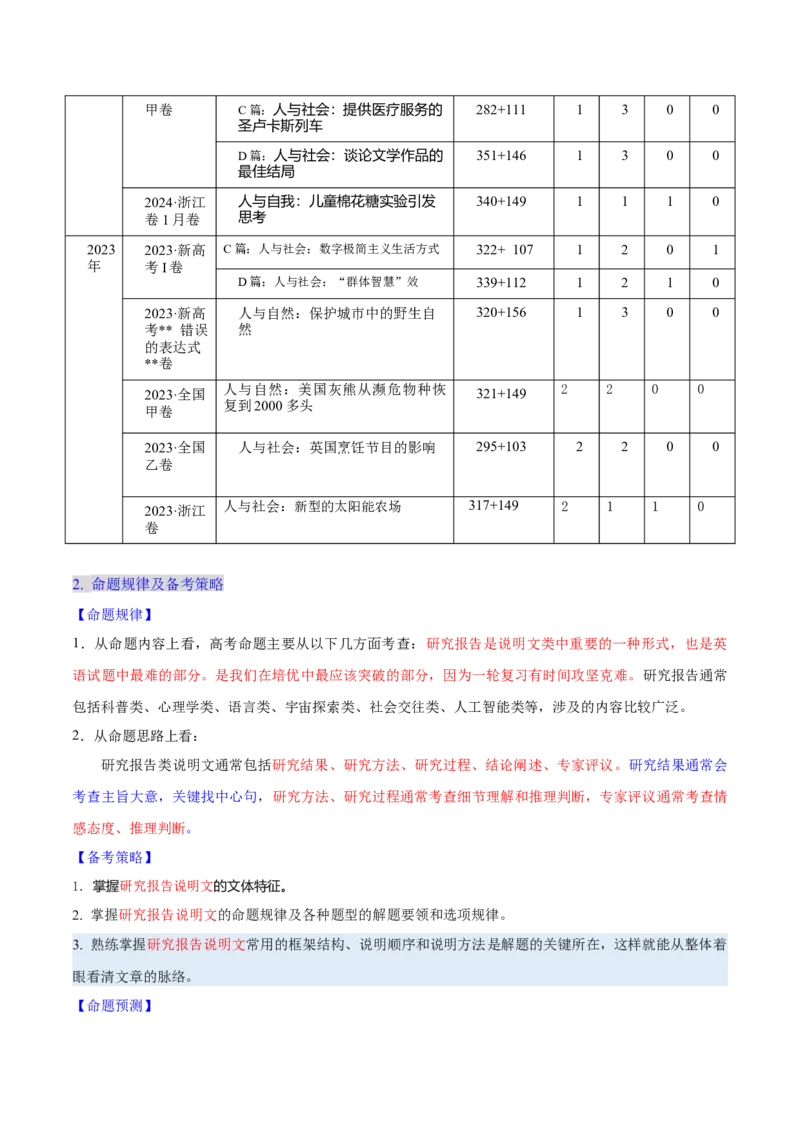
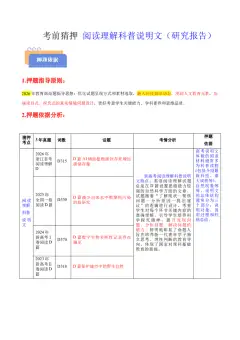
1. 高考真题考点分布
年份
卷次
主题语境
字数
题型分类
细
节
理
解
推
理
判
断
主
旨
大
意
词
义
猜
测
2025
年
2025 全国
一卷
D 减少自来水中微塑料
330+135
2
2
0
0
2025 全国
二卷
D 餐厅创意改造被丢弃食材
334+135
1
2
1
0
C 室内植物利于身心
264+126
2
1
1
0
2025 浙江
1 月卷
C 矩阵式种植方法
299+121
1
1
1
1
2024
年
2024·新高
考I 卷
C 篇:人与社会:纸质阅读与数字
阅读在学习效果上的差异
323+160
1
2
0
1
D 篇:人与自然:现代生物采样数
据的科学性
366+122
1
3
0
0
2024·新高
考II 卷
B 篇:人与社会::旧金山湾区快
速交通引入短篇故事自助服务亭
276+126
2
2
0
0
C 篇:人与社会:巴比伦微农场
272+125
2
1
1
0
D 篇:人与社会:图书《人工智能
设计:与人工智能共生的计划》
321+160
0
3
0
1
2024·全国
B 篇:人与自然:了解猫的行为
312+124
1
1
1
1
甲卷
C 篇:人与社会:提供医疗服务的
圣卢卡斯列车
282+111
1
3
0
0
D 篇:人与社会:谈论文学作品的
最佳结局
351+146
1
3
0
0
2024·浙江
卷1 月卷
人与自我:儿童棉花糖实验引发
思考
340+149
1
1
1
0
2023
年
2023·新高
考I 卷
C 篇:人与社会:数字极简主义生活方式
322+ 107
1
2
0
1
D 篇:人与社会:“群体智慧”效
339+112
1
2
1
0
2023·新高
考** 错误
的表达式
**卷
人与自然:保护城市中的野生自
然
320+156
1
3
0
0
2023·全国
甲卷
人与自然:美国灰熊从濒危物种恢
复到2000 多头
321+149
2
2
0
0
2023·全国
乙卷
人与社会:英国烹饪节目的影响
295+103
2
2
0
0
2023·浙江
卷
人与社会:新型的太阳能农场
 317+149
2
1
1
0
2. 命题规律及备考策略
【命题规律】
1.从命题内容上看,高考命题主要从以下几方面考查:研究报告是说明文类中重要的一种形式,也是英
语试题中最难的部分。是我们在培优中最应该突破的部分,因为一轮复习有时间攻坚克难。研究报告通常
包括科普类、心理学类、语言类、宇宙探索类、社会交往类、人工智能类等,涉及的内容比较广泛。
2.从命题思路上看:
研究报告类说明文通常包括研究结果、研究方法、研究过程、结论阐述、专家评议。研究结果通常会
考查主旨大意,关键找中心句,研究方法、研究过程通常考查细节理解和推理判断,专家评议通常考查情
感态度、推理判断。
【备考策略】
1. 掌握研究报告说明文的文体特征。
2. 掌握研究报告说明文的命题规律及各种题型的解题要领和选项规律。
3. 熟练掌握研究报告说明文常用的框架结构、说明顺序和说明方法是解题的关键所在,这样就能从整体着
眼看清文章的脉络。
【命题预测】
预计2026 年研究报告类说明文仍然是试卷中的难点。预想英语得高分成功突破研究报告是关键。问题
设置主要以细节理解和推理判断为主,多出现态度观点题。
【必备基础知识】
科普研究类文本结构
总的结构:研究的问题,对象,内容----研究的方法,过程---研究的结果,发现
1. 提出问题----(各类观点/背景信息)----实验发现----解决问题
2. 现象----原因----进一步推进----如何做到----进一步推进----总结
3.结论--实验--总结
结论是批旧立新;实验是设立参照组;总结是照应结论和展望未来。
命题点是:结论是什么?实验说明了什么?未来是什么?
干扰项特点:截取关键句或非关键句的部分词汇生造一个逻辑,可以说是无中生有。
考生要注意:即使选项每个词文中都有,也要留意这是命题人可能在用熟悉词来混淆视线。
高考说明文阅读技巧
1. 把握首段/尾段/及段落主题句(段首句)
2. 通过每个段落主题句快速掌握文章结构
3. 把握关键词/并忽略无关紧要的修饰词
4. 耐心分析与解题相关的长难句
说明文阅读方法及解题技巧:
Step 1. 略读。在第一遍通读文章时,明确每段话的主题句,了解段落大意。(阅读过程中标记关键词:
人名、专有名词、表结论/对比/因果等)
Step 2. 梳理段落主题句,掌握文章架构,体会作者写作目的及意图。
Step 3. 做题。仔细阅读题干,判断题目与文章各个段落的相关性,二次精读时将选项代入对应段落,继
而得出答案。
把握说明方法,抓准关键词
 在行文中,为了把事物的本质特征说清楚,或把事理阐述明白,通常会用到下列说明方法:举例子、做
比较、分类别、析因果、列数字、作诠释、打比方、下定义、列图标、引用、假设、对比或类比等。
对应的就会出现一些标志性的用词:find/discover/prove/indicate/state/stress/explain/show/for example/
for instance/define/compare/cause
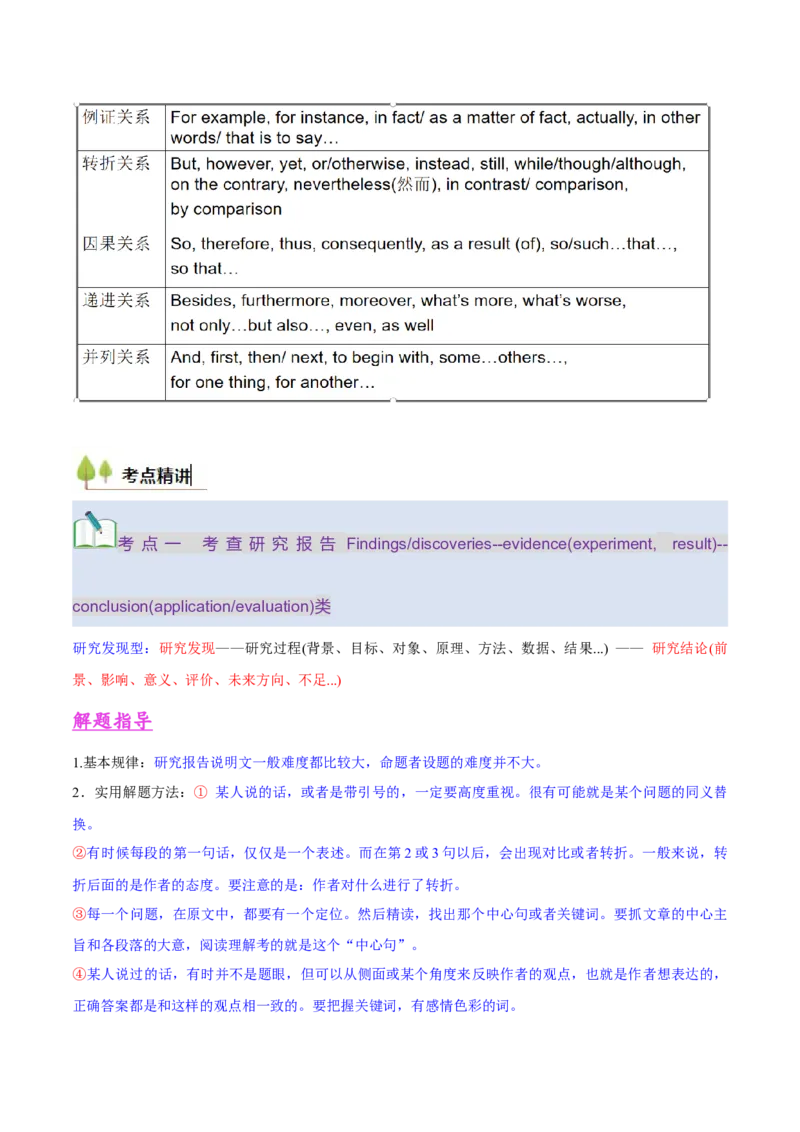
表示上下文逻辑关系的词
考点一 考查研究报告Findings/discoveries--evidence(experiment, result)--
conclusion(application/evaluation)类
研究发现型:研究发现——研究过程(背景、目标、对象、原理、方法、数据、结果...) —— 研究结论(前
景、影响、意义、评价、未来方向、不足...)
解题指导
1.基本规律:研究报告说明文一般难度都比较大,命题者设题的难度并不大。
2.实用解题方法:① 某人说的话,或者是带引号的,一定要高度重视。很有可能就是某个问题的同义替
换。
②有时候每段的第一句话,仅仅是一个表述。而在第2 或3 句以后,会出现对比或者转折。一般来说,转
折后面的是作者的态度。要注意的是:作者对什么进行了转折。
③每一个问题,在原文中,都要有一个定位。然后精读,找出那个中心句或者关键词。要抓文章的中心主
旨和各段落的大意,阅读理解考的就是这个“中心句”。
④某人说过的话,有时并不是题眼,但可以从侧面或某个角度来反映作者的观点,也就是作者想表达的,
正确答案都是和这样的观点相一致的。要把握关键词,有感情色彩的词。
⑤注意中心句(即题眼)和前后句子之间的关系,是接着说的,还是转折关系。要把握和前后句子之间的
关系。是并列关系的,可以从这些句子里找同义词;是转折关系的,就通过转折关系句子里的关键词的相
反意思来判断。
 ⑥注意几个词,yet 表转折,hardly 表否定。while 有时是比较,有时也表转折。比较的时候,注意比较的
对象,要弄清楚。转折的时候,你要知道作者对什么进行了转折。
【2024 新课标Ⅰ卷】In the race to document the species on Earth before they go extinct, researchers and
citizen scientists have collected billions of records. Today, most records of biodiversity are often in the form of
photos, videos, and other digital records. Though they are useful for detecting shifts in the number and variety of
species in an area, a new Stanford study has found that this type of record is not perfect.
 “With the rise of technology it is easy for people to make observations of different species with the aid of a
mobile application,” said Barnabas Daru, who is lead author of the study and assistant professor of biology in the
Stanford School of Humanities and Sciences. “These observations now outnumber the primary data that comes
from physical specimens (标本), and since we are increasingly using observational data to investigate how species
are responding to global change, I wanted to know: Are they usable?”
Using a global dataset of 1.9 billion records of plants, insects, birds, and animals, Daru and his team tested
how well these data represent actual global biodiversity patterns.
“We were particularly interested in exploring the aspects of sampling that tend to bias (使有偏差) data, like
the greater likelihood of a citizen scientist to take a picture of a flowering plant instead of the grass right next to it,”
said Daru.
Their study revealed that the large number of observation-only records did not lead to better global coverage.
Moreover, these data are biased and favor certain regions, time periods, and species. This makes sense because the
people who get observational biodiversity data on mobile devices are often citizen scientists recording their
encounters with species in areas nearby. These data are also biased toward certain species with attractive or eye-
catching features.
What can we do with the imperfect datasets of biodiversity?
“Quite a lot,” Daru explained. “Biodiversity apps can use our study results to inform users of oversampled
areas and lead them to places — and even species — that are not well-sampled. To improve the quality of
observational data, biodiversity apps can also encourage users to have an expert confirm the identification of their
uploaded image.”
【文章的结构分析】
Para1 研究背景
(问题)
most records of biodiversity are often in the form of digital records;not perfect 大多数生物
多样性记录通常以数字记录的形式存在,但并非完美
Para2 研究原因
Observational data,Are they usable?Daru 想知道这种观测数据是否有用。
Para3 过程与方法
Using a global dataset   Daru 和他的团队使用了一个全球数据集进行测试
Para4-5 结论与解
释
the large number of observation-only records are biased and favor certain regions, time
periods, and species.大量的仅观察记录有失偏颇,倾向于于某些地区、时间段和物种。
Para6-8 研究前景
Biodiversity apps;inform users 利用生物多样性应用程序引导用户
32. What do we know about the records of species collected now?
A. They are becoming outdated.
B. They are mostly in electronic form.
C. They are limited in number.
D. They are used for public exhibition.
33. What does Daru’s study focus on?
A. Threatened species.
B. Physical specimens.
C. Observational data.
D. Mobile applications.
34. What has led to the biases according to the study?
A. Mistakes in data analysis.
B. Poor quality of uploaded pictures.
C. Improper way of sampling.
D. Unreliable data collection devices.
35. What is Daru’s suggestion for biodiversity apps?
A. Review data from certain areas.
B. Hire experts to check the records.
C. Confirm the identity of the users.
D. Give guidance to citizen scientists.
(2026·湖北省宜昌市高三上学期九月起点考试)Plastic has become an essential part of modern life,
with around 1 million plastic water bottles sold every minute and 5 trillion plastic bags used worldwide every year,
according to the UN’s Environment Program. Half of all plastic production is designed for single-use purposes, and
the annual output of over 400 million tons is projected to reach 1,100 million tons by 2050. This growing mountain
of waste has intensified public and regulatory demands for improved recycling.
Recycling plastic, however, is complex. Many items are dirty or made from multiple layers, making
traditional methods ineffective. Consequently, over 90% of plastic waste is buried, or deserted in nature. In
response, forward-thinking companies are investing in advanced recycling technologies to turn waste into raw
materials for new plastic. Yet, this approach has caused debates.
One common method, pyrolysis, involves heating plastic waste to produce oil and synthetic gas, which
powers recycling plants. However, the process releases harmful substances, raising concerns about its
environmental impact. Critics argue that, rather than achieving a reduction in carbon emissions (排放), this method
might result in similar or even higher levels of emissions compared to the production of new plastic. Some even
accuse the industry of using advanced recycling as a way to justify continued plastic production. America’s
Environmental Protection Agency has rejected this approach, and European environmental groups share similar
concerns.
Despite these challenges, advanced recycling has potential. For instance, Mura Technology in the UK claims
its hydrothermal process produces more output with lower carbon emissions, while Australia’s Samsara Eco is
developing enzyme-based methods that remove the need for new oil. These advancements could make recycling
more efficient and environmentally friendly, helping to keep plastic in use rather than in landfills (填埋场).
While the debate around advanced recycling continues, progress is underway. Britain recently approved a
version of the mass-balance approach, and many EU member states are leaning towards acceptance. With further
innovation and investment, advanced recycling could play a vital role in addressing the global plastic waste crisis.
12.What do the figures in paragraph 1 indicate?
A.The difficulty of recycling.
B.The severity of plastic waste.
C.The prospect of plastic goods.
D.The popularity of plastic items.
13.Why does advanced recycling meet with criticism?
A.It legalizes plastic production.
B.It produces more plastic waste.
C.It does harm to recycling plants.
D.It risks higher carbon emissions.
14.What can be inferred about the innovations in advanced recycling?
A.They offer an alternative to new oil.
B.They have won popularity in the west.
C.They hold promise for green recycling.
D.They guarantee a solution to plastic waste.
15.What is the author’s attitude towards advanced recycling?
A.Critical.
B.Objective.
C.Doubtful.
D.Supportive.

考点二 Problem--study--analysis--conclusion 类研究报告
理解“问题-研究-分析-结论”(Problem–Study-Analysis–Conclusion)类研究报告文章并有效做题,关
键在于把握文章的结构逻辑、识别关键信息、理解各部分的功能及其相互关系。
(2025 年1 月浙江卷)
As new technologies take on increasingly humanlike qualities, there’s been a push to make them genderless.
“People are stereotyping (形成刻板印象) their gendered objects in very traditional ways,” says Ashley Martin, a
Stanford associate professor of organizational behavior. Removing gender from the picture altogether seems like a
simple way to fix this. Yet as Martin has found in her work, gender is one of the fundamental ways people form
connections with objects, particularly those designed with human characteristics.
In her study, Martin asked participants to rate their attachment to male, female, and genderless versions of a
digital voice assistant and a self-driving car known as “Miuu.” It was found that gender increased users’ feelings
of attachment to these devices and their interest in purchasing them. For example, participants said they would be
less likely to buy a genderless voice assistant than versions with male or female voices.
While gendering a product may be good marketing, it may also strengthen outdated or harmful ideas about
power and identity. The stereotypes commonly associated with men, such as competitiveness and dominance, are
more valued than those associated with women. These qualities, in turn, are mapped onto products that have been
assigned a gender.
Martin’s study also found that creating a genderless object was difficult. For instance, if an object’s name
was meant to sound genderless, like Miuu, participants would still assign a gender to it — they would assume Miuu
was a “he” or “she.”
Martin sees a silver lining, however: She believes that anthropomorphism (拟人化) “provides an opportunity
to change stereotypes.” When women are put into positions of leadership like running companies, it reduces
negative stereotypes about women. Similarly, anthropomorphized products could be created to take on stereotype-
inconsistent roles — a male robot that assists with nursing or a female robot that helps do calculations, for instance.
【文章结构分析】
Para 1——Problem
As new technologies take on increasingly humanlike
qualities, there’s been a push to make them genderless.
随着新技术越来越像人类,人们一直在推动它们变
得无性别。
Para2——finding(研究发现)1
gender increased users’ feelings of attachment to these
devices and their interest in purchasing them.性别增加
了用户对这些设备的依恋感和购买兴趣。
Para 3——Analysis
While gendering a product may be good marketing, it
may also strengthen outdated or harmful ideas about
power and identity.虽然给产品性别化可能是好的营
销,但它也可能强化过时或有害的权力和身份观
念。
Para 4——finding(研究发现)2
 creating a genderless object was difficult 创建无性别
的对象很困难
Para 5——solution
anthropomorphism (拟人化) “provides an opportunity
to change stereotypes.“拟人化”提供了一个改变刻
板印象的机会。
【长难句分析】
1.【原句】Yet as Martin has found in her work, gender is one of the fundamental ways people form connections
with objects, particularly those designed with human characteristics.
【译文】然而,正如马丁在她的工作中发现的那样,性别是人们与物体建立联系的基本方式之一,尤其是
那些具有人类特征的设计。
【句子结构分析】as Martin has found in her work 是非限制性定语从句,people form connections with
objects...是定语从句,修饰先行词ways。designed with human characteristics 是过去分词短语作定语。
2.【原句】Similarly, anthropomorphized products could be created to take on stereotype-inconsistent roles — a
male robot that assists with nursing or a female robot that helps do calculations, for instance.
【译文】类似地,人类化的产品也可以被创造出来承担与刻板印象不一致的角色——例如,一个男性机器
人帮助哺乳,或一个女性机器人帮助计算。
【句子结构分析】破折号后是同位语,同位语由并列连词or 连接,that assists with nursing 和 that helps do
calculations 是定语从句。
32.What is the purpose of making new technologies genderless?
A.To reduce stereotypes.
B.To meet public demand.
C.To cut production costs.
D.To encourage competition.
33.What were the participants probably asked to do in the study?
A.Design a product.
B.Respond to a survey.
C.Work as assistants.
D.Take a language test.
34.Why is it difficult to create genderless objects?
A.They cannot be mass-produced.
B.Naming them is a challenging task.
C.People assume they are unreliable.
D.Gender is rooted in people’s mind.
35.What does the last paragraph mainly talk about?
A.The quality of genderless products.
B.The upside of gendering a product.
C.The meaning of anthropomorphism.
D.The stereotypes of men and women.
(2026·浙江省嘉兴市高三上学期9 月月考)Throughout history, trees have played a crucial role in
maintaining ecological balance. They absorb CO2 and transform it into oxygen. But one of the challenges with this
traditional carbon absorption is that the CO2 trees store can be released back into the atmosphere when they die.
However, the discovery of certain trees in Kenya adds a new dimension to this natural process. These trees,
also found in several other countries, have been observed to transform CO2 into calcium oxalate. Then bacteria (细
菌) present in the trees and surrounding soil transform it further into calcium carbonate ( 碳酸钙), a primary
component of limestone and chalk. The unique process ensures that the CO2 is kept in solid form for much longer,
even after the tree’s life ends. This finding was emphasized by Mike Rowley from the University of Zurich at the
Goldschmidt Conference.
While the scientific community is optimistic about these findings, several challenges remain. The primary
concern is determining the exact amount of CO2 that these trees can transform throughout their lifetime. Without
this accurate data, it is challenging to assess the full impact of this method globally. Understanding the ecological
balance and ensuring the preservation of biodiversity are crucial before worldwide planting of these trees.
Cooperative research efforts are needed to explore these aspects and develop a comprehensive strategy for using
these trees as a natural solution to climate change.
This discovery in Kenya invites us to reconsider the potential of natural processes in addressing
environmental challenges. While technological solutions to climate change are vital, integrating natural methods
offers an alternative approach. The unique ability of these trees presents a promising method for exploration.
The journey to fighting climate change is complex. As we dig deeper into understanding natural phenomena
like the Kenyan trees, we must ask ourselves: How can we make the best of the power of nature to create a
sustainable future for generations to come?
32.What is special about the trees found in Kenya?
A.They absorb more CO2.
B.They help turn CO2 into solids.
C.They release oxygen quickly.
D.They live in harmony with bacteria.
33.What is the core challenge before applying the discovery globally?
A.Assessing the cost of the process.
B.Understanding the impact on soil.
C.Quantifying the CO2 transformation.
D.Collecting the data on biodiversity.
34.What does the author try to explore in the last two paragraphs?
A.The seriousness of climate change.
B.The method of green development.
C.The prospect of scientific approaches.
D.The role of nature in climate solutions.
35.What can be a suitable title for the text?
A.A defensive Strategy in Nature
B.A Recent Advance in CO2 Research
C.Kenyan Trees: A Natural Carbon Lock
D.Tree Planting: A Key to Ecological Balance

考点三 Phenomenon--analysis--conclusion 类研究报告
理解“现象-分析-结论”(Phenomenon–Analysis–Conclusion)类研究报告文章并有效做题,关键在于把握文
章的结构逻辑、识别关键信息、理解各部分的功能及其相互关系。
【2025·全国I 卷】D
Does your soul die a little every time you throw away unused food? Mine does. Maybe that feeling comes
from growing up in South Africa, where the phrase “there are children starving in Africa” was more of an
uncomfortable reminder of fact than a prayer at dinner time.
Food waste is a growing concern in the restaurant, supermarket, and supply chain industries. From
technological solutions to educational campaigns, food producers and sellers are looking for ways to use more of
what we’re already growing. But last month, one popular New York City restaurant tried a different way: It
changed its menu to exclusively (专门) offer food that would otherwise be thrown away.
For two weeks in March, Greenwich Village’s Blue Hill restaurant was renamed wastED, and served items
like fried skate cartilage, a juice pulp burger, and a dumpster diver’s vegetable salad. Each dish was tailor-made to
raise awareness regarding food waste.
A study by the Food Waste Alliance determined that the average restaurant generates 33 pounds of food waste
for every $1,000 in revenue (收入), and of that waste only 15.7% is donated or recycled. Up to 84.3% is simply
thrown out. Restaurants like Silo in the UK have experimented with zero-waste systems, but wastED took the
concept to its logical conclusion.
It should be noted that none of the items on wastED’s menu was technically made from garbage. Instead, all
the ingredients (配料) used were examples of meat cuts and produce that most restaurants would never consider
serving. Things like kale ribs, fish collars, rejected sweet potatoes, and cucumber butts were all re-appropriated and,
with the help of a number of good chefs, turned into excellent cuisine.
Though wastED received enthusiastic reviews, it was designed from the start as a short-lived experiment; Blue
Hill has since returned to its regular menu. Nevertheless, it serves as a reminder that there are many ways to address
problems of sustainability, and that you can make an amazing meal out of almost anything.
【文章结构分析】
Para 1——feeling(感受)
your soul die a little every time you throw away unused
food(浪费食物的感受)
Para2——solution(方法)1
 one popular New York City restaurant tried a different
way: It changed its menu to exclusively (专门) offer
food that would otherwise be thrown away.纽约一家很
受欢迎的餐厅尝试了一种不同的方式:它改变了菜
单,只提供本来会被扔掉的食物。
Para 3-5 ——solution(方法)2
wastED solved the problem successfully wastED 成
功解决了这个问题
Para 6——evaluation
 creating a genderless object was difficult 创建无性别
的对象很困难
12. What can be inferred about the author’s early life?
A. He witnessed food shortage.
B. He enjoyed the local cuisine.
C. He donated food to Africans.
D. He helped to cook at home.
13. Why did Blue Hill carry out the experiment?
A. To customize dishes for guests.
B. To make the public aware of food waste.
C. To test a food processing method.
D. To improve the UK’s zero-waste systems.
14. What is paragraph 5 mainly about?
A. Why the ingredients were used.
B. Which dishes were best liked.
C. What the dishes were made of.
D. Where the ingredients were bought.
15. What can we learn about wastED?
A. It has ended as planned.
B. It is creating new jobs.
C. It has regained popularity.
D. It is criticized by top chefs.
(2026·黑龙江省龙东联盟高三上学期开学考试)For decades, scientists have identified chronic low-
level inflammation (炎症) — called “inflammaging” — as one of the primary drivers of age-related diseases. Think
of it as your body’s immune system stuck in overdrive — constantly fighting battles that don’t exist, gradually
wearing down organs and systems. But a new study challenges that idea and could reshape how we think about
aging itself.
The research, published in Nature Aging, compared patterns of inflammation in four very different
communities around the world. Two groups were from modern, industrialised societies — older adults living in
Italy and Singapore. The other two were pristine communities who live more traditional lifestyles: the Tsimane
people of the Bolivian Amazon and the Orang Asli in the forests of Malaysia.
The researchers analysed blood samples from more than 2,800 people, looking at a wide range of
inflammatory molecules ( 分子), known as cytokines. Among the Italian and Singaporean participants, the
researchers found a fairly consistent inflammaging pattern. As people aged, levels of inflammatory markers in the
blood rose together. Higher levels were linked to a greater risk of chronic diseases including kidney disease and
heart disease. But in the Tsimane and Orang Asli populations, the inflammaging pattern was absent. The same
inflammatory molecules did not rise consistently with age, and they were not strongly linked to age-related
diseases. In fact, among the Tsimane, who face high rates of microorganism infections, inflammation levels were
often high. Yet this did not lead to the same rates of chronic diseases that are common in industrialised nations.
These results raise important questions. One possibility is that inflammaging, at least as measured through
these blood signals, is not a universal biological feature of aging. Instead, it may arise in societies marked by high-
calorie diets, low physical activity and reduced exposure to infections.
In other words, chronic inflammation linked to aging and disease might not simply result from an inevitable
biological process, but rather from a mismatch between our ancient physiology and the modern environment. If
these findings are confirmed, they could have some significant consequences.
32.How is inflammaging related to aging in the established scientific view?
A.It attacks human organs.
B.It causes the inactivity of organs.
C.It generates overactive immune response.
D.It lowers the efficiency of immune system.
33.What does the word “pristine” in paragraph 2 probably mean?
A.Unspoiled.
B.Unwelcoming.
C.Unsafe.
D.Unlivable.
34.What has the study found about the Tsimane and Orang Asli people?
A.They seldom develop chronic diseases.
B.Their blood lacks inflammatory markers.
C.They rarely get exposed to sources of infection.
D.Their inflammation levels are independent of aging.
35.What does the new study suggest?
A.Inflammaging is a signal of aging.
B.Inflammaging is biologically unavoidable.
C.Repeated infections hold back inflammaging.
D.Modern lifestyle contributes to inflammaging.
、
(最新模拟试题演练)
1.(2026·浙江省Z20 名校联盟高三上学期第一次联考)AI Radiology: Faster, Smarter, and More Accurate
Hospital waiting time for scan results could soon be reduced from days to minutes. A 2025 Stanford study
reveals that DeepMedScan, an AI system analyzing CT/MRI images, detects tumors 30% faster than human
radiologists (放射科医生) while matching top experts’ 98% accuracy. The system is now used in 40+ EU hospitals,
reducing diagnosis delays by up to 80%.
The breakthrough lies in 3D neural mapping. Unlike traditional AI recognizing 2D patterns, DeepMedScan
constructs dynamic 3D models of organs: It cross-references scans with global databases — processing 200,000+
historical cases in 0.2 seconds. “It’s like giving each radiologist a super-powered second brain,” explains lead
researcher Dr. Aris Thorne.
Critical advantages include identifying micro-lesions under 2 mm — often missed by human eyes — and
predicting disease progression. In German trials, the AI detected early-stage pancreatic cancer in 83% of high-risk
patients a year before symptoms emerged, enabling life-saving interventions.
Challenges persist, however, Legal frameworks struggle with responsibility for AI misdiagnosis (occurring
in 0.7% of cases vs. human 1.2%). Inaccuracy risks also exist; early versions performed poorly on pediatric ( 小儿
科的) scans due to limited child data. Regulatory authorities now enforce “human-AI co-diagnosis” — requiring
doctor confirmation for critical cases.
Future upgrades focus on accessibility. Lightweight versions for rural clinics are being tested in India, using
smartphone-compatible calculation procedure. As WHO advisor Dr. Priya Sharma notes, “Making this tech widely
accessible could prevent 500,000+ annual late-stage cancer deaths globally by 2030.”
32.How does the article present the issue in the first paragraph?
A.By quoting an expert.
B.By defining a concept.
C.By providing statistics.
D.By presenting classifications.
33.What does the author highlight with super-powered second brain?
A.Replacing radiologists with automated systems.
B.Emphasizing its ultra-fast data processing capacity.
C.Demonstrating its superiority over human intelligence.
D.Promoting commercial sales of medical equipment.
34.What does the author intend to convey in paragraph 4?
A.The potential of AI diagnosis.
B.The inaccuracy of AI diagnosis.
C.The dominance of authorities in AI diagnosis.
D.The necessity of human participation in AI diagnosis.
35.What can be inferred about AI radiology’s future development?
A.It will replace doctors.
B.It can work with smart phones.
C.It can reach people in far-off areas.
D.It can avoid late-stage cancer deaths completely.
2.(2026·湖北省高中名校联盟高三上学期第一次联合测评)The newest, hottest power couple doesn’t
live in Hollywood. It’s actually the marriage of solar panels and reservoirs (水库): Known as floatovoltaics, these
devices on simple floats (浮体) generate power while shading the water below.
The primary advantage of the technology is that no trees need to be cleared for solar farms. As an added
bonus, the water cools the panels, increasing their efficiency. Research shows that floatovoltaics on just a small
share of global lakes and reservoirs could meet nearly a third of the US’s annual electricity demand.
As floatovoltaic systems expand, with the market expected to grow 23% annually from 2025 to 2030,
scientists are studying their impact on ecosystems. “We shouldn’t be expanding clean energy at the cost of
biodiversity loss,” warns Elisa Stephens, a researcher at the University of California, Davis. “This is a great
opportunity to increase our research and develop smart designs and better siting practices to have this happy
marriage between a healthy, biodiverse ecosystem and renewable energy expansion.”
Most floatovoltaics are placed on reservoirs. When paired with the existing water power plants, the panels
can generate additional daytime power. This combination can make up for seasonal drops in water or sunlight,
ensuring a more stable yearly output.
Though artificial, reservoirs host lots of water life that floatovoltaics can interact with. Would this bring risks
or benefits? “Our customers have seen migrating (迁徙的) birds feeding and resting on the floats,” reports Chris
Bachman of a leading floatovoltaics company.
Ecological considerations get trickier where there are unforeseen knock-on effects. Experiments show that
shading from panels can slow the growth of algae that fish eat and also reduce harmful algae, affecting the food
chain. Floats can hide fish from birds that hunt them but may also serve as safe habitats for these birds. “We need to
monitor for long periods to understand the big picture,” says freshwater ecologist Simpson Cardoso.
Scientists and companies are discussing wider spacing between panels and avoiding construction during
waterbirds’ sensitive periods, such as migration and nesting. “There can definitely be that kind of ecological
balance,” says Stephens.
32.How does the author introduce floatovoltaics?
A.By giving a technical definition.
B.By explaining how they work.
C.By relating them to a married couple.
D.By describing a popular movie scene.
33.What is scientists’ major concern about floatovoltaics?
A.Their influence on ecosystems and biodiversity.
B.Their seasonal changes in power output.
C.Their high cost of construction and maintenance.
D.Their competition against traditional solar farms.
34.Why does the author quote Chris Bachman in paragraph 5?
A.To provide evidence of customer satisfaction. B.To show a potential benefit of floatovoltaics.
C.To note the complexity of ecological interactions. D.To draw attention to protecting migrating birds.
35.What are scientists focusing on?
A.Conducting the application of wider panels.
B.Developing smarter designs and practices.
C.Proving the existence of ecological balance.
D.Avoiding constructions on waterbird habitats.
3.(2026·湖北省武汉市九师联盟高三上学期8 月开学)Jade Benjamin-Chung, an assistant professor at
the Stanford School of Medicine, worked with her coworkers to analyze the impact of hygiene (卫生) interventions
on health outcomes in middle — and low-income Bangladeshi households. They found many common strategies
used to protect children from disease weren’t as effective as expected. Feeling curious, Benjamin-Chung and her
coworkers identified a potential reason.
Around 70% of rural homes in Bangladesh have soil-packed floors. As young kids eat and play on the floor,
they often absorb tiny soil-based parasites (寄生虫) that spread disease. So they thought about the concrete floors,
which could create a space easier to clean and reduce pathogen (病原体) spread.
Benjamin-Chung mentioned their idea to Sarah Billington, an expert on concrete and building materials from
the Stanford Doerr School of Sustainability. When Billington heard the team’s idea of broadly replacing soil-packed
floors with concrete, she worried the approach could have unintended consequences for the climate due to heavy
carbon emissions (排放) from concrete production.
So Billington invited other Stanford experts into the fold to understand why concrete was effective in
reducing pathogen spread and design low-emission concrete alternatives that kept those helpful properties. They
wanted to develop a mix using materials that’ re easily found in countries like Bangladesh. Finally, one possible
material was recycled fly ash, a byproduct of burning coal. The concrete mix was affordable, durable and produced
fewer emissions. Then they did an experiment where they hardened concrete test tiles (砖) made with alternative
“green” concrete and then some pathogens were put into the tiles to measure how well they survived on the surface.
The team’s findings suggest the pathogens have similar rates of survival on traditional concrete mix tiles and
“green” alternative fly ash tiles. “This project could be a model for how to improve public health with sustainability
baked in at the beginning,” said Benjamin-Chung.
32.What did Benjamin-Chung and her coworkers focus on initially?
A.The bad influences of concrete.
B.Disease spread in the neighborhood.
C.Hygiene practices in specific families.
D.Recycling methods of fly ash.
33.What made Billington invite other experts in?
A.Her lack of knowledge of pollution.
B.Her worries about health outcomes.
C.Her struggle with pathogen resistance.
D.Her concern about climate impacts.
34.What can we infer from the last paragraph?
A.The alternative is effective at reducing disease spread.
B.Traditional concrete does more harm to people’s health.
C.The study helps reduce the cost of healthcare in Bangladesh.
D.The study offers good educational resources to medical schools.
35.What could be a suitable title for the text?
A.Strategies for Bangladeshi Public Health B.Sustainable Concrete for Healthier Homes
C.Hygiene Interventions in Low-income Homes D.Pathogens Spread through Building Materials
4.(2026·湘豫名校高三上学期入学摸底)The gravitational pull of Mars may be strong enough to stir (搅
动) up Earth’s ocean, shifting its sediment (沉淀物) as part of a 2.4-million-year climate cycle, researchers claim.
It has long been accepted that shifts in Earth’s orbit around the sun influence the planet's climate, with these
Milankovitch cycles operating on periods measured in thousands of years. Now, Adriana Dutkiewicz at the
University of Sydney and her teammates say they have found a 2.4-million-year “Grand Cycle”, which they believe
is driven by Mars and has had dramatic impacts on currents in Earth’s oceans for at least 40 million years.
The evidence for this cycle comes from almost 300 deep-sea drill cores that reveal unexpected variation in
the ocean sediment. During periods of stable ocean currents, oceanographers expect sediment to settle in steady
layers, but unusual currents can see it stored elsewhere.
According to the team, absences or interruptions in the sediment record line up with times when Mars’s
gravity puts maximum force on Earth, impacting our planet’s orbital stability. This changes solar radiation levels
and climate, resulting in stronger currents in the oceans.
Team member Dietmar Müller, also at the University of Sydney, acknowledges that the distance between
Earth and Mars is so vast that it is hard to imagine any significant gravitational force being produced. “But there are
so many feedbacks that can reflect changes,” he says. “Mars’s impact on Earth’s climate is similar to a butterfly
effect.”
Benjamin Mills at the University of Leeds, UK, says the drill cores provide more evidence for the existence
of global environmental change.
“Many of us have seen these multi-million-year cycles in various different geological, geochemical and
biological records — including during the famous explosion of animal life in the Cambrian Period,” he says. “This
paper helps confirm these ideas as key parts of environmental change.”
12.What evidence supports the 2.4-million-year cycle?
A.Changes in Earth’s orbit.
B.Variation in ocean sediment.
C.Records of solar radiation.
D.Impact on Earth’s gravity.
13.What can we infer about Mars’s gravity?
A.It directly controls Earth’s climate.
B.It has no influence on Earth’s orbit.
C.It slightly weakens Earth’s ocean currents.
D.Its effect on Earth is indirect but significant.
14.What is Dietmar Müller’s attitude towards the research?
A.Doubtful.
B.Supportive.
C.Negative.
D.Uncaring.
15.Why does Benjamin Mills mention the Cambrian Period?
A.To question the new finding.
B.To introduce a new theory.
C.To show the cycle’s long history.
D.To explain the butterfly effect.
5.(2026·辽宁名校联盟高三上学期8 月联考)Chinese scientists have made a significant breakthrough in
producing hydrogen from water using light. They added scandium (钪) to titanium dioxide (二氧化钛, TiO₂) to
create a new TiO₂ structure. This innovation increases hydrogen production efficiency 15 times under sunlight
compared to previous TiO₂ materials.
The new performance of photocatalys, which is a chemical reaction that is accelerated by the absorption of
light by a catalyst (催化剂) is due to 5% scandium doping. This creates TiO₂ particles with two crystal facets (面):
{101} and {110}. The {101} facet collects electrons, while the {110} facet receives holes. This arrangement
produces a strong electric field within the TiO₂ particles, enhancing charge transport efficiency. As a result, the
photoinduced (光诱导的) charge separation efficiency has improved over 200 times, and the quantum efficiency
for ultraviolet light at 360 nm has exceeded 30%.
Compared to traditional solar hydrogen production methods like photovoltaic-powered electrolysis, this new
approach is simpler and more cost-effective. Traditional methods require complex and expensive equipment, while
TiO₂-based photocatalysts offer a more straightforward alternative. However, TiO₂ has a problem: photoexcited
electrons and holes reunite quickly, reducing efficiency. The scandium-doped TiO₂ solves this problem in two ways:
1. Eliminating Charge Traps: Sc³⁺ ions fit well into the TiO₂ structure without causing distortion. Their stable
+3 charge neutralizes the imbalance caused by oxygen vacancies, reducing electron-hole recombination.
2. Reconstructing the Crystal Surface: Scandium atoms rearrange the crystal surface to form specific facets,
giving electrons and holes more time and space to participate in reactions.
If made into a 100 m² photocatalytic panel, this material could generate enough hydrogen in one day to
power a hydrogen fuel cell vehicle to travel about 68 kilometers. China has the world’s largest TiO₂ production
capacity and significant scandium reserves, so this discovery could facilitate the large-scale industrial application of
photocatalytic water splitting technology. It offers a promising way for more efficient and economical hydrogen
production, which is crucial for transitioning to sustainable and carbon-neutral energy systems.
This advancement highlights the potential of rare-earth elements in improving photocatalytic materials. As
the world seeks ways to reduce carbon emissions and combat climate change, this scandium-doped TiO₂
photocatalyst provides hope. It could accelerate the adoption of hydrogen as a clean energy carrier and support the
development of hydrogen-powered technologies across various industries.
In summary, this new scandium-doped TiO₂ photocatalyst is a major step forward in renewable energy. Its
impressive performance and potential for widespread application bring us closer to a future where clean,
sustainable hydrogen energy is both abundant and economically feasible. This breakthrough is expected to inspire
further research and innovation in the design of advanced photocatalytic materials, driving the world closer to a
carbon-neutral and sustainable energy future.
12.What fundamental innovation enables the dramatic improvement in hydrogen production efficiency?
A.Substituting rare-earth elements for traditional catalysts.
B.Optimizing catalyst structure through elemental integration.
C.Developing ultra-thin semiconductor membrane layers.
D.Implementing multi-stage photovoltaic conversion systems.
13.Which dual mechanism addresses the rapid recombination of electrons and holes?
A.Neutralizing ionic imbalances and restructuring reactive pathways.
B.Enhancing photon absorption and extending wavelength ranges.
C.Introducing magnetic fields and cooling thermal byproducts.
D.Isolating oxygen molecules and pressurizing reaction chambers.
14.Considering China’s industrial context, which factor would most critically determine the scalability of this
technology?
A.Global market demand for hydrogen vehicles.
B.Availability of specialized manufacturing equipment.
C.Domestic mineral resource distribution patterns.
D.International carbon emission regulations.
15.A renewable energy startup plans to pilot this technology. Which implementation challenge aligns with the
statement “photoexcited electrons and holes reunite quickly”  (para. 3)?
A.Maintaining stable light intensity across large surface areas.
B.Preventing premature energy loss during charge migration.
C.Scaling up ultraviolet light filtration systems.
D.Balancing production costs with catalyst durability.
6.(2026·湖南省长沙市湖南师范大学附属中学高三上学期8 月月考)Writing and editing working
messages with tools like ChatGPT or Gemini has become a commonplace practice. While generative AI tools are
seen to make writing easier, are they effective for communicating between managers and employees?
“We see a tension between perceptions of message quality and perceptions of the sender,” said Anthony
Coman, a researcher at the University of Florida. “Despite positive impressions of professionalism in AI-assisted
writing, managers who use AI for routine communication tasks put their trustworthiness at risk when using
medium-to -high-levels of AI assistance.” In this study, Coman and his co-author, Peter Cardon, surveyed
professionals about how they viewed emails that they were told were written with low, medium and high AI
assistance. Survey participants were asked to evaluate different AI-written versions of a congratulatory message on
both their perception of the message content and their perception of the sender.
While AI-assisted writing was generally seen as efficient, effective, and professional, the impact on trust was
substantial: Only 40% to 52% of employees viewed supervisors as sincere when they used high levels of AI,
compared to 83% for low-assistance messages. Similarly, while 95% found low-AI supervisor messages
professional, this dropped to 69%-73% when supervisors relied heavily on AI tools.
The findings reveal employees can often detect AI-generated content and interpret its use as lack of caring.
When supervisors rely heavily on AI for messages like team congratulations, employees perceive them as less
sincere and question their leadership abilities. “In some cases, AI-assisted writing can undermine perceptions of
traits linked to a supervisor’s trustworthiness,” Coman noted.
The study suggests managers should carefully consider message types, level of AI assistance and relational
context before using AI in their writing. While AI may be appropriately received for informational or routine
communications, like meeting reminders, relationship-oriented messages requiring empathy, praise or personal
feedback are better handled with minimal technological intervention.
12.What is the focus of Coman’s research?
A.The technical complexity of generative AI tools.
B.The AI-written message quality and credibility conflict.
C.The controversy over AI’s role in employee motivation.
D.The rapid decline of human writing skills in workplaces.
13.Why do employees distrust the high-AI messages?
A.The messages tend to be less informative.
B.Employees feel AI lacks emotional intelligence.
C.There are uncontrollable technical errors in the messages.
D.Employees spot supervisors’ inattention from the messages.
14.What practical guideline does the research suggest?
A.Prohibit AI in all working communications.
B.Match AI usage to message types and context.
C.Prioritize AI for relationship-oriented messages.
D.Train employees to accept AI-generated content.
15.What is the author’s attitude toward AI-assisted writing in the workplace?
A.Cautious.
B.Suspicious.
C.Opposed.
D.Approving.
7.(2026·湖南省长沙市麓山国际实验学校高三上学期入学考试)The ability to detect a nearby presence
without seeing or touching it may sound fantastical — but it’s a real ability that some creatures have. A family of
African fish known as Mormyrids are weakly electric, and have special organs that can locate a nearby target, even
when it’s hiding in the mud. Scientists have now developed an artificial sensor system modelled on the ability of
these fish.
“We developed a new strategy for 3D motion positioning by electronic skin, bio-inspired by ‘electric fish’,”
says Dr. Xinge Yu, an associate professor in the Department of Biomedical Engineering at the City University of
Hong Kong. The team described their e-skin sensor in a paper published on November 14 in Nature.
The artificial sensor is multi-layered. One layer acts as a transmitter ( 发射器), which will generate an
electric field once activated, and another layer acts as a receiver to detect both the direction and the distance to an
object. A separate controller creates the driving signal to activate the transmitter. When an object comes within
range, the electric field around the sensor is disrupted (扰乱), which in turn can be detected by the receiver. This
data is then processed by a microcontroller unit, which computes the position of the target object and sends that
information to a smartphone or other devices.
A special biogel (生物凝胶) is used in the sensor, which has the ability to transmit and receive electric
signals from a pattern of microchannels on the surface. The end result is a sensor that is thin, soft and flexible,
making it cosy to adapt to irregular surfaces, such as the human body. In contrast to the traditional sensor system
that needs a large number of sensors to achieve spatial positioning, the new system can locate an object precisely in
3D space using just a few sensors. This significantly reduces the power consumption of data collection,
transmission, and processing.
The researchers hope that this sensor could one day open up a new range of wearable technologies, including
sensors for human-machine interaction and thin, flexible e-skin.
12.The first paragraph aims to show __________.
A.the special ability of African fish
B.the inspiration for a new invention
C.the big challenge of locating objects
D.the reason for developing a sensor
13.What is the correct order of the system’s working procedures?
a. The transmitter creates an electric field.
b. A unit computes the position of the target.
c. The controller sends the activating signal.
d. The receiver detects the change of electric signals.
e. The electric field is disrupted by an approaching object.
A.c-a-e-d-b.
B.c-a-d-e-b.
C.a-c-e-d-b.
D.a-e-c-d-b.
14.What is an advantage of the new sensor system?
A.Its sensitivity to different stimulations.
B.Its adaptation to environmental changes.
C.Its efficiency in achieving 3D positioning.
D.Its speed in data collection and processing.
15.What is the best title for the text?
A.Machine Detective “Wears” Flexible E-skin
B.Bio-inspired Sensor “Feels” Without Touching
C.E-Skin Sensor: The Future of Machine Learning
D.Electric Fields: The Frontier of Object Detection
1.(2026·湖北省孝感高级中学高三上学期8 月测试)People have been using OpenAI’s GPT-4o to
generate Ghibli-style illustrations, landscapes, portraits and even events from history and current affairs. While it
may seem entertaining, it could be a key test for copyright (版权) 。
Unlike with some previous AI controversies, the company is not promising to add new controls to stop its
generator from ripping off (窃取) an artistic style or to stop people from using controversial subjects. OpenAI CEO
Sam Altman’s only concern seems to be the stress it’s putting on the company’s GPUs as the number of weekly
active users rose by 11%. “It’s super fun seeing people love images in ChatGPT... But our GPUs are melting,” he
wrote.
Like some other companies, OpenAI applied restrictions in previous versions of its AI image generators to
prevent imitations of the styles of living artists or the portraits of real people. but GPT-4o’s ability to clearly imitate
the Ghibli style would appear to suggest OpenAI has cast such measures aside.
In a technical paper, OpenAI claims that it’s still taking a “conservative approach” to image rights by
including a refusal that activates “when a user attempts to generate an image in the style of a living artist”. But it
seems it’s now only applying that to individual artists, not studios. So while GPT-4o should, in theory, refuse to
generate an image if the prompt (提示词) asks for the style of Hiyao Mayazaki, it will accept a prompt that asks for
the style of Studio Ghibli.
The change is curious given that companies can also own copyright, and they’re more likely to have the
resources to be able to take legal action. It may be that OpenAI believes that it would be more difficult for a studio
to prove ownership over a style. Legal experts argue that a “style” cannot be copyrighted, so the question is
whether GPT-4o images use elements of existing works of art.
OpenAI now has license arrangements with some companies to allow it to use their content to train its AI
models. There has been no statement from either OpenAI or Studio Ghibli about whether this is the case.
12.What is Sam Altman’s worry about GPT-4o?
A.Its impact on copyright issues.
B.Its GPU pressure from user growth.
C.Its inability to control the art imitation. D.Its failure to block controversial topics.
13.What restriction does GPT-4o apply to images?
A.It forbids copying studio styles.
B.It bans imitating specific living artists.
C.It limits the number of images per day.
D.It prevents the artworks of real people.
14.Why is GPT-4o’s generation of Ghibli-style images allowed?
A.Studio Ghibli can hardly prove its copyright.
B.OpenAI has agreements with Studio Ghibli.
C.Ghibli-style images boost user engagement.
D.Studio Ghibli doesn’t take any legal action.
15.What is the passage mainly about?
A.GPT-4o raises art copyright issues.
B.OpenAI faces tech challenges with GPT-4o.
C.OpenAI removes all restrictions on AI imagery.
D.AI-generated art is dominating the artistic world.
2.(2026·福建省厦门双十中学高三上学期开学)The concept of dynamic pricing is simple—and easy for
businesses to implement. Whether it’ s a Friday-evening fight, a hotel during the holidays, or a taxi ride in a
downpour, we have all been burned by higher-than-normal prices due to excess demand. Raising costs when
businesses are busiest is the norm across the travel industry. Perhaps the most well-known example of this is within
ride-share companies, which have used surge pricing for years to charge riders when demand for cars rockets
relative to the number of drivers available.
Outside travel, online stores are increasingly using this dynamic pricing, too, says Vomberg. “On Amazon.
com alone, millions of price changes occur within a day, corresponding to a price change of about every ten
minutes for each product. ”While consumers might not always pick up on these variations in price, Vomberg says
time-based dynamic pricing will likely become a competitive standard at least in online markets. “AI-enabled tools
can suggest the best prices via machine learning algorithms(算法). They can also track and learn competitor and
customer responses to price changes,” he says.
Now, surge pricing is happening in stores including bars and supermarkets as well. “Physical businesses are
adopting electronic shelf labels that enable real time price adjustment depending on the time of day, stock levels
and whether items are approaching their sell-by date,” says Sarwar Khawaja, chairman of the Oxford Education
Group. He says this technology is likely to cause prices in bars that use these signs to increase during the rushes of
dinner,weekends or holidays,or for supermarkets to adjust prices throughout the day or week,depending on volume
of shoppers.
The current economic climate is also driving the need for these pricing technologies. While creating
competitive prices is always key to healthy profit margins, Khawaia says dynamic pricing enables businesses to
optimise their pricing depending on the financial situations of their customer base. “Businesses can offer discounts
during downturns while increasing prices in better off areas,” he says.
The changes, however, may not sit well with consumers. “Dynamic and surge pricing will likely expand to
more industries and more companies in the long term, but just because a product may be popular does not mean
that customers are willing to turn a blind eye to being charged more,” says Khawaja. He adds surge pricing can
cause customers to lose faith in a company if they believe they are being overcharged. “Perhaps dynamic pricing of
a drink in your favourite pub might be a step too far for loyal customers.”
12.Which of the following best explains “dynamic pricing” in paragraph 1?
A.A system of deciding what the prices should be.
B.A means for companies to find target customers.
C.A method that helps promote sharing economy
D.A strategy of offering discounts to attract clients.
13.It can be inferred from Arnd Vomberg’s comments that online stores ________.
A.offer the most competitive prices
B.make profits by changing prices in real time
C.confuse customers by changing prices
D.rely too much on machine learning algorithms
14.According to the passage, why do physical businesses adopt dynamic pricing?
A.To match supply and demand during peak hours.
B.To lift customer experience and encourage loyalty.
C.To maintain consistent pricing across all products.
D.To compete with online stores and businesses.
15.Which of the following best predicts how customers may react to the expansion of dynamic pricing?
A.Turn to whatever offers the lowest prices.
B.Protest against it for being too annoying.
C.Refuse to give in and are likely to resist.
D.Take it for granted and accept it altogether.
3.(2027·福建省(全国名校联盟)高三上学期开学摸底联考)A research team from AMOLF in
Amsterdam has created a soft robot that walks, jumps, and swims — all without a brain, electronics, or AI. As
described in the study published in Science, it has no computer, no software, and no sensors. And still, it moves
with surprising autonomy and speed, simply because of its body and how it interacts with the world.
So, what’s really driving it? Underneath the movement is a principle you’ve probably seen, though you
might have overlooked. Think of those shaky, air-filled tube dancers swinging freely around in front of gas stations.
The same physics that makes them move could hold the key to the next generation of autonomous robots.
Powered by a continuous stream of air alone, each of the robot’s soft, tubular legs begins to swing. On its
own, each leg waves around randomly. But when many are coupled together, their motions quickly synchronize.
“Suddenly, order emerges from chaos,” says the first author Alberto Comoretto. “No controllers, no programming.
Complex collective motions arise just from simple interactions.” Even more surprising, the synchronization adapts.
If the robot runs into an obstacle, it adjusts itself. When it moves from land to water, it quickly shifts to freestyle
swimming. All the movement emerges from the tight coupling between body and environment.
The research challenges the conventional idea that robots need complicated control systems to realize lifelike
behavior. “Simple objects, like tubes, can give rise to complex and functional behavior, provided we understand
how to take advantage of the underlying physics,” says principal investigator Bas Overvelde. “There is no brain, no
computer. Essentially, it’s a machine. But when properly designed, it can outperform many robotic systems and
behave like an artificial creature.”
Possible future applications range from smart pills to space technology: safe microrobots that can be
swallowed and release drugs after autonomously reaching the target tissue, robotic wearable suits matching the
walking steps without processors, reducing power consumption while enhancing human strength. More broadly,
these examples illustrate how this research opens doors to mechanical systems that behave as if they had a
computer, without actually needing one.
12.Why does the author mention tube dancers in paragraph 2?
A.To stress the wide use of robots.
B.To introduce a daily application.
C.To show the need for observation.
D.To explain the working principle.
13.What does the underlined word “synchronize” in paragraph 3 mean?
A.Slow down.
B.Match up.
C.Change direction.
D.Consume energy.
14.What enables the soft robot to adjust itself?
A.Its ability to get over obstacles.
B.Its connection with a computer.
C.Its interaction with the environment.
D.Its reliable performance underwater.
15.What should robots be like according to Bas Overvelde?
A.Physics-based.
B.Cost-effective.
C.Function-focused.
D.Environmentally-friendly.
4.(2026·安徽省高三上学期8 月摸底大联考)New era requires a new vocabulary. Will we still talk about
the “mobile” phone when all phones are mobile, or when they are implanted (植入) within us?
Technology is everywhere nowadays, especially at work. Some people are really good at using all the cool
new tools that keep popping up. They have something called TQ, or technology quotient. It’s like a superpower for
understanding the latest tech stuff that our great-grandparents would have found really impossible. Having a high
TQ means you’re awesome at using all the cool new things that not everyone knows about yet.
The examples are common and becoming more and more frequent. For the parent it might be a home-school
video class. For the brand manager it might be search engine boosting. And for the clinician, it might be the role of
artificial intelligence in supporting the analysis of a CT scan. TQ attempts to quantify our ability to make sensible
use of current technologies and to quickly adapt, embrace and capitalize on future creations. This adoption is
critical from a variety of perspectives, from social to business. One trip into the world of ChatGPT and we can see
how the dynamics of AI and search are changing for just about everyone.
Any Mom or Dad can understand the value of IQ and EQ in projecting the potential for a child’s success. But
what about technology? The ability for the child and the teacher to understand, embrace and adopt technology will
be a defining aspect of their lives as we speed into the future. We are increasingly defined by technology and our
active participation in everything from smart phones to Facebook. It might just be time for the basic human needs
of food, water and shelter to incorporate (吸收) technology too. And when that happens, it just might be a good
idea to measure it.
While this shift brings challenges, it’s unstoppable. As TQ rises, it will combine with IQ and EQ, reshaping
how we live, work, and learn—turning adaptability with tech into a measurable edge.
12.What is TQ according to the text?
A.Speed of learning new languages.
B.Skill of fixing high-tech products.
C.Talent to follow modern changes.
D.Ability to apply new technologies.
13.Which of the following people has a high TQ?
A.A manager who often uses modern search engines.
B.A doctor who analyzes CT scans with AI assistance.
C.A grandparent who finds new tech devices awkward.
D.A mom who watches videos of her child’s school life.
14.What’s the writer’s attitude towards TQ?
A.Positive.
B.Negative.
C.Doubtful.
D.Contradictory.
15.What might be the best title for the passage?
A.Why Are IQ and EQ Important for TQ?
B.How Has TQ Changed in the Modern Era?
C.What Makes TQ the New Intelligence?
D.Where to Start Adapting to TQ Changes?
5.(2025·湖南省怀化市高三上学期开学)Flamingos (火烈鸟) look graceful, but when it’s time to eat,
they look very silly. The birds feed on shrimp and algae (虾和藻) in wetlands. To grab a bite, they stick their heads
underwater and open and close their mouth rapidly. Then they step hard with their feet and move around in the
mud, shaking their heads up and down as they walk. Why do they take this absurd approach to getting a meal?
Flamingos are filter feeders ( 滤食性动物) and they filter water through their L-shaped beaks ( 鸟喙),
trapping shrimp, algae and other food. But with their heads bending down between their legs, their beaks appear to
be upside down, which seems like the wrong way to catch the shrimp and algae in front of them.
Of course, flamingos know perfectly well what they’re doing, and so do Saad Bhamla, a biophysicist from
Georgia Institute of Technology, and his group. The team reveals that the bird is creating vortices (漩涡) in the
water with almost every move. For example, as it pulls out of the water, its beak creates vortices, stirring up shrimp
and algae and traps them long enough for the bird to eat. Then as for the strange stepping hard with their feet, the
study finds that flamingos’ feet create a pair of vortices that push food toward their beaks. That’s why it makes
sense to have the head facing the feet instead of whatever is in front of them.
“What they’re basically doing is playing with fluid dynamics — using the beak, using their legs, using their
heads and necks,” said Bhamla.
Bhamla believes flamingos may have some have some more to teach humans. He works with chemists to
learn how to better filter water. Those filters frequently get blocked by substances similar in size to what the
flamingos filter for their food. So it seems possible that some of the vortex-generating techniques of flamingos
could be adapted to help keep the filters clear.
32.What does flamingos’ feeding behavior appear to be like?
A.Awkward.
B.Flexible.
C.Uncontrollable.
D.Unchanged.
33.How do flamingos’ L-shaped beaks help them feed?
A.By allowing them to drink more water.
B.By catching food as water flows through.
C.By making it easier to catch fast-moving food.
D.By stopping water from entering their mouths.
34.Why do flamingos move their heads up and down while feeding?
A.To clean their beaks from mud and debris.
B.To signal to other flamingos about danger.
C.To create water currents that help trap food.
D.To dig deeper into the mud for hidden food.
35.What will Bhamla continue to study about flamingos’ feeding habits?
A.The species conservation.
B.Its possible limitation.
C.The new research method.
D.Its potential application.
6.(2026·云南三校高三备考实用性8 月联考卷(二))In the presence of chubby (胖嘟嘟) babies, furry
puppies or other adorable little things, it isn’t uncommon to be driven by a desire to squeeze, pinch ( 捏) or even
bite them. While you may have the desire to do one or more of these things, you certainly don’t wish to hurt these
cute creatures. But why do some of us react in this strange way? Scientists have revealed what happens in the brain
to fuel this response, which they refer to as “cute aggression.”
The researchers gathered together 54 participants between the ages of 18 and 40 and fitted them with
electrode caps (电极头罩) to measure their brain activity. The participants were asked to look at 32 photographs
that were divided into four separate blocks: one consisted of images of adult animals (which the study’s authors
classified as “less cute”), one of baby animals (classified as “cuter”), and two of human babies. The first block of
human baby images had been altered to enhance those features we humans typically perceive as being cuter while
the other was altered to reduce cuteness.
After they had viewed the images, the participants were asked to fill out questionnaires that measured their
responses to the photos. Images of baby animals got the strongest response. According to the study’s authors, the
participants expressed more significant feelings of cute aggression — such as feelings of overwhelmingness, care-
taking desires, and so forth — toward the baby animals than to the adult animals. They didn’t observe the same
distinction between participants’ reactions to cuter and less-cute images of babies. Researchers said that this may be
because both sets of babies were “objectively pretty cute.”
By using the electrode caps, researchers were also able to gain insight into the neural ( 神经的) activity of
participants who experienced cute aggression. This response was associated with greater activity, not only in the
brain’s emotional systems, but also in its reward systems. The latter regulate motivation, pleasure and feelings of
“wanting”.
Scientists suspect that cute aggression is the brain’s way of coping with the overwhelming response that
occurs when these two powerful brain systems start to work together. In other words, the brain tosses in a dash of
aggression to temper the attack of these positive feelings.
12.Which of the following statements best describes the participants’ reactions to the images?
A.They showed similar responses towards images of cute animals and babies.
B.They expressed the most significant reactions towards images of baby animals.
C.They exhibited stronger emotions towards images of cuter babies compared to less cute ones.
D.They displayed the same reactions to the images of baby animals and adult animals.
13.What happened when participants experienced cute aggression?
A.There was stronger activity only in the brain’s reward systems.
B.There was larger activity only in the brain’s emotional systems.
C.There was no significant neural activity related to cute aggression.
D.There was greater activity in the brain’s emotional and reward systems.
14.What is cute aggression according to the passage?
A.A sign of mental health issues causing aggression.
B.A result of negative feelings towards cute creatures.
C.A form of control over things perceived as less powerful.
D.A way for the brain to handle overwhelming positive feelings.
15.What is the main purpose of the passage?
A.To investigate why people are driven to destroy cute things.
B.To explore the standards people use to determine what is cute.
C.To introduce what happens in the brain to cause cute aggression.
D.To examine people’s emotional responses to seeing something cute.
7.(2026·江苏省盐城市七校联盟高三上学期9 月月考)Two U. S.— based groups, the Council on
Foreign Relations and the National Geographic, Society commissioned an online survey earlier this year. They
wanted to know what young people educated in American colleges knew about geography, U. S. foreign policy,
recent international events, and economics.
The survey was given to over 1,200 Americans between the ages of 18 and 26 years. All of them presently
attending, or having previously graduated from, a 2- or 4-year college or university.
The average test score, out of 75 total possible answers, was 55 percent. The study identifies a few important
problems. For example, only 30 percent knew that the only part of the U. S. government that can declare war is
Congress. Only 60% of those taking the survey could identify Brazil on a world map.
Part of the problem, argue the organizers of the survey, is the internet. They say it is becoming harder to find
high-quality information about world events amongst all the fake news and trivia which swamp the web. Forty-
three percent of those questioned said they read about the news on Facebook.
Another problem is that most college courses do not require students to learn about international issues. If
such information is not required, Richard Haass from the Council on Foreign Relations said, then the United States
could have leaders like Gary Johnson. He was a recent presidential candidate who did not know about the Syrian
city of Aleppo when a reporter asked him about it.
The survey results were not all bad. The young people also demonstrated a good understanding of climate
change and renewable energy. And the majority of them said that international issues were becoming more
important to them.
Haass says these findings suggest the need to find was to get good information to students, both in school
and online. To help, the Council on Foreign Relations is creating a new program called CFR Campus, designed to
help build knowledge about global issues.
12.What can we learn about the survey?
A.All the participants were recent university graduates.
B.It was an online survey conducted by two US universities.
C.Its aim is to figure out what the young people know about America.
D.It was given to over 1,200 American people aged from 18 to 26.
13.What’s one reason survey organizers give for young people’s lack of knowledge?
A.Young people are unwilling to travel abroad.
B.The sources from which they get their information.
C.The US university system is of poor quality.
D.Their lack of interest in knowing more about the world.
14.According to the survey, what topic did the young Americans understand best?
A.Environmental matters.
B.Geographic information.
C.Foreign relations.
D.Government organizations.
15.In which column of a newspaper could we find this article?
A.Economics.
B.Entertainment.
C.Politics.
D.Education.
8.(2026·安徽省江淮十校高三上学期8 月第一次联考)French scientists from France’s Atomic Energy
Commission (CEA) have announced their experiment — carried out on February 12 — has set a new record of
1,337 seconds for keeping or maintaining hydrogen atoms in a state called plasma (等离子体), 25 percent longer
than the previous one, which was set in China last month.
The team said their work marks an important step in the search for nuclear fusion ( 核聚变) methods that
could produce clean, safe and almost limitless energy. The aim of fusion research is to create the same kind of
nuclear reaction as happens in the center of the sun. In a fusion reaction, the centers of two atoms fuse, or join
together, to form a new atom with a heavier nucleus, or center, releasing large amounts of energy.
However, because fusion happens at very high temperatures, it is difficult to control. The scientists in France
used a machine — a circular ring with strong walls to resist intense heat — called a tokamak to do their research.
Inside the ring, hydrogen atoms are heated to temperatures up to about 50 million degrees Celsius, creating plasma
that is held together by powerful magnets.
Anne-Isabelle Etienvre, CEA’s head of fundamental research, told the French news agency AFP the new
record for making plasma shows “that we control its production, but also its maintenance.” However, Etienvre
noted that there are still many “technological barriers” to overcome before fusion can “produce more energy than it
consumes”.
Scientists say that for nuclear fusion to succeed, hydrogen atoms will need to be heated up to more than 100
million degrees Celsius. But at this extreme temperature, plasma can become unstable and difficult to control,
which can lead to energy loss and limit how well a possible future nuclear fusion reactor could work.
In the coming months, the research team will look to increase the time they can keep the atoms in a plasma
state, hoping to bring the total time “up to several hours combined”. The CEA noted that in future experiments,
scientists will also aim to heat the plasma to higher temperatures and examine the effects the hot plasma has on
their testing machine.
Teams from multiple countries are working together in southern France to build the world’s largest tokamak
and fusion research center, called ITER, hoping the current research on maintaining plasma will be useful for future
projects at ITER. However, AFP reports that repeated delays and increasing costs have postponed operations at
ITER until at least 2033.
12.What is the main achievement reported by French scientists?
A.They created a new type of tokamak machine.
B.They achieved nuclear fusion at 100 million degrees Celsius.
C.They broke China’s record for plasma maintenance time by 25%.
D.They sustained plasma for 1,337 seconds, setting a new world record.
13.According to the text, what remains a major challenge for nuclear fusion?
A.Building larger tokamak machines.
B.Reducing experiment costs.
C.Maintaining plasma stability at over 100 million degrees Celsius.
D.Finding alternative energy sources.
14.What will the scientists mainly try to do in the next step?
A.To heat the plasma to 100 million degrees Celsius.
B.To keep hydrogen atoms in a plasma state longer.
C.To test how the hot plasma affects the testing machine.
D.To research how nuclear fusion happens.
15.Which would be the best title for the passage?
A.Plasma — a state of hydrogen atoms
B.Nuclear fusion — a technology to improve human life
C.A great breakthrough — scientists made in nuclear fusion
D.Hydrogen atoms — the fuel of nuclear fusion
9.(2026·广东省湛江市湛江市八校联考高三上学期8 月月考)Scientists think that microplastics from
ultra-processed (超加工的) foods may be building up in our brains. What they have found was showed in four
papers in Brain Medicine recently, suggesting a possible connection to the rise in mental health problems like
depression.
The cover of Brain Medicine shows a human brain filled with colorful microplastic particles (微粒), next
to a plastic spoon. This image highlights a key finding: Human brains may contain about “a spoonful” of
microplastic material. Ultra-processed foods, which now make up over 50% of energy intake in the US, contain far
more microplastics than whole foods. These tiny plastic particles, less than 5 millimeters in size, can get into
human brains and increase significantly in large amounts.
Studies have shown a link between eating ultra-processed foods and negative mental health. People who eat
such foods have a 22% higher risk of depression, a 48% higher risk of anxiety, and a 41% higher risk of poor sleep.
The new assumption is that microplastics could be the missing link in this connection. For example, a type of
processed chicken has 30 times more microplastics per gram than fresh chicken breasts. Recent findings in Nature
Medicine also revealed high levels of microplastics in the human brain, and these levels were three to five times
higher in people with serious mental decline. Ultra-processed foods and microplastics seem to damage human
brains through similar biological processes, like causing deleterious reactions and stress inside human bodies.
To study this further, researchers suggest creating a Dietary Microplastic Index (DMI) with the aim of
measuring microplastic exposure from food. Another paper shows that a modern technique might be able to remove
microplastic particles from the blood, but more research is needed. In conclusion, while more studies are required,
it is clear that reducing ultra-processed food consumption and finding ways to remove microplastics from our
bodies are important. After all, as the saying goes, “You are what you eat.”
12.How does the author introduce the topic of the text?
A.By giving examples.
B.By defining a concept.
C.By providing statistics.
D.By presenting a discovery.
13.What can we learn about microplastics from the cover of Brain Medicine?
A.They look like spoons.
B.They can be too tiny to be found.
C.They may build up in the human brain. D.They are primarily found in whole foods.
14.What does the underlined word “deleterious” in paragraph 3 mean?
A.Vague.
B.Harmful.
C.Positive.
D.Necessary.
15.What is DMI used to do according to the text?
A.Assess the intake of microplastics through food.
B.Measure the amount of microplastics in the blood.
C.Promote the consumption of ultra-processed foods.
D.Facilitate the removal of microplastics from the body.
10.(2026·江苏省南京市六校联合体高三学情调研)Critical thinking influences our daily lives more
extensively than we typically acknowledge. Even common decisions, such as selecting a breakfast, involve
subconscious (下意识的) application of critical thinking as we weigh factors like nutrition, taste preferences, and
dietary needs to determine the best option for that particular morning.
This ability functions much like a muscle — it strengthens progressively with deliberate practice. As a
cornerstone of professional success, critical thinking equips individuals with the capacity to navigate workplace
challenges, systematically test hypotheses (假说) through continuous trials, and put forward effective solutions to
complex problems. Its significance in career advancement cannot be overstated.
Fundamentally, critical thinking refers to the capacity to comprehend, assess, and analyze factual information
to form reasoned judgments or evaluate the validity of claims. Beyond mere curiosity about the world, critical
thinkers excel at establishing logical connections between ideas to grasp broader contexts. Developing this skill
enables individuals to convey their thoughts logically, present arguments systematically, and make informed
decisions helpful to continuous improvement.
While scientific professions clearly demand critical thinking, its application extends across diverse careers
including law, medicine, journalism, engineering, accounting, and analysis. The World Economic Forum
consistently identifies it as an important workforce skill due to its role in enhancing information analysis,
improving creativity, enabling innovative problem-solving, and advancing strategic planning. In everyday life,
critical thinking operates inconspicuously yet powerfully, empowering independent thought and judgment.
Contrary to common misconceptions, critical thinking strengthens interpersonal relationships by boosting
empathy for others’ perspectives and maintaining an open mindset. Critical thinkers maintain intellectual curiosity,
pose inquiring questions, and refuse to accept information at face value. Critical thinking isn’t just a nice-to-have;
it’s how we grow, improve, and make sense of an increasingly complex world. It helps us ask better questions,
listen more deeply, and approach problems with clarity instead of chaos.
32.Which method best helps develop critical thinking skills according to the passage?
A.Learning through repeated errors.
B.Developing stronger emotional awareness.
C.Engaging in focused, intentional practice.
D.Making decisions based on subconsciousness.
33.Which example best shows critical thinking?
A.Consumers buy phones just based on ads.
B.Doctors analyze tests before treatment.
C.Viewers believe news without confirmation.
D.Managers overemphasize certificates in hiring.
34.What does the underlined word “inconspicuously” in paragraph 4 mean?
A.Obviously.
B.Precisely.
C.Unnoticeably.
D.Abstractly.
35.What can be inferred from the last paragraph?
A.Critical thinking helps drive the world forward.
B.Critical thinking harms interpersonal relationships.
C.Critical thinkers refuse to accept basic information.
D.Critical thinkers can put themselves in others’ shoes.
1.【2022 新课标II 卷】
As we age, even if we’re healthy, the heart just isn’t as efficient in processing oxygen as it used to be. In most
people the first signs show up in their 50s or early 60s. And among people who don’t exercise, the changes can start
even sooner.
“Think of a rubber band. In the beginning, it is flexible, but put it in a drawer for 20 years and it will become
dry and easily broken,” says Dr. Ben Levine, a heart specialist at the University of Texas. That’s what happens to
the heart. Fortunately for those in midlife, Levine is finding that even if you haven’t been an enthusiastic exerciser,
getting in shape now may help improve your aging heart.
Levine and his research team selected volunteers aged between 45 and 64 who did not exercise much but were
otherwise healthy. Participants were randomly divided into two groups. The first group participated in a program of
nonaerobic (无氧) exercise—balance training and weight training—three times a week. The second group did high-
intensity aerobic exercise under the guidance of a trainer for four or more days a week. After two years, the second
group saw remarkable improvements in heart health.
“We took these 50-year-old hearts and turned the clock back to 30-or 35-year-old hearts,” says Levine. “And
the reason they got so much stronger and fitter was that their hearts could now fill a lot better and pump (泵送) a lot
more blood during exercise.” But the hearts of those who participated in less intense exercise didn’t change, he
says.
“The sweet spot in life to start exercising, if you haven’t already, is in late middle age when the heart still has
flexibility,” Levine says. “We put healthy 70-year-olds through a yearlong exercise training program, and nothing
happened to them at all.”
Dr. Nieca Goldberg, a spokeswoman for the American Heart Association, says Levine’s findings are a great
start. But the study was small and needs to be repeated with far larger groups of people to determine exactly which
aspects of an exercise routine make the biggest difference.
32. What does Levine want to explain by mentioning the rubber band?
A. The right way of exercising.
B. The causes of a heart attack.
C. The difficulty of keeping fit.
D. The aging process of the heart.
33. In which aspect were the two groups different in terms of research design?
A. Diet plan.
B. Professional background.
C. Exercise type.
D. Previous physical condition.
34. What does Levine’s research find?
A. Middle-aged hearts get younger with aerobic exercise.
B. High-intensity exercise is more suitable for the young.
C. It is never too late for people to start taking exercise.
D. The more exercise we do, the stronger our hearts get.
35. What does Dr. Nieca Goldberg suggest?
A. Making use of the findings.
B. Interviewing the study participants.
C. Conducting further research.
D. Clarifying the purpose of the study.
2.【2024 新课标II 卷】
Given the astonishing potential of AI to transform our lives, we all need to take action to deal with our AI-
powered future, and this is where AI by Design: A Plan for Living with Artificial Intelligence comes in. This
absorbing new book by Catriona Campbell is a practical roadmap addressing the challenges posed by the
forthcoming AI revolution (变革).
In the wrong hands, such a book could prove as complicated to process as the computer code ( 代码) that
powers AI but, thankfully, Campbell has more than two decades’ professional experience translating the heady into
the understandable. She writes from the practical angle of a business person rather than as an academic, making for
a guide which is highly accessible and informative and which, by the close, will make you feel almost as smart as
AI.
As we soon come to learn from AI by Design, AI is already super-smart and will become more capable,
moving from the current generation of “narrow-AI” to Artificial General Intelligence. From there, Campbell says,
will come Artificial Dominant Intelligence. This is why Campbell has set out to raise awareness of AI and its future
now-several decades before these developments are expected to take place. She says it is essential that we keep
control of artificial intelligence, or risk being sidelined and perhaps even worse.
Campbell’s point is to wake up those responsible for AI-the technology companies and world leaders-so they
are on the same page as all the experts currently developing it. She explains we are at a “tipping point” in history
and must act now to prevent an extinction-level event for humanity. We need to consider how we want our future
with Al to pan out. Such structured thinking, followed by global regulation, will enable us to achieve greatness
rather than our downfall.
AI will affect us all, and if you only read one book on the subject, this is it.
32. What does the phrase “In the wrong hands” in paragraph 2 probably mean?
A. If read by someone poorly educated. B. If reviewed by someone ill-intentioned.
C. If written by someone less competent.
D. If translated by someone unacademic.
33. What is a feature of AI by Design according to the text?
A. It is packed with complex codes.
B. It adopts a down-to-earth writing style.
C. It provides step-by-step instructions. D. It is intended for AI professionals.
34. What does Campbell urge people to do regarding AI development?
A. Observe existing regulations on it.
B. Reconsider expert opinions about it.
C. Make joint efforts to keep it under control.
D. Learn from prior experience to slow it down.
35. What is the author’s purpose in writing the text?
A. To recommend a book on AI.
B. To give a brief account of AI history.
C. To clarify the definition of AI. D. To honor an outstanding AI expert.
3.【2024 浙江1 月卷】
The Stanford marshmallow (棉花糖) test was originally conducted by psychologist Walter Mischel in the late
1960s. Children aged four to six at a nursery school were placed in a room. A single sugary treat, selected by the
child, was placed on a table. Each child was told if they waited for 15 minutes before eating the treat, they would be
given a second treat. Then they were left alone in the room. Follow-up studies with the children later in life showed
a connect ion between an ability to wait long enough to obtain a second treat and various forms of success.
As adults we face a version of the marshmallow test every day. We’ re not tempted (诱惑) by sugary treats, but
by our computers, phones, and tablets — all the devices that connect us to the global delivery system for various
types of information that do to us what marshmallows do to preschoolers.
We are tempted by sugary treats because our ancestors lived in a calorie-poor world, and our brains developed
a response mechanism to these treats that reflected their value — a feeling of reward and satisfaction. But as we’ve
reshaped the world around us, dramatically reducing the cost and effort involved in obtaining calories, we still have
the same brains we had thousands of years ago, and this mismatch is at the heart of why so many of us struggle to
resist tempting foods that we know we shouldn’t eat.
A similar process is at work in our response to information. Our formative environment as a species was
information-poor, so our brains developed a mechanism that prized new information. But global connectivity has
greatly changed our information environment. We are now ceaselessly bombarded (轰炸) with new information.
Therefore, just as we need to be more thoughtful about our caloric consumption, we also need to be more
thoughtful about our information consumption, resisting the temptation of the mental “junk food” in order to
manage our time most effectively.
32. What did the children need to do to get a second treat in Mischel’s test?
A. Take an examination alone.
B. Show respect for the researchers.
C. Share their treats with others.
D. Delay eating for fifteen minutes.
33. According to paragraph 3, there is a mismatch between ___________.
A. the calorie-poor world and our good appetites
B. the shortage of sugar and our nutritional needs
C. the rich food supply and our unchanged brains
D. the tempting foods and our efforts to keep fit
34. What does the author suggest readers do?
A. Absorb new information readily.
B. Be selective information consumers.
C. Use diverse information sources.
D. Protect the information environment.
35. Which of the following is the best title for the text?
A. Eat Less, Read More
B. The Bitter Truth about Early Humans
C. The Later, the Better
D. The Marshmallow Test for Grownups
4.【2023 新课标I 卷】
On March 7, 1907, the English statistician Francis Galton published a paper which illustrated what has come
to be known as the “wisdom of crowds” effect. The experiment of estimation he conducted showed that in some
cases, the average of a large number of independent estimates could be quite accurate.
This effect capitalizes on the fact that when people make errors, those errors aren’t always the same. Some
people will tend to overestimate, and some to underestimate. When enough of these errors are averaged together,
they cancel each other out, resulting in a more accurate estimate. If people are similar and tend to make the same
errors, then their errors won’t cancel each other out. In more technical terms, the wisdom of crowds requires that
people’s estimates be independent. If for whatever reasons, people’s errors become correlated or dependent, the
accuracy of the estimate will go down.
But a new study led by Joaquin Navajas offered an interesting twist (转折) on this classic phenomenon. The
key finding of the study was that when crowds were further divided into smaller groups that were allowed to have a
discussion, the averages from these groups were more accurate than those from an equal number of independent
individuals. For instance, the average obtained from the estimates of four discussion groups of five was
significantly more accurate than the average obtained from 20 independent individuals.
In a follow-up study with 100 university students, the researchers tried to get a better sense of what the group
members actually did in their discussion. Did they tend to go with those most confident about their estimates? Did
they follow those least willing to change their minds? This happened some of the time, but it wasn’t the dominant
response. Most frequently, the groups reported that they “shared arguments and reasoned together.” Somehow,
these arguments and reasoning resulted in a global reduction in error. Although the studies led by Navajas have
limitations and many questions remain the potential implications for group discussion and decision-making are
enormous.
12. What is paragraph 2 of the text mainly about?
A. The methods of estimation.
B. The underlying logic of the effect.
C. The causes of people’s errors.
D. The design of Galton’s experiment.
13. Navajas’ study found that the average accuracy could increase even if ________.
A. the crowds were relatively small
B. there were occasional underestimates
C. individuals did not communicate
D. estimates were not fully independent
14. What did the follow-up study focus on?
A. The size of the groups.
B. The dominant members.
C. The discussion process.
D. The individual estimates.
15. What is the author’s attitude toward Navajas’ studies?
A. Unclear.
B. Dismissive.
C. Doubtful.
D. Approving.
5.【2022 新课标I 卷】
Human speech contains more than 2,000 different sounds, from the common “m” and “a” to the rare clicks of
some southern African languages. But why are certain sounds more common than others? A ground-breaking, five-
year study shows that diet-related changes in human bite led to new speech sounds that are now found in half the
world’s languages.
More than 30 years ago, the scholar Charles Hockett noted that speech sounds called labiodentals, such as “f”
and “v”, were more common in the languages of societies that ate softer foods. Now a team of researchers led by
Damián Blasi at the University of Zurich, Switzerland, has found how and why this trend arose.
They discovered that the upper and lower front teeth of ancient human adults were aligned (对齐), making it
hard to produce labiodentals, which are formed by touching the lower lip to the upper teeth. Later, our jaws
changed to an overbite structure (结构), making it easier to produce such sounds.
The team showed that this change in bite was connected with the development of agriculture in the Neolithic
period. Food became easier to chew at this point. The jawbone didn’t have to do as much work and so didn’t grow
to be so large.
Analyses of a language database also confirmed that there was a global change in the sound of world
languages after the Neolithic age, with the use of “f” and “v” increasing remarkably during the last few thousand
years. These sounds are still not found in the languages of many hunter-gatherer people today.
This research overturns the popular view that all human speech sounds were present when human beings
evolved around 300,000 years ago. ”The set of speech sounds we use has not necessarily remained stable since the
appearance of human beings, but rather the huge variety of speech sounds that we find today is the product of a
complex interplay of things like biological change and cultural evolution,” said Steven Moran, a member of the
research team.
32. Which aspect of the human speech sound does Damián Blasi’s research focus on?
A. Its variety. B. Its distribution. C. Its quantity.D. Its development.
33. Why was it difficult for ancient human adults to produce labiodentals?
A. They had fewer upper teeth than lower teeth.
B. They could not open and close their lips easily.
C. Their jaws were not conveniently structured.
D. Their lower front teeth were not large enough.
34. What is paragraph 5 mainly about?
A. Supporting evidence for the research results.
B. Potential application of the research findings.
C. A further explanation of the research methods.
D. A reasonable doubt about the research process.
35. What does Steven Moran say about the set of human speech sounds?
A. It is key to effective communication.
B. It contributes much to cultural diversity.
C. It is a complex and dynamic system.
D. It drives the evolution of human beings.
6.【2025 全国一卷】
Microplastics have become a common source of pollution across the Earth — they have settled in the deep sea
and on the Himalayas, stuck inside volcanic rocks, filled the stomachs of seabirds and even fallen in fresh Antarctic
snow. They are even appearing inside humans.
Now, new research suggests that a simple, cheap measure may significantly reduce the level of microplastics
in water from your tap (水龙头): boiling and filtering (过滤) it. In a study published Wednesday in Environmental
Science & Technology Letters, researchers from China found that boiling tap water for just five minutes — then
filtering it after it cools — could remove at least 80 percent of its microplastics.
Crucially, this process relies on the water containing enough calcium carbonate (碳酸钙) to trap the plastics.
In the study, boiling hard water containing 300 milligrams of calcium carbonate led to an almost 90 percent drop in
plastics. But in samples with less than 60 milligrams of calcium carbonate, boiling reduced the level of plastics by
just 25 percent. Additionally, the research didn’t include all types of plastics. The team focused only on three
common types — polystyrene, polyethylene and polypropylene — and they didn’t study other chemicals previously
found in water such as vinyl chloride.
Still, the findings show a potential path forward for reducing microplastic exposure — a task that’s becoming
increasingly difficult. Even bottled water, scientists found earlier this year, contains 10 to 1,000 times more
microplastics than originally thought.
Scientists are still trying to determine how harmful microplastics are — but what they do know has raised
concerns. The new study suggests boiling tap water could be a tool to limit intake. “The way they demonstrated
how microplastics were trapped through the boiling process was nice,” Caroline Gauchotte-Lindsay, an
environmental engineer of the University of Glasgow in Scotland who was not involved in the research, tells New
Scientist. “We should be looking into upgrading drinking water treatment plants so they remove microplastics.”
32. How does the author present the issue in the first paragraph?
A. By quoting an expert.B. By defining a concept.
C. By giving examples.
D. By providing statistics.
33. What determines the effectiveness of trapping microplastics in water?
A. The hardness of water.
B. The length of cooling time.
C The frequency of filtering. D. The type of plastic in water.
34. What does the author try to illustrate by mentioning bottled water in paragraph 4?
A. The importance of plastic recycling. B. The severity of the microplastic problem.
C. The danger in overusing pure water. D. The difficulty in treating polluted water.
35. What is Gauchotte-Lindsay’s suggestion about?
A. Choice of new research methods.
B. Possible direction for further study.
C. Need to involve more researchers.
D. Potential application of the findings.
7.【2024 新课标I 卷】
In the race to document the species on Earth before they go extinct, researchers and citizen scientists have
collected billions of records. Today, most records of biodiversity are often in the form of photos, videos, and other
digital records. Though they are useful for detecting shifts in the number and variety of species in an area, a new
Stanford study has found that this type of record is not perfect.
“With the rise of technology it is easy for people to make observations of different species with the aid of a
mobile application,” said Barnabas Daru, who is lead author of the study and assistant professor of biology in the
Stanford School of Humanities and Sciences. “These observations now outnumber the primary data that comes
from physical specimens (标本), and since we are increasingly using observational data to investigate how species
are responding to global change, I wanted to know: Are they usable?”
Using a global dataset of 1.9 billion records of plants, insects, birds, and animals, Daru and his team tested
how well these data represent actual global biodiversity patterns.
“We were particularly interested in exploring the aspects of sampling that tend to bias (使有偏差) data, like
the greater likelihood of a citizen scientist to take a picture of a flowering plant instead of the grass right next to it,”
said Daru.
Their study revealed that the large number of observation-only records did not lead to better global coverage.
Moreover, these data are biased and favor certain regions, time periods, and species. This makes sense because the
people who get observational biodiversity data on mobile devices are often citizen scientists recording their
encounters with species in areas nearby. These data are also biased toward certain species with attractive or eye-
catching features.
What can we do with the imperfect datasets of biodiversity?
“Quite a lot,” Daru explained. “Biodiversity apps can use our study results to inform users of oversampled
areas and lead them to places – and even species – that are not well-sampled. To improve the quality of
observational data, biodiversity apps can also encourage users to have an expert confirm the identification of their
uploaded image.”
32. What do we know about the records of species collected now?
A. They are becoming outdated.
B. They are mostly in electronic form.
C. They are limited in number.
D. They are used for public exhibition.
33. What does Daru’s study focus on?
A. Threatened species.
B. Physical specimens.
C. Observational data.
D. Mobile applications.
34. What has led to the biases according to the study?
A. Mistakes in data analysis. B. Poor quality of uploaded pictures.
C. Improper way of sampling.
D. Unreliable data collection devices.
35. What is Daru’s suggestion for biodiversity apps?
A. Review data from certain areas.
B. Hire experts to check the records.
C. Confirm the identity of the users.
D. Give guidance to citizen scientists.
8.【2023 新课标II 卷】
As cities balloon with growth, access to nature for people living in urban areas is becoming harder to find. If
you’re lucky, there might be a pocket park near where you live, but it’s unusual to find places in a city that are
relatively wild.
Past research has found health and wellness benefits of nature for humans, but a new study shows that
wildness in urban areas is extremely important for human well-being.
The research team focused on a large urban park. They surveyed several hundred park-goers, asking them to
submit a written summary online of a meaningful interaction they had with nature in the park. The researchers then
examined these submissions, coding (编码) experiences into different categories. For example, one participant’s
experience of “We sat and listened to the waves at the beach for a while” was assigned the categories “sitting at
beach” and “listening to waves.”
Across the 320 submissions, a pattern of categories the researchers call a “nature language” began to emerge.
After the coding of all submissions, half a dozen categories were noted most often as important to visitors. These
include encountering wildlife, walking along the edge of water, and following an established trail.
Naming each nature experience creates a usable language, which helps people recognize and take part in the
activities that are most satisfying and meaningful to them. For example, the experience of walking along the edge
of water might be satisfying for a young professional on a weekend hike in the park. Back downtown during a
workday, they can enjoy a more domestic form of this interaction by walking along a fountain on their lunch break.
“We’re trying to generate a language that helps bring the human-nature interactions back into our daily lives.
And for that to happen, we also need to protect nature so that we can interact with it,” said Peter Kahn, a senior
author of the study.
12. What phenomenon does the author describe at the beginning of the text?
A. Pocket parks are now popular.
B. Wild nature is hard to find in cities.
C. Many cities are overpopulated.
D. People enjoy living close to nature.
13. Why did the researchers code participant submissions into categories?
A. To compare different types of park-goers.
B. To explain why the park attracts tourists.
C. To analyze the main features of the park.
D. To find patterns in the visitors’ summaries.
14. What can we learn from the example given in paragraph 5?
A. Walking is the best way to gain access to nature.
B. Young people are too busy to interact with nature.
C. The same nature experience takes different forms.
D. The nature language enhances work performance.
15. What should be done before we can interact with nature according to Kahn?
A. Language study.
B. Environmental conservation.
C. Public education.
D. Intercultural communication.
9.【2023 全国甲卷】
Grizzly bears, which may grow to about 2.5 m long and weigh over 400 kg, occupy a conflicted corner of the
American psyche-we revere (敬畏) them even as they give us frightening dreams. Ask the tourists from around the
world that flood into Yellowstone National Park what they most hope to see, and their answer is often the same: a
grizzly bear.
“Grizzly bears are re-occupying large areas of their former range,” says bear biologist Chris Servheen. As
grizzly bears expand their range into places where they haven’t been seen in a century or more, they’re increasingly
being sighted by humans.
The western half of the U.S. was full of grizzlies when Europeans came, with a rough number of 50,000 or
more living alongside Native Americans. By the early 1970s, after centuries of cruel and continuous hunting by
settlers, 600 to 800 grizzlies remained on a mere 2 percent of their former range in the Northern Rockies. In 1975,
grizzlies were listed under the Endangered Species Act.
Today, there are about 2,000 or more grizzly bears in the U.S. Their recovery has been so successful that the
U.S. Fish and Wildlife Service has twice attempted to delist grizzlies, which would loosen legal protections and
allow them to be hunted. Both efforts were overturned due to lawsuits from conservation groups. For now, grizzlies
remain listed.
Obviously, if precautions ( 预防) aren’t taken, grizzlies can become troublesome, sometimes killing farm
animals or walking through yards in search of food. If people remove food and attractants from their yards and
campsites, grizzlies will typically pass by without trouble. Putting electric fencing around chicken houses and other
farm animal quarters is also highly effective at getting grizzlies away. “Our hope is to have a clean, attractant-free
place where bears can pass through without learning bad habits,“ says James Jonkel, longtime biologist who
manages bears in and around Missoula.
32. How do Americans look at grizzlies?
A. They cause mixed feelings in people.
B. They should be kept in national parks.
C. They are of high scientific value.
D. They are a symbol of American culture.
33. What has helped the increase of the grizzly population?
A. The European settlers’ behavior.
B. The expansion of bears’ range.
C. The protection by law since 1975.
D. The support of Native Americans.
34. What has stopped the U. S. Fish and Wildlife Service from delisting grizzlies?
A. The opposition of conservation groups.
B. The successful comeback of grizzlies.
C. The voice of the biologists.
D. The local farmers’ advocates.
35. What can be inferred from the last paragraph?
A. Food should be provided for grizzlies.
B. People can live in harmony with grizzlies.
C. A special path should be built for grizzlies.
D. Technology can be introduced to protect grizzlies.
10.【2023 浙江1 月卷】
According to the Solar Energy Industry Association, the number of solar panels installed( 安装)has grown
rapidly in the past decade, and it has to grow even faster to meet climate goals. But all of that growth will take up a
lot of space, and though more and more people accept the concept of solar energy, few like large solar panels to be
installed near them.
Solar developers want to put up panels as quickly and cheaply as possible, so they haven’t given much
thought to what they put under them. Often, they’ll end up filling the area with small stones and using chemicals to
control weeds. The result is that many communities, especially in farming regions, see solar farms as destroyers of
the soil.
“Solar projects need to be good neighbors,” says Jordan Macknick, the head of the Innovative Site Preparation
and Impact Reductions on the Environment(InSPIRE)project. “They need to be protectors of the land and
contribute to the agricultural economy.” InSPIRE is investigating practical approaches to “low-impact” solar
development, which focuses on establishing and operating solar farms in a way that is kinder to the land. One of the
easiest low-impact solar strategies is providing habitat for pollinators(传粉昆虫).
Habitat loss, pesticide use, and climate change have caused dramatic declines in pollinator populations over
the past couple of decades, which has damaged the U.S. agricultural economy. Over 28 states have passed laws
related to pollinator habitat protection and pesticide use. Conservation organizations put out pollinator-friendliness
guidelines for home gardens, businesses, schools, cities—and now there are guidelines for solar farms.
Over the past few years, many solar farm developers have transformed the space under their solar panels into
a shelter for various kinds of pollinators, resulting in soil improvement and carbon reduction. “These pollinator-
friendly solar farms can have a valuable impact on everything that’s going on in the landscape,” says Macknick.
32. What do solar developers often ignore?
A. The decline in the demand for solar energy.
B. The negative impact of installing solar panels.
C. The rising labor cost of building solar farms.
D. The most recent advances in solar technology.
33. What does InSPIRE aim to do?
A. Improve the productivity of local farms.
B. Invent new methods for controlling weeds.
C. Make solar projects environmentally friendly.
D. Promote the use of solar energy in rural areas.
34. What is the purpose of the laws mentioned in paragraph 4?
A. To conserve pollinators.
B. To restrict solar development.
C. To diversify the economy.
D. To ensure the supply of energy.
35. Which of the following is the best title for the text?
A. Pollinators: To Leave or to Stay
B. Solar Energy: Hope for the Future
C. InSPIRE: A Leader in Agriculture
D. Solar Farms: A New Development
11.【2020 全国I 卷】
The connection between people and plants has long been the subject of scientific research. Recent studies
have found positive effects. A study conducted in Youngstown, Ohio, for example, discovered that greener areas
of the city experienced less crime. In another ,employees were shown to be 15% more productive when their
workplaces were decorated with houseplants.
The engineers at the Massachusetts Institute of Technology (MIT)have taken it a step further changing the
actual composition of plants in order to get them to perform diverse, even unusual functions. These include plants
that have sensors printed onto their leaves to show when they’re short of water and a plant that can detect harmful
chemicals in groundwater. “We’re thinking about how we can engineer plants to replace functions of the things that
we use every day,”explained Michael Strano, a professor of chemical engineering at MIT.
One of his latest projects has been to make plants grow( 发光) in experiments using some common
vegetables. Strano’s team found that they could create a faint light for three-and-a-half hours. The light ,about
one-thousandth of the amount needed to read by, is just a start. The technology, Strano said, could one day be used
to light the rooms or even to turn tree into self-powered street lamps.
In the future, the team hopes to develop a version of the technology that can be sprayed onto plant leaves in a
one-off treatment that would last the plant’s lifetime. The engineers are also trying to develop an on and off "
switch"where the glow would fade when exposed to daylight.
Lighting accounts for about 7% of the total electricity consumed in the US. Since lighting is often far
removed from the power source(电源) —such as the distance from a power plant to street lamps on a remote
highway-a lot of energy is lost during transmission(传输).
Glowing plants could reduce this distance and therefore help save energy.
32. What is the first paragraph mainly about?
A. A new study of different plants.
B. A big fall in crime rates.
C. Employees from various workplaces.
D. Benefits from green plants.
33. What is the function of the sensors printed on plant leaves by MIT engineer?
A. To detect plants’ lack of water.
B. To change compositions of plants.
C. To make the life of plants longer.
D. To test chemicals in plants.
34. What can we expect of the glowing plants in the future?
A. They will speed up energy production.
B. They may transmit electricity to the home.
C. They might help reduce energy consumption.
D. They could take the place of power plants.
35. Which of the following can be the best title for the text?
A. Can we grow more glowing plants?
B. How do we live with glowing plants?
C. Could glowing plants replace lamps?
D. How are glowing plants made pollution-free?