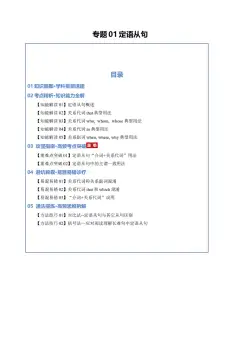
专题03 状语从句(2)
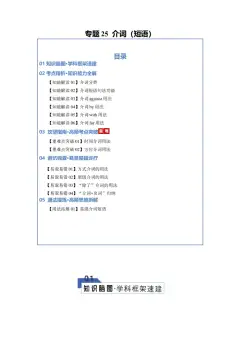
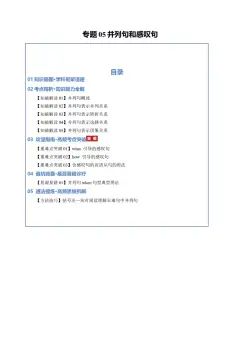
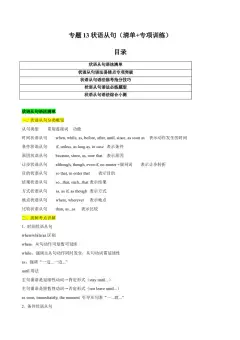
目录
01 知识脑图·学科框架速建
02 考点精析·知识能力全解
【知能解读01】状语从句概述
【知能解读02】时间状语从句用法
【知能解读03】原因状语从句用法
03 攻坚指南·高频考点突破
【重难点突破01】方式状语从句用法
【重难点突破02】地点状语从句用法
04 避坑锦囊·易混易错诊疗
【易混易错01】比较状语从句用法
【易混易错02】“一……就……”多样化表达方式
05 通法提炼·高频思维拆解
【方法技巧】状语从句的省略用法
01 状语从句概述
状语从句:状语从句就是一个从句在句中相当于一个副词,表示时间、原因、条件、伴随、结果、让步等。
类型:根据功能,分让步状语从句、条件状语从句、目的状语从句、结果状语从句、时间状语从句、原因
状语从句、方式状语从句、地点状语从句、比较状语从句等。
状语从句分类及连接词明细表
从句类型
常见引导词
让步状语从句
though, although, as, whether…or, while, no matter wh-, -ever
条件状语从句
if, unless, once, in case, on condition that, supposing, provided that, for fear that
目的状语从句
so that, in order that
结果状语从句
so that, such that, so…that, such…that
时间状语从句
when, while, as, before, as soon as, the moment, the first time
原因状语从句
because, as, since, now that, in that
方式状语从句
as, as if, as though
地点状语从句
where
比较状语从句
as…as…, than…, the more…the more…
02 时间状语从句用法
1. as, when 和while 引导的时间状语从句
as 强调从句动作与主句动作同时或几乎同时发生,译作“随着”。when 从句可以是时间点也可以是时间
段,译作“当……时候”。while 表示“在……期间”,谓语应用延续性动词。
As the sun rose, the birds began to sing. 太阳升起时,鸟儿开始歌唱。
As children grow older, they become more independent. 随着孩子们长大,他们变得更独立。
When the bell rang, the students rushed out of the classroom.铃声响起时,学生们冲出了教室。
When I was young, I often played in this park. 我小时候经常在这个公园玩。
Please keep quiet while the teacher is speaking. 老师讲话时请保持安静。
While my wife was reading the newspaper, I was watching TV.妻子在看报纸我在看电视。
2. after, before 引导的时间状语从句
after 接从句,表示“在……之后”; before 接从句,表示“在……之前”。有时根据语境翻译作
“趁……”,“还没来得及……就”。before 常用于It will be+时间段+before,It was +时间段+before…
等句型。
He called me after he arrived at the airport. 他到达机场后给我打了电话。
After the rain stopped, a beautiful rainbow appeared in the sky. 雨停后,天空中出现了一道美丽的彩虹。
The sun had risen before we started our journey.我们出发前,太阳已经升起来了。
It will be a few weeks before the new library opens. 新图书馆要几周后才会开放。
It was two hours before the firefighters arrived. 过了两个小时消防员才赶到。
★易错提醒:It was +时间段+before…句型注意与强调句型的不同。
It wasn't long before they found the missing child. 没过多久,他们就找到了那个失踪的孩子。
It was last Monday that we held the meeting. 我们是在上周一开的会。
3. since 引导的时间状语从句
since 表示“自从……以来”,引导时间状从,从句谓语用一般过去时,常用于It is+时间段+since…句型;
从句谓语是瞬时性动词,表示“自从……以来”。
I have lived in this city since I graduated from college.自从大学毕业以来,我就住在这座城市。
It has been three years since we last saw each other. 自从我们上次见面以来,已经过去三年了。
★易错提醒:since 从句是延续性动词则表示“自该动作结束以来”。
She hasn’t called me since she lived here. 自从她离开这里(不住在这里)后,就没给我打过电话。
4. till 和until 引导的时间状语从句
till 和 until 含义相同,都表示 “直到…… 为止”,引导时间状语从句时,主句动作持续到从句动作发
生时结束。两者的区别在于:till 多用于口语,until 可用于句首,till 一般不用于句首。
1)肯定句中,其主句谓语动词必须为延续性动词,表示某动作一直延续到某时间为止。
2)否定句中(not... until):表示 “直到…… 才”,主句常用非延续性动词。
She stayed in the office until she finished all the work. 她一直在办公室待到完成所有工作。
He didn’t apologize to me not until I pointed out his mistake. 直到我指出他的错误,他才向我道歉。
★易错提醒:Not until…位于句首,主句采用部分倒装语序,主句仍然采用陈述语序。
Not until I traveled abroad did I realize the importance of learning English.
直到出国旅行,我才意识到学英语的重要性。
5. 名词短语引导的时间状语从句
every/each time…每次next time…下次the first/last time…第一次/最后一次the minute/instant/second…
一……就后面直接跟名词,构成时间状语从句。
I’ll remember to call you next time I’m in town. 下次我进城时,会记得给你打电话。
The first time I traveled abroad, I felt both excited and nervous. 我第一次出国旅行时,既兴奋又紧张。
He called me the instant he arrived at the station. 他一到车站就给我打了电话。
★易错提醒:every/each time…, next time…, the first/last time…, the minute/instant/second 等短语用作连
词,名词后边不能接when 等词。
The minute she walked in, the phone rang. 她一进门,电话就响了。
The last time we met, we didn’t say goodbye properly.  我们最后一次见面时,没有好好道别。
【跟踪训练】在空白处填1 个适当的单词或括号内单词的正确形式。
1.________ he grew older, he became less active.
2.Not __________we succeed in letting wildlife live in peace can we smile in relief.
3.Alice recognized Tom __________ instant she saw him.
4 .It will be several years __________ the full impact of the recent technological advancements in artificial
intelligence is fully understood.
5.— Jack, where is Tom?
— Sorry, I don’t know. But I will tell him that you want to see him __________ moment he comes back.
6.John thinks it won’t be long __________ he is ready for his new job.
7.I was informed that it will be eight months __________ a rescue mission arrives from Earth.
8.I have worked in this school__________I graduated from Peking University.
9.Please don’t talk so loudly __________ others are working.
10.You can only imagine how travellers felt __________ they saw the oasis of Dunhuang ahead of them.
03 原因状语从句的用法
1.because 引导的原因状语从句
because 通常用于回答why 引出的疑问句,语气最强,除特别强调外,该从句一般位于主句后面。
They didn’t buy the house because it was too far from the city.他们没买那栋房子,因为它离市区太远。
He was hungry, because he didn’t eat breakfast. 他饿了,因为没吃早餐。
2.as 引导的原因状语从句
as 引导的原因状语从句多位于主句之前,通常可以和since 换用,as 语气稍弱。
As the weather was fine, we decided to have a picnic by the lake. 因为天气好,我们决定去湖边野餐。
As we’re both free today, why not go to the museum? 既然我们今天都有空,为什么不去博物馆呢?
3.since 引导的原因状语从句
since 表示人们已知的事实,不许强调的原因,故常译为“既然……”,通常位于主句前,相当于now
that。
Since everyone is here, let’s start the meeting. 既然大家都到了,我们开始开会吧。
Since the project is finished, we can celebrate now. 由于项目已经完成,我们现在可以庆祝了。
4.Now that 等原因状语从句
in that“因为;基于……的理由”,可以和because 换用,多用于正式文体,总是位于主句之后。Seeing
that/Considering that/Given that…表示“鉴于,考虑到”,通常用于非正式文体。
He is not suitable for the job in that he lacks relevant experience. 他不适合这份工作,因为他缺乏相关经验。
Now (that) you are grown up, you should not rely on your parents. 既然你长大了, 就不应该依靠你的父母了。
Considering (that) everybody is here, let’s begin our discussion. 既然大家都到了, 我们就开始讨论吧。
Seeing (that) he refused to help us, there’s no reason that we should now help him. 他既然曾经拒绝帮助我们,
【跟踪训练】在空白处填1 个适当的单词或括号内单词的正确形式。
1.Enjoying a fresh morning is important ________ it can set the mood for the rest of the day.
2.________ (give) that they’re inexperienced, they’ve done a good job. (所给词的适当形式填空)
3.Now ________you have finished your work, you’d better have a rest.
4.________ everyone is here, let's begin our class.
5.We listened eagerly, ________ he brought news of our families.
6.________ that we are all part of the global village, everyone becomes a neighbour.
7.________you have already known the truth, I don’t need to explain it again.
8.He was late for the meeting in________ his car broke down on the way.
9.________ you can’t answer the question, I’ll ask someone else.
10.Many students lost marks in the exam simply ________ they didn’t read the questions carefully.
01 方式状语从句用法
1. as 引导的方式状语从句
as 引导的方式状语从句通常位于主句后,意思是"正如……","就像",多用于正式文体。
Leave the things as they are. 别动这些东西。
You must try to hold the tool as I do.你必须像我这样拿工具。
Always do to the others as you would be done by. 你希望人家怎样待你,你就要怎样待人。
2. as if/as though 引导的方式状语从句
as if/as though 引导的方式状语从句谓语多用虚拟语气,表示与事实相反,常译作"仿佛……似的"。
He looks as if he is angry. 他看上去好像生气了。
It looked as if there would be an exciting race.看来要有一场激动人心的比赛。
He stared at me as if seeing me for the first time. 他目不转睛地看着我,就像第一次看见我似的。
【跟踪训练】在空白处填1 个适当的单词或括号内单词的正确形式。
1.Football _________ we know it today started in Great Britain, where the game was given new rules.
2.The kids were very friendly with her and even looked up to her as _________ she were their own mother.
3.What we are concerned about is how we can finish the task in two weeks_________ planned.
4.Just _________ a single word can change the meaning of a sentence, a single sentence can change the meaning
of a paragraph.
5.We’d better leave things _________ they are until the police arrive, which helps them investigate the case.
02 地点状语从句用法
where 既可引导定语从句,也可引导地点状语从句。where 引导定语从句时,从句前应有一个表示地点的名
词作先行词,where 可替换成“介词+ which'”;而状语从句前则无先行词。
They should go where they are needed most.他们应该去最需要他们的地方。
She lives where the climate is mild all year round. 她住在气候终年温和的地方。
【跟踪训练】在空白处填1 个适当的单词或括号内单词的正确形式。
1.The flowers grow best _________ there is enough sunlight.
2.Located _________ the Belt meets the Road, Jiangsu will contribute more to the Belt and Road
construction.
3.He always parks his car _________ he can see it from the window, just to make sure it’s safe.
4.Mohammed Rezwan saw opportunity_________ others saw only disaster.
5.Today, the USS Arizona lies _________ it sank: in the middle of the Pacific Ocean.
01 比较状语从句用法
1. as…as…引导的原级比较状语从句
as…as…引导的原级比较状语从句,第一个as 是副词,第二个是连词,中间接形容词、副词原级。也可以
是as+形容词+a(n)+名词+as 结构。否定句中,可以替换为not so…as…。
The weather today is as hot as it was yesterday. 今天的天气和昨天一样热。
He doesn’t study as carefully as his sister. 他学习不如他妹妹认真。
2.than 引导的比较状语从句
形容词/副词比较级+than…结构是常用比较级结构。
This problem is more difficult than I expected. 这个问题比我预期的更难。
He speaks English more fluently than he writes it. 他说英语比写英语更流利。
This movie is not more interesting than the one we saw yesterday. 这部电影不比我们昨天看的那部更有趣。
3.the+比较级+主语+谓语,the+比较级+主语+谓语
前半句是从句,后半句是主句, 在非正式语境中,有时可省略主语和谓语,直接用“the + 比较级,the +
比较级”。
The fewer mistakes you make, the higher score you will get.你犯的错误越少,得分就会越高。
The colder it gets, the more I want to stay at home. 天气越冷,我就越想待在家里。
【跟踪训练】在空白处填1 个适当的单词或括号内单词的正确形式。
1.It’s true; the _________ (old) I get, the more I feel time has wings.
2.Do foreigners not understand British humor or are the British just not so funny_________ they think they are?
3.The volunteers are no longer the same young men _________ they were ten years ago.
4.We’re doing everything we can to make things as easy for you _________ we can.
5.The more we know each other, the _________ (well) we understand each other.
6.Some young girls think the _________ (slim) they are, the more attractive they will look.
7.Scientists have collected more data _________ expected to prove the theory.
8.Building a skyscraper in the 21st century is much easier_________ it used to be.
9.The more we acknowledge the outstanding universal value of our heritage sites, the_________ (likely) we are
to treat them with respect.
10.When it opens in 2023, it should be able to produce more energy_________it uses.
02 “一……就……”多样化表达方式
1.标准型:as soon as 引导时间状语从句,注意“主将从现”用法。
As soon as the bell rings, the students will rush out of the classroom.铃一响,学生们就会冲出教室。
2.名词型:the moment/ minute/ instant/ second+从句引导时间状语从句。
The moment she saw the gift, she knew it was from him. 她一看到礼物,就知道是他送的。
3.副词型:immediately /directly/ instantly 形式上是副词,其实这里转化为从属连词,引导时间状语
从句。
Immediately he finished speaking, the audience broke into applause. 他一讲完,观众就鼓起掌来。
4.介词型:on/upon 后接名词或动名词,构成时间状语。
On arriving at the station, he realized he had lost his ticket. 一到车站,他就发现票丢了。
At the sight of the snake, she screamed. 她一看到蛇就尖叫起来。
5.倒装型:no sooner…than.../hardly… when … 句式不同但意思相同,都表示“刚一……就……”,
注意主句用过去完成时,且部分倒装(前提是no sooner/hardly 位于句首)。
No sooner had she left than he regretted what he said. 她刚离开,他就后悔自己说的话了。
Hardly had I opened the door when the phone rang. 我刚打开门,电话就响了。
【跟踪训练】在空白处填1 个适当的单词或括号内单词的正确形式。
1.I had hardly sat down on the train and opened a bar of chocolate ________ an old man with huge
bags sat down across from me.
2.I detected two obvious mistakes ________ (instant) I saw the article.
3.— Jack, where is Tom?
— Sorry, I don’t know. But I will tell him that you want to see him ________ moment he comes back.
4.No sooner had I begun to understand how British people communicate ________ it was time to head
back home.
5.No sooner had she took off the dark glasses ________ I recognized her.
6.I could hardly recognize her ________ (instant) I saw her after a couple of years.
7.He had hardly finished the composition ________ the bell rang.
8.Hardly ________ the police received the emergency call when they rushed to the scene.
9.I had hardly got to the office ________ my wife phoned me to go back home at once.
10.Hardly had I solved the problem ________ a new one arose, which really tired me out.
 状语从句的省略用法
状语从句含有it is 或者主从句主语一致且含有be 动词时,省略主语和be 动词。如果用“从属连词+现在分
词”,强调从句谓语动词与句子主语之间的主动关系;“从属连词+过去分词”强调二者之间被动关系。
When (he was)walking in the street, he met an old friend. 在街上走时,他遇到了一位老朋友。
Once (it is) printed, the report will be sent to the manager. 报告一旦打印好,就会发给经理。
Unless (it is) necessary, we won’t hold a meeting. 除非必要,否则我们不开会。
★易错提醒:before 和after 后接动词,只能接动名词作宾语。
He became more confident after winning

   the competition

 . 赢得比赛后,他变得更自信了。
The document needs to be reviewed before being submitted.文件在提交前需要审核。
【跟踪训练】用括号法把下列各句的状语从句括起来。
1.Once __________ (addict) to the Internet, you will destroy your life and study without awareness.
2.Though__________ (lack) money, his parents managed to send him to college.
3.We all know that, if not carefully__________ (deal) with, the situation will get worse.
4.Children, when __________ (accompany) by their parents, are allowed to enter the stadium.
5.While __________ (walk) along the street, I met an old friend of mine.
6.Even if __________ (damage), the robot can still send an emergency signal.
7.Once __________ (release), the results of the experiment will definitely start a heated discussion.
8.When __________ (face) with difficulties, wise men try their best to get over them, but not to hold back.
9.While __________  (drive) along the freeway, they noticed a kangaroo standing in the middle of the road.
10.When first __________ (introduce) to the market, the product won great popularity.
一、单项语法填空
在空白处填1 个适当的单词或括号内单词的正确形式。
1. _________watching TV, children do not merely absorb words and images.
状语从句(2)综合能力提升
2.Not_________we succeed in letting wildlife live in peace can we smile in relief.
3.Jingdezhen has a fascinating and storied history, of which I knew little_________I had the opportunity to visit it
recently.
4.The little boy broke away from me _________ (instant) he saw his mother.
5.It’s easy to get lost when you drive in a new city, so it is important to study a good map_________you set out.
6.No sooner had I begun to understand how British people communicate_________ it was time to head back
home.
7.I didn’t go to bed _________ I finished my homework.
8.A parking lot is going to be built _________there used to be a small park.
9._________ (give) that they lack experience, they have done a good job.
10.Mark needs to learn Chinese _________ his company is opening a branch in Beijing.
11.Leave your kids _________ they are and they will grow up healthily and brightly.
12._________a single word can change the meaning of a sentence, a single sentence can change the meaning of a
paragraph.
13.The construction industry is no longer as depressed _________ it was.
14.Air pollution is getting more and more serious, so we must take action _________it is too late.
15.The house was greatly damaged by the truck and we’d better leave it _________ it is until the police arrives.
16.The school was much smaller _________he had expected.
17.He gives you his full attention _________ (immediate) you begin to speak.
18.As a matter of fact, it will take some years _________our country develops this technology.
19.I didn’t think about it much _________a morning last week when I knocked my favorite teapot off the table.
20.He had no sooner finished his speech _________ the students started cheering.
二、状语从句在语法填空中应用
(24-25 高二下·福建莆田·期末)阅读短文,在空白处填1 个适当的单词或括号内单词的正确形式。
The skin, the body’s largest organ, serves as a barrier against various threats and helps with temperature
regulation and water loss.     1     you can imagine, getting burnt can lead to very serious injuries.     2
first and most important step in the     3     (treat) of burns is giving first aid.
Depending on the depth of skin damage, burns are divided into three     4     (type). First-degree burns
affect only the top skin layer, like mild sunburns, which are dry, red and     5     (mild) swollen and painful.
Second-degree burns     6     (cause) by hot liquids go below the top layer of the skin, resulting in redness,
blisters, and extreme pain. They are serious and take a few weeks     7     (get) better. Third-degree burns
affect every layer, and the tissue underneath can often     8     (see), which requires immediate hospital care.
If you see someone get burnt, first remove any clothes unless you see the fabric sticking to the burn and cool
the burnt area with cool     9     (run) water. Then dry the area gently and cover the area      10      a dry,
clean bandage in order not to get it infected. If the burn is serious, the victim should be sent to a doctor or hospital
at once.