04.词句猜测题
【题型总览】
【题型特征】
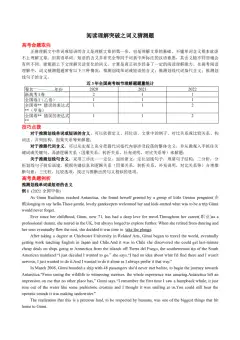
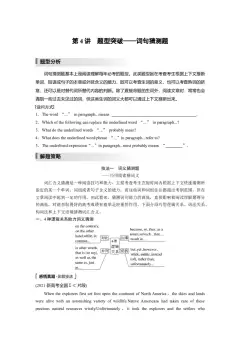
词句猜测题它可以是对一个单词的意义的推断,也可以是对一个短语或句子的意义的推
断。词句猜测题既可以考查生词的意义,也可以考查熟词的新义,还可以是对替代词所替代内
容的判断。在阅读理解题中,所考查的词或短语的意义往往不停留在字面上,而要根据短文提
供的语境,通过阅读上下文,根据已知的信息或常识来推测尚不熟悉的词或短语的含义。
【设题趋势】
词 义 类 : (1)The underlined word/phrase...probably means/can be replaced by
______. (2)Which of the following is closest in meaning to the underlined word/phrase...?
指代类:(1)What does the underlined word “this/that/it/they...” refer to? (2)The underlined
part “this/that/it/they...” refers to ______.
句意类:(1)The underlined sentence in the...paragraph probably means ______. (2)What
can we infer from the underlined sentence in Paragraph...?
1.正确选项
(1)含义和其字面意思一般没有任何关系。
(2)上下文逻辑通顺。
(3)与原句意思最接近。
2.干扰选项
(1)与所考词汇形似。
(2)如果考的是熟词,含有常规词义的往往是错误选项。
(3)句子解释中含有过多原句中已有的词和短语的选项一般是错误选项。
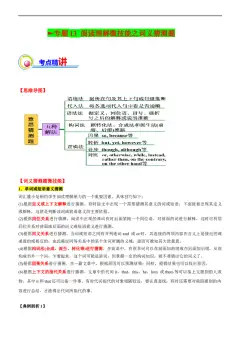
【常考类型】
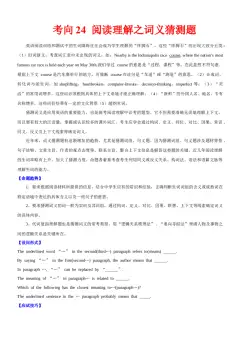
考查考生猜测文章中某个生词或短语的含义,或考查该词能
题型1 词义(词组)猜测题
被哪个单词或短语代替
考查考生准确理解作者的观点,尤其是对特定的人、物、事
题型2 句意猜测题
件的褒贬观点,以准确推断语句的含义
要求考生依据语境的逻辑关系,判断画线的人称代词或指示
题型3 代词指代题
代词在文章中指代的对象
【题型精析】
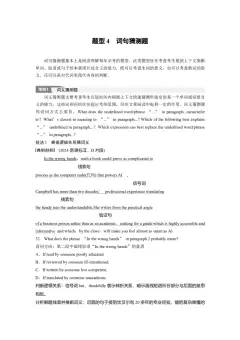
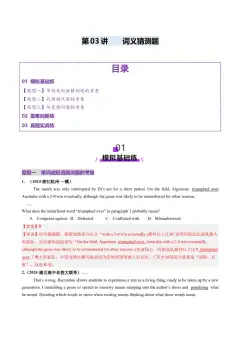
【题型1】词义(词组)猜测题【真题示例】(2023·新高考Ⅱ卷·C篇节选)
...These scenes may have been painted hundreds of years ago, but they record moments we
can all relate to.
30.What do the underlined words “relate to” in Paragraph 2 mean?
A.Understand. B.Paint.
C.Seize. D.Transform.
【解答思路】
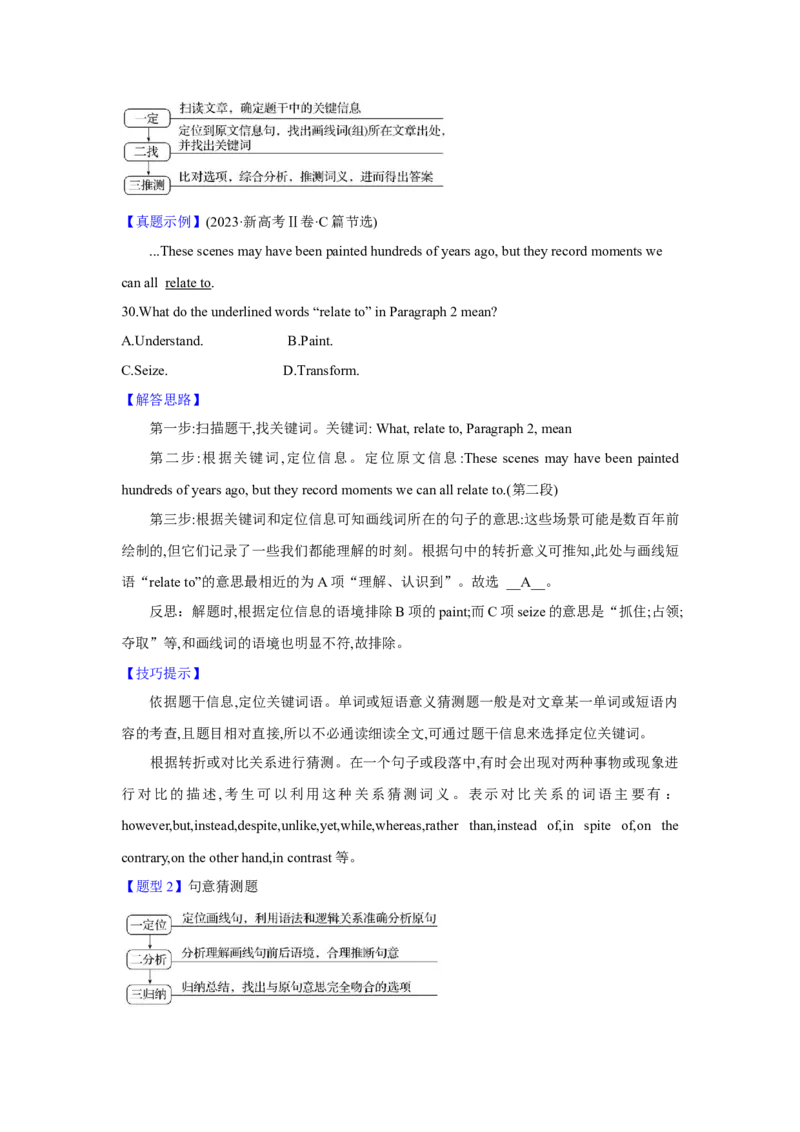
第一步:扫描题干,找关键词。关键词: What, relate to, Paragraph 2, mean
第二步:根据关键词,定位信息。定位原文信息:These scenes may have been painted
hundreds of years ago, but they record moments we can all relate to.(第二段)
第三步:根据关键词和定位信息可知画线词所在的句子的意思:这些场景可能是数百年前
绘制的,但它们记录了一些我们都能理解的时刻。根据句中的转折意义可推知,此处与画线短
语“relate to”的意思最相近的为A项“理解、认识到”。故选 __A__。
反思:解题时,根据定位信息的语境排除B项的paint;而C项seize的意思是“抓住;占领;
夺取”等,和画线词的语境也明显不符,故排除。
【技巧提示】
依据题干信息,定位关键词语。单词或短语意义猜测题一般是对文章某一单词或短语内
容的考查,且题目相对直接,所以不必通读细读全文,可通过题干信息来选择定位关键词。
根据转折或对比关系进行猜测。在一个句子或段落中,有时会出现对两种事物或现象进
行对比的描述,考生可以利用这种关系猜测词义。表示对比关系的词语主要有 :
however,but,instead,despite,unlike,yet,while,whereas,rather than,instead of,in spite of,on the
contrary,on the other hand,in contrast等。
【题型2】句意猜测题【真题示例1】(2023·全国甲卷·B篇节选)
Terri Bolton is a dab hand when it comes to DIY (do-it-yourself).Skilled at putting up shelves
and piecing together furniture, she never pays someone else to do a job she can do herself.
24.Which is closest in meaning to “a dab hand” in paragraph 1?
A.An artist. B.A winner.
C.A specialist. D.A pioneer.
【解答思路】
第一步:扫描题干,找关键词。关键词:closest in meaning to “a dab hand”
第二步:根据关键词,定位信息。定位原文信息:Skilled at putting up shelves and piecing
together furniture, she never pays someone else to do a job she can do herself. (她擅长摆架子和
拼接家具,从不付钱给别人来做她自己能做的工作)
第三步:比对选项信息:根据原文信息可知,关键词所在句子意为“泰瑞·博尔顿是
DIY(自己动手)的能手。”,故该词意为“专家,能手”。故选 C 。
反思:该题容易错选成D项,选错的原因是忽视下句,仅凭主观臆断误认为泰瑞·博尔顿
是DIY的先锋。在解答词句猜测题时,充分理解画线词前后文的语境是解题的关键。
【真题示例2】(2017·浙江高考A·节选)
Benjamin West, the father of American painting, showed his talent for art when he was only
six years of age. But he did not know about brushes before a visitor told him he needed one. In
those days, a brush was made from camel’s hair. There were no camels nearby. Benjamin decided
that cat hair would work instead. He cut some fur from the family cat to make a brush.
The brush did not last long. Soon Benjamin needed more fur. Before long, the cat began to
look ragged(蓬乱). His father said that the cat must be sick. Benjamin was forced to admit what
he had been doing.
The cat’s lot was about to improve. That year, one of Benjamin’s cousins, Mr Pennington,
came to visit. He was impressed with Benjamin’s drawings. When he went home, he sent
Benjamin a box of paint and some brushes. He also sent six engravings(版画) by an artist. These
were the first pictures and first real paint and brushes Benjamin had ever seen.
...
22.What does the underlined sentence in Paragraph 3 suggest?
A.The cat would be closely watched.
B.The cat would get some medical care.C.Benjamin would leave his home shortly.
D.Benjamin would have real brushes soon.
【解答思路】
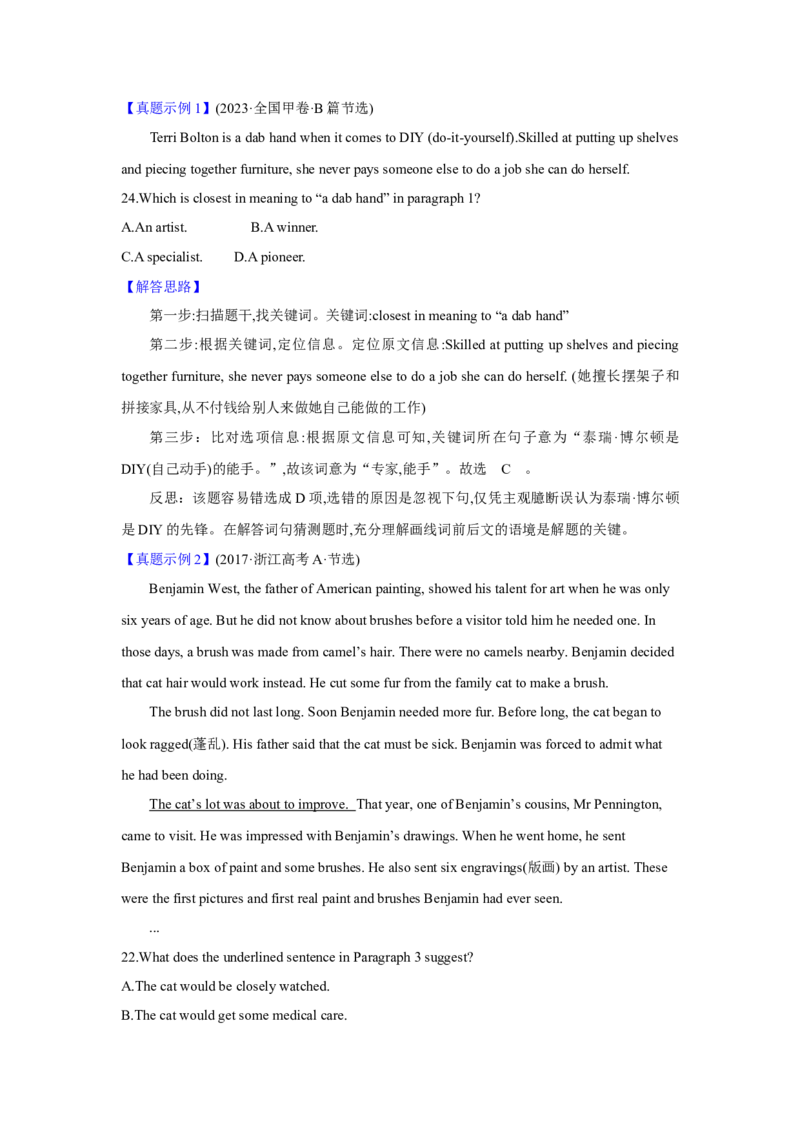
第一步:定位画线句The cat’s lot was about to improve.
第二步:分析第三段最后一句These were the first pictures and first real paint and brushes
Benjamin had ever seen.可知这些是本杰明见过的第一批画和第一批真正的绘画颜料和画笔。
第三步:归纳可知本杰明在剪完猫的毛做画笔之后, 很快就有了真正的画笔, 故选
__D__。
【技巧提示】
【题型3】代词指代题
【真题示例】(2022·新高考Ⅱ卷·C篇节选)
An idea from lawmakers in New York is to give police officers a new device called the
Textalyzer.It would work like this: An officer arriving at the scene of a crash could ask for the
phones of the drivers and use the Textalyzer to check in the operating system for recent
activity.The technology could determine whether a driver had just texted, emailed or done
anything else that is not allowed under New York’s hands-free driving laws.
“We need something on the books that can change people’s behavior,” said Félix W.Ortiz,
who pushed for the state’s 2001 ban on hand-held devices by drivers.If the Textalyzer bill
becomes law, he said,“people are going to be more afraid to put their hands on the cell phone.”
30.What does the underlined word “something” in the last paragraph refer to?
A.Advice. B.Data.C.Tests. D.Laws.
【解答思路】
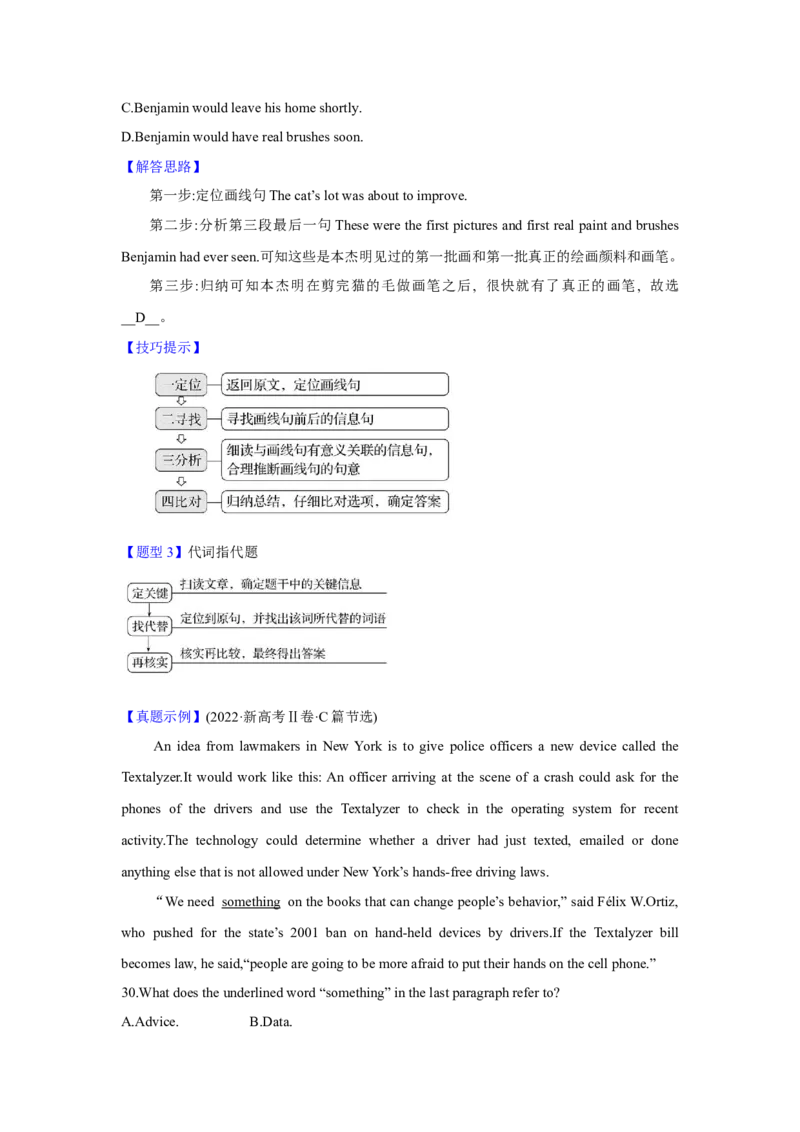
第一步:扫描题干,找关键词。关键词:the underlined word “something” in the last paragraph
第二步:根据关键词,定位信息。定位原文信息:We need something on the books that can
change people’s behavior我们需要一些能改变人们行为的有案可查的东西。(画线词所在的
句子)If the Textalyzer bill becomes law, he said, “people are going to be more afraid to put their
hands on the cell phone.”如果文本分析仪法案成为法律,他说:“人们会更害怕把手放在手机
上。”(画线词下文)
比对选项信息:根据原文信息可知,画线词指代下文中的law,即法律。故选 D 。
反思:考生在解答本题时,要注意画线词后文对答案的提示作用,特别注意画线词前后文
的语境。如果忽略画线词后的句子,则很容易选错答案。
【技巧提示】
【题型精练】
1
When we experience earthquakes, medical emergencies — whatever the situation, the first
thing you probably do is panic. Everybody does. While many of us think that we’re cool in a
crisis, science tells us that we seldom are. At the moment we need to be keenly aware of our
surroundings, but our attention goes to the scariest thing on the scene, leaving us unaware of the
other sights, sounds, and even smells around us. At the moment, we’re anything but at our best.
These normal human reactions can be reversed. For example, firefighters are taught how to
bring down their blood pressure and heart rates quickly, box breathing, belly breathing, hum
breathing — you can learn these techniques in minutes. Once you calm down, you’ll identify
accurately what the problem is really about. Lack of practice always causes us to judge problemsin wrong ways. Doing the thinking ahead of time also helps you fire off the solution when it’s
show time. This is why you are advised to find the closest exit before the flight. And sometimes
we aren’t prepared with all the knowledge we need. Let’s say we’re on a hike and a bear shows up.
What shall we do? Better to read suggestions on how to respond before heading into the wild.
Performing in a crisis is becoming more important for all of us for two reasons. Back in the
good old days, the reliability of most anything we used or did was far less than it is today. Now
think about what happens to our preparedness as the probability of something had happening
reduces. Unless we practice what hardly ever happens, our ability to respond when it does happen
tends to slip away. Reliability can kill you. Also, the systems we use today are more complex.
There are seldom moving parts in plain view that allow us to see when things are about to go
wrong. Consequently, terrible situations can “come out of nowhere”. Ironically, the systems that
were designed to lessen our workload might require us to remain in a state of increased vigilance
(警觉) in order to survive these increasingly infrequent events when they do happen.
As technology becomes part of most everything, and as once-large risks break into countless
small ones, crisis situations may become standard affairs. We should all learn to breathe, recognize
the situation, and carry out the plan that we are smart enough to prepare well in advance.
1. According to the passage, when an armed robbery (抢劫) happens, most witnesses will
first___________.
A. observe the surroundings
B. pretend to be calm
C. decide what to do
D. focus on the gun
2. What does the underlined word “reversed” in Paragraph 2 probably mean?
A. Tested. B. Changed. C. Predicted. D. Understood
3. It can be inferred from Paragraph 3 that ___________.
A. things are less dependable than they used to be
B. cautiousness helps prevent the occurrence of crisis
C. convenience reduces our problem-solving capability
D. the complexity of present systems ensures our safety
4. What is the main purpose of the passage?
A. To introduce ways of avoiding crisis situations.B. To point out the connection between stress and risks.
C. To raise awareness of the preparation for emergencies.
D. To analyse the influence of technology on crisis management.
2
When John was growing up, other kids felt sorry for him. His parents always had him
weeding the garden, carrying out the garbage and delivering newspapers. But when John reached
adulthood, he was better off than his childhood playmates. He had more job satisfaction, a better
marriage and was healthier. Most of all, he was happier.
These are the findings of a 40-year study that followed the lives of 456 teenage boys from
Boston. The study showed that those who had worked as boys enjoyed happier and more
productive lives than those who had not. "Boys who worked in the home or community gained
competence (能力) and came to feel they were worthwhile members of society," said George
Vaillant, the psychologist (心理学家) who made the discovery. "And because they felt good about
themselves, others felt good about them."
Vaillant’s study followed these males in great detail. Interviews were repeated at ages 25,31
and 47. Under Vaillant, the researchers compared the men’s mental-health scores with their
boyhood-activity scores. Points were awarded for part-time jobs, housework, effort in school, and
ability to deal with problems.
The relationship between what the men had done as boys and how they turned out as adults
was surprisingly sharp. Those who had done the most boyhood activities were twice as likely to
have warm relations with a wide variety of people, five times as likely to be well paid and 16
times less likely to have been unemployed. The researchers also found that IQ and family social
and economic class made no real difference in how the boys turned out. Working — at any age —
is important. Childhood activities help a child develop responsibility, independence, confidence
and competence — the underpinnings (基础) of emotional health. They also help him understand
that people must cooperate and work toward common goals. The most competent (能干的) adults
are those who know how to do this. Yet work isn't everything. As Tolstoy once said, “One can live
magnificently in this world if one knows how to work and how to love to work for the person one
loves and to love one's work.”5. Vaillant’s words in Paragraph 2 serve as ___________.
A. a description of personal values and social values
B. an analysis of how work was connected with competence
C. an example for parents’ expectations of their children
D. an explanation why some boys grew into happy men
6. Vaillant’s team obtained their findings by _______.
A. recording the boys’ effort in school
B. evaluating the men’s mental health
C. comparing different sets of scores
D. measuring the men’s problem solving ability
7. What does the underlined word "sharp" probably mean in Paragraph 4?
A. Quick to react.
B. Having a thin edge.
C. Clear and definite.
D. Sudden and rapid.
8. What can be inferred from the last paragraph?
A. Competent adults know more about love than work.
B. Emotional health is essential to a wonderful adult life.
C. Love brings more joy to people than work does.
D. Independence is the key to one’s success.
3
The candy we eat, the tea we drink, the lotion we use---they all likely contain ingredients
from wild plants. While natural ingredients can be beneficial to buyers, the way those plants are
harvested could harm ecosystems. In a recent United Nations report, medicinal plant experts
revealed the risks behind several of them, including Brazil nuts, frankincense, goldenseal, gum
arabic, and licorice.
Plant derivatives (衍生物) in household products “sit there somewhere in the middle of
the ingredients list” on product labels, often going unnoticed, says Caitlin Schindler, lead author of
the report. Even if consumers do take note, there’s no information about what’s involved in
obtaining or processing the derivatives.Many of these plants are threatened with extinction from overharvesting, disease and pests,
climate change, and habitat loss. The endangered state of more than 20,000 medicinal plant
species has never been assessed, which means it’s impossible to know whether their use is
sustainable.
Meanwhile, the trade in wild plants is booming. U. S. consumers spent more than $12.3
billion on herbal dietary supplements in 2021---up more than 9 percent from 2020. Wild plants
have been used locally for centuries, but today’s global demand puts many at risk. And
international customers often have no idea where these products originate.
Should consumers stop buying the products? No. Schindler says, because “the ingredients are
really critical to a lot of people’s livelihoods.” Solutions for transforming the trade in wild plants
are rooted in awareness. The first step for consumers is to “just notice that you’re buying
something that has a wild ingredient,” she says. It’s generally safer to purchase local products and
splurge on more expensive ones, if possible.
Consumers can also look for organic and fair-trade certifications. Various programs evaluate
wild-plant supply chains for sustainability, and many companies advertise these certifications,
either on the product or online. One of the most prominent is Fair Wild, which assesses
environmental risks and recommends best sourcing practices. If certifications are missing,
Schindler encourages people to challenge companies to do better. “Until businesses get a bit more
pressure from consumers, we won’t see any changes happening,” she says.
9. What can we learn about wild plants according to the report?
A. Their current situation is ignored. B. They are limited on a global scale.
C. They have been evaluated regularly. D. Their process information is on the label.
10. Which of the following can replace the underlined words “splurge on” in paragraph 5?
A. Get rid of. B. Spend much money on.
C. Pay attention to. D. Conduct many experiments on.
11. Why are the organic and fair-trade certifications valued?
A. They confirm the quality of the wild plants.
B. They offer consumers rights to assess the products.
C. They ensure the use of wild plants at a steady level.
D. They inspire companies to make more advertisements.
12. What is the structure of the passage?A. B. C. D.
4
UK safety advisers have dismissed concerns that highly processed food, also known as ultra-
processed food (UPF), is automatically unhealthy because of the way it is made or its artificial
ingredients. The current way that the UK and most other countries assess the nutrition al value of
foods—which is generally by how much fat, salt, sugar and calories they contain—remains the
best approach to achieving a health y diet, said a team of scientists. They also warned that people
who cut out all ultra-processed foods could make their diets more unhealthy, for instance, if they
avoid foods such as yogurts, low-fat spreads, wholemeal bread and food made of grains.
Concerns about processed foods have been growing, but it is unclear if there is something
uniquely bad about them or if they just tend to be higher in things like fat and sugar. The issue has
come into focus this year since Chris van Tulleken, a doctor and TV presenter, published a book
called Ultra-Processed People: Why do we all eat stuff that isn’ t food... and why can’t we stop?
Chris van Tulleken has called for more countries to adopt dietary guidelines pioneered in Brazil,
where people are advised to prioritise eating whole foods and homemade meals, and avoid eating
factory-made foods.
On 27 September, researchers from nutrition organisations rejected the proposed system. “We
absolutely need foods to be processed so that we can feed the world,” said May at the University
of Leeds, UK, who is a member of the British Nutrition Foundation. May also said UPF includes
products that are both healthy and unhealthy. “It’s important we don’t throw the baby out with the
bath water here. There are many components that have a very important role to play in nutrition
and in safety,” he said.
Benefits of food processing include the use of preservatives that make food last longest and
artificial sweeteners that help people reduce their sugar intake, said May. Other examples of
processed foods that can be beneficial include baby food, infant formula milk and breads with
added vitamins and minerals, said the panel.
13. What can be known from paragraph 1?A. Low-fat spreads are ultra-processed food.
B. Wholemeal bread is unhealthy to us.
C. Ultra-processed food doesn’t contain sugar.
D. The nutritional value of food needs to be precisely recorded.
14. What does Chris van Tulleken suggest people do?
A. They should avoid ultra-processed food. B. They should not have homemade food.
C. They should consume more Brazilian food. D. They should read more books on
healthy food.
15. What does May imply by saying the underlined sentence in paragraph 3?
A. Kids should raise their awareness of food safety.
B. Children are the biggest victims of ultra-processed food.
C. Ultra-processed food does cause more damage to children.
D. Ultra-processed food has both advantages and disadvantages.
16. What can be the best title for the text?
A. How Ultra-processed Food Benefits People
B. Ultra-processed Food Isn’t Always Unhealthy
C. A Popular Book Brings Focus on Ultra-processed Food
D. What Health Risks Ultra-processed Food Brings to People
5
For some climate challenges, there are relatively straightforward fixes. For example,
renewable energy sources can already replace much of the energy needed to power buildings, cars
and more.
There’s no substitute for food, but shifting what we eat is possible. If everyone on the planet
ate vegetables, greenhouse gas emissions from the food system could be cut by more than half; a
planet of vegetarians would reduce food emissions by two thirds. If we stopped consuming
conventional food and relied on a lab-grown nutritional food instead of soil or water-produced
food, we could prevent about 1 degree centigrade of future warming, according to a recent paper
that considered the unique thought experiment.
“What this work says is: Hey, look, we can still get pretty big wins even if we’re not making
these really big changes in dietary composition,” says Clark. “I think that’s really powerful,because a lot of people just don’t want to make those really big dietary changes, for many reasons.
While vegetarian diets are becoming more common in America and some European countries, it’s
absolutely ridiculous to assume that everyone will be eating a vegetarian diet 30 years from now,”
he says.
Food choices are personal, deeply connected to cultural, religious, emotional, economic
concerns and so much more. “Rather than dictate how to do it, it’s much better to try to give
choices,” says Naglaa, a food, nutrition and environment researcher at Tufts University. This
approach aims to inform people so that they can make choices that correspond with their needs
and values instead of waiting for the authority’s rules and orders. As a whole, those choices can
benefit both human health and the planet. For that to happen, it is necessary to work alongside
large-scale efforts to reshape industrial food production.
“But what people choose to eat daily is far from insignificant,” says Clark. “We don’t all
have to become vegetarians overnight. Small changes can make a big difference.”
17. How does the author show the effects of dietary changes in paragraph 2?
A. By analyzing the reasons. B. By using a quotation.
C. By answering questions. D. By listing data.
18. What is Clark’s attitude towards small dietary changes?
A. Indifferent. B. Skeptical. C. Favorable. D. Negative.
19. What does the underlined word “dictate” in paragraph 4 mean?
A. Command. B. Persuade. C. Perceive. D. Describe.
20. What is the best title for the text?
A. How small changes to our diets can benefit the planet
B. Small changes in life choices can make a big difference
C. Why renewable energy sources can reduce gas emissions
D. Lab-grown nutritional food could prevent future warming
6
In our daily life, it has never been easier to understand time: The National Institute of
Standards and Technology (NIST) broadcasts the time to points across the country and then it’s
fed through computer networks and cellphone towers to our personal devices. The time from NIST
keeps society organized and increases economic productivity.“Growing up, a lot of us are fed with this concept of absolute time,” says Chanda Prescod
Weinstein, a theoretical physicist at the University of New Hampshire. “But the time we’re
experiencing is a social construct. Real time is something quite different. In some of the corners of
the Universe, space and time can stretch and slow-and sometimes even break down completely.”
For many people, his idea of time is unbelievable. But true time is actually much more
flexible than most people realize. According to Einstein’s general theory of relativity, space and
time are tied together, and space-time can bend and curve (弯曲). As time stretches, it slows.
The best-known force that stretches time is gravity. The more gravity somebody experiences,
the slower time passes for them when compared to someone in a lower gravitational field. In
places where gravity is very strong, time as we understand can break down completely. At the
edge of black holes, for example, the gargantuan gravitational pull slows time dramatically.
“Upon crossing the black hole’s point of no return, known as its event-horizon, you end up in
a region where time breaks down entirely, ”Weinstein says. “At that point time has no real
meaning. There is no direction. There is no future. ”
The scientists at NIST are well aware of all the problems with time. “Just as humans keep
improving their maps, we must improve our clocks. Better clocks can make GPS more accurate,
computer networks faster, and much, much more,” says John Kitching, one of the NIST scientists.
“But it’s pretty hard to define time in a satisfactory way.”
Kitching agrees with Weinstein that time as we experience it is a technology rather than a
fundamental part of the Universe. “From a physics sense, it doesn’t have that much value,” he
concludes.
21. What is paragraph 3 mainly about?
A. The problems with NIST time. B. The need to keep time accurate.
C. The challenges to define time. D. The strange features of real time.
22. What does the word “gargantuan” underlined in paragraph 4 mean?
A. Powerful. B. Gentle. C. Straight. D. Careless.
23. What will happen to time at the event-horizon?
A. It will be tied to space. B. It becomes totally meaningless.
C. It just points to the future. D. It usually slows down sharply.
24. According to the text, the time from NIST is ______.
A. based on the real time B. of little valueC. a man-made measurement D. hard to understand
7
Ever wondered why your partner is up with the lark (百灵鸟) while you are happily sleeping
till noon? It could be thanks to Neanderthal genes, according to a new study.
Scientists comparing ancient DNA with the genetics of modern humans discovered a
“striking trend”, said John Capra, an epidemiologist (流行病学家) at the University of California
in San Francisco. The researchers found that the Neanderthal genes that remain affect the body
clock —increasing tendency to be a morning person.
Neanderthals lived at higher latitudes (纬度) than our ancestors who migrated from Africa —
further away from the equator, with the days longer in summer and shorter in winter. “The gene
that makes people early risers likely enables more rapid alignment (协调一致) of the circadian
clock (生物钟) with changing seasonal light patterns,” Dr Capra said, “when Neanderthals were
able to make the most of daylight hours to hunt.”
Scientists have previously explored how the circadian rhythms of insects, plants, and fish
have developed depending on latitude. But that hasn’t been well studied in humans. There
searchers wanted to see whether there was a genetic reason for differences in circadian rhythms
between Neanderthals and modern people, and found 16 variants (变异体) associated with greater
“morningness”. They suspected that as Neanderthals and the ancestors of modern humans mated,
people today could have followed Neanderthal “circadian variants”.
To test this,scientists analyse the genetics of several hundred thousand people from the UK
Biobank and found many of the variants that affect sleep preference. “Most noticeably, they found
that these variants increase morningness,” the researchers said. This is consistent with what has
been found in other animals that have adapted to living at a high latitude, as Neanderthals did.
25. Why does the author mention “your partner is up with the lark”in paragraph 1?
A. To introduce the following context.
B. To compare two morning life styles.
C. To praise those who get up early.
D. To express gratitude to Neanderthals.
26. What is the root for Neanderthals’ morningness according to paragraph 3?
A. The capability of hunting animals. B. The genes from African ancestors.C. The environment at higher latitudes. D. The daylight hours around their habitats.
27. What can be inferred in paragraph 4?
A. Morningness in human is unlike that in plants.
B. Insects’ circadian rhythms are impacted by latitude.
C. Scientists have previously studied the genes of animals.
D. The genes of Neanderthals is the only reason for morningness.
28. How did researchers prove their suspection?
A. By analyzing statistics of the subjects.
B. By observing people’s sleeping habits.
C. By interviewing participants in the experiment.
D. By comparing sleep preference among human and animals.
8
This story is part of Nature’s 10, an annual list produced by the world’s leading science
journal Nature, exploring individuals who contributed to the key developments in science. On the
2023 list published, the journal included a non-human entity — ChatGPT, for the first time.
ChatGPT and related software can help to brainstorm ideas, enhance scientific search engines
and identify research gaps in the literature, says Marinka Zitnik, who works on AI for medical
research at Harvard Medical School in Boston, Massachusetts. Models trained in similar ways on
scientific data could help to build AI systems that can guide research, perhaps by designing new
molecules or simulating cell behaviour, Zitnik adds.
But why include a computer program in a list of people who have shaped science in 2023?
ChatGPT is not a person. But actually, it and other generative artificial-intelligence (AI) programs
are changing how scientists work. They have also rekindled debates about the limits of AI, the
nature of human intelligence and how best to regulate the interaction between the two. That’s why
this year’s Nature’s 10 has a non-human addition.
Interestingly, Nature’s list also includes one of its creators. Ilya Sutskever, the chief scientist
and cofounder of OpenAI, the organization that created ChatGPT, is one of the minds at the
forefront of generative artificial intelligence. He saw this company as an opportunity to develop
general artificial intelligence that could outperform humans and develop its own consciousness.
Sutskever believes that artificial intelligence’s potential is too great for models to be availableto anyone who wants to use them, and he was among the first to realize that the systems that
scientists like his mentor, Geoffrey Hinton, had begun to develop would begin to show their actual
capabilities as computing power increased. In recent months, he devoted his efforts toward
creating a method to direct and control artificial intelligence systems that are more intelligent than
humans.
29. Which of the following is true about Nature’s 10 according to the passage?
A. Nature’s 10 is celebrating the development of science technology.
B. Only human beings were elected as Nature’s 10 before.
C. Nature’s 10 was started in 2023 for the first time.
D. It was awarded by the local government yearly.
30. What is the second paragraph about?
A. Experts’ opinions on ChatGPT.
B. How ChatGPT functions.
C. The application of ChatGPT in science research.
D. The promotion of ChatGPT.
31. What does the underlined word rekindled in paragraph 3 mean?
A. Settled. B. Restarted. C. Participated. D. Launched.
32. Which of the following can best describe Ilya Sutskever’s attitude towards ChatGPT?
A. Confident and cautious. B. Proud and concerned.
C. Objective and doubtful. D. Enthusiastic and warning.