模板 03 阅读理解词义猜测题
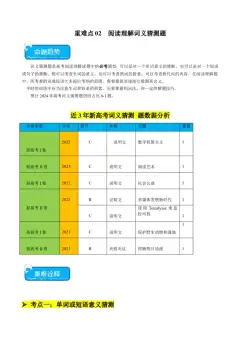
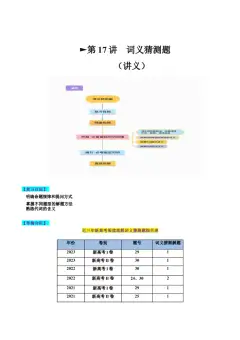
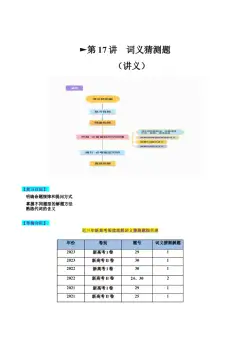
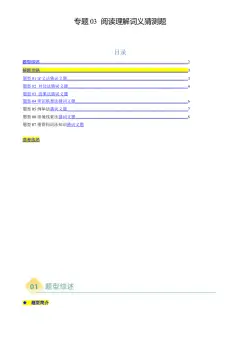
本节导航
本节导航:
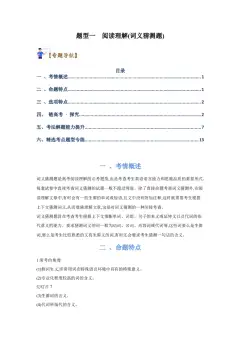
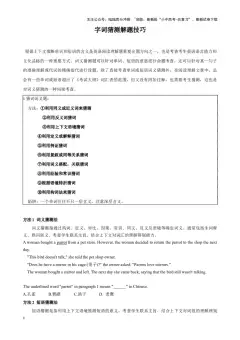
模识板·0题1 型词义解(读词 组 ) 真猜题测分题析 + 常 见 设 问 / 关 模键板词 +0 命2 题句预意测猜 /测 技题巧 解读
模板03 代词指代题
明·模板构建 答题模板 + 技巧点拨
模板01 词义(词组)猜测题 模板02 句意猜测题
模板03 代词指代题
·模板运用 真题示例 + 思路点拨 / 模板运用 + 规范答题 + 举一反三
通
练·模板演练 最新模拟、预测考向
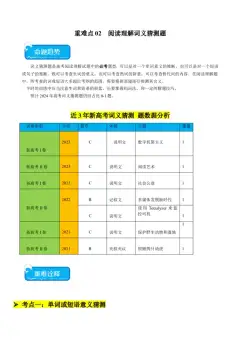
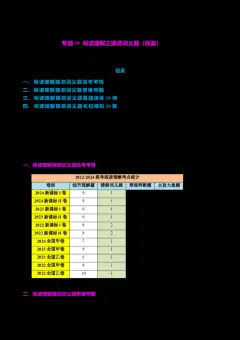
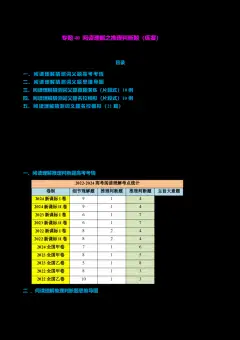
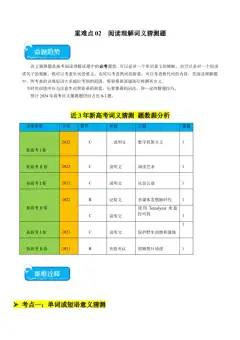
年份 卷别 题号
2024 新高考I卷 28
新高考II卷 32
全国甲卷 26
2023 新高考I卷 29
新高考II卷 30
全国甲卷 24
全国乙卷 34
2022 新高考I卷 30
新高考II卷 24、30
全国甲卷 28
全国乙卷 29
题型 真题示例 常见设问/关键词
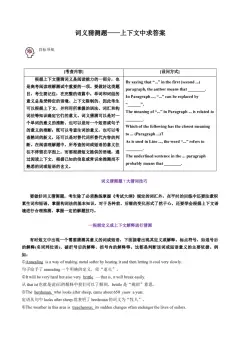
模板02 【2022年新高考全国Ⅱ卷】 4. What 设问关键词:do the underlined words “hit home for 1.“mean”(意思是),例如 “What does
me” mean in paragraph 2? the word‘XXX’mean in the passage?”。
2.“refer to”(指代),常见问句如 “Which
of the following does the underlined
phrase‘XXX’refer to?”。
3.“be closest in meaning to”(与…… 意
句意猜测题 思最接近),像 “Which word is closest in
meaning to‘XXX’?” 这样的表述。
4.“can be replaced by”(可以被…… 替
代),比如 “The word‘XXX’can be
replaced by which of the following?” 等。
【2024年浙江卷1月B篇】What does
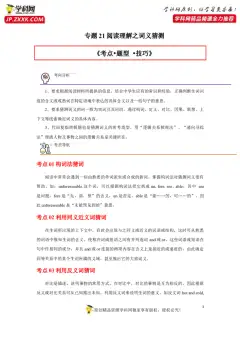
考点关键词:
the underlined word “it” in the first
1.熟词生义:一些常见单词在特定语境中出现
paragraph refer to?
了不同于其常规释义的新意思。
2.生词释义:文中出现的陌生词汇,需要通过
上下文的线索,比如解释说明、举例、对比、
模板03 代词指
因果等关系来推断其含义。
代题。
3. 代 词 指 代 内 容 : 考 查 像
“it”“they”“this”“that” 等代词具体指
代的前文所提到的名词、短语或内容等,往往
要从前文中去找与之相关的具体所指对象。
4.短语、俗语理解:对于一些固定短语、俗语
等,要依据文章语境判断其确切内涵。
一、命题预测
1)融合情境与实际应用:
1.高考英语词义猜测题将更加注重考查学生在联系实际中对所学知识的融会贯通和灵活运用。
2.题目可能会设置具体的情境,让学生在模拟真实语境中猜测词义,以检验其语言应用能力。
2)注重逻辑与推理:
1.命题者可能会通过增加干扰项或设置复杂的语境来考查学生的逻辑推理能力。
2.学生需要仔细阅读上下文,通过对比、分析、推理等方法来准确猜测词义。
3)涵盖广泛词汇:
命 题 预 1.高考英语词义猜测题将涵盖广泛的词汇,包括常见词、生僻词、短语、习语等。
测/考情揭
2.题目可能会涉及不同领域的词汇,如科技、文化、历史等,以全面考查学生的词汇量。
秘
二、考情揭秘
1)考查重点:
1.生词词义猜测:学生需要运用构词法、上下文语境等方法来猜测生词的含义。
2.熟词生义理解:对于常见词汇在特定语境下的新含义或引申义,学生需要准确理解并应用。
3.代词指代判断:学生需要根据上下文语境,准确判断代词的具体指代对象。
4.短语或句子含义理解:对于由多个单词组成的短语或句子,学生需要理解其整体含义,而非
简单地将各单词含义相加。
2)解题技巧:
1.利用上下文语境:上下文是猜测词义的重要依据。学生需要仔细阅读题目所给的语境,结合语境中的信息来猜测词义。
2.注意词汇复现:有时,文章中会多次出现与猜测词汇相关的词汇或短语,这些复现的词汇或
短语可以为猜测词义提供线索。
3.运用逻辑推理:学生需要根据上下文语境,运用逻辑推理能力来排除干扰项,选出最符合语
境的词义。
4.积累词汇与短语:广泛的词汇量是解答词义猜测题的基础。学生需要平时注重词汇积累,掌
握常见词汇的不同含义和用法。
3)易错点分析:
1.脱离语境:学生可能会因为对某个词汇的熟悉程度而脱离语境进行猜测,导致误解词义。
2.望文生义:对于熟词生义或短语的整体含义,学生可能会因为字面意思而误解其真正含义。
3.忽视逻辑关系:学生可能会因为忽视上下文中的逻辑关系而猜测错误。
方法1:关注词的功能。授课过程中引导学生关注构词法、词的情感色彩、同义词、反义词、
上下义词。
方法2:关注语篇中的解释功能。引导学生总结解释的几种方式:下定义、定语(从句)、同
位语(从句)、举例子、标点符号等。
技巧解读
方法3:关注逻辑关系。引导学生总结几种常见的逻辑关系:因果、转折、并列、递进等。
结合生活常识和文化背景
方法4:结合生活常识和文化背景。
生活常识:在猜测词义时,利用自己已有的生活经验和常识。
文化背景:对于一些具有文化特色的词汇,要考虑相关的文化背景知识。
高考英语阅读理解细节理解题主要考查学生根据文章内容获取特定信息的能力。以下是一个详细的做
题模板,旨在帮助学生高效、准确地解答这类题目:
步骤+解题思路
第一步:定位原文
1.仔细阅读题目,确定需要猜测词义的单词、短语或句子在文章中的位置。一般题目会明确指出该词在第
几段第几行,或者通过引用原文中的句子来提示位置。
2.标记出这个词及其所在的句子,同时关注该句子前后的几句话,因为这些内容往往包含着重要的线索。
分析线索
第二步:分析线索
1)上下文语境线索
1.观察该词所在句子的语法结构,判断它在句子中充当的成分(如主语、谓语、宾语、定语、状语等),
这有助于理解其大致的语义范围。
2.查看前后句是否有对这个词的解释、说明、举例、对比、因果等关系。例如,如果有 “that is”“in other
words” 这样的短语,后面的内容很可能就是对该词的解释;如果有 “but”“however” 等词,就需要注意前
后的对比关系。2)利用构词法线索(如果适用)
分析单词的词根、前缀和后缀。比如,如果知道 “tele -” 这个前缀有 “远程” 的意思,“scope” 这个
词根和 “看” 有关,那么 “telescope”(望远镜)的意思就可以大致推测出来。
第三步:推测词义
根据分析出的线索,初步推测出单词或短语的意思。如果是通过上下文的逻辑关系推测,要确保推测出的
意思在逻辑上是通顺的;如果是利用构词法,要结合整个单词在句子中的语境来确定具体含义。
可以同时推测出几个可能的意思,尤其是对于一些多义词,要结合上下文确定最符合语境的那一个意思。
第四步:代入验证
将推测出的词义代入原文中,看句子是否通顺,是否符合文章的主题、风格和逻辑。
同时,还要注意代入后的意思是否能使前后句子之间的衔接自然合理。如果代入后发现句子意思不通或者
与上下文矛盾,那么这个推测可能是错误的,需要重新分析线索并推测。
第五步:检查答案
将选择的答案或推断的词义放回原文中,检查是否合乎逻辑和语境。
确保答案能够使句子或段落在意义上连贯。
模板01 词义(词组)猜测题
【2023·新高考Ⅱ卷·C篇节选】...These scenes may have been painted hundreds of years ago, but they record
moments we can all relate to.
30.What do the underlined words “relate to” in Paragraph 2 mean?
A.Understand. B.Paint. C.Seize. D.Transform.
第一步:定位原文定位原文信息:These scenes may have been painted hundreds of years ago, but they record
moments we can all relate to.(第二段)
第二步:分析线索 根据句中的but可推知,此处与前面为转折关系。
第三步:推测词义 画线短语“relate to”的意思最相近的为A项“理解、认识到”。
第四步:代入验证 此句意为:这些场景可能绘制于数百年前,但它们记录的是我们都能感同身受的时刻。解题时,根据定位信息的语境排除B项的paint;而C项seize的意思是“抓住;占领;夺取”等,和画线词的语境
也明显不符,故排除。
第五步:检查答案 故选 __A__。
(2023·安徽马鞍山·模拟预测)...
However, online interactions can have an adverse effect on existing relationships. 68% of teen social media
users report having experienced unpleasant feelings toward their friends on social media and 26% of all teens have
had an argument with a friend over something that happened online or over text messages.
The Internet is undoubtedly an invaluable link between people separated by distance. But this link must be
based on intimacy and familiarity and a balance of online and offline interactions will pave the way for better
relationships in the world.
3.What does the underlined word “adverse” in paragraph 5 mean?
A.Lasting. B.Harmful. C.Decisive. D.Noticeable.
模板02 句意猜测题
【2022年新高考全国Ⅱ卷】We journalists live in a new age of storytelling, with many new multimedia
tools. Many young people don’t even realize it’s new. For them, it’s just normal.
This hit home for me as I was sitting with my 2-year-old grandson on a sofa over the Spring Festival holiday.
I had brought a children’s book to read. It had simple words and colorful pictures — a perfect match for his age.
Picture this: my grandson sitting on my lap as I hold the book in front so he can see the pictures. As I read, he
reaches out and pokes (戳) the page with his finger.
...
4. What do the underlined words “hit home for me” mean in paragraph 2?
A. Provided shelter for me. B. Became very clear to me.
C. Took the pressure off me. D. Worked quite well on me.
第一步:定位原文 This hit home for me as I was sitting with my 2-year-old grandson on a sofa over the SpringFestival holiday.(第二段)
第二步:分析线索 根据第一段“We journalists live in a new age of storytelling, with many new multimedia
tools. Many young people don’t even realize it’s new. For them, it’s just normal. ”以及画线词后文“as I was
sitting with my 2-year-old grandson on a sofa over the Spring Festival holiday. ”可知此句是对前面的解释说明。
第三步:推测词义 作者是记者,生活在一个讲故事的新时代,有许多新的多媒体工具。许多年轻人甚至
没有意识到它是新的。对他们来说,这很正常。而这在春节假期,作者和两岁的孙子坐在沙发上,尤其清
楚认识到了这一点。故画线词意思是“我很清楚”。故画线词意思是“我很清楚”。
第四步:代入验证 我们记者生活在一个全新的故事讲述时代,拥有众多新颖的多媒体工具。许多年轻人
甚至没有意识到这是新事物。对他们来说,这一切再正常不过了。
春节期间,当我与两岁的孙子坐在沙发上时,我深刻体会到了这一点。
第五步:代入答案 B
(2024·江西·一模)One of China’s first female sea-rescue pilots looks back in pride at 300-plus missions
and promises to save more lives. When the perfect storm brews(酝酿) over the boundless sea and lives are in
danger, a crew of highly trained professionals embarks on a mission impossible to search for and rescue survivors
from the rough waters. Wan Qiuwen is one of them. And, she’s a woman.
The 36-year-old from Shanghai has broken the glass ceiling to become one of China’s first two female
rescue helicopter pilots who respond to search and rescue missions involving cargo ship snags(货船遇险), vessel
accidents, medical emergencies and special marine operations. The demanding nature of the profession had always
favored male candidates until the rules were changed for the first and only time. She says, “Rescue at sea can be
both challenging and terrifying. If you don’t think and act fast, people may die.”
On Aug 20,2020, an oil tanker ferrying 3,000 metric tons of gasoline collided with a cargo ship loaded with
sand and gravel about 1.5 nautical miles (2,778 meters) southeast of the Yangtze River estuary, sparking a fire on
the deck of the oil tanker and causing the latter to sink. Wan was among the first respondents. She flew to the site
from Gaodong helicopter airport, which is the country’s first-of-its-kind marine rescue launchpad(发射台). “The
tanker was still burning and there was a thick envelope of smoke, reducing visibility to near zero.” she recalls. And
yet, with her sea wisdom, Wan spotted a survivor and executed a successful rescue operation. She hovered above
the troubled waters for a couple of minutes to estimate the best extraction point, and then threw down a rope and
pulled up a seriously injured crew member.
Now, a mother of a boy, when people ask her if she will continue to fly once her child grows up, Wan’sresponse is affirmative. “This profession is about saving lives and I am a rescue pilot, once and always.”
9.What do the underlined words “broken the glass ceiling” probably mean?
A.Winning wide praise. B.Making a personal breakthrough.
C.Disobeying rules of her career. D.Breaking barriers preventing women’s advancement.
模板03 代词指代题
【2024浙江1月卷】When was the last time you used a telephone box? I mean to make an actual phone call —
,
not to shelter from the rain. Ages ago right? The last time I used a phone box for its intended purpose was…2006.
I was conducting auditions (试演) for my play in my tiny old shared house in London. Hoping to impress some
talented actors to come and work for me for nothing, I spread some throws over the sofas and lit candles to make it
seem a bit more ”young professional”.
As I rushed outdoors to empty the wastepaper baskets, the door swung shut behind me. Suddenly I was locked
outside. My mobile phone was inside, but luckily there was a telephone box across the street. So, I called Directory
Assistance, got put through to our landlady’s managing agent, and had a spare key sent to me with just enough time
to get back in before the actors arrived.
As it has been many years since I last used one, I should hardly be surprised that then are no longer any public
telephones near my house. The last one standing has just been turn into a “mini community library”: any passer-by
can “borrow” a book from its shelves return it later, or replace it with another title from their own collection.
For a few months after the “library” opened, I didn’t bother taking a look, as I had assumed that it would be
stuffed full of cheese love stories. Then I noticed fork conducting spring cleans dropping boxes of voluminous
books on various subjects there. And these books were free. This unbeatable price-point encouraged me to
experiment with dozens of titles that I would never normally consider buying. And I’ve discovered some great
books!
If I ever get trapped outside my house again, my local telephone box will, sadly no longer be able to connect
me with my keys. But it can certainly keep me entertained while I wait for my wife to rescue me.
4. What does the underlined word “it” in the first paragraph refer to?
A. The play. B. The shared house.
C. The sofa. D. The telephone box.第一步:定位原文
第一段 "I mean to make an actual phone call — not to shelter from the rain. Ages ago right? The last
time I used a phone box for its intended purpose was…2006." (我指的是打实际的电话——不是为了躲雨。
很久之前了对吧?我上次为了它原本的目的使用电话亭是在……2006年。) 其中,"it" 出现在 "for its
intended purpose" 这个短语中。
第二步:推测词义
根据上下文,作者提到了“打实际的电话”和“不是为了躲雨”,然后提到自己上次为了某个东西(it)原本的
目的使用电话亭是在2006年。结合常识和语境,电话亭原本的目的就是打电话,因此可以推断 "it" 指的
是电话亭(telephone box)。
第三步:代入验证
将 "telephone box" 代入原文,句子意思变为:“我上次为了电话亭原本的目的使用它是在2006年。” 这
与上下文语境相符,因此可以确定 "it" 指的是 "telephone box"。
第四步:检查答案
根据以上分析,选项D(The telephone box)是正确答案。其他选项(A. The play. B. The shared house.
C. The sofa.)在上下文中均未与 "it" 形成直接关联,因此可以排除。
答案为D。
2. (2022·新高考Ⅱ卷·C 篇节选) An idea from lawmakers in New York is to give police officers a new
device called the Textalyzer.It would work like this: An officer arriving at the scene of a crash could ask for the
phones of the drivers and use the Textalyzer to check in the operating system for recent activity.The technology
could determine whether a driver had just texted, emailed or done anything else that is not allowed under New
York’s hands-free driving laws.
“We need something on the books that can change people’s behavior,” said Félix W.Ortiz, who pushed for the
state’s 2001 ban on hand-held devices by drivers.If the Textalyzer bill becomes law, he said,“people are going to be
more afraid to put their hands on the cell phone.”
31.What does the underlined word “something” in the last paragraph refer to?
A. Advice. B.Data.C.Tests. D.Laws.
第一步:定位原文 We need something on the books that can change people’s behavior我们需要一些能改变人
们行为的有案可查的东西。(画线词所在的句子)If the Textalyzer bill becomes law, he said, “people are going to
be more afraid to put their hands on the cell phone.”第二步:推测词义 根据下文句意如果文本分析仪法案成为法律,他说:“人们会更害怕把手放在手机上。”
和原文信息可知, 画线词指代下文中的law, 即法律。
第三步:代入验证 根据原文信息可知,画线词指代下文中的law,即法律。故选D。
第四步:检查答案 考生在解答本题时,要注意画线词后文对答案的提示作用,特别注意画线词前后文的语
境。如果忽略画线词后的句子,则很容易选错答案。
【2024-2025学年江西省多校联考高三上学期10月月考】
The Arctic has seen the largest and most steady declines in sea ice’s cooling power since1980, but until
recently, the South Pole had appeared more adaptive to the changing climate, according to new research led by
scientists in University of Michigan. Its sea ice cover had remained relatively stable from 2007 to the 2010s, and
the cooling power of the Antarctic sea ice was actually trending up at that time.
That view suddenly changed in 2016, when an area larger than Texas melted on one of the continent’s largest
ice shelves. The Antarctic lost sea ice then too, and its cooling power hasn’t recovered. As a result, 2016 and the
following seven years have had the weakest global sea ice cooling effect since the early 1980s.
Beyond the disappearing ice cover, the remaining ice is also becoming less reflective as warming
temperatures and increased rainfall create thinner and wetter ice and more melt ponds that reflect less solar
radiation. This effect has been most obvious in the Arctic, where sea ice has become less reflective in the sunniest
parts of the year, and the new study raises the possibility that it could be an important factor in the Antarctic, too—
in addition to lost sea ice cover.
6.What does the underlined word “it” in paragraph 3 refer to?
A.The study. B.The warming temperature.
C.The sea ice. D.The effect.
Passage 1
(24-25高三上·甘肃定西·阶段练习)The European Central Bank, or ECB, has cut interest rates for the
first time in nearly four years, bringing them down from a record high of 4 percent to 3.75 percent, leading people
to guess that the Bank of England, or BoE, and the United States Federal Reserve could follow suit, sooner rather
than later. A statement issued by the governing council of the ECB on Thursday said, “Based on an updated
assessment of the inflation (通货膨胀) outlook, the potential inflation and the strength of monetary policytransmission, it is now appropriate to change the degree of monetary policy restriction after nine months of holding
rates steady.”
Lindsay James, an investment strategist at Quilter Investors, told broadcaster CNBC that the decision “fired
the starting gun”, and could cause other major central banks to take action of their own. “Central banks will not
want to differ too far from one another, and with political risk being rising, they also won’t want to be seen as too
influential,” she said, adding that the decision ended “one of the most aggressive and swift rate-hiking (加息)
cycles in modern times”.
Interest rates have stayed high in an attempt to keep inflation under control, but as a consequence, they have
a bad effect on economic growth. The move, James added, would influence the 20 countries in the eurozone by
“breathing life into an economy that desperately needs some form of stimulus (刺激)”.
Katherine Neiss, chief European economist at investment company PGIM, told the BBC she was
“reasonably confident” there would be another ECB cut in the summer or fall, taking the figure down to 3.5 percent
or maybe lower by the year’s end. “Growth is encouragingly recovering from the recession (萧条) that the euro
area went through toward the end of last year, but it is still weak,” she added.
Although inflation in the United Kingdom has fallen to 2.3 percent, close to the BoE’s target of 2 percent,
interest rates remain at 5.25 percent. The next interest rate decision from the BoE, which is independent of the
government, is due on June 20, and although there have been calls for a cut, the fact that there is a general election
campaign going on at the moment could affect whether or not one is made because of the political sensitivity of any
change during the campaign. He added that he expected to see a rate cut in the US in the coming months, with the
country also facing an election, this one presidential, in November.
1.How did Lindsay James describe the last rate-hiking cycle in Para. 2?
A.Controllable. B.Slow. C.Rapid. D.Normal.
2.What does the underlined word “it” in Paragraph 4 refer to?
A.The growth. B.The investment. C.The figure. D.The euro area.
3.What do the US and the UK have in common?
A.They have the same interest rates.
B.They will soon have a general election.
C.They have the same target of inflation.
D.They will raise their minimum wage standard.
4.Which can serve as the best title for the news report?
A.ECB cuts interest rates across EuropeB.ECB holds rates steady for nine months
C.ECB updates assessment of inflation outlook
D.ECB’s action influences 20 countries in eurozone
Passage 2
(2024·浙江金华·一模)Last winter I enjoyed a brief adventure in Guatemala. Over a period of 12 days, I
explored through the jungle to watch the sunrise and danced in the street during the holiday parade. But looking
back on that trip, what I remember most vividly is a New Year’s Eve in Guatemala City, at a lifeless hotel. Rather
than a countdown to midnight, I counted down the hours until my departure.
Nothing special happened during that night. Rather, the big role this hotel plays in my memories can be
explained by a psychological principle called the recency effect. “The recency effect helps to account for our
tendency to remember the ending part of a sequence of events with far more clarity than the rest, ” said Dr. Mary
Poffenroth, a biopsychologist.
She says it arises from our short-term memory’s inability to hold on to more than a small amount of
information at once. So while there is no magic formula to create lovely travel memories, employing the recency
effect can turn a good trip into an unforgettable one.
Dr. Stephanie, a Neuroscientist, says that while you can strategically set off the recency effect at a trip’s end,
you may have multiple opportunities to create lasting memories all along the way by breaking it up into smaller
chunks.
Keep in mind that the recency effect can also backfire. “Ending an amazing trip with stressful flight delays,
lost luggage or feeling unwell might be enough to overshadow the entire experience, resulting in remembering the
trip as awful instead of joyful, ” Stephanie said.
To avoid disproportionately (不成比例地)spotlighting the final days, Poffenroth has created a trick: She
amplifies (增强) earlier days in a trip to keep her memories well-rounded. “I collect little bits that will remind me
of that day: a subway ticket, a seashell, a cardboard drink with a pub’ s logo on it. ” Then, as she is packing on the
last day, “I go through all my little found treasures and spend a few moments recalling each one, ” she said. “This
gives me a sense of closure for that chapter of travel and makes the experience memorable. ”
1.How did the author feel about the New Year’s Eve in Guatemala City?
A.It was boring. B.It was eventful.
C.It was relaxing. D.It was cheerful.
2.What do we know about the recency effect from paragraph 2?
A.It is based on a psychological principle.B.It is widely used to create lovely memories.
C.It highlights the final part of a series of events.
D.It makes up for the inability of short-term memory.
3.What does the underlined word “backfire” mean in paragraph 4?
A.Be avoided to some extent. B.Be applied extensively.
C.Produce undesirable consequences. D.Pose unexpected challenges.
4.According to Poffenroth, which of the following may help travelers have good memories?
A.Share travel experiences. B.Recall the final days of a journey.
C.Purchase as many souvenirs as possible. D.Purposely gather reminders of a journey.
Passage 3
(24-25 高三上·福建厦门·期中)Imagine finding yourself in a spoken word event (also known as
performance poetry). You’re attracted by the performer on stage as he conveys his deepest thoughts to the room:
Today I bought you flowers,
How strange meanings can change,
What was once a symbol of joy is now one of pain,
A universal language for when you don’t know what to say.
The crowd is attentive but far from silent. Throughout the performance, you hear clapping and cheers,
expressing approval of specific lines. And then the poem ends with thunderous applause and the poet returns to his
seat. The performance has ended, but its energy continues to exist throughout the night.
Spoken word events are far from your standard poetry reading. Many people today think of poetry as a silent,
individual act but it actually started as an oral (口头的) tradition. Before mass literacy, poems and stories were
shared verbally and performed to the public. In modern times, mass media provided audiences with alternative
means of entertainment and the art of storytelling declined. The recent and increasing popularity of the spoken
word is poetry returning to its oral roots.
The spoken word helps people achieve healing and emotional balance. It shares many benefits with written
poetry, including helping us organize our thoughts, process our emotions and promote self-reflection. However, it’s
not just the sharing of poetry that is healing. It’s the connections that form between the audience and the poet. This
adds to the degree of social connection, which is central to the essence of spoken word poetry. Poets can be
themselves in this safe space, where they avoid being judged and laughed at. The feeling of healing also applies to
audience members who relate to the poet’s words. Hearing someone who is going through the same feelings or
experiences that you are going through or have experienced in the past can make you feel less alone and moreconnected to others, knowing that the struggles are shared.
The spoken word is an unbelievably accessible art form. There are very few rules, and the form is interpreted
fairly broadly. As long as you are performing an original piece which doesn’t include any offensive (冒犯的)
content, it will be accepted at a spoken word event.
5.Why is the scene of a performance mentioned in the first paragraph?
A.To draw readers’ attention to the spoken word.
B.To call on audience to participate in the event.
C.To inform the content of a spoken word event.
D.To highlight the importance of spoken word poetry.
6.What does the word “verbally” in paragraph 3 probably mean?
A.In private. B.On stage.
C.In spoken words. D.With enthusiasm.
7.What’s the core of spoken word poetry according to the passage?
A.The sharing of individual poems among performers.
B.The same feelings and experiences connecting people.
C.The promotion of self-reflection and emotional balance.
D.The extent of relationships between the poets and audience.
8.What is the best title of the passage?
A.Reading Aloud in Public B.More Than Poetry Reading
C.A New Kind of Spoken Events D.The Popularity of the Spoken Word
Passage 4
(24-25高三上·湖南长沙·阶段练习)You see a fantastic offer, like a hotel room. You decide to book.
Then it turns out there is a service fee. Then a cleaning fee. Then a few other extra costs. By the time you pay the
final price, it is no longer the fantastic offer you thought.
Welcome to the world of drip pricing — the practice of promoting something at an attractive headline price
and then, once you’ve committed to the purchase process, hitting you with unavoidable add-ons that are “dripped”.
In most cases, you see through all additionally added mandatory fees, and even though you could relinquish
the deal, you choose to bite the bullet and complete the deal. Resistance to the idea of starting the search all over
again is not simply a matter of laziness or indecision. There’s a profound psychological mechanism at play here,
called the present bias.
In the paper, Doing It Now or Later, economist Matthew Rabin defines people’s present-biased preferencevia an example of choosing between doing seven hours of unpleasant activity on April 1 or eight hours two weeks
later: If asked on February 1, most people will choose the earlier option. But come April 1, given the same choice,
most of us tend to put off work till April 15. In simple terms, the inconvenience of doing something “right now”
often feels disproportionately large. Beyond the challenge of starting over, there’s another psychological
phenomenon that drip pricing uses - loss aversion. Imagine you’re booking tickets for a show. Initially attracted by
the headline price, you’re now presented with different seating categories. Seeing a VIP ticket is within your
budget, you decide to fork out. But then, during the checkout process, the drip begins. You realize you could have
chosen lower-category seats, but by this stage, you’ve already imagined yourself enjoying the show from those nice
seats. Going back to a cheaper seat will feel like a loss.
Buyers would benefit from a ban on drip pricing. Many countries are taking steps to protect consumers from
drip pricing. The effectiveness of such measures, however, is uncertain. Nonetheless, you can hopefully make a
more informed decision by understanding why the strategy works.
9.Which of the following is an example of drip pricing?
A.FlightHub introduces a bonus after you choose their flight.
B.Airbnb offers you a membership account when you book a trip.
C.Rent-A-Car charges wear and tear fees beyond the advertised price.
D.Ticketmaster provides optional items at later stages of your purchase.
10.What does the underlined word “relinquish” in paragraph 3 mean?
A.Reach. B.Abandon. C.Sign. D.Expand.
11.How will Rabin explain people’s refusal to cancel an order and remake one?
A.People are likely to blindly stick to their initial intentions.
B.People like to grab earlier rewards and delay immediate costs.
C.People struggle to make a decision among multiple choices.
D.People tend to tolerate additional costs within their budget.
12.What is the author’s main purpose in writing the text?
A.To explain why people fall into the drip pricing trick.
B.To educate customers on how to deal with drip pricing.
C.To call on governments to protect consumers’ interests.
D.To introduce two psychological phenomena about spending.
Passage 5
(24-25高三上·宁夏·期中)Artificial intelligence (AI) is generating excitement everywhere, but in thefield of health care it has the potential to be transformational. In Europe analysts predict that AI could save
hundreds of thousands of lives each year.
There is already evidence that AI systems can enhance diagnostic accuracy and disease tracking, improve the
prediction of patients’ outcomes and suggest better treatments. It can also boost efficiency in hospitals and
surgeries. It may already be reducing the time it takes for new drugs to reach clinical trials. New tools, including
generative AI, could supercharge these abilities. Yet as our research this week shows, although AI has been used in
health care for many years, integration has been slow and the results have often been mediocre.
There are good and bad reasons for this. The good reasons are that health care demands high evidential
barriers when introducing new tools, to protect patients’ safety. The bad reasons involve data, regulation and
motivations. Overcoming them could hold lessons for AI in other fields.
AI systems learn by processing huge volumes of data, something health-care providers have in abundance.
But health data is highly fragmented; strict rules control its use. Governments recognize that patients want their
medical privacy protected. But patients also want better and more personalized care. Each year roughly 800,000
Americans suffer from poor medical decision-making.
Improving accuracy and reducing bias in AI tools requires them to be trained on large data sets that reflect
patient’ full diversity. Finding secure ways to allow health data to move more freely would help. But it could
benefit patients, too: they should be given the right to access their own records in a portable, digital format.
Consumer-health firms are already making use of data from wearable devices, with varying success, Portable
patients’ records would let people make fuller use of their data and take more responsibility for their health.
13.What does the underlined phrase “mediocre” in paragraph 2 mean?
A.Outstanding. B.Average. C.Innovative. D.Obvious.
14.Why do patients want more personalized care?
A.To reduce medical costs. B.To avoid visiting hospitals.
C.To have accurate medical treatment. D.To control medical regulation
15.How do AI systems improve accuracy?
A.By collecting more and more data. B.By processing small volumes of data.
C.By avoiding strict rules and regulations. D.By using only government-regulated data.
16.What’s the best title of the passage?
A.The Way of AI Revolutionizing Patient Care
B.The Application of AI in Modern Health Care
C.Advancements in AI for Personalized MedicineD.The Benefits and Barriers of AI in Health Care
Passage 6
(24-25高三上·安徽·期中)On Sept. 29, bus driver Radford-Baker began her shift like any other people. It
was she was filling in for another bus driver that day that it turned out she was in the right place at the right time.
Radford-Baker was about to drop off students at Seagoville North Elementary School when something went
wrong - all of it caught on surveillance video (监控录像). Video from inside the bus showed 7-year-old Preston
Bell put something in his mouth. Moments later, he dropped down between the seats before heading toward his bus
driver.
“He mentioned something about a penny and I immediately said, Penny? I just grabbed him, ran down the
stairs with him. On my way to the sidewalk, I was actually performing the Heimlich maneuver,” Radford-Baker
explained. “The whole entire time I’m saying, ‘Baby, breathe. I got you. Breathe,’” she continued. He was limp and
blue in the face. That is when Radford-Baker spotted a parent and asked her to call 911.
Radford-Baker said she had never performed the Heimlich before, but in that moment — her training kicked
in. “I was nervous at the time. But I couldn’t panic,” she said. “All I said to myself was, ‘God, help me. Help me
save this baby.’” She didn’t even realize when a quarter flew out of Preston’s mouth.
“The lady said, ‘Ma’am, there’s a quarter there,’ and I’m still in shock because I’m still trying to work with
him and he stepped to the side and said, ‘I’m OK. I can breathe,’” Radford-Baker recalled. “It was a powerful relief
for me because I can’t believe that I just reversed this whole thing that could have really gone wrong.” She doesn’t
know how she got the courage to do what she did that day, but she knows, “I feel like God placed me there for a
reason... I mean, if I wasn’t there, I don’t know what the other driver may have done.”
17.Why did Preston Bell walk toward the driver?
A.Because he tripped over the seats. B.Because he choked on a coin.
C.Because he suddenly fell unconscious. D.Because he ruined the video device.
18.What did Radford-Baker do while performing the Heimlich maneuver?
A.She comforted the student. B.She tried to spot the student’s parent.
C.She called 911 for immediate assistance.D.She gave the student mouth-to-mouth breathing.
19.What does the underlined phrase “kicked in” mean in Para. 4?
A.Passed down. B.Popped up. C.Came into being. D.Did the trick.
20.Which of the following can best describe Radford-Baker?
A.Earnest and sympathetic. B.Adventurous and competent.
C.Courageous and composed. D.Approachable and considerate.Passage 7
(24-25高三上·江苏连云港·期中)Dr. Joseph Needham (1900-1995) was an excellent biochemist and
social activist who dedicated most of his life to the history of science and technology in China.
He was born in London on December 9th, 1900. He entered Cambridge University in 1918. Soon he was
attracted to the evolving modern science of biochemistry, and received a Ph. D.in Chemical Embryology (胚胎
学) in 1924. His research on this subject was so widely acknowledged that it earned him recognition as the “father
of chemical embryology”.
In 1937, he met Lu Gwei-Dien, a young graduate from China, at Cambridge, which completely changed his
life. She challenged him to explore the great contributions of ancient Chinese science and technology to the rise of
modern science. He started to study Chinese and later mastered it so well that he could easily read classical Chinese
texts.
Joseph Needham was the first Western scholar to conduct a comprehensive and comparative (对比的) study
of the history of Chinese science and technology related to the rise of modern science. By citing many modern
scientific and technological advances that originated in ancient China, he powerfully dispelled a long-held view in
the West that China neither had science nor made any contribution to modern science.
He, together with his many distinguished co-workers, demonstrated that China and the Near East had made
many outstanding contributions in the transformation of ancient to modern science. His monumental work Science
and Civilisation in China has been characterized as “perhaps the greatest single act of historical synthesis (整合)
and inter-cultural communication ever attempted…”
In one of his poems he describes himself as:
Having written much, whether well or ill. I know not.
But with devout (虔诚的) intention for the healing of the nations.
This intention makes his work not simply impressive but important. As a scholar, he will always be
remembered as a bridge-builder between the East and the West.
21.What can we learn about Joseph’s personal background?
A.He earned a Ph. D.at the age of 37. B.He moved to London after graduation.
C.He received high praise for his research.D.He was devoted to studying British history.
22.What did Lu Gwei-Dien advise Joseph to do?
A.Make great changes to his lifestyle.
B.Read more classical Chinese works.
C.Work with her teammates in biochemistry.D.Study ancient Chinese science and technology.
23.What does the underlined word “dispelled” in Paragraph 4 mean?
A.Challenged. B.Supported. C.Shared. D.Stated.
24.What is Joseph’s intention of writing Science and Civilisation in China?
A.To heal and bridge different countries.
B.To gain personal fame and recognition.
C.To provide entertainment for the readers.
D.To document important historical events.
Passage 8
(24-25 高三上·山东·期中)Recently, a landmark study has revealed that many fruits and vegetables
contain less protein, iron and vitamin C than they did in the 1950s, though carbohydrates (碳水化合物) levels have
increased. Researchers believe a crucial factor for this phenomenon is the rising CO levels in Earth’s changing
2
atmosphere.
Within the next 50 years, CO concentrations are expected to reach 550 parts per million, which is almost
2
double the amount measured before the mid-19th century. Research shows that increased CO levels will affect 95
2
percent of plant species by causing essential mineral levels to drop by 6 to 8 percent. Though this decrease may
sound negligible, it will have far-reaching consequences for global health.
The impacts of an increasingly carbon-concentrated atmosphere were first observed in zooplankton (浮游动
物), tiny sea creatures that primarily feed on algae (海藻). Scientists found that shining lights on water caused more
algae to grow in it, which should have benefited the hungry zooplankton. Instead, the zooplankton struggled to
survive. That’s because the algae grew faster at a lower nutritional quality. In other words, the lower-nutrition algae
restricted the zooplankton’s ability to multiply. Similarly, the land plants, which rely on both light and CO to grow,
2
also experienced a decreased nutritional value with rising CO levels, as land plants can more easily transform
2
sunlight and CO into higher concentration of carbohydrates at the expense of protein, iron and other essential
2
nutrients.
Will the increase of carbohydrates and consequent decrease of other nutrients in your meals make a
difference to your health? Nutrient-rich plants are critical for tackling health problems around the world, and lower
levels of nutrients put fragile populations at risk. For instance, estimates show that 150 million people may be at
risk for protein deficiency (不足) by 2050, and iron deficiency may affect a billion pregnant women within the
same time frame. Increasing CO levels will cause chain effects throughout the ecosystem in ways scientists can’t
2
anticipate.25.What can we know from the study?
A.Foods consist of less nutrients nowadays.
B.The rising CO level may lead to nutrient loss.
2
C.Carbohydrates levels in foods decrease greatly.
D.The Earth’s atmosphere keeps stable at present.
26.What does the underlined word “negligible” mean in paragraph 2?
A.Avoidable. B.Messurable. C.Insignificant. D.Unmanageable.
27.What is a possible impact of increased CO level?
2
A.The algae multiplies quickly. B.The zooplankton survives better.
C.Land plants become more nutritious. D.People enjoy better physical condition.
28.What does the last paragraph mainly talk about?
A.Chain effects taking place in the ecosystem.
B.Physical problems impacting people by 2050.
C.Health risks generated by the rise of CO level.
2
D.Nutrient deficiencies caused by the lack of plants.
Passage 9
(24-25高三上·山西运城·期中)Guilt, if left unchecked, can produce problems ranging from the physical
to the mental. However, despite its reputation, guilt — once properly controlled and used — can be more positive
than negative.
“We’ve only recently come to understand that guilt can be constructive,” says Will Bynum, a professor at the
Duke University. “We now have a new concept of guilt as a potential source for growth. It can point us toward
actions we can take to improve our lives.”
Guilt is “a self-conscious emotion characterized by a painful judgment of having done or thought something
that is wrong.” It’s a feeling of could’ve, should’ve, would’ve that’s often termed a “self-aware” emotion. It’s an
unpleasant emotion in our guts (直觉), a voice whispering warnings in our heads — it’s the reminder that we have a
guilty feeling.
In a 2021 study, researchers interviewed Canadian adults and then showed them videos related to their
interview responses and designed to cause guilt. For example, a participant would see a sentence “You donate less
than the average Canadian”, before they watched a video about starving children in need of donations.
Researchers found that guilt affected the autonomic nervous system, raising electrical activity in the skin,upsetting gastric rhythms in the stomach and lowering swallowing rates.
Guilt affects us for good or for ill depending on how we experience and manage it. The trick to replacing
regret with relief is to learn how to distinguish between the healthy guilt that can help you and the unhealthy kind.
Healthy guilt is realistic and justified, a self-correction that promotes personal development, whereas unhealthy
guilt is twisted and worsens, eating into our self-respect and preventing us from growing as much as we should.
“Thinking ahead about guilt works even better than later acknowledging it,” Baumeister says. “If you get a
hint that you’re about to do wrong to someone and will feel guilty about it afterwards, just stop yourself. The
sooner you see the guilt coming, the better prepared you’ll be to prevent it.”
29.What is paragraph 3 mainly about?
A.The definition of guilt. B.The impact of guilt.
C.The cause of guilt. D.The feature of guilt.
30.Why are the participants shown the underlined sentence?
A.To make them donate more money. B.To get them to feel guilty.
C.To enhance their sense of responsibility. D.To help them understand the children.
31.What does the author want to highlight in paragraph 6?
A.How to manage ill guilt. B.How promote personal development.
C.How to play tricks on guilt. D.How to make guilt affect us for good.
32.Which of the following can best interpret Baumeister’s words?
A.Experience teaches. B.Prevention is better than cure.
C.Take things as they come. D.In time of peace prepare for war.
Passage 10
(24-25 高三上·山西运城·期中)About one-third of adults globally suffer from loneliness, which can
cause problems like depression and anxiety. A new generation of AI apps called AI companions is designed to
simulate (模拟) natural conversations and keep people company. AI assistants like ChatGPT can do those things to
some extent, but AI companions are designed to respond in a sympathetic, realistic way when you share your
problems. Most of these programs are still at a relatively early stage, and are just building an audience. But do AI
companions really work?
Our studies show that the best of these apps really do work. We started by analyzing 50,000 app reviews of
five popular AI companions, looking for how often the reviews mentioned loneliness, as well as their ratings for the
apps. We then looked at reviews for ChatGPT to make a comparison.
Our findings show that only 4% of ChatGPT reviews mentioned loneliness. But the companion apps turnedin a much better showing, as high as 20%. The more mentions, the more people might use the apps to help with
loneliness. They also received higher ratings. The implication is clear: AI companions can help people to reduce
loneliness.
We then divided about 1,100 online participants into two groups. One group interacted daily with an AI
companion; the other didn’t. Those who used the AI companion reported 14% points less loneliness on average.
They said they felt heard and the AI companion offered emotional responses during their talks.
There is still the question of whether AI companions will be good for society. Some people fear, reasonably,
that companions will turn people into shut-ins who avoid human contact. But any debate about the long-term
impact of companions should account for their potential for reducing loneliness. Because we aren’t doing well as a
society on loneliness, we should at least keep an open mind on any tool that helps at all.
33.What does the underlined phrase in paragraph 1 mean?
A.Attracting customers. B.Selecting assistants.
C.Employing programmers. D.Seeking sponsors.
34.What do we know about the new AI companion apps?
A.They may identify health problems. B.They function as well as AI assistants.
C.They can provide emotional support. D.They have been completely accepted.
35.How did the researchers carry out the first part of the study?
A.By doing online surveys. B.By conducting experiments.
C.By interviewing participants. D.By analyzing data.
36.What does the author intend to convey in the last paragraph?
A.Society should pay more attention to loneliness.
B.People may withdraw after using AI companions.
C.AI companions are worth trying though not perfect.
D.A debate on the effect of AI companions is necessary.
Passage 11
(24-25高三上·江苏盐城·期中)If a patient knew their doctor was going to give them bad information
during an upcoming appointment, they’d cancel immediately. Generative AI models such as ChatGPT, however,
frequently make stuff up to cheat our eyes. So why would anyone want to use an AI for medical purposes?
Here’s the optimistic scenario (设想): not only do AI tools get trained on medical literature, but they also
scan patient records and smart watch data. Then, they produce personalized tips to each user, accurate enough to be
helpful. The dystopian version: governments, insurance companies, and the medical enterprises push immature AIto cut costs, leaving patients desperate for medical care from clinicians. Right now, it’s easy to imagine things
going wrong, especially because AI has already been accused of offering harmful advice online.
“ChatGPT and other large language models are very confident, they express themselves clearly, and they’re
very often wrong,” says Mark Dredze, a professor at Johns Hopkins University. Still, he is optimistic. ChatGPT
already gives advice that’s comparable to the recommendations physicians offer online, his newly published
research has found. And future generative models might complement (完善) trips to the doctor, rather than
replacing consults entirely. They could help explain treatments and conditions, such as preventing
misunderstandings due to language barriers. In a more promising future, AI systems would combine multiple data
sources. Using photos, patient records, information from wearable sensors, and more, they could deliver good care
anywhere to anyone.
As medical AI develops, the industry must keep growing amounts of patient data secure. But many hospitals
already sell sensitive patient data to tech companies. Someone suggests that that information be added to national
data sets to improve medical AI models. Additionally, the government could review the accuracy of AI tools used
by hospitals and medical groups and cut off valuable funding for substandard software. Doctors shouldn’t just be
handed AI tools, either, they should receive extensive training on how to use them.
It’s easy to see how Al companies might trick organizations and patients into signing up for services that
can’t be trusted. Lawmakers, heal the are providers and tech companies need to move ahead with caution (谨慎).
Lives depend on it.
37.What does the underlined word “dystopian” in paragraph 2 probably mean?
A.Uplifting. B.Practical. C.Advanced. D.Discouraging.
38.What might be the current view on AI in medical fields?
A.It can provide accurate suggestions. B.AI will adapt and replace doctors.
C.Patients are eager for AI treatment. D.There is still a long way for AI to go.
39.According to Mark Dredze, what can AI possibly help do?
A.Prevent illnesses. B.Improve communication.
C.Assess doctors. D.Check recommendations.
40.Which of the following statements might the author agree with?
A.The development of AI is too fast for human control.
B.It is highly irresponsible to introduce AI to medicine.
C.Promoting AI-aid medical checkups is as easy as pie.
D.The application of AI to medicine is worth joint efforts.Passage 12
(24-25高三上·山西太原·期中)What should you do if your child steals another kid’s toy in a playdate or
gets pushed by another kid at the park? These are common behaviors for preschoolers who are still learning how to
act around others and regulate their emotions. But for many parents, these moments are a struggle to manage.
“We feel on the spot when we’re in public,” says Celina Benavides, a developmental psychologist at Oxnard
College in California. “We feel the judgmental eyes from other people, and that can shape how we parent and how
children might respond to us.” So, how should parents address their kids’ challenging behaviors in public?
Benavides explains the reason why sometimes young children suffer meltdown is that they are stuck in a tough
situation for them to handle properly. So try to distract them by stepping in timely and offering help they need.
For example, at a park, a boy comes up behind your 2-year-old daughter and hits her on the back of the head
so that he can climb the stairs first, but his parents don’t say anything or apologize. What would you do? “It’s
always OK to simply remove your child from situations that don’t feel safe. But if you choose to engage, focus first
on the harmed child. Then, move on to the child doing the harm, producing a situation to help the children repair
the relationship in a healthy way.” says Benavides.
Assuming your 18-month-old son is at a children’s party. He grabs an older child’s shirt, and then takes a
truck toy from his hand! The other child starts crying. Your son looks on, confused. Should the parents get involved
in it? “Actually, parents’ role is to help the kid figure out how to resolve the dilemma on his own.” Benavides says.
He also recommends pausing before jumping in, and if you do need to participate, label what you’re seeing and ask
questions, like “What if we try taking turns?” This allows children to come up with ideas themselves.
41.Why is parenting in public difficult?
A.The kids’ misbehaviors are tolerated. B.It’s hard to regulate parents’ emotions.
C.Parents feel stressed by others’ judgement. D.Adults lack communication skills with kids.
42.What does the underlined word “meltdown” in paragraph 2 mean?
A.Constant fear. B.Emotional outbursts.
C.Physical problems. D.Temporary setbacks.
43.What is suggested by Benavides when kids are in a dilemma?
A.Blaming the child doing harm. B.Presenting children with choices.
C.Standing by without engagement. D.Getting kids away from the spot.
44.What does the text mainly talk about?
A.How to parent sensibly in public. B.How to construct family relations.C.How to develop kids’ good manners. D.How to get on well with other parents.