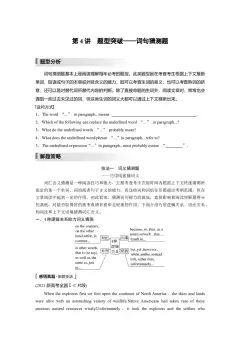
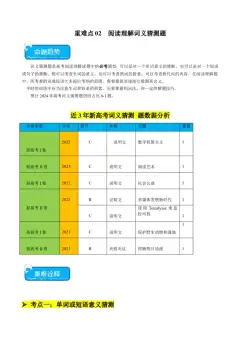
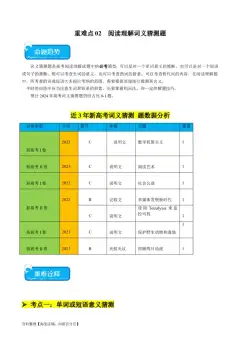
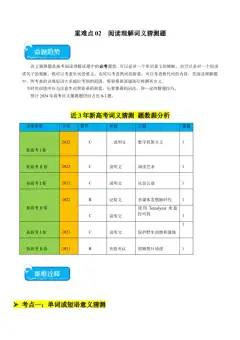
题型03 阅读理解词义猜测题
题型简介
词义猜测题是高考英语阅读理解中的基础且关键的题型,它重点考查考生在具体语境中推断
生词、短语,句子或代词指代含义的能力。与依赖词汇记忆不同,该题型要求考生通过分析上下
文线索(如定义、解释、同反义关系、举例或逻辑因果)来进行合理推断。其答案通常不会直接
呈现,而是隐含在字里行间,需要考生进行逻辑分析和信息整合。常见考查对象包括生词、熟词
生义、短语及代词指代。掌握此题型,不仅能提升应试能力,更有助于培养真正的语篇理解能力。
设题类型&命题方式
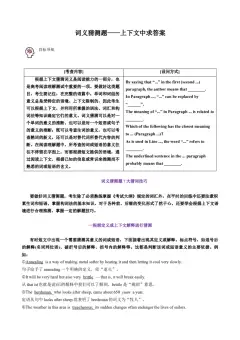
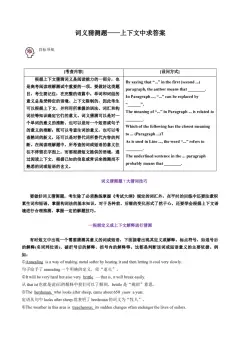
1. 词义猜测题:词义猜测题主要考查考生在短时间内根据上下文快速猜测所指定的某一个单
词或词组含义的能力,这些词和词组往往超出考纲范围,但在文章阅读中起到一定的作用。词义猜测
题的设问方式主要有:What does...” in paragraph...mean/refer to? What's closest in meaning to “...” in para
the underlined word/phrase “graph. .. ? Which of the following best explains “... " underlined in paragraph...?
Which expression can best replace the underlined word/phrase “. ..”in paragraph...?
2. 句意猜测题:高考阅读理解有时会对某一个句子的本意或外延含义进行考查,因此要求考生
准确理解前后句所表达的含义, 巧解句意猜测题。设问方式有:What does the underlined
expression/sentence“...”in paragraph...mean?
3. 代词指代题:代词指代题常出现在人物或事物变换多、动作转换频繁的语境中,考生应根据
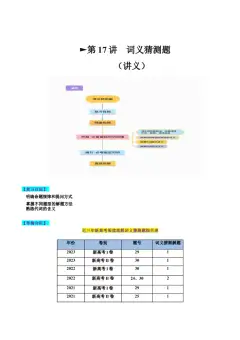
目录
第一部分 题型解码 高屋建瓴,掌握全局
第二部分 考向破译
解
微观
剖,精细教学
典例引领
方法透视
变式演练
考向01 词义猜测题【必考】
考向02 句意猜测题【重难】
考向03 代词指代题
第三部分 综合巩固 整合应用,模拟实战
专题01 高考真题练
专题02 优秀模拟题
语境判断人称代词、不定代词和指示代词的指代对象。有时也会考查定语从句中关系代词的指代
内容。常见的设问形式有:What does the underlined word “that/this/it/...” in paragraph. .. refer to?

解题思路
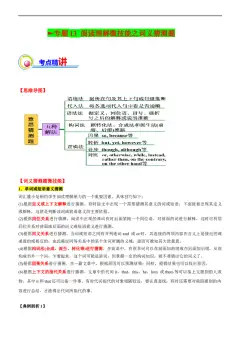
1: 词义猜测题解题思路
解答词义猜测题的核心原则是 “瞻前顾后”
即紧密依托上下文语境,通过分析逻辑关系
——
、
语法结构、构词法和同义/反义线索来进行合理推断,而非依赖词汇的字典释义。
核心心法:语境为王,线索为纲。永远记住,答案藏在生词的“左邻右舍”里。你的任务就
是成为一名侦探,在上下文中寻找所有可能的线索。
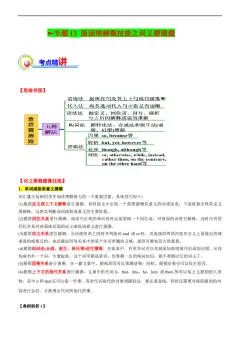
1. 利用逻辑关系:通过识别上下文中的逻辑信号词来推断词义。
转折关系 (but, however, yet):画线词的意思通常与信号词后的意思相反或形成对比。
因果关系 (because, so, therefore):结果或原因部分常能解释画线词的涵义。
对比关系 (while, unlike, in contrast):通过对比双方的反义关系来推测词义。
并列或选择关系 (and, or, similarly, otherwise):连接的内容意思相近或提供选择范围,可相互参
照。
2. 利用语法与标点:某些语法结构和标点符号直接提供了解释说明的线索。
定义与解释 (be called, mean, refer to, that is):信号词后的内容是对画线词的直接定义。
同位语与定语从句:通常对前面的画线词进行补充说明或解释。
举例说明 (such as, for example, like):例子所体现的共同特征揭示了画线词的含义。
标点符号 (冒号、破折号、括号):这些符号后面的内容常是对画线词的进一步解释。
3. 利用构词法:通过分析单词的构成部分来推测词义。
合成词:将各组成部分(通常是两个熟悉的单词)的意思综合起来。
例如:heartbreaking = heart (心) + breaking (打破) → 令人心碎的
派生词:将词根的含义与前缀、后缀的含义相结合。
例如:unpredictable = un- (不) + pre- (前) + dict (说) + -able (能
的
…
) → 无法预言的
4. 利用上下文语义:通过寻找上下文中与画线词形成同义、近义或反义关系的词语或句子来
推断。
2. 句意猜测题解题思路
解题核心在于紧扣上下文,通过“定位-寻找-分析-对比”四步法,推断画线句的深层含义。
第一步:定位:返回原文,精确找到画线句所在位置。
第二步:寻找:以画线句为中心,向前后文辐射,寻找与之存在逻辑或语义关联的信息句。
这些句子是推敲句意的直接依据。
第三步:分析:仔细研读找到的信息句,分析与画线句之间的逻辑关系(如因果、解释、转
折、举例等),并据此进行合理推断,初步理解画线句的语境意义。
第四步:对比:将分析得出的句意与各个选项进行仔细比对。正确选项并非字面直译,而是
能与上下文信息相互印证、意义吻合的同义转述或合理引申。需排除那些偏离核心语义、过度解
读或与文意相悖的干扰项。
3. 代词指代题解题思路
核心原则与定位:解答此类题型,首要任务是精确定位画线代词在文中的位置。需谨记一个
关键语法规则:代词永远出现在其所指代的原词(即先行词)之后。因此,解题范围应锁定在画
线词之前的上文。
核心方法:就近原则与逻辑分析:解题的核心方法是 “就近原则” 。在绝大多数情况下,
代词所指代的内容是离它最近的、在语法和逻辑上相匹配的名词或名词性短语。解题时,应优先
在同一句子或前一句中寻找可能的指代对象。
系统解题步骤
1. 判断类型:首先识别画线代词的类型,常见考向包括人称代词(如it, they)、指示代词
(如this, that)、不定代词(如some, another)和关系代词(如which, that)。不同类型的代词,其
指代特点和范围略有不同。
2. 向前搜寻:根据“就近原则”,在画线词之前的上文中,由近及远地寻找与代词在单复数、
性别、人称上保持一致的候选名词。
3. 分析概括:找到候选词后,需分析其与画线词所在句子的逻辑关系。特别是指示代词(如
this/that),它们所指代的可能不是一个单一名词,而是前文所述的整个事件、观点或情况。此时
需要对前文信息进行准确的概括与归纳。
4. 代入验证:最后,将确定的指代内容代入原句中替换掉画线代词,通读检查其是否能使句
子意思完整、逻辑通顺。这是验证答案是否正确无误的关键一步。
考向01 词义猜测题
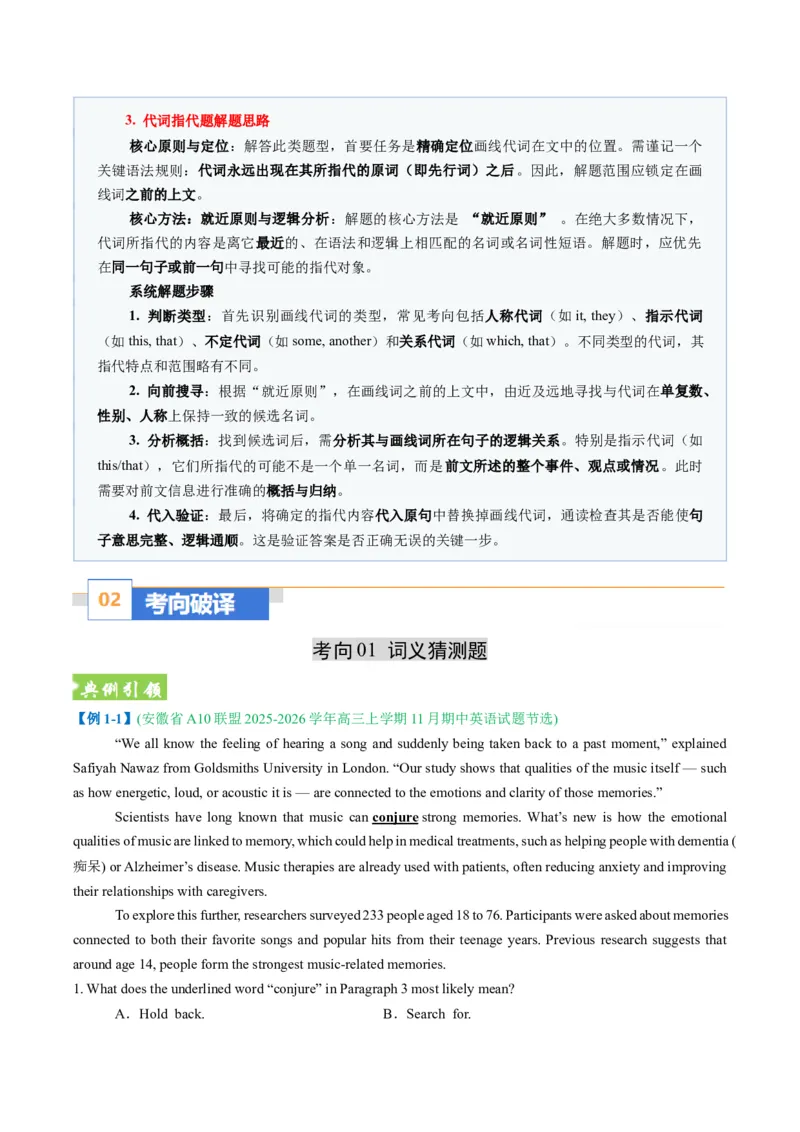
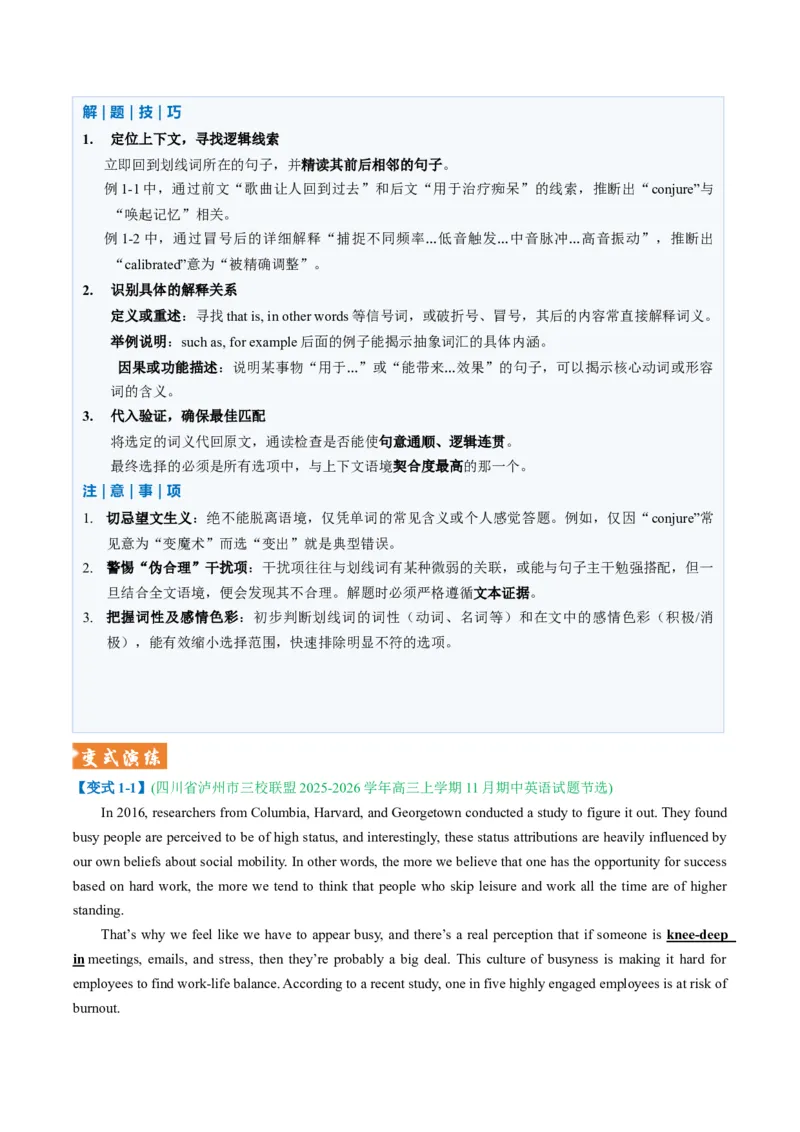
【例1-1】(安徽省A10 联盟2025-2026 学年高三上学期11 月期中英语试题节选)
“We all know the feeling of hearing a song and suddenly being taken back to a past moment,” explained
Safiyah Nawaz from Goldsmiths University in London. “Our study shows that qualities of the music itself — such
as how energetic, loud, or acoustic it is — are connected to the emotions and clarity of those memories.”
Scientists have long known that music can conjure strong memories. What’s new is how the emotional
qualities of music are linked to memory, which could help in medical treatments, such as helping people with dementia (
痴呆) or Alzheimer’s disease. Music therapies are already used with patients, often reducing anxiety and improving
their relationships with caregivers.
To explore this further, researchers surveyed 233 people aged 18 to 76. Participants were asked about memories
connected to both their favorite songs and popular hits from their teenage years. Previous research suggests that
around age 14, people form the strongest music-related memories.
1. What does the underlined word “conjure” in Paragraph 3 most likely mean?
A.Hold back.
B.Search for.
C.Put down.
D.Bring about.
【答案】D
【详解】 词句猜测题。根据第二段 "Our study shows that qualities of the music itself - such as how
energetic, loud, or acoustic it is- are connected to the emotions and clarity of those memories.(我们的研
究表明,音乐本身的特质(比如其能量感、音量的大小或者原生化程度)与那些记忆所引发的情绪以及清晰
度之间存在着关联)”以及划线词后文“What's new is how the emotional qualities of music are linked to
memory, which could help in medical treatments, such as helping people with dementia (痴果)or Alzheimer's
disease. Music therapies are already used with patients, often reducing anxiety and improving their
relationships with caregivers.(新的发现在于音乐所蕴含的情感特质与记忆之间存在着怎样的关联,这一发现
或许能为医疗治疗带来帮助,比如有助于治疗痴呆症或阿尔茨海默病忠者。音乐疗法已经在患者中得到应
用,通常能减轻患者的焦虑情绪,并改善他们与护理人员之间的关系)”可知,上下文提到“听到一首歌突
说明音乐能“唤起”强烈记忆。故划线词意思是“引起;促成”,与Bring about 意义相近。故选D。然回到
过去的时刻”,
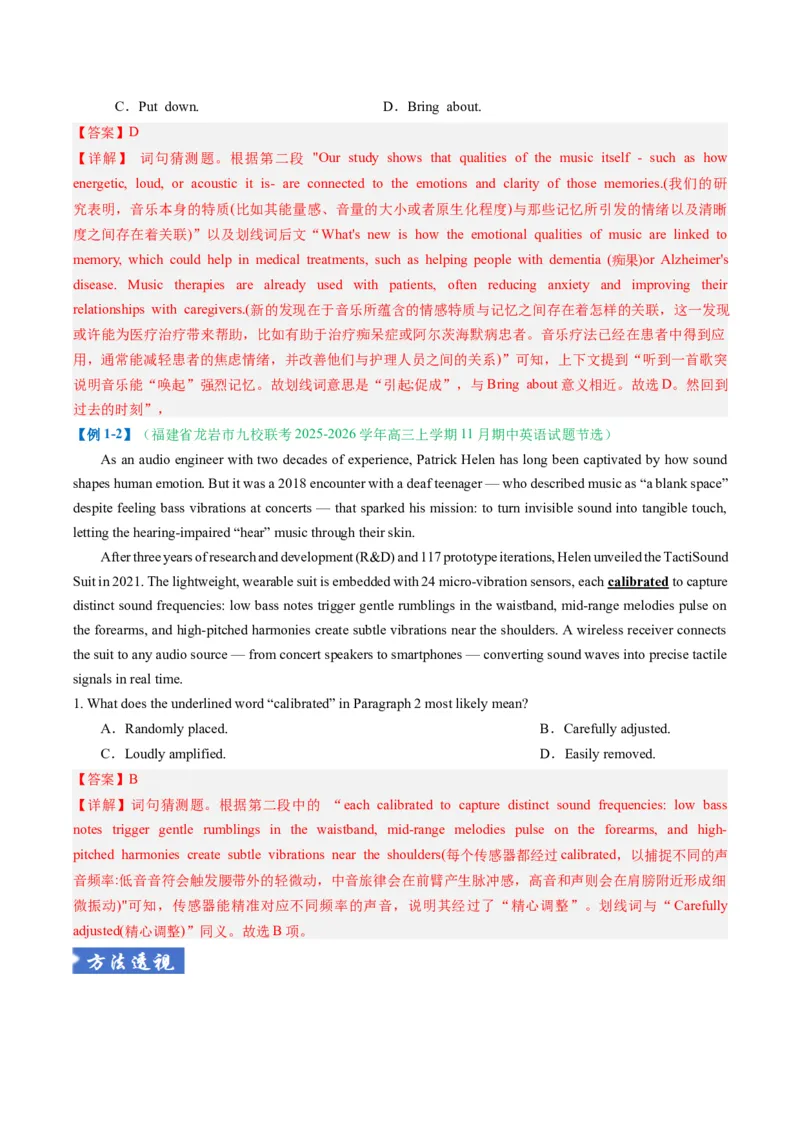
【例1-2】(福建省龙岩市九校联考2025-2026 学年高三上学期11 月期中英语试题节选)
As an audio engineer with two decades of experience, Patrick Helen has long been captivated by how sound
shapes human emotion. But it was a 2018 encounter with a deaf teenager — who described music as “a blank space”
despite feeling bass vibrations at concerts — that sparked his mission: to turn invisible sound into tangible touch,
letting the hearing-impaired “hear” music through their skin.
After three years of research and development (R&D) and 117 prototype iterations, Helen unveiled the TactiSound
Suit in 2021. The lightweight, wearable suit is embedded with 24 micro-vibration sensors, each calibrated to capture
distinct sound frequencies: low bass notes trigger gentle rumblings in the waistband, mid-range melodies pulse on
the forearms, and high-pitched harmonies create subtle vibrations near the shoulders. A wireless receiver connects
the suit to any audio source — from concert speakers to smartphones — converting sound waves into precise tactile
signals in real time.
1. What does the underlined word “calibrated” in Paragraph 2 most likely mean?
A.Randomly placed.
B.Carefully adjusted.
C.Loudly amplified.
D.Easily removed.
【答案】B
【详解】词句猜测题。根据第二段中的 “each calibrated to capture distinct sound frequencies: low bass
notes trigger gentle rumblings in the waistband, mid-range melodies pulse on the forearms, and high-
pitched harmonies create subtle vibrations near the shoulders(每个传感器都经过calibrated,以捕捉不同的声
音频率:低音音符会触发腰带外的轻微动,中音旅律会在前臂产生脉冲感,高音和声则会在肩膀附近形成细
微振动)"可知,传感器能精准对应不同频率的声音,说明其经过了“精心调整”。划线词与“ Carefully
adjusted(精心调整)”同义。故选B 项。
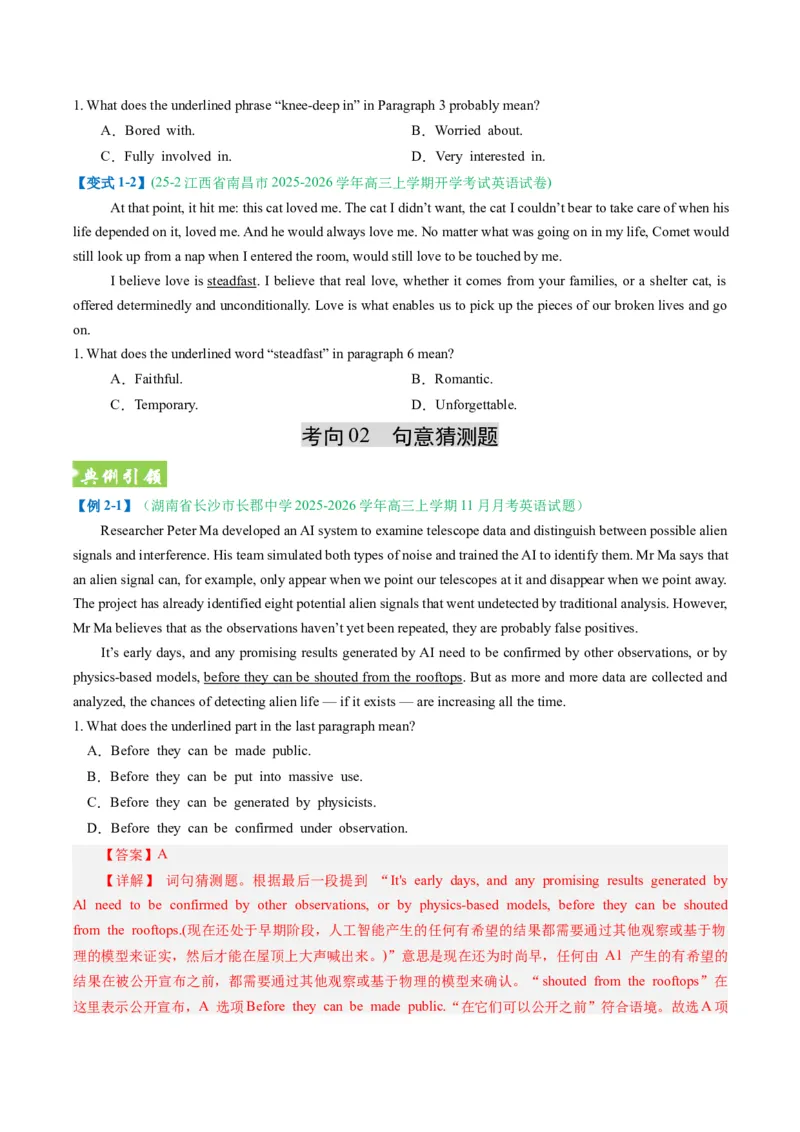
【变式1-1】(四川省泸州市三校联盟2025-2026 学年高三上学期11 月期中英语试题节选)
In 2016, researchers from Columbia, Harvard, and Georgetown conducted a study to figure it out. They found
busy people are perceived to be of high status, and interestingly, these status attributions are heavily influenced by
our own beliefs about social mobility. In other words, the more we believe that one has the opportunity for success
based on hard work, the more we tend to think that people who skip leisure and work all the time are of higher
standing.
That’s why we feel like we have to appear busy, and there’s a real perception that if someone is knee-deep
in meetings, emails, and stress, then they’re probably a big deal. This culture of busyness is making it hard for
employees to find work-life balance. According to a recent study, one in five highly engaged employees is at risk of
burnout.
解|题|技|巧
1.
定位上下文,寻找逻辑线索
立即回到划线词所在的句子,并精读其前后相邻的句子。
例1-1 中,通过前文“歌曲让人回到过去”和后文“用于治疗痴呆”的线索,推断出“conjure”与
“唤起记忆”相关。
例1-2 中,通过冒号后的详细解释“捕捉不同频率
低音触发
中音脉冲
高音振动”,推断出
…
…
…
“calibrated”意为“被精确调整”。
2.
识别具体的解释关系
定义或重述:寻找that is, in other words 等信号词,或破折号、冒号,其后的内容常直接解释词义。
举例说明:such as, for example 后面的例子能揭示抽象词汇的具体内涵。
因果或功能描述:说明某事物“用于
”或“能带来
效果”的句子,可以揭示核心动词或形容
…
…
词的含义。
3.
代入验证,确保最佳匹配
将选定的词义代回原文,通读检查是否能使句意通顺、逻辑连贯。
最终选择的必须是所有选项中,与上下文语境契合度最高的那一个。
注|意|事|项
1.
切忌望文生义:绝不能脱离语境,仅凭单词的常见含义或个人感觉答题。例如,仅因“conjure”常
见意为“变魔术”而选“变出”就是典型错误。
2.
警惕“伪合理”干扰项:干扰项往往与划线词有某种微弱的关联,或能与句子主干勉强搭配,但一
旦结合全文语境,便会发现其不合理。解题时必须严格遵循文本证据。
3.
把握词性及感情色彩:初步判断划线词的词性(动词、名词等)和在文中的感情色彩(积极/消
极),能有效缩小选择范围,快速排除明显不符的选项。
1. What does the underlined phrase “knee-deep in” in Paragraph 3 probably mean?
A.Bored with.
B.Worried about.
C.Fully involved in.
D.Very interested in.
【变式1-2】(25-2 江西省南昌市2025-2026 学年高三上学期开学考试英语试卷)
At that point, it hit me: this cat loved me. The cat I didn’t want, the cat I couldn’t bear to take care of when his
life depended on it, loved me. And he would always love me. No matter what was going on in my life, Comet would
still look up from a nap when I entered the room, would still love to be touched by me.
I believe love is steadfast. I believe that real love, whether it comes from your families, or a shelter cat, is
offered determinedly and unconditionally. Love is what enables us to pick up the pieces of our broken lives and go
on.
1. What does the underlined word “steadfast” in paragraph 6 mean?
A.Faithful.
B.Romantic.
C.Temporary.
D.Unforgettable.
考向02  句意猜测题
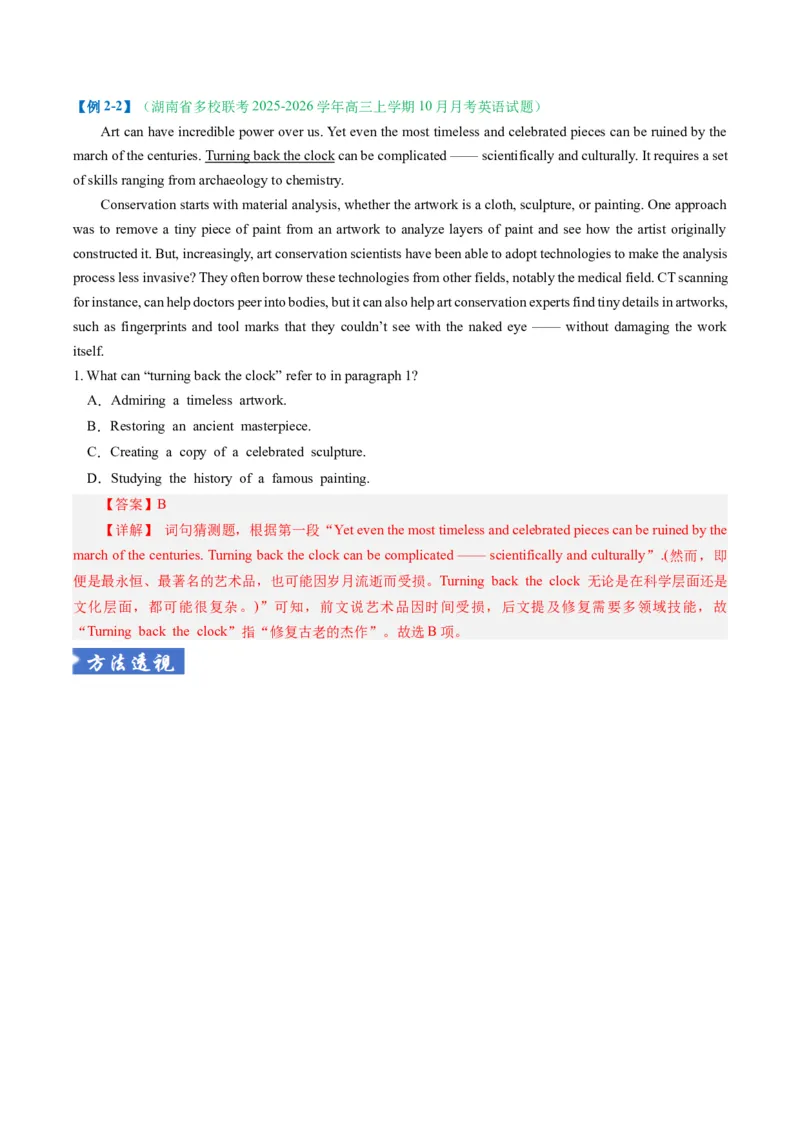
【例2-1】(湖南省长沙市长郡中学2025-2026 学年高三上学期11 月月考英语试题)
Researcher Peter Ma developed an AI system to examine telescope data and distinguish between possible alien
signals and interference. His team simulated both types of noise and trained the AI to identify them. Mr Ma says that
an alien signal can, for example, only appear when we point our telescopes at it and disappear when we point away.
The project has already identified eight potential alien signals that went undetected by traditional analysis. However,
Mr Ma believes that as the observations haven’t yet been repeated, they are probably false positives.
It’s early days, and any promising results generated by AI need to be confirmed by other observations, or by
physics-based models, before they can be shouted from the rooftops. But as more and more data are collected and
analyzed, the chances of detecting alien life — if it exists — are increasing all the time.
1. What does the underlined part in the last paragraph mean?
A.Before they can be made public.
B.Before they can be put into massive use.
C.Before they can be generated by physicists.
D.Before they can be confirmed under observation.
【答案】A
【详解】 词句猜测题。根据最后一段提到 “It's early days, and any promising results generated by
Al need to be confirmed by other observations, or by physics-based models, before they can be shouted
from the rooftops.(现在还处于早期阶段,人工智能产生的任何有希望的结果都需要通过其他观察或基于物
理的模型来证实,然后才能在屋顶上大声喊出来。)”意思是现在还为时尚早,任何由 A1 产生的有希望的
结果在被公开宣布之前,都需要通过其他观察或基于物理的模型来确认。“shouted from the rooftops”在
这里表示公开宣布,A 选项Before they can be made public.“在它们可以公开之前”符合语境。故选A 项
【例2-2】(湖南省多校联考2025-2026 学年高三上学期10 月月考英语试题)
Art can have incredible power over us. Yet even the most timeless and celebrated pieces can be ruined by the
march of the centuries. Turning back the clock can be complicated —— scientifically and culturally. It requires a set
of skills ranging from archaeology to chemistry.
Conservation starts with material analysis, whether the artwork is a cloth, sculpture, or painting. One approach
was to remove a tiny piece of paint from an artwork to analyze layers of paint and see how the artist originally
constructed it. But, increasingly, art conservation scientists have been able to adopt technologies to make the analysis
process less invasive? They often borrow these technologies from other fields, notably the medical field. CT scanning
for instance, can help doctors peer into bodies, but it can also help art conservation experts find tiny details in artworks,
such as fingerprints and tool marks that they couldn’t see with the naked eye —— without damaging the work
itself.
1. What can “turning back the clock” refer to in paragraph 1?
A.Admiring a timeless artwork.
B.Restoring an ancient masterpiece.
C.Creating a copy of a celebrated sculpture.
D.Studying the history of a famous painting.
【答案】B
【详解】 词句猜测题,根据第一段“Yet even the most timeless and celebrated pieces can be ruined by the
march of the centuries. Turning back the clock can be complicated —— scientifically and culturally”.(然而,即
便是最永恒、最著名的艺术品,也可能因岁月流逝而受损。Turning back the clock 无论是在科学层面还是
文化层面,都可能很复杂。)”可知,前文说艺术品因时间受损,后文提及修复需要多领域技能,故
“Turning back the clock”指“修复古老的杰作”。故选B 项。
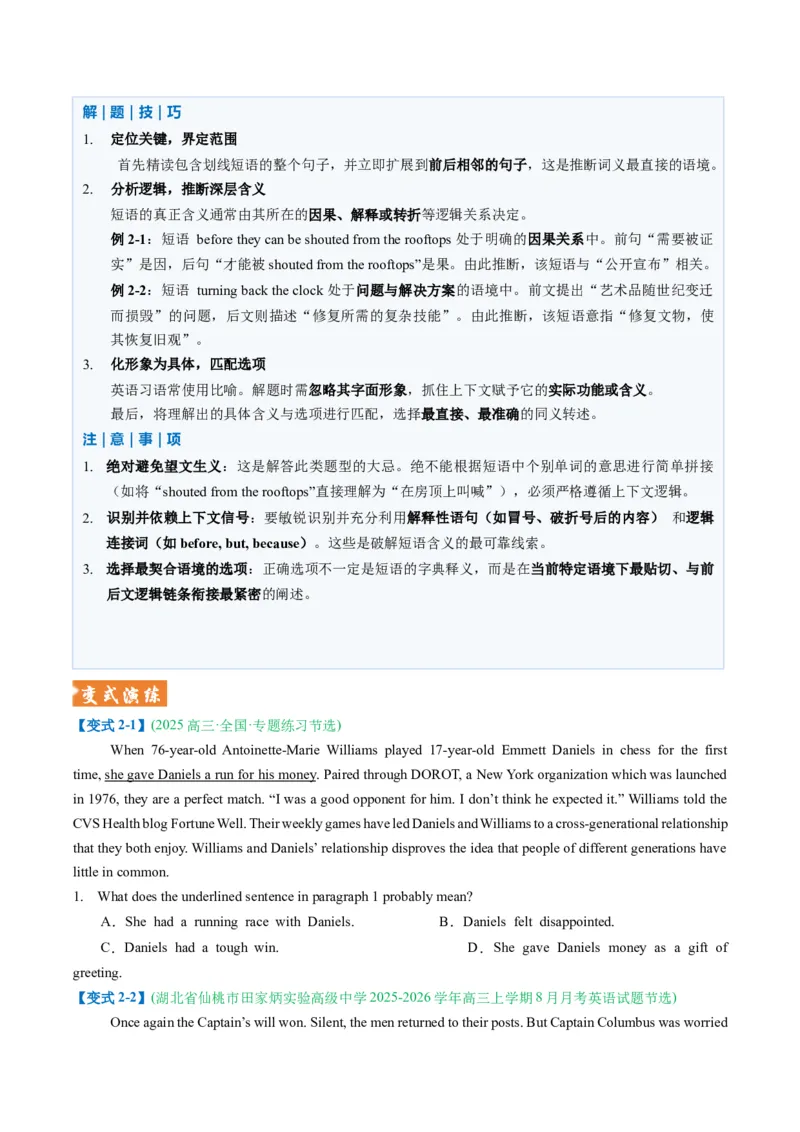
【变式2-1】(2025 高三·全国·专题练习节选)
When 76-year-old Antoinette-Marie Williams played 17-year-old Emmett Daniels in chess for the first
time, she gave Daniels a run for his money. Paired through DOROT, a New York organization which was launched
in 1976, they are a perfect match. “I was a good opponent for him. I don’t think he expected it.” Williams told the
CVS Health blog Fortune Well. Their weekly games have led Daniels and Williams to a cross-generational relationship
that they both enjoy. Williams and Daniels’ relationship disproves the idea that people of different generations have
little in common.
1.  What does the underlined sentence in paragraph 1 probably mean?
A.She had a running race with Daniels.
B.Daniels felt disappointed.
C.Daniels had a tough win.
D.She gave Daniels money as a gift of
greeting.
【变式2-2】(湖北省仙桃市田家炳实验高级中学2025-2026 学年高三上学期8 月月考英语试题节选)
Once again the Captain’s will won. Silent, the men returned to their posts. But Captain Columbus was worried
解|题|技|巧
1.
定位关键,界定范围
首先精读包含划线短语的整个句子,并立即扩展到前后相邻的句子,这是推断词义最直接的语境。
2.
分析逻辑,推断深层含义
短语的真正含义通常由其所在的因果、解释或转折等逻辑关系决定。
例2-1:短语 before they can be shouted from the rooftops 处于明确的因果关系中。前句“需要被证
实”是因,后句“才能被shouted from the rooftops”是果。由此推断,该短语与“公开宣布”相关。
例2-2:短语 turning back the clock 处于问题与解决方案的语境中。前文提出“艺术品随世纪变迁
而损毁”的问题,后文则描述“修复所需的复杂技能”。由此推断,该短语意指“修复文物,使
其恢复旧观”。
3.
化形象为具体,匹配选项
英语习语常使用比喻。解题时需忽略其字面形象,抓住上下文赋予它的实际功能或含义。
最后,将理解出的具体含义与选项进行匹配,选择最直接、最准确的同义转述。
注|意|事|项
1.
绝对避免望文生义:这是解答此类题型的大忌。绝不能根据短语中个别单词的意思进行简单拼接
(如将“shouted from the rooftops”直接理解为“在房顶上叫喊”),必须严格遵循上下文逻辑。
2.
识别并依赖上下文信号:要敏锐识别并充分利用解释性语句(如冒号、破折号后的内容) 和逻辑
连接词(如before, but, because)。这些是破解短语含义的最可靠线索。
3.
选择最契合语境的选项:正确选项不一定是短语的字典释义,而是在当前特定语境下最贴切、与前
后文逻辑链条衔接最紧密的阐述。
because he knew in his heart that a day would come when his words would no longer help. Before that day, he would
see land.
Not an eye closed that night. The Captain stood on the high poop (艉楼) and with sleepless eyes he tried hard to
look into the darkness ahead.
Then, two hours before midnight, the miracle happened. A far-off light struck his eyes. It wavered (摇曳) once
or twice, moving quickly on the horizon, like a fisherman’s boat on the waves.
1. What’s the meaning of the underlined sentence “Not an eye closed that night”?
A.Captain Columbus had been awake for the whole night.
B.Captain Columbus kept an eye closed that night.
C.Captain Columbus had one eye open that night.
D.Captain Columbus had slept heavily for the whole night.
考向03 代词指代题
【例3-1】(福建省泉州市第七中学2025 学年高三上学期第一次返校考英语试卷节选)
Despite the celebrations, though, in the U.S. the jazz audience continues to shrink and grow older, and the music
has failed to connect with younger generations.
It’s Jason Moran’s job to help change that. As the Kennedy Center’s artistic adviser for jazz, Moran hopes to
widen the audience for jazz, make the music more accessible, and preserve its history and culture.
1. What does the underlined word “that” in paragraph 3 refer to?
A.Jazz becoming more accessible.
B.Jazz being less popular with the young.
C.The production of jazz growing faster.
D.The jazz audience becoming larger.
【答案】B
【详解】词句猜测题。根据第二段“Despite the celebrations, though, in the U.s, the jazz audience
continues to shrink and grow older, and the music has failed to connect with younger generations.(然而,
尽管有这些庆祝活动,但在美国,爵士乐的受众群体仍在不新缩减目年龄日趋老龄化,这种音乐也未能打
动年轻一代。)”和第三段"it's Jason Moran's job to help change that.(as on Moran 的职责就是助力改变这
一现状。)”可知,第三段中的that 指代的是爵士乐在年轻人中受欢迎程度降低。故选B
【例3-2】(湖南省部分学校2025-2026 学年高三上学期9 月大联考英语试卷节选)
Though many self-improvement books claim “imagine it and it will happen”, this is actually the opposite of
what you should be doing. The best preparation for the future is to imagine the process — not the outcome — of your
desired future event. One study showed that when students imagined desired outcomes (good grades for an upcoming
test) they performed significantly worse than students who imagined the process of getting to the desired outcomes
(imagining studying thoroughly). Perhaps now you have something to keep in mind for your New Year’s
resolutions?
1. What does “something” underlined in the last paragraph probably indicate?
A.How you will achieve your goal.
B.What goal you want to achieve.
C.What future events will affect you.
D.How future events will take place.
【答案】A
【详解】代词指代题。根据最后一段中“The best preparation for the future is to imagine the process — not the
outcome — of your desired future event. One study showed that when students imagined desired outcomes (good
grades for an upcoming test) they performed significantly worse than students who imagined the process of getting
to the desired outcomes (imagining studying thoroughly)”.(为未来做最好的准备,是设想你所期望的未来事件
的过程,而非其结果。一项研究表明,当学生设想期望的结果(即将到来的考试取得好成绩)时,他们的表
现明显不如那些设想达到期望结果的过程(设想自己彻底学习)的学生)”可知,为未来做准备的最佳方式是
想象实现目标的过程,而非结果。最后一段中划线词something 指的是如何实现目标,即想象实现目标的
过程。故选A。
【变式3-1】(2025 高三·全国·专题练习节选)
•Built-in brain
Roads of the future may be able to know how many people are on them. They could send  them

  updates on
weather and traffic jams, and recharge electric cars as they drive.
This seems to be a dream, but one American company has almost made it come true. By sensing the weight of
a vehicle, the company’s smart roads can track the speed of each wheel. “We are basically making very large
touchpads,” says Tim Sylvester, CEO of the company. “But instead of looking for fingers, our roads look for tires.”
After having collected traffic data, the roads will send it to the drivers.
1. The underlined word “them” (in the “Built-in brain” section) refers to “_________”.
A.the roads
B.the people
解|题|技|巧
1.
定位与前瞻:锁定上文
代词永远指向其上文(前文) 已出现的内容。解题时,应立刻在前一、两句中寻找线索。
2.
应用就近原则与逻辑匹配
优先考虑与画线代词在空间上最近的名词、名词短语或句子,但必须确保其在单复数、性别和逻
辑上与代词保持一致。
例3-1:that 作为单数代词,指代前文离它最近且逻辑完整的核心问题
“爵士听众减少并老龄
——
化,未能连接年轻一代”,即“在年轻人中不受欢迎”的状况。
3.
概括抽象概念
当代词(如this, that, something)指代一个观点、方法或现象时,需要对前文信息进行准确的概括。
例3-2:something 指代的不是某个具体名词,而是前文详细阐述的完整方法论
“为未来做最
——
好的准备是想象过程而非结果”。因此,它指代的是“如何实现目标”这种方法。
4.
代入验证
将确定的指代内容代入原句,通读检查是否使文意通顺、逻辑成立。这是验证答案的关键一步。
注|意|事|项
1.
避免“就近陷阱”
不能机械地选择离代词最近的那个词,而必须进行逻辑判断。要确保找到的指代内容能使句子意
思完整。
2.
区分具体与抽象
明确代词指代的是一个具体事物,还是一个抽象观点或方法。这决定了你是在寻找一个名词,还
是需要概括一段论述。
3.
关注指代内容的一致性
确保你找到的指代对象与代词在单复数、人称和逻辑主语上完全匹配。
C.the electric cars
D.the traffic data
【变式3-2】(2025 高三·全国·专题练习)
“Plant-for-the-Planet” came out of a school project when Finkbeiner was a fourth-grader. The topic was climate
change. To his nine-year-old worldview, that meant a danger to his favorite animal, the polar bear. The boy began to
do his research online. Instead of information about polar bears, he found stories about Wangari Maathai. The Kenyan
woman had planted 30 million trees in order to fix the environment of her hometown. The effort won her the Nobel
Peace Prize in 2004.
Finkbeiner realized that it was not really about saving polar bears. Instead, it was about saving humans. He
made a big decision: to plant one million trees in Germany. He talked about it with his schoolmates and with his head
teacher. No one expected anything to come of it, but the boy was serious about his goal. Two months later,
Finkbeiner planted his first tree, a crab apple (酸苹果树), near the entrance to his school.
1. The underlined word “it”(in Paragraph 4)refers to “________”.
A.the polar bear.
B.fighting climate change.
C.the 2004 Nobel Peace Prize.
D.the fourth-grade school project.
专题01 高考真题练
A
(浙江首考2025 年1 月普通高等学校招生全国统一考试英语试题)
A novel design approach to gardening has been gaining in popularity worldwide. Referred to as matrix planting,
this approach aims for nature to do a lot more of the heavy lifting in the garden, and even some of the designing.
Eschewing fertilizers (化肥) and power tools, it’s based on an elegantly simple principle: to garden more like nature
does.
The concept was born when German city planners sought to plant large areas of parkland after World War II
in a reproducible way that would need minimal maintenance. Planners created planting mixes that could be used
modularly (模块化). In a matrix garden, plants with similar cultural needs are grouped so that they will grow together
above and below ground, forming a cooperative ecosystem that conserves water and discourages weeds.
Dutch plantsman and designer Piet Oudolf’s gardens popularized this style, adding artistic flavors to the
planting mixes while playing with color and form, including four-season interest and serving the needs of wildlife.
Beautiful year-round, they invite you to enjoy the smallest detail, from the sound of grasses in the gentle wind to the
sculpture of odd-looking seed heads.
It takes a lot of thought to look this natural. While matrix gardens appear wild, they are carefully planned, with
cultural needs the first consideration. Led by the concept of “right plant, right place,” they match plants that enjoy
the same soil, sun and weather conditions, and arrange them according to their patterns of growth.
The benefits are substantial for both gardener and planet. With human inputs dramatically reduced, the garden’s
ecology can develop well. Established matrix gardens should not need the life support we give most gardens: fertilizer,
dividing, regular watering. Compared to traditional garden plots, they increase carbon absorption, reduce stormwater
runoff and boost habitat and biodiversity significantly.
1.What does the underlined word “Eschewing” in the first paragraph mean?
A.Running out of.
B.Keeping away from.
C.Putting up with.
D.Taking advantage of.
2.Why was the idea of matrix planting introduced?
A.To control weeds in large gardens.
B.To bring in foreign species of plants.
C.To conserve soil and water resources.
D.To develop low-maintenance parkland.
3.Which of the following best describes Piet Oudolf’s gardens?
A.Traditional.
B.Odd-looking.
C.Tasteful.
D.Well-protected.
4.Which of the following can be a suitable title for the text?
A.The future of gardening is WILD.
B.Nature treats all lives as EQUALS.
C.Matrix gardens need more CARE.
D.Old garden plots work WONDERS.
B
(2024 年新课标全国Ⅱ卷英语真题)
Given the astonishing potential of AI to transform our lives, we all need to take action to deal with our AI-
powered future, and this is where AI by Design: A Plan for Living with Artificial Intelligence comes in. This
absorbing new book by Catriona Campbell is a practical roadmap addressing the challenges posed by the forthcoming
AI revolution (变革).
In the wrong hands, such a book could prove as complicated to process as the computer code (代码) that
powers AI but, thankfully, Campbell has more than two decades’ professional experience translating the heady into
the understandable. She writes from the practical angle of a business person rather than as an academic, making for
a guide which is highly accessible and informative and which, by the close, will make you feel almost as smart as
AI.
As we soon come to learn from AI by Design, AI is already super-smart and will become more capable, moving
from the current generation of “narrow-AI” to Artificial General Intelligence. From there, Campbell says, will come
Artificial Dominant Intelligence. This is why Campbell has set out to raise awareness of AI and its future now —
several decades before these developments are expected to take place. She says it is essential that we keep control of
artificial intelligence, or risk being sidelined and perhaps even worse.
Campbell’s point is to wake up those responsible for AI—the technology companies and world leaders—so
they are on the same page as all the experts currently developing it. She explains we are at a “tipping point” in history
and must act now to prevent an extinction-level event for humanity. We need to consider how we want our future
with AI to pan out. Such structured thinking, followed by global regulation, will enable us to achieve greatness rather
than our downfall.
AI will affect us all, and if you only read one book on the subject, this is it.
1.What does the phrase “In the wrong hands” in paragraph 2 probably mean?
A.If read by someone poorly educated.
B.If reviewed by someone ill-intentioned.
C.If written by someone less competent.
D.If translated by someone unacademic.
2.What is a feature of AI by Design according to the text?
A.It is packed with complex codes.
B.It adopts a down-to-earth writing style.
C.It provides step-by-step instructions.
D.It is intended for AI professionals.
3.What does Campbell urge people to do regarding AI development?
A.Observe existing regulations on it.
B.Reconsider expert opinions about it.
C.Make joint efforts to keep it under control.
D.Learn from prior experience to slow it down.
4.What is the author’s purpose in writing the text?
A.To recommend a book on AI.
B.To give a brief account of AI history.
C.To clarify the definition of AI.
D.To honor an outstanding AI expert.
C
(2025 年全国高考一卷英语真题)
In my ninth-grade writing class last year, I met a cowboy who saved his town, a strict father who demanded
his son earn straight A’s, and a modern-day Juliet who died of heartbreak after her parents rejected the love of her
young life. More than once, I found myself wondering just how my students, who’d created these people, knew their
subjects so well.
But things were different for their first essay, which was about the question: “Why is writing important?” Most
of the essays filled less than one page, and few contained a sentence that could be interpreted as a thesis ( 论点)
statement. I was shocked. Then I realized that the problem was the question itself. They could have written pages on
the necessity of computers, but writing, in and of itself, simply didn’t strike them as important. This would have to
change.
As a new unit started, I asked everyone to write a persuasive piece on a health-related topic of their choice.
This time they found the exercise much more interesting. For the next two assignments, a personal-narrative unit
followed by a creative-writing workshop, I only required that the piece meet the specifications of its genre (体裁)
and that it contain a thesis. The results were staggering. The students took on diverse topics and turned in stories, 10
to 20 pages each, with characters that broadened my view and touched my heart.
I walked into class believing that writing is important as a means of communication. However, my students
demonstrated something more important to me. When the final bell rang in June, I walked away with a yearbook full
of messages about writing’s most powerful significance — the ability to connect people, to put us in another’s skin,
to teach us what it means to be human.
1.Who are the people mentioned at the beginning of paragraph 1?
A.Ninth graders.
B.Students’ parents.
C.Modern writers.
D.Fictional characters.
2.Why did the students perform poorly in writing their first essay?
A.They were not given enough time.
B.They had a very limited vocabulary.
C.They misunderstood the question.
D.They had little interest in the topic.
3.What does the underlined word “staggering” in paragraph 3 mean?
A.Mixed.
B.Amazing.
C.Similar.
D.Disturbing.
4.What does the author’s experience show?
A.Teaching is learning.
B.Still waters run deep.
C.Knowledge is power.
D.Practice makes perfect.
D
(2024 年新课标Ⅰ卷英语真题)
Is comprehension the same whether a person reads a text onscreen or on paper? And are listening to and
viewing content as effective as reading the written word when covering the same material? The answers to both
questions are often “no”. The reasons relate to a variety of factors, including reduced concentration, an entertainment
mindset (心态) and a tendency to multitask while consuming digital content.
When reading texts of several hundred words or more, learning is generally more successful when it’s on paper
than onscreen. A large amount of research confirms this finding. The benefits of print reading particularly shine
through when experimenters move from posing simple tasks — like identifying the main idea in a reading passage
— to ones that require mental abstraction — such as drawing inferences from a text.
The differences between print and digital reading results are partly related to paper’s physical properties. With
paper, there is a literal laying on of hands, along with the visual geography of distinct pages. People often link their
memory of what they’ve read to how far into the book it was or where it was on the page.
But equally important is the mental aspect. Reading researchers have proposed a theory called “shallowing
hypothesis (假说)”. According to this theory, people approach digital texts with a mindset suited to social media,
which are often not so serious, and devote less mental effort than when they are reading print.
Audio (音频) and video can feel more engaging than text, and so university teachers increasingly turn to these
technologies — say, assigning an online talk instead of an article by the same person. However, psychologists have
demonstrated that when adults read news stories, they remember more of the content than if they listen to or view
identical pieces.
Digital texts, audio and video all have educational roles, especially when providing resources not available in
print. However, for maximizing learning where mental focus and reflection are called for, educators shouldn’t assume
all media are the same, even when they contain identical words.
1.What does the underlined phrase “shine through” in paragraph 2 mean?
A.Seem unlikely to last.
B.Seem hard to explain.
C.Become ready to use.
D.Become easy to notice.
2.What does the shallowing hypothesis assume?
A.Readers treat digital texts lightly.
B.Digital texts are simpler to understand.
C.People select digital texts randomly.
D.Digital texts are suitable for social media.
3.Why are audio and video increasingly used by university teachers?
A.They can hold students' attention.
B.They are more convenient to prepare.
C.They help develop advanced skills.
D.They are more informative than text.
4.What does the author imply in the last paragraph?
A.Students should apply multiple learning techniques.
B.Teachers should produce their own teaching material.
C.Print texts cannot be entirely replaced in education.
D.Education outside the classroom cannot be ignored.
专题02 优秀模拟题
A
(25-26 高三上·湖南湘东十二校联考·期中)
In the bitter cold of the Arctic and Antarctica, bubbles in ice could become the ideal way to send messages.
Communicating in these regions is easier said than done, as the extreme sub-zero temperatures often limit equipment
with high energy demands. To solve this issue, scientists have pioneered a plan to introduce frozen bubbles messages
as a new method of communication.
And the idea is more than an exercise in frivolity, said Mengjie Song, an expert in thermodynamics (热力
学) at the Beijing Institute of Technology and one of the lead authors of the new study published in the scientific
journal Cell Reports Physical Science. “It is a totally new method for humans to record information,” Dr. Song said.
He and his colleagues found that they could produce different shapes of air pockets in the ice sheet. Those shapes
could be turned into Morse code (莫尔斯电码), which relies on dashes and dots. A camera captured the sequence of
shapes, which were subsequently processed by a computer and translated into English letters and Arabic numerals.
Researchers acknowledged, however, that much more work would have to be done to make such applications
feasible.
This foundational breakthrough opens up a range of potential practical uses. For instance, it could be used to
help create more accurate models for de-icing power lines, airplanes and high- speed trains. A clearer grasp of how
ice bubbles form could also help scientists better understand the thermal and mechanical properties of bricks made
from lunar soil. Trained to recognize patterns in ice bubbles, artificial intelligence (AI) could help study glaciers for
clues about past climate patterns, or identify potential deposits (矿床) of natural gas.
Ice is an ancient substance that is found in every aspect of our lives. More specifically, ice bubbles are already
known to hold clues about the atmospheric conditions that existed when they were formed. “We can not only make
a message, but we can know the message inside it,” Dr. Song said. Although ice bubbles would probably not replace
text messages, the new findings were important. “Science often works this way,” he said. Not all bubbles, maybe, are
fated to burst.
1. What does the underlined word “frivolity” in paragraph 2 mean?
A.An untested theory.
B.A conventional practice.
C.A tough challenge.
D.A meaningless behavior.
2.What do we know about ice bubbles from the text?
A.Their shapes can be processed to record information.
B.Their formation helps in developing de-icing models.
C.They are studied to improve lunar soil brick properties.
D.Their patterns help AI to confirm existing natural gas deposits.
3. What can we infer from “Not all bubbles, maybe, are fated to burst” in paragraph 4?
A.Some ice bubbles may exist permanently.
B.The new research may have lasting value.
C.Ice bubbles would replace text messages.
D.Science relies on ice bubbles to prove key facts.
4. What is the best title for the text?
A.Ice Bubbles for Arctic Communication
B.Morse Code: Ice Bubble Translation Tool
C.Ice Bubbles: Messages and Clues
D.Ice Bubbles and Practical Solutions
B
(25-26 高三上·山东名校考试联盟·期中)
Ever wondered how social media platforms decide how to fill our feeds? They use algorithms (算法), of course,
but how do these algorithms work? In 2021, Frances Haugen, a Facebook product manager secretly took ten thousand
pages of documents and internal messages out of Facebook headquarters. She leaked these to a handful of media
outlets. A lot of stories soon ran, largely focusing on the most alarming, attention-grabbing secrets.
It turns out that Facebook engineers have assigned a point value to each type of engagement users can perform
on a post (liking, commenting, resharing, etc.). Facebook’s algorithm calculates a personalized score for each post to
determine its place in the feed. This score is got by multiplying the probability you’ll perform each engagement —
likes, loves, etc. — by its pre-assigned point value, then summing these products. Posts are then ranked from highest to
lowest

score,

creating

your

tailored

feed.

Then

the

magic

formula

is:
Score=Vlike×Plike+Vlove×Plove+Vangry×Pangry+Vcomment×Pcomment+Vshare×Pshare.
The idea is that the algorithm wants to surface the posts you’re most likely to engage with. Have you ever
seen a TikTok video with overlaid text saying something like “You won’t believe what happens,” or “You’ve gotta
watch till the end?” Some people post videos where literally nothing happens, but they trick you into watching
multiple times, thereby winning even more expected seconds. Comments and seconds watched, no matter what
quality and kind, tell TikTok’s algorithm one thing: “Give me more videos like this.”
Social media algorithms bring the things we engage with closer and closer. Once we start clicking the social
media, we’re going to be served up a lot more of it. It’s a cruel cycle that can quickly turn our feeds into endless
streams of digital trash. Knowing how and why this cycle happens is the first step to stop it. Just remember: the tech
companies choose the Vs in the social media formula, but the Ps are shaped by your actions online.
1. What does the underlined part in paragraph 1 indicate?
A.The social media were affected.
B.The leak went viral immediately.
C.The manager hated Facebook a lot.
D.The secret was an eye-catching event.
2. What is paragraph 2 mainly about?
A.Why Facebook designed a formula.
B.How Facebook determines our feeds.
C.How the formula was created carefully. D.Why users have to be cautious about posts.
3. What does the author intend to tell us with the TikTok example?
A.Algorithms are smart to track everything.
B.Even unintentional watch can tell about our likes.
C.Some people will do everything to attract attention.
D.TikTok has more powerful algorithms than Facebook.
4. What does the author advise us to do?
A.Focus on the positive videos only.
B.Engage less with the content we hate.
C.Comment more on what we appreciate. D.Mind our responses to what is fed to us.
C
(2026 届广东省大湾区高三上学期普通高中毕业年级联合模拟考试英语试卷)
Children are born with the curiosity to explore. Yet over time they are becoming less curious about science.
Why? This loss of interest may be partly the result of language cues (提示) children hear. And these cues don’t come
just from parents; they can also come from school teachers who treat science as an identity rather than actions.
When talking to children, many adults might say things like “Let’s be scientists today!” or “You’re such a good
scientist!”. But this kind of identity-focused language, which focuses on science as an identity rather than activities
and actions that people do, can be demoralizing for young children. One study showed that children as young as
four, especially girls, kept their interest longer when their cue to participate in science activities was “Let’s do science”
rather than “Let’s be scientists.”
One possibility is that when thinking of a scientist, children might picture a white man. If they don’t share that
identity, they lose interest in an activity designed “for scientists.” This stereotypical (刻板印象的) belief that science
is reserved for only certain-kinds of people emerges surprisingly early. By the first grade, when asked to draw a
scientist, children tend to draw a white man.
The good news is that language cues can also be directed to promote engagement with science. Describing
science as actions that we take, for example, seems to protect young children’s interest in science over time. But it’s
also true that teenagers are actively trying on and ultimately forming different identities for themselves. So in contrast
to its demoralizing effects on young children, identity-focused language may help teens stay interested in science. In
another study, cueing a future identity based on science (such as “scientist” or “doctor”) motivated middle schoolers to
do more homework and was associated with higher grades.
Consequently, adults had better use different language cues for children of different age groups to maintain
their curiosity about science.
1.What does the underlined word “demoralizing” in paragraph 2 mean?
A.Inappropriate. B.Impolite.
C.Unconvincing.
D.Discouraging.
2.Why was action-focused language especially effective to young girls?
A.Because it avoids identity conflict in girls’ mind.
B.Because stereotypical belief is reserved for girls.
C.Because it enhances girls’ engagement in science.
D.Because it shows the activity is designed for girls.
3.What may be the author’s suggestion for parents and teachers?
A.To treat language as cues.
B.To use identity-focused language.
C.To adopt flexible strategies.
D.To help teenagers form identities.
4.What can be a suitable title for the text?
A.Why Is Action Better than Identity?
B.How Do Parents Raise Young Scientists?
C.How Does Age Affect Science Learning?
D.What Affects Children’s Interest in Science?
D
(25-26 高三上·河南·期中)
As the world’s appetite for electronic devices grows ever bigger, the other side of the coin — e-waste — is
raising alarms. According to a UN report, 62 million tons of e-waste was generated in 2022, enough to fill 1.5 million
trucks.
Most of the e-waste went to landfills or burning, with potential negative consequences for the environment
and human health. Besides, $62 billion-worth of recyclable resources like rare earth elements are lost in the process.
Currently, just 1% of the world’s demand for these elements, which are necessary to modern electronic devices, is
met by e-waste recycling.
Aquafade, a plastic which can completely dissolve (溶解) in about six hours when placed in water, brings
hope. It could be used in computers or keyboards, and dissolve when they’re no longer wanted, making it easier to
recycle the most valuable components and reducing e-waste.
“For most electronic products, when they’re being recycled, it’s the disassembly ( 拆卸) that’s the real
hassle. Another bottleneck in e-waste recycling is transportation, which raises costs and creates carbon emissions.”
says Samuel Wangsaputra, one of the inventors of Aquafade. “I think the brilliant bit with Aquafade is that a lot of
that process is simply done at home.”
Their challenge is to make a coating (涂层). It is also made of a plastic polymer, only applied to the outer shell,
making the product water resistant up to five meters for 30 minutes, which covers accidental spills or wet weather.
But once we disassemble the product, it creates a crack. That’s when we put it in water to dissolve six hours later,
and what’s left is the most valuable parts of the product.
Peter Edwards, a professor at the University of Oxford, calls it “an interesting development”, but wonders
whether the dissolved plastic will persist in the environment and ultimately end up as microplastic. Samuel
acknowledges they have not yet fully investigated how the solution would biodegrade (生物降解) in the long term.
1. What is the main concern raised about e-waste in paragraph 2?
A.The rising cost of recycling e-waste.
B.The great loss of valuable materials.
C.The insufficient supply of rare earth elements.
D.The public’s appetite for new electronic goods.
2. What does the underlined word “hassle” in paragraph 4 mean?
A.Strategy.
B.Reason.
C.Trouble.
D.Value.
3. What was the primary technical challenge in developing Aquafade?
A.Ensuring the coating dissolves quickly enough.
B.Making a material that biodegrades completely.
C.Applying the coating to the internal parts of a device.
D.Creating a coating resisting water yet dissolving in it.
4.What is Peter Edwards’ attitude to Aquafade?
A.Careful.
B.Supportive.
C.Critical.
D.Unclear.
E
(25-26 高三上·江苏无锡·期中)
Scientists are advancing forward in brain-computer interface (BCI) technology, and a newly developed system
can translate our thoughts into text or sound.
It’s essentially an inner speech decoder (解码器), developed by researchers from institutions across the US. In
tests on four volunteers with severe disabilities, the decoder has an accuracy rate of up to 74 percent in translating
thoughts into audible (听得见的) speech. The potential here is for a BCI that can help those with speech disabilities
to communicate more effectively than ever before.
Previous BCIs have relied on brain activity that is created when a person tries to speak or write, even though
their bodies cannot carry out the action. This new technology gets a step closer to the source. “If you just have to
think about speech instead of actually trying to speak, it’s potentially easier and faster for people,” says neuroscientist
Benjamin Meschede-Krasa, from Stanford University in the US.
Machine learning was used to train the BCI to connect brain signals to words as the four participants thought
about them. The researchers found that there was overlap between certain brain patterns when the volunteers tried
to speak and when they only imagined words and phrases. Despite this, the signals could be distinguished from each
other. With some probability calculations thrown in, the new BCI can recognize up to 125,000 words using only inner
speech. “We found that we could decode these signals well enough to demonstrate a proof of principle, although still
not as well as we could with attempted speech,” says neuroscientist Frank Willett, from Stanford University.
There’s still a long way to go there, and the BCI often falls far short of that 74 maximum accuracy rating.
However, by employing more advanced technology, the researchers are confident that the system can be quickly
improved over the next few years. “This work gives real hope that speech BCIs can one day restore communication
that is as fluent, natural, and comfortable as conversational speech,” says Willett.
1. How does the new BCI system differ from previous ones?
A.It helps healthy people communicate fluently.
B.It doesn’t require the user to try to speak or write.
C.It uses a more advanced machine learning model.
D.It can identify more words with higher accuracy.
2. What does the underlined word “overlap” in paragraph 4 refer to?
A.Gap.
B.Conflict.
C.Balance.
D.Similarity.
3. What is the main problem with the new BCI?
A.Security.
B.Speed.
C.Accuracy.
D.Convenience.
4. What is the text mainly about?
A.A breakthrough in decoding inner speech.
B.The working principle of a new BCI system.
C.Differences between a new BCI and previous ones.
D.Challenges for people with severe speech disabilities.
F
(25-26 高三上·湖北武汉中学·期中)
Fooled by Randomness is a famous book in Nassim Nicholas Taleb’s landmark Incerto series, an investigation
of luck, uncertainty, probability, human error, risk, and decision-making in a world we don’t understand.
Now in a striking new hardcover edition, Fooled by Randomness is the word-of-mouth sensation that will
change the way you think about business and the world. Nassim Nicholas Taleb — seasoned trader, renowned risk
expert, knowledgeable scholar, and New York Times bestselling author of The Black Swan — has written a modern
classic that turns on its head what we believe about luck and skill.
This book is about luck — or more precisely, about how we perceive and deal with luck in life and business.
Set against the backdrop of the most notable forum in which luck is mistaken for skill — the world of trading — Fooled
by Randomness provides captivating insight into one of the least understood factors in all our lives. Writing in an
entertaining narrative style, the author tackles major intellectual issues related to the underestimation of the influence
of happenstance on our lives.
The book is populated with a number of characters, some of whom have grasped, in their own way, the
significance of chance: the baseball legend Yogi Berra; the philosopher of knowledge Karl Popper; the modern
financier George Soros; and the Greek voyager Odysseus. We also meet the fictional Nero, who seems to understand
the role of randomness in his professional life but falls victim to his own irrational foolishness.
However, the most recognizable character of all remains unnamed — the lucky fool who happens to be in the
right place at the right time — he embodies the “survival of the least fit.” Such individuals attract devoted followers
who believe in their mentor’s (导师) insights and methods. But no one can copy what is obtained by chance.
Are we capable of distinguishing the fortunate charlatan (冒充内行的人) from the genuine innovator? Must
we always try to uncover nonexistent messages in random events? It may be impossible to guard ourselves against
the unpredictability of the goddess Fortuna, but after reading Fooled by Randomness we can be a little better
prepared.
1. What is Fooled by Randomness mainly about?
A.The success of modern traders.
B.The importance of skill in trading.
C.The role of luck in life and business.
D.The impact of human errors on decision-making.
2.What’s the purpose of mentioning the characters in paragraph 4?
A.To highlight the significance of their achievements.
B.To emphasize their success in the trading world.
C.To illustrate how foolishness always leads to failure.
D.To show examples of those who understood randomness.
3.What does “lucky fool” in paragraph 5 really refer to?
A.A trader known for their skill and achievements.
B.A scholar famous for their insights and methods.
C.Someone who owes their success to skill, ignoring luck.
D.A person who foolishly undervalues hard work and devotion.
4.According to the passage, what mistake do people often make?
A.They overestimate their personal abilities.
B.They fail to see how chance affects their success.
C.They depend heavily on guidance from mentors.
D.They overlook significant events in daily life.
G
(25-26 高三上·湖北华中师范大学第一附属中学·月考)
In a new study published in the British Journal of Health Psychology, researchers from the Universities of Bath
and Southampton have revealed how just 10 minutes of daily mindfulness (正念) practice can improve wellbeing,
ease depression and anxiety and help people to be more motivated to improve their lifestyle — including healthier
exercise, eating and sleeping habits.
The research recruited 1,247 adults from 91 countries and utilized a free mobile app called Medito to deliver
brief daily mindfulness sessions. Participants were randomly allocated to either a month-long mindfulness routine or
a control group that listened to excerpts (节选) from “Alice in Wonderland”. The mindfulness sessions included
relaxation exercises, intention-setting, body scans, breath-focused attention and self-reflection. Surveys conducted
before and after the 30-day training period revealed substantial improvements in the mindfulness group:
Reduced Depression by 19.2% more than control group;
Improved Wellbeing by 6.9% more;
Decreased Anxiety by 12.6% more;
Attitudes to Health got more positive by 7.1% over control group;
Behavioural Intentions to look after health increased by 6.5% beyond control group.
These benefits were largely maintained after 30 days. In follow-up surveys one month later(Day 61), the
mindfulness group showed long-term improvements in their wellbeing, notably a reduction in depression, more
positive attitudes and even better sleep.
This research is among the first to link mindfulness practice to broader lifestyle changes, underscoring its
potential for promoting healthier living habits like exercising regularly. Masha Remskar, the lead researcher and an
expert in behavior change, emphasized that even short daily mindfulness practice can be a powerful tool for mental
health improvement. Dr. Max Western from the University of Bath stressed the potential global impact of a light-
touch, affordable mindfulness intervention (介入) on healthy lifestyle behaviors, noting its benefits still lasted after
the course ended, indicating that it can help build sustainable habits.
The study was supported by the UKRI Economic and Social Research Council and collaborated with the
Medito Foundation, a non-profit promoting mindfulness globally through a free app alternative to subscription based
services. Medito paved the way for the “30 Day Challenge”, but had no part in data collection, analysis or
publication.
1. What can be inferred about daily mindfulness?
A.It can cure depression and anxiety.
B.It may lead to sustainable benefits.
C.Its benefits are limited to stress reduction.
D.It is especially effective for severe depression.
2.What does the underlined word “underscoring” in paragraph 4 mean?
A.Highlighting.
B.Ignoring.
C.Doubting.
  D.Transforming.
3. What does the Medito Foundation do in the study?
A.Fund the research and collect data.
B.Analyse the data and release results.
C.Make profits and monitor the process.
D.Facilitate the study and spread mindfulness.
4. Which of the following is the best title for the passage?
A.The Medito App: Promoting Mindfulness Practice
B.Brief Daily Mindfulness: Big Benefits for Wellbeing
C.Mindfulness vs. Control Group: A Comparative Study
D.Recent Research in Health Psychology: Mindfulness Edition
H
(2025 届江苏省南京市鼓楼区南京师范大学附属中学高三下学期三模英语试题)
One of the top sources of added sugar in children’s diets in America is in their breakfast cereal (麦片). A study
published in the American Journal of Preventive Medicine shows that advertising drives sales of high-sugar cereals
when it’s aimed directly at kids under 12-but not when it targets adults.
In the study, researchers looked at all cereals purchased by 77,000 U.S. households over a nine-year period,
between 2008 and 2017. They also looked at Nielsen ratings data, which closely monitored all the ads that people in
a household saw-both children and adults. What they found was a strong relationship between how much advertising
was targeted to kids and how much sugary cereal that households with children bought. By contrast, there was no
link to increased purchases when ads targeted adults. And these extensive data also showed that behaviors that were
learned in childhood could track into adulthood, which could lead to poor health outcomes over a lifetime.
The study is the first to directly compare the influence of food advertising exposure by children with that of
adults. The findings offer novel evidence of how food marketing turns children into the “ultimate weapon” in
influencing family spending because they consistently ask their parents to purchase a concept known as “pester
power”.
The food industry launched the Children’s Food and Beverage Advertising Initiative, a voluntary effort to
police itself. The 21 participating food companies made a commitment to cut back on marketing unhealthy foods to
children under 12 — later revised to under 13. A new study conducted in 2024 showed that children’s exposure to
cereal ads on TV programming aimed at kids has dropped dramatically.
But Lindsey Smith Taillie, a food policy researcher at the University of North Carolina at Chapel Hill, says
these voluntary efforts aren’t making a difference. Advertisements, like kids’ eyeballs, are moving online, making it
even harder to know what marketing children are being exposed to, Taillie notes.
1.What did the study find about child-targeted food ads?
A.They had no connection with adults’ purchases.
B.They were less effective than adult-targeted ads.
C.They might affect children’s health in the long run.
D.They could reduce children’s interest in sugary food.
2.What does the underlined phrase “pester power” in paragraph 3 mean?
A.Parents’ unconditional love.
B.Children’s uncontrolled spending.
C.Parents’ growing consumption.
D.Children’s repeated purchase requests.
3.What is paragraph 4 mainly about?
A.An expectation for further study.
B.The follow-up influence of the study.
C.A limitation of the research method.
D.The potential application of the findings.
4.What is Tallie’s attitude toward the voluntary efforts?
A.Favorable.
B.Tolerant.
C.Disapproving.
D.Reserved.
I
(2025 届江苏省南京市南京师范大学附属中学高三下学期5 月英语模拟试题)
As students draw near the midterm season, so do their feelings of anxiety and stress. With deadlines approaching,
it’s easy to become wrapped up in essays and exams, but Arthur Lyhne-Gold, a student at the University of Edinburgh,
found the poems may be the means to calm that stress.
His idea blossomed from the concept of “the Poetry Pharmacy (药房)”, which was a shop that, instead of
offering pills or prescriptions, gave customers books of poetry to solve their own problems. Calm, comfort, inspiration:
whatever they were searching for, there was always a poem to help them find it.
Arthur brought this concept to campus, handing out 400 free poems with various themes to brighten the day
of students. Students could always find him giving out poems outside the Main Library, especially when the midterms
and Edinburgh winters got them down.
His project was rooted in personal struggles. During a study abroad year in Canada, he battled loneliness and
seasonal depression. Arthur said, “I tried medical recommendations like light therapy but they weren’t as helpful.
Instead, I found so much comfort in some songs, some literature, and some poetry.” He then began to hang posters
around campus with poems relating to the theme of seasonal depression and decided to expand on the idea of “the
Poetry Pharmacy” ,when he came back to the University of Edinburgh.
While many dismiss studies in arts as less useful as those in science, Arthur argues for the unique value of arts
and poems. He explains that, “there is a tendency in Western medicine to compartmentalise things: You have a
cardiologist (心脏病医生), a dentist, but never someone looking comprehensively.” On the contrary, as he claims,
arts can arrange all the things and words to bring peace to people and cure their body as a whole. “In a way, poetry is
medicine.”
1.Who was “the Poetry Pharmacy” originally intended for?
A.Book lovers searching for themed poems.
B.Students anxious about essays and exams.
C.People struggling with personal problems.
D.Patients seeking free medical consultations.
2.What motivated Arthur to start his project?
A.His emotional issues in Canada.
B.His academic struggles in Edinburgh.
C.His doctor’s medical recommendation.
D.His experience in the Poetry Pharmacy.
3.What does the underlined word “compartmentalise” in paragraph 5 mean?
A.Prioritize.
B.Integrate.
C.Simplify.
D.Divide.
4.What is the text mainly about?
A.The development of the Poetry Pharmacy.
B.A medical treatment for seasonal depression.
C.A student’s poetry initiative to ease peers’ stress.
D.The combination of arts and science in mental health.
J
(2025 届湖南省长沙市雅礼中学高三下学期模拟考试(二)英语试卷)
The convenience of modern life is nothing short of astonishing. As I write this, my phone is wirelessly sending
some hits from the 1700s to my portable speaker. The fact that, as a culture, we celebrate such short cuts is
understandable. That said, most people are able to sense that convenience has a darker side.
Before getting into that, we’d better understand why convenience is so seductive first. We often desist doing the
things we need to do to make progress. Behind every well-intentioned plan lies this horrible sense of inertia (惰性).
Why is this resistance — and our corresponding appetite for ease — such an essential part of our makeup?
Here, insights from evolutionary psychology (particularly the idea of“the evolutionary mismatch”) can help.
The evolutionary mismatch is the idea that we colved for a hunter-gather difostyle, and that while our circumstances
have changed completely, our brains and bodies haven’t. Resistance was a necessary counterbalance (制衡) to the
bursts of intense activity that characterized the lives of hunter-gatherers: searching for food in driving rain, or running
to escape a dangerous animal. It’s the reason we still ask: “Do I really have to be doing this? Shouldn’t I save my
energy?” The people choosing to remain sheltered during snowstorms, when the prospect of obtaining food was low,
were more likely to live and pass on their genes to the next generation.
Since then, of course, innovation has changed things greatly. We’ve altered technology and our environments
partly to serve our natural instinct (本能) to conserve energy. The question is: what do we stand to lose by following
our tendency to prioritize comfort and convenience?
Continually choosing the convenient path lessens your ability to deal with unavoidable difficulties. And, from
an evolutionary perspective, some measure of discomfort is as crucial to our survival as rest and relaxation. Our
ancestors didn’t survive purely by being lazy, but through a combination of playing it safe and taking necessary
risks.
This difficulty itself does shape our character. In the technological world we have fashioned, we must sometimes
make conscious efforts to act in opposition to our instincts. As a culture, we must remember while convenience feels
good in the moment, our capacity to adapt and overcome challenges is part of our evolutionary inheritance (遗传)
too, and central to the adventure of life.
1.What does the underlined word “seductive” in paragraph 2 most probably mean?
A.Attractive and inviting.
B.Useful and practical.
C.Harmful and dangerous.
D.Annoying and frustrating.
2.What does“the evolutionary mismatch” primarily refer to?
A.The inconsistency between personal goals and societal expectations.
B.The contrast between modern convenience and ancient challenges.
C.The argument over the hunter-gatherer lifestyle of ancient people.
D.The conflict between our natural instinct and the current environment.
3.What may prioritizing convenience in modern life result in?
A.It may lead to a lack of innovation and progress.
B.It may reduce our ability to overcome challenges.
C.It may make us overly dependent on technology.
D.It may cause a decline in physical fitness.
4.Which of the following can be the best title for the passage?
A.The Benefits of Modern Technology
B.Understanding Evolution in Today’s World
C.The Dark Side of Convenience in Modern Life
D.Rejecting Modern Convenience for a Better Life
K
(2026 届广东省深圳市福田高三上学期第二次模拟英语试题)
The interplay between literature and scientific research has been evident throughout history. At a surface level,
literature often anticipates future scientific developments, and science, in turn, provides a rich source of inspiration
for literary creation. However, the interaction between these two goes beyond mere creativity; it invites deeper
thoughts on the ethical (道德的) and philosophical impacts of technological advancements.
For instance, science fiction works like Isaac Asimov’s I, Robot play a direct role in shaping and inspiring
the development of artificial intelligence (AI). This book pictures a future where robots coexist with humans and are
governed by the “Three Laws of Robotics”. These laws not only influence the real-world AI research but also become
a cornerstone in the debate surrounding AI ethics. These fictional laws provide more than just a blueprint for scientists;
they serve as a bridge, making complex technological issues easier for the public to grasp.
Yet, the influence of literature on science extends even further. Take Liu Cixin’s The Three-Body Problem as an
example. The scientists in this fiction are not merely pioneers of scientific breakthroughs — they also represent the
difficult choices and inner conflicts that humanity faces. Through their struggles, Liu presents a profound question:
As science pushes us into new territory, are we truly prepared to bear the responsibility for the unforeseen impacts of
technological advancements in the future?
The true value of literature in relation to science is its ability to stir the pot. It not only question what we can
achieve through science but also whether we should pursue these achievements. While science focuses on problem-
solving and innovation, literature makes us consider the broader influence on nature and society, ensuring our progress
is guided by wisdom, understanding, and humanity.
1.What do we know about I, Robot?
A.It instructs scientists in detail.
B.It boosts research on bridges.
C.It facilitates public access to science.
D.It sets laws for robots in the real world.
2.Why does the author mention The Three-Body Problem?
A.To point out the complexity of science.
B.To warn about the dangers of technology.
C.To show literature’s moral concerns about science.
D.To suggest literature’s direct influence on innovation.
3.What do the underlined words “stir the pot” in paragraph 4 mean?
A.Explore and explain.
B.Challenge and reflect.
C.Assume and examine.
D.Educate and entertain.
4.What can be a suitable title for the text?
A.Science: the Blueprint of Literature
B.Science: a Whisper in Literature’s Ear
C.Literature: a Critical Insight into Science D.Literature: the Gateway to Scientific Ideas
L
(2026 届广东省中山市第一中学高三第二次模拟预测英语试题)
Beneath the quiet surface of a forest lies a busy network scientists call the “Wood Wide Web”. Far from being
isolated individuals, trees communicate, share resources, and even send warnings through an underground system of
fungi (真菌).
The key players in this hidden conversation are mycorrhizal fungi. These thread-like organisms connect tree
roots, forming vast networks. Research from the University of British Columbia reveals that up to 90% of land plants
depend on these fungi. Through this interdependent relationship, trees exchange nutrients like carbon and nitrogen.
Older “mother trees” often act as hubs, sending extra sugars to younger saplings struggling in shaded areas — a
phenomenon called “forest family connections”.
When under attack, trees release chemical signals. A 2023 study in Nature Ecology & Evolution demonstrates
that acacia trees (金合欢树) bitten by giraffes produce ethylene (乙烯) gas. Nearby trees pick up these chemical
signals from the air within minutes and increase tannin (鞣酸) production, making their leaves bitter and less tasty.
Similarly, pine trees attacked by beetles send out warning signals through fungal networks, pushing neighbors to
boost defensive resins (树脂).
Not all interactions are cooperative. Some plants, like the ghost orchid, hack the network to steal nutrients
from nearby trees without offering anything in return. Other species, such as black walnut trees, release toxins (毒
素) to restrain competitors — a strategy called “biological warfare” by ecologists.
Understanding this “social network” challenges traditional views of forests. Logging dominant mother trees
can collapse entire ecosystems, much like removing servers from the Internet. Scientists now advocate for selective
cutting practices that preserve fungal networks, ensuring forests’ resilience (适应力) to climate change.
As author Peter Wohlleben notes in The Hidden Life of Trees, “Forests are super-organisms with intelligence
we’re just beginning to decode.” This silent dialogue beneath our feet reminds us that nature’s deepest conversations
often happen without a single word.
1.What method do acacia trees use to warn nearby trees of giraffe feeding?
A.Producing defensive resins in bark.
B.Transmitting electrical signals through roots.
C.Releasing a warning gas into the air.
D.Increasing sugar distribution via fungal networks.
2.What does “biological warfare” refer to in paragraph 4?
A.Using chemicals to kill insects.
B.Releasing poisons to contain competitors.
C.Fighting for sunlight through height.
D.Stealing nutrients via underground roots.
3.Why should mother trees be preserved according to scientists?
A.They attract diverse wildlife species.
B.They offer young trees nutrients.
C.They battle against climate change.
D.They maintain ecosystem stability.
4.What’s the main idea of the text?
A.The defensive strategies of trees.
B.The cooperative interaction between trees.
C.The important role of mother trees.
D.The hidden communication among trees.
M
(25-26 高三上·江苏镇江一中、镇江中学、南京部分学校·月考)
Walking into Dryden Theater, I felt as if I had stepped into a time machine—the traditional, old-timey box
office, tons of old-style movie posters on the walls. As everyone took their seats, an older gentleman who looked like
he walked straight out of the 1920s spoke to all of the attendees.
Normally, Philip Carli is the pianist playing the live accompaniment for the films. However, The Barker has
music synchronized (同步) with the film, so he was tasked with giving the audience a historical background of the
film. Carli’s wide breadth of knowledge about the background of the film made it feel as if I was transported to the
time and place of The Barker before the start of the film.
Earlier, films were played with live accompaniment, contained intertitles to add context, and some added sound
bites. With the invention of synchronized sound, films slowly added talking dialogue in scenes occasionally. The
Barker, released in 1928, is considered a “part-talkie”.
The film, which explores the lives of workers, is the first appearance of all of the main cast in a talking role.
It was revolutionary for the technology but also for the actors. My film experience consists of mostly talkies ( 有声
电影), so watching The Barker, I felt like I witnessed something brand new.
The experience was unlike any movie-going experience I have ever had. Since viewing films has gradually
been reduced to streaming services, especially since the pandemic, this has increased the accessibility of film but
we are stripped of a social experience to watch a movie — one that attending The Barker reminded me of. This
allowed us to return to the movie-going adventure. Finally, everyone wanted big screens and surround sound rather
than the tiny screens in bedrooms. More importantly, we were all able to interact with a piece of content alongside
other people.
The experience brought back the pastime of going to the cinema — one that I think we should continue to
enjoy. I say we take a page out of the 1920s playbook and return back to the cinema.
1.Who is Philip Carli?
A.A famous pianist in the film.
B.A person introducing the music.
C.A staff member in a box office.
D.A musician playing music live.
2. What can we know about The Barker?
A.Its main cast had dialogues.
B.It had an old-style movie poster.
C.It was a talkie about workers.
D.It attracted quantities of audience.
3.What does the underlined word “stripped” probably mean in paragraph 5?
A.Disapproved.
B.Dispossessed.
C.Transferred.
D.Transformed.
4. What’s the purpose of this passage?
A.To introduce a brand new film.
B.To compare silent films and sound films.
C.To appeal for seeing films in the cinema.
D.To show the author’s preference for films.
N
(25-26 高三上·湖南长沙雅礼中学·月考)
“What would the world be if there were no hunger?” It’s a question that Professor Crystal would ask her
students. They found it hard to answer, she wrote later, because imagining something that isn’t part of real life — and
learning how to make it real — is a rare skill. It is taught to artists and engineers, but much less often to scientists.
Crystal set out to change that, and helped to create a global movement. The result — an approach known as
systems thinking — is now seen as essential in meeting global challenges.
Systems thinking is crucial to achieving targets such as zero hunger and better nutrition because it requires
considering the way in which food is produced, processed, delivered and consumed, and looking at how those things
intersect (交叉) with human health, the environment, economics and society. According to systems thinking, changing
the food system — or any other network — requires three things to happen. First, researchers need to identify all the
players in that system; second, they must work out how they relate to each other; and third, they need to understand
and quantify the impact of those relationships on each other and on those outside the system.
Take nutrition. In the latest UN report on global food security, the number of undernourished (营养不良的)
people in the world has been rising, despite great advances in nutrition science. Tracking of 150  biochemicals in
food has been important in revealing the relationships between calories, sugar, fat and the occurrence of common
diseases. But using machine learning and artificial intelligence, some scientists propose that human diets consist of
at least 26,000 biochemicals — and that the vast majority are not known. This shows that we have some way to travel
before achieving the first objective of systems thinking.
A systems approach to creating change is also built on the assumption that everyone in the system has equal
power. But as some researchers find, the food system is not an equal one. A good way to redress such power
imbalance is for more universities to do what Crystal did and teach students how to think using a systems approach.
More researchers, policymakers and representatives from the food industry must learn to look beyond their
direct lines of responsibility and adopt a systems approach. Crystal knew that visions alone don’t produce results, but
concluded that “we’ll never produce results that we can’t envision”
1. What is the main purpose of Professor Crystal’s question mentioned in the first paragraph?
A.To highlight a skill seldom taught to scientists.
B.To initiate a discussion on an unrealistic situation.
C.To assess the students’ understanding of global hunger.
D.To inspire a creative approach to a fundamental problem.
2. According to the second paragraph, what is the core requirement of systems thinking?
A.It involves a thorough consideration of various related factors.
B.It requires the application of artificial intelligence in analysis.
C.It prioritizes the improvement of food production efficiency.
D.It demands a focus on economic growth above everything else.
3. What does the example of nutrition research in paragraph 3 demonstrate?
A.The newest UN reports on food security are no longer trustworthy.
B.Machine learning has made traditional nutrition science outdated.
C.Most common diseases are caused by a severe lack of unknown biochemicals.
D.Achieving the first goal of systems thinking is more challenging than it seems.
4. What does the underlined word “redress” in paragraph 4 most probably mean?
A.Recognize.
B.Correct.
C.Measure.
D.Discuss.
O
(25-26 高三上·湖南师范大学附属中学·月考)
Does an apple a day keep diseases away? There has never been a clear answer agreeable to the whole medical
profession. However, recent research may finally provide some insights.
A team of nine researchers based at Tianjin University of Traditional Chinese Medicine in China gathered
more than 200 apple-related medical studies from the past decades. They painstakingly dug into these studies and
ultimately published their reviews in Food Science and Nutrition. This comprehensive study shows the width of
medical reports addressing a wide range of health questions, winding up with a thought-provoking statement: “In
conclusion, the effects of apples and apple derivatives (衍生物), like apple juice, on disease risk reduction are both
challenging and encouraging.”
Apples appeal to diverse audiences, ranging from scientists to anyone with a genuine taste for apples. They
offer both tantalization and mystery, even perhaps especially to scientists studying the complexities of the human
brain. A research team in Belgium makes a connection to apples while discussing how “activities of daily living are
difficult to perform in a lab or clinic”. This idea briefs the challenge of translating everyday experiences into scientific
inquiry. Moreover, a specific Japanese study explains the complexities involved in apple-centric research. The study
presents a photograph with the words, “A subject, lying in an fMRI (功能性磁共振成像) environment, performs a
mock-peeling task while observing his hands, an apple, and a plastic knife model through a mirror.”
Though these studies reveal significant difficulties, they do not stop progress. “Chewing yellow apples,” an
Iranian study published in 2021 suggests, “was discovered to be a more effective method in reducing dental diseases
than chewing red apples or using toothbrushes.” This finding not only underlines the potential health benefits of
apples but also invites further exploration into how various types of apples might contribute to overall well-being.
The quest to answer whether an apple a day keeps diseases away continues, with each study adding another layer to
our understanding of this beloved fruit.
1. How did the Tianjin University research team conduct their study?
A.By analyzing existing apple studies.
B.By using apples to treat health issues.
C.By gathering different apple varieties.
D.By performing experiments with apples.
2. What does the underlined word “tantalization” in paragraph 3 most likely imply?
A.Charm.
B.Puzzle.
C.Nutrition.
D.Amazement.
3. What is the primary focus of paragraph 3?
A.The medical benefits of apples.
B.The obstacles in apple research.
C.The challenge of studying daily activities.
D.The link between apples and brain function.
4. How does the author perceive current research on apples?
A.Interesting but not practical.
B.Thorough and widely accepted.
C.Demanding but full of potential.
D.Innovative and highly effective.