学科网(北京)股份有限公司
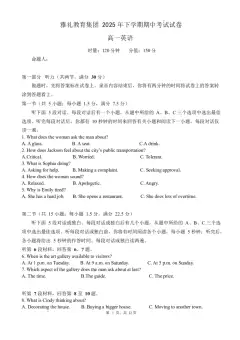
2025 年下学期九年级期中检测试卷
英语科目
考生注意:本试卷共4 个部分,61 道小题,满分100 分,时量100 分钟第一部分听力(共
两节,满分20 分)
第一节(共5 小题;每小题1 分,满分5 分)
听下面5 段对话。每段对话后有一个小题,从题中所给的A、B、C 三个选项中选出最佳选项。
听完每段对话后,你都有10 秒钟的时间来回答有关小题和阅读下一小题。
1. How does Jim study for English tests?
A. By listening to tapes.
B. By working with a group.
C. By reading the textbook.
2. What are they talking about?
A. Traditional art.
B. Chinese tea.
C. Chinese science.
3. Where is the nearest restaurant?
A. Near the bookstore.
B. Beside the post office.
C. Behind the police office.
4. Which team did Steve use to be on?
A. The swimming team.
B. The soccer team.
C. The tennis team.
5. Why does the boy like Mid-Autumn Festival?
A. Because he can eat delicious moon cakes.
B. Because he can hear the story of Change.
C. Because he can visit his grandparents.
第二节(共15 小题;每小题1 分,满分15 分)
听下面6 段对话或独白,每段对话或独白后有两到三个小题,从题中所给的A、B、C 三个选
项中选出最佳选项回答问题。听每段对话或独白前,你将有时间阅读各个小题,每小题5 秒
钟;听完后,各小题将给出5 秒钟的作答时间。
听第六段材料,回答第6、7 题。
6. What did Lisa use to look like?
A. She was tall.
B. She was thin.
C. She wore glasses.
7. What's the probable relationship between the two speakers now?
A. Workmates.
B. Roommates.
C. Deskmates.
听第七段材料,回答第8、9 题。
8. What did Miss Wang do during the National Day holiday?
A. She traveled a lot.
B. She watched TV.
C. She worked in the office.
9. How was Mr. Chen's National Day holiday?
A. Tiring but happy.
B. Busy and boring.
C. Relaxing but meaningless.
听第八段材料,回答第10、11 题。
10. Which festival will the two speakers celebrate?
A. The Chinese New Year.
B. The Dragon Boat Festival.
C. The Double Ninth Festival.
11. When will Ann go back to work?
A. On February 1st.
B. On February 15th.
C. On February 21st.
学科网(北京)股份有限公司
听第九段材料,回答第12 至14 题。
12. How much is a toy car now?
A.15 yuan.
B.25 yuan.
C.50 yuan.
13. What does the man buy for his sons?
A. A red car and a yellow car.
B. A red car and a black car.
C. A yellow car and a blue car.
14. What did the man buy for his wife?
A. A coat.
B. Some chocolates.
C. Some flowers.
听第十段材料,回答第15 至17 题。
15. Why does the girl feel nervous before going to Switzerland?
A. Because she doesn't know the language.
B. Because she has never been abroad.
C. Because she doesn't have enough money.
16. What do the Swiss(瑞士人) consider the most important?
A. Being on time.
B. Being polite to strangers.
C. Being able to speak Engli
sh.
17. Why does the man want to buy a gift for his father?
A. For his birthday.
B. For the Teachers’ Day.
C. For the Father's Day.
听第十一段材料,回答第18 至20 题。
18. Who always taught Ms. Wu paper cutting?
A. Her mother.
B. Her grandma.
C. Her teacher.
19. What prize did Ms. Wu get in the national art competition?
A. The first prize.
B. The second prize.
C. The third prize.
20. Why did Ms. Wu introduce Chinese paper cutting?
A. To win the competition.
B. To make it less popular.
C. To show Chinese cultur
e.
第二部分阅读(共两节,满分30 分)
第一节(共10 小题;每小题2 分,满分20 分)
阅读下面的材料,从每题中所给的A、B、C 三个选项中,选出最佳选项。
A
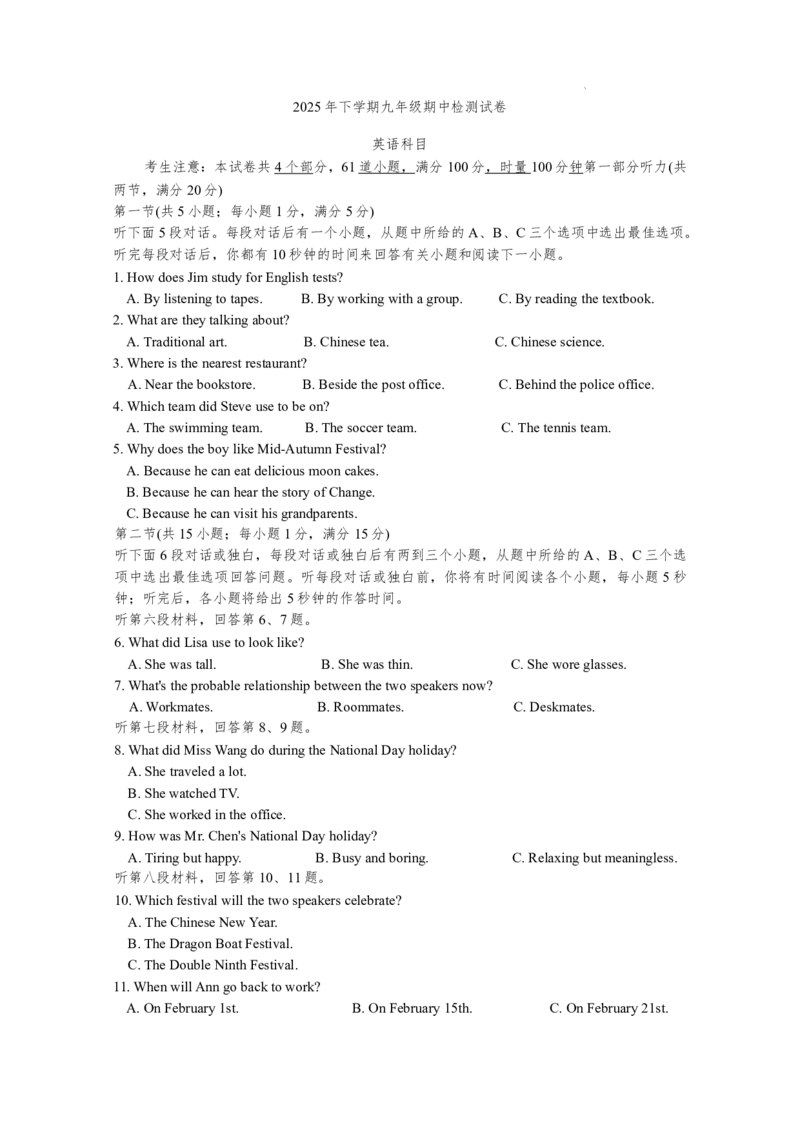
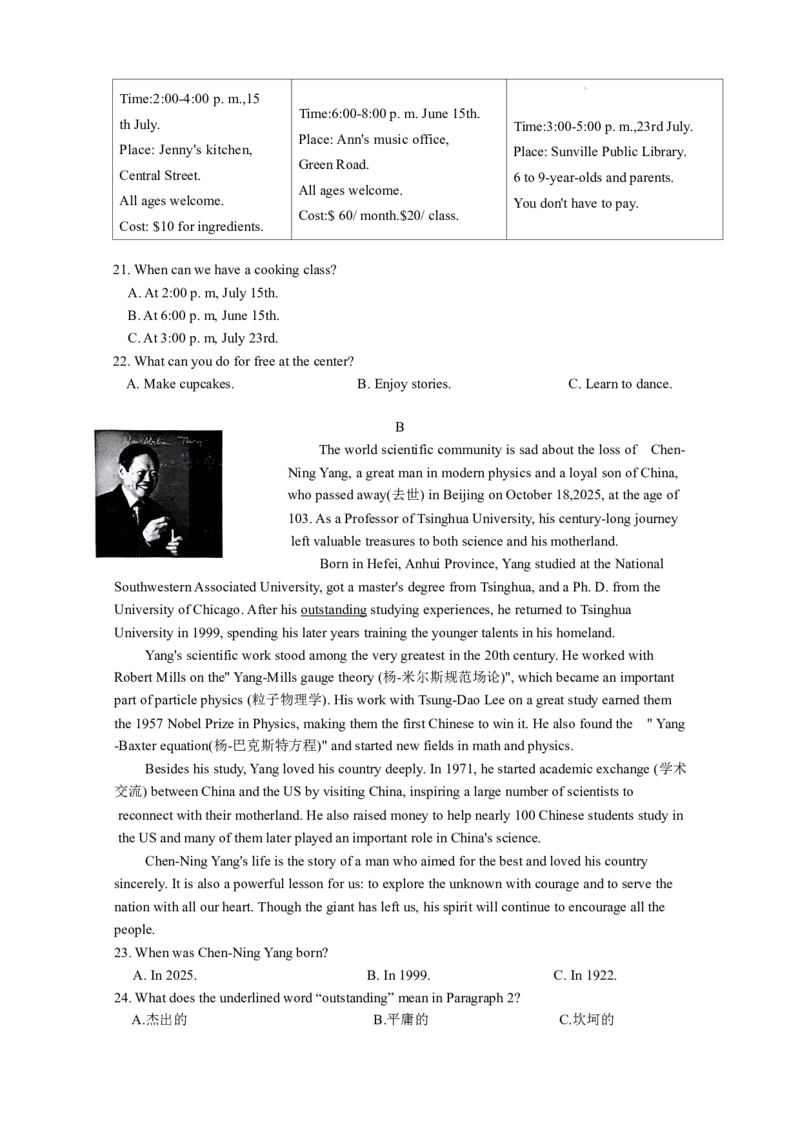
SUNVILLE COMMUNITY(社区) CENTER NOTICEBOARD
学科网(北京)股份有限公司
Time:2:00-4:00 p. m.,15
th July.
Place: Jenny's kitchen,
Central Street.
All ages welcome.
Cost: $10 for ingredients.
Time:6:00-8:00 p. m. June 15th.
Place: Ann's music office,
Green Road.
All ages welcome.
Cost:$ 60/ month.$20/ class.
Time:3:00-5:00 p. m.,23rd July.
Place: Sunville Public Library.
6 to 9-year-olds and parents.
You don't have to pay.
21. When can we have a cooking class?
A. At 2:00 p. m, July 15th.
B. At 6:00 p. m, June 15th.
C. At 3:00 p. m, July 23rd.
22. What can you do for free at the center?
A. Make cupcakes.
B. Enjoy stories.
C. Learn to dance.
B
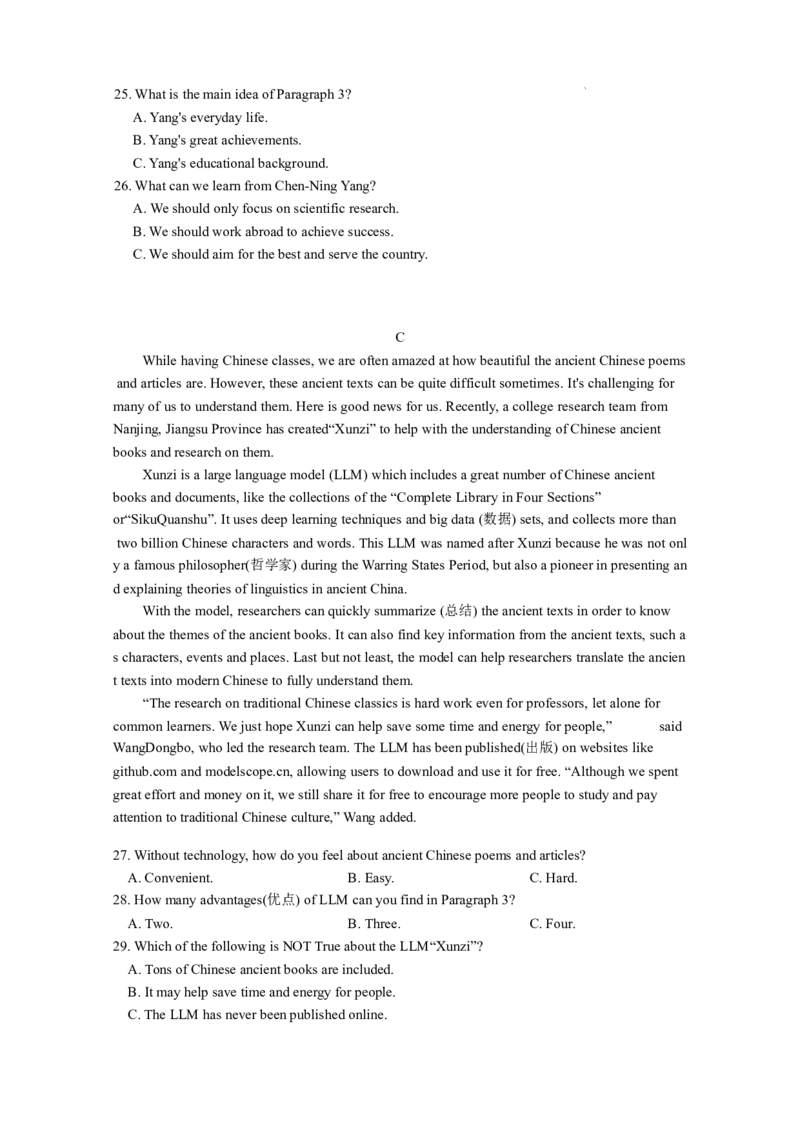
The world scientific community is sad about the loss of
Chen-
Ning Yang, a great man in modern physics and a loyal son of China,
who passed away(去世) in Beijing on October 18,2025, at the age of
103. As a Professor of Tsinghua University, his century-long journey
left valuable treasures to both science and his motherland.
Born in Hefei, Anhui Province, Yang studied at the National
Southwestern Associated University, got a master's degree from Tsinghua, and a Ph. D. from the
University of Chicago. After his outstanding studying experiences, he returned to Tsinghua
University in 1999, spending his later years training the younger talents in his homeland.
Yang's scientific work stood among the very greatest in the 20th century. He worked with
Robert Mills on the" Yang-Mills gauge theory (杨-米尔斯规范场论)", which became an important
part of particle physics (粒子物理学). His work with Tsung-Dao Lee on a great study earned them
the 1957 Nobel Prize in Physics, making them the first Chinese to win it. He also found the
" Yang
-Baxter equation(杨-巴克斯特方程)" and started new fields in math and physics.
Besides his study, Yang loved his country deeply. In 1971, he started academic exchange (学术
交流) between China and the US by visiting China, inspiring a large number of scientists to
reconnect with their motherland. He also raised money to help nearly 100 Chinese students study in
the US and many of them later played an important role in China's science.
Chen-Ning Yang's life is the story of a man who aimed for the best and loved his country
sincerely. It is also a powerful lesson for us: to explore the unknown with courage and to serve the
nation with all our heart. Though the giant has left us, his spirit will continue to encourage all the
people.
23. When was Chen-Ning Yang born?
A. In 2025.
B. In 1999.
C. In 1922.
24. What does the underlined word “outstanding” mean in Paragraph 2?
A.杰出的
B.平庸的
C.坎坷的
学科网(北京)股份有限公司
25. What is the main idea of Paragraph 3?
A. Yang's everyday life.
B. Yang's great achievements.
C. Yang's educational background.
26. What can we learn from Chen-Ning Yang?
A. We should only focus on scientific research.
B. We should work abroad to achieve success.
C. We should aim for the best and serve the country.
C
While having Chinese classes, we are often amazed at how beautiful the ancient Chinese poems
and articles are. However, these ancient texts can be quite difficult sometimes. It's challenging for
many of us to understand them. Here is good news for us. Recently, a college research team from
Nanjing, Jiangsu Province has created“Xunzi” to help with the understanding of Chinese ancient
books and research on them.
Xunzi is a large language model (LLM) which includes a great number of Chinese ancient
books and documents, like the collections of the “Complete Library in Four Sections”
or“SikuQuanshu”. It uses deep learning techniques and big data (数据) sets, and collects more than
two billion Chinese characters and words. This LLM was named after Xunzi because he was not onl
y a famous philosopher(哲学家) during the Warring States Period, but also a pioneer in presenting an
d explaining theories of linguistics in ancient China.
With the model, researchers can quickly summarize (总结) the ancient texts in order to know
about the themes of the ancient books. It can also find key information from the ancient texts, such a
s characters, events and places. Last but not least, the model can help researchers translate the ancien
t texts into modern Chinese to fully understand them.
“The research on traditional Chinese classics is hard work even for professors, let alone for
common learners. We just hope Xunzi can help save some time and energy for people,”
said
WangDongbo, who led the research team. The LLM has been published(出版) on websites like
github.com and modelscope.cn, allowing users to download and use it for free. “Although we spent
great effort and money on it, we still share it for free to encourage more people to study and pay
attention to traditional Chinese culture,” Wang added.
27. Without technology, how do you feel about ancient Chinese poems and articles?
A. Convenient.
B. Easy.
C. Hard.
28. How many advantages(优点) of LLM can you find in Paragraph 3?
A. Two.
B. Three.
C. Four.
29. Which of the following is NOT True about the LLM“Xunzi”?
A. Tons of Chinese ancient books are included.
B. It may help save time and energy for people.
C. The LLM has never been published online.
学科网(北京)股份有限公司
30. What is the purpose of the passage?
A. To introduce a useful language model.
B. To make people study Chinese culture.
C. To share studies of Chinese classics.
第二节(共5 小题;每小题2 分,满分10 分)
阅读下面短文,从短文后的选项中选出能填入空白处的最佳选项。每个选项仅使用一次。
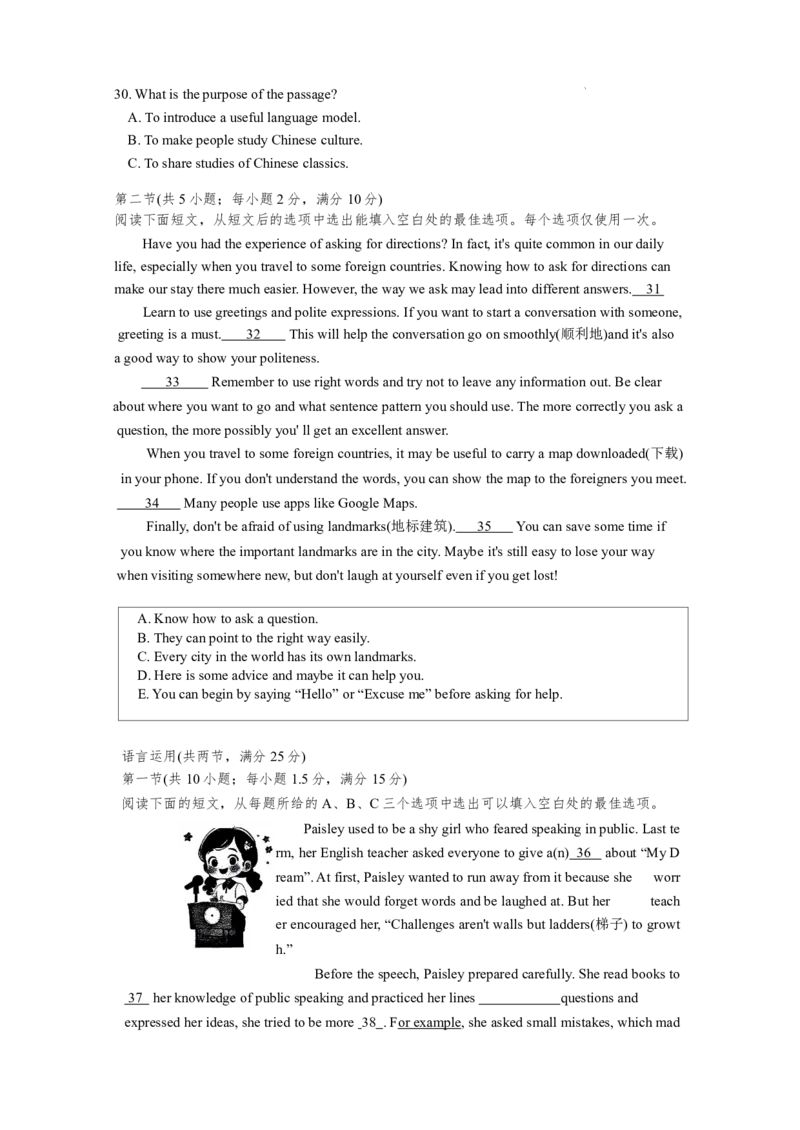
Have you had the experience of asking for directions? In fact, it's quite common in our daily
life, especially when you travel to some foreign countries. Knowing how to ask for directions can
make our stay there much easier. However, the way we ask may lead into different answers.
31
Learn to use greetings and polite expressions. If you want to start a conversation with someone,
greeting is a must.
32
This will help the conversation go on smoothly(顺利地)and it's also
a good way to show your politeness.
33
Remember to use right words and try not to leave any information out. Be clear
about where you want to go and what sentence pattern you should use. The more correctly you ask a
question, the more possibly you' ll get an excellent answer.
When you travel to some foreign countries, it may be useful to carry a map downloaded(下载)
in your phone. If you don't understand the words, you can show the map to the foreigners you meet.
34
Many people use apps like Google Maps.
Finally, don't be afraid of using landmarks(地标建筑).
35
You can save some time if
you know where the important landmarks are in the city. Maybe it's still easy to lose your way
when visiting somewhere new, but don't laugh at yourself even if you get lost!
A. Know how to ask a question.
B. They can point to the right way easily.
C. Every city in the world has its own landmarks.
D. Here is some advice and maybe it can help you.
E. You can begin by saying “Hello” or “Excuse me” before asking for help.
语言运用(共两节,满分25 分)
第一节(共10 小题;每小题1.5 分,满分15 分)
阅读下面的短文,从每题所给的A、B、C 三个选项中选出可以填入空白处的最佳选项。
Paisley used to be a shy girl who feared speaking in public. Last te
rm, her English teacher asked everyone to give a(n) 36
about “My D
ream”. At first, Paisley wanted to run away from it because she
worr
ied that she would forget words and be laughed at. But her
teach
er encouraged her, “Challenges aren't walls but ladders(梯子) to growt
h.”
Before the speech, Paisley prepared carefully. She read books to
37 her knowledge of public speaking and practiced her lines
questions and
expressed her ideas, she tried to be more 38 . For example, she asked small mistakes, which mad
学科网(北京)股份有限公司
e her braver.
On the day of the speech, Paisley felt nervous. But she took a deep breath and told herself,“I
have practiced hard and I can do this!” She stood up, spoke
40
to the class, and shared her
dream of becoming a writer. To her surprise, she didn't
41
at all. When she finished, the
class cheered loudly.
Later, her teacher said, “Your courage didn't just influence your own growth, but also inspired
your classmates.” Paisley also found her exam
42
improved. She now studied wisely an
d never
43
to do her homework without thinking carefully.
Paisley learned an important lesson: being afraid is
44
, but facing fears confidently
helps you find your best self. Now, she takes every chance to learn and grow, and she feels a strong
sense of
45
in her progress. As she wrote in her diary: “Every small step forward is a
victory. Keep going, and you' ll surprise yourself with how excellent you can be!”
36. A. examination
B. speech
C. interview
37. A. increase
B. request
C. suggest
38. A. silent
B. humorous
C. active
39. A. treated
B. punished
C. discovered
40. A. bravely
B. widely
C. privately
41. A. grow up
B. put up
C. mess up
42. A. forms
B. scores
C. courses
43. A. tied
B. noted
C. rushed
44. A. normal
B. strange
C. useful
45. A. sadness
B. pride
C. shyness
第二节(共10 小题;每小题1 分,满分10 分)
阅读下面短文,在空白处填入1 个适当的单词或括号内单词的正确形式。
Have you seen circles, squares and triangles (三角形) in your daily life? H
ave you thought about
46
(they) meanings in films? Much like colors,
different shapes can show different
features (特征) of characters.
Circles represent (象征) goodness,
47
(happy) and
friendliness. The round shape reminds us of things that appear in nature, like th
e sun, flowers, raindrops and so on. We can also connect circles
48
be
autiful eyes, babies’ round faces and so on. All these things are
49
(help) to make us feel h
appy and warm. This is why so many cartoon characters’ bodies are round in shape, such heroes, ki
ds, and good people.
Squares are symbols of unnatural or man- made things, or things that are boring or
old-
fashioned. In Up(《飞屋环游记》), Carl, an elderly man, has a square face and wears square
glasses, while Russell,
50
8- year- old boy with a round face, always wears round medals.
These shapes show the characters' personalities. Carl is stubborn (执拗的) and lonely, while Russel
l is lovely
51
outgoing.
学科网(北京)股份有限公司
The angriest shape is the triangle. When Kids draw a monster(怪物) with many sharp
52
(tooth), they draw a row of triangles, don't they? That's because the shape represents fear, distrust
and doubt in some way. If you look at the bad guys in cartoons, you’ ll find that they' re all drawn
with plenty of points and triangles. And triangles are stable and don't fall down
53
(easy).In
films, this feature makes it difficult
54
(deal) with bad people.
Not only in cartoons, but also in other kinds of films, different shapes
55
(use) to
show different personalities. So, next time you see a film, try to find the hidden shapes and you will
know what the characters are like.
第四部分读写综合(共两节,满分25 分)
第一节(共5 小题;每小题2 分,满分10 分)
阅读下面短文,根据短文内容回答问题。
The Qingming Festival, also called Tomb- Sweeping
Day, is one of China's 24 traditional solar terms (节气),
usually falling between April 4th and 6th. It marks the
arrival of spring and the revival (复苏) of nature, serving
as both a seasonal sign and an important cultural festival.
On this day, people remember their families through old
ceremony and enjoy their life with spring outings(踏青).
The customs of Qingming are rich and excellent. Tomb sweeping is the most important
tradition, where families clean gravesides, offer flowers and pay respects to their ancestors. Spring
outings let people relax in nature, such as enjoying picnics and admiring flowers in the countryside.
Flying kites is another fun activity, meaning the letting go of worries and welcoming new
beginnings.
The Qingming Festival is more than just a time to remember the past. It also encourages deep
thought about the meaning of life. It reminds us to value the present, be thankful for what our
ancestors have done for us, and find peace in nature. As times change, how we celebrate Qingming
has also changed. Now, people use online memorial services and eco-friendly ceremonies. No
matter how it's celebrated, the main spirit of Qingming never seems to change: to keep our cultural
heritage (遗产) alive and show respect for life itself.
56. Does the Qingming Festival always fall on the same day every year?
57. What is the most important tradition in the Qingming Festival?
58. How can we relax in nature during the spring outings?
59. What is the main spirit of the Qingming Festival?
学科网(北京)股份有限公司
60. What do you normally do in the Qingming Festival?
第二节(共1 小题;满分15 分)
根据要求完成短文写作。
61.假如你是来自英国的中学生Billy,你已经在中国度过了充实的两年,有了很大变化。上
周,你参加了学校举办的以传统中国节日为主题的语文学科活动,让你沉浸式地领略了中国
传统节日的独特韵味,内心满是感触。请你根据以下表格内容,给远在英国的挚友Jerry 写
一封信。
Changes in the past two years
1. Appearance(外貌);
2. Personality(性格);
3. …
The
Festival
1. Customs.(至少写两点)
2. Meaning.
要求:1.文章需包含以上所有要点,可适当发挥;
2.80 词左右(开头已给出,不计入总词数);
3.文中不得出现真实人名和校名。
Dear Jerry,
How time flies It has been two years since I came to China.
学科网(北京)股份有限公司
参考答案
听力:略
21-30 题答案(阅读第一节)
21. A(根据社区通知,烹饪课时间为7 月15 日下午2 点)
22. B(6-9 岁儿童及家长可免费参与讲故事活动,其余项目需付费)
23. C(2025 年去世,享年103 岁,2025-103=1922)
24. A(结合上下文,杨先生学业经历优异,“outstanding”意为“杰出的”)
25. B(第三段主要介绍杨先生的科学成就,包括理论研究、诺贝尔奖等)
26. C(文章结尾强调杨先生追求极致、热爱祖国,启示我们应精益求精并报效国
家)
27-29. 原文材料不完整,无法作答
30. A(结合剩余内容推测,文章核心是介绍实用的语言模型)
31-35 题答案(阅读第二节)
31. D(引出下文的问路建议,起承上启下作用)
32. E(呼应“使用问候语和礼貌用语”,举例具体问候方式)
33. A(下文强调“用对词汇、不遗漏信息”,对应“知道如何提问”)
34. B(承接“展示地图”,说明地图能帮助对方指路)
35. C(呼应“使用地标建筑”,说明每个城市都有地标可利用)
36-45 题答案(语言运用第一节)
36. B(根据下文“speech”“shared her dream”可知是做演讲)
37. A(“increase knowledge”为固定搭配,意为“增长知识”)
38. C(由“问问题、表达观点”可知是变得“活跃”)
39. B(老师不因为小错误惩罚她,让她更勇敢)
40. A(克服恐惧后“勇敢地”向全班演讲)
41. C(根据“惊喜的是”可知她没有“搞砸”演讲)
42. B(后文提到“明智学习”,推测“成绩”有所提高)
43. C(不再不假思索“仓促”完成作业)
44. A(害怕是“正常的”,但勇敢面对能发现最好的自己)
45. B(从进步中感受到强烈的“自豪感”)
46-55 题答案(语言运用第二节)
46. their(修饰名词“meanings”,用形容词性物主代词)
47. happiness(与“goodness”“friendliness”并列,用名词形式)
48. with(“connect...with...”为固定搭配,意为“把……和……联系起来”)
49. helpful(be 动词后接形容词作表语)
50. an(8-year-old 以元音音素开头,用不定冠词an)
51. and(连接“lovely”和“outgoing”,表并列)
52. teeth(tooth 的复数形式,“sharp teeth”意为“锋利的牙齿”)
53. easily(修饰动词“fall down”,用副词形式)
54. to deal(“it’s difficult to do sth”为固定句型,意为“做某事很困难”)
55. are used(主语“shapes”与“use”为被动关系,用一般现在时被动语态)
56-60 题答案(读写综合第一节)
56. No, it doesn’t.(通常在4 月4 日至6 日之间,并非固定同一天)
学科网(北京)股份有限公司
57. Tomb sweeping.(文中明确提到“扫墓是最重要的传统”)
58. By enjoying picnics and admiring flowers in the countryside.(踏青时可通过
野餐、赏花放松)
59. To keep our cultural heritage alive and show respect for life itself.(文章结尾
点明核心精神)
60. (示例)I usually go tomb sweeping with my family to remember ancestors.
Sometimes I also go for spring outings and fly kites with friends.(符合节日习俗
即可,答案不唯一)
61 题作文范文(读写综合第二节)
Dear Jerry,
How time flies! It has been two years since I came to China. I’ve changed a lot—
from a shy boy who feared speaking Chinese to someone who can
communicate freely.
Last week, our school held a Chinese activity about traditional festivals. We
learned to make mooncakes for Mid-Autumn Festival and listened to stories of
Dragon Boat Festival. It was amazing to feel the unique charm of Chinese
culture.
I really enjoy life here. The festivals are colorful and the people are friendly. I
miss you so much. Would you like to visit China and experience these
interesting traditions with me?
Yours,
Billy