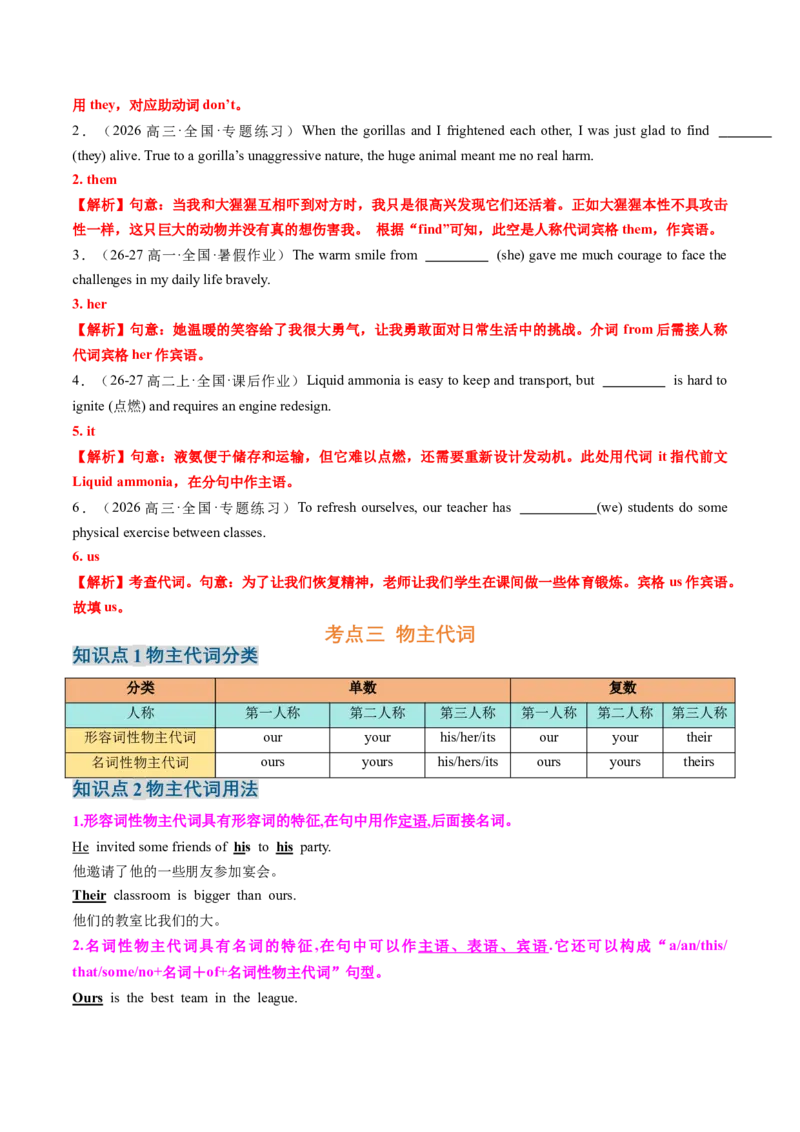
专题 26 代词(知识清单)
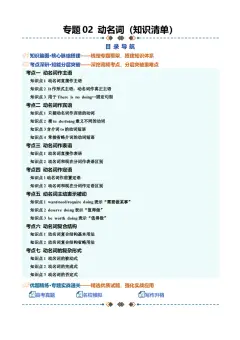
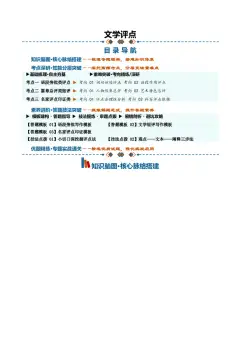
目 录 导 航
01知识脑图·核心脉络搭建——梳理专题框架,搭建知识体系
02考点深研·知能分层突破——深挖高频考点,分层突破重难点
考点一 代词的分类
知识点1 代词的分类
知识点2 代词的句法功能
考点二 人称代词
知识点1 人称代词分类
知识点2 人称代词用法
考点三 物主代词
知识点1 物主代词分类
知识点2 物主代词用法
考点四 反身代词
知识点1 反身代词分类
知识点2 反身代词用法
考点五 不定代词
知识点1不定代词some和 any 知识点2不定代词all和both
知识点3不定代词every和each 知识点4不定代词either和 neither
知识点5不定代词many和much 知识点6不定代词(a) few和(a) little
知识点7不定代词another和others等 知识点8不定代词one和ones等
知识点9 不定代词something和nothing等 知识点10 不定代词such和same
考点六 反身代词
知识点1 it用作人称代词 知识点2 it用作非人称代词
知识点3 it用作形式主语 知识点4 it用作形式宾语
知识点5 it引导强调句型 知识点6 it用于固定词组
03优题精练·专题实战通关——精选优质试题,强化实战应用
高考真题(代词) 名校模拟(代词) 原创语填(外卖骑手获鲁迅文学奖)
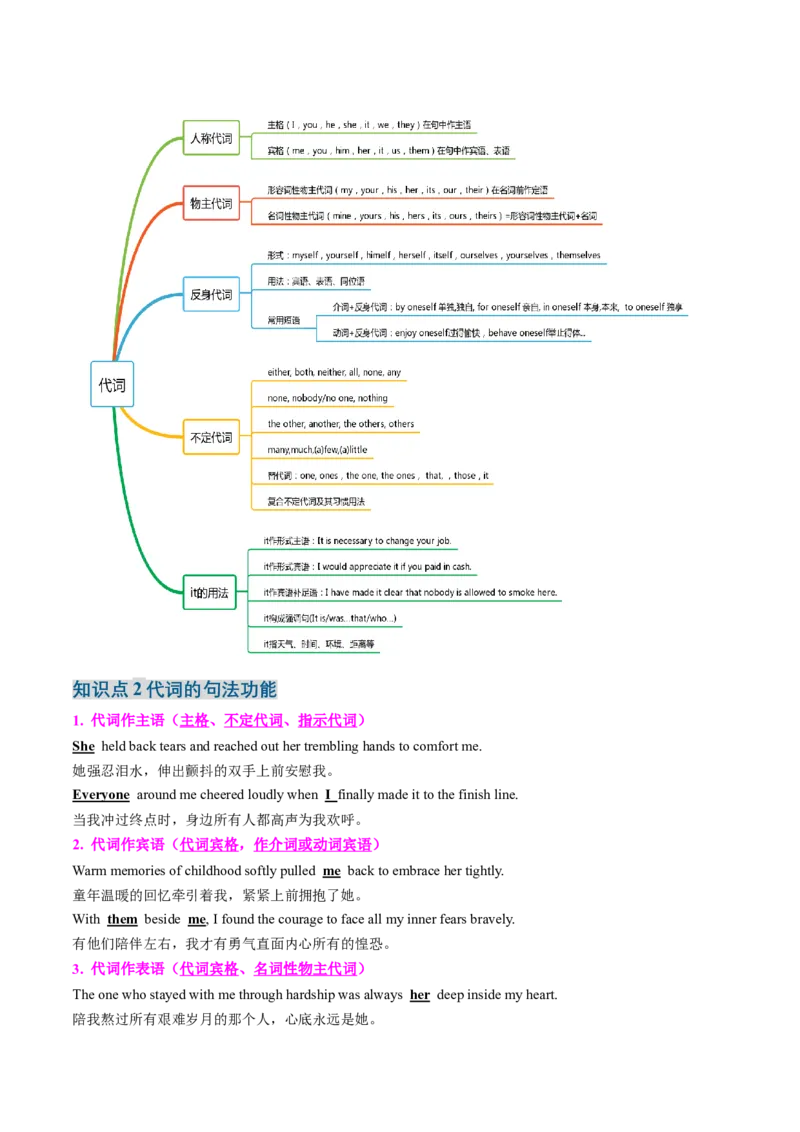
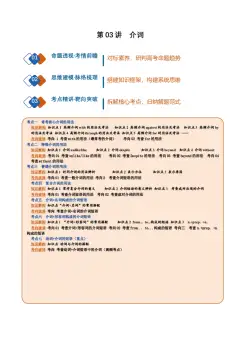
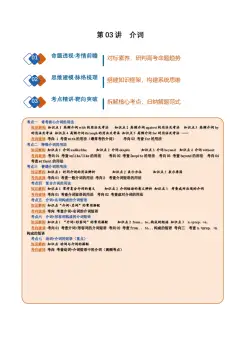
知识脑图·核心脉络搭建考点深研·知能分层突破
考点1 代词的分类
知识点1 代词的分类知识点2代词的句法功能
1. 代词作主语(主格、不定代词、指示代词)
She held back tears and reached out her trembling hands to comfort me.
她强忍泪水,伸出颤抖的双手上前安慰我。
Everyone around me cheered loudly when I finally made it to the finish line.
当我冲过终点时,身边所有人都高声为我欢呼。
2. 代词作宾语(代词宾格,作介词或动词宾语)
Warm memories of childhood softly pulled me back to embrace her tightly.
童年温暖的回忆牵引着我,紧紧上前拥抱了她。
With them beside me, I found the courage to face all my inner fears bravely.
有他们陪伴左右,我才有勇气直面内心所有的惶恐。
3. 代词作表语(代词宾格、名词性物主代词)
The one who stayed with me through hardship was always her deep inside my heart.
陪我熬过所有艰难岁月的那个人,心底永远是她。This warm shelter full of care and quiet joy is truly mine from now on.
这间盛满温情与欢喜的小屋,从今往后真正属于我。
4. 代词作定语(形容词性物主代词、指示代词)
My weak legs shook wildly as I watched my lost friend walk toward me slowly.
望见失联好友缓缓走来,我的双腿控制不住地剧烈发抖。
Those soft words he whispered eased my heavy anxiety little by little.
他低声诉说的那些温柔话语,一点点抚平我沉重的不安。
5. 代词作同位语(反身代词)
I myself wiped away hot tears and made up my mind not to give up hope.
我亲手拭去滚烫泪水,下定决心绝不放弃心中的希望。
She herself knelt down and held my cold hands to calm my restless heart.
她亲自蹲下身,握住我冰凉的手安抚我慌乱的心。
考点二 人称代词
知识点1人称代词分类
分类 单数 复数
人称 第一人称 第二人称 第三人称 第一人称 第二人称 第三人称
主格 I you he/she/it we you they
宾格 me you him/her/it us you them
知识点2人称代词用法
1.主格人称代词在句中作主语。
She is as intelligent as he(is). 她像他一样聪明.
You, he and I are in different classes. 你、他和我都在不同班级。
2.宾格人称代词在句中作动词宾语或介词宾语。
We often go to see her on Saturdays. 我们常在星期六去看她.
Give me a challenge, and I will meet it with joy. 让我迎接挑战,我会欣然接受。
易错提醒:并列主语中,“I”总是放在最后,排列顺序:二 三 一(人称)
You, Lily and I gathered together to comfort the sad lonely little girl.
你、莉莉和我聚在一起,安抚那个伤心孤单的小女孩。
He and I held each other’s hands to overcome all unexpected difficulties.
他与我紧紧相握,一同跨过所有突如其来的难关。
【跟踪训练】在空白处填入1个适当的单词或括号内单词的正确形式。
1.(26-27高一·全国·暑假作业)Everybody knows the answer, don’t ?
1. they
【解析】句意:每个人都知道答案,不是吗?不定代词everybody作主语时,反意疑问句的人称代词统一用they,对应助动词don’t。
2.(2026 高三·全国·专题练习)When the gorillas and I frightened each other, I was just glad to find
(they) alive. True to a gorilla’s unaggressive nature, the huge animal meant me no real harm.
2. them
【解析】句意:当我和大猩猩互相吓到对方时,我只是很高兴发现它们还活着。正如大猩猩本性不具攻击
性一样,这只巨大的动物并没有真的想伤害我。 根据“find”可知,此空是人称代词宾格them,作宾语。
3.(26-27高一·全国·暑假作业)The warm smile from (she) gave me much courage to face the
challenges in my daily life bravely.
3. her
【解析】句意:她温暖的笑容给了我很大勇气,让我勇敢面对日常生活中的挑战。介词 from后需接人称
代词宾格her作宾语。
4.(26-27高二上·全国·课后作业)Liquid ammonia is easy to keep and transport, but is hard to
ignite (点燃) and requires an engine redesign.
5. it
【解析】句意:液氨便于储存和运输,但它难以点燃,还需要重新设计发动机。此处用代词 it指代前文
Liquid ammonia,在分句中作主语。
6.(2026 高三·全国·专题练习)To refresh ourselves, our teacher has (we) students do some
physical exercise between classes.
6. us
【解析】考查代词。句意:为了让我们恢复精神,老师让我们学生在课间做一些体育锻炼。宾格us作宾语。
故填us。
考点三 物主代词
知识点1物主代词分类
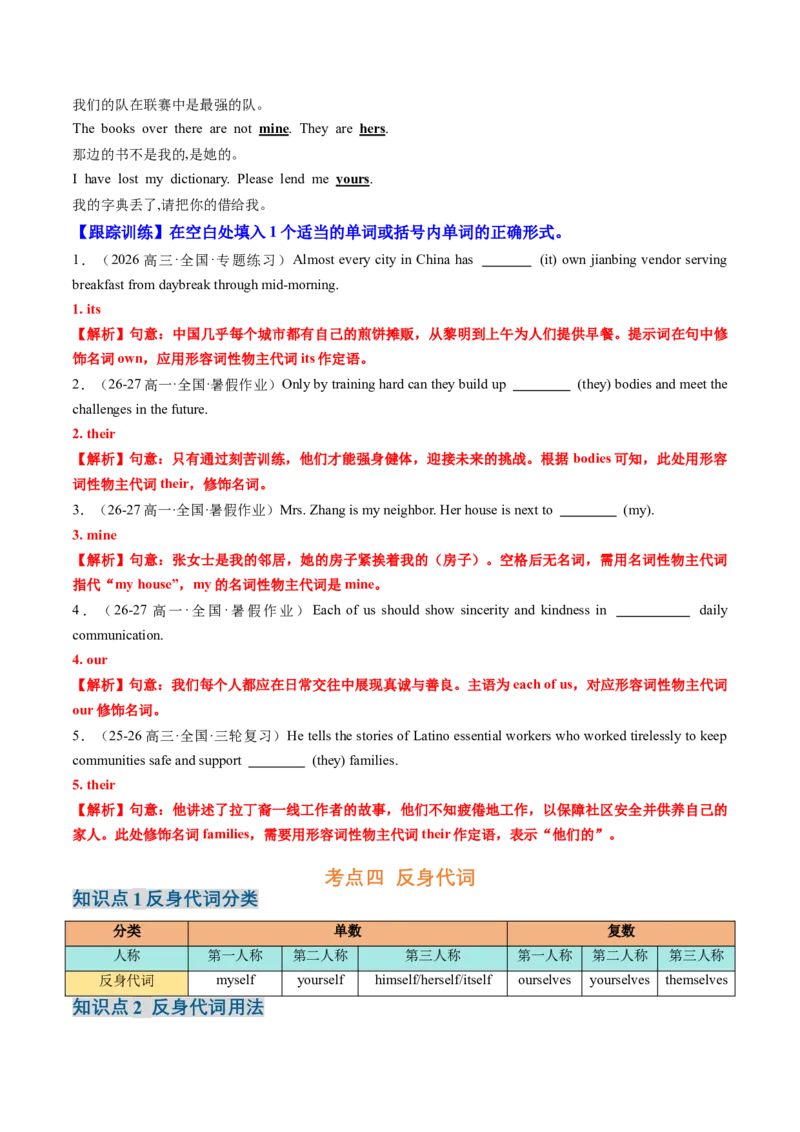
分类 单数 复数
人称 第一人称 第二人称 第三人称 第一人称 第二人称 第三人称
形容词性物主代词 our your his/her/its our your their
名词性物主代词 ours yours his/hers/its ours yours theirs
知识点2物主代词用法
1.形容词性物主代词具有形容词的特征,在句中用作定语,后面接名词。
He invited some friends of his to his party.
他邀请了他的一些朋友参加宴会。
Their classroom is bigger than ours.
他们的教室比我们的大。
2.名词性物主代词具有名词的特征,在句中可以作主语、表语、宾语.它还可以构成“a/an/this/
that/some/no+名词+of+名词性物主代词”句型。
Ours is the best team in the league.我们的队在联赛中是最强的队。
The books over there are not mine. They are hers.
那边的书不是我的,是她的。
I have lost my dictionary. Please lend me yours.
我的字典丢了,请把你的借给我。
【跟踪训练】在空白处填入1个适当的单词或括号内单词的正确形式。
1.(2026高三·全国·专题练习)Almost every city in China has (it) own jianbing vendor serving
breakfast from daybreak through mid-morning.
1. its
【解析】句意:中国几乎每个城市都有自己的煎饼摊贩,从黎明到上午为人们提供早餐。提示词在句中修
饰名词own,应用形容词性物主代词its作定语。
2.(26-27高一·全国·暑假作业)Only by training hard can they build up (they) bodies and meet the
challenges in the future.
2. their
【解析】句意:只有通过刻苦训练,他们才能强身健体,迎接未来的挑战。根据 bodies可知,此处用形容
词性物主代词their,修饰名词。
3.(26-27高一·全国·暑假作业)Mrs. Zhang is my neighbor. Her house is next to (my).
3. mine
【解析】句意:张女士是我的邻居,她的房子紧挨着我的(房子)。空格后无名词,需用名词性物主代词
指代“my house”,my的名词性物主代词是mine。
4.(26-27 高一·全国·暑假作业)Each of us should show sincerity and kindness in daily
communication.
4. our
【解析】句意:我们每个人都应在日常交往中展现真诚与善良。主语为each of us,对应形容词性物主代词
our修饰名词。
5.(25-26高三·全国·三轮复习)He tells the stories of Latino essential workers who worked tirelessly to keep
communities safe and support (they) families.
5. their
【解析】句意:他讲述了拉丁裔一线工作者的故事,他们不知疲倦地工作,以保障社区安全并供养自己的
家人。此处修饰名词families,需要用形容词性物主代词their作定语,表示“他们的”。
考点四 反身代词
知识点1反身代词分类
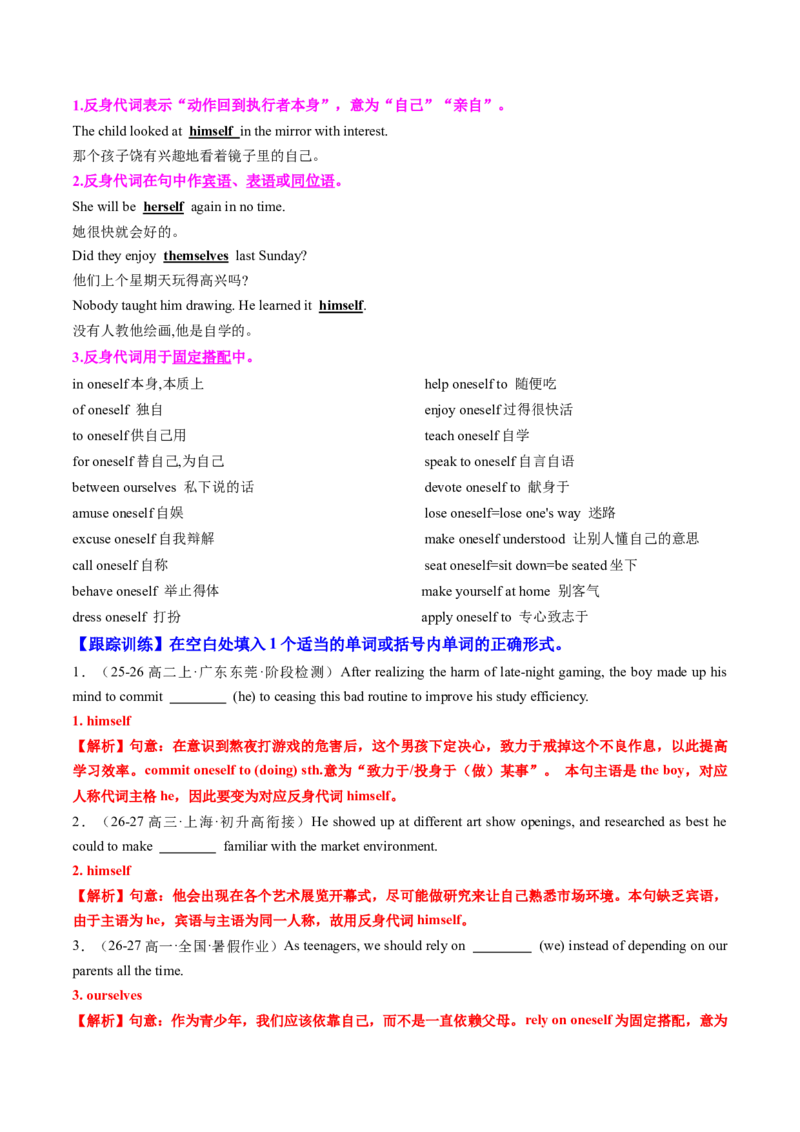
分类 单数 复数
人称 第一人称 第二人称 第三人称 第一人称 第二人称 第三人称
反身代词 myself yourself himself/herself/itself ourselves yourselves themselves
知识点2 反身代词用法1.反身代词表示“动作回到执行者本身”,意为“自己”“亲自”。
The child looked at himself in the mirror with interest.
那个孩子饶有兴趣地看着镜子里的自己。
2.反身代词在句中作宾语、表语或同位语。
She will be herself again in no time.
她很快就会好的。
Did they enjoy themselves last Sunday?
他们上个星期天玩得高兴吗?
Nobody taught him drawing. He learned it himself.
没有人教他绘画,他是自学的。
3.反身代词用于固定搭配中。
in oneself本身,本质上 help oneself to 随便吃
of oneself 独自 enjoy oneself过得很快活
to oneself供自己用 teach oneself自学
for oneself替自己,为自己 speak to oneself自言自语
between ourselves 私下说的话 devote oneself to 献身于
amuse oneself自娱 lose oneself=lose one's way 迷路
excuse oneself自我辩解 make oneself understood 让别人懂自己的意思
call oneself自称 seat oneself=sit down=be seated坐下
behave oneself 举止得体 make yourself at home 别客气
dress oneself 打扮 apply oneself to 专心致志于
【跟踪训练】在空白处填入1个适当的单词或括号内单词的正确形式。
1.(25-26高二上·广东东莞·阶段检测)After realizing the harm of late-night gaming, the boy made up his
mind to commit (he) to ceasing this bad routine to improve his study efficiency.
1. himself
【解析】句意:在意识到熬夜打游戏的危害后,这个男孩下定决心,致力于戒掉这个不良作息,以此提高
学习效率。commit oneself to (doing) sth.意为“致力于/投身于(做)某事”。 本句主语是the boy,对应
人称代词主格he,因此要变为对应反身代词himself。
2.(26-27高三·上海·初升高衔接)He showed up at different art show openings, and researched as best he
could to make familiar with the market environment.
2. himself
【解析】句意:他会出现在各个艺术展览开幕式,尽可能做研究来让自己熟悉市场环境。本句缺乏宾语,
由于主语为he,宾语与主语为同一人称,故用反身代词himself。
3.(26-27高一·全国·暑假作业)As teenagers, we should rely on (we) instead of depending on our
parents all the time.
3. ourselves
【解析】句意:作为青少年,我们应该依靠自己,而不是一直依赖父母。rely on oneself为固定搭配,意为“依靠自己”。
4.(2026 高三上·北京·专题练习)She was famous for being the first to observe chimpanzees use tools to
protect (they).
4. themselves
【解析】句意:她因第一个观察到黑猩猩使用工具保护自己而闻名。空处作 protect的宾语,与主语
chimpanzees指同一对象,且为复数概念,应用反身代词themselves。
5.(2026高三·全国·专题练习)In 2019, the Liangzhu Ruins were added to the UNESCO World Heritage List,
recognizing (it) global significance.
5. its
【解析】句意:2019年,良渚古城遗址被列入联合国教科文组织《世界遗产名录》,确认了其全球重要性。
根据空后“global significance”可知,空处需填形容词性物主代词its,修饰名词significance作定语。
考点五 不定代词
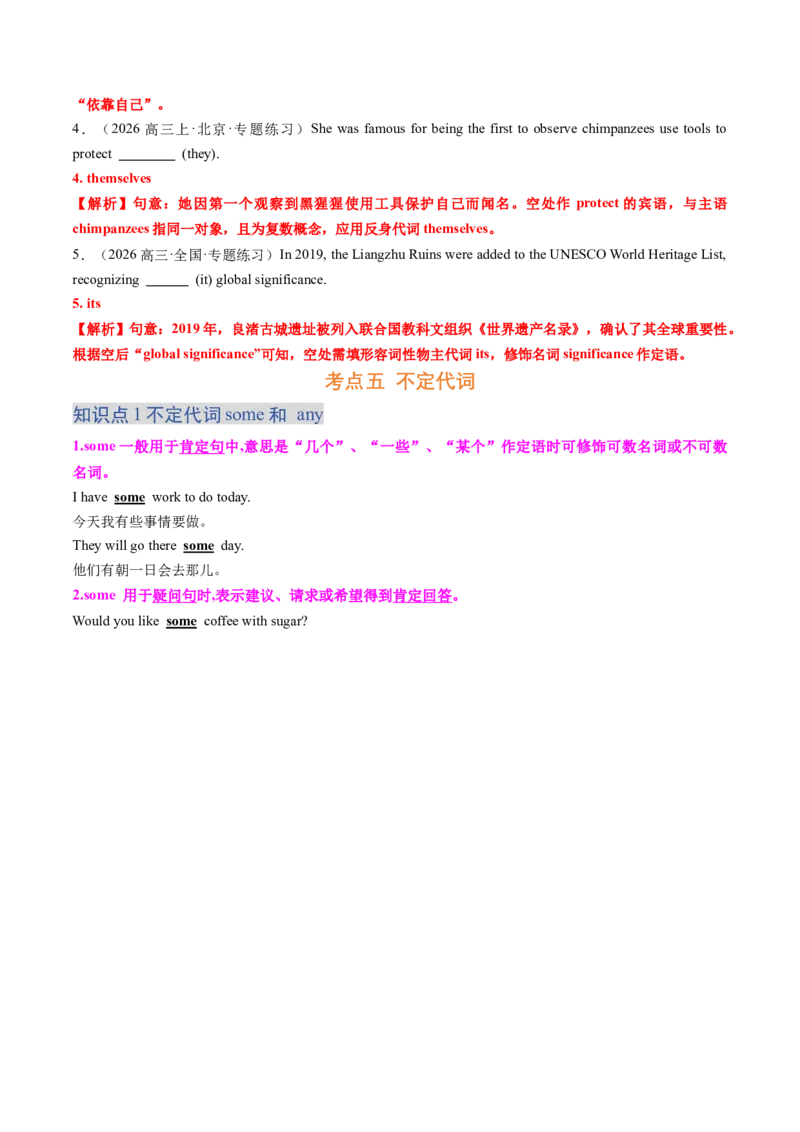
知识点1不定代词some和 any
1.some一般用于肯定句中,意思是“几个”、“一些”、“某个”作定语时可修饰可数名词或不可数
名词。
I have some work to do today.
今天我有些事情要做。
They will go there some day.
他们有朝一日会去那儿。
2.some 用于疑问句时,表示建议、请求或希望得到肯定回答。
Would you like some coffee with sugar?你要加糖的咖啡吗?
3.any 一般用于疑问句或否定句中,意思是“任何一些”、“任何一个”,作定语时可修饰可数或不可数
名词。
They didn’t have any friends here.
他们在这里没有朋友.
Have you got any questions to ask?
你有问题要问吗?
知识点2不定代词all和both
1.all指三者或三者以上的人或物,用来代替或修饰可数名词,在句子中作主语、宾语、表语、定语等。
I know all of the four British students in their school.
他们学校里四个英国学生我全认识。
All water on the earth is important for life.
地球上所有的水对生命都很重要。
2.both指两个人或物,用来代替或修饰可数名词, 在句子中作主语、宾语、表语、定语等。
I have two pens, and both of them work well.
我有两支笔,都很好用。
Both she and her brother like swimming.
她和她弟弟都喜欢游泳。
知识点3不定代词every和each
1.every是形容词,只能作定语修饰单数名词,意思是“每一个”,表示整体概念。
She goes to the park every Sunday.
她每个周日都去公园。
2.“every+数词+名词”表示“每,每隔”。
She visits her grandparents every two weeks .
她每两周去看望一次祖父母。
We have a meeting every other week.
我们每隔一周开一次会。
3. each是形容词、代词,可用作主语、宾语、定语等,意思是“每个”或者“各个”,表示单个概念。
There is a tree on each side of the road.
路的每一边都有一棵树。
There are two books. Each is interesting.
有两本书,每本都很有趣。
4.each可以放在名词前,可以后跟of短语,与动词同时出现时要放在“be动词、助动词、情态动词”之
后或者行为动词之前。
Each of the girls has a different hobby.
每个女孩都有不同的爱好。
They each have a bike.他们每个人都有一辆自行车。
知识点4不定代词either和 neither
1.either意思是“两个中间的任何一个”, 在句子中可作主语、宾语和定语等,都用作单数。 e ither…
or…表示 “要么…… 要么……”。
I don’t care much for what to drink. Either of the two will do.
我不介意喝些什么,两个之中随便哪个都行。
We can either go to the park or stay at home.
我们要么去公园,要么待在家里。
2.neither 在句子中可作主语、宾语和定语等,都用作单数,neither...nor... 表示 “既不…… 也
不……”。
I asked both of them, but neither knew the answer.
我问了他们俩,但两人都不知道答案。
Neither he nor I am going to the party.
他不去派对,我也不去。
知识点5不定代词many和much
1.many意思是“很多”,与可数名词复数连用;还有 many a+单数名词;a good many+复数名词等用法。
Many a student has passed the exam.
许多学生通过了考试。
A good many of the students are from the south.
相当多的学生来自南方。
2.much意思是“很多”,与不可数名词连用,much作主语、宾语、定语等。
She spent much time on this project.
她在这个项目上花了许多时间。
There isn’t much milk in the fridge.
冰箱里没有多少牛奶了。
知识点6不定代词(a) few和(a) little
1. few修饰可数名词,否定含义,“几乎没有”, a few修饰可数名词,肯定含义,“几个;一些”。
The last few winters have been very cold.
过去几个冬天都很冷。
I have a few friends, but my younger sister has very few.
我有一些朋友,但我妹妹几乎没有朋友。
2.little修饰不可数名词,否定含义,“几乎没有”; 修饰不可数名词,肯定含义,“一点”。
There is little time left.
几乎没剩下什么时间了。
She can speak a littl e French, but she knows little English.
她能讲点法语,但她几乎不懂英语。知识点7不定代词another和others等
1.other泛指“其余的”,只作定语。
She likes this book, but not other books.
她喜欢这本书,但不喜欢其他的书。
2.others泛指 “其他的人或事物”,不能修饰名词,常与 some 搭配使用(some...others... 表示 “一
些…… 另一些……”)。
I don’t like these shoes. Do you have any others?
我不喜欢这双鞋,你有其他的吗?
3.another表示三者及以上中的 “另一个”;可用于 “another + 数词 + 名词复数”。
I don’t like this shirt. Can you show me another one?
我不喜欢这件衬衫,能再给我看一件吗?
We need another three days to prepare.
我们还需要三天时间准备。
4.the other特指两者之中的另一个,常用于one...the other...句型,表示“两者中一个…… 另一个……”。
I have two pens: one is red, and the other is blue.
我有两支笔:一支红色,另一支蓝色。
5.the others指“其余的人/物”,指全部。
There are 10 students in the group. Three are from Beijing, and the others are from Shanghai.
小组里有 10 个学生,3 个来自北京,其余的都来自上海。
知识点8不定代词one和ones等
1.one指代单数可数名词,表泛指,前面可加形容词、冠词或限定词(如 this, that, another 等)。
I need a pen. Can you lend me one?
我需要一支笔,你能借我一支吗?
This book is boring. I want an interesting one.
这本书很无聊,我想要一本有趣的。
2.ones指代“同类不同物” 的复数可数名词,表泛指,前面可加形容词或限定词(如 these, those, some
等)。
These apples are too small. I want big ones.
这些苹果太小了,我想要大的。
Some students prefer math, and others like ones related to art.
有些学生喜欢数学,另一些喜欢和艺术相关的学科。
3.the one指代“同类不同物”的单数可数名词,表特指,有明确的范围或上文限定。
There are two cups on the table. The one with a flower pattern is mine.
桌上有两个杯子,带花纹的那个是我的。
4.the ones指代“同类不同物”的复数可数名词,表特指,有明确的范围或上文限定。
She has many dolls. The ones in the box are her favorites.
她有很多玩偶,盒子里的那些是她最喜欢的。5.it指代前文提到的 “同一事物”(单数可数名词或不可数名词),即 “同名同物”。
The water is cold. Don’t drink it.
水太凉了,别喝。
6.that指代单数可数名词或不可数名词,常用于比较结构中,避免重复;复数形式为 those。
The weather in Beijing is drier than that in Guangzhou.
北京的天气比广州的干燥。
The streets in Shanghai are wider than those in my hometown.
上海的街道比我家乡的宽。
知识点9 不定代词something和nothing等
1.something 用于肯定句,表示“不确定的某事”;用于疑问句时,表示请求、建议或希望得到肯定回答。
There’s something wrong with my phone.
我的手机出了点问题。
2.anything用于否定句和疑问句,表示 “任何事物”;用于肯定句时,强调 “无论什么事物”。
Do you have anything important to tell me?
你有什么重要的事要告诉我吗?
3.nothing带有否定含义,相当于“not...anything”;表示 “没有任何事物”,可单独作主语、宾语等。
She said nothing about her trip.
她没提任何关于旅行的事。
4.everything表示“全部事物”,强调整体;作主语时,谓语动词用单数。
She knows everything important about the project.
她知道这个项目所有重要的事。
知识点10 不定代词such和same
1.不定代词such的用法
such表示“如此的,如此的事物”,具有名词和形容词的性质,在句子中可用作主语、定语、表语、宾语等。
The problems are such that we can't solve by ourselves.、
这样的问题,我们自己是解决不了的。
If you act like a child, you will be treated as such .
你要是这样孩子气,人家就把你当孩子看待了。
2. 不定代词same的用法
使用same(同样的),前边必须用定冠词 th e 。它具有名词和形容词的性质,在句中作主语、宾语、表语、定
语、状语等。
The same can be said of the other article.
另一篇文章也是同样情况。
She went to swim and I did the same .
她去游泳,我也去了。
Our ideas are exactly the same .
我们的想法完全一个样。【即时训练】用括号内所给单词的适当形式填空。
1.(26-27高一·全国·暑假作业) who keeps working hard will finally achieve their long-awaited
dreams.
1. Anyone
【解析】句意:任何坚持努力奋斗的人,终将会实现自己期盼已久的梦想。空处缺主语,根据句意可知,
此处表示“任何坚持努力奋斗的人”,anyone表示“任何人”,anyone who...表示“任何……的人”,位
于句首首字母大写。
2.(26-27 高一·全国·暑假作业) of the two solutions is perfect, so we need to combine them
properly.
2. Neither
【解析】句意:这两种解决方案都不完美,因此我们需要将二者合理结合。根据“so we need to combine
them properly.”可知,这两种解决方案都不完美。neither表示“两者都不”,谓语动词用单数。首字母大
写。
3.(26-27高一·全国·暑假作业)There is wrong with your method; you just need more time to stick
to it.
3. nothing
【解析】句意:你的方法没有任何问题,你只是需要更多时间坚持下去。nothing wrong为常用表达,表示
“没有问题”,固定句式there is nothing wrong with意为“……没有问题”。
4.(25-26高一下·全国·课后作业)Some of us like singing and dancing, while go in for sports.
4. others
【解析】考查代词。句意:我们中一些人喜欢唱歌跳舞,而另一些人喜欢体育运动。此处表示为“some…,
while others…”结构,表示“另一些人”用代词others。故填others。
5.(2026高三·全国·专题练习)I want to drink some tea but there’s left in the teapot.
5. none
【解析】考查代词。句意:我想喝点茶,但茶壶里一点也没剩了。根据前文“I want to drink some tea”以
及转折连词but可知,此处表示茶壶里一点茶也没剩了,none表示“没有一个;毫无”,用于对前面所提
名词的全部否定,强调数量。故填none。
6.(2026高三·全国·专题练习)I had to buy of these sweaters because I didn’t know which one was
better.
6. both
【解析】考查代词。句意:这两件毛衣我都得买,因为我不知道哪件更好。根据“because I didn’t know
which one was better(因为我不知道哪件更好)”可知,由于不知道买哪一件毛衣,“我”只有把两件毛衣都
买下来。both表示“两者都”,符合要求。故填both。
7.(2026高三·全国·专题练习)I don’t have ink. Could you give me ?
7. any, some
【解析】考查代词。句意:我没有墨水了。你能给我一些吗?在英语中,any和some都可以表示“一些”
的意思,any通常用于否定句和疑问句中,表示“任何一些”或“一些也不”;而some则通常用于肯定句
中,表示“一些”。但在表示请求、建议或期待肯定回答的疑问句中,some也可以被使用。第一个空所在的句子“I don’t have _____ ink.”是一个否定句,因此这里应该用any。第二个空所在的句子“Could you
give me _____?”是一个表示请求的疑问句,期待对方给予肯定的回答,因此这里应该用 some。故填
①any;②some。
8.(2026 高三·全国·专题练习)You can go to the teacher or go to your classmates for advice or use
ways.
8. both
【解析】考查不定代词。句意:你可以向老师或同学寻求建议,或者两者方式都采用。前文提到向老师和
向同学寻求建议这两种方式。both表示“两者都”,在这里修饰ways,表明两种方式都可以用,在句中
作定语。故填both。
9.(2026高三·全国·专题练习)The manager believes prices will not rise by more than four percent.
9. another
【解析】考查代词。句意:经理认为价格的涨幅不会再超过四个百分点。限定词 another用于数词前,意
为“再、又”,符合句子“涨幅在原有基础上不会再多出四个百分点”的语义逻辑和语法规则。故填
another。
10.(2026高三·全国·专题练习)In some countries, people eat with chopsticks, while in , knives and
forks.
10. others
【解析】考查代词。句意:在一些国家,人们用筷子吃饭,而在另一些国家,人们用刀叉。由于
some...others...是固定搭配,表示“一些……另一些……”。故填others。
11.(25-26 高三·广东·三轮复习)To warm himself, the sailor sat in front of the fire rubbing one bare foot
against .
11. the other
【解析】考查代词。句意:为了让自己暖和,那位水手坐在火堆前面,用一只脚摩擦另外一只脚。根据
“one”和“foot”可知,此处指两只脚之中的另外一个,表示“两者之间另外一个”应用 the other。故填
the other。
12.(25-26高三·江苏·三轮复习) of the twins is interested in English, so of them can
help you with your English homework.
12. Some, some
【解析】考查代词。句意:这些双胞胎中有一些对英语感兴趣,所以他们中的一些可以帮助你做英语作业。
两句均为肯定句,表示“一些”,应用 some,且第一空位语句首,单词首字母大写。故填①Some;
②some。
13.(24-25高三上·福建泉州·开学考试)Recycling is one way to protect the environment; reusing is .
13. another
【解析】考查代词。句意:回收是保护环境的一种方法,再利用是另一种。分析句子可知,设空处应填代
词作表语,前文提及“one way(一种方法)”,此处表示“(三者或三者以上中的)另一种方法 t”,对
应的代词是another,符合语境。故填 another。
14.(25-26高一上·全国·课后作业)On the one hand you are old; on the hand, you are not in goodhealth.
14. other
【解析】考查固定搭配。句意:一方面你年纪大了;另一方面,你的健康状况也不好。分析句子结构可知,
这里考查固定搭配“on the one hand... on the other hand...”,意为“一方面……另一方面……”,用于引
出两个相对的观点,或说明两种不同的情况。故填other。
15.(25-26高三·全国·学业考试复习)Cars do cause us some health problems —in fact far more serious
than mobile phones do.
15. ones
【解析】考查代词。句意:汽车确实给我们带来了一些健康问题——事实上,这些问题比手机严重得多。
此处应用ones代指上文提到的health problems,故填ones。
考点六 it用法
知识点1 it用作人称代词
1. it用作人称代词,主要限于指代性别不明的婴儿或身份不明的人。
Someone is knocking at the door. Who can it be?
有人在敲门,他是谁呢?
2. it用于代替指示代词 this , that 以及复合不定代词 something, anything, nothing等。
This is a new car. It has a powerful engine.
这是一辆新车。它有强劲的发动机。
She has something important to say. It will affect everyone.
她有重要的事要说。这事会影响所有人。
知识点2 it用作非人称代词
1. it用作非人称代词,指代时间,季节,天气,距离,环境等。
① 指代天气
It was pouring heavily when we set out to search for the missing kid.
我们动身寻找走失孩子时,天正下着瓢泼大雨。
It grew foggy and we could hardly see the path ahead of us clearly.
起雾了,我们几乎看不清前方的小路。
② 指代时间
It was nearly dusk before we finally reached the foot of the mountain.
将近黄昏时分,我们才终于抵达山脚下。
It was midnight when she heard a soft knock at the wooden door.
午夜时分,她听见木门传来一阵轻轻的敲击声。
③ 指代季节
It was early spring and wild flowers dotted both sides of the quiet stream.
时值早春,野花点缀在静谧小溪的两岸。
④ 指代距离
It is a two-hour hike from our camp to the hidden lake in the valley.从营地徒步两小时才能到达山谷中那片隐秘湖泊。
2. it用于某些高频句型 :
It’s time for sth. 该做某事了。
It’s time to do sth. 该做某事的时候了。
It’s time for sb to do sth. 某人该干某事了。
It’s about / high time + that …从句. 某人该做某事了。
It is the first time + that…从句。这是某人第一次做某事。(从句用现在完成时)
That was the first time + that…从句。那是某人第一次做某事。(从句用过去完成时)
It's+时间段+since...自从……有一段时间了。
It's+时间段+before...过多长时间才……。
It’s time for us to put aside our anger and try to understand each other.
我们应当放下怒气,试着去理解彼此内心的想法。
It’s high time that we took action to protect the local wild animals around us.
我们早该采取行动,保护身边这片区域的野生动物。
It is the first time that I have joined in such a meaningful voluntary activity.
这是我第一次参加如此富有意义的志愿实践活动。
That was the first time that she had experienced such warm kindness from strangers.
那是她第一次感受到陌生人给予的这般温暖善意。
It’s three years since we took part in the unforgettable summer camp together.
距离我们一同参加那次难忘的夏令营已经三年了。
It will be several days before he recovers enough to take part in the hiking trip.
还要再过几天,他才能恢复体力参加这次徒步旅行。
知识点3 it用作形式主语
不定式、动名词、从句等复杂成分用作句子主语时,为保持句子平衡,通常把真正的主语放在句末,而在
句首使用 形式主语 i t。
1. It + be + adj. for (of) sb to do sth 某人做某事…… 。
It was careless of her to leave her notebook on the school bus.
她把笔记本落在校车上,太粗心了。
It is necessary for students to take exercise every single day.
学生每天坚持锻炼十分有必要。
【说明】of 用于指某人的性格、属性、特征等,介词for表示对象,意为“对„„来说”。
2. It takes sb +时间段 + to do sth. 某人做某事花了……时间。
It took her one whole week to prepare for the coming speech.
她花整整一周准备这场演讲。
3. It is up to sb to do sth. 该由某人做某事。It is up to you to decide whether to accept this valuable volunteering chance.
是否接受这次珍贵的志愿机会,该由你来决定。
4. It looks (seems, appears, happens, occurs) that …. 似乎……。
It seems that he has lost interest in outdoor activities now.
他好像已经对户外活动失去兴趣。
5. It is a pity/shame that ... 真可惜……。
It’s a shame that you missed the wonderful performance.
你错过了那场精彩的演出,太遗憾了。
6. It is clear/important that……… 很明显 / 重要 。
It is clear that he is telling the truth.很明显,他在说真话。
7. It is reported/known that…. 据报道 / 都知道 ……。
It is reported tha t the new hospital will open next month.
据报道,这家新医院将于下个月开业。
8. It is no use/good doing ... 做……没有用 / 好处 。
It is no good staying up late every night — it harms your health.
每晚熬夜没好处,会损害健康。
9. It is a waste of time doing sth….……是在浪费时间。
It is a waste of time playing computer games all day.
整天玩电脑游戏是浪费时间。
10.It is no wonder that ... 难怪……。
I t’s no wonder that you’re cold — you’re only wearing a T-shirt in winter!
难怪你冷 —— 冬天你只穿了件 T 恤!
11. It remains to be seen whether … 是否 …… 还有待观察 。
It remains to be seen whether the plan will work. 这个计划是否可行,还有待观察。
知识点4 it用作形式宾语
1. think/ find/ feel/ consider/ make+it+n./adj.+ 不定式 / 动名词 / 从句 。
She t hinks it a pity that y ou missed the meeting. 她认为你错过会议很可惜。
We think it no use complaining . 我们认为抱怨是没有用的。
We found it strange that he didn’t reply to our email.我们觉得他没回邮件很奇怪。
2. like/dislike/hate+ it + when…从句。
She likes it when her students ask thoughtful questions in class.
她喜欢学生在课堂上提出有深度的问题。
They dislike it when the neighbors play loud music late at night.
他们不喜欢邻居深夜大声播放音乐。
3. depend on/rely on/see to+it+ that 从句。
We depend on it that the weather will be fine for the outdoor concert.
我们指望天气会变好,以便举办户外音乐会。The manager sees to it that the team meets the deadline.
经理确保团队在截止日期前完成任务。
知识点5 it引导强调句型
It is/was+被强调部分+ that(who)… 强调句型用来强调谓语动词以外的任何句子成 分。当被强调部分
是人时也可以用 who。
When was it that he changed his mind to take part in the activity? (特殊疑问句式)
It was because he was ill that he didn't come to school yesterday. (陈述句式)
It was not until she took off her dark glasses that I realized she was my brother. (含not until…句
式)
知识点6 it用于固定词组
1.take it easy
take it easy意为 “别紧张;放松点;慢慢来”,用于劝人保持轻松心态。
Take it easy—there’s no need to rush.
放松点,没必要这么急。
2.make it
make it意为 “成功;做到;及时赶到”,可指达成目标、克服困难或赶上时间。
He finally made it to the top of the mountain.
他最终成功登上了山顶。
3.take it seriously
take it seriously意为 “认真对待某事”,it 指代前文提到的事情。
You should take his warning seriously—it’s not a joke.
你应该认真对待他的警告,那不是玩笑。
4.as it is
as it is意为 “事实上;照目前情况”,强调现状。
We can’t afford a new car, and as it is, our old one still works.
我们买不起新车,事实上,旧车还能用。
5.put it another way
put it another way意为 “换句话说;换个方式说”。
He’s not interested in the project. Put it another way—he won’t join us.
他对这个项目没兴趣。换句话说,他不会加入我们。
6. Believe it or not
Believe it or not 意为“信不信由你”,用作插入语。
Believe it or no t , I’ve never eaten pizza in my life.
信不信由你,我这辈子从没吃过披萨。
7. It all depends
It/That all depends在口语中,表示“那 得看情况,还没有定下来 ”。--Do you like spicy food? 你喜欢辣的食物吗?
--It all depends. Sometimes I enjoy it, but not every day.
这要看情况。有时我喜欢,但不会每天吃。
8.call it a day
call it a day意为 “收工;结束当天的工作”,指停止正在做的事。
Let’s call it a day—we’ve worked enough.
我们收工吧,已经做得够多了。
【即时训练】用括号内所给单词的适当形式填空。
1.(25-26高三·北京·三轮复习)Bodyboarding uses a short, soft board to catch the waves. allows
you to be closer to the water and feel more connected to the power of the ocean.
1. It
【解析】句意:趴板冲浪使用一块短而软的板来冲浪。它能让你更贴近水面,更能感受到海洋的力量。空
格处位于句首,需要主语,指代前文提到的“Bodyboarding(趴板冲浪)”这项运动,需用代词it,且句首
首字母大写,故填It。
2.(25-26高一下·黑龙江牡丹江·期末)As I left the drugstore, suddenly occurred to me that I
hadn’t bought the bandage yet.
2. it
【解析】句意:当我离开药店时,我突然想到我还没有买绷带。it occurs/occurred to sb. that...是固定句式,
表示“某人突然想起……”,在该结构中,it充当形式主语,真正主语是that引导的主语从句。
3.(26-27高一·全国·暑假作业) is of great importance for teenagers to develop good living and
learning habits.
3. It
【解析】句意:青少年养成良好的生活和学习习惯至关重要。It is of great importance for sb. to do sth.为固
定句型,意为“做某事对某人来说非常重要”,It作形式主语,真正主语为后置的不定式结构。
4.(25-26高二下·广东东莞·期末)Most doctors consider necessary for people to have regular
physical examinations.
4. it
【解析】句意:大多数医生认为,人们定期进行体检是必要的。此处为 consider it adj. for sb. to do sth.,it
作形式宾语。
5.(25-26高一下·吉林·期末) was my parents who taught me how to approach life with the right
attitude.
5. It
【解析】句意:是我的父母教会了我如何以正确的态度对待生活。此处考查强调句型“It is/was + 被强调
部分 + that/who + 其他”。本句强调了主语my parents,且描述的是过去的事实,故be动词用was,因
此空格处应填It。
6.(26-27高二·全国·暑假作业)What is it makes you so confident about the competition?
6. that
【解析】句意:到底是什么让你对这场比赛如此自信?“特殊疑问词+ is/was+ it+that...? ”为强调句的特殊疑问句句式,表示“到底……?”。
7.(25-26高二下·全国·课后作业)It is the Sinologist has made a deep study of The Analects.
7. that/who
【解析】句意:正是这位汉学家对《论语》进行了深入研究。此句是强调句结构“It is +被强调部分+
that / who +其他部分”,本句强调主语the Sinologist(汉学家),当被强调部分是人时,既可用that也可
用who。
8.(26-27高一上·全国·课后作业) was in 2020 that I started to learn English. (用适当的词填
空)
8. It
【解析】考查强调句。句意:正是在2020年,我开始学习英语。去掉设空处和was以及that,句子依然完
整,因此本句为强调句,其基本结构为“It is/was + 被强调部分 + that/who + 其他部分”,因此空格处需
填it。故填It。
9.(2025·江苏南京·一模)It will be several years the full impact of the recent technological
advancements in artificial intelligence is fully understood.
9. before
【解析】考查固定句型和时间状语从句。句意:要过几年,人们才能完全理解人工智能近期技术进步的全
部影响。分析句子可知,此处为固定句型“It will be + 一段时间 + before...”,意为“要过多久才……”,
满足句意要求。before引导时间状语从句。故填before。
10.(26-27高三上·全国·课后作业)It’s been years they were dusty little rooms with books.
10. since
【解析】考查连词。句意:那些满是灰尘的小房间已经好几年没放书了。“It’s been + 时间段 + since 从
句” 为固定句型,表示“自从……以来已经过了……时间”,since时间状语从句中需用一般过去时。符
合语境和从句用过去时的语法规则,故填since。
优题精练·专题实战通关
高考真题分类精炼(代词)
考点01 考查反身代词用法(作宾语、表语、同位语)
1. (2024九省联考卷) However, he believes that the practice with fountain pens helps students to focus, to write
faster, and they can feel proud of (they).
1. themselves
【解析】考查代词。句意:然而,他认为,用钢笔练习可以帮助学生集中注意力,写得更快,他们可以为
自己感到自豪。根据空格前的介词of可知,空格处应填代词作宾语,根据句意“他们自己”应用
themselves。故填themselves。
2.(2022北京卷)Since people can’t always eat out or cook for ____________ (they), they get takeout or order
delivery.
2. themselves【解析】考查反身代词。句意:因为人们不能总是在外面吃饭或者为他们自己做饭,所以他们叫外卖或者
叫外卖。空处在句中作介词for的宾语,当主语和宾语为同一物时,宾语要用反身代词。所以此处要用反
身代词themselves。故填themselves。
3.(2021浙江卷)She was extremely pretty, and her house was a reflection of ____________ (she), everything in
good taste and in perfect order.
3. herself
【解析】考查代词。句意:她非常漂亮,她的房子是她自己的写照,一切都很有品位,井井有条。根据句
意可知,此处意为“她自己”,可知此处考查反身代词;提示词she的反身代词是herself。故填herself。
4.(2025全国一卷)Over time, I’ve found ____________ (I) feeling extremely at home here. And in the
process, I’ve experienced things that really surprise me at times.
4. myself
【解析】考查反身代词。句意:随着时间的推移,我发现自己在这里有了宾至如归的感觉。本空指代主语
I,表示“我自己”,应用反身代词myself。故填myself。
考点02 人称代词用法(主格、宾格、形容词性/名词性物主代词)
5. (2026全国二卷)It’s time for my dan tian ____________ (meet) another life force: coffee.
5. to meet
【解析】考查非谓语动词。句意:是时候让我的丹田迎接另一股活力——咖啡。固定句型It’s time for sth
to do sth.“是某物做某事的时间了”,本空用不定式to meet。
6.(2024全国甲卷)Last week, I saw a program about Chongqing hotpot on TV. I was curious but planned a
special one-day trip there with a friend of me.
6. me改成mine
【解析】考查代词。句意:我很好奇,和我的一个朋友计划了一个特别的一日游。a friend of mine我的一
个朋友。介词of后接是名词性物主代词作宾语。故将me改成mine。
7. (2024全国甲卷)This area, with ____________(it) unique and breathtaking natural beauty, must be well
preserved for all people of the nation to enjoy - as a national park.
7. its
【解析】考查代词。句意:这个地区拥有独特的、令人惊叹的自然美景,必须作为国家公园保护好,为了
所有国家的人都能享受。修饰名词beauty用形容词性物主代词its,故填its。
8.(2023新课标I卷)Nanxiang aside, the best Xiao long bao have a fine skin, allowing them to be lifted out of
the steamer basket without allowing them tearing or spilling any of ____________ (they) contents.
8. their
【解析】考查代词。句意:除了南翔,最好的小笼包有一个精致的外皮,可以让它们从蒸笼篮中拿出来,
而不会撕裂或溢出里面的东西。修饰后面的名词contents(东西)需用形容词性物主代词their。故填their。
9.(2023全国甲卷)In that class, Miss Zhao, our biology teacher, showed we insects on stamps.
9. we改为us
【解析】考查代词。句意:在那节课上,我们的生物老师赵老师给我们看了邮票上的昆虫。作动词show
的宾语,应用宾格us。故we改为us。10.(2023全国乙卷)Last Friday my mom decided to color his hair.
10.his改为her
【解析】考查代词。句意:上周五,我妈妈决定染头发。此处指“我妈妈染她的头发”,应用代词 her。
故his改为her。
11.(2022全国乙卷)The Chinese Ancient Tea Museum was officially unveiled (揭幕) at the ceremony, opening
____________ (it)first exhibition: The Avenue of Truth—A Special Exhibition of Pu’er Tea.
11. its
【解析】考查代词。句意:在开幕式上,中国古茶博物馆正式揭牌,开启了它的第一个展览:大道遗真
——普洱茶专题展。名词exhibition前用形容词性物主代词。故填its。
12.(2021新课标I卷)As the song goes, this long and winding road “will never disappear”, and it will always
stick in the visitor’s memory. It sure does in ____________ (I). While you’re in China, Mount Huangshan is a
must to
12. mine
【解析】考查代词。上文提到“in the visitor’s memory”,此处相当于“in my memory”,所以用mine代
替my memory。
13.(2021全国乙卷)Ecotourism has ____________ (it) origin with the environmental movement of the 1970s. It
was not widely accepted as a travel concept until the late 1980s.
13. its
【解析】句意:生态旅游起源于20世纪70年代的环境运动。根据空格后名词origin可知,此处形容词性
物主代词来修饰名词origin。故填its。
14.(2020全国I卷)Data about the moon’s composition, such as how much ice and other treasures it contains,
could help China decide whether ____________ (it) plans for a future lunar (月球的) base are practical.
14. its
【解析】考查代词。根据空后的名词plans可知,此处应使用形容词性物主代词its,故填its。
考点03 考查不定代词用法(one, ones, that, those替代用法)
15. (2025浙江3月卷) Equipped with modern facilities, today’s libraries differ greatly from________ of the past.
A. that B. one C. those D. ones
15. C
【解析】考查代词辨析。句意:如今的图书馆配备了现代化的设施,与过去的图书馆相比有了很大的不同。
A. that那个;B. one一个;C. those那些;D. ones泛指复数可数名词。指代前文的复数名词“libraries”,
为特指用those。故选C。
16. (2025浙江6月卷) The application of Al technologies in health care industry is in an initial stage compared
with _______automatic driving.
A.it B. that C.those D.ones
16. B
【解析】考查代词辨析。句意:与自动驾驶领域(的应用)相比,人工智能技术在医疗行业的应用尚处于
起步阶段。A.it 它;B. that那个;C. those那些;D. ones泛指复数可数名词。指代前文的单数名词“Theapplication of Al technologies”,为特指用that。故选B。
17. (2024 浙江 1 月卷)Who knows, perhaps some of the more forward-looking ____________ (one) may yet
come out with a whole range of “just for you” pack sizes with special offers as well.
17. ones
【解析】考查代词。句意:谁知道呢,也许一些更有远见的人可能还会推出一系列“只为你”的包装尺寸,
并提供特别优惠。代词one意为“一个人”,在some of后应用复数形式。故填ones。
18.(2024天津3月卷) I really want to go to a place for the summer vacation, ________ especially with beautiful
scenery and unique culture.
A.it B.that C.this D.one
18. D
【解析】考查代词辨析。句意:我真的很想去一个地方过暑假,一个特别美丽的风景和独特的文化。A. it
它;B. that那个;C. this这个;D. one一个。分析句子,此处表示泛指过暑假的地方,one指代的刚提到
过的同一类人或物。故选D。
名校模拟分类精炼(代词)
1.(25-26高一上·广东东莞·期中)The company made a rule that employees must attend monthly
training sessions.
1.it
【解析】句意:这家公司规定员工必须参加每月的培训课程。分析句子结构可知,此处考查固定结构
make it a rule that...,表“定为常规”,it作形式宾语,真正宾语是后面that引导的从句。
2.(26-27高一·全国·暑假作业)If you lose (you) in it, you can find a whole new world without
leaving your house.
2.yourself/yourselves
【解析】句意:如果你沉浸其中,足不出户就能发现一个全新的世界。 分析句子结构可知,此处考查固
定短语lose oneself in sth.,意为“沉浸于……”;主句主语是you,此处为单数泛指“你”,用反身代词
yourself;若you指代多人“你们”,则可用yourselves,两者语法均成立。
3.(26-27高一·全国·暑假作业)This isn’t my dictionary. (my) is over there, on the desk.
3.Mine
【解析】句意:这不是我的词典,我的在那边的桌子上。my是形容词性物主代词,空格后无名词,需用
名词性物主代词指代“my dictionary”,my的名词性物主代词是mine,句首单词首字母需大写。
4.(26-27高一·全国·暑假作业)When Lin Ming saw Lin Fang, he couldn’t wait to run to her. Jumping with
joy, Lin Fang rushed to meet (he).
4.him
【解析】句意:当林明看到林芳时,他迫不及待地向她跑去。林芳高兴地跳着,跑过去迎接他。meet是及
物动词,后接人称代词宾格作宾语,he的宾格形式是him。
5.(26-27高二·全国·暑假作业)It is no use (cry) over spilt milk.
5.crying【解析】句意:覆水难收。It is no use doing sth.是固定句型,意为“做某事毫无用处”,It作形式主语,
动名词作真正主语,此空是crying。
6.(26-27高一·全国·暑假作业)The environment we live in now is much better than of the past.
6.that
【解析】句意:我们现在居住的环境比过去的环境要好得多。that常用于比较句中,指代前文出现的单数
名词the environment。
7.(26-27高一·全国·暑假作业)I think important to keep a positive attitude when facing difficulties
in life and study.
7.it
【解析】句意:我认为在面对学习和生活中的困难时,保持积极的心态很重要。it作形式宾语,真正的宾
语是后面的不定式。
8.(26-27高一·全国·暑假作业)The lifestyle of teenagers is quite different from of teenagers
decades ago.
8.that
【解析】句意:近几十年来,青少年的生活方式与过去的生活方式大有不同。此处为同类异物特指,上文
lifestyle不可数,因此用that,相当于the lifestyle。
9.(26-27高一·全国·暑假作业)We should learn to respect others and treat (we) with strict demands
in daily growth.
9.ourselves
【解析】句意:成长过程中我们要学会尊重他人,并用严格的标准要求自己。treat oneself为固定用法,主
语为we,对应反身代词ourselves。
10.(26-27高一·全国·暑假作业)We find necessary to develop good habits to improve our learning
efficiency constantly.
10.it
【解析】句意:我们认为养成良好习惯来持续提升学习效率是十分有必要的。空处作宾语,find真正宾语
是动词不定式to develop good habits,故空处用it作形式宾语。
11.(26-27高一·全国·暑假作业)As senior high students, we should learn to depend on (we) instead
of waiting for others’ help all the time.
11.ourselves
【解析】句意:作为高中生,我们应该学会依靠自己,而不是一直等待别人的帮助。 分析句子结构可知,
此处考查固定短语depend on oneself,表示“依靠自己”,主语是we,对应的反身代词为ourselves,符合
语境。
12.(26-27高一·全国·暑假作业)Whatever difficulties you meet, believe in (you) and never give up
easily on your way to success.
12.yourself
【解析】句意:无论遇到什么困难,相信自己,在通往成功的路上不要轻易放弃。believe in oneself为固定
搭配,意为“相信自己”。此处主语为you,反身代词用yourself“你自己”。13.(26-27高一·全国·暑假作业)My lifestyle is quite different from (she) though we are close
friends.
13.hers
【解析】句意:虽然我们是挚友,但我的生活方式和她的截然不同。空处作介词宾语,指“她的生活方
式”用名物代hers,相当于her lifestyle。
14.(2026高三·全国·专题练习) of the two girls is fit for this job. In other words, they are not equal
to this job.
14. Neither
【解析】考查代词。句意:这两个女孩中没有一个适合这份工作。换句话说,她们无法胜任这份工作。
neither用于指两者都不,契合two girls及not equal to this job的否定语境,且位于句首首字母需大写,故
填Neither。
15.(2026高三·全国·专题练习)Ants have two stomachs. One is for themselves and the is for folks
back home.
15. other
【解析】考查固定搭配。句意:蚂蚁有两个胃。一个为自己,另一个为家里的同伴。此处考查固定搭配
one...the other...,表示“一个……另一个……”,其中the other指两者中的另一个。故填other。
重点语法填空原创(代词)
外卖骑手获鲁迅文学奖
Food delivery rider wins China's top literary prize
The winners of the 9th Lu Xun Literary Prize, one of China's most respected national literary awards, 1
(announce) officially on July 15. Wang Jibing, a 56-year-old food delivery rider from Jiangsu Province, took home
the poetry award for his collection Low Flight.
Wang first took up writing in 1988. 2 was not until 2009 that he completed his first poem and
gradually focused all his creative energy on poetry. At nearly 50 years old in 2018, he became a full-time delivery
rider. Over more than 30 years of consistent writing, he 3 (produce) nearly 6,000 poems in total. 4(write) in simple yet sincere language, these poems 5 (vivid) reveal delivery workers' inner worlds and
highlight the resilience and hope hidden within their 6 (exhaust) daily routines.
Even with this literary honor, Wang plans to keep making deliveries until he reaches the official working age
limit. He appreciates the vitality of this job, 7 fuels his creative inspiration. He hopes to help the public
understand delivery workers better and build 8 (deep) mutual understanding between different social
groups. Wang's success breaks the common idea that serious writing belongs only to scholars and professional
authors. Authentic stories rooted 9 real working lives carry powerful emotional impact. Wang's journey
proves that any ordinary person with careful observation and lasting passion can create touching literary works and
earn nationwide 10 (recognize).
1. 1. were announced 2. It 3. has produced 4. Written 5. vividly 6. exhausting 7. which 8. deeper 9. in 10.
recognition
【导读】第九届鲁迅文学奖获奖名单于7月15日正式揭晓。来自江苏省的56岁外卖骑手王计兵凭借诗集
《低处飞行》拿下诗歌奖。
【解析】
1.考查动词时态语态。句意:第九届鲁迅文学奖获奖名单于 7月15日正式揭晓。结合语境这里缺少谓语;
时间状语on July 15暗示用一般过去时;同时又是被动含义。故填were announced。
2.考查强调句型。句意:直到2009年,他才完成人生第一首诗歌,并逐步将全部创作重心转向写诗。结合
语境这里考查强调句型It was not until...that....表示“直到……才”。故填It。
3.考查动词时态。句意:三十余年笔耕不辍,他累计创作了近 6000首诗作。结合语境Over more than 30
years of consistent writing暗示用现在完成时。故填has produced。
4.考查非谓语。句意:整部诗集语言质朴真毕,生动展现外卖从业者的内心世界,凸显他们在疲惫日常中
坚守的韧性与希望。结合语境这里应用过去分词短语作原因状语,表示被动含义。故填Written。
5.考查分词。句意:同上。结合语境修饰动词应用副词。vividly表示“生动地”。故填vividly。
6.考查非谓语。句意:同上。结合语境这里应用 exhausting 作定语,表示“令人疲惫的”。故填
exhausting。
7.考查定语从句。句意:他十分珍视这份工作鲜活的生命力,这份工作为他供给创作灵感。结合语境这里
应用which引导非限制性定语从句,并充当其主语。故填which。
8.考查形容词比较级。句意:他希望能让大众更加理解外卖骑手群体,增进不同社会群体之间更深的相互
理解。结合语境and前后包含两个比较级相呼应。故填 deeper。
9.考查介词。句意:扎根真实劳动生活的真挚故事,具备极强的情感冲击力。结合语境这里考查be rooted
in短语表示“扎根于”。故填in。
10.考查名词。句意:王计兵的经历印证:只要用心观察、长久热忱,任何普通人都能创作出打动人心的文
学作品,获得全国范围的广泛认可。结合语境这里应用名词作宾语。recognition表示“承认,认可”。故
填recognition。