第1 页共15 页
初中英语教师资格证2024 下半年真题(回忆版)
一、单项选择题
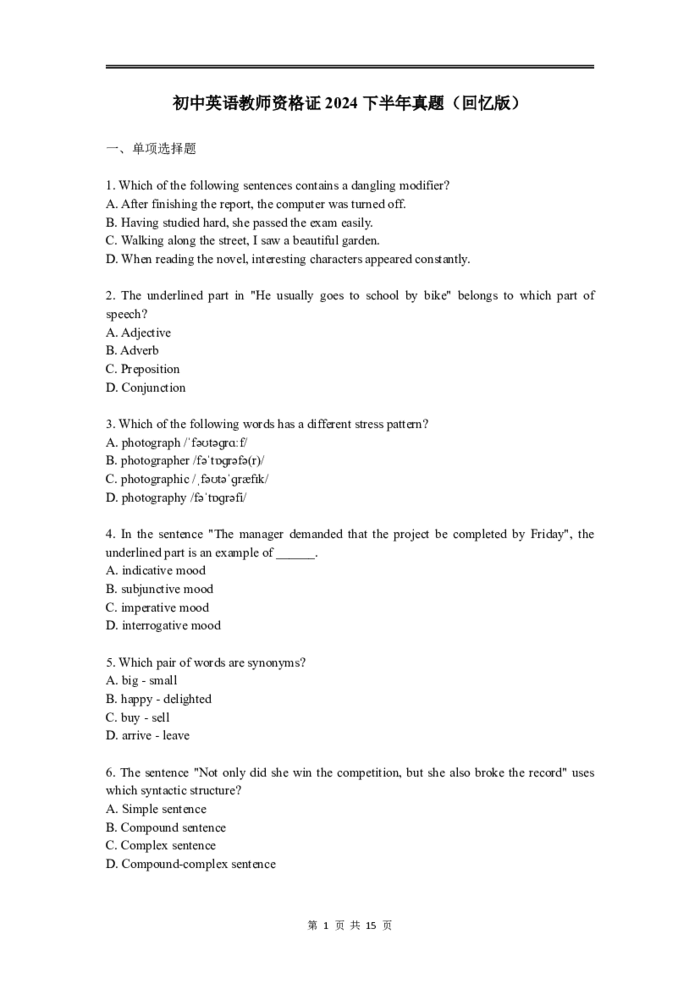
1. Which of the following sentences contains a dangling modifier?
A. After finishing the report, the computer was turned off.
B. Having studied hard, she passed the exam easily.
C. Walking along the street, I saw a beautiful garden.
D. When reading the novel, interesting characters appeared constantly.
2. The underlined part in "He usually goes to school by bike" belongs to which part of
speech?
A. Adjective
B. Adverb
C. Preposition
D. Conjunction
3. Which of the following words has a different stress pattern?
A. photograph /ˈfəʊtəɡrɑːf/
B. photographer /fəˈtɒɡrəfə(r)/
C. photographic /ˌfəʊtəˈɡræfɪk/
D. photography /fəˈtɒɡrəfi/
4. In the sentence "The manager demanded that the project be completed by Friday", the
underlined part is an example of ______.
A. indicative mood
B. subjunctive mood
C. imperative mood
D. interrogative mood
5. Which pair of words are synonyms?
A. big - small
B. happy - delighted
C. buy - sell
D. arrive - leave
6. The sentence "Not only did she win the competition, but she also broke the record" uses
which syntactic structure?
A. Simple sentence
B. Compound sentence
C. Complex sentence
D. Compound-complex sentence
第2 页共15 页
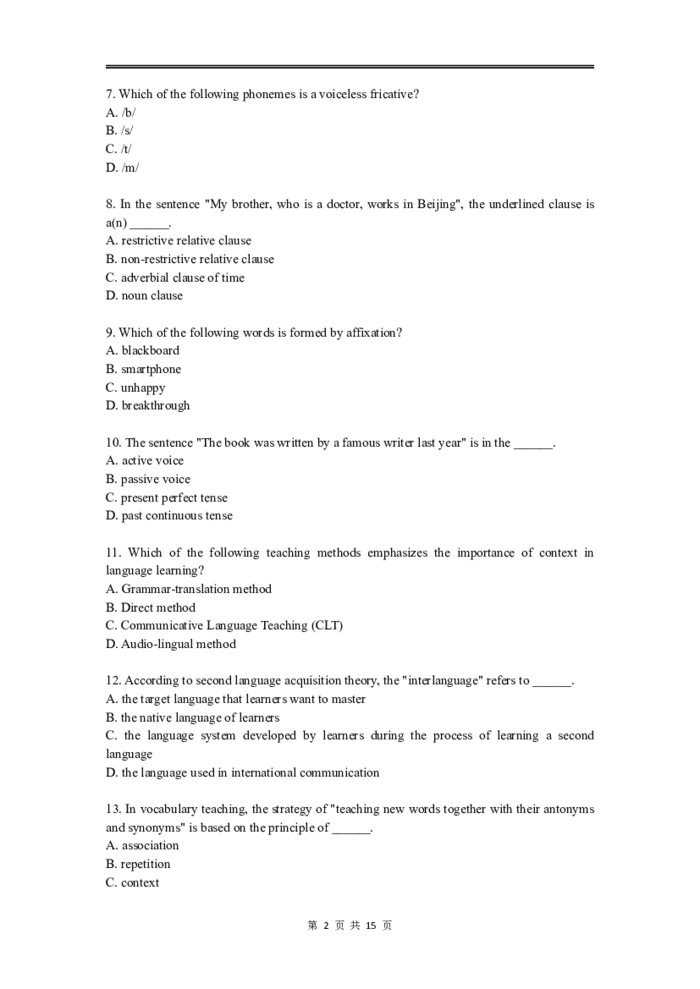
7. Which of the following phonemes is a voiceless fricative?
A. /b/
B. /s/
C. /t/
D. /m/
8. In the sentence "My brother, who is a doctor, works in Beijing", the underlined clause is
a(n) ______.
A. restrictive relative clause
B. non-restrictive relative clause
C. adverbial clause of time
D. noun clause
9. Which of the following words is formed by affixation?
A. blackboard
B. smartphone
C. unhappy
D. breakthrough
10. The sentence "The book was written by a famous writer last year" is in the ______.
A. active voice
B. passive voice
C. present perfect tense
D. past continuous tense
11. Which of the following teaching methods emphasizes the importance of context in
language learning?
A. Grammar-translation method
B. Direct method
C. Communicative Language Teaching (CLT)
D. Audio-lingual method
12. According to second language acquisition theory, the "interlanguage" refers to ______.
A. the target language that learners want to master
B. the native language of learners
C. the language system developed by learners during the process of learning a second
language
D. the language used in international communication
13. In vocabulary teaching, the strategy of "teaching new words together with their antonyms
and synonyms" is based on the principle of ______.
A. association
B. repetition
C. context
第3 页共15 页
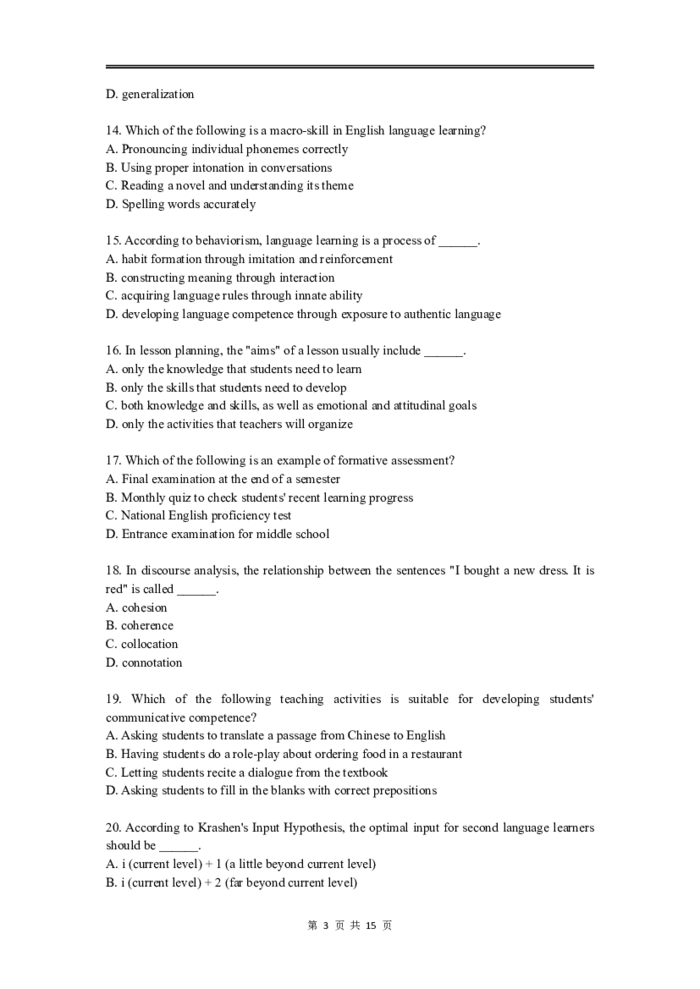
D. generalization
14. Which of the following is a macro-skill in English language learning?
A. Pronouncing individual phonemes correctly
B. Using proper intonation in conversations
C. Reading a novel and understanding its theme
D. Spelling words accurately
15. According to behaviorism, language learning is a process of ______.
A. habit formation through imitation and reinforcement
B. constructing meaning through interaction
C. acquiring language rules through innate ability
D. developing language competence through exposure to authentic language
16. In lesson planning, the "aims" of a lesson usually include ______.
A. only the knowledge that students need to learn
B. only the skills that students need to develop
C. both knowledge and skills, as well as emotional and attitudinal goals
D. only the activities that teachers will organize
17. Which of the following is an example of formative assessment?
A. Final examination at the end of a semester
B. Monthly quiz to check students' recent learning progress
C. National English proficiency test
D. Entrance examination for middle school
18. In discourse analysis, the relationship between the sentences "I bought a new dress. It is
red" is called ______.
A. cohesion
B. coherence
C. collocation
D. connotation
19. Which of the following teaching activities is suitable for developing students'
communicative competence?
A. Asking students to translate a passage from Chinese to English
B. Having students do a role-play about ordering food in a restaurant
C. Letting students recite a dialogue from the textbook
D. Asking students to fill in the blanks with correct prepositions
20. According to Krashen's Input Hypothesis, the optimal input for second language learners
should be ______.
A. i (current level) + 1 (a little beyond current level)
B. i (current level) + 2 (far beyond current level)
第4 页共15 页
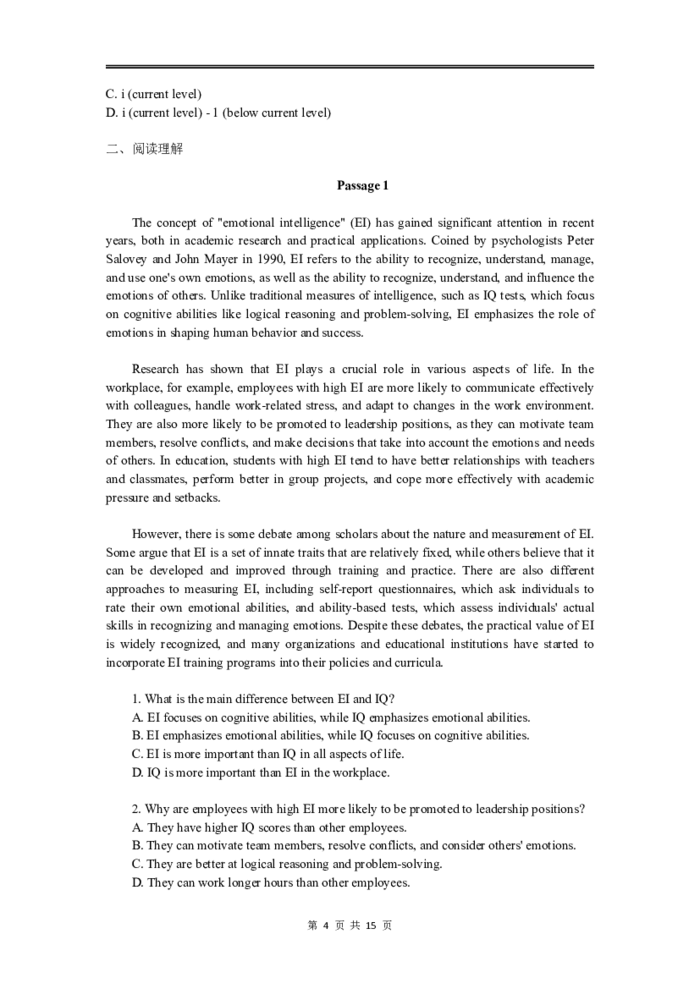
C. i (current level)
D. i (current level) - 1 (below current level)
二、阅读理解
Passage 1
The concept of "emotional intelligence" (EI) has gained significant attention in recent
years, both in academic research and practical applications. Coined by psychologists Peter
Salovey and John Mayer in 1990, EI refers to the ability to recognize, understand, manage,
and use one's own emotions, as well as the ability to recognize, understand, and influence the
emotions of others. Unlike traditional measures of intelligence, such as IQ tests, which focus
on cognitive abilities like logical reasoning and problem-solving, EI emphasizes the role of
emotions in shaping human behavior and success.
Research has shown that EI plays a crucial role in various aspects of life. In the
workplace, for example, employees with high EI are more likely to communicate effectively
with colleagues, handle work-related stress, and adapt to changes in the work environment.
They are also more likely to be promoted to leadership positions, as they can motivate team
members, resolve conflicts, and make decisions that take into account the emotions and needs
of others. In education, students with high EI tend to have better relationships with teachers
and classmates, perform better in group projects, and cope more effectively with academic
pressure and setbacks.
However, there is some debate among scholars about the nature and measurement of EI.
Some argue that EI is a set of innate traits that are relatively fixed, while others believe that it
can be developed and improved through training and practice. There are also different
approaches to measuring EI, including self-report questionnaires, which ask individuals to
rate their own emotional abilities, and ability-based tests, which assess individuals' actual
skills in recognizing and managing emotions. Despite these debates, the practical value of EI
is widely recognized, and many organizations and educational institutions have started to
incorporate EI training programs into their policies and curricula.
1. What is the main difference between EI and IQ?
A. EI focuses on cognitive abilities, while IQ emphasizes emotional abilities.
B. EI emphasizes emotional abilities, while IQ focuses on cognitive abilities.
C. EI is more important than IQ in all aspects of life.
D. IQ is more important than EI in the workplace.
2. Why are employees with high EI more likely to be promoted to leadership positions?
A. They have higher IQ scores than other employees.
B. They can motivate team members, resolve conflicts, and consider others' emotions.
C. They are better at logical reasoning and problem-solving.
D. They can work longer hours than other employees.
第5 页共15 页
3. What is the debate about the nature of EI?
A. Whether EI can be measured accurately.
B. Whether EI is more important than IQ.
C. Whether EI is an innate trait or can be developed.
D. Whether EI is useful in the workplace.
4. Which of the following is an example of an ability-based test for measuring EI?
A. A questionnaire that asks individuals to rate their own emotional skills.
B. A test that assesses individuals' ability to recognize emotions in facial expressions.
C. An exam that tests individuals' logical reasoning skills.
D. A survey that asks colleagues to evaluate an individual's emotional abilities.
5. What can we infer from the passage?
A. EI training programs are only used in the workplace.
B. EI training programs are becoming more and more popular.
C. All scholars agree on the measurement of EI.
D. EI has no impact on students' academic performance.
Passage 2
The rapid development of artificial intelligence (AI) has brought about profound changes
in various industries, and the field of education is no exception. AI-powered educational tools
and platforms are increasingly being used in classrooms around the world, offering new
possibilities for personalized learning, intelligent assessment, and interactive teaching.
One of the most significant advantages of AI in education is its ability to provide
personalized learning experiences for students. Traditional classroom teaching often adopts a
"one-size-fits-all" approach, where teachers teach the same content at the same pace to all
students, regardless of their individual learning styles, interests, and abilities. AI, however,
can analyze large amounts of data on students' learning behaviors, such as their performance
in quizzes, the time they spend on different learning tasks, and their responses to various
teaching materials. Based on this analysis, AI can generate personalized learning plans for
each student, recommend suitable learning resources, and adjust the difficulty and pace of
learning according to the student's progress. For example, if a student struggles with a
particular grammar rule in English, AI can provide additional exercises and explanations on
that topic until the student masters it.
Another important application of AI in education is intelligent assessment. Traditionally,
assessing
students'
learning
progress
and
performance
is
a
time-consuming
and
labor-intensive task for teachers, especially in large classes. AI-based assessment tools can
automatically grade objective tests, such as multiple-choice questions and fill-in-the-blanks,
with high accuracy and speed. Moreover, some advanced AI systems can even evaluate
students' subjective works, such as essays and oral presentations, by analyzing factors like
第6 页共15 页
content organization, language use, and logical reasoning. This not only saves teachers a lot
of time but also provides more timely and detailed feedback to students, helping them identify
their strengths and weaknesses.
Despite the many benefits of AI in education, there are also some challenges and
concerns. One of the main concerns is the privacy and security of students' data. AI systems
collect and analyze a large amount of personal information about students, including their
learning data, performance records, and even personal preferences. If this data is not properly
protected, it may be leaked or misused, posing a threat to students' privacy. Another concern
is the potential impact of AI on the role of teachers. Some people worry that AI may replace
teachers in the future, as it can provide personalized teaching and assessment. However, most
experts believe that AI will not replace teachers but rather complement their work. Teachers
will still play a crucial role in guiding students' learning, inspiring their creativity, and
providing emotional support, which AI cannot do.
1. What is the main idea of the passage?
A. AI has replaced teachers in many classrooms.
B. AI brings both opportunities and challenges to education.
C. AI is only used for personalized learning in education.
D. AI has no impact on the traditional teaching approach.
2. What is the advantage of AI-based personalized learning compared to traditional
classroom teaching?
A. It teaches the same content to all students.
B. It ignores students' individual learning styles.
C. It provides learning plans suitable for each student.
D. It does not adjust the learning pace for students.
3. How can AI help with intelligent assessment?
A. It can only grade objective tests.
B. It can grade both objective and subjective tests quickly and accurately.
C. It provides no feedback to students.
D. It increases the workload of teachers.
4. What is a major concern about the use of AI in education?
A. AI cannot provide personalized learning.
B. AI will make teachers lose their jobs.
C. The privacy and security of students' data.
D. AI is too expensive for educational institutions.
5. What do most experts think about the relationship between AI and teachers in
education?
A. AI will replace teachers completely.
B. Teachers will replace AI in the future.
第7 页共15 页
C. AI and teachers will complement each other.
D. AI and teachers have no connection.
三、简答题
教学情境在初中英语词汇教学中,“联想记忆法”是提升学生词汇记忆效率的重要方
法。请简述联想记忆法在初中英语词汇教学中的核心原理,并说明教师可通过哪三种具
体联想形式帮助学生记忆词汇?每种形式需结合具体例子说明。
四、分析题
材料
某初中八年级英语课堂,教师正在开展“School Life”主题对话教学。教学流程如下:
1. 教师用PPT 展示“classroom”“homework”“club activity”等核心词汇,领读5 分钟
后,让学生背诵并抽查;
2. 教师呈现预设对话模板(A: What do you usually do after school? B: I usually join
the music club. What about you? A: ...),带领学生齐读3 遍;
3. 教师要求学生两人一组仿照模板进行对话练习,10 分钟后随机邀请3 组学生展
示。
过程中发现:多数学生在背诵词汇时机械重复,抽查时卡顿频繁;对话练习时,近
半数学生仅替换模板中的名词,无法拓展内容;展示环节,被邀请的小组表现紧张,对
话不流畅,其他学生注意力分散,甚至小声聊天。
问题
1. 结合材料,分析该课堂中教师在互动设计上存在的两个主要问题,并说明这些问
题对学生语言学习的影响。
2. 针对上述问题,提出两个具体的改进策略,需说明策略的实施步骤及预期效果。
五、教学设计题
33. 设计任务:阅读下面的学生信息和语言素材,设计20 分钟的英语阅读课教学方
案。教案没有固定格式,但须包含下列要点:
• teaching objectives
• teaching contents
• key and difficult points
• major steps and time allocation
第8 页共15 页
• activities and justifications
教学时间:20 分钟
学生概况:某城市重点高中高一年级学生,班级人数45 人,多数学生英语水平良
好,具备较强的阅读理解能力,课堂参与度较高。
语言素材:
The concept of "green living" has gained increasing popularity in recent years. It refers
to a lifestyle that aims to reduce one's environmental impact by making conscious choices in
daily activities, such as using renewable energy, reducing waste, and consuming sustainable
products.
A growing body of research shows that green living not only benefits the planet but also
improves people's health and well-being. For example, choosing to walk or bike instead of
driving can reduce air pollution and promote physical fitness. Eating organic food can lower
the intake of harmful chemicals and support local farmers.
However, adopting a green lifestyle can be challenging. Some eco-friendly products are
more expensive, and changing long-held habits requires effort and commitment. Despite these
obstacles, many individuals and communities are finding creative ways to embrace green
living, from community gardens to zero-waste initiatives.
To contribute to a greener future, everyone can start with small steps. Even simple
actions like turning off lights when leaving a room, recycling properly, and reducing water
usage can make a significant difference when practiced collectively.
第9 页共15 页
初中英语教师资格证2024 下半年真题解析
一、单项选择题
1. A
◦解析:悬垂修饰语指修饰语的逻辑主语与句子主语不一致。A 选项中“finishing the
report”的逻辑主语应为人,而句子主语是“the computer”,因此存在悬垂修饰语。B、C、
D 选项的逻辑主语与句子主语一致。
2. B
◦解析:“usually”是频率副词,用于修饰动词“goes”,表示动作发生的频率,因此属于
副词(Adverb)。
3. A
◦解析:重音位置不同。A 选项“photograph”重音在第一个音节/ˈfəʊtəɡrɑːf/;B、C、D
选项的重音均在第二个音节或之后。
4. B
◦解析:在“demand that...”结构中,从句需使用虚拟语气(subjunctive mood),形式为
“(should) + 动词原形”,此处“be completed”符合虚拟语气规则。
5. B
◦解析:同义词指意义相近的词。“happy”和“delighted”都表示“高兴的”,属于同义词;
A、C、D 选项为反义词。
6. D
◦解析:该句包含“Not only...but also...”并列结构,且前半句使用了倒装语序,整体为并
列复合句(Compound-complex sentence)。
7. B
◦解析:清擦音(voiceless fricative)是发音时声带不振动、气流通过狭窄通道产生摩擦
的音。/s/符合这一特征;/b/、/m/为浊音,/t/为塞音。
8. B
◦解析:非限制性定语从句(non-restrictive relative clause)用逗号与主句隔开,补充说
明先行词的附加信息,不影响主句核心意义。句中“who is a doctor”仅补充说明“my
第10 页共15 页
brother”的身份,属于非限制性定语从句。
9. C
◦解析:词缀法(affixation)指通过添加前缀或后缀构成新词。“unhappy”由前缀
“un-”+“happy”构成;A、B、D 选项为合成词(compounding)。
10. B
◦解析:被动语态(passive voice)的结构为“be + 过去分词”,句中“was written”符合被
动语态特征。
11. C
◦解析:交际语言教学法(CLT)强调在真实语境中运用语言,重视语境对语言学习的
作用;A、B、D 选项对语境的重视程度较低。
12. C
◦解析:中介语(interlanguage)是二语学习者在学习过程中形成的过渡性语言系统,
既不同于母语也不同于目标语。
13. A
◦解析:通过同义词、反义词联想记忆词汇,利用了词汇间的语义关联,符合联想
(association)原则。
14. C
◦解析:宏观技能(macro-skill)指综合运用语言的能力,如理解文章主题;A、B、D
选项为微观技能(micro-skill),侧重语言形式层面。
15. A
◦解析:行为主义(behaviorism)认为语言学习是通过模仿和强化形成习惯的过程。
16. C
◦解析:课程目标(aims)应涵盖知识、技能、情感态度等多个维度,而非单一维度。
17. B
◦解析:形成性评价(formative assessment)用于监控学习过程、提供反馈,如月度测
验;A、C、D 选项为终结性评价(summative assessment)。
第11 页共15 页
18. A
◦解析:衔接(cohesion)指语篇中句子间的语言联系,如代词“it”指代前句的“a new dress”,
体现了衔接关系。
19. B
◦解析:角色扮演(role-play)模拟真实交际场景,有助于培养交际能力;A、C、D 选
项侧重语言形式训练。
20. A
◦解析:Krashen 的输入假说认为,最优输入应略高于学习者当前水平(i+1),既具挑
战性又可理解。
二、阅读理解
Passage 1
1. B
◦解析:原文明确指出“IQ tests focus on cognitive abilities...EI emphasizes the role of
emotions”,因此B 选项正确。
2. B
◦解析:原文提到“they can motivate team members, resolve conflicts, and make decisions
that take into account the emotions and needs of others”,直接对应B 选项。
3. C
◦解析:关于EI 本质的争论在于“EI 是先天特质还是可通过训练发展”,对应C 选项。
4. B
◦解析:能力-based 测试评估实际技能,如识别面部表情中的情绪;A 选项为自陈问卷,
C 选项与EI 无关,D 选项为他人评价。
5. B
◦解析:原文提到“many organizations and educational institutions have started to
incorporate EI training programs”,可推断EI 培训项目日益普及。
Passage 2
第12 页共15 页
1. B
◦解析:文章既阐述了AI 在教育中的优势(个性化学习、智能评估),也提及挑战(数
据隐私、教师角色),因此B 选项全面概括主旨。
2. C
◦解析:AI 可“generate personalized learning plans for each student”,与传统“一刀切”教学
形成对比,对应C 选项。
3. B
◦解析:AI 可自动批改客观题,部分系统还能评估主观题,且反馈及时准确,对应B
选项。
4. C
◦解析:原文明确指出“the privacy and security of students' data”是主要担忧之一。
5. C
◦解析:多数专家认为AI 不会取代教师,而是“complement their work”,即互补关系。
三、简答题
核心原理
联想记忆法的核心原理是利用词汇间的语义、形式或语境关联,构建记忆网络,通过激
活已有知识来强化新词汇的记忆,提升记忆效率和持久性。
三种联想形式及例子
1. 语义联想:通过同义词、反义词、上下义词等语义关系联想。
◦例子:学习“happy”时,联想同义词“delighted”、反义词“sad”、上下义词“emotion”。
2. 形式联想:通过拼写、发音相似性联想。
◦例子:学习“night”时,联想发音相近的“knight”;学习“believe”时,联想拼写相似的
“relieve”。
3. 语境联想:通过具体语境或场景联想词汇用法。
◦例子:学习“recycle”时,联想“垃圾分类”“环保活动”等场景,记忆其在语境中的搭配
第13 页共15 页
和意义。
四、分析题
1. 互动设计问题及影响
问题1:互动形式单一机械,缺乏真实交际情境。
• 影响:学生机械背诵词汇、套用模板,无法理解语言的交际功能,导致语言运用能力
薄弱,对话卡顿、内容僵化。
问题2:互动参与度低,反馈机制缺失。
• 影响:多数学生被动参与,注意力分散;展示环节仅关注少数小组,缺乏对全体学生
的有效反馈,导致学习动机下降,语言输出质量不高。
2. 改进策略
策略1:创设真实交际情境,优化词汇与对话教学
• 实施步骤:
1. 词汇教学:结合校园场景图片、短视频,让学生用“classroom”“club activity”等词汇描
述自己的校园生活,而非机械背诵。
2. 对话练习:将模板改为“分享你的课后安排”,鼓励学生加入个性化细节(如时间、感
受),教师巡视并提供即时语言支持。
• 预期效果:学生在真实语境中理解词汇和句型,提升语言运用的灵活性和流畅度。
策略2:采用分层互动设计,强化全员参与
• 实施步骤:
1. 小组练习:4 人一组,每组分配“记录员”“发言人”角色,确保每人参与;练习后先组
内互评,再推选代表展示。
2. 反馈机制:展示后采用“同伴评价+教师点评”,肯定亮点并针对性纠正语言错误,同
时邀请未展示的学生补充发言。
• 预期效果:提升全员参与度,增强学习自信心,形成有效反馈闭环,促进语言输出质
量提升。
五、教学设计题
Teaching Objectives
第14 页共15 页
1. Knowledge objectives:
◦Students can master the key vocabulary related to green living, such as “renewable energy”,
“sustainable products”, “zero-waste initiatives”.
◦Students can understand the main idea and structure of the passage about green living.
2. Skill objectives:
◦Students can extract specific information from the passage through skimming and scanning.
◦Students can express their own opinions on green living in English.
3. Emotional objectives:
◦Students can realize the importance of green living and develop environmental awareness.
Teaching Contents
• Key vocabulary: renewable energy, sustainable products, zero-waste initiatives, etc.
• Reading skills: skimming for main idea, scanning for specific details.
• Topic: Green living – concept, benefits, challenges, and actions.
Key and Difficult Points
• Key points:Understanding the main idea of the passage and mastering key vocabulary.
• Difficult points:Expressing personal opinions on green living in coherent English.
Major Steps and Time Allocation
1. Warm-up (3 mins):Show pictures of green living (e.g., recycling, walking to school) and
ask students to discuss “What can we do to protect the environment?”
2. Pre-reading (2 mins) :Present key vocabulary with context and check students’ prior
knowledge about green living.
3. While-reading (10 mins):
◦Skimming: Ask students to read quickly and match paragraphs with main ideas.
第15 页共15 页
◦Scanning: Ask students to find answers to specific questions (e.g., “What are the benefits of
green living?”).
4. Post-reading (5 mins):
◦Group discussion: “What small steps can we take in our daily life to practice green living?”
◦Share opinions and summarize key takeaways.
Activities and Justifications
1. Warm-up discussion:Activates students’ prior knowledge and arouses interest in the topic.
2. Vocabulary presentation in context:Helps students understand vocabulary meaning in real
situations, improving retention.
3. Skimming and scanning tasks :Trains students’ core reading skills and deepens
comprehension of the passage.
4. Group discussion :Encourages students to apply what they’ve learned, promotes
communicative competence, and fosters environmental awareness.