版权所有。未经版权所有人书面许可,不得在任何地区以任何形式、任何媒介、任何文字
翻印、仿制或转载本书的内容、文字或图片。
普通高中教科书·英语[必修 第三册]
主 编 王守仁 何 锋
副 主 编 顾爱彬 范红升
编 写 Michelle Kaeser 胡 明 邢文骏 吴 宁 梁 健 杨志平 李 娜 徐静芳
责任编辑 丁晓红 梁 健 马绯璠 潘志娟 丁 婧 高睿君
装帧设计 韦 枫 胡 苨 黄 晨
出 版 译林出版社
地 址 南京市湖南路1 号A 楼
邮 箱 jiaocai@yilin.com
购买热线 400—928—9069
教材热线 025—83658349, 83672889
重 印 江苏凤凰出版传媒股份有限公司
发 行 江苏凤凰出版传媒股份有限公司
印 刷 江苏凤凰新华印务集团有限公司
开 本 890 毫米×1240 毫米 1/16
印 张 8
版 次 2020 年12 月第1 版
印 次 2024 年5 月第8 次印刷
标准书号 ISBN 978—7—5447—8130—5
定 价 9.74 元
审 批 号 苏费核(2023 年)0362 号 举报电话: 12315
版权所有 · 侵权必究
如发现印、 装质量问题, 请与凤凰传媒联系。电话:400—828—1132
前 言
同学们:
欢迎使用《普通高中教科书·英语》!本册教材围绕“人与自然”和“人与社会”
的主题语境,依托话题丰富、文体多样的语篇,引领你通过一系列英语学习活动,发
展英语学科核心素养。现在,让我们走进教材,开启一段有趣的英语学习之旅。
每个单元首页的 Welcome to the unit 板块是你单元学习的起点,借助歌曲、
视频、图示、文字等形式多样的语篇激发你的学习兴趣,帮助你初步了解单元主题,
为单元学习做好热身准备。随后,你将进入一个非常重要的学习环节——Reading
板块。在这里,你将有机会阅读关于热带雨林、自然灾害、互联网世界以及科学家
与科学精神等话题的语篇,感受真实、地道、优美的英语,了解自然环境与科技进步。
你可以通过一系列多维度、分层次的阅读活动,深入探究主题意义,提升语言能力、
文化意识和思维品质。来到 Grammar and usage 板块,你将在语篇中观察、探究
语法现象,自主归纳语法规则,并在新的语境和活动中正确使用语法。接下来,在
Integrated skills 板块,你将综合运用听、说、读、看、写的技能,完成语言技能融合
的活动。随后,在 Extended reading 板块,你将进行拓展阅读,通过观点表达等
活动,进一步探究主题意义,获得对人与自然环境、科学技术的新认识。在 Project
板块,你将和同学一起开展合作学习、探究学习,完成一项综合性、实践性活动。
Assessment 板块以列表的形式提供自评、互评等多种评价方式,促使你及时反思
并调整学习行为,提升学习能力,使学习更有成效。在 Further study 板块,你可以
根据自身的学习情况来选择教材推荐的资源在课后进行自主学习、拓展学习,继续
体验英语学习的快乐。
祝你在这段英语学习之旅中,带着梦想,快乐而自信地前行!
《普通高中教科书·英语》编写组
2020 年12 月
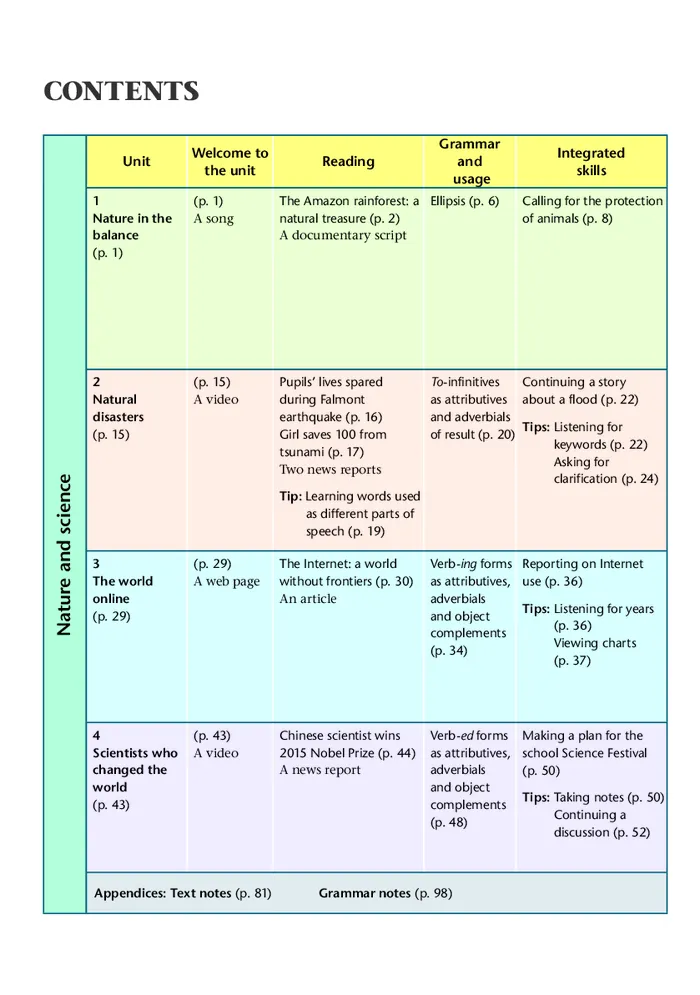
Unit
Welcome to
the unit
Reading
Grammar
and
usage
Integrated
skills
1
Nature in the
balance
(p. 1)
(p. 1)
A song
The Amazon rainforest: a
natural treasure (p. 2)
A documentary script
Ellipsis (p. 6)
Calling for the protection
of animals (p. 8)
2
Natural
disasters
(p. 15)
(p. 15)
A video
Pupils’ lives spared
during Falmont
earthquake (p. 16)
Girl saves 100 from
tsunami (p. 17)
Two news reports
Tip: Learning words used
as different parts of
speech (p. 19)
To-infinitives
as attributives
and adverbials
of result (p. 20)
Continuing a story
about a flood (p. 22)
Tips: Listening for
keywords (p. 22)
Asking for
clarification (p. 24)
3
The world
online
(p. 29)
(p. 29)
A web page
The Internet: a world
without frontiers (p. 30)
An article
Verb-ing forms
as attributives,
adverbials
and object
complements
(p. 34)
Reporting on Internet
use (p. 36)
Tips: Listening for years
(p. 36)
Viewing charts
(p. 37)
4
Scientists who
changed the
world
(p. 43)
(p. 43)
A video
Chinese scientist wins
2015 Nobel Prize (p. 44)
A news report
Verb-ed forms
as attributives,
adverbials
and object
complements
(p. 48)
Making a plan for the
school Science Festival
(p. 50)
Tips: Taking notes (p. 50)
Continuing a
discussion (p. 52)
Appendices: Text notes (p. 81) Grammar notes (p. 98)
Nature and science
CONTENTS
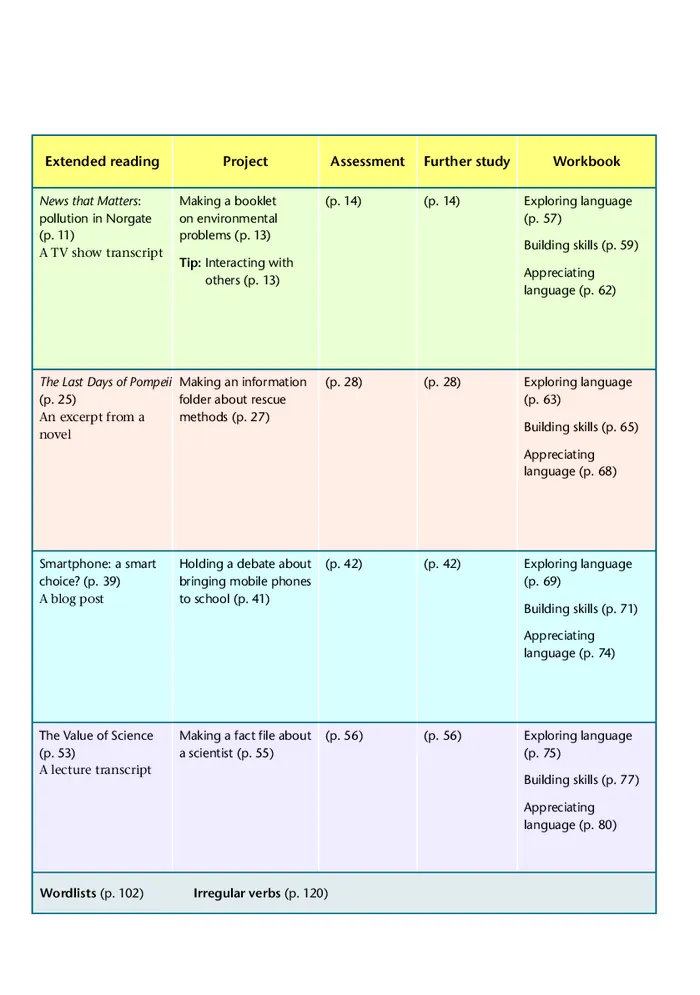
Extended reading
Project
Assessment
Further study
Workbook
News that Matters:
pollution in Norgate
(p. 11)
A TV show transcript
Making a booklet
on environmental
problems (p. 13)
Tip: Interacting with
others (p. 13)
(p. 14)
(p. 14)
Exploring language
(p. 57)
Building skills (p. 59)
Appreciating
language (p. 62)
The Last Days of Pompeii
(p. 25)
An excerpt from a
novel
Making an information
folder about rescue
methods (p. 27)
(p. 28)
(p. 28)
Exploring language
(p. 63)
Building skills (p. 65)
Appreciating
language (p. 68)
Smartphone: a smart
choice? (p. 39)
A blog post
Holding a debate about
bringing mobile phones
to school (p. 41)
(p. 42)
(p. 42)
Exploring language
(p. 69)
Building skills (p. 71)
Appreciating
language (p. 74)
The Value of Science
(p. 53)
A lecture transcript
Making a fact file about
a scientist (p. 55)
(p. 56)
(p. 56)
Exploring language
(p. 75)
Building skills (p. 77)
Appreciating
language (p. 80)
Wordlists (p. 102) Irregular verbs (p. 120)
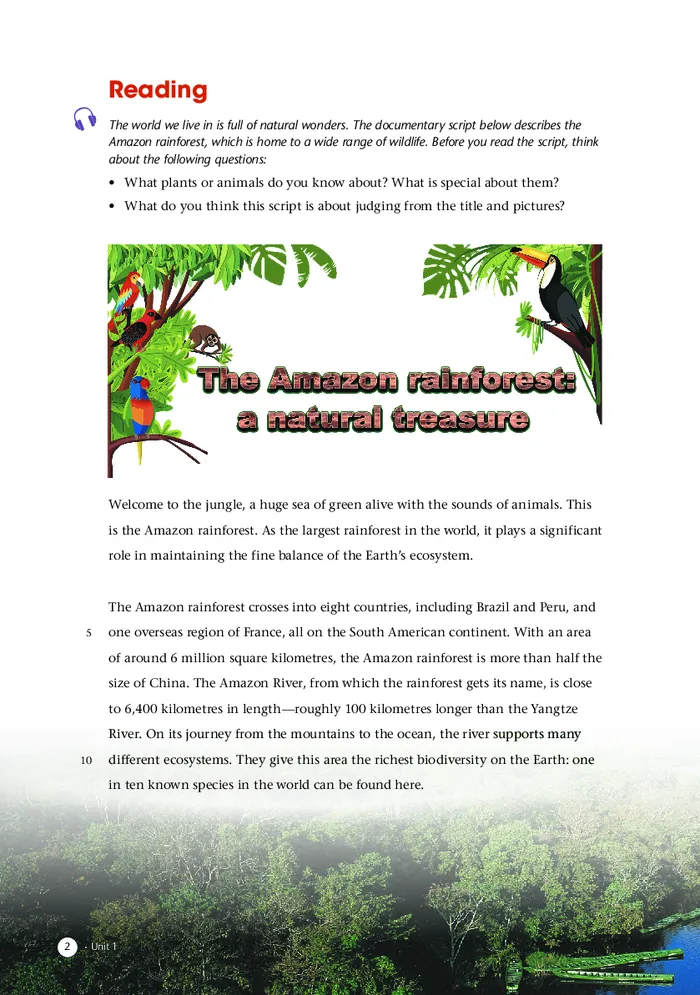
The human race has done much harm.
We have polluted our soils and seas,
And cut down too many trees.
Now is the time to sound the alarm.
We want to live in a world that’s clean;
We want to live in a world of green.
The human race has done much harm;
Now is the time to sound the alarm.
Let’s be thankful for the skies above;
Let’s plant new trees and stop pollution;
Let’s work together to find the solution;
The Earth’s our home to protect and love.
We want to live in a world that’s clean;
We want to live in a world of green.
Let’s be thankful for the skies above;
The Earth’s our home to protect and love.
Nature in the balance
1
UNIT
1
Nature in the balance
Let us not, however, flatter ourselves overmuch on account of our
human victories over nature. For each such victory nature takes its
revenge on us.
—Friedrich Engels
In this unit, you are going to:
• read a documentary script about a rainforest;
• write an article for the school newspaper calling for
the protection of animals;
• read a TV show transcript about a polluted city;
• make a booklet on environmental problems.
1 What is the message of the song?
2 What can you do to help protect the environment?
Welcome to the unit
The Earth is our only home. Listen to the song below and discuss the following questions in pairs.
2
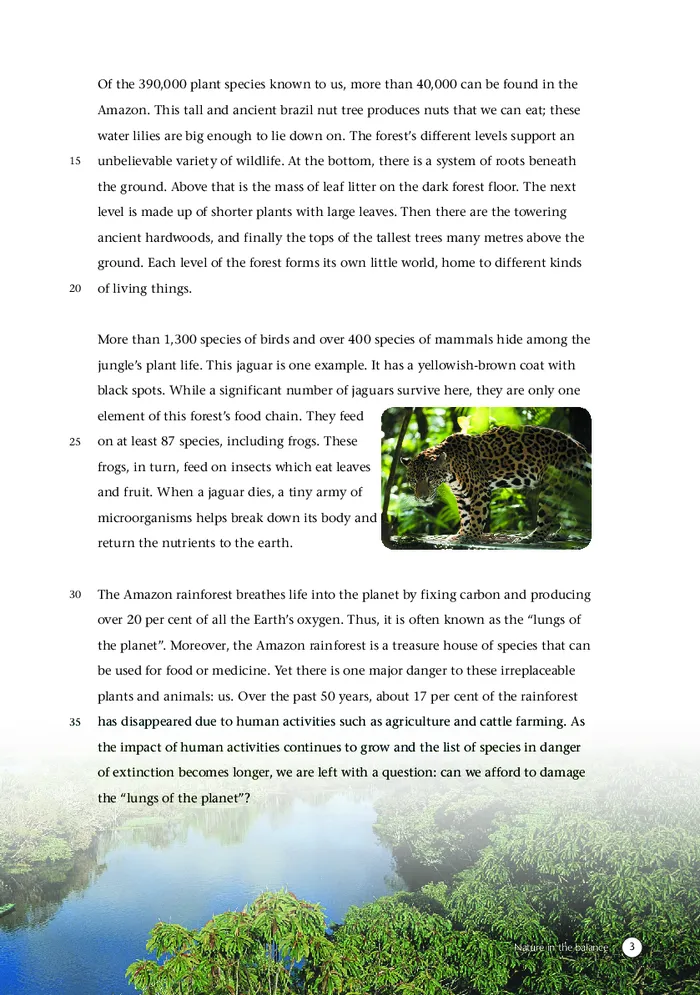
Welcome to the jungle, a huge sea of green alive with the sounds of animals. This
is the Amazon rainforest. As the largest rainforest in the world, it plays a significant
role in maintaining the fine balance of the Earth’s ecosystem.
The Amazon rainforest crosses into eight countries, including Brazil and Peru, and
one overseas region of France, all on the South American continent. With an area
of around 6 million square kilometres, the Amazon rainforest is more than half the
size of China. The Amazon River, from which the rainforest gets its name, is close
to 6,400 kilometres in length—roughly 100 kilometres longer than the Yangtze
River. On its journey from the mountains to the ocean, the river supports many
different ecosystems. They give this area the richest biodiversity on the Earth: one
in ten known species in the world can be found here.
The world we live in is full of natural wonders. The documentary script below describes the
Amazon rainforest, which is home to a wide range of wildlife. Before you read the script, think
about the following questions:
• What plants or animals do you know about? What is special about them?
• What do you think this script is about judging from the title and pictures?
Reading
5
10
Unit 1
3
Of the 390,000 plant species known to us, more than 40,000 can be found in the
Amazon. This tall and ancient brazil nut tree produces nuts that we can eat; these
water lilies are big enough to lie down on. The forest’s different levels support an
unbelievable variety of wildlife. At the bottom, there is a system of roots beneath
the ground. Above that is the mass of leaf litter on the dark forest floor. The next
level is made up of shorter plants with large leaves. Then there are the towering
ancient hardwoods, and finally the tops of the tallest trees many metres above the
ground. Each level of the forest forms its own little world, home to different kinds
of living things.
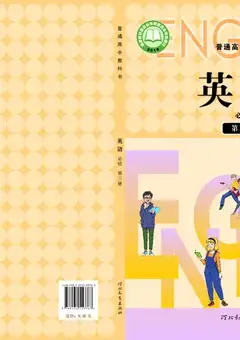
More than 1,300 species of birds and over 400 species of mammals hide among the
jungle’s plant life. This jaguar is one example. It has a yellowish-brown coat with
black spots. While a significant number of jaguars survive here, they are only one
element of this forest’s food chain. They feed
on at least 87 species, including frogs. These
frogs, in turn, feed on insects which eat leaves
and fruit. When a jaguar dies, a tiny army of
microorganisms helps break down its body and
return the nutrients to the earth.
The Amazon rainforest breathes life into the planet by fixing carbon and producing
over 20 per cent of all the Earth’s oxygen. Thus, it is often known as the “lungs of
the planet”. Moreover, the Amazon rainforest is a treasure house of species that can
be used for food or medicine. Yet there is one major danger to these irreplaceable
plants and animals: us. Over the past 50 years, about 17 per cent of the rainforest
has disappeared due to human activities such as agriculture and cattle farming. As
the impact of human activities continues to grow and the list of species in danger
of extinction becomes longer, we are left with a question: can we afford to damage
the “lungs of the planet”?
15
20
25
30
35
Nature in the balance
Unit 1
4
A3 In pairs, discuss the following questions.
1 What makes the Amazon rainforest a natural treasure according to the script?
2 What is your answer to the question at the end of the script? Support your opinion
with information from the script or other sources.
3 Are there any places in China with rich biodiversity like the Amazon rainforest?
What are they? Introduce one to the class.
A2 Read the documentary script again carefully and fill in the blanks with the figures.
A Understanding the text
A1 Read the documentary script and write the main idea of each paragraph.
around (2) _____ km
2
of forest
over (7) _____ of all
the Earth’s oxygen
produced
more than (5) _____
bird species
about (3) _____ km in length
about (8) _____ of the rainforest
lost over the past 50 years
more than (4) _____ plant
species
(1) _____ countries and
one overseas region
over (6) _____ species
of mammals
Para. 1: Introduction to the Amazon rainforest
Para. 2: Basic information about the rainforest
Para. 3: ____________________________________________________________________
Para. 4: ____________________________________________________________________
Para. 5: ____________________________________________________________________
AMAZON
Nature in the balance
5
B Building your language
B1 The passage below is from a website about the Amazon rainforest. Complete the passage
with the correct forms of the words and phrases in the box below.
The Amazon rainforest is home to a great (1) _________________ of plant life; however,
its soil is surprisingly poor in nutrients. In fact, the soil in the region cannot support
(2) _________________ for more than a few years. If a scientist is shown a report listing
the nutrients of that soil, he or she will probably think that only desert plants can
(3) _________________ in it! Then why is the soil so poor in nutrients? For one thing,
the rainy season has a(n) (4) _________________ on the soil. In the rainy season, the
water level can rise to more than 12 metres. When the water goes away, it takes
away the nutrients in the soil. For another thing, (5) _________________ the Amazon’s
hot climate, it is difficult for the soil to build up enough nutrients. Dead plants
and animals (6) _________________ more quickly. The nutrients are soon taken in by
the roots of the plants deep (7) _________________ the ground. As a result, most of
the forest’s nutrients are locked up in the plants themselves, (8) _________________
allowing them to grow at an unbelievable speed.
Prefixes
Words
un-
unbelievable
dis-
disappear
in-/im-/il-/ir-
irreplaceable
non-
non-smoking
B3 The documentary script compares the size of the Amazon rainforest with that of China,
and the length of the Amazon River with that of the Yangtze River. Find these comparisons in
the script and think of similar comparisons for the figures below.
Learn this While the reader may find a large figure too abstract to understand,
making comparisons with familiar places or objects will help them gain a better
understanding. Here are some expressions used to make comparisons:
the same size/length as ...
as large/long as ...
more than/larger than/longer than ...
twice/three times as large/long as ...
1 It was reported that in 2011, about 34 million people lived in the Amazon.
(population of Canada: 37 million; population of Shanghai: 24 million)
2 From 2001 to 2012, about 177,000 square kilometres of the Amazon rainforest
were lost. (size of New Zealand: 268,000 km
2; size of Jiangsu: 107,200 km
2)
B2 The documentary script uses some words with negative prefixes. Note the following
prefixes and think of more words formed with them. Then fill in the table below with as many
words as you can.
agriculture
impact
thus
due to
variety
survive
beneath
break down
Unit 1
6
Grammar and usage
Ellipsis
A Exploring the rules
Jack and Henry are talking about a documentary on environmental protection. Pay attention
to the underlined sentences and write down the words that have been left out in the brackets
below. The first one has been done for you.
• We sometimes use ellipsis to avoid (1) _________________ (stressing/
repeating) one or more words when the meaning is clear.
• We can use ellipsis:
in short responses;
in infinitives;
after some conjunctions like if, when and while;
in clauses with the same pattern and the same verb;
at the beginning of a sentence in (2) _________________ (informal/
formal) speech.
Grammar notes page 98
Jack:
Hi, Henry! Did you watch the documentary about environmental
protection on TV yesterday?
Henry: (1) No, I didn’t.
Jack:
What a pity! I highly recommend it. (2) You can watch it online if you want
to. It’s about some of the worst environmental problems we’re facing today.
Global warming, for example, is a major problem caused by greenhouse
gases. It may lead to extreme weather events: droughts, heatwaves and so
on. (3) I felt worried when watching the documentary.
Henry: Does it also talk about solutions to these problems?
Jack:
Yes. It includes interviews with more than 20 of the world’s leading experts
on environmental issues. All of them come up with creative ideas on how
to solve these problems. (4) Some call for the application of modern
technology, and others a change of lifestyle.
Henry: I wish we could also do something to help. (5) Got any ideas?
Jack:
What about making a brochure about environmental problems?
Henry: (6) Sounds great! Let’s get started after lunch.
1 No, I didn’t (watch the documentary about environmental protection on TV yesterday).
2 You can watch it online if you want to ( ).
3 I felt worried when ( ) watching the documentary.
4 Some call for the application of modern technology, and others ( ) a change
of lifestyle.
5 ( ) Got any ideas?
6 ( ) Sounds great!
Working out the rules
Nature in the balance
7
B2 Jack is sharing with his classmates his experience of taking part in a forest clean-up
activity. Use ellipsis where necessary. Put brackets around the word(s) that can be left out.
Last weekend, I took part in a forest clean-up activity. It was organized by
GreenHope, an organization devoted to protecting forests. At first I didn’t want
to take part in the forest clean-up activity, but then I thought, “What if nobody
goes?” Our team leader, Joe, took us to a forest outside the city. I was sad to see litter
everywhere. There was a “No littering is allowed here” sign at the entrance to the
forest, but that didn’t stop people from throwing their rubbish on the ground. Joe
divided us into two groups: one group cleaned up the north side of the forest, and
the other group cleaned up the south side of the forest. We worked for several hours
and we were happy to see that the forest looked cleaner than it had looked before.
It was absolutely worth our effort! There’ll be another clean-up activity in the green
belt next Saturday. You can find Joe and sign up if you’re willing to help. Everyone
who takes part in the activity will receive a medal. I’ll join you too if I have time.
B3 In pairs, describe the pictures below using ellipsis to call for the protection of the
environment. Use the example to help you. You can also draw a picture and think of a slogan.
B Applying the rules
B1 Find the mistakes and rewrite the sentences using ellipsis.
1 I cannot watch the documentary this weekend, though I would like.
______________________________________________________________________________
2 Cows live on land, and fish the water.
______________________________________________________________________________
3 The Amazon rainforest is smaller now than was 50 years ago.
______________________________________________________________________________
4 He had planned to borrow a book on environmental protection, but he didn’t do.
______________________________________________________________________________
5 When taking photos of wildlife, every effort should be made to ensure that we
keep away from the animals.
______________________________________________________________________________
When the water is too dirty to
drink and the air too polluted to
breathe, will you be able to look
at your children and say, “What
a beautiful world!”?
Example
Unit 1
8
Human activities cause
increasing harm to animals
Integrated skills
Calling for the protection of animals
A Jim is reading a news report about how human activities are harming animals. Read the
news report and answer the questions below.
When you think of a fearsome hunter, images of lions and sharks may spring to
mind. Recent research by environmental scientists, however, shows that in fact,
humans are the most fearsome hunters who have the greatest impact on animal
populations. Human activities have brought many animals close to extinction. In
the last 500 years, over 300 species of animals have gone extinct. Some activities,
such as hunting and fishing, directly harm animals, while other activities, such as
development in towns and cities, impact indirectly on animal populations.
Hunting and fishing have directly influenced the world’s animal populations.
Some people hunt animals for food: whale meat is eaten
in some parts of the world. Some people hunt animals for
fashion: animal skin is used to make coats and bags. Still
others hunt animals just for fun: deer are tracked and
shot by people who enjoy the excitement of the sport.
Human activities that have indirect effects on animals can be just as harmful.
When we build farms or factories, we destroy animal habitats and leave many
animals with nowhere to live, or no food to eat. We can also put animals in danger
without ever entering their habitats. Air, water, noise and light pollution can all
have a deep and damaging influence quite far from their source. Partly due to
pollution caused by ship traffic and other human activities, the dolphin population
has dropped greatly. As the human population continues to grow, so does the effect
we have on animals.
1 What are the three main reasons why people hunt animals?
______________________________________________________________________________
2 How do human activities indirectly have an effect on animals?
______________________________________________________________________________
Nature in the balance
9
Animal protection
B
Jim has found a video about protecting animals. Watch and finish the exercises below.
B1 Watch the video and answer the following questions.
1 What happened to several whale species in the last century?
______________________________________________________________________________
2 What can protected areas ensure?
______________________________________________________________________________
3 What causes the loss of animal habitats in the Amazon rainforest?
______________________________________________________________________________
4 What will we be better able to do if we learn more about how human activities
harm the environment?
______________________________________________________________________________
B2 Watch the video again and complete the notes below.
Ways to protect animals
• Make hunting endangered
animals (4) _________________.
• Protect (5) _________________.
Create well-planned and
well-managed protected
areas.
Take small actions, like
(6) _________________.
• Make people understand the
problems facing animals.
Importance of animals
• They make our world
more (1) _________________.
• They provide
(2) _________________ for
us.
• They play a role in
(3) _________________ of our
ecosystem.
Unit 1
10
C In pairs, talk about animal protection. Use the following questions and expressions to
help you.
• Why should we protect animals?
• How are animals harmed by human activities?
• What action should be taken to protect animals?
D Write an article for the school newspaper calling for everyone to protect animals. Use
your ideas from part C and the information in parts A and B to help you.
Expressions
Talking about animal protection
Animals are in danger/at risk when we ...
We can take care of/protect animals with these measures.
Protecting animal habitats is of great importance because ...
We can take measures to/make efforts to ...
We should call on people to ...
Planning your writing
• Learning about the structure
When you write an article to call for the protection of animals, you can follow
the structure below:
State the importance of protecting animals.
Explain how human activities harm animals.
Come up with ways to protect animals.
• Learning about the language
It is a good idea to give examples when you explain how human activities
harm animals. You can use the following expressions: for example, for instance,
take the example of, etc.
You can also use powerful and emotive words and phrases to make a strong
impact on the reader.
Checking your writing
Remember to check your writing after you finish and exchange drafts between you
and your partner. Pay attention to the following aspects:
Punctuation
Spelling
Grammar
Choice of words
Style (formal/informal)
Structure
Self-review
• What ways do you come up with on
protecting animals?
• Do the examples help explain how
human activities harm animals?
Peer review
• What advice does your partner give on
your writing?
• How can you improve your writing?
Nature in the balance
11
Extended reading
Read the TV show transcript about a polluted city.
HOST:
Good evening and welcome to News that Matters. Our topic today is
pollution in Norgate. Joining us in the studio tonight are James Smith,
a local resident; Vincent Brown, senior manager of a local factory; and
Julie Archer, chief of the Norgate Environmental Protection Committee.
Welcome.
Norgate’s rapid development has had significant environmental costs.
Mr Smith, you’ve lived in this city for over 20 years. How would you
describe the effects of pollution over that time?
SMITH:
It’s been awful, really. When I first moved here, the air was fresh, the
grass green and the water clear. Then heavy industry factories moved in,
and things became entirely different. I don’t enjoy outdoor activities any
more. The river is dirty and smelly. The smog in the air has coloured the
sky a smoky grey; it’s also given me a cough that I can’t get rid of. For
health and safety reasons alone, heavy industry has to go.
HOST:
Mr Smith protested against heavy industry. Mr Brown, would you like
to respond?
BROWN: Well, I’m sorry you feel that way, Mr Smith. People tend to connect
factories with pictures of clouds of dirty smoke and irresponsible
businessmen eager to make huge profits. In defence of the factories,
however, I’d like to point out that we also try to control the amount of
pollution we produce. I think I speak for all factory managers when I
say we’re deeply concerned about the environment. We’ve been taking
various measures, including the use of new technologies, to reduce
pollution in the production process, even though these measures raise
5
10
15
20
News that Matters:
pollution in Norgate
Unit 1
12
our production costs. I’d also like to draw your attention to the economic
benefits factories have brought to Norgate. We’ve created many jobs for
local residents and helped the city’s economy grow.
HOST:
Thank you, Mr Brown. With pollution levels on the rise, the Norgate
Environmental Protection Committee is searching for ways to fight
the problem. Mrs Archer, what are your thoughts on how to deal with
pollution?
ARCHER: Well, our committee has a major role to play in maintaining air and
water quality. We have to achieve a balance between environmental
protection and economic development. We’ve made environmental
policies for businesses to observe, like strict clean-up requirements.
We also work hand in hand with other branches of government to
ensure that development strategies are followed in an environmentally
friendly way. However, fighting pollution isn’t just a task
for factories and the government. It has to be a
community-wide effort, and everyone can
help by following the golden rule: reduce,
reuse and recycle. For example, you
can save energy by taking the bus or
the subway, or using the bike-sharing
system.
HOST:
Thank you, Mrs Archer, and thanks again to
all of our guests. A former UN official once said, “Saving our planet,
lifting people out of poverty, advancing economic growth ... these are
one and the same fight.” The fortunes of our environment and our
economy are inseparable. It’s our duty to protect the environment while
we aim for economic development. It’s our duty to leave a better, cleaner
and healthier planet to our children. It’s our duty to build a human
community with a shared future.
B
Pollution is a serious problem around the world, and much effort has been put into the
fight against it. Do you think things will change significantly in the future? Describe what the
world will be like 20 years from now.
25
30
35
40
45
50
A Summarize the main viewpoints of the host and three guests.
Points of view
James Smith
Vincent Brown
Julie Archer
Host
Nature in the balance
13
Tip
B
As a group, research your chosen problem. Use the diagram below to help you.
A As a class, discuss different environmental problems. You can
use the ideas below or think of other ideas. Then in groups, choose
one problem to research.
Project
Making a booklet on environmental problems
air pollution
noise pollution habitat loss
light pollution
water pollution
global warming
soil pollution
overfishing
...
Causes
Control
Consequences
C As a group, put together your information to make your part of the booklet. Use the
example below to help you. Present your part to the rest of the class. Then as a class, put all
the parts together to make the booklet.
While discussing in a group, make
eye contact with others to make sure
that they can understand and are
interested. Listen to their feedback
carefully and respond appropriately.
You may also ask questions to show
that you are interested.
Interacting with others
Causes
There are various causes of water pollution. Large amounts of industrial
waste poison the water after they enter water bodies. Moreover, animal and
human waste pollutes the water. Water pollution is also caused by poisonous
chemicals used in agriculture.
Consequences
Polluted water bodies not only do harm to animals and plants; they also have
a long-lasting effect on humans. For example, in many parts of the world, the
poor quality of the local drinking water gives rise
to public health problems.
Control
To prevent further damage to water bodies, it
is necessary to take some measures. First, we
must draw public attention to the problem.
Second, more strict laws should be passed to
help reduce water pollution. Third, we can
volunteer to take part in clean-up activities.
Water pollution
Unit 1
14
Assessment
A In pairs, rank your performance level in the following areas from 1 to 5. Write down your
own assessment in the column “Me” and ask your partner to write down his/her assessment
of your performance in the column “Partner”.
How well can you:
Me
Partner
understand the documentary script about
the Amazon rainforest?
write an article calling for the protection of
animals?
understand the TV show transcript about
pollution in Norgate?
interact with others and make a booklet on
environmental problems?
use the new vocabulary from this unit? *
identify and make use of ellipsis? *
5 = Excellent
4 = Good
3 = Satisfactory
2 = Fair
1 = �Improvement
required
“My Wish: Build the Encyclopedia of Life” is a video talk given
by biologist Edward O. Wilson. In the talk, he comes up with
the idea for collecting data about every species living on the
Earth. He believes that we can understand and manage the
Earth’s biodiversity better by exploring it properly. Watch the
video talk to find out why this project is important to us all.
Seven Worlds, One Planet is a documentary that takes the viewer
on an eye-opening journey across the seven continents. Each
continent has its own distinct geography and climate, which
over time has resulted in unique wildlife. Watch the
documentary and enjoy the stories about the natural world.
Further study
* Assess your learning of vocabulary and grammar by doing language practice on
pages 57–58.
B
If improvement is required for some of the areas above, make an action plan.
_______________________________________________________________________________
_______________________________________________________________________________
Natural disasters
15
Welcome to the unit
Natural disasters are terrible reminders of the power of nature. Watch the video and finish
the following exercises.
UNIT
2
Natural disasters
Welcome to the unit
Natural disasters are terrible reminders of the power of nature. Watch the video and finish
the following exercises.
1 What other types of natural disasters do you know about?
2 What natural disasters in history have you heard about?
Nature is kind of a loving mother, but also a butcher in cold blood.
—Victor Hugo
In this unit, you are going to:
• read two news reports about how disaster
preparation has helped save lives;
• continue a story about a family caught in a natural
disaster;
• read an excerpt from a novel about a famous
volcanic eruption;
• make an information folder about rescue methods.
• Plates moving underground can
cause an earthquake, which is
________________ of the earth’s
surface.
• When a volcano erupts,
________________, volcanic ash
and even rocks escape through
a large opening at the top.
• A large amount of
________________ falling down
a hill or mountain is called a
landslide.
20
Pupils’ lives spared
during Falmont earthquake
By Raymond Tran
18 March
Unit 2
16
FALMONT—On 17 March, 476 students and 36 teachers at Falmont Primary School
escaped an earthquake that hit the county at 2:27 p.m. Only 5 students suffered
slight injuries, despite the current figures of 7 killed and over 200 injured in the
disaster area at large.
Alice Brown, head teacher at Falmont Primary School, was teaching when the floor
began to shake. Her students’ reaction was quick and correct—they moved under
their desks, head first, and held on to the legs of the desks. At the same time, Miss
Brown quickly opened the classroom door, in case it became damaged during
the shaking and could not open. There were loud crashes of glass breaking and
things falling to the ground, but the students remained still and waited calmly and
quietly.
The moment the shaking stopped, Miss Brown sensed it was the best time for the
class to make their escape. She signalled to her students to exit the classroom in an
orderly line covering their heads with their hands. Within one minute and twenty
seconds, the whole class went down the stairs and rushed to the playground. Soon
students from other classes arrived too. After a roll call confirmed that all were safe
and sound, they relaxed, laughing, crying
and hugging each other.
“We practise earthquake safety procedures
twice a year,” said Miss Brown, “so the kids
were calm enough to protect themselves
during the earthquake.”
We cannot prevent natural disasters, but is there anything we can do when they hit? The
news reports below describe lucky escapes from two natural disasters. Before you read the
news reports, think about the following questions:
• What do you know about the signs of a natural disaster?
• What would you do during an earthquake?
Reading
5
10
15
By Jessie Cable
21 December
Girl saves 100 from
tsunami
17
NEWDALE—On 20 December, a series of huge waves caused by an undersea
earthquake raced across the ocean near Goldshore and left thousands dead.
Goldshore Beach was the only local beach to survive the disaster without any loss
of life. A 10-year-old girl, Sabrina Andron, helped around 100 people escape danger
with her knowledge of tsunamis.
The day began like any other on Goldshore Beach. People were walking, running
or simply sitting on the sandy beach, enjoying the warm sea air and the soft wind
that brushed their hair. Sabrina was one of the happy tourists until she noticed
something odd. “The water was like the bubbles on the top of a beer,” she later
explained. “It wasn’t calm and it wasn’t going in and then out. It was just coming
in and in and in.” Sabrina had just learnt about tsunamis in a Geography lesson. It
immediately occurred to her that these were signs of an approaching tsunami.
Sabrina was frightened, but she soon kept her head. She warned her parents of the
danger, though at first they just thought she was joking. However, Sabrina was
certain that a terrible disaster was on its way and kept asking her parents to talk to
a safety officer. To her great relief, the officer immediately realized the coming
danger. The beach was rapidly cleared of people, just before the huge waves crashed
into the coast.
5
10
15
Natural disasters
A2 Read the news reports again carefully and answer the following questions.
A3 In pairs, discuss the following questions.
1 What personalities did Miss Brown and Sabrina show in the disasters? Use
details from the news reports to support your opinion.
2 What can you learn from these two news reports?
3 What can be done to prepare for a natural disaster?
1 How many deaths and injuries did the earthquake cause in Falmont?
______________________________________________________________________________
2 Why did Miss Brown quickly open the classroom door?
______________________________________________________________________________
3 What did Sabrina notice about the sea water?
______________________________________________________________________________
4 What was her parents’ first reaction when Sabrina warned them of the
approaching tsunami?
______________________________________________________________________________
Unit 2
18
A Understanding the text
A1 Read the news reports and complete the table below.
News report 1
News report 2
When
(1) ________________________________
20 December
Where
Falmont Primary School
(4) ________________________________
What
Students and teachers at a
primary school (2) ________________
___________________________________.
A girl (5) _________________________
___________________________________.
How
They reacted correctly and quickly
when the earthquake hit.
(6) ________________________________
___________________________________.
Why
(3) ________________________________
___________________________________.
The girl had learnt about tsunamis
in a Geography lesson.
B2 The news reports use “crash” and “escape” as different parts
of speech. Find the sentences containing these words and make
sentences using each of them. The first pair of sentences are given.
There were loud crashes of glass breaking and things falling to the
ground, but the students remained still and waited calmly and quietly.
The beach was rapidly cleared of people, just before the huge waves
crashed into the coast.
Tip
B Building your language
B1 The passage below is about typhoon safety tips. Complete the passage with the correct
forms of the words and phrases in the box below.
A typhoon is a destructive storm that occurs in the north-west Pacific Ocean.
Typhoons are quite common in south-east Asian countries. In 2013, when Super
Typhoon Haiyan hit the Philippines and neighbouring countries, huge waves
(1) _________________ into the coasts, causing serious damage. The disaster killed
thousands of people in the area (2) _________________.
Although there is no way to prevent a typhoon, you can get prepared for it. In order
to protect yourself from a typhoon, follow the proper safety (3) _________________.
The correct and quick (4) _________________ can make the difference between life and
death. If a typhoon is approaching, close and lock all windows and doors, and tie
down large outdoor objects so that they do not blow away. During a typhoon, you
should do your best to (5) _________________. It is also important that you stay inside.
If you have to go outside, always (6) _________________ using the stairs. When you are
out, stay away from trees, large signs and light poles. Remember to inform yourself
of what is going on. Pay attention to news updates (7) _________________ whether the
danger is gone. These tips will help keep you (8) _________________ in the face of a
typhoon.
B3 The news reports describe scenes using different senses. Find the sentences about sights
and sounds in the news reports and describe the picture below, using at least two senses.
Learn this When describing a scene, use sensory
information to put the reader in the action. How do things
look, sound, feel, smell and taste? Such descriptive details
allow the reader to be transported into the scene.
Many English words can be used as
more than one part of speech. For
example, water can be used as a
noun (drinking water) and a verb
(water the flowers). Pay attention to
these words and their collocations—
remembering how they are used
helps you master these words.
Learning words used as different
parts of speech
reaction
procedure
crash
keep one’s head
confirm
exit
safe and sound
at large
Natural disasters
19
Grammar and usage
To-infinitives as attributives and adverbials of result
A Exploring the rules
Anna is interviewing her teacher, Mr Li, about his experiences during a hurricane. Find the
sentences with to-infinitives and fill in the table below. The first ones have been done for you.
Unit 2
20
To-infinitives as attributives
To-infinitives as adverbials of result
I was staying in Atlanta, and that was one of
the cities to be hit.
That morning, I turned on the TV for some local
news, only to hear that a hurricane was on its
way.
Grammar notes pages 98–99
• When the to-infinitive is used as an attributive, it is often put
(1) _________________ (before/after) the noun or pronoun it modifies.
• When the to-infinitive is used as an adverbial of result, it can refer to an
(2) _________________ (expected/unexpected) result. In this case, we often
use only before the to-infinitive.
Anna: Mr Li, I heard you experienced a strong hurricane when you were attending
a conference in the United States. Can you tell me about it?
Mr Li: Sure. I was staying in Atlanta, and that was one of the cities to be hit.
Anna: Did you know that the hurricane was coming?
Mr Li: Yes. That morning, I turned on the TV for some local news, only to hear that
a hurricane was on its way. As you can imagine, it was a bit of a shock.
Anna: What did you do during the hurricane?
Mr Li: The roads were blocked, so there was nothing for me to do but stay inside.
You know, going outside during a hurricane is much too dangerous.
Anna: Exactly. How did you feel during the hurricane?
Mr Li: The strong wind and heavy rain didn’t scare me, but I was quite frightened
during the power failure.
Anna: Were you afraid of running out of supplies?
Mr Li: Actually, no. I had enough food and water to last a whole week!
Anna: That was lucky! What did the streets look like after the hurricane?
Mr Li: When the wind and rain stopped, I looked out of the window, only to see
huge trees lying across the street and water everywhere!
Anna: The hurricane must have caused a lot of damage and suffering.
Mr Li: Yes. Luckily, many people came to help, donating food and clothes to
charities.
Working out the rules
B2 Below is Anna’s to-do list from yesterday afternoon. Complete the diary entry below
using to-infinitives.
Natural disasters
21
B Applying the rules
B1 Match the first half of the sentences below with the correct to-infinitives. Write the letters
in the blanks. Then try to understand the functions of the to-infinitives.
1:30 p.m. Find books about hurricanes in the school library
3 p.m.
Meet Mr Li in his office (Mr Li will attend a staff meeting at 4 p.m.)
5 p.m.
Make PPT slides for my project in the school computer room
B3 Jim is talking to his friend Julie about his experience after the earthquake. In pairs,
complete the conversation below using to-infinitives.
1 I went to the annual earthquake
workshop
2 The authorities told the local people
3 They arrived at the airport
4 Before we returned home, the flood
damage needed
5 This was the last city
a to be cleared of people before
the volcano erupted.
b to be repaired.
c to stay inside when the
typhoon arrived.
d only to find the flight had been
cancelled due to the snowstorm.
e to learn some safety tips.
_______
_______
_______
_______
_______
This afternoon, I went to the school library (1) __________________________________.
At 3 p.m., I arrived at Mr Li’s office, only (2) __________________________________. Just
then, I saw a note from Mr Li on the office door saying he was in the meeting room.
I went there and we talked about his experiences during a strong hurricane. Mr Li
described the hurricane in great detail. He also mentioned a charity event to raise
funds for the disaster area. Our interview ended at 3:50 p.m. because Mr Li had a
staff meeting (3) __________________________________ at 4 p.m. Next I went through
my notes of Mr Li’s experiences and at 5 p.m. I went to the school computer room
(4) __________________________________.
Julie: I heard the earthquake in your city was terrible. Did you move to a safe place?
Jim: Yes. My neighbourhood (1) __________________________________. People from
other neighbourhoods followed later.
Julie: Is it true that the emergency services provided everyone with sleeping bags?
Jim: Yes. They did this (2) __________________________________.
Julie: Did you miss home?
Jim: Yes, I did. I (3) __________________________________, but I had to wait three weeks
before it was safe to go back.
Julie: What did your home look like when you returned?
Jim: I came home (4) __________________________________. Nothing was left in one
piece.
Julie: I’m sorry to hear that. Did the authorities give you any advice?
Jim: Yes. They (5) __________________________________.
Unit 2
22
Integrated skills
Continuing a story about a flood
A Leo has found an online talk about flood safety tips. Listen and finish the exercises below.
A1 Listen to the talk and decide whether the following statements are true (T) or false (F).
Circle the incorrect information in the false statements and correct it in the blanks.
1 About 250,000 people in the world are affected by floods every year.
T / F
______________________________________________________________________________
2 Floods are not always caused by heavy rainfall.
T / F
______________________________________________________________________________
3 People should prepare food and drinking water to last at least seven days. T / F
______________________________________________________________________________
4 Fifteen centimetres of moving water can wash most cars away.
T / F
______________________________________________________________________________
A2 Listen to the talk again and complete the notes below.
Before a flood
• Prepare (1) _________________. They should include:
(2) _________________;
sleeping bags;
(3) _________________;
food;
drinking water.
• Bring the (4) _________________ to the upper levels of the house.
During a flood
• Leave immediately and move to (5) _________________.
• Move to the upper floor if you are already inside a building.
• Do not (6) _________________ through the moving floodwater.
After a flood
• Listen for official (7) _________________ to learn when it is safe to go
home.
• Watch out for (8) _________________ and power lines.
• Stay away from the floodwater. It may be polluted and unsafe to
touch.
Flood safety tips
Tip
Listening for keywords
It is important to listen
for keywords carefully.
Keywords are the most
important words in a
sentence or paragraph.
They are often stressed
and repeated. There is
usually a pause before a
keyword.
Natural disasters
23
B
After completing his research, Leo began to write a story about a family caught in a
flood. Read the first half of his story below and fill in the table.
(Part I)
Mary and her parents were downstairs in the living room. Mary was looking
through the windows at the endless rain outside. It had been raining non-stop for
three days. She had never seen a storm this bad. It was making her nervous. The
wind roared and the rain beat on the roof and windows. Dad was listening to a
weather report on the radio, while Mum was putting their important documents
and disaster supplies into a bag.
“Mum, Dad,” said Mary suddenly, “I think we should leave here right away!”
“No,” said Dad. “It’s too late! The radio says the city has already been flooded.”
“We can drive our car through the floodwater! Let’s just leave! I’m really scared!”
cried Mary.
“We can’t do that, honey,” explained Mum, “otherwise the moving water could
wash the car away!”
Mary walked to the door. She was curious to see how much water there was outside.
“Don’t open the door!” shouted Mum and Dad at the same time. “The water may
flood in!”
Dad moved the dinner table against the door, in case the floodwater forced the
door open. Mum waved to Mary to sit on the sofa. “Mary, don’t worry.
Everything’s going to be OK,” she said softly, trying her best to comfort Mary. Her
voice was calm, but Mary could tell she was
worried too.
Without saying a single word, Dad walked to
the sofa, sat down and hugged his wife and
daughter. The sudden silence in the house
seemed to make the wind and rain more
frightening outside. What could they do?
Caught in a flood
Setting
Characters
Plot
Unit 2
24
C In pairs, discuss what might happen next in the story. Use the following questions to help
you.
• What if Mary and her parents try to leave their house? What
if they decide to stay at home?
• What safety tips from part A can be used to help Mary and
her parents protect themselves?
• Will any new characters appear? Who are they and what will
they do?
D Continue the story about Mary’s family caught in a flood. Use your ideas from part C
and the information in parts A and B to help you.
Tip
Asking for clarification
In a discussion, you may not
hear some of your partner’s
words clearly, or you would
like him/her to explain his/
her ideas more clearly to you.
Try to ask for clarification, e.g.
I’m sorry, could you say that
again? What do you mean by
that? Could you please explain
this word?
Planning your writing
• Learning about the text type
The typical features of a story are the setting, characters and plot. The setting
refers to the time, the place and the social and cultural conditions connected
with the characters. The characters are usually people or animals. There can be
one main character or many in the story. The plot refers to the series of events
that happen in the story.
• Learning about the structure
At the beginning of your writing, use transitional words or sentences to make
connections with the first half of the story. Make sure the second half matches
the first half in terms of characters and content.
• Learning about the language
Dialogue is important in a story. It can show emotion, move the plot forward
and reveal a character’s personality. Dialogue is usually placed inside quotation
marks.
Checking your writing
Remember to check your writing after you finish and exchange drafts between you
and your partner. Pay attention to the following aspects:
Punctuation
Spelling
Grammar
Choice of words
Style (formal/informal)
Structure
Self-review
• Does your writing match the first half
of the story in terms of characters and
content?
• Do you use dialogue in your writing?
Peer review
• What does your partner think of your
writing? Does it show creativity and
imagination?
• What suggestions does your partner give
on improving your writing?
Edward Bulwer-Lytton (1803–1873) was a talented British writer who left his
mark on the English language. His classic novel The Last Days of Pompeii
imagines life in the ancient Roman city of Pompeii in the year 79, when Mount
Vesuvius erupted. This terrible natural disaster destroyed Pompeii completely,
but it also kept the ancient city as it was for future ages. Since 1748, Pompeii has
been systematically unearthed. Today it is an international tourist destination.
(Excerpt)
Natural disasters
25
Extended reading
Read the introduction to Edward Bulwer-Lytton and his novel The Last Days of Pompeii. Then
read the excerpt from the novel.
10
15
Pompeii was a typical Roman city. In its little shops, its tiny palaces, its forum, its
wine bars, its theatre—in the energy and skill of its people, you saw a model of the
whole Roman Empire. Trading ships bringing imports to the city or carrying exports
overseas, along with golden pleasure boats for the rich, were crowded together in the
glassy water of the port. The boats of the fishermen moved rapidly in all directions.
Above all, the cloud-capped top of Mount Vesuvius appeared. Its ashy rocks, now
dark, now light, told a story of past eruptions that might have warned the city what
was to come!
The awful night rolled slowly away, and the dawn greyly broke on THE LAST DAY
OF POMPEII! The crowd looked upwards, and saw, with unspeakable fear, a huge
cloud shooting from the top of the volcano. It took the form of a huge tree: the
trunk, blackness, the branches, fire! This fire moved and changed in colour with
5
Unit 2
26
A Write a summary of the excerpt from the novel. Use the following ideas to help you.
• Before the volcanic eruption
• During the volcanic eruption
• After the volcanic eruption
every moment: now it was wildly bright, now of a pale and dying red, and now
again it burnt with an unbearable light!
The cries of women broke out; the men looked at each other, but were silent. At that
moment, they felt the earth shaking beneath their feet; beyond in the distance, they
heard the crash of falling roofs. A moment later, the mountain-cloud seemed to roll
towards them, dark and rapid, like a river; at the same time, it threw out a shower of
ashes and huge pieces of burning stone! Over the empty streets—over the forum—
far and wide—with many a noisy crash in the stormy sea—fell that awful shower!
Each turned to fly—each running, pressing, pushing against the other. If, in the
darkness, wife was separated from husband, or parent from child, there was no
hope of their meeting again. Each hurried blindly and fearfully on. So came the
earthquake ... and so ended life in Pompeii.
Nearly seventeen centuries had rolled away
before the city of Pompeii was dug from
its silent resting place. Its walls were fresh
as if painted yesterday; not a single colour
changed on the rich pattern of its floors. In
its forum, the half-finished columns seemed
as if just left by the workman’s hand. Long
after fire and ash came for the people of Pompeii, the remains of their beautiful city
survive to remind us that human lives burn bright and short.
20
25
30
35
B
How does the author create a sense of fear and confusion during the volcanic eruption?
C People in Pompeii were not aware of the signs before the volcano erupted, and the city
was destroyed. Do you think that we will be better able to protect ourselves from natural
disasters in the future? Why or why not?
Natural disasters
27
Project
Making an information folder about rescue methods
A As a class, discuss different rescue methods in natural disasters. You can use the ideas
below or think of other ideas. Then in groups, choose one method to research.
B
As a group, research your chosen method. Use the ideas below to help you.
C As a group, put together your information to make your part of the information folder.
Use the example below to help you. Present your part to the rest of the class. Then as a class,
put all the parts together to make the information folder.
search and rescue dogs
life detectors
...
search and rescue robots
unmanned aircraft
...
• History
• Advantages and disadvantages
• Real rescue stories
Introduction
Dogs have been very helpful in
rescue efforts on land. Due to
the effort of well-trained search
and rescue dogs, thousands of
human lives are saved every
year.
Search and rescue dogs
Advantages and disadvantages
Because of their small size and
sharp sense of smell, dogs can
locate survivors much faster
than humans can. However, it
takes much time and effort to
train them. Also, dogs may lose
their sensing ability if they work
too long. In that case, they have
to retire.
History
The Great St Bernard Hospice, which
was built in 1049 for travellers in
Switzerland, raised a type of dog
known as the St Bernard. This type
of dog has been used in mountain
rescues for hundreds of years.
A rescue story
When a destructive earthquake
hit Nepal in 2015, six well-trained
search and rescue dogs worked
alongside members of the China
International Search and Rescue
Team. They went to the location
and two minutes later gave the
rescuers a strong signal. At last, a
16-year-old boy was rescued.
Unit 2
28
Further study
Assessment
A In pairs, rank your performance level in the following areas from 1 to 5. Write down your
own assessment in the column “Me” and ask your partner to write down his/her assessment
of your performance in the column “Partner”.
How well can you:
Me
Partner
understand the two news reports about how
disaster preparation has helped save lives?
listen for keywords, ask for clarification and
continue a story about a family caught in a
flood?
understand the excerpt from The Last Days
of Pompeii?
make an information folder about rescue
methods?
use the new vocabulary from this unit
and learn words used as different parts of
speech? *
identify and use to-infinitives as attributives
and adverbials of result? *
5 = Excellent
4 = Good
3 = Satisfactory
2 = Fair
1 = �Improvement
required
The Grapes of Wrath, the best-known novel by John Steinbeck,
was published in 1939. The novel tells the story of an American
farm family who are forced to leave their drought-hit home in
search of a new life. Read the novel to learn about the family’s
struggle for survival in the 1930s.
The Day After Tomorrow is a sci-fi disaster film. The film
describes a world where global warming brings about sudden
climate change. Watch the film to learn about the destructive
effects of extreme weather events.
B
If improvement is required for some of the areas above, make an action plan.
_______________________________________________________________________________
_______________________________________________________________________________
* Assess your learning of vocabulary and grammar by doing language practice on
pages 63–64.
The world online
29
The first email was sent in 1971 by Ray Tomlinson. It was a test
message to himself. He wanted to see whether he could send a message
from one computer to another. He chose the “@” sign to separate the
username from the name of his machine.
The first webcam was created by computer scientists at the University
of Cambridge in 1991. What did it film? A coffee pot outside the office.
These scientists used the webcam to see from their desks whether the
pot was empty to avoid wasted trips for coffee.
Emojis, small digital images used to express ideas or feelings in
electronic communication, were created in 1999 in Japan. The creator
was inspired by Japanese comics, street signs and Chinese characters.
Soon emojis took off throughout the world. Oxford Dictionaries selected
, the “Face with Tears of Joy” emoji, as the Word of the Year 2015.
UNIT
3
The world online
I hope we will use the Net to cross barriers and connect cultures.
—Tim Berners-Lee
In this unit, you are going to:
• read an article about the advantages of the Internet;
• write a report on Internet use;
• read a blog post about living without a smartphone
for a week;
• hold a debate about bringing mobile phones to
school.
Welcome to the unit
There are many important milestones in the development of the Internet. Read the web page
below and discuss the following questions in pairs.
1 Which of the above inventions do you use most frequently? Why?
2 What other facts do you know about the Internet?
Unit 3
30
The Internet has the power to connect people across the world to a single shared
community. Billions of people in different parts of the world have joined it already,
and obviously many more will follow. Even in the countryside, the Internet enables
people to reach beyond their villages and get in touch with the outside world. We
can achieve almost anything online—with access to the Internet come some truly
life-changing advantages.
One of the greatest advantages of the Internet lies in the quick and easy access to
a huge amount of information. To a certain extent, the world’s knowledge is all at
our fingertips. With the click of a mouse or the touch of a button, it is possible to
find out almost anything we care to know, from recipes to travel packages, from
military affairs to learning resources. In the time it takes to find one book in the
library, we can use a search engine to bring up millions of results. No wonder the
Internet has now become the first place that the majority of people turn to for
information.
The Internet is a technological wonder, bringing about far-reaching changes in all aspects
of our lives. The article below describes the advantages of the Internet. Before you read the
article, think about the following questions:
• What do you often do on the Internet?
• What effects do you think the Internet has on your life?
Reading
5
10
The world online
31
The Internet has also made our lives unbelievably convenient,
with all sorts of goods and services provided by electronic
commerce, more commonly known as e-commerce. You can
have food delivered to you using food delivery apps and sites.
Gone are the days of searching shop after shop for the perfect
pair of boots—you can compare styles and prices quickly
and easily in the comfort of your living room. Why wait
hopelessly for a taxi in the cold rain? It is now simple and fast
to order one with a taxi app. Sit back and relax indoors for a
few warm minutes until the driver arrives. When you wish
to go on holiday, you can make all your travel arrangements
just in front of the computer. Forgot to carry cash? There is no
need to worry—you can pay for almost everything on your
smartphone.
Above all else, the Internet helps us establish and maintain
social ties. With all sorts of communication software, physical
distance no longer gets in the way. No matter where we are, we
are able to keep in contact with loved ones, find long-lost
friends and discover whole new communities who share our
hobbies. An instant message, a group chat, a video call, a
comment on an update—there are endless ways to share our
views or let someone know we care about them.
However, while the Internet brings many valuable advantages,
being connected has its problems. As with any great invention,
we must be aware of these problems and be careful to use the
Internet properly and responsibly. Only in this way can the
Internet be a place of discovery, wonder and inspiration for
everyone. It is truly a world without frontiers.
15
20
25
30
35
40
A2 Read the article again carefully and complete the table below with supporting details for
each advantage.
A3 In pairs, discuss the following questions.
1 The author believes that the Internet has benefited us in various ways. Can you
think of any other examples to support the author’s ideas?
2 The author mentions in the conclusion that the Internet has its problems. What
do you think the problems with the Internet are? Make a list of them.
Advantages
Supporting details
Advantage 1
• Having access to (1) _________________ information
• Gathering information quickly and easily
Advantage 2
• (2) _________________
• Doing shopping quickly and easily
• Ordering a taxi with an app
• Making travel arrangements
• (3) _________________ on the smartphone
Advantage 3
• Keeping in contact with loved ones
• Finding (4) _________________
• Discovering communities who (5) _________________
Unit 3
32
A Understanding the text
A1 Read the article and complete the chart below.
Introduction
Para. 1: _________
_________________
_________________
Main body
Paras. 2–4: The
Internet has many
advantages.
Conclusion
Para. 5: _________
_________________
_________________
Advantage 1
_________________
_________________
_________________
Advantage 2
_________________
_________________
_________________
Advantage 3
_________________
_________________
_________________
The Internet has brought us great convenience. (1) _________________, we can hardly
live without it. However, it also raises all sorts of questions: when surfing the
Internet, how can we protect ourselves? How can we use the Internet responsibly?
The following guidelines may show you how to live in the digital world.
(2) _________________, you should use the Internet in a safe way. You must always be
careful about which (3) _________________ to trust. One wrong (4) _________________
may damage your computer and remove all your computer files! Therefore, before
visiting a web page, always check for signs that warn people of danger. Another tip
is to keep your personal information private, including your phone number, address
and email account.
You also need to show respect when communicating with other online users.
Leave (5) _________________ politely and treat others the way you would like to be
treated. Though the (6) _________________ of online users are nice and friendly, there
might be some users who make you feel uncomfortable online. In such cases, be
(7) _________________ that you always have the right to say no and cut off contact.
Remember that relationships you (8) _________________ in the digital world are just
the same as those you have in real life.
The world online
33
B3 To show the advantages of the Internet more clearly, the article describes what life was
like before the Internet. Find the sentences showing comparisons in the article and write a
short paragraph about a comparison of the life before and after smartphones were invented.
Learn this When giving your opinion, you can make a “before-and-after”
comparison. By showing the reader what the situation was like in the past and what
it is like now, you can make your argument more convincing and more likely to be
accepted by the reader.
comment
site
establish
to a certain extent
majority
click
aware
above all else
B2 The article uses some collocations about online activities. Think of more collocations and
put them in the categories below. You can also create your own categories.
Information
use a search engine
Online
activities
E-commerce
order food online
Communication
leave a comment on an update
Entertainment
watch online films
B Building your language
B1 The passage below is about proper online behaviour. Complete the passage with the
correct forms of the words and phrases in the box below.
Grammar and usage
Verb-ing forms as attributives, adverbials and object complements
A Exploring the rules
Anna is reading an article about a website. Find the verb-ing forms in the article and fill in the
table below. The first ones have been done for you.
Verb-ing forms as
attributives
a website belonging to all dance lovers
Verb-ing forms as
adverbials
Taking advantage of the site’s great start
Verb-ing forms as
object complements
she watched her daughter dancing
Unit 3
34
Grammar notes pages 99–100
• The verb-ing form can be used like an adjective or an adverb, indicating
a(n) (1) _________________ (active/passive) meaning.
• When the verb-ing form is used as an attributive, it often comes
(2) _________________ (before/after) the noun, but the verb-ing phrase used as
an attributive is usually put (3) _________________ (before/after) the noun.
• When used as an adverbial, the verb-ing form can express time, reason,
result or condition.
• The verb-ing form can also be used as an object complement.
JustDance is a website belonging to all dance lovers. Fiona Lin, the lady running
the website, had the idea after she watched her daughter dancing two years ago. It
occurred to her that dance had a very positive effect on her daughter. “My daughter
just loved her ballet classes. She always found dance relaxing after a long day at
school,” she said. Fiona wanted to introduce more people to dance, so she set up
JustDance. Over 300 users joined in the first month. Taking advantage of the site’s
great start, Fiona decided to add more content. Now users can find whatever they
are interested in on the website—introductions to various styles of dancing, tips for
dancing and videos on how to dance. The website welcomes inspiring stories from
dance lovers about how they started dancing and how dance has changed their
lives. There is also a forum where users can discuss all sorts of topics on dancing.
More than 10,000 users visit JustDance on a regular basis. Having achieved such
success, Fiona hopes to attract more users through other forms of new media. For
example, she has requested a technical team to develop an app so as to satisfy
different users’ needs.
Working out the rules
B2 Anna is having a conversation with her friend Jen. Complete the conversation with the
correct forms of the verbs in the box below.
The world online
35
B Applying the rules
B1 Rewrite the following sentences using verb-ing forms as attributives, adverbials or object
complements.
B3 In pairs, describe the picture below using verb-ing forms as attributives, adverbials or
object complements. Use the example to help you.
1 I saw that Jess was doing research online in the computer room.
I saw ________________________________ in the computer room.
2 Anybody who goes online should be careful about their personal information.
________________________________ should be careful about their personal
information.
3 When he heard the news, he jumped for joy.
________________________________, he jumped for joy.
4 After I searched the Internet for information, I started writing my article.
________________________________, I started writing my article.
Anna: Jen, I love your new haircut. It looks great!
Jen:
Thanks! I chose it online. I was always worried about picking a wrong style.
That got me (1) _________________—what if someone could choose it for me?
Anna: What do you mean?
Jen:
I found this (2) _________________ app. If you upload a photo of your face, it’ll
recommend a few haircuts to you.
Anna: Sounds super, but what if I don’t like the recommended haircuts?
Jen:
In that case, you can choose different styles from hundreds of hairstyles and
try them out. You can also share pictures of your chosen haircuts on social
media and let your friends choose one for you!
Anna: Cool! What did the person (3) _________________ your hair think about the app?
Jen:
She said it would make her job easier. (4) _________________ apps like this,
people are more likely to find satisfactory haircuts.
Anna: I agree. (5) _________________ a few bad haircuts myself, I’m always a little
nervous about having a new haircut. I’ll download it and get it
(6) _________________.
amaze cut have run use think
S1: The family chatting
online look so happy.
S2: Chatting online with the
girl’s mum, the family
are having a good time.
S3: I can see the family
chatting happily online.
Example
Unit 3
36
A2 Listen to the talk again and complete the timeline below.
Integrated skills
Reporting on Internet use
A Mr Tan, an IT teacher, is giving a brief introduction to the Internet. Listen and finish the
exercises below.
A1 Listen to the talk and answer the following questions.
1 What does Mr Tan mainly talk about in his introduction to the Internet?
______________________________________________________________________________
2 How many computers were connected in the beginning?
______________________________________________________________________________
3 What did scientists around the world originally use the Internet as?
______________________________________________________________________________
4 What did Tim Berners-Lee teach others to do?
______________________________________________________________________________
In (1) _________________
The first general-purpose computers
came onto the market.
In 1969
Computers allowed people to
(2) _________________ along a network.
In (3) _________________
Public commercial use of the
Internet began.
In 1990
(4) _________________ was built.
In (5) _________________
There were (6) _________________ websites online.
In 2016
There were (7) _________________ people using the Internet—
(8) _________________ of the world’s population at the time.
Tip
Listening for years
Be careful when listening for
years: it is normal to treat the
first two numbers and the
last two numbers separately,
but there are various ways of
saying them. In general,
speakers try to use the
shortest way possible, for
example, 1979 (nineteen
seventy-nine), 2003 (two
thousand and three), 1805
(eighteen o five). Sometimes
we add mid- before a certain
year, e.g. mid-2008. We also
use expressions like the early/
late 1980s.
The world online
37
Tip
B
Mr Tan also shows the students some charts about Internet use. View the charts below
and answer the questions.
Ages of Internet users by percentage
Online activities by percentage
1 According to the first chart, which use of the Internet has increased the most
during the last five years?
______________________________________________________________________________
2 What change can you see from the two pie charts?
______________________________________________________________________________
3 In the last chart, what change do you notice in the Internet users above 59?
______________________________________________________________________________
Five years ago Now
Ways people access the Internet by percentage
Users who access the
Internet using mobile
devices
Users who access the
Internet without using
mobile devices
Five years ago
Now
100%
80%
60%
40%
20%
0%
News
Instant messaging
Search engines
Email
Entertainment
Shopping
Payment
Travel booking
Five years ago
Now
0%
20%
40%
60% 80% 100%
0–19
20–39
40–59
Above 59
95%
5%
There are different types
of charts to show
information. Bar charts are
often used to show how
something changes over
time or to compare
different things. Pie charts
are used to show
percentages. Line charts
are often used to show
trends. To understand a
chart, it is important to
read the title and captions.
Viewing charts
69%
31%
D Write a report on Internet use. Use your ideas from part C and the information in parts A
and B to help you.
Unit 3
38
C In pairs, talk about Internet use. Use the following questions and expressions to help you.
Talking about changes
There is a rise/an increase/a drop of ... per cent.
The number has risen/increased/dropped/decreased from ... to ...
The figure has gone up/gone down/fallen by ... per cent.
The figure/number/percentage remains/stays the same/unchanged.
Expressions
• How has the Internet developed over the years?
• How has Internet use changed in the past five years?
• What do you think the future of Internet use will be like?
Planning your writing
• Learning about the text type
A report is a piece of writing that provides information in a formal style. Come to
a conclusion based on facts and figures and avoid giving personal opinions when
analysing a situation.
• Learning about the structure
To write a report on Internet use, you can follow the structure below:
Briefly introduce the history of the Internet.
Clarify the recent changes on Internet use.
Predict the future of Internet use.
• Learning about the language
Use simple and plain language to present your information in a clear and correct
way. You can also include facts or statistics in your report.
Checking your writing
Remember to check your writing after you finish and exchange drafts between you
and your partner. Pay attention to the following aspects:
Punctuation
Spelling
Grammar
Choice of words
Style (formal/informal)
Structure
Self-review
• What changes do you list in your report? Are
the changes well supported by evidence?
• Which part of the report is the hardest for
you to write?
Peer review
• Which part of the report does your
partner think needs further
improvement?
• How can you improve your writing?
Smartphone:
a smart choice?
The world online
39
I was a smartphone addict. My eyes were glued to the little screen whenever
I walked down the street, had dinner with friends or lay in bed at night. The first
thing I did when I woke up in the morning was reach for my phone. I always
asked for Wi-Fi connections when I went to a new restaurant or coffee shop. A
dead battery in my smartphone would make me feel stressed. Sometimes I had the
uncomfortable feeling that this little machine had taken up too much of my time,
and that I could have done something more meaningful than just looking at a tiny
screen all day. Sliding into the habit was easy, but it was difficult to quit the habit.
Then the day came when I finally realized I had to make a change. Head down, eyes
on my smartphone, I stepped into the road and a car shot past, nearly knocking
me off my feet! At that very moment, I made up my mind to spend a whole week
without my smartphone.
The first day was the hardest. I was used to checking the news and my friends’
social media updates every few minutes, but now I did not know what to do with
myself. I kept reaching for my pocket, for my smartphone that was not there. I felt
lost and anxious, as if I had missed something of value. Very soon, time slowed
down. The empty hours stretched out in front of me, and I felt disconnected from
everyone and everything.
Read the blog post written by Alan about living without a smartphone for a week.
5
10
15
Extended reading
Unit 3
40
20
25
30
35
It was scary at first. Then somehow I began to feel free. The things that I had time
for! I finally picked up the classic novel I had always wanted to read and was soon
lost in the beautiful language. I kept a journal of my feelings, thoughts and daily
activities to see how much progress I was making. I went out for a run and felt more
alive than I had in days. The details of the scene were revealed in front of me: the
soft sunlight, a bird singing from a high tree branch, the rich and earthy smell of
the soil after the rain. Best of all, I began to appreciate the beauty in life with my
own eyes, instead of through my smartphone camera.
My offline relationships benefited as well. I went for a long walk with an old friend.
Our wide-ranging conversation went so much deeper than brief texts ever could.
With eyes no longer fixed on our phones, we had a chance to really enjoy each
other’s company. I also made sure to spend more time with my parents. We went to
the opera, played badminton, and visited museums. One night, my mother took out
some family photos and we laughed about old times. I brought them up to date with
what was going on in my life. We had never felt closer to each other.
By the end of the week, I almost did not want to turn my phone back on. Those
seven days have given me a great appreciation for life beyond the screen. Real life—
and real relationships—are more important to me now. I cannot escape from the
modern world, but I can cut back on the amount of time I spend on my smartphone
every day, and I do. Life beyond smartphones is richer and more beautiful, and I am
going to take advantage of it.
A What was Alan’s life like before and after he stopped using his smartphone? Make a list of
these differences.
B
What would you do if you had to live without a smartphone for a week?
C Design a public service advertisement calling for people to reduce their use of
smartphones. You can come up with a story or a slogan that you think could encourage people
to put down their smartphones.
3
posted at 6:44 p.m., 10 May by Alan
The world online
41
Project
Holding a debate about bringing mobile phones to school
A As a class, discuss the debate topic: should students be allowed to bring mobile phones to
school? Then in groups, choose your side.
B
As a group, do some research and think of arguments to support your point of view. Decide
which role each of you will play. Use the following expressions to help you.
C As a group, choose one group with the opposing point of view. Then two groups debate
the topic. Use the example below to help you. After each debate, hold a class vote to determine
the winning group.
The “for” side
This group believes that students
should be allowed to bring mobile
phones to school. Mobile phones
play a significant role in modern life.
Students use them to contact their
parents as well as the other way
round, especially in emergencies.
With mobile phones, they can seek
help immediately when in trouble. In
addition, mobile phones are highly
useful for ...
The “against” side
This group believes that students
should not be allowed to bring
mobile phones to school. Simply
put, mobile phones are like
Pandora’s box. When students
have their phones on them, they
will always want to check new
messages during lessons, causing
them to lose concentration and
miss important points. Also,
mobile phones are harmful to ...
Introducing arguments
My first/second/next argument is ...
There are many examples for this/for ... For instance, ...
In fact, you can find many examples for this in real life. Just think of ...
There are similar cases, such as ...
Arguing against previous opposition speaker(s)
But before I come to my own arguments, let’s first have a look at what ... has said.
The first opposition speaker has told us ...; on the contrary ...
He/She also said that ...; but in fact ...
He/She was claiming that ...; but as my lead speaker already told you, ...
Expressions
• Lead speaker
Introduce the topic and put forward
arguments
• Third speaker
Argue against previous opposition
speakers and build on key arguments
• Second speaker
Argue against the previous opposition
speaker and introduce new arguments
• Summary speaker
Summarize key arguments and
conclude the debate
Unit 3
42
How well can you:
Me
Partner
understand the article about the Internet as
a world without frontiers?
listen for years, view charts and write a
report on Internet use?
understand the blog post about Alan’s
experience of spending a week without a
smartphone?
debate whether or not to bring mobile
phones to school?
use the new vocabulary from this unit? *
identify and use verb-ing forms as
attributives, adverbials and object
complements? *
Assessment
A In pairs, rank your performance level in the following areas from 1 to 5. Write down your
own assessment in the column “Me” and ask your partner to write down his/her assessment
of your performance in the column “Partner”.
5 = Excellent
4 = Good
3 = Satisfactory
2 = Fair
1 = �Improvement
required
Further study
Look Up is a short film for the online generation. It speaks to
the realities behind our dependency on mobile technology,
and encourages us to put down our smartphones and connect
with others in real life. Watch this film and be inspired by its
thoughtful message.
How the Internet Works is a series of short videos that covers
different topics about the Internet in an interesting and easy-to-
understand way. Featuring the world’s leading Internet experts,
it explores the most basic principles behind it. Watch the videos
to learn more about the Internet and how it works.
B
If improvement is required for some of the areas above, make an action plan.
_______________________________________________________________________________
_______________________________________________________________________________
* Assess your learning of vocabulary and grammar by doing language practice on
pages 69–70.
Scientists who changed the world
43
UNIT
4
Scientists who changed
the world
The scientist is motivated primarily by curiosity and a desire for truth.
—Irving Langmuir
Welcome to the unit
Many scientists have changed our lives and made a difference to the world. Watch the video
and finish the following exercises.
In this unit, you are going to:
• read a news report on a Chinese Nobel Prize winner;
• write a plan for the school Science Festival;
• read a lecture transcript about the value of science;
• make a fact file about a scientist.
1 What else do you know about the two scientists in the video?
2 What other great scientists do you know of?
Yuan Longping
• In 1953, he ______________
South-west Agricultural College.
• In the 1970s, he ______________
the first hybrid rice varieties.
Stephen Hawking
• He ______________ the field of
general relativity.
• In 1988, A Brief History of Time
was published and stayed on a
bestseller list for ______________.
By Dina Conner
11 December 2015
Unit 4
44
Behind every scientific discovery lies a lot of hard work. The news report below describes the
Chinese scientist Tu Youyou and her discovery of a life-saving medicine. Before you read the
news report, think about the following questions:
• What do you know about the Nobel Prize?
• What important scientific discoveries in history have you heard about?
Reading
10
15
Tu Youyou has become the first female scientist of the
People’s Republic of China to receive a Nobel Prize,
awarded for her contribution to the fight against
malaria, one of the deadliest diseases in human
history. Thanks to her discovery of qinghaosu, malaria
patients all over the world now have had a greatly
increased chance of survival.
Born in 1930, in Ningbo, Zhejiang Province, Tu
studied medicine at university in Beijing between 1951 and 1955. After graduation,
she worked at the Academy of Traditional Chinese Medicine. She completed further
training courses in traditional Chinese medicine, acquiring a broad knowledge of
both traditional Chinese medicine and Western medicine.
Tu’s education was soon to prove very useful. In the 1960s, many people were dying
of malaria, and in 1969 Tu became head of a team that intended to find a cure for
the disease. She collected over 2,000 traditional Chinese medical recipes for malaria
5
45
20
25
30
35
40
treatment and made hundreds of extracts from different herbs. When they failed
to produce any promising results, Tu referred to the ancient books of traditional
Chinese medicine again. Inspired by an over 1,600-year-old text about preparing
qinghao extract with cold water, Tu redesigned the experiments and tried extracting
the herb at a low temperature in order not to damage its effective part. On 4
October 1971, after 190 failures, she succeeded in making qinghao extract that could
treat malaria in mice.
However, it was hard to produce enough qinghao extract for large trials because
research resources were limited. Tu and her team managed to find solutions to the
problem. When there was no research equipment, they had to extract herbs using
household water containers. They worked day and night and their health began to
suffer because of the poor conditions, but they never gave up.
Even with large amounts of qinghao extract produced, however, they still faced
another problem. The trials on patients were likely to be postponed because they
did not have sufficient safety data. To speed up the process and ensure its safety, Tu
and her team volunteered to test qinghao extract on themselves first.
The efforts of Tu and her team finally paid off. In November 1972, through trial
and error, they successfully discovered qinghaosu—the most effective part of the
qinghao extract. As a key part of many malaria medicines, qinghaosu has since
benefited about 200 million malaria patients. More than 40 years after its discovery,
Tu was eventually awarded a Nobel Prize for her work. In her Nobel Lecture, she
encouraged scientists to further explore the treasure house of traditional Chinese
medicine and raise it to a higher level. Perhaps the next generation of scientists,
drawing on the wisdom of traditional Chinese medicine, will indeed discover more
medicines beneficial to global health care.
Scientists who changed the world
Unit 4
46
A Understanding the text
A1 Read the news report and complete the chart below with the main idea of each part.
A2 Read the news report again carefully and fill in the table below.
A3 In pairs, discuss the following questions.
1 What qualities did Tu Youyou show as a scientist? Use details from the news
report to support your ideas.
2 Tu Youyou is the first Chinese female scientist to win a Nobel Prize. In your
opinion, what is the significance of this achievement?
Para. 1
Para. 2
Paras. 3–5
Para. 6
Problems
Solutions
The extracts failed to produce any
promising results.
Tu and her team could not produce
enough qinghao extract because
research resources were limited.
Tu and her team did not have
sufficient safety data to start trials
on patients.
Tu Youyou won a Nobel Prize in 2015 for her
discovery of qinghaosu.
____________________________________________________
____________________________________________________
____________________________________________________
Scientists who changed the world
47
Parts of speech
Suffixes
Words
Adjectives
-dom
wisdom
-ness
effectiveness
Verbs
-al
survival
-ance
appearance
-ure
failure
Adjectives/
Verbs/Nouns
-age
shortage
broad
sufficient
intend
pay off
limited
experiment
wisdom
refer to
In her Nobel Lecture, Tu Youyou (1) _________________ the strengths of both
traditional Chinese medicine and Western medicine, and pointed out that there is
great potential for future advances if scientists make good use of these strengths.
Their efforts to conduct research in both fields may finally (2) _________________.
A good example to illustrate this point is the discovery of qinghaosu in 1972, which
was (3) _________________ as an effective treatment for malaria. The Chinese herb
qinghao, from which qinghaosu comes, has been used to cure diseases for almost
2,000 years. However, it was not until the 1970s that Tu succeeded in discovering
qinghaosu, after many failed (4) _________________. By then, the fight against malaria
had achieved only (5) _________________ success. Since the discovery of qinghaosu, the
survival rate of malaria patients has increased by around 30%.
Without her (6) _________________ knowledge of both traditional Chinese medicine
and Western medicine, Tu might never have discovered qinghaosu. It is important that
scientists draw on the (7) _________________ of both fields. With (8) _________________
research, many more medical discoveries like qinghaosu are likely to be made.
B3 The news report explains “malaria” and “qinghaosu” using noun phrases. Find these
explanations in the news report and explain the two medical terms below using noun phrases.
Learn this You can use a noun phrase to explain a term, thus making it easier to
understand. A comma or a dash is often put before the explanation.
1 The doctor asked me to have a good rest and take some aspirin.
2 After surgery, the man was sent to ICU.
B Building your language
B1 The passage below is about traditional Chinese medicine and Western medicine.
Complete the passage with the correct forms of the words and phrases in the box below.
B2 The news report uses some abstract nouns. Note the following suffixes and think of more
words formed with them. Then fill in the table below with as many words as you can.
Unit 4
48
Verb-ed forms as
attributives
something produced by the mould
Verb-ed forms as
adverbials
Verb-ed forms as
object complements
Grammar and usage
Verb-ed forms as attributives, adverbials and object complements
A Exploring the rules
Henry is reading a science magazine article about a world-changing discovery. Find the
verb-ed forms in the article and fill in the table below. The first one has been done for you.
• The verb-ed form can be used like an adjective or an adverb, indicating
a(n) (1) _________________ (active/passive) meaning.
• The verb-ed form can appear before or after a noun or pronoun. It modifies
the noun or pronoun like a(n) (2) _________________ (relative clause/adverbial
clause).
• The verb-ed form can be used as an adverbial or an object complement.
Grammar notes pages 100–101
Great discoveries can come from unlikely sources. Penicillin is widely considered
to be one of the most important medical discoveries in history, but it was not what
Alexander Fleming was looking for when he found it in September 1928.
Fleming, a scientist from Scotland, returned to his laboratory after a holiday and
found some mould on one of his plates of bacteria. He observed that the bacteria
surrounding the mould were dead. Surprised by this, Fleming performed some tests.
The results indicated that something produced by the mould had killed the bacteria.
He was aware that it could be very useful for treating wounds.
For more than 10 years, Fleming had been researching penicillin and trying to
make it into an effective medicine. Finally, his work caught the attention of some
other scientists who were able to do it. Since its mass production began in the 1940s,
penicillin has saved millions of lives.
One might think Fleming discovered penicillin by accident, but actually this is far
from the truth. He was intelligent and experienced enough to notice its potential,
and his hard work and determination helped get its mass production started. As
Louis Pasteur said, “Fortune favours the prepared mind.”
Working out the rules
B Applying the rules
B1 Rewrite the following sentences using verb-ed forms as attributives, adverbials or object
complements.
B3 Read the notes below about Alfred Wegener and his theory of continental drift. Then
write a short paragraph using verb-ed forms, verb-ing forms and to-infinitives. The beginning
has been written for you.
• Looked at a world map and found the eastern coastline of South America and
the western coastline of Africa could fit together;
• did more research and put forward the theory of continental drift;
• published his ideas in The Origin of Continents and Oceans;
• people did not accept his theory partly because:
it challenged many theories at that time;
Wegener could not explain the driving force behind continental drift.
Looking at a world map, Alfred Wegener found ...
B2 Henry is reading an article about Franklin’s kite experiment. Complete the article below
with the correct verb-ed forms or verb-ing forms.
Benjamin Franklin was a famous scientist, writer, printer, inventor and politician.
As a scientist, he was well known for his kite experiment. The story goes like this:
Franklin had found lightning (1) _________________ (interest) for years, believing it
was actually electricity. He designed an experiment to prove his theory.
He worked out that by flying a kite during a thunderstorm, electricity could go
through the wet kite line down to the earth. (2) _________________ (know) it was
too dangerous to hold the wet line, Franklin held a silk ribbon (3) _________________
(tie) to the end of it. He made sure the silk ribbon stayed dry so that the electricity
would not go through his body. Then he attached a metal key where the ribbon and
kite line joined. When a thunderstorm approached, the lightning would charge the
key. (4) _________________ (conduct) on a stormy day in 1752, his experiment proved
lightning was really just electricity.
Franklin had his theory (5) _________________ (accept) by many people. However,
some people questioned whether he had actually done the experiment,
(6) _________________ (argue) that if he had really done it, he would have received a
deadly electric shock. Whatever the truth, Franklin did make contributions to the
studies of electricity.
1 The scientist who has been highly praised won an award.
______________________________________________________________________________
2 The experiment that is mentioned in your article is interesting.
______________________________________________________________________________
3 The patients soon recovered because they were treated with the new medicine.
______________________________________________________________________________
4 The scientist found that the equipment in the laboratory had been destroyed.
______________________________________________________________________________
5 Once this report is finished, it will be very useful for future research.
______________________________________________________________________________
Scientists who changed the world
49
Tip
Integrated skills
Making a plan for the school Science Festival
A The chairperson of the school Science Club is talking about the school Science Festival.
Listen and finish the exercises below.
A1 Listen to the talk, circle the incorrect information in each statement and correct it in the
blanks.
A2 Listen to the talk again and complete the notes below.
1 The Science Festival is coming up in two months.
______________________________________________________________________________
2 The Science Festival was started five years ago.
______________________________________________________________________________
3 The Science Festival aims to encourage students to take an interest in science and
develop skills that may help them in their studies.
______________________________________________________________________________
4 Students who take part in the workshop can design different experiments.
______________________________________________________________________________
5 The plan should be handed in next week.
______________________________________________________________________________
If you need to write down
information quickly, it is
important that you make
your notes as brief as
possible. You can:
• use abbreviations and
contractions;
• write down only the
keywords;
• use symbols.
Taking notes
What to include in the plan
(1) _________________ of the Science Festival
Events of the Science Festival
• (2) _________________ by a well-known scientist
The person to be invited
The time and place for the event
(3) _________________ that students might be interested in
• Science Workshop
Experiments to be done
Equipment and (4) _________________ needed
• (5) _________________
Suggestions on how each class can design activities and
(6) _________________
Unit 4
50
Science Festival goes off
with a bang!
B
Read the school news report about last year’s Science Festival. Then fill in the table
below.
By Victor Wang
20 April
Our annual school Science Festival finished on Friday and once again
it was amazing fun. This year’s “Space” theme was truly excellent and
showed off all of the students’ creative talent.
On Wednesday morning, Dr Li arrived to talk about whether life can
exist on other planets. Everyone loved his lecture about conditions on
different planets. He also answered students’ questions on outer space.
In Thursday’s Science Workshop, students tried different experiments
with great interest. The most popular experiment was “Planets in a
bottle”, in which students tried to create the conditions of different
planets inside glass bottles. The experiment allowed students to get a
taste of what it was like to live in outer space.
The Science Fair also attracted much interest from students. Every class
decorated their classroom and designed activities according to the
theme of space. The most amazing decoration was from Class 3A, who
made their classroom look like a space station. Possibly the standout
activity of the fair was Class 2C’s “Big Bang”. It was certainly noisy!
The Science Festival has proved to be a huge success
due to all of the students’ hard work—it was a
real team effort. Everyone is looking forward
to next year’s Science Festival!
Scientists who changed the world
51
Theme
Events
C In pairs, discuss a plan for holding the Science Festival at your school. Use the following
questions to help you.
D Write a plan for the school Science Festival. Use your ideas from part C and the information
in parts A and B to help you.
• What is your chosen theme?
• Who will you invite to give a lecture on your theme
and what is the topic?
• What kind of experiments would you recommend?
• What kind of Science Fair activities and decorations
would you suggest?
Tip
To ensure a discussion moves
smoothly, everyone should be active.
When answering questions, you
should follow your answers with
explanations or personal experiences.
If you have any doubts, ask questions
to check your understanding and to
get further information.
Continuing a discussion
Planning your writing
• Learning about the text type
A plan is a detailed proposal for doing something. It can offer the reader a better
understanding of a certain project or activity.
• Learning about the structure
A plan involves both the theme and events. Organize the Science Festival events
clearly, usually in order of time. Describe one event in one paragraph.
• Learning about the language
Keep in mind who you are writing to, what the purpose of your writing is and
what you are writing about. Use formal language and be polite when writing a
plan for the school Science Festival.
Checking your writing
Remember to check your writing after you finish and exchange drafts between you
and your partner. Pay attention to the following aspects:
Punctuation
Spelling
Grammar
Choice of words
Style (formal/informal)
Structure
Self-review
• What theme do you give in your plan?
Are all the events focused on the theme?
• Is your writing formal or informal?
Peer review
• What does your partner think of the
theme and events you suggest?
• Which sentences does your partner
appreciate most?
Unit 4
52
Extended reading
Read the lecture transcript about the importance of science.
When I was younger, I thought science would make good things for everybody.
It was obviously useful; it was good. But then during the war I worked on the
atomic bomb. This result of science was obviously very serious—it represented the
destruction of people and it put our future at risk. I had to ask myself, “Is there
some evil involved in science?”
Put another way, what is the value of the science I had long devoted myself to—the
thing I had loved—when I saw what terrible things it could do? It was a question
I had to answer. I thought long and hard about this question, and I will try to
answer it in this talk.
The first way in which science is of value is familiar to everyone: scientific
knowledge enables us to do and make all kinds of things. Of course, if we make
good things, it is not only to the credit of science; it is also to the credit of the moral
choice which led us to good work. Scientific knowledge is an enabling power to
do either good or bad—but it does not carry instructions on how to apply it. Such
power has obvious value—even though the power may be negated by what one does
with it.
Scientists who changed the world
53
5
10
15
Another value of science is the intellectual enjoyment it can provide us with. When
we look at any question deeply enough, we feel the excitement and mystery coming
to us again and again. With more knowledge comes a deeper, more wonderful
mystery, inspiring one to look deeper still. Never concerned that the answer may
let us down, with pleasure and confidence we turn over each new stone to find
unimagined strangeness leading on to more wonderful questions and mysteries.
Thanks to the scientific effort, we have been led to imagine all sorts of things more
fantastic than poets and dreamers of the past ever could.
I would now like to turn to a third value that science has. The scientist has a lot of
experience with ignorance and doubt and uncertainty, and this experience is of
very great importance. When a scientist doesn’t know the answer to a problem, he
is ignorant. When he has an idea as to what the result is, he is uncertain. And when
he is pretty sure of what the result is going to be, he is still in some doubt.
Now, we scientists take it for granted that it is perfectly
possible to live and not know. But our freedom to doubt was
born out of a deep and strong struggle against authority in
the early days of science. In order to progress, we must not
forget the importance of this struggle; we must recognize our
ignorance and leave room for doubt. Permit us to question—
to doubt—to not be sure.
It is our responsibility as scientists, knowing the great progress that is the fruit of
freedom of thought, to declare the value of this freedom; to teach how doubt is not
to be feared but to be welcomed and discussed; and to demand this freedom as our
duty to all coming generations.
(Adapted from a public lecture by Richard Feynman, an American scientist who
won the Nobel Prize in Physics in 1965)
A Write a summary of the lecture transcript. Use the following ideas to help you.
• His personal experience
• His ideas on the value of science
B
Feynman believes that of all science’s many values, the greatest must be the freedom to
doubt. How do you understand this?
Unit 4
54
20
25
30
35
40
Project
Making a fact file about a scientist
A As a class, discuss some scientists that have changed the world. You can think of both
Chinese scientists and scientists of other countries in different fields. Then in groups, choose a
scientist to research.
B
As a group, research your chosen scientist. Use the ideas below to help you.
• Personal information (name, date of birth/death, nationality, childhood,
education, etc.)
• Achievements (scientific research, published works, etc.)
• Influence
• Interesting facts
C As a group, put together your information to make your fact file. Use the example below
to help you. Then present your fact file to the rest of the class.
Charles Darwin
Personal information
Date of birth: 12 February 1809
Date of death: 19 April 1882
Nationality:
English
Education:
Edinburgh University,
Cambridge University
Achievements
He put forward the theory of evolution by
natural selection and published On the Origin of Species in 1859.
Influence
His theory of evolution by natural selection has greatly influenced the
development of biology.
Interesting fact
Darwin was such a scientific man that before he made up his mind
to get married, he made a careful list of the advantages and
disadvantages of marriage.
Scientists who changed the world
55
Assessment
A In pairs, rank your performance level in the following areas from 1 to 5. Write down your
own assessment in the column “Me” and ask your partner to write down his/her assessment
of your performance in the column “Partner”.
B
If improvement is required for some of the areas above, make an action plan.
_______________________________________________________________________________
_______________________________________________________________________________
5 = Excellent
4 = Good
3 = Satisfactory
2 = Fair
1 = �Improvement
required
How well can you:
Me
Partner
understand the news report about Tu
Youyou winning a Nobel Prize?
take notes while listening, continue a
discussion and write a plan for the Science
Festival at your school?
understand the lecture transcript about the
value of science?
make a fact file about a scientist?
use the new vocabulary from this unit? *
identify and use the verb-ed forms as
attributives, adverbials and object
complements? *
Further study
The Nobel Prizes in Chemistry, Physics and Physiology or
Medicine are awarded to scientists who have made great
contributions to humanity. Visit the official Nobel Prize
website to learn more about these great scientists and their
achievements.
Scientists around the world have made important discoveries
and helped us understand things better, allowing us to progress
quickly in many areas. Without their hard work our world
would be very different. Find and read stories about famous
scientists to learn more about their lives and achievements.
* Assess your learning of vocabulary and grammar by doing language practice on
pages 75–76.
Unit 4
56
Unit 1 Nature in the balance
Workbook
A Fill in the blanks with proper words. The first letter of some words has been given.
1 —�What has contributed greatly to local e_________________ development?
—Tourism.
2 —What has an impact on all l_________________ things?
—The sun.
3 —Do we have to move these plants into the greenhouse?
—Yes. They cannot s_________________ in very cold conditions.
4 —What is recycling?
—�It is the p_________________ of turning used things into things which can be
used again.
5 —Did the company make a _________________ on the project last year?
—No. It lost a lot of money.
6 —How big is your school’s swimming pool?
—It’s 25 metres in _________________ and 8 metres in width.
7 —The number of people living in _________________ has dropped significantly.
—Well, further measures will be taken to help the poor.
8 —Did Sam leave his job a couple of months ago?
—Yes. He is no longer in touch with his _________________ colleagues.
B
Fill in the blanks with the correct forms of the phrases in the box below.
1 The woods at the back of my house ______________________ the sounds of birds.
2 The BeiDou Navigation Satellite System can provide ______________________
services such as positioning services, global search and rescue assistance, and
short message communication.
3 A teenage boy ______________________ this amazing idea of advertising online.
4 They ______________________ the company to apologize for making products of
low quality.
5 The moment I saw Robinson, the days when we were together on the island
immediately ______________________.
6 Please open all the windows so that we can ______________________ the
unpleasant smell quickly.
7 ______________________ the policy, he raised many powerful arguments.
8 The icy roads and high speed might ______________________ accidents.
be alive with
call for
come up with
get rid of
give rise to
in defence of
a variety of
spring to mind
57
Nature in the balance
Exploring language
C Put brackets around the word(s) that can be left out to make the sentences more concise.
1 —Have you seen this film?
—Yes, I have seen it.
2 —Will the performance be put off till next week?
—I hope it will not be put off till next week.
3 The emperor cannot break his promise, although he would like to break his
promise.
4 You can watch the documentary or you can watch the feature film.
5 The opera house looks grander now than it did when I visited it last year.
6 In the Amazon rainforest, you can see many plants known to us and you can
see thousands of animals.
7 When she was alone, she often felt anxious and uncomfortable.
8 I want to do something to help protect endangered animals, but I don’t know
how to help protect them.
9 The boy could not go out to play basketball, even though he wanted to go out
to play basketball.
10 I like dancing more than I like singing.
D Translate the following sentences into English. Use the words and phrases in the brackets.
1 这则新闻报道损害了公司的公众形象。(harm)
2 她看着公共汽车,直到它完全消失在视线中。(disappear)
3 中国人民愿同世界人民携手开创人类更加美好的未来。(hand in hand)
4 通往山区的道路因大雪被封闭了。(due to)
5 人类活动正对环境产生巨大的影响。(impact)
6 我们欢迎能给公司注入活力的人。(breathe life into)
7 食物在胃里被分解。(break down)
8 许多动物因为全球变暖有灭绝的危险。(in danger of)
58
Unit 1
Swimming for clean water
Martin Strel knows a thing or two about rivers. He has been swimming in
them since he was a young boy. Although he holds five world records in
marathon swimming, he is best known for using his sport to raise awareness of
water pollution. After years of swimming in dirty water, he decided he had to
do something. Strel says he began to swim to promote “peace, friendship and
clean waters”. He hopes to see environmental laws strengthened and strictly
enforced.
As part of his quest, he has swum in many of the world’s most famous rivers.
In 2000, he conquered Europe’s second longest river, the Danube. He swam
1,866 miles (3,003 km) in 58 days and set a world record for long-distance
swimming. The Danube is heavily polluted from sewage and years of
unregulated industrial waste.
In 2002, Strel swam in the Mississippi River and covered a distance of 2,360
miles (3,798 km) in 68 days. The Mississippi is one of the most polluted rivers
in the United States, and millions of pounds of poisonous chemicals enter the
river each year. Its mouth leads into the Gulf of Mexico and is so polluted that
it is called the dead zone. This zone covers more than 6,000 square miles (15,500
square km), and is devoid of oxygen and marine life. Strel became so sick by
the end of his Mississippi swim that he had to be hospitalized for three days.
In 2007, he swam 3,274 miles (5,269 km) of the Amazon River in 66 days.
Most of the pollution in the Amazon comes from mercury used in gold mining
and oil leaks from poorly maintained boats. He lost 42 pounds and was so
weak that he couldn’t feed himself and had to be carried in and out of the
water.
Strel plans to keep on swimming for peace, friendship and clean water, but he
would prefer to do it in the ocean. Sadly, the world’s rivers are simply too dirty.
“Everyone would like to go swimming in clean water,” says Strel. He dreams of
a day when that will be possible for people around the world.
1 What does the underlined phrase “is devoid of” in the third paragraph mean?
2 What were Strel’s swimming experiences in the three rivers like?
59
Nature in the balance
Building skills
A Reading and speaking
A1 Have you thought that there could be a connection between swimming and protecting
the environment? Read the magazine article about a man swimming for clean water and
answer the questions below.
A2 Martin Strel tries to raise environmental awareness at the price of his own health. In
pairs, discuss what you think of Strel’s actions. Use the example below to help you and pay
attention to the expressions in bold.
A: I think Martin Strel is doing the right thing.
B: I disagree. What he’s doing is very dangerous. He’s only harming himself. In
the end, his actions won’t have any effect on pollution.
A: But don’t you think that pollution is a serious issue? The problem is that
people aren’t doing enough about it. Strel is doing a lot to raise awareness.
B: I agree that pollution is a serious issue, but there are other ways of raising
awareness—for instance, he could travel to different cities and give lectures
about it instead.
A: I don’t think newspaper journalists would pay any attention to him—there are
already so many people giving lectures. But now newspapers around the world
are writing about him and people are talking about him—isn’t that proof that
he’s been successful?
B Listening and writing
B1 Justin is listening to his teacher talking about desertification. Listen to the lecture and
answer the questions below.
1 What happens when farmers farm their land too much?
__________________________________________________________________________________
2 What happens to the soil when trees are cut down?
__________________________________________________________________________________
3 What effect has climate change had on the land?
__________________________________________________________________________________
4 What happens to people’s way of living when farmland turns into desert?
__________________________________________________________________________________
5 What percentage of the human population is directly affected by
desertification?
__________________________________________________________________________________
60
Unit 1
B2 Justin and Amy are discussing their research on China’s efforts to solve the problem of
desertification. Listen to the conversation and complete the notes below.
Desertification, as the name suggests, ______________________________________
__________________________________________________________________________
Desertification can be caused by several factors, _____________________________
__________________________________________________________________________
__________________________________________________________________________
We need to take steps to prevent desertification. ____________________________
__________________________________________________________________________
__________________________________________________________________________
__________________________________________________________________________
__________________________________________________________________________
__________________________________________________________________________
China’s efforts to stop desertification
Planting a long stretch of trees and bushes
• This project, called the “Green Great Wall”, was started in the year
(1) ____________________________.
• (2) ____________________________ billion trees have been planted.
Building large fences
These fences (3) ____________________________ from eating certain plants, which
gives the plants time to grow.
Setting up a monitoring centre
• This centre tries to record (4) ____________________________ deserts are growing
and find creative new ways to solve the problem.
• The centre was opened in the year (5) ____________________________.
Educating people on environmental problems
People should learn how to (6) ____________________________.
B3 Desertification is a serious environmental problem around the world. Write an article
about desertification.
Title: __________________________________
61
Nature in the balance
Appreciating language
There has been growing concern about the use of chemicals and its damage to the
environment. Read aloud the excerpt below about such environmental problems.
A fable for tomorrow
THERE WAS ONCE a town in the heart of America where all life seemed to live
in harmony with its surroundings. The town was surrounded by prosperous
farms, with fields of grain and hillsides of orchards where, in spring, white
clouds drifted above the green fields.
Along the roads, beautiful trees delighted the traveler’s eye through much of
the year. Even in winter the roadsides were places of beauty, where countless
birds came to feed on the berries. The countryside was, in fact, famous for
its rich bird life, and people traveled from great distances to observe them.
Others came to fish the streams, which flowed clear and cold out of the hills.
So it had been from the days many years ago when the first settlers raised
their houses, sank their wells, and built their barns.
Then everything began to change: mysterious illnesses swept the flocks of
chickens; the cattle and sheep sickened and died. Everywhere was a shadow
of death.
There was a strange silence. The birds, for example—where had they gone?
Many people spoke of them, puzzled and disturbed. The few birds seen
anywhere were unhealthy; they were shaking violently and could not fly. It
was a spring without voices. On the mornings that had once been alive with
birdsong, there was now no sound; only silence lay over the fields and woods.
The roadsides, once so attractive, were now lined with browned and withered
plants as though swept by fire. These, too, were silent, deserted by all living
things. Even the streams were now lifeless. People no longer visited them, for
all the fish had died.
No black magic, no enemy action had silenced the rebirth of new life in this
stricken world. The people had done it themselves.
This town does not actually exist, and I know of no community that has
experienced all the things I describe. Yet every one of these disasters has
actually happened somewhere. A dangerous threat has crept upon us almost
unnoticed, and this imagined tragedy may easily become a terrible reality we
all shall know.
(Adapted from Silent Spring, by Rachel Carson)
62
Unit 1
Unit 2 Natural disasters
Exploring language
Exploring language
A Fill in the blanks with proper words. The first letter of some words has been given.
1 —Were you scared during the p_________________ failure last night?
—Actually, yes. I felt unsafe and couldn’t see anything in the dark.
2 —He’s absent from school. Do you know why?
—I heard he was involved in a car c_________________.
3 —�That’s o_________________. I’m certain I put my mobile phone here, but it’s
nowhere to be seen.
—Sometimes, strange things happen.
4 —What are you going to do tomorrow?
—I have a c_________________ to attend, and it’s about environmental protection.
5 —How did you _________________ the building when the fire broke out?
—I left through a fire door.
6 —Beijing has a lot for people to see, hasn’t it?
—Yes. It’s a popular tourist _________________.
7 —What happened to Johnson?
—He fell down the stairs and _________________ his back.
8 —It was a great _________________ to find that our company would have to close.
—Yes, indeed. We need to find new jobs as soon as possible.
B
Fill in the blanks with the correct forms of the phrases in the box below.
1 Search and rescue dogs are searching ______________________ for the missing
climbers in the mountains.
2 ______________________, my father made a full recovery from the heart operation.
3 None of the kids listened to me. As a result, I ______________________ patience.
4 Please take a camera with you just ______________________ you see something
that makes a good picture.
5 Noticing that the water was rising quickly, he ______________________ and
considered how to deal with the difficult situation.
6 The chef cut the watermelon into pieces and laid them on the plate. They soon
______________________ a red flower.
7 After two weeks’ training, the soldiers finally returned to the camp
______________________.
8 Can you see the plane ______________________? It will soon disappear.
far and wide
in case
in the distance
keep one’s head
run out of
safe and sound
take the form of
to one’s relief
63
Natural disasters
D Fill in the blanks with proper words or the correct forms of the words in the brackets.
In late August, 2005, Hurricane Katrina, one of the most (1) _________________
(destroy) hurricanes in American history, hit the south-eastern parts of the country.
It began on August 23, causing only (2) _________________ (slightly) damage in the
beginning. But it soon grew to be a Category 5 hurricane over the warm waters of
the Gulf of Mexico, causing severe damage along its path.
New Orleans, a city which was built largely below sea level, was worst hit. In
(3) _________________ (react) to the coming hurricane, the city government gave an
order to clear the city (4) _________________ all residents. However, many stayed in
the city. Some of them chose to stay because they believed that the city’s defense
system would keep them safe and sound, (5) _________________ others were unable
to leave because they had no access to transport. The defense system finally failed.
As a result, 80% of the city (6) _________________ (flood) for weeks. People were stuck
in the city without power, food, or drinking water, (7) _________________ (anxious)
waiting for rescue.
The hurricane died away on August 31. In all, Hurricane Katrina caused nearly 2,000
(8) _________________ (die), and left millions of people homeless.
______ 1 I’m sorry that I cannot come to your birthday party
tomorrow as I have an important meeting to attend.
______ 2 She hurried to the cinema, only to find all the
tickets had been sold out.
______ 3 I ask you to complete the task on your own.
______ 4 To reach the summit, we need a local guide.
______ 5 We must learn to walk before we can run.
______ 6 I’m afraid they will have a difficult decision to make.
______ 7 To avoid losing a good friend, you need to apologize
as soon as possible.
______ 8 He left his hometown, never to be heard from again.
______ 9 We agreed to change our plan at the meeting.
______ 10 She invited me to watch a film.
a object
b object
complement
c attributive
d adverbial of
purpose
e adverbial of
result
C Match the to-infinitives in the sentences with the functions in the box. Write the letters in
the blanks.
64
Unit 2
Building skills
A Listening and speaking
A1 There has been a terrible blizzard in the town of Fairview. Listen to the radio broadcast
and decide whether the following statements are true (T) or false (F). Circle the incorrect
information in the false statements and correct it in the blanks.
1 Fairview has experienced the worst blizzard in 50 years.
T / F
__________________________________________________________________________________
2 Most bus and train services have been cancelled.
T / F
__________________________________________________________________________________
3 The emergency services have advised people to stay where they are.
T / F
__________________________________________________________________________________
4 The blizzard has caused at least 29 traffic accidents.
T / F
__________________________________________________________________________________
5 “Whiteout” refers to a condition in which it is hard to see anything
because of the snow.
T / F
__________________________________________________________________________________
6 It takes five times longer for your car to stop during a blizzard.
T / F
__________________________________________________________________________________
A2 The radio host Michelle is talking about the Great Blizzard of 1888 with a historian.
Listen to the conversation and complete the fact file below.
The Great Blizzard of 1888
Date:
(1) ____________________________, 1888
Areas affected: (2) ____________________________ of the United States
Snowfall:
• (3) ____________________________ millimetres in some places
• �(4) ____________________________ metres thick in some places
Damage:
• More than (5) ____________________________ people died in
total.
• More than (6) ____________________________ people died in
New York City.
• Over (7) ____________________________ sailors died.
• At least nine ships were (8) ____________________________.
65
Natural disasters
A3 Suppose a blizzard will hit your hometown tomorrow. Role-play a conversation between
a local resident and an emergency service worker on how to prepare for it. Use the example
below to help you and pay attention to the expressions in bold. Switch roles after you finish.
A: It looks like tomorrow’s blizzard will be very serious. How can we prepare for
this?
B: First, you should make sure that you have enough food and water at home.
The supermarkets won’t be open. It is important to have warm blankets and a
heater ready. The electricity might be cut off for more than 24 hours.
A: Will it be safe to drive?
B: No, definitely not. All the snow on the road will make driving very dangerous.
Do not drive anywhere unless you really have to—the roads might be blocked.
The local police will provide traffic information on the radio—it is very
important that you listen to the radio news broadcasts. You must follow
instructions from the local police.
A: What about public transport?
B: There won’t be any buses or trains after 9 p.m. tonight. You need to get home
before then!
Black Sunday
The story of Black Sunday began in 1931, when a severe drought hit the Great
Plains of the United States. As crops died and farmlands dried, dust began to
blow. The following year, 14 dust storms struck the region; that number was
more than double in 1933 (locals counted 139 “dirty days” that year).
Then, on May 11, 1934, a major dust storm built up in the Dakotas; dust
traveled in the air across the States all the way to the east coast. Dense sand
blocked out the sun over Washington, DC, 2,000 miles away. The storm also
drove grains of sand between the teeth of New Yorkers and dusted the decks of
ships 300 miles out to sea! Meanwhile, heat records soared in the Great Plains;
record highs were broken on a regular basis. Hundreds of people died in the
heat.
Nearly a year later, the bleak scene repeated itself. This time, the dust blew in
from the drying farmlands of Kansas, Colorado, Texas and Oklahoma. One
headline screamed, “The Worst Dust Storm in History.” Some two million
acres of farmland were evacuated overnight. Children in the Midwest rushed
to school covering their noses with wet cloths. So much sand fell in Kansas
that an oil driller reported digging down 18 feet and finding nothing but dry
B Reading and writing
B1 Black Sunday was one of the worst dust storms in American history. Read the magazine
article and answer the questions below.
66
Unit 2
B2 Natural disasters happen every day in the world. Write an article about a real natural
disaster. Plan your writing based on the structure of the passage in B1.
powder all the way. But the worst was yet to come.
On Sunday, April 14, 1935, after weeks of disastrous dust storms, huge black
clouds suddenly appeared on the horizon across the Plains. In no time, people
were under a “black blizzard”—as dust clouds more than 1,000 feet high and
many miles wide swept through the Great Plains at a rate of 60 miles per hour.
Some people thought the world was coming to an end.
During these stormy years, hundreds of thousands of families left the Plains,
abandoning their homes and fields. Millions of acres of farmland had become
useless. Still the dust continued to blow—but at less intense levels—until 1939!
The areas hardest hit by the 1930s dust storms—the Dakotas, Nebraska,
Kansas, Oklahoma, eastern Colorado, New Mexico and the north of Texas—
are dubbed the Dust Bowl.
Title: __________________________________
_______________________________________________________________________
_______________________________________________________________________
_______________________________________________________________________
_______________________________________________________________________
_______________________________________________________________________
_______________________________________________________________________
_______________________________________________________________________
_______________________________________________________________________
_______________________________________________________________________
_______________________________________________________________________
_______________________________________________________________________
_______________________________________________________________________
_______________________________________________________________________
_______________________________________________________________________
_______________________________________________________________________
1 What does the underlined word “abandoning” in the fifth paragraph mean?
2 In what order is the article organized? Why do you think the author chooses
to organize the text in this way?
Stating
what
influences
it had
Explaining
how the
natural
disaster
happened
67
Natural disasters
Appreciating language
Not in history has a modern city been so completely destroyed. San Francisco
is gone. The factories, warehouses, great stores, newspaper buildings, and
hotels, are all gone. There remain only some houses on the outskirts of what
was once San Francisco.
Within an hour after the earthquake shock, the smoke of San Francisco’s
burning was a horrible tower visible a hundred miles away. And for three days
and nights this tower of fire swayed in the sky, reddening the sun, darkening
the day, and filling the land with smoke.
On Wednesday morning at a quarter past five came the earthquake. A minute
later the flames were leaping upward. There was no opposing the flames.
There was no organization, no communication. All the innovative creations of
a twentieth-century city had been broken by the earthquake. The streets were
twisted out of shape and piled with the remains of fallen walls. The steel rails
were twisted into different angles, the telephone and telegraph systems were
cut off, and the great water mains had burst. All had been destroyed by thirty
seconds’ trembling of the earth.
By Wednesday afternoon, half the heart of the city was gone. I watched the
huge fire from out on the bay. There was no wind, yet from every side wind
was pouring in upon the city.
Wednesday night saw the destruction of the very heart of the city. Many of
San Francisco’s proudest structures fell into ruin, but there was no stopping
the onrush of the flames. Time and again attempts were made by the
firefighters, and every time the flames surrounded them and turned to defeat
the hard-won victory. A list of the buildings destroyed would be a directory of
San Francisco. A list of the buildings not destroyed would be a line and several
addresses. A catalog of the deeds of heroism would stock a library. A record of
the dead will never be made.
Remarkably, Wednesday night, while the whole city crashed and roared into
ruin, was a quiet night. There were no crowds. There was no shouting. In
all those terrible hours I saw not one woman who cried, not one man who
was excited, not one person who was in the slightest degree panic-stricken.
Before the flames fled tens of thousands of homeless ones. Yet everybody was
gracious. Never in all San Francisco’s history, were her people so kind as on
this night of terror.
(Adapted from “The Story of an Eyewitness”, by Jack London)
In 1906, a terrible earthquake hit San Francisco. Just a few hours after the earthquake, Jack
London, a famous American writer, went to the disaster-stricken area and wrote a report
about it. Read aloud the adaptation of part of his report below.
68
Unit 2
Unit 3 The world online
Exploring language
Exploring language
A Fill in the blanks with proper words. The first letter of some words has been given.
1 —We have a_________________ to good resources online.
—Yes, it’s really convenient.
2 —What time shall I have the goods d_________________ to your home?
—Oh, any time will do.
3 —�It seems that you came across some problems when using the computer.
—Yes. I just don’t know how to download this f_________________.
4 —I haven’t seen Jenny for years.
—Neither have I. But I have been trying to e_________________ contact with her.
5 —Smartphones play a significant role in people’s lives.
—Yes. The _________________ of people pay for things on their smartphones.
6 —Do you like reading her blog posts?
—Yes, and I often leave _________________ on her posts.
7 —More and more teenagers are becoming addicted to computer games.
—Indeed they are. They should be made _________________ of the danger.
8 —Why did he decide to _________________ his job?
—Because of poor health.
B
Fill in the blanks with the correct forms of the phrases in the box below.
1 After further improvement in content, the new fashion magazine began to
______________________.
2 We plan to ______________________ the issue of working conditions at the
meeting next week.
3 He seems to have all the information ______________________, doesn’t he?
4 I enjoy reading my favourite novels ______________________ my own home.
5 I promise that we will not ______________________. Instead, we will do our best to
help you.
6 Sarah ______________________ the TV, watching the opening ceremony of the
Winter Olympics.
7 This beautiful house used to ______________________ the Smith family but they
sold it last month.
8 To my shock, the car nearly ______________________ before it crashed into a tree
and caught fire.
in the comfort of
at one’s fingertips
be glued to
bring up
get in the way
knock sb off one’s feet
belong to
take off
69
The world online
C Rewrite the following sentences using verb-ing forms.
1 The man who operates the factory is concerned about the environment.
The man __________________________________ is concerned about the
environment.
2 If you walk straight down this road, you will see the post office on your right.
__________________________________, you will see the post office on your right.
3 He sat there and did not know what to say.
He sat there, __________________________________.
4 Jim has to stay at home, because he does not feel well.
__________________________________, Jim has to stay at home.
5 This job is a challenge for me.
I find __________________________________.
6 I noticed the man was listening to music.
I noticed __________________________________.
7 The bridge which is being built will shorten the driving distance between the
two villages.
The bridge __________________________________ will shorten the driving distance
between the two villages.
8 The factory keeps giving off smoke. As a result, the air is polluted.
The factory keeps giving off smoke, __________________________________.
9 I appreciate your effort to help people who live in poverty.
I appreciate your effort to help people __________________________________.
10 While I was waiting for the bus, I met an old friend of mine.
__________________________________, I met an old friend of mine.
D Translate the following sentences into English. Use the words and phrases in the brackets.
1 司机在一定程度上要对这起事故负责。(to a certain extent)
2 在博物馆里,你能欣赏到优秀的艺术作品。(appreciate)
3 他沉浸在书中,没有注意到我进了房间。(be lost in)
4 我们能免费下载音乐的日子一去不复返了。(gone are the days ...; download)
5 工厂宣布他们将削减自行车的产量。(cut back on)
6 她让我们知道现代科学技术的最新发展。(bring ... up to date)
7 最重要的是,互联网有助于世界各地的人们有效地沟通。(above all else)
8 请不要删除文档里的关键信息。(remove)
70
Unit 3
Building skills
A Listening and speaking
A1 Li Yue is talking to Ms Wu about Internet addiction. Listen to the conversation and
decide whether the following statements are true (T) or false (F). Circle the incorrect
information in the false statements and correct it in the blanks.
1 About 33 million people under the age of 29 are Internet addicts in China. T / F
__________________________________________________________________________________
2 Students aged 13 to 19 have the highest rate of Internet addiction.
T / F
__________________________________________________________________________________
3 The newspaper article explains why so many students get addicted to the
Internet.
T / F
__________________________________________________________________________________
4 Students who are addicted to the Internet may suffer from sleep problems. T / F
__________________________________________________________________________________
5 Students who are addicted to the Internet seldom get bored.
T / F
__________________________________________________________________________________
Tips on preventing Internet addiction
Reduce Internet use
• Set a timer, which helps (1) ____________________________ as well.
• (2) ____________________________ that monitors and limits your smartphone use.
• (3) ____________________________ the apps you waste the most time on.
Have a rich and rewarding offline life
• Find (4) ____________________________ rather than staring at the screen.
• Take part in (5) ____________________________ more often, which helps build
real relationships.
Seek support
• Talk to your teachers or parents if you have problems controlling your
Internet use.
• Seek (6) ____________________________ if things get worse.
A2 Li Yue is listening to Ms Wu’s lecture about preventing Internet addiction. Listen to the
lecture and complete the notes below.
71
The world online
A3 Internet addiction has become a serious problem. In pairs, role-play a conversation
between an Internet addict and a friend who tries to offer advice. Use the example below to
help you and pay attention to the expressions in bold. Switch roles after you finish.
B Reading and writing
B1 There has been growing concern about crime on the Internet. Read the news story and
answer the questions below.
Late last night 38-year-old David Klein was sent to prison for cybercrime. Over
the course of a few months, Klein had cheated dozens of teenagers out of their
money over the Internet.
One of the victims was 15-year-old Todd Jones of Washington, DC. In a chat
room, Todd started talking to someone claiming to be a 13-year-old middle
school student in Texas named Josh. For several weeks, they chatted online
about their hobbies and schools. “He seemed like a great guy,” said Todd.
Then Josh started telling Todd about his family. He said that his father had lost
his job and his grandmother was very ill and there was no money to pay for
the treatment and medicine she needed. He was worried that he would have
to get a part-time job to help his family pay bills. He wondered if Todd could
help. “I felt really sorry for him,” explained Todd. “I wanted to help my new
friend, so I agreed to send him some money. I really thought I was doing a
good thing.” Josh gave Todd his account and Todd sent him $50.
Two weeks later, Josh asked Todd for $100 to help pay for a new bicycle. Josh
said that he really needed it to go to school. Again, Todd sent the money. Over
the next month, Josh asked Todd for money five times, for a total of $300.
“I wanted to help him as much as I could,” said Todd. “But I was starting to
think it was a bit strange that a friend I had met in a chat room would ask me
for so much money.”
Todd finally told his parents about what was happening. When his family
A: I’m a bit worried … I think I’m spending too much time online.
B: I think you need to find something else to do besides browsing the Internet.
A: I guess you’re right. What kind of things are you thinking of in particular?
B: To avoid spending too much time online, we should interact more with the
people around us. It’s much easier to break away from Internet addiction
with the support of family and friends.
A: Yeah, I agree. It’s definitely better to hang out with classmates and talk about
our studies or life in general. But all my friends are so busy with homework
right now. Is there anything else I could do?
B: You could always try out a new hobby—if you like spending time in front of
the computer, why not learn about computer programming? And if you’re
stressed out, you could simply go for a walk. That’ll help you clear your mind.
A: Thank you. You’ve been so helpful!
72
Unit 3
heard, they decided to talk to Bob Howard, a cybercrime specialist at the police
department. After days of investigation, Howard discovered that Todd’s chat
room friend was not 13-year-old Josh from Texas but 38-year-old David Klein
from New York. “I was shocked,” said Todd. “I thought I knew who I had been
talking to.”
Todd was not the only victim. Klein had made friends with more than 20
junior high and senior high school students in different chat rooms, using a
different identity each time. By claiming to be poor or ill, Klein had received
more than $3,000 from these students. Police arrested Klein soon after. He was
sent to prison for his crimes.
For now, students are safe from David Klein. But certainly, he is not the only
cybercriminal out there. Howard urges everyone to be careful when they visit
chat rooms, “Remember that you cannot know who you are really chatting
with. Don’t send money to someone you meet online. And it is never a good
idea to meet online friends in person.”
1 What do the underlined words “cybercrime” in the first paragraph and “victims”
in the second paragraph mean?
2 How did David Klein manage to get money from Todd? Give specific examples.
B2 Using the Internet to make payments can be very convenient but it can also be
dangerous. Write an argumentative essay on the advantages and disadvantages of making
online payments.
Nowadays, many people use the Internet to make payments. Online payments
have both advantages and disadvantages.
One of the biggest advantages of online payments is that ______________________
________________________________________________________________________________
________________________________________________________________________________
________________________________________________________________________________
________________________________________________________________________________
However, there are also disadvantages connected with online payments. ______
________________________________________________________________________________
________________________________________________________________________________
________________________________________________________________________________
In conclusion, _________________________________________________________________
________________________________________________________________________________
Title: __________________________________
73
The world online
Appreciating language
The Internet has made a huge difference to people’s lives. Read aloud the essay below about
what life was like before the Internet.
Before the Internet
The Internet has brought huge changes to the way people interact with each
other and how they get their information. However, rather than debate
whether life was better or worse before the Internet, we can certainly say that
it was different. Perhaps it would be interesting to reflect upon some of these
differences.
Before the Internet, if I needed to know something, it would generally mean
a trip to the library or seeking out somebody who knew the answer to my
burning question. As this process usually required a lot of effort, only the most
important topics were worth researching. Nowadays, I find myself surfing
the Internet for all kinds of information, much of it trivial. I can spend hours
jumping from one website or app to another and have nothing to show for it
when I have finished! Perhaps the Internet has taken us from knowing a few
things in depth to knowing very little about a lot!
Before the Internet, life was definitely less frantic and nobody expected an
immediate answer to their message. Letter-writing, for example, used to be a
joyful “labour of love”; now, it is a skill which is rapidly becoming obsolete.
Letter-writing required care and thought and rewarded the writer with a sense
of achievement and expectation. The whole process was an experience to be
enjoyed: from choosing the paper to write on, to collecting and organizing
thoughts to put onto the paper, to seeing these thoughts take shape in your
own handwriting, and ending with a trip to the post office to post the letter.
Then, of course, there was the long, expectant wait for the reply and, at last,
the excitement of hearing the letter box open and the reply drop softly onto
the doormat.
The pace of modern life has certainly become faster, and instant access to
the rest of the world has undoubtedly created countless distractions that, for
many, have become an addiction. How often do we see people walking along
the pavement or even stepping into the road, totally immersed in their mobile
phone? With thumbs twitching, they fire off “important” messages, totally
unaware of what is happening around them … and the world passes them by.
There was a time before the Internet, when I always had two free hands to
seize any opportunity that presented itself. Now, unfortunately, one of them is
always holding a mobile phone …
74
Unit 3
Unit 4 Scientists who changed the world
Exploring language
Exploring language
A Fill in the blanks with proper words. The first letter of some words has been given.
1 —Has the meeting been cancelled?
—No. It has been p_________________ until next Monday.
2 —The doctor said he had a very small chance of s_________________.
—I’m sorry to hear that.
3 —There isn’t s_________________ time to look into the case.
—Don’t worry. We can ask others for help.
4 —He is an experienced, helpful and wise man.
—�So he is. I feel we have benefited a great deal from his experience and
w_________________.
5 —What’s your _________________?
—Chinese.
6 —Can I enter the building? Do I need a special pass?
—Yes. Nobody is _________________ to get in without the pass.
7 —The government has _________________ war on cybercrime.
—That’s good news.
8 —When will your new book come out?
—I guess it will be _________________ in May.
B
Fill in the blanks with the correct forms of the phrases in the box below.
1 She gave the speech without _________________________ her notes.
2 The side effect of the drug is that it may ______________________ your heart rate.
3 She got the job as a doctor. All her efforts ______________________ in the end.
4 The party ______________________ very well. We all had a good time.
5 They ______________________ some plans to ensure modern standards of living in
rural areas.
6 I don’t think we have anything to ______________________. We should work harder.
7 You may ______________________ life at a British school during your two-week
stay in the UK.
8 He ______________________ that he would be given the job as a managing director.
go off
get a taste of
pay off
refer to
show off
speed up
take it for granted
put forward
75
Scientists who changed the world
C Rewrite the following sentences using verb-ed forms.
1 The museum which was built in 1900 is still in excellent condition.
The museum ________________________________ is still in excellent condition.
2 The seats which are reserved for the disabled are just near the entrance.
The seats ________________________________ are just near the entrance.
3 After he was encouraged by what Jane said, Peter walked to the centre of the
stage.
________________________________, Peter walked to the centre of the stage.
4 Unless I am invited, I won’t go to Jack’s graduation party.
________________________________, I won’t go to Jack’s graduation party.
5 When I got there, I noticed the car was stuck in the snow.
When I got there, I noticed ________________________________ in the snow.
6 When they were inspired by the young man, they decided to go out and explore
the woods.
________________________________, they decided to go out and explore the woods.
7 They broke down the door to reach the people who were locked inside.
They broke down the door to reach the people ________________________________.
8 If I was given more time, I would be able to finish the task.
________________________________, I would be able to finish the task.
D Translate the following sentences into English. Use the words and phrases in the brackets.
1 我的奶奶通过不断摸索才学会使用电脑。(through trial and error)
2 老师做的实验使我们对科学产生了浓厚的兴趣。(conduct)
3 我的手机可以在这里充电吗?(charge)
4 我打算在山里过夜,所以随身带了帐篷和睡袋。(intend)
5 至于我们未来的规划,我认为我们应该努力提高产品的市场份额。(as to)
6 他又让我失望了。我以后再也不会信任他了。(let sb down)
7 这份工作需要付出很多努力,但是值得。(involve)
8 从外语学校毕业后,西蒙成为了一名画家,这纯属偶然。(by accident)
76
Unit 4
A Reading and speaking
A1 What happens when science is combined with art? Read the magazine article about a
great naturalist and painter and answer the questions below.
Building skills
Maria Sibylla Merian—drawing from life
In 17th-century Europe, it was unheard of for a woman to travel by herself,
but that didn’t stop Maria Sibylla Merian. In 1699, she and her 21-year-old
daughter Dorothea sailed from Amsterdam to Surinam in South America. The
three-month voyage was dangerous but she was determined to go. Besides,
she was on a bold mission. She would be the first person to go to a foreign
country to study and paint insects directly from nature.
When they arrived in Surinam, Maria and Dorothea started working. Day
after day, they took their painting materials into the hot, humid rainforest
to collect and draw insects and plants. Artists had never done such a thing
before. Still life painters drew from dead specimens. But Merian had always
been interested in painting living animals and plants, and her favourite
subjects were insects.
In the rainforest, she climbed ladders to study and collect insects. She had
trees cut down so she could see what lived at the top level of the forest more
than a hundred feet overhead. Merian combined both art and science in her
work. A skilled observer, she kept detailed notes.
Merian planned to stay in Surinam for five years, painting and collecting
insects and plants that Europeans had never seen. She learnt about the
medicinal plants of the area and expanded her interest to spiders, birds, lizards
and snakes. She planned to publish a book of her new work on her return to
Amsterdam.
After two years, she had to leave Surinam. The heat was unbearable and she
was ill with malaria. But she had more than enough material for a book.
In June 1701, Maria and Dorothea sailed back to Amsterdam with many
paintings and specimens—butterflies preserved in brandy, bottles with
crocodiles and snakes, lizards’ eggs and boxes of pressed insects.
Four years later, in 1705, Merian published the book for which she is best
known, Metamorphosis of the Insects of Surinam. The paintings of insects and
plants in their natural habitats revolutionized scientific illustration and
advanced the scientific study of insects.
1 What does the underlined word “specimens” in the second paragraph mean?
2 Why does the author think that Merian’s achievements were unusual? Give at
least three reasons.
77
Scientists who changed the world
A2 Maria Sibylla Merian made great contributions to both the study of insects and the art
of painting. In pairs, discuss what qualities she had and how those qualities led to her success.
Use the example below to help you and pay attention to the expressions in bold.
B Listening and writing
B1 Raymond is listening to a lecture about the scientist Alfred Nobel. Listen to the lecture
and put the correct years in the boxes.
A: It’s obvious that Merian was very brave. She travelled across the world to
study unusual insects.
B: I agree. Back then, it was very dangerous and difficult to travel abroad, but she
still did it. She must have been a calm and confident person.
A: That’s right. And her drawings are so beautiful! She was clearly a very talented
woman.
B: Yes, and she definitely knew what she was doing. She also had a clear goal in
life—she worked really hard on learning how to draw living insects. This was
something that nobody else had done before.
A: Yes. It’s a very interesting topic. I think one of her talents was being able to see
the beauty in everyday life.
B: Good point. I also think she must have been very patient. Imagine how
difficult it is to find those strange insects in the wild, and then paint them!
a 1896
b 1901
c 1867
d 1850
e 1842
f 1895
1 Alfred Nobel decided to give away his fortune to establish the Nobel Prizes.
2 Alfred Nobel successfully invented dynamite.
3 Alfred Nobel left Russia to spend a year in Paris.
4 Alfred Nobel moved to Russia.
5 Alfred Nobel died.
6 The Nobel Prizes were first awarded.
78
Unit 4
B2 Raymond is talking to his friend Debby about Alfred Nobel. Listen to the conversation
and complete the notes below.
Alfred Nobel
About his education
• He didn’t spend much time in a formal school. All his instruction was
provided by (1) ____________________________.
• He learnt to speak (2) ____________________________ fluently, including
Russian and Swedish.
• At the age of (3) ____________________________, he went on educational
travels.
• His education continued in the United States, where he studied
(4) ____________________________.
About his achievements
• He came up with more than (5) ____________________________, including
dynamite.
• He signed (6) ____________________________ and established the Nobel Prizes.
B3 Who is your favourite scientist? Write an article about the scientist’s personal life,
research area and achievements.
_____________________________________________________________________________
_____________________________________________________________________________
_____________________________________________________________________________
_____________________________________________________________________________
_____________________________________________________________________________
_____________________________________________________________________________
_____________________________________________________________________________
_____________________________________________________________________________
_____________________________________________________________________________
_____________________________________________________________________________
_____________________________________________________________________________
_____________________________________________________________________________
_____________________________________________________________________________
Title: __________________________________
Providing
detailed
information
about his/
her research
area and
achievements
Introducing
the
scientist’s
personal life
Stating
reasons why
you admire
him/her
79
Scientists who changed the world
John Herschel made numerous important contributions to photography and was one of
the leading astronomers of the mid-19th century. Read aloud the excerpt below, where he
discusses how to approach scientific study.
Appreciating language
Every student who begins to explore science will find not only that he
has much to learn, but also much to unlearn. Familiar objects and events
seldom present themselves to our senses in the way that science requires
them to be viewed, where they can have a rational explanation.
There is, therefore, every reason to expect that those objects and relations,
which together make up the subject, will have been previously understood
by the student, at least imperfectly. However, much of the information
which is essential to its right understanding will have escaped his notice.
In addition, some of the student’s understanding of science will simply be
wrong.
As a first preparation, therefore, the student must loosen his hold on all
crude and hastily adopted notions, and must strengthen himself, through
effort and resolve, to accept without prejudice any conclusion which is
supported by careful observation and logical argument, even though it goes
against notions he may have previously formed for himself, or taken up,
without examination, from others.
Such an effort is, in fact, the first step on the road to that intellectual
discipline which forms one of the most important ends of all science. It
is the first movement of an approach towards that state of mental purity
which alone can fit us for a full and steady perception of moral beauty as
well as physical adaptation. It is the medicine with which we must clear our
eyes before we can receive and contemplate the defining features of truth
and nature as they really are.
80
Unit 4
Unit 1
1
Let us not, however, flatter ourselves overmuch on account of our human victories
over nature. For each such victory nature takes its revenge on us.
—Friedrich Engels (page 1)
但是我们不要过分陶醉于我们人类对自然界的胜利。对于每一次这样的胜利,自然
界都对我们进行报复。——弗里德里希·恩格斯
这两句出自德国哲学家、革命导师弗里德里希·恩格斯的《劳动在从猿到人转变过程
中的作用》一文,意在说明人类与自然界要和谐共处。
2
Welcome to the jungle, a huge sea of green alive with the sounds of animals. (page 2,
line 1)
欢迎来到这片丛林,这是一片绿色的海洋,到处都可以听到动物发出的声音。
(1) 句中a sea of 意为“大量的,大片的”。如:
He looked down and saw a sea of smiling faces.
他往下看,看到一张张笑脸。
(2) 句中(be) alive with 意为“充满,到处都是(活的或动的东西)”。如:
The pond was alive with frogs.
池塘里满是青蛙。
3
The Amazon River, from which the rainforest gets its name, is close to 6,400
kilometres in length—roughly 100 kilometres longer than the Yangtze River.
(page 2, lines 7–9)
亚马孙雨林得名于亚马孙河,亚马孙河长接近6400 千米,比长江还长约100 千米。
句中from which the rainforest gets its name 是非限制性定语从句,为先行项The
Amazon River 提供补充信息,先行项和非限制性定语从句之间用逗号隔开。如:
The house, which was built over a hundred years ago, was not damaged in the
earthquake.
这座一百多年前建成的房子在地震中没有受损。
4
The forest’s different levels support an unbelievable variety of wildlife. (page 3,
lines 14–15)
雨林的不同层次使种类多到难以置信的野生动植物得以生存。
句中variety 意为“(同一事物的)不同种类,多种式样”,a variety of 意为“各种各样
81
Text notes
Appendices
的”。如:
We can see that a variety of techniques are used in the painting.
我们可以看到这幅画作中使用了多种技巧。
5
At the bottom, there is a system of roots beneath the ground. (page 3, lines 15–16)
在底部,有一个地表下的根系。
句中beneath 意为“在……下面”。如:
Alice quickly hid the letter beneath a pile of clothes.
艾丽斯迅速把信藏在一堆衣服下。
6
Each level of the forest forms its own little world, home to different kinds of living
things. (page 3, lines 19–20)
雨林的每一层都形成了自己的小世界,成为各种生物的家园。
句中living 是形容词,意为“活的,活着的”。如:
He is considered to be one of the greatest living writers.
他被认为是在世的最伟大的作家之一。
7
While a significant number of jaguars survive here, they are only one element of
this forest’s food chain. (page 3, lines 23–24)
尽管相当多的美洲豹在这里生存,但它们只是这个雨林食物链的一个要素。
句中survive 意为“生存,存活,继续存在”;survive 还可以表示“幸存,幸免于难,艰
难度过”,后面直接跟宾语,不加介词。如:
It was very hard for me in those days but I survived.
那段日子对我来说很艰难,但我还是挺过来了。
He survived the accident without any injury.
他在事故中幸免于难,而且毫发无损。
8
These frogs, in turn, feed on insects which eat leaves and fruit. (page 3,
lines 25–27)
相应地,这些青蛙以昆虫为食,而昆虫则吃树叶和水果。
句中in turn 意为“相应地,转而”。如:
Increasing production costs will, in turn, lead to higher prices.
生产成本不断提高相应地会引起价格上涨。
9
The Amazon rainforest breathes life into the planet by fixing carbon and producing
over 20 per cent of all the Earth’s oxygen. (page 3, lines 30–31)
亚马孙雨林通过固定碳,并产生超过全球总量20% 的氧气,使得地球生生不息。
句中breathe life into 意为“给……带来起色,注入活力”。如:
We need some new people to breathe life into this project.
我们需要一些新人来为这个项目注入活力。
82
10 Over the past 50 years, about 17 per cent of the rainforest has disappeared due to
human activities such as agriculture and cattle farming. (page 3, lines 34–35)
在过去的50 年里,由于农耕和养牛等人类活动,约17% 的雨林已经消失了。
句中due to 意为“由于,因为”。due to 一般用于正式文体,日常英语中人们一般用
because of。如:
The flight was cancelled due to bad weather.
由于天气不好,航班被取消了。
11 As the impact of human activities continues to grow and the list of species in
danger of extinction becomes longer, we are left with a question: can we afford to
damage the “lungs of the planet”? (page 3, lines 35–38)
随着人类活动的影响不断增加,濒危物种的名单越来越长,这就留给我们一个问题:
我们能承担得起损害“地球之肺”的后果吗?
(1) 句中impact 意为“作用,影响”。如:
New technologies will have an impact on teaching methods.
新技术会对教学方法产生影响。
(2) 句中leave 意为“造成,使留下”。如:
She left me with the impression that she disliked me.
她给我的印象是她讨厌我。
(3) 句中damage 是动词,意为“损害,损坏,损伤”;damage 还可以作名词,后面常
跟介词to。如:
His house was badly damaged in the earthquake.
他的房子在地震中受损严重。
The disease can cause serious damage to the brain.
这种疾病会对大脑造成严重损伤。
12 When you think of a fearsome hunter, images of lions and sharks may spring to
mind. (page 8)
当你想到一个可怕的捕猎者,狮子和鲨鱼的形象可能会立刻跃入脑海。
(1) 句中fearsome 意为“可怕的”。词缀-some 可置于某些名词后构成形容词,表
示“易于……的;引起……的”。如:
quarrelsome 爱争吵的,好口角的
troublesome 令人烦恼的,讨厌的
(2) 句中spring to mind 意为“马上想到,突然出现在脑海里”,spring 是不规则动词,
过去式为sprang,过去分词为sprung。如:
If you refer to Hawaii, a vision of pretty beaches and blue seas may spring to
mind.
如果你提到夏威夷,美丽海滩和蓝色海洋的景象可能就会立刻浮现在脑
海中。
83
13 Still others hunt animals just for fun: deer are tracked and shot by people who
enjoy the excitement of the sport. (page 8)
还有一些人猎杀动物只是为了找乐子:那些追踪、射猎鹿的人喜欢狩猎的刺激。
句中track 意为“追踪,找寻”。如:
Police have been tracking the criminal for months.
警察几个月来都在追踪那名罪犯。
14 As the human population continues to grow, so does the effect we have on animals.
(page 8)
随着人口的持续增长,我们对动物的影响也在不断增加。
本句为主从复合句,主句是so 引导的倒装句,目的是强调人类对动物的影响在日益
增加,相当于the effect we have on animals continues to grow as well。句中so 表
示前者的情况同样适用于后者,常用结构为“so + 助动词 / 情态动词 / 系动词+ 主语”。
如:
As the demand for products rises, so do their prices.
随着对产品需求的增加,其价格也会上涨。
15 The smog in the air has coloured the sky a smoky grey; it’s also given me a cough
that I can’t get rid of. (page 11, lines 12–13)
空气中的雾霾把天空染成了烟灰色,还让我患上了咳嗽,老是不好。
(1) 句中smog 意为“雾霾,烟雾”,smog 是由smoke 和fog 两个词各取一部分缩合
而成的一个新词。这在英语中被称为缩合构词法。如:
brunch = breakfast + lunch 早午餐
motel = motor + hotel 汽车旅馆
(2) 句中colour 是动词,意为“给……着色,给……染色”。如:
The rising sun coloured the sky bright red.
冉冉升起的太阳把天空染得通红。
(3) 句中get rid of 意为“摆脱,丢弃”。如:
We got rid of all the old toys.
我们扔掉了所有的旧玩具。
16 In defence of the factories, however, I’d like to point out that we also try to control
the amount of pollution we produce. (page 11, lines 19–21)
不过,为工厂说句公道话,我想指出的是我们也在努力控制所产生的污染量。
句中defence 意为“(对批评的)辩护,维护”,in defence of 意为“为……作解释或辩
护”。如:
I have to say in her defence that she meant no harm.
我得为她说句话,她并没有恶意。
17 It has to be a community-wide effort, and everyone can help by following the
golden rule: reduce, reuse and recycle. (page 12, lines 39–42)
84
全社会必须共同努力,每个人都遵循减少使用、重复使用和循环利用的指导原则,就
能尽一份力。
该原则简称为3R 原则,包括减少使用、重复使用和循环利用三个方面。其中,减少
使用要求尽量用高效的方式来达到既定的生产目的或消费目的,从源头上节约资源,
减少污染,反对产品的过度包装;重复使用要求制造的产品和包装容器能够被多次使
用,选择使用周期较长的高质量产品,抵制一次性用品;循环利用要求物品在完成使
用功能后能变成可重新利用的资源,而不是只能作为垃圾填埋。
18 A former UN official once said, “Saving our planet, lifting people out of poverty,
advancing economic growth ... these are one and the same fight.” (page 12,
lines 47–49)
一位联合国前官员曾经说过:“拯救地球,使人们摆脱贫困,促进经济增长……这些就
是同一场战斗。”
句中one and the same 意为“同一个(人或物)”,表示强调。如:
I was amazed to discover that Muhammad Ali and Cassius Clay were one and
the same person.
我惊奇地发现穆罕默德·阿里和卡修斯·克莱是同一个人。
Unit 2
1
Nature is kind of a loving mother, but also a butcher in cold blood.
—Victor Hugo (page 15)
大自然是慈爱的母亲,也是冷血的屠夫。——维克多·雨果
该句出自法国作家维克多·雨果,其代表作有长篇小说《巴黎圣母院》等。这句话意在
说明大自然能造福人类,也能给人类带来灾祸。
2
Only 5 students suffered slight injuries, despite the current figures of 7 killed and
over 200 injured in the disaster area at large. (page 16, lines 2–4)
尽管目前整个灾区的伤亡数字是7 人死亡,200 多人受伤,但(在这所学校)只有5 名
学生受了轻伤。
(1) 句中injure 意为“伤害,使受伤”,injury 是它的名词形式。如:
They were seriously injured in the accident.
他们在这次事故中受了重伤。
He had to quit the competition because of injury.
他因为受伤而不得不放弃比赛。
(2) 句中at large 意为“整个,全部,总地,一般地”。如:
This article represents the opinion of the public at large.
这篇文章代表了广大公众的意见。
85
3
Her students’ reaction was quick and correct—they moved under their desks, head
first, and held on to the legs of the desks. (page 16, lines 6–7)
她的学生们反应迅速、正确——他们头朝里,爬到课桌下面,并紧紧抓住桌腿。
(1) 句中reaction 意为“反应”。如:
What was his reaction when you told him about the news?
你告诉他这个消息的时候,他是什么反应?
(2) 句中hold on to 意为“抓紧,不放开”;hold on to 还有“(替别人或更长时间地)
保存某物”的意思。如:
Hold on to my arm.
抓紧我的胳膊。
I’ll hold on to these old stamps for my grandparents until they get back.
我祖父母回来之前我将一直替他们保管这些老邮票。
4
There were loud crashes of glass breaking and things falling to the ground, but the
students remained still and waited calmly and quietly. (page 16, lines 9–11)
尽管玻璃破碎和物体落地发出阵阵巨响,但是学生们仍然一动不动,沉着安静地等
待着。
句中crash 是名词,意为“(倒下、破碎等突然的)碰撞声,破裂声”;crash 还可以作动
词,意为“碰撞,猛击,撞击”。如:
The billboard fell down to the ground with a crash.
广告牌轰隆一声倒在地上。
The car crashed into a tree, and the driver got slightly injured.
车撞到了树上, 驾驶员受了轻伤。
5
She signalled to her students to exit the classroom in an orderly line covering their
heads with their hands. (page 16, lines 13–14)
她示意学生们抱着头,排好队,有序离开教室。
(1) 句中signal 是动词,意为“发信号,发暗号,示意”;signal 还可以作名词,意为“信
号,暗号”。如:
He signalled to the children to be quiet.
他示意孩子们安静点。
At an agreed signal the lights went out.
约定的信号一发出,灯就全灭了。
(2) 句中exit 意为“离开”。如:
We exited the theatre by the side door.
我们从侧门离开了剧院。
(3) 句中orderly 是形容词,意为“有秩序的,有条理的,整齐的”。如:
We will develop nuclear power in an active, safe, and orderly manner.
我们将积极安全有序发展核电。
86
6
After a roll call confirmed that all were safe and sound, they relaxed, laughing,
crying and hugging each other. (page 16, lines 16–18)
点名确认所有人都安然无恙后,他们才放松下来,笑啊,哭啊,互相拥抱着。
(1) 句中confirm 意为“确认”。如:
Please confirm your booking by telephone by Saturday.
请在星期六之前电话确认您的预订。
(2) 句中safe and sound 意为“安然无恙的”。如:
Three days later, the travellers arrived home safe and sound.
三天之后,游客们安然无恙地回到了家。
7
On 20 December, a series of huge waves caused by an undersea earthquake raced
across the ocean near Goldshore and left thousands dead. (page 17, lines 1–2)
12 月20 日,由海底地震引起的一排排巨浪急速冲过金海岸附近的海面,造成数千人
死亡。
句中race 是动词,意为“快速移动”。如:
I had to race home for my homework.
我不得不飞奔回家拿家庭作业。
8
Sabrina was one of the happy tourists until she noticed something odd. (page 17,
lines 8–9)
萨布丽娜是这些快乐的游客中的一个,直到她注意到了一些奇怪的现象。
句中odd 意为“奇怪的”。如:
I find her really odd—I can’t figure her out at all.
我觉得她很古怪,我一点儿也摸不透她。
9
It immediately occurred to her that these were signs of an approaching tsunami.
(page 17, lines 11–12)
她立刻意识到这些是海啸来临的征兆。
句中occur to 意为“(观念或想法)浮现于脑中,被想到”,常用句型结构有:it occurs
to sb (that) ...、 it occurs to sb to do sth。如:
It suddenly occurred to me that he had grown up.
我突然意识到他已经长大了。
10 To her great relief, the officer immediately realized the coming danger. (page 17,
lines 16–17)
使她大为宽慰的是,这名安全员立即意识到了即将到来的危险。
句中relief 意为“宽慰,轻松,解脱”,to one’s relief 意为“使某人宽慰的是”。如:
To my great relief, the doctor said that it was just the flu.
使我大为宽慰的是,医生说那只是流感。
87
11 A typhoon is a destructive storm that occurs in the north-west Pacific Ocean.
(page 19)
台风是一种发生在太平洋西北地区、具有破坏性的风暴。
句中destructive 意为“毁灭性的,造成破坏的”。如:
Only then did he realize the destructive power of nuclear weapons.
直到那时他才意识到核武器的破坏力。
12 Remember to inform yourself of what is going on. (page 19)
记得要了解事态的进展。
句中inform oneself of 意为“了解,熟悉”。如:
We need time to inform ourselves of any development of the project.
我们需要时间了解项目的所有进展情况。
13 Mr Li will attend a staff meeting at 4 p.m. (page 21)
李老师下午四点要参加教职工会议。
句中staff 意为“(全体)员工”,表达“一名员工”要用a member of staff 或a staff
member,不能说a staff。如:
Our company has a staff of over one hundred.
我们公司有100 多名员工。
In today’s meeting, we’ll welcome a new member of staff.
今天的会议上我们将要欢迎一名新员工。
14 Its ashy rocks, now dark, now light, told a story of past eruptions that might have
warned the city what was to come! (page 25, lines 12–14)
火山岩忽明忽暗,讲述着过去火山几度喷发的故事,这本来可以警告这座城市里的人
们,灾难即将降临!
句中might have done 表示过去本可以做而实际并没有做,含有轻微的责备或惋惜之
意。如:
She might have lost the opportunity if her mother hadn’t insisted on her going.
要不是妈妈坚持让她去,她可能就失去这个机会了。
15 It took the form of a huge tree: the trunk, blackness, the branches, fire! (page 25,
lines 17–18)
它的形状像一棵大树:树干呈黑色,树枝是烈火!
(1) “the trunk, blackness, the branches, fire”是以省略形式呈现,简短的句式强调
了火山的形态,营造了一种火山爆发时紧张、扣人心弦的氛围。
(2) 句中take the form of 意为“呈现……的形状”。如:
This valley takes the form of a big “U”.
这座山谷呈一个大大的U 形。
88
16 At that moment, they felt the earth shaking beneath their feet; beyond in the
distance, they heard the crash of falling roofs. (page 26, lines 21–23)
那一刻,他们感到大地在脚下晃动;他们听到远处屋顶坍塌的巨响。
(1) 句中beyond 是副词,意为“在另一边,在更远处”。如:
I can see through the open door into the room beyond.
通过敞开的大门我可以看见远处房间的内部。
(2) 句中distance意为“遥远,久远”,in the distance意为“在远处”;distance还有“距
离”的意思。如:
Finally she caught sight of a village in the distance.
她终于看到了远处的村庄。
His new house is within walking distance of his company.
他的新家到公司只有几步路。
17 Over the empty streets—over the forum—far and wide—with many a noisy crash
in the stormy sea—fell that awful shower! (page 26, lines 25–26)
可怕的熔岩雨砸下来了,落在空荡荡的街道上、广场上,到处都是,落在波涛汹涌的大
海里,发出阵阵巨响。
(1) 本句最重要的信息以主句形式出现在最后,次要的信息出现在句首,通常,这样
的句式称为“圆周句”或者“掉尾句”。这种句式可以营造一种悬念,抓住读者的
注意力,在末尾形成高潮,有力地表达重要的信息。
(2) 句中far and wide 意为“四处,到处”。如:
People came from far and wide to visit the museum.
四面八方的人们都来参观这个博物馆。
18 Long after fire and ash came for the people of Pompeii, the remains of their
beautiful city survive to remind us that human lives burn bright and short. (page 26,
lines 37–39)
在大火和火山灰吞噬庞贝城的人们很久很久之后,他们美丽城市的遗迹幸存下来,提
醒我们人类的生命灿烂而短暂。
句中remains 是名词,意为“遗址,遗迹”,只用复数形式;remains 还有“剩余部分”的
意思。如:
The remains of the snow have been cleared from the roofs.
残雪已经从屋顶上清除了。
19 Because of their small size and sharp sense of smell, dogs can locate survivors
much faster than humans can. (page 27)
因为狗体形小,嗅觉灵敏,它们定位幸存者的速度要比人快得多。
句中locate 意为“找出……的准确位置”。如:
After two days’ search, they located the missing ship by radar.
经过两天的搜索,他们用雷达确定了失踪船只的位置。
89
Unit 3
1
I hope we will use the Net to cross barriers and connect cultures.
—Tim Berners-Lee (page 29)
我希望我们能用互联网跨越障碍,联结文化。——蒂姆·伯纳斯—李
该句出自英国计算机科学家蒂姆·伯纳斯—李。他是万维网(World Wide Web)的
发明者。这句话体现了伯纳斯—李对互联网的美好愿景。他希望互联网能发挥其互
联互通的作用,跨越各种障碍,成为不同文化的纽带,带来信息交流的全新模式。
2
Soon emojis took off throughout the world. (page 29)
很快表情符号就风靡全球了。
句中take off 意为“突然大受欢迎,迅速流行”。如:
The magazine took off after the interview.
那次采访之后这本杂志很快大受欢迎。
3
We can achieve almost anything online—with access to the Internet come some
truly life-changing advantages. (page 30, lines 4–6)
在网上我们几乎什么都能做到。接入互联网带来了一些实实在在改变我们生活的
好处。
(1) with access to the Internet ... 是一个倒装结构,起强调作用,正常的语序是:
some truly life-changing advantages come with access to the Internet。
(2) 句中access 是名词,意为“使用权,进入权,接触的机会”,通常与介词to 连用;
access 还可以作动词,意为“到达,使用,进入”。如:
He made a promise to broaden access to higher education.
他允诺将扩大高等教育的招生范围。
More and more people are using mobile devices to access the Internet.
越来越多的人用移动设备上网。
4
To a certain extent, the world’s knowledge is all at our fingertips. (page 30,
lines 8–9)
在某种程度上,我们能随时了解全世界的知识。
(1) 句中to a certain extent 意为“在某种程度上,在一定程度上”,to some extent、
to an extent 也有类似的意思。如:
I have to admit that I do agree with him to a certain extent.
不得不承认,在某种程度上我的确同意他的看法。
(2) 句中at one’s fingertips 意为“随时可供使用,了如指掌”。如:
They have all the latest statistics at their fingertips.
他们手头掌握所有最新的统计数据。
90
5
No wonder the Internet has now become the first place that the majority of people
turn to for information. (page 30, lines 12–14)
难怪互联网现在已经成为大多数人查找信息的首选途径。
(1) 句中majority 意为“大部分,大多数”。如:
The great majority of people seem to agree with the proposal.
似乎绝大多数人都同意这一提案。
(2) 句中turn to 意为“求助于,求教于”。如:
I don’t know who to turn to for help.
我不知道该找谁帮忙。
6
Gone are the days of searching shop after shop for the perfect pair of boots—you
can compare styles and prices quickly and easily in the comfort of your living
room. (page 31, lines 19–21)
一家店一家店寻找那双最合适的靴子的日子一去不复返了。你们可以舒舒服服地待
在客厅里轻松快捷地比较款式和价格。
(1) 句中gone are the days ...使用了倒装结构,意为“……的日子一去不复返了”。如:
Gone are the days when women worked on half pay.
女性工作拿一半工资的日子一去不复返了。
(2) 句中in the comfort of 意为“在……里舒舒服服地”。如:
Now you can order your meals online and wait for the delivery in the comfort of
your own room.
现在你可以在网上订餐,然后在自己的房间里舒舒服服地等着配送了。
7
With all sorts of communication software, physical distance no longer gets in the
way. (page 31, lines 30–31)
有了各种通信软件,现实距离已不再是阻碍了。
句中get in the way 意为“阻挡,阻碍”,也可以表述为get in one’s way。如:
They won’t let anything get in their way.
他们不会让任何事情妨碍自己。
8
As with any great invention, we must be aware of these problems and be careful to
use the Internet properly and responsibly. (page 31, lines 38–40)
就像任何伟大的发明一样,我们必须意识到这些问题,并恰当地、负责任地谨慎使用
互联网。
句中aware 意为“意识到”,常用结构有:be aware of sth、be aware (that) ...。如:
Advanced English learners are well aware of the importance of collocation.
高阶英语学习者十分清楚搭配的重要性。
I became uncomfortably aware that everybody was looking at me.
我意识到所有人都在看我,真别扭。
91
9
Sometimes I had the uncomfortable feeling that this little machine had taken up too
much of my time, and that I could have done something more meaningful than just
looking at a tiny screen all day. (page 39, lines 5–8)
有时候,我有种不安的感觉,这台小机器占用了我太多的时间,我本可以做一些更有
意义的事,而不是整天只盯着一个小屏幕看。
句中could have done 是一个虚拟语气结构,表示过去本可以做而实际未做。如:
The worst of it is that I could have prevented the accident.
最糟糕的是,我本来可以防止这次事故发生的。
10 Head down, eyes on my smartphone, I stepped into the road and a car shot past,
nearly knocking me off my feet! (page 39, lines 9–11)
我低着头,眼睛盯着智能手机,走到马路上,突然一辆车飞驰过来,差点把我撞倒!
句中shoot 意为“朝某方向快速移动”。如:
A cat shot across the street.
一只猫飞快地穿过街道。
11 The details of the scene were revealed in front of me: the soft sunlight, a bird
singing from a high tree branch, the rich and earthy smell of the soil after the rain.
(page 40, lines 23–25)
风景的细微之处展现在我的面前:阳光柔和,一只小鸟在高高的树枝上歌唱,雨后土
壤散发出浓郁的泥土气息。
句中reveal 意为“展现,使显露”。如:
She doesn’t like to reveal much of her inner self.
她不喜欢流露太多内心自我。
12 We had never felt closer to each other. (page 40, line 33)
我们从来没有觉得彼此这么亲近。
英语中否定词与比较级连用时,常常有最高级的含义。如:
No one in our class studies harder than John does.
我们班没有人学习比约翰更用功。
13 I cannot escape from the modern world, but I can cut back on the amount of time I
spend on my smartphone every day, and I do. (page 40, lines 36–38)
我无法逃离现代世界,但我可以减少每天花在智能手机上的时间,而且我也就是这么
做的。
句中cut back on 意为“削减,缩减”。如:
The company has no choice but to cut back on staff at the moment.
公司现在别无选择,只能裁员。
92
Unit 4
1
The scientist is motivated primarily by curiosity and a desire for truth.
—Irving Langmuir (page 43)
科学家的驱动力主要是好奇心和对真理的渴望。——欧文·朗缪尔
该句出自美国化学家、物理学家欧文·朗缪尔。朗缪尔因在表面化学的贡献于1932
年获得诺贝尔化学奖。这句话意在说明科学家应保有一颗好奇心,勇于追求真理。
2
Tu Youyou has become the first female scientist of the People’s Republic of China
to receive a Nobel Prize, awarded for her contribution to the fight against malaria,
one of the deadliest diseases in human history. (page 44, lines 1–5)
屠呦呦成为中华人民共和国第一位获得诺贝尔奖的女科学家。她获奖是因为她在抗
击疟疾中做出的贡献,疟疾是人类历史上最致命的疾病之一。
(1) 疟疾又称寒热病,曾经肆虐全世界,夺去了无数人的生命。在人类和疟疾的战斗
中,最初有效的药物是奎宁,后来科学家又发明了奎宁替代物——氯喹,一度是
抗击疟疾的特效药。但引发疟疾的疟原虫被抑制了近200 年之后抗药性逐渐增
强,20 世纪60 年代,疟疾再度肆虐东南亚,疫情蔓延到无法控制的地步。
(2) 句中deadly 是形容词,意为“致命的”。如:
The leaves of certain trees contain a deadly poison.
某些树的叶子含有致命毒素。
3
In the 1960s, many people were dying of malaria, and in 1969 Tu became head of a
team that intended to find a cure for the disease. (page 44, lines 13–15)
20 世纪60 年代,许多人死于疟疾。1969 年屠呦呦担任了一个课题组的组长,这个课
题组计划找到该疾病的治疗方法。
句中intend 意为“打算,计划”。如:
I intend to stay for a couple of days there.
我打算在那里住几天。
4
When they failed to produce any promising results, Tu referred to the ancient books
of traditional Chinese medicine again. (page 45, lines 16–18)
当它们未能产生预期效果时,屠呦呦再次查阅历代中医典籍。
句中refer to 意为“查阅,查看”。如:
She referred to a history book to find out the exact date of the event.
她查阅了一本历史书以弄清该事件发生的确切日期。
5
Inspired by an over 1,600-year-old text about preparing qinghao extract with
cold water, Tu redesigned the experiments and tried extracting the herb at a low
temperature in order not to damage its effective part. (page 45, lines 18–20)
据一本1600 多年前的古籍记载,古人通过冷水制备青蒿提取物,受此启发,屠呦呦重
93
新设计了实验,为了不破坏其(抗疟的)有效成分,她尝试在低温下提取青蒿。
青蒿在中国的应用已经有2000 多年历史。关于入药最早见于马王堆三号汉墓出土
的帛书《五十二病方》,而青蒿治疗疟疾的记载则始见于东晋葛洪所著的《肘后备急
方》。在反复研读文献过程中,屠呦呦发现《肘后备急方》上讲到:“青蒿一握,以水二
升渍,绞取汁,尽服之。”这给了屠呦呦新的启发,她重新设计了研究方案,发现在低温
下用乙醚提取青蒿效果最好。
6
When there was no research equipment, they had to extract herbs using household
water containers. (page 45, lines 25–26)
当时没有研究设备,他们只能用家用的盛水容器提取青蒿。
句中household是形容词,意为“家庭的”;household也可以作名词,意为“一家人”。如:
It is important to recycle household waste.
回收家庭垃圾是重要的。
Most households now own at least one computer.
现在大多数家庭拥有至少一台电脑。
7
The trials on patients were likely to be postponed because they did not have
sufficient safety data. (page 45, lines 29–30)
因为他们没有充足的安全性数据,在病人身上进行试验有可能推迟。
句中sufficient 意为“足够的”。如:
Did you have sufficient time to finish the book?
你有充裕的时间写完这本书吗?
8
The efforts of Tu and her team finally paid off. (page 45, line 32)
屠呦呦和其团队的努力终于有了回报。
句中pay off 意为“得到回报,获得成功”。如:
He finally succeeded and all his hard work paid off.
他终于成功了,所有努力都有了回报。
9
Perhaps the next generation of scientists, drawing on the wisdom of traditional
Chinese medicine, will indeed discover more medicines beneficial to global health
care. (page 45, lines 38–40)
也许下一代的科学家借鉴中医的智慧,确实会发现更多有益于全球医疗的药物。
(1) 句中draw on 意为“利用,动用”。如:
He had rich experience to draw on.
他有丰富的经验可供借鉴。
(2) 句中wisdom 意为“智慧,知识,学问”。如:
The book serves as a bridge between ancient wisdom and modern science.
这本书成为古代智慧和现代科学的桥梁。
(3) 句中beneficial 意为“有益的,有用的”。如:
94
The food is beneficial to the brain function.
这种食物对于大脑功能有帮助。
10 One might think Fleming discovered penicillin by accident, but actually this is far
from the truth. (page 48)
有人可能会认为弗莱明发现青霉素是出于偶然,然而实际上,这远非事实。
(1) 句中by accident 意为“偶然地,意外地”。如:
We met each other in the coffee shop by accident.
我们在咖啡厅不期而遇。
(2) 句中far from 意为“远非,几乎相反”。如:
The paperless office is still far from possible for the moment.
目前,实现无纸化办公还远不可能。
11 When a thunderstorm approached, the lightning would charge the key. (page 49)
当雷雨来临,闪电就会给钥匙充电。
句中charge 意为“充电”。如:
You don’t have to charge your mobile phone all night.
你不必整夜给手机充电。
12 “Science Festival goes off with a bang!” (page 51)
(1) 句中go off 意为“(以某种方式)发生”,还有“开火,爆炸”的意思,与后面的with
a bang 呼应,让人联想到“宇宙大爆炸”(the Big Bang),增加标题的趣味性。如:
How did the meeting go off?
会议开得如何?
The fireworks went off all over the town.
镇上到处都在放烟花。
(2) 句中with a bang 意为“极为成功”。如:
Their concert went with a bang.
他们的音乐会极为成功。
13 “The Value of Science” (page 53)
本文改写自理查德·费曼(1918—1988)的演讲。费曼是美国著名物理学家,1965
年诺贝尔物理学奖得主。1942 年,24 岁的费曼加入美国原子弹研究项目小组,参与
秘密研制原子弹的项目“曼哈顿计划”。
14 I had to ask myself, “Is there some evil involved in science?” (page 53, lines 4–5)
我不得不问自己:“科学里是不是有罪恶?”
句中involve 意为“包含,含有”;involve 还可以表示“牵涉,牵连,影响”。如:
These positive changes will involve everyone in the company.
这些积极的变化将影响公司里的每个人。
95
15 Of course, if we make good things, it is not only to the credit of science; it is also
to the credit of the moral choice which led us to good work. (page 53, lines 11–13)
当然,如果我们做了善事,不仅归功于科学,还归功于引导我们行善的道德选择。
(1) 句中credit 意为“认可,赞扬”。如:
As long as we get things done, we don’t mind who gets the credit.
只要我们把事情办成,谁受表扬都无所谓。
(2) 句中moral 意为“道德的”。如:
These efforts will help raise public moral standards.
这些努力将有助于提高公众道德水准。
16 Never concerned that the answer may let us down, with pleasure and confidence
we turn over each new stone to find unimagined strangeness leading on to more
wonderful questions and mysteries. (page 54, lines 20–22)
我们从不担心答案可能会令人失望,总是快乐而自信地开始每一次新探索,发现一些
意想不到、稀奇古怪的东西,随之而来的是更加奇妙的问题和奥秘。
(1) 句中let sb down 意为“使某人失望”。如:
I’m sorry that I have let you down.
对不起,我让你失望了。
(2) 句中turn over each new stone 字面意思是“翻开一块块新的石头”,引申意思是
“进行一次次新的探索”。
17 The scientist has a lot of experience with ignorance and doubt and uncertainty, and
this experience is of very great importance. (page 54, lines 25–27)
科学家经常会经历无知、疑惑和不确定,而这种经历是十分重要的。
句中ignorance 意为“无知”,形容词形式是ignorant,意为“不了解的,无知的,愚昧
的”,它们都是由动词ignore 加词缀构成的。如:
It is said that poverty and ignorance are the enemies of progress.
有人说,贫穷和无知是进步之敌。
We remain ignorant of the causes of this disease.
我们对这个疾病的起因仍然一无所知。
18 Now, we scientists take it for granted that it is perfectly possible to live and not
know. (page 54, lines 30–31)
现在,我们科学家理所当然地认为,人类生而有所不知是完全有可能的。
句中take it for granted (that ...) 意为“认为……是理所当然的”。如:
He just took it for granted that I would follow his advice.
他还想当然地认为我会听从他的建议。
96
19 It is our responsibility as scientists, knowing the great progress that is the fruit of
freedom of thought, to declare the value of this freedom; to teach how doubt is not
to be feared but to be welcomed and discussed; and to demand this freedom as our
duty to all coming generations. (page 54, lines 37–40)
作为科学家,我们明白巨大进步源于思想自由,因此,我们有责任声明这一自由的价
值;有责任教育人们不必害怕疑惑,而要欢迎疑惑、讨论疑惑;有责任强烈要求这一自
由,这就是我们对后世的义务。
(1) 这是一个长句,句首it 是形式主语,真正的主语是三个并列的动词不定式短语;
knowing the great progress that is the fruit of freedom of thought 是动词-ing
形式充当原因状语。
(2) 句中declare 意为“声明,宣称”;declare 还有“宣布,宣告”的意思。如:
The government declared a state of emergency following the tsunami.
海啸过后,政府宣布进入紧急状态。
97
98
Grammar notes
Unit 1
省 略
运用省略手法,可以避免重复,使句子简练。常见的省略现象有以下几种情况:
1
在非正式场合,如果语境清晰,常省略主语或主语和动词。如:
(Are you) Ready?
2
在简短对话中,答句常保留主语和助动词,省略其后主要动词以及上句出现过的其他
内容。如:
—Did you go to the museum yesterday?
—No, I didn’t (go to the museum yesterday).
3
在并列句结构中,常省略与前面相同的主语、谓语或其他成分。如:
Peter entered the classroom and (Peter) sat at his desk.
I like dancing but my brother (likes) singing.
What I said made Jack happy but (what I said made) Jane angry.
4
从属连词when、where、if、than 等后常用省略结构。如:
We must remember to maintain harmony between humanity and nature when (we
are) planning our development.
You need to make improvements where (it is) necessary.
Please call me back if (it is) possible.
I love English more than (I) ever (loved English).
5
动词不定式作宾语或宾语补足语时,在后句的动词不定式结构中,常省略与前句重复
的to 后面的内容。如:
You don’t have to do it if you don’t want to (do it).
You’d better not take medicine unless your doctor told you to (take medicine).
在to be 或to have done 结构中,省略时往往保留be 或have。如:
I am busier now than I used to be (busy).
—Has Mike finished his project?
—He seems to have (finished his project).
Unit 2
动词不定式作定语
动词不定式作定语,一般置于被修饰的名词或代词后面,与名词或代词之间常有一定的逻
辑关系。具体如下:
99
1
名词或代词为动词不定式的逻辑主语。如:
Wendy was the first one to arrive at school.
2
名词或代词为动词不定式的逻辑宾语。如:
I have a meeting to attend.
如果动词不定式是不及物动词,需加介词才能与名词或代词之间构成动宾关系。如:
This is a good topic to talk about.
3
名词与动词不定式是同位关系。如:
She expressed a wish to make a change.
4
动词不定式作定语,有被动形式。如:
The house to be built there will be a library.
动词不定式作结果状语
动词不定式作结果状语,常见于以下结构:
1
在 too ... to ... 结构中。如:
It’s never too late to learn.
2
在 ... enough to ... 结构中。如:
I was fortunate enough to get the ticket.
3
在 so ... as to ... 结构中。如:
Jane sang so well as to come out first in the singing competition.
4
在 never to ... 结构中。如:
He has learnt a lesson, never to repeat the same mistake.
5
在 only to ... 结构中,动词不定式常表示没有预料到的结果。如:
I hurried to the station, only to find the train gone.
Unit 3
动词-ing 形式作定语
动词-ing 形式作定语,有以下几种情况:
1
单个动词-ing 形式作定语,常置于被修饰词之前。有些动词-ing 形式已转化成形容
词,表示“令人……的”。如:
This is an amazing achievement.
2
动词-ing 形式短语作定语,常置于被修饰词之后。如:
The people talking there are my friends.
3
动词-ing 形式作定语,有被动形式。如:
Do you know anything about the new film being shot?
100
动词-ing 形式作状语
动词-ing 形式可用作状语,常表示原因、时间、伴随情况、条件等。具体如下:
1
动词-ing 形式用作原因状语。如:
Having a bad cold, Tom didn’t go to the theatre.
2
动词-ing 形式用作时间状语。如:
Walking along the street, I saw an old friend.
3
动词-ing 形式用作伴随状语。如:
They stood talking to each other.
4
动词-ing 形式用作条件状语。如:
Turning to the left, you will see the shop.
5
动词-ing 形式用作状语时,可以在前面加连词。如:
While watching TV, Grandpa fell asleep.
Though living near the cinema, I seldom go there.
6
动词-ing 形式用作状语时,有完成式和被动式。如:
Having worked for over 30 years, Mr Wang retired last month.
Having been raised on a farm, Tim knows a lot about farm animals.
7
动词-ing 形式用作状语时,其逻辑主语与句子主语一致。如:
Being tired, John had a rest. (√)
Being tired, I asked John to have a rest. (×)
动词-ing 形式作宾语补足语
1
动词-ing 形式可在watch、see、hear、feel、find、notice、smell 等表示感官和心理状
态的动词后作宾语补足语。如:
I hear someone playing the piano in the next room.
2
动词-ing 形式可在have、keep、set、get 等表示“使”
“让”的动词后作宾语补足语。如:
The teacher’s words set me thinking.
Unit 4
动词-ed 形式作定语
动词-ed 形式作定语,有以下几种情况:
1
不及物动词的-ed 形式作定语,常表示已经发生的动作。如:
The road is covered with fallen leaves.
2
及物动词的-ed 形式作定语,通常既表示已经完成,又可以表示被动的意义。如:
Used cars are less expensive.
3
单个动词-ed 形式作定语,常置于被修饰词之前;动词-ed 形式短语作定语,常置于被
修饰词之后。如:
101
Mr Wang is a respected teacher.
The scientific advances mentioned in your article are interesting.
动词-ed 形式作状语
1
动词-ed 形式作状语,常表示时间、原因、伴随情况等。如:
Seen from the top of the mountain, the river looks like a dragon.
Greatly interested, I began to read the book.
The professor entered the hall, followed by a group of students.
2
动词-ed 形式作状语,有时可以与连词一起使用。如:
He will go there if asked.
3
动词-ed 形式作状语,其逻辑主语与句子主语一致。如:
Given more time, he could finish the task. (√)
Given more time, I think he could finish the task. (×)
动词-ed 形式作宾语补足语
动词-ed 形式可在see、hear、notice、feel、have、make、keep、leave 等动词后作宾语补足
语。如:
I have never heard this song sung in English.
Unit 1
harm /hɑːm/ n. & vt. 伤害,损害
(1)
soil /sɔɪl/ n. 土壤;国土,领土,土地
(1)
*ecosystem /ˈiːkəʊsɪstəm/ n. 生态系统
(2)
overseas /ˌəʊvəˈsiːz/ adj. 海外的,国外的
adv. 在海外,向国外
(2)
region /ˈriːdʒən/ n. 地区,区域;行政区
(2)
continent /ˈkɒntɪnənt/ n. 大陆,陆地,洲 (2)
million /ˈmɪljən/ num. 一百万;许多,大量 (2)
length /leŋθ/ n. 长,长度;时间的长短;篇幅,
(电影)片长
(2)
biodiversity /ˌbaɪəʊdaɪˈvɜːsəti/
n. 生物多样性
(2)
species /ˈspiːʃiːz/ n. (pl. species) 种,物种 (2)
nut /nʌt/ n. 坚果
(3)
brazil nut 巴西坚果
(3)
*lily /ˈlɪli/ n. 百合(花)
(3)
water lily 睡莲
(3)
variety /vəˈraɪəti/ n. 不同种类;变化,多样
性;变种,变体
(3)
wildlife /ˈwaɪldlaɪf/ n. 野生动植物,野生生物 (3)
beneath /bɪˈniːθ/ prep. 在…下面,在…下
方;配不上
(3)
mass /mæs/ n. 大量;团,块,堆;一大群
adj. 大批的,广泛的
(3)
towering /ˈtaʊərɪŋ/ adj. 高大的,高耸的;
出色的
(3)
hardwood /ˈhɑːdwʊd/ n. 阔叶树;硬材(阔叶
树的木材)
(3)
living /ˈlɪvɪŋ/ adj. 活着的,活的;在使用的
n. 生计,谋生;生活方式
(3)
*mammal /ˈmæml/ n. 哺乳动物
(3)
*jaguar /ˈdʒæɡjuə(r)/ n. 美洲豹,美洲虎 (3)
survive /səˈvaɪv/ vi. 生存,存活
vt. 幸存,幸免于难
(3)
frog /frɒɡ/ n. 蛙,青蛙
(3)
in turn 相应地,转而
(3)
insect /ˈɪnsekt/ n. 昆虫
(3)
microorganism /ˌmaɪkrəʊˈɔːɡənɪzəm/
n. 微生物
(3)
break down 使分解(为),使变化(成)
(3)
nutrient /ˈnjuːtriənt/ n. 营养素,营养物 (3)
breathe life into 给…带来起色,
注入活力
(3)
carbon /ˈkɑːbən/ n. 碳
(3)
oxygen /ˈɒksɪdʒən/ n. 氧,氧气
(3)
thus /ðʌs/ adv. 因此,从而;这样
(3)
disappear /ˌdɪsəˈpɪə(r)/ vi. 不复存在,
灭绝,消亡;消失;失踪
(3)
due /djuː/ to 由于,因为
(3)
agriculture /ˈæɡrɪkʌltʃə(r)/ n. 农业,农学 (3)
cattle /ˈkætl/ n. 牛
(3)
impact /ˈɪmpækt/ n. 影响,作用;撞击,冲撞
/ɪmˈpækt/ vi. & vt. 有影响;冲击 (3)
extinction /ɪkˈstɪŋkʃn/ n. 灭绝,绝种
(3)
damage /ˈdæmɪdʒ/ vt. & n. 损害,伤害,
损坏,破坏
(3)
说明:本表收录各单元阅读文章和语篇练习中所包含的生词和短语,不收录指示语和讲解
文字中所包含的生词和短语。带* 的词条为《普通高中英语课程标准( 2017 年版2020 年
修订 )》规定之外的词汇。
102
Wordlist 1
(by unit)
climate /ˈklaɪmət/ n. 气候;倾向,风气
(5)
build up 逐渐增加,扩大
(5)
global /ˈɡləʊbl/ adj. 全球的;全面的
(6)
greenhouse /ˈɡriːnhaʊs/ n. 温室,暖房
(6)
gas /ɡæs/ n. 气体;煤气;汽油
(6)
drought /draʊt/ n. 旱灾,久旱
(6)
come up with 想出,想到
(6)
call for (公开)要求;需要
(6)
application /ˌæplɪˈkeɪʃn/
n. 应用,运用;申请
(6)
brochure /ˈbrəʊʃə(r)/ n. 小册子
(6)
organization /ˌɔːɡənaɪˈzeɪʃn/ n. 组织,团体;
组织工作;安排;条理
(7)
absolutely /ˈæbsəluːtli/ adv. 绝对地,完全
地;极其
(7)
belt /belt/ n. 地带,地区;腰带;传送带
(7)
medal /ˈmedl/ n. 奖章,勋章
(7)
image /ˈɪmɪdʒ/ n. 形象;图像;意象
(8)
shark /ʃɑːk/ n. 鲨鱼
(8)
spring to mind 突然记起(或想到)
(8)
whale /weɪl/ n. 鲸
(8)
deer /dɪə(r)/ n. (pl. deer) 鹿
(8)
track /træk/ vt. & vi. 跟踪,追踪
n. 足迹,踪迹;小道;轨道;
跑道;路线
(8)
habitat /ˈhæbɪtæt/ n. 生活环境,栖息地 (8)
nowhere /ˈnəʊweə(r)/ adv. 无处,哪里都不 (8)
dolphin /ˈdɒlfɪn/ n. 海豚
(8)
resident /ˈrezɪdənt/ n. 居民,住户
(11)
chief /tʃiːf/ n. 首领,最高领导人
adj. 主要的;首席的
(11)
committee /kəˈmɪti/ n. 委员会
(11)
entirely /ɪnˈtaɪəli/ adv. 完全地,全部地,
完整地
(11)
smog /smɒɡ/ n. 雾霾,烟雾
(11)
get rid /rɪd/ of 摆脱,丢弃,扔掉
(11)
protest /prəˈtest/ vi. 反对,抗议
vt. 反对;坚持声称,申辩
/ˈprəʊtest/ n. 抗议,反对
(11)
profit /ˈprɒfɪt/ n. 利润,收益;好处
vi. & vt. 获益,得到好处 (11)
defence /dɪˈfens/ (AmE defense) n. 辩护;
防御,保护;防御物;国防;防守
(11)
various /ˈveəriəs/ adj. 各种不同的,各种各
样的
(11)
process /ˈprəʊses/ n. 过程,进程;步骤,流程
vt. 加工,处理
(11)
economic /ˌiːkəˈnɒmɪk/ adj. 经济的,经济上
的;可赚钱的
(12)
policy /ˈpɒləsi/ n. 政策,方针;原则
(12)
branch /brɑːntʃ/ n. (政府或机构)部门;
分部;树枝;支流;分支
(12)
strategy /ˈstrætədʒi/ n. 策略,行动计划;
策划,部署
(12)
recycle /ˌriːˈsaɪkl/ vt. 回收利用,再利用 (12)
subway /ˈsʌbweɪ/ n. 地铁;地下人行道 (12)
former /ˈfɔːmə(r)/ adj. 昔日的,前任的;以前
的,从前的
(12)
official /əˈfɪʃl/ n. 官员,要员
adj. 公务的;正式的,官方的 (12)
poverty /ˈpɒvəti/ n. 贫穷,贫困;贫乏
(12)
poison /ˈpɔɪzn/ vt. 污染;毒死,毒害
n. 毒物,毒药
(13)
chemical /ˈkemɪkl/ n. 化学制品
adj. 化学的;化学作用的 (13)
consequence /ˈkɒnsɪkwəns/ n. 结果,后果;
重要性
(13)
give rise to 使发生(或存在)
(13)
further /ˈfɜːðə(r)/ adj. 更多的,更进一步的
adv. 较远,更远;进一步
vt. 促进,增进
(13)
Unit 2
county /ˈkaʊnti/ n. 郡,县
(16)
injure /ˈɪndʒə(r)/ vt. 伤害,使受伤;损害 (16)
103
disaster /dɪˈzɑːstə(r)/ n. 灾难,灾害;彻底
失败
(16)
at large 整个,全部
(16)
reaction /riˈækʃn/ n. 反应,回应;抗拒;
化学反应
(16)
crash /kræʃ/ n. 碰撞声,破裂声;碰撞;崩溃
vi. & vt. 碰撞,撞击;崩溃 (16)
signal /ˈsɪɡnəl/ vi. & vt. 发信号,示意;标志
n. 信号,暗号;标志;信号灯 (16)
exit /ˈeksɪt; ˈeɡzɪt/ vt. & vi. 出去,离去,退场;
退出
n. 出口,通道;离开 (16)
orderly /ˈɔːdəli/ adj. 有秩序的,有条理的,整
齐的
(16)
stair /steə(r)/ n. 楼梯;梯级
(16)
roll /rəʊl/ n. 名单;卷;一管;翻滚
vi. & vt. 翻滚,滚动;翻身;卷起 (16)
roll call 点名
(16)
confirm /kənˈfɜːm/ vt. 证实,确认;使确信;
批准
(16)
safe and sound 安然无恙的
(16)
hug /hʌɡ/ vt. 拥抱,搂抱;抱紧
(16)
procedure /prəˈsiːdʒə(r)/ n. 程序,步骤,
手续
(16)
*tsunami /tsuːˈnɑːmi/ n. 海啸
(17)
odd /ɒd/ adj. 奇怪的,怪异的;偶尔的;
不成对的
(17)
*bubble /ˈbʌbl/ n. 泡沫,泡,气泡
(17)
occur /əˈkɜː(r)/ vi. 发生,出现;存在于 (17)
occur to 被想到,浮现在脑中
(17)
keep one’s head (在困境中)保持冷静 (17)
relief /rɪˈliːf/ n. 宽慰,轻松;减轻,消除;
救济
(17)
typhoon /taɪˈfuːn/ n. 台风
(19)
destructive /dɪˈstrʌktɪv/ adj. 引起破坏
(或毁灭)的,破坏(或毁灭)性的
(19)
pole /pəʊl/ n. 柱,杆;极
(19)
inform /ɪnˈfɔːm/ vt. 了解,熟悉;通知
(19)
hurricane /ˈhʌrɪkən/ n. 飓风
(20)
conference /ˈkɒnfərəns/ n. 会议,研讨会;
讨论,商谈
(20)
shock /ʃɒk/ n. 震惊,惊愕;剧烈震动
vt. 使震惊
(20)
scare /skeə(r)/ vt. & vi. 惊吓,害怕
n. 恐慌;惊吓
(20)
power /ˈpaʊə(r)/ n. 电,电力;权力;政权;控
制力;能力;能量;力量
(20)
run out of 用完,耗尽
(20)
supply /səˈplaɪ/ n. 补给,补给品;供应;
供应量,储备
vt. 供应,供给,提供
(20)
donate /dəʊˈneɪt/ vt. 捐赠,赠送;献(血) (20)
charity /ˈtʃærəti/ n. 慈善机构(或组织);慈
善,施舍;仁爱,宽容
(20)
staff /stɑːf/ n. 全体职工;管理人员
vt. 在…工作,任职于
(21)
slide /slaɪd/ n. 幻灯片;降低;滑行;山崩
vi. & vt. 滑行;逐渐陷入
(21)
fund /fʌnd/ n. 资金;基金
(21)
flood /flʌd/ n. 洪水,水灾;大量
vi. & vt. 淹没,泛滥;大量涌入;充满 (23)
downstairs /ˌdaʊnˈsteəz/ adv. 在楼下,往楼下
n. 楼下
(23)
document /ˈdɒkjumənt/ n. 文件,公文;(计
算机中的)文档
(23)
honey /ˈhʌni/ n. (爱称)亲爱的;蜂蜜
(23)
otherwise /ˈʌðəwaɪz/ adv. 否则,不然;除此
以外
(23)
curious /ˈkjʊəriəs/ adj. 好奇的;奇特的 (23)
*Roman /ˈrəʊmən/ adj. 古罗马的;罗马的
n. 古罗马人;罗马人 (25)
erupt /ɪˈrʌpt/ vi. & vt.(火山)爆发;突然
发生
(25)
unearth /ʌnˈɜːθ/ vt. 使出土,挖掘,发掘;
发现,找到
(25)
destination /ˌdestɪˈneɪʃn/ n. 目的地,终点 (25)
104
bar /bɑː(r)/ n. 酒吧;小馆子;吧台;条,块;栏
杆;障碍
vt. 封;阻挡;阻止
(25)
import /ˈɪmpɔːt/ n. 进口产品,输入的产品;
输入
/ɪmˈpɔːt/ vt. 进口,引进
(25)
export /ˈekspɔːt/ n. 出口产品,输出的产品;
出口,输出
/ɪkˈspɔːt/ vt. 出口,输出
(25)
port /pɔːt/ n. 港口,避风港;港口城市
(25)
cloud-capped /ˈklaʊd kæpt/ adj. 高耸入云
的,耸入云霄的
(25)
*ashy /ˈæʃi/ adj. 覆盖着灰的;灰色的
(25)
*dawn /dɔːn/ n. 黎明,破晓;开端,萌芽
vi. 开始;开始清楚
(25)
volcano /vɒlˈkeɪnəʊ/ n. 火山
(25)
take the form of 呈现…的形状;采取…
的形式
(25)
trunk /trʌŋk/ n. 树干
(25)
unbearable /ʌnˈbeərəbl/ adj. 难耐的,无法
忍受的
(26)
break out 突然开始,爆发
(26)
beyond /bɪˈjɒnd/ adv. 在(或向)较远处,
在另一边
prep. 在(或向)更远处;
超出;晚于;无法;超出…之外
(26)
distance /ˈdɪstəns/ n. 遥远,久远;距离;差异;
疏远
(26)
far and wide 到处,各处
(26)
pattern /ˈpætn/ n. 图案,花样;模式;范例;
模型
(26)
column /ˈkɒləm/ n. 柱,圆柱;柱状物;栏;
专栏;队,列
(26)
rescue /ˈreskjuː/ n. & vt. 救援,营救,抢救 (27)
sharp /ʃɑːp/ adj. 灵敏的;锋利的;急剧的;明
显的;尖锐的;强烈的
(27)
locate /ləʊˈkeɪt/ vt. 找出…的准确位置;把…
安置在(或建造于)
(27)
retire /rɪˈtaɪə(r)/ vi. & vt. 退休,退职
(27)
Unit 3
*webcam /ˈwebkæm/ n. 网络摄像头
(29)
pot /pɒt/ n. 壶,瓶,罐;锅
(29)
*emoji /ɪˈməʊdʒi/ n. 表情符号
(29)
comic /ˈkɒmɪk/ n. 连环漫画;喜剧演员
adj. 滑稽的;喜剧的
(29)
take off 突然大受欢迎,迅速流行
(29)
frontier /ˈfrʌntɪə(r)/ n. 国界,边界;尖端,
边缘
(30)
billion /ˈbɪljən/ num. 十亿
(30)
obviously /ˈɒbviəsli/ adv. 显然,明显地 (30)
access /ˈækses/ n. 机会,权利;入径,通道
vt. 到达,进入,使用
(30)
extent /ɪkˈstent/ n. 程度,限度;范围
(30)
to a certain extent 在一定程度上 (30)
at one’s fingertips 掌握(信息),熟悉、精通
(知识等),了如指掌
(30)
click /klɪk/ n. 点击,单击;咔哒声
vi. & vt. 使发出咔哒声;点击,
单击
(30)
button /ˈbʌtn/ n. 按键;纽扣
(30)
recipe /ˈresəpi/ n. 食谱;方法,秘诀
(30)
military /ˈmɪlətri/ adj. 军事的,军队的 (30)
affair /əˈfeə(r)/ n.公共事务,政治事务;事件,
事情
(30)
bring up 使显示在计算机屏幕上,调出;
提出
(30)
majority /məˈdʒɒrəti/ n. 大部分,大多数;
多数票
(30)
goods /ɡʊdz/ n. 商品,货品;私人财产 (31)
commerce /ˈkɒmɜːs/ n. 商务,商业,贸易 (31)
deliver /dɪˈlɪvə(r)/ vt.递送,传送;发表,宣布;
交出
(31)
site /saɪt/ n. 网站,站点;地点;现场
(31)
boot /buːt/ n. 靴子
(31)
105
arrangement /əˈreɪndʒmənt/ n. 安排;布置;
约定;排列
(31)
cash /kæʃ/ n. 现金;金钱,资金
(31)
above all else 最重要的是,尤其是
(31)
establish /ɪˈstæblɪʃ/ vt. 建立(关系或联系);
设立;确立;使得到认可;查实,确定 (31)
software /ˈsɒftweə(r)/ n. 软件
(31)
instant /ˈɪnstənt/ adj. 立即的,立刻的;方便的
n. 瞬间,片刻;某一时刻 (31)
comment /ˈkɒment/ n. 议论,评论;批评,指责
vi. & vt. 表达意见 (31)
aware /əˈweə(r)/ adj. 知道,意识到;察觉
到,发觉;有…意识的
(31)
surf /sɜːf/ vt. & vi.(互联网上)冲浪,浏览;
进行冲浪运动
(33)
guideline /ˈɡaɪdlaɪn/ n. 准则,指导方针;
参考
(33)
remove /rɪˈmuːv/ vt. 删除;移走;开除
(33)
file /faɪl/ n. 文件;文件夹;档案
(33)
belong /bɪˈlɒŋ/ vi. 应在(某处);能适应 (34)
belong to 属于,归…所有
(34)
ballet /ˈbæleɪ/ n. 芭蕾舞;芭蕾舞剧;芭蕾
舞团
(34)
set up 创建,建立
(34)
request /rɪˈkwest/ vt. 要求,请求
n. 要求,请求;要求的事 (34)
technical /ˈteknɪkl/ adj. 技术的,技能的;
专门技术的;专业的
(34)
upload /ˌʌpˈləʊd/ vt. 上载,上传
(35)
download /ˌdaʊnˈləʊd/ vt. 下载
(35)
percentage /pəˈsentɪdʒ/ n. 百分率,百分比;
提成
(37)
entertainment /ˌentəˈteɪnmənt/ n.娱乐活动;
招待,娱乐
(37)
mobile /ˈməʊbaɪl/ adj. 可移动的,非固定的;
行动方便的;流动的
n. 手机
(37)
device /dɪˈvaɪs/ n. 设备,仪器;手段,技巧 (37)
addict /ˈædɪkt/ n. 对…入迷的人;瘾君子 (39)
be glued to sth 全神贯注看着某物,离某物
很近
(39)
Wi-Fi /ˈwaɪ faɪ/ n. 无线网络
(39)
battery /ˈbætri; ˈbætəri/ n. 电池
(39)
quit /kwɪt/ vt. & vi. (quit, quit; quitted,
quitted) 停止,戒掉;离开
(39)
shoot past 飞驰而过
(39)
knock sb off one’s feet 撞倒某人,使某人双
脚离地
(39)
scary /ˈskeəri/ adj. 恐怖的,吓人的
(40)
somehow /ˈsʌmhaʊ/ adv. 不知怎么地;以某
种方式(或方法)
(40)
be lost in 全神贯注,沉浸于
(40)
journal /ˈdʒɜːnl/ n. 日记;报纸,杂志 (40)
reveal /rɪˈviːl/ vt. 展示,显出;揭示,透露 (40)
appreciate /əˈpriːʃieɪt/ vt. 欣赏,赏识;感谢 (40)
wide-ranging /ˌwaɪd ˈreɪndʒɪŋ/ adj. 覆盖面
广的,内容广泛的
(40)
opera /ˈɒprə/ n. 歌剧;歌剧院
(40)
badminton /ˈbædmɪntən/ n. 羽毛球运动 (40)
cut back on 减少,削减
(40)
Unit 4
republic /rɪˈpʌblɪk/ n. 共和国,共和政体 (44)
*malaria /məˈleəriə/ n. 疟疾
(44)
deadly /ˈdedli/ adj.致命的;十足的,彻底的(44)
survival /səˈvaɪvl/ n. 生存,存活;残存物,
幸存事物
(44)
province /ˈprɒvɪns/ n. 省,省份
(44)
broad /brɔːd/ adj. 广泛的;宽阔的,广阔的;
概括的;开阔的
(44)
intend /ɪnˈtend/ vt. & vi. 想要,计划;意指 (44)
*extract /ˈekstrækt/ n. 提取物;选录
/ɪkˈstrækt/ vt. 提取;选录;取出;设法
得到
(45)
herb /hɜːb/ n. 药草,香草;草本
(45)
106
refer /rɪˈfɜː(r)/ to 查阅,参考;提到,谈及 (45)
experiment /ɪkˈsperɪmənt/
n. 实验,试验;尝试,实践
vi. 做试验,进行实验;尝试
(45)
trial /ˈtraɪəl/ n. 试用,试验;审讯,审判;考验
vi. & vt. 测试,试验
(45)
limited /ˈlɪmɪtɪd/ adj. 有限的
(45)
household /ˈhaʊshəʊld/
adj. 家庭的,家用的,家务的
n. 一家人,家庭
(45)
container /kənˈteɪnə(r)/ n. 容器;集装箱,
货柜
(45)
postpone /pəˈspəʊn/ vt. 延迟,延期
(45)
sufficient /səˈfɪʃnt/ adj. 足够的,充足的 (45)
data /ˈdeɪtə/ n. 数据,资料,材料
(45)
speed up (使)加速
(45)
pay off 成功,奏效,达到目的
(45)
error /ˈerə(r)/ n. 错误,差错
(45)
through trial and error 反复试验 (45)
wisdom /ˈwɪzdəm/ n. 智慧,知识,学问;
才智;明智
(45)
beneficial /ˌbenɪˈfɪʃl/ adj. 有益的,有用的 (45)
conduct /kənˈdʌkt/ vt. & vi. 组织,实施;指
挥;引导;举止
(47)
illustrate /ˈɪləstreɪt/ vt. 说明,解释;加插
图于
(47)
*penicillin /ˌpenɪˈsɪlɪn/ n. 青霉素,盘尼西林 (48)
*mould /məʊld/ (AmE mold) n. 霉菌;模具;
类型
vt. 浇铸;塑造
(48)
*bacteria /bækˈtɪəriə/ n. (sing. bacterium)
细菌
(48)
surround /səˈraʊnd/ vt. 围绕,环绕;包围;
与…紧密相关
(48)
indicate /ˈɪndɪkeɪt/ vt. 表明;暗示;提及;
指出
(48)
accident /ˈæksɪdənt/ n. 意外,偶然的事;事
故,意外遭遇
(48)
by accident 偶然,意外地
(48)
intelligent /ɪnˈtelɪdʒənt/ adj. 有才智的,聪明
的;有智力的
(48)
favour /ˈfeɪvə(r)/ (AmE favor)
vt. 较喜欢;偏袒;有助于
n. 帮助,好事;赞同;偏袒
(48)
politician /ˌpɒləˈtɪʃn/ n. 政治家,从政者;
投机钻营者
(49)
*lightning /ˈlaɪtnɪŋ/ n. 闪电
(49)
electricity /ɪˌlekˈtrɪsəti/ n. 电,电能
(49)
theory /ˈθɪəri/ n.学说,论;原理;看法,意见(49)
thunderstorm /ˈθʌndəstɔːm/ n. 雷雨,雷暴 (49)
*ribbon /ˈrɪbən/ n. 带子,丝带;带状物
(49)
metal /ˈmetl/ n. 金属
(49)
charge /tʃɑːdʒ/ vt. & vi. 充电;收费;控告;
谴责;使…承担责任;使充满
n. 收费;控告;谴责;掌管 (49)
electric /ɪˈlektrɪk/ adj. 电的,发电的,电
动的
(49)
*bang /bæŋ/ n. 突然的巨响;猛敲,猛击
vi. & vt. 砸;砰地关上;猛摔;
碰撞
(51)
with a bang 很成功;引人注目,有强烈
影响
(51)
standout /ˈstændaʊt/ adj. 突出的
n. 突出的人(或物)(51)
*atomic /əˈtɒmɪk/ adj. 原子能的;原子的 (53)
bomb /bɒm/ n. 炸弹;核武器
vt. 轰炸
(53)
*evil /ˈiːvl/ n. 罪恶,罪行;害处,坏处
adj. 恶毒的;有害的;恶魔的 (53)
involve /ɪnˈvɒlv/ vt. 包含;牵涉,影响;
(使)参加
(53)
scientific /ˌsaɪənˈtɪfɪk/ adj. 科学的,关于科学
的;细致严谨的
(53)
credit /ˈkredɪt/ n. 赞扬,认可;信用
vt. 存入金额;把…归于 (53)
moral /ˈmɒrəl/ adj. 道德的;道义上的;品行
107
端正的
n. 品行,道德;寓意
(53)
apply /əˈplaɪ/ vt. & vi. 应用;申请;涂;有关 (53)
negate /nɪˈɡeɪt/ vt. 取消,使无效;否认,否定 (53)
*intellectual /ˌɪntəˈlektʃuəl/
adj. 脑力的;有才智的,智力发达的
n. 知识分子,脑力劳动者
(54)
*mystery /ˈmɪstri/ n. 神秘;神秘的人(或事
物);悬疑作品
(54)
let sb down 使某人失望
(54)
ignorance /ˈɪɡnərəns/ n. 无知
(54)
as to 关于,至于
(54)
take it for granted /ˈɡrɑːntɪd/ 想当然地认
为,认为…是理所当然
(54)
freedom /ˈfriːdəm/ n. 自由
(54)
authority /ɔːˈθɒrəti/ n. 权威,权力;官方 (54)
permit /pəˈmɪt/ vt. & vi. 允许,准许,许可;
使有可能
/ˈpɜːmɪt/ n. 许可证
(54)
responsibility /rɪˌspɒnsəˈbɪləti/ n. 责任,负
责;职责,义务
(54)
declare /dɪˈkleə(r)/ vt. 表明,宣称;公布,
宣布;申报
(54)
nationality /ˌnæʃəˈnæləti/ n. 国籍;民族 (55)
put forward 提出,提议,建议
(55)
*evolution /ˌiːvəˈluːʃn/ n. 进化;演变,发展 (55)
publish /ˈpʌblɪʃ/ vt. 出版,发行;发表;
公布
(55)
marriage /ˈmærɪdʒ/ n. 结婚,婚姻;已婚状态 (55)
108
109
A
above all else 最重要的是,尤其是
(31)
absolutely /ˈæbsəluːtli/ adv. 绝对地,完全
地;极其
(7)
access /ˈækses/ n. 机会,权利;入径,通道
vt. 到达,进入,使用
(30)
accident /ˈæksɪdənt/ n. 意外,偶然的事;事
故,意外遭遇
(48)
by accident 偶然,意外地
(48)
addict /ˈædɪkt/ n. 对…入迷的人;瘾君子 (39)
affair /əˈfeə(r)/ n.公共事务,政治事务;事件,
事情
(30)
agriculture /ˈæɡrɪkʌltʃə(r)/ n. 农业,农学 (3)
application /ˌæplɪˈkeɪʃn/
n. 应用,运用;申请
(6)
apply /əˈplaɪ/ vt. & vi. 应用;申请;涂;有关 (53)
appreciate /əˈpriːʃieɪt/ vt. 欣赏,赏识;感谢 (40)
arrangement /əˈreɪndʒmənt/ n. 安排;布置;
约定;排列
(31)
as to 关于,至于
(54)
*ashy /ˈæʃi/ adj. 覆盖着灰的;灰色的
(25)
at large 整个,全部
(16)
at one’s fingertips 掌握(信息),熟悉、精通
(知识等),了如指掌
(30)
*atomic /əˈtɒmɪk/ adj. 原子能的;原子的 (53)
authority /ɔːˈθɒrəti/ n. 权威,权力;官方 (54)
aware /əˈweə(r)/ adj. 知道,意识到;察觉
到,发觉;有…意识的
(31)
说明:本表收录各单元阅读文章和语篇练习中所包含的生词和短语,不收录指示语和讲解
文字中所包含的生词和短语。带* 的词条为《普通高中英语课程标准( 2017 年版2020 年
修订 )》规定之外的词汇。
B
*bacteria /bækˈtɪəriə/ n. (sing. bacterium)
细菌
(48)
badminton /ˈbædmɪntən/ n. 羽毛球运动 (40)
ballet /ˈbæleɪ/ n. 芭蕾舞;芭蕾舞剧;芭蕾
舞团
(34)
*bang /bæŋ/ n. 突然的巨响;猛敲,猛击
vi. & vt. 砸;砰地关上;猛摔;
碰撞
(51)
with a bang 很成功;引人注目,有强烈
影响
(51)
bar /bɑː(r)/ n. 酒吧;小馆子;吧台;条,块;栏
杆;障碍
vt. 封;阻挡;阻止
(25)
battery /ˈbætri; ˈbætəri/ n. 电池
(39)
be glued to sth 全神贯注看着某物,离某物
很近
(39)
be lost in 全神贯注,沉浸于
(40)
belong /bɪˈlɒŋ/ vi. 应在(某处);能适应 (34)
belong to 属于,归…所有
(34)
belt /belt/ n. 地带,地区;腰带;传送带
(7)
beneath /bɪˈniːθ/ prep. 在…下面,在…下
方;配不上
(3)
beneficial /ˌbenɪˈfɪʃl/ adj. 有益的,有用的 (45)
beyond /bɪˈjɒnd/ adv. 在(或向)较远处,
在另一边
prep. 在(或向)更远处;
超出;晚于;无法;超出…之外
(26)
Wordlist 2
(in alphabetical order)
110
billion /ˈbɪljən/ num. 十亿
(30)
biodiversity /ˌbaɪəʊdaɪˈvɜːsəti/
n. 生物多样性
(2)
bomb /bɒm/ n. 炸弹;核武器
vt. 轰炸
(53)
boot /buːt/ n. 靴子
(31)
branch /brɑːntʃ/ n. (政府或机构)部门;
分部;树枝;支流;分支
(12)
break down 使分解(为),使变化(成)
(3)
break out 突然开始,爆发
(26)
breathe life into 给…带来起色,
注入活力
(3)
bring up 使显示在计算机屏幕上,调出;
提出
(30)
broad /brɔːd/ adj. 广泛的;宽阔的,广阔的;
概括的;开阔的
(44)
brochure /ˈbrəʊʃə(r)/ n. 小册子
(6)
*bubble /ˈbʌbl/ n. 泡沫,泡,气泡
(17)
build up 逐渐增加,扩大
(5)
button /ˈbʌtn/ n. 按键;纽扣
(30)
C
call for (公开)要求;需要
(6)
carbon /ˈkɑːbən/ n. 碳
(3)
cash /kæʃ/ n. 现金;金钱,资金
(31)
cattle /ˈkætl/ n. 牛
(3)
charge /tʃɑːdʒ/ vt. & vi. 充电;收费;控告;
谴责;使…承担责任;使充满
n. 收费;控告;谴责;掌管 (49)
charity /ˈtʃærəti/ n. 慈善机构(或组织);慈
善,施舍;仁爱,宽容
(20)
chemical /ˈkemɪkl/ n. 化学制品
adj. 化学的;化学作用的 (13)
chief /tʃiːf/ n. 首领,最高领导人
adj. 主要的;首席的
(11)
click /klɪk/ n. 点击,单击;咔哒声
vi. & vt. 使发出咔哒声;点击,
单击
(30)
climate /ˈklaɪmət/ n. 气候;倾向,风气
(5)
cloud-capped /ˈklaʊd kæpt/ adj. 高耸入云
的,耸入云霄的
(25)
column /ˈkɒləm/ n. 柱,圆柱;柱状物;栏;
专栏;队,列
(26)
come up with 想出,想到
(6)
comic /ˈkɒmɪk/ n. 连环漫画;喜剧演员
adj. 滑稽的;喜剧的
(29)
comment /ˈkɒment/ n. 议论,评论;批评,指责
vi. & vt. 表达意见 (31)
commerce /ˈkɒmɜːs/ n. 商务,商业,贸易 (31)
committee /kəˈmɪti/ n. 委员会
(11)
conduct /kənˈdʌkt/ vt. & vi. 组织,实施;指
挥;引导;举止
(47)
conference /ˈkɒnfərəns/ n. 会议,研讨会;
讨论,商谈
(20)
confirm /kənˈfɜːm/ vt. 证实,确认;使确信;
批准
(16)
consequence /ˈkɒnsɪkwəns/ n. 结果,后果;
重要性
(13)
container /kənˈteɪnə(r)/ n. 容器;集装箱,
货柜
(45)
continent /ˈkɒntɪnənt/ n. 大陆,陆地,洲 (2)
county /ˈkaʊnti/ n. 郡,县
(16)
crash /kræʃ/ n. 碰撞声,破裂声;碰撞;崩溃
vi. & vt. 碰撞,撞击;崩溃 (16)
credit /ˈkredɪt/ n. 赞扬,认可;信用
vt. 存入金额;把…归于 (53)
curious /ˈkjʊəriəs/ adj. 好奇的;奇特的 (23)
cut back on 减少,削减
(40)
D
damage /ˈdæmɪdʒ/ vt. & n. 损害,伤害,
损坏,破坏
(3)
data /ˈdeɪtə/ n. 数据,资料,材料
(45)
*dawn /dɔːn/ n. 黎明,破晓;开端,萌芽
111
vi. 开始;开始清楚
(25)
deadly /ˈdedli/ adj. 致命的;十足的,彻底的 (44)
declare /dɪˈkleə(r)/ vt. 表明,宣称;公布,
宣布;申报
(54)
deer /dɪə(r)/ n. (pl. deer) 鹿
(8)
defence /dɪˈfens/ (AmE defense) n. 辩护;
防御,保护;防御物;国防;防守
(11)
deliver /dɪˈlɪvə(r)/ vt.递送,传送;发表,宣布;
交出
(31)
destination /ˌdestɪˈneɪʃn/ n. 目的地,终点 (25)
destructive /dɪˈstrʌktɪv/ adj. 引起破坏
(或毁灭)的,破坏(或毁灭)性的
(19)
device /dɪˈvaɪs/ n. 设备,仪器;手段,技巧 (37)
disappear /ˌdɪsəˈpɪə(r)/ vi. 不复存在,
灭绝,消亡;消失;失踪
(3)
disaster /dɪˈzɑːstə(r)/ n. 灾难,灾害;彻底
失败
(16)
distance /ˈdɪstəns/ n. 遥远,久远;距离;差异;
疏远
(26)
document /ˈdɒkjumənt/ n. 文件,公文;(计
算机中的)文档
(23)
dolphin /ˈdɒlfɪn/ n. 海豚
(8)
donate /dəʊˈneɪt/ vt. 捐赠,赠送;献(血) (20)
download /ˌdaʊnˈləʊd/ vt. 下载
(35)
downstairs /ˌdaʊnˈsteəz/ adv. 在楼下,往楼下
n. 楼下
(23)
drought /draʊt/ n. 旱灾,久旱
(6)
due /djuː/ to 由于,因为
(3)
E
economic /ˌiːkəˈnɒmɪk/ adj. 经济的,经济上
的;可赚钱的
(12)
*ecosystem /ˈiːkəʊsɪstəm/ n. 生态系统
(2)
electric /ɪˈlektrɪk/ adj. 电的,发电的,电
动的
(49)
electricity /ɪˌlekˈtrɪsəti/ n. 电,电能
(49)
*emoji /ɪˈməʊdʒi/ n. 表情符号
(29)
entertainment /ˌentəˈteɪnmənt/ n.娱乐活动;
招待,娱乐
(37)
entirely /ɪnˈtaɪəli/ adv. 完全地,全部地,
完整地
(11)
error /ˈerə(r)/ n. 错误,差错
(45)
through trial and error 反复试验 (45)
erupt /ɪˈrʌpt/ vi. & vt.(火山)爆发;突然
发生
(25)
establish /ɪˈstæblɪʃ/ vt. 建立(关系或联系);
设立;确立;使得到认可;查实,确定 (31)
*evil /ˈiːvl/ n. 罪恶,罪行;害处,坏处
adj. 恶毒的;有害的;恶魔的 (53)
*evolution /ˌiːvəˈluːʃn/ n. 进化;演变,发展 (55)
exit /ˈeksɪt; ˈeɡzɪt/ vt. & vi. 出去,离去,退场;
退出
n. 出口,通道;离开 (16)
experiment /ɪkˈsperɪmənt/
n. 实验,试验;尝试,实践
vi. 做试验,进行实验;尝试
(45)
export /ˈekspɔːt/ n. 出口产品,输出的产品;
出口,输出
/ɪkˈspɔːt/ vt. 出口,输出
(25)
extent /ɪkˈstent/ n. 程度,限度;范围
(30)
to a certain extent 在一定程度上 (30)
extinction /ɪkˈstɪŋkʃn/ n. 灭绝,绝种
(3)
*extract /ˈekstrækt/ n. 提取物;选录
/ɪkˈstrækt/ vt. 提取;选录;取出;设法
得到
(45)
F
far and wide 到处,各处
(26)
favour /ˈfeɪvə(r)/ (AmE favor)
vt. 较喜欢;偏袒;有助于
n. 帮助,好事;赞同;偏袒
(48)
file /faɪl/ n. 文件;文件夹;档案
(33)
flood /flʌd/ n. 洪水,水灾;大量
vi. & vt. 淹没,泛滥;大量涌入;充满 (23)
112
former /ˈfɔːmə(r)/ adj. 昔日的,前任的;以前
的,从前的
(12)
freedom /ˈfriːdəm/ n. 自由
(54)
frog /frɒɡ/ n. 蛙,青蛙
(3)
frontier /ˈfrʌntɪə(r)/ n. 国界,边界;尖端,
边缘
(30)
fund /fʌnd/ n. 资金;基金
(21)
further /ˈfɜːðə(r)/ adj. 更多的,更进一步的
adv. 较远,更远;进一步
vt. 促进,增进
(13)
G
gas /ɡæs/ n. 气体;煤气;汽油
(6)
get rid /rɪd/ of 摆脱,丢弃,扔掉
(11)
give rise to 使发生(或存在)
(13)
global /ˈɡləʊbl/ adj. 全球的;全面的
(6)
goods /ɡʊdz/ n. 商品,货品;私人财产
(31)
greenhouse /ˈɡriːnhaʊs/ n. 温室,暖房
(6)
guideline /ˈɡaɪdlaɪn/ n. 准则,指导方针;
参考
(33)
H
habitat /ˈhæbɪtæt/ n. 生活环境,栖息地 (8)
hardwood /ˈhɑːdwʊd/ n. 阔叶树;硬材(阔叶
树的木材)
(3)
harm /hɑːm/ n. & vt. 伤害,损害
(1)
herb /hɜːb/ n. 药草,香草;草本
(45)
honey /ˈhʌni/ n. (爱称)亲爱的;蜂蜜
(23)
household /ˈhaʊshəʊld/
adj. 家庭的,家用的,家务的
n. 一家人,家庭
(45)
hug /hʌɡ/ vt. 拥抱,搂抱;抱紧
(16)
hurricane /ˈhʌrɪkən/ n. 飓风
(20)
I
ignorance /ˈɪɡnərəns/ n. 无知
(54)
illustrate /ˈɪləstreɪt/ vt. 说明,解释;加插
图于
(47)
image /ˈɪmɪdʒ/ n. 形象;图像;意象
(8)
impact /ˈɪmpækt/ n. 影响,作用;撞击,冲撞
/ɪmˈpækt/ vi. & vt. 有影响;冲击 (3)
import /ˈɪmpɔːt/ n. 进口产品,输入的产品;
输入
/ɪmˈpɔːt/ vt. 进口,引进
(25)
in turn 相应地,转而
(3)
indicate /ˈɪndɪkeɪt/ vt. 表明;暗示;提及;
指出
(48)
inform /ɪnˈfɔːm/ vt. 了解,熟悉;通知
(19)
injure /ˈɪndʒə(r)/ vt. 伤害,使受伤;损害 (16)
insect /ˈɪnsekt/ n. 昆虫
(3)
instant /ˈɪnstənt/ adj. 立即的,立刻的;方便的
n. 瞬间,片刻;某一时刻 (31)
*intellectual /ˌɪntəˈlektʃuəl/
adj. 脑力的;有才智的,智力发达的
n. 知识分子,脑力劳动者
(54)
intelligent /ɪnˈtelɪdʒənt/ adj. 有才智的,聪明
的;有智力的
(48)
intend /ɪnˈtend/ vt. & vi. 想要,计划;意指 (44)
involve /ɪnˈvɒlv/ vt. 包含;牵涉,影响;
(使)参加
(53)
J
*jaguar /ˈdʒæɡjuə(r)/ n. 美洲豹,美洲虎 (3)
journal /ˈdʒɜːnl/ n. 日记;报纸,杂志
(40)
K
keep one’s head (在困境中)保持冷静 (17)
knock sb off one’s feet 撞倒某人,使某人双
脚离地
(39)
113
L
length /leŋθ/ n. 长,长度;时间的长短;篇幅,
(电影)片长
(2)
let sb down 使某人失望
(54)
*lightning /ˈlaɪtnɪŋ/ n. 闪电
(49)
*lily /ˈlɪli/ n. 百合(花)
(3)
water lily 睡莲
(3)
limited /ˈlɪmɪtɪd/ adj. 有限的
(45)
living /ˈlɪvɪŋ/ adj. 活着的,活的;在使用的
n. 生计,谋生;生活方式
(3)
locate /ləʊˈkeɪt/ vt. 找出…的准确位置;把…
安置在(或建造于)
(27)
M
majority /məˈdʒɒrəti/ n. 大部分,大多数;
多数票
(30)
*malaria /məˈleəriə/ n. 疟疾
(44)
*mammal /ˈmæml/ n. 哺乳动物
(3)
marriage /ˈmærɪdʒ/ n. 结婚,婚姻;已婚状态 (55)
mass /mæs/ n. 大量;团,块,堆;一大群
adj. 大批的,广泛的
(3)
medal /ˈmedl/ n. 奖章,勋章
(7)
metal /ˈmetl/ n. 金属
(49)
microorganism /ˌmaɪkrəʊˈɔːɡənɪzəm/
n. 微生物
(3)
military /ˈmɪlətri/ adj. 军事的,军队的 (30)
million /ˈmɪljən/ num. 一百万;许多,大量 (2)
mobile /ˈməʊbaɪl/ adj. 可移动的,非固定的;
行动方便的;流动的
n. 手机
(37)
moral /ˈmɒrəl/ adj. 道德的;道义上的;品行
端正的
n. 品行,道德;寓意
(53)
*mould /məʊld/ (AmE mold) n. 霉菌;模具;
类型
vt. 浇铸;塑造
(48)
*mystery /ˈmɪstri/ n. 神秘;神秘的人(或事
物);悬疑作品
(54)
N
nationality /ˌnæʃəˈnæləti/ n. 国籍;民族 (55)
negate /nɪˈɡeɪt/ vt. 取消,使无效;否认,否定 (53)
nowhere /ˈnəʊweə(r)/ adv. 无处,哪里都不 (8)
nut /nʌt/ n. 坚果
(3)
brazil nut 巴西坚果
(3)
nutrient /ˈnjuːtriənt/ n. 营养素,营养物 (3)
O
obviously /ˈɒbviəsli/ adv. 显然,明显地 (30)
occur /əˈkɜː(r)/ vi. 发生,出现;存在于 (17)
occur to 被想到,浮现在脑中
(17)
odd /ɒd/ adj. 奇怪的,怪异的;偶尔的;
不成对的
(17)
official /əˈfɪʃl/ n. 官员,要员
adj. 公务的;正式的,官方的 (12)
opera /ˈɒprə/ n. 歌剧;歌剧院
(40)
orderly /ˈɔːdəli/ adj. 有秩序的,有条理的,整
齐的
(16)
organization /ˌɔːɡənaɪˈzeɪʃn/ n. 组织,团体;
组织工作;安排;条理
(7)
otherwise /ˈʌðəwaɪz/ adv. 否则,不然;除此
以外
(23)
overseas /ˌəʊvəˈsiːz/ adj. 海外的,国外的
adv. 在海外,向国外
(2)
oxygen /ˈɒksɪdʒən/ n. 氧,氧气
(3)
P
pattern /ˈpætn/ n. 图案,花样;模式;范例;
模型
(26)
pay off 成功,奏效,达到目的
(45)
*penicillin /ˌpenɪˈsɪlɪn/ n. 青霉素,盘尼西林 (48)
114
percentage /pəˈsentɪdʒ/ n. 百分率,百分比;
提成
(37)
permit /pəˈmɪt/ vt. & vi. 允许,准许,许可;
使有可能
/ˈpɜːmɪt/ n. 许可证
(54)
poison /ˈpɔɪzn/ vt. 污染;毒死,毒害
n. 毒物,毒药
(13)
pole /pəʊl/ n. 柱,杆;极
(19)
policy /ˈpɒləsi/ n. 政策,方针;原则
(12)
politician /ˌpɒləˈtɪʃn/ n. 政治家,从政者;
投机钻营者
(49)
port /pɔːt/ n. 港口,避风港;港口城市
(25)
postpone /pəˈspəʊn/ vt. 延迟,延期
(45)
pot /pɒt/ n. 壶,瓶,罐;锅
(29)
poverty /ˈpɒvəti/ n. 贫穷,贫困;贫乏
(12)
power /ˈpaʊə(r)/ n. 电,电力;权力;政权;控
制力;能力;能量;力量
(20)
procedure /prəˈsiːdʒə(r)/ n. 程序,步骤,
手续
(16)
process /ˈprəʊses/ n. 过程,进程;步骤,流程
vt. 加工,处理
(11)
profit /ˈprɒfɪt/ n. 利润,收益;好处
vi. & vt. 获益,得到好处 (11)
protest /prəˈtest/ vi. 反对,抗议
vt. 反对;坚持声称,申辩
/ˈprəʊtest/ n. 抗议,反对
(11)
province /ˈprɒvɪns/ n. 省,省份
(44)
publish /ˈpʌblɪʃ/ vt. 出版,发行;发表;
公布
(55)
put forward 提出,提议,建议
(55)
Q
quit /kwɪt/ vt. & vi. (quit, quit; quitted,
quitted) 停止,戒掉;离开
(39)
R
reaction /riˈækʃn/ n. 反应,回应;抗拒;
化学反应
(16)
recipe /ˈresəpi/ n. 食谱;方法,秘诀
(30)
recycle /ˌriːˈsaɪkl/ vt. 回收利用,再利用 (12)
refer /rɪˈfɜː(r)/ to 查阅,参考;提到,谈及 (45)
region /ˈriːdʒən/ n. 地区,区域;行政区
(2)
relief /rɪˈliːf/ n. 宽慰,轻松;减轻,消除;
救济
(17)
remove /rɪˈmuːv/ vt. 删除;移走;开除
(33)
republic /rɪˈpʌblɪk/ n. 共和国,共和政体 (44)
request /rɪˈkwest/ vt. 要求,请求
n. 要求,请求;要求的事 (34)
rescue /ˈreskjuː/ n. & vt. 救援,营救,抢救 (27)
resident /ˈrezɪdənt/ n. 居民,住户
(11)
responsibility /rɪˌspɒnsəˈbɪləti/ n. 责任,负
责;职责,义务
(54)
retire /rɪˈtaɪə(r)/ vi. & vt. 退休,退职
(27)
reveal /rɪˈviːl/ vt. 展示,显出;揭示,透露 (40)
*ribbon /ˈrɪbən/ n. 带子,丝带;带状物
(49)
roll /rəʊl/ n. 名单;卷;一管;翻滚
vi. & vt. 翻滚,滚动;翻身;卷起 (16)
roll call 点名
(16)
*Roman /ˈrəʊmən/ adj. 古罗马的;罗马的
n. 古罗马人;罗马人 (25)
run out of 用完,耗尽
(20)
S
safe and sound 安然无恙的
(16)
scare /skeə(r)/ vt. & vi. 惊吓,害怕
n. 恐慌;惊吓
(20)
scary /ˈskeəri/ adj. 恐怖的,吓人的
(40)
scientific /ˌsaɪənˈtɪfɪk/ adj. 科学的,关于科学
的;细致严谨的
(53)
set up 创建,建立
(34)
shark /ʃɑːk/ n. 鲨鱼
(8)
115
sharp /ʃɑːp/ adj. 灵敏的;锋利的;急剧的;明
显的;尖锐的;强烈的
(27)
shock /ʃɒk/ n. 震惊,惊愕;剧烈震动
vt. 使震惊
(20)
shoot past 飞驰而过
(39)
signal /ˈsɪɡnəl/ vi. & vt. 发信号,示意;标志
n. 信号,暗号;标志;信号灯 (16)
site /saɪt/ n. 网站,站点;地点;现场
(31)
slide /slaɪd/ n. 幻灯片;降低;滑行;山崩
vi. & vt. 滑行;逐渐陷入
(21)
smog /smɒɡ/ n. 雾霾,烟雾
(11)
software /ˈsɒftweə(r)/ n. 软件
(31)
soil /sɔɪl/ n. 土壤;国土,领土,土地
(1)
somehow /ˈsʌmhaʊ/ adv. 不知怎么地;以某
种方式(或方法)
(40)
species /ˈspiːʃiːz/ n. (pl. species) 种,物种 (2)
speed up (使)加速
(45)
spring to mind 突然记起(或想到)
(8)
staff /stɑːf/ n. 全体职工;管理人员
vt. 在…工作,任职于
(21)
stair /steə(r)/ n. 楼梯;梯级
(16)
standout /ˈstændaʊt/ adj. 突出的
n. 突出的人(或物)(51)
strategy /ˈstrætədʒi/ n. 策略,行动计划;
策划,部署
(12)
subway /ˈsʌbweɪ/ n. 地铁;地下人行道 (12)
sufficient /səˈfɪʃnt/ adj. 足够的,充足的 (45)
supply /səˈplaɪ/ n. 补给,补给品;供应;
供应量,储备
vt. 供应,供给,提供
(20)
surf /sɜːf/ vt. & vi.(互联网上)冲浪,浏览;
进行冲浪运动
(33)
surround /səˈraʊnd/ vt. 围绕,环绕;包围;
与…紧密相关
(48)
survival /səˈvaɪvl/ n. 生存,存活;残存物,
幸存事物
(44)
survive /səˈvaɪv/ vi. 生存,存活
vt. 幸存,幸免于难
(3)
T
take it for granted /ˈɡrɑːntɪd/ 想当然地认
为,认为…是理所当然
(54)
take off 突然大受欢迎,迅速流行
(29)
take the form of 呈现…的形状;采取…
的形式
(25)
technical /ˈteknɪkl/ adj. 技术的,技能的;
专门技术的;专业的
(34)
theory /ˈθɪəri/ n.学说,论;原理;看法,意见(49)
thunderstorm /ˈθʌndəstɔːm/ n. 雷雨,雷暴 (49)
thus /ðʌs/ adv. 因此,从而;这样
(3)
towering /ˈtaʊərɪŋ/ adj. 高大的,高耸的;
出色的
(3)
track /træk/ vt. & vi. 跟踪,追踪
n. 足迹,踪迹;小道;轨道;
跑道;路线
(8)
trial /ˈtraɪəl/ n. 试用,试验;审讯,审判;考验
vi. & vt. 测试,试验
(45)
trunk /trʌŋk/ n. 树干
(25)
*tsunami /tsuːˈnɑːmi/ n. 海啸
(17)
typhoon /taɪˈfuːn/ n. 台风
(19)
U
unbearable /ʌnˈbeərəbl/ adj. 难耐的,无法
忍受的
(26)
unearth /ʌnˈɜːθ/ vt. 使出土,挖掘,发掘;
发现,找到
(25)
upload /ˌʌpˈləʊd/ vt. 上载,上传
(35)
V
variety /vəˈraɪəti/ n. 不同种类;变化,多样
性;变种,变体
(3)
various /ˈveəriəs/ adj. 各种不同的,各种各
样的
(11)
volcano /vɒlˈkeɪnəʊ/ n. 火山
(25)
116
W
*webcam /ˈwebkæm/ n. 网络摄像头
(29)
whale /weɪl/ n. 鲸
(8)
wide-ranging /ˌwaɪd ˈreɪndʒɪŋ/ adj. 覆盖面
广的,内容广泛的
(40)
Wi-Fi /ˈwaɪ faɪ/ n. 无线网络
(39)
wildlife /ˈwaɪldlaɪf/ n. 野生动植物,野生生物 (3)
wisdom /ˈwɪzdəm/ n. 智慧,知识,学问;
才智;明智
(45)
说明:本表收录教科书中出现的人名、国名、地名、节日名称等专有名词。本表按页码排序。
Friedrich Engels /ˌfriːdrɪk ˈeŋɡəlz/
弗里德里希·恩格斯 (德国哲学家、革命导师)
(1)
the Amazon /ˈæməzən/ rainforest
(南美洲)亚马孙雨林
(2)
Brazil /brəˈzɪl/
巴西
(2)
Peru /pəˈruː/
秘鲁
(2)
the Amazon River
(南美洲)亚马孙河
(2)
the Yangtze /ˈjɑŋtsi/ River
(中国)长江
(2)
Canada /ˈkænədə/
加拿大
(5)
New Zealand /ˌnjuː ˈziːlənd/
新西兰
(5)
Jack /dʒæk/
杰克(男子名)
(6)
Henry /ˈhenri/
亨利(男子名)
(6)
GreenHope
绿色希望(虚构机构名)
(7)
Joe /dʒəʊ/
乔(男子名)
(7)
Jim /dʒɪm/
吉姆(男子名)
(8)
News that Matters
《焦点新闻》(虚构节目名)
(11)
Norgate /ˈnɔːɡeɪt/
诺盖特(虚构地名)
(11)
James Smith /ˌdʒeɪmz ˈsmɪθ/
詹姆斯·史密斯(男子名)
(11)
Vincent Brown /ˌvɪnsnt ˈbraʊn/
文森特·布朗(男子名)
(11)
Julie Archer /ˌdʒuːli ˈɑːtʃə(r)/
朱莉·阿彻(女子名)
(11)
Norgate Environmental Protection
诺盖特环境保护委员会(虚构机构名)
(11)
Committee
the UN
联合国(the United Nations 的缩写)
(12)
“My Wish: Build the Encyclopedia
《我的愿望:打造生命的百科全书》(演讲名)
(14)
/ɪnˌsaɪkləˈpiːdiə/ of Life”
Edward O. Wilson /ˌedwəd əʊ ˈwɪlsn/
爱德华·O. 威尔逊 (美国生物学家)
(14)
Seven Worlds, One Planet
《七个世界,一个星球》(纪录片名)
(14)
Victor Hugo /ˌvɪktə(r) ˈhjuːɡəʊ/
维克多·雨果(法国作家)
(15)
Falmont /ˈfælmɒnt/
弗尔蒙特(虚构地名)
(16)
Raymond Tran /ˌreɪmənd ˈtræn/
雷蒙德·特兰(男子名)
(16)
Falmont Primary School
弗尔蒙特小学(虚构校名)
(16)
Alice Brown /ˌælɪs ˈbraʊn/
艾丽斯·布朗(女子名)
(16)
Jessie Cable /ˌdʒesi ˈkeɪbl/
杰西·凯布尔(女子名)
(17)
Newdale /ˌnjuːˈdeɪl/
纽代尔(虚构地名)
(17)
117
Wordlist 3
(proper nouns)
118
Goldshore /ˌɡəʊldˈʃɔː(r)/
金海岸(虚构地名)
(17)
Sabrina Andron /səˌbriːnə ˈændrən/
萨布丽娜·安德龙(女子名)
(17)
the Pacific Ocean
太平洋
(19)
Super Typhoon Haiyan
超强台风“海燕”
(19)
(the) Philippines /ˈfɪlɪpiːnz/
菲律宾
(19)
Anna /ˈænə/
安娜(女子名)
(20)
the United States
美国
(20)
Atlanta /ətˈlæntə/
亚特兰大(美国城市)
(20)
Leo /ˈliːəʊ/
利奥(男子名)
(22)
Mary /ˈmeəri/
玛丽(女子名)
(23)
Edward Bulwer-Lytton
爱德华·布尔沃—利顿(英国外交家、作家)
(25)
/ˌedwəd ˌbʊlwə ˈlɪtn/
The Last Days of Pompeii /pɒmˈpeɪi/
《庞贝城的末日》(爱德华·布尔沃—利顿的小说)
(25)
Pompeii
庞贝(意大利古城)
(25)
Mount /maʊnt/ Vesuvius /vɪˈsjuːviəs/ (意大利)维苏威火山
(25)
the Roman Empire /ˈempaɪə(r)/
古罗马帝国
(25)
the Great St Bernard /snt ˈbɜːnəd/
大圣伯纳救护所
(27)
Hospice /ˈhɒspɪs/
Switzerland /ˈswɪtsələnd/
瑞士
(27)
St Bernard
圣伯纳犬
(27)
Nepal /nəˈpɔːl/
尼泊尔
(27)
China International Search and
中国国际救援队
(27)
Rescue Team
The Grapes of Wrath /rɒθ/
《愤怒的葡萄》(约翰·斯坦贝克的作品)
(28)
John Steinbeck /ˌdʒɒn ˈstaɪnbek/
约翰·斯坦贝克 (美国小说家)
(28)
The Day After Tomorrow
《后天》(电影名)
(28)
Tim Berners-Lee /ˌtɪm ˌbɜːnəz ˈliː/
蒂姆·伯纳斯—李(英国计算机科学家)
(29)
Ray Tomlinson /ˌreɪ ˈtɒmlɪnsən/
雷·汤姆林森(电子邮件的发明者)
(29)
the University of Cambridge
(英国)剑桥大学
(29)
/ˈkeɪmbrɪdʒ/
Japan /dʒəˈpæn/
日本
(29)
Oxford /ˈɒksfəd/ Dictionaries
牛津词典
(29)
JustDance
跳舞吧(虚构网站名)
(34)
Fiona /fiˈəʊnə/
菲奥娜(女子名)
(34)
Jess /dʒes/
杰丝(女子名)
(35)
Jen /dʒen/
珍(女子名)
(35)
Alan /ˈælən/
艾伦(男子名)
(39)
Pandora /pænˈdɔːrə/
潘多拉(希腊神话中的人物)
(41)
119
Look Up
《抬起头来》(短片名)
(42)
How the Internet Works
《互联网工作原理》(系列视频名)
(42)
Irving Langmuir /ˌɜːvɪŋ ˈlæŋmjʊə(r)/
欧文·朗缪尔(美国化学家、物理学家)
(43)
the Nobel /nəʊˈbel/ Prize
诺贝尔奖
(43)
Yuan Longping
袁隆平(中国杂交水稻育种专家)
(43)
South-west Agricultural College
西南农学院
(43)
Stephen Hawking /ˌstiːvn ˈhɔːkɪŋ/
斯蒂芬·霍金(英国物理学家)
(43)
A Brief History of Time
《时间简史》(霍金的著作)
(43)
Tu Youyou
屠呦呦(中国药学家)
(44)
Dina Conner /ˌdiːnə ˈkɒnə(r)/
迪娜·康纳(女子名)
(44)
the People’s Republic of China
中华人民共和国
(44)
the Academy /əˈkædəmi/ of
中医研究院(现中国中医科学院)
(44)
Traditional Chinese Medicine
the Nobel Lecture
诺贝尔获奖演说
(45)
Alexander Fleming
/ˌælɪɡzɑːndə ˈflemɪŋ/
亚历山大·弗莱明(英国生物化学家、微生物学家)(48)
Scotland /ˈskɒtlənd/
苏格兰
(48)
Louis Pasteur /ˌluːi pæˈstɜː(r)/
路易·巴斯德(法国微生物学家)
(48)
Benjamin Franklin
本杰明·富兰克林(美国科学家、政治家)
(49)
/ˌbendʒəmɪn ˈfræŋklɪn/
Alfred Wegener /ˌælfrɪd ˈveɪɡənə(r)/
阿尔弗雷德·魏格纳(德国地球物理学家、气象学家) (49)
South America
南美洲
(49)
Africa /ˈæfrɪkə/
非洲
(49)
The Origin /ˈɒrɪdʒɪn/ of Continents
《海陆的起源》(魏格纳的作品)
(49)
and Oceans
Victor /ˈvɪktə(r)/
维克托(男子名)
(51)
Richard Feynman /ˌrɪtʃəd ˈfaɪnmən/
理查德·费曼(美国物理学家)
(54)
the Nobel Prize in Physics
诺贝尔物理学奖
(54)
Charles Darwin /ˌtʃɑːlz ˈdɑːwɪn/
查尔斯·达尔文(英国生物学家)
(55)
Edinburgh /ˈedɪnbrə/ University
爱丁堡大学
(55)
On the Origin of Species
《物种起源》(达尔文的作品)
(55)
the Nobel Prize in Chemistry
诺贝尔化学奖
(56)
the Nobel Prize in Physiology
诺贝尔生理学或医学奖
(56)
/ˌfɪziˈɒlədʒi/ or Medicine
120
Irregular verbs
Base form
Simple past
Past participle
Base form
Simple past
Past participle
eat
ate
eaten
fall
fell
fallen
feed
fed
fed
feel
felt
felt
fight
fought
fought
find
found
found
fly
flew
flown
forecast
forecast/
forecast/
forecasted
forecasted
forget
forgot
forgotten
forgive
forgave
forgiven
freeze
froze
frozen
get
got
got
give
gave
given
go
went
gone
grow
grew
grown
hang
hung/hanged
hung/hanged
have
had
had
hear
heard
heard
hide
hid
hidden
hit
hit
hit
hold
held
held
hurt
hurt
hurt
keep
kept
kept
know
knew
known
lay
laid
laid
lead
led
led
learn
learnt/learned
learnt/learned
leave
left
left
lend
lent
lent
let
let
let
arise
arose
arisen
awake
awoke
awoken
be
was/were
been
bear
bore
borne
beat
beat
beaten
become
became
become
begin
began
begun
bend
bent
bent
bet
bet
bet
bite
bit
bitten
bleed
bled
bled
blow
blew
blown
break
broke
broken
bring
brought
brought
broadcast
broadcast
broadcast
build
built
built
burn
burnt/burned
burnt/burned
buy
bought
bought
cast
cast
cast
catch
caught
caught
choose
chose
chosen
come
came
come
cost
cost
cost
cut
cut
cut
deal
dealt
dealt
dig
dug
dug
do
did
done
draw
drew
drawn
dream
dreamt/dreamed dreamt/dreamed
drink
drank
drunk
drive
drove
driven
121
Base form
Simple past
Past participle
Base form
Simple past
Past participle
lie
lied/lay
lied/lain
light
lit/lighted
lit/lighted
lose
lost
lost
make
made
made
mean
meant
meant
meet
met
met
mistake
mistook
mistaken
misunderstand
misunderstood
misunderstood
overcome
overcame
overcome
panic
panicked
panicked
pay
paid
paid
prove
proved
proved/proven
put
put
put
quit
quit/quitted
quit/quitted
read
read
read
ride
rode
ridden
ring
rang
rung
rise
rose
risen
run
ran
run
say
said
said
see
saw
seen
seek
sought
sought
sell
sold
sold
send
sent
sent
set
set
set
sew
sewed
sewn/sewed
shake
shook
shaken
shine
shone
shone
shoot
shot
shot
show
showed
shown
shut
shut
shut
sing
sang
sung
sink
sank
sunk
sit
sat
sat
sleep
slept
slept
slide
slid
slid
smell
smelt/smelled
smelt/smelled
sow
sowed
sown/sowed
speak
spoke
spoken
speed
sped/speeded
sped/speeded
spell
spelt/spelled
spelt/spelled
spend
spent
spent
spread
spread
spread
spring
sprang
sprung
stand
stood
stood
steal
stole
stolen
stick
stuck
stuck
strike
struck
struck/stricken
string
strung
strung
sweep
swept
swept
swim
swam
swum
swing
swung
swung
take
took
taken
teach
taught
taught
tell
told
told
think
thought
thought
throw
threw
thrown
understand
understood
understood
upset
upset
upset
wake
woke
woken
wear
wore
worn
weep
wept
wept
wet
wet/wetted
wet/wetted
win
won
won
wind
wound
wound
withdraw
withdrew
withdrawn
write
wrote
written
《普通高中教科书·英语》是集体智慧的结晶,感谢所有参与教材设计和编写
的人员,感谢使用教材的师生。
特别鸣谢:
牛津大学出版社(中国)有限公司魏亚晖、戴思泉、Johan Uusitalo 参与编辑、审
读本册教材。
徐映青、郝乐心、倪宏、季钰、石小刚、Leigh Smith 审读本册教材。
Cricket Media
授权部分语篇在本册教材中使用。
Leigh Smith 为本册教材中的歌曲谱曲并演唱。
笪贞子为本册教材绘制部分插图。
我们竭尽所能取得作品权利人的授权许可。如无意中侵犯作品权利人的权益,
相关权利人可随时与我们联系。
如果您在使用教材过程中有任何问题、意见、建议,欢迎与我们联系。
教材邮箱:jiaocai@yilin.com
教材热线:025—83658349, 83672889
通信地址: 南京市湖南路1 号A 楼
译林出版社《普通高中教科书·英语》编写组
210009
《普通高中教科书·英语》编写组
2020 年12 月
后 记
定价: 9.74 元
审批号:苏费核(2023 年)0362 号 举报电话:12315