上海教育出版社
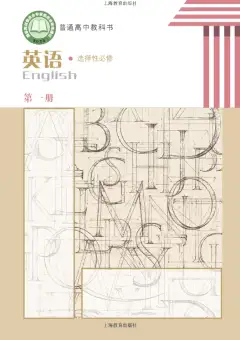
英语
English
选择性必修
第二册
普通高中教科书
主 编:邹为诚
副 主 编:李伟英
编写人员:张建琴 桑紫林
本套教材项目编辑团队
总 编 辑:程 林
责任编辑:黄 艳 任慧子
特约编辑:戴思泉 陈峤琦 Johan Uusitalo
装帧设计:赵志文 张淇萌
美术编辑:朱博
普通高中教科书 英语 选择性必修 第二册
上海市中小学(幼儿园)课程改革委员会组织编写
出 版 发 行 上海教育出版社有限公司
地 址 上海市闵行区号景路159 弄C 座
邮 编 201101
印 刷 上海中华印刷有限公司
开 本 890 毫米×1240 毫米 1/16
印 张 6
字 数 221 千字
版 次 2021 年8 月第1 版
印 次 2023 年8 月第3 次印刷
书 号 ISBN 978-7-5720-0694-4/G·0527
电子出版物号 ISBN 978-7-900841-14-8(音频和视频)
定 价 20.70 元(含音频和视频)
版权所有·未经许可不得采用任何方式擅自复制或使用本产品任何部分·违者必究
如发现内容质量问题,请拨打电话021-64319241,或发送邮件至jcjy@seph.com.cn
如发现印、装质量问题,影响阅读,请与上海教育出版社联系。电话:021-64373213
全国物价举报电话:12315
声明 按照《中华人民共和国著作权法》第二十五条有关规定,我们已尽量寻找著作权人支付报酬。
著作权人如有关于支付报酬事宜可及时与出版社联系。
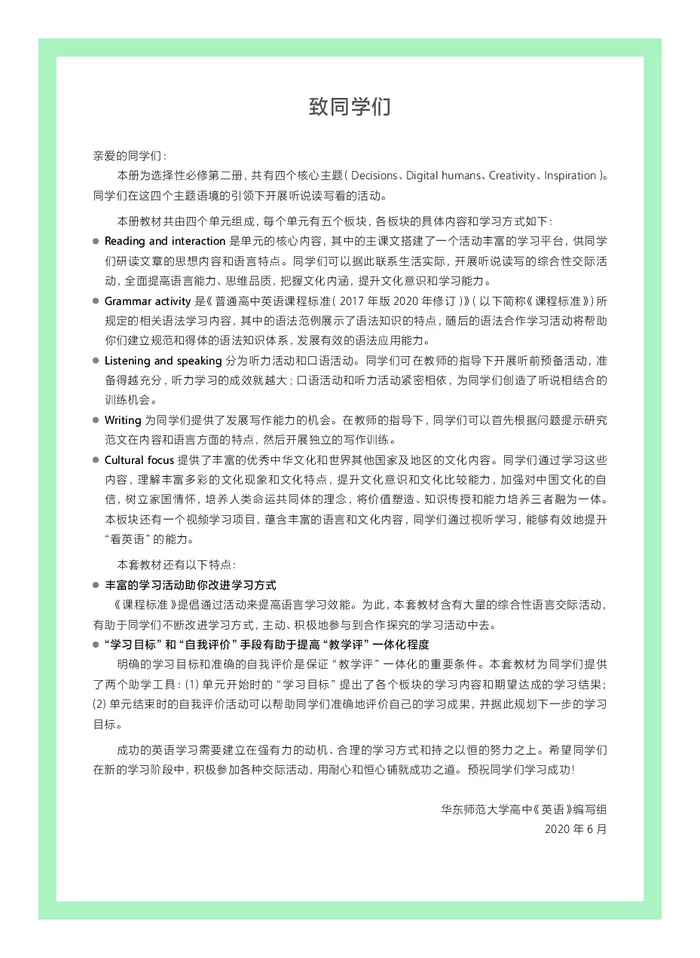
亲爱的同学们:
本册为选择性必修第二册,共有四个核心主题(Decisions、Digital humans、Creativity、Inspiration)。
同学们在这四个主题语境的引领下开展听说读写看的活动。
本册教材共由四个单元组成,每个单元有五个板块,各板块的具体内容和学习方式如下:
�Reading and interaction 是单元的核心内容,其中的主课文搭建了一个活动丰富的学习平台,供同学
们研读文章的思想内容和语言特点。同学们可以据此联系生活实际,开展听说读写的综合性交际活
动,全面提高语言能力、思维品质,把握文化内涵,提升文化意识和学习能力。
�Grammar activity 是《普通高中英语课程标准(2017 年版2020 年修订)》(以下简称《课程标准》)所
规定的相关语法学习内容,其中的语法范例展示了语法知识的特点,随后的语法合作学习活动将帮助
你们建立规范和得体的语法知识体系,发展有效的语法应用能力。
�Listening and speaking 分为听力活动和口语活动。同学们可在教师的指导下开展听前预备活动,准
备得越充分,听力学习的成效就越大; 口语活动和听力活动紧密相依,为同学们创造了听说相结合的
训练机会。
�Writing 为同学们提供了发展写作能力的机会。在教师的指导下,同学们可以首先根据问题提示研究
范文在内容和语言方面的特点,然后开展独立的写作训练。
�Cultural focus 提供了丰富的优秀中华文化和世界其他国家及地区的文化内容。同学们通过学习这些
内容,理解丰富多彩的文化现象和文化特点,提升文化意识和文化比较能力,加强对中国文化的自
信,树立家国情怀,培养人类命运共同体的理念,将价值塑造、知识传授和能力培养三者融为一体。
本板块还有一个视频学习项目,蕴含丰富的语言和文化内容,同学们通过视听学习,能够有效地提升
“看英语”的能力。
本套教材还有以下特点:
�丰富的学习活动助你改进学习方式
《课程标准》提倡通过活动来提高语言学习效能。为此,本套教材含有大量的综合性语言交际活动,
有助于同学们不断改进学习方式,主动、积极地参与到合作探究的学习活动中去。
�“学习目标”和“自我评价”手段有助于提高“教学评”一体化程度
明确的学习目标和准确的自我评价是保证“教学评”一体化的重要条件。本套教材为同学们提供
了两个助学工具:(1) 单元开始时的“学习目标”提出了各个板块的学习内容和期望达成的学习结果;
(2) 单元结束时的自我评价活动可以帮助同学们准确地评价自己的学习成果,并据此规划下一步的学习
目标。
成功的英语学习需要建立在强有力的动机、合理的学习方式和持之以恒的努力之上。希望同学们
在新的学习阶段中,积极参加各种交际活动,用耐心和恒心铺就成功之道。预祝同学们学习成功!
华东师范大学高中《英语》编写组
2020 年6 月
致同学们
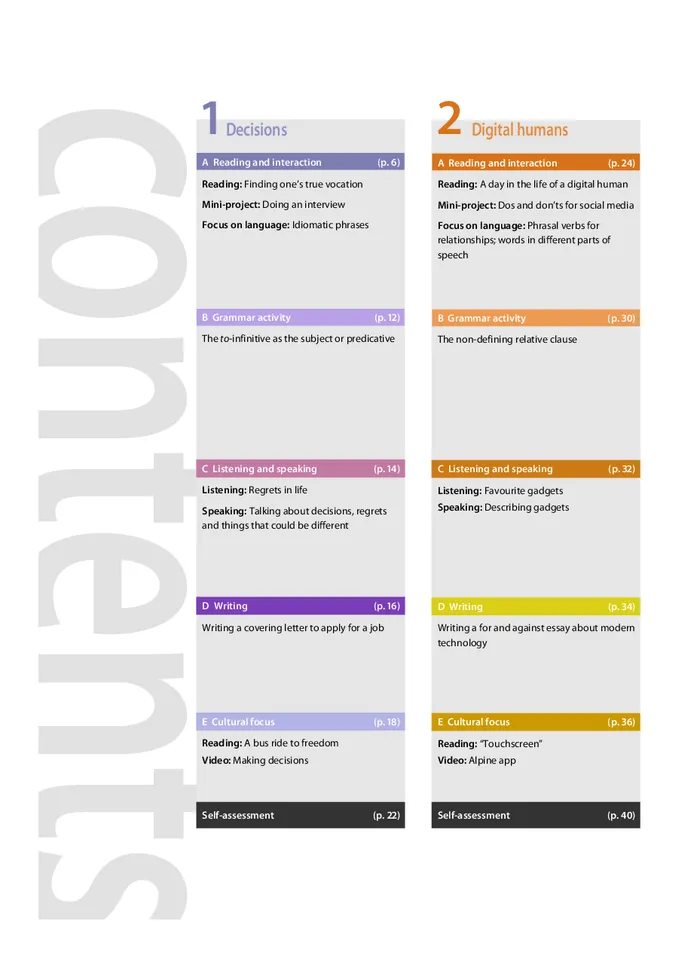
1Decisions
C Listening and speaking�
(p. 14)
Listening: Regrets in life
Speaking: Talking about decisions, regrets
and things that could be different
D Writing�
(p. 16)
Writing a covering letter to apply for a job
E Cultural focus�
(p. 18)
Reading: A bus ride to freedom
Video: Making decisions
B Grammar activity�
(p. 12)
The to-infinitive as the subject or predicative
A Reading and interaction�
(p. 6)
Reading: Finding one’s true vocation
Mini-project: Doing an interview
Focus on language: Idiomatic phrases
2 Digital humans
A Reading and interaction�
(p. 24)
Reading: A day in the life of a digital human
Mini-project: Dos and don’ts for social media
Focus on language: Phrasal verbs for
relationships; words in different parts of
speech
B Grammar activity�
(p. 30)
The non-defining relative clause
C Listening and speaking�
(p. 32)
Listening: Favourite gadgets
Speaking: Describing gadgets
D Writing�
(p. 34)
Writing a for and against essay about modern
technology
E Cultural focus�
(p. 36)
Reading: “Touchscreen”
Video: Alpine app
Self-assessment�
(p. 22)
Self-assessment�
(p. 40)
Appendices
Vocabulary (p. 77)
Proper nouns (p. 86)
Glossary (p. 87)
Grammar reference
(p. 88)
4 Inspiration
A Reading and interaction�
(p. 60)
Reading: “The Last Leaf”
Mini-project: Characterization
Focus on language: Adverbs of manner
B Grammar activity�
(p. 66)
The present perfect continuous
C Listening and speaking�
(p. 68)
Listening: What makes a hero?
Speaking: Discussing the qualities of a hero
D Writing�
(p. 70)
Writing an essay about a teen role model
E Cultural focus�
(p. 72)
Reading: From Robben Island: the dark years
Video: 16-year-old boss
3 Creativity
A Reading and interaction�
(p. 42)
Reading: The stories behind the names
Mini-project: Factors for success
Focus on language: Abstract nouns; fixed
expressions with and
B Grammar activity�
(p. 48)
The verb-ing form as the subject, object or
predicative
C Listening and speaking�
(p. 50)
Listening: Doodles and personality
Speaking: Discussing the role of art in the
school curriculum
D Writing�
(p. 52)
Writing a review of a school event
E Cultural focus�
(p. 54)
Reading: The return of Kun opera
Video: Inventors
Self-assessment�
(p. 58)
Self-assessment�
(p. 76)
C Listening and speaking
�Talk about decisions
and regrets in life using
appropriate language
D Writing
�Write a covering letter using
appropriate language and
format
A Reading and interaction
�Appreciate the humour and
analyse the questioning
skills as described in the
passage
B Grammar activity
�Use the to-infinitive as
the subject or predicative
correctly in the given
context
E Cultural focus
�Understand the background
and results of Rosa Parks’s
bus ride
�Evaluate the important
decisions that four people
made
Objectives
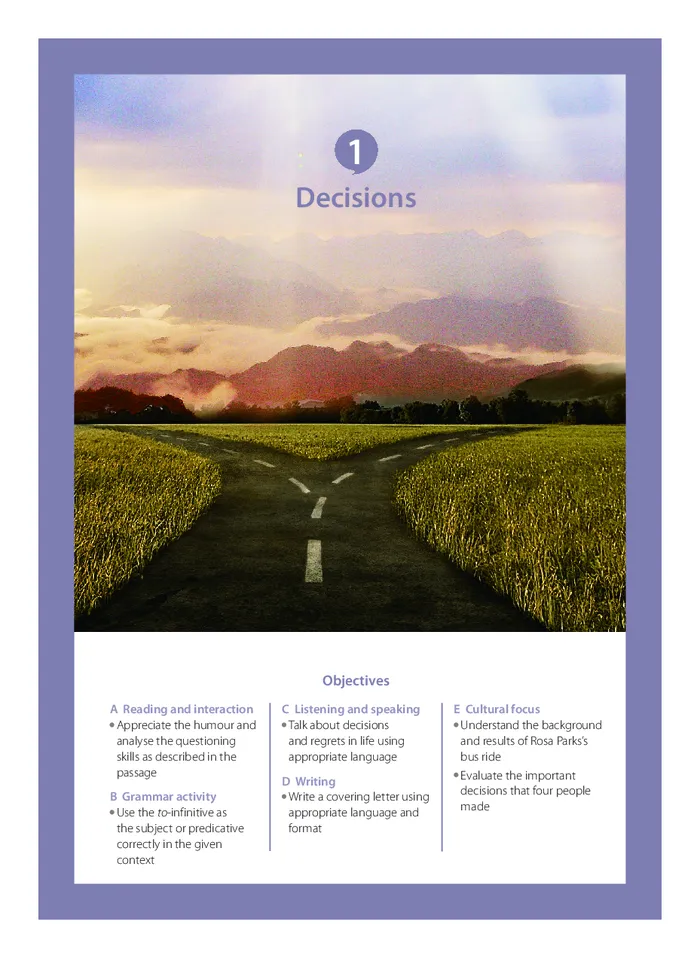
Decisions
1
A Reading and interaction
Pre-reading activity
1 �Think about what kind of job you
would like to do in the future. Which
of the things below are important? Put
them in order from 1–8. Compare your
list with other students in the class.
make a lot of money
travel to different places
do many different things every day
use your talent
help other people
make your own decisions
work with a variety of people
have the same job for a long time
2 �Work in pairs. Discuss the statements.
Do you agree? Why or why not?
(1) �Many people want to find a job that
pays lots of money. But if you love
what you do, money isn’t important.
(2) �You should listen to your parents and
teachers when choosing a job. They
have experience and can give you
advice.
5
10
15
20
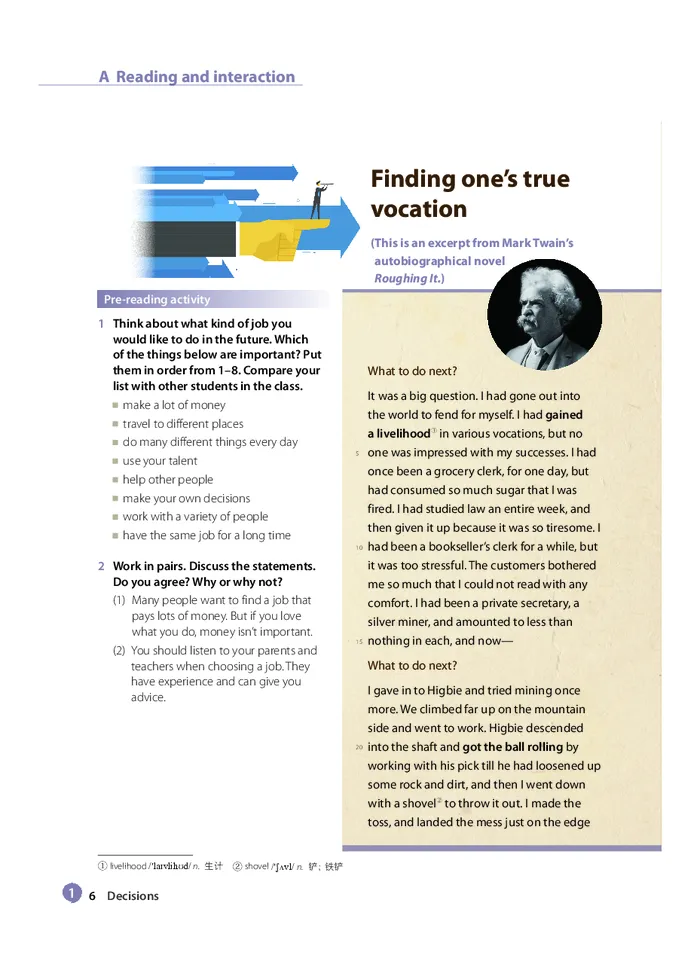
Finding one’s true
vocation
What to do next?
It was a big question. I had gone out into
the world to fend for myself. I had gained
a livelihood
a in various vocations, but no
one was impressed with my successes. I had
once been a grocery clerk, for one day, but
had consumed so much sugar that I was
fired. I had studied law an entire week, and
then given it up because it was so tiresome. I
had been a bookseller’s clerk for a while, but
it was too stressful. The customers bothered
me so much that I could not read with any
comfort. I had been a private secretary, a
silver miner, and amounted to less than
nothing in each, and now—
What to do next?
I gave in to Higbie and tried mining once
more. We climbed far up on the mountain
side and went to work. Higbie descended
into the shaft and got the ball rolling by
working with his pick till he had loosened up
some rock and dirt, and then I went down
with a shovel
b to throw it out. I made the
toss, and landed the mess just on the edge
(�This is an excerpt from Mark Twain’s
autobiographical novel
Roughing It.)
a livelihood �/9laIvlihWd/ �n. �生计 b shovel �/9SVvl/ �n.� 铲;铁铲
6 Decisions
1
25
30
35
40
45
50
of the shaft. It all came back on my head and down the back of my neck. I never said a word,
but climbed out and walked home.
Back in the small wooden house, I put my feet up and thought about my situation. In the
past, I had amused myself with writing letters to the chief paper of the territory, the Virginia
Daily Territorial Enterprise, and had always been surprised when they appeared in print. I
had found a letter in the mailbox as I came home from the hillside, and opened it. Eureka
a!
It was an offer to me of 25 dollars a week to come up to Virginia and be city editor of the
Enterprise. Twenty-five dollars a week was a fortune.
I went up to Virginia and entered upon my new vocation. I asked the chief editor, Mr
Goodman, to show me the ropes, and he told me to go all over town and ask all sorts of
people all sorts of questions, make notes of any worthwhile information gained, and write
them out for publication. It was the whole thing in a nutshell.
I can never forget my first day’s experience as a reporter. I wandered about town
questioning everybody, boring everybody, and finding out that nobody knew anything.
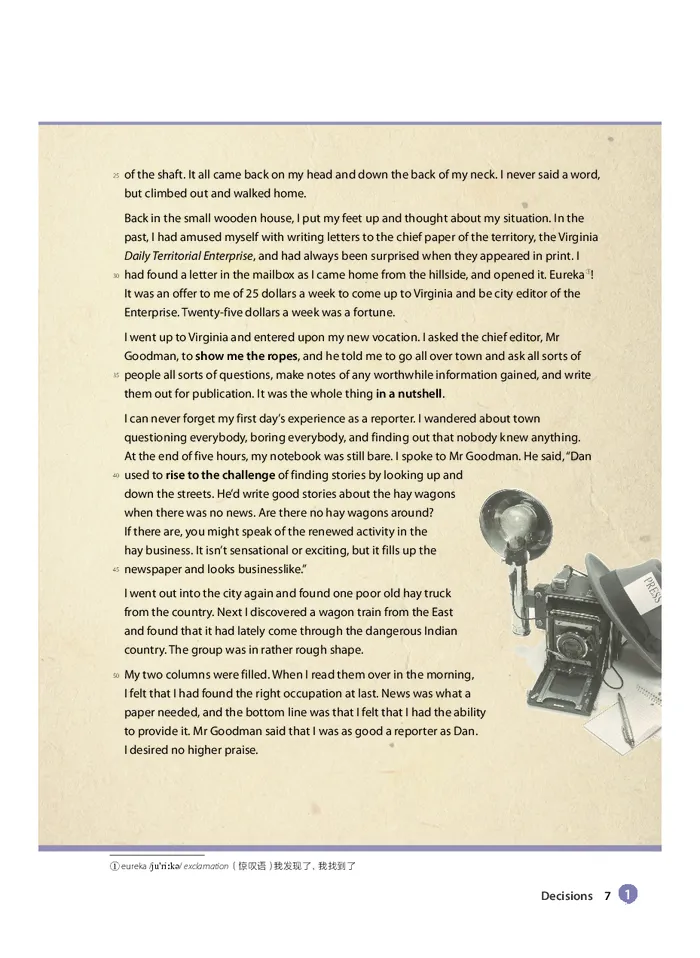
At the end of five hours, my notebook was still bare. I spoke to Mr Goodman. He said, “Dan
used to rise to the challenge of finding stories by looking up and
down the streets. He’d write good stories about the hay wagons
when there was no news. Are there no hay wagons around?
If there are, you might speak of the renewed activity in the
hay business. It isn’t sensational or exciting, but it fills up the
newspaper and looks businesslike.”
I went out into the city again and found one poor old hay truck
from the country. Next I discovered a wagon train from the East
and found that it had lately come through the dangerous Indian
country. The group was in rather rough shape.
My two columns were filled. When I read them over in the morning,
I felt that I had found the right occupation at last. News was what a
paper needed, and the bottom line was that I felt that I had the ability
to provide it. Mr Goodman said that I was as good a reporter as Dan.
I desired no higher praise.
a eureka �/ju9ri:kR/ �exclamation �(惊叹语)我发现了,我找到了
1
Decisions 7
A Reading and interaction
Comprehension work
1 Read the passage and answer the questions.
(1) �What jobs had Mark Twain tried before he became a reporter? Were they right for him? Why
or why not?
(2) What offer did Twain receive from a newspaper?
(3) What was Twain’s first day as a reporter like?
(4) What advice did the chief editor give Twain?
(5) What was the first story Twain wrote for the newspaper?
(6) What did Twain find out after reading his first story printed in the paper?
2 �Read the summary below and fill in each blank with a suitable word based on the
language of the passage. You may change the form if necessary.
I had tried various vocations, but was
1
. I had been a
grocery
2
and got fired on the first day. I had studied
law, but found it tiresome. I had been a bookseller’s clerk, but it was too
3
for me. I even had tried
4
with Higbie
once more, but failed. Fortunately, I received a letter from the Enterprise
and was asked to be its city
5
. I asked the chief editor to
show me the
6
and he suggested that I interview people
and note down
7
information. But I didn’t get any useful
information. The chief editor urged me to learn from Dan, a journalist
who rose to the
8
to find good stories. Some stories
might not be
9
or exciting, but as long as they looked
10
, they would do. I set out again to finish the task. This
time I found a good story. I realized that I had found a suitable occupation
for myself.
8 Decisions
1
Deep reading
1 �Mark Twain used humour to describe his frustrations and difficulties in finding the right
job. Study the following sentences in pairs and discuss where the humour lies.
Sentences
My explanations
(1) �I had once been a grocery clerk,
for one day, but had consumed so
much sugar that I was fired.
Mark Twain was fired as a grocery clerk because he ate
much sugar without the owner’s permission. The owner
was not happy about this and fired him. However, Mark
Twain took it as a matter of course by saying he just
“consumed” some sugar, suggesting he did not deserve to
be fired. This different way of thinking creates humour in
the sentence.
(2) �I had been a bookseller’s clerk for
a while, but it was too stressful.
The customers bothered me so
much that I could not read with any
comfort.
(3) �I made the toss, and landed the
mess just on the edge of the shaft.
It all came back on my head and
down the back of my neck.
(4) �In the past, I had amused myself
with writing letters to the chief
paper of the territory, the Virginia
Daily Territorial Enterprise, and had
always been surprised when they
appeared in print.
(5) �I wandered about town questioning
everybody, boring everybody, and
finding out that nobody knew
anything.
1
Decisions 9
A Reading and interaction
Mini-project
Doing an interview
Journalists are good at asking questions. Imagine you are a journalist, and that you are
going to interview some classmates for your school newspaper. Work in groups and decide
on a topic.
Brainstorm at least three specific questions.
Interview your classmates and note down their answers.
Make suggestions based on their answers.
Select one person to report on behalf of your group.
Topic: Getting to school
Questions
Answers
How did you get to school today?
How long did it take you to get to school in the
morning?
What did you see on your way to school?
my dad drove me / dropped me off at the gate
30 minutes
traffic jam near school / too many cars arriving
at the same time / waste of time waiting
My suggestion: Encourage students to take public transportation.
My topic:
Questions
Answers
My suggestion:
2 Work in pairs and discuss the questions.
(1) �Twain interviewed people twice and got different results. What do you think caused the
difference?
(2) �What lessons do you think Twain learnt from working as a reporter?
10 Decisions
1
Focus on language
1 �Read the passage again. Find the idiomatic phrases in bold in the passage (e.g. gain a
livelihood ) and match them to the meanings below.
(1) to earn a living
(2) to teach someone new how to do something correctly
(3) to make something start happening
(4) to try your best to do something difficult and be successful
(5) in a few words
2 Complete the sentences with the correct form of the words below.
rough
loosen
column
impress
amused
suitable
bare
fortune
descend
gain
(1) �As a famous writer said, man’s mind, once stretched by a new idea, never
its original size.
(2) �Sometimes when we are generous in small,
detectable ways it can
change someone else’s life forever.
(3) �His books can
be divided into three categories: science fiction stories,
travel writing and historical novels.
(4) �It is far more
when others discover your good qualities without your help.
(5) �The stories in the book are
connected: they are set in different small
towns.
(6) �A
is a writer who contributes regular articles to a column in a newspaper
or magazine.
(7) �Since the printing press came into being, poetry has ceased to be the joy of the whole
community of man; it has become the
and joy of the few.
(8) �Everyone enjoys doing the kind of work for which they are best
.
(9) �Focus on your strengths, not your weaknesses. Focus on your blessings, not your
.
(10) �The wise man must remember that while he is a
of the past, he is a
parent of the future.
1
Decisions 11
B Grammar activity
1 �Read the passage. Match sentences 1–7 to grammar rules a–d on page 13 and complete
the rules in c and d.
1Sometimes, it doesn’t take much to improve someone’s life. In the
case of Beatrice Biira, all that was needed was a goat.
Beatrice, her mother and her seven brothers and sisters lived in
a small village in Uganda. They were very poor and basic necessities were a luxury.
Worse still, Beatrice couldn’t read or write.
2To send a child to school only costs 20 in
Beatrice’s village, but her family didn’t have that kind of money.
They were not alone: in fact, one in three girls in Uganda can’t read or write.
3It is easy
to forget how valuable basic education is: in many parts of the world, the poor cannot
afford to send their children to school.
However, when Beatrice was nine, the family was given a goat by a small charity called
Heifer International.
4Heifer’s aim isn’t to give people food or pay for their schooling.
Rather, the organization wants to provide people with the means to make a living.
Within three months of receiving the goat, Beatrice and her family had raised enough
money from the sale of the goat’s milk to send Beatrice to school. Without any
further help from Heifer, she managed to get an education. Although she was much
older than the other children in her class, she did well, studied hard and soon won a
scholarship to study abroad. In 2010, she graduated with a master’s degree.
Beatrice has many people to thank for their support and encouragement along the
way. But most of all, she’s grateful to that first goat.
5To say that it improved her and
her family’s circumstances is not an exaggeration.
6It’s hard not to be touched by Beatrice’s story, and it is proof that charity does work.
Many people have been inspired by her, including a children’s book author who
wrote a story called Beatrice’s
Goat. Beatrice now works as an
ambassador for Heifer. She’s very
passionate about her work.
7Her
goal is to help children in need:
she wants to return the gift of
hope that Heifer gave her when
she was nine years old.
The to-infinitive as the subject or predicative
The to-infinitive can be used as the subject or predicative of a sentence.
(1) To drive this car is easy. = It is easy to drive this car.
(2) The most important thing is to relax.
12 Decisions
1
Grammar reference 1 (p. 88)
2 �Rewrite the sentences using the to-infinitive and the words in brackets.
a The to-infinitive can be used as the subject of a sentence. This is very formal.
b In everyday language we often use the anticipatory subject it with to-infinitives.
c �It is common to use the anticipatory subject it with adjectives that describe
the level of difficulty or possibility, such as
,
,
difficult, possible or impossible.
d �The to-infinitive can also be used as a predicative.
�It often comes after nouns that indicate plans, wishes, choices or other future possibilities,
such as
,
, dream, mission, option or purpose.
(1) �I want to be a teacher in the Confucius Institute. That is my dream.
It
.
(2) On long train rides, people have difficulties staying awake.
�It is
(hard, fall asleep) on a long train
ride.
(3) Sending rockets into space is expensive.
To
(cost a lot of money).
(4) Many students have trouble reciting this long poem.
(hard) this long poem.
(5) He doesn’t want to apply for new patents.
(goal) new patents.
3 �Work in groups. Think of three things that are easy or difficult to do for most people.
Write them on the lines below. You may use the examples below to help you.
It is hard for most people to learn how to play an instrument.
To learn how to play an instrument is hard for most people.
(1)
(2)
(3)
�Now ask the other group members about their ideas. Select the one you like most and
report to the class.
You may ask questions like this: What is easy / difficult for people to do?
You may respond like this: It is easy to make empty promises. / It is difficult to actually do it.
�You may report like this: I think Li Chen’s views are very interesting. He says, “It is easy to
make empty promises about what you can do. But it is difficult to actually do it.”
1
Decisions 13
C Listening and speaking
1 �Listen to three people talking about their regrets. Match speakers 1–3 to their regrets
a–c.
a accepting a job offer
Speaker
b listening to parents
Speaker
c leaving a team
Speaker
2 �Listen again. Decide whether the sentences are true (T) or false (F).
(1) Speaker 1 followed his teacher’s advice.
(2) He decided to do more training.
(3) He’s still in contact with his friend.
(4) Speaker 2 missed a great opportunity.
(5) She needed to make money.
(6) Speaker 3 experienced problems at school.
(7) He had a serious disagreement with his parents.
DECISION
MAKING
�one thing you wish to
change about your life
�the most important decision
you have made in your life
�a decision which you once
made, but now regret
3 �Complete the statements about the speakers according to what you have heard.
Speaker 1:
I wish I hadn’t (1)
.
If only I had (2)
.
Speaker 2:
I wish I had (3)
.
If only I hadn’t (4)
.
Speaker 3:
I wish (5)
.
If only (6)
.
4 �Work in pairs. Student A chooses one of the options below. Student B should interview
him / her about it. Switch roles afterwards.
14 Decisions
1
Student A
Talk about the option you choose, such as a decision you made regarding your studies or
hobbies.
Student B
Ask your partner questions about his / her decision, including:
how it has influenced his / her life;
whether he / she regrets that decision;
what he / she has learned from this experience.
You may talk about your decisions like this:
It was a wonderful / meaningful time when ...
It was challenging when ...
It was a difficult decision since ...
Then I started having problems with ...
At the time / In the end / Finally, / Unfortunately, I ...
How I wish ...
If only ...
My life was never the same after ...
You may ask questions like this:
How does it influence your life?
Have you ever regretted your choice?
Why do you want to make the change?
Have you learnt anything from it?
What insight into life did you get from it?
Language guide
Tak
e yo
ur n
ot
es
he
re
!
1
Decisions 15
Imagine that you are looking for an internship
a position during the
summer vacation. You find the two advertisements below online. Write
a covering letter to apply for one of the positions.
Dear Ms Frank,
Re: Library Assistant position
I am writing to apply for the above post, which was advertised online. Please find my CV
enclosed.
I am currently studying English and Drama at Walworth High School and feel that my love
of books and literature would make me a very good candidate for this job.
As you will see from my CV, I achieved excellent grades in my exams, and also received a
computer certificate in May last year. Furthermore, for the last two years, I have held the
role of library assistant at my school and have gained some useful experience in sorting
books. In this role, I have also developed an online catalogue and organized training for
the students. I have also facilitated monthly book discussions in the library’s reading group.
D Writing
1 �You may prepare your writing by thinking about the question.
What do you need to include? Select different aspects from the list below.
your qualifications
where you saw the advertisements
your CV
b
your reasons for applying
a request for an interview
when you are available
your experience
questions about the pay
a internship �/9IntF:nSIp/ �n. �实习 b CV �/0si:9vi:/ �n. �个人简历
2 �Read the sample letter. Which aspects from exercise 1 are mentioned? Then complete
the table on page 17 before you write.
Summer camp counsellor
National Summer Camp is looking for young, enthusiastic people to help with teaching, food
preparation and evening entertainment at our summer camps for 7–14-year-olds.
We are looking for people who:
★ enjoy working with children;
★ �have experience in teaching sports, arts and crafts or music.
Please write to Ms Ellis Brook if you are interested in this position.
Library assistant
The Central Library has a summer position for a hard-working student who has excellent IT skills
and is organized and eff icient. Daily tasks will include:
★ sorting books;
★ �answering customers’ inquiries and helping promote the library;
★ scanning and f iling documents.
Please write to Ms Mary Frank if you are interested in this position.
16 Decisions
1
Last year, as part of my work experience at the local sports centre, I advised customers about
the services and assisted with filing and scanning documents. I also designed a new leaflet for
the centre advertising its tennis coaching plan, and arranged an Open Day for new customers.
This experience has given me a good understanding of dealing with customers and helping
promote services.
I am available for an interview immediately and look forward to hearing from you.
Yours sincerely,
Jonathan Smith
Aspects of writing
Guiding questions
My exploration
Content
Why does the writer use “Re: ...” at the
beginning? What is the purpose of this
letter?
What qualifications does the writer have?
What job experience does the writer have?
Language
How does the writer address the receiver?
Does the writer describe his experience and
qualifications generally or specifically? Give
examples.
What language does the writer use to
connect ideas?
3 �Now write a covering letter. Edit your writing properly.
1
Decisions 17
E Cultural focus
1 �Some decisions and laws can affect people’s lives significantly. How would you feel if the
things below became law? Work in pairs and discuss the questions.
(1) The minimum age for having a mobile phone is 18.
(2) All clothes worn by teenagers must be approved by parents.
(3) Under-18s may only use the Internet for study purposes.
2 �Read the passage about Rosa Parks. Match paragraphs 1–6 to descriptions a–g. There is
one description that you do not need.
a What would have happened if Rosa hadn’t done what she did�
b Where African Americans could sit on buses�
c How Martin Luther King reacted to violence�
d How the driver on Rosa’s bus felt�
e Why Rosa admired Martin Luther King�
f How Rosa’s actions improved everyday life for African Americans�
g How people showed their support for Rosa�
5
1 On 1 December 1955, Rosa Parks had just finished work at a
department store in Montgomery, Alabama. She had a job there, and
was making her way home to help with an NAACP
a youth meeting.
There were a lot of people at the bus stop that evening, so Rosa did some
shopping, and then caught the next bus home. Luckily, she found a seat
at the back, but after a few stops, more passengers got on, so the driver
A bus ride to freedom
a �NAACP: The National Association for the Advancement of Colored People, founded in 1909 in the
USA. Its mission is to secure the political, educational, social and economic equality of rights in
order to eliminate race-based discrimination.
However important or trivial the matter at hand is, it can be difficult to make decisions.
Our choices may have a huge impact on other people’s lives, as well as on our own, and
some decisions may even change the world.
In this section, you will first read a passage about the historically important decision that
Rosa Parks made. You will then watch a video where people talk about big life decisions.
18 Decisions
1
10
15
20
25
30
35
a segregation �/0seGrI9GeISn/ �n.� 隔离政策 b boycott �/9bOIkBt/ �v.� 拒绝购买(或使用、参加);抵制
told Rosa to stand up. Why? Because the new passengers were white and Rosa was
black. African Americans could only sit at the back seats of the bus but when the
bus was full, they had to give up their seats to white people.
2 In the 1950s, African Americans were treated like second-class citizens.
Segregation
a laws separated people of different races and meant that inequality
was present everywhere—on buses, in restaurants, in cinemas and in shops.
Such unfair treatment was permitted by the US Constitution. Even schools were
divided up according to the colour of people’s skin. Back on the bus, the driver
shouted at Rosa to stand up again. She wasn’t tired and her feet didn’t hurt, but
she didn’t move. By now, the driver was very angry and told Rosa he would get the
police. “You may go and do so,” she calmly replied. The police arrived and Rosa was
arrested. She must have felt humiliated as she was driven to prison, but she didn’t
back down. She didn’t know it at the time, but her simple act of opposition had
sown the seeds of something that would change the course of history and end
segregation in America.
3 The next day, news of Rosa’s arrest spread rapidly
through the city. People decided to boycott
b the buses
and use other means of transport. They wanted the
bus company to stop discrimination against black
passengers. In fact, 75% of the bus company’s
passengers were African Americans, so surely
they would listen? They didn’t, so on Monday
5 December, thousands of people walked,
shared cars and rode bicycles to get to
work. It can’t have been easy, but everyone
was united in a common struggle.
4 In the end, the boycott lasted 381
days. During that time, many African
Americans received threatening
phone calls and homes were damaged
on purpose. A young minister at the
local church called Martin Luther King
led the boycott and his home was
1
Decisions 19
E Cultural focus
4 Research the topic and discuss the questions with your partner.
(1) What was the significance of the bus boycott?
(2) Is there still racial discrimination in the US today? If there is, what does it look like?
3 �Complete the timeline below with the key events that happened in the passage. Then
summarize it orally.
40
45
50
55
attacked too. People were ready to fight back, but Dr King made them stop and think.
“We cannot solve this problem with violence,” he said. “We must meet violence with non-
violence.” The attacks and threats failed to scare off supporters. In fact, they united people
and taught everyone the value of peaceful opposition.
5 All this finally led to important legal reforms. On 13 November 1956, the Supreme
Court finally ruled that segregation on buses in Alabama was illegal. The next day, Rosa
Parks, along with Martin Luther King, got on a city bus. Proudly, she took a seat right at
the front. Rosa had shown how one person’s decision could make a huge difference. She
had bravely taken a stand against racism in America, and through this small but powerful
action, she inspired others to do the same. Less than a decade later, laws discriminating
against African Americans were cancelled.
6 “When I declined to give up my seat, it was not because of that day or bus in particular,”
Rosa said later. “I just wanted to be free, like everybody else.” But what would have
happened if Rosa Parks hadn’t refused to stand up on the bus that day? Another African
American passenger might have done the same soon afterwards. On the other hand, they
might not have. Without Rosa’s brave actions, segregation could have lasted for longer
than it did.
(1) �
Rosa Parks was arrested.
5 December 1955
(2) �
381 days’ boycott
(3) �
13 November 1956
(4) �
20 Decisions
1
Start thinking
1 Answer the questions.
(1) How easy do you find it to make decisions?
(2) Who do you consult when you have to make a decision?
(3) What is the most important decision that you have made in your life so far?
Comprehension check
2 Watch the video. Answer the questions.
(1) Which important decision did James make?
He decided to
.
(2) �What was the hard part of the decision made by Matt?
He says that the hard part was
.
(3) How many of the speakers think that they made the right decision?
of them.
(4) �Apart from his parents, who else did John use to consult about making decisions when he
was younger?
He used to consult
.
(5) In Matt’s view, who shapes our future?
He believes that
.
Vocabulary
3 Complete the text with the correct form of the words below.
determine
talk
parent
regret
defeat
make
wise
It is not always easy to make the right decision. To do that, people may need to consult different
people. John talked to his family members when he was younger. Even now, he sometimes asks
his parents for their thoughts on important matters: he says he needs “
1
advice and
words of
2
” from them. Caroline knew her decision to move to a different country
was the right one because she never
3
it. People have different views about fate.
Matt believes in
4
efforts to change one’s life. He thinks that believing in fate is very
5
. People can change their lives if they are
6
and passionate, and if they
7
to the right people.
Extension
4 �Work in groups. Think of people who have managed to control their own fates, and then
prepare a presentation to the class.
(1) Suggest several people.
(2) Decide on one person in your group.
(3) Make a list of things that this person did.
(4) �Make a class presentation about this person’s life.
Video
Making decisions
1
Decisions 21
Self-assessment
22 Decisions
1
Checklist
*
1
Me
2
My teacher /
classmate
3
Action
A Reading and interaction
�I can retell Mark Twain’s story about his search for a
suitable job.
�I can explain the humour in the story in simple language.
�I can raise at least three specific questions that will
provide suitable information for a brief news report.
B Grammar activity
�I can recognize the to-infinitive as the subject or
predicative in the passage.
�I can use the to-infinitive as the subject or predicative to
write sentences if the context is clear.
C Listening and speaking
�I can retell the three stories about regrets.
�I can talk about my experiences of decision-making and
regrets.
D Writing
�I can identify the basic elements and the features of
language in the sample covering letter.
�I can write a covering letter to apply for a position using
appropriate language and format.
E Cultural focus
�I can retell the story of Rosa Parks’s fight for freedom and
social justice.
�I can make comments on the decisions that the four
interviewees made in the video.
Use the checklist and reflective questions below to evaluate your study in this unit.
Reflective questions
Besides having good English skills, an interviewer should also have good people skills. Think of
some successful or unsuccessful experiences from your mini-project, and what lesson(s) can you
draw from them?
* �Ask your teacher or your classmate to assess what you can do. Use the four symbols (33, 3 and !, !!). In column 1 or 2, 33=I’m
confident about this; 3=I’m OK, but not quite sure. In column 3, ! = I must review this part; !! = I must seek help about this. The
symbols can be applied to other Self-assessment sections in the book.
C Listening and speaking
�Describe the appearance
and functions of a gadget
D Writing
�Write a for and against essay
using appropriate language
and format
A Reading and interaction
�Understand the influence
of social media and discuss
online behaviour
B Grammar activity
�Use the non-defining
relative clause correctly in
the given context
E Cultural focus
�Identify the speaker’s
attitudes in the poem
�Explain the process of
designing an app and the
benefits it brings
Objectives
Digital humans
2
2
A Reading and interaction
Pre-reading activity
1 Work in pairs and discuss the questions.
(1)� �What are the advantages and
disadvantages of sharing information on
social media?
(2) �Is it easier to be mean to people in the
digital world? Why or why not?
2 �Discuss the meanings of the following
terms related to social media in pairs.
log in
status update
post
likes
comments
tagged
friend requests
A day in the life of
a digital human
As part of our week on digital humans, we
asked teenager Song Lili to keep a digital diary.
Psychologist Mia Graham analysed the results.
7:30 a.m.
I’m usually on social media first thing and
today was no different. I actually logged in
while I was still in bed, just to see what my
friends had posted the night before and to
catch up with the gossip. Over breakfast, I
did a status update and within 30 minutes,
I had a dozen likes and two comments.
Nothing special about that—it was just
another ordinary day. I bet everyone does
the same thing.
Mia: It’s natural for humans to share
experiences and open up to people. Lili
enjoys being part of a community. She
likes it when people from this community
comment on her status.
8:45 a.m.
As I was walking to school, I noticed that
I’d been tagged in a picture. I looked
absolutely awful, so I clicked “untag”. It’s
stressed me out, so I’m currently checking
the latest updates again. I pray that no one
will recognize me in the picture.
5
10
15
20
25
24 Digital humans
2
Mia: On social media, Lili is always on display and she is under intense pressure to consistently
“look good”. In a recent survey, 41% of teens said their online image was extremely important;
consequently, they made more of an effort to look good at all times. However, friends can
compromise this image by tagging you in photos, saying where you’ve been or what you’ve
said. You might not like it, but you can’t stop friends sharing information about you.
12:30 p.m.
At lunchtime, a friend posted quite a nasty comment about another friend on my profile.
The two girls recently had a row, but they need to get over it and make up with each other. I
deleted the comment because I don’t want to get involved.
Mia: It’s easy to pick on people in the digital world. Cyberbullies
a can post an ugly picture or
a nasty comment and reach a wide audience. And in an online world, you can’t see people
break down and weep. As a result, you’re less sympathetic and less likely to stick up for them.
Lili did the right thing when she deleted the comment.
5:30 p.m.
At home, I wrote a post about a boy I quite like. He left his mobile in class today and I found it.
It was nice to talk to him. He was friendly and we have a lot in common—we really hit it off!
Mia: Like so many of us, Lili shares personal details of her life online. The problem is that these
details stay on the web forever and are easy to dig up again. In a recent survey, 40% of teens
said they were concerned about who could view their online activities.
They also worried about how these activities might eventually be perceived by parents,
teachers, future employers or their peers. They are right to be concerned about who is
watching. The Internet never forgets, so Lili needs to think before she posts. The exposure of
personal information online may be dangerous: it is easy to become a victim of cybercrime.
11:00 p.m.
I updated my status before I went to bed and I had two friend requests, which I accepted. I
didn’t know one of them, but that’s why social media is so exciting. You can chat with people
who you possibly wouldn’t run into in your everyday life and you can contact people who you
haven’t seen for years ...
Mia: Lili’s right—it’s good to talk, but she needs to be extremely careful about who she talks
to. The average teen has 237 social media friends; however, they have talked to only a fraction
of these people in real life. Essentially, it’s a question of trust, so before you accept a friend
request, consider this: who is this person and do I really want them to read my posts? Don’t
forget there are people behind the machines.
30
35
40
45
50
55
Digital humans 25
a cyberbully �/9saIbRbWli/ �n.� 网络欺凌者
2
A Reading and interaction
Comprehension work
1 Read the passage and answer the questions.
(1) Why did Lili say “it was just another ordinary day”?
(2) Why do human beings like sharing experiences with each other?
(3) What kind of pressure do people have on social media?
(4) �What is the difference between the real world and the online world that makes
cyberbullying easier?
(5) Why are young people concerned about who can see their online activities?
(6) What should we consider before accepting a friend request?
2 �Read the summary below and fill in each blank with a suitable word based on the
language of the passage. You may change the form if necessary.
Lili recorded her day as a
1
human. She logged on to
her social media account first thing in the morning to check her friends’
2
, catch up with the gossip, and
3
her
status. She found she was tagged in a photo by a friend and felt stressed
out because she didn’t look nice in it. She
4
a nasty
comment from one friend about another on her
5
and wrote a post about a boy she likes. She also accepted two friend
6
in the evening. Mia Graham, a psychologist,
7
Lili’s journal. She thinks that people like to be part
of a
8
and they all want to look good on social media.
However, that can be compromised by other friends when they share
information online. Online users also need to be aware of the harm of
cyberbullying, as people are less sympathetic towards others in the
online world. And some users are
9
about what parents,
teachers, future employers and
10
might think about
them. She advised people to think twice before accepting friend requests
from strangers.
26 Digital humans
2
Deep reading
1 �In the passage, psychologist Mia Graham makes a few remarks about young people’s
behaviour on social media. Think about these remarks and give opinions or examples
from your own life with the help of the guiding questions.
Points of view in the passage
My opinions or examples
(1) �People like to share their experiences
and open up to people.
Guiding question: How do you use social
media to share things and connect to
people?
As a young student, I like to share my experiences
and feelings with the people around me both
in person and through social media. I share my
secrets with my best friend and tell the people
around me openly how I feel if they ask me.
Open communication makes me feel part of a
community.
(2) �Teenagers want photos of themselves
to “look good”.
Guiding question: What kind of things do
you do in order to give a good impression
online?
(3) �It’s easy to pick on people in the digital world.
Guiding question: How might people get hurt
in the digital world?
(4) �Young people worry about who can see
their private information online.
Guiding questions: What kind of information
do you usually share online? Do you share
different things with different people? Why?
(5) �People should think twice before
accepting a friend request.
Guiding question: What are the potential
dangers of accepting friend requests from
strangers?
Digital humans 27
2
A Reading and interaction
Mini-project
Dos and don’ts for social media
The Students’ Union in your school plans to provide a list of dos and don’ts to guide
students’ online behaviour. Work in groups and write down your suggestions.
Discuss the questions in groups.
What rules should people follow on social media? Why?
What shouldn’t people do? Why?
Share ideas within your group.
Select one person to report on behalf of your group.
1 �We should respect people on social media.
2
3
4
Dos
1 �We shouldn’t accept friend requests from people we don’t know.
2
3
4
Don’ts
2 �Make a list of Lili's activities on social media and compare it with yours on a typical day.
Write a short passage to discuss the differences between you and Lili. What do these
differences tell you about your life?
28 Digital humans
2
Focus on language
1 �Read the passage again. Find some language points in the passage and list them
in the blanks.
(1) Phrasal verbs for relationships (e.g. make up with)
(2) Words in the passage with different parts of speech (e.g. like, n. line 11; v. line 18; prep. line 43).
2 �Replace the underlined parts with the correct form of the words below.
intense
analyse
potential
sympathetic
consequently
pray
profile
weep
(1) Man’s main task in life is to give birth to himself, to become what he could possibly be.
Man’s main task in life is to give birth to himself, to become what he
is.
(2) Nothing fixes a thing so deeply in the memory as the wish to forget it.
Nothing fixes a thing so
in the memory as the wish to forget it.
(3) �Make up your mind to act decidedly and accept the results. No good is ever done in this
world by hesitation.
�Make up your mind to act decidedly and accept the
. No good is ever
done in this world by hesitation.
(4) We should be caring towards those who are less fortunate than we are.
We should be
towards those who are less fortunate than we are.
(5) �Do not wish for easy lives. Pray to be stronger men.
Do not
for easy lives. Pray to be stronger men.
(6) �If you dared ask any good poet to explain his work, he would say: if you see it, then it's there.
�If you dared ask any good poet to
his work, he would say: if you see it,
then it's there.
(7) A job description is a useful tool to provide necessary information to your future employees.
�A job
is a useful tool to provide necessary information to your future
employees.
(8) Those, who don't know how to cry with their whole heart, don't know how to laugh either.
�Those, who don't know how to
with their whole heart, don't know how
to laugh either.
Digital humans 29
1In the 21st century world, where instant communication
is possible, it is easy to forget that things were once very different.
Seventy years ago, Maggie Wilkinson and Tessa Langley became good friends.
2At
that time, when smartphones didn’t exist and a mouse was something you wouldn’t
dare to have on your desk, they managed to make friends despite being 5,000 miles
apart—using only pen and paper.
3The two women, both of whom are now in their eighties, have been writing to
each other ever since. How did they do it?
4The answer is simple: they were both
members of a club, which was set up to encourage friendships between children
from different countries.
At first sight, Maggie and Tessa couldn’t have been more different.
5Maggie, who was a
shy English girl, lived in a small flat in east London.
6The first letter from Tessa, in which
she described her life and family, came as a big surprise. “It was so exciting,” says Maggie,
“I had never travelled abroad before.
7Now, I was writing to this outgoing and adorable
American girl, who lived nearly five thousand miles away on a huge farm in Colorado!”
Despite these differences, it turned out that the girls had many things in common: they
loved animals and enjoyed reading detective stories.
8In the letters they sent each other,
most of which were more than ten pages long, they discussed books they had read.
Maggie and Tessa kept writing to each other for 25 years prior to their first meeting.
Then, one summer, Tessa came to England on a family holiday and met up with her
penfriend at Paddington Station in London.
9Maggie, whose long blond hair made
her stand out from the crowd, was easy to spot. “I recognized Maggie from her
photograph, but she was much taller than I thought,” says Tessa.
Maggie and Tessa hit it off in person, just as they had on paper; now their grandchildren
have also become friends. “They all get on very well with each other, but of course, they
don’t write proper letters!” laughs Tessa. “They keep in touch on social media.”
Maggie and Tessa:
a lasting friendship
The non-defining relative clause
The non-defining relative clause adds information to a noun phrase or a main clause. They are
separated by a comma in writing or a brief pause in speaking.
That’s Peter, who lives next door.
1 �Read the passage. Match clauses 1–9 to grammar rules a–g on page 31.
Grammar reference 2 (p. 90)
B Grammar activity
2
30 Digital humans
To form non-defining relative clauses, we can use:
a who for people as the subject of the clause
b which for things as the subject or object of the clause
c whose to indicate belonging
d where for places
e when for time
f preposition + relative pronoun (more formal)
g both, most, some, ... + of whom or of which
2 �Read the passage and complete the sentences with who, whom, which or when. Add a
preposition where necessary.
Nowadays, people use social media to stay in touch with friends across the globe. However,
before the 1990s,
1
it became possible for ordinary people to access the Internet,
long-distance communication was a lot more difficult than it is now: there weren’t any
chat apps, and international phone calls were much more expensive. Back then, it was
instead common for young people to write letters to penfriends in other countries, many
2
they would never meet in real life.
The traditional penfriend letter,
3
students got to communicate directly with one
another across continents, was seen as a way to promote peace and understanding across
the world. The students,
4
had never met before, got a chance to find out about
each other’s lives. Penfriend programmes are still common, but nowadays people mostly use
email to communicate with international penfriends.
3 �Work in pairs. Think of a person, an object or a location in your school. Make two
sentences about each of them and then combine these using who, which, where, etc. You
may use the example below to help you.
A: My friend Daming likes playing basketball.
B: He is very strong.
Daming, who is very strong, likes playing basketball. Or:
Daming, who likes playing basketball, is very strong.
�Now ask other classmates about their ideas. Select the most interesting one and report
to the class.
You may ask questions like this: What do you want to talk about?
�You may respond like this: I want to talk about the small canal that passes our school. The
canal, which is often covered by thick layers of foggy mist in the early summer mornings, is a
rich source of inspiration for the students’ poems.
�You may report like this: I think the most interesting topic is from Linlin. She says, “The
industrial estate next to our school, which has been abandoned for a long time, is covered in
weeds and rusty wires. I wish someone could clean it up.”
2
Digital humans 31
A
B
C
D
E
2 Listen again and answer the questions.
(1) Who uses a gadget when driving?
Speaker
(2) Who talks about a friend who broke his gadget?
Speaker
(3) Who talks about the size of a gadget?
Speakers
,
(4) Who says that a gadget is not new?
Speaker
(5) Who uses a gadget to help with their coursework?
Speaker
(6) Who makes calls with a gadget?
Speakers
,
(7) Who talks about accessories
a for a gadget?
Speakers
,
(8) Who talks about the cost of a gadget?
Speaker
3 �Complete the statements about the speakers according to what you have heard.
Speaker 1 uses her favourite gadget to
.
Speaker 2 likes his gadget a lot because
.
Speaker 3 finds her gadget very useful because
.
Speaker 4’s old gadget has some problems:
.
4 Work in groups. Describe a gadget and play a guessing game.
�Write a short poem in the first-person about an electronic gadget, like in the example on
page 33. Describe its function, the material, colour and shape, etc.
Read the poem to your group members and have them guess what gadget it is.
Select the best poem in your group and share it with the class.
Speaker 1:
Speaker 2:
Not mentioned:
Speaker 3:
Speaker 4:
1 �Listen to four people talking about their favourite gadgets. Match the speakers to the
gadgets A–E. One gadget is not mentioned.
a accessory �/Rk9sesRri/ �n.� 附件;配件
tablet
mobile phone
camera
music player
electric kettle
C Listening and speaking
2
32 Digital humans
Example
I’m a sharp-eyed box of black colour, smooth to touch.
Sitting in my cased seat, I watch the world.
The pretty scenes and wonderful people
All reward me with unforgettable memories.
What gadget am I?
Answer: Camera
You may make your description like this:
Here’s / Here comes my description.
�Now, I’d like to introduce my gadget ...
Can you guess what it is?
My eyes ... my lungs ... and my feet ...
�It’s wrapped by a piece of square cloth like a handkerchief ...
�When you plug in ...
�You may wear it on your wrist / finger / waist.
�The body comprises a number of components ...
You may ask your group members questions like this:
Could you repeat the first line?
What do you mean by ...?
Could you give more clues?
Could you please clarify ...?
You may respond to your group members like this:
You are almost there.
No, not exactly.
Want more clues?
Try again.
Think about ... in my poem.
Bingo
a.
a bingo �/9bINGRW/ �exclamation �好;成功了;猜中了
Language guide
2
Digital humans 33
1 �Imagine that you are going to write an essay analysing the advantages and
disadvantages of modern technology. You may prepare your writing by thinking about
the questions.
(1) What are the advantages of modern technology?
(2) Are there any disadvantages? What are they?
2 Read the sample essay and complete the table on page 35 before you write.
The advantages and disadvantages of constant connection
�With smartphones and computers, it is often said that we are rarely more than
a few minutes away from our emails, updates from friends or global and local
news. However, it could be claimed that we have become too reliant on technology.
Does this make our lives better or more stressful? In this essay, I will discuss the
advantages and disadvantages of being constantly connected.
One advantage is that people can find important information very quickly and
they don’t have to go to the library or read books for research. Another point is
that people can buy many things online. This is useful for people who have mobility
problems. It may also be argued that people are safer because they know that they
can instantly get help if there is an emergency. Furthermore, photographs, videos
and news can be shared online, so people can always catch up with friends who live
on the other side of the world.
However, there are also some disadvantages of constant connection. Firstly,
although people can access a lot of information online, some claim that the
information is often misleading or inaccurate. Anyone can put information onto
a web page and, as a result, it can be difficult to check the source. Secondly, it
seems evident that some shops on the high street are now struggling due to the
rise in online shopping. Many shops are being closed down. Thirdly, although there
are people who feel safer because of mobile phones, others would argue that there
are new dangers like cyberbullying. It is true that constant connection helps us
keep in touch with friends, but it can be very stressful when people expect instant
responses.
�In conclusion, I believe that although there are many advantages of constant
connection, we should also switch off our phones sometimes, walk away from our
computers and talk to real people.
Modern technology has a strong impact on people’s lives. Some people say
it makes life more convenient, while others think it causes problems like
unemployment. What is your view?
D Writing
2
34 Digital humans
Aspects of writing
Guiding questions
My exploration
Content
What is the main idea introduced by
the writer in the first paragraph?
What advantages does the writer talk
about?
What disadvantages does the writer
talk about?
What is the writer’s conclusion?
Language
What language does the writer use to
make the writing more objective?
What language does the writer use to
present different viewpoints?
What language does the writer use
to state the opposite viewpoint while
presenting the argument?
3 Now write your essay. Edit your writing properly.
2
Digital humans 35
1 Work in pairs and discuss the questions.
(1) �Some people say that our lives are becoming more and more digital. Do you agree? Why or
why not?
(2) �Do you think we are happier than previous generations thanks to this change? Why or why
not?
2 �Read the poem on page 37. Identify the lines in the poem that refer to modern
technologies or gadgets below and explain their effects on our lives. Then complete the
table below.
Modern technologies /
gadgets
Lines in the poem
Effects
any gadget with a
touchscreen
e.g. smartphone and
tablet (line 4)
Using our mobile devices is fun, and we
can become completely absorbed in it.
However, there’s a risk that they will make
us withdraw from real social life and forget
about our friends and family.
apps
social media
voice-to-text technology
For better or for worse, digital technology is all around us, and it affects how we interact
with other people and the rest of the world.
In this section, you will first read a poem where a young man describes the frightening
effects technology has had on his life. You will then watch a video about how two
teenagers designed an app to help improve people’s skiing experience.
E Cultural focus
2
36 Digital humans
Introducing the new digital person complete with multitouch
doesn’t it feel good to touch?
doesn’t it feel good to touch?
compatible with your smartphone and tablet
doesn’t it feel good to touch?
doesn’t it feel good to touch?
no friends, there’s an app for that
no life, there’s an app for that
you’re a complete loser, there’s an app for that
doesn’t it feel good to touch?
doesn’t it feel good to touch?
doesn’t it feel good to touch?
My world, my world has become so digital
I have forgotten what that feels like
it was difficult to connect when friends formed cliquesa
now it’s even more difficult to connect
now that clicks form friends
I text, I post, I like, I chat
I can do all of these things without making eye contact
can’t hear the sound of mother nature speaking over all this bleepingb
and our ability to feel along with it is fleeting
so when my phone goes off in my hip I touch and I touch
and I touch and I touch and I touch because in a world
where laughter is never heard
and voices are only read
we are so desperate to feel
that we hope our technology can reverse the universe
until the screen touches us back
and maybe one day it will
when our technology is advanced enough ...
to make us human again.
Touchscreen
5
10
15
20
25
30
Note: A poetry slamc is a type of poetry competition where poets perform
their works in front of an audience, without propsd, costumes or music. This
slam poem is an adapted version of ”Touchscreen” by Marshall “Soulful” Jones.
a clique �/kli:k/ �n. �小团体;小集团 b bleep �/bli:p/ �v.� 发出短促响亮的声音;发哔哔声
c poetry slam �/slCm/� �诵诗擂台赛 d prop �/prBp/ �n. �道具
2
Digital humans 37
3 �Jones used some poetic devices to create certain effects. Read the four examples and the
definitions of poetic devices and their effects below. Match them and then explain your
reasons.
Poetic devices:
a repetition of vowels
b repetition of consonants
c repetition of words, phrases or sentences
d rhyming
Effects of the poetic devices:
A A sense of familiarity in speaking when you arrive at that word in reading.
B A monotonous
a, mechanical and lifeless impression.
C The familiar sounds help you associate the meanings of the two words.
Examples
Poetic devices
Effects
(1) �doesn’t it feel good to touch?
doesn’t it feel good to touch?
(2) �compatible with your smartphone and tablet
…
you’re a complete loser, there’s an app for that
(3) �I text, I post, I like, I chat
I can do all of these things without making eye contact
(4) �can’t hear the sound of mother nature speaking over
all this bleeping
and our ability to feel along with it is fleeting
4 Discuss the questions in groups.
�What is the speaker’s
b attitudes towards modern technologies and humanity? Is it positive,
negative or neutral? Why? Find evidence from the poem to support your view.
a monotonous �/mR9nBtRnRs/ �adj.� 单调乏味的 b speaker: The speaker is the voice of a poem. It is not necessarily the poet, as
the poet may be writing from a different perspective.
E Cultural focus
2
38 Digital humans
2
Digital humans 39
Start thinking
1 Answer the questions.
(1) What apps do you use most often?
(2) What can the apps do?
(3) What benefits do they bring?
Comprehension check
2 �Watch the video. Answer the questions.
(1) �What do Kit and Ed like doing in their free time?
(2) �What did city boys enjoy doing when they were running and cycling around London?
(3) �What was the first step for Kit and Ed when they designed the app?
(4) �Do people have to pay to use the app?
(5) �What can skiers use the app for?
Vocabulary
3 Complete the text with the words below.
data
basics
resorts
code
maximum
measure
Skiing is an exciting sport. But when people have mastered the
1
, they would like to
be able to
2
their progress. This is what motivated Kit and Ed to design a special app
for skiing and snowboarding. First, they found out what kind of
3
skiers wanted. Some
people would like to know the
4
speed they reached on the run, as well as the average
speed. They worked out a simple design and wrote the
5
. They got financial support
from many people, as well as from ski
6
. Their app made skiing even more fun.
Extension
4 �Work in groups. Find something in your daily life or study that could be improved and
design an app that could solve this problem.
(1) �Brainstorm problems or difficulties you have encountered.
(2) �Choose one of the most common problems in your group and brainstorm how an app
might help you.
(3) �Explain what the app should be able to do.
(4) Present your app to the class and vote on the most useful one.
Video
Alpine app
Checklist
1
Me
2
My teacher /
classmate
3
Action
A Reading and interaction
�I can retell the events of a typical day in the life of a
teenager on social media based on the passage.
�I can explain the impact of social media on people’s lives
with examples.
�I can express my views on appropriate online behaviour
using words and phrases from the passage.
B Grammar activity
�I can recognize non-defining relative clauses in the
passage.
�I can use the correct relative pronouns to form non-
defining relative clauses in the given context.
C Listening and speaking
�I can understand the four speakers’ descriptions of their
favourite gadgets.
�I can describe a gadget in a short poem.
D Writing
�I can identify the basic elements and the features of
language in the sample essay.
�I can write a for and against essay presenting viewpoints
clearly and logically in a well organized structure.
E Cultural focus
�I can identify the technologies mentioned in the poem.
�I can explain the process of designing an app and the
benefits it might bring.
Use the checklist and reflective questions below to evaluate your study in this unit.
Reflective questions
While a defining relative clause is used to give essential information about someone or something,
a non-defining relative clause gives additional information. Have you tried to make this distinction
with two or more relevant examples? What did you discover?
2
40 Digital humans
Self-assessment
C Listening and speaking
�Explain the pros and cons
of art classes in the school
curriculum
D Writing
�Review a school event using
appropriate language and
format
A Reading and interaction
�Explore the stories of two
artists and design a quiz
about their lives
B Grammar activity
�Use the verb-ing form
as the subject, object or
predicative correctly in the
given context
E Cultural focus
�Evaluate the value of Kun
opera by studying its
historical development
�Evaluate the value of
creativity and the role it
plays in our lives
Objectives
Creativity
3
You might see a Picasso painting printed on a T-shirt or hear the beginning of Mozart’s Piano
Sonata
a played as a ringtone on a phone, but how much do you know about these artists?
Picasso and Mozart were both child geniuses, but with very different stories ...
Pablo Picasso (1881–1973)
When Picasso was born in Málaga, Spain, in 1881, the midwife
b
thought he was born dead. Luckily the doctor, who was smoking,
blew some smoke into the baby’s face and Pablo started
screaming. Picasso was alive and well, to everyone’s relief!
Pablo Picasso was a born artist and to prove it, his first word was
piz, short for lápiz (pencil in Spanish). His father Ruiz, who was an
art professor, recognized his son’s talent and taught him from the
age of seven. Picasso completed his first painting when he was
nine (Le Picador).
Pre-reading activity
Work in pairs on the KWL table below. Before you read the passage, talk about what you
know about Pablo Picasso and Wolfgang Amadeus Mozart and complete the first column
of the table. Then talk about what you would like to know about them and complete the
second column.
Artists
K (What I know)
W (What I want to know)
L (What I have learned)
Picasso
Mozart
Now read the passage about the two artists and fill in the third column.
5
10
The stories behind the names
a sonata �/sR9nA:tR/ �n. �奏鸣曲 b midwife �/9mIdwaIf/ �n. �助产士
A Reading and interaction
3
42 Creativity
Between 1892 and 1897, Picasso studied art in Madrid and Barcelona. His work
showed a brilliance and maturity that was years ahead of his classmates, but Picasso
was not a good student. He was sick and tired of school, so he didn’t listen to his
teachers. As punishment he was put in a room on his own. “I took along a sketch pad
and drew ...,” said Picasso later. “I could have stayed there forever, drawing without
stopping.”
Eventually Picasso left art school and went to Paris, where he met a painter and
sculptor called Georges Braque. Picasso began to experiment and through trial
and error produced many different styles. One of these styles was cubism, which
grew into an art movement founded by Picasso and Braque. They used squares and
triangles in their paintings and showed the front and side view of people at the same
time. Picasso used this technique in his most famous works, such as Les Demoiselles
d’Avignon (1907) and Guernica (1937). Many people found the style shocking and
controversial, but others applauded his genius.
Picasso enjoyed much success in his life and could pick and choose what he painted, but
he never stopped experimenting. That’s why he is known as the master of modern art.
Wolfgang Amadeus Mozart (1756–1791)
Like Picasso, Mozart was a child genius—he wrote musical notes before he could
write words and began composing music when he was only four years old. One day,
his father came home and found Wolfgang at his desk. There were bits and pieces
of paper everywhere and at first his father was angry. Then he realized that the child
had written a sonata for the piano. When he commented that it was difficult to play,
little Wolfgang replied, “not with some practice,” and began
to play the piece himself. Mozart went on to write his first
symphony at the age of nine.
The Mozart family were very talented and his sister, Maria
Anna, was also a brilliant musician. The family lived in
Austria, but the two children and their father toured
Europe several times, travelling far and wide, giving
superb performances for noble families and royal courts.
Unfortunately, the children often fell ill. But thanks to his
travels, Mozart learnt 15 different languages.
15
20
25
30
35
40
45
3
Creativity 43
50
55
60
Comprehension work
1 Read the passage and answer the questions.
(1) Why were people surprised when Picasso was born?
(2) Did Picasso like school? Why or why not?
(3) What did people think of Picasso’s painting style called cubism?
(4) How was Mozart’s talent discovered?
(5) How did travelling influence Mozart?
(6) Why did Mozart experience a lot of financial problems?
a concerto �/kRn9tSF:tRW/ �n. 协奏曲
During Mozart’s life, many people admired the beauty and originality of his music. Young
Mozart could compose anything, anywhere—during meals, while talking to friends, or
while travelling on a coach. He composed very quickly and wrote huge amounts of music—
his artistic output included more than 600 pieces in all, including symphonies, piano
concertos
a and even operas, like The Magic Flute. He also gave music lessons and played at
concerts. But despite this hard work and devotion, his life had many ups and downs. Mozart
spent money faster than he made it. He loved the high life: he bought fancy clothes from
the finest tailors and had servants, and all this meant that he was often anxious about his
finances.
In July 1791, a stranger wearing dark clothes
came to Mozart’s house, asking him to compose a
piece of music for remembering the dead. Mozart
was ill, but needed the money, so he agreed to
do the work. As Mozart composed the piece, he
had a vision that he was writing music for his own
funeral. In fact, he died before it was finished.
Mozart was 35 years old and had so little money
that he was buried in an unmarked grave.
A Reading and interaction
3
44 Creativity
2 �Read the summary below and fill in each blank with a suitable word based on the
language of the passage. You may change the form if necessary.
Both Picasso and Mozart were born artists. Their
1
was first discovered
by their fathers at an early age. From then on, they stepped into the art world, but their
life journeys were very different. As a school boy, Picasso showed an unusual brilliance
and
2
in his paintings. Later on, he moved to France where he constantly
3
with different forms of art and helped to found cubism, a bold style of
art that received both
4
and criticism. However, his
5
and works were gradually accepted and he became an established artist.
Mozart was no less talented. He
6
his first symphony at the age of nine.
As a child, he travelled far and
7
with his family around Europe and
learned many languages. He was a productive composer, and his music was splendid and
8
. Throughout his short life, he worked hard and was
9
to composing music, playing at concerts and teaching. He produced substantial amounts
of musical works. Despite his success at these, he always had
10
problems because he lived the high life. He died at 35 as a poor man before he finished
composing his last piece of music.
Deep reading
1 �Read the passage and study the details. Create a quiz with eight questions, and then
provide four options as in the examples below. There should only be one correct answer
to each question. Then ask your classmates to complete the quiz.
Questions
A
B
C
D
Which country was Picasso
from?
Austria
Italy
Spain
Canada
Who discovered Mozart’s talent
for music?
his father
his sister
his teacher
not given
(1)
(2)
(3)
3
Creativity 45
Mini-project
Factors for success
As geniuses, Picasso and Mozart are special cases of success stories. For ordinary people,
however, there are other factors for success. What are these other factors?
�Read the list below. Select five factors you think are the most important for achieving
success and put them in order of importance. Explain your reasons.
(4)
(5)
(6)
(7)
(8)
2 Work in pairs and discuss the questions.
(1) How do you think their teachers and classmates felt about the two artists?
(2) What would be the advantages and disadvantages of being a child genius?
interest
perseverance
inspiration
cooperation
ambition
loyalty
honesty
modesty
motivation
creativity
reasoning ability
devotion
problem-solving ability
communication ability
hard work
interpersonal skills
critical thinking skills
�Share your list and reasons within your group.
�Select a student to report on behalf of your group.
A Reading and interaction
3
46 Creativity
Focus on language
1 �Read the passage again. Find some language points in the passage and list them in the
blanks.
(1) Abstract nouns used to indicate quality, property, state, etc. (e.g. maturity)
(2) �Phrases formed by using and to link two words of similar / opposite meanings (e.g. ups and
downs)
2 �Complete the sentences with the correct form of the words below. There are two words
that you don’t need.
substantial
vision
sculptor
splendid
found
finance
maturity
compose
criticism
royal
(1) All his music pieces were performed in the order of their
.
(2) The organization has grown enormously since its
in the early 1950s.
(3) �To my disappointment, the price of the computer was
higher than I had
expected.
(4) �The decision has been
for not giving due attention to those in need.
(5) �I am convinced that what kids need today is someone who can make a
judgment.
(6) He is both an oil painter and a collector of modern
.
(7) The Chinese women’s volleyball team played
in the Olympic Games.
(8) There is no doubt that the company has the
strength to do more deals.
I think the most important factor
is interpersonal skills because
harmonious social relationships
will ensure that we have a happy
life and a successful career. The
second most important factor
is cooperation: we are more likely
to achieve success as a group
rather than alone. The third most
important factor is creativity, which
in my opinion will equip us with the
potential to go beyond our limits.
Finally, devotion and hard work also
contribute to success.
3
Creativity 47
The verb-ing form as the subject, object or predicative
The verb-ing form can be used as the subject, object or predicative of a sentence.
(1) Seeing is believing.
(2) Many people avoided driving in the rush hour.
1 Read the passage. Match sentences 1–6 to grammar rules a–c on page 49.
Dancing around the world
Grammar reference 3 (p. 91)
Matt Harding was a video game designer working in Australia.
1He loved
travelling, so in 2003, he decided to leave his job to go on a trip around South
East Asia with his friend Brad.
2Their hobby was making videos, so they filmed
short clips wherever they went.
One day in Hanoi, Brad asked Matt to dance in front of the camera.
3Matt liked
doing silly dance moves and thought the idea was great fun.
4Soon, the dancing
became an important part of their travels: Matt danced in front of the ruins of
Angkor Wat in the jungles of Cambodia. He made a video showing
his silly dances all around the world and posted it on his blog. It
quickly became an Internet sensation.
A chewing gum company contacted him and wanted him to make
a video for them. In 2006, Matt made a round-the-world tour
sponsored by the company.
5Dancing was now his job, even
though he was really bad at it!
6Some of the other unlikely things
Matt did was writing a book and going on a speaking tour.
But then, something changed. Matt didn’t want to
dance around the world any more; he wanted to
dance with the world. So his new videos, made in
2008 and 2012, have a sense of joy and community.
They show crowds of people dancing and laughing
together.
B Grammar activity
3
48 Creativity
a We can use the verb-ing form as a subject.
b We can also use the verb-ing form as a predicative.
c �We can also use the verb-ing form as an object. This is common with verbs that
express opinions, such as like, love, prefer, enjoy, dislike and hate, as well as a few
other verbs, such as avoid, imagine, remember and forget.
2 Rewrite the sentences using verb-ing forms and the words in brackets.
(1) It is fun to learn a new language.
fun.
(2) People can’t smoke anywhere in this building. (is not allowed)
.
(3) Football is a sport that I enjoy. (play)
.
(4) Carlos isn’t very patient. He doesn’t want to wait for people. (dislike)
.
(5) I like to ski. It’s my favourite sport, but I don’t have many opportunities to do it.
My
.
(6) It can be very difficult to run a business.
.
3 �Work in groups. Think of one thing you love doing, one thing you hate doing, and one
thing you don’t mind doing. Write them on the lines below. You may use the example
below to help you.
I love hanging out with my friends on Sundays.
(1)
(2)
(3)
�Now ask the other group members about their answers. Select some interesting ones
and report to the class to see whether they can guess who the person is.
You may ask questions like this: What do you love doing?
You may respond like this: I don’t mind reading English novels for a whole day.
�You may report like this: X loves reading fantasy books. X hates wearing leather shoes. And
X doesn’t mind watching football matches even though it is raining. Do you know who X is?
3
Creativity 49
2 �Listen to the talk again. Note down key information about the drawer’s personality. Then
match personality descriptions a–e to doodles 1–5.
a is emotional and perhaps romantic
b has physical or creative energy
c wants to develop as a person
d is practical and needs security
e likes to play and have fun
3 �Listen to the interview with an art therapist. Decide whether the statements are true (T)
or false (F). Correct the false ones.
(1) Art therapists only work with children or sick people.�
(2) It’s important to look at all the small details in a doodle, not just at the main picture. �
(3) Frank usually asks people to talk about their doodles. �
(4) Drawing is a good way of using both the left and the right sides of the brain.�
(5) Frank thinks it’s important to help people improve their drawing technique.�
(6) �Art therapists teach people how to understand their own drawings and paintings.�
1
2
3
4
5
doodles
a
(1) What is the main idea of the talk?
(2) What do you think the speaker’s job is?
1 �Listen to an expert talking about the following doodles and discuss the questions in
pairs.
a doodle �/9du:dl/ �n. 乱涂的作品;乱涂乱画
C Listening and speaking
3
50 Creativity
4 �Your school is planning to introduce art lessons for all students. They want to know your
attitudes towards the plan. Make a survey on your group members’ opinions. You may
take the steps below.
�Consider factors such as the skills to be taught, their usefulness, the cost of the materials, etc.,
and write down a few survey questions to ask your classmates.
�Decide how you would answer these questions yourself and give reasons.
�Interview the other group members and make notes about their opinions.
�Discuss the topic as a group and share your opinions.
�Summarize the discussion and share your group’s opinions with the class.
Group member
Attitude towards the plan
Reasons
Me
Student A
Student B
Student C
Language guide
You may ask for someone’s opinion like this:
�What do you think of this plan?
�Do you support this plan?
�Are you opposed to this plan?
�Why do you think so?
�What are the benefits of art lessons?
�Are there any problems with this plan?
You may state your opinion like this:
�The plan of adding art lessons might ...
�To my understanding, art lessons could ...
�The plan sounds reasonable because ...
�Art lessons are sure to be popular with ...
�The skill taught in art lessons may ...
�It’s not quite as straightforward as that.
�There are all sorts of ...
�We can use art to ...
�Art allows people to share their emotions / express things that ...
You may report your group’s
opinion like this:
�The majority opinion of my
group is that ...
�Most of my group members
welcome it because ...
�I, however, think otherwise.
3
Creativity 51
On 21 October, a Shakespeare drama festival called “One Table, Two Chairs” was
held at No. 1 High School. Participants from several other local high schools in
our city attended the festival.
Clearly, No. 1 High School International Division put a lot of effort into organizing
and preparing this wonderful festival. Besides the students who performed
the plays, the school also invited recognized experts from Shanghai Dramatic
Arts Centre to the festival. The experts provided direction and support to the
participants, and all of their hard work paid off: all of the drama teams from the
invited schools gave wonderful performances, and there was never a boring
moment. The teams competed in two categories: prepared dramas and unprepared
performance. The amazing thing about all of the performances during the festival was
the absence of props: the only objects allowed on the stage were a table and two chairs.
Some of the more remarkable performances included No. 2 High School’s funny play
Bank Robber and No. 1 High School Musical Club’s amusing interpretation of A Midsummer
Night’s Dream. They were both so funny that the audience couldn’t help laughing. No. 1
Foreign Language School’s interesting performance of Macbeth was also one of the festival’s
great shows. For the unprepared performance, student teams had to think on their feet
and come up with clever responses together, and the scenes they created were extremely
creative. The toughest task of the festival, however, was selecting the winners from so many
brilliant performances!
The judges did their best, though. Each show and actor were rated for overall expression,
control of the stage, precision in performance and originality in script adaptation.
At the end of the day Cloud Drama Club from No. 1 Foreign Language School took home
the most awards of the festival. This team of actors won Best Original Screenplay
a, Best Actor
and Best Supporting Actress. However, the biggest winners of the day were the audience.
It was a rare treat to watch such interesting performances by talented actors in a festival in
honour of the greatest English playwright
b.
1 �Imagine that you are writing a review of a school event. You may prepare your writing by
thinking about the questions.
(1) What event would you like to review?
(2) What information do you need to include in the review?
2 �Now read the sample review and complete the table on page 53 before you write.
The “One Table, Two Chairs” festival
As a senior high school student, you must have experienced some interesting
and meaningful school events, either as a participant or an audience member.
One way of sharing your experiences is to write a review of the event.
a screenplay �/9skri:npleI/ �n.� 剧本 b playwright �/9pleIraIt/ �n. �剧作家
D Writing
3
52 Creativity
3 �Now write a review of a school event. Edit your writing properly.
Aspects of writing
Guiding questions
My exploration
Content
What background details are provided in the
review, e.g. type of event, time and place?
What information is provided about the
participants and their performances?
What information is provided about the
quality of the event?
What information is included at the end of the
review?
Language
What tenses does the writer use in the review?
What evaluative adjectives are used in the
review, and for what purposes?
3
Creativity 53
One of the best-known works of Kun opera is The Peony Pavilion. This magical story of dreams,
death and love was written in 1598. In 2010, Tan Dun created new music and a new setting for
the story, breathing fresh life into the opera.
The composer hit on the idea of bringing back The Peony Pavilion while sitting in a garden
outside of Shanghai one evening: he realized that it would be a perfect setting for the story.
Tan Dun adapted music from the original Kun opera and added his own work to these
traditional pieces. Of course, the actors still sang in the centuries-old Kun opera style in a high
5
1 �Work in groups and discuss the questions.
(1) What Chinese operas have you heard of?
(2) Do you know anything about Kun opera?
2 �Read the passage. Decide whether the following statements are true (T) or false (F).
Correct the false ones.
(1) The idea that Tan Dun had was to create a new kind of opera.
(2) The opera mentioned the most often in the passage is A Dream of Red Mansions.
(3) Tan Dun is not important in the development of Kun opera.
(4) �One thing audiences will appreciate when they watch traditional Kun opera is how
the story is told without speaking.
(5) The passage mentions that Kun opera has been performed in the UK and Greece.
The return of Kun opera
Creativity is a vital part of life, and progress would be impossible without it: just think
about the work of artists, composers, writers and scientists, whose efforts continue to
play a crucial role in the development of human civilization.
In this section, you will first read a passage about the history of Kun opera, and how this
art form has found a global audience. You will then watch a video about inventors who
use their creativity to help people around the world.
E Cultural focus
3
54 Creativity
voice. Although the garden where the performances were
given was small, no one could deny that Tan Dun’s opera
was a success. It played to sold-out crowds every weekend
for two years.
The origin of Kun opera goes back to the 16th century in
Kunshan, when a musician and actor named Wei Liangfu
developed a new form of music for theatres. The new opera
style soon spread across China for about two centuries. It
was the most popular form of opera among well-educated
Chinese audiences. Then in the 1800s, Beijing opera slowly
replaced Kun opera as the favoured form of opera.
The distinctive features of Kun opera are spoken story-
telling, singing and dancing, and each character has their
own particular style of movement on stage. This includes
the way the character stands while speaking, and the way
they dance to show their inner spirit or essence. Actors
may also be required to perform kung fu during their
performance. Given the emphasis on how actors move,
Kun operas do not normally have complicated stage sets.
Audiences will usually see only a few objects on stage
to suggest where a scene is taking place: in a house, in a
garden or in a dream. With its characteristic style, UNESCO
listed Kun opera among the Masterpieces of the Oral and
Intangible Heritage of Humanity in 2001.
10
15
20
25
30
35
40
Many Kun opera actors and musicians have a great desire to share this art form with a wider
audience. In 2016, they finally found the perfect opportunity: that year marked the 400th
anniversary of the death of Tang Xianzu, the writer of The Peony Pavilion among many other
works. In addition, 2016 marked the 400th anniversary of the death of William Shakespeare.
And who could miss the striking similarities in the love stories of The Peony Pavilion and
Romeo and Juliet? To celebrate the anniversary, The Peony Pavilion—The Young Lovers’ Edition
was staged as part of the China–United Kingdom Year of Cultural Exchange. Then the year
after that, three Kun operas were performed at the Greek National Opera in Athens. Perhaps
Kun opera, “the mother of traditional Chinese opera”, may soon come to a theatre near you,
as well.
3
Creativity 55
3 �Throughout its long history, Kun opera has experienced its ups and downs. Work in
groups and identify the relevant events at different stages of its development. There
could be more than one activity / event at one stage. Then fill in the table below.
Time / Stage
Activities / Events
In the 1500s
Wei Liangfu created Kun opera as a new form of music for theatres.
Before the 1800s
In the 1800s
In 2001
In 2010
In 2016
4 Work in groups and discuss the questions.
(1) �What is implied in the title “The return of Kun opera”? Is it possible for young people to like
Kun opera? Why or why not?
(2) �If you were a director or an actor of Kun opera, what would you do to make it more popular
with young people?
E Cultural focus
3
56 Creativity
Start thinking
1 Answer the questions.
(1) What do you think are the greatest inventions of the last 50 years?
(2) Which invention could you not live without?
(3) Have you got a mobile phone? What do you use it for?
Comprehension check
2 Watch the video. Answer the questions.
(1) How many people in the world own a mobile phone?
(2) Who inspired Emily Cummins to invent things?
(3) What’s the purpose of Emily’s invention?
(4) What percentage of people need glasses in the world?
(5) What does Professor Silver teach at university?
(6) What is Henry AJ Mensa’s job?
(7) What motivated Michael Pritchard to make his invention?
(8) What is removed from sea water when it moves from the sea to the clouds?
Vocabulary
3 Join a word in A to a word in B. Then complete the sentences.
A eye-care
modern
Mother
phone
sewing
water
B app
bottle
convenience
machine
Nature
professional
(1) Our latest
allows you to test your own eye sight!
(2) My sister makes a lot of her own clothes on her
.
(3) I always carry a
with me when I go hiking in the mountains.
(4) You should ask your
for advice about reading glasses.
(5) The mobile phone is an essential
for most people in China.
(6) Even the most powerful countries in the world cannot control
.
Extension
4 Work in groups. Make a poster about a famous inventor. Present it to the class.
(1) Make a list of the famous inventors you know about. What did they invent?
(2) Choose one inventor. Brainstorm and discuss about the inventor and his / her invention(s).
(3) �Make a poster about the inventor.
(4) Present your poster to the class.
phone app
Video
Inventors
3
Creativity 57
Checklist
1
Me
2
My teacher /
classmate
3
Action
A Reading and interaction
�I can recount key information about the two artists’
lives and achievements.
�I can create a quiz based on the information in the
passage.
�I can present my views on the factors for success.
B �Grammar activity
�I can recognize the use of the verb-ing form as the
subject, object or predicative in the passage.
�I can use verb-ing forms correctly if the context is
clear.
C �Listening and speaking
�I can identify the key information from an expert’s
talk on the relationship between doodles and
personality.
�I can explain my views on the role of art lessons in
the school curriculum.
D Writing
�I can recognize the main elements and the
features of language in the sample review.
�I can write a review of an event with sufficient
details and appropriate language.
E Cultural focus
�I can describe the important stages of
development and the cultural significance of Kun
opera.
�I can explain how creative inventions help people
in need as shown in the video.
Use the checklist and reflective questions below to evaluate your study in this unit.
Reflective questions
Which activity in this unit gave you the biggest sense of achievement? What lesson(s) can you
draw from it to improve your language learning?
Self-assessment
3
58 Creativity
Inspiration
4
E Cultural focus
�Evaluate the qualities of a
historic leader
�Describe the life of a
16-year-old boy who starts
his own business
C Listening and speaking
�Describe heroes in terms of
their qualities, achievements
and influence on society
D Writing
�Write a response essay to
a newspaper article using
appropriate language and
format
A Reading and interaction
�Explore the characters of a
short story
B Grammar activity
�Use the present perfect
continuous correctly in the
given context
Objectives
Pre-reading activity
1 �Discuss the quotes in pairs. Which quote
do you like best? Why?
(1) �“Big words seldom accompany good
deeds
a.” (Charlotte Whitton)
(2) �“How far that little candle throws his
beams! So shines a good deed in a
weary world.” (William Shakespeare)
(3) �“A good deed is never lost.” (Alexandre
Dumas)
2 �Good deeds are often the result of some
kind of sacrifice. Discuss the reasons for
this before you read the story.
5
10
15
20
25
A At the top of a three-storey
b brick house
Sue and Johnsy had their studio. In November
Johnsy was struck down by pneumonia
c.
She lay, hardly moving, on her bed looking
through the window at the blank side of the
next brick house.
One morning the doctor told Sue something
privately. “Johnsy has made up her mind
that she’s not going to get well. I will do all
that I can. But unless she changes her mind,
chances are 50 / 50 whether she will pull
through or not.”
In the room, Johnsy whispered to Sue.
“They’re falling faster now. Three days ago
there were almost a hundred. There goes
another one. There are only five left now.”
“Five what, dear?”
“Leaves. On the ivy vine
d. When the last one
falls, I must go too. Didn’t the doctor tell
you?”
“Oh, I never heard of such nonsense,”
complained Sue. “I don’t want you to keep
looking at those silly ivy leaves. Try to sleep,
dear,” said Sue. “I want to draw and I must call
Behrman up to be my model. I’ll not be gone
a minute. Don’t try to move till I come back.”
B Old Behrman was a painter who lived on
the ground floor. He was past 60 and was a
(Adapted from O. Henry's short story “The Last Leaf”)
The Last Leaf
The Last Leaf
a deed �/di:d/ �n. �行为;行动
b storey �/9stO:ri/ �n. �楼层
c pneumonia �/nju:9mRWniR/ �n. �肺炎
d ivy vine �/9aIvi vaIn/ 常春藤
4
60 Inspiration
A Reading and interaction
failure in art. He had been always about to
paint a masterpiece, but had never yet begun
it. He earned a little by serving as a model
to young artists. He regarded himself as a
special protector of the two young artists in
the studio above.
Sue told Behrman of Johnsy’s fancy about the
ivy leaves outside her window.
Old Behrman was not happy to hear such
stupid thoughts.
“What!” he cried. “That’s silly. Who in the world
dies because leaves drop off from a vine? I
have not heard of such a thing. Someday I
will paint a masterpiece, and you shall both
leave this awful house with the money I give
you!”
Johnsy was sleeping when they went
upstairs. Sue pulled the shade down, and
motioned Behrman into the other room.
They peered out the window fearfully at the
ivy vine. Then they looked at each other for a
moment without speaking. A constant, cold
rain was falling, mixed with snow.
C When Sue awoke the next morning, she
found Johnsy staring at the drawn green
shade.
“Pull it up; I want to see,” she ordered, in a
whisper.
Sue pulled it up. But, lo! After the heavy rain
and strong wind, there yet stood out against
the brick wall one firm ivy leaf. It was the last
on the vine. Still dark green near its stem, it
hung bravely from a branch some 20 feet
above the ground.
“It is the last one,” said Johnsy calmly. “It will
fall today, and I shall die at the same time.”
The day wore away, and they could see the
lone ivy leaf clinging to its stem against the
wall. And even the next day, the ivy leaf
was still there. Johnsy lay for a long time
observing it. And then she called to Sue, who
was cooking her chicken soup in the kitchen.
“I’ve been a bad girl, Sue,” said Johnsy.
“Something has made that last leaf stay there
to show me how bad I was. It is a sin to want
to die. You may bring me a little soup now. I
will eat it.” Sue eagerly did what she said.
The doctor came in the afternoon. He
hopefully noted Johnsy’s change for the
better. The doctor told Sue, “Johnsy is
recovering. Now I must see another case
downstairs. Behrman, some kind of an artist,
I believe. Pneumonia too. He is an old, weak
man. There is no hope for him.”
D Johnsy seemed stronger the next
morning. That afternoon Sue came to the bed
where Johnsy lay and put one arm around
her.
“I have something to tell you,” she said. “Mr
Behrman died of pneumonia today.
He was ill only two days. The doorkeeper
found him sick in his room downstairs. His
shoes and clothing were wet through and icy
cold.
They couldn’t imagine where he had been.
And then they found a lantern and a ladder,
and some brushes, and green and yellow
paint—look out of the window, dear, at the
last surviving ivy leaf on the wall. Didn’t
you wonder why it never moved when the
wind blew? It’s Behrman’s masterpiece—he
painted it there the night that the last leaf
fell.”
30
35
40
45
50
55
60
65
70
75
80
85
90
95
100
4
Inspiration 61
Comprehension work
1 Read the passage and answer the questions.
(1) Who are Johnsy, Sue and Behrman?
(2) What happened to Johnsy in part A?
(3) What did the doctor tell Sue about Johnsy’s condition?
(4) How did Old Behrman react when Sue told him about Johnsy’s condition?
(5) �How did Johnsy feel when she saw the last leaf for the first time? Did she change her mind
when she saw it again the next day?
(6) What was the good deed in the story? Who did the good deed?
2 �Read the summary below and fill in each blank with a suitable word based on the
language of the passage. You may change the form if necessary.
Johnsy and Sue were young artists sharing a
1
in a
three-storey brick house. Downstairs lived an amateur artist called Old
Behrman. He was a
2
in art, but insisted that he would
paint a
3
someday. Though he lived a humble life, he
regarded himself as a protector of the two young artists. After Johnsy was
4
down by pneumonia, she was in low spirits and ready to
die along with the ivy leaves on the vine outside of her bedroom window. The
doctor told Sue that Johnsy would not
5
through unless she
changed her mind. Sue told Old Behrman of Johnsy’s
6
about
the ivy leaves outside her window. Old Behrman was
7
to
hear such a silly idea. Together with Sue, he went to Johnsy’s room and peered
8
out at the ivy vine amid the long-lasting cold rain mixed
with snow. Then quietly, he came back to his small room downstairs. The next
day, it was quite surprising that one firm ivy leaf had survived the storm and
9
to its stem against the wall. Seeing this, Johnsy realized
how
10
it was to want to die and she regained the courage to
live on. As she was recovering, Old Behrman died of pneumonia because on
that icy cold rainy night he had completed his masterpiece—the last leaf on
the ivy vine.
4
62 Inspiration
A Reading and interaction
Deep reading
1 �O. Henry ended the story in a surprising way. But to make the surprise ending sound
reasonable, he provided many clues to prepare readers for it. Discuss the questions and
complete the table in pairs.
(1) What clues does the writer give? Identify at least five such clues in the passage.
(2) How do you think these clues lead to the surprising ending?
Clues
My interpretation
But unless she changes her mind, chances are
50 / 50 whether she will pull through or not.
This sentence hints that Johnsy might survive.
The reader can be either pessimistic or optimistic
about Johnsy’s fate. Generally, readers hope for
the best result, so “50 / 50” is one of the clues
to the surprising ending.
4
Inspiration 63
Old Behrman was a humble man with a
big heart. Though he struggled to make
a living, he still had a dream of painting
a masterpiece sometime in the future.
For example, the author wrote that the
old man “had been always about to paint
a masterpiece” and Behrman himself
told Sue that “Someday I will paint a
masterpiece” even though he only “earned
a little by serving as a model to young
artists”. I think such people are not
uncommon in real life. There are always
ordinary people who dream big. Therefore,
the character is credible.
Mini-project
Characterization
Character analysis is essential for understanding short stories. Readers can get to know a
character by studying:
his / her words
his / her actions
how the writer describes him / her
comments from other characters
Discuss the following questions and present the results to the class.
(1) What kind of person is Old Behrman? You may use the words given below.
selfless
optimistic
single-minded
poor
materialistic
ambitious
compassionate
a
brave
warm-hearted
humble
others:
(2) How did you come to the conclusion? Find evidence of your answer in the passage.
(3) Is this character credible? Why? Can you find such people in your life?
a compassionate �/kRm9pCSRnRt/ �adj. �有同情心的
2 Work in pairs and discuss the questions.
(1) �What makes a sick person give up the hope of ever becoming well again? What makes a
sick person want to fight and become well again?
(2) Would you do the same as Behrman to help Johnsy? Why or why not?
4
64 Inspiration
A Reading and interaction
Focus on language
1 �Read the passage again. Find some language points in the passage and list them in the
blanks.
An adverb used to give extra meaning to the verb or adjective (e.g. eagerly did what she said)
2 Translate the Chinese part into English by using the words given in brackets.
(1) �
(作为乐团中的业余小提琴手), I soon realized
that there was a limit to how far I could go as a musician. (amateur)
(2) �
(有进取心是一件好事), but it is a terrible
mistake to let your goals get in the way of treating people with kindness. (ambitious)
(3) �Write on one side of the paper and
(把另一
面空出来). (blank)
(4) �I think that
(你们对于获胜的可能性过于悲观了).
(pessimistic)
(5) �
(我坚信任何人最美好的时刻) is that moment
when he has worked his heart out in a good cause. (firm)
(6) �It was a terrible night, with
(狂风夹着暴雨).
(accompany)
(7) �We should
(虚心地从自己的错误中学习).
(humble)
(8) �
(人并非命运的俘虏), but only prisoners of
their own minds. (fate)
(9) �Hearing the doorbell, the little girl
(急切地去
开门迎接参加她生日聚会的朋友们). (eagerly)
(10) �It all happened so fast that the young man did not have time to think and
(除了紧紧抱住一棵树,别无他法). (cling)
4
Inspiration 65
1 �Read the passage. Study the numbered verb structures. Number 12 is an example of the
present perfect continuous. Work in pairs and complete the following tasks.
The present perfect continuous
The form of the present perfect continuous is have / has been + verb-ing.
It has been raining all day long. The little pond in the garden is flowing over.
(1) Classify verb structures 1–15 into groups. Put the numbers in the corresponding blanks.
Present perfect
Past perfect
Simple past
Simple present
Present continuous
Past continuous
Present perfect continuous
12
(2) �Discuss the differences between the present perfect continuous and the other verb
structures. Form a rule for how to use the present perfect continuous.
We use the present perfect continuous to
.
a Pakistani �/9pCkIstCnI/ �adj. �巴基斯坦的 n. 巴基斯坦人
�Craig Kielburger
1was reading a newspaper when he
2came across an article that would
change his life. The story was about Iqbal, a Pakistani
a child, whose parents
3had sold him
into forced labour. Eventually, Iqbal
4escaped and joined an organization that fought for
children’s rights. As a small child, he
5had worked twelve-hour days on handmade carpets
and blankets, so he
6knew the hardships suffered by child workers. When Craig read this
shocking news story, he
7felt he
8needed to do something. That’s why he
9founded Free
the Children together with some classmates. Twelve years later, he also
10created We Day
together with his brother Marc. Every year, We Day
11organizes special six-hour events or
parties around the country. Recently,
12it’s been growing in popularity—it has 3.3 million
followers on social media. One volunteer said that it is not hard to find young people who
want to make a contribution: “
13I’ve always believed there are plenty of hard-working,
selfless teens out there.” In fact, since We Day began in 2007, school children
14have given
over 6 million hours of service. Charities like We Day
15are turning
“me” into “we”, one click
at a time.
B Grammar activity
4
66 Inspiration
Grammar reference 4 (p. 91)
2 Complete the passage with the correct form of the verbs in brackets.
Thirteen-year-old Kesz Valdez 1
(smile) as he receives his award. Today is a big day as
he
2
(just / win) the International Children’s Peace Prize for helping street children in
the Philippines. However, life
3
(always / not be) kind to Kesz. When he was just two
years old, his father
4
(force) him to work in the city dump. Life was so bad that when
he was four, he
5
(run away) from home and began living in the streets. Then, a few
years later, an accident happened. While he
6
(look for) food in a rubbish dump one
night, he
7
(fall) into some burning rubbish and severely injured his arm.
Things couldn’t get any worse for Kesz, but fortunately, his luck started to change. A community
worker called Harnin Manalaysay
8
(take) him in,
9
(look after) him and
treated his wounds. Kesz
10
(never / know) such kindness before, and the experience
changed his life.
He wanted to help other street children in the same way, so, with his guardian’s help, Kesz
11
(found) an organization called Championing Community Children. Kesz and his
friends
12
(visit) poor communities to talk to children about their rights for eight
years now. They
13
(give out) “Hope Gifts” to more than 5,000 children, which include
hygiene products, clothing and toys. Since 2006, Kesz
14
(become) a new voice for
the voiceless. “I want children in the streets to get the same chance I had,” he says. “My belief is:
we can change the world one heart at a time.”
A voice for the voiceless
3 �Work in groups. Think of three things that you (or your family or friends) began doing a
long time ago and are still doing now. Write them on the lines below. You may use the
examples below to help you.
I have been jogging every week for one and a half years.
My brother has been practising rock climbing for two years.
(1)
(2)
(3)
Now ask the other group members about their answers. Select some interesting ones
and report to the class.
You may ask questions like this: What have you been doing for a long time?
You may respond like this: I have been reading an English novel for two weeks.
�You may report like this: My group members have been doing some interesting things. For
example, Li Ming has been learning how to make bows and arrows for two years.
4
Inspiration 67
1 Listen to a radio discussion, take notes and answer the question.
What are the speakers talking about?
2 �Why do some people help in life-threatening situations while others just stand back and
do nothing? Listen to the radio discussion again and write your answers in the box.
Why do people help?
Why do people stand back and do nothing?
e.g. They themselves are threatened directly.
3 �Listen again. Decide whether the following statements are true (T) or false (F). Correct
the false ones.
(1) Wesley risked his own life to save a stranger.
(2) During the bank robbery, people panicked when they saw the gun.
(3) Our first reaction to danger is to acknowledge the threat.
(4) Stress always helps us think faster.
(5) The bank customer reacted quickly to protect himself.
(6) Heroes usually feel in control of their lives.
(7) Heroes tend to get stressed very easily.
(8) Heroes interact more with their local community.
(9) Not many people are truly heroic.
C Listening and speaking
4
68 Inspiration
4 �Play a game of “Who is the hero?” Prepare clues in groups of four and have the
class guess which heroes you are describing. You may use the words below in your
descriptions.
selflessness
bravery
materialism
self-interest
optimism
single-mindedness
Decide on two heroes (Chinese or foreign) to describe in your group.
�Brainstorm and decide what information to include in your descriptions, such as the heroes’
achievements, etc. Remove any information that will make it too easy to guess the answer.
�Choose one person from your group to describe the heroes and let the class guess who they are.
Be prepared to answer possible questions raised by your classmates.
You may discuss your choice of heroes like this:
I think ... may be a good pick because ...
... might be a better choice.
If we choose ..., it will be too easy to guess the answer.
... might be too challenging.
�What about a national hero from the Chinese People’s Liberation Army?
You may describe the hero like this:
The first hero is a familiar figure in Chinese history.
He / She served in the army / navy / air force.
He / She was part of the crew of ...
He / She was assigned to work on ...
... gave no consideration to self-interest.
... is a typical hero by our standard.
... showed unmatched bravery when confronted with ...
... is considered a hero because ...
He / She seized the initiative and ...
... as a member of the Communist Party of China ...
... went so far as to sacrifice his / her life to ...
You may invite questions like this:
Now, do you know who that might be?
Do you have any questions about the hero?
Shall I give you some more information?
Language guide
4
Inspiration 69
1 �Imagine that you are writing an essay in response to this. You may prepare your writing
by thinking about the questions.
(1) Do you support or oppose this argument?
(2) What information do you need to include in the essay?
(3) How are you going to structure the essay?
2 Now read the sample essay. Then complete the table on page 71 before you write.
Recently, a famous writer claimed that there were no teen role models. I strongly
disagree with this and I have decided to prove the writer wrong. In my opinion, there
are plenty of inspiring teens out there and Li Yifan is just one of them.
Li Yifan is very fond of nature and also good at raising plants and animals. At the age
of four, he watched a documentary about dinosaurs, which awakened his passion for
the natural world. From then on, he spent most of his spare time learning more about
different kinds of animals and plants. He also started going out in nature to do field
observations. His outings often start at sunrise and end at sunset. Though tiring, they
are definitely fun and worthwhile. He enjoys these trips because they allow him to
experience the beautiful scenery and meet others with the same interests. According
to Li, “The wide variety of life forms makes me feel humble. There are so many, and I
know I won’t be able to study them all in my lifetime.”
In order to keep a record of these fascinating plants, he learnt how to draw them.
Moreover, he set up his own garden at home: it is home to 66 families of plants,
including some rare herbs and flowers. His garden is very popular and receives a lot of
visitors: people from all over the neighbourhood come to see his extraordinary plant
collection. After graduating from senior high school, he naturally chose gardening as
his university major so that he could continue developing his skills.
I am not the only one who looks up to Li Yifan: many young people in the local
community see him as a role model. By simply pursuing something he loves with
his whole heart, he inspires others to do the same. Li Yifan has taught me that it is
important to have a clear goal in life and actively develop one’s talents. We can all
learn from people like him.
No teen role models?
A famous writer recently claimed that teenagers today have few teen role
models. The local newspaper has asked high school students to write short
essays in response to this, where they share stories about outstanding
teenagers they know.
D Writing
4
70 Inspiration
Aspects of writing
Guiding questions
My exploration
Content
What is the writer’s central
argument?
Why does the writer think
that Li Yifan is a teenage
role model? Find details and
examples in the essay.
How does the writer end
the essay?
Language
What tenses does the writer
use to describe Li Yifan?
Why?
Why does the writer quote
Li Yifan’s words?
3 �Now write your response essay. Edit your writing properly.
4
Inspiration 71
1 Work in groups and discuss the questions.
(1) �Some people dedicate their lives to helping others. They sometimes do so even at a great
cost. Why do you think they do so?
(2) �If you could interview Nelson Mandela, the former South African leader who fought for the
liberty of black South Africans, what would you ask him? Think of three questions for your
interview.
2 �The extract is from the book Long Walk to Freedom. Read the extract. Then work in pairs
and answer the questions.
(1) Why was Mandela’s impression of time different from other people’s?
(2) What did Mandela realize when he saw his mother?
(3) Why did he have mixed emotions when he saw his mother?
(4) What family tradition was Mandela forced to break?
(5) What made him reflect on his life choices? What regrets did he have?
(6) �What is the “struggle” he refers to? How did his family initially react to his commitment to
this “struggle”?
(7) What conclusion does he come to about the life choices he made?
Ordinary people like Old Behrman, Wesley Autrey and Li Yifan can achieve extraordinary
things, and they inspire others to take action and make the world a better place. In fact,
we can also find inspiration in the lives of great people.
In this section, you will first read an excerpt from the autobiography of the great South
African leader Nelson Mandela, who sacrificed his freedom for his beliefs. You will then
watch a video about a British teenager who starts a new business to save the family farm.
E Cultural focus
4
72 Inspiration
Time may seem to stand still for those of us in prison, but it did not stop for those
outside. I was reminded of this when I was visited by my mother in the spring of
1968. She had journeyed all the way from the Transkei, accompanied by my son
Makgatho, my daughter Makaziwe, and my sister Mabel. I had not seen her since the
end of the Rivonia Trial. Change is gradual, and when one lives in the midst of one’s
family, one rarely notices differences in them. But when one doesn’t see one’s family
for many years at a time, the transformation can be striking.
My mother suddenly seemed very old. She had lost a great deal of weight, which
concerned me. Her face appeared tired. Only my sister Mabel seemed unchanged.
While it was a great pleasure to see all of them and to discuss family issues, I was
uneasy about my mother’s health.
Several weeks later, after returning from the work site, I was told to go to the Head
Office to collect a message. It was from Makgatho, informing me that my mother had
died of a heart attack. I immediately made a request to the officer to be permitted to
go home for her funeral, which he turned down. “Mandela,” he said, “while I know you
are a man of your word and would not try to escape, I cannot trust your own people,
and we fear that they would try to keep you.” It added to my sorrow that I was not able
to bury my mother, which was my responsibility as her eldest child and only son.
In the subsequent months I thought about her a great deal. Her life had been far from
easy. I had been able to support her when I was practising as a lawyer, but once I went
to prison, I was unable to help her. I had never felt so painful.
A mother’s death causes a man to look back on and evaluate his own life. Her
difficulties, her poverty, made me question once again whether I had taken the
right path. That was always the problem: Had I made the right choice in putting the
people’s welfare even before that of my own family?
For a long time, my mother had not understood my
commitment to the struggle. My family had not asked
for or even wanted to be involved in the struggle, but
my involvement brought them suffering.
But I came back to the same answer. In South Africa,
it is hard for a man to ignore the needs of the people,
even at the expense of his own family. I had made my
choice, and in the end, she had supported it.
5
10
15
20
25
30
From Robben Island: the dark years
4
Inspiration 73
3 �Read the passage again. Discuss the following two questions in groups. Then complete
the table.
(1) What qualities do you think Nelson Mandela had either as a person or as a leader?
(2) �How do Mandela’s actions illustrate these qualities? Find evidence (his words, actions, or
how other people described him) in the passage.
Qualities
Evidence
honest, principled
“Mandela,” he said, “while I know you are a man of your word and would not
try to escape ...”
4 �Work in groups and list those qualities that you believe are essential to a leader. Rank
them in order of importance and report them to the class. You may use the words given
below.
courage
dignity
devotion
willpower
persistence
humbleness
compassion
nerves of steel
determination
resourcefulness
emotional stability
negotiating skills
a persuasive manner
problem-solving capacity
E Cultural focus
4
74 Inspiration
4
Inspiration 75
Start thinking
1 Answer the questions.
(1) Have you ever thought of running a farm? Why or why not?
(2) What do you think dogs can be used for in the farm?
Comprehension check
2 Watch the video. Answer the questions.
(1) �When did Philip finish secondary school, and how did he feel about it?
(2) �Why did Philip and his mother decide to stop milking altogether and sell the cows?
(3) �What new idea for making money did Philip come up with?
(4) �Where did Philip buy his first dog?
(5) �Why was it a significant summer for Philip?
Vocabulary
3 �Complete the sentences with one of the phrases below. Change the form if necessary.
take control of
strike a deal
feel on top of the world
split the difference
at the end of the day
(1) �All my friends
when they discovered that the maths quiz had been
cancelled.
(2) �
, it’s up to the managers to decide which strategies to adopt for the
company.
(3) �My father
with the dealer and bought the second-hand sports car at
a reasonable price.
(4) �The seller offered a price much higher than I expected, so I suggested
with him.
(5) �Things have been running a lot more smoothly ever since the newly appointed manager
the project.
Extension
4 �Work in groups. You are going to discuss the qualities essential to the success of young
people who start their own business.
(1) �Brainstorm and list some qualities of a successful young business person.
(2) �Share your ideas in your group and give reasons for your choices.
(3) �As a group, discuss and select the five most important qualities.
(4) �Choose one group member to report to the class.
Video
16-year-old boss
Self-assessment
4
76 Inspiration
Checklist
1
Me
2
My teacher /
classmate
3
Action
A Reading and interaction
�I can retell the story of “The Last Leaf” and relate it to my
own life.
�I can interpret the clues to the surprising ending that
the writer gives.
�I can analyse the personality of the character Old Behrman
and compare him to people I know.
B Grammar activity
�I can recognize the use of the present perfect
continuous in the passage.
�I can use the present perfect continuous correctly if the
context is clear.
C Listening and speaking
�I can summarize the main idea of the radio discussion
about people’s reactions in life-threatening situations.
�I can describe the necessary qualities of a hero.
D Writing
�I can recognize the central argument and the different
strategies to support the argument in the sample essay.
�I can write a response essay about a role model for
teenagers with enough details and in an appropriate
format.
E Cultural focus
�I can retell the story of Nelson Mandela’s hardship and
explain the reasons for his commitment.
�I can retell the story of how the 16-year-old boy started
and managed his own business on a farm.
Use the checklist and reflective questions below to evaluate your study in this unit.
Reflective questions
What role did you play in the mini-project? Were you cooperative? Why is cooperation with your
classmates important for improving your English?
Vocabulary
词汇等级说明:
1. 不标星的词汇为高中英语选择性必修课程要求。
2. 标一颗星的词汇为课标以外高频词汇。
Words and phrases by unit
Unit 1
*vocation /vRW9keISn/ n. a type of work that one thinks is suitable for oneself (适合自己的)工作,职业
gain /GeIn/ v. to obtain something, especially something that you need 获得;取得
n. increase 增加
impress /Im9pres/ v. to make somebody feel admiration 使钦佩;使敬仰;给……留下深刻的好印象
clerk /klA:k/ n. a person who keeps the records or accounts in an office or store, etc. 职员;文员
*descend /dI9send/ v. to come down from a higher to a lower level 下来;下降
*shaft /SA:ft/ n. a long, narrow passage that goes straight up and down in a building or underground (电梯或矿
井中的)升降机井;通风井
loosen /9lu:sn/ v. to make something less tight or fixed (使)放松;变松
*toss /tBs/ v. to throw something lightly or carelessly ( 轻轻或漫不经心地) 扔,抛
edge /edZ/ n. the outside limit of an object, a surface or an area 边;边沿
amused /R9mju:zd/ adj. thinking something or somebody is funny 被逗笑的;觉得好笑的
territory /9terRtri/ n. land that belongs to a particular country 领土;版图
mailbox /9meIlbBks/ n. a small box near a building or by the road, which mail is delivered to 信箱
worthwhile /0wF:P9waIl/ adj. worth spending time, money or effort on 值得花时间(或花钱, 努力等)的
wander /9wBndR(r)/ v. to walk slowly around a place, often without any particular purpose 漫游;闲逛;游荡
n. a short walk in or around a place, usually with no special purpose 游荡;溜达
bare /beR(r)/ adj. empty 空的
*sensational /sen9seISRnl/ adj. causing great surprise, excitement, or interest 轰动的
rough /rVf/ adj. not feeling well 不舒服的
not smooth 不平滑的
column /9kBlRm/ n. a part of a newspaper or magazine which appears regularly (报刊的)专栏
occupation /0Bkju9peISn/ n. a job or profession 工作;职业
suitable /9su:tRbl/ adj. right or appropriate for a particular purpose or occasion 合适的;适当的
deserve /dI9zF:v/ v. if somebody / something deserves something, it is right that they should have it, because of
the way they have behaved or because of what they are 值得;应受
cease /si:s/ v. to stop doing something or stop happening 停止
goat /GRWt/ n. an animal with horns and a coat of hair, that lives wild in mountain areas or is kept on farms for its
milk or meat 山羊
scholarship /9skBlRSIp/ n. an amount of money given to somebody by an organization to help pay for their
education 奖学金
Appendices
Appendices
77
circumstance /9sF:kRmstRns/ n. the conditions and facts that are connected with and affect a situation 条件;环境
*exaggeration /IG0zCJR9reISn/ n. a statement or description that makes something seem larger, better, worse or
more important than it really is 夸张;言过其实
proof /pru:f/ n. information, documents, etc. that show that something is true 证据;证明
passionate /9pCSRnRt/ adj. showing enthusiasm for something or belief in something 热诚的
mission /9mISn/ n. particular work that you feel it is your duty to do 使命
rocket /9rBkIt/ n. a spacecraft in the shape of a tube that is driven by a stream of gas when fuel is burned inside 火箭
recite /rI9saIt/ v. to say a poem, piece of literature, etc. that you have learned 背诵;吟诵
patent /9pCtnt/ n. an official right to be the only person to make, use or sell a product or an invention 专利
insight /9InsaIt/ n. an understanding of what something is like 洞悉;了解
*counsellor /9kaWnsRlR(r)/ n. a person who is in charge of young people at a summer camp 夏令营负责人
a person trained to advise people with problems 顾问
enthusiastic /In0Pju:zI9CstIk/ adj. feeling or showing a lot of excitement and interest about somebody /
something 热情的;热心的
entertainment /0entR9teInmRnt/ n. things that are intended to amuse people 娱乐节目;娱乐活动
assistant /R9sIstRnt/ n. a person who helps somebody in their job 助理;助手
adj. having a rank below that of a senior person and helping them in their work 助理的;副的
inquiry /In9kwaIRri/ n. a request for information about somebody / something 询问;打听
*scan /skCn/ v. to pass light over a picture or document using a scanner in order to copy it and put it in the
memory of a computer 扫描(图像或文件)
qualification /0kwBlIfI9keISn/ n. an exam that you have passed or a course of study that you have successfully
completed (通过考试或者学习课程取得的)资格,学历
*enclose /In9klRWz/ v. to put something in the same envelope, package, etc. as something else 随函(或包裹等)
附上
drama /9drA:mR/ n. a play for the theatre, television or radio 戏;剧
candidate /9kCndIdRt/ n. a person who is trying to be elected or is applying for a job 候选人;申请人
certificate /sR9tIfIkRt/ n. an official document proving that you have completed a course of study or passed an
exam 文凭;合格证书
*catalogue /9kCtRlBG/ n. a complete list of items 目录
sincerely /sIn9sIRli/ adv. in a way that shows what you really feel or think about somebody / something 真诚地;
诚实地
minimum /9mInImRm/ adj. the smallest that is possible or allowed; very small 最低的;最小的;最低限度的
n. the lowest or smallest amount 最小值;最低额度
approve /R9pru:v/ v. to think that somebody / something is good, acceptable or suitable 赞成;同意
freedom /9fri:dRm/ n. the right to do or say what you want without anyone stopping you ( 指权利) 自由
citizen /9sItIzn/ n. a person who has the legal right to belong to a particular country 公民
constitution /0kBnstI9tju:Sn/ n. the system of laws and basic principles that a state, a country or an organization is
governed by 宪法;章程
arrest /R9rest/ v. (of a person) to be suspected of a crime and taken to the police station 逮捕;拘留
n. the act of arresting somebody 逮捕;拘捕
*humiliate /hju:9mIlieIt/ v. to make somebody feel ashamed or stupid 羞辱
prison /9prIzn/ n. a building where people are kept as a punishment for a crime they have committed 监狱
sow /sRW/ v. to plant or spread seeds in or on the ground 播种;种
78
seed /si:d/ n. the small hard part produced by a plant, from which a new plant can grow 种子;籽
discrimination /dI0skrImI9neISn/ n. the practice of treating somebody or a particular group in society less fairly than
others 歧视
damage /9dCmIJ/ v. to harm or spoil something / somebody 损害;伤害
church /tSF:tS/ n. a building where Christians go to worship (基督教的)教堂
threat /Pret/ n. a statement in which you tell somebody that you will harm them if they do not do what you
want 威胁;恐吓
reform /rI9fO:m/ n. change that is made to a social system, an organization, etc. in order to improve or correct it 改
革;变革
v. to improve a system, an organization, a law, etc. by making changes to it 改革;改进
illegal /I9li:Gl/ adj. not allowed by the law 不合法的;非法的
decline /dI9klaIn/ v. to refuse politely to accept or to do something 谢绝;婉言拒绝
n. decrease in the number, value, quality, etc. of something (数量、价值、质量等的)减少,下降,衰落,衰退
racial /9reISl/ adj. happening or existing between people of different races 人种的
Phrases
fend for oneself to take care of oneself without help from anyone else 自谋生计
in a nutshell using fewest possible words 简而言之
hay wagon a four-wheeled vehicle for carrying dried grass 运干草的四轮车
autobiographical novel a novel that contains many of the writer’s own experiences 自传体小说
traffic jam too many vehicles in one place so that it is impossible to move 交通阻塞
arts and crafts some handmade pieces with decorative and practical purposes 手工艺品
department store a large store selling different types of goods or services 百货公司
Unit 2
log /lBG/ v. to gain access to social media websites 登录;注册
n. a thick piece of wood 原木
*status /9steItRs/ n. the situation at a particular time during a process (进展的)状况,情形
the legal position of a person, group or country 法律地位(或身份)
analyse /9CnRlaIz/ v. to examine the nature or structure of something 分析
*gossip /9GBsIp/ n. informal talk or stories about other people’s private lives 流言蜚语
dozen /9dVzn/ n. a group of twelve of the same thing (一)打;十二个
bet /bet/ v. used to say that you are almost certain that something is true or that something will happen 敢说
*untag /9VntCG/ v. to remove a friend’s account in one’s posts 去除标签
pray /preI/ v. to hope very much that something will happen 企盼;祈望
intense /In9tens/ adj. very great; very strong 很大的;十分强烈的
consistently /kRn9sIstRntli/ adv. in a systematic or consistent manner 一直;持续地
consequently /9kBnsIkwRntli/ adv. as a result; therefore 因此; 所以
*compromise /9kBmprRmaIz/ v. to bring someone or something into danger 使陷入危险
*nasty /9nA:sti/ adj. very bad or unpleasant 极差的;令人厌恶的
profile /9prRWfaIl/ n. a description of somebody or something that gives useful information 概述;简介
delete /dI9li:t/ v. to remove or make invisible 删除;移除
weep /wi:p/ v. (wept, wept) to cry, usually because you are sad (通常因悲伤)哭泣,流泪
sympathetic /4sImpR9PetIk/ adj. caring or feeling sorry about someone’s problems 有同情心的
Appendices
79
employer /Im9plOIR(r)/ n. a person or company that pays people to work for them 雇主;老板
exposure /Ik9spRWZR(r)/ n. the act of showing something that is usually hidden 暴露
harm /hA:m/ n. damage or injury that is caused by a person or an event 伤害;损害
potential /pR9tenSl/ adj. that can develop into something or be developed in the future 潜在的;可能的
*pause /pO:z/ n. a period of time during which somebody stops talking or stops what they are doing 停顿;停顿
的时间
instant /9InstRnt/ adj. happening immediately 立刻的;立即的
dare /deR/ v. to be brave enough to do something 敢于;胆敢
outgoing /9aWtGRWIN/ adj. liking to meet other people, enjoying their company and being friendly towards
them 爱交际的;外向的
adorable /R9dO:rRbl/ adj. very attractive and easy to feel love for 可爱的;讨人喜爱的
prior /9praIR(r)/ adj. happening or existing before something else or before a particular time 先前的;在前的
globe /GlRWb/ n. the world 地球; 世界
canal /kR9nCl/ n. a long straight passage dug in the ground and filled with water for boats and ships to travel
along 运河
foggy /9fBGi/ adj. not clear because of fog 有雾的
mist /mIst/ n. a cloud of very small drops of water in the air just above the ground 薄雾
estate /I9steIt/ n. an area of land with a lot of houses or factories of the same type on it 住宅区;工业区
weed /wi:d/ n. a wild plant growing where it is not wanted 杂草;野草
wire /9waIR(r)/ n. metal in the form of thin thread 金属丝;金属线
kettle /9ketl/ n. a container used for boiling water 水壶
lung /lVN/ n. either of the two organs in the chest that you use for breathing 肺
handkerchief /9hCNkRtSIf/ n. a small piece of material that you use for blowing your nose 手帕
plug /plVG/ v. to connect a piece of electrical equipment to the main supply of electricity 接通(电源)
wrist /rIst/ n. the joint between the hand and the arm 手腕;腕关节
waist /weIst/ n. the area around the middle of the body between the ribs and the hips, often narrower than the
areas above and below 腰;腰部
comprise /kRm9praIz/ v. to have somebody / something as parts or members 包括;由……组成
component /kRm9pRWnRnt/ n. one of several parts of which something is made 组成部分
clue /klu:/ n. a fact or a piece of evidence that helps you discover the answer to a problem 线索;提示
clarify /9klCrRfaI/ v. to make something clearer or easier to understand 使更清晰易懂;阐明
constant /9kBnstRnt/ adj. happening repeatedly or all the time 不断的;连续发生的
rarely /9reRli/ adv. not very often 罕有;很少
instantly /9InstRntli/ adv. immediately 立刻;马上
emergency /I9mF:dZRnsi/ n. an unexpected and dangerous situation that one must deal with 紧急情况;突发事件
inaccurate /In9CkjRrRt/ adj. not exact or accurate 不准确的
objective /Rb9JektIv/ adj. not influenced by personal feelings or opinions 客观的;不带个人感情的
device /dI9vaIs/ n. an object or a piece of equipment that has been designed to do a particular job 装置
a method of doing something that produces a particular result or effect 手段;方法;技巧
absorb /Rb9zO:b/ v. to interest somebody very much so that they pay no attention to anything else 吸引全部注意力
withdraw /wIQ9drO:/ v. (withdrew, withdrawn) to stop taking part in an activity or being a member of an
organization ( 使) 退出
*compatible /kRm9pCtRbl/ adj. the state of two things possible to be used together 相容的;兼容的
80
*fleeting /9fli:tIN/ adj. lasting only a short time 短暂的;闪现的
*hip /hIp/ n. one of the two parts on each side of your body between the top of your leg and your waist 臀部
desperate /9despRrRt/ adj. needing something very much 极想的;渴望的
feeling little hope and are ready to do anything without worrying about the results (因绝望而)不顾一切的
*reverse /rI9vF:s/ v. to change something completely so that it is the opposite of what it was before 颠倒;使完全相反
version /9vF:Sn/ n. a film / movie, play, etc. that is based on a particular piece of work but is in a different form, style
or language 版本;改编形式
rhyme /raIm/ v. to put words that sound the same together 使押韵
mechanical /mR3kCnIkl/ adj. (disapproving) (of people’s behaviour and actions) done without thinking, like a
machine 机械般的;呆头呆脑的
operated by power from an engine 机械的;机械驱动的
*neutral /9nju:trRl/ adj. without strong feeling 中立的
Phrases
log in to perform the actions that allow you to begin using a computer system 登录;注册
have a row with to have an argument with somebody (与某人)吵架
human being a person rather than an animal or machine 人(类)
detective story a story whose plot involves the investigation and solving of a crime 侦探小说
Unit 3
genius /9dZi:niRs/ n. a person who is intelligent or artistic or has a high level of skill, especially in one area 天才人
物;(某领域的)天才
scream /skri:m/ v. to give a loud, high cry, because you are hurt, frightened, excited, etc. 尖叫
professor /prR9fesR(r)/ n. a university teacher of the highest rank 教授
maturity /mR9tSWRrRti/ n. the quality of thinking and behaving in a sensible, adult manner ( 思想行为、作品等)
成熟
sculptor /9skVlptR(r)/ n. a person who makes sculptures 雕刻家;雕塑家
*cubism /9kju:bIzRm/ n. a style and movement in early 20th century art in which objects and people are
represented as geometric shapes, often shown from many different angles at the same time ( 20 世纪初艺术
的) 立体主义,立体派
found /faWnd/ v. to start an organization or an institution, especially by providing money 创建;创办
*triangle /9traIæNGl/ n. a flat shape with three straight sides and three angles; a thing in the shape of a triangle
三角形;三角形物体
*controversial /0kBntrR9vF:Sl/ adj. causing a lot of angry public discussion and disagreement 引起争论的;有争议的
applaud /R9plO:d/ v. to express praise for somebody / something because you approve of them or it 称赞;赞许;
赞赏
to show your approval of somebody / something by clapping your hands 鼓掌
compose /kRm9pRWz/ v. to write music 作曲;创作
symphony /9sImfRni/ n. a long complicated piece of music for a large orchestra, in three or four main parts 交响乐;
交响曲
brilliant /9brIliRnt/ adj. very successful 很成功的
very intelligent or skillful 聪颖的;技艺高的
superb /su:9pF:b/ adj. excellent; of very good quality 极佳的;卓越的
noble /9nRWbl/ adj. belonging to a family of high social rank 贵族的;高贵的
Appendices
81
royal /9rOIRl/ adj. connected with or belonging to the king or queen of a country 皇家的;王室的
beauty /9bju:ti/ n. the quality of being pleasing to the senses or to the mind 美;美丽
output /9aWtpWt/ n. the amount of something that a person, a machine or an organization produces (人、机器、
机构的)产量,输出量
opera /9BprR/ n. a dramatic work in which all or most of the words are sung to music; works of this type as an art
form or entertainment 歌剧;歌剧艺术
devotion /dI9vRWSn/ n. the action of spending a lot of time or energy on something 奉献;忠诚;专心;热心
tailor /9teIlR(r)/ n. a person whose job is to make men's clothes, especially somebody who makes suits, etc. for
individual customers 裁缝
servant /9sF:vRnt/ n. a person who works in another person’s house, and cooks, cleans, etc. for them 仆人;佣人
finance /9faInæns/ n. money available to a person, an organization or a country; the way this money is
managed (个人、组织、国家的)财力,财源,财务管理
vision /9vIZn/ n. an idea or a picture in your imagination 想象;幻想
a dream or similar experience 梦幻
*funeral /9fju:nRrRl/ n. a ceremony for burying a dead person 葬礼;丧礼;出殡
*grave /GreIv/ n. a place in the ground where a dead person is buried 坟墓;墓穴;坟头
financial /faI9nCnSl/ adj. connected with money and finance 财政的;财务的;金融的
criticism /9krItIsIzRm/ n. the act of expressing disapproval of somebody / something and opinions about their
faults or bad qualities; a statement showing disapproval 批评;批判;责备
gradually /9GrCdZuRli/ adv. slowly, over a long period of time 逐渐地;逐步地;渐进地
splendid /9splendId/ adj. very impressive; very beautiful 壮丽的;雄伟的;华丽的
substantial /sRb9stCnSl/ adj. large in amount, value or importance 大量的;价值巨大的;重大的
property /9prBpRti/ n. a quality that something has 性质;特性
ruin /9ru:In/ n. (pl. ruins) the parts of a building that remain after it has been destroyed or severely damaged 残垣断
壁;废墟
v. to damage something so badly that it loses all its value, pleasure, etc.; to spoil something 毁坏;破坏
jungle /9JVNGl/ n. an area of tropical forest where trees and plants grow very thickly (热带)丛林,密林
fantasy /9fCntRsi/ n. a product of your imagination 幻想作品
a pleasant situation that you imagine but that is unlikely to happen 幻想;想象
leather /9leQR(r)/ n. material made by removing the hair or fur from animal skins and preserving the skins using
special processes 皮革
practical /9præktIkl/ adj. (of a person) sensible and realistic 明智的;实事求是的
security /sI9kjWRrRti/ n. the state of feeling happy and safe from danger or worry 安全;平安
straightforward /0streIt9fO:wRd/ adj. easy to do or to understand; not complicated 简单的;易懂的;不复杂的
emotion /I9mRWSRn/ n. a strong feel such as love, fear or anger; the part of a person’s character that consists of
feelings 强烈的感情;激情;情感;情绪
division /dI9vIZn/ n. a large and important unit or section of an organization (机构的)部门
compete /kRm9pi:t/ v. to try to be more successful or better than somebody else who is trying to do the same as
you 竞争;对抗
category /9kætRGRri/ n. a group of people or things with particular features in common (人或事物的)类别,种类
absence /9CbsRns/ n. the fact of somebody / something not existing or not being available; a lack of something 不
存在;缺乏
the fact of somebody being away from a place where they are usually expected to be 缺席;不在
82
remarkable /rI9mA:kRbl/ adj. unusual or surprising in a way that causes people to take notice 非凡的;奇异的;显
著的;引人注目的
*robber /9rBbR(r)/ n. a person who steals from a person or place, especially using violence or threats 强盗;盗贼;
抢劫犯
interpretation /In0tF:prI9teISn/ n. the particular way in which somebody chooses to perform a piece of music, a role
in a play, etc. 演绎;演奏方式;表演方式
adaptation /0ædæp9teISn/ n. a film, book or play that is based on a particular piece of work but that has been
changed for a new situation 改编本;改写本
evaluative /I9vCljuRtIv/ adj. based on an assessment of the values, qualities, and significance of a particular person
or thing 评估的;评价的
deny /dI9naI/ v. to say that something is not true 否认;否定
favoured /9feIvRd/ adj. preferred by most people 大众喜爱的
distinctive /dI9stINktIv/ adj. having a quality or characteristic that makes something different and easily noticed
独特的;特别的;有特色的
inner /9InR(r)/ adj. private and secret; not expressed or shown to other people 内心的;隐藏的
emphasis /9emfRsIs/ n. special importance that is given to something 强调;重视;重要性
complicated /9kBmplIkeItId/ adj. made of many different things or parts that are connected; difficult to
understand 复杂的;难懂的
characteristic /0kærRktR9rIstIk/ adj. very typical of something or of somebody’s character 典型的;独特的;特有的
*anniversary /0ænI9vF:sRri/ n. a date that is an exact number of years after the date of an important or special
event 周年纪念日
striking /3straIkIN/ adj. interesting and unusual enough to attract attention 引人注目的;显著的
Phrases
sketch pad a number of pieces of paper for writing or drawing on, that are fastened together at one edge 速写簿;
画板
trial and error the process of solving a problem by trying various methods until you find a method that is
successful 反复试验;不断摸索
Unit 4
accompany /R9kVmpRni/ v. to travel or go somewhere with somebody 陪同;陪伴
*beam /bi:m/ n. a line of light 光线
brick /brIk/ n. something used for building walls, houses and other buildings 砖;砖块
blank /blæNk/ adj. empty; with no pictures, marks or decoration 空的;无图画(或装饰、标记)的
*nonsense /9nBnsns/ n. ideas, statements or beliefs that you think are ridiculous or not true 谬论;胡扯;胡言乱语
shade /SeId/ n. a covering for a window, especially one made of a roll of cloth that is fixed at the top of the window
and can be pulled up and down 窗帘;卷帘
an area that is dark and cool under or behind something because the sun’s light does not get to it 阴凉处;背
阴;(树)荫
firm /fF:m/ adj. strongly fixed in place 牢固的;稳固的
*stem /stem/ n. the main long thin part of a plant above the ground from which the leaves or flowers grow; a
smaller part that grows from this and supports flowers or leaves (花草的)茎;(花或叶的)梗,柄
*sin /sIn/ n. an offence against a religious or moral law 罪;罪恶;罪过
*ladder /9lædR(r)/ n. a piece of equipment for climbing up and down a wall, the side of a building, etc., consisting
Appendices
83
of two lengths of wood or metal that are joined together by steps or rungs 梯子
fate /feIt/ n. the things, especially bad things, that will happen or have happened to somebody / something
命运的安排
amateur /9æmRtR(r)/ n. a person who takes part in a sport or other activity for enjoyment, not as a job 业余爱好者;
业余运动员
adj. done for enjoyment or interest, not as a job 业余的
humble /3hVmbl/ adj. showing that you are not as important as other people 谦逊的;虚心的
*amid /R9mId/ prep. in the middle of or during something, especially something that causes excitement or
fear 在……过程中;在……中
*hint /hInt/ v. to suggest something in an indirect way 暗示;透露;示意
n. something that you say or do in an indirect way in order to show somebody what you are thinking 暗示;
提示;示意
pessimistic /0pesI9mIstIk/ adj. expecting bad things to happen or something not to be successful 悲观的;悲观主
义的
ambitious /Cm9bISRs/ adj. determined to be successful, rich, powerful, etc. 有野心的;有雄心的
pond /pBnd/ n. a small area of still water, especially one that is artificial 池塘;水池(尤指人工的)
labour /'leIbR(r)/ n. work, especially physical work 劳动;(尤指)体力劳动
carpet /9kA:pIt/ n. a thick woven material made of wool, etc. for covering floors or stairs 地毯
blanket /9blCNkIt/ n. a large cover, often made of wool, used especially on beds to keep people warm 毯子;毛毯
*classify /9klæsIfaI/ v. to arrange something in groups according to their common features 分类
to decide which type or group somebody / something belongs to 划分
corresponding /0kBrR9spBndIN/ adj. matching or connected with something that you have just mentioned 符合的;
相应的;相关的
severely /sI9vIRli/ adv. extremely badly or seriously 非常严重地
belief /bI9li:f/ n. a strong feeling that something / somebody exists or is true; confidence that something /
somebody is good or right 相信;信心
bow /bRW/ n. a weapon used for shooting arrows, consisting of a long curved piece of wood or metal with a tight
string joining its ends 弓
arrow /9CrRW/ n. a thin stick with a sharp point at one end, which is shot from a bow 箭
acknowledge /Rk9nBlIdZ/ v. to accept that something is true 承认(属实)
interact /0IntRr9Ckt/ v. to communicate with somebody, especially while you work, play or spend time with
them 交流;沟通;合作
liberation /0lIbR9reISn/ n. the act of freeing a country or a person from the control of somebody else 解放
navy /9neIvi/ n. the part of a country’s armed forces that fights at sea, and the ships that it uses 海军;海军部队
crew /kru:/ n. all the people working on a ship, plane, etc. ( 轮船、飞机等上面的) 全体工作人员
assign /R9saIn/ v. to give somebody something that they can use, or some work or responsibility 分配(某物);分
派,布置(工作、任务等)
*confront /kRn9frVnt/ v. to make somebody face or deal with an unpleasant or difficult person or situation 使面临,
使面对,使对付(令人不快或难处的人、场合)
seize /si:z/ v. to take somebody / something in your hand suddenly and using force 抓住;捉住;夺
communist /9kBmjRnIst/ n. a person who believes in or supports communism 共产主义者;共产主义的支持者
outstanding /aWt9stændIN/ adj. extremely good; excellent 优秀的;杰出的;出色的
*fascinating /9fCsIneItIN/ adj. extremely interesting and attractive 极有吸引力的;迷人的
84
herb /hF:b/ n. a plant whose leaves, flowers or seeds are used to flavour food, in medicines or for their pleasant
smell 药草;香草
extraordinary /Ik9strO:dnri/ adj. not normal or ordinary; greater or better than usual 不平常的;不一般的;非凡
的;卓越的
pursue /pR9sju:/ v. to do something or try to achieve something over a period of time 追求;致力于;执行;贯彻
*dedicate /9dedIkeIt/ v. to give a lot of your time and effort to a particular activity or purpose because you think it
is important 把……奉献给
liberty /9lIbRti/ n. freedom to live as you choose without too many restrictions from government or authority 自由
initially /I9nISRli/ adv. at the beginning 开始;最初;起初
transformation /0trCnsfR9meISn/ n. a complete change in somebody / something (彻底的)变化,改观,转变
sorrow /9sBrRW/ n. a feeling of great sadness because something very bad has happened 悲伤;悲痛;悲哀
subsequent /9sVbsIkwRnt/ adj. happening or coming after something else 随后的;后来的;之后的
lawyer /9lO:jR(r)/ n. a person who is trained and qualified to advise people about the law and to represent them in
court, and to write legal documents 律师
welfare /9welfeR(r)/ n. the general health, happiness and safety of a person, an animal or a group (个人、动物或
群体的)幸福,福祉,安康
involvement /In9vBlvmRnt/ n. the act of taking part in something 参与;加入;插手
expense /Ik9spens/ n. the money you spend on something 费用;价钱
principled /9prInsRpld/ adj. having strong beliefs about what is right and wrong; based on strong beliefs 是非观念
强的;原则性强的;基于坚定信念的
persistence /pR9sIstRns/ n. the fact of continuing to do something despite difficulties 坚持;锲而不舍
dignity /9dIGnRti/ n. a sense of your own importance and value 自豪;自尊;自重
steel /sti:l/ n. a strong hard metal that is made of a mixture of iron and carbon 钢
stability /stR9bIlRti/ n. the quality or state of being steady and not changing or being disturbed in any way 稳定
(性);稳固(性)
negotiate /nI9GRWSieIt/ v. to try to reach an agreement by formal discussion 谈判;磋商;协商
manner /9mCnR(r)/ n. the way that somebody behaves towards other people 举止;行为方式
the way that something is done or happens 方式;方法
capacity /kR9pCsRti/ n. the ability to understand or to do something 领悟(或理解、办事)能力
Phrases
cling to to hold on tightly to somebody / something 抓紧;紧握;紧抱
fond of having a liking for somebody / something 喜爱
in the midst of in the middle of 在……中间;在……中部
turn down to reject or refuse to consider an offer, a proposal, etc. or the person who makes it 拒绝;顶回(提议、
建议或提议人)
Appendices
85
Unit 1
Mark Twain 马克·吐温
Roughing It 《艰苦岁月》
Higbie 希格比
Daily Territorial Enterprise 《边区企业报》
Virginia 弗吉尼亚市
Goodman 古德曼
Beatrice Biira 比阿特丽斯·比耶拉
Uganda 乌干达
Heifer International 国际小母牛组织
the Confucius Institute 孔子学院
Ellis Brook 埃利斯·布鲁克
Mary Frank 玛丽·弗兰克
Walworth High School 沃尔沃斯高中
Jonathan Smith 乔纳森·史密斯
Rosa Parks 罗莎·帕克斯
Martin Luther King 马丁·路德·金
Montgomery 蒙哥马利
Alabama 亚拉巴马州
the Supreme Court (美国)联邦(州)最高法院
Unit 2
Mia Graham 米娅·格雷厄姆
Maggie Wilkinson 玛吉·威尔金森
Tessa Langley 泰萨·兰利
Colorado 科罗拉多州
Paddington 帕丁顿
Marshall “Soulful” Jones 马歇尔·“索福”·琼斯
Unit 3
Pablo Picasso 巴勃罗·毕加索
Wolfgang Amadeus Mozart 沃尔夫冈·阿玛多伊斯·莫
扎特
Málaga 马拉加
Ruiz 鲁伊斯
Le Picador 《斗牛士》
Madrid 马德里
Barcelona 巴塞罗那
Georges Braque 乔治·布拉克
Les Demoiselles d’Avignon 《亚维农的少女》
Guernica 《格尔尼卡》
Maria Anna 玛丽亚·安娜
Austria 奥地利
The Magic Flute 《魔笛》
Brad 布拉德
Hanoi 河内
Angkor Wat 吴哥窟
Cambodia 柬埔寨
Carlos 卡洛斯
A Midsummer Night’s Dream 《仲夏夜之梦》
Macbeth 《麦克白》
The Peony Pavilion 《牡丹亭》
A Dream of Red Mansions 《红楼梦》
UNESCO 联合国教科文组织(United Nations
Educational, Scientific and Cultural Organization)
Oral and Intangible Heritage of Humanity 人类口头和
非物质遗产
William Shakespeare 威廉·莎士比亚
the United Kingdom 英国,联合王国(由英格兰、苏
格兰、威尔士和北爱尔兰组成的政治实体)
Athens 雅典
Greece 希腊
Unit 4
Charlotte Whitton 夏洛特·惠顿
Alexandre Dumas 亚历山大·仲马
O. Henry 欧·亨利
Sue 苏
Johnsy 约翰西
Behrman 贝尔曼
Craig Kielburger 克雷格·基尔伯格
Iqbal 伊克巴尔
Kesz Valdez 凯斯·瓦尔德斯
the Philippines 菲律宾
Proper nouns
说明:
专有名词表包括人名、地名、机构名、作品名和专有概念名。
86
Harnin Manalaysay 哈宁·马纳莱赛
Wesley 韦斯利
the Chinese People’s Liberation Army 中国人民解放军
the Communist Party of China 中国共产党
Wesley Autrey 韦斯利·奥特雷
Nelson Mandela 纳尔逊·曼德拉
Robben Island 罗宾岛
Transkei 特兰斯凯(南非)
Makgatho 马克贾托
Makaziwe 玛卡兹维
Mabel 梅布尔
Rivonia Trial 瑞佛尼亚审判
predicative 表语
anticipatory subject 形式主语
non-defining relative clause 非限定定语从句
main clause 主句
vowel 元音
consonant 辅音
abstract noun 抽象名词
present perfect continuous 现在完成进行(结构)
simple infinitive 一般不定式
complex infinitive 复杂不定式
perfect infinitive 不定式的完成(结构)
continuous infinitive 不定式的进行(结构)
perfect continuous infinitive 不定式的完成进行
(结构)
passive infinitive 不定式的被动(结构)
perfect passive infinitive 不定式的完成被动(结构)
Glossary
说明:
专业术语表按书中出现顺序排列,不分单元。
Appendices
87
Grammar reference
1 The infinitive as subject and predicative
An infinitive is the base form of a verb. The infinitive is most often used with to, such as to go, though sometimes we
use the bare infinitive (infinitive without to). There are also six other complex forms in addition to the simple one.
Simple
form
Negative
form
Perfect
form
Continuous
form
Perfect
continuous
Passive
form
Perfect
passive
to do
not to do
to have
done
to be doing
to have been
doing
to be
done
to have been
done
Simple infinitive, bare infinitive and complex infinitive
1 Simple infinitive
Infinitives (to + verb) or negative infinitives (not to + verb) are usually used after nouns, verbs, or adjectives.
I’m excited to visit the museum.
John promised not to lie any more.
The second to is usually omitted when two infinitives are used together, and linked with and, or with or.
I just want to lie down and (to) have a rest.
Do you plan to buy a computer or (to) rent one?
To or not to can be used alone instead of a complete infinitive to avoid repetition.
Billy wanted to go swimming but his father told him not to. (Billy’s father told him not to go swimming.)
But if there is be in the infinitive, it cannot be omitted.
Is Betty sad? She seems to be. (NOT: She seems to.)
2 Bare infinitive
Bare infinitives (infinitives without to) are used after some verbs with objects.
I didn’t see Tom enter the room. (NOT: ... see Tom to enter ...)
Please let me go. (NOT: ... let me to go)
These verbs include make, let, have and perception verbs such as feel, notice, observe, overhear, watch, etc. Notice
when these verbs are used in passive sentences, to in the infinitive cannot be omitted.
He was seen to enter the room.
Either an infinitive with or without to can be used after the verb help.
Tom helped me (to) finish my assignment.
3 Complex infinitive
Perfect infinitives (to have + verb-ed) are used to refer to a completed activity or an activity that happened at an
earlier time.
I’m sorry to have caused so much trouble.
88
Continuous infinitives (to be + verb-ing) are used to describe an activity in progress.
The girl pretended to be reading a book.
Perfect continuous infinitives (to have been + verb-ing) are used to describe a continuing but not completed
activity.
She seemed to have been working for hours.
Passive infinitives (to be + verb-ed) are used to describe an activity that happens to the subject at the present time
or in the future.
This assignment is to be finished tomorrow.
Perfect passive infinitives (to have been + verb-ed) are used to describe an activity that happens to the subject at an
earlier time.
It was supposed to have been finished last week.
Infinitive used as subject and predicative
1 An infinitive can be used as a subject or the subject complement.
To listen to lectures all day is very tiring.
To let such a thing bother you is silly.
Quite often it is used as an anticipatory subject for the infinitive. The structure is it + be + adjective / noun phrase +
to-infinitive.
It’s silly to let such a thing bother you.
It’s a pleasure to meet you, Mr Smith.
After some adjectives, for is used with a noun phrase to identify the subject of the infinitive.
It is good for him to learn to do some housework.
Notice that of (NOT for) is used when we are evaluating someone’s action.
It is good of him to do some housework for his mother.
Other adjectives which are used like this include bad, kind, nice, silly, stupid, wrong, etc.
A wh-word (what, when, where, which, who, how, why) can be used with an infinitive as the subject of a sentence.
When to start the project hasn’t been decided yet.
2 An infinitive can be used as a predicative.
What I suggest is to postpone the meeting.
To leave is to give up.
Linda seems to be a shy girl.
We can use the structure be + to-infinitive to talk about future actions.
He is to take your place.
Appendices
89
2 Non-defining relative clause
A non-defining relative clause provides additional information which is not essential to understanding the meaning of
the sentence. It tells us more about someone or something, but does not define it.
The first student, who is from No. 3 Middle School, didn’t give the correct answer.
The book, which I didn’t like at first, turned out to be very interesting.
If the non-defining relative clause occurs in the middle of a sentence, a comma is put before the relative pronoun and
at the end of the clause. If the non-defining relative clause occurs at the end of a sentence, a comma is put before the
relative pronoun.
(1) Non-defining relative clauses with who, whom and which
The following relative pronouns are used in non-defining relative clauses.
Person
Thing
Subject
who
which
Object
who / whom
which
The new president, who is very unfriendly, has criticized Mr Johnson, who(m) he replaced.
The meeting, which was scheduled at 10 o’clock, has been delayed.
The car accident, which I saw yesterday, killed three people.
The relative pronoun which at the beginning of a non-defining relative clause, can refer to all the information
contained in the previous part of the sentence, rather than just one word.
The film will be on tomorrow, which is exciting.
An elephant and a mouse fell in love, which is most unusual.
Notice that we do not use a zero relative pronoun in a non-defining relative clause. We cannot use that in place of
who, whom and which.
Non-defining relative clauses can be introduced by all / many + of + relative pronoun to add information about the
whole or part of a particular number of things or people. Words like this include both, each, most, neither, none, part,
some, etc. and superlatives.
He had many books, many of which were borrowed from the library.
The teacher selected 80 students, some of whom were girls.
(2) Non-defining relative clauses with whose
Whose can also be used after noun phrases for towns, countries and organizations, etc.
Mr Black, whose wife is also a teacher, teaches us English.
(3) Non-defining relative clauses with where and when
We can use where and when after noun phrases referring to places and time. Notice that why is usually not used in
non-defining relative clauses. Like in defining relative clauses, in formal English a phrase with preposition + which can
often be used instead.
I will go back to my hometown, where (in which) I was born and lived for 18 years.
I really miss my childhood time, when (during which) I never worried about so many things.
90
3 The verb-ing form as subject, object and predicative
1 The verb-ing form can be used as the subject. It is usually followed by a linking verb.
Dancing is fun.
Having a picnic seems a good idea for this weekend.
The verb-ing form as a subject can also be followed by other verbs occasionally.
Sarah’s teasing / singing / dancing makes me embarrassed.
But after the anticipatory subject it and be + adjectives, only infinitives are used. (See Infinitive 1: Simple infinitive)
It is important to listen carefully.
Other adjectives used like this include crucial, essential, unnecessary, vital, etc.
2 We use the verb-ing form as an object.
We can use the verb-ing form as an object after verbs such as admit, avoid, consider, delay, deny, enjoy, feel like, finish,
imagine, miss, recall, risk, suggest.
I enjoy listening to music.
Just imagine living in such a big house.
Notice that some verbs, such as begin, cease, start and continue, can be followed by either a to-infinitive or a
verb-ing form with almost no difference in meaning.
Though feeling tired, he continued to study / studying.
While some other verbs can also be followed by either a to-infinitive or a verb-ing form, there can be a difference in
meaning. These verbs include go on, regret, remember, stop, try, etc.
I really regret telling you the secret. (I shouldn’t say it, but I have said it.)
I regret to tell you that I can’t come next week. (I’m sorry that I can’t come.)
3 We use the verb-ing form as a predicative.
The verb-ing form can be used as a predicative to provide information about the subject. The verb-ing form usually
follows the verb be, sense verbs such as feel, look, taste, smell, sound, verbs of perception such as seem and appear,
change-of-state verbs such as become, grow, get, go, turn, etc.
Seeing is believing.
My hobby is playing the piano.
4 The present perfect continuous
1 �The present perfect continuous (have / has been + verb-ing) is used for speaking about a situation or event that
started in the past and has been going on for some time until the present.
He is out of breath. He has been climbing the mountain. (He is out of breath now because of the climbing.)
You look very excited. What have you been talking about? (You look excited now because of the conversation.)
2 �The present perfect continuous is often used with how long, for ... and since ... to indicate that the activity is still
happening or has just stopped. There is usually a connection with the present.
How long have you been waiting for him? (You’re still waiting now.)
Appendices
91
He has been working for 15 hours. (He’s still working.)
You have been watching TV since you came back. (You’re still watching TV.)
Your clothes are so dirty. What have you been doing? (You have just stopped doing something.)
3 �The present perfect continuous can be used to talk about actions repeated over a certain length of time.
Tom has been saying that for months.
We have been seeing quite a lot of each other recently.
Present perfect continuous and present perfect
1 �When the present perfect continuous is used, we focus on the action or the event. It is not important whether it
has been finished or not.
When the present perfect is used, we focus on the result of the action, instead of the action itself. What matters is
that something has been done or finished.
John has been watching the programme for two hours.
John has already watched the programme.
Look at my dirty hands. I have been repairing the bicycle.
The bicycle is OK to ride. I have repaired it.
2 �The present perfect continuous is used when we ask or say how long (for an activity or an event that is still going
on).
The present perfect is used when we ask or say how much, how many or how many times (completed actions or
events).
How long has Mary been reading that novel?
How many pages of the novel has Mary read?
How long have you been repairing the bicycle?
How many times have you repaired this bicycle?
3 �Verbs describing states (know, like, believe, etc.) are usually not used in the present perfect continuous.
They have known each other for 30 years. (NOT: They have been knowing ...)
These verbs include:
believe belong consist contain
depend hate
know
like
love
mean
need
prefer
remember realize
seem suppose understand want
92
本教材根据教育部颁布的《普通高中英语课程标准(2017 年版2020 年修
订)》编写并经国家教材委员会专家委员会审核通过。
1997 年底,上海市教委和课改委决定在“二期课改”中引进牛津英语教材
进行改编并试验用。2005 年原教材编写组依据课标对教材作成套修订,送审通
过后于2006 年始在全市范围内试用。该套教材对上海市英语教育教学水平、
教师专业发展、学生英语语言能力和交际能力的提高作出了较大贡献,在这些
方面所积累的宝贵经验是此次修订的主要基础和重要参考。本次修订也是对上
海市“二期课改”重要成果的传承和发展。
本次教材修订使用了牛津大学出版社语料库中的部分优秀素材,在修订过
程中牛津大学出版社的外籍专家帮助修改语篇、润色语言,在此表示衷心感谢。
修订过程中,上海市中小学(幼儿园)课程改革委员会专家工作委员会,上
海市教育委员会教学研究室,上海市课程方案教育教学研究基地、上海市心理教
育教学研究基地、上海市基础教育教材建设研究基地、上海市英语教育教学研究
基地(上海高校“立德树人”人文社会科学重点研究基地)及基地所在单位上海外
国语大学,编写组所在单位华东师范大学等单位给予了大力支持。此外,全市数
十位高中英语教师、教研员和专家给我们提供了良好的教学试验机会和有价值的
意见。在此表示衷心的感谢!
华东师范大学高中《英语》编写组
上海教育出版社
2020 年5 月
后
记
本书含有改编自牛津大学出版社2013 年和2014 年出版的 Insight: Intermediate Student’s
Book 和Insight: Upper-Intermediate Student’s Book 的内容,在此谨向原作者 Jayne Wildman、
Cathy Myers、Claire Thacker、 Fiona Beddall 表示真挚的感谢!
另外,向为本书提供图片和视频的单位致谢!
壹图网(第5 页一张图,第7 页一张图,第12 页一张图,第18 页一张图, 第19 页一
张图, 第23 页一张图,第24 页一张图,第30 页一张图,第32 页五张图,第37 页两张图,
第41 页一张图, 第42 页一张图,第43 页一张图,第44 页一张图,第48 页两张图,第50
页五张图,第52 页两张图,第55 页一张图,第59 页一张图,第60 页一张图,第66 页两
张图,第67 页一张图,第70 页两张图,第73 页一张图);
123RF(第6 页 一张图,第12 页一张图,第73 页一张图);
ITNEdu (第39 页视频Alpine app,第75 页视频16-year-old boss)。
致 谢