上海教育出版社
上海教育出版社
上海教育出版社
上海教育出版社
上海教育出版社
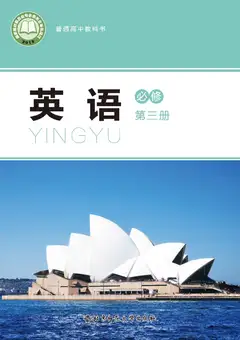
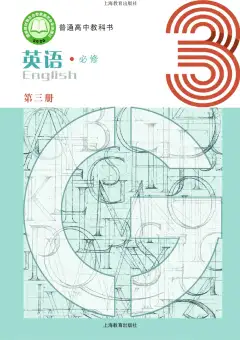
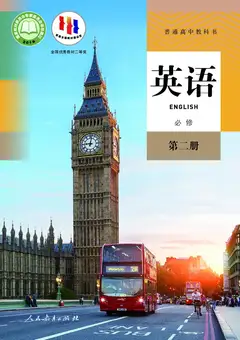
英语
必修
第三册
普通高中教科书
English
上海教育出版社
上海教育出版社
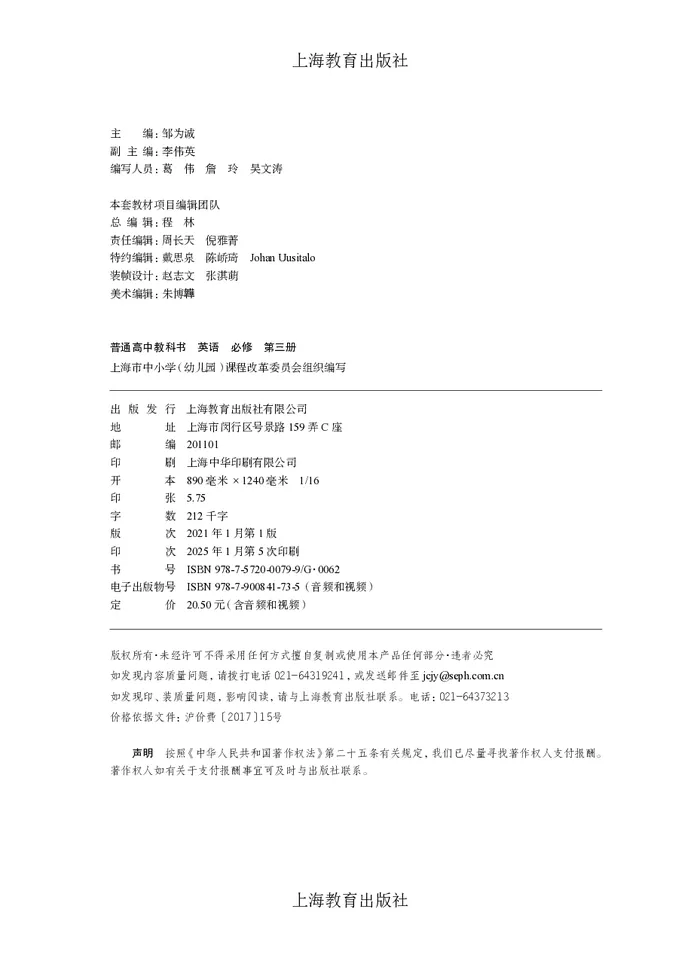
主 编:邹为诚
副 主 编:李伟英
编写人员:葛 伟 詹 玲 吴文涛
本套教材项目编辑团队
总 编 辑:程 林
责任编辑:周长天 倪雅菁
特约编辑:戴思泉 陈峤琦 Johan Uusitalo
装帧设计:赵志文 张淇萌
美术编辑:朱博
普通高中教科书 英语 必修 第三册
上海市中小学(幼儿园)课程改革委员会组织编写
出 版 发 行 上海教育出版社有限公司
地 址 上海市闵行区号景路159 弄C 座
邮 编 201101
印 刷 上海中华印刷有限公司
开 本 890 毫米×1240 毫米 1/16
印 张 5.75
字 数 212 千字
版 次 2021 年1 月第1 版
印 次 2025 年1 月第5 次印刷
书 号 ISBN 978-7-5720-0079-9/G·0062
电子出版物号 ISBN 978-7-900841-73-5(音频和视频)
定 价 20.50 元(含音频和视频)
版权所有·未经许可不得采用任何方式擅自复制或使用本产品任何部分·违者必究
如发现内容质量问题,请拨打电话021-64319241,或发送邮件至jcjy@seph.com.cn
如发现印、装质量问题,影响阅读,请与上海教育出版社联系。电话:021-64373213
价格依据文件:沪价费〔2017〕15号
声明 按照《中华人民共和国著作权法》第二十五条有关规定,我们已尽量寻找著作权人支付报酬。
著作权人如有关于支付报酬事宜可及时与出版社联系。
上海教育出版社
上海教育出版社
亲爱的同学们:
本册为必修第三册,共有四个核心主题(The media、The things around us、The way we are、Travellers’
tales)。同学们在这四个主题语境的引领下开展听说读写看的活动。
本册教材共由四个单元组成,每个单元有五个板块,各板块的具体内容和学习方式如下:
�Reading and interaction 是单元的核心内容,其中的主课文搭建了一个活动丰富的学习平台,供同学
们研读文章的思想内容和语言特点。同学们可以据此联系生活实际,开展听说读写的综合性交际活
动,全面提高语言能力、思维品质,把握文化内涵,提升文化意识和学习能力。
�Grammar activity 是《普通高中英语课程标准(2017 年版2020 年修订)》(以下简称《课程标准》)所
规定的相关语法学习内容,其中的语法范例展示了语法知识的特点,随后的语法合作学习活动将帮助
你们建立规范和得体的语法知识体系,发展有效的语法应用能力。
�Listening and speaking 分为听力活动和口语活动。听力活动之前有丰富的听前准备活动,同学们准
备得越充分,听力学习的成效就越大; 口语活动和听力活动紧密相依,为同学们创造了听说相结合的
训练机会。
�Writing 为同学们提供了发展写作能力的机会。在教师的指导下,同学们可以首先根据问题提示研究
范文在内容、语言和文本编辑方面的特点,然后开展独立的写作训练。
�Cultural focus 提供了丰富的优秀中华文化和世界其他国家及地区的文化内容。同学们通过学习这些
内容,理解丰富多彩的文化现象和文化特点,提升文化意识和文化比较能力,加强对中国文化的自
信,树立家国情怀,培养人类命运共同体的理念,将价值塑造、知识传授和能力培养三者融为一体。
本板块还有一个视频学习项目,蕴含丰富的语言和文化内容,同学们通过视听学习,能够有效地提升
“看英语”的能力。
本套教材还有以下特点:
�丰富的学习活动助你改进学习方式
《课程标准》提倡通过活动来提高语言学习效能。为此,本套教材含有大量的综合性语言交际活动,
有助于同学们不断改进学习方式,主动、积极地参与到合作探究的学习活动中去。
�“学习目标”和“自我评价”手段有助于提高“教学评”一体化程度
明确的学习目标和准确的自我评价是保证“教学评”一体化的重要条件。本套教材为同学们提供
了两个助学工具:(1) 单元开始时的“学习目标”提出了各个板块的学习内容和期望达成的学习结果;
(2) 单元结束时的自我评价活动可以帮助同学们准确地评价自己的学习成果,并据此规划下一步的学习
目标。
本册教材是必修课程的最后一册,同学们即将完成国家《课程标准》所要求的学业质量水平一的学
习任务,接下来将进入更高一级的学习,希望同学们继续努力,顺利完成选择性必修课程的学习。
华东师范大学高中《英语》编写组
2020 年6 月
致同学们
上海教育出版社
上海教育出版社
2
Self-assessment �
(p. 40)
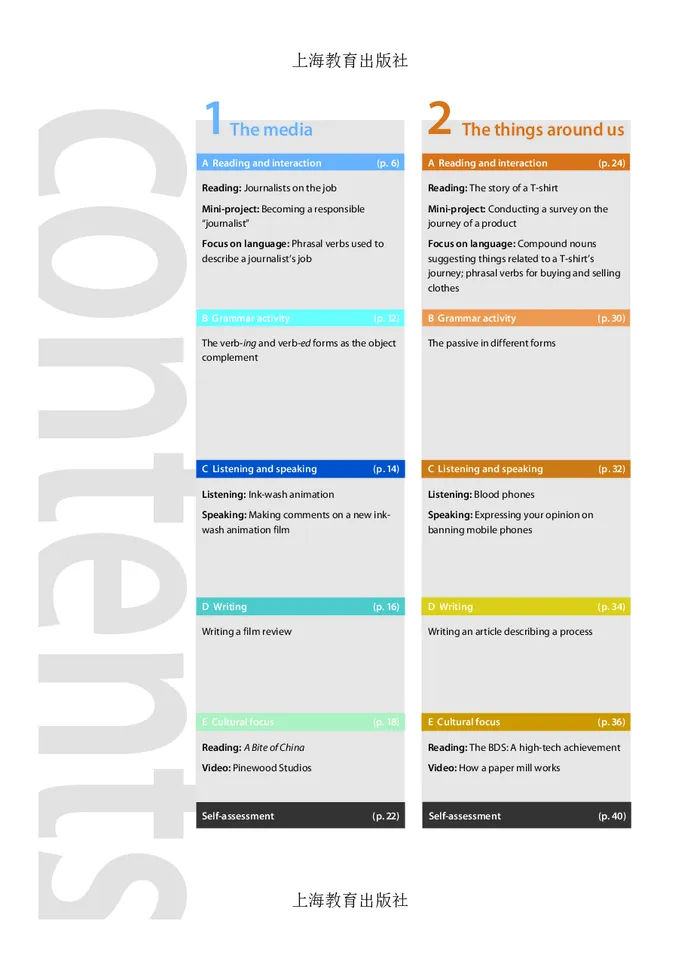
The things around us
A Reading and interaction�
(p. 24)
Reading: The story of a T-shirt
Mini-project: Conducting a survey on the
journey of a product
Focus on language: Compound nouns
suggesting things related to a T-shirt’s
journey; phrasal verbs for buying and selling
clothes
B Grammar activity�
(p. 30)
The passive in different forms
C Listening and speaking�
(p. 32)
Listening: Blood phones
Speaking: Expressing your opinion on
banning mobile phones
D Writing�
(p. 34)
Writing an article describing a process
E Cultural focus�
(p. 36)
Reading: The BDS: A high-tech achievement
Video: How a paper mill works
1
Self-assessment �
(p. 22)
The media
A Reading and interaction�
(p. 6)
Reading: Journalists on the job
Mini-project: Becoming a responsible
“journalist”
Focus on language: Phrasal verbs used to
describe a journalist’s job
B Grammar activity�
(p. 12)
The verb-ing and verb-ed forms as the object
complement
C Listening and speaking�
(p. 14)
Listening: Ink-wash animation
Speaking: Making comments on a new ink-
wash animation film
D Writing�
(p. 16)
Writing a film review
E Cultural focus�
(p. 18)
Reading: A Bite of China
Video: Pinewood Studios
上海教育出版社
上海教育出版社
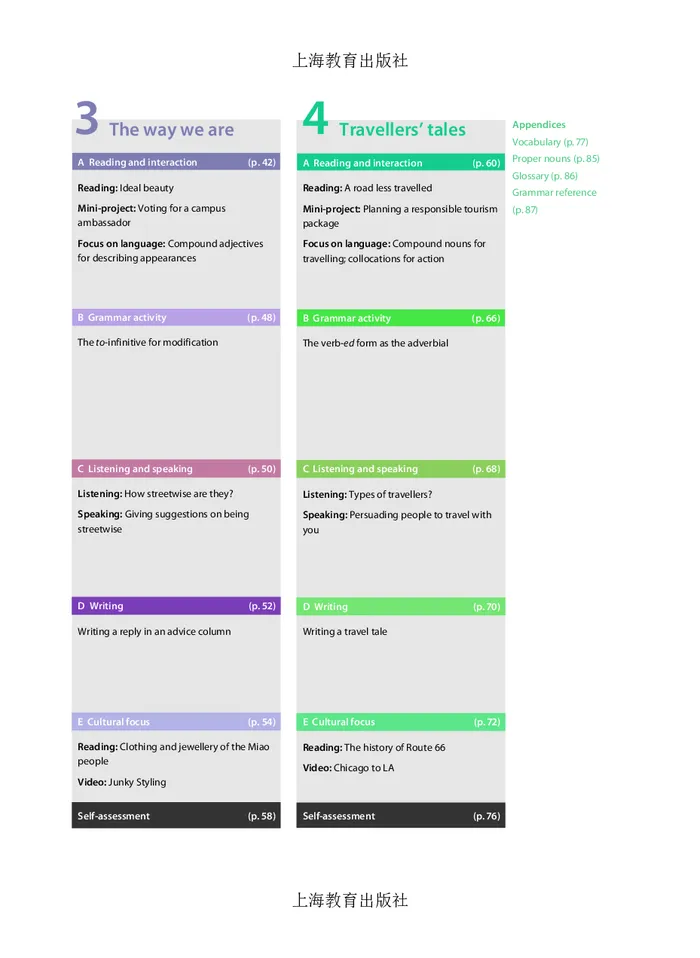
Appendices
Vocabulary (p. 77)
Proper nouns (p. 85)
Glossary (p. 86)
Grammar reference
(p. 87)
3
Self-assessment �
(p. 58)
The way we are
C Listening and speaking�
(p. 50)
Listening: How streetwise are they?
Speaking: Giving suggestions on being
streetwise
D Writing�
(p. 52)
Writing a reply in an advice column
E Cultural focus�
(p. 54)
Reading: Clothing and jewellery of the Miao
people
Video: Junky Styling
B Grammar activity�
(p. 48)
The to-infinitive for modification
A Reading and interaction�
(p. 42)
Reading: Ideal beauty
Mini-project: Voting for a campus
ambassador
Focus on language: Compound adjectives
for describing appearances
4
Self-assessment �
(p. 76)
Travellers’ tales
A Reading and interaction�
(p. 60)
Reading: A road less travelled
Mini-project: Planning a responsible tourism
package
Focus on language: Compound nouns for
travelling; collocations for action
B Grammar activity�
(p. 66)
The verb-ed form as the adverbial
C Listening and speaking�
(p. 68)
Listening: Types of travellers?
Speaking: Persuading people to travel with
you
D Writing�
(p. 70)
Writing a travel tale
E Cultural focus�
(p. 72)
Reading: The history of Route 66
Video: Chicago to LA
上海教育出版社
上海教育出版社
上海教育出版社
上海教育出版社
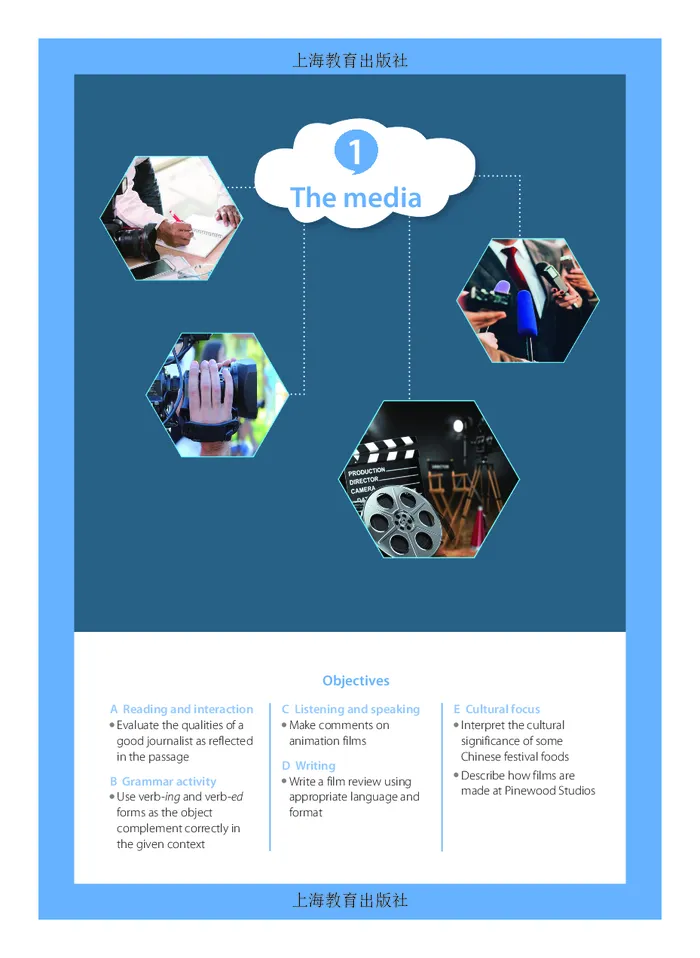
Objectives
1
The media
A Reading and interaction
�Evaluate the qualities of a
good journalist as reflected
in the passage
B Grammar activity
�Use verb-ing and verb-ed
forms as the object
complement correctly in
the given context
C Listening and speaking
�Make comments on
animation films
D Writing
�Write a film review using
appropriate language and
format
E Cultural focus
�Interpret the cultural
significance of some
Chinese festival foods
�Describe how films are
made at Pinewood Studios
上海教育出版社
上海教育出版社
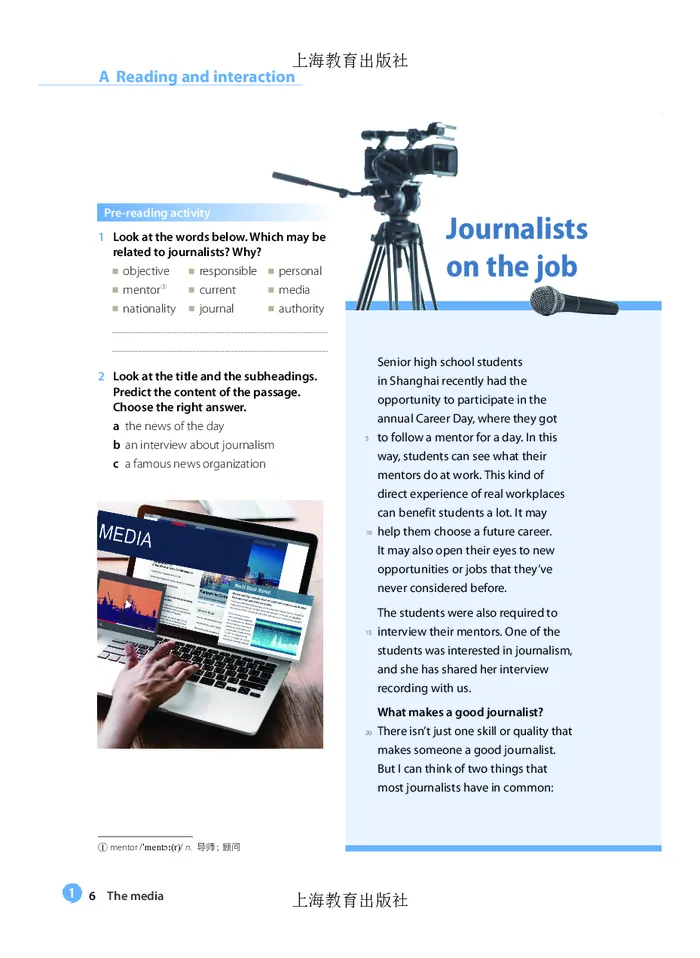
Pre-reading activity
1 �Look at the words below. Which may be
related to journalists? Why?
objective
responsible
personal
mentor
a
current
media
nationality
journal
authority
2 �Look at the title and the subheadings.
Predict the content of the passage.
Choose the right answer.
a the news of the day
b an interview about journalism
c a famous news organization
Senior high school students
in Shanghai recently had the
opportunity to participate in the
annual Career Day, where they got
to follow a mentor for a day. In this
way, students can see what their
mentors do at work. This kind of
direct experience of real workplaces
can benefit students a lot. It may
help them choose a future career.
It may also open their eyes to new
opportunities or jobs that they’ve
never considered before.
The students were also required to
interview their mentors. One of the
students was interested in journalism,
and she has shared her interview
recording with us.
What makes a good journalist?
There isn’t just one skill or quality that
makes someone a good journalist.
But I can think of two things that
most journalists have in common:
5
10
15
20
Journalists
on the job
a mentor /9mentO:(r)/ n. 导师;顾问
A Reading and interaction
1
6 The media
上海教育出版社
上海教育出版社
they are curious, and they love language. Journalists look around and always ask who, what,
why, where and when. Then they try to tell others what they find out.
Would all writers make good journalists?
No, I wouldn’t say that. Writing a news article is not like writing a book. For one thing,
journalists need to write in a clear way, using as few words as possible. There is always a limit
on the number of words a journalist can write, so they need to focus on the key points. If you
want to be a journalist, you ought to start developing this important skill.
How do you spot a good news story?
News is about what is happening right now, so good journalists keep up with current events.
By paying attention to what’s going on, and keeping your eyes and ears open at all times, you
always come across things worth reporting.
Do journalists always write true news stories?
They should. If the story’s not entirely true, then it isn’t news—it’s fiction. This means journalists
need to be good at checking up on facts and making sure their information is true. If our
articles contain errors, our readers won’t trust us. We need to find good sources of information
and collect all the facts.
Should news stories appeal to the readers’ emotions?
I think you could say that. What is the use of reporting things that your readers don’t care
about? However, as journalists, we need to write with care and tell news stories in an objective
way. We also need to present the facts in a fair way that benefits our readers.
What is challenging about working as a journalist?
The biggest challenge is probably time. A journalist has to find a good story, collect all the
important information and report it before the news gets old. So, if you work as a journalist,
you have to be responsible. You can’t be late for interviews, and you can’t turn in your reports
late. Journalists always work under time pressure.
What makes the work of a journalist valuable?
My work has personal value for me when I get to answer a question that’s been on my mind.
And I love when I get a chance to share
that answer with others, especially when
it helps people improve their lives. I feel
like I’ve done a good job then. This is
not just a job I do to get paid—I do it
because I believe it has purpose.
25
30
35
40
45
50
55
1
The media 7
上海教育出版社
上海教育出版社
Comprehension work
1 �Read the passage and decide whether the following statements are true (T) or false (F).
Correct the false ones and give your reasons.
(1) �For Career Day, mentors got to follow a high school student for a day.�
(2) �A female student recorded an interview with a journalist.�
(3) �A good writer will make a good journalist.�
(4) �It is important for journalists to keep up with current events.�
(5) �Not all news stories need to be completely true.�
(6) �Journalists should write news stories that make people emotional.�
(7) �One of the difficult parts of working as a journalist is turning in the reports on time.�
(8) �The journalist believes that the most important thing is to have a meaningful job.�
2 �Read the summary below and fill in each blank with a suitable word based on the
language of the passage. You may change the form if necessary.
As part of the annual Career Day, a high school student interviewed a journalist.
The interview illustrates the most important qualities of a good journalist. Most
journalists have two things in common: their
1
about what
is happening and their
2
of language. Journalists need to
keep their eyes and ears
3
to discover things that are worth
4
. They also need to
5
all the facts to ensure
that their news stories are
6
true. Besides, since they have
a word limit, journalists have to focus on the key points and work effectively
under pressure. In addition, journalists should remain
7
when reporting news stories. They must be
8
: they can’t
be late for interviews. On the whole, by providing information, journalists
are helping people
9
their lives, which makes their work
10
.
A Reading and interaction
1
8 The media
上海教育出版社
上海教育出版社
Quotes and guiding questions
My understanding
(1) Writing a news article is not like writing a book.
Guiding question: What does the journalist imply
about writing a book?
(2) �... you always come across things worth
reporting.
Guiding question: What kinds of events would be
worth reporting? Give two examples.
(3) ... making sure their information is true.
Guiding question: How can we tell true news
stories from false ones?
(4) —�Should news stories appeal to the readers’
emotions?
—I think you could say that.
Guiding question: Why does the journalist reply to
the question in this way?
(5) Journalists always work under time pressure.
Guiding questions: What may cause “time
pressure” for journalists? If you were a journalist,
how would you deal with this problem?
(6) ... I believe it has purpose.
Guiding question: What purpose or value do you
think the job of a journalist has?
Deep reading
1 �The passage talks about different aspects of being a journalist. Read the passage again.
Study the quotes and guiding questions in pairs. Complete the table below. You may use the
example below to help you.
But I can think of two things that most journalists have in common: they are curious, and they love
language.
Guiding question: In addition to curiosity and love of language, what other things make a good
journalist?
You may ask and respond like this:
A: What are the two things that most journalists have in common?
B: They are curious and they love language.
A: In addition to these two things, what other things make a good journalist?
B: They need to be responsible and be good at communication.
1
The media 9
上海教育出版社
上海教育出版社
Aspects of life
Possible benefits
Possible problems
Our friends
(e.g. post their pictures online)
We can film our daily lives with
smartphones, upload the clips
onto the Internet, and share
them with our friends.
We may hurt our friends if we
film them and upload the film
online without their permission.
School children
(e.g. post their school life online)
Our privacy
(e.g. post our names and
addresses online)
How do we become responsible “journalists” when we post online? Write a summary of your
discussion here.
Mini-project
Becoming a responsible “journalist”
In the Internet age, it is possible for anyone to be a “journalist” because people can post
comments, photos, videos and news stories online using smartphones anywhere and anytime.
You are going to make suggestions on how to become a responsible social media user.
Discuss the questions below in groups.
�What are the possible benefits and problems of posting things online?
How would it affect the aspects of life below?
Share ideas within your group.
Select one person to report on behalf of your group.
2 �Work in pairs and discuss the questions.
(1) Would you like to be a journalist? Why or why not?
(2) What effects has the Internet had on journalism?
A Reading and interaction
1
10 The media
上海教育出版社
上海教育出版社
Focus on language
1 �Read the passage again. Find some language points in the passage and list them in the
blanks.
Phrasal verbs used to describe a journalist’s job (e.g. check up on facts)
2 �Complete the passage with the correct form of the words below.
benefit
spot
illustrate
appeal
mentor
authority
fiction
valuable
current
common
When I was in high school, I loved reading and dreamt of becoming a
1
writer. One thing led to another, and I became a journalist instead. I began working as a
newspaper reporter in 1991, and I still remember my
2
, who helped me
get through the first months on the job. She taught me how to
3
a good
story and how to interview people. I learnt many
4
lessons from her.
Nowadays, the media industry is very different. When I started, newspapers were still
paper-based. The Internet has changed the business completely: almost every newspaper
is now available online. To
5
my point, let’s look at today’s young
newspaper readers. They have very little in
6
with the people who were
reading newspapers 30 years ago. Instead of buying print newspapers, most of them read
the news online for free, and it has become very difficult for newspapers to make money.
In order to survive, our online newspaper has started providing videos and in-depth feature
articles that are only available to paying readers. By offering such
7
, we
have attracted many new customers who are happy to spend money on digital content.
Despite the move to digital publishing, the basic purpose of a newspaper hasn’t changed:
in order to stay in business, we still need to report on
8
topics and provide
the readers with well-written articles that
9
to them. Finally, nothing
is more important than trust: journalists need to write with
10
on the
subjects that matter—otherwise, we will lose our readers.
1
The media 11
上海教育出版社
上海教育出版社
A recent survey into the media habits of teenagers reveals some surprising results. The average
teenager spends an incredible eleven hours each day on their mobile phone, computer or TV.
That’s more hours than they are awake outside school time! How are they able to do this? The
answer, of course, is multitasking.
The researchers interviewed some teenagers about their media habits, and also
1observed
them doing everyday things. To confirm the results of the survey, I spoke to one teenager, who
agreed to let me interview him in his home.
Fifteen-year-old Jake Kendall is a typical teenager. As I walked into his room,
2I saw him
watching a TV show, chatting to friends online and clicking on links of interesting articles—all
at the same time! During the interview,
3I caught him looking at his phone several times. He
told me that he often multitasked when he was online.
Some experts are concerned that teenagers may have difficulties in the future because of their
multitasking habits. Will they be able to focus their attention as adults? However, other experts
believe that teenagers are learning the skills needed to be flexible and succeed in 21st century
workplaces: after all,
4digital devices help us get things done.
The verb-ing and verb-ed forms as the object
complement
One way of using the verb-ing or verb-ed form as the complement, such as the object
complement, is to put it after the object.
(1) He found his mother cooking in the kitchen when he came home.
(2) He had a few things stolen on the subway.
1 �Read the passage. Match clauses or phrases 1–4 to grammar rules a and b.
Grammar reference 1 (p. 87)
Grammar reference 2 (p. 87)
Multitasking teenagers
By Sharon McCall
a �We can use the structure verb + someone / something + verb-ing to describe things we have
perceived with our senses.�
b �We can use the structure have / get + something + verb-ed to describe actions that have
happened to something. This often refers to things that others do for us. �
B Grammar activity
1
12 The media
上海教育出版社
上海教育出版社
2 Complete the interview with the correct form of the verbs below.
have
take
get
do
hear
see
sleep
play
film
sing
Sharon: OK, so Marisa, tell me about your day!
Marisa: �Well, I got up at 6: 00 a.m., had a light breakfast and then went to my soccer practice. This
neighbourhood is really quiet. I can
1
the birds
2
every morning!
Sharon: That’s nice!
Marisa: �On the way, I
3
a black and white cat
4
on a car. The light was
perfect, so I took a picture and posted it to my friends.
Sharon: �Nice picture! Oh, this is your soccer practice?
Marisa: �Yeah, I
5
my friends
6
soccer. I love taking photos, but I don’t like
7
my picture
8
, especially not now.
Sharon: �Why?
Marisa: �I need to
9
my hair
10
. It looks horrible at the moment.
Sharon: �Oh, it’s not that bad!
3 �Work in groups. Write three sentences to describe different seasons, using the structures
“verb + something / someone + verb-ing” and “get / have + something + verb-ed”. You
may use the examples below to help you.
I have flowers planted in my garden.
I hear birds singing joyfully in the woods, and everything is calm.
(1) I see / notice
(2) I smell / hear
(3) I get / have
Now ask the other group members about their descriptions and guess which season
they are describing. Then report the most interesting description to the class.
�You may ask and respond like this:
A: What are your descriptions?
B: �Well, let me read my descriptions. I have flowers planted in my garden. I hear birds singing
joyfully in the woods.
A: �I like your descriptions and I guess you are describing the season of spring. Do you all
agree?
�You may report like this: In our group, Lili’s description of spring is the most interesting.
She says, “I see the grass coming out of the earth, breathing the fresh air merrily. I have my
windows cleaned so I can enjoy the view outside.”
1
The media 13
上海教育出版社
上海教育出版社
a director
a video game
an award-winning film
an interview
a concert
a famous artist
Tadpoles Searching for Mama
The Plume
Time of release
present
Director
not mentioned
Style
Innovations
2 �Listen to the first part of the radio programme, Dominic’s Download. Which of the
following things does the programme mention?
3 �Listen to the second part of the radio programme. Complete the table.
1 �Below are a few different ways of making animated films. Match the film-making
techniques to the pictures.
Stop-motion
a animation
b
3D-computer animation
Ink-wash painting
Miniature
c figures
Watercolours
a stop-motion /stBp 9mRWSn/ n. 定格拍摄 b animation /0CnI9meISn/ n. 动画片
c miniature /9mInRTR(r)/ adj. 微型的
C Listening and speaking
1
14 The media
a
b
c
d
e
上海教育出版社
上海教育出版社
4 �Imagine that The Plume has been awarded a prize and that you are one of the judges.
You need to deliver a speech and give the reasons for the award. Work in groups and
prepare the speech in discussion. You may follow the steps below.
Discuss the following questions and take notes.
Who is the director of the film?
What special technique was used to make it?
How did the film-maker use this technique in a new way?
What traditional arts did the film-maker use in the film?
Organize your notes and outline a speech in the space below.
Select one person to present the speech on behalf of your group.
Language guide
Ou
tlin
e y
ou
r s
pe
ec
h
h
er
e!
You may discuss the film like this:
�The director of the film is ... / The
film is directed by ...
The film was made with ...
It is done in a / an ... style.
It’s a beautiful / great / ... film.
�It is included in a collection of
award-winning films.
The interesting thing about ... is ...
Thanks to ..., the film ...
You may present your speech like this:
�Good evening / ..., ladies and
gentlemen! The award committee is
pleased to announce that ...
The award for ... goes to ...
I feel honoured to ...
1
The media 15
上海教育出版社
上海教育出版社
Search
Films have been around for over a hundred years, and are still very popular. We are
calling for film-goers to share their views on their favourite films. The best entries
will be published on our website.
Imagine that the world is going to end in seven days. Would you rush home to spend the
remaining time with your family, or would you risk your life saving the Earth and human
civilization?
This is the theme of The Wandering Earth, a film directed by Guo Fan. The film is based on a
novel by Liu Cixin and is the first Chinese science fiction film to become internationally famous.
The film stars Wu Jing as the astronaut Liu Peiqiang, along with a number of other big-name
actors.
The plot is exciting and super easy to follow. The sun is about to die out, and Liu Peiqiang is
sent on a difficult task. His job is to guide the Earth on its journey to a new location outside
the solar system. However, when the Earth is passing Jupiter, something goes wrong. It will
crash into the planet in seven days. Faced with this possible disaster, Liu acts heroically, and
successfully saves the Earth at the cost of his own life.
The film is packed with thrilling
b action scenes where problems and dangers come up one
after another. However, the heroes act bravely with an added touch of humour. The lines often
make me think. For example, there is a line saying: Long, long ago, people didn’t care much
about the sun. They only cared about the thing called “money”. This description shows how silly
human behaviour can be, especially how we destroy the environment.
To sum up, The Wandering Earth is an example of Chinese science fiction film-making at its
best. I really enjoyed watching it because it is both entertaining and educational. This is a film
not to be missed!
1 �Read the short notice above. Imagine that you are going to write a film review. You may
prepare your writing by thinking about the questions.
(1) Which film do you want to write about?
(2) What elements do you want to include in your film review?
the action scenes
the plot
the soundtrack
the script
a
the characters
the lines
the special effects
the ending
2 �Read the sample film review. Then complete the table on page 17 before you write.
The Wandering Earth
a script �/skrIpt/ �n. �(电影)剧本 b thrilling �/9PrIlIN/ �adj. �惊险的;紧张的;扣人心弦的
D Writing
1
16 The media
上海教育出版社
上海教育出版社
3 Now write your film review.
Aspects of writing
Guiding questions
My exploration
Content
What is the basic information
about the film (genrea, director,
actors, characters)?
What is the plot of the film?
What does the reviewer think of
the film in general? Is it a positive
or negative review?
How does the reviewer end the
review?
Language
What language does the reviewer
use to express his / her opinions?
What tense does the reviewer use
when commenting on the film?
Editing
What words are capitalized?
What words are italicized?
Which words are hyphenated?
a genre /9ZBnrR/ n. 体裁
1
The media 17
上海教育出版社
上海教育出版社
1 �What is your family’s favourite food? Choose one of the items below and talk about it
with your partner.
stewed beef with soy sauce
jiaozi
steamed fish with black beans
steamed buns
sugar-coated rice cakes
others:
5
A Bite of China
2 Read the passage and choose the correct answers.
(1) A Bite of China is about
.
a the different ways of making dishes
b the history of food and the rich culture behind it
c the scientific knowledge in food production
d eating habits in different families
(2) Which of the following statements is not true about Ningbo rice cakes?
a Traditionally, many families would make rice cakes after the rice harvest.
b People in Ningbo would eat rice cakes throughout the year.
c Rice cake making is also part of a cultural celebration in Ningbo.
d At a family reunion, everyone will take part in rice cake making.
(3) �The photographer, Bai Bo, enjoys making jiaozi. The most important reason is that
.
a this is the family celebration of the new year
b his daughters like the jiaozi that he makes
c �this is a Chinese tradition that needs to be followed
d this is one of the rare moments he can spend with his family
TV shows about food are quite popular these days, aren’t
they? Maybe you’ve seen or heard about shows explaining
how to make different dishes. Or maybe you’ve heard
about shows that introduce the history of foods to viewers. On the surface, the Chinese
documentary A Bite of China may seem like this second type of show, but it’s much more.
There is a wider variety of media nowadays than ever before. Television, radio, films
and newspapers, as well as the Internet, with its social networking sites, expand our
knowledge of the world.
In this section, you will first read about the Chinese documentary series A Bite of China.
You will then watch a video about Pinewood Studios in the UK, where its secrets of film-
making are revealed.
E Cultural focus
1
18 The media
上海教育出版社
上海教育出版社
10
15
20
25
30
35
The producers of the show wanted to show the relationship of foods
from different regions of China with the people living there. This
relationship includes the widely held customs and traditions of the
region, which influence family values and people’s attitudes towards
life. Overall, the show aims to help audiences understand traditional
Chinese culture through stories about food told by ordinary people.
During the first season of A Bite of China, a story from the second
episode of the show focused on Ningbo in Zhejiang Province. After
the late rice harvest, the people in this region begin making rice
cakes. The flour used to make rice cakes comes from polished round-
grain rice
a. Traditionally, many families would prepare rice cakes
before the Chinese New Year. A family would prepare enough to eat
through the year, either as a staple food in meals or as a side dish. The
rice cakes are also called get-together cakes. Why is that? When the
cakes are being prepared, everyone knows a family reunion
b is soon
to come.
Another Chinese New Year tradition appears in the same episode
of A Bite of China. This tradition is shown through the family of Bai
Bo, a photographer whose family lives in Beijing. This busy father
of two girls rarely has time to spend with his family during the year.
That’s why during the Chinese New Year holidays, Bai Bo won’t allow
anything to get in the way of spending time with his family. One
tradition he enjoys during this holiday is stuffing and wrapping jiaozi,
his daughters’ favourite food, to be served with their New Year’s Eve
meal. A Bite of China makes it clear that, for Chinese people, nothing
is more important than family get-togethers.
When A Bite of China’s first season went on the air, countless viewers
kept coming back for more as new episodes came out. Many were
moved to tears by the touching stories of real people and the foods
they love. And the show wasn’t just a hit in China. After the first
season ended, more than 35 countries bought the rights to show it
internationally. A Bite of China sounds fantastic, doesn’t it?
a polished round-grain rice 晚粳米 b reunion /0ri:9ju:niRn/ n. 重逢;团聚
1
The media 19
上海教育出版社
上海教育出版社
3 �Read the passage and discuss the cultural elements reflected in this episode of A Bite of
China.
A Bite of China
Cultural object
Cultural festival /
celebration
Cultural behaviour
Cultural idea
rice cakes
jiaozi
4 �Read the passage again and discuss why A Bite of China is so popular. Then report to the
class.
E Cultural focus
1
20 The media
上海教育出版社
上海教育出版社
1
The media 21
Start thinking
1 Answer the questions.
(1) �What films have you seen recently?
(2) �Where were they made?
Comprehension check
2 Watch the video. Correct the factual errors in the sentences.
(1) �One director at Pinewood Studios said it’s easier to control the wind inside.
(2) The outside pool at Pinewood Studios is nearly 70 metres deep.
(3) The pool in the underwater stage holds over six million litres of water.
(4) There are about fourteen stages at Pinewood Studios.
(5) Mamma Mia! was the sixth most successful film in 2008.
(6) Mamma Mia! was mostly filmed in Greece.
Vocabulary
3 Complete the sentences with the expressions below.
audience
underwater
keep up with
blockbuster
fan
shoot
(1) �The film was so sad that everybody in the
cried.
(2) �At Pinewood Studios, they use a huge
to move the water in the outdoor pool.
(3) �The last Harry Potter film was a
—it was extremely successful.
(4) �Directors have to check the light conditions before they
a scene.
(5) �Deep-sea divers can stay
for more than an hour.
(6) �People who work in the media always have to
new technology.
Extension
4 Work in groups. Imagine you are going to make a film at Pinewood Studios.
(1) �Make a list of the different types of film you can make (e.g. action, sci-fi, etc.). Then choose
one for your group.
(2) �In your group, think of the different types of stages at Pinewood Studios that you could use.
Think of any special effects that you might need. Think of any objects or sets (e.g. a Greek
village) that you might want to build.
(3) �Write down the general story for your film. Use your ideas for using Pinewood Studios to
help you.
(4) �Present your film idea to the class.
(5) �Have a class vote to choose the best film.
Video
Pinewood Studios
上海教育出版社
上海教育出版社
Self-assessment
1
22 The media
Checklist
*
1
Me
2
My teacher /
classmate
3
Action
A Reading and interaction
�I can describe what a journalist’s job is like, based on the
information in the interview.
�I can summarize the different qualities a good journalist
should have, based on the passage.
�I can talk about how to be a responsible journalist.
B Grammar activity
�I can recognize the verb-ing and verb-ed forms used as
the object complement in the passage.
�I can use verb-ing and verb-ed forms as the object
complement correctly if the context is clear.
C Listening and speaking
�I can identify the details of two ink-wash animation films
mentioned in the radio programme.
�I can make comments on an ink-wash animation film
using appropriate expressions.
D Writing
�I can recognize the content and the features of language
in the sample film review.
�I can write a film review with sufficient details and
appropriate language in a well-organized structure.
E Cultural focus
�I can analyse the cultural significance of the Chinese
festival foods in the passage.
�I can briefly explain how films are made at Pinewood
Studios.
Use the checklist and reflective questions below to evaluate your study in this unit.
Reflective questions
Did you take note of the teacher’s feedback on your mini-project presentation? How does it help
you improve your language proficiency?
* �Ask your teacher or your classmate to assess what you can do. Use the four symbols (33, 3 and !, !!). In column 1 or 2, 33=I’m
confident about this; 3=I’m OK, but not quite sure. In column 3, ! = I must review this part; !! = I must seek help about this. The
symbols can be applied to other Self-assessment sections in the book.
上海教育出版社
上海教育出版社
C Listening and speaking
�Express one’s personal views
on banning mobile phones
D Writing
�Describe a process using
appropriate language and
format
A Reading and interaction
�Describe the process of
making a product and its
impact on the people and
environment
B Grammar activity
�Use passive structures
correctly in the given context
E Cultural focus
�Recognize the features and
applications of the BDS
�Describe the process of
paper-making
Objectives
The things around us
2
上海教育出版社
上海教育出版社
2
A Reading and interaction
Pre-reading activity
1 Work in pairs. Answer the questions.
(1) �How many T-shirts have you got? Do
you buy new T-shirts frequently? Why
or why not?
(2) �Do you know where they were made?
2 �Look at the title and the picture. Guess
the answers to the questions below.
Then read the passage to check your
answers.
(1) What type of passage may it be?
a A magazine article.
b A report.
c A leaflet
a.
(2) Who is it written for?
a Children.
b Teenagers.
c Shop owners.
(3) What may its main purpose be?
a �To explain why people buy
second-hand clothes.
b �To give information about
environmental problems.
c �To encourage readers to change
their habits.
Lagos, Nigeria—Yaba market is busy,
hot and dusty. People are looking
around the second-hand shops,
picking through piles
b of old clothes,
and they’re all searching for deals.
The market is flooded with cheap
clothes from America and Europe,
and they usually sell out fairly quickly.
“These clothes make people’s dreams
come true,” says Abeke, a shop owner.
“Everyone wears them. When they put
them on, you can’t tell the difference
between the rich and the poor.” At the
front of Abeke’s store is a cotton T-shirt
with the words “Get Real”. It’s picked up
5
10
15
a leaflet �/9li:flRt/ �n. �( 宣传或广告) 小册子;散页印刷品;传单 b pile /paIl/ n. 堆
24 The things around us
上海教育出版社
上海教育出版社
2
by a young guy who looks at it carefully. He tries it on and smiles—it fits him and it
looks good. It’s a simple T-shirt, but it has a long story.
A few years ago, the T-shirt started life in a cotton field in Uzbekistan. The cotton was
watered every day and harmful chemicals were used to kill insects in the field. As the
cotton grew, a young woman called Feruza picked it. She sweated in the field for ten
to twelve hours every day in temperatures of over 30°C, but she was paid very little.
Sometimes the chemicals hurt her eyes.
Next, the cotton was flown to India. The T-shirt was made in a tiny factory in the Indian
port city of Mumbai. There were 20 adults in it, five children and no air conditioning.
The adults made the T-shirts and the children checked them.
The finished T-shirt was sent to a huge discount shop in the UK. The people who
shopped there didn’t know where the clothes came from. They didn’t want to spend a
lot of money, but they wanted to look good. The T-shirt was cheap and it was bought
by 15-year-old Ryan who liked the words on it. It was washed, worn and ironed and,
after a few months, Ryan threw it away. His mum took it to a charity shop with some
other old clothes, which were sold to an export company. A few weeks later, the T-shirt
made its way to Yaba market in Nigeria.
Back at the market, the young man takes off the T-shirt and looks at the $3 price tag.
He hesitates for a moment and then he offers Abeke $1.50 because that’s all the cash
he’s got. Abeke shakes her head. As she hangs up the T-shirt at the front of the shop,
the charity shop’s price tag is still on the back: 25p.
The journey of a T-shirt tells many stories. Stories about people, countries and
cultures. Stories about farmers
and factory workers. Stories about
shopping centres. But for most of
all, it’s a story about choices, and our
choices can make a difference. Do
you really need another T-shirt? Do
you care where it’s from? What’s the
cost to the environment? What’s the
human cost? Think about it, because
our choices could start a new story.
20
25
30
35
40
45
a litre �/9li:tR(r)/ �n. �升 b tonne /tVn/ n. 吨
• �Ten thousand litres
a of water are used to
make one T-shirt.
• �A 200-gram T-shirt can use up to 5
tonnes
b of resources.
• �3.4 billion T-shirts are sold in the USA
every year.
• �Children as young as seven work in
cotton fields and factories.
Did you know?
The things around us 25
上海教育出版社
上海教育出版社
2
A Reading and interaction
Comprehension work
1 Read the passage and answer the questions.
(1) �Why do Africans like Western clothes?
(2) �Who made T-shirts in the Indian factory?
(3) �Why do people still go to discount shops?
(4) �Why doesn’t the young man buy the T-shirt from Yaba market?
(5) �From the charity shop to Yaba market, who may profit from the T-shirt according to the writer?
(6) �What impacts might the making of a T-shirt have?
2 �Read the summary below and fill in each blank with a suitable word based on the
language of the passage. You may change the form if necessary.
The passage tells us a story about a T-shirt and the people and societies
connected to it. A T-shirt was put on sale at an African market, but it started
1
in Uzbekistan, where people worked and used harmful
2
in the cotton field. When the cotton was picked, it was
3
to a factory in India where the T-shirt was made by adults
and children under poor working conditions.
The T-shirt was sent to a
4
shop in the UK. Many young
people shop there. They do not want to spend a lot of money, but they want
to look good. So they try to search for
5
. A 15-year-old boy
bought the T-shirt because he liked the words on it. However, after a few
months he
6
it away. It was then collected by a charity shop
and
7
to Nigeria, where it ended up at Yaba market. Here,
the cotton T-shirts from American and European second-hand markets are
8
by both the rich and the poor.
It is suggested at the end of the passage that the things we buy often
affect many people’s lives around the world. It’s more than a matter of
9
when we decide what to buy. We should think twice about
the effect on the environment and the human
10
before
buying new things.
26 The things around us
上海教育出版社
上海教育出版社
2
Deep reading
1 �Read the passage again. Work in pairs. Study the T-shirt’s journey and pay attention to
the stories that have happened in each place and describe people’s lives there. Complete
the table below. You may use the example below to help you.
the cotton field in Uzbekistan
You may ask and respond like this:
A: A T-shirt starts its journey in a cotton field in Uzbekistan. What do people do there?
B: �They water and pick the cotton in cotton fields. And they use harmful chemicals to kill
insects.
A: What are their lives like?
B: �They have to work long hours every day in cotton fields to earn a living in spite of the high
temperatures and harmful chemicals.
The T-shirt’s journey
What happens to the
T-shirt?
Who are the people involved in this
journey? What are their lives like?
the cotton field in
Uzbekistan
in
in
in
The things around us 27
上海教育出版社
上海教育出版社
2
A Reading and interaction
Mini-project
Conducting a survey on the journey of a product
You are going to do a survey about a product to follow its journey before it reaches
consumers. Choose one of the products listed below.
� shoes � tables
sofas
paper
floorboards
wine
others:
Discuss the questions below in groups.
How and where are they produced?
How do they affect people’s lives?
Share ideas within your group.
Select one person to report on behalf of your group.
Jeans
Making jeans is a major economic
industry in some developing
countries. It involves designing,
washing, cutting and packaging. This
is a source of income for local people.
On the other hand, the washing
process produces wastewater. If
it goes directly into rivers without
proper treatment, they may later
turn blue, smell strange and become
poisonous. This will have a harmful
effect on people’s drinking water as
well as their farmland.
2 Work in pairs and discuss the questions.
(1) Is it important to know where your clothes come from? Why or why not?
(2) If you buy one fewer T-shirt, will it make any difference? Why or why not?
28 The things around us
上海教育出版社
上海教育出版社
1 �Read the passage again. Find some language points in the passage and list them in the
blanks.
(1) Compound nouns suggesting things related to the T-shirt in Abeke’s store (e.g. charity shop)
(2) A phrasal verb related to buying and selling clothes (e.g. put on)
2 Complete the sentences with the correct form of the phrases below.
Focus on language
(1) �Every summer, students from all over the country
the Shanghai Science and
Technology Museum.
(2) �The competition is getting easier and easier as it goes on. He will hardly need to
to reach the final.
(3) �Factories in South China produce large quantities of clothes
to meet the needs
of the international market.
(4) �The couple sold their house
and were finally able to travel around the world.
(5) �The two companies are attempting to
the final details of the agreement.
(6) �Payment has become more convenient nowadays. Customers don’t need to pay
; instead, they use smartphone apps to pay for their shopping.
(7) �He didn’t
taking the job with lower pay, because he thought that personal
interest was the most important thing in a job.
(8) �
are getting popular among young people, who like to hunt for bargains.
(9) �It is rather difficult to
a group where people speak a language different from
yours.
(10) �Hebe has decided it’s time to
her dancing shoes as she’s over 40.
flood into
for export
discount shop
at a profit
hang up
iron out
in cash
hesitate about
fit into
break sweat
2
The things around us 29
上海教育出版社
上海教育出版社
Simon’s day (Part 1)
The passive in different forms
In this section, you will review passive structures in the simple present and the simple past,
and learn passive structures in the present perfect.
1 �Read the passage. Match sentences 1–11 to grammar items a–c.
a Present perfect passive
b Simple present passive
c Simple past passive
The alarm clock goes off at 7: 00 a.m. on Saturday
and Simon wakes up and kicks off his duvet
a. Duvets
come from Scandinavian
b countries like Denmark.
1 The first modern alarm clock was invented by an
American called Levi Hutchins in 1787.
2 But Simon’s
clock isn’t made in America—it’s made in China.
Simon quickly gets dressed, then he puts his football kit and trainers
c
into his sports bag.
3 When were trainers first used? In 1907, by American
basketball players.
4 Since then, trainers for all kinds of other sports have
been designed.
5 Today, millions of pairs are sold every day around the
world.
Next, Simon goes to the bathroom and cleans his teeth with a toothbrush.
6 The first toothbrushes were made by the Chinese in 1498. They used
horsehair back then!
Simon listens to the radio while he is having breakfast.
7 The radio was
invented by an Italian
d called Guglielmo Marconi. The first radio programme
took place in 1906.
While Simon is listening to his favourite programme, his dad is reading the
newspaper.
8 The first newspaper was printed in Germany in 1605.
9 While it
was only a few pages long and a few copies were printed, it proved to be a
wonderful invention.
10 Newspapers have been read and enjoyed by people
ever since.
11 Today, many of them are on the Internet and some aren’t
printed at all.
Grammar reference 3 (p. 88)
a duvet /9du:veI/ n. 羽绒被 b Scandinavian /0skCndI9neIviRn/ adj. 斯堪的纳维亚的
c trainer /9treInR(r)/ n. 运动鞋; 便鞋 d Italian /I9tCliRn/ n. 意大利人
B Grammar activity
2
30 The things around us
上海教育出版社
上海教育出版社
2 �Complete the passage. Use the active or passive form of the verbs in brackets.
Simon’s day (Part 2)
3 �Describe three unusual things in your life. Use at least two different forms of passive
structures in your descriptions. You may use the examples below to help you. Then write
your own descriptions in the blanks.
A new talking blackboard was invented to speak to the students in the classroom.
Six sci-fi stories have been written by me and my best friend.
(1)
(2)
(3)
Now ask your classmates about their descriptions. Select the funniest one and report to
the class.
You may ask questions like this: Can you share one of your descriptions with me?
You may respond like this: Yes, I can. Yesterday my hat was painted blue by my cat. It
happened when she jumped onto my desk and knocked over my blue ink bottle.
You may report like this: I think the funniest description is Lili’s. She says a new language has
been developed by her so that she can have conversations with her parrot
c.
a chicle /9tSIkl/ n. 糖胶树胶( 用于制作口香糖) b garage /9GCrA:Z/ n. 车库
c parrot /9pCrRt/ n. 鹦鹉
By now it’s 8:30 a.m., so Simon checks his mobile
phone for text messages. The first mobile phones
1
(invent) by Martin Cooper in 1973, in the
USA. They were big and heavy and people 2
(pay) $10,000 for one. Imagine that!
Simon grabs his sports bag, puts some chewing
gum in his mouth, and leaves for the gym. Chewing
gum 3
(enjoy) by people all over the world
since the Aztecs in South America first discovered
chicle
a thousands of years ago. They 4
(use)
it to freshen their breath. It 5
(still use) for the same purpose today. Simon shouts
goodbye to his mum, and then he 6
(take) his mountain bike out of the garage
b.
Millions of mountain bikes 7
(sell) since the 1970s. The first mountain bike 8
(build) in 1977 by an American called Joe Breeze. Simon 9
(ride) his bike fast, so he
gets to the gym on time!
2
The things around us 31
上海教育出版社
上海教育出版社
1 �A guest on the radio programme 21st Century Global Issues is going to talk about a
gadget. Look at the clues below and guess what the gadget is.
It is made in many different places, from many kinds of materials.
One of its parts is made of coltan
a, a type of rare material that can store energy.
It can send sounds or images around the world.
We can carry it around with us every day.
What is it?
2 �Read the following statements, then listen and decide whether they are true (T) or
false (F).
(1) Most of the world’s coltan comes from the Congo.�
(2) The mining of coltan in the Congo is beneficial to the rainforest.�
(3) Only adult workers are employed to mine the coltan.�
(4) The mining of coltan affects the gorillas’
b habitat or living space.�
(5) The gorilla population is growing rapidly because of the mining.�
(6) �The devices using coltan from the Congo are called “blood phones” because the mining
kills a lot of workers.�
3 �Listen to the radio programme again. Tick the suggestions mentioned by the speaker
about conserving coltan.
Stop using electronic devices that are made using coltan.
Stop importing coltan from the Congo.
Find a new material that can replace coltan.
Buy certified coltan from Australia.
Sign online petitions
c to protest against the mining.
Post comments on the Internet.
Support charities that provide aid to the Congo.
Buy second-hand devices instead of new ones.
Make sure old devices are recycled.
a coltan /9kBltCn/ n. ( 矿) 钶钽铁矿 b gorilla /GR9rIlR/ n. 大猩猩 c petition /pR9tISn/ n. 请愿书
C Listening and speaking
2
32 The things around us
上海教育出版社
上海教育出版社
4 �Work in groups. Discuss the questions about mobile phones below.
If mobile phones are banned, the world will be a better place. Do you agree?
(1) Brainstorm ideas.
�What are the pros
a of mobile phones? Think about what you use them for, the people
who make and sell them, etc.
�What are the cons
b? Think about the impact on the environment, people, etc.
(2) Discuss if there are more pros or cons, and then try to reach a conclusion.
It’ll be awful if they are
banned because ...
Language guide
You may discuss the topic like this:
I think it would be a disaster / a good idea / ... to ...
That sounds ridiculous / reasonable / impossible.
It would be awkward if ...
It wouldn’t work to ... by throwing away ...
It would be workable to sign online petitions ...
It’ll be unfortunate because ...
We suggest ... / We’d better ... / It would be better if ...
We can post comments on the Internet to ...
A majority of the students would ...
It’ll be good if they are
banned because ...
a pro /prRW/ n. 有利条件;优势 b con /kBn/ n. 不利条件;弊端
Wri
te
yo
ur
id
ea
s
h
er
e
!
2
The things around us 33
上海教育出版社
上海教育出版社
Chocolate was first created by Mayan Indians in Mexico about thousands of years ago, but
today it is eaten by people all over the world. The word “chocolate” comes from an Aztec
word meaning “bitter water”. Dark chocolate can be bitter, which is probably why 70% of
people prefer milk chocolate. This description will look at how milk chocolate is produced.
First of all, the cocoa
a trees are grown in countries like Brazil, Ghana and Nigeria. 450 grams
of cocoa are made from one tree every year. The cocoa beans are cut down from the trees.
Next, they are put on banana tree leaves and covered. This is when the chocolate flavour
develops.
After a while, the beans are sun-dried. Then they are packed into bags. Later they are
transported to chocolate factories all over the world. Before they are made into chocolate,
they’re cleaned, roasted and broken into small pieces. These pieces are made into a liquid
and mixed with sugar and milk. Last of all, the chocolate is made into a chocolate bar and it’s
ready to sell in shops. What happens next? I think we all know!
1 �Imagine that you are going to describe a process of making or doing something. You
may prepare your writing by thinking about the questions below.
(1) What process are you going to describe?
making cookies
cleaning a fridge
fixing a printer
making a smog mask
creating a PPT file for a slide show
harvesting honey
others:
(2) How many stages will be involved?
2 �Below are some photos showing how chocolate is made. Put the photos in the correct
order. Then read the sample article and complete the table on page 35 before you write.
F
D
B
E
A
C
a cocoa /9kRWkRW/ n. 可可树;可可粉
D Writing
2
34 The things around us
上海教育出版社
上海教育出版社
Aspects of writing
Guiding questions
My exploration
Content
What is the purpose of this article?
How many stages are involved in the process
of making chocolate? What are they?
What are some unusual or surprising facts
about the process?
Language
What tense does the writer use?
What voice is mainly used, and where is it used?
What verbs and phrasal verbs does the writer
use to describe the process?
What words or expressions does the writer
use to link different stages?
Editing
What words are capitalized?
Which words are hyphenated?
Where does the writer use quotation marks?
Why?
3 Now write an article about the option you chose.
2
The things around us 35
上海教育出版社
上海教育出版社
1 �Work in pairs. Discuss the questions below.
(1) What does GPS stand for?
(2) Do you use positioning technology in your daily life? When and where?
(3) What does BDS stand for?
a Basic Digital System
b Big Data System
c Beijing Daytime System
d BeiDou Navigation Satellite System
2 �Read the passage. Match summaries a–e to paragraphs 1–5.
a The BDS is a system that benefits China and the rest of the world.
b On land, the BDS is used to help the police, firefighters and farmers.
c Satellite systems around the world help people know their locations.
d One place where people use the BDS is on boats.
e The BDS has become better and better over the years.
The BDS: A high-tech achievement
1 In our modern age, we do not think much about how our technology works. We are
so used to tapping
a on our phone screen to get a map of our location. But how do our
phones know where in the world we are and in which direction we are going? It is all
thanks to the satellites in space that help our phones calculate our position. Depending
on where you are around the world, your phone may be receiving data from different
systems. In Europe, people have the Galileo system. In Russia, they have GLONASS. In the
USA, people use GPS. China, meanwhile, has the BeiDou Navigation
b Satellite System
(BDS).
5
a tap /tCp/ v. 轻敲;轻拍 b navigation /0nCvI9GeISn/ n. 导航;领航
Products are all around us. There is often an amazing story behind the things we use in
our everyday lives.
In this section, you will first read about BeiDou, an advanced satellite navigation system that is
the product of China’s high-tech industry. You will then watch a video about paper, a product
that was first invented in China, and how paper is made in Britain’s oldest paper mill.
E Cultural focus
2
36 The things around us
上海教育出版社
上海教育出版社
2 The BDS in operation today is more advanced than the first version of the system,
which was sent into space in 2000. The current version has better technology and
more satellites. In the future, those satellites will allow us to determine the position
of objects with millimetre accuracy: that is ten times more accurate than GPS.
3 Even though more satellites are being added to the system, the BDS has already
been put to use. More than 40,000 Chinese fishing boats are currently using the
system. These boats are very helpful in search and rescue operations at sea. They
are able to communicate with support services on land as well as give the exact
locations of ships in trouble.
4 The BDS is being used on land as well. Of course, it’s not hard to imagine how the
system is helping the police and firefighters do their job. Agriculture is another area
where there are applications for the system. Farmers are able to put the data to good
use when operating smart farming equipment. For instance, the BDS can be used to
control driverless tractors
a as they turn up the fields. Farmers are also using drones
b
to check the health of crops and spread seeds over fields.
5 Although the BDS is of Chinese origin, the developers have said that “China’s
BeiDou is the world’s BeiDou”, and they are actively promoting international
cooperation. Developers predict that the system will not only grow in popularity
within China, but overseas as well. The BDS will undoubtedly provide countless
benefits to China and the rest of the world.
10
15
20
25
a tractor /9trCktR(r)/ n. 拖拉机; 牵引机;( 牵引式挂车的) 牵引车,拖车头 b drone /drRWn/ n. 无人驾驶飞机
2
The things around us 37
上海教育出版社
上海教育出版社
3 �Read the passage again. Decide whether the following statements are true (T) or false (F).
Correct the false ones.
(1) Galileo, GLONASS and GPS can all help people to locate their position. �
(2) At present, the BDS is ten times more accurate than GPS. �
(3) The BDS has already been used for searching for more than 40,000 boats. �
(4) The BDS can be used both at sea and on land. �
(5) The BDS is presently increasing in popularity both at home and abroad. �
(6) �China’s BeiDou is the world’s BeiDou because it is a result of international cooperation.�
4 Work in pairs. Discuss the questions.
(1) �Did you learn anything new about the BDS from the passage? What aspect did you find the
most interesting?
(2) �What do you know about other remarkable achievements China has made in the field of
space exploration or space research? You may choose one of the topics below.
�the Chang’e-4 mission visiting the far side of the Moon
the Long March rocket series
�FAST (Five-hundred-metre Aperture Spherical Telescope) in Guizhou
�QUESS (Quantum Experiments at Space Scale) and the Mozi quantum satellite
E Cultural focus
2
38 The things around us
上海教育出版社
上海教育出版社
Start thinking
1 Answer the questions.
(1) What do you use paper for?
(2) How much paper do you use every week?
(3) What do you know about the process of making paper?
Comprehension check
2 �Watch the video. Number the stages of the paper-making process a–h in the correct
order 1–8.
a The water is squeezed out of the pulp.
b The paper is dried and cut into different sizes.
c The pulp is treated until it becomes a smooth milky liquid.
d The paper is packaged and shipped to its final destination.
e The wood is mixed with water and chemicals to make pulp.
f Trees are cut down.
g The paper is stretched and heated.
h Different substances are added to the pulp to make the right sort of paper.
Vocabulary
3 Complete the sentences with the verbs.
beat
churn
package
ship
squeeze
stretch
(1) �To make fresh orange juice, you cut some oranges in half and then
the juice
into a glass.
(2) Companies can
their products by road, rail, air or sea.
(3) If Kate wears her younger sister’s clothes, she’ll
them.
(4) Companies should
their products carefully, so that they are not damaged.
(5) �To make butter,
some milk in a large container until it becomes thick.
(6) �To make an omelette, you break some eggs into a bowl, then
them with a fork.
Extension
4 �Work in groups. Research the manufacturing process of something you use every day.
Explain to the class how this thing is made.
(1) Brainstorm things we use every day.
(2) �Research how one of the items is made. When you have finished, briefly explain the
manufacturing process to your group.
(3) �Choose one of the things that someone in your group researched. Write a more detailed
explanation of the manufacturing process of this thing. Find some pictures to help illustrate
your presentation.
(4) Present the process to the class.
(5) Have a class vote on the most interesting presentation.
Video
How a paper mill works
2
The things around us 39
上海教育出版社
上海教育出版社
Use the checklist and reflective questions below to evaluate your study in this unit.
2
40 The things around us
Self-assessment
Checklist
1
Me
2
My teacher /
classmate
3
Action
A Reading and interaction
�I can retell the story of the T-shirt.
�I can describe the stories of the people that were involved in the
T-shirt’s journey.
�I can explain the impact of a product on people’s lives and the
environment.
B Grammar activity
�I can identify the passive in different forms.
�I can use the passive in the simple present, the simple past and
the present perfect correctly if the context is clear.
C Listening and speaking
�I can understand the impact that making mobile phones has on
wildlife and people.
�I can express my opinion in a group on whether to ban mobile
phones.
D Writing
�I can identify the main content and the features of language in
the sample article.
�I can describe the process of making a product with
appropriate verbs and linking words.
E Cultural focus
�I can summarize the major applications of the BDS.
�I can describe the process of paper-making as shown in the
video.
Reflective questions
Did you take note of your classmates’ mini-project presentations? How do they inspire you to
improve your language learning?
上海教育出版社
上海教育出版社
C Listening and speaking
�Analyse the factors that
make people streetwise
D Writing
�Write a reply in an advice
column using appropriate
language and format
A Reading and interaction
�Interpret the sociocultural
meaning of beauty practices
in different places
B Grammar activity
�Use the to-infinitive for
modification correctly in the
given context
E Cultural focus
�Understand different
cultural aspects of Miao
clothing and jewellery
�Retell the story of a small
fashion boutique in London
Objectives
The way we are
3
上海教育出版社
上海教育出版社
A Reading and interaction
Pre-reading activity
1 �People do different things to make
themselves look more attractive. Have
you ever tried the following things? Why
or why not?
wearing make-up
dieting
having medical operations
taking physical exercise
wearing rings / earrings
others:
2 Work in pairs. Talk about people that
you think are attractive and find out
what characteristics they share. Do
you share common ideas for judging
beauty? What are they?
Nigerian teenager Happiness Edem had
just one aim in life: to put on weight. So
she spent six months in a “fattening room”
where her daily routine was to sleep, eat
and grow fat. She went in weighing 60 kg,
but came out weighing twice that. In
some parts of Africa, being fat is desirable
because it is a sign of attractiveness in
women and power and wealth in men.
However, in magazines and in the media
we are bombarded
a with images of slim
women with a fair complexion
b and
handsome, broad-shouldered young men.
It is fairly rare to see short-sighted, middle-
aged models. Some people question
these shallow beauty ideals. Is one idea of
physical beauty really more attractive than
another?
Ideas about physical beauty change over
time and different periods of history reveal
different views of beauty, particularly
of women. Egyptian paintings often
show slim dark-haired women as the
normal practice, while one of the earliest
representations of women in art in Europe
5
10
15
20
25
Ideal
beauty
a bombard �/bBm9bA:d/ �v. �提供过多信息
b complexion �/kRm9plekSn/ �n. �面色;肤色;气色
42 The way we are
3
上海教育出版社
上海教育出版社
30
35
40
45
50
55
is an overweight female. This is the Venus of
Hohle Fels and it is more than 35,000 years
old. In the early 1600s, artists like Peter Paul
Rubens also painted plump
a, pale-skinned
women who were thought to be the most
stunning
b examples of female beauty at
that time. In Elizabethan England, pale skin
was still fashionable because it was a sign
of wealth: the make-up used to achieve
this look was expensive, so only rich people
could afford it.
Within different cultures around the world,
there is a huge difference in what is
considered beautiful. Traditional customs,
like tattooing
c, head-shaving, piercing
d or
other kinds of bodily changes can express
social position, identity or values. In
Borneo, for instance, tattoos are like a diary
because they are a written record of all the
important events and places a man has
experienced in his life. For New Zealand’s Maoris they reflect the person’s position in society.
Western society used to have a very low opinion of tattoos. Today they are considered a
popular form of body art among the new generation.
For Europeans, the tradition of using metal rings to stretch a girl’s neck may be shocking, but
the Myanmar people consider women with long and thin necks more elegant. In Indonesia,
the custom of sharpening girls’ teeth to points might seem very odd while it is perfectly
acceptable in other places to straighten children’s teeth with braces
e. Wearing rings in the
nose or plastic surgery might be seen as ugly and unattractive by some cultures, but it is
commonplace in many others.
It appears that through the ages and across different cultures, people have always changed their
bodies and faces for a wide variety of reasons: sometimes to help them look more beautiful, and
sometimes to enable them to show social position or display group identity. Whether it is wearing
make-up or decorating the body with tattoos, rings and piercings, different cultures view these
things with different eyes. Does this mean that we are all beautiful in our own way?
a plump �/plVmp/ �adj. �丰腴的;微胖的 b stunning �/9stVnIN/ �adj. �极有魅力的 c tattoo �/tR9tu:/ �v. �给……文身
d pierce �/pIRs/ �v. �扎;刺破 e brace �/breIs/ (braces [pl.]) �n. �(儿童)牙箍
3
The way we are 43
上海教育出版社
上海教育出版社
A Reading and interaction
Comprehension work
1 Read the passage and answer the questions.
(1) �What did Happiness Edem want to do?
(2) �What kind of images of beauty do the media promote?
(3) �Why do people in Borneo and New Zealand have tattoos on their bodies?
(4) �What beauty practices in Myanmar might Europeans find unacceptable?
(5) �Why do people of different ages and cultures try to change the way they look?
(6) �What conclusion does the writer draw about the standards of beauty?
2 �Read the summary below and fill in each blank with a suitable word based on the language
of the passage. You may change the form if necessary.
The passage shows that views of beauty have varied across societies and
1
. Nowadays, many people across the world want to lose
weight because they are surrounded with images of
2
models.
However, in parts of Africa, being fat is considered as a sign of
3
in women and
4
in men, so people work hard to get the
5
body shape.
It is the culture in which we live that determines our beauty standards for both
sexes. What is considered as a normal practice in one culture may be viewed
as
6
in another. For example, people in parts of Myanmar
think that the longer girls’ necks are, the more
7
they look. It is
common for girls to have their necks
8
with metal rings, which
may be shocking to people from other countries. Tattoos are another example
of this. In some cultures, they are seen as a sign of social position and group
9
; in other cultures, people have a low opinion of them.
To summarize, whether to
10
beauty or show social position,
people of all ages in different cultures have found different reasons for changing
their bodies and faces.
44 The way we are
3
上海教育出版社
上海教育出版社
Deep reading
1 �Study the sentences about different concepts of beauty. Discuss the following questions
in pairs and complete the table. You may use the example below to help you.
In some parts of Africa, being fat is desirable because it is a sign of attractiveness in women and power
and wealth in men.
Guiding questions: Is “fat” a positive word or a negative word in this context? Why? What do people in
parts of Africa think of fat women or men?
You may ask and respond like this:
A: What do you think of the word “fat” here? Is it positive or negative?
B: �Though “fat” is often used as a negative adjective, in this context, it is not. As you can see
from the sentence, “being fat in some parts of Africa” is described as attractive and desirable.
A: That’s what I think too.
(1) In magazines and in the media we are bombarded with images of slim women with a fair
complexion and handsome, broad-shouldered young men.
Guiding question: By using the word “bombard”, what does the writer imply about the images
of men and women in the media?
My understanding
(2) It is fairly rare to see short-sighted, middle-aged models.
Guiding question: Why does the writer mention this immediately after describing the types of
images we see in magazines and in the media?
My understanding
(3) Western society used to have a very low opinion of tattoos.
Guiding questions: Why does the writer use “used to” here? What is implied?
My understanding
(4) Does this mean that we are all beautiful in our own way?
Guiding questions: The writer uses a question to end the passage. Would the statement “I think
we are all beautiful in our own way” be a better ending? Why or why not?
My understanding
3
The way we are 45
上海教育出版社
上海教育出版社
A Reading and interaction
Mini-project
Voting for a campus ambassador
The Students’ Union is launching a voting campaign for a campus ambassador. You are
required to recommend a student in your class as a candidate.
�Discuss the questions below in groups.
Who would you like to recommend?
What do you think the requirements for a campus ambassador are? Do you prefer to consider
internal characteristics such as character, personality or social skills, or external characteristics
such as appearance or clothes?
Share ideas within your group.
Select one person to report on behalf of your group.
2 Work in pairs and discuss the question.
Look at the factors below. How would they influence our views on beauty? Give at least one
example for each of these factors.
age
gender
social trends
occupation
social class
social environment
I would like to vote for Li Ping.
I prefer to consider her internal
characteristics first and then her
external characteristics. Li Ping
meets all the requirements for a
campus ambassador. First of all,
she has a good personality. She
is sociable and kind, and she never
hesitates to praise others for their
achievements. She is also helpful and
hard-working. It’s always a relief to
have her on my team. Furthermore,
she is elegantly dressed and always
gives a good impression. In short,
I think Li Ping would make an excellent
campus ambassador.
46 The way we are
3
上海教育出版社
上海教育出版社
Focus on language
1 �Read the passage again. Find some language points in the passage and list them in the
blanks.
Compound adjectives for describing appearances (e.g. broad-shouldered)
2 �Complete the passage with the suitable words below.
broad-shouldered
overweight
pale-skinned
middle-aged
dressed
stunning
fashionable
short-sighted
It is unusual for a
1
man to start modelling, but for the physics teacher
Simon Thompson, age is just a number. His story is a
2
example of what a
change in habits can do.
Simon used to feel bad about his appearance: being
3
and wearing thick
glasses, he was often teased as a student. All this changed when Simon’s car broke down
early last year. He couldn’t afford to fix it, so he had to bike to work every day. Simon began
to lose weight and discovered that he really liked exercising. He also began doing strength
training. A year and a half later, the results are impressive:
4
and powerfully
built, Simon now looks more like a gym instructor than a physics teacher.
A suntanned
a Simon greets me when I meet him at a café. “I went biking around Spain
during my holidays, so I got to be out in the sun all day,” he explains. “It’s quite a difference
from the
5
man I was 18 months ago. Exercising made me feel a lot
better about myself,” he adds. With the newly found confidence, Simon also started caring
about his appearance a lot more. He has become interested in fashion and is always neatly
6
.
Simon still wears glasses, but nowadays, he gets paid for it. On his way to work one
morning, he was noticed by a talent spotter from an Italian eyewear company, and he
was hired as a model: “It’s not fun being
7
, but now I get to try on lots of
8
glasses, and I really enjoy that. I’m not going to quit my job, though—I
love teaching!”
a suntanned �/9sVntCnd/ �adj. �晒得黝黑的
3
The way we are 47
上海教育出版社
上海教育出版社
B Grammar activity
Today, in our series on wildlife, we’re looking at animals and their appearance. Why
are polar bears white? Why do rabbits have long ears? Why do zebras
a have stripes
b?
It’s all about survival.
Wild animals normally focus their efforts on two important tasks.
1One task is to
look for things to eat. While they do that, they have to avoid getting eaten! They
can’t afford to ignore any dangers around them. Life is just one long game of hide-
and-seek. Luckily for them, the way they look usually helps them. The zebra is a very
good example.
Zebras usually travel in large groups. Imagine a hundred zebras moving together
across the grassland in Africa. Not far away, a lioness is lying on a tree branch,
resting.
2She is waiting for her chance to attack. The zebras are getting nearer, but
they’re running very close together. Now she’s seen them, and she’s getting ready:
3she knows she’ll soon have a zebra to kill.
The lioness’s goal is to catch a zebra for breakfast.
4There is no place to hide, but the
zebras have a secret line of defence: their stripes.
Lions are colour-blind. As the zebras move in a large group,
5it’s hard for the lioness
to see which zebra to attack. All she sees is a big mass of black and white stripes.
She’s not sure what to do. Breakfast must wait. The animals are always trying to hide
from her.
But do zebras’ stripes cause problems for
other zebras as they do for lions? No, they
don’t. Actually, the purpose of the stripes in
this case is to help zebras recognize each
other. Every zebra has an individual pattern
of stripes and zoologists believe this is how
zebras know who is who in the group. A
mother zebra always recognizes her child
among the crowd because its stripes are just a little different from the others.
The to-infinitive for modification
The to-infinitive can be used to modify a noun phrase.
I have several reports to write this month. It’s part of my duty as the club secretary.
1 �Read the passage and identify the to-infinitive in sentences 1–5. Complete grammar
rules a–c on page 49.
Grammar reference 4 (p. 88)
a zebra �/'zebrR/ �n. �斑马 b stripe �/straIp/ �n. �条纹;线条
Appearance and survival
48 The way we are
3
上海教育出版社
上海教育出版社
a To-infinitives can be used to modify
(subjects / objects).
b They come immediately
(before / after) the nouns they modify.
c Such to-infinitives refer to actions that
(have / have not) been completed.
2 Complete the passage with the to-infinitive, verb-ed or verb-ing form of the verbs below.
approach
catch
kill (x2)
hide
a modest �/9mBdIst/ �adj. �谦虚的;谦逊的
For many animals, one of the most important skills is hiding. There are several reasons for this,
but for many animals, the goal is simply to avoid being caught by a meat-eater. Rabbits are a
typical example of this: their first response is to quickly find a place
1
at the first
sign of danger.
The goal of meat-eaters like tigers, meanwhile, is to find a small animal
2
, and
then attack it before they’re seen. For this reason, they’re very skilled at hiding and waiting.
We can safely observe this type of behaviour by looking at a more modest
a meat-eater: the
ordinary house cat. Strange as it may seem, most of the birds
3
by house cats
aren’t eaten. Cats usually get plenty of food from us humans, but they are constantly looking
for small animals
4
, even though they aren’t hungry. Cats often hide themselves,
waiting for a bird to appear. Once the bird is near enough, the cat will walk up quietly to it.
And what does the little bird do when it hears the
5
cat? Fly away, of course!
3 �Describe three things you plan to do this summer vacation. Use the to-infinitive for
modification in your descriptions. You may use the example below to help you.
There is a lot of homework to do, and I have some interesting books to read.
(1)
(2)
(3)
Now ask your classmates about their plans. Find the most interesting one, decide if you
would like to join him / her and report to the class.
You may ask and respond like this:
A: What are you going to do this summer vacation?
B: �I want to learn some interesting new skills, so I will find a fun art course to take. Would you
like to join me?
A: I’d love to, but I have a project to finish.
�You may report like this: I think Lili’s plan is very interesting. She’s going to find a diving
course to take. I’d like to join her.
3
The way we are 49
上海教育出版社
上海教育出版社
C Listening and speaking
1 �Listen to a talk given by an anthropologist on survival skills in an “urban jungle”—
the crowded big city streets full of commuters and shoppers. Then choose the correct
answer.
These skills can be called:
a Being attractive.
b Being aggressive
a.
c Being streetwise.
d Being defensive.
2 Listen again and choose the correct answer.
What sort of person is streetwise, according to the expert?
a A person who stands out from the crowd and is easy to notice.
b A person who looks aggressive.
c A person who is aware of what is going on and doesn’t stand out from the crowd.
d A person who looks shy, nervous and self-conscious
b.
e A person who looks confident.
3 Listen to the interview again. Complete the table.
Speaker
Aspect
The boy
The girl
How streetwise are they?
The way they look
Appearance
(1)
Clothing
wearing an orange T-shirt
Impression
(2)
(3)
aggressive
Appearance
(5)
Clothing
wearing dark clothes
Impression
self-conscious
nervous
The way they walk
Body language
(4)
and make
eye contact
Body language
(6)
and hold
her handbag tightly
The way they react to
people
aware of the environment
(7) cannot
or protect herself
How to improve themselves?
Dr Walker’s
suggestions
Don’t look too different from the
people around or
(8)
Don’t talk on the phone while
walking in case of
(9)
a aggressive �/R9GresIv/ �adj. �富于攻击性的 b conscious �/9kBnSRs/ �adj. �有意识的
50 The way we are
3
上海教育出版社
上海教育出版社
4 �Work in groups. Conduct a survey on how other members in your group usually walk on
the street. You may follow the steps below.
Talk about how you walk on the street.
Take notes when listening to others.
Decide whether your group members are streetwise or not.
Give suggestions on how to be streetwise.
Complete the table below and select one person to report on behalf of your group.
Student A
Student B
Student C
How do they walk on
the street?
My opinions
My suggestions
You may do the task like this:
a Describe how you behave on the streets:
I wear ... when I ...
I walk very fast / move with the crowd ...
I hold my bag tightly ...
I like / avoid making eye-contact with ...
b Give your opinions:
�... is streetwise because he does not walk with his head down or talk on the phone.
She / He is streetwise because she / he ...
... is just the opposite / not streetwise because ...
c Give suggestions:
She’d better be careful not to ...
Don’t ... and if he / she ..., he / she could ...
Language guide
3
The way we are 51
上海教育出版社
上海教育出版社
D Writing
1 �The editor of the advice column is asking readers to provide their advice. Read the letter
from the teen above and write your reply. You may prepare your writing by thinking
about the questions.
(1) Have you ever experienced similar problems? Did you receive any helpful advice?
(2) �What kind of information would you include in your reply? Select one or more topics from
the list below:
Sir,
I’m a 16-year-old boy, and I have an embarrassing problem: my ears look really weird
a,
and some of my classmates tease
b me about it. Every time I look in the mirror or see a
photo of myself, I feel terrible.
What should I do?
—Teen Tired of Teasing
Do you have any advice for this week’s letter writer? If you do, please write a reply to our
column “My Advice”. Selected answers will be published in next week’s issue.
a weird �/wIRd/ �adj. �奇异的;不寻常的 b tease �/ti:z/ �v. �取笑;戏弄
Dear Teen Tired of Teasing,
Don’t worry. You’re not alone! Most teens worry about their appearance, and everyone’s
got some part of their body that they’re unhappy with. When I was a teenager, I really
hated my big nose, and my friends kept making jokes about it. At the time, I thought
that it was the only thing that people saw when they first met me.
Later, I discovered that my best friend hated the shape of his mouth, even though it
looked perfectly normal! When we look in the mirror, we often focus on the things that
we don’t like. However, appearance isn’t everything: in the long run, people will form
their opinions about us based on how we behave, not on how we look.
Also, while we cannot choose the way we look, we can choose how we think about
ourselves. Nobody’s perfect, so you shouldn’t judge yourself by some impossible
standard. I know it is difficult, but you need to learn how to accept yourself as you are.
The next time you stand in front of the mirror, tell yourself: “This is the way I look, and
there’s nothing wrong with that.” If you do this every morning, you will hopefully be
able to change the way you think about yourself.
Yours truly,
Derek
expressions of understanding
a personal story
a different perspective on the problem
practical advice
encouragement
ways of getting professional help
2 Read the sample reply. Then complete the table on page 53 before you write.
52 The way we are
3
上海教育出版社
上海教育出版社
3 �Now write your reply.
Aspects of
writing
Guiding questions
My exploration
Content
Who is the writer? What is the purpose of the reply?
What advice does the writer give the teen?
Why does the writer provide a personal example?
Language
How does the writer begin and end the passage?
Which personal pronouns does the writer use in the
passage? Why?
Editing
What punctuation mark does the writer use for emphasis
and / or strong emotion?
How does the writer use quotation marks?
3
The way we are 53
上海教育出版社
上海教育出版社
E Cultural focus
1 �Work in groups. Talk about the costumes below and share with each other the knowledge
of traditional Chinese clothing.
qipao
Zhongshan suit
Zang costume
hanfu
The Mongolian costume
2 �Read the passage. Find as many details as possible about the traditional clothing and
jewellery of the Miao people. Then complete the table below.
The costume culture of the Miao people
Cultural aspect
Detail
Influence
recognized internationally
Region
e.g. south-east Guizhou
Object
e.g. silver articles
Behaviour
e.g. wear colourful clothing
Idea
e.g. Silver is a symbol of wealth and social position.
Beauty standards have changed over time, and vary from culture to culture. The clothes that
people wear reflect their ideals, their society and history, and also how they see themselves
and others.
In this section, you will first read a passage about the traditional clothing of the Miao people.
You will then watch a video about a designer shop in East London that makes stylish fashion
items from old clothes.
54 The way we are
3
上海教育出版社
上海教育出版社
Traditional Miao clothing and jewellery are recognized worldwide for their high quality of
craft
a skills and unique designs, which include hundreds of different styles. Where should
one go to learn more about this topic? Experts would probably suggest visiting south-
east Guizhou first. But even in Guizhou, the clothing styles vary across different regions. In
west Hunan and north-east Guizhou, women typically wear trousers and jackets that are
buttoned on the right. Their jackets and trousers are decorated with embroidery
b. In other
areas, Miao women prefer wearing short jackets with full- or half-length skirts. The skirts are
decorated with colourful patterns based on images from nature, such as flowers or birds.
The Miao believe that all of the colours existing in nature can be used when making their
costumes.
In addition to their clothing, Miao women usually wear various kinds of silver articles
at weddings and on other special occasions. Since ancient times, the Miao have been
perfecting their art of crafting silver decorations, which has been described as “a beautiful
poem written with silver”. The jewellery is typically handmade and decorated with animals
and unusual patterns. The stories carved onto Miao jewellery often include lively and
delicate images of dragons, phoenixes
c, flowers and birds.
To the Miao, silver is a key symbol of wealth and social position. Women in particular hold
the idea that the more silver they wear, the more
beautiful and richer they appear. The jewellery is
also thought to protect against bad luck as well
as bring good luck. For example, girls often wear
a silver long-life lock necklace from a young age.
The Miao people believe that the silver locks will
ensure a safe and sound life for the girls.
Because the Miao have no written language,
the people record their history and values
of life through their music, silver articles and
embroidery. No wonder they are called “the epic
d
of the Miao”.
5
10
15
20
25
Clo
thi
ng
a
nd
je
we
lle
ry
of
t
he
M
ia
o p
eo
ple
a craft �/krA:ft/ �n. �手艺;工艺 b embroidery �/Im'brOIdRri/ �n. �绣花;刺绣图案;刺绣品
c phoenix �/9f i:nIks/ �n. �(传说中的)凤凰,长生鸟 d epic �/9epIk/ �n. �史诗
3
The way we are 55
上海教育出版社
上海教育出版社
E Cultural focus
3 �Read the passage. Decide whether the following statements are true (T) or false (F).
Correct the false ones.
(1) The Miao people wear silver articles in their daily lives.�
(2) �Miao women usually wear dresses decorated with embroidery and colours from nature.�
(3) �Miao girls like to wear a long-life lock necklace because it will help them live a
wealthy life.�
(4) Miao clothing is a little bit dull because it looks the same across different regions.�
(5) Clothing of the Miao people can partly reflect their history and values. �
(6) �The Miao’s love of nature and their great skills at making clothing are well reflected in
their clothing.�
(7) �Miao clothing is culturally and historically valuable now, although it is not fashionable
in the modern sense.�
4 Work in pairs and discuss the questions.
(1) �What do you think of the Miao’s costume? Is it fashionable, practical or environmentally
friendly? Why or why not?
(2) �Do you know any other types of clothing that have special cultural meaning? Give examples
and explain.
56 The way we are
3
上海教育出版社
上海教育出版社
Start thinking
1 Answer the questions.
(1) �Where do you buy most of your new clothes? Why?
(2) �What do you do with your old clothes? Why?
Comprehension check
2 Watch the video. Correct the factual errors in the sentences.
(1) �The textile industry has been important in Spitalfields since the 16th century.
(2) �Junky Styling was started by two brothers.
(3) �Now, Junky Styling is one of the most popular clothes shops in the world.
(4) �In the video, the designers at Junky Styling are making a new shirt.
(5) �Junky Styling creates mass-produced items of clothing.
(6) �Junky Styling’s success shows that recycling furniture is good for the environment.
Vocabulary
3 Complete the sentences with the verbs below.
avoid
browse
damage
guarantee
thrive
weave
(1) �I often go to our local street market on Sundays to
through all the stalls.
(2) �Before the invention of special machines, people used to
silk by hand.
(3) �The Chinese economy began to
after the reform and opening-up in 1978.
(4) �Some small clothes shops can’t
the quality of all the clothes they sell.
(5) �He left the room to
having an argument with his mother.
(6) �They are worried that tomorrow’s storm will
the garden plants.
Extension
4 Work in groups. Design a fashionable outfit and present it to the class.
(1) �Research and make a list of the latest fashions for teenagers. What colours and designs are
in fashion this season?
(2) �Choose a fashionable outfit that you like. Describe it to your group members.
(3) �Choose one outfit in your group. Draw a picture of a model wearing the outfit and colour it.
(4) �Present the picture with your outfit to the class.
Video
Junky Styling
3
The way we are 57
上海教育出版社
上海教育出版社
Self-assessment
Checklist
1
Me
2
My teacher /
classmate
3
Action
A Reading and interaction
�I can explain how the standards and practices of
beauty vary between different cultures.
�I can understand people’s views on beauty by
analysing the language.
�I can express my views on beauty in simple
words.
B Grammar activity
�I can recognize the to-infinitive used for
modification in the passage.
�I can use the to-infinitive to modify a noun if the
context is clear.
C Listening and speaking
�I can summarize what makes a person streetwise
in the interview.
�I can give suggestions on being streetwise.
D Writing
�I can identify the content and features of
language in the sample email.
�I can write a reply in an advice column using
appropriate language and format.
E �Cultural focus
�I can analyse the cultural elements of Miao
clothing and jewellery.
�I can present some facts about the fashion
boutique using appropriate language.
Use the checklist and reflective questions below to evaluate your study in this unit.
Reflective questions
Which part in this unit is the most challenging? Why? How successful were you in explaining your
understanding of beauty and fashion? What lesson(s) can you draw from it for your future learning?
58 The way we are
3
上海教育出版社
上海教育出版社
C Listening and speaking
�Explain a travel plan to
convince your friend
D Writing
�Write a travel tale using
appropriate language and
format
A Reading and interaction
�Describe a responsible
tourism package
B Grammar activity
�Use clauses with verb-ing
and verb-ed correctly in the
given context
E Cultural focus
�Explain the historical
significance of Route 66 in
the USA
�Describe some important
features of Chicago and
LA, and their connection to
Route 66
Objectives
Travellers’ tales
4
上海教育出版社
上海教育出版社
Pre-reading activity
1 �Before you read, think about the
question. What do most people do on
holidays? Choose three most typical
activities from the list below and discuss
them in pairs.
�find out about local communities
�learn a new language
�make new friends
�eat local food
�use public transport
�buy local handicrafts
a
�help with environment projects
�relax by the pool
�get a good suntan
b
�read safety guidelines
2 �Read the definition of responsible
tourism below. What things in exercise 1
would a responsible tourist do?
responsible tourism
Travel that is not harmful to the
cultural or natural environment.
It can improve the life of local
people and help protect the
environment.
Amy Carter-James is small, blue-eyed and
blonde, with a friendly smile. She doesn’t
look like she could change the lives of
thousands of people but, clearly, she has.
It all started when Amy took a gap year in
Africa after she finished university. “I spent
eight months volunteering in a very poor
countryside school in Kenya,” she says. “That
was the first time I saw poverty. I was so
young and so easily inspired and I thought,
‘Why can’t tourism do the same thing for
community development?’ ”
On her return to England, 22-year-old Amy
and her boyfriend Neal decided to take
“the road less travelled”. They drove across
Mozambique, one of the poorest countries
in Africa, but it wasn’t exactly a holiday.
Mozambique had two qualities which
appealed to them: great attraction as a
travel destination and local people who
badly needed help. Once there, the couple
got off the beaten track and headed for
Quirimbas National Park, where they
found a tiny stretch of white sand close to
a village. Life in the village was hard: there
was little clean water and not enough
food. Health care was poor and people
in the village had a life expectancy of 38
years. Amy and Neal had no qualifications
in tourism or health care but they had
5
10
15
20
25
30
A road less
travelled
a handicraft /9hCndikrA:ft/ n. 手工艺品 b suntan /9sVntCn/ n. 晒黑
4
60 Travellers’ tales
A Reading and interaction
上海教育出版社
上海教育出版社
35
40
45
50
55
common sense, enthusiasm and determination. They talked to the villagers about their
plan to create a small beach resort
a, which would provide employment for people so that
they could have a better life. The response from the villagers was extremely positive. Their
only question was: “When can you start?”
The couple set to work on a beach lodge
b, building beach huts from local materials and
employing people from the area. Once the lodge was complete, they set up a charitable
foundation called NEMA, which received 5% of the money made. This money was used to
create clean water points, fund health care projects, build two primary schools and support
conservation projects—it helped to improve the lives of thousands of people. “We wanted
to show the world the power of tourism, that it could be a vehicle for change,” says Amy.
It isn’t easy to get to this village. It’s not a typical package holiday with airport pick-ups
and drop-offs. There’s no public transport, either. The nearest city is about 260 kilometres
away and once there, you have to take a boat or go on a three-hour car journey along
badly maintained roads. But the village lodge is worth the effort. Today the lodge
has nine beach huts, with beautiful sea views. There are no overpriced gift
shops and other tourist traps. It’s the perfect place to take time out,
escape the crowds and soak up the sun. Visitors can see the sights—
explore the island nearby with a tour guide, go scuba-diving
c or
observe African wildlife. But the highlight for many is getting to
know people in the village, taking part in festivals and learning
about NEMA’s work. “People who stay with us often come for the
diving or the beach,” says Amy, “but it’s the communities that
really blow them away.”
Amy and Neal are not alone: all over the world, similar
community-based tourism projects are being set up. This
new concept is changing tourism and recreation, one lodge
at a time.
NEMA in numbers
2 new primary schools
150 secondary school scholarships
800 primary school meals
8,000 mosquito nets
Clean water for 15,000 people
a resort /rI9zO:t/ n. 旅游胜地 b lodge /lBdZ/ n. 乡间小屋
c scuba-diving /9sku:bR daIvIN/ n. 戴水肺潜水
4
Travellers’ tales 61
上海教育出版社
上海教育出版社
Comprehension work
1 Read the passage and answer the questions.
(1) �What gave Amy the idea to help people through tourism?
(2) �Why did Amy and Neal decide to go to Mozambique?
(3) What helped Amy and Neal to achieve their dream?
(4) �In what ways did the new beach lodge help local people?
(5) �How can tourists get to the lodge?
(6) �What can tourists see and do there?
2 �Read the summary below and fill in each blank with a suitable word based on the
language of the passage. You may change the form if necessary.
This story shows how tourism can be a
1
for change in local
communities. Amy Carter-James was a British university graduate. She took a
gap year to do
2
work in Kenya. Amy was
3
by what she saw and decided to start a tourism project that would bring
benefits to thousands of people who live off the beaten
4
.
She worked with her boyfriend Neal to set up a
5
foundation
called NEMA in a poor village in Mozambique. With the help of the villagers,
the two young people constructed a beach lodge, with huts built using local
6
. Tourists had to travel a long distance from the airport to
the beach, but they were excited about this new form of tourism. The money
made from the beach resort was used to support health care projects and
7
projects, and
8
life and education there.
Today the village has become a tourist destination with beautiful sea views and
is the perfect place to
9
the crowds and
10
up the sun.
4
62 Travellers’ tales
A Reading and interaction
上海教育出版社
上海教育出版社
Sentences in the passage
Strategies
My explanations
(1) �On her return to England, 22-year-
old Amy and her boyfriend Neal
decided to take “the road less
travelled”.
(2) �Mozambique had two qualities
which appealed to them: great
attraction as a travel destination
and local people who badly
needed help.
(3) �Once there, the couple got off
the beaten track and headed for
Quirimbas National Park, where
they found a tiny stretch of white
sand close to a village.
(4) �We wanted to show the world the
power of tourism, that it could be a
vehicle for change.
(5) �There are no overpriced gift shops
and other tourist traps.
Deep reading
1 �Read the passage again. The writer uses strategies a–f to enhance the communicative
effect. Work in pairs. Match the strategies to the sentences below and explain your
reasons. You may use the example below to help you.
a Using a culture-loaded expression to express a cultural message
b Using someone’s words to create a link
c Using a metaphor to compare two ideas
d �Continuing a metaphor, based on the previous one
e Putting two opposite ideas together in order to make a point
f Using certain words or expressions to soften the negative meaning
It all started when Amy took a gap year in Africa after she finished university.
You may ask and respond like this:
A: What strategy does the writer use in this sentence?
B: I believe it’s strategy a. The writer uses a culture-loaded expression—“gap year”.
A: What is the cultural message expressed, then?
B: �The cultural message is that in Britain, young people might take some time off after
graduation.
4
Travellers’ tales 63
上海教育出版社
上海教育出版社
Mini-project
Planning a responsible tourism package
You are going to plan a responsible tourism package. You have to take many things into
consideration.
Discuss the questions below in groups.
�Which specific place are you going to choose (e.g. an island, a beach, a forest park, a dinosaur
museum, a deer park, a wetland, etc.)?
Why do you want to choose this place?
What can you do there?
Share ideas within your group.
Select one person to report on behalf of your group.
2 �Work in pairs and discuss the questions.
(1) �How can we apply the idea of responsible tourism in our local area? Make a list of things
that we can do ourselves.
(2) Have you ever taken part in responsible tourism? Share your story with your classmates.
I will plan a responsible tourism
package for Chongming Island in
Shanghai. It is a beautiful island
located on the Changjiang River. The
island is a natural habitat for many
rare birds.
Nowadays, more and more people
come to visit Chongming Island, but
this has caused some problems.
The environment is becoming worse,
which harms the birdlife. I want to
put up a sign—“Enjoy our birds.
Please do not make loud noises or
feed them.”—at the gate of the
park.
4
64 Travellers’ tales
A Reading and interaction
上海教育出版社
上海教育出版社
Focus on language
1 �Read the passage again. Find some language points in the passage and list them in the
blanks.
(1) Compound nouns for travelling (e.g. travel destination)
(2) Collocations for action (e.g. get off )
2 Complete the passage with the correct form of the words and phrases below.
transport
head for
volunteer
create
destination
soak up
appeal to
escape
highlight
set up
Paris is a dream
1
for many foreign tourists. It is a city that
2
all kinds of people, no matter what their interests are. Some love
shopping in the boutiques
a and admiring the latest fashions—Parisians are famous
for their timeless modern style and effortless elegance. Other tourists immediately
3
the museums and art galleries, especially the world-famous Louvre.
There are also those who prefer to
4
the crowds and simply spend their
time relaxing and
5
the atmosphere. But, like all big cities, Paris can be a
lonely place at times! If you’d like to meet other travellers during your stay, why not attend
our “Polyglot
b Picnic”? During the picnic, you will have a chance to meet people who speak
different languages. Our group of
6
hold this free event every Sunday at
3:00 p.m. for visitors who are looking for language exchanges, food and fun. We try our best
to
7
a cozy environment for everyone who attends the picnic. You can take
public
8
to join in the noise and crowds in a beautiful city park near the
university. The
9
of this activity is getting to know people in the area and
making friends from around the world. Everyone is very welcome, so there’s no need to be
shy. No one is a stranger here, and you’ll quickly feel welcome. We used to be a small group
when we first
10
it
five years ago, but now hundreds of
people join us every summer. We hope you’ll join us too! Please bring board game or music
to share. And of course, a smile.
a boutique /bu:9ti:k/ n. 时装店;精品店 b polyglot /9pBliGlBt/ adj. 使用多种语言的
4
Travellers’ tales 65
上海教育出版社
上海教育出版社
The verb-ed form as the adverbial
In this part, you will learn to use the verb-ed form as an adverbial. The clause with verb-ed can
be placed before or after a main clause.
Encouraged by his mother, Daniel declared that he would enter the competition.
1 �Read the passage. Match sentences 1–4 to grammar rules a–c.
From Tenerife to Barbados:
9,000 km, two rowers, one boat.
Are you tough enough to compete?
Apply online at www.row ...
Atlantic challenge
... the world’s toughest rowing race
Grammar reference 2 (p. 87)
a �We can use clauses with verb-ing to indicate a state that the subject of
the main clause is in.
b �We can use clauses with verb-ed to show that something happened to
the subject before the event or action in the main clause.
c �We can use clauses with having + verb-ed to show that someone
completed an action shortly before they did something else.
Atlantic challenge
Jan Meek usually got home from work at 6 o’clock and today was no
different.
1Having made herself a cup of tea, she sat down and looked
out of the kitchen window. It was raining and cold outside—not good
weather for building a boat.
2Feeling a little uneasy, Jan decided to check
her answering machine. There was a message from her son, Daniel, and
it wasn’t good news. At the time, 21-year-old Daniel was preparing to
compete in the Atlantic challenge with a friend. Unfortunately, his friend
had just called him with some bad news. He didn’t have the time to
prepare for the race, so he wouldn’t be able to compete.
3Upset by the bad news, Daniel had to seek advice from her. Jan realized
that Daniel had to find another partner, someone with enough free time
to raise money, to build a boat and to train! The boat was very small and
the race was long, so it also had to be someone he could get on with.
4Troubled by the message, Jan decided to call her son to ask him
what had happened. Then while Jan was suggesting solutions, Daniel
stopped her ...
Memorable journeys
B Grammar activity
4
66 Travellers’ tales
上海教育出版社
上海教育出版社
2 �Complete the passage about the Atlantic challenge using the correct form of the verbs
in brackets.
Daniel’s mum was not a typical 50-year-old. Jan was curious about the world and was always
looking for new experiences.
1
(go) backpacking around the world on her own a
year earlier, Jan had then gone on to study Chinese in China. In other words, she was a true
romantic.
2
(be) very adventurous, she was in fact the perfect rowing partner.
3
(know) that this race was a “once-in-a-lifetime” opportunity, Jan immediately said
“yes”.
Two years and many hours of training later, Jan and Daniel arrived in Tenerife and were ready
to take part in the race. They knew that they would spend many days and hours on the boat.
4
(realize) that it would be very difficult, they had asked friends to write them letters
and poems, so that they had something to read during the difficult days ahead.
During the race, there were terrible days when they wanted to give up, but there were also
good days. While they were rowing, they saw dolphins and whales.
5
(amaze) by
these wonderful animals, they found new strength to carry on.
In the end, the journey took 101 days—two months longer than the winners of the race.
6
(arrive) at the finish line, Jan and Daniel saw lots of people waiting on boats to
greet them. Everyone was clapping and cheering.
3 �Work in groups. Think about three of your friends. Write three sentences about
something they experienced and feelings they had. Use verb-ed and verb-ing forms as
adverbials in your descriptions. You may use the words and the examples below to help
you.
happy
anxious
sad
worried
scared
relaxed
ashamed
overjoyed
Being late for class, Li Ming felt a bit ashamed.
(1) (see)
the examination results, Tingting felt very happy.
(2) (hear the news)
, (overjoyed)
.
(3)
.
Now ask the other group members about their descriptions. Select the most interesting
one and report to the class.
You may ask questions like this: Who did you write about?
�You may respond like this: I wrote about Linlin. Lost deep in thought, Linlin revised her
project plan in her mind again and again.
�You may report like this: Lili’s description is the most interesting. She said, “Having heard our
promise to redo the writing assignment, our English teacher announced that he would put in
extra hours to help us.”
4
Travellers’ tales 67
上海教育出版社
上海教育出版社
1 �The Travel Show is finding out about different types of travellers. Listen to the radio
programme and choose the types of travellers that are mentioned.
Name
Type
Reasons
Luca
(1)
He wants to escape from everyday life.
He thinks travelling (2)
.
Noah
(3)
He wants to escape, but still (4)
.
He likes (5)
too.
Katrina
(6)
She doesn’t do it because she wants to save
money, but because she believes (7)
.
She thinks (8)
.
Jed
(9)
He wants to (10)
.
He wants to (11)
.
a armchair travellers
a
b explorers
c adventure tourists
d staycationers
b
e culture tourists
f globetrotting backpackers
c
g holidaymakers
2 �Listen again. Choose the correct types of travellers from the list in exercise 1 and write
them in the blanks of the descriptions below.
(1)
are those who book package holidays in a rush.
(2) �
are those who prefer short trips closer to home, rather than travelling
abroad.
(3)
are those who like exciting activities in different countries.
(4) �
are those who prefer to learn about the world by watching TV
documentaries or surfing the Internet at home.
(5) �
are those who travel around for a long time and try to engage with
different local cultures.
3 Listen again and complete the blanks with information from the four interviewees.
a armchair traveller n. 神游旅行者 b staycationer /0steI9keISnR(r)/ n. 在家中(或附近)度假的人
c globetrotting backpacker n. 环球旅行者
C Listening and speaking
4
68 Travellers’ tales
上海教育出版社
上海教育出版社
4 Role play in pairs. Decide on a tour and invite your partner to go with you.
Language guide
You may invite or persuade
your friends like this:
�I am going to ... Would you
like to join me / ...?
Why don’t we ...?
�It would be ... Please come
and ...
... is exciting.
�To be frank, it’s a bit of
escapism from ...
You may accept or refuse an invitation like this:
�That’s a good idea. I’m looking forward to that.
Sounds fantastic! I’ll ...
�I can postpone my other plans ...
I’m happy to imagine that, but ...
... take(s) time and effort.
I know ... but I like to ...
Not really, but ...
�Well, can we find some other time to do that?
a tick /tIk/ v. 打上钩
Student A
You are very sporty and like to be
active. You also like visiting famous
places and ticking
a them off your
“100-things-to-see-before-you-die”
list. You think the idea of a jogging
tour is great. It’s also cheap and you
don’t want to spend much money.
Persuade your friend.
Student B
You are really interested in films and
operas and think a film and theatre
tour sounds amazing. It’s expensive,
but you’re willing to pay because it’s
a “once-in-a-lifetime” experience that
includes a visit to a film studio. Your
friend is not that interested. Persuade
your friend.
Wri
te
yo
ur
id
ea
s
h
er
e
!
4
Travellers’ tales 69
上海教育出版社
上海教育出版社
1 �Read the advertisement for a competition above in a travel magazine. Imagine that you are
going to write a story for it. You may prepare your writing by thinking about these questions
before you write.
(1) What story are you going to write about?
(2) What is special about it? Are there sufficient details?
2 �Study the samples and complete the table on page 71. Judge which story you think may
win the competition and give reasons.
The Australian Outback is a very
big place. It went on as far as the
eyes could see. I tried to start the
car again, but the engine died.
“That’s it,” said Jez. “What do we do
now? Wait for some kangaroos to
show up?” He was starting to feel
afraid. “Just wait,” I replied calmly.
“And if nobody comes? It’s hot out
here and we only have one bottle
of water.” “Look,” I replied angrily,
“I don’t know, OK? Let’s just hope
someone comes along.” That’s
when we noticed the small sign a
few hundred metres further down
the road. We ran over to it and read:
“William’s Creek 20 km”. “We could
walk there ... ,” I thought.
A
It was raining hard as we drove
along Route 66. It was late and we
were tired and looking for a place
to stop. After a while we saw some
neon lights ahead. They belonged
to a motel
a, so we decided to take
a break. There were no customers in
the motel café . The waitress
b looked
up, but she didn’t smile. “We’re out
of pancakes and fries,” she said as
she handed us the menu, “but I can
do y’all a hamburger.” Minutes later
she handed us a plate with two
hamburgers. We were eating our
hamburgers when some motorcycle
riders stopped outside. “Time to
move on,” I thought, but the rain was
getting worse, and I could see flashes
of lighting. Suddenly, the lights went
out.
B
will have a chance to join our Summer Camp abroad!
Travellers’ Tales Writing Competition
This month is all about Travellers’ Tales. Send in tales
of your special or wonderful journeys and you might
appear in next month’s magazine. One lucky winner
a motel /mRW9tel/ n. 汽车旅馆 b waitress /9weItrRs/ n. (餐馆等的)女服务员
D Writing
4
70 Travellers’ tales
上海教育出版社
上海教育出版社
3 �Now write your own travel tale.
Aspects of writing
Guiding questions
My exploration
(A)
(B)
Content
Does the story illustrate the elements of a
story (who / what / where / when / why)?
What is the major experience described in
the story?
Language
Is there a quote from a character in the
story that introduces a main event? If yes,
what is it?
Is there a description of the weather, the
time of day, and how the main character
is feeling? If yes, what is it?
What words or phrases does the writer
use to develop the story?
Editing
Which words are capitalized?
When are quotation marks used with
other punctuation marks?
4
Travellers’ tales 71
上海教育出版社
上海教育出版社
5
1 �Have you been on any road that is famous in China (or even world-famous)? If you have,
tell your partner about what you saw along the road.
2 �Read the passage and decide whether the statements below are true (T) or false (F).
Correct the false ones.
(1) �Route 66 connects the East coast of America with the West coast.�
(2) The road represented a new chapter in American history.�
(3) �Unusual weather conditions caused many people to leave their homes.�
(4) �In the 1930s, it was easy for farmers to find work in California.�
(5) In the 1940s, the road was given a new name.�
(6) �The road became popular because of the tourist attractions along its way.
The history
of Route 66
It’s over 4,000 km long and crosses two-thirds of the USA. It’s been called “The
Main Street of America”. It’s been described in films, books and songs and
there’s even a piece on display at the Smithsonian Museum in Washington.
Welcome to Route 66.
Route 66 starts in the city of Chicago. Outside the city, it cuts
through cornfields and the cattle farms of the West, into
gold mining towns, over deserts and through valleys,
Travelling from one place to another can enrich one’s understanding of the world. Many
people have travelled along Route 66, and the road tells the story of the often difficult
journey that Americans have gone through.
In this section, you will first read a passage about the amazing history of Route 66, and the
role it has played in the lives of American people. You will then watch a video about the cities
at the beginning and the end of Route 66: Chicago and Los Angeles.
E Cultural focus
4
72 Travellers’ tales
上海教育出版社
上海教育出版社
10
15
20
winding around lakes and mountains, until it arrives in Los Angeles on the Pacific Ocean.
Midwest America is connected with the West Coast, and the past is connected with the present.
Let’s go back to the 1920s to see how it all began.
1920s
In the early 1920s, life in Midwest America was very different. People didn’t use to travel much
because there were no highways near the small towns—a trip to LA would usually take weeks.
But in 1926, things started to change thanks to a new road called Route 66. This new road
opened up the American West to hundreds of thousands of people. Agricultural communities
started to grow and develop into towns. Farmers were also able to sell their produce in big cities.
1930s
In the mid-1930s, hard times returned. America was suffering from the Great Depression
and across the country, millions of people were out of work. In the Midwest, serious drought
conditions and dust storms destroyed farmland and thousands of families were forced to leave
their homes. They headed for California, along Route 66, where they had heard there were
agricultural jobs. Unfortunately, the road led them to poor towns outside towns and cities. Route
66 became connected with the pain and difficulties of this great movement of people.
25
30
35
40
1940s–1950s
When the Great Depression came to an end after World War II, there
was a new age of hope and thousands moved from East to West,
looking for a better life. People had more free time and many owned
cars. Families wouldn’t stay at home during holidays. Instead, they
would drive along Route 66 to the beaches of California, visiting
the attractions along the way. It was a golden time for the road and
hundreds of restaurants, motels and service stations lined the route.
The road had a brand new image—one of freedom and fun.
1956–present day
As more people travelled from East to West, a newer, bigger road was
needed and work began on a national highway. Sadly, the towns and
attractions along Route 66 began to die out. Then in the 1990s, people
started projects to protect the old road, new signs were put up and
tourists began to travel down it once again.
Today, the road still offers an amazing journey through the American
West. Whether you want the freedom of the open road, a trip into the
past, or simply an oily burger from an all-American restaurant, you can
still “get your kicks on Route 66”.
4
Travellers’ tales 73
上海教育出版社
上海教育出版社
3 �Read the passage again. Write down the role that Route 66 played during each period of
American history.
Time
Role of Route 66
1920s
The new road opened up the American West. Towns developed along the
road, and farmers could sell their produce in big cities.
1930s
1940s–1950s
1956–present day
4 �Work in groups and discuss the questions.
(1) Why is Route 66 called “The Main Street of America”?
(2) �Which routes in China, such as roads or waterways, have played a significant role in China’s
history? How? You may draw a picture or diagram to help present your ideas.
E Cultural focus
4
74 Travellers’ tales
上海教育出版社
上海教育出版社
4
Travellers’ tales 75
Start thinking
1 Answer the questions.
(1) What’s the longest car journey you’ve ever been on? How was the experience?
(2) What do you know about Chicago and Los Angeles?
Comprehension check
2 Watch the video. Read the sentences and write C (Chicago) or LA (Los Angeles).
(1) This is the third largest city in the USA.
(2) Over four million people live here.
(3) You can go shopping in Rodeo Drive in this city.
(4) Around 30 million tourists visit this city every year.
(5) This city is known as “The City of Dreams”.
(6) The Willis Tower is a popular tourist attraction in this city.
(7) It’s probably windier and wetter here than anywhere else in the USA.
(8) Many of the roads here have up to eight lanes of traffic.
Vocabulary
3 Join the verbs and verb phrase in A to the words in B. Then complete the sentences.
A change chase hold invest secure soak up
B dramatically his dream in research the sun a sustainable future true
(1) The weather was lovely, so we decided to lie in the garden and
.
(2) Tom is moving to London so that he can
of becoming a famous actor.
(3) I think he’s lying because his story doesn’t
.
(4) A company has to
before it produces a new product.
(5) Countries need to make sure that they have enough water to
.
(6) �She isn’t a very hard-working student, so she’ll have to
if she wants to succeed
at university.
Extension
4 �Work in groups. You are going to discuss this statement: “Cars should be banned from
all city centres”. One group will be against the statement and the other group will be in
favour of the statement.
(1) �Choose one person in your group to write notes. In your group, think of as many arguments
(for or against) as possible and write them down.
(2) �Now choose the five best arguments. Prepare a short speech presenting your arguments.
Give examples where possible.
(3) �Your teacher or chairperson will start the debate. One person in your group will give a short
speech, presenting the group’s arguments. He / She should talk for about one minute.
(4) �When both groups have finished their speeches, you can respond to each other’s arguments.
(5) �At the end of the debate, the teacher or chairperson will hold a vote. Decide if you are
against or in favour of the statement, based on the arguments of each group. You don’t have to
agree with the opinion of the group that you are in.
Video
Chicago to LA
上海教育出版社
上海教育出版社
Self-assessment
4
76 Travellers’ tales
Checklist
1
Me
2
My teacher /
classmate
3
Action
A Reading and interaction
�I can retell the story about Amy and Neal’s responsible
tourism project.
�I can explain how the writer uses different strategies to
enhance the expressive power of the passage.
�I can talk about my plan for making a responsible tourism
package.
B Grammar activity
�I can identify verb-ing and verb-ed forms as adverbials in
the passage.
�I can use them correctly if the context is clear.
C Listening and speaking
�I can categorize the types of travellers and their ideas in
the radio show.
�I can explain my travel plans clearly in order to persuade
my classmates.
D Writing
�I can judge a good travel story by analysing the content
and language features in the samples.
�I can write a travel tale with attractive details and
appropriate language.
E Cultural focus
�I can retell the history of Route 66 in the USA.
�I can describe at least two important features of Chicago
and LA, and their connection to Route 66.
Use the checklist and reflective questions below to evaluate your study in this unit.
Reflective questions
During which part of the unit were you most engaged as a learner? What does it tell you about
how to improve your study?
上海教育出版社
上海教育出版社
Vocabulary
词汇等级说明:
1. 不标星的词汇为高中英语必修课程要求。
2. 标一颗星的词汇为高中英语选择性必修课程要求。
Words and phrases by unit
Unit 1
nationality /0nCSR9nClRti/ n. one’s legal right to belong to a nation 国籍
journal /9dZF:nl/ n. a written record of the things you do, see, etc. every day 日志;日记
a newspaper or magazine 报纸; 刊物; 杂志
authority /O:9PBrRti/ n. the power to give orders to people 权力
the power to influence people because they respect your knowledge or official position 权威;威信;影响力
*journalist /9dZF:nRlIst/ n. a reporter 新闻记者;新闻工作者
annual /9CnjuRl/ adj. happening or done once every year 每年的;一年一次的
*spot /spBt/ v. to see or notice a person or thing, especially suddenly or when it is not easy to do so 看见;看出;
发现
entirely /In9taIRli/ adv. in every way possible; completely 全部地;完整地;完全地
error /9erR(r)/ n. a mistake, especially one that causes problems or affects the result of something 错误;差误
*emotion /I9mRWSn/ n. a strong feeling such as love, fear or anger 强烈的感情;情绪
female /9fi:meIl/ adj. being a woman or a girl 女的;女性的
illustrate /9IlRstreIt/ v. to make the meaning of something clearer by using examples, pictures, etc. (用示例、图画
等)说明,解释
to use pictures, photographs, diagrams, etc. in a book, etc. 加插图于;给(书等)做图表
ensure /In9SWR(r)/ v. to make sure that something happens or is definite 保证;担保;确保
*affect /R9fekt/ v. to produce a change in somebody / something 影响
permission /pR9mISn/ n. the act of allowing somebody to do something 准许;许可;批准
subway /9sVbweI/ n. an underground railway / railroad system in a city 地铁;地铁交通
average /9CvRrIdZ/ adj. ordinary; not special 普通的;平常的;一般的
typical or normal 典型的;正常的
confirm /kRn9fF:m/ v. to state or show that something is definitely true or correct, especially by providing
evidence (尤指提供证据来)证实,证明,确认
click /klIk/ v. to press a button on the mouse to choose something on the computer screen 点击
to make or cause something to make a short sharp sound (使)发出咔哒声
flexible /9fleksRbl/ adj. able to change to suit new conditions or situations 能适应新情况的;灵活的
*perceive /pR9si:v/ v. to notice or become aware of something 注意到;意识到;察觉到
soccer /9sBkR(r)/ n. (American English) football 足球运动
horrible /9hBrRbl/ adj. very bad or unpleasant 极坏的;十分讨厌的;可恶的
joyfully /9dZOIfRli/ adv. happily 高兴地;快乐地
Appendices
Appendices
77
上海教育出版社
上海教育出版社
calm /kA:m/ adj. quiet and peaceful 宁静的
breathe /bri:Q/ v. to take air into your lungs and send it out again through your nose or mouth 呼吸
merrily /9merRli/ adv. in a happy, cheerful way 高兴地;愉快地
*release /rI9li:s/ n. the act of making something available to the public 公开;发行
v. to allow (news, etc) to be made known 发布(新闻等)
*innovation /0InR9veISn/ n. the introduction of new things, ideas or ways of doing something (新事物、思想或方
法的)创造;创新;改革
*outline /9aWtlaIn/ v. to give a description of the main facts or points involved in something 概述;略述
collection /kR9lekSn/ n. a group of objects, often of the same sort, that have been collected (常指同类的)收集物,
收藏品
committee /kR9mIti/ n. a group of people chosen to do a particular job, make decisions, etc. 委员会
announce /R9naWns/ v. to make something known publicly 宣布
*entry /9entri/ n. something that you do, write or make to take part in a competition 参赛作品
publish /9pVblIS/ v. to produce a book, magazine, CD-ROM, etc. and sell it to the public 出版;发行
*plot /plBt/ n. the series of events that form the story of a novel, play, film / movie, etc. 故事情节;布局
super /9su:pR(r)/ adv. extremely 非常;极
soundtrack /9saWndtrCk/ n. all the music, speech and sounds that are recorded for a film / movie (电影的)声迹,
声带
character /9kCrRktR(r)/ n. a person or an animal in a book, play or film / movie (书籍、戏剧或电影中的)人物,角色
*civilization /0sIvRlaI9zeISn/ n. a state of human society that is very developed and organized 文明
*novel /9nBvl/ n. a story long enough to fill a complete book, in which the characters and events are usually
imaginary (长篇)小说
*astronaut /9CstrRnO:t/ n. a person whose job involves travelling and working in a spacecraft 宇航员;航天员
system /9sIstRm/ n. a group of things, pieces of equipment, etc. that are connected or work together 系统
an organized set of ideas or theories or a particular way of doing something (思想或理论)体系;体制
crash /krCS/ v. to hit something hard while moving, causing noise and / or damage (使)猛撞;碰撞
disaster /dI9zA:stR(r)/ n. an unexpected event, such as a very bad accident, a flood or a fire, that kills a lot of people
or causes a lot of damage 灾难;灾祸
*pack /pCk/ v. to fill something with a lot of people or things 塞进
to put clothes, etc. into a bag 装(箱)
*entertaining /0entR9teInIN/ adj. interesting and amusing 有趣的;娱乐的;使人愉快的
throughout /Pru:9aWt/ prep. during the whole period of time of something 自始至终;贯穿整个时期
*photographer /fR9tBGrRfR(r)/ n. a person who takes photographs, especially as a job 拍照者;摄影师
*rare /reR(r)/ adj. not done, seen, happening, etc. very often 稀少的;稀罕的
region /9ri:dZRn/ n. a large area of land 地区;区域;地方
custom /9kVstRm/ n. an accepted way of behaving or of doing things in a society or a community 风俗;习俗
*overall /0RWvRr9O:l/ adv. including everything or everyone; in total 全部;总计
generally 一般来说;大致上;总体上
ordinary /9O:dnri/ adj. not unusual or different in any way 普通的;平常的;平凡的
province /9prBvIns/ n. one of the areas that some countries are divided into with its own local government 省份;
(某些国家的)一级行政区
*flour /9flaWR(r)/ n. a fine white or brown powder made from grain, especially wheat, and used in cooking for
making bread, cakes, etc. (尤指小麦的)面粉;(谷物磨成的)粉
78
上海教育出版社
上海教育出版社
Phrases
participate in to take part in or become involved in an activity 参加;参与
ought to used to say what is the right thing to do 应该;应当
appeal to to attract or interest somebody 有吸引力;有感染力;引起兴趣
stewed beef a dish in which beef is slowly cooked in liquid, which results in a thick, soup-like food 炖牛肉
soy sauce a thin dark brown sauce that is made from soya beans and has a salty taste 酱油
steamed bun a flour dish that is cooked by hot steam 馒头
staple food a basic type of food 基本食物;主食
focus on to give attention, effort, etc. to one particular subject, situation or person 集中(注意力、精力等)于
Unit 2
flood /flVd/ v. to become or make something become available in a place in large numbers (使)充斥,充满
*cotton /9kBtn/ n. a plant grown in warm countries for the soft white hairs around its seeds that are used to make
cloth and thread 棉;棉花
the cloth made from the cotton plant 棉布
guy /GaI/ n. a man 男人;小伙子;家伙
insect /9Insekt/ n. any small creature with six legs and a body divided into three parts 昆虫
sweat /swet/ v. produce liquid on skin / surface 出汗;流汗
n. drops of liquid that appear on the surface of your skin when you are hot, ill / sick or afraid 汗
port /pO:t/ n. a place where ships load and unload goods or shelter from storms 港口;避风港
*discount /9dIskaWnt/ n. an amount of money that is taken off the usual cost of something 折扣
*iron /9aIRn/ v. to make clothes, etc. smooth by using an iron ( 用熨斗) 熨,烫平
n. a tool with a flat metal base that can be heated and used to make clothes smooth 熨斗
export /9ekspO:t/ n. the selling of goods or services to another country 出口;输出
/Ik9spO:t/ v. to sell goods or services to another country 出口;输出
hesitate /9hezIteIt/ v. to be slow to speak or act because you feel uncertain or nervous (对某事)犹豫,迟疑不决
cash /kCS/ n. money in the form of coins or notes / bills 现金
profit /9prBfIt/ v. to get something useful from a situation; to be useful to somebody or give them an advantage 获
益;得到好处
n. the money that you make in business or by selling things, especially after paying the costs involved 利润;
收益;赢利
living /9lIvIN/ n. money to buy the things that you need in life 生计;谋生;收入
adj. alive now 活着的;活的
wine /waIn/ n. an alcoholic drink made from the juice of grapes 葡萄酒
jeans /dZi:nz/ n. trousers / pants made of strong cotton, especially denim 牛仔裤;粗斜纹棉布裤
*economic /0i:kR9nBmIk/ adj. connected with the trade, industry, and development of wealth of a country, an area
or a society 经济的;经济上的;经济学的
*involve /In9vBlv/ v. to include something as an important or necessary part or result of it 包含;需要;使成为必
然部分(或结果)
income /9InkVm/ n. the money that a person, a region, a country, etc. earns from work, from investing money, from
business, etc. 收入;收益;所得
treatment /9tri:tmRnt/ n. a way of dealing with or discussing a subject, work of art, etc. 处理;讨论
*quantity /9kwBntRti/ n. an amount or a number of something 数量
*kit /kIt/ n. a set of clothes and equipment that you use for a particular activity 全套衣服及装备
Appendices
79
上海教育出版社
上海教育出版社
a set of tools or equipment that you use for a particular purpose 成套工具;成套设备
gym /dZIm/ n. a room or hall with equipment for doing physical exercise, for example in a school 健身房;体育馆
*breath /breP/ n. the air that you take into your lungs and send out again 呼吸的空气
*habitat /9hCbItCt/ n. the place where a particular type of animal or plant is normally found (动植物的)生活环境;
栖息地
import /Im9pO:t/ v. to bring a product, service, an idea, etc. into one country from another 进口;输入;引进
replace /rI9pleIs/ v. to be used instead of something / somebody else; to do something instead of something /
somebody else 代替;取代
*certify /9sF:tIfaI/ v. (formal) to state officially, especially in writing, that something is true (尤指书面)证明;证实
protest /prR9test/ v. to say or do something to show that you disagree with or disapprove of something, especially
publicly (公开)反对;抗议
awkward /9O:kwRd/ adj. making you feel embarrassed 令人尴尬的;使人难堪的
majority /mR9dZBrRti/ n. the largest part of a group of people or things 大部分;大多数
smog /smBG/ n. a form of air pollution that is or looks like a mixture of smoke and fog, especially in cities 烟雾
slide /slaId/ n. one page of an electronic presentation, that may contain text and images, that is usually viewed on
a computer screen or projected onto a larger screen 幻灯片
*harvest /9hA:vIst/ v. to cut and gather a crop 收割(庄稼)
honey /9hVni/ n. a sweet sticky yellow substance made by bees that is spread on bread, etc. like jam 蜂蜜
*bitter /9bItR(r)/ adj. (of food, etc.) having a strong, unpleasant taste; not sweet (食物等)味苦的
(of arguments, disagreements, etc.) very serious and unpleasant, with a lot of anger and hatred involved (争
论、分歧等)激烈而不愉快的;充满愤怒与仇恨的
*flavour /9fleIvR(r)/ n. how food or drink tastes (食物或饮料的)味道
*roast /rRWst/ v. to cook nuts, beans, etc. in order to dry them and turn them brown; to be cooked in this way 烘烤,
焙,炒(坚果、豆子等)
to cook food, especially meat, without liquid in an oven or over a fire; to be cooked in this way 烘,烤,焙(肉等)
*liquid /9lIkwId/ n. a substance that flows freely and is not a solid or a gas, for example water or oil 液体
adj. in the form of a liquid 液体的
bar /bA:(r)/ n. a piece of something with straight sides ( 长方形) 条,块
a place where you can buy and drink alcoholic and other drinks 酒吧
*calculate /9kClkjuleIt/ v. to use numbers to find out a total number, amount, distance, etc. 计算;核算
operation /0BpR9reISn/ n. the way that parts of a machine or a system work; the process of making something
work 运转;运行;操作
advanced /Rd9vA:nst/ adj. having the most modern and recently developed ideas, methods, etc. 先进的
(of a course of study) at a high or difficult level (课程)高级的;高等的
*version /9vF:Sn/ n. a form of something that is slightly different from an earlier form or from other forms of the
same thing 变体;变种;型式
*dozen /9dVzn/ n. a group of twelve of the same thing (一)打;十二个
*accurate /9CkjRrRt/ adj. correct and true in every detail 正确无误的
*rescue /9reskju:/ n. the act of saving something / somebody from a dangerous or difficult situation; the fact of
being saved 救援;营救;抢救;获救
application /0CplI9keISn/ n. the practical use of something, especially a theory, discovery, etc. ( 尤指理论、发现等
的) 应用,运用
a formal (often written) request for something, such as a job, permission to do something or a place at a
80
上海教育出版社
上海教育出版社
college or university 申请;请求;申请书
equipment /I9kwIpmRnt/ n. the things that are needed for a particular purpose or activity 设备;器材
overseas /0RWvR9si:z/ adv. to or in a foreign country, especially those separated from your country by the sea or
ocean 在国外;向海外
adj. connected with foreign countries, especially those separated from your country by the sea or ocean 外国
的;海外的
*remarkable /rI9mA:kRbl/ adj. unusual or surprising in a way that causes people to take notice 非凡的;奇异的;
显著的
*mission /9mISn/ n. a flight into space 太空飞行任务
an important official job that a person or group of people is given to do, especially when they are sent to
another country 官方使命
Phrases
in spite of if you say that somebody did something in spite of a fact, you mean it is surprising that that fact did
not prevent them from doing it 不管;尽管
chewing gum a sweet / candy that you chew but do not swallow 口香糖
Unit 3
make-up /9meIk Vp/ n. substances used especially by women to make their faces look more attractive, or used by
actors to change their appearance 化妆品
*ideal /aI9di:Rl/ adj. perfect; most suitable 完美的;理想的;最合适的
broad /brO:d/ adj. wide 宽阔的;广阔的
short-sighted /0SO:t9saItId/ adj. able to see things clearly only if they are very close 近视的
shallow /9SClRW/ adj. (of a person, an idea, a comment, etc.) not showing serious thought, feelings, etc. about
something 肤浅的;浅薄的
normal /9nO:ml/ adj. typical usual or ordinary; what you would expect 典型的;正常的;一般的
representation /0reprIzen9teISn/ n. the act of presenting somebody / something in a particular way; something that
shows or describes something 表现;描述;描绘;表现形式
*shave /SeIv/ v. to cut hair from the skin, especially the face, using a razor 剃(须发);(尤指)刮脸
generation /0dZenR9reISn/ n. all the people born and living at about the same time 一代人;一辈人
metal /9metl/ n. a type of solid mineral substance that is usually hard and shiny and that heat and electricity can
travel through, for example tin, iron and gold 金属
*stretch /stretS/ v. to make something longer, wider or looser, for example by pulling it; to become longer, etc. in
this way 拉长;拽宽;撑大;抻松
*elegant /9elIGRnt/ adj. (of people or their behaviour) attractive and showing a good sense of style 优美的; 文雅的
odd /Bd/ adj. strange or unusual 奇怪的;怪异的;反常的
enable /I9neIbl/ v. to make it possible for somebody to do something 使能够;使有机会
*display /dI9spleI/ v. to show signs of something, especially a quality or feeling 显示,显露,表现(尤指特性或情感)
*vary /9veRri/ v. (of a group of similar things) to be different from each other in size, shape, etc. (大小、形状等)相
异,不同,有别
surround /sR9raWnd/ v. to be well around something / somebody 围绕;环绕
sex /seks/ n. the state of being male or female 性别
context /9kBntekst/ n. the words that come just before and after a word, phrase or statement and help you to
understand its meaning 上下文;语境
Appendices
81
上海教育出版社
上海教育出版社
*gender /9JendR(r)/ n. the fact of being male or female, especially when considered with reference to social and
cultural differences, not differences in biology 性别(尤指社会和文化差异,而非生理差异)
*trend /trend/ n. a general direction in which a situation is changing or developing 趋势;倾向;动向
*occupation /0Bkju9peISn/ n. a job or profession 工作;职业
campus /9kCmpRs/ n. the building of a university or college and the land around them (大学、学院的)校园,校区
personality /0pF:sR9nClRti/ n. the various aspects of a person’s character that combine to make them different from
other people 性格;个性;人格
external /Ik9stF:nl/ adj. connected with or located on the outside of something / somebody 外部的;外面的
relief /rI9li:f/ n. the feeling of happiness that you have when something unpleasant stops or does not happen (不
快过后的)宽慰;轻松;解脱
duty /9dju:ti/ n. something that you feel you have to do because it is your moral or legal responsibility 责任;义务;
本分
effort /9efRt/ n. the physical or mental energy that you need to do something; something that takes a lot of
energy 气力;努力;费力的事
ignore /IG9nO:(r)/ v. to pay no attention to something 忽视;对……不予理会
hide-and-seek /0haId n 9si:k/ n. a children’s game in which one player covers his or her eyes while the other players
hide and then tries to find them 捉迷藏游戏
branch /brA:ntS/ n. a part of a tree that grows out from the main stem and on which leaves, flowers and fruit
grow 树枝
mass /mCs/ n. a large amount or quantity of something 大量;许多
individual /0IndI9vIdZuRl/ adj. considered separately rather than as part of a group 单独的;个别的
pattern /9pCtn/ n. a regular arrangement of lines, shapes, colours, etc. as a design on material, carpets, etc. 图案;
花样;式样
observe /Rb9zF:v/ v. (formal) to see or notice something / somebody 看到;注意到;观察到
*constantly /9kBnstRntli/ adv. all the time; repeatedly 始终;一直;重复不断地
*dive /daIv/ v. to swim underwater wearing breathing equipment, collecting or looking at things (戴呼吸装备)
潜水
sort /sO:t/ n. a group or type of people or things that are similar in a particular way 种类;类别
impression /Im9preSn/ n. an idea, a feeling or an opinion that you get about somebody / something, or that
somebody / something gives you 印象;感想
*react /rI9Ckt/ v. to change or behave in a particular way as a result of or in response to something 起反应;
(对……)作出反应;回应
*column /9kBlRm/ n. a part of a newspaper or magazine which appears regularly and deals with a particular
subject or is written by a particular writer 专栏;栏目
*sample /9sA:mpl/ n. example of something 样本
*emphasis /9emfRsIs/ n. the extra force given to a word or phrase when spoken, especially in order to show
importance (对某个词或短语的)强调
*suit /su:t/ n. a set of clothes made of the same cloth, including a jacket and trousers / pants or a skirt 西装;西服;
套装
exist /IG9zIst/ v. to be real; to be present in a place or situation 存在;实际上有
*symbol /9sImbl/ n. a person, an object, an event, etc. that represents a more general quality or situation 象征
various /9veRriRs/ adj. several; different 各种不同的;各种各样的
wedding /9wedIN/ n. a marriage ceremony, and the meal or party that usually follows it 婚礼;结婚庆典
82
上海教育出版社
上海教育出版社
*carve /kA:v/ v. to make objects, pattern, etc. by cutting away material from wood or stone 雕刻
*delicate /9delIkRt/ adj. made or formed in a very careful and detailed way 精致的;精细的;精密的
*practical /9prCktIkl/ adj. connected with real situations rather than with ideas or theories 实际的;真实的;客观
存在的
Phrases
plastic surgery operations that improve your appearance after you have been injured, or because you want to
look more attractive 整容外科手术
Unit 4
guideline /9GaIdlaIn/ n. guidelines (pl.) rules or instructions telling you how to do something 准则
track /trCk/ n. a rough path or road, usually one that has not been built but that has been made by people walking
there 小道;小径
*qualification /0kwBlIfI9keISn/ n. a skill or type of experience that you need for a particular job or activity (通过经
验或具备技能而取得的)资格,资历
*enthusiasm /In9Pju:ziCzRm/ n. a strong feeling of excitement; interest in something; a desire to become involved
in it 热情;热心
*employ /Im9plOI/ v. to give somebody a job to do for payment 雇用
to use something such as a skill, method, etc. for a particular purpose 应用;运用;使用
charitable /9tSCrRtRbl/ adj. connected with a charity or charities 慈善团体的;慈善事业的
*foundation /faWn9deISn/ n. an organization that is established to provide money for a particular purpose 基金会
*conservation /0kBnsR9veISn/ n. the protection of the natural environment (对自然环境的)保护
escape /I9skeIp/ v. to get away from an unpleasant or dangerous situation 逃脱;摆脱
nearby /0nIR9baI/ adj. near in position, not far away 附近的
highlight /9haIlaIt/ n. the best, most interesting or most exciting part of something 最好(或最精彩、最激动人心)
的部分
*concept /9kBnsept/ n. an idea or a principle that is connected with something abstract 概念;观念
*recreation /0rekri9eISn/ n. the fact of people doing things for enjoyment, when they are not working 娱乐;消遣
*scholarship /9skBlRSIp/ n. an amount of money given to somebody by an organization to help pay for their
education 奖学金
*mosquito /mR9ski:tRW/ n. a flying insect that bites humans and animals and suck their blood 蚊子
*construct /kRn9strVkt/ v. to build or make something such as a road, building or machine 建造;修建
specific /spR9sIfIk/ adj. detailed and exact 明确的;具体的
dinosaur /9daInRsO:(r)/ n. an animal that lived millions of years ago but is now extinct 恐龙
deer /dIR(r)/ n. an animal with long legs, that eats grass, leaves, etc. and can run fast 鹿
*harm /hA:m/ v. to hurt or injure somebody or to damage something 伤害;损害
declare /dI9kleR(r)/ v. to say something officially or publicly 宣布;宣告
tough /tVf/ adj. having or causing problems or difficulties 艰难的;棘手的
*compete /kRm9pi:t/ v. to try to be more successful or better than somebody else 竞争;对抗
seek /si:k/ v. (sought, sought) to look for something / somebody 寻找
romantic /rRW9mCntIk/ n. a person who is emotional and has a lot of imagination, and who has ideas and hopes
that may not be realistic 浪漫的人;耽于幻想的人
dolphin /9dBlfIn/ n. a sea animal (a mammal) that looks like a large fish with a pointed mouth 海豚
whale /weIl/ n. a very large animal that lives in the sea and looks like a very large fish 鲸
Appendices
83
上海教育出版社
上海教育出版社
anxious /9CNkSRs/ adj. feeling worried or nervous 焦虑;忧虑;担心
scared /skeRd/ adj. frightened of something or afraid that something bad might happen 害怕;恐惧;担心
revise /rI9vaIz/ v. to change something, in order to correct or improve it 修改;修订
extra /9ekstrR/ adj. more than is usual, expected, or than exists already 额外的;外加的
*engage /In9GeIJ/ v. to become involved with and try to understand something / somebody 与……建立密切关
系;尽力理解
to take part 参与
jogging /9JBGIN/ n. the activity of running slowly and steadily as a form of exercise 慢跑
*persuade /pR9sweId/ v. to make somebody do something by giving them good reasons for doing it 劝说;说服
opera /9BprR/ n. a dramatic work in which all or most of the words are sung to music 歌剧
studio /9stju:diRW/ n. a place where films / movies are made or produced 电影摄影棚
postpone /pR9spRWn/ v. to arrange for an event, etc. to take place at a later time or date 延迟;延期
*tale /teIl/ n. an exciting description of an event 讲述;叙述
sufficient /sR9fISnt/ adj. enough for a particular purpose 足够的;充足的
kangaroo /0kCNGR9ru:/ n. a large Australian animal with a strong tail and back legs, that moves by jumping 袋鼠
engine /9endZIn/ n. the part of a vehicle that produces power to make the vehicle move 发动机;引擎
calmly /9kA:mli/ adv. behaving in a very controlled or ordinary way in a frightening or unusual situation 平静地;
冷静地
further /9fF:QR(r)/ adv. at or to a greater distance 较远;更远
plate /pleIt/ n. a flat, usually round, dish that you put food on 盘子;碟子
flash /flCS/ n. a sudden bright light that shines for a moment and then disappears 闪光;闪耀
chapter /9TCptR(r)/ n. a period of time in a person’s life or in history (人生或历史的)时期,篇章
a separate section of a book, usually with a number or title ( 书) 的章,篇,回
highway /9haIweI/ n. a main road for travelling long distances, especially one connecting and going through cities
and towns (尤指城镇间的)公路,干道
agricultural /0CGrI9kVlTRrRl/ adj. about agriculture 农业的
drought /draWt/ n. a long period of time when there is little or no rain 久旱;旱灾
movement /9mu:vmRnt/ n. an act of moving from one place to another 移动;迁移
diagram /9daIRGrCm/ n. a simple drawing using lines to explain where something is, how it works, etc. 简图;图解
Phrases
gap year a year that a young person spends working and / or travelling, often between leaving school and
starting university 空缺年(常指中学毕业后上大学前所休的一年假期,用于实习或旅游)
life expectancy the number of years that a person is likely to live 预期寿命
soak up take in or absorb 吸收或吸掉
secondary school a school for young people between the ages of 11 and 16 or 18 中等学校;中学
to be frank used to show that you are being honest about something 老实说
neon light very bright and colourful electric light 霓虹灯
dust storm a storm that carries clouds of dust in the wind over a wide area 尘暴
brand new completely new 全新的;崭新的
84
上海教育出版社
上海教育出版社
Unit 1
Sharon McCall 莎伦·麦考尔
Jake Kendall 杰克·肯达尔
Marisa 玛丽莎
Tadpoles Searching for Mama 《小蝌蚪找妈妈》
The Plume 《月晦》
The Wandering Earth 《流浪地球》
Jupiter 木星(太阳系中最大的行星)
A Bite of China 《舌尖上的中国》
New Year’s Eve 除夕
Unit 2
Lagos 拉各斯
Yaba market 亚巴市场
Abeke 艾贝克
Uzbekistan 乌兹别克斯坦
Feruza 弗鲁兹
Mumbai 孟买
Ryan 赖安
Simon 西蒙
Levi Hutchins 利瓦伊·哈钦斯
Guglielmo Marconi 伽利尔摩·马可尼
Martin Cooper 马丁·库帕
Aztecs 阿兹特克人,北美洲南部墨西哥人数最多的
一支印第安人
Joe Breeze 乔·布里芝
the Congo 刚果
Mayan Indians 玛雅印第安人
Mexico 墨西哥
Ghana 加纳
GPS (Global Positioning System) 全球定位系统
BDS (BeiDou Navigation Satellite System) 北斗卫星导
航系统
GLONASS (Global Navigation Satellite System) 全球导
航卫星系统
Chang’e-4 嫦娥四号
the Long March rocket series 长征系列运载火箭
FAST (Five-hundred-metre Aperture Spherical
Telescope) 500 米口径球面射电望远镜,也被誉为
“中国天眼”
QUESS (Quantum Experiments at Space Scale) 中国量
子科学实验卫星
Mozi quantum satellite “墨子号”量子卫星
Unit 3
Happiness Edem 哈皮尼斯·艾迪姆
Venus of Hohle Fels 霍赫勒·菲尔斯的维纳斯
Peter Paul Rubens 彼得·保罗·鲁本斯
Elizabethan England 伊丽莎白女王时期的英国
Borneo 婆罗洲
Simon Thompson 西蒙·汤普森
Derek 德里克
Zhongshan suit 中山装
Zang costume 藏族服饰
Mongolian costume 蒙古族服饰
Unit 4
Amy Carter-James 艾米·卡特·詹姆斯
Kenya 肯尼亚
Neal 尼尔
Mozambique 莫桑比克
Quirimbas National Park 基林巴国家公园(位于莫桑
比克)
the Changjiang River 长江
Paris 巴黎
the Louvre (法国)卢浮宫博物馆
Atlantic 大西洋(的)
Tenerife 特内里费岛
Barbados 巴巴多斯(岛)
Jan Meek 简·米克
Luca 卢卡
Noah 诺亚
Katrina 卡特丽娜
Jed 杰德
Proper nouns
说明:
专有名词表包括人名、地名、机构名、作品名和专有概念名。
Appendices
85
上海教育出版社
上海教育出版社
The Australian Outback 澳大利亚内陆地区
Jez 耶兹
William’s Creek 威廉姆斯溪谷
Route 66 (美国)第66 号公路
Smithsonian Museum 史密森尼博物馆(位于美国华
盛顿特区)
Washington 华盛顿
Los Angeles 洛杉矶
the Great Depression 大萧条(指1929- 约1933 年发
生于美国和其他国家的经济衰退)
object complement 宾语补足语
italicized 用斜体字书写(或印刷)的
hyphenated 用连字符连接的;带连字符的
phrasal verb 动词词组
modification 修饰
metaphor 暗语;隐喻
collocation 词组;组合
simple present 一般现在(结构)
simple past 一般过去(结构)
present perfect 现在完成(结构)
passive in the simple present 一般现在被动(结构)
passive in the simple past 一般过去被动(结构)
passive in the present perfect 现在完成被动(结构)
indefinite pronoun 不定代词
Glossary
说明:
专业术语表按书中出现顺序排列,不分单元。
86
上海教育出版社
上海教育出版社
Grammar reference
1 The verb-ing form as object complement
We use the verb-ing form as a complement.
Some verbs must have an object before the verb-ing form. So this verb-ing form serves as a complement to the object.
The police found the man lying on the ground.
I overheard them talking about throwing a surprise party.
Other verbs like this include catch, discover, feel, hear, leave, notice, observe, see, spot, watch, etc.
When these verbs are in the passive, the verb-ing form serves as the subject complement.
The man was found lying on the ground.
2 The verb-ed form as object complement and adverbial
1 �The verb-ed form can be used as a complement. Some verbs must have an object before the verb-ed form. So the
verb-ed form serves as the complement to the object.
The police found the black car parked outside the man's house.
I saw the singer surrounded by fans.
Other verbs like this include catch, discover, feel, hear, leave, notice, observe, see, spot, watch, etc.
When these verbs are in the passive, the verb-ed form serves as the complement to the subject.
The black car was found parked outside the man's house.
2 �The verb-ed form can be used as an adverbial when we talk about an action that happened earlier than the action
in the main clause.
Encouraged by her friends, she decided to apply for this job.
The verb-ed form can follow subordinating conjunctions such as although, though, when and while.
When given a medical examination, many people are very nervous.
Although broken, it still worked.
Notice that because is not used in this way.
Notice that if the action in the verb-ed form is not done by the same subject as in the main clause, a subject is
needed before the verb-ed form.
Work completed, he put on his coat and left the office.
Appendices
87
上海教育出版社
上海教育出版社
3 The passive in the simple present, past and present perfect
Form
Active
Passive
Simple present
do (does)
I paint the house every year.
The teacher asks the students to clean the
classroom every day.
am / is / are + past participle
The house is painted very year.
The students are asked to clean the classroom
every day.
Simple past
did
I painted the house.
The thief stole the painting.
was / were + past participle
The house was painted.
The painting was stolen.
Present perfect
have / has + past participle
I have painted the house.
The thief has stolen the painting.
have / has + been+ past participle
The house has been painted.
The painting has been stolen.
4 The infinitive for modification
An infinitive can be used as an attributive.
Infinitives can be used after general nouns for people and things such as person or place, or after indefinite pronouns
and adverbs such as someone or nowhere. We do this when we talk about what we can or want to do with those
people and things.
My mother is the person to ask about cooking.
Suzhou is a beautiful city to visit.
I have an important report to write.
Is there anything to eat?
I want something to drink.
—Do you have anywhere to go?
—I have nowhere to go.
Infinitives can be used after nouns such as agreement to give more specific information about them.
We have reached an agreement to continue our cooperation.
Other nouns like this include aim, decision, expectation, hope, offer, plan, wish, desire, etc.
After nouns and indefinite pronouns, we can use for with a noun phrase or object pronoun to identify the subject of
the infinitive.
It’s time for the students to hand in the test papers.
My mother bought a hamburger for me to eat.
Infinitives are used to express future actions. Usually the noun or pronoun modified by the infinitive is the subject of
the verb in the infinitive.
The next plane to arrive is from New York City.
88
上海教育出版社
上海教育出版社
后
记
本教材根据教育部颁布的《普通高中英语课程标准(2017 年版2020 年修
订)》编写并经国家教材委员会专家委员会审核通过。
1997 年底,上海市教委和课改委决定在“二期课改”中引进牛津英语教材
进行改编并试验用。2005 年原教材编写组依据课标对教材作成套修订,送审通
过后于2006 年始在全市范围内试用。该套教材对上海市英语教育教学水平、
教师专业发展、学生英语语言能力和交际能力的提高作出了较大贡献,在这些
方面所积累的宝贵经验是此次修订的主要基础和重要参考。本次修订也是对上
海市“二期课改”重要成果的传承和发展。
本次教材修订使用了牛津大学出版社语料库中的部分优秀素材,在修订过
程中牛津大学出版社的外籍专家帮助修改语篇、润色语言,在此表示衷心感谢。
修订过程中,上海市中小学(幼儿园)课程改革委员会专家工作委员会,上
海市教育委员会教学研究室,上海市课程方案教育教学研究基地、上海市心理教
育教学研究基地、上海市基础教育教材建设研究基地、上海市英语教育教学研究
基地(上海高校“立德树人”人文社会科学重点研究基地)及基地所在单位上海外
国语大学,编写组所在单位华东师范大学等单位给予了大力支持。此外,全市数
十位高中英语教师、教研员和专家给我们提供了良好的教学试验机会和有价值的
意见。在此表示衷心的感谢!
华东师范大学高中《英语》编写组
上海教育出版社
2020 年5 月
上海教育出版社
上海教育出版社
本书含有改编自牛津大学出版社2013 年出版的Insight: Pre-Intermediate Student’s Book 和
Insight: Intermediate Student’s Book 的内容,在此谨向原作者 Jayne Wildman、 Fiona Beddall、
Cathy Myers、 Claire Thacker 表示真挚的感谢!
另外,向为本书提供图片的单位致谢!
壹图网(第5 页四张图,第6 页三张图,第12 页三张图,第14 页四张图, 第16 页一
张图, 第19 页一张图,第23 页一张图,第30 页两张图,第31 页两张图,第34 页六张图,
第48 页一张图,第60 页一张图,第61 页一张图,第66 页一张图,第70 页一张图,第72
页一张图,第73 页一张图);
图虫网(第37 页一张图,第41 页四张图);
123RF(第7 页一张图,第14 页一张图,第36 页一张图,第55 页一张图,第59 页一
张图);
Wikipedia(第43 页一张图)。
致 谢
上海教育出版社
上海教育出版社
上海教育出版社
上海教育出版社
上海教育出版社
上海教育出版社