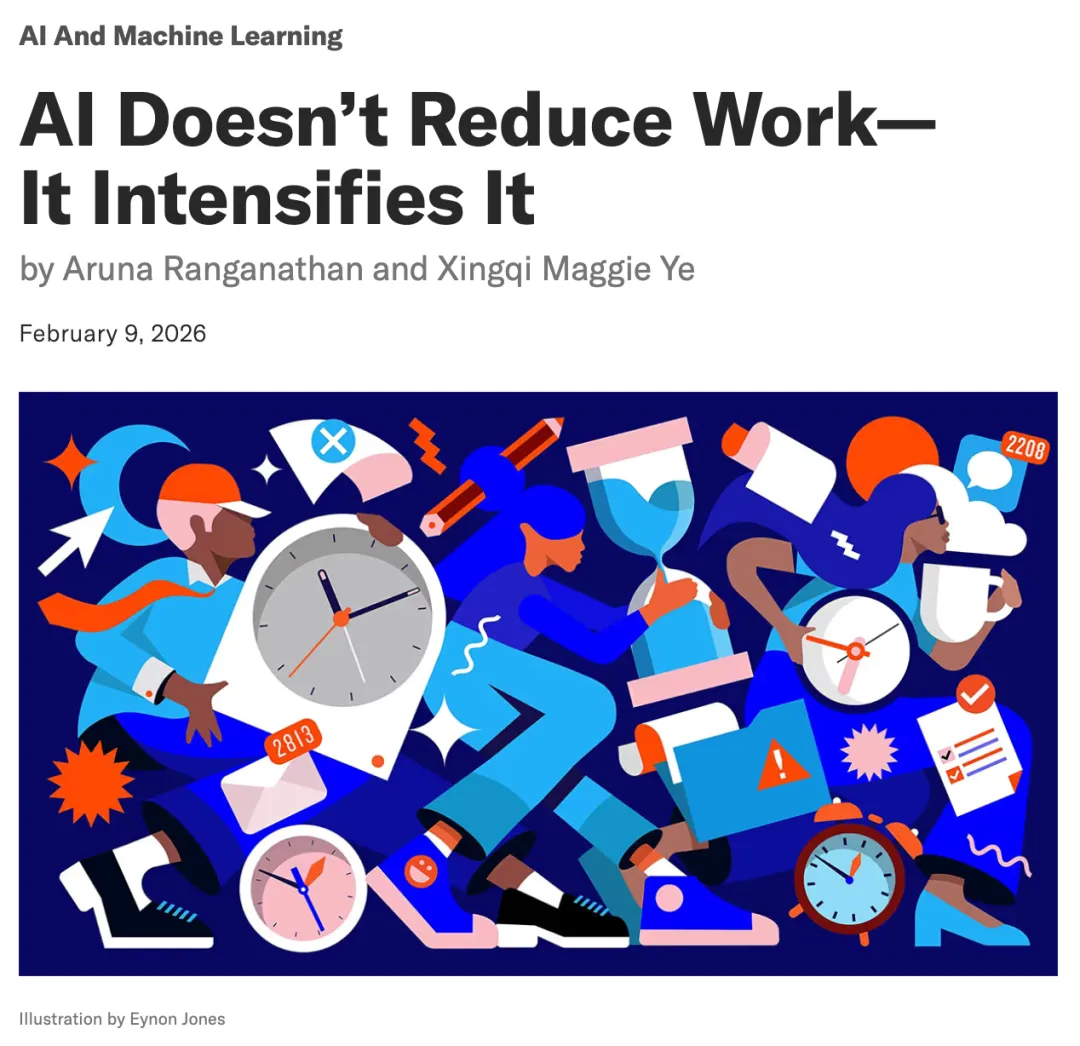
One of the promises of AI is that it can reduce workloads so employees can focus more on higher-value and more engaging tasks. But according to new research, AI tools don’t reduce work, they consistently intensify it: In the study, employees worked at a faster pace, took on a broader scope of tasks, and extended work into more hours of the day, often without being asked to do so. That may sound like a win, but it’s not quite so simple. These changes can be unsustainable, leading to workload creep, cognitive fatigue, burnout, and weakened decision-making. The productivity surge enjoyed at the beginning can give way to lower quality work, turnover, and other problems. To correct for this, companies need to adopt an “AI practice,” or a set of norms and standards around AI use that can include intentional pauses, sequencing work, and adding more human grounding.
关于作者
1.Xingqi Maggie Yeis a Ph.D. student in the Management of Organizations group at Berkeley Haas. Her research combines ethnography and field experiments to examine how generative AI is reshaping work practices, professional identities, and organizational structures. She holds an MHA from Cornell University and a BS from Imperial College London.
2.Aruna Ranganathanis associate professor of management and organizations at the Haas School of Business, UC-Berkeley. She received her PhD from MIT’s Sloan School of Management. Her research uses full-cycle research methods to study the future of work, identification with work and inequality in the workplace.
 夜雨聆风
夜雨聆风