 夜雨聆风
夜雨聆风📚 狂暴英语教案 · 新概念英语第一册
第97-98课 A small blue case
一只蓝色小箱子 / 它是谁的?
请评论区交流。有干货。
📘 本课信息教材:新概念英语第一册 · 第97-98课核心功能:描述失物 · 确认物品归属 · 礼貌交流语法焦点:名词性物主代词 · Whose引导的特殊疑问句 · There be句型 · 一般过去时与have got
🏷️ 热门标签
🎯 本课学习目标
(一)词汇目标
1. 掌握与物品描述相关的核心词汇:suitcase, describe, zip, label, handle, address, sure, right, another, mine, yours, his, hers, ours, theirs。2. 掌握名词性物主代词,并区分其与形容词性物主代词的用法。3. 识记基数词序数词在编号中的用法(如83, Bridge Street)。
(二)语法目标
1. 重点掌握名词性物主代词(mine, yours, his, hers, ours, theirs)的构成与用法。2. 复习一般过去时(left, was, were)与现在完成时('s got)的对比。3. 掌握由“whose”引导的特殊疑问句及其答语。
(三)技能目标(日常对话)
1. 学会描述失物(物品大小、颜色、特征)。2. 学会用物主代词确认物品归属。3. 掌握在失物招领处进行礼貌交流的基本表达。
(四)文化目标
1. 了解英国火车上的失物招领服务(Lost Property Office)。2. 了解英国人如何填写姓名地址(如 D. N. Hall 的书写习惯)。3. 通过“Whose is it?”训练,理解英语中所有权的表达方式与中文的区别。
📖 一、课文完整内容
(一)课文原文
1. 单课课文(Lesson 97)
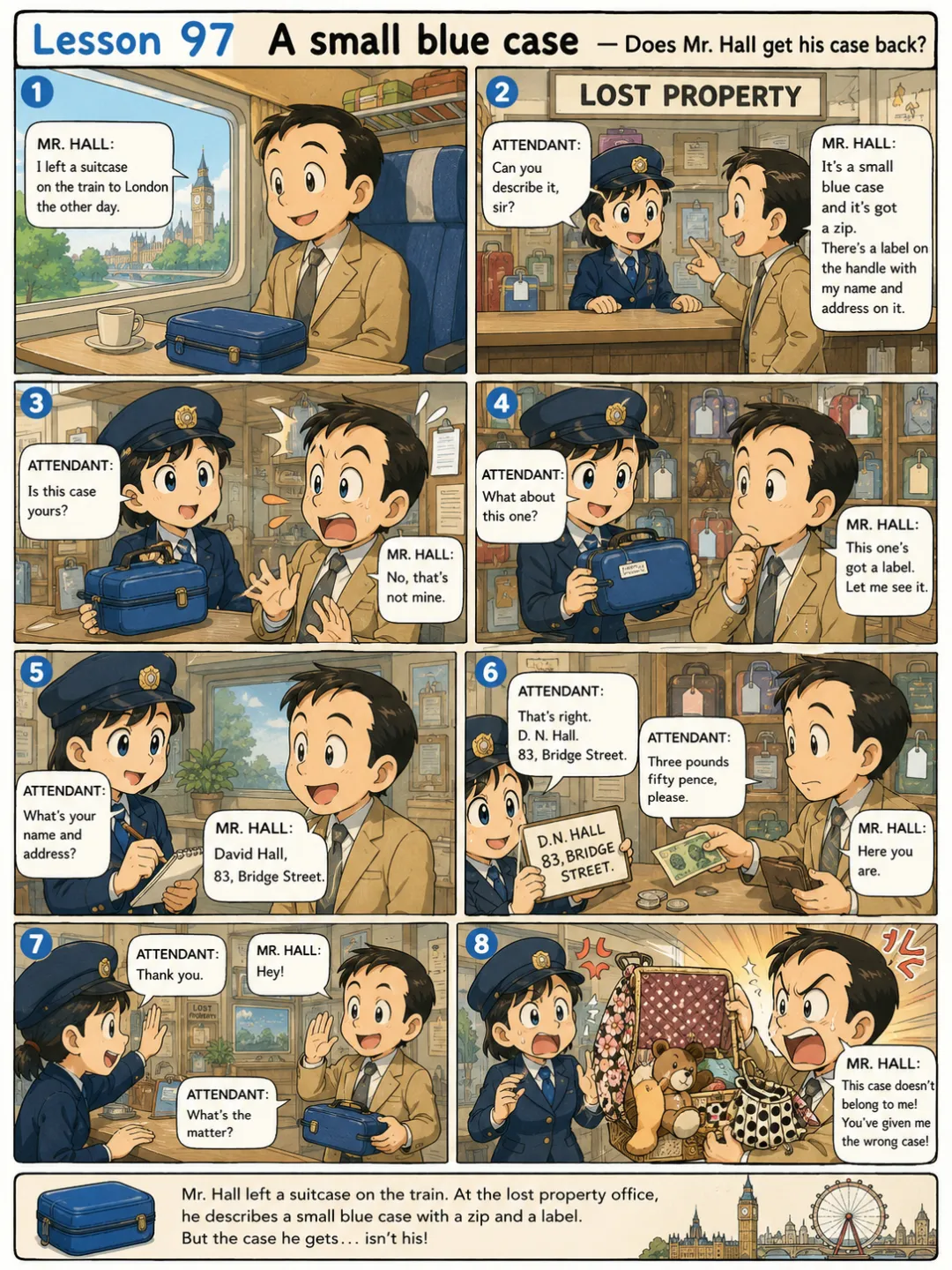
Lesson 97 A small blue case
[ˈlesn ˈnaɪnti ˈsevnt ə smɔːl bluː keɪs]
Listen to the tape then answer this question.
[ˈlɪsn tə ðə teɪp ðen ˈɑːnsə ðɪs ˈkwestʃən]
Does Mr. Hall get his case back?[dʌz ˈmɪstə hɔːl ɡet hɪz keɪs bæk]
I left a suitcase on the train to London the other day.[aɪ left ə ˈsjuːtkeɪs ɒn ðə treɪn tə ˈlʌndən ði ˈʌðə deɪ]
Can you describe it, sir?[kæn juː dɪˈskraɪb ɪt sɜː]
It's a small blue case and it's got a zip.[ɪts ə smɔːl bluː keɪs ænd ɪts ɡɒt ə zɪp]
There's a label on the handle with my name and address on it.[ðeəz ə ˈleɪbl ɒn ðə ˈhændl wɪð maɪ neɪm ænd əˈdres ɒn ɪt]
Is this case yours?[ɪz ðɪs keɪs jɔːz]
No, that's not mine.[nəʊ ðæts nɒt maɪn]
What about this one?[wɒt əˈbaʊt ðɪs wʌn]
That's mine.[ðæts maɪn]
Are you sure?[ɑː juː ʃʊə]
Yes, I'm sure.[jes aɪm ʃʊə]
What's your name and address?[wɒts jɔː neɪm ænd əˈdres]
David Hall, 83, Bridge Street.[ˈdeɪvɪd hɔːl ˈeɪti θriː brɪdʒ striːt]
That's right. D. N. Hall, 83, Bridge Street.[ðæts raɪt diː en hɔːl ˈeɪti θriː brɪdʒ striːt]
Here you are.[hɪə juː ɑː]
Thank you very much.[θæŋk juː ˈveri mʌtʃ]
语音要点说明:- “left a”中 /t/ 与 /ə/ 形成连读,/left ə/ → /lef tə/。- “on the train”中 /n/ 与 /ð/ 连读,/ɒn ðə/ → /ɒn ðə/,the 弱读。- “the other day”中 /ði/ 用于元音前,/ði ˈʌðə/。- “it's got a”中 /ts/ 与 /ɡ/ 之间可稍微停顿,或连读为 /ɪts ɡɒtə/。- “What about”中 /t/ 与 /ə/ 连读,/wɒt əˈbaʊt/。- “Are you sure”中 /ɑː juː/,you 弱读为 /jə/。- “Thank you very much”中 /θ/ 要咬舌,very 的 /v/ 要上齿咬下唇。
2. 双课练习课文(Lesson 98)——(含双课练习融合)
Lesson 98 Whose is it?
[ˈlesn ˈnaɪnti eɪt huːz ɪz ɪt]
Listen to the tape then answer these questions.
[ˈlɪsn tə ðə teɪp ðen ˈɑːnsə ðiːz ˈkwestʃənz]
1 Whose is this pen? It's mine.[huːz ɪz ðɪs pen ɪts maɪn]
2 Whose is this pencil? It's yours.[huːz ɪz ðɪs ˈpensl ɪts jɔːz]
3 Whose is this book? It's his.[huːz ɪz ðɪs bʊk ɪts hɪz]
4 Whose is this watch? It's hers.[huːz ɪz ðɪs wɒtʃ ɪts hɜːz]
5 Whose is this coat? It's ours.[huːz ɪz ðɪs kəʊt ɪts ˈaʊəz]
6 Whose is this dress? It's theirs.[huːz ɪz ðɪs dres ɪts ðeəz]
双课语音要点说明:- “Whose is” 中 /huːz ɪz/ 连读自然。- “It's mine” 中 /ɪts maɪn/,mine 的长元音 /aɪ/ 要饱满。- “It's yours” 中 /ɪts jɔːz/,yours 的 /j/ 轻微,/ɔː/ 要圆唇。- 注意 his /hɪz/ 与 hers /hɜːz/ 中 /z/ 的发音区别。- “ours” /ˈaʊəz/ 有两个音节,注意双元音 /aʊ/ 的滑动。- “theirs” /ðeəz/ 中 /ð/ 要咬舌,/eə/ 是双元音。
(二)情景说明本课对话发生在火车站的失物招领处(Lost Property Office)。霍尔先生几天前在前往伦敦的火车上遗失了一个手提箱,他来到失物招领处向工作人员描述箱子特征并通过证物确认箱子归属。工作人员通过核对箱子上的姓名地址标签确认箱子确实是霍尔先生的。对话使用了物主代词询问和确认物品归属,体现了公共服务场景中的礼貌交流。双课第98课是一节句型练习课,通过“Whose is it?”问答操练名词性物主代词,学习者需要根据图片中物品的所有者关系用相应物主代词回答。
(三)参考译文第97课:一只蓝色小箱子听录音,然后回答问题。霍尔先生找回他的箱子了吗?霍尔先生:几天前我把一只手提箱忘在了去伦敦的火车上。工作人员:先生,您能描述一下它吗?霍尔先生:是一只蓝色的小箱子,上面有拉链。手柄上有一个标签,上面写着我的名字和地址。工作人员:这个箱子是您的吗?霍尔先生:不,那不是我的。工作人员:这一个呢?霍尔先生:那个是我的。工作人员:您肯定吗?霍尔先生:是的,我肯定。工作人员:您的姓名和地址是什么?霍尔先生:大卫·霍尔,桥街83号。工作人员:没错。D. N. 霍尔,桥街83号。工作人员:给您。霍尔先生:非常感谢。第98课:它是谁的?1 这支钢笔是谁的?是我的。2 这支铅笔是谁的?是你的。3 这本书是谁的?是他的。4 这只手表是谁的?是她的。5 这件外套是谁的?是我们的。6 这条连衣裙是谁的?是他们的。
🔍 二、逐句精讲与词块总结
句子1(单课Lesson 97)
1. 原文: I left a suitcase on the train to London the other day.
2. 翻译: 几天前我把一只手提箱忘在了去伦敦的火车上。
3. 句子结构: 主谓宾结构(SVO)+ 地点状语 + 时间状语。主语 I,谓语 left,宾语 a suitcase,地点状语 on the train to London,时间状语 the other day。
4. 重点词汇:
left 蓝思值 400 L
英音[left] 美音[left]词性:动词(leave 的过去式)释义:离开;遗忘(某物)常用语块:leave sth. somewhere, leave for, leave behind例句一:I left my umbrella on the bus. 我把伞忘在公交车上了。例句二:He left home at seven o'clock. 他七点钟离开家。拓展:left 作为过去式时发音和原形不同,注意不规则变化。常见搭配 leave sth. + 地点表示“把某物遗忘在某地”。
suitcase 蓝思值 700 L
英音[ˈsjuːtkeɪs] 美音[ˈsuːtkeɪs]词性:名词释义:手提箱,衣箱常用语块:pack a suitcase, a small suitcase例句一:She packed her suitcase for the trip. 她收拾好手提箱准备旅行。例句二:My suitcase is very heavy. 我的手提箱很重。拓展:suit + case,suit 是套装,case 是箱子,最初用来装西装。注意英音 /sjuː/ 美音 /suː/。
train 蓝思值 300 L
英音[treɪn] 美音[treɪn]词性:名词释义:火车常用语块:by train, on the train, train station例句一:We went to Beijing by train. 我们坐火车去北京。例句二:The train to London leaves at 8:00. 去伦敦的火车八点发车。
the other day 蓝思值 500 L
英音[ði ˈʌðə deɪ] 美音[ðə ˈʌðər deɪ]释义:前几天(用于过去时)常用语块:the other day, the other night例句一:I saw him the other day. 我前几天看见他了。例句二:She called me the other day. 她前几天给我打电话了。拓展:固定短语,用于一般过去时,不能用于将来时。
5. 语法点睛: 本句使用一般过去时,表示过去某个时间发生的动作。leave 在这里意为“遗忘”,是及物动词,后直接接地点时不需要加介词,如 leave sth. on the train。时间状语 the other day 只能用于过去时。
6. 语音要点: “left a” 中 /t/ 和 /ə/ 连读为 /lef tə/; “on the” 中 /n/ 和 /ð/ 连读; “the other” 中 the 读 /ði/ 因为 other 以元音开头。
句子2(单课Lesson 97)
1. 原文: Can you describe it, sir?
2. 翻译: 先生,您能描述一下它吗?
3. 句子结构: 主谓宾结构,一般疑问句。情态动词 Can + 主语 you + 动词 describe + 宾语 it + 呼语 sir。
4. 重点词汇:
describe 蓝思值 600 L
英音[dɪˈskraɪb] 美音[dɪˈskraɪb]词性:动词释义:描述,形容常用语块:describe sth. to sb., describe as例句一:Can you describe the man to the police? 你能向警察描述那个男人吗?例句二:She described her holiday as wonderful. 她把她的假期描述为棒极了。拓展:de-(向下)+ scribe(写)→ 写下来 → 描述。形容词形式 descriptive。
sir 蓝思值 300 L
英音[sɜː] 美音[sɜːr]词性:名词释义:先生(对男性的尊称)常用语块:yes, sir; excuse me, sir例句一:Good morning, sir. 先生,早上好。例句二:Can I help you, sir? 先生,需要帮忙吗?拓展:正式场合使用,单独使用不加名字。在英式英语中常用于服务行业。
5. 语法点睛: Can 是情态动词,表示“能力”或“请求许可”。本句是请求别人做某事。其结构为:Can + 主语 + 动词原形 + 其他?肯定回答用 Yes, I can. 否定回答用 No, I can't.。注意 describe 是及物动词,后直接跟宾语 it。
6. 语音要点: “Can you” 中 can 弱读为 /kən/,you 弱读为 /jə/,整体 /kən jə/; “describe it” 中 /ɪt/ 与前面 /b/ 可轻度连读; sir 用降调表示礼貌。
句子3(单课Lesson 97)
1. 原文: It's a small blue case and it's got a zip.
2. 翻译: 是一只蓝色的小箱子,上面有拉链。
3. 句子结构: 并列句。第一分句:主系表(It's a small blue case);第二分句:主谓宾(it's got a zip)。and 连接。
4. 重点词汇:
small 蓝思值 250 L
英音[smɔːl] 美音[smɔːl]词性:形容词释义:小的常用语块:small change, a small amount例句一:This is a small room. 这是一个小房间。例句二:The dog is very small. 那只狗很小。拓展:反义词 large/big。
blue 蓝思值 200 L
英音[bluː] 美音[bluː]词性:形容词/名词释义:蓝色的常用语块:blue sky, dark blue例句一:The sky is blue. 天空是蓝色的。例句二:She wears a blue dress. 她穿着一条蓝色连衣裙。
case 蓝思值 400 L
英音[keɪs] 美音[keɪs]词性:名词释义:箱子,情况,案例常用语块:in this case, in any case例句一:This is a case for storing tools. 这是一个存放工具的工具箱。例句二:We have a lot of cases to deal with. 我们有很多案件要处理。拓展:本课指“箱子”。
zip 蓝思值 500 L
英音[zɪp] 美音[zɪp]词性:名词释义:拉链常用语块:zip up, a long zip例句一:The zip on my jacket is broken. 我夹克上的拉链坏了。例句二:She pulled the zip down. 她把拉链拉下来。
5. 语法点睛: 第一个分句是主系表结构,形容词 small 和 blue 修饰名词 case,注意英语中尺寸在前颜色在后。第二个分句 “it's got” 是英国英语常用的现在完成时表拥有,等于 “it has got”,口语中常用,强调“有”。现在完成时结构 have/has got + 宾语,常用于非正式场合。在此表示箱子的特征。
6. 语音要点: “It's a” 中 /ts/ 与 /ə/ 连读; “small blue case” 中三个单词连续,注意 /l/ 的发音; “and it's got a” 中 and 弱读为 /ən/,/t/ 与 /ɪ/ 连读,/gɒt ə/ 连读。
句子4(单课Lesson 97)
1. 原文: There's a label on the handle with my name and address on it.
2. 翻译: 手柄上有一个标签,上面写着我的名字和地址。
3. 句子结构: There be 结构。There's a label + 地点状语 on the handle + 定语 with my name and address on it。
4. 重点词汇:
label 蓝思值 600 L
英音[ˈleɪbl] 美音[ˈleɪbl]词性:名词/动词释义:标签,标记常用语块:price label, label on例句一:There is a label on the bottle. 瓶子上有一个标签。例句二:He labelled all the boxes. 他给所有箱子贴了标签。拓展:本课作名词。
handle 蓝思值 500 L
英音[ˈhændl] 美音[ˈhændl]词性:名词/动词释义:手柄,把手;处理常用语块:door handle, handle with care例句一:The handle of the cup is hot. 杯子的手柄很烫。例句二:She knows how to handle the situation. 她知道如何处理情况。
address 蓝思值 500 L
英音[əˈdres] 美音[əˈdres] 或 [ˈædres]词性:名词释义:地址常用语块:home address, email address例句一:What is your address? 你的地址是什么?例句二:Please write your address here. 请在这里写下你的地址。
5. 语法点睛: There be 句型表示“存在”。There's = There is,后接单数名词。介词短语 on the handle 作地点状语。with 短语作定语修饰 label,意为“带有……的”。注意介词 on it 中 it 指代 label。
6. 语音要点: “There's a” 中 /r/ 与 /ə/ 连读(英音中 r 不发音则 /ðəz ə/); “label on” 中 /l/ 与 /ɒ/ 连读; “handle with” 中 /dl/ 与 /w/; “name and” 中 /m/ 与 /ænd/ 连读,and 弱读为 /ən/。
句子5(单课Lesson 97)
1. 原文: Is this case yours?
2. 翻译: 这个箱子是你的吗?
3. 句子结构: 主系表结构的一般疑问句。系动词 Is + 主语 this case + 表语 yours(名词性物主代词)。
4. 重点词汇:
yours 蓝思值 300 L
英音[jɔːz] 美音[jʊrz]词性:代词(名词性物主代词)释义:你的,你们的常用语块:yours truly, a friend of yours例句一:This book is yours. 这本书是你的。例句二:Is this pen yours? 这支钢笔是你的吗?拓展:名词性物主代词 yours = your + 名词,后面不能再接名词。
5. 语法点睛: 本句使用名词性物主代词 yours 作表语,相当于 your case。在英语中,物主代词分为形容词性(my, your, his, her, our, your, their)和名词性(mine, yours, his, hers, ours, yours, theirs)。名词性物主代词可作主语、宾语或表语。本句 yours 作表语。注意一般疑问句的结构:Is + 主语 + 表语?
6. 语音要点: “Is this” 中 /ɪz ðɪs/,/z/ 与 /ð/ 连读; “case yours” 中 /s/ 与 /j/ 连读为 /s j/,yours 的 /z/ 要发音。
句子6(单课Lesson 97)
1. 原文: No, that's not mine.
2. 翻译: 不,那不是我的。
3. 句子结构: 否定句。主语 that + 系动词 is not + 表语 mine。口语中缩略为 that's not。
4. 重点词汇:
mine 蓝思值 300 L
英音[maɪn] 美音[maɪn]词性:代词(名词性物主代词)释义:我的常用语块:a friend of mine, this is mine例句一:This umbrella is mine. 这把伞是我的。例句二:Is this seat mine? 这个座位是我的吗?拓展:注意 mine 是 I 的名词性物主代词,单复数同形。
5. 语法点睛: that's not = that is not。否定句中 not 放在 be 动词后。名词性物主代词 mine 作表语。注意区分:My book is red. = Mine is red. 前者 my 是形容词性,后者 mine 是名词性。
6. 语音要点: “No, that's not” 中 no 用降调; “that's” 中 /ðæts/; “not mine” 中 /t/ 与 /m/ 可分开发音,但正常语流中 /t/ 可能失去爆破。
句子7(单课Lesson 97)
1. 原文: What about this one?
2. 翻译: 这一个呢?
3. 句子结构: 省略句。原句可为 What about this one? 是固定短语,用于提出建议或询问意见。
4. 重点词汇:
about 蓝思值 300 L
英音[əˈbaʊt] 美音[əˈbaʊt]词性:介词/副词释义:关于,大约常用语块:talk about, think about例句一:What about going for a walk? 去散步怎么样?例句二:Tell me about your trip. 告诉我关于你的旅行。
one 蓝思值 200 L
英音[wʌn] 美音[wʌn]词性:代词/数词释义:一个(用来避免重复名词)常用语块:this one, that one, one of them例句一:I want the red one. 我想要红色的那个。例句二:Which one is yours? 哪一个是你的?
5. 语法点睛: “What about...?” 是提出建议或询问另一方意见的常用句型,后接名词或动名词。本句中 about 是介词,后面 this one 是名词短语。one 代替前面提到的 case,避免重复。
6. 语音要点: “What about” 中 /t/ 与 /ə/ 连读,/wɒt əˈbaʊt/; “this one” 中 /s/ 与 /w/ 连读。
句子8(单课Lesson 97)
1. 原文: That's mine.
2. 翻译: 那是我的。
3. 句子结构: 主系表结构。That is mine. 缩略形式 That's。
4. 重点词汇:
mine 蓝思值 300 L
英音[maɪn] 美音[maɪn]词性:代词(名词性物主代词)释义:我的常用语块:a friend of mine, this is mine例句一:This umbrella is mine. 这把伞是我的。例句二:Is this seat mine? 这个座位是我的吗?拓展:注意 mine 是 I 的名词性物主代词,单复数同形。
5. 语法点睛: 与句子6类似,mine 作表语。注意 that 和 this 的区别:this 指近处,that 指远处。
6. 语音要点: “That's mine” 中 /ðæts maɪn/,强调 mine 时重读。
句子9(单课Lesson 97)
1. 原文: Are you sure?
2. 翻译: 你肯定吗?
3. 句子结构: 主系表结构的一般疑问句。系动词 Are + 主语 you + 表语 sure。
4. 重点词汇:
sure 蓝思值 300 L
英音[ʃʊə] 美音[ʃʊr]词性:形容词释义:确信的,有把握的常用语块:be sure of, sure about, make sure例句一:I am sure that he is right. 我确信他是对的。例句二:Are you sure about the time? 你对时间有把握吗?拓展:sure 后也可带从句。
5. 语法点睛: 一般疑问句把 be 动词提前,肯定回答 Yes, I am sure. 否定回答 No, I'm not sure. 或 No, I'm not. sure 还可用于口语中表同意,如 Sure!= 当然。
6. 语音要点: “Are you” 中 are 弱读为 /ə/,you 弱读为 /jə/,整体 /ə jə/; “sure” 发音为 /ʃʊə/,注意 r 不发音(英音)。
句子10(单课Lesson 97)
1. 原文: Yes, I'm sure.
2. 翻译: 是的,我肯定。
3. 句子结构: 主系表结构。I am sure.
4. 重点词汇: 同前。
5. 语法点睛: 肯定回答。I'm sure 与问句呼应。
6. 语音要点: “I'm sure” 中 /aɪm ʃʊə/,I'm 由 /aɪ/ 和 /m/ 组成。
句子11(单课Lesson 97)
1. 原文: What's your name and address?
2. 翻译: 你的姓名和地址是什么?
3. 句子结构: 特殊疑问句。疑问词 What + 系动词 is + 主语 your name and address。注意 name and address 被视为一个整体概念,用单数动词 is。
4. 重点词汇:
name 蓝思值 200 L
英音[neɪm] 美音[neɪm]词性:名词/动词释义:名字,名称常用语块:full name, first name, last name例句一:My name is Tom. 我的名字是汤姆。例句二:What is the name of the book? 这本书的名字是什么?
address 蓝思值 500 L
英音[əˈdres] 美音[əˈdres] 或 [ˈædres]词性:名词释义:地址常用语块:home address, email address例句一:What is your address? 你的地址是什么?例句二:Please write your address here. 请在这里写下你的地址。
5. 语法点睛: What's = What is。注意 name and address 虽然是两个名词,但视为一个整体,所以用单数 is。在英语中,双重身份或成对的事物常如此处理。
6. 语音要点: “What's your” 中 /wɒts jɔː/,your 可弱读为 /jə/; “name and” 中 /m/ 与 /ænd/ 连读,and 弱读。
句子12(单课Lesson 97)
1. 原文: David Hall, 83, Bridge Street.
2. 翻译: 大卫·霍尔,桥街83号。
3. 句子结构: 名词短语,独立结构,用作回答。
4. 重点词汇:
David 蓝思值 200 L 专有名词
英音[ˈdeɪvɪd] 美音[ˈdeɪvɪd]词性:专有名词(人名)释义:大卫(男子名)拓展:源自希伯来语,意为“被爱的人”。
Hall 蓝思值 200 L 专有名词
英音[hɔːl] 美音[hɔːl]词性:专有名词(姓氏)释义:霍尔(姓氏),本义为“大厅,会堂”。
Bridge Street 蓝思值 300 L
英音[brɪdʒ striːt] 美音[brɪdʒ striːt]词性:专有名词(地名)释义:桥街(街道名)拓展:bridge桥 + street街,常见街道名称。
5. 语法点睛: 英美人写地址时从小到大:门牌号、街道、城镇、国家。此处 83, Bridge Street 表示桥街83号。英语中门牌号在前,街道在后。
6. 语音要点: “Bridge Street” 中 /dʒ/ 与 /s/ 可能分开,也可连读为 /brɪdʒ striːt/; 83 读作 eighty-three /ˈeɪti θriː/。
句子13(单课Lesson 97)
1. 原文: That's right. D. N. Hall, 83, Bridge Street.
2. 翻译: 没错。D. N. 霍尔,桥街83号。
3. 句子结构: 第一句是主系表结构,第二句是省略答语。
4. 重点词汇:
right 蓝思值 300 L
英音[raɪt] 美音[raɪt]词性:形容词释义:正确的,对的常用语块:all right, right answer, right now例句一:You are right. 你是对的。例句二:Is that the right address? 地址对吗?拓展:right 还有“右边”的意思。
D. N. Hall 蓝思值 200 L 专有名词
英音[diː en hɔːl] 美音[diː en hɔːl]释义:D. N. 霍尔(缩写名加姓氏)拓展:D. N. 可能指 David Norman 或其他,英国人常用首字母缩写表示名字。
5. 语法点睛: That's right. 是确认对方信息正确的常用表达。D. N. Hall 中 D和N是名字的首字母,Hall是姓氏。在正式场合常用这种写法。
6. 语音要点: “That's right” 中 /ðæts raɪt/; “D. N.” 读作 /diː en/,注意字母发音; “Hall” 与前面连读。
句子14(单课Lesson 97)
1. 原文: Here you are.
2. 翻译: 给您。
3. 句子结构: 倒装句。正常语序 You are here. 但 “Here you are.” 是固定短语,用于递给别人东西时。
4. 重点词汇:
here 蓝思值 200 L
英音[hɪə] 美音[hɪr]词性:副词释义:这里常用语块:here and there, here you are例句一:Come here. 过来。例句二:Here is your book. 这是你的书。
5. 语法点睛: “Here you are.” 是英语中递给别人东西时的固定套语,也可以用 “Here it is.” 或 “Here you go.”。注意这里代词 you 在动词 are 前,是正常语序,但副词 here 提前引起倒装?实际上 Here you are 中 you 是主语,are 是谓语,here 是状语提前,但主语是代词时不倒装。如果是名词则倒装:Here is your book.。
6. 语音要点: “Here you” 中 /hɪə juː/,you 弱读; “are” 在句末读强式 /ɑː/。
句子15(单课Lesson 97)
1. 原文: Thank you very much.
2. 翻译: 非常感谢。
3. 句子结构: 固定短语。
4. 重点词汇:
thank 蓝思值 200 L
英音[θæŋk] 美音[θæŋk]词性:动词/名词释义:感谢常用语块:thank you, thanks, thank for例句一:Thank you for your help. 感谢你的帮助。例句二:I want to say thank you to everyone. 我想对每个人说谢谢。拓展:注意发音 /θ/ 要咬舌。
very 蓝思值 200 L
英音[ˈveri] 美音[ˈveri]词性:副词释义:非常,很常用语块:very much, very good例句一:She is very happy. 她非常高兴。例句二:I like it very much. 我非常喜欢它。
much 蓝思值 200 L
英音[mʌtʃ] 美音[mʌtʃ]词性:副词/形容词/代词释义:非常,多常用语块:very much, how much, too much例句一:There is too much water. 水太多了。例句二:How much is it? 它多少钱?
5. 语法点睛: “Thank you very much.” 是比 “Thank you.” 更正式更礼貌的表达。very much 是程度副词修饰 thank。
6. 语音要点: “Thank you” 中 /θæŋk juː/,/k/ 与 /j/ 可连读; “very much” 中 /v/ 和 /m/ 要清晰。
双课句子1(Lesson 98)
1. 原文: Whose is this pen? It's mine.
2. 翻译: 这支钢笔是谁的?是我的。
3. 句子结构: 特殊疑问句(Whose is this pen?)+ 主系表回答(It is mine.)。
4. 重点词汇:
whose 蓝思值 400 L
英音[huːz] 美音[huːz]词性:疑问代词释义:谁的(用于询问所属关系)常用语块:whose is this?, whose book?例句一:Whose coat is this? 这是谁的外套?例句二:Whose are these shoes? 这些鞋是谁的?拓展:注意与 who's(who is 缩写)发音相同。
pen 蓝思值 200 L
英音[pen] 美音[pen]词性:名词释义:钢笔常用语块:a ballpoint pen, a pen friend例句一:I have a new pen. 我有一支新钢笔。例句二:Please sign with a pen. 请用钢笔签名。
5. 语法点睛: Whose 是疑问代词,本句 Whose is this pen? 中 Whose 作表语,相当于 Whose pen is this? 但结构不同。回答时用名词性物主代词 mine 作表语。注意 Whose 可以单独使用或后接名词。
6. 语音要点: “Whose is” 中 /huːz ɪz/ 连读; “this pen” 中 /s/ 和 /p/; “It's mine” 中 /ɪts maɪn/,mine 重读。
双课句子2(Lesson 98)
1. 原文: Whose is this pencil? It's yours.
2. 翻译: 这支铅笔是谁的?是你的。
3. 句子结构: 同前。
4. 重点词汇:
pencil 蓝思值 250 L
英音[ˈpensl] 美音[ˈpensl]词性:名词释义:铅笔常用语块:pencil case, sharp pencil例句一:I need a pencil to draw. 我需要一支铅笔画画。例句二:The pencil is on the desk. 铅笔在桌子上。
5. 语法点睛: 与句子1完全对称,只是换用 pencil 和 yours。
6. 语音要点: 注意 pencil 中 /l/ 要轻拍舌尖。
双课句子3(Lesson 98)
1. 原文: Whose is this book? It's his.
2. 翻译: 这本书是谁的?是他的。
3. 句子结构: 同前。
4. 重点词汇:
book 蓝思值 200 L
英音[bʊk] 美音[bʊk]词性:名词释义:书常用语块:read a book, a book about例句一:I have a good book. 我有一本好书。例句二:This book is mine. 这本书是我的。
his 蓝思值 200 L
英音[hɪz] 美音[hɪz]词性:代词释义:他的(名词性物主代词)常用语块:This book is his.例句一:This pen is his. 这支钢笔是他的。例句二:Is that bag his? 那个包是他的吗?
5. 语法点睛: his 既是形容词性物主代词(his book)也是名词性物主代词(It's his.),单复数同形。
6. 语音要点: /hɪz/。
📌 核心词块总结
汇总本课最实用的4-6个词块:1.the other day– a few days ago. Example: I saw her the other day.2.on the train to London– traveling by train to London. Example: We met on the train to London.3.a label on the handle– like a tag attached to the handle. Example: There is a label on the handle of my bag.4.What about this one?– used to suggest another option. Example: What about this one? It's cheaper.5.Here you are.– said when giving something to someone. Example: “Can I have a menu?” “Here you are.”6.Are you sure? – used to check someone's certainty. Example: Are you sure you locked the door?
💬 三、基础会话技巧
(一)分析课文中的日常用语、礼貌表达、问答模式1.礼貌表达:-Excuse me? / I'm sorry?虽然本课未直接出现,但 sir 的使用体现了礼貌。例如:Can you describe it, sir? 用 sir 表示对男性的尊称。-Thank you very much.是表达强烈感谢的常用短语,比单说 “Thanks” 更礼貌。2.问答模式:-Yes/No 一般疑问句模式:Is this case yours? → No, that's not mine. / Are you sure? → Yes, I'm sure.-Wh- 特殊疑问句模式:What's your name and address? → David Hall, 83, Bridge Street.-What about...? 提议模式: What about this one? 用于转向另一个选项。
(二)提供类似场景的扩展对话示例扩展对话1:在失物招领处(Lost and Found)情景:乘客B在机场丢失了一个背包,向工作人员A描述。A: Can I help you, sir?B: Yes, I lost my backpack on the plane to New York earlier today.A: Can you describe it, please?B: It's a large black backpack with a red zipper. There is a small pocket on the front.A: Is there a label on it?B: Yes, there is a label with my name and phone number inside.A: Wait a moment. Is this backpack yours?B: Let me check. Yes, it's mine! Thank you very much.A: You're welcome.
扩展对话2:在学校认领物品情景:老师找到一些物品,询问学生是谁的。Teacher: I found a pencil case in the classroom. Whose is it?Student 1: It's not mine. Mine is blue.Teacher: What about you, Lily? Is it yours?Student 2: No, it isn't. I have my pencil case in my bag.Teacher: Then whose could it be? There is a name tag inside. It says “Tom”.Student 3: Oh, that's Tom's pencil case. I'll give it to him.Teacher: Here you are. Thank you.
扩展对话3:在朋友家借东西情景:朋友A找不到自己的手机充电器,朋友B帮忙找。A: I can't find my phone charger. Is this yours?B: No, that's not mine. Mine is white.A: What about this one? It's black.B: That's mine, actually. But I have another one. You can use it.A: Are you sure?B: Yes, I'm sure. Here you are.A: Thank you very much.
(三)设计简单的角色扮演活动建议活动:失物招领处角色扮演将学生分为两人一组(A为失主,B为工作人员)。失主描述前一天在公交车上丢失的一个物品(如背包、书包、帽子等)。工作人员使用本课句型询问描述并最终确认物品。学生需至少使用下列句型:- I lost... on...- Can you describe it?- It's... and it's got...- Is this... yours?- No, that's not mine.- Whose is this...?- Here you are.
(四)双课补充:替换问答操练替换问答框架1:Q: Whose is this [物品]?A: It's [名词性物主代词].
替换演示:1. Whose is this umbrella? It's mine.2. Whose is this key? It's yours.3. Whose is this bag? It's his.4. Whose is this smartphone? It's hers.5. Whose are these books? They're ours.6. Whose are these shoes? They're theirs.
替换问答框架2:Q: Is this [物品] yours?A: No, it's not mine. It's [his/hers/...].
替换演示:1. Is this phone yours? No, it's not mine. It's his.2. Is this hat yours? No, it's not mine. It's hers.3. Is this bottle yours? No, it's not mine. It's theirs.
📐 四、本课语法精析(加强版)
语法点一:名词性物主代词(Possessive Pronouns)
1. 规则说明:名词性物主代词用于代替“形容词性物主代词+名词”,避免重复。其构成如下:
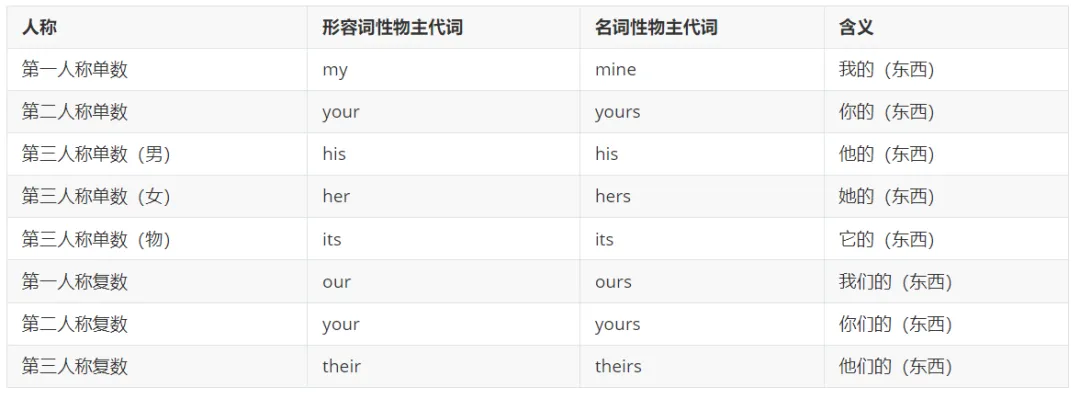
注意:his 和 its 既是形容词性也是名词性,形式不变。
用法规则:- 名词性物主代词可以作主语:Mine is on the table. 我的在桌子上。- 作宾语:I like yours better. 我更喜欢你的。- 作表语:This pen is mine. 这支钢笔是我的。- 不能与名词连用。不能说 mine pen,只能说 my pen 或 mine。
2. 课文例句对照:- Is this case yours? (yours = your case)- No, that's not mine. (mine = my case)- That's mine. (mine = my case)
3. 记忆口诀:“名词物主代名词,前面不用再加名;my变mine你变yours,his her its形同名。”口诀解析:前两句说明名词性物主代词本身已包含名词含义,所以后面不能再跟名词。后两句说明变化规律:my→mine,your→yours,his/her/its 本身不变形。
4. 补充例句:(1) This car is ours. 这辆车是我们的。(2) The red bags are theirs. 这些红色背包是他们的。(3) Is this towel yours? 这条毛巾是你的吗?(4) My phone is broken. Can I use yours? 我的手机坏了,我能用你的吗?(5) Her coat is blue, but mine is black. 她的外套是蓝色的,但我的(外套)是黑色的。(6) Ours is a happy family. 我们的家庭是幸福的。(ours 作主语)(7) I have lost my keys. Have you seen hers? 我丢了钥匙,你看到她的了吗?(hers 作宾语)(8) This isn't my backpack. Mine is larger. 这不是我的书包,我的更大。(9) Whose are those shoes? They are his. 那些鞋是谁的?是他的。(10) The house on the corner is ours. 拐角处的房子是我们的。
语法点二:一般过去时(Simple Past Tense)与本课中的现在完成时(have/has got)
1. 规则说明:一般过去时表示过去某个时间发生的动作或存在的状态。动词过去式有规则变化(-ed)和不规则变化。本课中 left 是 leave 的不规则过去式。
现在完成时 have/has got 在英式英语中常表示“拥有”,相当于 have/has,但更口语化。形式:have/has + got + 名词。本课 it's got = it has got。
2. 课文例句对照:- I left a suitcase on the train... (一般过去时,表示过去发生的遗忘动作)- It's got a zip. (现在完成时,表示箱子有拉链这一状态)
3. 记忆口诀:“过去时表过去,动词用过去式;规则加ed,不规则要牢记。have got 表拥有,口语当中少不得。”口诀解析:前两句强调过去时间需用过去式,规则变化加ed,不规则需记忆。后两句说明 have got 在口语中表拥有的用法。
4. 补充例句:(1) She left her keys at home yesterday. 她昨天把钥匙忘在家里了。(2) I saw a good film the other day. 我前几天看了一部好电影。(3) He has got a new bicycle. 他有一辆新自行车。(4) They have got a big house. 他们有一所大房子。(5) We visited the museum last week. 我们上周参观了博物馆。
语法点三:由 Whose 引导的特殊疑问句
1. 规则说明:Whose 用于询问物品的所属关系。结构有两种:- Whose + 名词 + is/are + 其他?例:Whose pen is this?- Whose + is/are + 名词?例:Whose is this pen?两种结构意思相同,前者更常见。回答时需用名词性物主代词或名词所有格。
2. 课文例句对照:- Whose is this pen? It's mine.- 课文未直接出现 Whose 问句(出现在双课练习中)。
3. 记忆口诀:“Whose 问所属,两种结构要分清楚;名词在前或在后,回答只用名物主。”口诀解析:指出 Whose 引导的疑问句有两种语序,但回答必须用名词性物主代词或名词所有格。
4. 补充例句:(1) Whose book is this? It's Mary's.(2) Whose are these glasses? They're his father's.(3) Whose idea was it? It was mine.(4) Whose jacket is hanging there? It's hers.
语法点四:There be 句型(复习与深化)
1. 规则说明:There be 表示“某处存在某物”。there be 中的 be 动词要与后面的名词在数上保持一致(就近原则)。本课 There's a label on the handle. 为单数形式。
2. 课文例句对照:There's a label on the handle with my name and address on it.
3. 记忆口诀:“There be 表示‘有’,be 随名词走;单数用 is 复数用 are。”
4. 补充例句:(1) There is a cat under the table.(2) There are three apples on the table.(3) There is some water in the bottle.(4) There are many students in the classroom.
语法练习题(至少10题)
题目:
1. 选择正确的代词填空:This is not _______ (my/mine) pen. _______ (My/Mine) is blue.2. 改写句子:This is her watch. (用名词性物主代词改写) → This watch is _______.3. 翻译句子:这本书是我的,那本书是他的。4. 对划线部分提问:This is Tom's key. → _______ is this?5. 用所给词的正确形式填空:That is _______ (you) car. But _______ (I) is over there.6. 选择:Is this umbrella _______? A. your B. yours C. you7. 改错:This book is my.8. 用 Whose 完成句子:_______ are these photos? They are ________ (他们).9. 将下列句子改为一般疑问句并否定回答:This suitcase is mine.10. 用 have got 改写:I have a small blue case. → I _______ _______ a small blue case.11. 选择:Look at the label. _______ (It's / Its) on the handle.12. 翻译:几天前我在公交车上丢了一把钥匙。
【参考答案】
1. my / Mine。解析:第一空后接名词 pen,用形容词性物主代词 my;第二空后无名词,用名词性物主代词 Mine。2. hers。解析:her watch → hers,名词性物主代词作表语。3. This book is mine, and that book is his.4. Whose key is this? 或 Whose is this key? 均可。5. your / mine。解析:第一空后接名词 car,用 your;第二空后无名词,用名词性 mine。6. B。解析:后无名词,用名词性物主代词 yours。7. my → mine。解析:book 已在前句出现,后面应接名词性物主代词。8. Whose / theirs (或 theirs)。9. Is this suitcase yours? No, it isn't. / No, it's not mine.10. 've got 或 have got。11. It's。解析:It's = It is,指代标签;Its 是物主代词“它的”。12. I lost a key on the bus the other day.
✏️ 五、基础练习与活动
(一)设计跟读练习、角色扮演、简单替换练习
1. 跟读练习: 播放课文录音,学生逐句跟读,注意连读和语调。重点跟读句子:“It's a small blue case and it's got a zip.” “Is this case yours?” “No, that's not mine.”
2. 角色扮演: 按照三(三)的方案进行。
3. 简单替换练习: 用给定的名词替换对话中的物品词,练习物主代词。教师给出提示词:pen, book, bag, watch, jacket, key, phone, umbrella, wallet, ticket.学生两人一组,A: “Whose is this ______?” B: “It's mine/yours/his/hers/ours/theirs.” 或 A: “Is this ______ yours?” B: “Yes, it's mine.” 或 “No, it's not mine.”
(二)提供听力理解题目(可结合课文录音)
题目:
1. What did Mr. Hall leave on the train?A. A briefcase. B. A suitcase. C. A backpack.
2. What colour is the case?A. Black. B. Blue. C. Brown.
3. What does the case have?A. A name tag. B. A zip. C. Both.
4. Where is the label?A. On the side. B. On the handle. C. Inside.
5. What is Mr. Hall's full name?A. David Hall. B. D. Hall. C. David N. Hall.
6. What is his address?A. 83, Bridge Street. B. 38, Bridge Street. C. 83, London Street.
【参考答案】
1. B (suitcase)2. B (blue)3. C (Both a zip and a name tag/label)4. B (on the handle)5. A (the label says David Hall, the man says David Hall)6. A (83, Bridge Street)
(四)可提供课文改写版本(词汇更简单)
改写文段(70词):
Lesson 97 A Small Blue Bag (rewritten)
Bob goes to the lost and found office. He lost his bag on a bus. The worker asks, “What does it look like?” Bob says, “It is small and blue. It has a long zipper. On the bag, there is a small card with my name.” The worker shows him a bag. “Is this yours?” Bob looks and says, “Yes, it is mine. Thank you!” The worker says, “You are welcome.”
全文翻译:鲍勃去了失物招领处。他在公交车上丢了包。工作人员问:“它看起来什么样?”鲍勃说:“它又小又蓝。它有一个长拉链。包上有一个小卡片,上面有我的名字。”工作人员给他看一个包。“这是你的吗?”鲍勃看了看说:“是的,是我的。谢谢!”工作人员说:“不客气。”
难词简析:- lost and found office (蓝思值 700 L) 英音[lɒst ænd faʊnd ˈɒfɪs] 美音[lɔːst ænd faʊnd ˈɔːfɪs] 释义:失物招领处- worker (蓝思值 200 L) 英音[ˈwɜːkə] 美音[ˈwɜːrkər] 释义:工作人员- look like (蓝思值 300 L) 英音[lʊk laɪk] 释义:看起来像- zipper (蓝思值 500 L) 英音[ˈzɪpə] 美音[ˈzɪpər] 释义:拉链(美式英语,英式通常用 zip)- card (蓝思值 200 L) 英音[kɑːd] 美音[kɑːrd] 释义:卡片
(五)双课配套练习精析(当课号为奇数x时强制添加)
本课课号为97(奇数),因此强制添加双课98练习内容。
1. 双课新增词汇清单:-whose[huːz] pron. 谁的-pen[pen] n. 钢笔-pencil[ˈpensl] n. 铅笔-book[bʊk] n. 书-watch[wɒtʃ] n. 手表-coat[kəʊt] n. 外套-dress[dres] n. 连衣裙-his[hɪz] pron. 他的(名词性)-hers[hɜːz] pron. 她的(名词性)-ours[ˈaʊəz] pron. 我们的(名词性)-theirs [ðeəz] pron. 他/她们的(名词性)
2. 双课替换句型操练题:题目1:根据提示完成对话。A: Whose is this ______ (book)?B: It's ______ (his).
题目2:将下列句子改为用“Whose is...?”提问。The red pencil is mine. → Whose is the red pencil?
题目3:用适当的物主代词填空。- This is ______ (I) hat. It's ______ (I).- That is ______ (you) umbrella. It's ______ (you).
【参考答案】1. book; his2. Whose is the red pencil?3. my / mine; your / yours
3. 双课听力/图片对应题:题目1:听描述,选择对应的图片。描述:It's a small round thing. It tells you the time.选项:A. a book B. a watch C. a pen答案:B
题目2:根据图片内容,写出“Whose”问句。图片:桌子上有一支钢笔,旁边标注“Tom”。问句示例:Whose is this pen? / Whose pen is this?答案:Whose pen is this? (合理即可)
🤔 六、英文深度思考与拓展(强化版)
本部分总篇幅不少于2500字。
(一)层次化英文问题与答案
Level 1 (Factual): 事实性问题Q1: What did Mr. Hall leave on the train?A1: Mr. Hall left a suitcase on the train to London the other day.
Q2: What color is the case?A2: It is a small blue case.
Q3: What is on the handle of the case?A3: There is a label on the handle with Mr. Hall's name and address on it.
Level 2 (Inferential): 推理性问题Q4: Why does the attendant ask “Are you sure?” ?A4: Because the attendant wants to confirm that the case really belongs to Mr. Hall before giving it to him.
Q5: How does the attendant know the case belongs to Mr. Hall?A5: The case has a label with “David Hall, 83, Bridge Street” on it, and Mr. Hall gives the same name and address.
Q6: Why does the attendant say “That's right” after Mr. Hall gives his name and address?A6: Because the information on the label matches what Mr. Hall says.
Level 3 (Evaluative/Creative): 评价/创造性问题Q7: If you lost something important, how would you describe it?A7: I would describe its colour, size, shape, and any special marks or features. For example, “My backpack is black and blue, with a small American flag patch on the front.”
Q8: Do you think it is important to put your name on your belongings? Why?A8: Yes, it helps people return your things to you if you lose them. It also makes it easier to prove that something is yours.
Q9: Imagine you are an attendant at a lost and found office. What questions would you ask?A9: I would ask: “What did you lose?” “When and where did you lose it?” “Can you describe it?” “Is there any identification inside?” “What is your name and contact information?”
Q10: Write two sentences using “Whose is...?” and two using “Is this... yours?”.A10: “Whose is this smartphone?” “Whose is that jacket?” “Is this bag yours?” “Is this key yours?”
(二)多类型拓展阅读
阅读1: 现代场景故事(Lost Phone)Tom lost his phone at the park. He went to the lost and found center. A girl found it and turned it in. Tom said, “My phone has a blue cover and a cracked screen.” The worker brought a phone. Tom looked and said, “Yes, it's mine. Thank you!” Now Tom always puts his name on his phone.
引导性问题:1. Where did Tom lose his phone?2. How did Tom describe his phone?3. What lesson does Tom learn?
全文翻译:汤姆在公园丢了手机。他去了失物招领中心。一个女孩捡到了并上交了。汤姆说:“我的手机有蓝色外壳,屏幕碎了。”工作人员拿了一部手机来。汤姆看了看说:“是的,是我的。谢谢!”现在汤姆总是在手机上写上名字。
难词简析:- cover (400 L) [ˈkʌvə] 外壳- cracked (600 L) [krækt] 碎裂的- screen (500 L) [skriːn] 屏幕- turn in (500 L) 上交- lesson (300 L) [ˈlesn] 教训
阅读2: 文化背景小知识(Lost Property Office in Britain)In Britain, every train station has a lost property office. If you lose something, you can go there and describe your item. The staff will check if they have it. You must prove ownership. It is a good idea to put your name and address on your belongings. Many offices keep items for up to three months.
引导性问题:1. How long do offices keep lost items?2. What must you do to get your item back?3. Why is it a good idea to put your name on items?
全文翻译:在英国,每个火车站都有失物招领处。如果你丢了东西,可以去那里描述你的物品。工作人员会检查是否有。你必须证明所有权。最好在物品上写下名字和地址。许多办公室保留物品长达三个月。
难词简析:- property (500 L) [ˈprɒpəti] 财产;处所- ownership (700 L) [ˈəʊnəʃɪp] 所有权- belongings (600 L) [bɪˈlɒŋɪŋz] 所有物,财物- up to (300 L) 多达
阅读3: 今昔对比(Then and Now)In the past, people used heavy suitcases with handles and locks. Today, many people use backpacks with zippers. But labels are still important. In the old days, people wrote their name on a paper tag. Now, we attach a luggage tag with a phone number. Technology helps: you can even track your bag with an app. However, the basic idea is the same: identify your bag so you don't lose it.
引导性问题:1. How did people label luggage in the past?2. How do people label bags now?3. What new technology helps track bags?
全文翻译:过去,人们使用带手柄和锁的重型手提箱。今天,许多人使用带拉链的背包。但标签仍然重要。过去,人们在纸标签上写名字。现在,我们附上带电话号码的行李牌。技术也有帮助:你甚至可以用应用追踪包。但基本想法是一样的:识别你的包以免丢失。
难词简析:- heavy (200 L) [ˈhevi] 重的- lock (300 L) [lɒk] 锁- attach (500 L) [əˈtætʃ] 系上,附上- track (500 L) [træk] 追踪- identify (600 L) [aɪˈdentɪfaɪ] 识别
阅读4: 品德主题(Honesty)A man found a wallet on the street. Inside was some money and a card with the owner's name. He went to the address and returned it. The owner was very happy and said, “Thank you! You are an honest man.” The man replied, “I believe what goes around comes around.” This story teaches us to return what is not ours.
引导性问题:1. What did the man find?2. How did he return it?3. What does “what goes around comes around” mean?
全文翻译:一个男人在街上捡到一个钱包。里面有一些钱和一张写有失主名字的卡片。他按地址归还了。失主很高兴地说:“谢谢!你是个诚实的人。”男人回答:“我相信善有善报。”这个故事教我们归还不属于自己的东西。
难词简析:- wallet (400 L) [ˈwɒlɪt] 钱包- owner (400 L) [ˈəʊnə] 失主- honest (500 L) [ˈɒnɪst] 诚实的- believe (300 L) [bɪˈliːv] 相信- replied (400 L) [rɪˈplaɪd] 回答
阅读5: 技能指南(How to Label Your Items)Follow these steps to label your suitcase: First, write your name and phone number on a small card. Second, put the card into a clear plastic sleeve. Third, attach the sleeve to the handle of your suitcase with a strong string. This way, if you lose your bag, people can call you. Always check the label before your trip. It helps a lot.
引导性问题:1. What should you write on the card?2. How do you attach the card to the suitcase?3. Why is labelling helpful?
全文翻译:按照以下步骤给你的手提箱贴标签:首先,在一张小卡片上写名字和电话号码。然后,把卡片放进透明的塑料套里。最后,用一根结实的绳子把塑料套系在手柄上。这样,如果你丢了包,人们可以打电话给你。旅行前一定要检查标签。它很有帮助。
难词简析:- steps (300 L) [steps] 步骤- plastic (500 L) [ˈplæstɪk] 塑料的- sleeve (500 L) [sliːv] 套子,袋- string (400 L) [strɪŋ] 细绳- useful (300 L) [ˈjuːsfəl] 有用的
🌍 七、日常应用延伸
(一)本课语言点在日常生活中的应用场景1. 失物招领处: 当你在公共场所丢失物品,去失物招领处时,可以用本课句型描述物品。例如:“I left a bag on the bus. It's a red backpack with a white strap. It's got a name tag.”2. 朋友间借用物品时确认归属: “Is this your phone charger?” “No, it's not mine. It's Tom's.”3. 学校班级物品管理: 捡到一支笔,可以问全班:“Whose is this pen?” 同学可用 “It's mine.” 或 “It's hers.” 回答。4. 家庭中物品归属: “This jacket is not mine. It's yours.” 用于整理衣物时。
(二)建议简单拓展学习材料1. 《新概念英语》语法新思维第一册(梅雪主编,中国石化出版社)——本书第97/98课对应的物主代词章节有详细讲解和练习题。使用方法:学习本课后,翻阅该书中“物主代词”章节,完成课后习题。2. Duolingo 英语App(手机应用)——其基础英语课程中有专门的物主代词单元。使用方法:在 Duolingo 中搜索“Possessive Pronouns”或直接按其课程路径学习,每天10分钟完成练习。3. 网站:British Council 的 LearnEnglish(learnenglish.britishcouncil.org)——提供互动练习和听力材料。使用方法:搜索“possession”即可找到相关游戏和测验。
(三)附加英美生活小常识1. 在英国,地址书写顺序是“门牌号 + 街道名 + 城镇 + 邮编”,如 83 Bridge Street, London。美国人则通常写“门牌号 + 街道名 + 城市 + 州 + 邮编”。2. 英国人常用 D. N. Hall 这种缩写名(首字母缩写),尤其正式场合或标签上。名字的缩写一般用首字母,中间加空格或点。3. 在英美,失物招领处(Lost and Found / Lost Property Office)通常由公共交通公司运营。如果你在火车上丢了东西,可以填写在线表格。很多服务是免费的,但可能需要提供证明。4. 名词性物主代词在口语中非常常见。注意区别:your 和 yours 发音不同(your 弱读为/jə/,yours 为/jɔːz/),这对听力理解很重要。
🗂️ 八、本课知识图谱(结构化逻辑图)
- 核心对话主题:失物招领(Lost and Found)- 主要句型:- 描述物品:It's (size) (colour) (noun) and it's got (feature).- 询问归属:Is this (noun) yours? / Whose is this (noun)?- 回答归属:It's mine/yours/his/hers/ours/theirs. / No, it's not mine.- 确认细节:What's your name and address? / Are you sure?- 给予物品:Here you are.- 关键词汇:- 物品:suitcase, case, label, handle, zip- 特征:small, blue, sure- 人称:mine, yours, his, hers, ours, theirs- 地名:London, Bridge Street- 其他:left, describe, name, address, right, thank you
- 双课替换模块:- 核心句型:Whose + is + this + 名词? → It's + 名词性物主代词.- 替代词汇:pen, pencil, book, watch, coat, dress (及其他常见物品)- 人称变化:mine, yours, his, hers, ours, theirs
- 语法链接:- 名词性物主代词(作表语/主语/宾语)- There be 句型(描述标签位置)- 一般过去时(left)- have got 表达拥有(it's got)- Whose 特殊疑问句
📌 【补充】
追加以下深度解析内容。
深度解析1:课文中的礼貌级别本课对话中,工作人员用“sir”称呼顾客,体现了正式礼貌。顾客使用“Can you...?”的请求句式而非“Describe it!”,显示礼貌询问。回答问题时用“Yes, I'm sure.”而不是简单的“Yeah.”,符合正式场合。这些礼貌表达值得学习者模仿。在实际对话中,应根据场合选择正式或非正式用语。例如,朋友之间可以用“What about this one?”更随意,但对陌生人应用更多礼貌词汇。
深度解析2:have got 与 have 的语体区别在英式英语口语中,“have got”比“have”更常用表示“拥有”,尤其在非正式场合。例如“I've got a new phone.”比“I have a new phone.”更自然。在美式英语中,“have”更普遍。但“have got”在英美都广泛使用。注意 have got 的否定式是 haven't got,疑问式是 Have you got...?这与 have 不同(don't have / do you have)。本课使用“it's got”是典型英式表达。
深度解析3:名词性物主代词的教学延伸形容词性物主代词与名词性物主代词的转换是初学者难点。教师可设计转换练习:将“This is my book.”改为“This book is mine.”让学生感知位置变化。同时,注意名词性物主代词不修饰名词,在句中独立充当成分。本课双课练习反复强化该点。此外,注意它与名词所有格的区别:“my mother's book”中的“mother's”是所有格,不是物主代词。
深度解析4:文化对比——中美地址表达中文地址从小到大:中国北京市海淀区某某路1号。英语地址从小到大:No. 1, XXX Road, Haidian District, Beijing, China. 在课文中,83 Bridge Street 是典型的英式地址。学生需注意,英语中门牌号用基数词,街道名首字母大写。路(Road)、街(Street)、大道(Avenue)等词常大写。教学时可让学生用英语写自己的地址。
© 本文为狂暴英语教案 · 新概念英语第一册第97-98课
排版设计 · 仅供学习交流使用
相关热门标签:#新概念英语 #第一册 #物主代词 #Whose #失物招领 #Suitcase #日常对话 #英式英语 #ThereBe #HaveGot