1
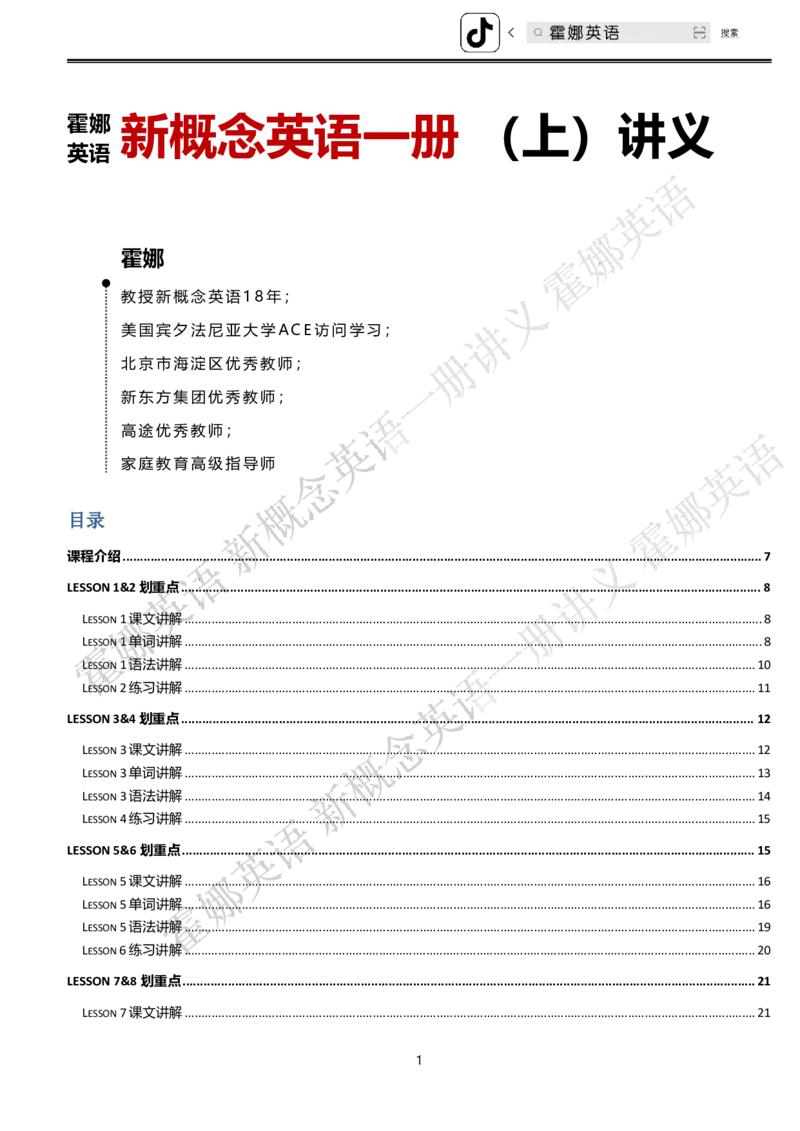
霍娜
英语新概念英语一册(上)讲义
霍娜
教授新概念英语1 8 年;
美国宾夕法尼亚大学A C E 访问学习;
北京市海淀区优秀教师;
新东方集团优秀教师;
高途优秀教师;
家庭教育高级指导师
目录
课程介绍....................................................................................................................................................................................... 7
LESSON 1&2 划重点...................................................................................................................................................................... 8
LESSON 1 课文讲解............................................................................................................................................................................ 8
LESSON 1 单词讲解............................................................................................................................................................................ 8
LESSON 1 语法讲解.......................................................................................................................................................................... 10
LESSON 2 练习讲解.......................................................................................................................................................................... 11
LESSON 3&4 划重点.................................................................................................................................................................... 12
LESSON 3 课文讲解.......................................................................................................................................................................... 12
LESSON 3 单词讲解.......................................................................................................................................................................... 13
LESSON 3 语法讲解.......................................................................................................................................................................... 14
LESSON 4 练习讲解.......................................................................................................................................................................... 15
LESSON 5&6 划重点.................................................................................................................................................................... 15
LESSON 5 课文讲解.......................................................................................................................................................................... 16
LESSON 5 单词讲解.......................................................................................................................................................................... 16
LESSON 5 语法讲解.......................................................................................................................................................................... 19
LESSON 6 练习讲解.......................................................................................................................................................................... 20
LESSON 7&8 划重点....................................................................................................................................................................21
LESSON 7 课文讲解.......................................................................................................................................................................... 21
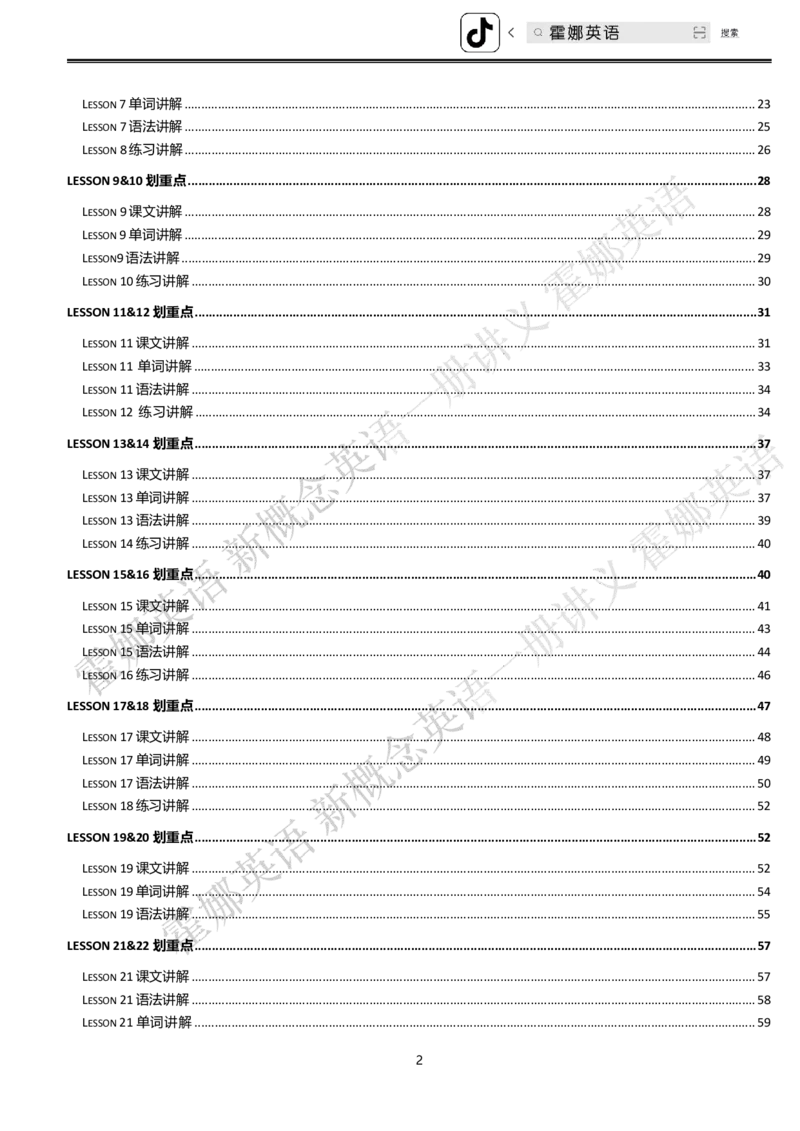
2
LESSON 7 单词讲解.......................................................................................................................................................................... 23
LESSON 7 语法讲解.......................................................................................................................................................................... 25
LESSON 8 练习讲解.......................................................................................................................................................................... 26
LESSON 9&10 划重点...................................................................................................................................................................28
LESSON 9 课文讲解.......................................................................................................................................................................... 28
LESSON 9 单词讲解.......................................................................................................................................................................... 29
LESSON9 语法讲解...........................................................................................................................................................................29
LESSON 10 练习讲解........................................................................................................................................................................ 30
LESSON 11&12 划重点.................................................................................................................................................................31
LESSON 11 课文讲解........................................................................................................................................................................ 31
LESSON 11 单词讲解....................................................................................................................................................................... 33
LESSON 11 语法讲解........................................................................................................................................................................ 34
LESSON 12 练习讲解.......................................................................................................................................................................34
LESSON 13&14 划重点.................................................................................................................................................................37
LESSON 13 课文讲解........................................................................................................................................................................ 37
LESSON 13 单词讲解........................................................................................................................................................................ 37
LESSON 13 语法讲解........................................................................................................................................................................ 39
LESSON 14 练习讲解........................................................................................................................................................................ 40
LESSON 15&16 划重点.................................................................................................................................................................40
LESSON 15 课文讲解........................................................................................................................................................................ 41
LESSON 15 单词讲解........................................................................................................................................................................ 43
LESSON 15 语法讲解........................................................................................................................................................................ 44
LESSON 16 练习讲解........................................................................................................................................................................ 46
LESSON 17&18 划重点.................................................................................................................................................................47
LESSON 17 课文讲解........................................................................................................................................................................ 48
LESSON 17 单词讲解........................................................................................................................................................................ 49
LESSON 17 语法讲解........................................................................................................................................................................ 50
LESSON 18 练习讲解........................................................................................................................................................................ 52
LESSON 19&20 划重点.................................................................................................................................................................52
LESSON 19 课文讲解........................................................................................................................................................................ 52
LESSON 19 单词讲解........................................................................................................................................................................ 54
LESSON 19 语法讲解........................................................................................................................................................................ 55
LESSON 21&22 划重点.................................................................................................................................................................57
LESSON 21 课文讲解........................................................................................................................................................................ 57
LESSON 21 语法讲解........................................................................................................................................................................ 58
LESSON 21 单词讲解....................................................................................................................................................................... 59
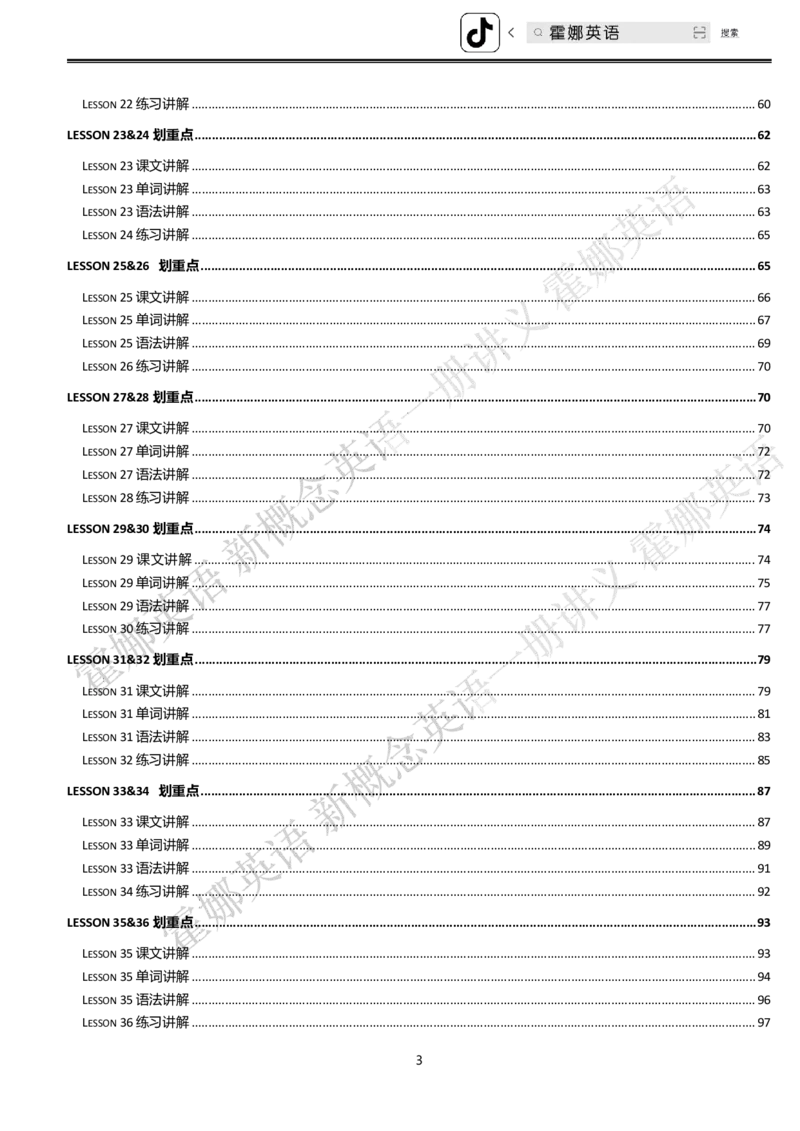
3
LESSON 22 练习讲解........................................................................................................................................................................ 60
LESSON 23&24 划重点.................................................................................................................................................................62
LESSON 23 课文讲解........................................................................................................................................................................ 62
LESSON 23 单词讲解........................................................................................................................................................................63
LESSON 23 语法讲解........................................................................................................................................................................ 63
LESSON 24 练习讲解........................................................................................................................................................................ 65
LESSON 25&26 划重点...............................................................................................................................................................65
LESSON 25 课文讲解........................................................................................................................................................................ 66
LESSON 25 单词讲解........................................................................................................................................................................67
LESSON 25 语法讲解........................................................................................................................................................................ 69
LESSON 26 练习讲解........................................................................................................................................................................ 70
LESSON 27&28 划重点.................................................................................................................................................................70
LESSON 27 课文讲解........................................................................................................................................................................ 70
LESSON 27 单词讲解........................................................................................................................................................................ 72
LESSON 27 语法讲解........................................................................................................................................................................ 72
LESSON 28 练习讲解........................................................................................................................................................................ 73
LESSON 29&30 划重点.................................................................................................................................................................74
LESSON 29 课文讲解....................................................................................................................................................................... 74
LESSON 29 单词讲解........................................................................................................................................................................ 75
LESSON 29 语法讲解........................................................................................................................................................................ 77
LESSON 30 练习讲解........................................................................................................................................................................ 77
LESSON 31&32 划重点.................................................................................................................................................................79
LESSON 31 课文讲解........................................................................................................................................................................ 79
LESSON 31 单词讲解........................................................................................................................................................................81
LESSON 31 语法讲解........................................................................................................................................................................ 83
LESSON 32 练习讲解........................................................................................................................................................................ 85
LESSON 33&34 划重点...............................................................................................................................................................87
LESSON 33 课文讲解........................................................................................................................................................................ 87
LESSON 33 单词讲解........................................................................................................................................................................89
LESSON 33 语法讲解........................................................................................................................................................................ 91
LESSON 34 练习讲解........................................................................................................................................................................ 92
LESSON 35&36 划重点.................................................................................................................................................................93
LESSON 35 课文讲解........................................................................................................................................................................ 93
LESSON 35 单词讲解........................................................................................................................................................................94
LESSON 35 语法讲解........................................................................................................................................................................ 96
LESSON 36 练习讲解........................................................................................................................................................................ 97
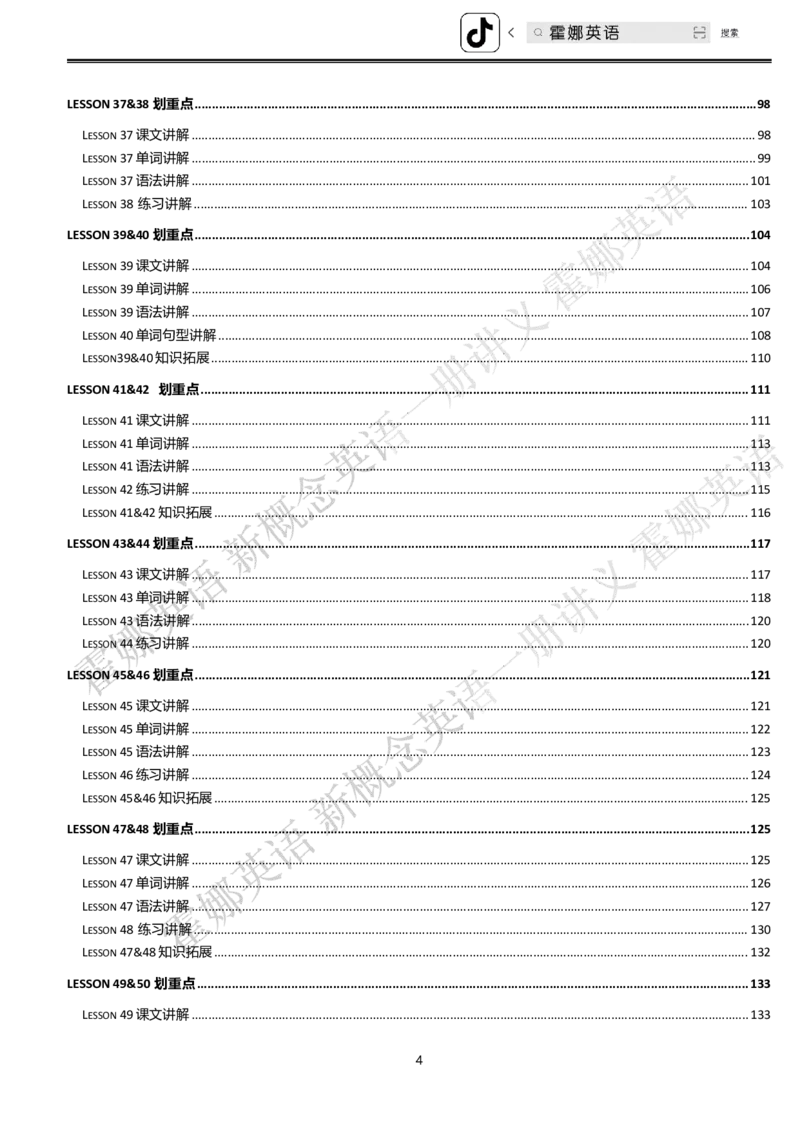
4
LESSON 37&38 划重点.................................................................................................................................................................98
LESSON 37 课文讲解........................................................................................................................................................................ 98
LESSON 37 单词讲解........................................................................................................................................................................99
LESSON 37 语法讲解...................................................................................................................................................................... 101
LESSON 38 练习讲解..................................................................................................................................................................... 103
LESSON 39&40 划重点...............................................................................................................................................................104
LESSON 39 课文讲解...................................................................................................................................................................... 104
LESSON 39 单词讲解......................................................................................................................................................................106
LESSON 39 语法讲解...................................................................................................................................................................... 107
LESSON 40 单词句型讲解..............................................................................................................................................................108
LESSON39&40 知识拓展................................................................................................................................................................ 110
LESSON 41&42 划重点.............................................................................................................................................................111
LESSON 41 课文讲解...................................................................................................................................................................... 111
LESSON 41 单词讲解......................................................................................................................................................................113
LESSON 41 语法讲解...................................................................................................................................................................... 113
LESSON 42 练习讲解...................................................................................................................................................................... 115
LESSON 41&42 知识拓展............................................................................................................................................................... 116
LESSON 43&44 划重点...............................................................................................................................................................117
LESSON 43 课文讲解...................................................................................................................................................................... 117
LESSON 43 单词讲解...................................................................................................................................................................... 118
LESSON 43 语法讲解......................................................................................................................................................................120
LESSON 44 练习讲解...................................................................................................................................................................... 120
LESSON 45&46 划重点...............................................................................................................................................................121
LESSON 45 课文讲解...................................................................................................................................................................... 121
LESSON 45 单词讲解...................................................................................................................................................................... 122
LESSON 45 语法讲解...................................................................................................................................................................... 123
LESSON 46 练习讲解...................................................................................................................................................................... 124
LESSON 45&46 知识拓展............................................................................................................................................................... 125
LESSON 47&48 划重点...............................................................................................................................................................125
LESSON 47 课文讲解...................................................................................................................................................................... 125
LESSON 47 单词讲解......................................................................................................................................................................126
LESSON 47 语法讲解...................................................................................................................................................................... 127
LESSON 48 练习讲解..................................................................................................................................................................... 130
LESSON 47&48 知识拓展............................................................................................................................................................... 132
LESSON 49&50 划重点..............................................................................................................................................................133
LESSON 49 课文讲解...................................................................................................................................................................... 133
5
LESSON49 单词讲解.......................................................................................................................................................................136
LESSON 49 语法讲解...................................................................................................................................................................... 137
LESSON 50 练习讲解...................................................................................................................................................................... 140
LESSON 49&50 知识拓展............................................................................................................................................................... 140
LESSON 51&52 划重点...............................................................................................................................................................142
LESSON 51 课文讲解...................................................................................................................................................................... 142
LESSON 51 单词讲解......................................................................................................................................................................144
LESSON 51 语法讲解...................................................................................................................................................................... 146
LESSON 52 练习讲解...................................................................................................................................................................... 148
LESSON 51&52 知识拓展............................................................................................................................................................... 150
LESSON 53&54 划重点...............................................................................................................................................................152
LESSON 53 课文讲解...................................................................................................................................................................... 152
LESSON 53 单词讲解...................................................................................................................................................................... 153
LESSON 53 语法讲解...................................................................................................................................................................... 155
LESSON 54 单词句型讲解..............................................................................................................................................................156
LESSON 53&54 知识拓展............................................................................................................................................................... 157
LESSON 55&56 划重点...............................................................................................................................................................160
LESSON 55 课文讲解...................................................................................................................................................................... 160
LESSON 55 单词讲解......................................................................................................................................................................162
LESSON 55 语法讲解...................................................................................................................................................................... 164
LESSON 56 单词句型讲解..............................................................................................................................................................165
LESSON 55&56 知识拓展............................................................................................................................................................... 166
LESSON 57&58 划重点...............................................................................................................................................................166
LESSON 57 课文讲解...................................................................................................................................................................... 166
LESSON 57 单词讲解...................................................................................................................................................................... 167
LESSON 57 语法讲解...................................................................................................................................................................... 168
LESSON 58 练习讲解...................................................................................................................................................................... 169
LESSON 57&58 知识拓展............................................................................................................................................................... 169
LESSON 59&60 划重点...............................................................................................................................................................171
LESSON 59 课文讲解...................................................................................................................................................................... 171
LESSON 59 单词讲解...................................................................................................................................................................... 173
LESSON 59 语法讲解...................................................................................................................................................................... 174
LESSON 60 练习讲解...................................................................................................................................................................... 174
LESSON 59&60 知识拓展............................................................................................................................................................... 175
LESSON 61&62 划重点...............................................................................................................................................................177
LESSON 61 课文讲解...................................................................................................................................................................... 177
6
LESSON 61 单词讲解......................................................................................................................................................................178
LESSON 61 语法讲解...................................................................................................................................................................... 180
LESSON 62 练习讲解...................................................................................................................................................................... 182
LESSON 61&62 知识拓展...........................................................................................................................................................184
LESSON 63&64 划重点...................................................................................................................................................................185
LESSON 63 课文讲解...................................................................................................................................................................... 186
LESSON 63 单词讲解......................................................................................................................................................................188
LESSON 63 语法讲解...................................................................................................................................................................... 190
LESSON 64 练习讲解...................................................................................................................................................................... 191
LESSON 63&64 知识拓展............................................................................................................................................................... 192
LESSON 65&66 划重点...............................................................................................................................................................192
LESSON 65 课文讲解...................................................................................................................................................................... 194
LESSON 65 单词讲解......................................................................................................................................................................195
LESSON 65 法讲解..........................................................................................................................................................................196
LESSON 66 单词句型讲解..............................................................................................................................................................197
LESSON 65&66 知识拓展............................................................................................................................................................... 199
LESSON 67&68 划重点...............................................................................................................................................................200
LESSON 68 单词句型讲解..............................................................................................................................................................201
LESSON 67 单词讲解......................................................................................................................................................................201
LESSON 67 语法讲解...................................................................................................................................................................... 203
LESSON 67&68 知识拓展............................................................................................................................................................... 205
LESSON 69&70 划重点...............................................................................................................................................................206
LESSON 69 课文讲解...................................................................................................................................................................... 206
LESSON 69 单词讲解......................................................................................................................................................................207
LESSON 69 语法讲解...................................................................................................................................................................... 209
LESSON 70 练习讲解.....................................................................................................................................................................211
LESSON 69&70 知识拓展............................................................................................................................................................... 211
LESSON 71&72 划重点...............................................................................................................................................................212
LESSON 71 课文讲解...................................................................................................................................................................... 212
LESSON 71 单词讲解......................................................................................................................................................................213
LESSON 71 语法讲解...................................................................................................................................................................... 214
LESSON 72 练习讲解...................................................................................................................................................................... 217
7
课程介绍
1. 课时:72 课
2. 课程模块设计:
视频1:划重点+课文讲解
视频2:单词讲解
视频3:语法讲解
视频4:练习讲解
视频5:-知识拓展
3. 学习步骤:
熟读单词→熟读课文→学习课文讲解→学习单词讲解→学习语法讲解→做练习题→背单词→背课文或
复述课文
8
Lesson 1&2 划重点
1.
发音:th 的发音;
2.
课文:打扰别人时用的口语句型;
3.
语法:一般疑问句
Lesson 1 课文讲解
1. Excuse me.
1.对不起,打扰了;
2.借过一下,让一让;
3.失陪了;
4.麻烦再说一遍。
2. Yes?
什么事?
3. Is this your handbag? 这是你的手提包吗?
4. Pardon?
麻烦您再说一遍。
Sorry?
Excuse me?
Say it again.
Lesson 1 单词讲解
1. Excuse [ɪkˈskju:s; ɪkˈskju:z] : 原谅
Excuse me.
9
A. 对不起,打扰;
B. 借过,让一让;
C. 失陪, 先走;
D. 麻烦再说一遍。
2. me[miː]
主格
宾格
I
me
为什么英文会有主格和宾格之分?
简单句的常用句型结构:主+ 谓+宾
主格
宾格
I
me
you
you
she
her
he
him
it
it
我爱他。
I love him.
你爱我。
You love me.
3. yes[jes] [ jɛs] :是的
yes
是的yes?
“什么事?”
4. is [ɪz] (be 动词现在时,第三人称单数)
be — is,am,are
5. this[ðɪs] : 这
this book: 这本书
10
that student: 那位学生
6. your [ jɔ:(r)] [ jʊər; jʊr] :你的
your friend: 你的朋友
your name: 你的名字
7. handbag[‘hæn(d)bæg] : 手提包
hand: 手
bag:包
8. pardon [ˈpɑːdn] ['pɑrdn]
原谅,再说一遍
Pardon?
9. it [ɪt] :它
可代替物体、时间、天气
It is a handbag. 它是个手提包。
It is 2:00. 现在是两点。
It is sunny today.今天天气晴朗。
10. thank [θæŋk] you: 谢谢你
Thanks!
Thanks a lot !
11. very ['verɪ] [ˈvɛrɪ] much: 非常地
I very love you.
I love you very much.
Very thank you.
Thank you very much.
Lesson 1 语法讲解
1. 一般疑问句
功能:询问
11
构成:be 动词置于句前
be—— is,am,are
(大将军)
这是你的名字。
这是你的名字吗?
This is your name.
This is yourname 吗?
Is this your name?
I am great.
Am I great?
Are you great?
You are my friend.
Are you my friend?
She is pretty.
Is she pretty?
Lesson 2 练习讲解
1.
pen [pen] [pɛn]: 钢笔
2.
pencil ['pens(ə)l; -sɪl] ['pɛnsl]: 铅笔
felt [fɛlt] pen 水彩笔
3.
book [bʊk]: 书
a
good
book a new
book
book1,book 2,book 3,book 4
4.
watch: [wɒtʃ] [wɑtʃ] :手表
a new watch
Swatch
12
5.
coat [kəʊt] : 外套
6.
dress [dres] [drɛs] : 连衣裙
7.
skirt [skɜːt] :短裙
8.
shirt [ʃɜːt] : 衬衫
a white shirt,一件白色的衬衫
9. car [kɑː] [kɑr] : 小车
bus: 公共汽车
coach: 长途客车
10. house [haʊs]: 大房子
公寓楼:
flat(英)
apartment(美)
11.Is this your…? 这是你的…吗?
Lesson 3&4 划重点
1.
语音:英式和美式发音的异同;
2.
课文:衣帽存放处取东西的场景;
3.
语法:否定句
Lesson 3 课文讲解
1. My coat and my umbrella,please.
我的外套和雨伞, 请。
请拿一下我的外套和雨伞。
n. + please
n. + please
13
1)点餐时
A roast duck, please.
2)购物时
This shirt, please.
3)检票时
Your ID card, please.
2. Here is my ticket.
这里, 是我的票。
My ticket is here.
我的票在这里。
3. Here’s your umbrella and your coat.
这里是你的雨伞和外套。
here放前面
Lesson 3 单词讲解
1.
umbrella [ʌm'brelə] [ʌm'brɛlə] n. 雨伞
sunshade ['sʌnʃeɪd] 遮阳伞
2. please [pliːz] int. 请
invite
3. here 英式[hɪə] 美式[hɪr]
adv. 这里
there
那里
where 哪里
4. my [maɪ] 我的
我的学校:my school
我的朋友:my friend
你的:your
你的学校:your school
你的朋友:your friend
5. ticket ['tɪkɪt] n. 票
14
a train ticket: 一张火车票
a movie ticket: 一张电影票
6. number [‘nʌmbə] n. 号码,数字
这是几?What’s the number?
1 号:one number
No. 1
7. five [faɪv]
五
8. sorry ['sɒrɪ] ['sɔri]
对不起
9. sir [sɜː]
n. 先生
10. cloakroom [‘kləʊkruːm ] n. 衣帽存放处,衣帽间
a cloakroom ticket 衣帽寄存号码牌
Lesson 3 语法讲解
否定句
功能:说不
构成:is not/ am not/ are not
这是我的名字。
这不是我的名字。
This is my name.
This is not my name.
这不是我的车:This is not my car.
我不是老师:I am not a teacher.
它们不是我的书:They are not my books
is not= isn’t
She is not here.= She isn’t here.
15
am not= ’ m not
I am not Linda.= I’ m not Linda.
are not= aren’ t
You are not Tom.= You aren’t Tom.
Lesson 4 练习讲解
1.
suit [sju:t; su:t] 一套衣服
2.
school [skuːl] 学校
小学:primary school
初中:middle school,secondary school
高中:high school
大学:university
3. teacher ['tiːtʃə] n. 老师
王老师:Mr. Wang/ Miss Wang
4. son [sʌn]
n. 儿子
5. daughter['dɔːtə] ['dɔtɚ] n. 女儿
Is this your…? 这是你的… 吗?
No, it isn’t.
Yes, he is.
No, she isn’t.
Lesson 5&6 划重点
1.
发音: ir的发音
16
2.
课文:初次见面的问候和介绍;
3.
语法:冠词
Lesson 5 课文讲解
1.Good morning. 早上好。
Morning!
下午见面打招呼:Good afternoon.
晚上见面打招呼:
Good evening.
晚上道别时: Good night.
2. 介绍
This is
.这是...
3. Nice to meet you.
见到你很高兴。
Great to meet you.
Great to see you.
It’s nice to meet you.
It’s great to see you.
4. 详细介绍
She is
.
He is
.
姓名、国籍、职业等基本情况
Lesson 5 单词讲解
17
1. Mr. [ˈmɪstər] : 先生
Miss [mɪs]
未婚女性Mrs.
[ˈmɪsɪz]
已婚女性
王先生: Mr. Wang
李叔叔: Uncle Li
2. good [gʊd] :好
well:身体好
3. morning ['mɔːnɪŋ] :早晨
Good morning. 早上好
4. new [njuː] :新的
old:旧的
5. student ['stjuːd(ə)nt] : 学生
浊化:
s+ 清辅音,读作浊辅音,比如:
sport
/p/
/b/
star
/t/
/d/
skirt
/k/ /g/
6. nice [naɪs]:美好的
bike
kite
fine…
take
nose
name
hope…
bate…
cute
i-e
tube…
18
a-e
o-e…
例外:love…
7. meet [miːt] : 遇见
meet you\ him\ her…
主格
宾格
I
me
you
you
he
him
she
her
8. too [tuː] : 也(肯定、疑问句末)
I love you, too.
Do you love me, too?
9. France [frɑːns] : 法国
French [frentʃ] : 法国人、法语、法国的
I am in France. 我在法国。
I can speak French. 我会说法语。
10. Germany ['dʒɜːmənɪ] : 德国
German ['dʒɜːmən] : 德国人、德语、德国的
This car is from Germany.
这辆车来自于德国。
This is a German car.
这是一辆德国车。
11. Japan [dʒə'pæn] : 日本Japanese[ˌ
19
dʒæpə'ni:z] : 日本人、日语、日本的I am in
Japan. 我在日本。
This is a Japanese dress.
这是日本的服饰。
12. Korea [kə'rɪə] : 韩国
Korean [kə'riən] : 韩国人、韩语、韩国的
13. China[ˈtʃaɪnə] : 中国
Chinese [tʃaɪˈniːz] : 中国人、中文、中国
Lesson 5 语法讲解
1. 冠词
A. 概念:戴在名词头上的帽子,
没有特殊情况不能摘帽子。
a nice car/
a big house/ a good name
B. 包括:a /an /the
C. 意思:a\an
一个、一间、一台、一……
the
这,那,这些,那些
the student 这\那个学生
the students 这\那些学生
D. 分类:
定冠词the —— 确定的、知道的
不定冠词a\an —— 不确定的、不知道的
There is a candy. 那有一个糖果。
20
The candy is sweet . 那个糖果很甜。
E. a\an 的区别
an+ 元音发音开头的单词,其余用a
an egg
an orange
an hour
戴在名词头上的帽子, 没有特殊情况不能摘帽子。
特殊情况:国家(简写)、国籍、人名、城市名。
I am from China.
I like Beijing.
She is Japanese.
Lesson 6 练习讲解
1.
make [meɪk] : 牌子
What make is
?
What make is your car?
What make is your hat?
2. Sweden ['swidən] : 瑞典
Swedish ['swi:dɪʃ] : 瑞典人、瑞典的
3. England [ˈɪŋɡlənd] : 英格兰
English ['ɪŋɡlɪʃ] : 英国人、英语、英国的
4. America [ə'merɪkə] : 美国
American [əˈmerɪkən] : 美国人、美国的
the United States of America
21
I am in America.
我在美国。
I can speak American English.
我会说美式英语。
5. Italy ['ɪtəlɪ] : 意大利
Italian [ɪˈtælɪən] : 意大利人、意大利语、意大利的I
am in Italy. 我在意大利。
He can speak Italian. 他会说意大利语.
What make is your car?
lesson 7&8 划重点
1.
课文:询问工作的口语句型;
2.
语法:人称代词和be 动词的搭配。
Lesson 7 课文讲解
1. I am a new student.
我是一个新学生。
2. My name’s Robert.
我的名字是Robert.
3. Are you French?
你是一个法国人吗?
4. I’m Italian.
我是一个意大利人。
22
冠词:戴在名词头上的帽子, 没有特殊情况不能摘。
特殊情况:国家(简写)、国籍、人名、城市名
我是一个中国人。
I am Chinese.
他在英国。
He is in England.
我们在北京。
We are in Beijing.
5. What nationality are you?
你是什么国籍?
1)那你是什么国籍的呢?
What nationality are you?
2)我的国籍是…
My nationality is… I’m...
I’m Chinese\ English\ American.
6. What’s your job?
你是干什么工作的?
1)那你是干什么工作的呢?
What’s your job?
2)我的工作是…
My job is…
I’m a teacher\doctor\ student.
I have no job. I’m a student
23
Lesson 7 单词讲解
1. I
[aɪ]
我(主格)
me: 我(宾格)
I
love English.
He loves
me
.
主格
宾格
I
me
you
you
he
him
she
her
it
it
我爱他。
I love him.
你爱她。
You love her.
他爱我。
He loves me.
她爱你。
She loves you.
2. am [æm]
be 动词现在时第一人称单数
be: am /are /is
I am…= I’m…
24
3. are [ɑ:(r) ]
be 动词现在时复数
You are…= You’re…
We are…= We’re…
He is… = He’s…
She is… = She’s…
It is… = It’s…
be: am /are /is
I
_am
in Beijing.
He is in Shanghai
They are in New York .
Who
are you?
What color is your car?
His name
is Steven Your
car is new
My shirts are here.
Who
is the boy?
What is your car number?
4. name [neɪm] n.名字
my name/ an English name/ a Chinese name
5. what [ wɒt ] 什么
6. nationality [ˌnæʃəˈnælətɪ] n. 国籍
station
location
25
7. job [dʒɒb ]
n.工作(职业)
a good job
Good job!
8. keyboard [ˈkiːbɔːd] n.电脑键盘
key: 钥匙
board: 板子
9. operator ['ɒpəreɪtə]
n. 操作人员
-or
director: 导演
10. engineer [endʒɪ'nɪə] n. 工程师
-er
teacher: 老师
Lesson 7 语法讲解
1. 一般疑问句
功能:询问
构成:is / am / are 置于句前
Are you French?
You are French.
Are you a teacher?
You are a teacher.
She is a doctor.
Is she a doctor?
He is a student.
Is he a student?
I am Chinese.
Are you Chinese?
This is my teacher.
Is this your teacher?
26
This is your car.
Is this your car?
2. 特殊疑问句
什么?谁?谁的?哪儿?哪个?…
What…
你的工作是什么?
Your job is what?
特殊疑问词+be+名词(n.)
What is your job?
你的名字是什么?
What is your name?
特殊疑问词+be+名词(n.)
你的国籍是什么?
What is your nationality?
你的车牌号是什么?
What is your car number?
特殊疑问词+be+名词(n.)
你的邮箱是?
What is your E-mail?
你的微信是?
What is your Wechat?
My Wechat is Tophuona3…
Lesson 8 练习讲解
27
1.
policeman [pə'liːsmən] : 警察
police: 警方
police car: 警车
2.
policewoman [pə'liːswʊmən] 女警察
3.
taxi driver: 出租车司机
出租车:taxi
的士:cab
4.
airhostess ['ɛəhəustis] : 空姐
air: 空气\ 航空
airline 航线\ 航空公司
host: 主人
-ess:表示女性的后缀
host
主人, hostess 女主人
waiter 男服务员, waitress 女服务员
actor 演员, actress 女演员
tiger 老虎, tigress 母老虎
5. postman ['pəʊs(t)mən] : 邮递员
post
邮政
mailman
E-mail
6. nurse [nɜːs] : 护士
7. mechanic [mɪ'kænɪk]:机械师
8. hairdresser ['heədresə(r)] : 理发师
28
9. housewife['haʊswaɪf] : 家庭主妇
house 房子
wife
妻子
10. milkman ['mɪlkmən] : 送牛奶的人
man: 表示人的后缀policeman postman superman
Lesson 9&10 划重点
1.
课文:日常打招呼的用语;
语法:特殊疑问词how。
Lesson 9 课文讲解
1. 标题:How are you today?
How are you doing today?
2. How are you? 的回应:
Fine. Thank you, and you?
Great. Wonderful!
Not bad.
Very bad. \Terrible.
3. How are you? 句型替换
How
is
your uncle?
How is Lucy?
How are your father and mother?
29
Lesson 9 单词讲解
1.
hello [həˈləʊ] 你好
hey [heɪ]
hi [haɪ]
2.
how [haʊ] : 如何,怎样
How are you?
3.
today [tə'deɪ] :今天
tonight: 今晚
4.
well [wel] :身体好
5.
fine [faɪn] :状况良好
6.
thanks [θæŋks] : 感谢
Thanks a lot. 多谢。
Thank you very much.
7.
good-bye ['gud'bai] : 再见
8.
see [siː] : 看见
See you. 回见。
Lesson9 语法讲解
1.
特殊疑问词:how
①意思:如何,怎样
②口语句型:How are you?
How to +动词?
How to open/use/do it?
30
Lesson 10 练习讲解
1.
fat[fæt]: 胖的adj.
a little heavy
2.
woman ['wʊmən] : n.女人
lady['leɪdɪ] 女士
an old woman
an old lady
3.
thin [θɪn] : adj. 瘦的
slim [slɪm] 苗条的
You are so slim. 你好苗条啊!
4.
tall [tɔːl]: adj. 高的(人、树、建筑物)
He is very tall.他个子很高。
tall buildings 高楼大厦
a tall tree 参天大树
5.
dirty ['dɜːtɪ]: adj.脏的
6.
clean [kliːn]: adj.干净的
Nice and clean. 干干净净。
7.
hot [hɒt]: adj.热的
It is hot today. 今天天气很热。
The girl is very hot. 那女孩性感。
…is hot now. …现在很火。
8.
cold [kəʊld] : adj. 冷的,冷漠的
It is very cold today. 今天天气很冷。
31
I have a cold welcome. 我受到了冷遇。
9.
old [əʊld] :adj. 老的、旧的
It is an old story. 这是一个古老的故事。
That is my old book. 那是我的旧书。
10.
young [jʌŋ] : adj. 年轻的
He is a young man. 他是个年轻人。
11.
busy['bɪzɪ] : adj. 忙碌的
It is a busy day. 真是忙碌的一天。
He is very busy . 他特别的忙。
12. lazy['leɪzɪ] : adj. 懒惰的
重点句型和词组:
①Look at… 看
meet you\him\her…
look at me\him\her…
②look at & see ,看& 看见
Look at that man. He is very busy.
I see him in the street. 我在街上看见他了。
Lesson 11&12 划重点
1.
课文:用who 寻找东西的主人;
2.
语法:名词所有格
Lesson 11 课文讲解
32
1.
Whose shirt is that?
那是谁的衬衫?
whose shirt\ whose car\ whose friend…
That is whose shirt?
特殊疑问词+ be+ 名词
Whose is that shirt?
特殊疑问词+名词+ be+ …
特殊疑问词+ be+ 名词
特殊疑问词+名词+ be+ …
whose +名词(不限)
what+名词(color,make,time,nationality)
What color is it? 这是什么颜色?
What make is your car?你的车什么牌子的?
What time is it? 几点了?
What nationality are you?你是什么国籍?
特殊疑问词+ be+ 名词.
特殊疑问词+名词+ be+ …
whose + be + 名词
whose + 名词+ be+…
Whose is that shirt?那件衬衫是谁的?
Whose shirt is that?那是谁的衬衫?
这是谁的车?
Whose is this car?
Whose car is this?
33
那是谁的包?
Whose is that bag?
Whose bag is that?
2. My shirt’s blue. Is
this shirt Tim’s?
Tim’s shirt’s white.
My shirt is blue. 我的衬衫是蓝色的。Is this shirt Tim’s?这是你的衬衫吗?
Tim’s shirt is white.Tim 的衬衫是白色的。
Lesson 11 单词讲解
1.
whose [huːz] : 谁的
whose pen\ whose shirt\ whose car…
2. blue [bluː]:
蓝色
①忧郁的
You are blue today.
②不健康的
It’s a blue movie.
③贵族的
blue blood
3. perhaps[pəˈhæps] :
大概
Perhaps it is. 可能是这样吧~
Perhaps so.
Perhaps not.
可能不是这样~
4. white[waɪt] : 白色
the White House 白宫
white lie 善意的谎言
5. catch [kætʃ] :v. 抓住、接着
34
catch the thief 抓住小偷
catch theball 接球
Lesson 11 语法讲解
1. 谁谁谁“的”
我的:my
Lucy 的:Lucy’s
你的:your
Sam 的:Sam’s
他的:his
王先生的:Mr.Wang’s
她的:her
李叔叔的:Uncle Li’s
Lucy 的朋友:Lucy’s friend
Sam 的书:Sam’s book
王先生的包:Mr.Wang’s bag
李叔叔的手表:Uncle Li’s watch
那位女士的车:the lady’s car
练习:
①他的女朋友的新房子。
his girlfriend’s new house
②她的姐姐的同学。
her sister’s classmate.
Lesson 12 练习讲解
1.
father ['fɑːðə]: n. 父亲
Dad\ Daddy
爸爸
2.
mother ['mʌðə] : n.母亲
Mom\Mum\ Mummy
妈妈
35
3. blouse ['blaʊz] : n.女式衬衫
4. sister ['sɪstə] : 姐姐,妹妹
younger sister 妹妹
elder sister 姐姐
5. tie [taɪ] : 领带
6. brother ['brʌðə] : 哥哥,弟弟
younger brother 弟弟
elder sister 哥哥兄
7. his [hɪz] : 他的
8. her [hɜː] : 她的
物主代词
形容词性
我的
my
你的
your
他的
his
她的
her
我的书:my book
你的房子:your house
他的领带:his tie
她的裙子:her dress
他的朋友:his friend
36
物主代词
形容词性
我的
my
你的
your
他的
his
她的
her
练习:
①她妹妹是他的女朋友。
Her sister is his girlfriend.
②他太太是她的好朋友。
His wife is her good friend.
③他哥哥是她的老板。
His brother is her boss.
这是她男朋友的手表。
This is she boyfriend’s watch.
This is she’s boyfriend’s watch.
This is her boyfriend’s watch.
Whose is this handbag?
1. Whose handbag is this?
It’s Stella’s.
2. 选片:
3. 字幕:
4. 数量;
37
5. 辅助。
Lesson 13&14 划重点
1.
课文:询问颜色;
2.
语法:特殊疑问句
Lesson 13 课文讲解
1.
What color is your
?
2.
Come and see it.
Come and meet my Mom.
Come and sit down. …
Come and do it.
3.
Here it is. = It is here.
Here + 主语+ be
我在这。I am here. =Here I am.
他在这。He is here.= Here he is.
咱开始吧。Here we go. …
4. 漂亮\ 好看
beautiful
smart
lovely
nice…
Lesson 13 单词讲解
38
1.
color \ colour ['kʌlə(r)] : 颜色
What color?
What color is it?
What color is your
?
What color is your car?
What+ 名词(make, time, nationality)
What nationality are you? 你是什么国籍?
What make is your car? 你的车什么牌子的?
What time is it? 几点了?
2. green[griːn] : 绿色
green tea 绿茶
a green hand 新手
3. come [kʌm] :来
Come here. 过来
4. upstairs [ʌp'steəz] :楼上
Come upstairs. 上楼来
Go downstairs. 下楼去
5. smart [smɑːt] [smɑrt] : 时髦的,漂亮的
beautiful \ smart
6. hat [hæt] : 帽子
cap[kæp]
hood[hʊd]
7. same [seɪm] : 相同的
the same color \ name \ city …
39
They have the same name.
8. lovely ['lʌvlɪ] : 可爱的,漂亮的
beautiful \ smart \ lovely \ nice
Lesson 13 语法讲解
特殊疑问句
1.
特殊疑问词:
(大王)what, whose, how…
2.
语序:
特殊疑问词+ be+ 名词
特殊疑问词+名词+ be+ …
what+ be+ 名词
what+ 名词+ be
2.
语序:
what+ be+ 名词
what+ 名词+ be
What is your name?
What is your job?
What color/time/make/nationality is
?
2.
语序:
whose+ be+ 名词
whose+ 名词+ be
Whose is this shirt?=
Whose shirt is this?
40
Whose is that phone?=
Whose phone is that?
2.
语序:
how+ be+ 名词
How are you?
How is Sam?
How is the weather?
Lesson 14 练习讲解
1.
case [keɪs] : 箱子
suitcase 手提箱
2.
carpet ['kɑːpɪt] ['kɑrpɪt] : 地毯
car 汽车+ pet 宠物= 地毯
3. dog [dɒg] :狗
puppy['pʌpɪ] 小狗
pup [pʌp]
a lucky dog 幸运儿
What color is your
?
umbrella
car
shirt
coat
Lesson 15&16 划重点
41
1.
课文:海关场景词汇及句型;
2. 语法:名词变复数。
Lesson 15 课文讲解
1.
Your passports, please.
请出示您的护照。
n.+ please.
①点餐时:A roast duck , please.
②购物时:This shirt, please.
③检票时:Your ID card, please.
2. We are Danish. 我们是丹麦人。
They are Norwegian. 他们的是丹挪威人。
我
I am
我们
we
are
你
you are
你们
you
are
他
he is
他们
they
are
她
she is
她们
they
are
3. 这些是你们的箱子吗?
Are these your cases?
4. 我们的箱子是棕色的。
Our cases are brown.
复数关乎整个句子,而非一个单词~
这是我的书。
This is my book.
这些是我们的书。
42
These are our books.
那是她的车。
That is her car.
那些是他们的车。
Those are their cars.
我们的our +单数或者复数他
们的their+单数或者复数our
books\ their cars
our mum\ school…
their teacher\ house…
我们的教室很大。
Our classroom is large.
他们的车是蓝色的。
Their car is blue.
我们的书都在这。
Our books are here.
他们的外套都是蓝色的。
Their coats are blue.
5. Here they are. 给你
They are here. 他们在这。
6. That’s fine.
就这样吧!
行啦!了!
护照:passport
43
现金:cash
机票:return ticket
在美国的住址:the address in America
去干吗?What’s your purpose of visit?
去旅游:For sightseeing/study.
Lesson 15 单词讲解
1.
customs ['kʌstəmz] :
海关
customer ['kʌstəmə] 顾客
2. officer ['ɔfɪsɚ] : 官员
customs officer 海关官员
CEO
首席执行官Chief Executive Officer
3. girl [gɜːl] :
女孩
my girl
my boy
4. Danish ['deɪnɪʃ] ['denɪʃ] : 丹麦人、丹麦的
Denmark ['denma:k] 丹麦
Chinese& China
5. friend [frend] : 朋友
boyfriend\ girlfriend\ a good friend\
a new friend\ an old friend…
6. Norwegian [nɔ:'wi:dʒən]: 挪威人
Norway ['nɔ:weɪ]: 挪威
44
Chinese& China
7. passport 英['pɑːspɔːt] 美['pæspɔrt] 护照
pass 通过
port
港口
visa ['vizə]
签证
8. brown: 棕色的
红茶
brown tea
红糖
brown sugar
9. tourist: 旅游者
-ist
dentist
artist
scientist…
-er
teacher
worker
driver…
-or
doctor
director…
Lesson 15 语法讲解
1. 名词的单数&复数
单数:1
复数:2 或以上
a car- two cars
a bag- three bags
名词n.!
2. 单数-复数的规则
①一般的名词+s
a girl—girls
an officer—officers
a coat—coats
45
a boy—boys
②以s、sh、x、ch 结尾的+es/iz/
a bus—buses
a box—boxes
a brush—brushes(刷子)
③以f、fe 结尾的变f,fe – ves\vz\
a wife—wives
a shelf—shelves
a knife—knives(小刀)
a leaf—leaves(树叶)
④土豆、西红柿、黑人、英雄+ es\z\
a potato- potatoes
a tomato- tomatoes
a hero- heroes
④其他+ s \z\
a zoo—zoos
a radio—radios
a photo- photos
⑤辅音字母+y 结尾的名词,变y-i+ es\iz\
a baby—babies
a lady—ladies
a fly— flies
3. 单数-复数名词在句子中
单数+ is
46
复数+ are
The tourists
are from Norway.
The teacher
is American.
These cars
are
brown.
My students
are
young.
4. 通常以复数形式出现的词:
jeans
pants
shorts
glasses
单数+ is
复数+ are
My pants
black .
Her glasses
broken.
The umbrella
brown.
The ladies
young.
Lesson 16 练习讲解
1.
Russian ['rʌʃən] : 俄罗斯人
Russia ['rʌʃə] 俄罗斯
Chinese& China
2.
Dutch [dʌtʃ] : 荷兰人
Holland['hɒlənd]
47
Netherland
3. these [ðiːz] : 这些
this 这个- these 这些
that 那个- those 那些
这是他的手表。
This is his watch.
这些是他们的手表。
These are their watches
4. red [red] : 红色的
red lights
5. grey [greɪ] : 灰色的
gray
grey hair 花白的头发
6. black [blæk] : 黑色的
black tea 红茶
black coffee 纯咖啡
black man 黑人
7. yellow ['jeləʊ] : 黄色的
8. orange ['ɔrɪndʒ] : 橘黄色的
Lesson 17&18 划重点
1.
课文:特殊疑问句&单复数
2. 语法:句子中的单复数匹配。
48
Lesson 17 课文讲解
1.
打招呼:
Hello, Hi, Hey
How are you?
How are you doing?
How do you do?
幸会,使用场合非常正式
回答—— How do you do!
2. Come and meet our employees.
过来坐吧:Come and sit down.
过来喝一杯:Come and have a drink.
过来见见我的朋友:
Come and meet my friend.
3. What are their jobs?
What is your job?
句子的复数:
名词、代词、动词
This is my name.
These are their names.
That is her car.
Those are our cars.
He is an assistant.
They are assistants.
49
Who is the young girl?
Who are the young girls?
What is your job?
What are their jobs?
He is a tourist.
They are tourists.
who 特殊疑问词,谁特
殊疑问词+ be+ 名词
特殊疑问词+名词+ be+ …
who 特殊疑问词,谁特
殊疑问词+ be+ 名词这
人是谁?
Who is this man?
这些人是谁?
Who are these men?
who 特殊疑问词,谁特
殊疑问词+ be+ 名词那
个年轻人是谁?
Who is that young man?
那些年轻人是谁?
Who are those young men?
Lesson 17 单词讲解
1. employee [ɪmplɔɪˈi:] : 雇员
50
employ 雇用
employer 雇佣者,雇主
-er
…的人
-ee
被…的人
trainer
培训者,trainee
被培训的人
2. hard-working [ˈhɑːdˈwɜːkɪŋ] :勤奋的
构词:adj.+ doing
good-looking 好看的
easy-going 好相处的
3. sales rep:推销员
复数:sales reps
全称:sales representative(销售代表)
4. man [mæn] : 人,男人
Hi, man! 哥们最近好啊!
复数:men
5. office ['ɔfɪs] : 办公室
office buildings 办公大楼
office hours 办公时间
6. assistant [ə'sɪst(ə)nt] : 助手
an office assistant 办公室助理
a shop assistant 商场售货员
a classroom assistant 助教
Lesson 17 语法讲解
51
1.
名词的单复数
①规则:
books
jobs
buses, boxes,
brushes, benches,
potatoes
wife-wives, leaf-leaves
baby-babies
②不规则:
man-men, woman-women
foot-feet, tooth-teeth
child-children
单复同形:sheep-sheep, fish-fish
2. 句子的复数
单数名词+ is…
复数名词+ are…
Her feet
are
here.
The men
are
keyboard operators.
This assistant
is
busy.
The children
are in the classroom.
My hair
is
black.
2. 句子的复数
单数名词+ is…
复数名词+ are…
My tooth are hurt.
My tooth is hurt.
The ladies is pretty.
The ladies are pretty
52
These child is busy.
This child is busy.
2. 句子的复数
单数名词+ is…
复数名词+ are…
There is three fish.
There are three fish.
This is his wives.
This is his wife.
Lesson 18 练习讲解
What are their jobs? 他们的工作是什么?
They are… 他们是…
Lesson 19&20 划重点
1.
课文:又…又…
2. 语法:单复数匹配。
Lesson 19 课文讲解
1.
Tired and thirsty.
又累又渴
beautiful and kind 美丽又善良
tall and handsome 又高又帅
young and rich 又年轻又富有
tall, rich and handsome 高富帅
2. What’s the matter, children?
53
孩子们怎么了?
- What’s up?
- What’s wrong?
- What’s wrong with you?
3. Are you all right now?
你们好点没?
all right=ok
Are you ok now?
Let’s go and buy some ice creams.
All right.= OK.
4. There’s an ice cream man.
那有一个卖冰激凌的人。
There be(is\ are) 句型
快递员:mailman
送牛奶的人:milkman
渔夫:fisherman
雪人:snowman
5. Two ice creams, please.
买两个冰激凌。
n. + please
6. These ice creams are nice.
这些冰激凌真好吃。
这个冰激凌真好吃。
This ice cream is nice.
54
Lesson 19 单词讲解
1.
matter ['mætə(r)] :
n. 事情
What’s matter?
What’s the matter?
2. children ['tʃɪldrən] :
孩子们
child 孩子
kid- kids
3. tired['taɪəd]:
adj. 累,疲乏
I am tired.
Are you tired?
I am not tired.
4. boy [bɔɪ] : n. 男孩
5. thirsty ['θɜːsti] : adj. 口渴的
He’s thirsty.
6. Mum [mʌm] : 妈妈
Mom( 美),
mummy, mommy
7. sit down ['sɪtˌdaʊn] : 坐下
Sit down, please.
Have a seat.
8. right [raɪt] : 好,可以
All right.
9. ice cream [aɪs kriːm] : 冰激凌
55
ice creams
cream [kriːm] : 霜
eye cream
face cream
body
cream
Lesson 19 语法讲解
1. 单复数概念在句子中的使用:
Those children
are
tired.
We
are
thirsty.
This child
is
very young.
What color
is
your car?
How
are your Dad and Mum?
Whose
are those dresses?
Are
your shoes white?
The\These\Those children are tired.
Their\Our\Her\His\My mother is busy.
My\Your\Our\Their\Her
friends are tall.
My\Your\His\Her
brother is a taxi driver.
Lesson 20 练习讲解
1.
big [bɪɡ]: 大的
风大、雨大、雪大:heavy
声音大:loud
56
年纪大:old
面积大:large
2.
small [smɔːl] : 小的
小雨:light rain
声音小: quiet
年纪小:young
面积小:small
3. open ['əʊpən] : 开着的
The door is open.
4. shut [ʃʌt] : 关着的
The window is shut.
The window is closed.
5. light [laɪt] : 轻的
6. heavy ['hevi] : 重的
7. long[lɒŋ]: 长的
时间、东西
a long time
a long knife
8. shoe [ʃuː] : 鞋
a shoe: 一只鞋
a pair of shoes: 一双鞋
我的鞋脏了。
My shoes are dirty.
9. grandfather ['ɡrænfɑːðə(r)] :
57
祖父、外祖父
10. grandmother ['ɡrænmʌðə(r)] : 祖母、外祖母
①in- law :结婚后的亲属关系
mother in-law
father in-law
sister in- law
brother in- law
②ex- :前任的
ex-girlfriend
ex-boyfriend
ex-wife
ex-husband
③step :后的,继的
step mother
step father
step sister
step brother
Lesson 21&22 划重点
1.
课文:one
2. 语法:简单句,特殊疑问词which
Lesson 21 课文讲解
58
1.
You
give
me a book.
主
谓
宾
宾
I
meet
him.
主
谓
宾
2. This one? 这本吗?
=This book?
3. Not that one.不是那本。
= Not that book.
4.
The red one. 红色那本。
= The red book.
Lesson 21 语法讲解
1.
特殊疑问词:which
what/how/whose
特殊疑问词+ be+ 名词
特殊疑问词+名词+ be+ …
特殊疑问词+ be+ 名词
特殊疑问词+名词+ be+ …
Which is your car? 哪一辆是你的车?
Which car is yours? 哪一辆车是你的?
特殊疑问词+ be+ 名词
特殊疑问词+名词+ be+ …
哪一本是你的书?
59
Which is your book?
Which book is yours?
2.
简单句的句型结构:
①. 主+ 谓
②. 主+ 谓+ 宾
③. 主+ 谓+ 宾+ 宾
④. 主+ 谓+ 宾+ 宾补
⑤. 主+ 系+ 表
Lesson 21 单词讲解
1. give [ɡɪv] : 给
give me\ her\ him\ them\ us…
把那本书给我。
Give me the book.
2. one [wʌn] : 一个
pron.(代词)
the blue one= the blue coat/dress…
the short one= the short girl/pencil…
I like the cheap one.
我喜欢便宜的那个。
3. which [wɪtʃ] :哪一个,哪一些
Which book? 哪本书?
Which books? 哪些书?
Which tourist? 哪位游客?
60
Which tourists? 哪些游客?
3. which:哪一个,哪一些
哪本书好?
Which book is good?
哪些游客来自于北京?
Which tourists are from Beijing?
Lesson 22 练习讲解
1. empty ['empti] : 空的
An street 空荡的街An
house 寂静的夜
A hole inside my heart 没有你在身边
I’m all alone and the rooms are
getting smaller 心里面对你的思念一遍一遍
2. full [fʊl] : 满的
I’m full.
我饱了。
a full stop 句号
a full time job 一份全职工作a
part time job 一份兼职工作
3. large [lɑːdʒ] [lɑːrdʒ] : 大的(强调面积)
China is a large country.
中国是一个幅员辽阔的国家。
This room is large.
这房间很大。
61
4. little ['lɪtl] :小的
a little girl 一个(可爱的)小女孩
a small girl 一个体型很小的女孩
5. sharp [ʃɑːp] :锋利的
The knife is sharp.
Cats have sharp claws
6. blunt [blʌnt] :钝的
The knife is blunt. 这刀很钝。
My pencil is blunt. 我的铅笔很钝。
7. small[smɔːl]:小的
Small world…
世界真小,又见面了。
8. big [bɪɡ] :大的(体积)
9. box [bɒks] :盒子,箱子
a small box
a big box
10. glass [ɡlɑːs] [ɡlæs] :玻璃杯子
11. cup [kʌp] :茶杯
12. bottle ['bɒtl] :瓶子
13. tin[tɪn]:罐头瓶、易拉罐
14. knife [naɪf] :刀子
15. fork [fɔːk] :叉子
16. spoon [spuːn] :勺子
chopsticks['tʃɒpstɪks] 筷子
62
Lesson 23&24 划重点
1. 课文:ones,后置定语
2. 语法:介词
Lesson 23 课文讲解
1.
Which glasses?
哪几个、哪些杯子?
which + 单数名词,表示哪个
which + 复数名词,表示哪些
2. Give me some glasses.
给我一些玻璃杯。
some [səm] : 一些+复数名词
some books
some cups
some boxes
some knives…
3. The ones on the shelf.
one- ones
I like the red coat.
I like the red one.
I like the red coats.
I like the red ones.
The ones on the shelf.
63
那些在架子上。X
架子上的那些。
the ones on the shelf
介词短语
介词短语后置,倒着翻译!
the book on the desk
书桌上的那本书
the cup on the table
桌上的那个杯子
the knife in the box
盒子里的那把刀
the man in the room
房间里的那人
地板上的那些鞋:
the shoes on the floor
沙发上的那位女士
the lady on the sofa
Lesson 23 单词讲解
1.
on [ɒn]英式, [ɑːn] 美式:
prep. 在…之上
on the table
on the floor
2.
shelf [ʃelf] :
架子、隔板
shelves
Lesson 23 语法讲解
1.
介词
prep.
介词:媒婆,连接两个词或词与句子。
64
媒婆:on(在…上面)
The book on the desk.
句子?
短语!
The book is on the desk.
句子中使用介词时,别忘记动词!
I sit on the floor.
There is a shoe on the floor.
那个玻璃杯在桌上。
The glass is on the table.
the glass on the table:
桌上的那个玻璃杯
那把勺子在盘子上。
The spoon is on the plate.
the spoon on the plate:盘子上那把勺子
那个瓶子在盒子上。
The bottle is on the box.
the bottle on the box: 盒子上那个瓶子
介词
prep.
介词:媒婆,连接两个词或词与句子。
媒婆:
on (在…上面)
65
in (在…里面)
句子中使用介词时,别忘记动词!
Lesson 24 练习讲解
1. desk [desk] : 课桌
2. table ['teɪbl] : 桌子
a bed table\ a tea table
3. plate [pleɪt] : 盘子
4. cupboard ['kʌbəd] : 食厨
5. cigarette [ˌsɪɡə'ret] : 香烟
6. television ['telɪvɪʒn] : 电视机
TV
7. floor [flɔː(r)] : 地板
It’s on the floor.
8. dressing table: 梳妆台
9. magazine [ˌmæɡə'ziːn] : 杂志
10. bed [bed] : 床
11. newspaper ['njuːzpeɪpə(r)] : 报纸
news 新闻
paper 纸张
12. stereo ['steriəʊ] : 立体声音响
Lesson 25&26 划重点
66
1. 课文:总-分结构
2. 语法:There be 句型
Lesson 25 课文讲解
2. 描述物体的方式:
There is … in the kitchen.
The … is blue.
It is on the left.
所在位置
颜色
具体位置
状态
所在位置:there
be 句型
颜色:It is+ 颜色
具体位置:on the right\left, in the middle of…
状态: It is clean\ empty\ big\ small…
卧室里有一张床,是白色的,
它在屋子的中间,上面很干净。
There is a bed in the bedroom.
It is white.
It is in the middle of the room.
And it is very clean.
67
桌上有一个茶杯,是绿色的,
它在碟子上面,它是空的。
There is a cup on the table.
It is green.
It is on the plate.
And it is empty.
3.
冠词用法复习
There is an … cooker.
The cooker is…
There is a refrigerator.
The refrigerator is…
There is a bottle.
The bottle is…
There is a cup.
The cup is …
总结:
初次出现,不了解,不确定,用不定冠词a\an,
再次出现,了解了,确定了,用定冠词the.
那有一个人,这人穿着蓝色的衣服,他是一位机械师。
There is a man.
The man is in blue.
And he is a mechanic.
Lesson 25 单词讲解
1.
Mrs. ['mɪsɪz] :夫人
2.
kitchen ['kɪtʃɪn] :厨房
in the kitchen
3.
refrigerator [rɪ'frɪdʒəreɪtə(r)] :电冰箱
68
fridge[frɪdʒ]
4.
right [raɪt] :右边n.
on the right
桌子在右边。
The desk is on the right.
5.
left [left] :左边n.
on the left
床在左边。
The bed is on the left.
6.
electric [ɪ'lektrɪk] : 带电的,可通电的
an electric cooker
an electric shaver
7.
cooker ['kʊkə(r)]: 炉子,炊具
8.
middle ['mɪdl] :中间
n.
in the middle of 在… 的中间
桌子在屋子的中间。
The table is in the middle of the room
9.
of [əv] (属于)……的
prep.
10. room [ruːm]
n.
房间
living room
dining room
bedroom
bathroom
11. cup: 杯子
69
Lesson 25 语法讲解
1.
There be 句型
②构成:There be(is, are)+地点
②用法:
拥有
have
有
存在There be…
③分类:
There is…+单数
There be…
There are…+复数名词
④翻译:There is one in my heart.
那有一个人在我心里。
我心里有一个人。
There is a cooker in the kitchen.
There is a fridge in the kitchen.
There are two chairs in the kitchen.
Lily’s bedroom is large.
There is a bed in the bedroom.
It is brown. And it is in the middle of the room.
⑤就近原则
There is a table and four chairs
70
There are four chairs and a table.
There are some students and a teacher.
There is a teacher and some students.
Lesson 26 练习讲解
1. where [weə(r)] : 哪里
特殊疑问词+ be+ 名词
特殊疑问词+名词+ be+ …
Where is/are+ 名词…?
Where are you? 你在哪?
2. in [ɪn] : 在…里面
钱在包里。
the money in the bag
包里的那钱
The money is in the bag.
Where is it?
Lesson 27&28 划重点
1. 课文:There be 句型的复数
2. 语法:介词
Lesson 27 课文讲解
71
There is a television in the room.
The television is near the window.
房间里有一个电视。
这个电视在窗户旁边。
a/an: 一个,一台,一…
the: 这个,那个,这些,那些
There is a television in the room.
There are some magazines on the…
There is a + 单数名词…
There are some+ 复数名词…
客厅里有一个沙发。这个沙发是紫色的。
There is a sofa in the living room. The sofa is purple.
客厅里有一个电视。墙上有很多图片。
There is a television in the living room.
There are some pictures on the wall.
72
Lesson 27 单词讲解
1. living room ['liviŋ ru:m] :
客厅
2. near [nɪə(r)] : prep. 靠近、旁边
电视靠近桌子。
the television near the table
桌子旁边的电视
The television is near the table.
3.
window ['wɪndəʊ] : 窗户
4.
armchair ['ɑːmtʃeə(r)] : 扶手椅
arm 胳膊+ chair 椅子
5. door [dɔː(r)] : 门
6. picture ['pɪktʃə(r)] : 图画、照片
7. wall [wɔːl] : 墙
the Great Wall 长城
Lesson 27 语法讲解
介词
prep.
介词:媒婆,连接两个词或词与句子。
媒婆:on-在…上面
in-在…里面
of-属于
near-靠近,旁边
73
The television is near the window.
句子中使用介词时,别忘记动词!
I sit on the floor.
There is a shoe on the floor.
超市在银行附近。
The supermarket is near the bank.
钱在包里。
The money is in the bag.
the money in the bag:包里的那些钱
那银行在学校附近。
The bank is near the school.
the bank near the school: 学校附近的那银行
Lesson 28 练习讲解
1.
trousers ['traʊzəz] : 长裤
pants[pænts]
jeans 牛仔裤
shorts 短裤
shoes\ socks\ gloves\ glasses
Where are they?
1.
There are some pencils on the desk.
74
2.
There are some knives near that tin.
3.
There are some policemen in the kitchen.
Lesson 29&30 划重点
1.
课文:句型模仿
2.
语法:祈使句
Lesson 29 课文讲解
1.
What must I do? 我该干什么?
What must I say \ read\ clean…?
Where must I go\ live\ stay…?
Who must I meet \ love\ invite …?
Which must I like\ take\ find?
2.
make the bed 整理床铺
make the bed
sweep the floor
dust the table
3.
then [ðen] 然后
First … Then/ and… And then…
75
Lesson 29 单词讲解
1.
shut [ʃʌt] :关着的,关
The door is shut.
adj. 门是关着的。
Shut the door. v. 关门。
2.
bedroom ['bedruːm]:卧室
in the bedroom
3.
untidy [ʌn'taɪdi]:不整齐的
un- 不, 表示否定
clean-unclean
easy-uneasy
happy-unhappy
4.
must [mʌst] : 必须
情态动词— 情感, 态度
You must go out.
Can you go out please?
5.
open ['əʊpən]:开着的,打开
The window is open. adj. 窗户是开着的。
Open the window.
v. 打开窗户。
6.
air [eə(r)] :n. /v. 使空气流通
The air is fresh. 空气清新。
Open the window and air the kitchen.
打开窗户, 让厨房通下气。
What is the color?什么颜色的?
Color the picture. 给图片上色。
76
I like milk. 我喜欢牛奶。
Milk it. 给奶牛挤奶。
This is my book. 这是我的书。
Book a ticket. 预定一张票。
There is some water in the glass.
杯子里有水。
Water the flower. 给花浇水。
There is some dust .
那有灰尘。
Dust the table.
把桌上的灰尘清扫掉。
7.
put [pʊt] :放置,搁
把书放桌上:
Put the book on the table.
Put your hand in yourpocket.
把手揣衣兜里。
8.
clothes [kləʊðz] :衣服(单复数同形)
people\ hair\ fish\ sheep…
9.
wardrobe ['wɔːdrəʊb] :大衣柜
把外套放在大衣柜里面。
Put your coat in the wardrobe.
closet ['klɒzɪt] 衣橱,衣帽间
10.
sweep [swiːp] :清扫
77
Sweep the floor please.
Lesson 29 语法讲解
祈使句:用来表示命令、请求、建议等;
a. 表示命令:动词原形+ …
Shut the door.
b. 表示请求:please+ 动词原形+…
Please give me it.
c. 表示建议:Let’s+ 动词原形+…
Let’s go, ok?
祈使句特点:
A. 没有主语
B. 动词打头
Come in.
Shut the door.
Open the window.
Air the room…
Lesson 30 练习讲解
1.
empty ['empti] :空的,使变空
My mind is empty. adj.
我的大脑一片空白。
Empty the bottle please.
v.
78
请把瓶子倒空。
2.
read [riːd] :读、看
看书、看报看杂志:
read a book
read a newspaper
read a magazine
3.sharpen['ʃɑːpən]:使锋利
adj. + en = v.
sharp + en= 使锋利
short + en= 缩短
weak + en= 削弱
4.
put on ['pʊtˌɒn, -ˌɔːn] 穿上,戴上
take off [teɪk ɒf] 脱下,卸下
5.
turn on [tɜːn ɒn] 打开
turn off ['tɜːnˌɔːf, -ˌɒf] 关掉
打开带电的设备
turn on\off the television
turn on\off the radio
turn on\off the light
turn on\off the tap(水龙头)…
6.
句型:What must I do?
What must I say \ read\ clean…?
Where must I go\ live\ stay…?
Who must I meet \ love\ invite …?
79
which must I like\ take\ find?
Put on/take off your coat.
Put on/take off your shirt.
Put on/take off your watch.
Put on/take off your shoes.
Put on/take off your tie…
Clean it!
- Clean thewindow!
Shut it! – Shut the door!
Open it! – Open the wardrobe!
Lesson 31&32 划重点
1. 课文:一家人岁月静好的画面;
2. 语法:现在进行时态
Lesson 31 课文讲解
There are two people in the room.
They are talking.
There is a boy in the tree.
He is climbing the tree.
There is a girl under thetree.
She is reading.
1.
She is sitting under the tree.
她正坐在树下。
sit-sitting
80
2.
He is climbing the tree.
他正在爬树。
climb-climbing
3.
I beg your pardon?
我祈求您的原谅,您可以再说一遍吗?
beg[beɡ] 恳求,祈求
Pardon?
Excuse me?
Sorry?
Say it again.
4.
What about …? …怎么样?
①反问
I am a teacher. What about you?
I am learning English. What about you?
②提议
I want rice. What about you?
5.
他正穿过那片草地。
He is acrossing the grass.
across
prep.
v.+ing
He is going\ walking\ running
across the grass.
6.
It’s running after a cat.
它正在一只猫后面跑。
81
run after 追赶
它正在追赶一只猫。
Lesson 31 单词讲解
1. garden ['ɡɑːdn] ['ɡɑːrdn] :
花园
in the garden 在花园里
a gardener 园艺师
2. under ['ʌndə(r)] : prep. 在…的之下
under the sun 阳光下
under the sea 海底
床下面有一把椅子。
There is a chair under the bed.
3. tree [triː] : 树
树下
under the tree
家谱
a family tree
4. climb [klaɪm] : v. 爬,攀登
上- 下
climb the mountain 爬山
5. who [huː] : 谁
特殊疑问词+ be+ 名词特
殊疑问词+名词+ be+ …
Who are you? 你是谁?
Who is this lady? 这位女士是谁?
82
Who is that man? 那位男士是谁?
6. run [rʌn] : v. 跑
run after 追赶
I run after the bus.
我追赶公交车。
a runner 跑步运动员
Liu xiang is a runner.
7. grass [ɡrɑːs] [ɡræs] : 草地
在草地上:
on the grass
8. after ['ɑːftə(r)] ['æftər] :
prep. 在…之后
3 点以后:after 3:00
After you!您先请。
9.across [ə'krɒs]: prep. 穿过
go across the street
walk across the street
run across the street
10.cat [kæt] : 猫
名词、代词、介词、动词、形容词、冠词……
动词!
1. 动词是句子的灵魂;
2.所有的时态都通过改变动词来实现;
3. 动词短语
83
时间
过去
现在
将来
状态
一般
进行
完成
Lesson 31 语法讲解
时态
现在进行时态
时间:现在
状态:进行
此时此刻正在做的动作。
read-reading
eat- eating
She is drinking.
sleep- sleeping
play- playing
sing- singing
swim- swimming
run- running
write- writing
do:“动词中心说”
do+ing:
reading
eating
84
drinking.
sleeping
playing
singing
swimming
running
writing
7.
一般+ing;
8.
以不发音的e 结尾, 去e +ing(take-taking)
9.
辅+元+辅(汉堡包结构),
双写辅音字母+ing,
除opening,sharpening,listening.
现在进行时态的构成:
主语+ is/am/are + doing
He is reading.
He is eating.
She is drinking.
He is sleeping.
He is playing.
They are singing.
He is swimming.
He is running.
She is writing.
现在进行时态的一般疑问:
85
Is/Am/Are+ 主语+doing?
Is she eating?
Is she swimming?
Is she teaching?
Are they walking?
What is she doing?
She is teaching.
Where is she teaching?
She is teaching in the classroom.
What is she teaching?
She is teaching math.
He is running.
She is writing.
Lesson 32 练习讲解
1.
type [taɪp] : v. 打字
type-typing
2.
letter ['letə(r)] : 信
a love letter 情书
3.
basket ['bɑːskɪt] ['bæskɪt] : 篮子
basketball 篮球
4.
eat [iːt] : v. 吃
eat-eating
5.
bone [bəʊn] : 骨头
6.
clean[kliːn]: v. 清洗
86
clean
adj.干净的
The room is clean.
房间很干净。
clean the room
v.
clean- cleaning
7.
tooth [tuːθ] : 牙齿
复数teeth
foot-
feet
toothbrush
8.
cook [kʊk] : v. 做饭
cooking
My mother is cooking.
9.
milk [mɪlk] : 牛奶
10. meal [miːl] : 饭,一顿饭
cook a meal
11. drink [drɪŋk] : v. 喝
drink-drinking
She is drinking some water.
12. tap[tæp]: 水龙头
water faucet ['fɔːsɪt] 美
turn on the tap
turn off the tap
What’s she\he\it doing?
1.
is opening the window.
87
2.
Is sharpening…
3.
Is dusting…
4.
Is emptying…
5.
Is looking at…
Lesson 33&34 划重点
1. 课文:写日记
2. 语法:现在进行时态
Lesson 33 课文讲解
1.
描述天气:it 作主语
今天天气很好。It is a fine day today.
春天天气很糟糕。It is bad in spring.
夏天天气很好。It is nice in summer.
描述天气的句型结构:It is+ adj.+ 时间
2.
…is with his family.
with: 介词
the house with a swimming pool
带着游泳池的房子
The house is with a swimming pool
这个房子带着游泳池。
the girl with her friends
和她的朋友在一起的那个女孩
88
The girl is with her friends.
那个女孩和她的朋友在一起。
课文仿写:
今天的天气真好。
天空中飘着几朵白云,但是阳光灿烂。
我和我的男朋友在一块儿。我男朋友正在开车。
我正在读一本有趣的书。
课文仿写:
一只小鸟正从天上飞过。
一些人从天桥上走过,他们很忙。
课文仿写:
今天的天气真好。It is fine today.
天空中飘着几朵白云,但是阳光灿烂。
There are some clouds in the sky. But the sun is shining.
我和我的我妈妈在一块儿。我妈妈正在开车。
I am with my mother. My mother is driving. 我正
在读一本有趣的书。
I am reading an interesting book.
课文仿写:
一只小鸟正从天上飞过。
A bird is flying in the sky.
一些人从天桥上走过,他们很忙。
Some people are walking over the bridge.
89
They are very busy.
Lesson 33 单词讲解
1. day [deɪ] :日子、天
today,今天yesterday,
昨天holiday,假日
2. cloud [klaʊd] :云
天空中飘着几朵云。
There are some clouds in the sky.
3.
sky [skaɪ] : 天空
in the sky
4.
sun[sʌn]
sunhat
sunglasses
sunblock ['sʌnblɒk]
5.
shine [ʃaɪn] : 照耀
The sun is shining. 阳光灿烂。
6.
with [wɪð] :和…在一起
prep. 介词
人与人,人与物,物与物
He is with his new girlfriend.
他和他的新女朋友在一起。
I am with my new sunglasses.
90
我戴着我的新墨镜。
The house is with a garden.
这栋房子带着一个花园。
7.
family ['fæməli] :家庭
a family meeting 家庭会议
We are a family. 我们是一家人。
Are you the family of…? 你们是…的家属吗?
家庭,家人,家属
8.
walk [wɔːk] :走路,步行
I walk to school. 我步行上学。
9.
over ['əʊvə(r)] :跨越、上方
He is walking over thebridge.
他正走着跨过那座桥。
The bird is flying over the river.
10. bridge [brɪdʒ]:桥
天桥:overbridge
过桥:over the bridge
他正在过桥:
He is overing the bridge.
He is going\walking\running over the bridge.
11.
boat[bəʊt] :小船
12. river ['rɪvə(r)] :河
13. ship [ʃɪp] :轮船
91
14. aeroplane ['eərəpleɪn] :飞机
15. fly [flaɪ] :飞
Lesson 33 语法讲解
时态
时间
过去
现在
将来
状态
一般
进行
完成
现在进行时态:主+ is\am\are+ doing
He is swimming in the river.
现在进行时态:主+ is\am\are+ doing
He is reading on the grass.
现在进行时态:主+ is\am\are+ doing
He is doing his homework.
现在进行时态:主+ is\am\are+ doing
He is running on the road.
你正在干什么?
What are you doing?
我正在吃饭。I am eating.
你正在哪吃饭?
Where are you eating?
92
我正在家吃饭。I am eating at home.
你在吃什么?
What are you eating?
我在吃面条。I am eating noodles.
你在和谁一起吃?
Who are you eating with?
我和我妹妹一起吃。I am eating with my sister.
Lesson 34 练习讲解
1.
1.sleep[sliːp] :
v. 睡觉
sleep- sleeping
2.
shave[ʃeɪv] :
v. 刮胡子
shave- shaving
shaver 刮胡刀
3.
cry[kraɪ] :
v. 哭
cry-crying
4.
wash [wɒʃ] : v. 洗
wash my face\ wash your hands
water- wash- wave- wine- well- wet…
5.
wait [weɪt]
: v. 等待
wait for me 等等我
look at
listen to
93
What are they doing?
Lesson 35&36 划重点
1.课文:描述照片
2.语法:名词所有格
Lesson 35 课文讲解
1.
a photograph of ourvillage
a photo of my book
a photo of my school
2.
My wife and I are walking along the bank of the river.
我和我妻子正沿着河岸走。
①我和我同学… My classmate and I…
我和我爸爸… My father and I…
②are…
3.
Here is another photograph…
another 另一个(大于等于3)
the other 另一个(等于2)I
have two best friends.
One is a teacher, the other is a doctor.
4.
Some children are coming out of the building.
94
①some+ children
②are
③come out of:从…出来
walk out of:从…走出来
run out of:从…跑出来
5.
Some of them are going into the park.
①some of them 他们中的一些
some of us 我们中的一些
②are
③go into:进入…
walk into:走进去
run into:跑进去
Lesson 35 单词讲解
1 photograph ['fəʊtəɡrɑːf] ['fəʊtəɡræf] :
n. 照片
photo
ph \ f \ : phone。
2.village
['vɪlɪdʒ] : 村庄
in the village
3. valley ['væli] : 山谷
in a valley
4. between [bɪ'twiːn] : prep. 在…之间
The lady is between her daughter and her friend.
95
between A and B
9:00-10:00 来吧!
Come between 9:00-10:00.
Just between you and me, don’t tell others.
天知地知,你知我知.
5.hill [hɪl] : 小山
mountain['maʊntən]: 大山
6.another [ə'nʌðə(r)] : 另一个
Here is another photo of my school.
7.wife [waɪf] : 妻子
wives 复数
The wives are playing Majiang when
their husbands are drinking.
8.
along [ə'lɒŋ] : prep. 沿着
We are driving along the main road.
我们沿着主路行驶。
9.
bank [bæŋk] : 河岸
the bank of the river 河岸
bank-银行
10. water ['wɔːtə(r)] : 水
11. swim [swɪm] : v. 游泳
swim-swimming
He is swimming in the water.
12. building ['bɪldɪŋ] : 大楼
the school building 教学大楼
96
13. park [pɑːk] : 公园
in the park
park
v. 停车
park the car
14. into['ɪntə] : prep. 进入
I come into the bedroom.
I jump into the water.
Lesson 35 语法讲解
1.
谁谁谁“的”
我的my
我们的our
你的your
你们的your
她的her
他们的their 他的his
2.
’s
名词所有格有生命的
Lucy 的朋友:Lucy’s friend Lily 的书:Lily’s book
我妈妈的包:my mother’s bag 我爸爸的手表:my father’s watch
3.
of: 倒着说!
我学校的照片: the photo of my school 这首歌的名字: the name of the song 我的车的颜色:
the color of my car
这房间的窗户: the window of the room 那只小狗的名字:
the dog’s name
那本书的颜色:
97
the color of the book
我妈妈的手提包:
my mother’s handbag
那位男士的妻子:
the man’s wife
他们的教室:
their classroom
世界地图:
the map of the world
我们的老师:
our teacher
那部电影的名字:
the name of the movie
我老板的办公室:
my boss’s office
Lesson 36 练习讲解
1.
beside [bɪ'saɪd] : prep. 在…的旁边
There is a bed table beside the bed.
2.
off [ɒf] [ɔːf] : prep. 离开
turn off: 关掉
take off: 脱掉
drive off: 开走
jump off: 跳离
98
Where is…?
He is going into the book store.
1.
swim… He is
across the river. (swimming)
2.
sit… She is
on the grass. (sitting)
3.
run… The cat is
along the wall. (running)
Lesson 37&38 划重点
1.词性:副词
2.课文:描述打算和计划;
3. 语法:一般将来时态。
Lesson 37 课文讲解
1.
You are working hard… 你正在努力工作…
你正忙着呢!
2.
Give me that hammer please, Dan.
…
Thanks Dan.
3.
I ’m going to paint it (the bookcase) pink.
主
谓
宾
宾补
宾补:
对宾语的补充和说明,
99
使句子更加简洁。
我发现那屋子是黑的。
I
find
the room is dark.
I
find
the room dark.
主
谓
宾
宾补
我们必须让这屋子暖和点。
We must keep the room warm.
大家务必保持教室的干净。
We must keep the classroom clean.
历史使人明知。Histories make men wise.
诗歌使人灵秀。Poems make men witty.
数学使人缜密。Math makes men subtle.
哲学使人深刻。Philosophy makes men deep.
4.
It’s for my daughter.
A. 为了…某人而…
It’s for you.
B. 对于某人来说…Math is so difficult for me.
C. 表原因…What are you sorry for?
D. 长达…
I study Yoga for two years.
Lesson 37 单词讲解
19. work [wɜːk] : v.工作
I work in NO School.
2.
hard [hɑːd] [hɑːrd] : adv.努力地
100
…的
adj. (形容词)
…地
adv. (副词)
A.
功能:
形容词:修饰名词
a busy day, a pretty girl…
副词:修饰adj.\ v.\ adv.
①修饰adj.
- I am tired. - I am very tired. - I am so tired.
- I am too tired. - I am awfully tired.
②修饰v.
I love you.
I love you very much.
I love you deeply.
B. 副词的位置:通常情况,形前动后
I am very tired.
I swim well. 我游泳游的很好。
I love you very much. 我非常爱你。
C. hard 词性讨论:
hard work: 艰苦的工作
work hard: 努力地工资
勤奋的/艰苦的adj.
努力地adv.
3.
make [meɪk] : 做
What make is it? 这是什么牌子的?
101
make the bed: 整理床铺
make a bookcase: 制作一个书架
4.
bookcase ['bʊkkeɪs] : 书架
bookshelf
5.
hammer ['hæmə(r)] : 锤子
6.
paint [peɪnt] : v. 涂色,上色,画
draw [drɔː] :画
painting: n. 画
Chinese paintings 中国国画
7.
pink [pɪŋk] : 粉色的
8.
favourite['feɪvərɪt] : 最喜欢的
favorite
favorite color \ city \ school \ book \ star…
What’s your favorite…?
Who’s your favorite…?
你最喜欢的城市是哪个?
你最喜欢的明星是谁?
Lesson 37 语法讲解
时态
102
时间
过去
现在
将来
状态
一般
进行
完成
一般将来时态:
①
何时用?
预先计划和打算要做的事
②
固定结构:
主+ is\am\are+ going to
③注意事项:
主+ is\am\are+ going to+ 动词原型
主+ is\am\are+ going to+ 地点名词
我打算周末去游泳。
I am going to swim this weekend.
他打算买辆新的。
He is going to buy a new car.
我们打算去上海。
We are going to Shanghai.
I am gonna be happy this year.
口语中:
going to = gonna
= I’m going to be happy this year.
is/am/are going to be + 非动词
is/am/are going to be+ 非动词
103
非动词:adj. n. prep. adv. …
我打算2 点到那。
I am going to be there at two.
他打算成为一名医生。
He is going to be a doctor.
我打算下周开始忙起来。
I am going to be busy next week.
他计划这周末呆家里。
He is going to be at home this weekend.
他们打算以后在北京。
They are going to be in Beijing.
④be going to 句型的疑问和否定:
疑问: be 提前
否定: be+not
她打算周末去游泳吗?
Is she going to swim this weekend?
她不打算周末去游泳。
She is not going to swim this weekend.
Lesson 38 练习讲解
1.
homework ['həʊmwɜːk] : 家庭作业
housework: 家务活
2.
listen ['lɪsn] : 听
104
listen to the music 听音乐
3.
dish [dɪʃ] : 盘子
洗碗:
wash the dishes
菜系:
Sichuan dish 四川菜
What are you going to do?
What are you doing?
Lesson 39&40 划重点
1.课文:祈使句,双宾语;
2.语法:各种否定;
Lesson 39 课文讲解
1.
What are you going to do with…?
你打算怎么处理…?
What are you going to do with the old books?
2.
Give it to me.
祈使句:
A. 没有主语
B. 动词打头
①Come in.
Shut the door.
Open the window.
105
Air the room…
②Be careful!
be+ 非动词(adj./ prep./n./ …)
Be happy!
Be good!
Be early!
Be here!
Be a good boy!
Give it to me.
You give the vase to me.
主
谓
宾
宾
双宾语:
give \ show \ take \teach…
You give the vase to me.
主
谓
宾
宾
You give me the vase.
主
谓
宾
宾
the vase: sth.
me: sb.
give sth. to sb.= give sb. sth.
I give some money to him. = I give him some money.
I give a flower to my mother. = I give my mother a flower.
我给了他们一些新书。
I give some new books to them =.I give them some new books.
106
car.
我给了她一个糖果。
I give her a candy. =I give a candy to her.
双宾语:
give \ show \ take \teach…
给予
展示
带给
教授
我向他展示了我的新车。
I show my new car to her=I show her my new car.
我带给了他生日礼物。
I take the birthday present to him. = I take him the birthday present.
我教她英语。
I teach English to her. =I teach her English.
3.
There we are.
= We are there. 就这么着吧!就到这儿吧!
Lesson 39 单词讲解
20. front [frʌnt] :
n. 前面
21. in front of: 在…之前
in the front of
The man is in front of the car.
The man is in the front of the
22. careful ['keəfl] : 小心的,仔细的
23. vase [vɑːz] [veɪs] : 花瓶
vases 复数
107
24. flower ['flaʊə(r)] : 花
flowers 复数
25. drop [drɒp] : v. 掉下
throw[θrəʊ] 扔
Don’t drop it!
Don’t throw it!
Lesson 39 语法讲解
说不
1.
is not/ am not/ are not
It is my name. - It is not my name.
She is pretty. - She is not pretty.
You are busy. -
You are not busy.
I am listening. - I am not listening.
2.
Don’t(Do not)+ v. (动词)
Do it!
Don’t do it!
Come in!
Don’t come in!
Don’t smoke!
108
Don’t litter!
Don’t fall!
Don’t enter!
Don’t drop it!别摔了!
Don’t do that! 别这么做!
Don’t put it there! 别放那儿!
不要工作啦!
Don’t work!
不要开车啦!
Don’t drive!
不要在这游泳!
Don’t swim here!
不要做饭啦!
Don’t cook!
我不在那儿!
I am not there!
我不会这么做!
I am not doing that!
不要开窗!
Don’t open the window!
Lesson 40 单词句型讲解
109
7.
show [ʃəʊ] : v. 给…看
8.
send [send] : v. 寄送,派遣
9.
take
[teɪk]
: v. 带给
接双宾语
show sb. sth.= show sth. to sb.
send sb. sth.= send sth. to sb.
take sb. sth.= take sth. to sb.
What are you going to do with…?
I’m going to give/show/send/take…
What are you going to do with the dress?
你打算怎么着这件裙子?
我打算把它送给我女儿。
I’m going give the dress to my daughter.
I’m going to give my daughter the dress.
What are you going to do with the flowers?
你打算怎么着这些花?
我打算把花送给我奶奶。
I’m going give the flowers to my grandmother.
I’m going to give my grandmother the flowers.
What are you going to do with the newspaper?
你打算怎么着这报纸?
我打算把它带给我爸。
I’m going to take the newspaper to my father.
110
I’m going to take my father the newspaper.
What are you going to do with the picture?
你打算怎么着这图片?
我打算把它寄给我妈。
I’m going to send the picture to my mother.
I’m going to send my mother the picture.
Lesson39&40 知识拓展
不要:Don’t+ v.
No+ n. :
Don’t smoke!
No smoking!
不许左转
不许右转
No right turn.
Don’t turn left.
111
不准调头
No U turn
不准停车
No parking!
Don’t park!
Lesson 41&42 划重点
1. 课文:量词;
2. 语法:不可数名词;
3. 知识拓展:认识货币。
Lesson 41 课文讲解
1.
Not very. 不是非常…
It is not very heavy.
Are you busy?
Is it expensive?
2.
What’s in it? 里面是什么?
What’s on it?上面是什么?
112
What’s under it?下面是什么?
What’s
over it?上方是什么?
What’s behind it?后面是什么?
3.
量词:
a piece of…
一片、一块的…
a loaf of…
一个、一条的…
a bar of…
一条、一块的…
a bottle of…
一瓶的…
a pound of…
一磅的…
a tin of…
一罐的…
a cup of…
a box of…
a spoon of…
4.
pound:
A. £英镑
one pound \ two pounds
penny: 便士,one penny \ two pence
五角≈fifty pence
dollar: $美元
one dollar \ two dollars
cent: 美分,one cent\ two cents
B.a
pound: 一磅
one pound ≈0.454 kilogram(千克\ 公斤)
113
a pound of apples: 一磅苹果
Her weight is under ninety pounds.
她的体重不足90 磅。(90 磅≈40.86 公斤)
半磅:half a pound of..
四分之一磅:a quarter of a pound of…
Lesson 41 单词讲解
26. cheese [tʃiːz] : 奶酪
笑音\ i:\
Say cheese!
27. bread [bred] : 面包
28. soap [səʊp] : 肥皂soup [suːp] 汤
29. chocolate ['tʃɒklət] : 巧克力
30. sugar ['ʃʊɡə(r)] : 糖(白砂糖)
candy,糖果
sugar coat?
Can you sugar coat a little?
你可以稍微委婉一点吗?
31. coffee ['kɒfi] : 咖啡
32. tea [tiː] : 茶
33. tobacco [tə'bækəʊ] : 烟草
cigarette 香烟
Lesson 41 语法讲解
114
名词
1.
冠词+名词
2.
名词所有格:‘s \ of
3.
单&复数
4.
可数&不可数
不可数名词
1.
概念:不可以数的、不可以计算的名词;
2.
包括:
A. 液体状的东西:
water\ tea\ coffee\ milk\ beer…
B. 物质名词:
soap\ gold\ chocolate\ tobacco…
C. 抽象名词:love\ friendship\ anger…
D. 无法计算:
work\homework\rice\rain…
3.
用法:
A. 前面不可以加one, two, three…
B. 前面不可以加a\an;
C. 后面不可以加s,永远是单数。
a water\two tea\some milks\breads
the beer\the cheese\some rice
4. 与量词的搭配:
a piece of bread
一片面包
115
a loaf of bread
一个面包
a bar of soap
一条肥皂
a bottle of cola
一瓶可乐
a pound of…
一磅的…
a tin of cola
一罐可乐
a cup of coffee
一杯咖啡
a spoon of sugar
一勺糖
1). There
some bread on the table.
√A. is
B. are
2). I am thirsty. Would you bring me , please?
A. some waters
√B. some tea
C. some soups
D. some eggs
3). There two bars of soap in the bathroom.
A. is
√B. are
two bars of chocolate
four cups of tea
two tins of cola
Lesson 42 练习讲解
13. bird [bɜːd] : 鸟
birds
14. any ['eni] : 一些
15. some [səm] : 一些
A. some \ any+ 复数或不可数名词时表“一些”, some
116
165
用在肯定句中, any 用在否定、疑问句中;一些学
生:
some students \ any students
一些水:
some water \ any water
1. Is there _
bread in the kitchen? (any)
2. There’s
loaf on the table. (a)
3. There’s
coffee on the table too. (some)
4. There isn’t
chocolate on the table. (any)
5. There is
spoon on that dish. (a)
6. Is there
soap on the dressing table? (any)
B. 但在表请求、建议的疑问句中用some;
Can you lend me some money?
你可以借我点钱吗?
Would you like to drink some tea?
你想喝点茶吗?
C. some +单数名词,“某一”
Any +单数名词,“任一”
Some day, he can be some one.
某一天,他可能成为个人物。
You can buy it in any supermarket.
你可以在任何一个超市买到。
Lesson 41&42 知识拓展
117
有关货币:
2.
常用币种:
A. Euro: € 欧元
B. dollar: $美元
C. pound: £英镑
3.
读法:
£3: three pounds
$5: five dollars
€ 7: seven euro
£0.9: ninety pence
$0.3: thirty cents
€ 0.6: sixty euro cents
£10.5: ten pounds fiftypence
€ 24.60: twenty four euro sixty euro cents
twenty-four sixty euro
£120: one hundred and twenty pounds
one twenty pound
Lesson 43&44 划重点
1.
课文:there, here 开头的口语表达;
2.
语法:can;
3.
知识拓展:数词1-20;
Lesson 43 课文讲解
118
1. Hurryup! 快点
Be quick!
2. Can you make the tea? 你可以沏点茶吗?
Make the tea, Sam! 沏茶去!
make
make the tea 沏茶
make the coffee 冲咖啡
make the bed 整理床铺
make a bookcase 做个书架
What make is it? 这个什么牌子的?
3. It’s over there. 就在那儿。
It’s right here 就在这儿。
4. Can you see it? 你能看得见吗?
Can you look at it? 你能看一下吗?
look- see
listen- hear
look for- find
5. There it is.
Here they are.
It is there.
They are here.
我到了。
Here I am.
他在那呢。
There he is.
Lesson 43 单词讲解
1. of course:
当然
certainly 更加正式
Of course not. 当然没有。
119
2. kettle ['ketl] : n. 水壶
3. behind [bɪ'haɪnd] : prep. 在…后面
The boy is standing behind the
tree.
4. teapot ['ti: pɒt] ['ti: pɑ: t] : n. 茶壶
hot pot, 火锅
"double flavor Pot"
"Yuanyang Pot"
5. now [naʊ] : 现在,此刻
- What are you doing now?
- I am learning English.
- What are you going to do now?
- I am going to swim.
6. find [faɪnd] : v. 找到
look for:寻找
Look! Can you see it?
Listen! Can you hear it?
Look for it! Can you find it?
7. boil [bɔɪl]: v. 沸腾,开
The water is boiling.
Let’s boil an egg.
boiled [bɔɪld] 烧开的,煮熟的
boiled water 开水
boiled egg 煮鸡蛋
120
Lesson 43 语法讲解
1. 可以吗?
Can you…?
Are you…?
Can she…?
Is she…?
Can he…?
Is he…?
Can we…?
Are we…?
Can they…?
Are they…?
2. can + 动词,且原形!
你可以帮我吗?
Can you help me?
他可以做这事吗?Can he do it?
我们可以一起游泳吗?
Can we swim together?
Can you make the tea?
Can you see it?
Can you find them?
你能拍手吗?
Can you clap your hands?
你能伸得很高吗?Can you stretch up high ?
你能跺跺脚吗?
Can you stamp your feet?
Lesson 44 练习讲解
1.
I can see spoons, but I can’t see any knives.
2.
I can see some hammers, but I can’t see any boxes.
3.
I can see some coffee, but I can’t see any loaves ofbread.
121
4.
I can see some cupboards, but I can’t see any shelves.
5.
I can see Mr. Jones and Mr.Brown, but I can’t see theirwives.
6.
I can see some cups, but I can’t see any dishes.
7.
I can see some cars, but I can’t see any buses.
Are there any…?
Is there any…?
Are there any +复数?
Is there any +不可数?
Lesson 45&46 划重点
1. 语法:情态动词;
2. 课文:can 的疑问句;
3. 知识拓展:常用的can 的口语句型。
Lesson 45 课文讲解
1. The boss’s letter 老板的信
[bɒsɪz]
2.
Can you come here a minute please?
请你过来一下好吗?
a minute:一下、一会儿
3.
She is next door. 她在隔壁。
next door 在隔壁\与…相邻
She is next door to us. 她与我们相邻。
122
There is a school next door to the park. 公园的隔壁有所学校。
next-door
adj. 隔壁的
The next-door girl is very beautiful. 隔壁的女孩很漂亮。
The old man next-door is going to leave. 隔壁的老人就要离开人世了。
4. The boss’s handwriting is terrible. 老板的字迹真糟糕了。/老板写的字真难看。
我妈写的字很好看。
My mother’s handwriting is beautiful.
Lesson 45 单词讲解
1. can[kæn] : 能够、可以
2. boss[bɒs] : 老板
manager, 经理
3. minute ['mɪnɪt] : 分钟\ 一会儿
hour['aʊə(r)] 小时
second['sekənd]
秒
稍等片刻:Wait a minute. / Wait a second.
4. ask [ɑ: sk] [æsk] :
v. 请求\ 问
Can I ask you a question?
ask the way 问路
5. handwriting ['hændraɪtɪŋ] :
n. 书写
他的字写的很好。
His handwriting is very nice.
123
6. terrible ['terəbl] : adj. 糟糕的
It’s terrible today. 天气很糟糕。
He is terrible. 他很讨厌。
Lesson 45 语法讲解
连系动词、情态动词、实义动词、助动词
情态动词:
1. 概念:表示情感、态度
You must go out!
Can you please stand up?
2. 包括:can, must, may…
3. 用法:+ 动词,且原形
He can do/read it.
4. 没有人称和数的变化
She is…
She can…
He is…
He can…
It is…
It can…
I am…
I can…
They are…
They can…
5. 疑问句:情态动词提前
He can read it.
Can he read it?
He can do it.
124
Can he do it?
6. 否定句:
can—can’t, cannot
must— mustn’t (禁止)
may— may not
①. Tom can swim well. (变为一般疑问句)
Can Tom swim well?
②. The students must finish their homework tonight. (变为否定句)
The students don’t need to finish their homework tonight.
③.
I can stay with you. (变为否定句)
I can’t/cannot stay with you.
④.
She can drive to school. (变为疑问句)
Can she drive to school?
Lesson 46 练习讲解
1. lift [lɪft] : v. 举起
Can you lift this heavy case?
电梯(英式直梯,美式:elevator)
There are thirteen people in this lift, it’s overweight.
电梯里有13 人,超重啦!
2. cake [keɪk] : 蛋糕,可数名词
3. biscuit ['bɪskɪt] : 饼干,可数名词
1) They are typing these letters.
They can type these letters.
125
2) She is making the bed.
She can make the bed.
3) You are swimming across the river..
You can swim across the river.
4) We are coming now.
We can come now.
5) We are running across the park.
We can run across the park.
Lesson 45&46 知识拓展
can 在口语中
1. Can I help you?
2. Can’t wait!
3. I can’t help!
没法子!
4. Can you give me a hand? 可以搭把手帮个忙吗?
Lesson 47&48 划重点
1. 语法:实义动词的疑问和否定;
2. 课文:
简单实用口语;
复习介词;
3. 数词及apple 相关俚语。
Lesson 47 课文讲解
126
the
1.
Do you like coffee?
Do you like a book?
Do you like the book?
Do you like book?
Do you like books?
2. - Do you want any sugar?
- Yes, please.
- Do you want any milk?
- No, thank you.
Yes, please. No,
thank you.
3. I don’t like milk in mycoffee.
我不喜欢咖啡里面加牛奶。
I don’t like English in Chinese.
我不喜欢中文里夹杂英文。
Lesson 47 单词讲解
1.
like[laɪk] : v. 喜欢,想要我
喜欢足球。
I like football.
我非常喜欢足球。
I very like football.
I like football very much.
127
我喜欢踢足球。(play football)
I like playing football.
我喜欢开车。(drive)
I like driving.
我喜欢游泳。(swim)
I like swimming.
2. want [wɒnt] : v. 想
think
考虑,认为
我想要一辆新车。
I want a new car.
我特别想要一辆新车。
I very want a new car.
I want a new car very much.
我想买一辆新车。(buy)
I want to buy a new car.
我想开车。(drive)
I want to drive.
我想游泳去。(swim)
I want to swim.
Lesson 47 语法讲解
128
他们幸福吗?
they happy?
Are
Do
他们是学生吗?
they students?
Are
Do
他们在地铁上吗?
they on the subway?
Are
Do
•
Are they happy?
•
Are they students?
•
Are they on the subway?
Are they + 形容词/名词/介词…
一般疑问句:
be+ 形容词/名词/介词…
Do you like coffee?
Do you want any sugar?
你说英语吗?
Do you speak English?
你经常吃早饭吗?
Do you often eat breakfast?
你正在吃早饭。
Do +动词?
129
You are eating breakfast.
Are you eating breakfast?
现在进行时态:
主语+ is/am/are + doing
他们不幸福。
They
happy.
are not
do not
他们不是学生。
They
students.
are not
do not
他们不在地铁上。
They
on the subway.
are not
do not
•
They are not happy.
•
They are not students.
•
They are not on the subway.
They are not+ 形容词/名词/介词…
否定句:
be not+形容词/名词/介词…
I don’t like milk in my coffee.
我不说英语。
I don’t speak English.
你不经常吃早饭。
… +动词
do not +动词
130
疑问句:
Do + 动词?
否定句:
do not/don’t + 动词
You don’t often eat breakfast.
我不开车。
I don’t drive.
我不游泳。
I don’t swim.
我不做家务。
I don’t do the housework.
你开车吗?
Do you drive?
你游泳吗?
Do you swim?
你做家务吗?
Do you do the housework?
Lesson 48 练习讲解
1.fresh [freʃ]
adj. 新鲜的
the fresh air
131
2. egg [eɡ]n. 鸡蛋
3. butter ['bʌtə(r)]
n. 黄油
4. pure [pjʊə(r)]
adj. 纯净的
the pure water
5. honey ['hʌni] n. 蜂蜜
6. ripe [raɪp] adj. 成熟的
7. banana [bə'nɑːnə] [bə'nænə] n. 香蕉
8. jam [dʒæm]
n. 果酱
traffic jam 交通堵塞
9. sweet [swiːt]
adj. 甜的
her sweet voice
10. orange ['ɒrɪndʒ]n. 橙子
11. Scotch Whisky 苏格兰威士忌
12. choice [tʃɔɪs]
adj. 上等的,精选的
some choice apples
n. 选择
He can make a wise choice.
你可以做出个明智的选择。
13. apple ['æpl] n. 苹果
14. wine [waɪn]
n. 果酒
15. beer [bɪə(r)]
n. 啤酒
16. blackboard ['blækbɔːd] n. 黑板
whiteboard 白板
off: 离开
over: 跨越,上方
132
between: 两者之间
along: 沿着
in front of: 前面
behind: 后面
under: 下面
across:穿过
Lesson 47&48 知识拓展
1. the apple of one’s eyes
掌上明珠
2. the big apple
纽约市
3. Adam’s
apple
男性的喉结
一百:one hundred
236
two hundred and thirty-six
542
five hundred and forty-two
807
eight hundred and seven
978
nine hundred and seventy-eight
685
six hundred and eighty-five
133
491
four hundred and ninety-one
Lesson 49&50 划重点
1. 语法:一般现在时态;
2. 课文:实用口语拓展;
3. 知识拓展:数词
Lesson 49 课文讲解
1. Do you want any meat today?
Are you…?
Do you…?
Are you+ 非动词?
Do you + 动词?
Are you…?
Do you…?
busy?
a teacher?
at home?
sleep well?
make the bed?
have breakfast?
Are you…?
Do you…?
Is she\he\it…?Does she\ he\ it…?
tall?
134
先看词性:
再看人称:
Are you…?
Do you…?
a boss?
in Beijing?
swim well?
wash your hands?
walk to school?
Is she\he\it…?
Does she\ he\ it…?
她是你的女朋友吗?
Is she your girlfriend?
你经常睡得很晚吗?
Do you go to bed late?
他在北京学习吗?
Does he study in Beijing?
你经常在家吃饭吗?
Do you eat at home?
先看词性: 动词or 非动词
再看人称: 三单or 非三单
(三单: 第三人称单数)
she\ he\ it
Lily, Sam, Mr. Lee, his mother, her uncle,
this lady, that man, Beijing, the moon
135
2. I like lamb. But my husband doesn’t.
isn’t, aren’t, don’t, doesn’t?
isn’t+ 非动词
aren’t+ 非动词
don’t+ 动词
doesn’t+ 动词
先看词性: 动词or 非动词
再看人称: 三单or 非三单
练习:
他个子不高。
He isn’t tall.
他不经常游泳。
He doesn’t usually swim.
我们不经常见面。
We don’t usually meet.
他们不在北京。
They aren’t in Beijing.
她不喜欢肉。
She doesn’t like meat.
我不忙。
I am not busy.
3.
Totell you the truth,…
136
说句老实话吧…
Well…
Yeah…
To be honest,…
That is to say…
Lesson49 单词讲解
1.
butcher ['bʊtʃə(r)] : 卖肉的
at the butcher’s: 在肉店
at the doctor’s: 在诊所
at the hairdresser’s: 在理发店
at the baker’s: 在面包店……
2.
meat [miːt] : 肉,不可数名词
3.
beef [biːf] : 牛肉
4.
lamb [læm] : 羔羊肉
mutton ['mʌtn] : 羊
肉涮羊肉:
instant-boiled mutton
mutton hotpot
5.
steak [steɪk] : 牛排
a piece of steak
6.
mince [mɪns] : 肉馅
137
7.
chicken ['tʃɪkɪn] : 鸡肉
8.
pork [pɔːk] : 猪肉
9.
husband ['hʌzbənd] : 丈夫
10.
tell [tel] : 告诉
tell sb. 告诉某人…
Tell me/him/her/us/them…
11.
truth [truːθ] : 实情、事实
true: adj. 真实的
12.
either ['aɪðə(r)] ['iðər] : 也,
too: 也,肯定句,疑问句
我也不知道。I don’t know either.
你也喜欢英语吗?
Do you love English, too?
Lesson 49 语法讲解
一般现在时态:
1. 何时用?
A.
经常的状态;
B.
习惯的动作;
C.
真理。
2. 结构?
A.
经常的状态;主语+ is \am\ are+非动词
B.
习惯的动作;主语+ v. (动词)
138
√
C.
真理。
主语+ is \am\ are, 主语+ v.(动词)
The earth is round.
The sun rises in the east.
3. 动词?
主语+ v.(动词)
主语为非三单+ 动词原形
主语为三单+ 动词s\es
非三单:第一,第二,第三人称复数
I, we, you, they
三单:第三人称单数,she,he,it
Lucy, Sam, Mr. Lee, his sister,
This book, that student, Beijing,
my uncle, her dog,
President Trump,
the teacher, her husband
He loves his girlfriend very much.
Jim and Lily walk to school every day.
They drink beer every night.
My dog watches TV at night.
The student goes to school on foot.
Sam and I eat together.
1). She
up(起床) at six in the morning.
A. get
B. gets
C. getting
139
doesn’t
don’t
2). Tom is aworker. He
in a factory.
His sisters
in a hospital.
A. work/ work
B. works/ works
C. works/work
D. work/works
4. 疑问?
They drink beer every night.
they drink beer every night?
He loves his girlfriend very much.
he love his girlfriend very much?
5. 否定?
They drink beer every night.
They
drink beer every night.
He loves his girlfriend very much.
He
love his girlfriend very much.
1). - How
you go to school?
- I go to school by bus.
But my brother school on foot.
A. do, go to
B. are, go to
C. do, goes to
D. are, goes to
2). Lucy
want to go shopping with her. But shemust.
A. don’t
B. aren’t
C. isn’t
D. doesn’t
Does
Do
140
am not, aren’t, isn’t,
can’t,
don’t,
doesn’t
Lesson 50 练习讲解
1.
tomato [tə'mɑːtəʊ] [tə'meɪtoʊ] : 西红柿
2.
potato [pə'teɪtəʊ] : 土豆
3.
cabbage ['kæbɪdʒ] : 卷心菜
4.
lettuce ['letɪs] : 莴苣;生菜
5.
pea[piː] : 豌豆
6.
bean [biːn] : 豆角
7.
pear [peə(r)] : 梨
8.
grape [ɡreɪp] : 葡萄
9.
peach [piːtʃ] : 桃子
草莓:strawberry
西瓜:watermelon
非动词
情态动词
实义动词
先看词性,再看人称
1.
He likes coffee, but Idon’t.
2.
She likes tea, but hedoesn’t.
3.
He is eating some bread, but she isn’t.
4. She can type very well, but he can’t.
5. They are working hard, but wearen’t.
6. He is reading a magazine, but I amnot.
Lesson 49&50 知识拓展
141
The kid is so strong. He can lifts this table.
The kid is so strong. He can lift this table.
1). - Time !
- Yeah. And you miss your family?
A. fly, do
B. flies, are
C. fly, does
D. flies, do
2). The picture
very nice.
she want to buy it?
A. is, Do
B. is, Does
C. are, Do
D. are, Does
一千:one thousand
1423
one thousand
four hundred and twenty-three
5736
five thousand
seven hundred and thrity-six
4042
four thousand and forty-two
7009
seven thousand nine
5416
3200
142
4833
9006
1832
Lesson 51&52 划重点
1. 语法:一般现在时态描述天气;
2. 词汇:季节、月份、时间前的介词;
3. 知识拓展:数词、sometimes 相关的词汇对比。
Lesson 51 课文讲解
1.
你来自哪里?
Where do you come from?
are?
do- 提问动词, are- 提问非动词
come v.
from
perp.
Where are you from?
- Where do you come from?
- I come from…
- Where are you from?
- I am from…
2. What’s the climate like?
like, prep.像…一样
143
What’s the weather like?
What’s sth./ sb. like?
What’s her boyfriend like?
What’s your boss like?
How’s sth./ sb.?
How’s the climate?
How’s the weather?
How’s her boyfriend?
How’s your boss?
What’s the climate like in…+国家/城市/季节/月份?
3. 三月经常是风天。
March often windy.
It’s often windy in March.
注意:主语,介词!
It’s
+ 天气形容词+ in +时间/地点
四月很暖和。
It’s warm in April.
六七八月很炎热。
It’s hot in June, July and August.
这里夏天很凉快。
It’s cool here in summer.
这里冬天很暖和。
It’s warm here in winter.
144
四月和五月会下雨。
It’s rain in April and May.
rain- rainy
snow- snowy
v.- adj.
v.- adj.
It
+ 天气动词+ in+时间/地点
It’s
+ 天气形容词+ in +时间/地点
Lesson 51 单词讲解
1.
Greece [ɡriːs] :
希腊
Greek, 希腊人
Athens, 雅典
2. climate ['klaɪmət] : n.气候
weather
n.天气
How is the climate in Beijing?
3. country ['kʌntri] :
n.国家
in my/your country
4. pleasant ['pleznt] :
adj.宜人的
The weather is very pleasant.
令人开心、愉快的,
a pleasant dream 美梦
145
A. 经常的状态: 主语+ is\am\are
B. 习惯的动作: 主语+ v.
a pleasant manner 随和的态度
5. weather['weðə(r)] : n. 天气
How is the weather today?
The weather is fine/ pleasant/ terrible.
6. spring[sprɪŋ]:
n.春季
summer['sʌmə(r)]
夏天
autumn ['ɔːtəm] / fall [fɔːl]
秋天
winter ['wɪntə(r)]
冬天
7. windy['wɪndi]: adj.有风的
It’s windy today.
8. warm[wɔːm] :
adj.温暖的
It’s warm today.
炎热的, hot — 寒冷的, cold
温暖和, warm—凉爽的, cool
9. rain[reɪn]: v. 下雨
这里经常下雨。
It is often rain here.
It often rain here.
It often rains here.
10. snow [snəʊ] :
v.下雪
这里经常下雪。
It often snows here.
146
A. 经常的状态: 主语+ is\am\are
B. 习惯的动作: 主语+ v.
11. sometimes ['sʌmtaɪmz] :
adv.有时
12. Jan. ['dʒænjuəri] 1月
13.Feb. ['februəri] : 2 月
14.Mar. [mɑːtʃ] : 3 月15.Apr.
['eɪprəl]: 4 月16.May[meɪ]:
5 月17.June[dʒuːn] :
6 月
18.July[dʒu'laɪ] : 7 月
19.Aug. ['ɔːɡəst] : 8 月
20.Sept. [sep'tembə(r)] :9 月
21.Oct. [ɒk'təʊbə(r)] : 10 月
22. Nov. [nəʊ'vembə(r)]
: 11 月
23. Dec. [dɪ'sembə(r)]: 12 月
A. 首字母大写
B. 可只记缩写
Lesson 51 语法讲解
1. 一般现在时态
A.
经常的状态:主语+ is \am\ are+非动词
B.
习惯的动作:主语+ v.
C.
真理。
147
It’s often snows in winter here.
He is works in Beijing.
D.
这里冬天经常是雪天。
E.
It’s often snowy in winter here.
这里冬天经常下雪。
It often snows in winter here.
这工作很简单。
The work is easy.
他在北京工作。
He works in Beijing.
2. 介词
A. 可翻译的介词
B. 无需翻译, 介词+时间/地点
冬天非常冷。
It’s cold in winter.
in+ 时间/地点
in+月、季、年
in April.
in summer
in 2019
148
in+地点(相对较大)
in Beijing
In China
三月很暖和。
It’s very warm in March.
夏天经常是雨天。
It is often rainy in summer.
我打算2026 年去南极旅行。
I am going to travel in the South Pole in 2026.
北京冬天很冷。
It is cold in Beijing in winter.
Lesson 52 练习讲解
1.the U.S.
:
美国
the United States of America
American 美国人
2.Brazil[brə'zɪl] :巴西
Brazilian 巴西人
149
3.Holland:['hɔlənd] 荷兰
Dutch
荷兰人
4.England: n. 英国
English
英国人
5.France [frɑːns] : 法国
French
法国人
6.Germany['dʒɜːməni] : 德国
German
德国人
7.Italy['ɪtəli] :意大利
Italian
意大利人
8.Norway['nɔːweɪ]:挪威
Norwegian
挪威人
150
9.Russia['rʌʃə] :俄罗斯
Russian
俄罗斯人
10.Spain:
n.西班牙
Spanish
西班牙人
11.Sweden['swiːdn]: 瑞典
Swedish
瑞典人
Lesson 51&52 知识拓展
1. sometimes: 有时,频率副词
151
He is sometimes late.
2. sometime: 某时,副词
I hope to see you again sometime.
3. some time: 一段时间
It takes me some time to get there.
一万:ten thousand
20000
twenty thousand
50000
fifty thousand
80000
Eight thousand
21’423
twenty-one thousand
four hundred and twenty-three
54’216
fifty-four thousand
two hundred and sixteen
82’691
eighty-two thousand
six hundred and ninety-one
69’130
sixty-nine thousand
one hundred and thirty
152
It is+ 形容词+ in+地点+时间
It + 动词+ in+ 地点+时间
Lesson 53&54 划重点
1. 话题:气候天气;
2. 词汇:频率副词;
3. 知识拓展:各种天气表达,数词
Lesson 53 课文讲解
1.
An interesting climate
2.
What’s the climate\weather like in…+
(月份、季节、年、地点)?
3. 描述天气的句型结构:
春天天气很糟糕。It is terrible in spring.
西部气候很干燥。It is dry in the west.
厦门天气很宜人。It is pleasant in Xiamen.
4. Which seasons do you like best?
Which are your favorite seasons?
Which is your favorite season?
which+ 单数名词:哪一个
which+ 复数名词:哪一些
153
Lesson 53 单词讲解
1.
mild [maɪld] : adj. 温和的,温暖的
It is mild in fall. 秋天天气很温和。
mild food 清淡的食物
spicy food 辛辣的食物
2. always ['ɔːlweɪz] : adv. 总是,一直,永远
3.
north [nɔːθ] : 北方
4.
east [iːst] : 东方
5.
west [west] : 西方
6.
south [saʊθ] : 南方
A. in the north…
B. in the north of…
Beijing is in the north of China.
C. news:
消息、新闻
D. East, west ,home is best.
金窝银窝,不如自己的草窝。
7. wet [wet] : 潮湿的
water- wash- wine- wave-
well- weep-woman…
8.
season ['siːzn] : 季节
一年有四季。
There are four seasons in a year.
154
They are spring, summer, fall and winter.
9.
best [best] : 最adv、最好的adj.
Green is my favorite color.
I like green best. (形前动后)
Beijing is my favorite city.
I like Beijing best.
Spring is his favorite season.
He likes spring best.
Chinese is her favorite language.
She likes Chinese best.
Little Prince is my favorite book.
I like Little Prince best.
10. night [naɪt] : 夜晚、深夜
evening: 傍晚
11. rise [raɪz] : 升起
12. set [set] : 落下
太阳每天上午6 点升起,7 点落下。
The sun rises at 6:00 in the morning and sets at 7:00 in the evening.
13. early ['ɜːli] : 早的adj.\ adv.
14. late [leɪt] : 晚的
adj.\adv.
I am late today. adj.
我今天很晚。
I come late today. adv.
我今天来得很晚。
155
15. interesting ['ɪntrəstɪŋ] : 有趣的
16. subject ['sʌbdʒɪkt] : 话题、科目
What’s the subject we are
going to talk about today?
We have nine subjects this term.
17. conversation [ˌkɒnvə'seɪʃn] : 谈话
Lesson 53 语法讲解
1.
频率副词:
2. 频率副词的位置:
通常情、系后,实义前
He can never sleep.
She is seldom ill.
He always loves her.
156
位置移动语法上不错!
我永远也记不住。
I can never remember.
I never can remember.
他老是迟到。
He is always late.
他经常吃肉。
He often eats meat.
Lesson 54 单词句型讲解
1.Australia- Australian: 澳大利亚,澳大利亚人
2.Austria- Austrian: 奥地利,奥地利人
3.Canada-Canadian: 加拿大,加拿大人
4.China- Chinese: 中国,中国人
5. Finland- Finnish: 芬兰,芬兰人
6. India-Indian: 印度,印度人
7.Japan-Japanese: 日本,日人
8.Nigeria- Nigerian: 尼日利亚,尼日利亚人
9.Turkey- Turkish: 土耳其,土耳其人
10.Korea- Korean: 韩国,韩国人
11.Poland-Polish: 波兰,波兰人
12.Thailand-Thai : 泰国,泰国人
1.The sun sets late.
Does the sun set late?
The sun doesn’t set late.
157
2. He likes ice cream.
Does he like ice cream?
He does not like ice cream.
3. Mrs. Jones wants a biscuit.
Does Mrs. Jones want a biscuit?
Mrs. Jones does not want a biscuit.
Lesson 53&54 知识拓展
1. 常见天气
A. 晴朗: sunny\ clear
B. 阵雨: rain showers
C. 小雪: light snow
D. 冰冻: freeze
E. 大部多云: mostly cloudy
F. 局部有风: partly windy
G. 飓风: hurricane
H. 雾霾: smoggy/haze
I. 暴雨洪灾: rain and flood
J. 沙尘暴: sandstorm
2. 抱怨天气:
The weather is bad\ terrible.
I’m feeling a bit under the weather.
3. 喜欢某种天气:
158
I like…\ I love…
I’m crazy about…
点钟的表达
5:00
five
11:00
eleven
9:00
Nine
7:06
seven o six
12:08
twelve o eight
7:05
seven o five
3:10
three ten
10:20
ten twenty
6:15
six fifteen
5:42
five forty-two
11:25
159
eleven twenty-five
12:55
twelve fifty-five
年份的表达
1983
nineteen eighty- three
1912
nineteen twelve
1995
nineteen ninety- five
2000
two thousand
2003
two thousand three
2008
two thousand eight
2012
two thousand twelve
2015
two thousand fifteen
2023
two thousand twenty- three
160
Lesson 55&56 划重点
1. 词汇:动词词组;
2. 课文:一般现在时态描述日常行为习惯;
3. 语法:三单后动词的变化。
Lesson 55 课文讲解
1.
the Sawyer family
the Sawyers:姓…一家人
the + 姓氏+ family \ the + 姓氏+s
the Lee family/ the Lees
the Smith family/ the Smiths
2.
The Sawyer family live at 87 King Street.
…住在国王街87 号。
地址:大-小
海淀路9 号:9 Haidian Road
海淀区海淀路9 号:
9 Haidian Road, Haidian District
朝阳区:Chaoyang District
北京市海淀区海淀路9 号:
9 Haidian Road, Haidian District, Beijing
北京市朝阳区幸福街4 号
4 Xingfu Street, Chaoyang District, Beijing
3.
动词短语:
161
go to work 去上班
go to school 去学校
take sb. to … 送…
去
stay at home 呆在家里
see her friends 见朋友
come home from work 下班回家
come home from school 放学回家
go to bed 去睡觉
read a newspaper 看报纸
watch television 看电视
谁?- 干什么?
我7 点上学。(go to school…去上学)
I go to school at 7:00.
他每天都去上班。(go to work 去上班)
He goes to work every day.
我送妹妹去火车站。(take sb. to … 送…去)
I take my sister to the train station.
他每天都看报。(read newspapers 看报)
He reads newspapers every day.
她经常下班回家很早。(come home from work 下班回家)
She often comes home from work early.
我通常晚上11 点睡觉。(go to bed 去睡觉)
I usually go to bed at 11:00 at night.
162
Lesson 55 单词讲解
1.
live[lɪv]:
v.住,生活(长期居住)
live + at
live + in
She lives at 23 Haidian Street.
I live in Beijing.
2.
stay[steɪ]:
v.呆在,停留(短暂停留)
stay + at
stay + in
stay at home
stay at the hotel
stay in New York
3.
arrive[ə'raɪv]: v. 到达
arrive + at
arrive + in
He arrives at the classroom early.
I arrive in Shanghai late.
4.
home[həʊm] :
n.家
adv.在家,到家
7.
housework ['haʊswɜːk] n. 家务
homework ['həʊmwɜːk] n. 家庭作业
不可数
163
do some housework/ homework
做家务/做家庭作业
She never does the housework.
她从不做家务。
8.
lunch [lʌntʃ] :
n.午饭
breakfast
n. 早饭
dinner n. 晚饭
eat\ have breakfast\ lunch\ dinner
7.
afternoon [ˌɑːftə'nuːn] :
n.下午
after
之后
noon
正午
morning
n. 早晨
evening
n. 傍晚
night
n. 夜晚
in the morning\ afternoon\ evening
at night
an evening dress
Good evening!
Good night!
9.
usually['juːʒuəli] :
adv.通常
usual: adj. 平常的
unusual: adj. 不同寻常的
10. together[tə'ɡeðə(r)] :
adv.一起
他们通常一起喝咖啡。
164
They usually drink coffee together.
咱一块干吧!
Let’s do it together.
Lesson 55 语法讲解
1. home
去学校:go to school
去上班:go to work
去睡觉:go to bed
去上海:go to Shanghai
回家:go to home
go home
arrive home
come home
home
n. 家
adv. 在家,到家
这是我的家。
This is my home.
欢迎来我家做客。
Welcome to my home.
2. 表示地点的副词:
home/ there/ here/ upstairs/downstairs…
stay here
go there
come upstairs
165
go downstairs
Lesson 56 单词句型讲解
名词的复数
动词的第三人称
A. +s
A. +s
a book- books
come-comes
a cat- cats
dust- dusts
a bottle-bottles
make-makes
My mother dusts the table every day.
B. 辅音+y-ies
B. 辅音+y-ies
a lady- ladies
study-studies
a baby-babies
try- tries
My sister studies hard every day.
C. s/sh/ch/x+es
C. s/sh/ch/x+es
a watch- watches
watch-watches
a bus- buses
pass-passes
a dish- dishes
wish- wishes
My dog watches TV every night.
D. o+es
D. o+es
a potato- potatoes
go-goes
a hero- heroes
do-does
My father does the housework every day.
1.The children go to school in the morning.
166
2.Their father takes them to school.
3.Mrs.Sawyer stays at home.
4.She does the housework. 155 7556 7557
5.She always eats her lunch at noon.
Lesson 55&56 知识拓展
She always eats her lunch.
The children always do their homework.
Mr.Sawyer usually reads his newspaper.
强调主语!
Lesson 57&58 划重点
1.
语法:一般现在, 现在进行的对比;
2.
时间的表达;
3.
英式美式英语
Lesson 57 课文讲解
1.
It is…
A.
天气;
B.
点钟;
C.
电话。
春天天气很糟糕:It is terrible in spring.
现在是8 点整:It is eight now.
是我,Venus:It’s me, Venus.
2.
The children go to school by car every day.
167
on foot-by bike-by bus-by car-by train-by air…
你是怎么去学校的?
How do you go to school?
我坐公交车去。
I go to school by bus.
3.
But today, they are going to school onfoot.
现在进行时态:主语+ is/am/are+ doing
一般将来时态:主语+is/am/are going to do/地点
They are going to school.
他们正在去学校。
他们打算去学校。
Lesson 57 单词讲解
1. o’ clock: 点钟,整点3 点整:
three o’ clock 5 点整:
five o’ clock
12 点整:twelve o’ clock
2. shop[ʃɒp] : 商店
书店:a book shop
免税店:a duty-free shop
服装店:a dress shop
玩具店:a toy shop
168
百货商店:department store(美)
3.
moment ['məʊmənt] : 片刻、瞬间
at the moment: 此刻
She is learning English at the moment.
稍等片刻:
Wait a moment. = Wait a minute.
Lesson 57 语法讲解
一般现在时& 现在进行时
1.
功能不同
A. 一般现在:
习惯的状态、经常的动作、真理;
B. 现在进行:
此时此刻正在做、一段时间内做。
2.
结构不同:
A. 一般现在:主语+is\am\are, 主语+v.
B. 现在进行:主语+ is\am\are + doing
3.
时间状语不同
A. 一般现在:every…always, usually,
often, sometimes…
B. 现在进行:now, at the moment…
我通常12 点吃饭,但今天都这会了,2 点才吃呢!
I usually have lunchat 12:00.
169
British
English
But I am having lunch now at 2:00.
他通常7 点画画,但今天现在在画。
He usually draws at 7:00.
But he is drawing now today.
Lesson 58 练习讲解
1.
What’s the time?
What time is it?
He usually shaves at 7:00 every day, but
today, he shaves at 8:00.
Lesson 57&58 知识拓展
American English
British English
1.
发音
2.
书写
3.
表达
1.
发音
170
daughter, city,
four, shirt,autumn…
2.
书写
color,favorite,chili,traveling…
coulor, favourite, chilli, travelling
3.
表达
美式:garbage
flashlight
mail
英式:rubbish
torch
post
美式:can
fall
faucet
英式:tin
autumn
tap
171
美式:apartment
cab
closet
英式:flat
taxi
wardrobe
美式:elevator
cookie
英式:lift
biscuit
Lesson 59&60 划重点
语法:have;
课文:购物场景;
知识拓展:序数词,购物口语表达。
Lesson 59 课文讲解
1.
买东西时用来询问的句型:
I want some…
Do you have any…?
n.+ please
2. 一盒粉笔:a box of chalk
一大盒粉笔:a large box of chalk
172
一瓶可乐:a bottle of cola
一大瓶可乐:a large bottle of cola
一杯水:a glass of water
一大杯水:a large glass of water
3. only
adv. 仅仅,只有
I have two watches.
I only have two watches.
I have only two watches.
4. I only have large ones.
ones- large pads
5. That’s all, thank you.
就这些了, 谢谢!
That’s all, thank you for your listening.
A. 发言完毕时;
B. 讲课结束时;
C. 购物时…
6. What else?
Who else?
Which else?
Where else?
What else do you want?
Who else do you like?
Which else is your favorite?
Where else do you want to go?
173
Lesson 59 单词讲解
1. envelope['envələʊp]:
n.信封
2. writing paper
:
a piece of writing paper
two pieces of writing paper
3.
shop assistant : n. 售货员
4.
size[saɪz] :
n.尺寸,尺码,大小
S\M\L
S – small
M - medium ['miːdiəm]
L
- large
XS- extra small
small\ medium\ large size
size 6\
size 7…
5.
pad[pæd]:
n.信笺簿
6.
glue[ɡluː]:
n.胶水
a bottle of glue
7.
chalk[tʃɔːk] :
n.粉笔
8.
change[tʃeɪndʒ]: n.零钱,找给的钱
零钱:small change
不用找了:keep the change
174
Lesson 59 语法讲解
1.
Have 用法
①词性:实义动词;
②人称变化:
I/You/We have…
He/She/It has…
③疑问句:
Do you have…?
Does she/he/it have…?
④否定句:
don’t…
doesn’t…
你有这首音乐吗?
Do you have the music?
没有。
I don’t have the music.
她有男朋友吗?
Does she have the music?
没有。
She doesn’t have the music.
Lesson 60 练习讲解
175
Do you have any…?
A. + 可数名词复数
friends\ envelopes\ bananas…
B. + 不可数名词
coffee\ tea\ time
Lesson 59&60 知识拓展
购物用语:
1.
请问您这卖短裤吗?
Do you have any shorts?
I want some shorts, please.
2.
有的,您要什么尺码的?
Yes. What size do you want?
3.
我要中码。
I want medium size.
4.
我可以试穿吗?
Can I have a try?
5. 当然了。
Yes, of course.
6. 没问题,我要了。OK,
this pair please.
序数词:
第一:first
1st
第二:second
2nd
176
第三:third
3rd
第四:forth
4th
第五:fifth
5th
第六:sixth
6th
第七:seventh
7th
第八:eighth
8th
第九:ninth
9th
第十:tenth
10th
第十一:eleventh
11th
第十二:twelfth
12th
第十三:thirteenth
13th
第十四:fourteenth
14th
第十五:fifteenth
15th
第十六:sixteenth
16th
第十七:seventeenth
17th
第十八:eighteenth
18th
第十九:nineteenth
19th
第二十:twentieth
29th
第二十一:twenty- first
21st
第二十二:twenty- second
22nd
第二十三:twenty- third
23rd
第二十四:twenty- forth
24th
第二十五:twenty- fifth
25th
第二十六:twenty- sixth
26th
177
第二十七:twenty- seventh
27th
第二十八:twenty- eighth
28th
第二十九:twenty- ninth
29th
第三十:thirtieth
30th
第三十一:thirty- first
31st
第三十二:thirty- second
32nd
第三十三:thirty- third
33
rd
Lesson 61&62 划重点
1. 语法:感官动词;
2. 课文:感冒的话题;
3. 知识拓展:生病的口语。
Lesson 61 课文讲解
178
1.
in bed(生病卧床)
He is in bed.
She is in the bed.
The man is in hospital.
The nurse is in the hospital.
2.
What’s the matter with him?
What’s the matter with sb. ?
What’s wrong with sb.?
What’s up?
3.
所以他必须在床上呆一周。
So he must in bed stay a week.
So he must stay in bed for a week.
for+ 段时间,表示长达
我今天上了8 小时的课。
I have classes for eight hours today.
他必须在北京呆10 年。
He must stay in Beijing for ten years.
4.
That’s good news for Jimmy.
对于某人来说…
英语对他来说很简单。
English is very easy for him.
北京的气候对她来说太干燥了。
It is too dry for her to stay in Beijing.
Lesson 61 单词讲解
179
2. feel [fiːl] : v.感觉
I feel cold.
She feels hot.
2.
look [lʊk] : v. 看(起来)
She looks pretty.
3.
must [mʌst] : 必须
4.
call [kɔːl] : v. 叫、请
Please call the
teacher. 请叫一下老师
5.
doctor ['dɒktə(r)] : n. 医生
6.
telephone ['telɪfəʊn] : n. 电话
call sb.
phone sb.
give sb. a call
give sb. a phone
明天我来看你,万一我来不了,我会打电话的。
I’m going to see you tomorrow, but in any event ,I'll phone/I’ll call/give you a call.
7.
remember [rɪ'membə(r)] : v.记得、记住
Do you remember?
Oh, yeah, I remember.
哦,对,我想起来了!
8.
mouth [maʊθ] : n. 嘴巴
Open your mouth.
张开嘴巴。
180
look
feel
sound
感官动词
smell
taste
9.
tongue[tʌŋ] :n. 舌头
tongue twister 绕口令
A big black bear sat on a big black bug.
Sixth sick Sheik’s Sixth Sheep’s sick.
10.
bad [bæd] : adj. 严重的
a bad cold: 严重的感冒
11.
cold [kəʊld] :
n. 感冒
a cold day(寒冷的一天)
a cold handshake (冷淡的,不热情)
the cold color (冷色调)
a bad cold(感冒)
12.
news [njuːz] : n. 消息
a piece of news
We have nine subjects this term.
Lesson 61 语法讲解
感官动词:
181
A.
感官动词-半系动词
B.
一半实义动词
①人称&时态变化:
do- does
look-looks, sound-sounds,
feel-feels, smell-smells,
taste-tastes
他看起来很忙。He looks very busy.
面包闻起来很香。The bread smells yummy.
②疑问句:
do/does
你做饭吗?Do you cook?
你感觉热吗?Do you feel hot?
音乐听起来美吗?
Does the music sound beautiful?
③否定句:
don’t/doesn’t
我不做饭。I don’t
cook.
我感觉不热。I don’t feel hot.
音乐听起来不美。
The music doesn’t sound beautiful.
面包闻起来不香。
The bread doesn’t smell yummy.
C.
一半系动词
182
1. 实义动词- 副词
She is listening to music carefully.
I eat my breakfast quickly.
2. 感官动词- 形容词
You look young.
It tastes good.
你像是很热。
You look very hot.
我觉得不舒服。
I feel ill\sick.
这道菜尝起来不错。
The dish tastes good.
这歌听起来很熟悉。
The song sounds familiar.
1. The girl looks
, but she doesn’t do her homework
(c)
A. gentle; careful
B. gently; carefully
C. gentle; carefully
2. The music
very nice. I enjoylistening to it again. (B)
A. sound
B. sounds
C. hears
3. The food smells
A.
good; well
B. good; good
B.
C.well; goodand sells
Lesson 62 练习讲解
1.
headache ['hedeɪk] : 头疼
183
2.
earache ['ɪəreɪk] : 耳朵疼
3.
toothache ['tuːθeɪk] : 牙疼
4.
stomach ache ['stʌmək eɪk] : 胃疼
ache- 表示疼痛
n.
backache 背疼
v. My head aches.我头疼。
I have a headache.
have a toothache
have a stomach ache
5.
flu [fluː] : 流感禽
流感: bird flu 猪
流感: swine flu
have flu\ have bird flu…
6.
measles ['miːzlz] : 麻疹
have measles
7.
mumps [mʌmps] : 腮腺炎
have mumps
8.
dentist ['dentɪst] : 牙医
scientist: 科学家tourist:
旅行的人
typist: 打字员
9.
medicine ['medsn] : 药(不可数)
10.
temperature['temprətʃə(r)] : 温度
发烧:
have a temperature
184
have a
fever
11.
aspirin ['æsprɪn] 阿斯匹林
重要短语:
1.
take an aspirin
2.
see a doctor
3.
take some medicine
4.
have a temperature
5.
have flu
6.
stay in bed
生病&解决办法
He has a headache.
The baby has atemperature.
What must he do?
What must we do?
He must take an aspirin.
He must see the doctor.
Lesson 61&62 知识拓展
1. 常见病症的表达:
He is under the weather.
185
He has a runny nose.他流鼻涕。
He sneezes. 他打喷嚏。
He has a scratchy throat. 他喉咙沙哑。
He has an allergy. 他过敏了。
2. 感冒如何解决?
A. stay in bed
B. eat mild food
C. drink more boiled water
D. keep warm
E. have some medicine
F.
see a doctor
3.
常用患病的词:
A. have\ has…
B. take\ catch
Mary takes cold easily.
C. get…
I think she gets flu.
D. suffer from...
They suffer from flu.
Lesson 63&64 划重点
1. 语法:must 的否定;
2. 课文:生病话题,组织句子的注意事项;
3. 知识拓展:break 组成的口语表达。
186
Lesson 63 课文讲解
1.
You look very well.
感官动词- adj.
你看起来很开心啊。
You look very happy.
他看起来很忙啊。
He looks very busy.
2. 你现在好多了,但还不能去上学呢。
You are better now,
but you mustn’t go to school yet.
mustn’t, 绝对不可以
yet, 否定疑问句末
3.
你必须再卧床两天。
卧床:stay in bed,再:again
You must stay in bed two days again.
A.
again, 再一次地
Try again.
Say it again.
another two days
another two weeks
B.
for+ two days
翻译汉语时不需要,介词+时间
187
for+ 时间段,长达
for a week
for two months
for three years
你必须再卧床两天。
You must stay in bed for another two days.
我必须在北京再呆三个月。
I must stay in BJ for another three months.
我必须再学两年英语。
I must study English for another two years.
我必须再休息10 分钟。
I must take a rest for another ten minutes.
4.
have a temperature
have a fever
三单:has
He has a fever.
Do you have a fever?
Does he have a fever?
I don’t have a fever.
He doesn’t have a fever.
5.
卧床:
stay in bed
remain in bed
6.
他每天可以起床大约2 小时。
188
He every day can get up about two hours.
①谁?- 干什么?
He can get up …
②for+ 时间段,长达
He can get up for about two hours.
③时间every day .
Every day, he can get up for about …
每天:every day & each day
every 整体
each 个体
Hi, every one! 大家好!
Each man has his own name
每个人都有自己的名字。
7. You must keep the room warm.
主
谓
宾
宾补
The room is warm.
主
系表
I’m going to paint it pink.
主
谓
宾宾补
Lesson 63 单词讲解
1. better['betə(r)]:
adj.形容词well 的比较级
good-better
189
well-better
I’m well.— I’m better.
2. certainly['sɜːtnli] :
adv.当然
- Can you help me?
- Certainly!
3.
get up[ɡet ʌp] : 起床
go
to
bed\
go
to
sleep 三单形式:
gets up\ goes to bed\ goes to sleep
4.
yet[jet] :
adv. 还,仍
否定、疑问句末
你还不能去上班呢。
You can’t go to work yet.
他还不会开车呢。
He can't drive yet.
9.
rich [rɪtʃ] : adj.油腻的
rich food
A. 富有的
B. 华丽的
a rich man
rich silk
C. 肥沃的
rich land
6.
food [fuːd] : n. 食物
rich food, 油腻的食物
mild food, 清淡的食物
190
spicy food,辛辣的食物
green food, 绿色食品
fast food, 快餐
sea food, 海鲜season ['siːzn] : 季节
7.
remain [rɪ'meɪn] : v.保持,继续
stay
I am going to remain/stay a long time in the city.
我打算在这个城市呆很长一段时间。
Lesson 63 语法讲解
must
1.
疑问:
我必须清扫屋子吗?
Must I clean the room?
2. 否定:
我不必清扫屋子。
I mustn’t clean the room.
mustn’t: 绝对不可以,禁止
你绝对不可以在这大吵。
You mustn’t make noise here.
你绝对不可以在这吸烟。
You mustn’t smoke here.
我不必清扫屋子。
I mustn’t clean the room.
191
I don’t need to clean the room.
don’t need to… 不必,不需要你
不必谢我。
You don’t need to say thanks to me.
Lesson 64 练习讲解
1.
play[pleɪ]:
v. 玩
A. play games 玩游戏
B. play the violin 弹奏,拉琴
C. play football\ basketball 踢球/打球
2.
match [mætʃ] :
n.火柴
matches
3.
talk [tɔːk] :
v.谈话
talk to sb. 与…谈话
Don't talk to me like that!
Don’t talk to strangers.4.China- Chinese: 中国,中国人
4.
library ['laɪbrəri] :
n.图书馆
in the library
5.
drive [draɪv] :
v. 开车
drive a car
6.
so [səʊ] :
adv.如此地
so beautiful \ so much
7.
quickly ['kwɪkli] :
adv.快地
192
He drives so quickly.
8.
lean out of
:
身体探出
lean [liːn], 倾斜,偏向,弯斜
lean out of the window 把身子探出窗户10.Korea- Korean: 韩国,韩国人
9.
break[breɪk]:
v.打破
Don’t break it!
10.
noise[nɔɪz]:
n. 喧闹声
发出噪音
make the noise
Lesson 63&64 知识拓展
1.
give me a break
Give me a break! I am nervous enough.
行行好吧,我已经够紧张的了。
Give me a break! Is she blind or what?
拜托,她眼睛瞎了吗?
拜托/ 放过我吧/ 行行好吧/ 不要强求我
2.
break up
They break up the partnership.
他们终止了合作关系。
She breaks up with her boyfriend.
她和男朋友分手了。
终止/ 结束/ 分手
Lesson 65&66 划重点
193
1. 词汇:反身代词;
2. 课文:各种时间的读法;
3. 知识拓展:时间前的介词。
Lesson 65 课文讲解
1.
You must be home at half past ten.
must\can+ be+ 非动词
他能够在这呆很久。
He can be here for a long time.
他们必须9 点到这。
They must be here at 9:00.
2.
回家:
be home\ get home\
come home\ arrive home…
3.
…the key to the front door.
前门的钥匙
the front door& the back door
the key to …
the answer to the question
the exit to the building
the ticket to the movie
4.
年龄的表达:
…years old
…year - old
19 岁:nineteen years old
194
nineteen year-old
5. Enjoy yourself. 玩的开心啊
Enjoy your holiday.
Enjoy your class.
Enjoy your dinnerparty.
Have a nice day.
Lesson 65 课文讲解
6.
You must be home at half past ten.
must\can+ be+ 非动词
他能够在这呆很久。
He can be here for a long time.
他们必须9 点到这。
They must be here at 9:00.
7.
回家:
be home\ get home\
come home\ arrive home…
8.
…the key to the front door.
前门的钥匙
the front door& the back door
the key to …
the answer to the question
the exit to the building
the ticket to the movie
195
9.
年龄的表达:
…years old
…year - old
19 岁:nineteen years old
nineteen year-old
10.
Enjoy yourself. 玩的开心啊
Enjoy your holiday.
Enjoy your class.
Enjoy your dinnerparty. Have a nice day.
Lesson 65 单词讲解
1. Dad: 爸爸(口语)
2. key [kiː] : 钥匙
门的钥匙:the key to the door
车的钥匙:the key to the car
书的颜色:the color of the book
张艺谋的电影:ZhangYimou’s movie
3.
baby ['beɪbi] : 婴儿、宝贝
baby-
kid(child)-
teenager
baby,
honey,
sweetheart…
4.
hear [hɪə(r)] : 听见
Listen! Can you hear it?
196
Look! Can you see it?
Look for it! Can you find it?
10. enjoy [ɪn'dʒɔɪ] : 玩的开心
en- 使得
enlarge, endanger, enslave, enjoy…
A. 过的愉快、玩的开心
I enjoy my holiday.
B. 喜欢
I enjoy the song every day.
11. mum [mʌm] : 妈妈
mom
Lesson 65 法讲解
反身代词:
1). 英语中为什么有反身代词?
2).
何时用?
A. 强调主语&宾语
He himself sent me a gift.
他亲自送我一件礼物。
I see Obama himself.
197
我见了奥巴马本人。
B. 不言而喻的宾语
Take good care of yourself.
Enjoy yourself.
3).
用法?
A. 介词+ 反身代词
by oneself 独自、依靠自己
I’m going to swim by myself.
He’s going to learn English by himself.
between oneself 私下
It’s just between ourselves.
B. 动词+ 反身代词
enjoy oneself 玩的开心、过的愉快
They always enjoy themselves.
help oneself 随意
Help yourselves, please.
Lesson 66 单词句型讲解
What’s the time?
198
时间的读法:
3:00
three o’clock
past- 过
to- 差
7:30
seven thirty
half past seven
half to eight
4:20
four twenty
twenty past four
forty to five
11:40
eleven forty
forty past eleven
twenty to twelve
a quarter- 15 分钟
10:15
ten fifteen
fifteen past ten
a quarter past ten
2:45
two forty-five
forty-five past two
three quarters past two
fifteen to three
a quarter to three
199
two fifty-five five to three
fifty-five past two
seven thirty thirty past seven half past seven half to eight
two quarters past seven
eleven fifty ten to twelve
fifty past eleven
Lesson 65&66 知识拓展
时间前是否加介词?
1.
需加介词的情况:
at + 点
on+ 天
in + 月、季、年
1). I often meet him at
ten o’clock.
2). They come back _in
May.
3). It’s clod _in
winter and hot_in summer.
4). His birthday is _on May 1st.
5). She must get up early on Monday.
6). I’m going to arrive at 10:00 on Friday.
1. I am going to see him at ten o’clock.
2. It often rains in November.
3. Where do you come from? I come from France.
4. I always go to work in the morning.
5. What is the climate like in yourcountry?
200
6. It’s cold in winter and hot in summer.
2. 不需用介词的情况:
today\ tomorrow\ yesterday\
this…\that…\next…\last…
1). It’s sunny today.
2). I’m going to meet some friends tomorrow.
3). He is going to go abroad next year.
4). He is free this month.
Lesson 67&68 划重点
1. 语法:一般过去时态;
2. 词汇:星期的表达;
3. 知识拓展:“我也是”。
Lesson 67 课文讲解
1.
回家:at the butcher’s: 在肉店
Were you at the butcher’s?
你刚在肉店吗?
were- 过去式
Are you at the butcher’s?
你现在在肉店吗?
2.
How’s Jimmy today?
How is…?
201
’s(is
was
has)
Lesson 68 单词句型讲解
1.
church[tʃɜːtʃ]: n. 教堂
at church 在教堂
2.
dairy ['deəri] :
n.乳品店
at the dairy
3.
baker['beɪkə(r)] :
n.面包师傅
at the baker’s 在面包店
4.
grocer ['ɡrəʊsə(r)] :
n.食品杂货商
at the grocer’s 在杂货铺
Lesson 67 单词讲解
1.greengrocer ['ɡriːnɡrəʊsə(r)] :
n.蔬菜水果零售商
grocer: 零售商
at the greengrocer’s: 在蔬菜水果零售店
at the butcher’s: 在肉店
at the doctor’s: 在诊所
at the grocer’s: 在零售店
2.
absent ['æbsənt] :
adj.缺席的
He is absent today.
He is absent from school today.
be absent from…
202
meeting \ school \ work \ class…
She is not absent from the meeting.
她没有缺席会议。
3.
keep [kiːp] :
v.(身体健康)处于(状况)
keep healthy 保持健康4.
hear [hɪə(r)]: 听见
4.
spend [spend] :
v. 度过
A.
spend + 时间+ 地点
He spends two days in Beijing.
He stays in Beijing for two days.
B.
spend + 时间+ with sb.
He spends two weeks with his girlfriend.
5.
weekend [ˌwiːk'end] :
n.周末
6.
country['kʌntri] :
n.乡村
in the country
在乡下
in the city
在城里
in the village
在村里
国家, in my country
7.
lucky['lʌki] :
adj.幸运的
You are so lucky!
You are a lucky dog.
A.
首字母大写
B. on + 天
8.
Sunday:
n. 星期日
9.
Monday:
n. 星期一
10. Tuesday:
n. 星期二
203
11. Wednesday:
n.星期三
12. Thursday:
n.星期四
13. Friday:
n.星期五
14. Saturday:
n.星期六
Lesson 67 语法讲解
一般过去时态
L31:现在进行
L37:一般将来
L49:一般现在
一般现在时态
一般过去时态
A. 经常的状态:
过去经常的状态:
主语+ is \am\ are
主语+ was\wer
B. 习惯的动作:
过去习惯的动作:
主语+ v. (动词)
主语+ v.(did)
C. 真理:
主语+ is \am\ are
主语+ v.(动词)
主语+was\ were
They were young.
She is beautiful.
She was beautiful.
He is a boy.
204
He was a boy.
You are at home.
You were at home.
一般过去时态
A. 过去(经常)的状态:
主语+ was\were+非动词
当时我上小学。
I was in the primary school.
当时我穿着红色衣服。
I was in red.
当时我在最前面。
I was in front.
当时我左手托着腮帮。
My chin was in my left hand.
I was a rich man.
一般过去时态
过去(经常)的状态:主语+
was\were+非动词
一般疑问句:was/were 提前
Were you a rich man?
Were you a poor man?
否定句:was/were+ not
You were not a rich man.
You were not a poor man.
205
Where were you on Sunday, Jan. 1st?
I was at church.
When were you at the butcher’s?
I was at the butcher’s on Wed, Apr. 4th.
书面练习
完成下列句子,必要时填上定冠词the
1. I was at ~ church on Sunday.
2. I was at the office on Monday.
3. My son was at ~ school on Tuesday.
4. My wife was at the butcher’s onWednesday.
5. She was at the grocer’s on Thursday.
6. My daughter was in the country onFriday.
7. I was at ~ home on Saturday.
Lesson 67&68 知识拓展
我也是。
Me too.
- I love Beijing. What aboutyou?
- Me too.
-I don’t love Beijing. What about you?
-Me either.
-My keys are in the car.
What about your keys?
206
-Mine too.
-My favorite sport is swimming.
What about you?
-Mine too.
Lesson 69&70 划重点
1.
语法:There be 句型的一般过去;
2.
词汇:时间前的介词;
3.
知识拓展:There be 句型。
Lesson 69 课文讲解
1.
There were hundreds of people there.
hundred: 百
one hundred, two hundred…
hundreds of… : 成百上千的
thousands of…:上千上万的
millions of…:不计其数的
2.
My wife and I were at the race.
You and I…
She\ he and I…
Lucy, you and I
207
at the race: 在比赛现场
3.
You can see us in the crowd.
4.
There were twenty cars in the race.
in the race: 参加比赛
5.
He was in car number 15.
他在15 号车里。
15 号车: car number 15 (car 15)
10 号线: Line 10
601 室: Room 601
19 站台: Platform 19…
6.
其他5 辆车?
other five cars
five other cars
其他两位老师:
two other teachers
7.
On the way home…
8.
My wife said to me, “…”.
is-was
am-was
are-were
say-said
Lesson 69 单词讲解
1.
year [jɪə(r)] : 年
208
1998 年:in 1998
2019 年:in 2019
蛇年:the year of the snake
猪年:the year of the pig
猴年:the year of the monkey
今年:this year
去年:last year
今年是猪年,去年是狗年。
It is the year of the pig
and it was the year of the dog.
2.
race [reɪs] : 比赛
比速度- 汽车比赛、划船比赛、赛跑
a car race, a boat race, a running race
球类比赛:match
a football match
a basketball match…
3.
town [taʊn] : 城镇
village- town- city
4.
crowd [kraʊd] : 人群
in the crowd
a crowd of people
5.
stand [stænd] : 站立
6.
exciting [ɪk'saɪtɪŋ] : 令人激动的
The football match is exciting.
209
7.
just[dʒʌst] adv. 正好,恰好
8.
finish: 完成、结尾
v.
I must finish it on time.
n.= ending
It is a good finish(ending) of the movie.
9.
winner ['wɪnə(r)] : n. 获胜者
win- winner
the first
10.
behind [bɪ'haɪnd] : prep. 后面
in front : 前面
11.
way [weɪ] : 路途
A.
on the way…
在去学校的路上:
on the way to school
在回家的路上:
on the way home
B. No way!
C. By the way,…顺便
Lesson 69 语法讲解
There be 句型的过去式
1. 构成:There be (was, were)+地点
210
2. 用法:拥有---have
存在---There be
3. 分类:
There was…+ 单数名词
There were…+复数名词
4. 使用:
酒店昨天有很多客人。
There were hundreds of guests in the hotel yesterday.
奥运会时北京的老外特别的多。
There were many foreigners in Beijingduring the Olympic Games.
5. 疑问句:
was/were 提前
从前这里有一条河。
There was a river here before.
从前这里有一条河吗?
Was there a river here before?
以往北京也有这么多地铁线吗?
Were there so many subway lines in Beijing?
人行道上昨天有垃圾吗?
Was there litter on the pavement yesterday?
6.
否定句:
was/were+not
从前这里有一条河。
There was a river here before.
211
从前这里没有河。
There was not a river here before.
Lesson 70 练习讲解
1.
stationer ['steɪʃənə(r)] : 文具商
在文具店:at the stationer’s
在肉店:at the butcher’s
在蔬菜水果店:at the greengrocer’s
2.
Denmark ['denmɑːk] : 丹麦
Danish: 丹麦人
at+ 点
on+
天
in+ 月、季、年
完成以下句子,用适当的介词填空。
We were at the stationer’s on Monday.
We were there at four o’clock .
They were in Australia in September.
They were there in spring.
On November 25th, they were in Canada.
They were there in 1990.
Lesson 69&70 知识拓展
212
Where there is a will, there is a way.
有志者, 事竟成。
Where there is great love,
there are always miracles.
哪里有真爱存在,哪里就有奇迹。
Without ideal, there is no secure direction;
without direction, there is no life.
没有理想,就没有坚定的方向;
没有方向,就没有生活。
Lesson 71&72 划重点
1. 语法:一般过去时态;
2. 课文:过去式的应用;
3. 知识拓展:电话用语。
Lesson 71 课文讲解
1.
What’s Ron Marston like?
What’s the weather like?
2.
他昨天给我打了四个电话。
He phoned me four telephones yesterday.
He phoned me four times yesterday.
我昨天接了6 个电话。
I answered the six phones yesterday.
213
I answered the phone six times yesterday.
3.
昨天:yesterday
前天:the day before yesterday
昨天早晨:yesterday morning
前天早晨:the day before yesterday in the morning
昨天下午:yesterday afternoon
前天下午:the day before yesterday in the afternoon
昨天傍晚:yesterday evening
前天傍晚:the day before yesterday in the evening
昨天夜里:last night
前天夜里:the night before last(night)
4.
动词的过去式:
telephone- telephoned
answer-answered
say- said
arrive- arrived
Lesson 71 单词讲解
1.
awful ['ɔːfl] :
adj.让人讨厌的,坏的
He is awful. 他真讨厌。
2.
telephone ['telɪfəʊn] : v .& n.打电话
3.
time [taɪm] :
n.次(数)
one time = once
two times = twice
three times
214
4.
answer ['ɑːnsə(r)] ['ænsər ]:
v.接(电话)
answer the phone 接电话
answer the question 回答问题
5.
last [lɑːst] :
a.最后的,前一次的
last time, 上次
last week, 上周
last month, 上个月
last year, 去年
6.
phone [fəʊn] :
n.电话(=telephone)
7.
again [ə'ɡen] :
adv.又一次地
Try again. 再试一次。
Do it again. 重做。
See you again. 再次见面
8.
say [seɪ] :
v.说
过去式—said
say hello to sb. 问好
say good-bye to sb. 道别
He said good-bye to me yesterday.
他昨天向我道别了。
Lesson 71 语法讲解
一般过去时态
215
A.
过去(经常的)状态:
主语+ was\were+ 非动词
B.
过去(习惯的)动作:
主语+ v.(did)
Michelle visited China in 2014.
I watched “Toy story 3” last month.
I cleaned my room this morning.
She helped me yesterday.
They enjoyed themselves last weekend.
动词过去时的变化:
1) 一般情况+ ed, call—called; air— aired;
2) 以字母e 结尾+ d, live—lived; love—loved;
3) 以辅音字母+ y 结尾,变y 为i +ed,
try—tried; study—studied;
4) 辅+元+辅(汉堡包结构),将辅音字母双写+ed,
stop—stopped.
我2010 年在美国学习。(study-studied)
I studied in the US in 2010.
公车刚刚停下来了。(stop-stopped)
The bus stopped just now.
他们两年前居住在纽约。(live-lived)
They lived in New York two years ago.
我上午给房间通风了。(air-aired)
I aired the room this morning.
一般现在时态:
疑问句:
216
Do\does + 动词?
否定句:
Don’t \Doesn’t+ 动词
一般过去时态:
疑问句:
Did + 动词?
否定句:
Didn’t + 动词
Michelle visited China in 2014.
Did Michelle visit China in 2014?
I watched “Toy story 3” last month.
I didn’t watch “Toy story 3” last month.
I cleaned my room this morning.
I didn’t clean my room this morning.
She helped me yesterday.
She didn’t help me yesterday.
They enjoyed themselves last weekend.
They didn’t enjoy themselves last weekend.
I went to Hollywood nine years ago.
217
I made a snow man last winter.
Lesson 72 练习讲解
When did you…?
When did you air the room?
I aired the room in the morning.
1.It rained yesterday.